

- Industry Size (2026)
- USD 132.8 Mn
- Forecast (2036)
- USD 505.5 Mn
- CAGR (2026 to 2036)
- 14.3%
Automotive Steer-by-Wire Actuator Market Size, Market Forecast and Outlook By FMI
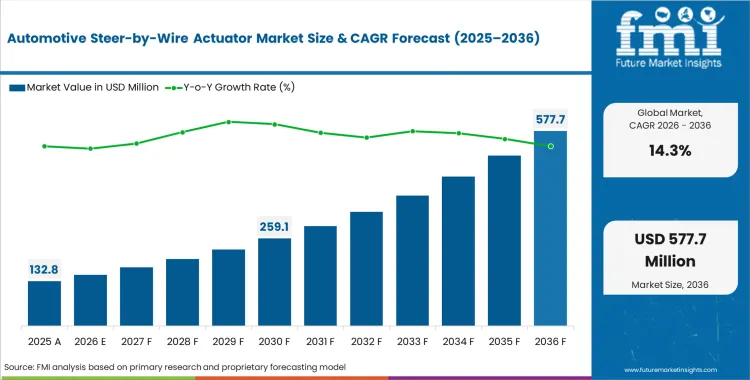
The automotive steer-by-wire actuator market accomplished USD 116.2 million in 2025. Industry revenue is projected to cross USD 132.8 million in 2026 at a CAGR of 14.3% during the forecast period. Persistent investment propels the market forecast to USD 505.5 million through 2036 as vehicle manufacturers remove mechanical steering columns to enable flat cabin floors and advanced autonomous driving features.
Summary of Automotive Steer-by-Wire Actuator Market
- The market is forecast to reach USD 505.5 million by 2036.
- The market is expected to grow at a CAGR of 14.3% from 2026 to 2036.
- The market was estimated at USD 116.2 million in 2025.
- The market is projected to generate an incremental opportunity of USD 372.6 million over the forecast period.
- Central rack motors lead by component type with a 44.0% share in 2026.
- Passenger cars dominate by vehicle type with an 82.0% share in 2026.
- Battery electric vehicles lead by propulsion type with a 68.0% share in 2026.
- OEM fitment leads by sales channel with a 93.0% share in 2026.
- Dual-channel systems dominate by system architecture with a 61.0% share in 2026.
- China is the fastest-growing market at 17.4%, followed by Japan at 14.9% and Germany at 14.6%.
- The market is driven by the shift toward fully electronic steering systems, regulatory approval for steer-by-wire vehicles, and increasing adoption in premium and electric vehicle platforms.
- Key companies in the market include major global automotive electronics and steering system suppliers focused on safety-critical system integration and regulatory compliance.
Car designers are building vehicle interiors around digital controls instead of physical steering columns. Such a change forces engineers to focus on software-driven steering motors rather than testing metal linkages. Delaying leaves older car brands unable to offer spacious cabin layouts or properly install self-driving software. Remote computer updates cannot fix a weak physical motor hidden inside an automotive steering assembly, turning it into an obstacle.
Once government agencies agree on clear safety rules across automotive steer-by-wire actuator markets, widespread use becomes guaranteed. Clear testing guidelines give major parts suppliers enough confidence to expand factory production, easily meeting demand for fail-safe steering components. Standardizing parts lowers manufacturing costs and speeds up deployment across everyday cars.
China anticipated to lead adoption at a projected 17.4% as local electric vehicle manufacturers aggressively implement digital chassis technologies. Japan likely to track closely at an estimated 14.9% on the back of established supplier investments in electronic control units. Germany seemingly follows at an expected 14.6% due to luxury vehicle makers shifting toward digital architectures. South Korea poised to expand at a predicted 14.2% driven by high-volume electric platform rollouts. United States demand set to grow at an assessed 13.3% as autonomous shuttle projects gain regulatory traction. United Kingdom adoption ready to increase at a forecasted 12.8% based on new vehicle safety mandates. France poised to round out the major regions at an estimated 12.4%, demonstrating how the steer-by-wire actuator CAGR varies heavily between regions favoring rapid tech deployment and those prioritizing extensive safety validation cycles.
Segmental Analysis
Automotive Steer-by-Wire Actuator Market Analysis by Component Type
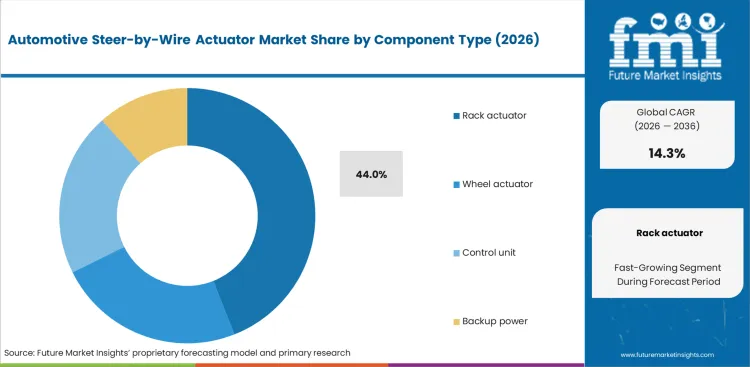
Automakers prefer simple drop-in replacements for traditional steering racks to keep initial production costs under control. Strong preference for minimal front-end redesign is expected to help the rack actuator segment account for an estimated 44.0% share in 2026 across global assembly lines. Chassis layouts remain easier to validate when manufacturers avoid changing core suspension mounting points. Replacing a standard hydraulic rack with a central digital unit also helps factories expand production within familiar manufacturing setups. Centralized motor designs still occupy space between the front wheels, which can limit some flat-floor packaging benefits associated with digital steering. Use of proven electric power steering motor formats continues to support dependable performance under sustained operating loads.
- • Mounting Point Compatibility: Central rack actuators fit within layouts already used for traditional steering systems. Chassis redesign pressure stays lower when front suspension subframe geometry can remain largely unchanged.
- • Hidden Packaging Constraints: Centralized motors continue to occupy space between the front wheels. Vehicle layouts must still accommodate cable routing and surrounding component placement carefully.
- • Lifecycle Cost Advantage: Use of standard rack geometries is expected to keep unit costs more manageable. Manufacturers can scale production more efficiently through existing tooling and established supplier setups.
Automotive Steer-by-Wire Actuator Market Analysis by Vehicle Type
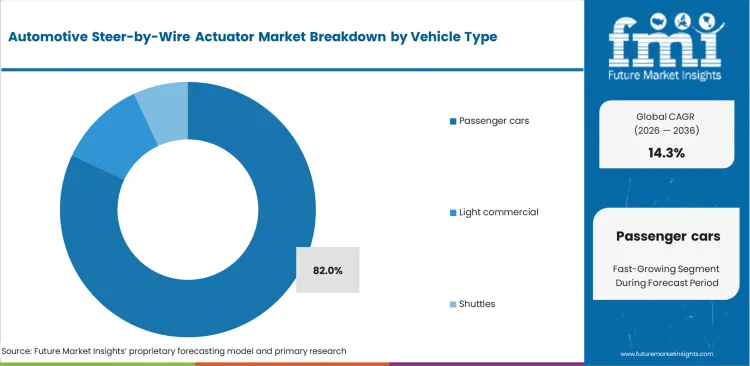
Luxury car makers use advanced steering features to justify high retail prices, meaning passenger cars are expected to hold an anticipated 82.0% share in 2026 as premium brands push to stand out. Adding a digital steering position sensor lets high-end sedans offer a heavy sports car feel on highways and effortless turning in crowded parking lots. Economy vehicles remain completely tied to mechanical steering columns because strict cost limits prevent adding expensive electronic backups. Failing to include retractable steering wheels inside expensive flagship models pushes buyers toward competing brands offering modern lounge-style interiors. High-end automotive brake actuation systems often develop right alongside these new electronic steering setups.
- Flagship Model Integration: Premium brands introduce digital steering in their highest-priced sedans first. Product planners use the technology as a marquee feature to attract early adopters.
- Software Tuning Capabilities: Digital control allows engineers to adjust steering weight instantly. Test drivers program multiple distinct driving profiles into a single vehicle chassis.
- Volume Segment Hesitation: Economy vehicles remain tied to mechanical steering columns due to strict cost limits. Cost engineers reject expensive redundant electronics for base-model commuter cars.
Automotive Steer-by-Wire Actuator Market Analysis by Propulsion
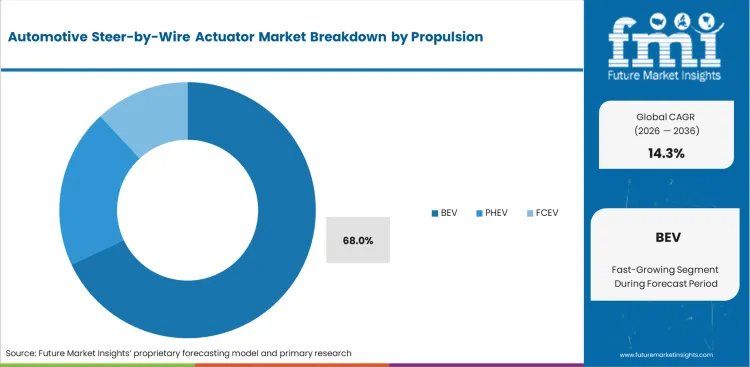
Pure electric platforms easily provide the massive electrical reserves required to turn heavy wheels without physical leverage. Standard gas-powered cars struggle to support digital steering because normal 12-volt alternators cannot handle sudden power spikes safely. High-voltage architectures naturally support the intense energy draw when an active stabilizer bar actuator or steering motor forces wheels to move at a standstill. Electrical engineers prefer working with existing large battery setups to avoid designing complex power converters, which is why BEVs are anticipated to capture a projected 68.0% market share in 2026 as digital chassis rollouts expand. Next-generation automotive electric drivetrain components make fitting these electronic steering units even easier.
- Voltage Capacity Alignment: Electric vehicles easily supply the brief 48-volt power spikes steering motors demand. Electrical systems engineers avoid complex power converter designs.
- Low-Speed Power Drain: Digital steering constantly consumes power to maintain wheel position during parking. Battery thermal operators must account for this continuous localized heat generation.
- Internal Combustion Incompatibility: Traditional 12-volt alternators struggle to power heavy digital steering racks safely. Powertrain integrators avoid deploying these systems on standard gas vehicles entirely.
Automotive Steer-by-Wire Actuator Market Analysis by Sales Channel
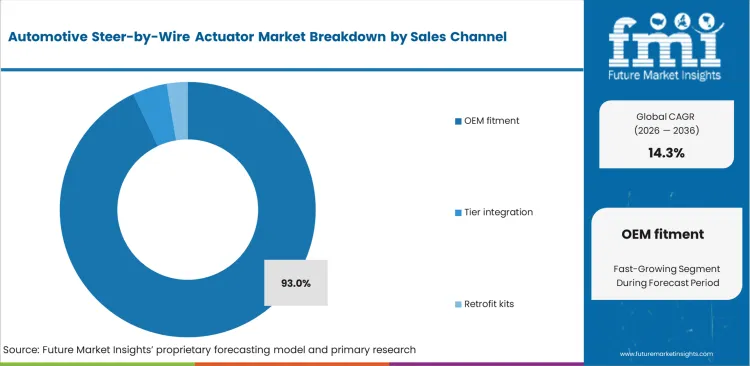
Factory assembly lines must integrate digital steering directly into the core safety networks of a car before it ever hits the road. Selling pre-calibrated systems directly to car builders explains why OEM fitment is poised to garner a 93.0% share in 2026 within the global supply chain. Aftermarket installations are virtually impossible because third-party mechanics lack the secret digital keys needed to program a replacement steering motor. Assembly software must communicate perfectly with braking computers and factory advanced driver assistance systems to function safely. Legal compliance groups absolutely refuse to let independent repair shops install unverified hardware that controls vehicle direction.
- Assembly Line Calibration: Digital steering units require complex software handshake protocols with main vehicle computers. Assembly line officers program the entire chassis network simultaneously.
- Aftermarket Service Lockouts: Independent mechanics cannot easily replace failed digital steering motors. Service technicians require proprietary OEM software tokens to validate new replacement parts.
- Liability Containment: Manufacturers restrict steering component sales to trusted tier-1 partners. Legal compliance officers refuse to allow unverified third-party hardware to control vehicle direction.
Automotive Steer-by-Wire Actuator Market Analysis by System Architecture
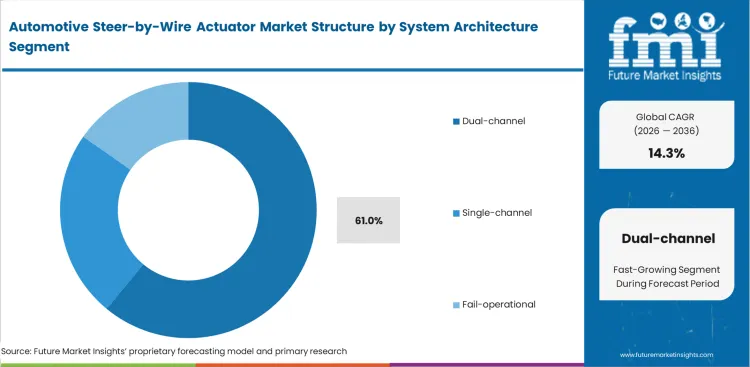
Passing strict government safety tests requires two completely separate electrical pathways inside the steering box. In 2026, dual-channel setups are set to represent 61.0% of market share because regulators demand full steering control even if one computer chip fails entirely. Squeezing twice the electronics into one small metal housing creates intense heat bottlenecks that engineers struggle to cool. Designing proper physical separation between the two wiring harnesses prevents a single crash impact from disabling both steering systems at once. Advanced battery electric vehicle (BEV) models rely completely on this dual-channel safety net to support future self-driving features.
- Regulatory Overlap: Safety certification officers demand two independent calculation pathways for steering commands. A single component failure must never result in loss of control.
- Thermal Density Challenges: Placing two high-performance microcontrollers in a sealed metal box generates intense heat. Component designers struggle to cool both chips evenly during operation.
- Common-Cause Failure Prevention: Engineers must route the dual wiring harnesses far apart from each other. Vehicle architects ensure a single physical impact cannot sever both communication lines simultaneously.
Automotive Steer-by-Wire Actuator Market Drivers, Restraints, and Opportunities
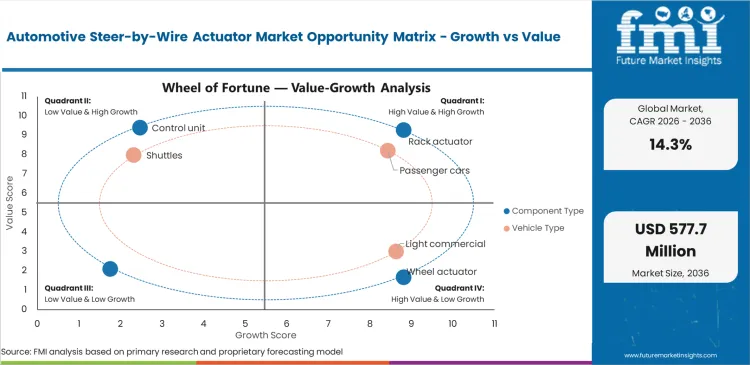
Car builders urgently need completely flat dashboards and retractable steering wheels. Removing bulky metal steering shafts gives interior designers complete freedom. Such design flexibility becomes commercially critical as brands compete to offer incredibly spacious cabins inside luxury electric vehicle (EV) lineups. Legacy auto companies delaying digital upgrades find interior designs limited by old hardware. Hesitation makes expensive flagship models look outdated against modern competitors pushing new steer-by-wire actuator market trends. Strict weight reduction targets also force vehicle architects to discard heavy hydraulic systems. Replacing heavy mechanical parts with lightweight electronic motors instantly improves overall battery range. Auto companies view digital steering as a necessary step to attract buyers who expect modern living-room style vehicle interiors.
Inconsistent safety testing standards across different countries actively slow global adoption. Regional transport authorities maintain varying requirements for fail-operational testing alongside backup power durations. Strict rules force compliance engineers to design distinct software and hardware variations across different global markets, destroying economies of scale. Even when a premium electric SUV proves technically capable under UNECE R79 steer-by-wire guidelines, legal departments block launches across regions lacking clear legal frameworks. Car manufacturers currently manage such roadblocks by running parallel production lines. Automakers build traditional steering racks for strict markets and digital variants for progressive areas. Maintaining two completely different steering architectures for one single vehicle model drains engineering resources and inflates final steer-by-wire actuator price per vehicle.
- Commercial Fleet Upgrades: Delivery companies want self-driving yard trucks to move cargo without human drivers. Equipment makers secure long-term contracts by building heavy-duty digital steering units capable of surviving constant commercial use.
- Standardized Testing Services: Government safety agencies require advanced computer simulations to verify how electronic steering reacts during an emergency. Independent testing firms generate steady revenue by selling certified safety validation programs to part suppliers entering USA X-by-Wire markets.
- Separate Software Sales: Physical motor builders now split steering computer code away from actual metal hardware. Such separation lets automotive steer-by-wire actuator manufacturers sell remote software updates directly to car owners without replacing physical parts.
Regional Analysis
Automakers across different countries are approaching digital steering at varying speeds depending on local safety rules and technology readiness. Local manufacturing strength and government testing approvals dictate how fast these electronic actuators replace mechanical steering columns worldwide.
.webp "Top Country Growth Comparison Automotive Steer By Wire Actuator Market Cagr (2026 2036)")
| Country | CAGR (2026 to 2036) |
|---|---|
| China | 17.4% |
| Japan | 14.9% |
| Germany | 14.6% |
| South Korea | 14.2% |
| United States | 13.3% |
| United Kingdom | 12.8% |
| France | 12.4% |
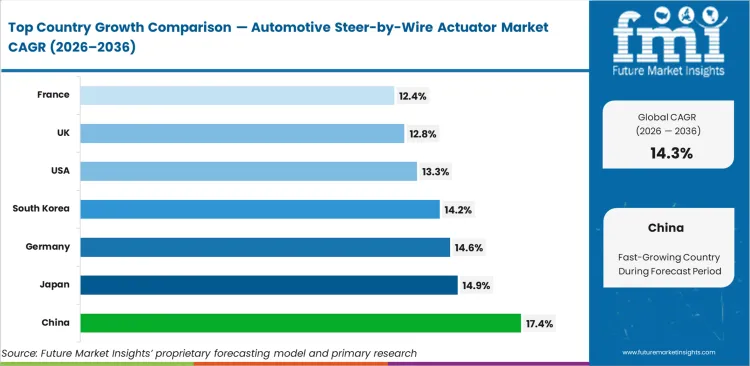
Source: Future Market Insights (FMI) analysis, based on proprietary forecasting model and primary research
Asia-Pacific Automotive Steer-by-Wire Actuator Market Analysis
Car builders across Asia treat digital chassis parts as vital upgrades for new electric models rather than experimental add-ons. Having a strong local supply chain allows factories to build these complex electronic control units quickly and at scale.
- China: Demand across the China steer-by-wire actuator is anticipated to rise at a forecasted CAGR of 17.4% through 2036 as domestic electric vehicle startups integrate advanced automated parking. Removing physical steering parts gives local designers the freedom to create spacious cabins that pull buyers away from older traditional brands.
- Japan: Demand for steer-by-wire actuators in Japan is projected to expand at a CAGR of 14.9% during 2026 to 2036, supported by the country’s strong base in electronic component manufacturing. Development activity remains centered on fail-safe x-by-wire control systems, which strengthens Japan’s position in high-value actuator production. This technical depth is expected to support export-oriented manufacturing across advanced vehicle platforms.
- South Korea: High-volume automotive companies here prioritize building modular electric platforms equipped with standardized digital steering interfaces. South Korea is projected to witness 14.2% CAGR in steer-by-wire component sales through 2036. Achieving high production numbers on these parts dramatically lowers the entry cost for everyday electric cars.
Per FMI’s assessments, expanding localized manufacturing across the broader ASEAN X-by-Wire network ensures specialized steering electronics become standard equipment rather than luxury options. Report also includes India and ASEAN countries.
Europe Automotive Steer-by-Wire Actuator Market Analysis
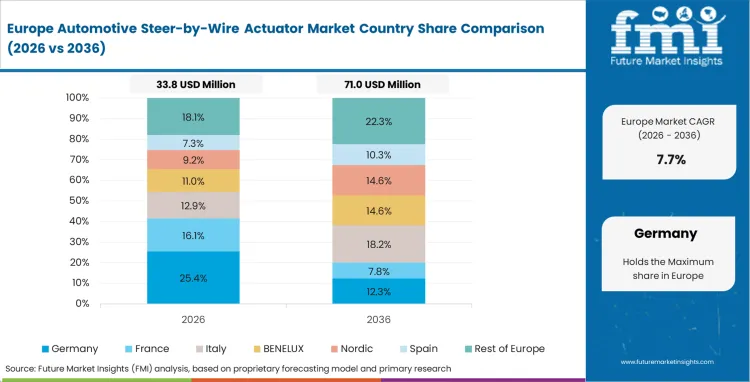
Strict safety testing and a historical focus on luxury car engineering dictate how fast digital steering spreads across this continent. Engineers spend years proving redundant power systems will not fail before gaining permission to sell vehicles without a physical steering shaft.
- Germany: Premium car brands rely on digital steering to improve high-speed stability, positioning the Germany steer-by-wire actuator market to expand at a projected CAGR of 14.6% through 2036. Local engineers working on Germany X-by-Wire setups use this technology to maintain a technological edge in their flagship electric sedans.
- United Kingdom: Active safety mandates push research facilities to develop rigorous testing protocols for cars lacking mechanical connections. Digital steering adoption across the United Kingdom is likely expected to move ahead at an anticipated CAGR of 12.8% through 2036. Specialized certification centers generate fresh revenue by helping global steering makers prove their systems are safe for public roads.
- France: Steer-by-wire actuator demand in France is projected to rise at a CAGR of 12.4% during 2026 to 2036, supported by the country’s focus on cost-efficient solutions for compact electric city cars. System standardization is expected to help manufacturers simplify assembly processes and reduce excess weight in smaller vehicle platforms.
FMI's report includes Italy, Spain, and the Nordics. Upgrading factory lines to handle high-voltage electrical systems gives European carmakers the necessary foundation to install advanced steering electronics safely.
North America & Latin America Automotive Steer-by-Wire Actuator Market Analysis
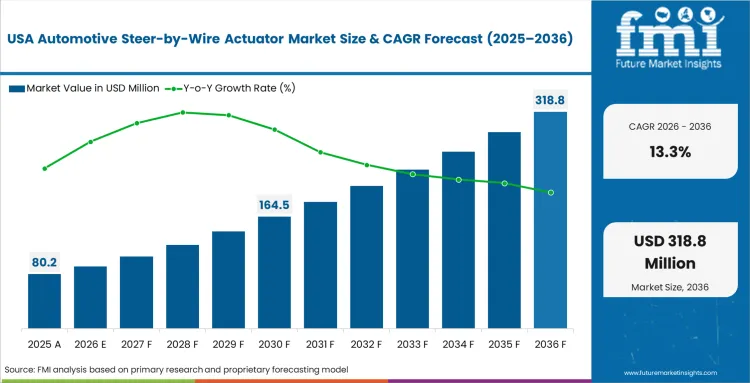
Massive spending on self-driving technology and commercial shuttle fleets drives the need for advanced digital steering across this region. Technology firms building autonomous software require true electronic steering connections to execute exact maneuvers without human input.
- United States: Autonomous robotaxi fleet operators mandate true digital control over vehicle turns, garnering the USA X-by-Wire sector to register an anticipated CAGR of 13.3% through 2036. Securing supply contracts for these commercial fleets guarantees steady, long-term revenue for specialized motor manufacturers.
FMI analyses, cross-border auto parts suppliers are gradually updating their production machinery to build advanced electronic steering components alongside traditional hardware. Report includes Canada, Mexico, and Brazil.
Competitive Aligners for Market Players
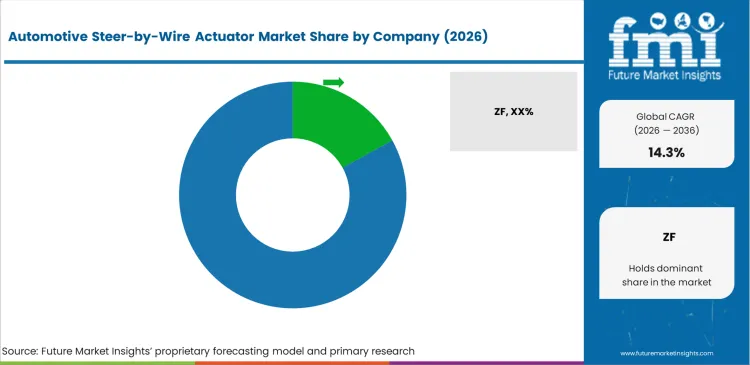
Proving safety without a mechanical backup remains one of the biggest competitive demands in this market. Suppliers are judged less by raw steering force and more by how reliably their control software performs under fault conditions. Building a digital steering rack is not the hardest part. Earning confidence in the electronic control unit requires long validation cycles, deep testing capability, and substantial financial commitment. That burden continues to keep smaller electrical component makers from becoming trusted steer-by-wire actuator suppliers.
Established automotive parts manufacturers hold an advantage because they already have years of validated safety data. Vehicle manufacturers place heavy weight on prior testing records, compliance readiness, and stable performance under sudden power loss or signal disruption. New entrants face a far steeper qualification path because proving electronic steering reliability takes time, capital, and repeated system validation. Accurate sensor integration also remains essential, since safe steering response depends on precise signal handling across the wider steer-by-wire actuator market.
Vehicle manufacturers are also pushing back against dependence on a single software source. Preference is shifting toward hardware that can support greater software flexibility at vehicle platform level. Component makers now have to decide whether to supply a closed, fully integrated system or provide hardware that can run custom vehicle-level code. This separation between physical steering hardware and control software is becoming more common as manufacturers seek tighter control over platform development and long-term sourcing flexibility.
Key Players in Automotive Steer-by-Wire Actuator Market
- ZF
- Robert Bosch
- JTEKT
- Nexteer Automotive
- thyssenkrupp Steering
- HL Mando
Scope of the Report
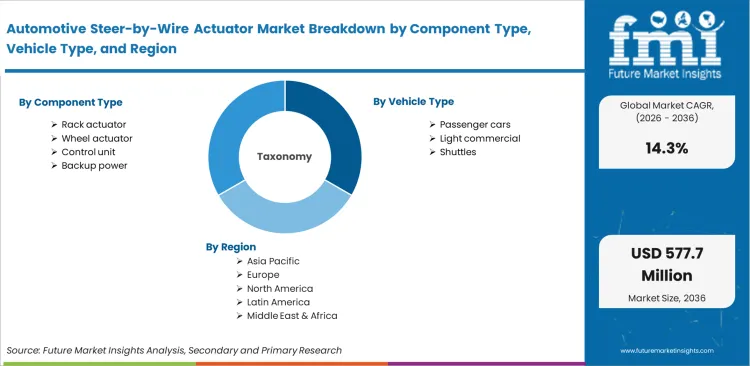
| Metric | Value |
|---|---|
| Quantitative Units | USD 132.8 million to USD 505.5 million, at a CAGR of 14.3% |
| Market Definition | This sector covers electromechanical devices that physically turn vehicle wheels based entirely on digital signals from a steering wheel or autonomous driving computer. |
| Segmentation | Component Type, Vehicle Type, Propulsion, Sales Channel, System Architecture |
| Regions Covered | Asia-Pacific, Europe, North America & Latin America, Middle East & Africa |
| Countries Covered | China, Japan, Germany, South Korea, United States, United Kingdom, France |
| Key Companies Profiled | ZF, Robert Bosch, JTEKT, Nexteer Automotive, thyssenkrupp Steering, HL Mando |
| Forecast Period | 2026 to 2036 |
| Approach | Annual vehicle production volumes combined with specific platform steering architecture transition schedules |
Source: Future Market Insights (FMI) analysis, based on proprietary forecasting model and primary research
Segments
Component Type
- Rack actuator
- Wheel actuator
- Control unit
- Backup power
Vehicle Type
- Passenger cars
- Light commercial
- Shuttles
Propulsion
- BEV
- PHEV
- FCEV
Sales Channel
- OEM fitment
- Tier integration
- Retrofit kits
System Architecture
- Dual-channel
- Single-channel
- Fail-operational
Regions
- Asia Pacific
- India
- China
- Japan
- South Korea
- Indonesia
- Australia
- New Zealand
- ASEAN
- Rest of Asia Pacific
- Europe
- Germany
- Italy
- France
- United Kingdom
- Spain
- Benelux
- Nordics
- Central & Eastern Europe
- Rest of Europe
- North America
- United States
- Canada
- Mexico
- Latin America
- Brazil
- Argentina
- Chile
- Rest of Latin America
- Middle East & Africa
- Kingdom of Saudi Arabia
- United Arab Emirates
- South Africa
- Turkey
- Rest of Middle East & Africa
Bibliography
- United Nations Economic Commission for Europe. (2024). Supplement 11 to the 03 series of amendments to UN Regulation No. 79 (Steering equipment).
- United Nations Economic Commission for Europe. (2024). Proposal for Supplement 7 to the 04 series of amendments to UN Regulation No. 79 (Steering equipment).
- Chung, I., Choi, J., & Nam, K. (2024). Modeling and control of a road wheel actuation module in steer-by-wire system. Actuators, 13(8), 311.
- Yin, H., Wang, Z., Liu, J., et al. (2024). Steer-by-wire control algorithm using a dual-layer closed-loop model. Scientific Reports, 14, 28536.
- Zhang, H., Jiang, W., Zhao, W., et al. (2024). Tracking and fault-tolerant controller design for uncertain steer-by-wire systems using model predictive control. Chinese Journal of Mechanical Engineering, 37, 141.
- Niegl, M., Hendewerk, J., Becker, M., Battlogg, S., & Pfeffer, P. (2024). Enhancing steer-by-wire systems with an integrated E-motor and MR-brake actuator, Feedback control strategy. In G. Mastinu, F. Braghin, F. Cheli, M. Corno, & S. M. Savaresi (Eds.), 16th International Symposium on Advanced Vehicle Control. AVEC 2024. Lecture Notes in Mechanical Engineering. Springer.
This bibliography is provided for reader reference. The full FMI report contains the complete reference list with primary source documentation.
This Report Addresses
- Identifies why rack actuators maintain dominance in early transition phases.
- Examines the impact of autonomous vehicle software on dual-channel control unit requirements.
- Details the steer-by-wire actuator sourcing checklist for OEM component buyers.
- Explains the homologation differences between Asian and European regulatory authorities.
- Analyzes the structural advantage of pure battery electric platforms for high-voltage steering systems.
- Unpacks the competitive tension between tier-1 hardware suppliers and OEM software engineers.
- Highlights the aftermarket service limitations created by encrypted digital steering calibrations.
- Tracks the rapid adoption of fail-operational systems in China compared to other major regions.
Frequently Asked Questions
What is an automotive steer-by-wire actuator?
It is an electromechanical device that replaces a physical steering column, turning the wheels entirely based on digital electronic signals.
How large is the automotive steer-by-wire actuator market in 2025, 2026, and 2036?
The industry was valued at USD 116.2 million in 2025, is expected to reach USD 132.8 million in 2026, and will expand to USD 505.5 million by 2036.
Which companies are active in steer-by-wire actuators right now?
Major tier-1 suppliers including ZF, Robert Bosch, JTEKT, Nexteer Automotive, thyssenkrupp Steering, and HL Mando currently develop and manufacture these systems.
Why are premium EVs adopting steer-by-wire first?
Luxury automakers use this technology to justify higher vehicle prices while offering cutting-edge features like retractable steering wheels and variable driving ratios.
What does UNECE R79 mean for steer-by-wire commercialization?
This regulatory framework establishes the mandatory safety testing and backup power redundancy required to legally sell digital steering systems without mechanical linkages.
Which countries lead steer-by-wire actuator demand?
China likely to expand at an industry-leading CAGR of an expected 17.4%, seemingly followed closely by Japan at a projected 14.9% and Germany at 14.6%.
How does steer-by-wire differ from conventional electric power steering?
Steer-by-wire actuator vs electric power steering comes down to the complete removal of the physical metal shaft connecting the driver's hands to the road wheels.
Why do steer-by-wire systems need dual-channel redundancy and backup power?
Regulatory agencies require two completely separate electrical pathways so that the vehicle retains full steering control even if one microcontroller or power supply fails entirely.
What is the role of the rack actuator in a true steer-by-wire system?
The central rack motor physically pushes and pulls the wheel tie rods, easily mounting into the same suspension space previously occupied by a traditional hydraulic rack.
When could steer-by-wire move beyond premium launches into wider vehicle segments?
Adoption will eventually reach economy vehicles once dual-channel electronic control units become cheap enough to integrate into low-margin commuter car platforms.
How big is the steer-by-wire actuator market expected to grow annually?
The global demand is poised to expand at a steady CAGR of an estimated 14.3% throughout the ten-year forecast period.
What creates the biggest thermal challenge inside the steering motor housing?
Packing two high-performance microcontrollers into a single sealed metal box to meet redundancy requirements generates intense localized heat that engineers must actively cool.
Why do heavy commercial delivery trucks avoid this technology initially?
Fleet operators prioritize extreme mechanical durability and low maintenance costs over the interior design benefits that digital steering provides.
Which vehicle propulsion architecture is best suited for this equipment?
Battery electric vehicles poised to capture an anticipated 68.0% share in 2026 because their high-voltage systems easily supply the brief power spikes needed to turn heavy wheels at a standstill.
Can local mechanics repair a broken steer-by-wire motor?
Independent repair shops cannot easily service these parts because replacement motors require proprietary cryptographic software keys from the original automaker.
How do autonomous shuttle fleets utilize digital steering?
Robotaxi developers rely on these actuators because self-driving algorithms require precise, rapid wheel adjustments that are difficult to achieve through traditional mechanical columns.
What advantage do established suppliers have over new hardware startups?
Legacy steering manufacturers possess massive libraries of certified safety homologation data that prove their software can survive extreme voltage fluctuations and single-point failures.
Why do automakers want hardware-agnostic steering systems?
Vehicle manufacturers want the flexibility to run their own proprietary driving software on physical motors supplied by any qualified tier-1 manufacturer.
How does digital steering impact a vehicle's driving range?
The constant micro-corrections required to hold the wheels steady during parking create a continuous low-level power drain on the main drive battery.
Do these steering actuators require a traditional 12-volt battery?
Engineers must bypass standard 12-volt alternators because they cannot reliably generate the power necessary to operate heavy digital steering racks safely.
What prevents third-party suppliers from selling aftermarket steering conversion kits?
Massive liability concerns and strict factory software lockouts make it virtually impossible to sell unverified digital steering hardware directly to consumers.
Why is Japan a major hub for this technology's development?
Established Japanese tier-1 suppliers dominate the intellectual property surrounding the highly reliable dual-channel electronic control units required for safe operation.
Preview the report firsthand - request a free sample
Get SampleGet the brochure for pricing and purchase details.
Get PDFTable of Content
- Executive Summary
- Global Market Outlook
- Demand-side Trends
- Supply-side Trends
- Technology Roadmap Analysis
- Analysis and Recommendations
- Market Overview
- Market Coverage / Taxonomy
- Market Definition / Scope / Limitations
- Research Methodology
- Chapter Orientation
- Analytical Lens and Working Hypotheses
- Market Structure, Signals, and Trend Drivers
- Benchmarking and Cross-market Comparability
- Market Sizing, Forecasting, and Opportunity Mapping
- Research Design and Evidence Framework
- Desk Research Programme (Secondary Evidence)
- Company Annual and Sustainability Reports
- Peer-reviewed Journals and Academic Literature
- Corporate Websites, Product Literature, and Technical Notes
- Earnings Decks and Investor Briefings
- Statutory Filings and Regulatory Disclosures
- Technical White Papers and Standards Notes
- Trade Journals, Industry Magazines, and Analyst Briefs
- Conference Proceedings, Webinars, and Seminar Materials
- Government Statistics Portals and Public Data Releases
- Press Releases and Reputable Media Coverage
- Specialist Newsletters and Curated Briefings
- Sector Databases and Reference Repositories
- FMI Internal Proprietary Databases and Historical Market Datasets
- Subscription Datasets and Paid Sources
- Social Channels, Communities, and Digital Listening Inputs
- Additional Desk Sources
- Expert Input and Fieldwork (Primary Evidence)
- Primary Modes
- Qualitative Interviews and Expert Elicitation
- Quantitative Surveys and Structured Data Capture
- Blended Approach
- Why Primary Evidence is Used
- Field Techniques
- Interviews
- Surveys
- Focus Groups
- Observational and In-context Research
- Social and Community Interactions
- Stakeholder Universe Engaged
- C-suite Leaders
- Board Members
- Presidents and Vice Presidents
- R&D and Innovation Heads
- Technical Specialists
- Domain Subject-matter Experts
- Scientists
- Physicians and Other Healthcare Professionals
- Governance, Ethics, and Data Stewardship
- Research Ethics
- Data Integrity and Handling
- Primary Modes
- Tooling, Models, and Reference Databases
- Desk Research Programme (Secondary Evidence)
- Data Engineering and Model Build
- Data Acquisition and Ingestion
- Cleaning, Normalisation, and Verification
- Synthesis, Triangulation, and Analysis
- Quality Assurance and Audit Trail
- Market Background
- Market Dynamics
- Drivers
- Restraints
- Opportunity
- Trends
- Scenario Forecast
- Demand in Optimistic Scenario
- Demand in Likely Scenario
- Demand in Conservative Scenario
- Opportunity Map Analysis
- Product Life Cycle Analysis
- Supply Chain Analysis
- Investment Feasibility Matrix
- Value Chain Analysis
- PESTLE and Porter’s Analysis
- Regulatory Landscape
- Regional Parent Market Outlook
- Production and Consumption Statistics
- Import and Export Statistics
- Market Dynamics
- Global Market Analysis 2021 to 2025 and Forecast, 2026 to 2036
- Historical Market Size Value (USD Million) Analysis, 2021 to 2025
- Current and Future Market Size Value (USD Million) Projections, 2026 to 2036
- Y-o-Y Growth Trend Analysis
- Absolute $ Opportunity Analysis
- Global Market Pricing Analysis 2021 to 2025 and Forecast 2026 to 2036
- Global Market Analysis 2021 to 2025 and Forecast 2026 to 2036, By Component Type
- Introduction / Key Findings
- Historical Market Size Value (USD Million) Analysis By Component Type , 2021 to 2025
- Current and Future Market Size Value (USD Million) Analysis and Forecast By Component Type , 2026 to 2036
- Rack actuator
- Wheel actuator
- Control unit
- Backup power
- Rack actuator
- Y-o-Y Growth Trend Analysis By Component Type , 2021 to 2025
- Absolute $ Opportunity Analysis By Component Type , 2026 to 2036
- Global Market Analysis 2021 to 2025 and Forecast 2026 to 2036, By Vehicle Type
- Introduction / Key Findings
- Historical Market Size Value (USD Million) Analysis By Vehicle Type, 2021 to 2025
- Current and Future Market Size Value (USD Million) Analysis and Forecast By Vehicle Type, 2026 to 2036
- Passenger cars
- Light commercial
- Shuttles
- Passenger cars
- Y-o-Y Growth Trend Analysis By Vehicle Type, 2021 to 2025
- Absolute $ Opportunity Analysis By Vehicle Type, 2026 to 2036
- Global Market Analysis 2021 to 2025 and Forecast 2026 to 2036, By Propulsion
- Introduction / Key Findings
- Historical Market Size Value (USD Million) Analysis By Propulsion, 2021 to 2025
- Current and Future Market Size Value (USD Million) Analysis and Forecast By Propulsion, 2026 to 2036
- BEV
- PHEV
- FCEV
- BEV
- Y-o-Y Growth Trend Analysis By Propulsion, 2021 to 2025
- Absolute $ Opportunity Analysis By Propulsion, 2026 to 2036
- Global Market Analysis 2021 to 2025 and Forecast 2026 to 2036, By Sales Channel
- Introduction / Key Findings
- Historical Market Size Value (USD Million) Analysis By Sales Channel, 2021 to 2025
- Current and Future Market Size Value (USD Million) Analysis and Forecast By Sales Channel, 2026 to 2036
- OEM fitment
- Tier integration
- Retrofit kits
- OEM fitment
- Y-o-Y Growth Trend Analysis By Sales Channel, 2021 to 2025
- Absolute $ Opportunity Analysis By Sales Channel, 2026 to 2036
- Global Market Analysis 2021 to 2025 and Forecast 2026 to 2036, By System Architecture
- Introduction / Key Findings
- Historical Market Size Value (USD Million) Analysis By System Architecture, 2021 to 2025
- Current and Future Market Size Value (USD Million) Analysis and Forecast By System Architecture, 2026 to 2036
- Dual-channel
- Single-channel
- Fail-operational
- Dual-channel
- Y-o-Y Growth Trend Analysis By System Architecture, 2021 to 2025
- Absolute $ Opportunity Analysis By System Architecture, 2026 to 2036
- Global Market Analysis 2021 to 2025 and Forecast 2026 to 2036, By Region
- Introduction
- Historical Market Size Value (USD Million) Analysis By Region, 2021 to 2025
- Current Market Size Value (USD Million) Analysis and Forecast By Region, 2026 to 2036
- North America
- Latin America
- Western Europe
- Eastern Europe
- East Asia
- South Asia and Pacific
- Middle East & Africa
- Market Attractiveness Analysis By Region
- North America Market Analysis 2021 to 2025 and Forecast 2026 to 2036, By Country
- Historical Market Size Value (USD Million) Trend Analysis By Market Taxonomy, 2021 to 2025
- Market Size Value (USD Million) Forecast By Market Taxonomy, 2026 to 2036
- By Country
- USA
- Canada
- Mexico
- By Component Type
- By Vehicle Type
- By Propulsion
- By Sales Channel
- By System Architecture
- By Country
- Market Attractiveness Analysis
- By Country
- By Component Type
- By Vehicle Type
- By Propulsion
- By Sales Channel
- By System Architecture
- Key Takeaways
- Latin America Market Analysis 2021 to 2025 and Forecast 2026 to 2036, By Country
- Historical Market Size Value (USD Million) Trend Analysis By Market Taxonomy, 2021 to 2025
- Market Size Value (USD Million) Forecast By Market Taxonomy, 2026 to 2036
- By Country
- Brazil
- Chile
- Rest of Latin America
- By Component Type
- By Vehicle Type
- By Propulsion
- By Sales Channel
- By System Architecture
- By Country
- Market Attractiveness Analysis
- By Country
- By Component Type
- By Vehicle Type
- By Propulsion
- By Sales Channel
- By System Architecture
- Key Takeaways
- Western Europe Market Analysis 2021 to 2025 and Forecast 2026 to 2036, By Country
- Historical Market Size Value (USD Million) Trend Analysis By Market Taxonomy, 2021 to 2025
- Market Size Value (USD Million) Forecast By Market Taxonomy, 2026 to 2036
- By Country
- Germany
- UK
- Italy
- Spain
- France
- Nordic
- BENELUX
- Rest of Western Europe
- By Component Type
- By Vehicle Type
- By Propulsion
- By Sales Channel
- By System Architecture
- By Country
- Market Attractiveness Analysis
- By Country
- By Component Type
- By Vehicle Type
- By Propulsion
- By Sales Channel
- By System Architecture
- Key Takeaways
- Eastern Europe Market Analysis 2021 to 2025 and Forecast 2026 to 2036, By Country
- Historical Market Size Value (USD Million) Trend Analysis By Market Taxonomy, 2021 to 2025
- Market Size Value (USD Million) Forecast By Market Taxonomy, 2026 to 2036
- By Country
- Russia
- Poland
- Hungary
- Balkan & Baltic
- Rest of Eastern Europe
- By Component Type
- By Vehicle Type
- By Propulsion
- By Sales Channel
- By System Architecture
- By Country
- Market Attractiveness Analysis
- By Country
- By Component Type
- By Vehicle Type
- By Propulsion
- By Sales Channel
- By System Architecture
- Key Takeaways
- East Asia Market Analysis 2021 to 2025 and Forecast 2026 to 2036, By Country
- Historical Market Size Value (USD Million) Trend Analysis By Market Taxonomy, 2021 to 2025
- Market Size Value (USD Million) Forecast By Market Taxonomy, 2026 to 2036
- By Country
- China
- Japan
- South Korea
- By Component Type
- By Vehicle Type
- By Propulsion
- By Sales Channel
- By System Architecture
- By Country
- Market Attractiveness Analysis
- By Country
- By Component Type
- By Vehicle Type
- By Propulsion
- By Sales Channel
- By System Architecture
- Key Takeaways
- South Asia and Pacific Market Analysis 2021 to 2025 and Forecast 2026 to 2036, By Country
- Historical Market Size Value (USD Million) Trend Analysis By Market Taxonomy, 2021 to 2025
- Market Size Value (USD Million) Forecast By Market Taxonomy, 2026 to 2036
- By Country
- India
- ASEAN
- Australia & New Zealand
- Rest of South Asia and Pacific
- By Component Type
- By Vehicle Type
- By Propulsion
- By Sales Channel
- By System Architecture
- By Country
- Market Attractiveness Analysis
- By Country
- By Component Type
- By Vehicle Type
- By Propulsion
- By Sales Channel
- By System Architecture
- Key Takeaways
- Middle East & Africa Market Analysis 2021 to 2025 and Forecast 2026 to 2036, By Country
- Historical Market Size Value (USD Million) Trend Analysis By Market Taxonomy, 2021 to 2025
- Market Size Value (USD Million) Forecast By Market Taxonomy, 2026 to 2036
- By Country
- Kingdom of Saudi Arabia
- Other GCC Countries
- Turkiye
- South Africa
- Other African Union
- Rest of Middle East & Africa
- By Component Type
- By Vehicle Type
- By Propulsion
- By Sales Channel
- By System Architecture
- By Country
- Market Attractiveness Analysis
- By Country
- By Component Type
- By Vehicle Type
- By Propulsion
- By Sales Channel
- By System Architecture
- Key Takeaways
- Key Countries Market Analysis
- USA
- Pricing Analysis
- Market Share Analysis, 2025
- By Component Type
- By Vehicle Type
- By Propulsion
- By Sales Channel
- By System Architecture
- Canada
- Pricing Analysis
- Market Share Analysis, 2025
- By Component Type
- By Vehicle Type
- By Propulsion
- By Sales Channel
- By System Architecture
- Mexico
- Pricing Analysis
- Market Share Analysis, 2025
- By Component Type
- By Vehicle Type
- By Propulsion
- By Sales Channel
- By System Architecture
- Brazil
- Pricing Analysis
- Market Share Analysis, 2025
- By Component Type
- By Vehicle Type
- By Propulsion
- By Sales Channel
- By System Architecture
- Chile
- Pricing Analysis
- Market Share Analysis, 2025
- By Component Type
- By Vehicle Type
- By Propulsion
- By Sales Channel
- By System Architecture
- Germany
- Pricing Analysis
- Market Share Analysis, 2025
- By Component Type
- By Vehicle Type
- By Propulsion
- By Sales Channel
- By System Architecture
- UK
- Pricing Analysis
- Market Share Analysis, 2025
- By Component Type
- By Vehicle Type
- By Propulsion
- By Sales Channel
- By System Architecture
- Italy
- Pricing Analysis
- Market Share Analysis, 2025
- By Component Type
- By Vehicle Type
- By Propulsion
- By Sales Channel
- By System Architecture
- Spain
- Pricing Analysis
- Market Share Analysis, 2025
- By Component Type
- By Vehicle Type
- By Propulsion
- By Sales Channel
- By System Architecture
- France
- Pricing Analysis
- Market Share Analysis, 2025
- By Component Type
- By Vehicle Type
- By Propulsion
- By Sales Channel
- By System Architecture
- India
- Pricing Analysis
- Market Share Analysis, 2025
- By Component Type
- By Vehicle Type
- By Propulsion
- By Sales Channel
- By System Architecture
- ASEAN
- Pricing Analysis
- Market Share Analysis, 2025
- By Component Type
- By Vehicle Type
- By Propulsion
- By Sales Channel
- By System Architecture
- Australia & New Zealand
- Pricing Analysis
- Market Share Analysis, 2025
- By Component Type
- By Vehicle Type
- By Propulsion
- By Sales Channel
- By System Architecture
- China
- Pricing Analysis
- Market Share Analysis, 2025
- By Component Type
- By Vehicle Type
- By Propulsion
- By Sales Channel
- By System Architecture
- Japan
- Pricing Analysis
- Market Share Analysis, 2025
- By Component Type
- By Vehicle Type
- By Propulsion
- By Sales Channel
- By System Architecture
- South Korea
- Pricing Analysis
- Market Share Analysis, 2025
- By Component Type
- By Vehicle Type
- By Propulsion
- By Sales Channel
- By System Architecture
- Russia
- Pricing Analysis
- Market Share Analysis, 2025
- By Component Type
- By Vehicle Type
- By Propulsion
- By Sales Channel
- By System Architecture
- Poland
- Pricing Analysis
- Market Share Analysis, 2025
- By Component Type
- By Vehicle Type
- By Propulsion
- By Sales Channel
- By System Architecture
- Hungary
- Pricing Analysis
- Market Share Analysis, 2025
- By Component Type
- By Vehicle Type
- By Propulsion
- By Sales Channel
- By System Architecture
- Kingdom of Saudi Arabia
- Pricing Analysis
- Market Share Analysis, 2025
- By Component Type
- By Vehicle Type
- By Propulsion
- By Sales Channel
- By System Architecture
- Turkiye
- Pricing Analysis
- Market Share Analysis, 2025
- By Component Type
- By Vehicle Type
- By Propulsion
- By Sales Channel
- By System Architecture
- South Africa
- Pricing Analysis
- Market Share Analysis, 2025
- By Component Type
- By Vehicle Type
- By Propulsion
- By Sales Channel
- By System Architecture
- USA
- Market Structure Analysis
- Competition Dashboard
- Competition Benchmarking
- Market Share Analysis of Top Players
- By Region
- By Component Type
- By Vehicle Type
- By Propulsion
- By Sales Channel
- By System Architecture
- Competition Analysis
- Competition Deep Dive
- ZF
- Overview
- Product Portfolio
- Profitability by Market Segments (Product/Age /Sales Channel/Region)
- Sales Footprint
- Strategy Overview
- Marketing Strategy
- Product Strategy
- Channel Strategy
- Robert Bosch
- JTEKT
- Nexteer Automotive
- thyssenkrupp Steering
- HL Mando
- ZF
- Competition Deep Dive
- Assumptions & Acronyms Used


