

- Industry Size (2026)
- USD 53.4 Mn
- Forecast (2036)
- USD 148.9 Mn
- CAGR (2026 to 2036)
- 10.8%
Automotive E-Axle Disconnect Actuator Market Size, Market Forecast and Outlook By FMI
The automotive e-axle disconnect actuator market crossed a valuation of USD 48.2 million in 2025. FMI estimates the market will reach USD 53.4 million in 2026 and rise to USD 148.9 million by 2036, reflecting a 10.8% CAGR over the forecast period. Expansion is being supported by automakers looking beyond battery chemistry gains and using mechanical drag-reduction systems to improve highway efficiency in dual-motor electric vehicles.
Summary of Automotive E-Axle Disconnect Actuator Market
- The market is forecast to reach USD 148.9 million by 2036.
- The market is expected to grow at a CAGR of 10.8% from 2026 to 2036.
- The market was estimated at USD 48.2 million in 2025.
- The market is projected to generate an incremental opportunity of USD 95.5 million over the forecast period.
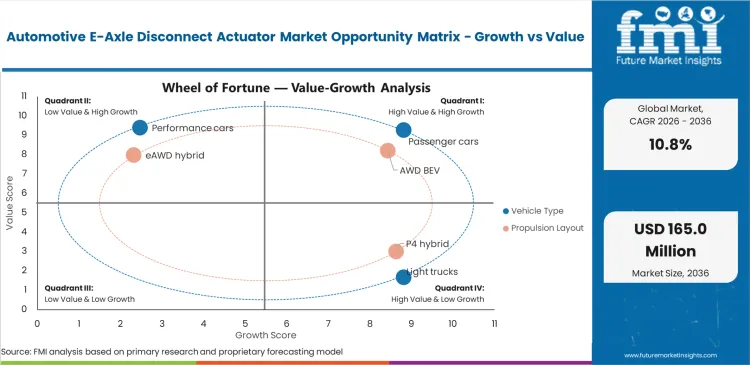
- Passenger cars lead by vehicle type with a 72.0% share.
- AWD BEV dominates by propulsion layout with a 56.0% share.
- Linear actuators lead by actuator type with a 46.0% share.
- Transmission-integrated systems dominate by integration type with a 61.0% share.
- OEM fitment leads by sales channel with an 88.0% share.
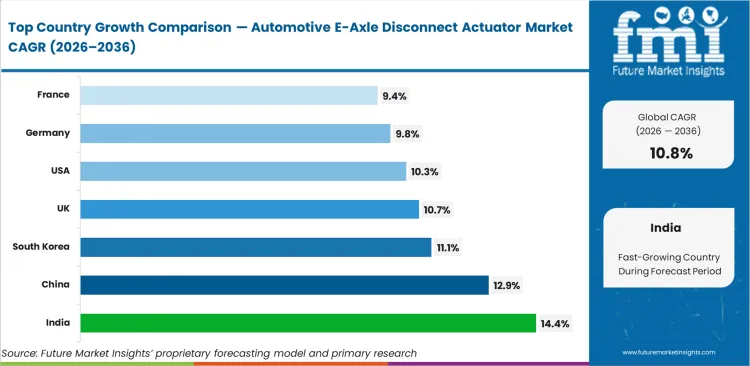
- India is the fastest-growing market at 14.4%, followed by China at 12.9% and South Korea at 11.1%.
- The market is driven by rising EV adoption, the need to reduce secondary axle drag in AWD systems, and increasing integration of disconnect mechanisms within compact electric drivetrains.
- Key companies in the market include Schaeffler AG, Valeo, GKN Automotive, Dana Incorporated, BorgWarner Inc., and HILITE International.
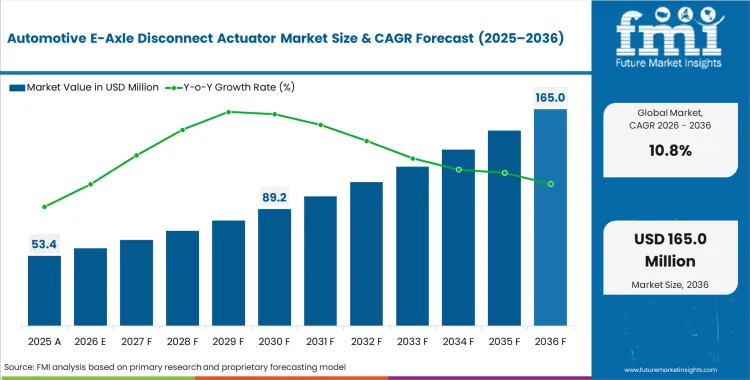
Automakers face tighter limits on battery weight and packaging, which is increasing the need to decouple the secondary automotive axle during steady cruising conditions. This reduces parasitic drag and helps extend range without increasing battery size. Delayed adoption can weaken vehicle efficiency performance under WLTP test cycles, especially in dual-motor layouts where permanent drivetrain engagement adds avoidable losses. Engagement speed is becoming more important than raw torque output because smooth, fast response directly affects energy efficiency, drivability, and control calibration. Legacy drivetrain suppliers also face integration pressure when actuator latency, calibration accuracy, and software coordination fall short of what newer EV platforms require.
Broader adoption strengthens once software control enables torque transfer without shock, hesitation, or disturbance in vehicle balance. At that point, secondary axle decoupling starts to move beyond premium performance trims and becomes more viable in higher-volume passenger platforms. Packaging actuators directly into planetary gearsets alongside the electric vehicle e-axle also improves integration efficiency and limits the space penalty associated with adding disconnect capability. FMI is of the opinion that this design shift remains central to the long-term expansion of the automotive e-axle disconnect actuator market, as manufacturers work to reduce unnecessary continuous-drag losses across EV drivetrains.
India is projected to expand at a 14.4% CAGR through 2036 as domestic manufacturers move toward electrified driveline layouts without carrying forward older all-wheel-drive mechanical systems. China is estimated to grow at 12.9% CAGR over the forecast period, supported by rapid platform electrification and wider use of locally developed EV architectures. South Korea is expected to register an 11.1% CAGR through 2036, with premium crossover production continuing to support demand for more efficient dual-motor systems. Range optimization remains a key demand factor in both the United Kingdom and the United States, where the market is anticipated to rise at a 10.7% CAGR and 10.3% CAGR, respectively, over the forecast period. Germany is estimated to grow at a 9.8% CAGR through 2036, while France is projected to expand at 9.4% CAGR. Demand variation across these countries reflects the degree to which each market favors single-motor efficiency or dual-motor performance.
Segmental Analysis
Automotive E-Axle Disconnect Actuator Market Analysis by Vehicle Type
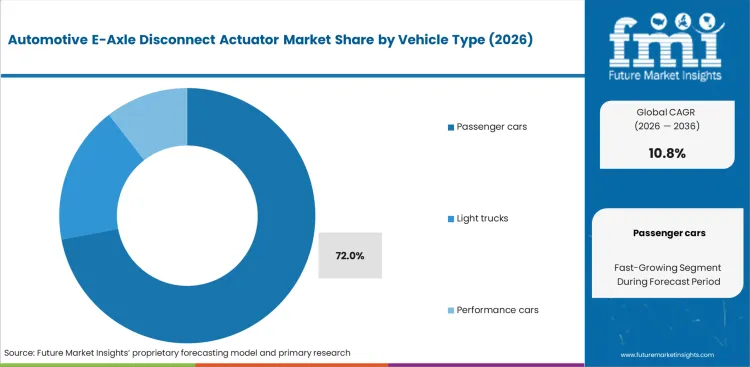
Passenger cars are expected to account for 72.0% share in 2026 because highway efficiency remains a primary benchmark in this class. High-volume sedan programs increasingly require physical decoupling, as aerodynamic gains alone cannot offset continuous secondary motor drag. Tight packaging constraints also force suppliers to reduce EV powertrain dimensions without compromising response or durability. Continuous AWD layouts weaken range positioning against single-motor alternatives when disconnect functionality is absent. Passenger car leadership also brings stricter NVH demands, since engagement noise is harder to mask in cabin-focused applications. Delayed adoption leaves automakers exposed in range comparisons at the point of sale and adds pressure on automotive transmission integration teams.
- Premium early adopters: Luxury sedans move first because higher pricing flexibility helps absorb the early cost of adapting complex transmission housings.
- Volume crossover followers: Mid-tier SUVs follow as scaled production supports broader use across commuter platforms with measurable efficiency gains.
- Performance laggards: Track-oriented variants adopt later once engagement latency falls below the threshold that affects vehicle response.
Automotive E-Axle Disconnect Actuator Market Analysis by Propulsion Layout
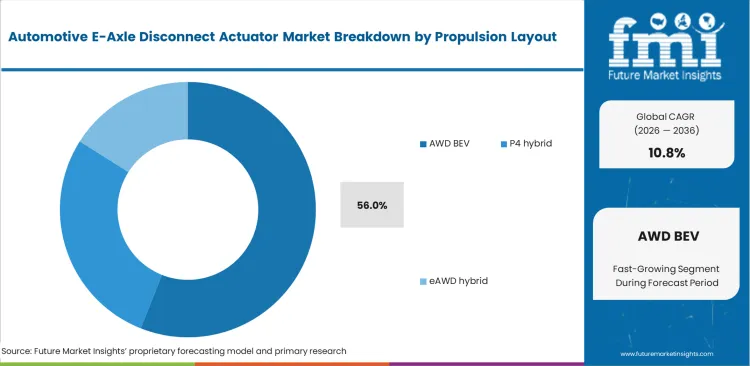
Dual-motor architecture makes physical separation increasingly necessary when battery efficiency targets tighten. Secondary drive isolation during steady-state cruising has become essential in front-rear motor layouts, which is why AWD BEV is projected to secure 56.0% share in 2026. Battery sizing, cooling load, and cruising efficiency all improve when the secondary drive can disengage fully. Integration of e-axle hub bearing units within these platforms also shapes thermal management and packaging choices from the start. Permanent all-wheel drive raises energy losses and pushes battery systems toward heavier configurations. Engineering pressure is equally visible in hybrid layouts, where packaging limitations make disconnect design more difficult and force closer calibration of the electric linear actuator. Poor decoupling performance leaves hybrid systems with weak electric-only range and reduces the value of the added hardware.
- Initial sourcing savings: Disconnect systems reduce battery size requirements, which offsets part of the added mechanical hardware cost.
- Operational hidden expenses: Software calibration remains expensive because engagement logic must be refined carefully to avoid actuator damage during torque matching.
- Total lifecycle advantage: Lower continuous motor operation reduces cooling demand and supports longer service life across secondary propulsion components.
Automotive E-Axle Disconnect Actuator Market Analysis by Actuator Type
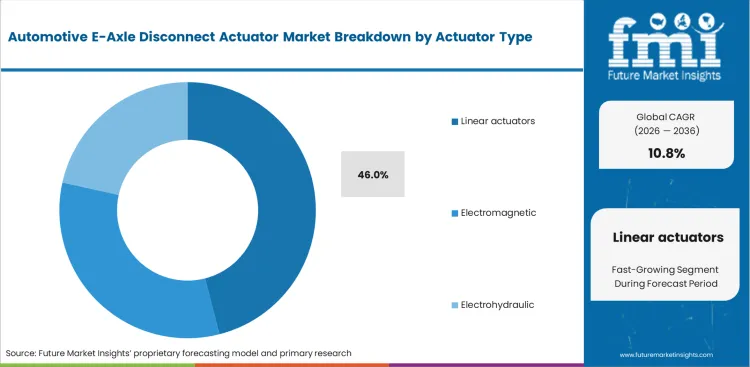
Available space inside modern gearbox layouts directly influences actuator selection. Linear actuators fit tight tubular shaft environments well and are therefore estimated to represent 46.0% of market share in 2026. Their straight-line force path also simplifies packaging inside compact driveline assemblies. This geometry supports easier integration where transmission shift actuator packaging must stay within tight dimensional limits. Bulky alternatives often force wider housing changes and extend platform development schedules. Linear formats still face trade-offs, since electromagnetic options can outperform them when response speed becomes the top evaluation factor. Selection errors at this stage also affect automotive differential behavior under sudden low-traction load changes and can weaken the full axle response.
- Baseline engagement thresholds: Mainstream vehicle programs accept moderate shift speeds when the primary objective is highway efficiency improvement.
- Edge condition gaps: Low-temperature lubricant thickening can delay actuator response during winter validation testing.
- Strict acceptance standards: High-performance platforms reject actuator systems that exceed tight torque-shock limits under rapid acceleration.
Automotive E-Axle Disconnect Actuator Market Analysis by Integration Type
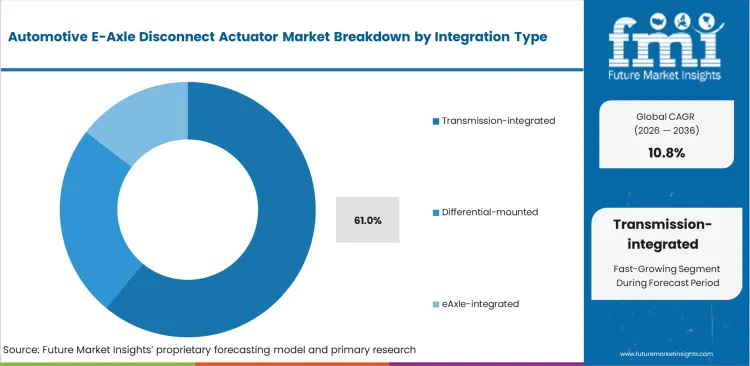
Weight reduction targets are pushing disconnect systems away from external add-on mechanisms. Internal placement reduces wiring exposure and allows shared lubrication paths, which is making transmission-integrated systems more favorable. Drivetrain packaging priorities remain central, and shared housing architecture is estimated to help this segment account for 61.0% share in 2026. Consolidating the mechanism inside the main casing also simplifies electric vehicle motor assembly and reduces installation complexity at the plant level. Standalone layouts raise part count and add sealing and mounting steps that make assembly more burdensome. Deep integration still brings a service trade-off, since even a minor actuator fault can lead to replacement of a larger driveline assembly. That limitation becomes harder to ignore when electric vehicle drive motors and disconnect hardware are packaged closely within one compact system.
- Primary component manufacturers: Tier-1 transmission suppliers remain at the forefront because actuator mounting features are integrated directly into core housing designs.
- Capacity planning constraints: Internal channel machining requires specialized tooling, which slows the conversion of legacy production lines.
- Long-term sourcing trajectories: Integrated architecture reduces supplier flexibility, leaving future programs more closely tied to specific transmission partners.
Automotive E-Axle Disconnect Actuator Market Analysis by Sales Channel
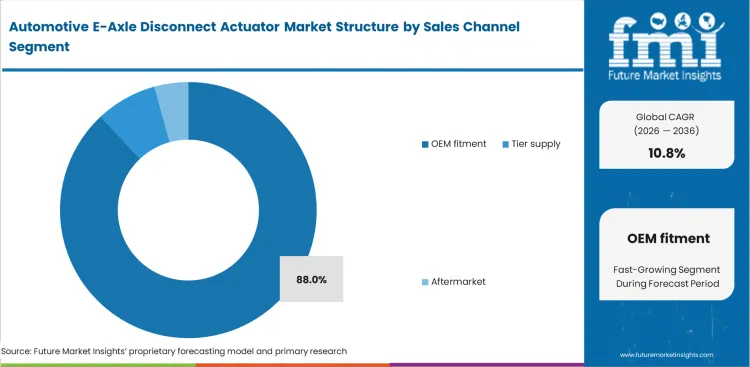
Independent retrofit channels face major limits once high-voltage drivetrain control is locked into factory software. OEM fitment is set to account for 88.0% share in 2026 because safety validation and control integration remain tightly managed at the factory level. Factory-installed systems ensure accurate coordination with primary electric vehicle transmission control logic before vehicles enter service. Retrofit attempts outside the OEM channel risk propulsion faults when control units detect unexpected mechanical resistance or unverified calibrations. Aftermarket participation, therefore, stays narrow and is mostly restricted to direct replacement activity. Software dependency also makes it difficult for independent suppliers to enter programs built around tightly linked automotive electric drivetrain components. Factory control of the channel is expected to remain firm as long as calibration access and safety validation stay centralized.
- Prevented system failures: Factory calibration reduces mismatch risk by aligning clutch actuation precisely with embedded drivetrain software logic.
- Residual operational risks: Mechanical wear still develops over time, with repeated disconnect cycles generating fine metal debris in transmission fluid.
- Required capture conditions: Range benefits depend on aggressive calibration logic that prioritizes disconnect action during steady-state driving.
Automotive E-Axle Disconnect Actuator Market Drivers, Restraints, and Opportunities
Battery mass limitations compel platform chief engineers to find mechanical solutions for range extension immediately, answering why do EVs use axle disconnect systems. Delaying implementation means fielding heavier vehicles that fail strict global efficiency standards, destroying showroom competitiveness. Sourcing rules now mandate decoupling hardware to claw back crucial highway miles without adding expensive chemical storage capacity. Automakers recognize continuous secondary motor drag as an unacceptable energy bleed in any EV AWD axle disconnect application. Eliminating parasitic losses through active physical separation instantly improves baseline efficiency metrics across entire electronic awd coupling modules line-ups.
Software calibration friction severely slows widespread adoption across entry-level electric platforms, presenting major e-axle disconnect actuator challenges. Synchronizing motor RPM with wheel speed before engaging mechanical dogs requires thousands of coding hours. Validation teams struggle to eliminate harsh engagement clunks that damage premium vehicle perceptions. While hardware exists, achieving seamless transitions demands processing power and algorithm sophistication many legacy OEMs lack. Simplified friction-based EV transmission system synchronizers offer partial workarounds but generate unwanted heat and wear prematurely under frequent urban driving cycles.
Opportunities in the Automotive E-Axle Disconnect Actuator Market
- Next-generation electro-magnetic designs: Powertrain engineers replace traditional fluid-driven systems with fast-acting magnetic coils. Instantaneous response times eliminate complex hydraulic dependencies and improve cold-weather reliability across platforms.
- Bi-stable mechanism deployment: Hardware architects specify actuators requiring zero holding current. Zero-power retention during disconnected states yields significant EV axle disconnect energy savings for maximum highway efficiency.
- Integrated sensing capabilities: Sensor specialists embed position feedback loops directly into actuator arms. Real-time travel data allows vehicle control units to predict and smooth engagement shocks dynamically.
Regional Analysis
Based on regional analysis, automotive E-Axle disconnect actuator market is segmented into North America, Europe, and Asia Pacific across 40 plus countries.
.webp "Top Country Growth Comparison Automotive E Axle Disconnect Actuator Market Cagr (2026 2036)")
| Country | CAGR (2026 to 2036) |
|---|---|
| India | 14.4% |
| China | 12.9% |
| South Korea | 11.1% |
| United Kingdom | 10.7% |
| United States | 10.3% |
| Germany | 9.8% |
| France | 9.4% |
Source: Future Market Insights (FMI) analysis, based on proprietary forecasting model and primary research
Asia Pacific Automotive E-Axle Disconnect Actuator Market Analysis
Asian supply chain conditions reflect rapid platform leapfrogging as local manufacturers move past legacy mechanical layouts. Domestic automakers are favoring modular dual-motor architectures built for premium SUV applications. Manufacturers are sourcing advanced electric drive unit mechanisms to align vehicle performance with western range expectations. Intense local competition is shortening technology cycles, which is bringing advanced decoupling hardware into mid-tier vehicle segments sooner than earlier market expectations suggested. Regional engineering hubs remain more focused on cost-effective integration than perfect noise and vibration refinement, as faster commercialization still carries greater weight.
- India: Rapid domestic OEM platform expansion continues to shape India’s e-axle disconnect actuator market. Demand for decoupling hardware in India is anticipated to rise at a CAGR of 14.4% through 2036. Automotive engineers are specifying these systems to improve range across localized premium SUVs operating under varied terrain conditions. Early supplier alignment is also allowing local manufacturers to protect margins in a growing domestic luxury vehicle segment.
- China: Local electrification pressure is pushing manufacturers toward highly efficient dual-motor architectures across China’s e-axle disconnect actuator market. Chinese tier-1 suppliers are closing performance gaps on global latency requirements, which is intensifying price pressure on established western hardware providers. Sales of disconnecting systems in China are expected to increase at a CAGR of 12.9% during the forecast period. Integrating these decoupling mechanisms also helps automakers meet demanding range-validation requirements across domestic electric vehicle programs.
- South Korea: Premium crossover export volume continues to shape efficiency expectations across South Korea’s e-axle disconnect actuator market. South Korea is projected to witness a CAGR of 11.1% through 2036 in this market. Vehicle manufacturers require seamless engagement performance to meet demanding consumer expectations in Europe and North America. Refined software calibration embedded into export-focused models continues to strengthen the country’s position in smooth torque delivery and drivability control.
FMI’s report also includes Japan, Australia, and ASEAN nations. Maturing semiconductor supply chains across these markets are improving access to electronic components required for advanced actuator control modules.
Europe Automotive E-Axle Disconnect Actuator Market Analysis
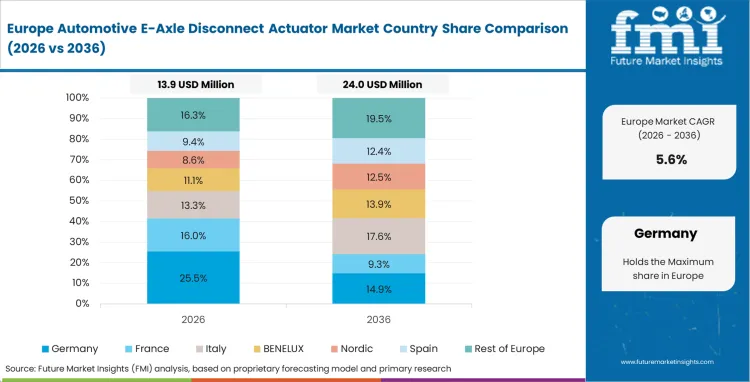
Strict WLTP efficiency testing protocols continue to reshape continental powertrain strategies. Regulatory pressure now extends beyond tailpipe emissions and places greater weight on total energy utilization across the vehicle system. European compliance requirements are pushing automotive engineering teams to adopt every viable parasitic loss reduction measure. Manufacturers across major regional hubs are demanding electric drive unit hardware with near-zero defect tolerance that can withstand disengagement events at autobahn speeds. Mature supply networks are under pressure to meet these performance expectations while component cost targets continue to tighten.
- United Kingdom: Rising consumer concern around real-world driving range is pushing OEMs to maximize highway efficiency, which is lifting demand across the United Kingdom e-axle disconnect actuator market. Automotive manufacturers are specifying disconnect functionality across imported and domestically produced dual-motor variants. Demand in the United Kingdom is expected to rise at a CAGR of 10.7% through 2036. Expanded national testing capacity is also allowing local engineering firms to secure higher-value calibration work from major automakers.
- Germany: Deep automotive supply chain depth continues to shape Germany’s e-axle disconnect actuator development priorities. Integration specialists are concentrating on high-speed engagement performance under maximum torque loads rather than pursuing cost reduction alone. Germany is anticipated to see demand for decoupling hardware expand at a CAGR of 9.8% over the forecast period. Volume growth may remain measured, though component value is likely to increase as domestic brands continue to require very high actuation precision.
- France: Mature electric vehicle penetration is moderating early-stage hardware expansion across France’s e-axle disconnect actuator market. Sales in France are likely to increase at a CAGR of 9.4% through 2036. Drivetrain engineers are refining existing decoupling architectures instead of moving toward entirely new engagement concepts. Engineering attention remains centered on lowering total actuator weight, as response-time gains alone no longer carry the same development priority.
FMI’s report also includes Italy, Spain, and Nordic countries. Cold-weather validation across northern European markets continues to expose viscosity-related limitations in legacy electro-hydraulic decoupling systems.
North America Automotive E-Axle Disconnect Actuator Market Analysis
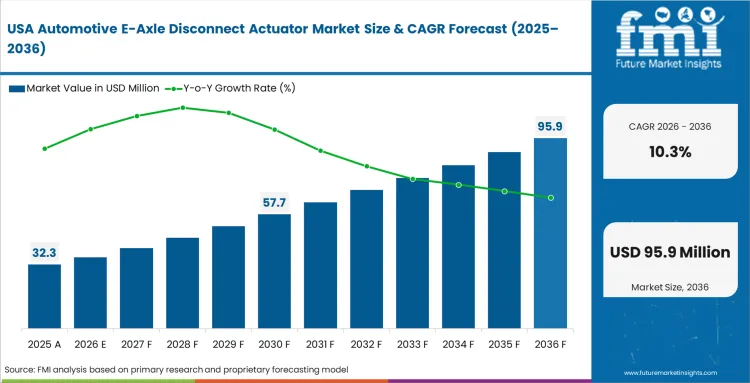
Heavy vehicle mass defines continental engineering challenges for electric drivetrains. Massive battery packs required for acceptable pickup truck range figures create high highway efficiency penalties. Manufacturers deploy heavy-duty decoupling mechanisms to isolate massive secondary drive units during interstate cruising. Differential mounted systems gain favor here due to complex solid-axle or heavy independent suspension requirements. Towing requirements necessitate robust mechanical dog clutches capable of handling sudden torque requests without shattering under load.
- United States: Long-distance highway commuting habits require maximum steady-state cruising efficiency, accelerating United States e-axle disconnect actuator market adoption. United States sales are forecast to record steady growth in e-axle disconnect actuators at a CAGR of 10.3% through 2036. Engineers integrate robust decoupling hardware into heavy electric pickup trucks to maintain advertised range targets while towing. Perfecting high-torque engagement allows domestic truck manufacturers to dominate highly profitable utility segments globally.
FMI's report includes Canada and Mexico. Expanding cross-border component manufacturing networks supply essential raw castings required for heavy-duty actuator housings.
Competitive Aligners for Market Players
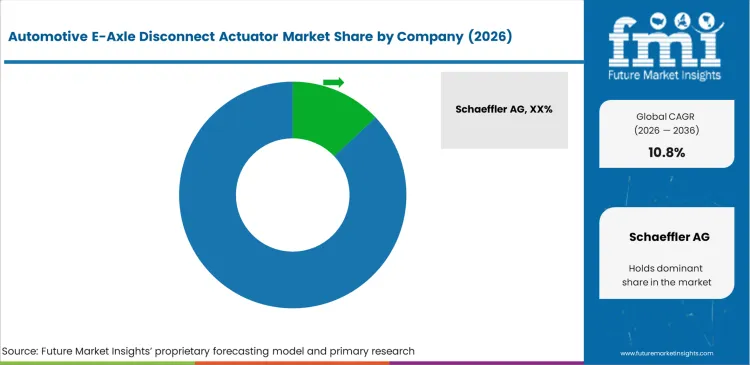
Packaging limits inside transmission housings keep supplier entry difficult in the automotive disconnect actuator market. Tier-1 integrators remain ahead because their engineering teams understand gearbox fluid behavior, casing layouts, and the tight spatial conditions that govern actuator fitment. Supplier assessment centers on volumetric efficiency, with manufacturers judging how much usable actuation force can be delivered within very small housing envelopes. Faster engagement claims carry little weight when coil designs fail to fit legacy casing dimensions or require housing changes that automakers are unwilling to approve.
Software integration adds another layer of separation between established suppliers and newer challengers. Pre-validated control logic, torque-matching calibration, and wheel-speed synchronization matter as much as the electro-mechanical device itself because poor coordination can damage gears during engagement. Suppliers with proven hardware and software packages remain better positioned since they reduce calibration effort during late-stage vehicle development. New entrants may reproduce the actuator hardware, yet matching years of validated control behavior remains far harder.
Automakers also limit supplier influence by keeping communication architecture flexible across vehicle programs. Disconnect actuators are expected to work cleanly with standard control units and common CAN-bus structures rather than forcing dependence on closed integration designs. Buyers favor solutions that protect pricing leverage and preserve control over final engagement calibration. Competitive strength in this market comes from fitting tight mechanical envelopes, integrating reliably with existing vehicle electronics, and removing launch risk from drivetrain programs.
Key Players in Automotive E-Axle Disconnect Actuator Market
- Schaeffler AG
- Valeo
- GKN Automotive
- Dana Incorporated
- BorgWarner Inc.
- HILITE International
Scope of the Report
| Metric | Value |
|---|---|
| Quantitative Units | USD 53.4 million to USD 148.9 million, at a CAGR of 10.80% |
| Market Definition | Hardware mechanisms tasked with decoupling secondary electric motors from drivelines to eliminate mechanical drag during steady cruising and extend battery range. |
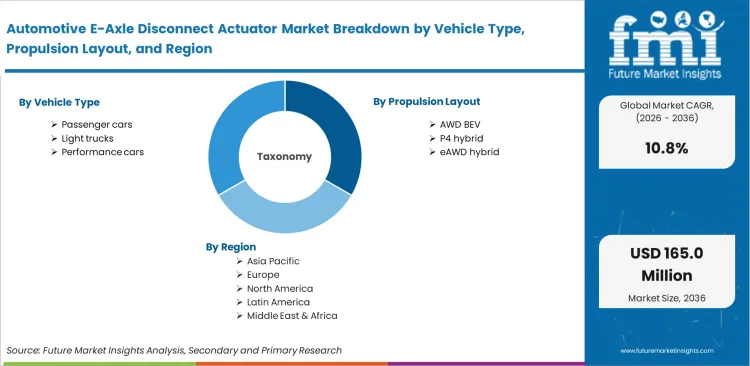
| Segmentation | Vehicle type, Propulsion layout, Actuator type, Integration type, and Sales channel |
| Regions Covered | North America, Europe, Asia Pacific, Latin America, Middle East & Africa |
| Countries Covered | United States, Canada, Germany, United Kingdom, France, Italy, Spain, China, Japan, India, South Korea, Australia, Brazil, Mexico |
| Key Companies Profiled | Schaeffler AG, Valeo, GKN Automotive, Dana Incorporated, BorgWarner Inc., HILITE International |
| Forecast Period | 2026 to 2036 |
| Approach | Dual-motor BEV production volume baselines mapped against AWD penetration rates across distinct vehicle classes |
Source: Future Market Insights (FMI) analysis, based on proprietary forecasting model and primary research
Automotive E-Axle Disconnect Actuator Market Analysis by Segments
By vehicle type
- Passenger cars
- Light trucks
- Performance cars
By propulsion layout
- AWD BEV
- P4 hybrid
- eAWD hybrid
By actuator type
- Linear actuators
- Electromagnetic
- Electrohydraulic
By integration type
- Transmission-integrated
- Differential-mounted
- eAxle-integrated
By sales channel
- OEM fitment
- Tier supply
- Aftermarket
Region
- North America
- United States
- Canada
- Europe
- Germany
- United Kingdom
- France
- Italy
- Spain
- Asia Pacific
- China
- Japan
- South Korea
- Taiwan
- Singapore
- Latin America
- Brazil
- Mexico
- Argentina
- Middle East & Africa
- GCC Countries
- South Africa
Bibliography
- Grđan, I., Škugor, B., & Deur, J. (2024). Energy-efficient straight-line driving torque vectoring for electric vehicles with disconnect clutches and unequal front/rear motors. In G. Mastinu, F. Braghin, F. Cheli, M. Corno, & S. M. Savaresi (Eds.), 16th International Symposium on Advanced Vehicle Control. AVEC 2024. Lecture Notes in Mechanical Engineering (pp. 364-370). Springer.
- Madireddy, K. C., Verhun, B., Xu, C., Sha, H., Tuller, Z., & Patel, N. (2024). Wheel & axle disconnect controls on hybrid electric powertrains (SAE Technical Paper 2024-01-2776). SAE International.
- Miroschnitschenko, B., Poltschak, F., & Amrhein, W. (2025). A novel double-sided electromagnetic dog clutch with an integrated synchronizer function. Actuators, 14(6), 286.
- Škugor, B., Deur, J., Chen, W., Zhang, Y., & Dai, E. (2024). A parameter-optimized rule-based control strategy for front-rear torque vectoring in electric vehicles with multiple motors and disconnect clutches. Vehicle System Dynamics, 64(2), 1-27.
- Škugor, B., Deur, J., Chen, W., Zhang, Y., & Dai, E. (2025). Optimization of straight-line driving torque vectoring for energy-efficient operation of electric vehicles with multiple motors and disconnect clutches. Optimization and Engineering, 26(2), 753-780.
This bibliography is provided for reader reference. The full FMI report contains the complete reference list with primary source documentation.
This Report Addresses
- Actuator packaging challenges inside transmission enclosures
- Software calibration protocols for shock-free engagement
- Torque capacity limits across different actuator geometries
- Efficiency gains measured against mechanical AWD baseline setups
- Cost-benefit analysis of adding decoupling hardware to platforms
- Failure modes associated with high-speed dynamic reconnections
- Lead times for qualifying new tier-1 component suppliers
- Thermal limits affecting electro-hydraulic mechanism reliability
Frequently Asked Questions
What size is Automotive E-Axle Disconnect Actuator Market?
Valuation reached USD 48.2 million in 2025. Total revenue is projected to hit USD 53.4 million in 2026 as automakers finalize new platform architectures.
What is the growth rate through 2036?
Sales are expected to expand at a 10.80% CAGR. Demand outlook indicates consistent upward momentum as dual-motor configurations become standard across premium segments.
What value will demand reach by 2036?
Revenue is forecast to cross USD 148.9 million. Sustained investment in mechanical efficiency drives this long-term accumulation.
How does an e-axle disconnect actuator work?
These mechanisms physically separate the electric motor from the drive wheels during steady-state cruising. Retracting a dog clutch or spline prevents the unpowered motor from spinning, eliminating parasitic mechanical drag.
Who makes e-axle disconnect actuators?
Leading tier-1 automotive suppliers handle primary production. Companies source these components from established powertrain engineering firms that already manufacture complex transmission housings and differentials.
Which EV platforms use e-axle disconnect actuators?
Dual-motor architectures primarily integrate these systems. Performance sedans and premium all-wheel-drive crossovers rely on them to boost highway efficiency without sacrificing secondary motor acceleration.
Who are the key companies in e-axle disconnect actuators?
Schaeffler AG, BorgWarner Inc., and GKN Automotive control significant volume. These suppliers leverage deep institutional knowledge of transmission fluid dynamics and software calibration to dominate tier-1 contracts.
What separates an e-axle disconnect actuator vs AWD coupling module?
Disconnect actuators strictly decouple an electric motor from an axle to stop parasitic drag. Traditional AWD coupling modules transfer and vector active torque between front and rear internal combustion axles.
Which are the top companies in e-axle disconnect actuators?
Valeo and Dana Incorporated rank among the elite providers. Companies value their ability to deliver complete hardware packages pre-validated with sophisticated torque-matching algorithms.
Why do passenger cars lead vehicle type?
Strict highway efficiency mandates hit sedans and crossovers hardest. Eliminating secondary motor drag is essential for maintaining competitive range figures.
Why does AWD BEV dominate propulsion layout?
Pure electric platforms rely entirely on battery capacity for range. Disconnecting secondary axles preserves crucial kilowatt-hours during steady-state cruising.
Why do linear actuators hold significant share?
Tight spaces inside gearboxes dictate component shapes. Straight-line actuation fits perfectly between existing differential carriers without demanding massive housing redesigns.
What makes transmission-integrated setups popular?
Centralizing components reduces overall vehicle mass. Engineering teams prefer utilizing shared lubrication fluid rather than building separate cooling systems for external actuators.
Why does OEM fitment control sales channels?
Software synchronization requires factory-level access. Modifying complex high-voltage drivetrain logic post-production remains technically impossible for independent repair facilities.
What drives growth in India?
Local automakers bypass legacy all-wheel-drive systems entirely. Modular dual-motor layouts allow domestic brands to compete aggressively in expanding premium SUV segments.
Why is South Korea expanding rapidly?
Heavy export volume dictates world-class efficiency metrics. Regional powertrain architects demand seamless engagement protocols to satisfy demanding European consumer expectations.
How does range anxiety influence purchase?
Consumer fear of depleted batteries forces OEMs to extract every possible mile. Active decoupling provides an immediate efficiency boost without adding expensive chemical mass.
What slows widespread actuator adoption?
Software calibration requires thousands of engineering hours. Eliminating harsh mechanical clunks during high-speed reconnections challenges even advanced powertrain teams.
How do incumbents maintain competitive advantage?
Legacy suppliers possess proprietary torque-matching algorithms. Validated software handshakes save automakers massive development costs during late-stage platform integration.
Why do OEMs split actuator contracts?
Automotive groups actively resist single-vendor dependence. Sourcing components from multiple suppliers guarantees pricing leverage and ensures continuous supply during factory bottlenecks.
What role do NVH standards play?
Noise and vibration guidelines dictate engagement speeds. Systems that introduce audible clunks into passenger cabins face immediate rejection by chassis integration teams.
How do thermal limits affect design?
Actuators operating near hot transmission fluid require specialized seals. Component engineers must specify high-temperature materials to prevent fluid leaks.
What forces rapid technology cycles in China?
Aggressive local electrification mandates push boundaries constantly. Chinese tier-1 suppliers quickly match western hardware latency standards to win domestic contracts.
Why do premium early adopters deploy technology first?
Initial development costs remain prohibitively high. Luxury vehicle pricing elasticity absorbs these expenses before technology scales down to commuter platforms.
How do cold weather conditions impact mechanisms?
Sub-zero temperatures increase internal lubricant viscosity. Calibration specialists must program compensating algorithms to handle sluggish response times during winter operation.
What advantage do electro-magnetic designs offer?
Magnetic coils eliminate complex hydraulic dependencies. Instantaneous response times provide powertrain software with much tighter control over engagement dynamics.
Why is bi-stable mechanism deployment an opportunity?
Zero holding current reduces parasitic electrical drain. Actuators that consume power only during transitions further improve total vehicle efficiency profiles.
How does integrated sensing improve performance?
Position feedback loops report exact actuator arm locations. Real-time data allows vehicle control modules to predict and smooth torque shocks instantly.
Preview the report firsthand - request a free sample
Get SampleGet the brochure for pricing and purchase details.
Get PDFTable of Content
- Executive Summary
- Global Market Outlook
- Demand-side Trends
- Supply-side Trends
- Technology Roadmap Analysis
- Analysis and Recommendations
- Market Overview
- Market Coverage / Taxonomy
- Market Definition / Scope / Limitations
- Research Methodology
- Chapter Orientation
- Analytical Lens and Working Hypotheses
- Market Structure, Signals, and Trend Drivers
- Benchmarking and Cross-market Comparability
- Market Sizing, Forecasting, and Opportunity Mapping
- Research Design and Evidence Framework
- Desk Research Programme (Secondary Evidence)
- Company Annual and Sustainability Reports
- Peer-reviewed Journals and Academic Literature
- Corporate Websites, Product Literature, and Technical Notes
- Earnings Decks and Investor Briefings
- Statutory Filings and Regulatory Disclosures
- Technical White Papers and Standards Notes
- Trade Journals, Industry Magazines, and Analyst Briefs
- Conference Proceedings, Webinars, and Seminar Materials
- Government Statistics Portals and Public Data Releases
- Press Releases and Reputable Media Coverage
- Specialist Newsletters and Curated Briefings
- Sector Databases and Reference Repositories
- FMI Internal Proprietary Databases and Historical Market Datasets
- Subscription Datasets and Paid Sources
- Social Channels, Communities, and Digital Listening Inputs
- Additional Desk Sources
- Expert Input and Fieldwork (Primary Evidence)
- Primary Modes
- Qualitative Interviews and Expert Elicitation
- Quantitative Surveys and Structured Data Capture
- Blended Approach
- Why Primary Evidence is Used
- Field Techniques
- Interviews
- Surveys
- Focus Groups
- Observational and In-context Research
- Social and Community Interactions
- Stakeholder Universe Engaged
- C-suite Leaders
- Board Members
- Presidents and Vice Presidents
- R&D and Innovation Heads
- Technical Specialists
- Domain Subject-matter Experts
- Scientists
- Physicians and Other Healthcare Professionals
- Governance, Ethics, and Data Stewardship
- Research Ethics
- Data Integrity and Handling
- Primary Modes
- Tooling, Models, and Reference Databases
- Desk Research Programme (Secondary Evidence)
- Data Engineering and Model Build
- Data Acquisition and Ingestion
- Cleaning, Normalisation, and Verification
- Synthesis, Triangulation, and Analysis
- Quality Assurance and Audit Trail
- Market Background
- Market Dynamics
- Drivers
- Restraints
- Opportunity
- Trends
- Scenario Forecast
- Demand in Optimistic Scenario
- Demand in Likely Scenario
- Demand in Conservative Scenario
- Opportunity Map Analysis
- Product Life Cycle Analysis
- Supply Chain Analysis
- Investment Feasibility Matrix
- Value Chain Analysis
- PESTLE and Porter’s Analysis
- Regulatory Landscape
- Regional Parent Market Outlook
- Production and Consumption Statistics
- Import and Export Statistics
- Market Dynamics
- Global Market Analysis 2021 to 2025 and Forecast, 2026 to 2036
- Historical Market Size Value (USD Million) Analysis, 2021 to 2025
- Current and Future Market Size Value (USD Million) Projections, 2026 to 2036
- Y-o-Y Growth Trend Analysis
- Absolute $ Opportunity Analysis
- Global Market Pricing Analysis 2021 to 2025 and Forecast 2026 to 2036
- Global Market Analysis 2021 to 2025 and Forecast 2026 to 2036, By Vehicle Type
- Introduction / Key Findings
- Historical Market Size Value (USD Million) Analysis By Vehicle Type , 2021 to 2025
- Current and Future Market Size Value (USD Million) Analysis and Forecast By Vehicle Type , 2026 to 2036
- Passenger cars
- Light trucks
- Performance cars
- Passenger cars
- Y-o-Y Growth Trend Analysis By Vehicle Type , 2021 to 2025
- Absolute $ Opportunity Analysis By Vehicle Type , 2026 to 2036
- Global Market Analysis 2021 to 2025 and Forecast 2026 to 2036, By Propulsion Layout
- Introduction / Key Findings
- Historical Market Size Value (USD Million) Analysis By Propulsion Layout, 2021 to 2025
- Current and Future Market Size Value (USD Million) Analysis and Forecast By Propulsion Layout, 2026 to 2036
- AWD BEV
- P4 hybrid
- eAWD hybrid
- AWD BEV
- Y-o-Y Growth Trend Analysis By Propulsion Layout, 2021 to 2025
- Absolute $ Opportunity Analysis By Propulsion Layout, 2026 to 2036
- Global Market Analysis 2021 to 2025 and Forecast 2026 to 2036, By Actuator Type
- Introduction / Key Findings
- Historical Market Size Value (USD Million) Analysis By Actuator Type, 2021 to 2025
- Current and Future Market Size Value (USD Million) Analysis and Forecast By Actuator Type, 2026 to 2036
- Linear actuators
- Electromagnetic
- Electrohydraulic
- Linear actuators
- Y-o-Y Growth Trend Analysis By Actuator Type, 2021 to 2025
- Absolute $ Opportunity Analysis By Actuator Type, 2026 to 2036
- Global Market Analysis 2021 to 2025 and Forecast 2026 to 2036, By Integration Type
- Introduction / Key Findings
- Historical Market Size Value (USD Million) Analysis By Integration Type, 2021 to 2025
- Current and Future Market Size Value (USD Million) Analysis and Forecast By Integration Type, 2026 to 2036
- Transmission-integrated
- Differential-mounted
- eAxle-integrated
- Transmission-integrated
- Y-o-Y Growth Trend Analysis By Integration Type, 2021 to 2025
- Absolute $ Opportunity Analysis By Integration Type, 2026 to 2036
- Global Market Analysis 2021 to 2025 and Forecast 2026 to 2036, By Sales Channel
- Introduction / Key Findings
- Historical Market Size Value (USD Million) Analysis By Sales Channel, 2021 to 2025
- Current and Future Market Size Value (USD Million) Analysis and Forecast By Sales Channel, 2026 to 2036
- OEM fitment
- Tier supply
- Aftermarket
- OEM fitment
- Y-o-Y Growth Trend Analysis By Sales Channel, 2021 to 2025
- Absolute $ Opportunity Analysis By Sales Channel, 2026 to 2036
- Global Market Analysis 2021 to 2025 and Forecast 2026 to 2036, By Region
- Introduction
- Historical Market Size Value (USD Million) Analysis By Region, 2021 to 2025
- Current Market Size Value (USD Million) Analysis and Forecast By Region, 2026 to 2036
- North America
- Latin America
- Western Europe
- Eastern Europe
- East Asia
- South Asia and Pacific
- Middle East & Africa
- Market Attractiveness Analysis By Region
- North America Market Analysis 2021 to 2025 and Forecast 2026 to 2036, By Country
- Historical Market Size Value (USD Million) Trend Analysis By Market Taxonomy, 2021 to 2025
- Market Size Value (USD Million) Forecast By Market Taxonomy, 2026 to 2036
- By Country
- USA
- Canada
- Mexico
- By Vehicle Type
- By Propulsion Layout
- By Actuator Type
- By Integration Type
- By Sales Channel
- By Country
- Market Attractiveness Analysis
- By Country
- By Vehicle Type
- By Propulsion Layout
- By Actuator Type
- By Integration Type
- By Sales Channel
- Key Takeaways
- Latin America Market Analysis 2021 to 2025 and Forecast 2026 to 2036, By Country
- Historical Market Size Value (USD Million) Trend Analysis By Market Taxonomy, 2021 to 2025
- Market Size Value (USD Million) Forecast By Market Taxonomy, 2026 to 2036
- By Country
- Brazil
- Chile
- Rest of Latin America
- By Vehicle Type
- By Propulsion Layout
- By Actuator Type
- By Integration Type
- By Sales Channel
- By Country
- Market Attractiveness Analysis
- By Country
- By Vehicle Type
- By Propulsion Layout
- By Actuator Type
- By Integration Type
- By Sales Channel
- Key Takeaways
- Western Europe Market Analysis 2021 to 2025 and Forecast 2026 to 2036, By Country
- Historical Market Size Value (USD Million) Trend Analysis By Market Taxonomy, 2021 to 2025
- Market Size Value (USD Million) Forecast By Market Taxonomy, 2026 to 2036
- By Country
- Germany
- UK
- Italy
- Spain
- France
- Nordic
- BENELUX
- Rest of Western Europe
- By Vehicle Type
- By Propulsion Layout
- By Actuator Type
- By Integration Type
- By Sales Channel
- By Country
- Market Attractiveness Analysis
- By Country
- By Vehicle Type
- By Propulsion Layout
- By Actuator Type
- By Integration Type
- By Sales Channel
- Key Takeaways
- Eastern Europe Market Analysis 2021 to 2025 and Forecast 2026 to 2036, By Country
- Historical Market Size Value (USD Million) Trend Analysis By Market Taxonomy, 2021 to 2025
- Market Size Value (USD Million) Forecast By Market Taxonomy, 2026 to 2036
- By Country
- Russia
- Poland
- Hungary
- Balkan & Baltic
- Rest of Eastern Europe
- By Vehicle Type
- By Propulsion Layout
- By Actuator Type
- By Integration Type
- By Sales Channel
- By Country
- Market Attractiveness Analysis
- By Country
- By Vehicle Type
- By Propulsion Layout
- By Actuator Type
- By Integration Type
- By Sales Channel
- Key Takeaways
- East Asia Market Analysis 2021 to 2025 and Forecast 2026 to 2036, By Country
- Historical Market Size Value (USD Million) Trend Analysis By Market Taxonomy, 2021 to 2025
- Market Size Value (USD Million) Forecast By Market Taxonomy, 2026 to 2036
- By Country
- China
- Japan
- South Korea
- By Vehicle Type
- By Propulsion Layout
- By Actuator Type
- By Integration Type
- By Sales Channel
- By Country
- Market Attractiveness Analysis
- By Country
- By Vehicle Type
- By Propulsion Layout
- By Actuator Type
- By Integration Type
- By Sales Channel
- Key Takeaways
- South Asia and Pacific Market Analysis 2021 to 2025 and Forecast 2026 to 2036, By Country
- Historical Market Size Value (USD Million) Trend Analysis By Market Taxonomy, 2021 to 2025
- Market Size Value (USD Million) Forecast By Market Taxonomy, 2026 to 2036
- By Country
- India
- ASEAN
- Australia & New Zealand
- Rest of South Asia and Pacific
- By Vehicle Type
- By Propulsion Layout
- By Actuator Type
- By Integration Type
- By Sales Channel
- By Country
- Market Attractiveness Analysis
- By Country
- By Vehicle Type
- By Propulsion Layout
- By Actuator Type
- By Integration Type
- By Sales Channel
- Key Takeaways
- Middle East & Africa Market Analysis 2021 to 2025 and Forecast 2026 to 2036, By Country
- Historical Market Size Value (USD Million) Trend Analysis By Market Taxonomy, 2021 to 2025
- Market Size Value (USD Million) Forecast By Market Taxonomy, 2026 to 2036
- By Country
- Kingdom of Saudi Arabia
- Other GCC Countries
- Turkiye
- South Africa
- Other African Union
- Rest of Middle East & Africa
- By Vehicle Type
- By Propulsion Layout
- By Actuator Type
- By Integration Type
- By Sales Channel
- By Country
- Market Attractiveness Analysis
- By Country
- By Vehicle Type
- By Propulsion Layout
- By Actuator Type
- By Integration Type
- By Sales Channel
- Key Takeaways
- Key Countries Market Analysis
- USA
- Pricing Analysis
- Market Share Analysis, 2025
- By Vehicle Type
- By Propulsion Layout
- By Actuator Type
- By Integration Type
- By Sales Channel
- Canada
- Pricing Analysis
- Market Share Analysis, 2025
- By Vehicle Type
- By Propulsion Layout
- By Actuator Type
- By Integration Type
- By Sales Channel
- Mexico
- Pricing Analysis
- Market Share Analysis, 2025
- By Vehicle Type
- By Propulsion Layout
- By Actuator Type
- By Integration Type
- By Sales Channel
- Brazil
- Pricing Analysis
- Market Share Analysis, 2025
- By Vehicle Type
- By Propulsion Layout
- By Actuator Type
- By Integration Type
- By Sales Channel
- Chile
- Pricing Analysis
- Market Share Analysis, 2025
- By Vehicle Type
- By Propulsion Layout
- By Actuator Type
- By Integration Type
- By Sales Channel
- Germany
- Pricing Analysis
- Market Share Analysis, 2025
- By Vehicle Type
- By Propulsion Layout
- By Actuator Type
- By Integration Type
- By Sales Channel
- UK
- Pricing Analysis
- Market Share Analysis, 2025
- By Vehicle Type
- By Propulsion Layout
- By Actuator Type
- By Integration Type
- By Sales Channel
- Italy
- Pricing Analysis
- Market Share Analysis, 2025
- By Vehicle Type
- By Propulsion Layout
- By Actuator Type
- By Integration Type
- By Sales Channel
- Spain
- Pricing Analysis
- Market Share Analysis, 2025
- By Vehicle Type
- By Propulsion Layout
- By Actuator Type
- By Integration Type
- By Sales Channel
- France
- Pricing Analysis
- Market Share Analysis, 2025
- By Vehicle Type
- By Propulsion Layout
- By Actuator Type
- By Integration Type
- By Sales Channel
- India
- Pricing Analysis
- Market Share Analysis, 2025
- By Vehicle Type
- By Propulsion Layout
- By Actuator Type
- By Integration Type
- By Sales Channel
- ASEAN
- Pricing Analysis
- Market Share Analysis, 2025
- By Vehicle Type
- By Propulsion Layout
- By Actuator Type
- By Integration Type
- By Sales Channel
- Australia & New Zealand
- Pricing Analysis
- Market Share Analysis, 2025
- By Vehicle Type
- By Propulsion Layout
- By Actuator Type
- By Integration Type
- By Sales Channel
- China
- Pricing Analysis
- Market Share Analysis, 2025
- By Vehicle Type
- By Propulsion Layout
- By Actuator Type
- By Integration Type
- By Sales Channel
- Japan
- Pricing Analysis
- Market Share Analysis, 2025
- By Vehicle Type
- By Propulsion Layout
- By Actuator Type
- By Integration Type
- By Sales Channel
- South Korea
- Pricing Analysis
- Market Share Analysis, 2025
- By Vehicle Type
- By Propulsion Layout
- By Actuator Type
- By Integration Type
- By Sales Channel
- Russia
- Pricing Analysis
- Market Share Analysis, 2025
- By Vehicle Type
- By Propulsion Layout
- By Actuator Type
- By Integration Type
- By Sales Channel
- Poland
- Pricing Analysis
- Market Share Analysis, 2025
- By Vehicle Type
- By Propulsion Layout
- By Actuator Type
- By Integration Type
- By Sales Channel
- Hungary
- Pricing Analysis
- Market Share Analysis, 2025
- By Vehicle Type
- By Propulsion Layout
- By Actuator Type
- By Integration Type
- By Sales Channel
- Kingdom of Saudi Arabia
- Pricing Analysis
- Market Share Analysis, 2025
- By Vehicle Type
- By Propulsion Layout
- By Actuator Type
- By Integration Type
- By Sales Channel
- Turkiye
- Pricing Analysis
- Market Share Analysis, 2025
- By Vehicle Type
- By Propulsion Layout
- By Actuator Type
- By Integration Type
- By Sales Channel
- South Africa
- Pricing Analysis
- Market Share Analysis, 2025
- By Vehicle Type
- By Propulsion Layout
- By Actuator Type
- By Integration Type
- By Sales Channel
- USA
- Market Structure Analysis
- Competition Dashboard
- Competition Benchmarking
- Market Share Analysis of Top Players
- By Region
- By Vehicle Type
- By Propulsion Layout
- By Actuator Type
- By Integration Type
- By Sales Channel
- Competition Analysis
- Competition Deep Dive
- Schaeffler AG
- Overview
- Product Portfolio
- Profitability by Market Segments (Product/Age /Sales Channel/Region)
- Sales Footprint
- Strategy Overview
- Marketing Strategy
- Product Strategy
- Channel Strategy
- Valeo
- GKN Automotive
- Dana Incorporated
- BorgWarner Inc.
- HILITE International
- Schaeffler AG
- Competition Deep Dive
- Assumptions & Acronyms Used


