

- Market Size (2026)
- USD 760.0 Mn
- Forecast (2036)
- USD 1.9 Bn
- CAGR (2026 to 2036)
- 9.7%
Impact-Modified PCR Plastics for Automotive Interiors Market Size, Market Forecast and Outlook By FMI
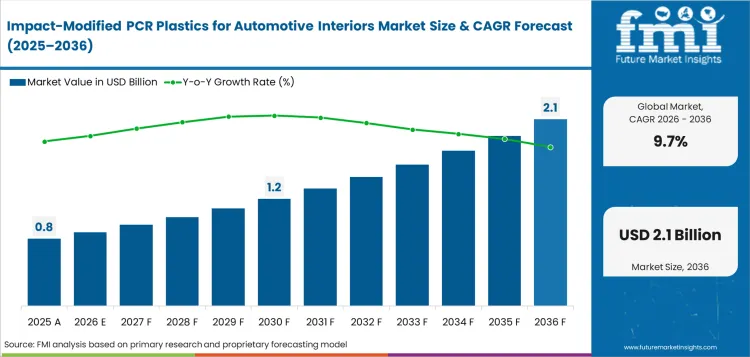
The impact-modified PCR plastics for automotive interiors market was valued at USD 692.8 million in 2025. The valuation is projected to reach USD 760.0 million by the end of 2026 and expand at a CAGR of 9.7% between 2026 and 2036 to reach USD 1.9 billion by 2036. Polypropylene is expected to lead the polymer type segment with 46.0% share in 2026. Console carriers are projected to lead the interior part segment with 28.0% share in 2026.
Summary of the Impact-Modified PCR Plastics for Automotive Interiors Market
- Demand and Expansion Drivers
- Automakers are testing recycled plastics in console carriers and door substrates, raising need for impact-modified PCR compounds.
- Demand for polypropylene continues because of low weight and known molding behavior across cabin structures.
- Wider use of console carriers supports PCR compound demand as automakers test recycled plastics in hidden structures.
- Electric vehicles support premium demand in automotive plastic applications exposed to sustainability checks.
- Product and Segment View
- Polypropylene is projected to account for 46.0% of polymer type in 2026 because of low density and stable processing.
- In interior segment, console carriers are expected to record 28.0% share in 2026 since hidden supports reduce surface risk.
- Elastomer blends are projected to capture 41.0% of impact modifier in 2026, as recycled resin needs toughness recovery.
- OEM programs are expected to contribute 52.0% of sales channel in 2026 through platform-level material approval.
- Geography and Competitive Outlook
- China is projected to record 11.4% CAGR during the forecast period, supported by EV output and local compounding strength.
- India is expected to advance at 10.8% CAGR by 2036 through vehicle output and localized supplier testing.
- Borealis and LyondellBasell hold stronger technical positions through recycled polypropylene grades and automotive compound supply programs.
- SABIC and Avient use circular polymer platforms and modifier chemistry for cabin part applications.
- Analyst Opinion
- Nikhil Kaitwade, Principal Consultant at FMI, states: “Demand from vehicles using recycled content without losing cabin durability supports adoption. These materials are preferred in interior applications because they help recycled polymers meet impact strength and molding needs. Automotive interiors raise the need for odor control and color stability. Repeatable part quality is another approval requirement. OEMs are using PCR plastics to support recycled content goals and reduce material carbon exposure. Future revenue prospects are projected to be driven by OEM-approved compounds used in console carriers and door panel substrates. End users need products able to handle heat and cabin wear. Repeated assembly stress also shapes material approval. Competitive advantage can be obtained from tested impact performance and stable recycled feedstock instead of broad sustainability claims.”
- Impact-Modified PCR Plastics for Automotive Interiors Market Value Analysis
- Polypropylene now serves interior programs needing lower weight and known molding performance across cabin parts.
- Console carriers are in demand as hidden structures allow recycled compounds without major surface appearance risk.
- OEM programs support recurring supplier access as automakers approve compounds during vehicle platform development.
- Adoption improves when suppliers prove recycled content and impact strength in the same interior compound.
- Price pressure is highest in mid-segment vehicles since modifier cost affects interior part approval.
Key Takeaways, Market Size, and Forecast
- Impact-modified PCR plastics for automotive interiors market valuation was USD 692.8 million in 2025.
- Revenue is expected to reach USD 1.9 billion by 2036.
- Sales expansion is forecast at 9.7% CAGR across 2026 to 2036.
- Incremental opportunity across 2026 to 2036 is USD 1.2 billion.
- Polypropylene is expected to lead polymer type demand with 46.0% share in 2026.
- China is projected to record 11.4% CAGR in impact-modified PCR plastics for automotive interiors through 2036.
- Console carriers are projected to account for 28.0% share in 2026.
Impact-modified PCR plastics for automotive interiors are expected to gain use as recycled-content rules tighten. In 2024, Hyundai and Kia filed a PCR-PP formulation using 15-55 wt% recycled PP with impact modifier support. Borealis also disclosed recycled PP blends with up to 60 wt% recycled content and elastomer modification. These filings show how OEMs are moving toward engineered recycled interior compounds. Odor and VOC control remain major qualification barriers for cabin parts. Demand is likely to favor PCR compounds that balance impact strength, surface finish and low-emission performance.
Impact-Modified PCR Plastics for Automotive Interiors Market Definition
Impact-modified PCR plastics for automotive interiors include recycled polymer compounds modified for cabin part strength. Scope includes polypropylene and ABS compounds used in dashboard trim and console carriers. Door panels and seat backs are covered separately. Impact modifiers include elastomer blends and rubber tougheners used to restore toughness in recycled resin. Products serve passenger cars and electric vehicles needing recycled content without weaker interior part performance.
Impact-Modified PCR Plastics for Automotive Interiors Market Inclusions
Market coverage includes all commercially traded impact-modified PCR plastics categorized by resin type, including PCR polypropylene, PCR polyethylene, PCR ABS, PCR polycarbonate, and PCR PET blends; modification type, including elastomer-modified, mineral-filled, compatibilized, reinforced, and flame-retardant grades; applications, including automotive interiors, appliance housings, electrical parts, packaging components, and consumer goods; and end users, including automotive, electronics, packaging, building products, and industrial manufacturing sectors. Revenue scope covers 2026 to 2036. Key stakeholders include PCR plastic compounders, recyclers, resin suppliers, additive and impact modifier producers, automotive component makers, electronics manufacturers, packaging converters, appliance companies, testing laboratories, distributors, sustainability certification bodies, and regulatory authorities.
Scope includes PCR polypropylene and PCR ABS. Polycarbonate and TPE compounds are included. Console carriers and dashboard trim are covered. Door panels and seat backs are within scope. OEM programs and Tier module supply are included for qualified automotive interior compounds.
Impact-Modified PCR Plastics for Automotive Interiors Market Exclusions
Scope excludes exterior bumper compounds and under-hood plastics. Virgin-only automotive polymers are outside scope. Bio-based plastics and natural fiber composites are excluded. Leather and textile trim are outside market scope. Foam seating materials are excluded separately.
Impact-Modified PCR Plastics for Automotive Interiors Market Research Methodology
- Primary Research: FMI analysts reviewed automotive compounders and Tier interior suppliers. OEM material teams and recycling specialists were reviewed separately. The research focused on impact strength and cabin approval cycles. It reviewed odor control and recycled feedstock stability needs.
- Desk Research: Desk research covered vehicle production statistics and recycled plastic policy data. Official circularity rules and automotive material publications helped define use exposure. Company releases and technical product literature defined compound scope. PCR-ready automotive PP compound and recycled polymer systems were reviewed separately.
- Market Sizing and Forecasting: The sizing model combined interior plastic demand and PCR compound penetration. Modifier loading and average compound value were considered after segment review. Forecasts were cross-checked with EV output and vehicle circularity rules. Country production and supplier presence were reviewed as separate checks.
- Data Validation: Validation compared company portfolios and public automotive production signals. End-use demand and interior technology patterns were checked separately. Forecasts were adjusted for recycled resin availability and vehicle platform changes in China. Europe and North America were reviewed separately.
Why the Impact-Modified PCR Plastics for Automotive Interiors Market is Growing?
- Vehicle circularity rules require higher recycled plastic use across new vehicle platforms.
- Cabin components create first demand pockets as hidden structures face lower appearance risk.
- Impact modifiers support recycled polypropylene use by improving toughness after resin reprocessing.
- Electric vehicle platforms increase recycled material trials across interiors and trim systems.
- OEM material teams standardize recycled compound validation to reduce part failure risk.
Recycled plastic rules are creating a larger demand base for modified PCR compounds in automotive interiors. European co-legislators agreed on minimum recycled plastic content of 15.0% within six years and 25.0% within ten years for new vehicle types, creating a direct material pull for recycled polymers in vehicle platforms. Interior parts benefit first since many cabin structures use moldable plastics and face controlled load conditions. Compounders need modifier packages that help recycled polymers pass impact tests. This factor pushes demand toward suppliers with proven interior-grade PCR compounds.
Automotive production scale creates another high-value sales opportunity for impact-modified recycled plastics. OICA reported global vehicle production of about 92.5 million units in 2024 across major producing regions. Production base increases revenue opportunity when more vehicle programs approve PCR compounds for console carriers and door panels. PCR compounds enter these systems through console supports and door panel substrates. Trim carriers create another application area. Tier suppliers need materials that process smoothly on existing molding lines. Companies with stable melt flow and odor performance can move faster through customer approval.
Market Segmentation Analysis
- Polypropylene segment is estimated to account for 46.0% share in 2026.
- In 2026, console carriers are expected to hold 28.0% share.
- Elastomer blends are anticipated to capture 41.0% of impact modifier demand in 2026.
- Passenger cars are projected to represent 61.0% of vehicle class in 2026.
- OEM programs are expected to contribute 52.0% of sales channel segment in 2026.
The market is divided into polymer type and interior part. Impact modifier and vehicle class are covered separately. Sales channel and region complete the segmentation view. Polymer type covers polypropylene and ABS. Polycarbonate and TPE are included as well. Interior part covers dashboard trim and console carriers. Door panels and seat backs are covered. Impact modifier includes elastomer blends and rubber tougheners. Compatibilizers and mineral fillers are included. Vehicle class includes passenger cars and electric vehicles. Light commercial vehicles are included. Sales channel includes OEM programs and Tier modules. Compounder sales and replacement parts are covered as separate supply uses.
Insights into the Polypropylene Polymer Type Segment
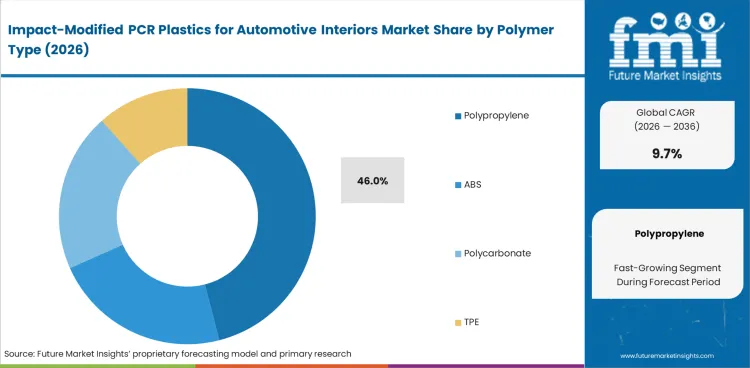
- In 2026, polypropylene is projected to account for 46.0% of polymer type demand as low weight and molding familiarity support approval.
- ABS serves visible trim uses needing better surface finish. Polypropylene covers broader hidden structures and larger molded cabin parts.
Insights into the Console Carriers Interior Part Segment
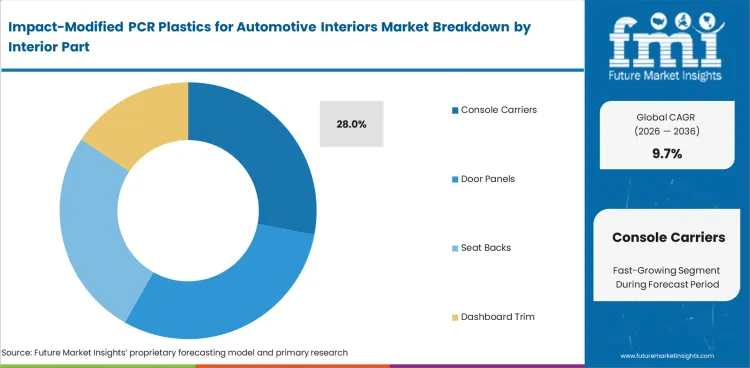
- Console carriers are expected to represent 28.0% of interior part in 2026 due to hidden placement and stable part geometry.
- Dashboard trim requires stronger color control and surface quality. Console carriers allow earlier PCR use in support structures behind visible layers.
Insights into the Elastomer Blends Impact Modifier Segment
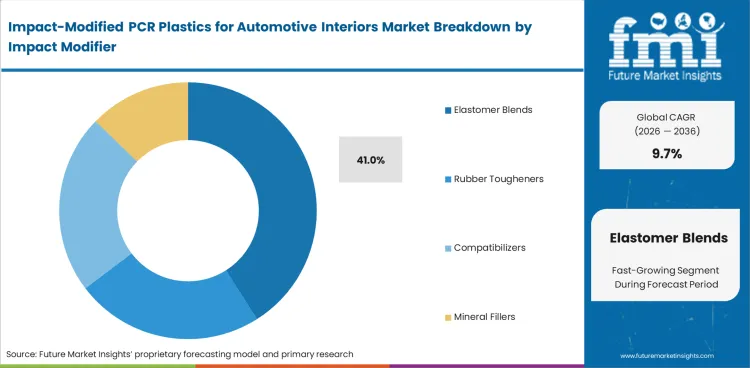
- Elastomer blends are anticipated to represent 41.0% of impact modifier in 2026 since recycled polymers need toughness recovery.
- Rubber tougheners support colder use conditions. Compatibilizers serve mixed resin streams needing better bonding during compounding.
Insights into the Passenger Cars Vehicle Class Segment
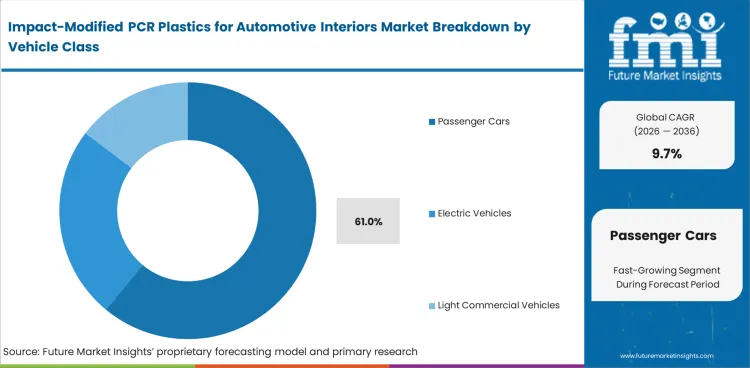
- Passenger cars are projected to account for 61.0% of vehicle class demand in 2026 as cabin part counts support material volume.
- Electric vehicle demand is rising as cabin sustainability claims increase interest in lightweight polymers.
Insights into the OEM Programs Sales Channel Segment
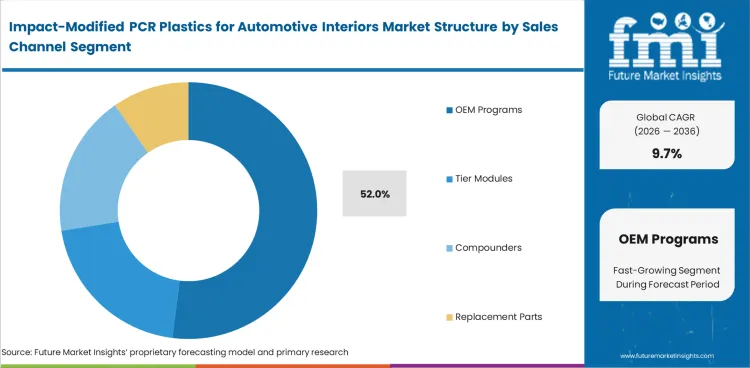
- OEM programs are expected to hold 52.0% share in 2026, supported by factory validation and platform approval.
- Tier modules follow OEM programs since recycled compound use needs approved specifications before interior assembly contracts.
Impact-Modified PCR Plastics for Automotive Interiors Market Drivers, Restraints, and Opportunities
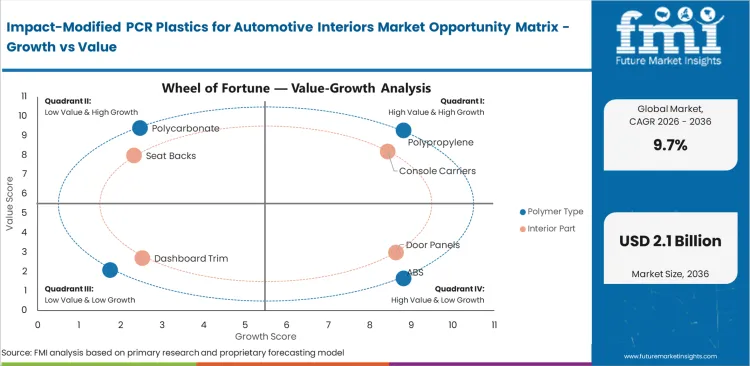
- Recycled plastic content rules raise demand for compounds able to pass automotive cabin testing.
- EV cabin redesign supports PCR compound use as automakers refresh interiors during platform updates.
- Feedstock variation is a restraint since odor and color drift can delay OEM approval.
- Closed-loop vehicle plastics create opportunity for suppliers with recovery and compounding control.
- Interior lightweighting supports polypropylene demand as cabin parts need lower mass and stable molding.
Recycled Content Mandates
Vehicle circularity regulation creates demand for automotive-grade PCR plastics with measurable recycled content. The EU agreement on end-of-life vehicle rules introduces phased recycled plastic targets for new vehicle types. These targets make recycled compounds a purchasing issue instead of a marketing claim. Interior suppliers can use closed-loop recycled polymers in parts with suitable performance limits. Impact modifiers become important as recycled resin needs strength recovery after sorting and reprocessing. Suppliers with material traceability and test data can defend higher value in OEM programs.
Interior Impact Approval
Impact approval guides compound selection because cabin parts face assembly stress and long service exposure. Borealis introduced Borcycle GD3600SY in June 2024 with 65.0% post-consumer recycled polymer content. The grade is a glass-fiber reinforced polypropylene compound designed for demanding automotive applications. The development indicates recycled PP can move into higher-value interior structures after proper reinforcement. Companies still need proof around odor and repeated part performance. Suppliers with validated automotive interior plastic components data can shorten approval discussions.
EV Cabin Redesign Opportunity
Electric vehicle interiors create new opportunities for PCR compounds in trim supports and hidden console carriers. Automakers use cabin materials to support sustainability claims beside battery efficiency claims. Automotive bioplastic products participate in this space, but PCR compounds support circular material targets directly. Impact-modified PCR plastics gain value if they meet heat and impact needs. EV programs allow suppliers to qualify new compounds during platform refreshes, improving the chance of moving PCR content from trial parts into repeated production.
Flammability Proof Is Tightening Interior Approval
For impact-modified PCR plastics used in automotive interiors, flammability proof and material traceability shape approval. NHTSA’s May 30, 2025 laboratory test procedure references FMVSS 302 flammability testing under S302 sections. The procedure also lists the FMVSS No. 213a mandatory compliance date as June 30, 2025. These references support a narrower point: interior material claims need fire-performance evidence before platform approval. OEMs are expected to ask for lot-level traceability and flammability records before using recycled-content compounds in cabin parts.
Analysis of Impact-Modified PCR Plastics for Automotive Interiors Market By Key Countries
.webp "Top Country Growth Comparison Impact Modified Pcr Plastics For Automotive Interiors Market Cagr (2026 2036)")
| Country | CAGR |
|---|---|
| China | 11.4% |
| India | 10.8% |
| Germany | 9.8% |
| United States | 9.3% |
| Japan | 8.7% |
| South Korea | 8.5% |
| Mexico | 8.2% |
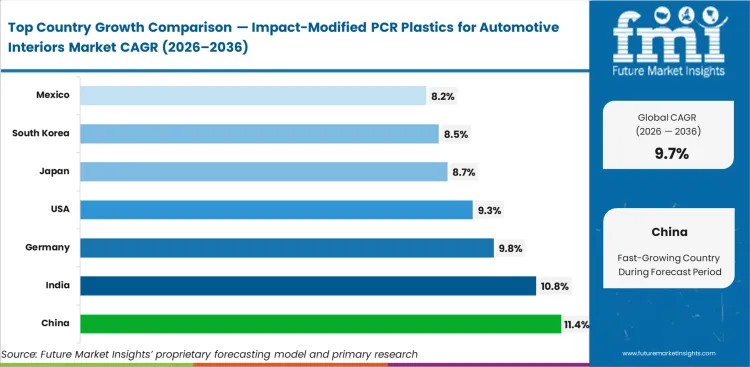
Source: FMI analysis based on primary research and proprietary forecasting model.
Impact-Modified PCR Plastics for Automotive Interiors CAGR Analysis By Country
- China is projected to progress at a CAGR of 11.4% by 2036
- India is projected to record a CAGR of 10.8% through 2036
- Germany is forecast to record a CAGR of 9.8% during the assessment period
- The United States is anticipated to expand at a CAGR of 9.3% over the forecast period.
- Japan is projected to post a CAGR of 8.7% by 2036.
- South Korea is expected to advance at a CAGR of 8.5% through 2036.
- Mexico is expected to register a CAGR of 8.2% during the forecast period.
Demand Outlook for Impact-Modified PCR Plastics for Automotive Interiors in China
China’s position reflects vehicle output scale and EV cabin redesign. Both areas support faster approval for recycled interior plastics. OICA placed China as the largest vehicle producer in 2024 through country-level production reporting, creating repeated opportunities for PCR compound trials across console carriers and door panel substrates. Local EV platforms require higher sustainability content and faster material updates. China is projected at 11.4% CAGR through 2036 with EV programs and compounding supply supporting interior PCR use. Local suppliers obtain orders if shorter validation cycles and lower service cost match automaker needs.
- Guangdong EV clusters support recycled interior material demand across electronics and vehicle assembly chains.
- Shanghai premium EV activity creates cabin material demand through smart cockpit design teams.
- Chongqing and Hubei auto plants drive repeat need for qualified molded interior suppliers.
Sales Analysis of Impact-Modified PCR Plastics for Automotive Interiors in India
India is expected to expand at 10.8% CAGR through 2036 with vehicle output and localized compounding supporting demand. India’s demand base reflects passenger vehicle upgrades and cost-sensitive interiors. OICA country data placed India among the largest vehicle producers in 2024, reflecting direct opportunity for PCR compounds across higher-volume cabin structures. Electric cars and premium SUVs create early demand for recycled interior materials. Companies often balance impact performance with price limits in India. Manufacturer opportunity improves if local technical support matches automaker schedules.
- Pune and Chennai supplier clusters support interior module demand across passenger vehicle platforms.
- Gujarat recycling capacity aids PCR feedstock supply near western automotive manufacturing belts.
- Haryana automotive clusters support material qualification through Maruti Suzuki and supplier networks.
Demand Analysis of Impact-Modified PCR Plastics for Automotive Interiors in Germany
Germany demand is shaped by EU recycled content rules and premium vehicle engineering standards. ACEA reported in April 2026 that Germany produced 21.0% of cars sold in the EU in 2025. This production role raises the importance of Germany OEM approvals in recycled cabin plastics. Germany companies prioritize documentation and low odor. Stable surface quality remains another purchase requirement. Advanced automotive materials suppliers gain interest if recycled content does not weaken cabin part performance. Approval speed improves only as recycled feedstock consistency strengthens across compound batches.
- Bavaria supports premium vehicle programs through BMW and related interior supplier networks.
- Baden-Württemberg strengthens Mercedes-Benz and Porsche programs needing tighter material validation.
- Lower Saxony reinforces Volkswagen platforms with broad scale across mass-premium interiors.
Opportunity Analysis of Impact-Modified PCR Plastics for Automotive Interiors in the United States
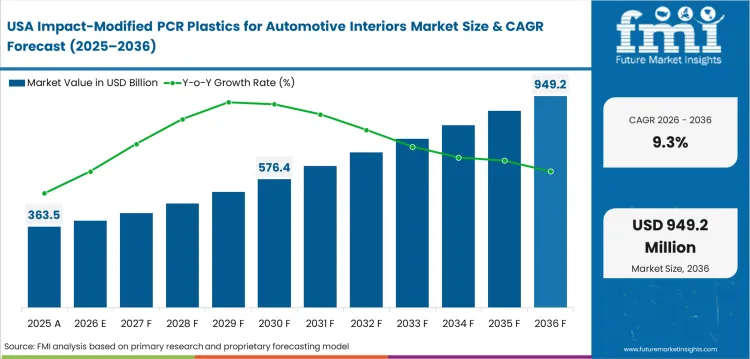
The United States has high demand from light trucks and SUVs. Electric vehicle programs create another demand source. OEM sustainability targets create interest in recycled cabin materials across selected platforms. EPA plastics data updated in March 2026 reported 35.7 million tons of plastics generation for 2018. The large waste base highlights feedstock potential, even as automotive‑grade sorting remains challenging. US suppliers need better separation and compound certification for cabin use. OEM programs with long supplier relationships create better sales opportunities for recycled interior compounds. Feedstock quality decides movement beyond pilot lots.
- Michigan engineering centers support material approval for Detroit automaker interior programs.
- Tennessee EV investments create cabin material opportunities around new assembly capacity.
- California EV programs aid recycled material claims across premium electric interiors.
Future Outlook for Impact-Modified PCR Plastics for Automotive Interiors in Japan
Japan’s market reflects tight precision requirements and strict qualification. Cautious material substitution slows wider PCR use. OICA data places Japan among leading global vehicle producers in 2024 despite output pressure, creating a sizeable cabin plastics base but slower PCR approval. Japan-based OEMs prefer compounds with strict odor control and tight color stability. PCR materials enter premium trims and hidden interior supports before wider cabin use. Japan is projected to rise at 8.7% CAGR through 2036 as careful validation supports stable sales. Suppliers must prove batch repeatability across heat and abrasion testing cycles.
- Aichi automotive clusters support recycled interior material trials across Toyota-linked programs.
- Kanagawa enables Nissan engineering and supplier collaboration for cockpit material systems.
- Shizuoka and Kyushu production bases support molded cabin plastics across established platforms.
Demand Outlook for Impact-Modified PCR Plastics for Automotive Interiors in South Korea
South Korea demand is shaped by export-focused automakers and cabin electronics. Hyundai and Kia platforms create demand for interior materials accepted across global vehicle lines. OICA listed South Korea among major vehicle producers in 2024 industry reporting. Companies’ production position supports PCR compound qualification for Europe and North America. South Korea is forecast to expand at 8.5% CAGR during the forecast period through export vehicle programs. Impact-modified PCR compounds serve these models through durability and recycled content support. Suppliers need low-odor data and reliable part testing to pass purchase checks.
- Ulsan supports Hyundai output and interior supplier activity across global vehicle programs.
- Gyeonggi Province aids electronics and cockpit suppliers serving cabin development.
- Busan logistics access helps export vehicle chains needing stable component delivery schedules.
In-depth Analysis of Impact-Modified PCR Plastics for Automotive Interiors in Mexico
Mexico’s opportunity depends on North America OEM programs and Tier interior production. OICA reporting places Mexico among the main vehicle producers in 2024 with output linked to export platforms. PCR compound use follows material approvals from US and Germany automaker programs. Mexican suppliers can grow volume if recycled compounds enter platform bills of material. Local molding capacity helps scale parts after qualification. Mexico is expected to register 8.2% CAGR through 2036 as regional sourcing supports interior part production. The main constraint is limited automotive-grade PCR feedstock control.
- Puebla and Guanajuato support interior component demand for export vehicle programs.
- Nuevo León supplier activity strengthens access to molded plastics and Tier assemblies.
- USMCA sourcing rules support regional discipline for automotive interior components.
Competitive Landscape and Strategic Positioning
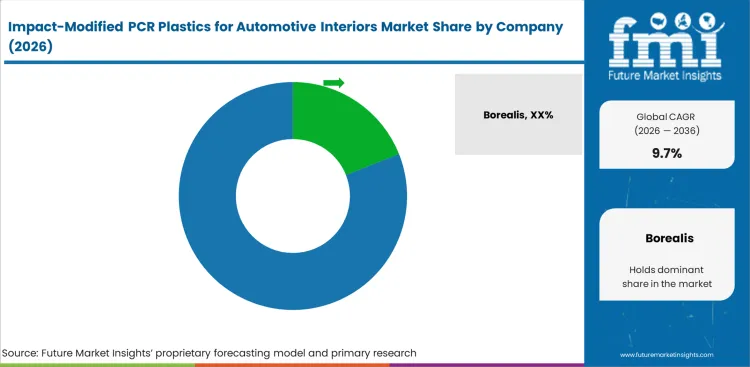
- The market is moderately concentrated with global polymer companies controlling automotive-grade PCR compound know-how.
- Smaller suppliers differentiate through local feedstock access and custom impact modifier packages.
- Barriers to entry include traceability and odor testing. OEM approval history raises the entry threshold.
- Regional compounders can win local vehicle programs if technical service and compound quality meet automaker needs.
Competitive strength begins with proof of recycled polymer performance across interior parts. Automakers test impact behavior and odor profile before approving suppliers. Color stability and melt flow consistency decide final qualification. Borealis’ June 2024 Borcycle GD3600SY launch indicates demand for glass-fiber reinforced PCR PP in automotive interiors. The development indicates approved suppliers can secure repeat work after technical qualification. In passenger cars and electric vehicles, compound failure can create warranty exposure. Suppliers with test records and compound control win repeat access in long-cycle OEM accounts.
Established companies benefit from product breadth across recycled polymers and automotive compounds. Polypropylene and ABS workflows create demand for plastic compounding strength. LyondellBasell supports durable-goods recycling through its Germany center for automotive and appliance plastics. SABIC participates through circular polymer platforms and global mobility customer access. BASF and Covestro support interior material needs through engineering polymer expertise. These companies can support resin selection through final part approval. That service range reduces switching risk for vehicle makers using recycled cabin plastics.
Specialist compounders win orders through focused modifier chemistry and faster testing support. Avient’s recycled-content thermoplastic elastomer launch with up to 60.0% PCR content points to more focused supplier work on flexible recycled materials. Soft-touch inserts and smaller cabin components create extra demand. Specialist vendors perform better in accounts needing color control or modified material behavior. Larger vendors may form partnerships to secure recycled feedstock and cabin testing capability. Recycled carbon fiber and recycled polymer systems may serve selected lightweight interior programs.
Entry is difficult as recycled interior compounds must work inside existing vehicle approval systems. Compatibility with molding lines and interior performance tests creates a technical hurdle for new entrants. A supplier can produce recycled resin but fail purchase checks on odor or impact strength. Premium and EV customers need durability data across heat exposure and assembly stress. Automotive sector buyers need support knowledge for material qualification and part design. The strongest suppliers combine compound reliability with application support during specification.
Key Companies in the Impact-Modified PCR Plastics for Automotive Interiors Market
Impact-modified PCR plastic competition includes global polymer suppliers, specialty compounders and regional recycled material suppliers.
Global Polymer Suppliers
Borealis and LyondellBasell strengthen positioning through recycled polyolefin strength and automotive compound programs. Borealis supports interior applications through glass-fiber reinforced PCR polypropylene. LyondellBasell supports recycled material supply through durable-goods recycling and CirculenRecover materials. SABIC supports mobility customers through TRUCIRCLE circular polymer platforms and engineering material access.
Specialty Compounders
Avient and Trinseo maintain advantage through modifier chemistry and custom compounding support. Avient supports recycled-content elastomers across transportation applications. Trinseo supports recycled polymer and engineered material needs in selected automotive uses. Their advantage is highest in programs needing color control and impact recovery. Cabin-specific performance checks increase their value.
Regional Recycled Material Suppliers
Ravago and MBA Polymers participate through recycling access. Veolia serves regional recycled material supply. Ravago supports compound distribution and polymer services across several regions. MBA Polymers has recycled plastic recovery strength. Veolia supports waste processing and recycled feedstock supply. These companies gain preference when automakers need regional recycled feedstock and tested compounding partners.
Competitive Benchmarking: Impact-Modified PCR Plastics for Automotive Interiors Market
| Company | PCR Feedstock Strength | Interior Impact Support | OEM Material Access | Geographic Footprint |
|---|---|---|---|---|
| Borealis | High | High | High | Global |
| LyondellBasell | High | High | High | Global |
| SABIC | High | High | High | Global |
| Avient | Medium | High | High | Global |
| BASF | Medium | High | High | Global |
| Covestro | Medium | Medium | High | Global |
| Trinseo | Medium | Medium | Moderate | Europe and North America |
| Ravago | Medium | Medium | Moderate | Europe and North America |
| MBA Polymers | High | Medium | Moderate | Europe and Asia |
| Veolia | High | Low | Moderate | Global |
Source: Future Market Insights competitive analysis, 2026. Ratings reflect relative positioning based on PCR Feedstock Strength and Interior Impact Support. OEM Material Access is assessed separately.
Key Developments in Impact-Modified PCR Plastics for Automotive Interiors Market
- In June 2024, Borealis introduced Borcycle GD3600SY with 65.0% PCR polymer content, supporting higher recycled PP use in demanding automotive interiors.
- In September 2024, LyondellBasell invested in a Germany recycling center for automotive and appliance plastics, supporting durable recycled feedstock for interior components.
- In October 2024, Avient launched recycled-content thermoplastic elastomers with up to 60.0% PCR content, supporting flexible cabin components needing recycled material performance.
- In October 2025, SABIC presented material solutions under its TRUCIRCLE portfolio at K 2025, supporting circular polymer use across mobility applications.
Key Players in the Impact-Modified PCR Plastics for Automotive Interiors Market
Global Polymer Suppliers
- Borealis
- LyondellBasell
- SABIC
- BASF
- Covestro
Specialty Compounders
- Avient
- Trinseo
Regional Recycled Material Suppliers
- Ravago
- MBA Polymers
- Veolia
Report Scope and Coverage
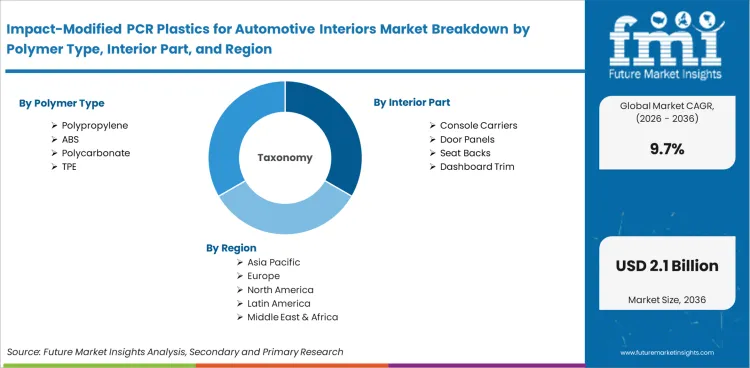
Impact-Modified PCR Plastics for Automotive Interiors Market Breakdown By Polymer Type, Interior Part, Impact Modifier, Vehicle Class, Sales Channel and Region
| Parameter | Details |
|---|---|
| Quantitative Units | USD 760.0 million in 2026 to USD 1.9 billion by 2036. CAGR is forecast at 9.7%. |
| Market Definition | Impact-modified post-consumer recycled plastic compounds used in molded automotive interior components |
| Regions Covered | North America and Latin America are covered. Europe and East Asia are covered. South Asia and Pacific is covered. Middle East and Africa is covered. |
| Countries Covered | China and India are covered. Germany and the United States are covered. Japan and South Korea are covered. Mexico and 30+ countries are covered. |
| Companies Profiled | Borealis and LyondellBasell are profiled. SABIC and Avient are profiled. BASF and Covestro are profiled. Trinseo is profiled separately. |
| Forecast Period | 2026 to 2036 |
| Approach | Hybrid bottom-up and top-down method using vehicle production and interior plastic demand. PCR penetration and country demand checks are reviewed separately. |
Impact-Modified PCR Plastics for Automotive Interiors by Segments
Impact-Modified PCR Plastics for Automotive Interiors Market Segmented by Polymer Type:
- Polypropylene
- ABS
- Polycarbonate
- TPE
Impact-Modified PCR Plastics for Automotive Interiors Market Segmented by Interior Part:
- Dashboard Trim
- Console Carriers
- Door Panels
- Seat Backs
Impact-Modified PCR Plastics for Automotive Interiors Market Segmented by Impact Modifier:
- Elastomer Blends
- Rubber Tougheners
- Compatibilizers
- Mineral Fillers
Impact-Modified PCR Plastics for Automotive Interiors Market Segmented by Vehicle Class:
- Passenger Cars
- Electric Vehicles
- Light Commercial Vehicles
Impact-Modified PCR Plastics for Automotive Interiors Market Segmented by Sales Channel:
- OEM Programs
- Tier Modules
- Compounders
- Replacement Parts
Impact-Modified PCR Plastics for Automotive Interiors Market by Region:
- North America
- United States
- Canada
- Mexico
- Latin America
- Brazil
- Chile
- Rest of Latin America
- Western Europe
- Germany
- UK
- Italy
- Spain
- France
- Nordic
- BENELUX
- Rest of Western Europe
- Eastern Europe
- Russia
- Poland
- Hungary
- Balkan and Baltic
- Rest of Eastern Europe
- East Asia
- China
- Japan
- South Korea
- South Asia and Pacific
- India
- ASEAN
- Australia and New Zealand
- Rest of South Asia and Pacific
- Middle East and Africa
- Kingdom of Saudi Arabia
- Other GCC Countries
- Turkiye
- South Africa
- Other African Union
- Rest of Middle East and Africa
Research Sources and Bibliography
- National Highway Traffic Safety Administration. (2025, May 30). Laboratory Test Procedure for FMVSS No. 213 Child Restraint Systems, FMVSS No. 213a Child Restraint Systems - Side Impact Protection, and FMVSS No. 213b Child Restraint Systems.
- European Parliament. (2025, December 12). Circular economy: Deal on new EU rules for the automotive sector. European Parliament.
- International Organization of Motor Vehicle Manufacturers. (2025, October). World motor vehicle production by country and region 2024. OICA.
- European Automobile Manufacturers’ Association. (2026, April). Economic and market report: Global and EU auto industry full year 2025. ACEA.
- United States Environmental Protection Agency. (2026, March). Plastics: Material-specific data. EPA.
- Plastics Europe. (2024). The circular economy for plastics: A European analysis 2024. Plastics Europe.
- Borealis. (2024, June 20). Borealis introduces glass-fiber reinforced PP with 65% PCR for demanding automotive applications. Borealis Group.
- LyondellBasell. (2024, September 10). LyondellBasell tackles end-of-life challenges in durable goods by investing in a new recycling center in Germany. LyondellBasell.
- Avient. (2024, October 15). Avient launches new recycled-content thermoplastic elastomers and metallic effect sulfone solutions at Fakuma 2024. Avient Corporation.
- SABIC. (2025, October). SABIC unveils advanced material solutions at K 2025 to shape everyday products. SABIC.
- Borealis. (2024). Borcycle GD3600SY product catalogue. Borealis Group.
The bibliography is provided for reader reference and uses trade body data, regulatory publications and official company sources.
This Report Answers
- Which value is projected for impact-modified PCR plastics for automotive interiors in 2026 and 2036?
- Which CAGR is forecast for impact-modified PCR plastics for automotive interiors between 2026 and 2036?
- Which polymer type is projected to lead automotive interior PCR compound demand in 2026?
- Which interior part is expected to account for the highest share in 2026?
- Which countries are forecast to record faster PCR interior plastics expansion through 2036?
- Which companies hold stronger technical positions in recycled automotive compounds and modifier systems?
- Which product types are included and excluded from this automotive interior plastics scope?
- Which vehicle classes shape recycled material validation and factory program demand?
- Which method supports FMI’s market size and country-level forecast view?
Frequently Asked Questions
Which value is projected for impact-modified PCR plastics for automotive interiors in 2026?
For 2026, the global market is expected to be worth USD 760.0 million through wider OEM interior use.
Which value is projected for the market by 2036?
By 2036 valuation is projected to reach USD 1.9 billion as PCR compound use expands.
Which CAGR is expected for the market between 2026 and 2036?
The market is forecast to expand at 9.7% CAGR between 2026 and 2036 across automotive interior applications.
Which polymer type is projected to lead in 2026?
Polypropylene is projected to account for 46.0% share in 2026 through broad molded interior use.
Which interior part is expected to lead in 2026?
Console carriers are expected to represent 28.0% share in 2026 because of hidden structural placement.
Which country is forecast to expand fastest through 2036?
China is projected to record 11.4% CAGR through 2036 as EV output supports recycled interior compounds.
Which products are included in this market?
The scope includes impact-modified PCR compounds used in dashboard trim and console carriers. Door panels and seat backs are covered separately.
Which method is used for the forecast?
FMI used vehicle production and interior plastic demand to validate the forecast. PCR penetration and modifier pricing were checked separately.
Preview the report firsthand - request a free sample
Get SampleGet the brochure for pricing and purchase details.
Get PDFTable of Content
- Executive Summary
- Global Market Outlook
- Demand-side Trends
- Supply-side Trends
- Technology Roadmap Analysis
- Analysis and Recommendations
- Market Overview
- Market Coverage / Taxonomy
- Market Definition / Scope / Limitations
- Research Methodology
- Chapter Orientation
- Analytical Lens and Working Hypotheses
- Market Structure, Signals, and Trend Drivers
- Benchmarking and Cross-market Comparability
- Market Sizing, Forecasting, and Opportunity Mapping
- Research Design and Evidence Framework
- Desk Research Programme (Secondary Evidence)
- Company Annual and Sustainability Reports
- Peer-reviewed Journals and Academic Literature
- Corporate Websites, Product Literature, and Technical Notes
- Earnings Decks and Investor Briefings
- Statutory Filings and Regulatory Disclosures
- Technical White Papers and Standards Notes
- Trade Journals, Industry Magazines, and Analyst Briefs
- Conference Proceedings, Webinars, and Seminar Materials
- Government Statistics Portals and Public Data Releases
- Press Releases and Reputable Media Coverage
- Specialist Newsletters and Curated Briefings
- Sector Databases and Reference Repositories
- FMI Internal Proprietary Databases and Historical Market Datasets
- Subscription Datasets and Paid Sources
- Social Channels, Communities, and Digital Listening Inputs
- Additional Desk Sources
- Expert Input and Fieldwork (Primary Evidence)
- Primary Modes
- Qualitative Interviews and Expert Elicitation
- Quantitative Surveys and Structured Data Capture
- Blended Approach
- Why Primary Evidence is Used
- Field Techniques
- Interviews
- Surveys
- Focus Groups
- Observational and In-context Research
- Social and Community Interactions
- Stakeholder Universe Engaged
- C-suite Leaders
- Board Members
- Presidents and Vice Presidents
- R&D and Innovation Heads
- Technical Specialists
- Domain Subject-matter Experts
- Scientists
- Physicians and Other Healthcare Professionals
- Governance, Ethics, and Data Stewardship
- Research Ethics
- Data Integrity and Handling
- Primary Modes
- Tooling, Models, and Reference Databases
- Desk Research Programme (Secondary Evidence)
- Data Engineering and Model Build
- Data Acquisition and Ingestion
- Cleaning, Normalisation, and Verification
- Synthesis, Triangulation, and Analysis
- Quality Assurance and Audit Trail
- Market Background
- Market Dynamics
- Drivers
- Restraints
- Opportunity
- Trends
- Scenario Forecast
- Demand in Optimistic Scenario
- Demand in Likely Scenario
- Demand in Conservative Scenario
- Opportunity Map Analysis
- Product Life Cycle Analysis
- Supply Chain Analysis
- Investment Feasibility Matrix
- Value Chain Analysis
- PESTLE and Porter’s Analysis
- Regulatory Landscape
- Regional Parent Market Outlook
- Production and Consumption Statistics
- Import and Export Statistics
- Market Dynamics
- Global Market Analysis 2021 to 2025 and Forecast, 2026 to 2036
- Historical Market Size Value (USD Million) Analysis, 2021 to 2025
- Current and Future Market Size Value (USD Million) Projections, 2026 to 2036
- Y-o-Y Growth Trend Analysis
- Absolute $ Opportunity Analysis
- Global Market Pricing Analysis 2021 to 2025 and Forecast 2026 to 2036
- Global Market Analysis 2021 to 2025 and Forecast 2026 to 2036, By Polymer Type
- Introduction / Key Findings
- Historical Market Size Value (USD Million) Analysis By Polymer Type , 2021 to 2025
- Current and Future Market Size Value (USD Million) Analysis and Forecast By Polymer Type , 2026 to 2036
- Polypropylene
- ABS
- Polycarbonate
- TPE
- Polypropylene
- Y-o-Y Growth Trend Analysis By Polymer Type , 2021 to 2025
- Absolute $ Opportunity Analysis By Polymer Type , 2026 to 2036
- Global Market Analysis 2021 to 2025 and Forecast 2026 to 2036, By Interior Part
- Introduction / Key Findings
- Historical Market Size Value (USD Million) Analysis By Interior Part, 2021 to 2025
- Current and Future Market Size Value (USD Million) Analysis and Forecast By Interior Part, 2026 to 2036
- Console Carriers
- Door Panels
- Seat Backs
- Dashboard Trim
- Console Carriers
- Y-o-Y Growth Trend Analysis By Interior Part, 2021 to 2025
- Absolute $ Opportunity Analysis By Interior Part, 2026 to 2036
- Global Market Analysis 2021 to 2025 and Forecast 2026 to 2036, By Impact Modifier
- Introduction / Key Findings
- Historical Market Size Value (USD Million) Analysis By Impact Modifier, 2021 to 2025
- Current and Future Market Size Value (USD Million) Analysis and Forecast By Impact Modifier, 2026 to 2036
- Elastomer Blends
- Rubber Tougheners
- Compatibilizers
- Mineral Fillers
- Elastomer Blends
- Y-o-Y Growth Trend Analysis By Impact Modifier, 2021 to 2025
- Absolute $ Opportunity Analysis By Impact Modifier, 2026 to 2036
- Global Market Analysis 2021 to 2025 and Forecast 2026 to 2036, By Vehicle Class
- Introduction / Key Findings
- Historical Market Size Value (USD Million) Analysis By Vehicle Class, 2021 to 2025
- Current and Future Market Size Value (USD Million) Analysis and Forecast By Vehicle Class, 2026 to 2036
- Passenger Cars
- Electric Vehicles
- Light Commercial Vehicles
- Passenger Cars
- Y-o-Y Growth Trend Analysis By Vehicle Class, 2021 to 2025
- Absolute $ Opportunity Analysis By Vehicle Class, 2026 to 2036
- Global Market Analysis 2021 to 2025 and Forecast 2026 to 2036, By Sales Channel
- Introduction / Key Findings
- Historical Market Size Value (USD Million) Analysis By Sales Channel, 2021 to 2025
- Current and Future Market Size Value (USD Million) Analysis and Forecast By Sales Channel, 2026 to 2036
- OEM Programs
- Tier Modules
- Compounders
- Replacement Parts
- OEM Programs
- Y-o-Y Growth Trend Analysis By Sales Channel, 2021 to 2025
- Absolute $ Opportunity Analysis By Sales Channel, 2026 to 2036
- Global Market Analysis 2021 to 2025 and Forecast 2026 to 2036, By Region
- Introduction
- Historical Market Size Value (USD Million) Analysis By Region, 2021 to 2025
- Current Market Size Value (USD Million) Analysis and Forecast By Region, 2026 to 2036
- North America
- Latin America
- Western Europe
- Eastern Europe
- East Asia
- South Asia and Pacific
- Middle East & Africa
- Market Attractiveness Analysis By Region
- North America Market Analysis 2021 to 2025 and Forecast 2026 to 2036, By Country
- Historical Market Size Value (USD Million) Trend Analysis By Market Taxonomy, 2021 to 2025
- Market Size Value (USD Million) Forecast By Market Taxonomy, 2026 to 2036
- By Country
- USA
- Canada
- Mexico
- By Polymer Type
- By Interior Part
- By Impact Modifier
- By Vehicle Class
- By Sales Channel
- By Country
- Market Attractiveness Analysis
- By Country
- By Polymer Type
- By Interior Part
- By Impact Modifier
- By Vehicle Class
- By Sales Channel
- Key Takeaways
- Latin America Market Analysis 2021 to 2025 and Forecast 2026 to 2036, By Country
- Historical Market Size Value (USD Million) Trend Analysis By Market Taxonomy, 2021 to 2025
- Market Size Value (USD Million) Forecast By Market Taxonomy, 2026 to 2036
- By Country
- Brazil
- Chile
- Rest of Latin America
- By Polymer Type
- By Interior Part
- By Impact Modifier
- By Vehicle Class
- By Sales Channel
- By Country
- Market Attractiveness Analysis
- By Country
- By Polymer Type
- By Interior Part
- By Impact Modifier
- By Vehicle Class
- By Sales Channel
- Key Takeaways
- Western Europe Market Analysis 2021 to 2025 and Forecast 2026 to 2036, By Country
- Historical Market Size Value (USD Million) Trend Analysis By Market Taxonomy, 2021 to 2025
- Market Size Value (USD Million) Forecast By Market Taxonomy, 2026 to 2036
- By Country
- Germany
- UK
- Italy
- Spain
- France
- Nordic
- BENELUX
- Rest of Western Europe
- By Polymer Type
- By Interior Part
- By Impact Modifier
- By Vehicle Class
- By Sales Channel
- By Country
- Market Attractiveness Analysis
- By Country
- By Polymer Type
- By Interior Part
- By Impact Modifier
- By Vehicle Class
- By Sales Channel
- Key Takeaways
- Eastern Europe Market Analysis 2021 to 2025 and Forecast 2026 to 2036, By Country
- Historical Market Size Value (USD Million) Trend Analysis By Market Taxonomy, 2021 to 2025
- Market Size Value (USD Million) Forecast By Market Taxonomy, 2026 to 2036
- By Country
- Russia
- Poland
- Hungary
- Balkan & Baltic
- Rest of Eastern Europe
- By Polymer Type
- By Interior Part
- By Impact Modifier
- By Vehicle Class
- By Sales Channel
- By Country
- Market Attractiveness Analysis
- By Country
- By Polymer Type
- By Interior Part
- By Impact Modifier
- By Vehicle Class
- By Sales Channel
- Key Takeaways
- East Asia Market Analysis 2021 to 2025 and Forecast 2026 to 2036, By Country
- Historical Market Size Value (USD Million) Trend Analysis By Market Taxonomy, 2021 to 2025
- Market Size Value (USD Million) Forecast By Market Taxonomy, 2026 to 2036
- By Country
- China
- Japan
- South Korea
- By Polymer Type
- By Interior Part
- By Impact Modifier
- By Vehicle Class
- By Sales Channel
- By Country
- Market Attractiveness Analysis
- By Country
- By Polymer Type
- By Interior Part
- By Impact Modifier
- By Vehicle Class
- By Sales Channel
- Key Takeaways
- South Asia and Pacific Market Analysis 2021 to 2025 and Forecast 2026 to 2036, By Country
- Historical Market Size Value (USD Million) Trend Analysis By Market Taxonomy, 2021 to 2025
- Market Size Value (USD Million) Forecast By Market Taxonomy, 2026 to 2036
- By Country
- India
- ASEAN
- Australia & New Zealand
- Rest of South Asia and Pacific
- By Polymer Type
- By Interior Part
- By Impact Modifier
- By Vehicle Class
- By Sales Channel
- By Country
- Market Attractiveness Analysis
- By Country
- By Polymer Type
- By Interior Part
- By Impact Modifier
- By Vehicle Class
- By Sales Channel
- Key Takeaways
- Middle East & Africa Market Analysis 2021 to 2025 and Forecast 2026 to 2036, By Country
- Historical Market Size Value (USD Million) Trend Analysis By Market Taxonomy, 2021 to 2025
- Market Size Value (USD Million) Forecast By Market Taxonomy, 2026 to 2036
- By Country
- Kingdom of Saudi Arabia
- Other GCC Countries
- Turkiye
- South Africa
- Other African Union
- Rest of Middle East & Africa
- By Polymer Type
- By Interior Part
- By Impact Modifier
- By Vehicle Class
- By Sales Channel
- By Country
- Market Attractiveness Analysis
- By Country
- By Polymer Type
- By Interior Part
- By Impact Modifier
- By Vehicle Class
- By Sales Channel
- Key Takeaways
- Key Countries Market Analysis
- USA
- Pricing Analysis
- Market Share Analysis, 2025
- By Polymer Type
- By Interior Part
- By Impact Modifier
- By Vehicle Class
- By Sales Channel
- Canada
- Pricing Analysis
- Market Share Analysis, 2025
- By Polymer Type
- By Interior Part
- By Impact Modifier
- By Vehicle Class
- By Sales Channel
- Mexico
- Pricing Analysis
- Market Share Analysis, 2025
- By Polymer Type
- By Interior Part
- By Impact Modifier
- By Vehicle Class
- By Sales Channel
- Brazil
- Pricing Analysis
- Market Share Analysis, 2025
- By Polymer Type
- By Interior Part
- By Impact Modifier
- By Vehicle Class
- By Sales Channel
- Chile
- Pricing Analysis
- Market Share Analysis, 2025
- By Polymer Type
- By Interior Part
- By Impact Modifier
- By Vehicle Class
- By Sales Channel
- Germany
- Pricing Analysis
- Market Share Analysis, 2025
- By Polymer Type
- By Interior Part
- By Impact Modifier
- By Vehicle Class
- By Sales Channel
- UK
- Pricing Analysis
- Market Share Analysis, 2025
- By Polymer Type
- By Interior Part
- By Impact Modifier
- By Vehicle Class
- By Sales Channel
- Italy
- Pricing Analysis
- Market Share Analysis, 2025
- By Polymer Type
- By Interior Part
- By Impact Modifier
- By Vehicle Class
- By Sales Channel
- Spain
- Pricing Analysis
- Market Share Analysis, 2025
- By Polymer Type
- By Interior Part
- By Impact Modifier
- By Vehicle Class
- By Sales Channel
- France
- Pricing Analysis
- Market Share Analysis, 2025
- By Polymer Type
- By Interior Part
- By Impact Modifier
- By Vehicle Class
- By Sales Channel
- India
- Pricing Analysis
- Market Share Analysis, 2025
- By Polymer Type
- By Interior Part
- By Impact Modifier
- By Vehicle Class
- By Sales Channel
- ASEAN
- Pricing Analysis
- Market Share Analysis, 2025
- By Polymer Type
- By Interior Part
- By Impact Modifier
- By Vehicle Class
- By Sales Channel
- Australia & New Zealand
- Pricing Analysis
- Market Share Analysis, 2025
- By Polymer Type
- By Interior Part
- By Impact Modifier
- By Vehicle Class
- By Sales Channel
- China
- Pricing Analysis
- Market Share Analysis, 2025
- By Polymer Type
- By Interior Part
- By Impact Modifier
- By Vehicle Class
- By Sales Channel
- Japan
- Pricing Analysis
- Market Share Analysis, 2025
- By Polymer Type
- By Interior Part
- By Impact Modifier
- By Vehicle Class
- By Sales Channel
- South Korea
- Pricing Analysis
- Market Share Analysis, 2025
- By Polymer Type
- By Interior Part
- By Impact Modifier
- By Vehicle Class
- By Sales Channel
- Russia
- Pricing Analysis
- Market Share Analysis, 2025
- By Polymer Type
- By Interior Part
- By Impact Modifier
- By Vehicle Class
- By Sales Channel
- Poland
- Pricing Analysis
- Market Share Analysis, 2025
- By Polymer Type
- By Interior Part
- By Impact Modifier
- By Vehicle Class
- By Sales Channel
- Hungary
- Pricing Analysis
- Market Share Analysis, 2025
- By Polymer Type
- By Interior Part
- By Impact Modifier
- By Vehicle Class
- By Sales Channel
- Kingdom of Saudi Arabia
- Pricing Analysis
- Market Share Analysis, 2025
- By Polymer Type
- By Interior Part
- By Impact Modifier
- By Vehicle Class
- By Sales Channel
- Turkiye
- Pricing Analysis
- Market Share Analysis, 2025
- By Polymer Type
- By Interior Part
- By Impact Modifier
- By Vehicle Class
- By Sales Channel
- South Africa
- Pricing Analysis
- Market Share Analysis, 2025
- By Polymer Type
- By Interior Part
- By Impact Modifier
- By Vehicle Class
- By Sales Channel
- USA
- Market Structure Analysis
- Competition Dashboard
- Competition Benchmarking
- Market Share Analysis of Top Players
- By Regional
- By Polymer Type
- By Interior Part
- By Impact Modifier
- By Vehicle Class
- By Sales Channel
- Competition Analysis
- Competition Deep Dive
- Borealis
- Overview
- Product Portfolio
- Profitability by Market Segments (Product/Age /Sales Channel/Region)
- Sales Footprint
- Strategy Overview
- Marketing Strategy
- Product Strategy
- Channel Strategy
- LyondellBasell
- SABIC
- Avient
- BASF
- Covestro
- Trinseo
- Ravago
- MBA Polymers
- Veolia
- Borealis
- Competition Deep Dive
- Assumptions & Acronyms Used


