

- Market Size (2026)
- USD 86.1 Bn
- Forecast (2036)
- USD 166.2 Bn
- CAGR (2026 to 2036)
- 6.8%
How big is Automotive Plastic Market in 2026?
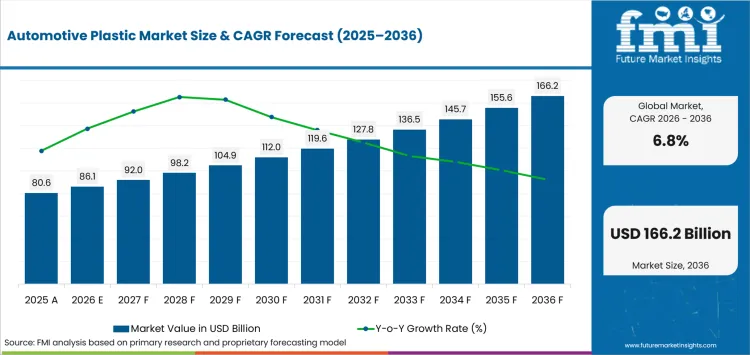
USD 86.1 billion in 2026 and USD 166.2 billion by 2036 at a 6.8% CAGR.
Demand for automotive plastics is projected to expand at 6.8% CAGR between 2026 and 2036, increasing valuation from USD 86.1 billion in 2026 to USD 166.2 billion by 2036. Vehicle programs use polymers to reduce component mass and integrate functions inside molded parts. USA fuel-economy standards finalized in June 2024 raise average light-duty efficiency toward about 50.4 miles per gallon by model year 2031, which keeps vehicle mass and system efficiency on engineering agendas.
Circularity is becoming a direct material-selection issue in parallel with performance. The Council of the European Union adopted vehicle-circularity rules in June 2026 that phase in recycled-plastic requirements for new vehicles. China supports vehicle replacement through trade-in policy, while India uses PM E-DRIVE to expand the electric-mobility ecosystem. Suppliers therefore need repeatable processing and documented material claims before a lower-carbon formulation can move into regular vehicle sourcing.
Key Takeaways of Automotive Plastic Market
- Automotive plastic demand expands as lightweighting and electrification increase the value of qualified polymer systems across vehicle platforms.
- Polypropylene is projected at 29.0% share in 2026 because its density and compounding flexibility fit high-volume molded component families.
- Interior Components are estimated at 31.0% of application demand in 2026 as cabins concentrate molded surfaces and functional housings.
- Passenger Cars are forecast at 68.0% by vehicle type in 2026 because program volumes create repeated qualification opportunities across component systems.
- Recycled-content adoption can slow when feedstock variability extends automotive validation or changes molding behavior.
- BASF SE, SABIC, LyondellBasell Industries N.V., Covestro AG, Celanese Corporation, DuPont de Nemours, Inc., Borouge Group International AG, LG Chem Ltd., Syensqo SA/NV and Asahi Kasei Corporation serve automotive polymer requirements across resin and engineering-material routes.
Analyst Perspective
"Automotive polymer suppliers need to treat qualification as part of the product. A resin can offer lower weight or recycled content, but procurement value appears only when processing remains stable and the component meets the vehicle program's validation requirements across production locations."
- Nikhil Kaitwade, Principal Consultant, Future Market Insights
How is the Automotive Plastic Market segmented?
The automotive plastic market is segmented by polymer type, application, vehicle type, process, resin source and region.
Automotive plastic demand is segmented across material chemistry and component use, then by vehicle platform and processing route. Polymer Type covers polypropylene, polyurethane, polyamide, ABS, PVC and other materials. Application includes interior components, exterior components, under-the-hood uses, electrical and electronics, and powertrain parts. Vehicle Type covers passenger cars and commercial vehicles. Process includes injection molding, compression molding, extrusion and blow molding. Resin Source separates virgin from recycled or circular materials.
Why do Interior Components hold a 31.0% share in the Application category?
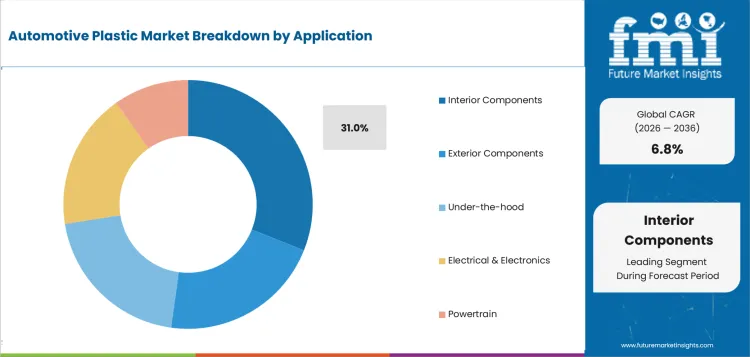
Vehicle interiors combine appearance requirements with structural and air-management functions across a large number of molded parts. Consoles and trim carriers can integrate mounting features inside one molding step, while ducts and housings add functional demand. Automotive-specific grades also need to meet cabin requirements for surface quality and emissions.
- Interior Components are estimated at 31.0% of application demand in 2026 because cabin systems contain many molded surfaces and integrated functional parts.
- BASF reported in April 2025 that its materials were used across the Kia EV3 Study Car, including engineering plastics and polyurethane-based solutions, illustrating how suppliers support vehicle-level material selection across several component zones.
Why does Polypropylene hold a 29.0% share in the Polymer Type category?
Polypropylene combines low density with a broad formulation window for vehicle parts produced at scale. Mineral filling or glass reinforcement can change stiffness and dimensional behavior without moving the program to a different base polymer. The material also fits established injection-molding equipment, which reduces process disruption during component redesign.
- Polypropylene is projected to account for 29.0% of polymer-type demand in 2026 because its processing economics fit large molded part families.
- SABIC reported in its 2024 integrated reporting that a STAMAX long-glass-fiber polypropylene grade with mechanically recycled content was developed for automotive applications, showing how PP platforms are being extended toward circular specifications.
Why do Passenger Cars hold a 68.0% share in the Vehicle Type category?
Passenger-car programs combine high production volumes with frequent model and trim changes. That creates recurring opportunities to qualify polymers in interior and exterior systems. Electrification adds further specifications around insulation and thermal management, while common platforms can extend an approved material across several vehicle derivatives.
- Passenger Cars are projected at 68.0% of vehicle-type demand in 2026 because their production scale creates a broad base of repeat material qualification.
- LyondellBasell announced in September 2024 that a CirculenRecover polypropylene compound with mechanically recycled content was used in exterior parts of the Dacia Duster, providing a production example within a passenger-vehicle platform.
Why does Injection Molding hold a 52.0% share in the Process category?
Injection molding combines repeatability with the ability to form ribs and clips inside complex part geometries. It supports automated production across commodity and engineering polymers while reducing secondary assembly in many applications. Compression molding and extrusion remain relevant for other geometries, but injection molding fits a wider range of high-volume vehicle components.
- Injection Molding is estimated at 52.0% of process demand in 2026 because it supports complex part integration at automotive production volumes.
- Asahi Kasei announced a PFAS-free PA66 in January 2026 for low-friction and high-load applications, including mechanical parts. Developments of this type expand the material options available for demanding molded components.
Why does Virgin resin hold a 78.0% share in the Resin Source category?
Automotive programs value lot-to-lot consistency because a material change can alter processing windows and long-term component behavior. Virgin grades provide a controlled reference for many approved specifications. Recycled and circular routes are expanding, but they must reproduce performance while documenting feedstock origin and content.
- Virgin resin is projected at 78.0% of resin-source demand in 2026 because qualification consistency remains central to many vehicle specifications.
- Covestro, Neste and Borealis announced in June 2024 that discarded tires were being converted through a traceable chain into feedstocks for high-purity polycarbonate used in automotive applications. The project shows how circular routes can be built around performance requirements without treating recycled content as a direct substitute.
What are the drivers, restraints and opportunities in the Automotive Plastic Market?
Lightweighting and electrification increase polymer value, while qualification requirements limit material substitution as circular-content rules create new sourcing opportunities.
- Driver: Vehicle efficiency and electrical content increase demand for polymers that reduce mass or combine several component functions.
- Restraint: Recycled feedstock variability can extend validation when molding behavior or long-term component performance changes.
- Opportunity: Traceable circular polymers can enter more vehicle specifications as recycled-content requirements move into formal regulation.
Vehicle engineering teams use material selection as one route to improve system efficiency. NHTSA finalized USA fuel-economy standards in June 2024 that increase light-duty efficiency through model year 2031. Plastics can support that engineering work by reducing part mass and consolidating functions where the material remains suitable for the component load and temperature conditions.
Circular resin adoption is constrained at the qualification stage. Recovered polymer streams can vary in composition or color, and unknown additive histories can change molding behavior. Vehicle programs therefore require evidence that a recycled formulation remains stable across production lots and meets the same component requirements as the approved reference material.
The commercial opportunity becomes clearer where regulation creates a defined recycled-content requirement. EU vehicle-circularity rules adopted in June 2026 phase in recycled-plastic targets for new vehicles. Suppliers that can connect traceable feedstock with automotive validation can compete for circular specifications without asking the customer to accept weaker processing or component performance.
Which country CAGRs are profiled in the Automotive Plastic Market?
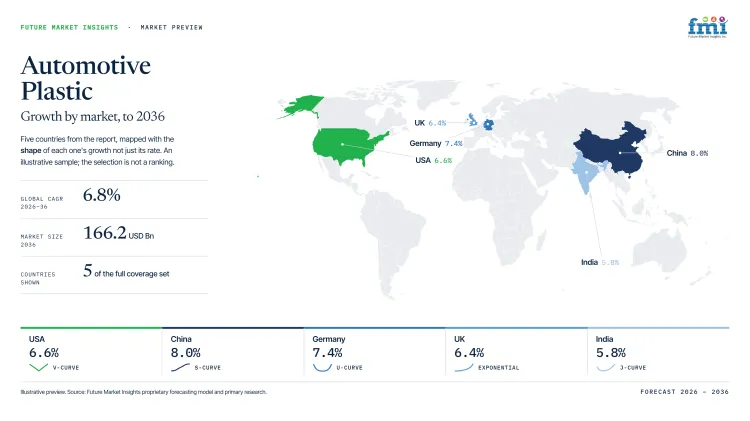
| Country | CAGR |
|---|---|
| China | 8.0% |
| Germany | 7.4% |
| USA | 6.6% |
| UK | 6.4% |
| Brazil | 6.3% |
| Japan | 6.1% |
| India | 5.8% |
How do country-level CAGRs compare in the Automotive Plastic Market?
The seven country CAGRs span 2.2 percentage points from 2026 to 2036. The spacing reflects differences in vehicle renewal, policy timing and material qualification conditions. CAGR indicates expected expansion and should be read separately from current market size or vehicle production volume.
- China records 8.0%, which is 0.6 percentage points above Germany. Frequent model turnover and domestic supply depth can shorten the time between material development and vehicle-program use.
- Germany records 7.4%, standing 0.8 percentage points above the USA Circular-content requirements in Europe increase the need for validated recycled automotive grades.
- The USA is projected at 6.6%, 0.2 percentage points above the UK. Material substitution remains tied to OEM and Tier-1 validation as efficiency requirements continue to shape engineering choices.
- The UK is forecast at 6.4%, 0.1 percentage points above Brazil. Vehicle electrification policy supports new material requirements, although local plant allocation can make program demand uneven.
- Brazil records 6.3%, 0.2 percentage points above Japan. The Mover policy links vehicle decarbonization with industrial development and gives suppliers a clearer reason to document material performance and circularity.
- Japan is forecast at 6.1%, 0.3 percentage points above India. Recycling programs emphasize controlled material recovery and quality, which raises the technical threshold for closed-loop automotive use.
- India records 5.8%. PM E-DRIVE supports the EV ecosystem, while local cost targets make regional compounding and application support important for material conversion.
Comparable CAGRs can translate into different supplier entry conditions. The full report evaluates country demand together with vehicle output and polymer content per platform, while local qualification rules and supply routes determine how forecast demand converts into revenue.
Country-wise Analysis
- China: Automotive polymer suppliers operate in a market with frequent model launches and a broad domestic vehicle supply chain. The automotive plastic sector in China is projected to record 8.0% CAGR through 2036. The government expanded consumer trade-in support in 2024, which encourages replacement demand and creates new specification windows for vehicle materials.
- Germany: Vehicle procurement combines detailed engineering validation with formal circularity requirements in the EU. Demand for automotive plastics in Germany is forecast to expand at 7.4% CAGR through 2036. Suppliers need traceable recycled-content claims and component data that allow a material change without forcing a redesign.
- USA: OEM and Tier-1 programs place strong weight on repeatable processing and long-term component performance. The USA automotive plastic sector is projected to grow at 6.6% CAGR through 2036. NHTSA fuel-economy standards keep vehicle efficiency on the engineering agenda, although material changes still need program-level qualification.
- UK: Vehicle programs are influenced by shared European platforms and domestic zero-emission vehicle policy. Demand for automotive plastics in the UK is projected to advance at 6.4% CAGR through 2036. Suppliers benefit from flexible regional logistics and materials that can transfer across EV-oriented vehicle architectures.
- Brazil: Vehicle sourcing balances local manufacturing economics with new decarbonization requirements under the Mover framework. Demand for automotive plastics in Brazil is forecast to grow at 6.3% CAGR through 2036. Regional production and technical documentation can help suppliers connect material changes with vehicle-level compliance and manufacturing cost.
- Japan: Automotive buyers emphasize material consistency and long program reliability. The automotive plastic sector in Japan is projected to expand at 6.1% CAGR through 2036. Recycling initiatives raise the value of controlled sorting and material characterization when recycled polymers are considered for established component specifications.
- India: Vehicle programs combine localized sourcing with close cost control as the EV ecosystem expands. Demand for automotive plastics in India is forecast to grow at 5.8% CAGR through 2036. Suppliers need local compounding and clear component-level economics to move higher-specification materials into domestic OEM and Tier-1 programs.
Who are the notable companies in the Automotive Plastic Market?
BASF SE, SABIC, LyondellBasell Industries N.V., Covestro AG, Celanese Corporation, DuPont de Nemours, Inc., Borouge Group International AG, LG Chem Ltd., Syensqo SA/NV, Asahi Kasei Corporation are the notable companies serving the automotive plastic market.
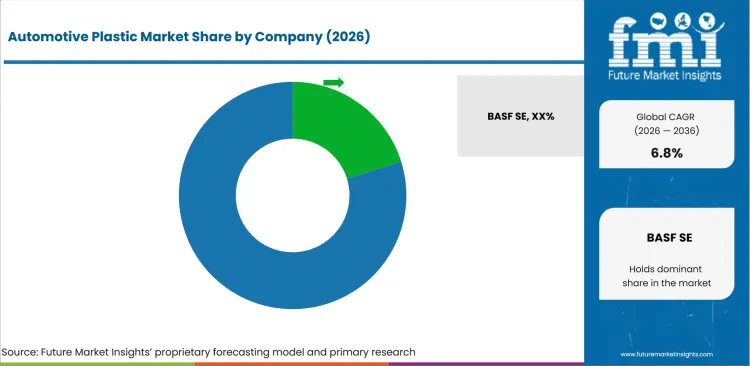
Competition is organized around material breadth and the ability to support part-level qualification. Broad resin suppliers can serve several component classes, while engineering-polymer specialists focus on tighter thermal or mechanical requirements. Circular feedstock capability is becoming more relevant as customers ask for traceable recycled content without changing approved processing behavior.
- BASF SE, SABIC, LyondellBasell Industries N.V. and Celanese Corporation combine scaled resin or compounding platforms with automotive application support.
- Covestro AG, DuPont de Nemours, Inc., LG Chem Ltd. and Asahi Kasei Corporation serve engineering-material requirements where heat or electrical performance narrows the material set.
- Borouge Group International AG and Syensqo SA/NV provide polyolefin or specialty-polymer routes that can support recycled-content specifications in automotive applications.
Competitive Benchmarking: Automotive Plastic Market
| Company | Automotive Polymer Coverage | Circular Resin Readiness | Application Engineering Support | Geographic Reach |
|---|---|---|---|---|
| BASF SE | High | High | High | Global |
| SABIC | High | High | High | Global |
| LyondellBasell Industries N.V. | Medium | High | High | Global |
| Covestro AG | High | High | High | Global |
| Celanese Corporation | High | High | High | Global |
| DuPont de Nemours, Inc. | Medium | Not publicly scored | Medium | Global |
| Borouge Group International AG | Medium | High | High | Global; operations across Europe, Middle East and North America |
| LG Chem Ltd. | Medium | High | Medium | Asia-led with global customer reach |
| Syensqo SA/NV | Medium | High | Medium | Global |
| Asahi Kasei Corporation | High | Medium | High | Japan, North America, Europe and Asia |
Scoring basis: Automotive Polymer Coverage reflects documented breadth across polymer families and vehicle application zones. Circular Resin Readiness reflects public evidence of recycled, mass-balance or closed-loop material routes relevant to automotive use. Application Engineering Support reflects documented formulation and customer-development capability. High indicates broad documented capability and Medium indicates a narrower documented position. Where public evidence is insufficient for a consistent score, the field is left unscored rather than treated as Low.
Key Developments in the Automotive Plastic Market
- In January 2026, Asahi Kasei Corporation announced a PFAS-free PA66 designed for low-friction and high-load performance. The material targets mechanical parts where friction control and thermal performance must be maintained without fluorinated additives.
- In April 2025, BASF SE reported that the Kia EV3 Study Car incorporated several of its material solutions, including engineering plastics and polyurethane-based systems. The project illustrates vehicle-level testing of materials that combine performance with lower-carbon or circular sourcing routes.
- In September 2024, LyondellBasell Industries N.V. and Dacia announced use of a CirculenRecover polypropylene compound in exterior parts of the Dacia Duster. The material contains mechanically recycled polypropylene and shows how recycled-content PP can enter visible production components when formulation and processing are controlled.
Key Players in the Automotive Plastic Market
Scaled Resin and Compounding Platforms
- BASF SE
- SABIC
- LyondellBasell Industries N.V.
- Celanese Corporation
Engineering Polymer and Functional Specialists
- Covestro AG
- DuPont de Nemours, Inc.
- LG Chem Ltd.
- Asahi Kasei Corporation
Circular Polyolefin and Polyamide Positions
- Borouge Group International AG
- Syensqo SA/NV
Automotive Plastic Market - Report Scope
| Coverage field | Report scope |
|---|---|
| Market breakdown | By polymer type, application, vehicle type, process, resin source and region. |
| Quantitative Units | USD billion. |
| Market Definition | Automotive plastic resins and compounded polymer materials sold for use within the stated vehicle applications. Finished molded components, complete vehicle systems, tooling and conversion services are excluded. |
| Regions Covered | North America, Latin America, Western Europe, Eastern Europe, East Asia, South Asia and Pacific, and Middle East and Africa. |
| Countries Covered | China, Germany, USA, UK, Brazil, Japan, India, and 20+ countries included in the full report. |
| Key Companies Profiled | BASF SE, SABIC, LyondellBasell Industries N.V., Covestro AG, Celanese Corporation, DuPont de Nemours, Inc., Borouge Group International AG, LG Chem Ltd., Syensqo SA/NV, Asahi Kasei Corporation. |
| Forecast Period | 2026 to 2036. |
| Approach | Primary and secondary research with market triangulation. |
Automotive Plastic Market - Research Methodology
| Method | Approach |
|---|---|
| Primary Research | FMI analysts gather input from automotive polymer producers, compounders, distributors, recyclers, molders, Tier-1 suppliers, OEM procurement teams and technical specialists. Interviews examine material selection, qualification requirements, pricing, sourcing routes and substitution barriers before a material change develops into regular purchasing. |
| Desk Research | Desk research covers government vehicle policy, regulatory publications, recycling programs, trade information, technical literature, standards, company filings and official corporate announcements. Sources are reviewed for publication date and direct relevance to the defined automotive plastic scope. |
| Market Sizing and Forecasting | The market model combines the baseline value with vehicle-production patterns, polymer mix, application demand, conversion routes, pricing indicators and material substitution. Forecast assumptions also consider electrification and circular-content requirements before segment and country estimates are reconciled. |
| Data Validation | Estimates are checked against multiple independent indicators, including public policy data and company activity. Validation tests whether materials fall within the market boundary and removes finished-component revenue or adjacent products that would create overlap across segments. |
Automotive Plastic Market by Segments
Automotive Plastic Market segmented by Polymer Type:
- Polypropylene
- Polyurethane
- Polyamide
- ABS
- PVC
- Others
Automotive Plastic Market segmented by Application:
- Interior Components
- Exterior Components
- Under-the-hood
- Electrical & Electronics
- Powertrain
Automotive Plastic Market segmented by Vehicle Type:
- Passenger Cars
- Light Commercial Vehicles
- Heavy Commercial Vehicles
- Other Vehicles
Automotive Plastic Market segmented by Process:
- Injection Molding
- Compression Molding
- Extrusion
- Blow Molding
- Others
Automotive Plastic Market segmented by Resin Source:
- Virgin
- Recycled / Circular
Research Sources and Bibliography
- USA National Highway Traffic Safety Administration. (2024, June 7). New Fuel Economy Standards for Model Years 2027-2031.
- State Council of the People's Republic of China. (2024, August 24). China's trade-in policy energizes consumer market.
- Press Information Bureau, Government of India. (2024, October). PM E-DRIVE Scheme: Driving Towards a Greener Future.
- Council of the European Union. (2026, June 29). Council greenlights rules for a more circular automotive sector.
- UK Department for Transport and Office for Zero Emission Vehicles. (2024, January 3). Pathway for zero emission vehicle transition by 2035 becomes law.
- Ministry of the Environment, Japan. (2024). Automotive recycling and recycled-material use initiatives.
- Ministry of Development, Industry, Trade and Services, Brazil. (2024, June 27). Green Mobility and Innovation Program (Mover).
- BASF SE. (2025, April 8). Kia EV3 Study Car made with BASF's sustainable and high-performance material solutions.
- SABIC. (2025). Integrated Annual Report 2024, TRUCIRCLE and mechanically recycled products.
- LyondellBasell Industries N.V. (2024, September 16). LyondellBasell and Dacia develop a recycled solution for the Duster model.
- Covestro AG. (2024, June 11). From old tires to new car parts: Covestro, Neste and Borealis aim at closing loop for automotive industry.
- Celanese Corporation. (2022, November 1). Celanese Completes Acquisition of Mobility & Materials Business.
- LG Chem Ltd. (2025, April 15). LG Chem Displays Sustainable Technology at CHINAPLAS 2025.
- Syensqo SA/NV. (2025, February 18). Syensqo joins global industry leaders to launch Automotive Plastics Circularity project.
- Asahi Kasei Corporation. (2026, January 29). Asahi Kasei Develops PFAS-Free PA66 Offering Low-Friction and High-Load Performance.
- OMV. (2026, March 31). OMV and XRG Complete Transactions to Create Borouge International, Boosting Global Chemicals Leadership.
- Solvay. (2023, December 11). Solvay marks new era after successful Syensqo spin-off.
This bibliography is provided for reader reference and is not exhaustive. The full report contains the complete reference list and detailed citations.
This Report Answers
- How large is the Automotive Plastic Market in 2026 and 2036?
- Which vehicle-engineering conditions support recurring demand for automotive plastics?
- Which polymer type has the principal 2026 share within the stated taxonomy?
- How does application demand differ across interior and exterior vehicle systems?
- Which vehicle type creates the broadest repeat qualification base?
- How do country growth rates affect commercial entry conditions?
- Which companies serve resin and engineering-polymer requirements?
- What limits the qualification of recycled automotive plastic grades?
Frequently Asked Questions
How big is the Automotive Plastic Market in 2026?
USD 86.1 billion represents the automotive plastic market value in 2026. Demand is projected to reach USD 166.2 billion by 2036 as vehicle programs use polymers for lightweighting and functional integration while circular-content requirements influence new material qualifications.
What is the CAGR of the Automotive Plastic Market from 2026 to 2036?
A 6.8% CAGR is projected for the automotive plastic market between 2026 and 2036. Growth depends on vehicle production and material value per platform, while qualification cycles determine how quickly new polymer formulations enter regular sourcing.
Which polymer type is projected to account for 29.0% of the Automotive Plastic Market?
Polypropylene is projected to account for 29.0% of polymer-type demand in 2026. Its low density and broad compounding range fit high-volume molded component families across vehicle interiors and other applications.
How much will the Automotive Plastic Market add between 2026 and 2036?
USD 80.1 billion is expected to be added to the automotive plastic market between 2026 and 2036. The increase reflects wider polymer use in vehicle systems and higher-value engineering requirements linked to electrification and circular material specifications.
Which companies are active in the Automotive Plastic Market?
Companies active in the automotive plastic market include BASF SE, SABIC, LyondellBasell Industries N.V., Covestro AG, Celanese Corporation, DuPont de Nemours, Inc., Borouge Group International AG, LG Chem Ltd., Syensqo SA/NV and Asahi Kasei Corporation. Their market roles span broad resin platforms, engineering polymers and circular material routes.
Preview the report firsthand - request a free sample
Get SampleGet the brochure for pricing and purchase details.
Get PDFTable of Content
- Key Takeaways
- Market Size and CAGR
- Top Growth Driver
- Fastest Growing Segment
- Leading Region
- Key Companies
- Emerging Opportunities
- Executive Summary
- Global Market Outlook
- Demand-side Trends
- Supply-side Trends
- Technology Roadmap Analysis
- Analysis and Recommendations
- Analyst Perspective (What is happening? Why now? What should investors know?)
- Key Questions Answered
- How large is the market?
- What is the CAGR?
- What are key trends?
- Which region dominates?
- Who are the leaders?
- Market Overview
- Market Coverage / Taxonomy
- Market Definition / Scope / Limitations
- Research Methodology
- Chapter Orientation
- Analytical Lens and Working Hypotheses
- Market Structure, Signals, and Trend Drivers
- Benchmarking and Cross-market Comparability
- Market Sizing, Forecasting, and Opportunity Mapping
- Research Design and Evidence Framework
- Desk Research Programme (Secondary Evidence)
- Expert Input and Fieldwork (Primary Evidence)
- Tooling, Models, and Reference Databases
- Data Engineering and Model Build
- Quality Assurance and Audit Trail
- Market Background
- Market Dynamics (Drivers, Restraints, Opportunity, Trends)
- Scenario Forecast (Optimistic, Likely, Conservative)
- Impact Analysis
- AI Impact
- Sustainability Impact
- Regulatory Impact
- Technology Impact
- Consumer / Buyer Analysis
- Purchase Drivers
- Adoption Barriers
- Buyer Journey
- Opportunity Map Analysis
- Product Life Cycle Analysis
- Supply Chain Analysis
- Investment Feasibility Matrix
- Value Chain Analysis
- PESTLE and Porter's Analysis
- Regulatory Landscape
- Regional Parent Market Outlook
- Production and Consumption Statistics
- Import and Export Statistics
- Global Market Analysis and Forecast, 2021 to 2036
- Historical Market Size Value (USD Billion) Analysis, 2021 to 2025
- Current and Future Market Size Value (USD Billion) Projections, 2026 to 2036
- Y-o-Y Growth Trend Analysis
- Absolute $ Opportunity Analysis
- Global Market Pricing Analysis, 2021 to 2036
- Global Market Analysis and Forecast, By Polymer Type, 2021 to 2036
- Introduction / Key Findings
- Historical Market Size Value (USD Billion) Analysis By Polymer Type, 2021 to 2025
- Current and Future Market Size Value (USD Billion) Analysis and Forecast By Polymer Type, 2026 to 2036
- Polypropylene
- Polyurethane
- Polyamide
- ABS
- PVC
- Others
- Polypropylene
- Y-o-Y Growth Trend Analysis By Polymer Type, 2021 to 2025
- Absolute $ Opportunity Analysis By Polymer Type, 2026 to 2036
- Global Market Analysis and Forecast, By Application, 2021 to 2036
- Introduction / Key Findings
- Historical Market Size Value (USD Billion) Analysis By Application, 2021 to 2025
- Current and Future Market Size Value (USD Billion) Analysis and Forecast By Application, 2026 to 2036
- Interior Components
- Exterior Components
- Under-the-hood
- Electrical & Electronics
- Powertrain
- Interior Components
- Y-o-Y Growth Trend Analysis By Application, 2021 to 2025
- Absolute $ Opportunity Analysis By Application, 2026 to 2036
- Global Market Analysis and Forecast, By Vehicle Type, 2021 to 2036
- Introduction / Key Findings
- Historical Market Size Value (USD Billion) Analysis By Vehicle Type, 2021 to 2025
- Current and Future Market Size Value (USD Billion) Analysis and Forecast By Vehicle Type, 2026 to 2036
- Passenger Cars
- Light Commercial Vehicles
- Heavy Commercial Vehicles
- Other Vehicles
- Passenger Cars
- Y-o-Y Growth Trend Analysis By Vehicle Type, 2021 to 2025
- Absolute $ Opportunity Analysis By Vehicle Type, 2026 to 2036
- Global Market Analysis and Forecast, By Process, 2021 to 2036
- Introduction / Key Findings
- Historical Market Size Value (USD Billion) Analysis By Process, 2021 to 2025
- Current and Future Market Size Value (USD Billion) Analysis and Forecast By Process, 2026 to 2036
- Injection Molding
- Compression Molding
- Extrusion
- Blow Molding
- Others
- Injection Molding
- Y-o-Y Growth Trend Analysis By Process, 2021 to 2025
- Absolute $ Opportunity Analysis By Process, 2026 to 2036
- Global Market Analysis and Forecast, By Resin Source, 2021 to 2036
- Introduction / Key Findings
- Historical Market Size Value (USD Billion) Analysis By Resin Source, 2021 to 2025
- Current and Future Market Size Value (USD Billion) Analysis and Forecast By Resin Source, 2026 to 2036
- Virgin
- Recycled - Circular
- Virgin
- Y-o-Y Growth Trend Analysis By Resin Source, 2021 to 2025
- Absolute $ Opportunity Analysis By Resin Source, 2026 to 2036
- Global Market Analysis and Forecast, By Region, 2021 to 2036
- Introduction
- Historical Market Size Value (USD Billion) Analysis By Region, 2021 to 2025
- Current Market Size Value (USD Billion) Analysis and Forecast By Region, 2026 to 2036
- North America
- Latin America
- Western Europe
- Eastern Europe
- East Asia
- South Asia and Pacific
- Middle East & Africa
- Market Attractiveness Analysis By Region
- North America Market Analysis and Forecast, By Country, 2021 to 2036
- Historical Market Size Value (USD Billion) Trend Analysis By Market Taxonomy, 2021 to 2025
- Market Size Value (USD Billion) Forecast By Market Taxonomy, 2026 to 2036
- By Country
- USA
- Canada
- By Polymer Type
- By Application
- By Vehicle Type
- By Process
- By Resin Source
- By Country
- Market Attractiveness Analysis
- By Country
- By Polymer Type
- By Application
- By Vehicle Type
- By Process
- By Resin Source
- Key Takeaways
- Latin America Market Analysis and Forecast, By Country
- Historical Market Size Value (USD Billion) Trend Analysis By Market Taxonomy, 2021 to 2025
- Market Size Value (USD Billion) Forecast By Market Taxonomy, 2026 to 2036
- By Country
- Brazil
- Mexico
- Chile
- Rest of Latin America
- By Polymer Type
- By Application
- By Vehicle Type
- By Process
- By Resin Source
- By Country
- Market Attractiveness Analysis
- By Country
- By Polymer Type
- By Application
- By Vehicle Type
- By Process
- By Resin Source
- Key Takeaways
- Western Europe Market Analysis and Forecast, By Country
- Historical Market Size Value (USD Billion) Trend Analysis By Market Taxonomy, 2021 to 2025
- Market Size Value (USD Billion) Forecast By Market Taxonomy, 2026 to 2036
- By Country
- Germany
- UK
- Italy
- Spain
- France
- Nordic
- BENELUX
- Rest of Western Europe
- By Polymer Type
- By Application
- By Vehicle Type
- By Process
- By Resin Source
- By Country
- Market Attractiveness Analysis
- By Country
- By Polymer Type
- By Application
- By Vehicle Type
- By Process
- By Resin Source
- Key Takeaways
- Eastern Europe Market Analysis and Forecast, By Country
- Historical Market Size Value (USD Billion) Trend Analysis By Market Taxonomy, 2021 to 2025
- Market Size Value (USD Billion) Forecast By Market Taxonomy, 2026 to 2036
- By Country
- Russia
- Poland
- Hungary
- Balkan & Baltic
- Rest of Eastern Europe
- By Polymer Type
- By Application
- By Vehicle Type
- By Process
- By Resin Source
- By Country
- Market Attractiveness Analysis
- By Country
- By Polymer Type
- By Application
- By Vehicle Type
- By Process
- By Resin Source
- Key Takeaways
- East Asia Market Analysis and Forecast, By Country
- Historical Market Size Value (USD Billion) Trend Analysis By Market Taxonomy, 2021 to 2025
- Market Size Value (USD Billion) Forecast By Market Taxonomy, 2026 to 2036
- By Country
- China
- Japan
- South Korea
- By Polymer Type
- By Application
- By Vehicle Type
- By Process
- By Resin Source
- By Country
- Market Attractiveness Analysis
- By Country
- By Polymer Type
- By Application
- By Vehicle Type
- By Process
- By Resin Source
- Key Takeaways
- South Asia and Pacific Market Analysis and Forecast, By Country
- Historical Market Size Value (USD Billion) Trend Analysis By Market Taxonomy, 2021 to 2025
- Market Size Value (USD Billion) Forecast By Market Taxonomy, 2026 to 2036
- By Country
- India
- ASEAN
- Australia & New Zealand
- Rest of South Asia and Pacific
- By Polymer Type
- By Application
- By Vehicle Type
- By Process
- By Resin Source
- By Country
- Market Attractiveness Analysis
- By Country
- By Polymer Type
- By Application
- By Vehicle Type
- By Process
- By Resin Source
- Key Takeaways
- Middle East & Africa Market Analysis and Forecast, By Country
- Historical Market Size Value (USD Billion) Trend Analysis By Market Taxonomy, 2021 to 2025
- Market Size Value (USD Billion) Forecast By Market Taxonomy, 2026 to 2036
- By Country
- Kingdom of Saudi Arabia
- Other GCC Countries
- Türkiye
- South Africa
- Other African Union
- Rest of Middle East & Africa
- By Polymer Type
- By Application
- By Vehicle Type
- By Process
- By Resin Source
- By Country
- Market Attractiveness Analysis
- By Country
- By Polymer Type
- By Application
- By Vehicle Type
- By Process
- By Resin Source
- Key Takeaways
- Key Countries Market Analysis
- USA
- Pricing Analysis
- Market Share Analysis, 2025
- By Polymer Type
- By Application
- By Vehicle Type
- By Process
- By Resin Source
- Canada
- Pricing Analysis
- Market Share Analysis, 2025
- By Polymer Type
- By Application
- By Vehicle Type
- By Process
- By Resin Source
- Mexico
- Pricing Analysis
- Market Share Analysis, 2025
- By Polymer Type
- By Application
- By Vehicle Type
- By Process
- By Resin Source
- Brazil
- Pricing Analysis
- Market Share Analysis, 2025
- By Polymer Type
- By Application
- By Vehicle Type
- By Process
- By Resin Source
- Chile
- Pricing Analysis
- Market Share Analysis, 2025
- By Polymer Type
- By Application
- By Vehicle Type
- By Process
- By Resin Source
- Germany
- Pricing Analysis
- Market Share Analysis, 2025
- By Polymer Type
- By Application
- By Vehicle Type
- By Process
- By Resin Source
- UK
- Pricing Analysis
- Market Share Analysis, 2025
- By Polymer Type
- By Application
- By Vehicle Type
- By Process
- By Resin Source
- Italy
- Pricing Analysis
- Market Share Analysis, 2025
- By Polymer Type
- By Application
- By Vehicle Type
- By Process
- By Resin Source
- Spain
- Pricing Analysis
- Market Share Analysis, 2025
- By Polymer Type
- By Application
- By Vehicle Type
- By Process
- By Resin Source
- France
- Pricing Analysis
- Market Share Analysis, 2025
- By Polymer Type
- By Application
- By Vehicle Type
- By Process
- By Resin Source
- India
- Pricing Analysis
- Market Share Analysis, 2025
- By Polymer Type
- By Application
- By Vehicle Type
- By Process
- By Resin Source
- ASEAN
- Pricing Analysis
- Market Share Analysis, 2025
- By Polymer Type
- By Application
- By Vehicle Type
- By Process
- By Resin Source
- Australia & New Zealand
- Pricing Analysis
- Market Share Analysis, 2025
- By Polymer Type
- By Application
- By Vehicle Type
- By Process
- By Resin Source
- China
- Pricing Analysis
- Market Share Analysis, 2025
- By Polymer Type
- By Application
- By Vehicle Type
- By Process
- By Resin Source
- Japan
- Pricing Analysis
- Market Share Analysis, 2025
- By Polymer Type
- By Application
- By Vehicle Type
- By Process
- By Resin Source
- South Korea
- Pricing Analysis
- Market Share Analysis, 2025
- By Polymer Type
- By Application
- By Vehicle Type
- By Process
- By Resin Source
- Russia
- Pricing Analysis
- Market Share Analysis, 2025
- By Polymer Type
- By Application
- By Vehicle Type
- By Process
- By Resin Source
- Poland
- Pricing Analysis
- Market Share Analysis, 2025
- By Polymer Type
- By Application
- By Vehicle Type
- By Process
- By Resin Source
- Hungary
- Pricing Analysis
- Market Share Analysis, 2025
- By Polymer Type
- By Application
- By Vehicle Type
- By Process
- By Resin Source
- Kingdom of Saudi Arabia
- Pricing Analysis
- Market Share Analysis, 2025
- By Polymer Type
- By Application
- By Vehicle Type
- By Process
- By Resin Source
- Türkiye
- Pricing Analysis
- Market Share Analysis, 2025
- By Polymer Type
- By Application
- By Vehicle Type
- By Process
- By Resin Source
- South Africa
- Pricing Analysis
- Market Share Analysis, 2025
- By Polymer Type
- By Application
- By Vehicle Type
- By Process
- By Resin Source
- USA
- Market Structure Analysis
- Competition Dashboard
- Competition Benchmarking
- Market Share Analysis of Top Players
- By Regional
- By Polymer Type
- By Application
- By Vehicle Type
- By Process
- By Resin Source
- Emerging Startups
- Innovation Benchmarking
- Competition Analysis
- Competition Deep Dive
- BASF SE
- Overview
- Product Portfolio
- Profitability by Market Segments
- Sales Footprint
- Strategy Overview
- Marketing Strategy
- Product Strategy
- Channel Strategy
- SABIC
- LyondellBasell Industries N.V.
- Covestro AG
- Celanese Corporation
- DuPont de Nemours, Inc.
- Borealis AG
- LG Chem Ltd.
- Solvay S.A.
- Asahi Kasei Corporation
- BASF SE
- Case Studies
- Success Stories
- Recent Developments
- Competition Deep Dive
- Assumptions & Acronyms Used


