

- Market Size (2026)
- USD 0.9 Bn
- Forecast (2036)
- USD 1.8 Bn
- CAGR (2026 to 2036)
- 7.2%
Capacitive Touch Switch Panels for Vehicle Interiors Market Size, Market Forecast and Outlook By FMI
Summary of the Capacitive Touch Switch Panels for Vehicle Interiors Market
- Demand and Growth Drivers
- Demand is supported by wider cabin digitization across HVAC and lighting controls. Premium interior programs add further support through greater use of touch-based interfaces.
- Product use is higher in automotive interior designed around flat surfaces and premium trim appeal.
- Wider focus on direct access to core functions supports mixed touch and tactile layouts in modern vehicle cabins.
- Product and Segment View
- Center stack panels have the highest current use because climate and media controls are still placed in one main dashboard area.
- Passenger cars hold a larger share than LCVs or HCVs because premium trim and vehicle electrification are widely used in passenger platforms. .
- Haptic surfaces work better than visual-only panels in vehicles that aim to reduce the time drivers spend looking at controls.
- Geography and Competitive Outlook
- China, India, and Mexico register faster growth because vehicle output is rising and cockpit electronics content is increasing.
- Europe and North America hold higher market value as vehicle makers spend more on interior control systems in these regions.
- Supplier competition is led by companies with stronger on automotive HMI integration and OEM program access.
- Entry becomes challenging if OEM validation and long-life durability requirements enter supplier selection.
- Analyst Opinion
- Nikhil Kaitwade, Principal Analyst at FMI states, ldquo;Our analysis indicates that demand for capacitive touch switch panels builds through wider use of digital cabin surfaces. The strongest growth stays concentrated in programs adding touch panels to selected control areas rather than across the full cabin. Safety-led interface design continues to preserve physical controls in repeated-use functions and gives an advantage to suppliers with strong haptic tuning and proven OEM validation support.rdquo;
- Capacitive Touch Switch Panels for Vehicle Interiors Market Value Analysis
- Value expansion tracks cabin electronics content rather than vehicle output alone.
- Premium trims and EV interiors lift ASP because console panels and steering inputs carry richer interfaces.
- Safety-led redesign limits full replacement of physical controls in core functions. Mixed architectures therefore retain a larger share of future fitment.
- Revenue from OEM programs using haptic layers and lighting-linked control modules is higher because these programs usually carry better pricing and longer program stability.
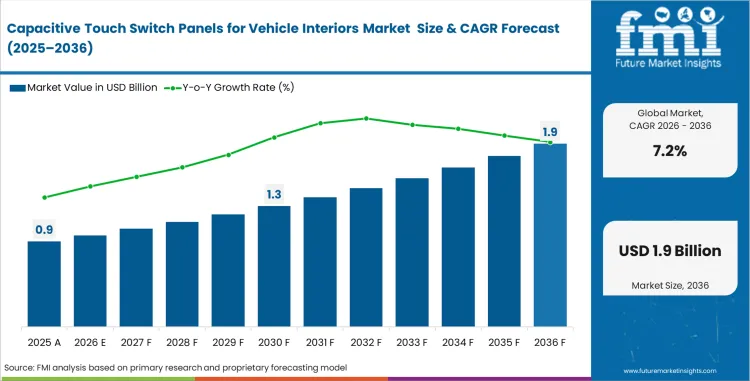
Key Takeaways
- Market value reached USD 0.8 billion in 2025.
- Industry is projected to reach USD 1.8 billion by 2036.
- The market is projected to expand at a CAGR of 7.2% between 2026 and 2036.
- Incremental opportunity across 2026 to 2036 is USD 0.9 billion.
- Center stack layouts in the mounting area segment are expected to account for 38.0% share in 2026.
- China is expected to record the fastest country growth at 8.4% through 2036.
- India is projected to rise at a CAGR of 8.0% during the forecast period.
- Commercial value is supported by slimmer cabin controls because concealed surface styling and higher EV fitment raise program value.
Capacitive Touch Switch Panels for Vehicle Interiors Market Definition
Capacitive touch switch panels for vehicle interiors are in-cabin control assemblies using capacitive sensing. These assemblies support command input across center stacks and steering wheel switches. They are also used in door trims and roof consoles. Rear comfort modules are also included. It also covers active haptic layers and force-sense elements. Control illumination is included. Panel-level integration for HVAC and media is also included. Comfort, lighting, and mode-selection functions are part of scope.
Capacitive Touch Switch Panels for Vehicle Interiors Market Inclusions
Scope includes standalone touch panels and display-integrated touch areas. Smart-surface control layers and hidden-until-lit interfaces are included. Haptic-enabled capacitive panels are included within the same scope. Related module assemblies supplied at OEM level are part of this market. Scope also includes polymer-overlay surfaces and glass surfaces. Decor-film surfaces are included within the material set. Passenger cars, light commercial vehicles, and heavy commercial vehicles are covered.
Capacitive Touch Switch Panels for Vehicle Interiors Market Exclusions
Scope excludes full infotainment displays sold without switch-panel functionality. Cockpit domain controllers and exterior touch interfaces are excluded. Consumer touchscreen devices remain outside this scope. Aftermarket decorative touch gadgets without OEM validation are excluded. Standalone voice systems without capacitive input are outside the same scope. Multimodal software stacks without panel hardware input are excluded from revenue capture.
Capacitive Touch Switch Panels for Vehicle Interiors Market Research Methodology
Primary Research: Interviews covered HMI suppliers and interior electronics vendors. Vehicle architecture teams and component distributors were included in the same review.
Desk Research: Review covered vehicle production statistics and safety protocol updates. Company product pages and public technical releases were reviewed.
Market sizing and forecasting: A bottom-up model used vehicle production and attach-rate estimates. Control-zone fitment and blended OEM ASP were included.
Data validation: Cross-checks covered supplier exposure and cockpit electronics ratios. Country production trends were reviewed in the same validation step.
Why is the Capacitive Touch Switch Panels for Vehicle Interiors Market Growing?
- Premium cabins and EV interiors are using flatter control surfaces with lower button density.
- OEMs are expanding touch-panel use across seat and lighting functions and across comfort controls.
- Haptic support improves safety fit and usability when compared with visual-only touch surfaces.
Growth in the capacitive touch switch panels for vehicle interiors market is supported by rising digital interface content in passenger cabins, especially in premium vehicles and EVs. Vehicle makers are using flatter control surfaces to reduce switch density and improve cabin styling. Touch-panel use is expanding across climate and comfort functions.
Haptic feedback supports demand because it improves control confirmation and makes touch surfaces more suitable for real driving conditions. Mixed control layouts are gaining wider acceptance than touch-only designs in safety-sensitive functions.
Market Segmentation Analysis
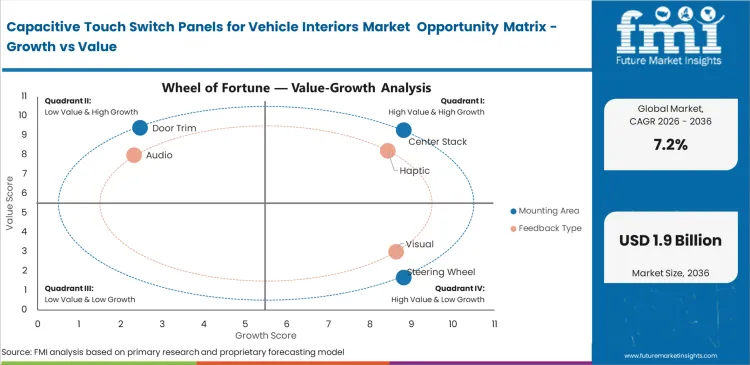
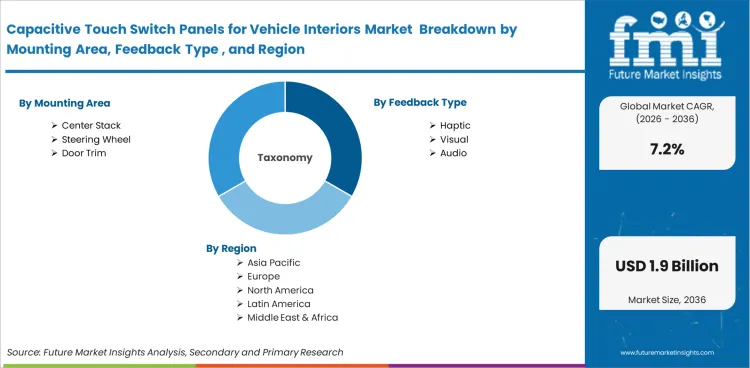
- Center stack is projected to lead the mounting area segment with 38.0% in 2026 as climate and drive-mode controls still sit in one main control area.
- Haptic feedback is projected to lead the feedback type segment with 41.0% in 2026 because tactile confirmation improves control confidence on flat surfaces.
- Polymer overlay is projected to lead the surface material segment with 46.0% in 2026 supported by lower cost and easier integration than full glass surfaces in high-volume programs.
- Passenger cars are projected to lead the vehicle type segment with 79.0% in 2026 owing to premium trim mix and EV launches which support wider touch-panel fitment.
- Hidden-until-lit layouts are projected to lead the interface layout segment with 36.0% in 2026 due to black-panel styling and illuminated controls support cleaner cabin design.
- Standalone panel is projected to lead the integration level segment with 44.0% in 2026 because separate control modules allow easier packaging and lower redesign cost than fully merged assemblies.
The market for capacitive touch switch panels for vehicle interiors is divided into groups based on mounting area, feedback type, surface material, vehicle type, interface layout, integration level, sales channel, and region. By mounting area, the market includes center stack, steering wheel, door trim, roof console, and rear console. Based on feedback type, it is segmented into haptic, visual, audio, and hybrid. By surface material, the market covers polymer overlay, glass, decor film, and leatherette. By vehicle type, the market includes passenger cars, LCVs, and HCVs. By interface layout, the market covers hidden-until-lit, fixed icons, slider strips, and multi-zone layouts. By integration level, the market includes standalone panels, display-integrated panels, smart surfaces, and module stack designs. By sales channel, the market includes OEM and aftermarket supply.
Insights into the Mounting Area Segment
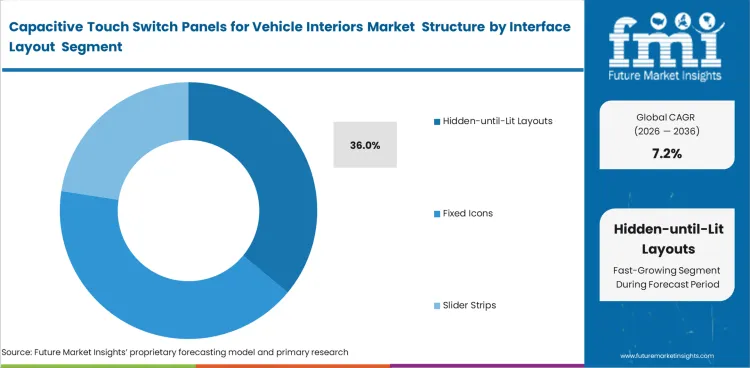
- Center stack is expected to account for 38.0% share in 2026. HVAC and drive-mode controls remain in one main dashboard area, so center stack panels use the highest amount of panel-related components in current cabin designs. This area creates the largest component opportunity in current cabin layouts.
- Steering wheel and door trim panels add value in premium programs. This pattern is more visible in cabins using layered control logic and lower hard-key density.
Insights into the Feedback Type Segment
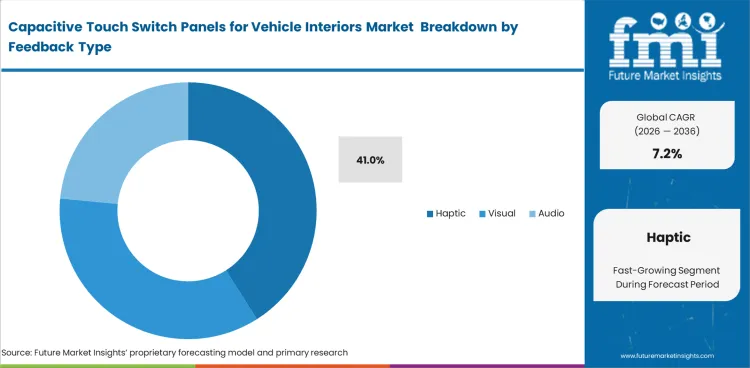
- Haptic feedback is anticipated to represent 41.0% of the market in 2026. Tactile confirmation holds stronger importance in flat surfaces because glance reduction and control confidence matter in actual driving use.
- Hybrid feedback packages combining haptic touchscreen and sound are gaining importance for application in upper trims.
Insights into the Surface Material Segment
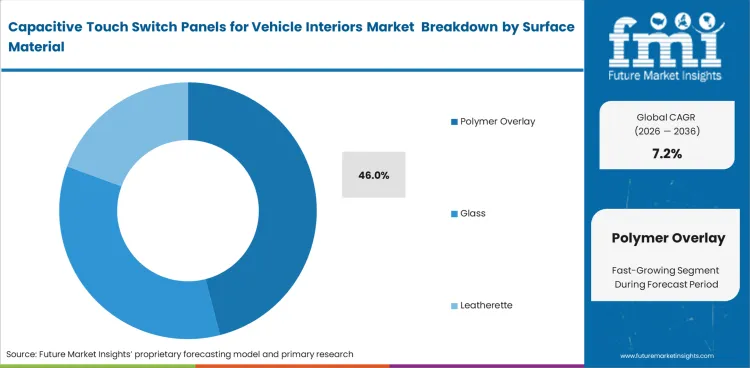
- Polymer overlay is expected to account for 46.0% share in 2026. Cost control and design flexibility support broader use across high-volume interior programs. Easier shaping adds further support for this material choice.
- Glass surfaces are more prevalent in premium cabins. Higher material costs and integration complexity limit adoption in mid-range vehicle segments.
Insights into the Vehicle Type Segment
Passenger cars are likely to secure 79.0% share in 2026. Premium trim penetration and EV launches support touch-panel fitment across passenger vehicle platforms.
LCV and HCV demand stays more selective because fleet-oriented programs place greater emphasis on durability and direct access to core controls.
Insights into the Interface Layout Segment
Hidden-until-lit layouts are expected to account for 36.0% share in 2026. Cabin programs using black-panel styling prefer concealed controls because visual clutter drops and trim continuity improves.
Fixed-icon and multi-zone layouts still hold value in cost-sensitive programs. Simpler interface logic and lower calibration effort keep demand steady in mainstream vehicles.
Insights into the Integration Level Segment
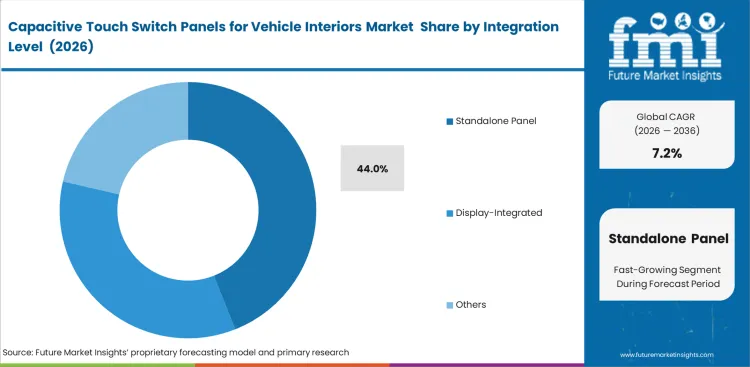 Standalone panel is set to make up 44.0% of the market in 2026. Separate control modules continue to offer easier packaging and lower redesign cost than fully merged automotive display-control assemblies in many current vehicle programs.
Display-integrated and smart-surface modules are expanding faster in upper trims. Validation effort and service complexity keep standalone panels relevant.
Insights into the Sales Channel Segment
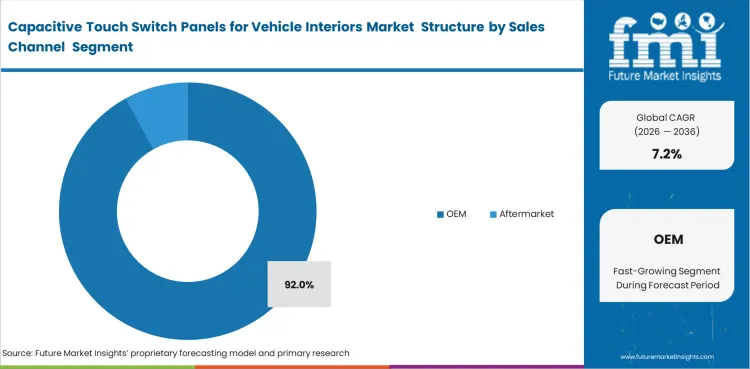 OEM is expected to account for 92.0% share in 2026. Platform-level validation and software mapping keep factory-fit demand dominant. Interior module integration adds a further barrier to retrofit supply.
Aftermarket demand stays limited because vehicle-specific packaging and electronic compatibility restrict wider replacement demand.
Capacitive Touch Switch Panels for Vehicle Interiors Market Drivers, Restraints, and Opportunities
- EV cabins and premium trims are increasing demand for slim illuminated control surfaces.
- Safety-led concern around touch-only control logic limits full replacement of physical interfaces.
- Haptic-enabled smart surfaces create opportunity in differentiated center-console applications and in steering applications.
Balanced Cabin Design and Control Strategy
Growth in the capacitive touch switch panel market reflects a clear trade-off in modern vehicle interiors. Designers are aiming for cleaner surfaces and visually appealing automotive HMI layouts that reduce visible switch density. Safety teams continue to prioritize quick and reliable access to frequently used controls. Suppliers see the strongest success in designs that combine capacitive touch with tactile or force-based confirmation, rather than relying on touch-only interfaces.
Hidden‑until‑lit control surfaces are gaining relevance as EVs and premium vehicles adopt slimmer, more decorative cabin layouts. Battery‑electric cars accounted for 17.4% of new car registrations in Europe in 2025, highlighting the growing influence of EV-led interior redesign. In these vehicles, illuminated surfaces and concealed controls help maintain trim continuity and create a premium, uncluttered appearance.
Haptic Confirmation and Force-Sense Tuning
Safety concerns continue to shape interface design choices. Distracted driving remains a major risk, with thousands of fatalities reported annually. NHTSA states that distracted driving claimed 3,208 lives in 2024 and injured 315,167 people. This reinforces the need for control concepts that minimise the driver’s visual distraction. Haptic confirmation plays a critical role in flat control surfaces by allowing drivers to feel input confirmation rather than relying only on visual cues.
Analysis of Capacitive Touch Switch Panels for Vehicle Interiors Market By Key Countries
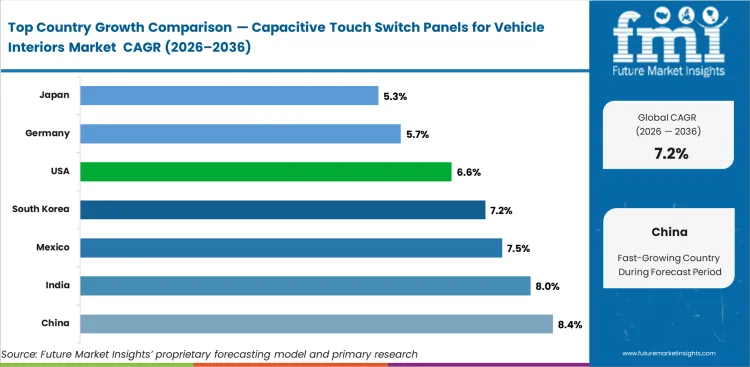
.webp "Top Country Growth Comparison Capacitive Touch Switch Panels For Vehicle Interiors Market Cagr (2026 2036)")
| Country | CAGR |
|---|---|
| China | 8.4% |
| India | 8.0% |
| Mexico | 7.5% |
| South Korea | 7.2% |
| United States | 6.6% |
| Germany | 5.7% |
| Japan | 5.3% |
Source: FMI analysis based on primary research and proprietary forecasting model.
Capacitive Touch Switch Panels for Vehicle Interiors Market Cagr Analysis By Country
- China is projected to advance at a CAGR of 8.4% because EV scale and smart-cockpit launches support faster touch-panel fitment.
- India is projected to expand at a CAGR of 8.0% as vehicle output is rising and electronics content is increasing in mid-priced passenger cars.
- Mexico is forecast to record a CAGR of 7.5% since export-oriented assembly and North American platform links support cockpit module demand.
- South Korea is set to post a CAGR of 7.2% because strong electronics capability supports tighter OEM-supplier coordination in cabin electronics.
- The United States is expected to register a CAGR of 6.6% because premium trim mix and SUV fitment raise cabin technology spending per vehicle.
- Germany is likely to progress at a CAGR of 5.7% due to premium cockpit programs in country which support demand while usability checks slow full touch migration.
- Japan is projected to witness a CAGR of 5.3% owing to premium feature upgrades while mainstream adoption stays more selective.
Demand Outlook for Capacitive Touch Switch Panels for Vehicle Interiors in China
China has high EV output and fast trim upgrades across domestic brands. Demand for capacitive touch switch panels for vehicle interiors in China is anticipated to rise at a CAGR of 8.4% through 2036 because EV model launches and premium console packages keep fitment high. Market relevance is higher in center stacks and rear-console modules for high-volume domestic OEM programs.
- Domestic EV makers keep adding illuminated surface controls.
- Smart-surface styling gains faster acceptance in upper trims.
- Local sourcing depth improves program conversion speed.
Future Outlook for Capacitive Touch Switch Panels for Vehicle Interiors in India
India benefits from passenger-vehicle expansion and richer electronics content in mid-range cabins. Sales of capacitive touch switch panels for vehicle interiors in India are expected to increase at a CAGR of 8.0% during the forecast period , driven by increasing passenger car production and feature upgrades. Console and steering applications hold stronger near-term fit than roof-console or rear-seat programs.
Mid-priced trims keep adding climate and media touch zones.
- Local assembly helps cost control.
- Passenger cars form the main demand base.
Opportunity Analysis of Capacitive Touch Switch Panels for Vehicle Interiors in Mexico
Mexico benefits from export-oriented vehicle assembly and platform links with North America based OEMs. The capacitive touch switch panels for vehicle interiors market in Mexico is projected to expand at a CAGR of 7.5% through 2036 due to rising cockpit module exports and premium trim integration. Value capture is stronger in OEM-linked supply chains than in local aftermarket channels.
- Export plants favor validated Tier 1 suppliers.
- Cross-border programs support steady module demand.
- HVAC and console controls lead current fitment.
In-depth Analysis of Capacitive Touch Switch Panels for Vehicle Interiors in South Korea
South Korea has strong electronics capability and close OEM-supplier coordination in cabin electronics. South Korea is set to record a CAGR of 7.2% in capacitive touch switch panels for vehicle interiors during the assessment period because premium interiors and integrated control designs are increasing control density in the cabin. Haptic and display modules gain stronger use than simple visual touch surfaces.
Local OEMs are pushing high-spec cockpit design.
Electronics supply depth supports rapid iteration.
Integration quality shapes supplier preference.
Sales Analysis of Capacitive Touch Switch Panels for Vehicle Interiors in United States
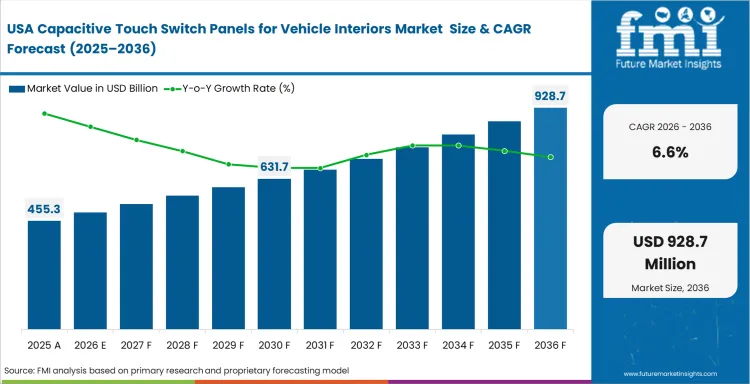
United States demand is supported by a large-vehicle mix and stronger premium trim penetration. Capacitive touch switch panels for vehicle interiors adoption in the United States is likely to advance at a CAGR of 6.6% by 2036 as SUV fitment and higher-value interior packages support demand. Suppliers with console and steering applications have better access to upper-trim vehicle programs.
- Pickup and SUV platforms lift content value per vehicle.
- Premium interiors support higher ASP.
- Safety-led usability review limits touch-only control spread.
Future Outlook for Capacitive Touch Switch Panels for Vehicle Interiors in Germany
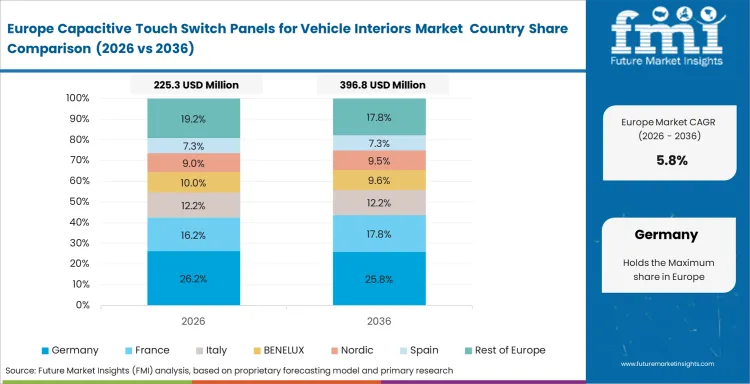
Germany retains strong premium-cabin engineering. Safety-led restraint tempers full surface digitalization across the same market. Germany is projected to witness 5.7% CAGR in the capacitive touch switch panels for vehicle interiors market through 2036 because luxury cockpit programs support demand while the need for direct and easy-to-use controls slows full replacement of physical buttons with touch surfaces. Mixed HMI layouts remain more suitable than fully flat control surfaces.
- Premium OEMs sustain demand for refined surfaces.
- Haptic quality matters in buyer evaluation.
- Compliance and usability checks slow extreme simplification.
Demand Outlook for Capacitive Touch Switch Panels for Vehicle Interiors in Japan
Japan has a mature supplier base and steady output. Conservative control logic keeps adoption selective in mainstream platforms. The market for capacitive touch switch panels for vehicle interiors in Japan is expected to grow at a rate of 5.3% during the study period because premium feature fitment and steady interior electronics upgrades support demand. Value stays stronger in quality-focused OEM programs than in mass adoption across all trims.
- Reliability and tactile precision remain under close review.
- Premium passenger models create most demand.
- Legacy switch preference limits rapid substitution.
Competitive Landscape and Strategic Positioning
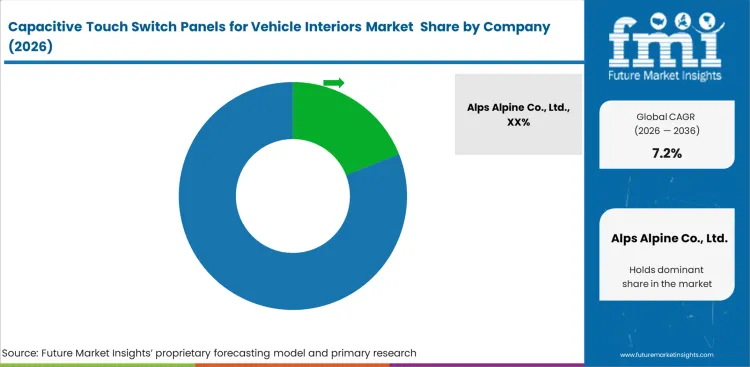
- The competitive landscape for capacitive touch switch panels is shaped by a concentrated group of established automotive HMI suppliers.
- Alps Alpine, Preh, and AUO Mobility Solutions/BHTC represent group of suppliers with strong capabilities in touch‑based interior controls.
- Tokai Rika and Continental form another key group, while Valeo and Leopold Kostal are some players active across major OEM programs.
Competition within this market is primarily driven by HMI integration capability and haptic performance quality. Suppliers that can deliver consistent tactile feedback, refined smart‑surface execution, and seamless integration with vehicle electronics platforms maintain a clear advantage. Decorative surface quality and the ability to support multi‑region OEM programs further influence supplier selection.
Market entry remains challenging due to long OEM validation cycles. Software integration requirements and the need to meet long‑term durability standards add further barriers, favouring suppliers with proven automotive experience and established production track records.
Key Companies in the Capacitive Touch Switch Panels for Vehicle Interiors Market
Key global companies leading the capacitive touch switch panels for vehicle interiors market include:
- HMI and touch-control specialists include Alps Alpine, Preh, and AUO Mobility Solutions/BHTC.
- Cabin electronics and interior system suppliers include Continental, Valeo, and Leopold Kostal.
- Tokai Rika remains a Japan-based switch and control company with a strong fit in steering and interior interfaces.
Competitive Benchmarking: Capacitive Touch Switch Panels for Vehicle Interiors
| Company | HMI Integration | Touch & Haptics | OEM Program Depth | Geographic Footprint |
|---|---|---|---|---|
| Alps Alpine Co., Ltd. | High | High | High | Global |
| Preh GmbH | High | High | High | Europe, China, North America |
| AUO Mobility Solutions / BHTC | High | High | Medium | Europe, Asia, North America |
| TOKAI RIKA CO., LTD. | Medium | Medium | High | Asia, North America |
| Continental AG | High | Medium | High | Global |
Source: Future Market Insights competitive analysis, 2026. Ratings reflect relative positioning based on HMI integration, touch & haptics, and OEM program depth.
Key Developments in Capacitive Touch Switch Panels for Vehicle Interiors
- In April 2024, AUO Corporation announced that its Smart Cockpit would be showcased at Touch Taiwan 2024, highlighting HMI solutions and interactive display applications for smart mobility.
- In September 2025, Preh GmbH presented its 2025 center console concept at IAA Mobility, showing a transparent-surface smartphone integration concept and onboard charger with V2G functionality.
- In January 2026, AUO Mobility Solutions presented cockpit technologies at CES 2026 with focus on visual, computing, and connectivity applications for future smart mobility.
Key Players in the Capacitive Touch Switch Panels for Vehicle Interiors
Major Global Players:
- Alps Alpine Co., Ltd.
- Continental AG
Emerging Players/Startups
- AUO Mobility Solutions / BHTC
- TOKAI RIKA CO., LTD.
Report Scope and Coverage
| Parameter | Details |
|---|---|
| Quantitative Units | USD Billion |
| Market Definition | OEM-supplied capacitive touch switch-panel assemblies used across vehicle interior control zones |
| Regions Covered | North America, Latin America, Europe, Asia Pacific, Middle East & Africa |
| Countries Covered | China, India, Mexico, South Korea, United States, Germany, Japan |
| Key Companies Profiled | Alps Alpine, Continental, Preh, AUO Mobility Solutions / BHTC, TOKAI RIKA, Valeo, Leopold Kostal |
| Forecast Period | 2026 - 2036 |
| Approach | Bottom-up vehicle production, attach-rate, and ASP model with company and country cross-checks |
Capacitive Touch Switch Panels for Vehicle Interiors Market by Segments
Capacitive Touch Switch Panels for Vehicle Interiors Market Segmented by Mounting Area:
- · Center stack
- · Steering wheel
- · Door trim
- · Roof console
- · Rear console
Capacitive Touch Switch Panels for Vehicle Interiors Market Segmented by Feedback Type:
- · Haptic
- · Visual
- · Audio
- · Hybrid
Capacitive Touch Switch Panels for Vehicle Interiors Market Segmented by Surface Material:
- · Polymer overlay
- · Glass
- · Decor film
- · Leatherette
Capacitive Touch Switch Panels for Vehicle Interiors Market Segmented by Vehicle Type:
- · Passenger cars
- · LCVs
- · HCVs
Capacitive Touch Switch Panels for Vehicle Interiors Market Segmented by Interface Layout:
- · Hidden-until-lit
- · Fixed icons
- · Slider strips
- · Multi-zone
Capacitive Touch Switch Panels for Vehicle Interiors Market Segmented by Integration Level:
· Standalone panel
· Display-integrated
· Smart surface
· Module stack
Capacitive Touch Switch Panels for Vehicle Interiors Market Segmented by Sales Channel:
- · OEM
- · Aftermarket
Capacitive Touch Switch Panels for Vehicle Interiors Market Segmented by Region:
- North America
- USA
- Canada
- Mexico
- Latin America
- Brazil
- Chile
- Rest of Latin America
- Western Europe
- Germany
- UK
- Italy
- Spain
- France
- Nordic
- BENELUX
- Rest of Western Europe
- Eastern Europe
- Russia
- Poland
- Hungary
- Balkan & Baltic
- Rest of Eastern Europe
- East Asia
- China
- Japan
- South Korea
- South Asia and Pacific
- India
- ASEAN
- Australia & New Zealand
- Rest of South Asia and Pacific
- Middle East & Africa
- Kingdom of Saudi Arabia
- Other GCC Countries
- Turkiye
- South Africa
- Other African Union
- Rest of Middle East & Africa
Research Sources and Bibliography
- European Automobile Manufacturers’ Association. (2026, January 27). New car registrations: +1.8% in 2025; battery-electric 17.4% market share.
- National Highway Traffic Safety Administration. Distracted Driving Dangers and Statistics.
- AUO Corporation. (2024, April 15). AUO Smart Cockpit to Showcase at Touch Taiwan 2024, Pioneering the Innovative Future of Smart Mobility.
- Preh GmbH. (2025, September 8). Preh at IAA Mobility: 2025 center console concept and onboard charger with V2G functionality.
- AUO Corporation. (2026, January 7). A First Look at AUO Mobility Solutions at CES 2026.
- International Organization of Motor Vehicle Manufacturers. (2025, October). By-country-region-2024.pdf.
- Euro NCAP. (2025, January). Euro NCAP publishes 2024 Year in Numbers.
- Euro NCAP. (2025, November). Euro NCAP announces 2026 protocol changes to tackle modern driving risks.
This Report Answers
- How large is the capacitive touch switch panels for vehicle interiors market in 2025?
- What revenue level is projected for 2036?
- What CAGR is expected across 2026 to 2036?
- Which mounting area leads current revenue contribution?
- Why do passenger cars dominate fitment depth?
- What role does haptic feedback play in future sourcing?
- Why does China lead country growth?
- What limits full replacement of physical controls?
- Which suppliers hold stronger HMI integration depth?
- How does OEM validation shape entry barriers?
- Which surface materials gain wider use in premium cabins?
- What sales channel controls most current revenue?
Frequently Asked Questions
What are capacitive touch switch panels for vehicle interiors?
Panel-based in-cabin controls using capacitive sensing for HVAC, media, comfort, lighting, and mode-selection inputs.
Why do OEMs use these panels?
OEMs use them for cleaner cabin design, richer interface styling, and wider electronics integration.
Why are haptic panels gaining more attention?
Haptic confirmation helps drivers confirm input without relying only on a visual check.
Do touch panels replace every physical button?
No. Core functions still need quick direct access in many vehicle programs.
Which vehicle type creates most demand?
Passenger cars create most demand because premium trim and EV fitment are deeper there.
Which country grows fastest?
China records the highest forecast CAGR in this article.
Why is aftermarket share low?
OEM validation, software linkage, and platform-specific packaging keep most revenue in factory-fit programs.
Which suppliers matter most?
Suppliers with HMI integration, haptic tuning, and OEM program access matter most.
What is the main restraint?
Safety-led concern around touch-only controls limits full migration away from tactile interfaces.
What keeps future demand healthy?
EV cabin redesign, decorative smart surfaces, and wider use of localized touch zones keep demand healthy.
Preview the report firsthand - request a free sample
Get SampleGet the brochure for pricing and purchase details.
Get PDFTable of Content
- Executive Summary
- Global Market Outlook
- Demand-side Trends
- Supply-side Trends
- Technology Roadmap Analysis
- Analysis and Recommendations
- Market Overview
- Market Coverage / Taxonomy
- Market Definition / Scope / Limitations
- Research Methodology
- Chapter Orientation
- Analytical Lens and Working Hypotheses
- Market Structure, Signals, and Trend Drivers
- Benchmarking and Cross-market Comparability
- Market Sizing, Forecasting, and Opportunity Mapping
- Research Design and Evidence Framework
- Desk Research Programme (Secondary Evidence)
- Company Annual and Sustainability Reports
- Peer-reviewed Journals and Academic Literature
- Corporate Websites, Product Literature, and Technical Notes
- Earnings Decks and Investor Briefings
- Statutory Filings and Regulatory Disclosures
- Technical White Papers and Standards Notes
- Trade Journals, Industry Magazines, and Analyst Briefs
- Conference Proceedings, Webinars, and Seminar Materials
- Government Statistics Portals and Public Data Releases
- Press Releases and Reputable Media Coverage
- Specialist Newsletters and Curated Briefings
- Sector Databases and Reference Repositories
- FMI Internal Proprietary Databases and Historical Market Datasets
- Subscription Datasets and Paid Sources
- Social Channels, Communities, and Digital Listening Inputs
- Additional Desk Sources
- Expert Input and Fieldwork (Primary Evidence)
- Primary Modes
- Qualitative Interviews and Expert Elicitation
- Quantitative Surveys and Structured Data Capture
- Blended Approach
- Why Primary Evidence is Used
- Field Techniques
- Interviews
- Surveys
- Focus Groups
- Observational and In-context Research
- Social and Community Interactions
- Stakeholder Universe Engaged
- C-suite Leaders
- Board Members
- Presidents and Vice Presidents
- R&D and Innovation Heads
- Technical Specialists
- Domain Subject-matter Experts
- Scientists
- Physicians and Other Healthcare Professionals
- Governance, Ethics, and Data Stewardship
- Research Ethics
- Data Integrity and Handling
- Primary Modes
- Tooling, Models, and Reference Databases
- Desk Research Programme (Secondary Evidence)
- Data Engineering and Model Build
- Data Acquisition and Ingestion
- Cleaning, Normalisation, and Verification
- Synthesis, Triangulation, and Analysis
- Quality Assurance and Audit Trail
- Market Background
- Market Dynamics
- Drivers
- Restraints
- Opportunity
- Trends
- Scenario Forecast
- Demand in Optimistic Scenario
- Demand in Likely Scenario
- Demand in Conservative Scenario
- Opportunity Map Analysis
- Product Life Cycle Analysis
- Supply Chain Analysis
- Investment Feasibility Matrix
- Value Chain Analysis
- PESTLE and Porter’s Analysis
- Regulatory Landscape
- Regional Parent Market Outlook
- Production and Consumption Statistics
- Import and Export Statistics
- Market Dynamics
- Global Market Analysis 2021 to 2025 and Forecast, 2026 to 2036
- Historical Market Size Value (USD Million) Analysis, 2021 to 2025
- Current and Future Market Size Value (USD Million) Projections, 2026 to 2036
- Y-o-Y Growth Trend Analysis
- Absolute $ Opportunity Analysis
- Global Market Pricing Analysis 2021 to 2025 and Forecast 2026 to 2036
- Global Market Analysis 2021 to 2025 and Forecast 2026 to 2036, By Mounting Area
- Introduction / Key Findings
- Historical Market Size Value (USD Million) Analysis By Mounting Area , 2021 to 2025
- Current and Future Market Size Value (USD Million) Analysis and Forecast By Mounting Area , 2026 to 2036
- Center Stack
- Steering Wheel
- Door Trim
- Center Stack
- Y-o-Y Growth Trend Analysis By Mounting Area , 2021 to 2025
- Absolute $ Opportunity Analysis By Mounting Area , 2026 to 2036
- Global Market Analysis 2021 to 2025 and Forecast 2026 to 2036, By Feedback Type
- Introduction / Key Findings
- Historical Market Size Value (USD Million) Analysis By Feedback Type, 2021 to 2025
- Current and Future Market Size Value (USD Million) Analysis and Forecast By Feedback Type, 2026 to 2036
- Haptic
- Visual
- Audio
- Haptic
- Y-o-Y Growth Trend Analysis By Feedback Type, 2021 to 2025
- Absolute $ Opportunity Analysis By Feedback Type, 2026 to 2036
- Global Market Analysis 2021 to 2025 and Forecast 2026 to 2036, By Surface Material
- Introduction / Key Findings
- Historical Market Size Value (USD Million) Analysis By Surface Material, 2021 to 2025
- Current and Future Market Size Value (USD Million) Analysis and Forecast By Surface Material, 2026 to 2036
- Polymer Overlay
- Glass
- Leatherette
- Polymer Overlay
- Y-o-Y Growth Trend Analysis By Surface Material, 2021 to 2025
- Absolute $ Opportunity Analysis By Surface Material, 2026 to 2036
- Global Market Analysis 2021 to 2025 and Forecast 2026 to 2036, By Vehicle Type
- Introduction / Key Findings
- Historical Market Size Value (USD Million) Analysis By Vehicle Type, 2021 to 2025
- Current and Future Market Size Value (USD Million) Analysis and Forecast By Vehicle Type, 2026 to 2036
- Passenger Cars
- LCVs
- HCVs
- Passenger Cars
- Y-o-Y Growth Trend Analysis By Vehicle Type, 2021 to 2025
- Absolute $ Opportunity Analysis By Vehicle Type, 2026 to 2036
- Global Market Analysis 2021 to 2025 and Forecast 2026 to 2036, By Interface Layout
- Introduction / Key Findings
- Historical Market Size Value (USD Million) Analysis By Interface Layout, 2021 to 2025
- Current and Future Market Size Value (USD Million) Analysis and Forecast By Interface Layout, 2026 to 2036
- Hidden-until-Lit Layouts
- Fixed Icons
- Slider Strips
- Hidden-until-Lit Layouts
- Y-o-Y Growth Trend Analysis By Interface Layout, 2021 to 2025
- Absolute $ Opportunity Analysis By Interface Layout, 2026 to 2036
- Global Market Analysis 2021 to 2025 and Forecast 2026 to 2036, By Integration Level
- Introduction / Key Findings
- Historical Market Size Value (USD Million) Analysis By Integration Level, 2021 to 2025
- Current and Future Market Size Value (USD Million) Analysis and Forecast By Integration Level, 2026 to 2036
- Standalone Panel
- Display-Integrated
- Others
- Standalone Panel
- Y-o-Y Growth Trend Analysis By Integration Level, 2021 to 2025
- Absolute $ Opportunity Analysis By Integration Level, 2026 to 2036
- Global Market Analysis 2021 to 2025 and Forecast 2026 to 2036, By Sales Channel
- Introduction / Key Findings
- Historical Market Size Value (USD Million) Analysis By Sales Channel, 2021 to 2025
- Current and Future Market Size Value (USD Million) Analysis and Forecast By Sales Channel, 2026 to 2036
- OEM
- Aftermarket
- OEM
- Y-o-Y Growth Trend Analysis By Sales Channel, 2021 to 2025
- Absolute $ Opportunity Analysis By Sales Channel, 2026 to 2036
- Global Market Analysis 2021 to 2025 and Forecast 2026 to 2036, By Region
- Introduction
- Historical Market Size Value (USD Million) Analysis By Region, 2021 to 2025
- Current Market Size Value (USD Million) Analysis and Forecast By Region, 2026 to 2036
- North America
- Latin America
- Western Europe
- Eastern Europe
- East Asia
- South Asia and Pacific
- Middle East & Africa
- Market Attractiveness Analysis By Region
- North America Market Analysis 2021 to 2025 and Forecast 2026 to 2036, By Country
- Historical Market Size Value (USD Million) Trend Analysis By Market Taxonomy, 2021 to 2025
- Market Size Value (USD Million) Forecast By Market Taxonomy, 2026 to 2036
- By Country
- USA
- Canada
- Mexico
- By Mounting Area
- By Feedback Type
- By Surface Material
- By Vehicle Type
- By Interface Layout
- By Integration Level
- By Sales Channel
- By Country
- Market Attractiveness Analysis
- By Country
- By Mounting Area
- By Feedback Type
- By Surface Material
- By Vehicle Type
- By Interface Layout
- By Integration Level
- By Sales Channel
- Key Takeaways
- Latin America Market Analysis 2021 to 2025 and Forecast 2026 to 2036, By Country
- Historical Market Size Value (USD Million) Trend Analysis By Market Taxonomy, 2021 to 2025
- Market Size Value (USD Million) Forecast By Market Taxonomy, 2026 to 2036
- By Country
- Brazil
- Chile
- Rest of Latin America
- By Mounting Area
- By Feedback Type
- By Surface Material
- By Vehicle Type
- By Interface Layout
- By Integration Level
- By Sales Channel
- By Country
- Market Attractiveness Analysis
- By Country
- By Mounting Area
- By Feedback Type
- By Surface Material
- By Vehicle Type
- By Interface Layout
- By Integration Level
- By Sales Channel
- Key Takeaways
- Western Europe Market Analysis 2021 to 2025 and Forecast 2026 to 2036, By Country
- Historical Market Size Value (USD Million) Trend Analysis By Market Taxonomy, 2021 to 2025
- Market Size Value (USD Million) Forecast By Market Taxonomy, 2026 to 2036
- By Country
- Germany
- UK
- Italy
- Spain
- France
- Nordic
- BENELUX
- Rest of Western Europe
- By Mounting Area
- By Feedback Type
- By Surface Material
- By Vehicle Type
- By Interface Layout
- By Integration Level
- By Sales Channel
- By Country
- Market Attractiveness Analysis
- By Country
- By Mounting Area
- By Feedback Type
- By Surface Material
- By Vehicle Type
- By Interface Layout
- By Integration Level
- By Sales Channel
- Key Takeaways
- Eastern Europe Market Analysis 2021 to 2025 and Forecast 2026 to 2036, By Country
- Historical Market Size Value (USD Million) Trend Analysis By Market Taxonomy, 2021 to 2025
- Market Size Value (USD Million) Forecast By Market Taxonomy, 2026 to 2036
- By Country
- Russia
- Poland
- Hungary
- Balkan & Baltic
- Rest of Eastern Europe
- By Mounting Area
- By Feedback Type
- By Surface Material
- By Vehicle Type
- By Interface Layout
- By Integration Level
- By Sales Channel
- By Country
- Market Attractiveness Analysis
- By Country
- By Mounting Area
- By Feedback Type
- By Surface Material
- By Vehicle Type
- By Interface Layout
- By Integration Level
- By Sales Channel
- Key Takeaways
- East Asia Market Analysis 2021 to 2025 and Forecast 2026 to 2036, By Country
- Historical Market Size Value (USD Million) Trend Analysis By Market Taxonomy, 2021 to 2025
- Market Size Value (USD Million) Forecast By Market Taxonomy, 2026 to 2036
- By Country
- China
- Japan
- South Korea
- By Mounting Area
- By Feedback Type
- By Surface Material
- By Vehicle Type
- By Interface Layout
- By Integration Level
- By Sales Channel
- By Country
- Market Attractiveness Analysis
- By Country
- By Mounting Area
- By Feedback Type
- By Surface Material
- By Vehicle Type
- By Interface Layout
- By Integration Level
- By Sales Channel
- Key Takeaways
- South Asia and Pacific Market Analysis 2021 to 2025 and Forecast 2026 to 2036, By Country
- Historical Market Size Value (USD Million) Trend Analysis By Market Taxonomy, 2021 to 2025
- Market Size Value (USD Million) Forecast By Market Taxonomy, 2026 to 2036
- By Country
- India
- ASEAN
- Australia & New Zealand
- Rest of South Asia and Pacific
- By Mounting Area
- By Feedback Type
- By Surface Material
- By Vehicle Type
- By Interface Layout
- By Integration Level
- By Sales Channel
- By Country
- Market Attractiveness Analysis
- By Country
- By Mounting Area
- By Feedback Type
- By Surface Material
- By Vehicle Type
- By Interface Layout
- By Integration Level
- By Sales Channel
- Key Takeaways
- Middle East & Africa Market Analysis 2021 to 2025 and Forecast 2026 to 2036, By Country
- Historical Market Size Value (USD Million) Trend Analysis By Market Taxonomy, 2021 to 2025
- Market Size Value (USD Million) Forecast By Market Taxonomy, 2026 to 2036
- By Country
- Kingdom of Saudi Arabia
- Other GCC Countries
- Turkiye
- South Africa
- Other African Union
- Rest of Middle East & Africa
- By Mounting Area
- By Feedback Type
- By Surface Material
- By Vehicle Type
- By Interface Layout
- By Integration Level
- By Sales Channel
- By Country
- Market Attractiveness Analysis
- By Country
- By Mounting Area
- By Feedback Type
- By Surface Material
- By Vehicle Type
- By Interface Layout
- By Integration Level
- By Sales Channel
- Key Takeaways
- Key Countries Market Analysis
- USA
- Pricing Analysis
- Market Share Analysis, 2025
- By Mounting Area
- By Feedback Type
- By Surface Material
- By Vehicle Type
- By Interface Layout
- By Integration Level
- By Sales Channel
- Canada
- Pricing Analysis
- Market Share Analysis, 2025
- By Mounting Area
- By Feedback Type
- By Surface Material
- By Vehicle Type
- By Interface Layout
- By Integration Level
- By Sales Channel
- Mexico
- Pricing Analysis
- Market Share Analysis, 2025
- By Mounting Area
- By Feedback Type
- By Surface Material
- By Vehicle Type
- By Interface Layout
- By Integration Level
- By Sales Channel
- Brazil
- Pricing Analysis
- Market Share Analysis, 2025
- By Mounting Area
- By Feedback Type
- By Surface Material
- By Vehicle Type
- By Interface Layout
- By Integration Level
- By Sales Channel
- Chile
- Pricing Analysis
- Market Share Analysis, 2025
- By Mounting Area
- By Feedback Type
- By Surface Material
- By Vehicle Type
- By Interface Layout
- By Integration Level
- By Sales Channel
- Germany
- Pricing Analysis
- Market Share Analysis, 2025
- By Mounting Area
- By Feedback Type
- By Surface Material
- By Vehicle Type
- By Interface Layout
- By Integration Level
- By Sales Channel
- UK
- Pricing Analysis
- Market Share Analysis, 2025
- By Mounting Area
- By Feedback Type
- By Surface Material
- By Vehicle Type
- By Interface Layout
- By Integration Level
- By Sales Channel
- Italy
- Pricing Analysis
- Market Share Analysis, 2025
- By Mounting Area
- By Feedback Type
- By Surface Material
- By Vehicle Type
- By Interface Layout
- By Integration Level
- By Sales Channel
- Spain
- Pricing Analysis
- Market Share Analysis, 2025
- By Mounting Area
- By Feedback Type
- By Surface Material
- By Vehicle Type
- By Interface Layout
- By Integration Level
- By Sales Channel
- France
- Pricing Analysis
- Market Share Analysis, 2025
- By Mounting Area
- By Feedback Type
- By Surface Material
- By Vehicle Type
- By Interface Layout
- By Integration Level
- By Sales Channel
- India
- Pricing Analysis
- Market Share Analysis, 2025
- By Mounting Area
- By Feedback Type
- By Surface Material
- By Vehicle Type
- By Interface Layout
- By Integration Level
- By Sales Channel
- ASEAN
- Pricing Analysis
- Market Share Analysis, 2025
- By Mounting Area
- By Feedback Type
- By Surface Material
- By Vehicle Type
- By Interface Layout
- By Integration Level
- By Sales Channel
- Australia & New Zealand
- Pricing Analysis
- Market Share Analysis, 2025
- By Mounting Area
- By Feedback Type
- By Surface Material
- By Vehicle Type
- By Interface Layout
- By Integration Level
- By Sales Channel
- China
- Pricing Analysis
- Market Share Analysis, 2025
- By Mounting Area
- By Feedback Type
- By Surface Material
- By Vehicle Type
- By Interface Layout
- By Integration Level
- By Sales Channel
- Japan
- Pricing Analysis
- Market Share Analysis, 2025
- By Mounting Area
- By Feedback Type
- By Surface Material
- By Vehicle Type
- By Interface Layout
- By Integration Level
- By Sales Channel
- South Korea
- Pricing Analysis
- Market Share Analysis, 2025
- By Mounting Area
- By Feedback Type
- By Surface Material
- By Vehicle Type
- By Interface Layout
- By Integration Level
- By Sales Channel
- Russia
- Pricing Analysis
- Market Share Analysis, 2025
- By Mounting Area
- By Feedback Type
- By Surface Material
- By Vehicle Type
- By Interface Layout
- By Integration Level
- By Sales Channel
- Poland
- Pricing Analysis
- Market Share Analysis, 2025
- By Mounting Area
- By Feedback Type
- By Surface Material
- By Vehicle Type
- By Interface Layout
- By Integration Level
- By Sales Channel
- Hungary
- Pricing Analysis
- Market Share Analysis, 2025
- By Mounting Area
- By Feedback Type
- By Surface Material
- By Vehicle Type
- By Interface Layout
- By Integration Level
- By Sales Channel
- Kingdom of Saudi Arabia
- Pricing Analysis
- Market Share Analysis, 2025
- By Mounting Area
- By Feedback Type
- By Surface Material
- By Vehicle Type
- By Interface Layout
- By Integration Level
- By Sales Channel
- Turkiye
- Pricing Analysis
- Market Share Analysis, 2025
- By Mounting Area
- By Feedback Type
- By Surface Material
- By Vehicle Type
- By Interface Layout
- By Integration Level
- By Sales Channel
- South Africa
- Pricing Analysis
- Market Share Analysis, 2025
- By Mounting Area
- By Feedback Type
- By Surface Material
- By Vehicle Type
- By Interface Layout
- By Integration Level
- By Sales Channel
- USA
- Market Structure Analysis
- Competition Dashboard
- Competition Benchmarking
- Market Share Analysis of Top Players
- By Regional
- By Mounting Area
- By Feedback Type
- By Surface Material
- By Vehicle Type
- By Interface Layout
- By Integration Level
- By Sales Channel
- Competition Analysis
- Competition Deep Dive
- Alps Alpine Co., Ltd.
- Overview
- Product Portfolio
- Profitability by Market Segments (Product/Age /Sales Channel/Region)
- Sales Footprint
- Strategy Overview
- Marketing Strategy
- Product Strategy
- Channel Strategy
- Continental AG
- AUO Mobility Solutions / BHTC
- TOKAI RIKA CO., LTD.
- Alps Alpine Co., Ltd.
- Competition Deep Dive
- Assumptions & Acronyms Used


