

- Industry Size (2026)
- USD 980.0 Mn
- Forecast (2036)
- USD 1722.2 Mn
- CAGR (2026 to 2036)
- 5.8%
Blanking Panels Market Forecast and Outlook 2026 to 2036
The blanking panels market is likely to be valued at USD 980.0 million in 2026 and is forecasted to reach USD 1,722.2 million by 2036, reflecting a CAGR of 5.8%. Value formation is directly linked to rack-level airflow control requirements rather than expansion of IT hardware alone. Blanking panels are consumed as infrastructure efficiency components within server racks, where each unused rack unit represents a potential cooling loss point. Demand scales with rack density, cabinet height utilization, and adoption of hot-aisle and cold-aisle containment architectures. Facilities with high equipment churn and modular deployment patterns generate higher recurring consumption as rack layouts evolve over time.
Procurement behavior is shaped by operational discipline, cooling strategy maturity, and energy cost exposure. Facilities with active thermal monitoring and airflow modeling enforce strict panel coverage policies, while lower-utilization environments exhibit inconsistent installation practices. Retrofit demand emerges when legacy data halls transition toward containment-based cooling or pursue incremental power usage effectiveness improvements. Material choice and mounting design influence replacement frequency, particularly in environments with frequent equipment access and reconfiguration. Blanking panels remain low-complexity components, but aggregate demand accumulates through quantity intensity rather than unit value growth. Market expansion therefore tracks densification of digital infrastructure, enforcement of cooling efficiency standards, and lifecycle optimization of existing rack assets rather than greenfield data center construction alone.
Quick Stats for Blanking Panels Market
- Blanking Panels Market Value (2026): USD 980.0 million
- Blanking Panels Market Forecast Value (2036): USD 1,722.2 million
- Blanking Panels Market Forecast CAGR 2026 to 2036: 5.8%
- Leading Panel Type by Demand Share: Toolless Snap-In Panels
- Fastest-Growing Countries: India, China, United Arab Emirates, Saudi Arabia, Singapore
- Top Players in Global Demand: Chatsworth Products (CPI), Schneider Electric (APC), Rittal, Vertiv, Panduit, Legrand, Eaton, nVent, Tripp Lite (Eaton), Siemon
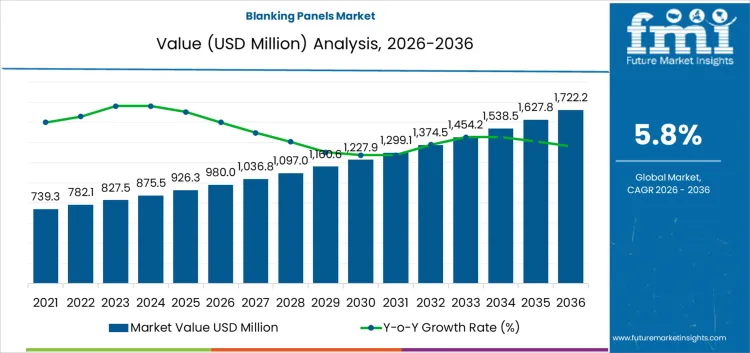
Blanking Panels Market Key Takeaways
| Metric | Value |
|---|---|
| Market Value (2026) | USD 980.0 million |
| Market Forecast Value (2036) | USD 1,722.2 million |
| Forecast CAGR 2026 to 2036 | 5.8% |
Why is the Demand for Blanking Panels Growing?
Demand for blanking panels is increasing as data center operators and telecommunications facilities prioritize airflow management to improve cooling efficiency and maintain reliable equipment performance. Blanking panels are specified to fill unused rack spaces and prevent hot air recirculation, which supports more predictable temperature control within cabinet aisles and reduces cooling load on HVAC systems. Engineers and facility planners assess panel fit accuracy, material quality, and ease of installation to ensure solutions align with rack design and weight loading parameters. Procurement teams evaluate fire safety ratings, static dissipative properties, and compliance with infrastructure standards because blanking panels contribute to environmental control strategies that protect sensitive electronics and support uptime objectives.
Adoption of structured cooling practices and capacity planning reinforces use of blanking panels as part of broader thermal management frameworks in digital infrastructure environments. Growth in edge computing facilities, cloud service expansion, and network densification reinforces uptake of blanking panels because unoccupied rack spaces become more prevalent as equipment configurations evolve. Facility managers integrate blanking panel deployment with asset inventories and load balancing plans to support scalable operations and reduce total energy expenditure. Coordination between design engineers, installation contractors, and operations staff ensures panel placement aligns with airflow modeling and future reconfiguration needs. These operational and environmental control considerations are contributing to sustained demand for blanking panels across evolving data center and network facilities.
How Are the Segments Classified in the Blanking Panels Market?
Demand for blanking panels is shaped by airflow management requirements, thermal efficiency targets, and equipment protection within rack-based infrastructure. Facilities deploy panels to prevent hot and cold air mixing and to maintain predictable cooling performance. Adoption aligns with densification of IT equipment and emphasis on energy efficiency within controlled environments. Product selection prioritizes ease of installation, rack compatibility, and durability. Segment classification reflects differentiation by panel mounting method, rack standard, and operational end use. Structure highlights how airflow control needs, rack architecture, and facility type influence specification priorities and deployment density.
Which Panel Type Represents the Largest Share of Demand?
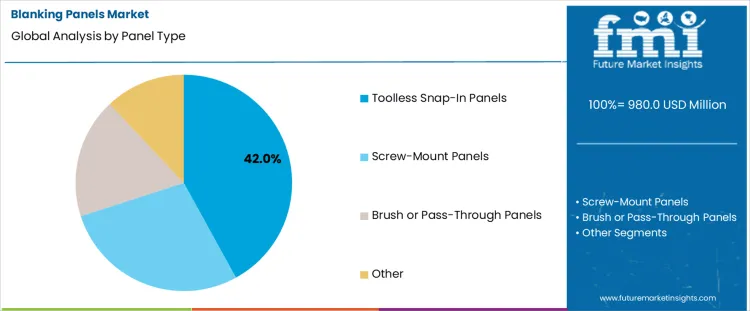
Toolless snap-in panels hold 42.0%, representing the largest share among panel types due to installation efficiency. These panels enable rapid placement and removal without specialized tools, supporting frequent rack reconfiguration. Secure snap mechanisms maintain airflow separation under vibration and thermal cycling. Reduced installation time supports operational flexibility within active environments. Screw-mount panels provide rigid fixation with higher installation effort. Brush or pass-through panels allow controlled cable routing with partial airflow sealing. Panel type segmentation reflects preference for solutions balancing speed, retention reliability, and adaptability in dynamic rack layouts.
Key Points
- Toolless panels support fast rack configuration changes.
- Secure retention maintains airflow separation reliability.
- Other panels address rigidity or cable pass-through needs.
Which Rack Standard Accounts for the Highest Share of Demand?
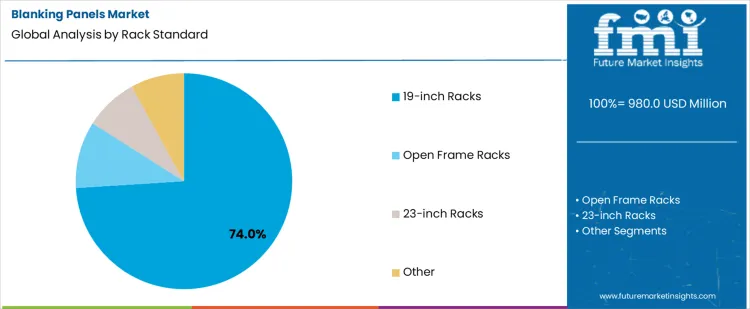
19-inch racks hold 74.0%, representing the largest share among rack standards due to widespread adoption. This standard supports compatibility across servers, networking equipment, and accessories. Infrastructure uniformity simplifies procurement and deployment planning. Cooling and airflow management designs are optimized around this rack size. Open frame and 23-inch racks serve specialized or legacy environments with lower volume. Rack standard segmentation reflects concentration of blanking panel usage within standardized rack ecosystems dominating enterprise and facility installations.
Key Points
- Nineteen-inch racks dominate infrastructure installations.
- Standardization simplifies accessory compatibility.
- Other rack formats serve niche or legacy needs.
Which End Use Drives the Largest Share of Demand?
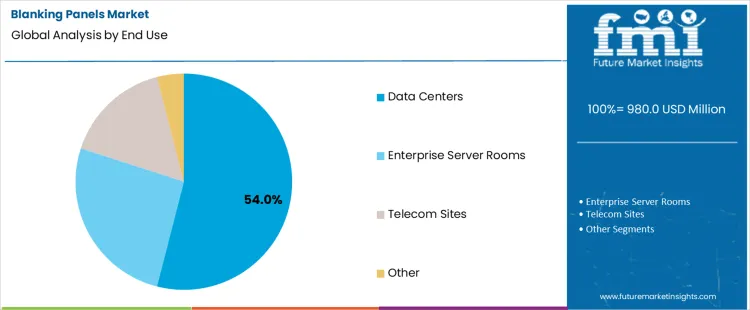
Data centers hold 54.0%, representing the largest share among end-use settings due to high rack density. Effective airflow containment supports cooling efficiency and equipment reliability. Blanking panels reduce bypass airflow and improve thermal predictability. Continuous operation increases focus on energy optimization and equipment protection. Enterprise server rooms apply panels with lower density requirements. Telecom sites deploy panels within distributed equipment locations. End-use segmentation reflects concentration of demand where thermal management and operational continuity remain critical.
Key Points
- Data centers require strict airflow management.
- Blanking panels improve cooling efficiency and reliability.
- Other environments apply panels at lower deployment density.
What are the Key Dynamics in the Blanking Panels Market?
Demand for blanking panels reflects airflow management, safety, and space optimization requirements within equipment racks and enclosures. Adoption spans data centers, telecommunications facilities, industrial control rooms, and network closets. Global scope aligns with thermal efficiency targets and infrastructure densification. Usage centers on metal and polymer panels installed in unused rack spaces to control airflow paths, protect equipment, and support compliance with operational standards.
How do thermal management efficiency and rack utilization shape adoption?
High-density racks generate localized heat loads requiring controlled airflow separation between hot and cold zones. Demand increases as blanking panels prevent air recirculation through empty rack units, improving cooling efficiency and temperature uniformity. Data center operators adopt panels to stabilize inlet temperatures and reduce cooling energy waste. Telecommunications facilities rely on panels to protect cabling and equipment from accidental contact and dust ingress. Modular rack configurations create frequent unused spaces, reinforcing routine panel installation. Standard rack dimensions support rapid deployment without tools. Adoption reflects operational focus on predictable thermal behavior and optimized cooling performance rather than aesthetic considerations.
How do cost sensitivity, material choice, and operational discipline influence market scalability?
Blanking panels face high price sensitivity due to large quantities required per facility. Demand sensitivity rises where operators defer installation in low-utilization racks. Material choice affects durability, fire performance, and electromagnetic compatibility compliance. Improper installation or removal during maintenance reduces effectiveness and consistency. Variation in rack standards limits universal fit across mixed environments. Maintenance teams require discipline to reinstall panels after equipment changes. Limited differentiation constrains margin-supported innovation. Dependence on data center build cycles and retrofit projects restricts steady volume expansion across non-critical infrastructure segments.
How Is Demand for Blanking Panels Evolving Globally?
Demand for blanking panels is expanding globally due to rising data center density, airflow management requirements, and energy efficiency compliance across IT facilities. Adoption aligns with thermal optimization, hot aisle containment, and equipment protection within server racks. Operators deploy blanking panels to prevent air recirculation and stabilize cooling performance under high rack power loads. Retrofit activity contributes where legacy racks undergo efficiency upgrades. Growth rates in India at 7.6%, China at 7.1%, UAE at 6.6%, Saudi Arabia at 6.4%, and Singapore at 6.1% indicate sustained expansion driven by digital infrastructure build-out, cooling optimization priorities, and lifecycle replacement.
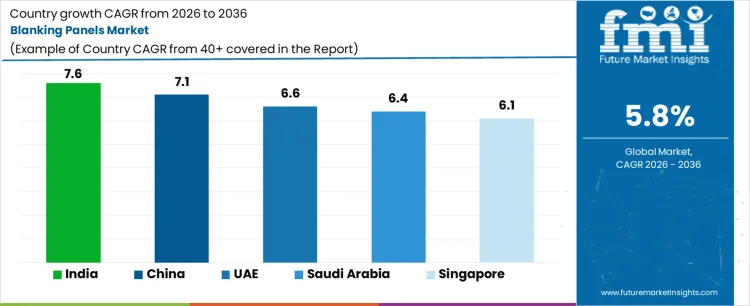
| Country | CAGR (%) |
|---|---|
| India | 7.6% |
| China | 7.1% |
| UAE | 6.6% |
| Saudi Arabia | 6.4% |
| Singapore | 6.1% |
What Is Driving Strong Growth of Blanking Panel Demand in India?
India is growing at a CAGR of 7.6%, supported by rapid expansion of hyperscale and enterprise data centers. High rack density increases need for airflow segregation to maintain thermal stability. Operators emphasize cost-effective efficiency improvements to manage energy consumption. Colocation facilities standardize blanking panels across mixed tenant environments. Compliance with uptime and cooling performance benchmarks drives consistent deployment. Retrofit projects contribute as older facilities upgrade containment strategies. Demand growth reflects operational efficiency focus and digital infrastructure scaling rather than discretionary facility enhancements.
- Expansion of hyperscale and colocation data centers
- Rising rack density increasing airflow management needs
- Energy efficiency optimization priorities
- Retrofit of legacy data center halls
Why Is China Sustaining Elevated Demand for Blanking Panels?
Blanking panel demand in China is expanding at a CAGR of 7.1%, driven by large-scale data center construction and standardized cooling architectures. High server density in cloud facilities requires strict airflow control to maintain reliability. Government guidance on energy efficiency influences adoption of containment accessories. Domestic manufacturing enables large-volume procurement with consistent specifications. Operators deploy blanking panels during initial rack build-out to reduce cooling losses. Demand growth reflects infrastructure scale and efficiency regulation rather than incremental IT capacity additions.
- Large-scale cloud data center deployment
- Standardized rack and cooling architectures
- Energy efficiency guidance influencing specifications
- Strong domestic manufacturing scale
How Is the UAE Shaping Demand for Blanking Panels?
Blanking panel demand in United Arab Emirates is growing at a CAGR of 6.6%, influenced by regional data hub development and climate-driven cooling intensity. High ambient temperatures increase importance of airflow containment. Data centers serving finance, government, and cloud services prioritize thermal efficiency. Operators adopt blanking panels to stabilize cooling under variable loads. Green building standards reinforce energy management practices. Demand growth reflects climate exposure and data hub positioning rather than sheer facility count expansion.
- High ambient temperatures increasing cooling sensitivity
- Regional data hub and cloud service growth
- Emphasis on airflow containment efficiency
- Alignment with green building standards
What Factors Are Supporting Blanking Panel Demand in Saudi Arabia?
Saudi Arabia is expanding at a CAGR of 6.4%, shaped by digital infrastructure investment and public sector data center development. Government and enterprise facilities adopt containment solutions to improve cooling predictability. New builds integrate blanking panels during rack commissioning. Energy efficiency targets influence accessory specification. Harsh climate conditions elevate focus on cooling loss prevention. Growth reflects institutional investment and efficiency standards rather than rapid private colocation expansion.
- Government-led data center infrastructure projects
- Rack-level airflow containment during commissioning
- Energy efficiency performance targets
- Climate-driven cooling optimization needs
Why Is Singapore Showing Consistent Growth in Blanking Panel Demand?
Blanking panel demand in Singapore is growing at a CAGR of 6.1%, supported by mature data center operations and strict efficiency benchmarks. Space constraints drive high rack density, increasing airflow management requirements. Operators emphasize incremental efficiency gains to meet regulatory limits on energy usage. Retrofit demand emerges from continual optimization of existing facilities. Strong operational discipline sustains predictable procurement cycles. Growth reflects efficiency-led replacement and optimization rather than expansion in total data center footprint.
- High rack density due to space constraints
- Strict regulatory limits on energy usage
- Continuous optimization of existing facilities
- Predictable retrofit-driven procurement cycles
What is the competitive landscape of demand for the blanking panels market globally?
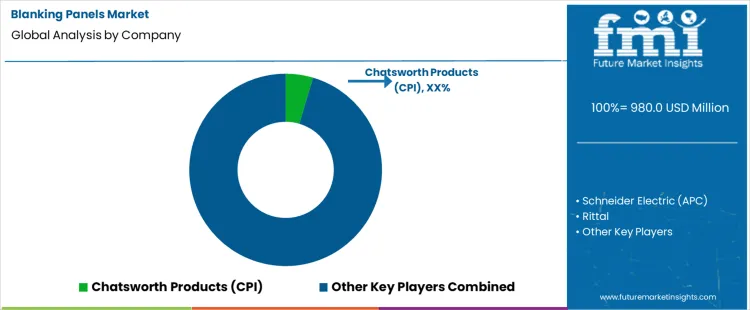
Demand for blanking panels is driven by growth in data centers, network closets, and telecommunications infrastructure where effective airflow management and equipment organization are essential. Blanking panels are used to fill unused rack spaces, reduce recirculation of hot and cold air, improve cooling efficiency, and support thermal management objectives. Buyers evaluate panel fit, material durability, ease of installation, compatibility with rack standards (such as EIA/ECA), and impact on airflow dynamics. Procurement teams prioritize suppliers with broad portfolio offerings, global distribution networks, adherence to industry standards, and support for design and specification workflows. Trend in the global market reflects emphasis on energy-efficient rack cooling, modular infrastructure deployment, and integration with cable management and containment systems.
Chatsworth Products (CPI) holds leading positioning through extensive rack and enclosure accessory portfolios including blanking panels designed for optimized airflow and thermal performance. Schneider Electric (APC) supports demand with blanking solutions integrated into comprehensive rack, power, and cooling systems used widely in hyperscale and enterprise environments. Rittal participates with blanking panels and enclosure solutions engineered for precision fit and long-term reliability. Vertiv contributes rack accessory offerings including airflow management panels aligned with data center infrastructure strategies. Panduit supplies blanking panels and support components that enhance cooling efficiency and cable organization in network installations. Competitive differentiation depends on fit and finish quality, airflow performance, compatibility with modular systems, and ability to support large-scale deployment and serviceability requirements.
Key Players in the Blanking Panels Market
- Chatsworth Products (CPI)
- Schneider Electric (APC)
- Rittal
- Vertiv
- Panduit
- Legrand
- Eaton
- nVent
- Tripp Lite (Eaton)
- Siemon
Scope of the Report
| Items | Values |
|---|---|
| Quantitative Units | USD million |
| Panel Type | Toolless Snap-In Panels; Screw-Mount Panels; Brush or Pass-Through Panels; Other |
| Rack Standard | 19-inch Racks; Open Frame Racks; 23-inch Racks; Other |
| End Use | Data Centers; Enterprise Server Rooms; Telecom Sites; Other |
| Sales Channel | IT or Network Distributors; Direct OEM Bundles; E-commerce; Other |
| Regions Covered | Asia Pacific, Middle East, Europe, North America |
| Countries Covered | India, China, UAE, Saudi Arabia, Singapore, and 30+ countries |
| Key Companies Profiled | Chatsworth Products (CPI); Schneider Electric (APC); Rittal; Vertiv; Panduit; Legrand; Eaton; nVent; Tripp Lite (Eaton); Siemon |
| Additional Attributes | Dollar sales by panel type, rack standard, and end use; airflow containment effectiveness and thermal efficiency benchmarks; compatibility with hot-aisle or cold-aisle containment strategies; material selection and flame-retardancy classifications; tool-free installation time and retrofit suitability; procurement patterns via distributor-led IT channels and OEM rack bundles; compliance with data center best practices and telecom facility standards influencing specification decisions. |
Blanking Panels Market by Segment
Panel Type:
- Toolless Snap-In Panels
- Screw-Mount Panels
- Brush or Pass-Through Panels
- Other
Rack Standard:
- 19-inch Racks
- Open Frame Racks
- 23-inch Racks
- Other
End Use:
- Data Centers
- Enterprise Server Rooms
- Telecom Sites
- Other
Sales Channel:
- IT or Network Distributors
- Direct OEM Bundles
- E-commerce
- Other
Region:
- Asia Pacific
- China
- Japan
- South Korea
- India
- Australia & New Zealand
- ASEAN
- Rest of Asia Pacific
- Europe
- Germany
- United Kingdom
- France
- Italy
- Spain
- Nordic
- BENELUX
- Rest of Europe
- North America
- United States
- Canada
- Mexico
- Latin America
- Brazil
- Chile
- Rest of Latin America
- Middle East & Africa
- Kingdom of Saudi Arabia
- Other GCC Countries
- Turkey
- South Africa
- Other African Union
- Rest of Middle East & Africa
Bibliography
- European Committee for Standardization. (2023). EN 50600-2-3: Information technology — Data centre facilities and infrastructures — Part 2-3: Power distribution and environmental control. CEN.
- International Electrotechnical Commission. (2024). IEC 60297-3-100: Mechanical structures for electronic equipment — Dimensions of mechanical structures of the 482.6 mm (19 in) series — Part 3-100: Basic dimensions, sub-rack-plug-in units, and mechanical structures. IEC.
- International Organization for Standardization. (2023). ISO 14763-2:2013/Amd 1:2023 — Information technology — Implementation and operation of customer-owned fibre optic cabling infrastructure — Part 2: Planning and installation (Amendment 1). ISO.
- National Fire Protection Association. (2024). NFPA 75: Standard for the fire protection of information technology equipment. NFPA.
- Telecommunications Industry Association. (2023). ANSI/TIA-942-C: Telecommunications infrastructure standard for data centers. TIA.
Frequently Asked Questions
How big is the blanking panels market in 2026?
The global blanking panels market is estimated to be valued at USD 980.0 million in 2026.
What will be the size of blanking panels market in 2036?
The market size for the blanking panels market is projected to reach USD 1,722.2 million by 2036.
How much will be the blanking panels market growth between 2026 and 2036?
The blanking panels market is expected to grow at a 5.8% CAGR between 2026 and 2036.
What are the key product types in the blanking panels market?
The key product types in blanking panels market are toolless snap-in panels, screw-mount panels, brush or pass-through panels and other.
Which rack standard segment to contribute significant share in the blanking panels market in 2026?
In terms of rack standard, 19-inch racks segment to command 74.0% share in the blanking panels market in 2026.
Preview the report firsthand - request a free sample
Get SampleGet the brochure for pricing and purchase details.
Get PDFTable of Content
- Executive Summary
- Global Market Outlook
- Demand-side Trends
- Supply-side Trends
- Technology Roadmap Analysis
- Analysis and Recommendations
- Market Overview
- Market Coverage / Taxonomy
- Market Definition / Scope / Limitations
- Market Background
- Market Dynamics
- Drivers
- Restraints
- Opportunity
- Trends
- Scenario Forecast
- Demand in Optimistic Scenario
- Demand in Likely Scenario
- Demand in Conservative Scenario
- Opportunity Map Analysis
- Product Life Cycle Analysis
- Supply Chain Analysis
- Investment Feasibility Matrix
- Value Chain Analysis
- PESTLE and Porter’s Analysis
- Regulatory Landscape
- Regional Parent Market Outlook
- Production and Consumption Statistics
- Import and Export Statistics
- Market Dynamics
- Global Market Analysis 2021 to 2025 and Forecast, 2026 to 2036
- Historical Market Size Value (USD Million) Analysis, 2021 to 2025
- Current and Future Market Size Value (USD Million) Projections, 2026 to 2036
- Y-o-Y Growth Trend Analysis
- Absolute $ Opportunity Analysis
- Global Market Pricing Analysis 2021 to 2025 and Forecast 2026 to 2036
- Global Market Analysis 2021 to 2025 and Forecast 2026 to 2036, By Panel Type
- Introduction / Key Findings
- Historical Market Size Value (USD Million) Analysis By Panel Type , 2021 to 2025
- Current and Future Market Size Value (USD Million) Analysis and Forecast By Panel Type , 2026 to 2036
- Toolless Snap-In Panels
- Screw-Mount Panels
- Brush or Pass-Through Panels
- Other
- Toolless Snap-In Panels
- Y-o-Y Growth Trend Analysis By Panel Type , 2021 to 2025
- Absolute $ Opportunity Analysis By Panel Type , 2026 to 2036
- Global Market Analysis 2021 to 2025 and Forecast 2026 to 2036, By Rack Standard
- Introduction / Key Findings
- Historical Market Size Value (USD Million) Analysis By Rack Standard, 2021 to 2025
- Current and Future Market Size Value (USD Million) Analysis and Forecast By Rack Standard, 2026 to 2036
- 19-inch Racks
- Open Frame Racks
- 23-inch Racks
- Other
- 19-inch Racks
- Y-o-Y Growth Trend Analysis By Rack Standard, 2021 to 2025
- Absolute $ Opportunity Analysis By Rack Standard, 2026 to 2036
- Global Market Analysis 2021 to 2025 and Forecast 2026 to 2036, By End Use
- Introduction / Key Findings
- Historical Market Size Value (USD Million) Analysis By End Use, 2021 to 2025
- Current and Future Market Size Value (USD Million) Analysis and Forecast By End Use, 2026 to 2036
- Data Centers
- Enterprise Server Rooms
- Telecom Sites
- Other
- Data Centers
- Y-o-Y Growth Trend Analysis By End Use, 2021 to 2025
- Absolute $ Opportunity Analysis By End Use, 2026 to 2036
- Global Market Analysis 2021 to 2025 and Forecast 2026 to 2036, By Sales Channel
- Introduction / Key Findings
- Historical Market Size Value (USD Million) Analysis By Sales Channel, 2021 to 2025
- Current and Future Market Size Value (USD Million) Analysis and Forecast By Sales Channel, 2026 to 2036
- IT or Network Distributors
- Direct OEM Bundles
- E-commerce
- Other
- IT or Network Distributors
- Y-o-Y Growth Trend Analysis By Sales Channel, 2021 to 2025
- Absolute $ Opportunity Analysis By Sales Channel, 2026 to 2036
- Global Market Analysis 2021 to 2025 and Forecast 2026 to 2036, By Region
- Introduction
- Historical Market Size Value (USD Million) Analysis By Region, 2021 to 2025
- Current Market Size Value (USD Million) Analysis and Forecast By Region, 2026 to 2036
- North America
- Latin America
- Western Europe
- Eastern Europe
- East Asia
- South Asia and Pacific
- Middle East & Africa
- Market Attractiveness Analysis By Region
- North America Market Analysis 2021 to 2025 and Forecast 2026 to 2036, By Country
- Historical Market Size Value (USD Million) Trend Analysis By Market Taxonomy, 2021 to 2025
- Market Size Value (USD Million) Forecast By Market Taxonomy, 2026 to 2036
- By Country
- USA
- Canada
- Mexico
- By Panel Type
- By Rack Standard
- By End Use
- By Sales Channel
- By Country
- Market Attractiveness Analysis
- By Country
- By Panel Type
- By Rack Standard
- By End Use
- By Sales Channel
- Key Takeaways
- Latin America Market Analysis 2021 to 2025 and Forecast 2026 to 2036, By Country
- Historical Market Size Value (USD Million) Trend Analysis By Market Taxonomy, 2021 to 2025
- Market Size Value (USD Million) Forecast By Market Taxonomy, 2026 to 2036
- By Country
- Brazil
- Chile
- Rest of Latin America
- By Panel Type
- By Rack Standard
- By End Use
- By Sales Channel
- By Country
- Market Attractiveness Analysis
- By Country
- By Panel Type
- By Rack Standard
- By End Use
- By Sales Channel
- Key Takeaways
- Western Europe Market Analysis 2021 to 2025 and Forecast 2026 to 2036, By Country
- Historical Market Size Value (USD Million) Trend Analysis By Market Taxonomy, 2021 to 2025
- Market Size Value (USD Million) Forecast By Market Taxonomy, 2026 to 2036
- By Country
- Germany
- UK
- Italy
- Spain
- France
- Nordic
- BENELUX
- Rest of Western Europe
- By Panel Type
- By Rack Standard
- By End Use
- By Sales Channel
- By Country
- Market Attractiveness Analysis
- By Country
- By Panel Type
- By Rack Standard
- By End Use
- By Sales Channel
- Key Takeaways
- Eastern Europe Market Analysis 2021 to 2025 and Forecast 2026 to 2036, By Country
- Historical Market Size Value (USD Million) Trend Analysis By Market Taxonomy, 2021 to 2025
- Market Size Value (USD Million) Forecast By Market Taxonomy, 2026 to 2036
- By Country
- Russia
- Poland
- Hungary
- Balkan & Baltic
- Rest of Eastern Europe
- By Panel Type
- By Rack Standard
- By End Use
- By Sales Channel
- By Country
- Market Attractiveness Analysis
- By Country
- By Panel Type
- By Rack Standard
- By End Use
- By Sales Channel
- Key Takeaways
- East Asia Market Analysis 2021 to 2025 and Forecast 2026 to 2036, By Country
- Historical Market Size Value (USD Million) Trend Analysis By Market Taxonomy, 2021 to 2025
- Market Size Value (USD Million) Forecast By Market Taxonomy, 2026 to 2036
- By Country
- China
- Japan
- South Korea
- By Panel Type
- By Rack Standard
- By End Use
- By Sales Channel
- By Country
- Market Attractiveness Analysis
- By Country
- By Panel Type
- By Rack Standard
- By End Use
- By Sales Channel
- Key Takeaways
- South Asia and Pacific Market Analysis 2021 to 2025 and Forecast 2026 to 2036, By Country
- Historical Market Size Value (USD Million) Trend Analysis By Market Taxonomy, 2021 to 2025
- Market Size Value (USD Million) Forecast By Market Taxonomy, 2026 to 2036
- By Country
- India
- ASEAN
- Australia & New Zealand
- Rest of South Asia and Pacific
- By Panel Type
- By Rack Standard
- By End Use
- By Sales Channel
- By Country
- Market Attractiveness Analysis
- By Country
- By Panel Type
- By Rack Standard
- By End Use
- By Sales Channel
- Key Takeaways
- Middle East & Africa Market Analysis 2021 to 2025 and Forecast 2026 to 2036, By Country
- Historical Market Size Value (USD Million) Trend Analysis By Market Taxonomy, 2021 to 2025
- Market Size Value (USD Million) Forecast By Market Taxonomy, 2026 to 2036
- By Country
- Kingdom of Saudi Arabia
- Other GCC Countries
- Turkiye
- South Africa
- Other African Union
- Rest of Middle East & Africa
- By Panel Type
- By Rack Standard
- By End Use
- By Sales Channel
- By Country
- Market Attractiveness Analysis
- By Country
- By Panel Type
- By Rack Standard
- By End Use
- By Sales Channel
- Key Takeaways
- Key Countries Market Analysis
- USA
- Pricing Analysis
- Market Share Analysis, 2025
- By Panel Type
- By Rack Standard
- By End Use
- By Sales Channel
- Canada
- Pricing Analysis
- Market Share Analysis, 2025
- By Panel Type
- By Rack Standard
- By End Use
- By Sales Channel
- Mexico
- Pricing Analysis
- Market Share Analysis, 2025
- By Panel Type
- By Rack Standard
- By End Use
- By Sales Channel
- Brazil
- Pricing Analysis
- Market Share Analysis, 2025
- By Panel Type
- By Rack Standard
- By End Use
- By Sales Channel
- Chile
- Pricing Analysis
- Market Share Analysis, 2025
- By Panel Type
- By Rack Standard
- By End Use
- By Sales Channel
- Germany
- Pricing Analysis
- Market Share Analysis, 2025
- By Panel Type
- By Rack Standard
- By End Use
- By Sales Channel
- UK
- Pricing Analysis
- Market Share Analysis, 2025
- By Panel Type
- By Rack Standard
- By End Use
- By Sales Channel
- Italy
- Pricing Analysis
- Market Share Analysis, 2025
- By Panel Type
- By Rack Standard
- By End Use
- By Sales Channel
- Spain
- Pricing Analysis
- Market Share Analysis, 2025
- By Panel Type
- By Rack Standard
- By End Use
- By Sales Channel
- France
- Pricing Analysis
- Market Share Analysis, 2025
- By Panel Type
- By Rack Standard
- By End Use
- By Sales Channel
- India
- Pricing Analysis
- Market Share Analysis, 2025
- By Panel Type
- By Rack Standard
- By End Use
- By Sales Channel
- ASEAN
- Pricing Analysis
- Market Share Analysis, 2025
- By Panel Type
- By Rack Standard
- By End Use
- By Sales Channel
- Australia & New Zealand
- Pricing Analysis
- Market Share Analysis, 2025
- By Panel Type
- By Rack Standard
- By End Use
- By Sales Channel
- China
- Pricing Analysis
- Market Share Analysis, 2025
- By Panel Type
- By Rack Standard
- By End Use
- By Sales Channel
- Japan
- Pricing Analysis
- Market Share Analysis, 2025
- By Panel Type
- By Rack Standard
- By End Use
- By Sales Channel
- South Korea
- Pricing Analysis
- Market Share Analysis, 2025
- By Panel Type
- By Rack Standard
- By End Use
- By Sales Channel
- Russia
- Pricing Analysis
- Market Share Analysis, 2025
- By Panel Type
- By Rack Standard
- By End Use
- By Sales Channel
- Poland
- Pricing Analysis
- Market Share Analysis, 2025
- By Panel Type
- By Rack Standard
- By End Use
- By Sales Channel
- Hungary
- Pricing Analysis
- Market Share Analysis, 2025
- By Panel Type
- By Rack Standard
- By End Use
- By Sales Channel
- Kingdom of Saudi Arabia
- Pricing Analysis
- Market Share Analysis, 2025
- By Panel Type
- By Rack Standard
- By End Use
- By Sales Channel
- Turkiye
- Pricing Analysis
- Market Share Analysis, 2025
- By Panel Type
- By Rack Standard
- By End Use
- By Sales Channel
- South Africa
- Pricing Analysis
- Market Share Analysis, 2025
- By Panel Type
- By Rack Standard
- By End Use
- By Sales Channel
- USA
- Market Structure Analysis
- Competition Dashboard
- Competition Benchmarking
- Market Share Analysis of Top Players
- By Regional
- By Panel Type
- By Rack Standard
- By End Use
- By Sales Channel
- Competition Analysis
- Competition Deep Dive
- Chatsworth Products (CPI)
- Overview
- Product Portfolio
- Profitability by Market Segments (Product/Age /Sales Channel/Region)
- Sales Footprint
- Strategy Overview
- Marketing Strategy
- Product Strategy
- Channel Strategy
- Schneider Electric (APC)
- Rittal
- Vertiv
- Panduit
- Legrand
- Eaton
- nVent
- Tripp Lite (Eaton)
- Siemon
- Chatsworth Products (CPI)
- Competition Deep Dive
- Assumptions & Acronyms Used
- Research Methodology


