

- Industry Size (2026)
- USD 824 Mn
- Forecast (2036)
- USD 1863.1 Mn
- CAGR (2026 to 2036)
- 8.50%
Enteric Bacterial Panels Market Forecast and Outlook 2026 to 2036
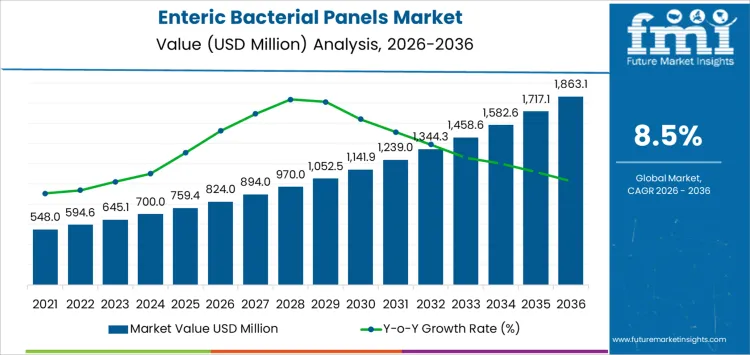
The enteric bacterial panels market is expected to grow from USD 824 million in 2026 to USD 1,863.1 million by 2036, reflecting a compound annual growth rate (CAGR) of 8.5%. Enteric bacterial panels are diagnostic tools used to identify pathogens responsible for gastrointestinal infections, including common bacteria such as Salmonella, E. coli, and Shigella. The market’s growth is driven by the increasing prevalence of foodborne diseases, rising awareness about gastrointestinal health, and the growing demand for rapid, accurate diagnostic tests. These panels allow for quick and effective detection of bacterial infections, which is crucial for appropriate treatment and management.
The market is further supported by advancements in molecular diagnostic technologies, which improve the accuracy, sensitivity, and speed of testing. Additionally, the rise in hospital-acquired infections and the increasing focus on improving healthcare outcomes through early diagnosis contribute to the market’s expansion. As healthcare systems worldwide continue to invest in advanced diagnostic tools, the demand for enteric bacterial panels is expected to grow steadily over the next decade.
Quick Stats for Enteric Bacterial Panels Market
- Enteric Bacterial Panels Market Value (2026): USD 824 million
- Enteric Bacterial Panels Market Forecast Value (2036): USD 1,863.1 million
- Enteric Bacterial Panels Market Global Forecast CAGR (2026-2036): 8.50%
- Top Sample Type by Share in Enteric Bacterial Panels Market: Stool (74%)
- Key Growth Regions in Enteric Bacterial Panels Market: China, USA, UK, Germany, Japan
- Top Players in Enteric Bacterial Panels Market: bioMérieux, Roche, QIAGEN, Thermo Fisher Scientific, BD, Cepheid (Danaher), Hologic, Seegene, DiaSorin, Abbott
What is the Growth Forecast for the Enteric Bacterial Panels Market through 2036?
The long-term value accumulation curve for the enteric bacterial panels market shows steady and consistent growth, with a noticeable acceleration as the technology becomes more widely adopted. Starting at USD 824 million in 2026, the market grows to USD 894.8 million in 2027 and USD 972.4 million in 2028, reflecting gradual growth driven by increasing awareness of gastrointestinal infections and the need for efficient diagnostic solutions.
From 2028 to 2030, the market continues to expand, reaching USD 1,057.4 million in 2029 and USD 1,151.2 million in 2030. This period marks a phase of acceleration as the healthcare industry increasingly integrates advanced diagnostic technologies, driven by the growing focus on improving patient outcomes through faster and more accurate detection. Between 2030 and 2035, the market sees further acceleration, reaching USD 1,254.2 million in 2031, USD 1,367.5 million in 2032, and USD 1,492.4 million in 2033.
By 2035, the market is projected to reach USD 1,629.9 million, with the final value of USD 1,863.1 million expected in 2036. The long-term value accumulation curve highlights the steady rise in demand for enteric bacterial panels, with acceleration driven by the growing need for rapid, accurate diagnostic tools in clinical settings. As the technology matures, the market is expected to continue expanding, reflecting the increasing reliance on advanced diagnostic solutions to manage gastrointestinal infections and improve healthcare outcomes.
PFAS-Free Powder Coatings Market Key Takeaways
| Metric | Value |
|---|---|
| Industry Sales Value (2026) | USD 824 million |
| Industry Forecast Value (2036) | USD 1,863.1 million |
| Industry Forecast CAGR (2026-2036) | 8.5% |
What Is Driving the Demand for the Enteric Bacterial Panels Market Globally?
The global demand for enteric bacterial panels is driven by the high incidence of gastrointestinal infections and the need for rapid, accurate diagnosis. Enteric pathogens such as Salmonella, Shigella, Campylobacter, and pathogenic E. coli cause significant morbidity in both developed and emerging markets, prompting clinicians to seek comprehensive diagnostic tools. Traditional culture methods are slow and can miss co infections, whereas multiplex molecular panels can detect multiple bacterial targets from a single specimen with greater speed and sensitivity. This capability supports timely clinical decisions, targeted antimicrobial therapy, and improved patient outcomes, particularly in acute care and paediatric settings. Growing awareness of antimicrobial stewardship and the need to reduce inappropriate antibiotic use also encourages adoption of precise diagnostic assays. Investments in laboratory automation, expansion of molecular diagnostics infrastructure, and integration of enteric panels into routine stool testing protocols further drive market uptake.
Future demand for enteric bacterial panels is expected to increase as healthcare systems prioritise rapid, data driven diagnostics and disease surveillance. Advances in panel design that expand pathogen coverage, reduce turnaround time, and integrate resistance marker detection will enhance clinical utility. Broader use of real time testing in emergency departments, outpatient clinics, and public health laboratories will support quicker outbreak detection and management. Growth in travel, urbanisation, and food supply complexity may also elevate exposure risk to enteric pathogens, reinforcing the need for comprehensive testing. Adoption will depend on cost effectiveness, reimbursement policies, and demonstration of impact on patient management. As molecular diagnostics become more accessible in low and middle income regions, demand for enteric bacterial panels that support efficient, accurate diagnosis is expected to continue rising worldwide.
What Are the Key Segments in Enteric Bacterial Panels Market?
The enteric bacterial panels market is segmented by panel type and sample type. Multiplex PCR syndromic panels lead the panel type segment with 56% of the market share, providing comprehensive detection of multiple pathogens in a single test. Stool samples dominate the sample type segment with 74%, reflecting their widespread use in diagnosing gastrointestinal infections. The market is expanding as the demand for rapid, accurate, and efficient diagnostic solutions for enteric bacterial infections continues to rise, driven by the need for improved patient outcomes and infection control.
Which Panel Type Drives Enteric Bacterial Panels Market Demand Globally?
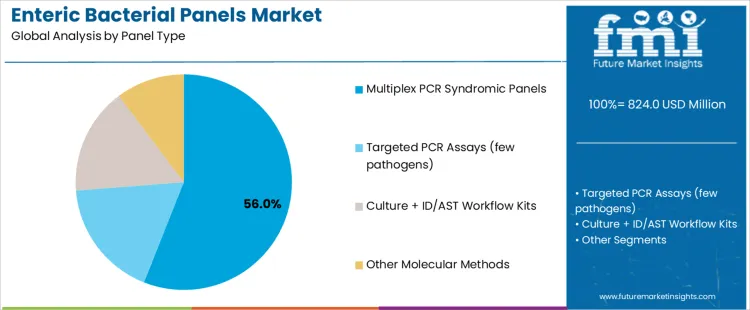
Multiplex PCR syndromic panels account for 56% of the market share. These panels allow for the simultaneous detection of multiple pathogens in a single test, offering a more comprehensive and efficient approach to diagnosing enteric bacterial infections. Multiplex PCR testing is particularly valuable in clinical settings where rapid identification of bacterial pathogens is essential for effective treatment decisions. By amplifying specific DNA or RNA sequences from a broad range of potential pathogens, multiplex PCR panels enable healthcare providers to detect and differentiate between various gastrointestinal infections quickly. This technology is especially beneficial in cases where multiple pathogens are suspected, and traditional testing methods may require longer turnaround times. The growing demand for fast, accurate, and cost-effective diagnostic solutions is driving the adoption of multiplex PCR syndromic panels, making them the dominant segment in the market.
Which Sample Type Drives Enteric Bacterial Panels Market Demand Globally?
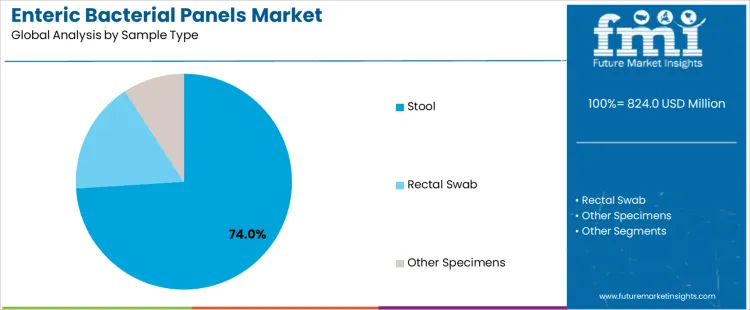
Stool samples lead the sample type segment with 74% of the market share. Stool samples are the most commonly used specimens for diagnosing gastrointestinal infections caused by enteric pathogens, as they provide direct access to the site of infection. Stool samples are non-invasive, easy to collect, and provide valuable information about the bacterial composition in the gut, making them the preferred choice for testing in enteric bacterial panels. The high volume of stool-based tests reflects their accuracy in diagnosing a wide range of gastrointestinal conditions, including bacterial infections, parasitic infections, and viral diseases. As the demand for accurate and rapid testing for enteric bacterial infections rises, the use of stool samples remains the dominant sample type due to their relevance and effectiveness in diagnosing these infections.
What is the Key Dynamics of the Global Enteric Bacterial Panels Market?
The global enteric bacterial panels market is expanding with rising demand for rapid, accurate diagnosis of gastrointestinal infections caused by multiple bacterial pathogens. These multiplex diagnostics detect agents such as Salmonella, Shigella, Campylobacter and E. coli simultaneously, supporting targeted treatment decisions. Growth is supported by increased awareness of antimicrobial stewardship, higher incidence of diarrhoeal diseases, expanded laboratory capacity and adoption of molecular testing in clinical settings. Use spans hospitals, reference laboratories and public health programmes that prioritise laboratory efficiency, patient care quality and reduced turnaround time for results.
What are the Key Drivers for the Global Enteric Bacterial Panels Market?
A key driver is the need for comprehensive, rapid diagnostics that can identify a range of enteric bacteria in a single test, shortening time to diagnosis and improving patient management. Concern about antibiotic misuse encourages clinicians to use precise bacterial identification before prescribing therapy. Expansion of molecular platforms such as PCR and next generation sequencing in clinical laboratories supports broader panel adoption. Growth in travel, foodservice, and community outbreaks elevates pressure on health systems to detect and contain enteric infections. Public health surveillance and regulatory emphasis on disease reporting also increase utilisation of multiplex bacterial panels.
What are the Restraints for the Global Enteric Bacterial Panels Market?
One restraint is cost of advanced multiplex testing compared with traditional culture methods, which can be a barrier for smaller or resource limited laboratories and clinics. Access to skilled laboratory personnel and training for new technologies can slow implementation. Variable reimbursement policies across regions affect affordability and routine use in outpatient settings. Some clinicians and institutions may prefer established microbiology workflows or point of care alternatives depending on clinical context. Supply chain challenges for reagents and instruments can disrupt consistent panel availability, especially amid global demand fluctuations or during public health emergencies.
What is the Key Trends in the Global Enteric Bacterial Panels Market?
A key trend is development of integrated molecular platforms that combine bacterial panels with viral and parasitic targets to provide broad gastrointestinal pathogen detection in one assay. Automation of sample handling, on board controls and user friendly software improve laboratory throughput and reduce hands on time. Adoption of cloud based data reporting and connectivity with electronic health records enhances workflow and supports longitudinal patient care. Diagnostic developers are focusing on cost effective panel formats suited for decentralised labs and point of care use. Increasing collaboration between diagnostic manufacturers and healthcare systems is driving validation studies that demonstrate clinical utility and cost benefits across care settings.
What is the Country-Wise Outlook for the Enteric Bacterial Panels Market?
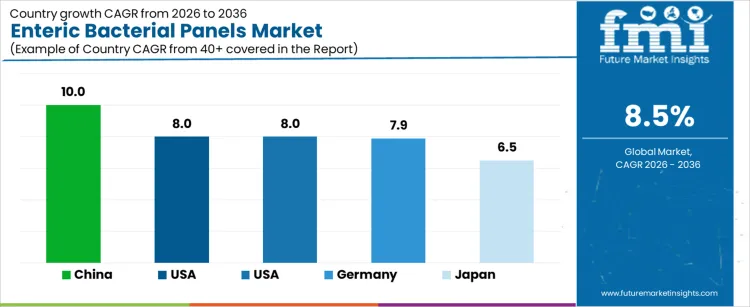
The Enteric Bacterial Panels market is experiencing growth due to increasing demand for accurate and efficient diagnostic tools for gastrointestinal infections caused by enteric bacteria. These panels are essential in identifying pathogens like Salmonella, E. coli, and Shigella, which cause foodborne illnesses and other digestive disorders. Countries such as China, the USA, and the UK are leading the market due to advancements in healthcare infrastructure, growing foodborne illness concerns, and an increasing need for rapid diagnostic solutions. In Germany and Japan, the adoption of enteric bacterial panels is supported by well-established healthcare systems and a focus on improving diagnostics in infectious diseases. As global demand for precise, rapid testing increases, the market for enteric bacterial panels is expected to expand in these regions.
| Country | CAGR (2026-2036) |
|---|---|
| China | 10% |
| USA | 8% |
| UK | 8% |
| Germany | 7.9% |
| Japan | 6.5% |
What is Driving the Growth of the Enteric Bacterial Panels Market in China?
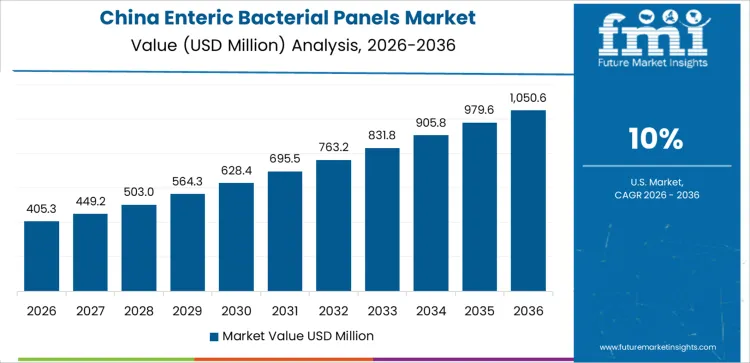
China’s Enteric Bacterial Panels market is projected to grow at a CAGR of 10%. The rising incidence of gastrointestinal diseases, particularly those caused by enteric bacteria, is driving the demand for diagnostic panels. As China’s healthcare infrastructure continues to improve, there is a growing need for efficient and rapid testing methods for foodborne pathogens. The adoption of advanced diagnostic technologies, combined with increased government focus on healthcare modernization, is contributing to the growth of the market. Furthermore, rising awareness of foodborne illnesses and the need for accurate diagnostics to prevent outbreaks are expected to drive continued growth in the enteric bacterial panels market in China.
What is Contributing to the Growth of the Enteric Bacterial Panels Market in the USA?
The USA’s Enteric Bacterial Panels market is expected to grow at a CAGR of 8%. The growing prevalence of foodborne illnesses caused by enteric bacteria is driving the demand for accurate and rapid diagnostic tools. Enteric bacterial panels, which help quickly identify pathogens, are becoming essential in diagnosing gastrointestinal infections and preventing the spread of diseases. With the increasing adoption of molecular diagnostic techniques and the growing need for timely disease management, the market for enteric bacterial panels in the USA is expanding. The country’s advanced healthcare system, coupled with a focus on improving public health and food safety, supports the widespread use of these diagnostic tools.
What is Driving the Enteric Bacterial Panels Market Growth in the UK?
The UK’s Enteric Bacterial Panels market is projected to grow at a CAGR of 8%. The rise in gastrointestinal infections and foodborne illnesses, coupled with a growing emphasis on quick and accurate diagnostics, is driving the market in the UK. Enteric bacterial panels offer a fast and effective way to identify harmful bacteria, improving diagnosis and treatment outcomes. The UK’s strong healthcare system, focused on improving diagnostic capabilities and patient care, is further accelerating the adoption of these panels. With a continued focus on infectious disease management, public health initiatives, and food safety, the market for enteric bacterial panels in the UK is expected to expand steadily.
What is Influencing the Growth of the Enteric Bacterial Panels Market in Germany?
Germany’s Enteric Bacterial Panels market is expected to grow at a CAGR of 7.9%. The increasing prevalence of foodborne diseases, alongside the country’s emphasis on advanced diagnostics, is contributing to market growth. Enteric bacterial panels offer a reliable, quick way to detect pathogens responsible for gastrointestinal infections, which is crucial for controlling outbreaks. Germany’s well-established healthcare system and its focus on improving infectious disease diagnostics support the adoption of these technologies. With the growing demand for efficient testing methods and the rising awareness of foodborne illness risks, the enteric bacterial panels market in Germany is expected to continue expanding.
What is Contributing to the Growth of the Enteric Bacterial Panels Market in Japan?
Japan’s Enteric Bacterial Panels market is projected to grow at a CAGR of 6.5%. The increasing incidence of gastrointestinal infections, coupled with Japan’s aging population and rising demand for healthcare services, is driving the adoption of enteric bacterial panels. The ability to rapidly identify enteric pathogens and provide targeted treatment is crucial for controlling infections. Japan’s well-developed healthcare infrastructure, combined with advancements in diagnostic technologies, supports the growing use of these panels. Additionally, Japan’s focus on public health initiatives and food safety is contributing to the expansion of the enteric bacterial panels market. As diagnostic testing becomes more widely available, demand for these panels is expected to increase.
What is the Competitive Landscape for the Enteric Bacterial Panels Market?
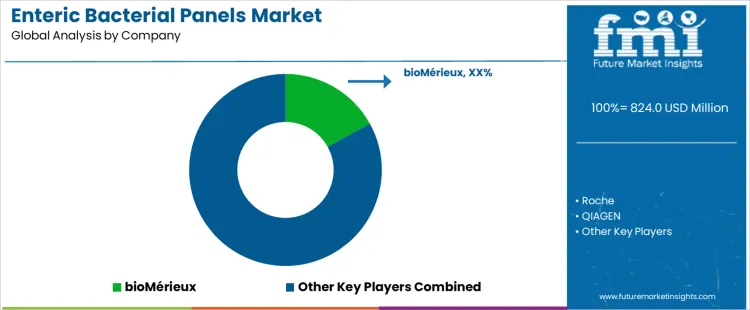
The Enteric Bacterial Panels Market is competitive, driven by the increasing need for rapid and accurate diagnostic solutions for gastrointestinal infections. bioMérieux leads the market with its advanced diagnostic systems, offering comprehensive enteric bacterial panels that aid in the quick identification of pathogens responsible for gastrointestinal diseases. Their focus on accuracy, speed, and ease of use positions them as a key player in the market. Roche, QIAGEN, and Thermo Fisher Scientific are also major competitors, offering innovative testing solutions. Roche provides high-quality, efficient diagnostic panels, while QIAGEN and Thermo Fisher Scientific focus on molecular diagnostics, delivering accurate results in a timely manner. These companies aim to enhance the accuracy of enteric bacterial testing and reduce time to diagnosis.
BD, Cepheid (Danaher), Hologic, Seegene, DiaSorin, and Abbott add to the competition, each with its own strengths in enteric bacterial testing. BD provides broad diagnostic solutions, including enteric bacterial panels designed for clinical laboratories. Cepheid, known for its molecular diagnostic tools, offers rapid testing for gastrointestinal pathogens. Hologic and Seegene focus on improving test sensitivity and specificity, enhancing their competitive edge. DiaSorin and Abbott continue to develop molecular diagnostic products that meet the growing demand for accurate enteric bacterial testing. These companies compete by focusing on speed, accuracy, and comprehensive pathogen detection, aiming to improve diagnostic capabilities and healthcare outcomes in gastrointestinal disease management.
Key Players of the Enteric Bacterial Panels Market
- bioMérieux
- Roche
- QIAGEN
- Thermo Fisher Scientific
- BD
- Cepheid (Danaher)
- Hologic
- Seegene
- DiaSorin
- Abbott
Scope of the Report
| Items | Values |
|---|---|
| Quantitative Units (2026) | USD Million |
| Panel Type | Multiplex PCR Syndromic Panels, Targeted PCR Assays (few pathogens), Culture + ID/AST Workflow Kits, Other Molecular Methods |
| Sample Type | Stool, Rectal Swab, Other Specimens |
| Setting | Hospital Labs, Reference Labs, Public Health Labs, Other Settings |
| Throughput | Low/Moderate Throughput Instruments, High Throughput Platforms, Point-of-Care / NeAR-Patient |
| Companies | bioMérieux, Roche, QIAGEN, Thermo Fisher Scientific, BD, Cepheid (Danaher), Hologic, Seegene, DiaSorin, Abbott |
| Regions Covered | North America, Latin America, Western Europe, Eastern Europe, South Asia and Pacific, East Asia, Middle East & Africa |
| Countries Covered | United States, Canada, Mexico, Brazil, Argentina, Germany, France, United Kingdom, Italy, Spain, Netherlands, China, India, Japan, South Korea, ANZ, GCC Countries, South Africa |
| Additional Attributes | Dollar by sales by panel type, sample type, setting, throughput, and region. Includes market trends in enteric bacterial panels, focusing on multiplex PCR, targeted PCR assays, culture + ID/AST kits, and other molecular methods. Highlights the role of various sample types (stool, rectal swab, other specimens) in diagnosis, the application of high and low throughput instruments, and the increasing demand for point-of-care solutions. Focus on cost-effectiveness, regulatory compliance, market share, and competitive positioning of key companies. |
Enteric Bacterial Panels Market Segmentation
Panel Type
- Multiplex PCR Syndromic Panel
- Targeted PCR Assays (few pathogens)
- Culture + ID/AST Workflow Kits
- Other Molecular Methods
Sample Type
- Stool
- Rectal Swab
- Other Specimens
Setting
- Hospital Labs
- Reference Labs
- Public Health Labs
- Other Settings
Throughput
- Low/Moderate Throughput Instruments
- High Throughput Platforms
- Point-of-Care / NeAR-Patient
Region
- Asia Pacific
- China
- Japan
- South Korea
- India
- Australia & New Zealand
- ASEAN
- Rest of Asia Pacific
- Europe
- Germany
- United Kingdom
- France
- Italy
- Spain
- Nordic
- BENELUX
- Rest of Europe
- North America
- United States
- Canada
- Mexico
- Latin America
- Brazil
- Chile
- Rest of Latin America
- Middle East & Africa
- Kingdom of Saudi Arabia
- Other GCC Countries
- Turkey
- South Africa
- Other African Union
- Rest of Middle East & Africa
Frequently Asked Questions
How big is the enteric bacterial panels market in 2026?
The global enteric bacterial panels market is estimated to be valued at USD 824.0 million in 2026.
What will be the size of enteric bacterial panels market in 2036?
The market size for the enteric bacterial panels market is projected to reach USD 1,863.1 million by 2036.
How much will be the enteric bacterial panels market growth between 2026 and 2036?
The enteric bacterial panels market is expected to grow at a 8.5% CAGR between 2026 and 2036.
What are the key product types in the enteric bacterial panels market?
The key product types in enteric bacterial panels market are multiplex pcr syndromic panels, targeted pcr assays (few pathogens), culture + id/ast workflow kits and other molecular methods.
Which sample type segment to contribute significant share in the enteric bacterial panels market in 2026?
In terms of sample type, stool segment to command 74.0% share in the enteric bacterial panels market in 2026.
Preview the report firsthand - request a free sample
Get SampleGet the brochure for pricing and purchase details.
Get PDFTable of Content
- Executive Summary
- Global Market Outlook
- Demand-side Trends
- Supply-side Trends
- Technology Roadmap Analysis
- Analysis and Recommendations
- Market Overview
- Market Coverage / Taxonomy
- Market Definition / Scope / Limitations
- Market Background
- Market Dynamics
- Drivers
- Restraints
- Opportunity
- Trends
- Scenario Forecast
- Demand in Optimistic Scenario
- Demand in Likely Scenario
- Demand in Conservative Scenario
- Opportunity Map Analysis
- Product Life Cycle Analysis
- Supply Chain Analysis
- Investment Feasibility Matrix
- Value Chain Analysis
- PESTLE and Porter’s Analysis
- Regulatory Landscape
- Regional Parent Market Outlook
- Production and Consumption Statistics
- Import and Export Statistics
- Market Dynamics
- Global Market Analysis 2021 to 2025 and Forecast, 2026 to 2036
- Historical Market Size Value (USD Million) Analysis, 2021 to 2025
- Current and Future Market Size Value (USD Million) Projections, 2026 to 2036
- Y-o-Y Growth Trend Analysis
- Absolute $ Opportunity Analysis
- Global Market Pricing Analysis 2021 to 2025 and Forecast 2026 to 2036
- Global Market Analysis 2021 to 2025 and Forecast 2026 to 2036, By Panel Type
- Introduction / Key Findings
- Historical Market Size Value (USD Million) Analysis By Panel Type , 2021 to 2025
- Current and Future Market Size Value (USD Million) Analysis and Forecast By Panel Type , 2026 to 2036
- Multiplex PCR Syndromic Panels
- Targeted PCR Assays (few pathogens)
- Culture + ID/AST Workflow Kits
- Other Molecular Methods
- Y-o-Y Growth Trend Analysis By Panel Type , 2021 to 2025
- Absolute $ Opportunity Analysis By Panel Type , 2026 to 2036
- Global Market Analysis 2021 to 2025 and Forecast 2026 to 2036, By Sample Type
- Introduction / Key Findings
- Historical Market Size Value (USD Million) Analysis By Sample Type, 2021 to 2025
- Current and Future Market Size Value (USD Million) Analysis and Forecast By Sample Type, 2026 to 2036
- Stool
- Rectal Swab
- Other Specimens
- Y-o-Y Growth Trend Analysis By Sample Type, 2021 to 2025
- Absolute $ Opportunity Analysis By Sample Type, 2026 to 2036
- Global Market Analysis 2021 to 2025 and Forecast 2026 to 2036, By Setting
- Introduction / Key Findings
- Historical Market Size Value (USD Million) Analysis By Setting, 2021 to 2025
- Current and Future Market Size Value (USD Million) Analysis and Forecast By Setting, 2026 to 2036
- Hospital Labs
- Reference Labs
- Public Health Labs
- Other Settings
- Y-o-Y Growth Trend Analysis By Setting, 2021 to 2025
- Absolute $ Opportunity Analysis By Setting, 2026 to 2036
- Global Market Analysis 2021 to 2025 and Forecast 2026 to 2036, By Throughput
- Introduction / Key Findings
- Historical Market Size Value (USD Million) Analysis By Throughput, 2021 to 2025
- Current and Future Market Size Value (USD Million) Analysis and Forecast By Throughput, 2026 to 2036
- Low/Moderate Throughput Instruments
- High Throughput Platforms
- Point-of-Care / NeAR-Patient
- Y-o-Y Growth Trend Analysis By Throughput, 2021 to 2025
- Absolute $ Opportunity Analysis By Throughput, 2026 to 2036
- Global Market Analysis 2021 to 2025 and Forecast 2026 to 2036, By Region
- Introduction
- Historical Market Size Value (USD Million) Analysis By Region, 2021 to 2025
- Current Market Size Value (USD Million) Analysis and Forecast By Region, 2026 to 2036
- North America
- Latin America
- Western Europe
- Eastern Europe
- East Asia
- South Asia and Pacific
- Middle East & Africa
- Market Attractiveness Analysis By Region
- North America Market Analysis 2021 to 2025 and Forecast 2026 to 2036, By Country
- Historical Market Size Value (USD Million) Trend Analysis By Market Taxonomy, 2021 to 2025
- Market Size Value (USD Million) Forecast By Market Taxonomy, 2026 to 2036
- By Country
- USA
- Canada
- Mexico
- By Panel Type
- By Sample Type
- By Setting
- By Throughput
- By Country
- Market Attractiveness Analysis
- By Country
- By Panel Type
- By Sample Type
- By Setting
- By Throughput
- Key Takeaways
- Latin America Market Analysis 2021 to 2025 and Forecast 2026 to 2036, By Country
- Historical Market Size Value (USD Million) Trend Analysis By Market Taxonomy, 2021 to 2025
- Market Size Value (USD Million) Forecast By Market Taxonomy, 2026 to 2036
- By Country
- Brazil
- Chile
- Rest of Latin America
- By Panel Type
- By Sample Type
- By Setting
- By Throughput
- By Country
- Market Attractiveness Analysis
- By Country
- By Panel Type
- By Sample Type
- By Setting
- By Throughput
- Key Takeaways
- Western Europe Market Analysis 2021 to 2025 and Forecast 2026 to 2036, By Country
- Historical Market Size Value (USD Million) Trend Analysis By Market Taxonomy, 2021 to 2025
- Market Size Value (USD Million) Forecast By Market Taxonomy, 2026 to 2036
- By Country
- Germany
- UK
- Italy
- Spain
- France
- Nordic
- BENELUX
- Rest of Western Europe
- By Panel Type
- By Sample Type
- By Setting
- By Throughput
- By Country
- Market Attractiveness Analysis
- By Country
- By Panel Type
- By Sample Type
- By Setting
- By Throughput
- Key Takeaways
- Eastern Europe Market Analysis 2021 to 2025 and Forecast 2026 to 2036, By Country
- Historical Market Size Value (USD Million) Trend Analysis By Market Taxonomy, 2021 to 2025
- Market Size Value (USD Million) Forecast By Market Taxonomy, 2026 to 2036
- By Country
- Russia
- Poland
- Hungary
- Balkan & Baltic
- Rest of Eastern Europe
- By Panel Type
- By Sample Type
- By Setting
- By Throughput
- By Country
- Market Attractiveness Analysis
- By Country
- By Panel Type
- By Sample Type
- By Setting
- By Throughput
- Key Takeaways
- East Asia Market Analysis 2021 to 2025 and Forecast 2026 to 2036, By Country
- Historical Market Size Value (USD Million) Trend Analysis By Market Taxonomy, 2021 to 2025
- Market Size Value (USD Million) Forecast By Market Taxonomy, 2026 to 2036
- By Country
- China
- Japan
- South Korea
- By Panel Type
- By Sample Type
- By Setting
- By Throughput
- By Country
- Market Attractiveness Analysis
- By Country
- By Panel Type
- By Sample Type
- By Setting
- By Throughput
- Key Takeaways
- South Asia and Pacific Market Analysis 2021 to 2025 and Forecast 2026 to 2036, By Country
- Historical Market Size Value (USD Million) Trend Analysis By Market Taxonomy, 2021 to 2025
- Market Size Value (USD Million) Forecast By Market Taxonomy, 2026 to 2036
- By Country
- India
- ASEAN
- Australia & New Zealand
- Rest of South Asia and Pacific
- By Panel Type
- By Sample Type
- By Setting
- By Throughput
- By Country
- Market Attractiveness Analysis
- By Country
- By Panel Type
- By Sample Type
- By Setting
- By Throughput
- Key Takeaways
- Middle East & Africa Market Analysis 2021 to 2025 and Forecast 2026 to 2036, By Country
- Historical Market Size Value (USD Million) Trend Analysis By Market Taxonomy, 2021 to 2025
- Market Size Value (USD Million) Forecast By Market Taxonomy, 2026 to 2036
- By Country
- Kingdom of Saudi Arabia
- Other GCC Countries
- Turkiye
- South Africa
- Other African Union
- Rest of Middle East & Africa
- By Panel Type
- By Sample Type
- By Setting
- By Throughput
- By Country
- Market Attractiveness Analysis
- By Country
- By Panel Type
- By Sample Type
- By Setting
- By Throughput
- Key Takeaways
- Key Countries Market Analysis
- USA
- Pricing Analysis
- Market Share Analysis, 2025
- By Panel Type
- By Sample Type
- By Setting
- By Throughput
- Canada
- Pricing Analysis
- Market Share Analysis, 2025
- By Panel Type
- By Sample Type
- By Setting
- By Throughput
- Mexico
- Pricing Analysis
- Market Share Analysis, 2025
- By Panel Type
- By Sample Type
- By Setting
- By Throughput
- Brazil
- Pricing Analysis
- Market Share Analysis, 2025
- By Panel Type
- By Sample Type
- By Setting
- By Throughput
- Chile
- Pricing Analysis
- Market Share Analysis, 2025
- By Panel Type
- By Sample Type
- By Setting
- By Throughput
- Germany
- Pricing Analysis
- Market Share Analysis, 2025
- By Panel Type
- By Sample Type
- By Setting
- By Throughput
- UK
- Pricing Analysis
- Market Share Analysis, 2025
- By Panel Type
- By Sample Type
- By Setting
- By Throughput
- Italy
- Pricing Analysis
- Market Share Analysis, 2025
- By Panel Type
- By Sample Type
- By Setting
- By Throughput
- Spain
- Pricing Analysis
- Market Share Analysis, 2025
- By Panel Type
- By Sample Type
- By Setting
- By Throughput
- France
- Pricing Analysis
- Market Share Analysis, 2025
- By Panel Type
- By Sample Type
- By Setting
- By Throughput
- India
- Pricing Analysis
- Market Share Analysis, 2025
- By Panel Type
- By Sample Type
- By Setting
- By Throughput
- ASEAN
- Pricing Analysis
- Market Share Analysis, 2025
- By Panel Type
- By Sample Type
- By Setting
- By Throughput
- Australia & New Zealand
- Pricing Analysis
- Market Share Analysis, 2025
- By Panel Type
- By Sample Type
- By Setting
- By Throughput
- China
- Pricing Analysis
- Market Share Analysis, 2025
- By Panel Type
- By Sample Type
- By Setting
- By Throughput
- Japan
- Pricing Analysis
- Market Share Analysis, 2025
- By Panel Type
- By Sample Type
- By Setting
- By Throughput
- South Korea
- Pricing Analysis
- Market Share Analysis, 2025
- By Panel Type
- By Sample Type
- By Setting
- By Throughput
- Russia
- Pricing Analysis
- Market Share Analysis, 2025
- By Panel Type
- By Sample Type
- By Setting
- By Throughput
- Poland
- Pricing Analysis
- Market Share Analysis, 2025
- By Panel Type
- By Sample Type
- By Setting
- By Throughput
- Hungary
- Pricing Analysis
- Market Share Analysis, 2025
- By Panel Type
- By Sample Type
- By Setting
- By Throughput
- Kingdom of Saudi Arabia
- Pricing Analysis
- Market Share Analysis, 2025
- By Panel Type
- By Sample Type
- By Setting
- By Throughput
- Turkiye
- Pricing Analysis
- Market Share Analysis, 2025
- By Panel Type
- By Sample Type
- By Setting
- By Throughput
- South Africa
- Pricing Analysis
- Market Share Analysis, 2025
- By Panel Type
- By Sample Type
- By Setting
- By Throughput
- USA
- Market Structure Analysis
- Competition Dashboard
- Competition Benchmarking
- Market Share Analysis of Top Players
- By Regional
- By Panel Type
- By Sample Type
- By Setting
- By Throughput
- Competition Analysis
- Competition Deep Dive
- bioMérieux
- Overview
- Product Portfolio
- Profitability by Market Segments (Product/Age /Sales Channel/Region)
- Sales Footprint
- Strategy Overview
- Marketing Strategy
- Product Strategy
- Channel Strategy
- Roche
- QIAGEN
- Thermo Fisher Scientific
- BD
- Cepheid (Danaher)
- Hologic
- Seegene
- DiaSorin
- Abbott
- bioMérieux
- Competition Deep Dive
- Assumptions & Acronyms Used
- Research Methodology


