

- Industry Size (2026)
- USD 58.8 Mn
- Forecast (2036)
- USD 204.4 Mn
- CAGR (2026 to 2036)
- 13.3%
Demand for Clean Room Panels in United Kingdom Forecast and Outlook 2026 to 2036
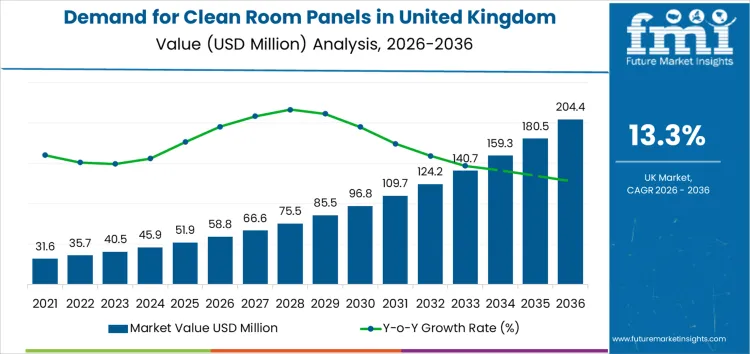
The clean room panels market in the United Kingdom is expected to grow from USD 58.8 million in 2026 to USD 204.4 million by 2036, at a CAGR of 13.3%. The industry holds significant potential, but execution risks are present, particularly around meeting stringent quality standards and regulatory compliance, which can vary across industries. Adoption friction may arise, as transitioning to clean room environments requires substantial upfront investment, particularly in highly regulated sectors such as pharmaceuticals and biotechnology.
The complexity of installation and the need for specialized design also contribute to slower adoption in certain areas. Economic sensitivity is another key factor, as fluctuations in construction budgets or industrial investments may impact the pace of clean room adoption. Companies must balance the high demand for precision and compliance with the capital and operational constraints associated with clean room infrastructure. Vendors will need to maintain cost control and efficiency while delivering customized, high-quality solutions.
Quick Stats for the Demand for Clean Room Panels in United Kingdom
- Clean Room Panels in United Kingdom Value (2026): USD 58.8 million
- Clean Room Panels in United Kingdom Forecast Value (2036): USD 204.4 million
- Clean Room Panels in United Kingdom Forecast CAGR (2026 to 2036): 13.3%
- Clean Room Panels in United Kingdom Leading Segment: Cleanroom Wall Panels (36.4% share)
- Key Growth Regions of Clean Room Panels in United Kingdom: England
- Top Players of Clean Room Panels in United Kingdom: AES Clean Technology, Inc., Plascore, Inc., Terra Universal Inc., G-CON Manufacturing, Pacific Panels Inc.
What is the Growth Forecast for Clean Room Panels in United Kingdom through 2036?
The demand for clean room panels in the United Kingdom is expected to rise from USD 58.8 million in 2026 to USD 109.7 million by 2031, reflecting a compound annual growth rate (CAGR) of 13.3%. Between 2026 and 2031, the industry will experience steady growth, with values increasing from USD 58.8 million to USD 109.7 million.
Between 2026 and 2031, the industry for clean room panels will experience strong, consistent growth. In the first phase of this period (2026-2028), the industry will grow from USD 58.8 million to USD 75.5 million, driven by the initial adoption of cleanroom technologies across multiple industries. From 2028 to 2031, the industry will continue to expand at an accelerated pace, increasing from USD 75.5 million to USD 109.7 million. This acceleration will be fueled by growing demand from pharmaceutical manufacturing, biotechnology R&D, and increased investments in advanced manufacturing technologies, with further adoption of stringent cleanroom standards and regulations.
Key Takeaways for Demand for Clean Room Panels in United Kingdom
| Metric | Value |
|---|---|
| Industry Sales Value (2026) | USD 58.8 million |
| Industry Forecast Value (2036) | USD 204.4 million |
| Industry Forecast CAGR (2026 to 2036) | 13.3% |
Why is Demand for Clean Room Panels in United Kingdom Growing?
Demand for clean room panels in the United Kingdom has strengthened as sectors with stringent contamination control requirements expanded infrastructure and compliance capabilities. Historically, clean room panels were installed mainly in pharmaceutical and semiconductor facilities where controlled environments were essential for product quality. Over recent years, the scope broadened to include advanced manufacturing sectors such as aerospace composites production, medical device assembly, and vaccine fill finish facilities, all of which require reliably sealed enclosures with precise particulate control. Hospitals and clinical laboratories also integrated clean room modules to support sterile compounding, cell therapy processing, and diagnostic testing that must meet defined cleanliness classifications.
Procurement teams overseeing capital projects began specifying modular clean room panels that provide uniform sealing, thermal performance, and rapid installation compared to site built solutions. Design and construction partners valued panels that integrate easily with access control, filtration systems, and environmental monitoring platforms, reducing schedule risk and improving qualification outcomes. These operational priorities supported a steady rise in demand as UK organizations sought consistent compliance with ISO clean room standards and regulatory expectations across diverse applications.
Looking ahead, demand for clean room panels in the United Kingdom is expected to continue rising as investment in high precision facilities adapts to evolving industry priorities. Growth drivers include expansion of life sciences clusters, upgrading of existing clean room assets, and new production capacity for biologics and advanced materials where particulate control is mission critical. Buyers will scrutinize panel performance criteria such as surface finish, fire rating, and ease of maintenance to ensure long term operational efficiency. Suppliers that offer comprehensive pre qualification data, engineered connection systems, and integration support with HVAC and filtration partners will align with project delivery needs in regulated environments.
Economies of scale and modular design flexibility will matter for manufacturers and contractors targeting sectors with variable footprint requirements, such as rapid response production lines and research facilities. For companies involved in specification, supply, and installation, emphasizing quality assurance, certification support, and lifecycle service offerings will enhance value propositions as clean room infrastructure remains a priority across the UK’s high tech and healthcare ecosystems.
What Are the Key Segments in the Demand for Clean Room Panels in the United Kingdom?
Demand for clean room panels in the United Kingdom is primarily driven by product type and end-user industry. Cleanroom wall panels lead the product type segment with 36.4%, while the biotech and pharmaceutical industry dominates the end-user segment with 35.7%. Other product types, such as cleanroom ceiling panels, door panels, window panels, and floor panels, as well as end-users like the food industry, electronic and semiconductor industry, life science and medical device manufacturing, research institutes, and optical industry, also contribute significantly. These trends highlight the importance of cleanroom infrastructure in industries where contamination control and strict environmental conditions are critical.
What Is the Product Type Segment of Demand for Clean Room Panels in the United Kingdom?
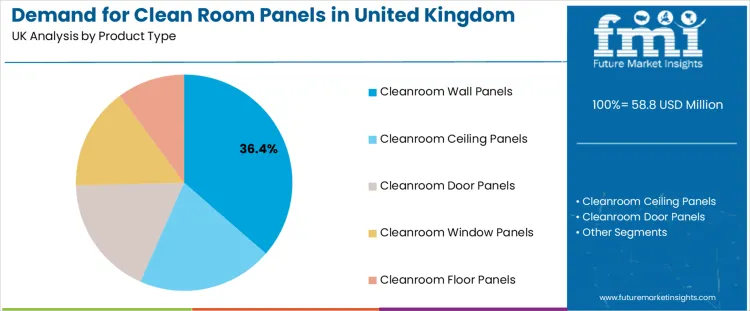
The product type segment for clean room panels in the United Kingdom is led by cleanroom wall panels, which account for 36.4% of the industry share. Cleanroom wall panels are essential for establishing the controlled environments needed to meet stringent hygiene and contamination control standards in industries such as biotech, pharmaceuticals, and electronics. These panels are designed to provide smooth, non-porous surfaces that are easy to clean and resistant to contaminants, making them a key component in maintaining sterile environments. The demand for cleanroom wall panels is driven by the need to support rigorous production processes and meet regulatory compliance requirements.
Cleanroom ceiling panels follow as another important product type, providing additional air flow control and supporting the overall environmental integrity of cleanrooms. These panels often include integrated features such as air filtration systems and are designed to work in tandem with other cleanroom components to ensure optimal cleanliness and safety. Cleanroom door panels, while a smaller segment, are critical for controlling access to cleanroom environments, ensuring that only authorized personnel and equipment enter the space without contaminating it. Cleanroom window panels are used to provide visibility and monitor the cleanroom environment without compromising its sterile conditions.
Cleanroom floor panels, although less commonly discussed, are equally essential for maintaining the integrity of cleanrooms. These panels are typically designed to withstand frequent cleaning and provide resistance to chemical and physical wear, ensuring that the floor does not become a source of contamination. As industries continue to expand and invest in high-quality manufacturing environments, the demand for clean room panels across these product types is expected to grow.
What Is the End-User Segment of Demand for Clean Room Panels in the United Kingdom?
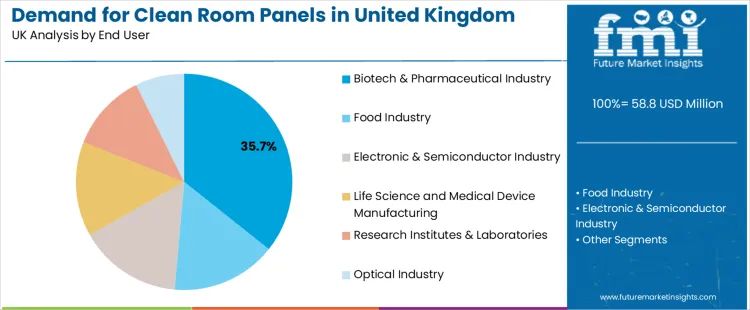
The end-user segment for clean room panels in the United Kingdom is primarily driven by the biotech and pharmaceutical industry, which accounts for 35.7% of the industry share. The biotech and pharmaceutical sectors rely heavily on cleanroom environments to ensure that their manufacturing processes meet stringent quality and regulatory standards. Cleanroom panels are integral to creating sterile, contaminant-free spaces where sensitive products such as drugs, vaccines, and medical devices are developed, tested, and produced. The demand for cleanroom panels in this industry is expected to continue to rise as the global demand for pharmaceutical and biotechnology products grows, particularly in the wake of increasing health concerns and advancements in medical research.
The food industry follows as another key end user of clean room panels. Cleanrooms are essential in food manufacturing environments to prevent contamination and maintain the highest hygiene standards, particularly in the production of high-risk items such as dairy, meats, and ready-to-eat meals. The electronic and semiconductor industry also represents a significant portion of the demand for cleanroom panels, as these industries require ultra-clean environments to produce delicate components like semiconductors and microchips. Life science and medical device manufacturing sectors also drive demand for cleanroom panels, as these industries rely on sterile environments for the production of high-precision medical devices and diagnostic equipment.
Research institutes and laboratories contribute to the clean room panel market, particularly for scientific research that requires controlled conditions to prevent contamination. The optical industry, while a smaller segment, also requires cleanrooms to maintain the precision and purity needed for optical component manufacturing. As the need for contamination-free environments continues to grow across various sectors, the demand for clean room panels is expected to expand, with the biotech and pharmaceutical industry maintaining its dominant position in driving market growth.
What are the Key Dynamics in the Demand for Clean Room Panels in the United Kingdom?
Demand for clean room panels in the United Kingdom is closely linked to growth in sectors that require controlled environments, including pharmaceuticals, biotechnology, life sciences, semiconductor manufacturing, medical devices, and advanced research laboratories. Clean room panels form the structural backbone of controlled environments, providing smooth, non particulate surfaces, thermal insulation, and integration points for airflow and services. Procurement decisions by manufacturers, engineering contractors, and facility owners are influenced by regulatory compliance requirements (e.g., ISO cleanroom classifications), project timelines, and long term operational cost considerations. Demand also correlates with capital investment cycles in new facilities and upgrade programs in existing assets.
What are the Key Drivers for Clean Room Panel Demand in the United Kingdom?
Several factors are driving demand for clean room panels in the United Kingdom. Expansion of pharmaceutical production, especially biologics and vaccine manufacturing, requires additional clean room capacity built to stringent hygiene and particulate control standards. Growth in semiconductor and microelectronics fabrication facilities increases specification of ISO class 5 8 clean rooms where stable surfaces and low contamination risk are critical. Government and private R&D investment in life sciences and healthcare technology infrastructure also supports demand. End users prioritize panels with superior fire resistance, chemical tolerance, and ease of maintenance to minimize downtime and total cost of ownership. Supplier capabilities in customization and rapid delivery influence buyer choices in competitive project environments.
What are the Restraints on Clean Room Panel Demand in the United Kingdom?
Despite robust activity in regulated sectors, clean room panel demand in the United Kingdom faces several restraints. High upfront capital investment for building or upgrading controlled environments may delay decisions, especially for smaller firms or academic research units with constrained budgets. Tight project schedules can conflict with long lead times for custom panel fabrication, transport, and installation, complicating planning for facility expansion. Regulatory rigor and inspection requirements can increase specification complexity, placing pressure on engineering teams to select compliant materials and systems. Volatility in raw material prices and construction cost inflation also affects tender pricing and contract negotiations.
What are the Key Trends in Clean Room Panel Demand in the United Kingdom?
Key trends shaping clean room panel demand in the United Kingdom include the adoption of modular and prefabricated clean room systems that reduce onsite construction duration and improve quality control. Suppliers are offering panels with integrated services (e.g., lighting, access points, sealing systems) that streamline installation and reduce risk of contamination. There is increasing interest in energy efficient insulation materials that support operational cost reduction and sustainability goals in large facilities. Retrofit solutions that adapt existing space into compliant controlled environments are gaining traction, particularly where capital expenditure must be staged. Digital tools that simulate clean room performance and inform panel specification are also influencing procurement by engineering teams and project managers.
What is the Country-Wise Demand for Clean Room Panels in the United Kingdom?
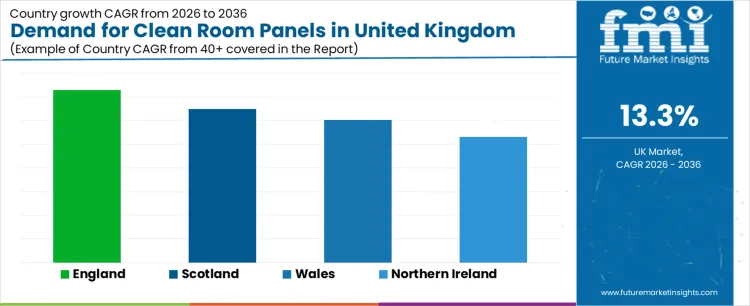
The demand for clean room panels in the United Kingdom demonstrates regional disparities, with England leading the industry. The increasing need for contamination-free environments across industries like pharmaceuticals, electronics, and biotechnology is driving the demand for high-quality clean room panels. In England, where industrial and manufacturing activities are more concentrated, the demand is highest. Scotland, Wales, and Northern Ireland follow with steady demand, supported by growing sectors in life sciences, research and development, and food processing. As regulatory standards continue to tighten and industries expand their clean room infrastructure, demand for clean room panels is expected to grow across the UK, with England maintaining the largest share of the industry.
| Country | CAGR (2026 to 2036) |
|---|---|
| England | 14.6% |
| Scotland | 13.0% |
| Wales | 12.1% |
| Northern Ireland | 10.6% |
What is Driving the Demand for Clean Room Panels in England?
The demand for clean room panels in England is projected to grow at a CAGR of 14.6% from 2026 to 2036. England’s dominance in industries such as pharmaceuticals, biotechnology, electronics, and food processing is a primary driver of this demand. Clean rooms are essential in these sectors for maintaining contamination-free environments that meet stringent regulatory standards. The growing need for clean and controlled environments, particularly in manufacturing and R&D, is fueling the demand for high-performance clean room panels. Furthermore, the increasing focus on health, safety, and environmental regulations, along with the expansion of the pharmaceutical and biotechnology sectors, is contributing to the industry’s growth. As industries in England continue to invest in infrastructure to comply with global standards, the demand for clean room panels is expected to remain strong.
How is the Demand for Clean Room Panels Performing in Scotland?
In Scotland, the demand for clean room panels is expected to grow at a CAGR of 13.0% from 2026 to 2036. Scotland’s pharmaceutical, life sciences, and biotechnology sectors are key drivers of this growth, as clean rooms are vital in these industries for maintaining sterile environments. The demand is also supported by the region’s growing focus on research and development, which often requires highly controlled environments for experimentation and production. With increasing government and industry investments in R&D and innovation, the need for clean room panels is expected to rise. Scotland’s expanding life sciences infrastructure, coupled with the growing adoption of clean technology in healthcare and food production, further strengthens the demand for clean room panels. As the industry matures and regulatory pressures increase, the demand for these panels is set to grow consistently.
What Are the Growth Drivers for Clean Room Panels in Wales?
The demand for clean room panels in Wales is projected to grow at a CAGR of 12.1% through 2036. The key drivers of this growth are Wales’ expanding biotechnology, pharmaceutical, and manufacturing sectors, which require clean rooms for both production and research purposes. As the Welsh economy focuses more on advanced manufacturing and innovation in life sciences, the need for contamination-free environments will increase. Clean rooms are essential for industries such as pharmaceuticals, biotechnology, and food processing, where quality control and sterile conditions are paramount. Additionally, the rising importance of environmental regulations and safety standards in Wales is driving the demand for clean room panels, as industries seek to comply with stricter requirements. The ongoing development of clean room infrastructure in Wales, supported by regional industrial growth and research initiatives, ensures continued growth in the demand for these products.
What is the Outlook for Clean Room Panels Demand in Northern Ireland?
Northern Ireland’s demand for clean room panels is expected to grow at a CAGR of 10.6% from 2026 to 2036. While Northern Ireland represents the smallest market for clean room panels in the United Kingdom, steady growth is expected, particularly in the pharmaceutical, biotechnology, and electronics industries. The region’s growing focus on R&D, along with the expansion of cleanroom facilities in manufacturing, is contributing to this demand. Northern Ireland’s increasing commitment to technological innovation and compliance with international standards is further boosting the adoption of clean room solutions. The healthcare and food processing sectors are also adopting clean rooms to meet hygiene and safety standards, further fueling demand. With continued investment in infrastructure and an emphasis on regulatory compliance, Northern Ireland’s market for clean room panels is poised for steady growth in the coming years.
What is the Competitive Landscape for Demand for Clean Room Panels in the United Kingdom?
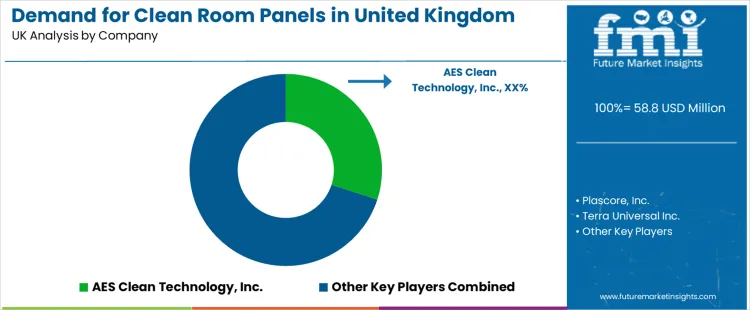
Demand for clean room panels in the United Kingdom is shaped by requirements from pharmaceutical manufacturing, semiconductor fabs, biotechnology facilities, and precision assembly sectors where contamination control standards are enforced. Decision makers in facilities planning and engineering departments specify panels based on documented performance metrics such as particulate shedding ratings, fire resistance classification, and dimensional tolerances.
AES Clean Technology, Inc. holds a leading position with technical documentation that outlines panel U values, documented cleanability ratings, and documented compliance with ISO 14644 classifications. These brochures and data sheets are used by clean room designers and procurement teams to align material selection with air flow specifications, HVAC integration parameters, and quality assurance audits. Buyers reference documented assembly guides and documented service options when evaluating how supplier offerings fit into project schedules and long term maintenance plans.
Plascore, Inc. competes with clean room wall and ceiling panels described in detailed literature that lists documented core materials, documented load bearing capacities, and documented chemical resistance values that assist facility engineers in material comparison exercises. Terra Universal Inc. supplies modular wall systems and documented installation workflows that are reviewed by construction managers to assess labour requirements and modular flexibility.
Documentation from G CON Manufacturing highlights pre validated panel assemblies with documented contaminant control performance and documented integration with mobile clean room formats, which is relevant to contract manufacturers and pilot line installations. Pacific Panels Inc. offers documented panel systems with specification sheets covering surface finishes, documented acoustic properties, and documented lifecycle performance values. In the United Kingdom, competitive evaluation includes documented lead times, documented warranty terms, and documented supply chain readiness. Technical reviewers weigh documented cleanability tests and documented fire test results to ensure that selections support regulatory inspections and facility certification requirements. Competitive activity centers on measurable technical specifications and documented support commitments that provide clarity to capital project managers, clean room consultants, and procurement professionals during specification and supplier selection processes.
Key Players of the Demand for Clean Room Panels in United Kingdom
- AES Clean Technology, Inc.
- Plascore, Inc.
- Terra Universal Inc.
- G-CON Manufacturing
- Pacific Panels Inc.
Scope of the Report
| Items | Values |
|---|---|
| Quantitative Units (2026) | USD Million |
| Product Type | Cleanroom Wall Panels, Cleanroom Ceiling Panels, Cleanroom Door Panels, Cleanroom Window Panels, Cleanroom Floor Panels |
| End User | Biotech & Pharmaceutical Industry, Food Industry, Electronic & Semiconductor Industry, Life Science and Medical Device Manufacturing, Research Institutes & Laboratories, Optical Industry |
| Material | PVC Based, HPL Based, Aluminum Honeycomb Based, Cold Rolled Steel Based, Stainless Steel Based, GRP Based |
| Companies | AES Clean Technology, Inc., Plascore, Inc., Terra Universal Inc., G-CON Manufacturing, Pacific Panels Inc. |
| Regions Covered | United Kingdom |
| Countries Covered | England, Scotland, Wales, Northern Ireland |
| Additional Attributes | Dollar sales by product type, end user, material, and region. Includes market trends towards regulatory compliance, clean room technology advancements, and the role of clean room panels in various industries like biotech, pharmaceuticals, and electronics. |
Key Segments of Demand for Clean Room Panels in United Kingdom
Product Type
- Cleanroom Wall Panels
- Cleanroom Ceiling Panels
- Cleanroom Door Panels
- Cleanroom Window Panels
- Cleanroom Floor Panels
End User
- Biotech & Pharmaceutical Industry
- Food Industry
- Electronic & Semiconductor Industry
- Life Science and Medical Device Manufacturing
- Research Institutes & Laboratories
- Optical Industry
Material
- PVC Based
- HPL Based
- Aluminum Honeycomb Based
- Cold Rolled Steel Based
- Stainless Steel Based
- GRP Based
Countries
- England
- Scotland
- Wales
- Northern Ireland
Bibliography
- International Organization for Standardization. (2023). ISO 14644‑1: Cleanrooms and associated controlled environments — Classification of air cleanliness. ISO.
- Health and Safety Executive. (2024). Controlling contamination and ventilation in pharmaceutical and high‑technology manufacturing environments. HSE.
- National Health Service England. (2024). Aseptic preparation facilities, medicines manufacturing, and controlled environment requirements. NHS England.
Frequently Asked Questions
How big is the demand for clean room panels in United Kingdom in 2026?
The demand for clean room panels in United Kingdom is estimated to be valued at USD 58.8 million in 2026.
What will be the size of clean room panels in United Kingdom in 2036?
The market size for the clean room panels in United Kingdom is projected to reach USD 204.4 million by 2036.
How much will be the demand for clean room panels in United Kingdom growth between 2026 and 2036?
The demand for clean room panels in United Kingdom is expected to grow at a 13.3% CAGR between 2026 and 2036.
What are the key product types in the clean room panels in United Kingdom?
The key product types in clean room panels in United Kingdom are cleanroom wall panels, cleanroom ceiling panels, cleanroom door panels, cleanroom window panels and cleanroom floor panels.
Which end user segment is expected to contribute significant share in the clean room panels in United Kingdom in 2026?
In terms of end user, biotech & pharmaceutical industry segment is expected to command 35.7% share in the clean room panels in United Kingdom in 2026.
Preview the report firsthand - request a free sample
Get SampleGet the brochure for pricing and purchase details.
Get PDFTable of Content
- Executive Summary
- UK Market Outlook
- Demand-side Trends
- Supply-side Trends
- Technology Roadmap Analysis
- Analysis and Recommendations
- Market Overview
- Market Coverage / Taxonomy
- Market Definition / Scope / Limitations
- Market Background
- Market Dynamics
- Drivers
- Restraints
- Opportunity
- Trends
- Scenario Forecast
- Demand in Optimistic Scenario
- Demand in Likely Scenario
- Demand in Conservative Scenario
- Opportunity Map Analysis
- Product Life Cycle Analysis
- Supply Chain Analysis
- Investment Feasibility Matrix
- Value Chain Analysis
- PESTLE and Porter’s Analysis
- Regulatory Landscape
- Regional Parent Market Outlook
- Production and Consumption Statistics
- Import and Export Statistics
- Market Dynamics
- UK Market Analysis 2021 to 2025 and Forecast, 2026 to 2036
- Historical Market Size Value (USD Million) Analysis, 2021 to 2025
- Current and Future Market Size Value (USD Million) Projections, 2026 to 2036
- Y-o-Y Growth Trend Analysis
- Absolute $ Opportunity Analysis
- UK Market Pricing Analysis 2021 to 2025 and Forecast 2026 to 2036
- UK Market Analysis 2021 to 2025 and Forecast 2026 to 2036, By Product Type
- Introduction / Key Findings
- Historical Market Size Value (USD Million) Analysis By Product Type , 2021 to 2025
- Current and Future Market Size Value (USD Million) Analysis and Forecast By Product Type , 2026 to 2036
- Cleanroom Wall Panels
- Cleanroom Ceiling Panels
- Cleanroom Door Panels
- Cleanroom Window Panels
- Cleanroom Floor Panels
- Cleanroom Wall Panels
- Y-o-Y Growth Trend Analysis By Product Type , 2021 to 2025
- Absolute $ Opportunity Analysis By Product Type , 2026 to 2036
- UK Market Analysis 2021 to 2025 and Forecast 2026 to 2036, By End User
- Introduction / Key Findings
- Historical Market Size Value (USD Million) Analysis By End User, 2021 to 2025
- Current and Future Market Size Value (USD Million) Analysis and Forecast By End User, 2026 to 2036
- Biotech & Pharmaceutical Industry
- Food Industry
- Electronic & Semiconductor Industry
- Life Science and Medical Device Manufacturing
- Research Institutes & Laboratories
- Optical Industry
- Biotech & Pharmaceutical Industry
- Y-o-Y Growth Trend Analysis By End User, 2021 to 2025
- Absolute $ Opportunity Analysis By End User, 2026 to 2036
- UK Market Analysis 2021 to 2025 and Forecast 2026 to 2036, By Material
- Introduction / Key Findings
- Historical Market Size Value (USD Million) Analysis By Material, 2021 to 2025
- Current and Future Market Size Value (USD Million) Analysis and Forecast By Material, 2026 to 2036
- PVC Based
- HPL Based
- Aluminum Honeycomb Based
- Cold Rolled Steel Based
- Stainless Steel Based
- GRP Based
- PVC Based
- Y-o-Y Growth Trend Analysis By Material, 2021 to 2025
- Absolute $ Opportunity Analysis By Material, 2026 to 2036
- Market Structure Analysis
- Competition Dashboard
- Competition Benchmarking
- Market Share Analysis of Top Players
- By Regional
- By Product Type
- By End User
- By Material
- Competition Analysis
- Competition Deep Dive
- AES Clean Technology, Inc.
- Overview
- Product Portfolio
- Profitability by Market Segments (Product/Age /Sales Channel/Region)
- Sales Footprint
- Strategy Overview
- Marketing Strategy
- Product Strategy
- Channel Strategy
- Plascore, Inc.
- Terra Universal Inc.
- G-CON Manufacturing
- Pacific Panels Inc.
- AES Clean Technology, Inc.
- Competition Deep Dive
- Assumptions & Acronyms Used
- Research Methodology


