

- Industry Size (2026)
- USD 17.8 Mn
- Forecast (2036)
- USD 55.1 Mn
- CAGR (2026 to 2036)
- 12%
Demand for Clean Room Panels in South Korea Forecast and Outlook 2026 to 2036
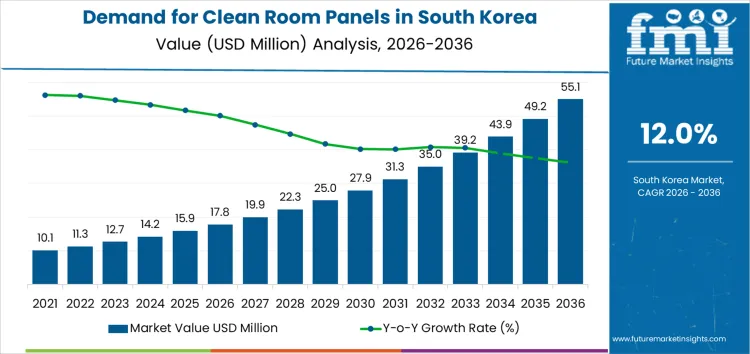
The demand for clean room panels in South Korea is expected to reach USD 55.1 million by 2036, growing at a CAGR of 12% from USD 17.8 million in 2026. These figures signal a growing confidence in clean room infrastructure, particularly in industries such as pharmaceuticals, biotechnology, and electronics. The steady rise in demand indicates an increasing prioritization of controlled environments for product quality and safety, driven by regulatory compliance and the need for high standards in production.
Suppliers, recognizing this trend, are likely to invest in innovation and supply chain resilience, anticipating long-term demand. The consistent growth suggests that customers are increasingly committed to the technology, viewing it as a critical component in operational efficiency and risk mitigation. As industries expand and regulatory frameworks tighten, purchasing behavior will likely reflect a shift toward high-performance, cost-effective solutions. This positions the market for steady, reliable growth over the coming decade.
Quick Stats for the Demand for Clean Room Panels in South Korea
- Clean Room Panels in South Korea Value (2026): USD 17.8 million
- Clean Room Panels in South Korea Forecast Value (2036): USD 55.1 million
- Clean Room Panels in South Korea Forecast CAGR (2026 to 2036): 12%
- Clean Room Panels in South Korea Leading Segment: Cleanroom Wall Panels (38%)
- Key Growth Regions of Clean Room Panels in South Korea: Jeju (leading CAGR ~14.4%)
- Top Players of Clean Room Panels in South Korea: AES Clean Technology, Inc., Plascore, Inc., Terra Universal Inc., G-CON Manufacturing, Pacific Panels Inc.
What is the Growth Forecast for the Clean Room Panel Market in South Korea through 2036?
The clean room panel market in South Korea is projected to grow steadily from 2026 to 2031. Starting at USD 17.8 million in 2026, the market is expected to increase to USD 19.9 million in 2027. By 2028, the market value will reach USD 22.3 million, followed by USD 25.0 million in 2029. The market will continue to grow, reaching USD 27.9 million in 2030 and USD 31.3 million in 2031.
The 5-year growth block analysis shows consistent growth in the market, with the strongest increase expected in the first half of the forecast period. This steady rise is indicative of expanding sectors that rely on cleanroom environments, with key drivers being the increasing demand for semiconductor production, pharmaceutical manufacturing, and advanced research facilities.
Key Takeaways for Demand for Clean Room Panels in South Korea
| Metric | Value |
|---|---|
| Industry Sales Value (2026) | USD 17.8 million |
| Industry Forecast Value (2036) | USD 55.1 million |
| Industry Forecast CAGR (2026 to 2036) | 12% |
Why is the Demand for Clean Room Panels Growing in South Korea?
Demand for clean room panels in South Korea has risen as sectors requiring controlled environments expand capacity and upgrade facilities. Semiconductor fabrication, pharmaceutical production, biotechnology, precision electronics, and advanced materials manufacture depend on clean rooms that maintain strict particulate, temperature, and humidity limits. South Korea’s semiconductor industry, which produces memory chips and logic devices for global markets, deploys clean room systems throughout wafer fabrication and assembly lines. These facilities require modular wall panels, ceiling grids, and partition systems that meet international clean room class standards while supporting airflow dynamics and ease of maintenance. In pharmaceutical and biologics manufacturing, clean room panels are critical for isolating production zones, enabling sterile fill-finish operations, and supporting regulatory compliance for drug safety. Increased investment in biologics, vaccines, and sterile injectable production has driven pharmaceutical facilities to expand clean room footprints. Similarly, manufacturers of precision optics, display panels, and medical devices have incorporated controlled environments into their production flows to avoid contamination that can compromise yields and product performance. Procurement specialists in these industries place emphasis on panels with high load-bearing capacity, chemical resistance, and smooth, cleanable surfaces to meet daily operational demands.
Looking ahead, demand for clean room panels in South Korea is expected to remain robust as both new construction and retrofitting projects proceed. Companies focusing on modular clean room solutions that can be installed with minimal disruption will appeal to manufacturers managing tight production schedules. Innovation in panel materials and finishes that improve energy efficiency, reduce particulates, and facilitate disinfection will differentiate suppliers in a competitive market. Integration of clean room panels with building management systems, such as embedded sensors for real-time environmental monitoring, will support customer needs for data-driven facility control. Local manufacturers and international suppliers should collaborate with design-build contractors and facility planners early in project lifecycles to tailor panel systems to specific process requirements and regulatory criteria. Emphasis on supply chain reliability, consistent quality certifications, and post-installation service will aid companies that aim to secure long-term contracts with semiconductor fabs, pharmaceutical parks, and advanced manufacturing hubs across South Korea.
What Are the Key Segments in Demand for Clean Room Panels in South Korea?
The demand for clean room panels in South Korea is driven by product type and end-user sectors. Key product types include cleanroom wall panels, cleanroom ceiling panels, cleanroom door panels, cleanroom window panels, and cleanroom floor panels, with cleanroom wall panels leading the market at 38%. In terms of end users, the biotech and pharmaceutical industry dominates, accounting for 37.6%, followed by sectors such as food manufacturing, electronic and semiconductor industries, life sciences, and research institutes. As industries requiring stringent cleanliness and contamination control grow, so does the demand for clean room panels.
How Does Product Type Influence Demand for Clean Room Panels in South Korea?
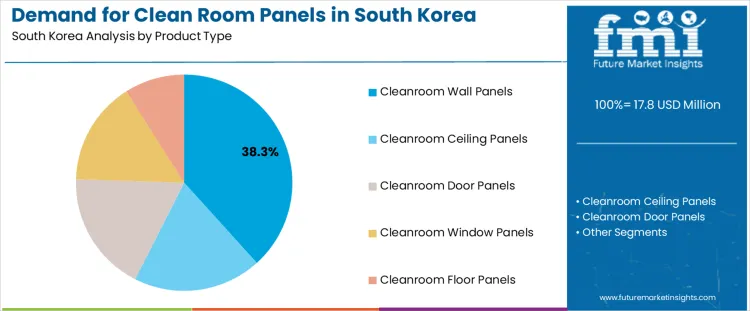
Product type significantly impacts the demand for clean room panels in South Korea, with cleanroom wall panels taking the largest share at 38%. Wall panels are critical in the construction of clean rooms, as they form the primary structure of the space and need to meet high standards for contamination control, durability, and ease of cleaning. Wall panels are used across various industries, especially where strict hygiene and cleanliness are required, such as in the biotech and pharmaceutical sectors. Cleanroom ceiling panels also play a key role, as they support ventilation systems, lighting, and other essential components while maintaining the integrity of the cleanroom environment.
These panels help ensure that airborne particles and contaminants do not accumulate in critical spaces. Cleanroom door panels are crucial for maintaining the controlled environment of a clean room while allowing easy access for personnel and equipment. They must be sealed tightly to prevent contamination. Cleanroom window panels, while less common, are important for specific applications where visibility is necessary without compromising cleanliness. Cleanroom floor panels are equally important, providing smooth, non-porous surfaces that are easy to clean and resistant to chemical exposure, making them essential for industries where floor contamination can jeopardize the cleanliness of the environment.
What Is the Demand for Clean Room Panels by End-User Industry in South Korea?
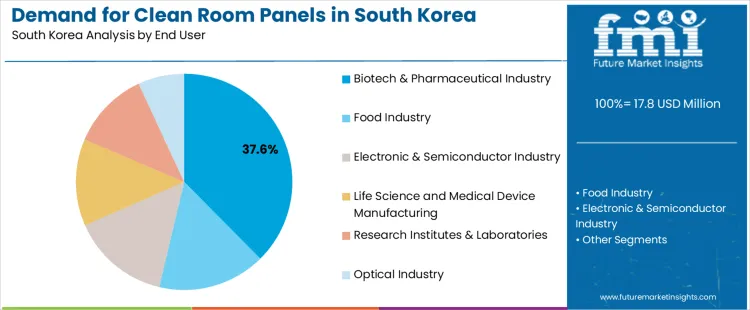
The demand for clean room panels in South Korea is highly influenced by end-user industries, with the biotech and pharmaceutical industry leading the market at 37.6%. This sector relies heavily on clean room environments to ensure the production of sterile products and the safety of laboratory processes. Clean room panels in this industry must meet stringent requirements for hygiene, contamination control, and air quality. As biotechnology and pharmaceutical sectors in South Korea continue to grow, so does the need for high-quality clean room panels. The food industry is another key sector driving demand, where clean rooms are essential for processing food and beverages in sanitary conditions. The rise in consumer demand for processed foods and the growing focus on food safety in South Korea has increased the need for clean rooms in food production facilities.
The electronic and semiconductor industries also require clean rooms to maintain the precision and contamination-free environments necessary for manufacturing electronic components and semiconductor chips. These industries use clean room panels to prevent dust and particulate matter from damaging sensitive equipment. Life science and medical device manufacturing, along with research institutes and laboratories, also contribute to the demand for clean room panels, as these sectors require sterile, controlled environments for experimentation, testing, and production. The optical industry, with its high precision manufacturing requirements, increasingly relies on clean rooms to ensure the quality and performance of optical components, further driving the demand for clean room panels. As South Korea's industries continue to prioritize cleanliness and contamination control, the demand for clean room panels is expected to expand across these diverse sectors.
What are the Key Dynamics in the Demand for Clean Room Panels in South Korea?
Demand for clean room panels in South Korea is driven by rigorous contamination control requirements across advanced manufacturing sectors. Industries such as semiconductor fabrication, pharmaceutical production, biotechnology, and medical device assembly require controlled environments with strict particulate, microbial, and chemical standards. Clean room panels form the structural backbone of controlled environments, providing airtight, durable partitions that support filtration and airflow management. Growth in high-precision electronics, biologics, and specialty chemicals has expanded facility build-outs and retrofit projects. Clean room certification and compliance standards, including ISO classifications and Korean Good Manufacturing Practice (KGMP), shape product specifications and influence procurement by facilities aiming to maintain regulatory conformity.
What are the Drivers of Demand for Clean Room Panels in South Korea?
A primary driver is the country’s established leadership in semiconductor manufacturing, where wafer processing and packaging demand ultra-clean environments. Expansion of chip fabrication facilities, particularly in logic and memory segments, increases orders for precision-engineered clean room panels. Growth in biopharmaceutical and vaccine manufacturing amplifies need for modular, compliant walls that support sterile production zones. Regulatory mandates for contamination control across pharmaceuticals and medical devices require periodic upgrades and expansions of controlled spaces. Adoption of advanced manufacturing techniques, including automation and Industry 4.0 frameworks, elevates expectations for environmental stability, which further reinforces panel specifications tied to HVAC performance and sealing integrity.
What are the Restraints on Demand for Clean Room Panels in South Korea?
Restraints include high initial capital outlays associated with constructing or upgrading controlled environments, which can delay procurement decisions, especially among smaller firms. Complex installation and integration with HVAC, lighting, and monitoring systems require skilled contractors, extending project timelines and increasing labor costs. Supply chain pressures, including raw material price volatility for metal, polymer, and insulation components, affect final product pricing and inventory availability. Diverse regulatory interpretations across industry segments can complicate standardization of panel specifications, demanding bespoke engineering and product customization that raise cost and lead times. Competitive pressures from imported panels and modular clean room solutions also challenge suppliers to differentiate on quality and service.
What Key Trends Affect Demand for Clean Room Panels in South Korea?
A notable trend is the shift toward modular and prefabricated clean room panel systems that reduce onsite construction time and support scalability. Manufacturers increasingly favor panel designs that facilitate reconfiguration and relocation as production needs evolve. Integration of smart monitoring sensors within panel assemblies allows real-time tracking of environmental conditions such as humidity, pressure, and particulate counts, which enhances compliance reporting and reduces manual inspection. Demand is rising for low-VOC and antimicrobial surface finishes that align with sustainability and hygiene expectations in pharmaceutical and healthcare applications. Partnerships between panel producers and HVAC or clean room integrators are becoming common, enabling comprehensive turnkey solutions. Cross-industry adoption of standardized interfacing systems for panels supports quicker commissioning and improved lifecycle serviceability.
What is the Regional Demand Trend for Clean Room Panels in South Korea?
The demand for clean room panels in South Korea is rising across various regions, driven by the growth of industries such as pharmaceuticals, biotechnology, electronics, and semiconductors. South Gyeongsang, with a projected CAGR of 12.6%, is leading the market, supported by the region's strong manufacturing base and significant demand for high-tech production environments. North Jeolla, with a growth rate of 9.6%, shows steady demand, fueled by its expanding industrial and pharmaceutical sectors. South Jeolla, with a CAGR of 11.4%, is also seeing strong demand, particularly in its growing biotech and healthcare industries. Jeju, with the highest growth rate of 14.4%, stands out due to its focus on advanced healthcare services and its growing reputation as a destination for high-tech industries. These regional trends highlight significant opportunities for suppliers of clean room panels to cater to the growing demand for controlled environments in South Korea.
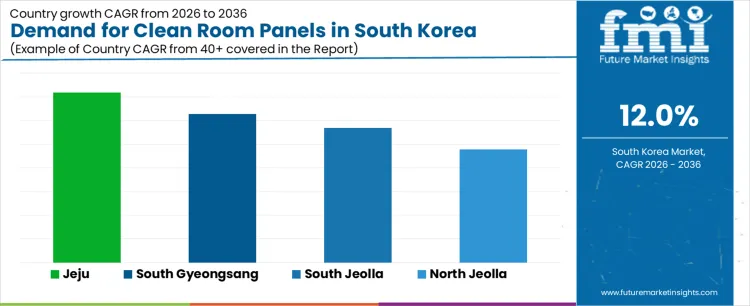
| Region | CAGR (2026 to 2036) |
|---|---|
| South Gyeongsang | 12.6% |
| North Jeolla | 9.6% |
| South Jeolla | 11.4% |
| Jeju | 14.4% |
How Can Clean Room Panel Suppliers Leverage the Growing Market in South Gyeongsang?
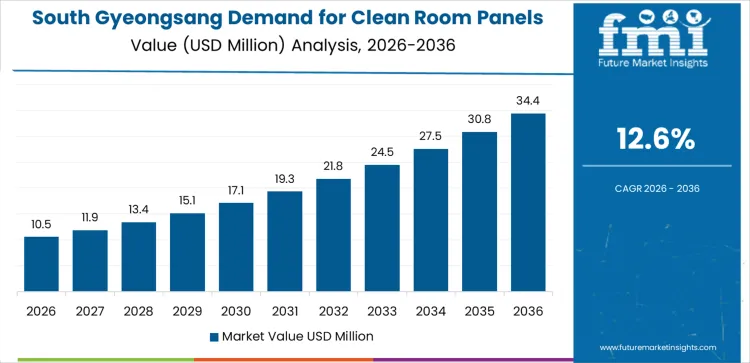
South Gyeongsang, with a projected CAGR of 12.6%, presents substantial growth opportunities for clean room panel suppliers. The region's strong industrial base, particularly in the manufacturing, electronics, and pharmaceutical sectors, is driving demand for clean rooms to maintain stringent production and environmental standards. Companies entering the South Gyeongsang market should focus on providing high-quality, customizable clean room panel solutions that meet the specific needs of semiconductor, biotech, and pharmaceutical companies. As the region continues to expand its high-tech industries, the demand for clean room panels will rise, offering a long-term growth opportunity for suppliers who can meet the evolving needs of South Gyeongsang's industrial sectors.
What is Driving Demand for Clean Room Panels in North Jeolla?
North Jeolla, with a projected CAGR of 9.6%, is experiencing moderate but steady growth in demand for clean room panels. The region's pharmaceutical and biotechnology industries are expanding, requiring controlled environments for research and production. Manufacturers looking to target North Jeolla should focus on providing high-performance, affordable clean room panels that cater to the needs of the local biotech and pharmaceutical sectors. As North Jeolla continues to develop its industrial base, the demand for clean room technology is expected to rise, particularly in the fields of drug manufacturing and medical device production. Suppliers can capture this growing market by offering reliable, energy-efficient, and customizable clean room solutions.
How is South Jeolla’s Clean Room Panel Market Expected to Evolve?
South Jeolla, with a projected CAGR of 11.4%, is witnessing strong demand for clean room panels, primarily driven by its expanding biotech, healthcare, and pharmaceutical industries. As the region continues to invest in advanced manufacturing capabilities, the need for clean room environments is increasing. Manufacturers should focus on offering tailored clean room panel solutions that meet the specific requirements of South Jeolla’s growing pharmaceutical and medical industries. By providing high-quality, easy-to-maintain, and customizable clean room systems, suppliers can capture a significant share of the South Jeolla market. As the region’s healthcare and biotech industries grow, the demand for clean room panels will likely continue to rise steadily.
Why is Jeju Seeing the Highest Growth in Demand for Clean Room Panels?
Jeju, with the highest projected CAGR of 14.4%, is experiencing rapid growth in demand for clean room panels. This growth is largely driven by Jeju’s increasing focus on advanced healthcare services, biotechnology research, and high-tech manufacturing. The region’s growing reputation as a hub for technology and healthcare innovation, combined with its commitment to sustainability and environmental control, has resulted in an increased need for controlled environments. Clean room panels are essential for maintaining sterile and regulated conditions in medical and pharmaceutical applications. Suppliers targeting Jeju should focus on providing versatile, energy-efficient, and high-quality clean room solutions that cater to the region’s unique needs. With the continued development of Jeju's high-tech and healthcare industries, the demand for clean room panels is expected to rise significantly, creating a strong opportunity for suppliers in this region.
What is the Competitive Landscape for Clean Room Panels Demand in South Korea?
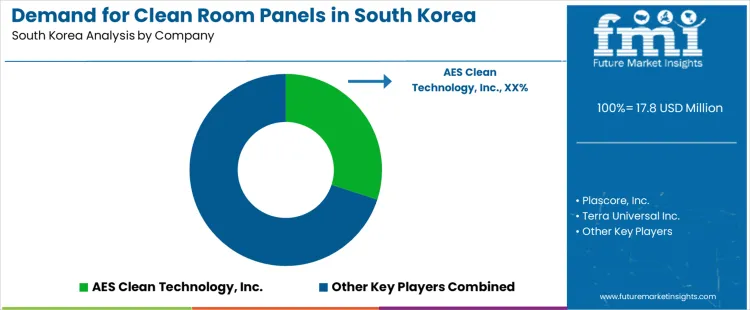
Demand for clean room panels in South Korea is anchored in the expanding semiconductor, pharmaceutical, biotechnology, and precision manufacturing sectors that require controlled environments meeting stringent particulate and microbial limits. Buyers include facility architects, construction firms, and engineering procurement teams specifying panels for new clean room builds and retrofit projects. Procurement requirements focus on measured performance in air tightness, fire resistance, static control, and ease of installation. Specifications also cover panel core materials, surface finishes, and compliance with ISO clean room classifications relevant to target applications. Industrial buyers increasingly prioritise suppliers that provide detailed compliance documentation and test data that support certification processes. Lifecycle cost considerations, including maintenance schedules and panel replaceability, are assessed alongside initial capital outlay. Demand drivers encompass facility capacity expansion, regulatory expectations for sterile and contaminant-free production, and competitive pressures to reduce defect rates in high-value products.
Competition among key suppliers in the South Korean clean room panel segment is defined by product technical differentiation, documented performance claims, and after-sales support frameworks. AES Clean Technology, Inc. is positioned as a leading supplier, with product brochures specifying panel thermal insulation values, core compositions, and tested air infiltration rates that inform engineering evaluations. Plascore, Inc. materials focus on structural integrity and lightweight construction, with specification sheets on honeycomb core variations and bonding methods relevant to high-throughput environments. Terra Universal Inc. documentation outlines modular panel systems, accessory compatibility, and customization options that assist facility planners in matching design constraints. G-CON Manufacturing literature highlights pre-built modular clean room panels with installation timelines and quality control measures documented for project scheduling teams. Pacific Panels Inc. brochures present panels with fire-rating classifications, gasket systems, and surface treatments that meet industry standards. Technical materials from these suppliers typically include dimensional tolerances, material properties, certification references, and handling guidelines that support South Korean integrators, architects, and procurement professionals in comparing offerings against performance, cost, and project delivery criteria.
Key Players of the Demand for Clean Room Panels in South Korea
- AES Clean Technology, Inc.
- Plascore, Inc.
- Terra Universal Inc.
- G-CON Manufacturing
- Pacific Panels Inc.
Scope of the Report
| Items | Values |
|---|---|
| Quantitative Units (2026) | USD Million |
| Product Type | Cleanroom Wall Panels, Cleanroom Ceiling Panels, Cleanroom Door Panels, Cleanroom Window Panels, Cleanroom Floor Panels |
| End User | Biotech & Pharmaceutical Industry, Food Industry, Electronic & Semiconductor Industry, Life Science and Medical Device Manufacturing, Research Institutes & Laboratories, Optical Industry |
| Material | PVC Based, HPL Based, Aluminum Honeycomb Based, Cold Rolled Steel Based, Stainless Steel Based, GRP Based |
| Companies | AES Clean Technology, Inc., Plascore, Inc., Terra Universal Inc., G-CON Manufacturing, Pacific Panels Inc. |
| Region Covered | South Korea |
| Provinces Covered | South Gyeongsang, North Jeolla, South Jeolla, Jeju |
| Additional Attributes | Dollar sales by product type, end user, and material. Growth is driven by South Korea’s expanding semiconductor, biotech, and medical device sectors, requiring advanced contamination-controlled environments supported by modular, durable, and industry-specific cleanroom panel systems. |
Key Segments of Demand for Clean Room Panels in South Korea
Product Type
- Cleanroom Wall Panels
- Cleanroom Ceiling Panels
- Cleanroom Door Panels
- Cleanroom Window Panels
- Cleanroom Floor Panels
- Other
End User
- Biotech & Pharmaceutical Industry
- Food Industry
- Electronic & Semiconductor Industry
- Life Science and Medical Device Manufacturing
- Research Institutes & Laboratories
- Optical Industry
- Other
Material
- PVC Based
- HPL Based
- Aluminum Honeycomb Based
- Cold Rolled Steel Based
- Stainless Steel Based
- GRP Based
- Other
Provinces
- South Gyeongsang
- North Jeolla
- South Jeolla
- Jeju
Bibliography
- Korea Ministry of Food and Drug Safety. (2024). Good Manufacturing Practice (GMP) requirements and cleanroom infrastructure standards for biopharmaceutical manufacturing. Ministry of Food and Drug Safety, Republic of Korea.
- Korea Semiconductor Industry Association. (2024). Advanced semiconductor manufacturing facilities and cleanroom technology trends in South Korea. KSIA.
- Korea Biotechnology Industry Organization. (2024). Biopharmaceutical production facilities and cleanroom demand trends in South Korea. K-BIO.
- International Organization for Standardization. (2024). Cleanrooms and associated controlled environments — ISO 14644 series (current editions). International Organization for Standardization.
- Korea Institute of Machinery & Materials. (2024). Smart cleanroom systems: IoT-based environmental control and compliance in advanced manufacturing. KIMM.
Frequently Asked Questions
How big is the demand for clean room panels in south korea in 2026?
The demand for clean room panels in south korea is estimated to be valued at USD 17.8 million in 2026.
What will be the size of clean room panels in south korea in 2036?
The market size for the clean room panels in south korea is projected to reach USD 55.1 million by 2036.
How much will be the demand for clean room panels in south korea growth between 2026 and 2036?
The demand for clean room panels in south korea is expected to grow at a 12.0% CAGR between 2026 and 2036.
What are the key product types in the clean room panels in south korea?
The key product types in clean room panels in south korea are cleanroom wall panels, cleanroom ceiling panels, cleanroom door panels, cleanroom window panels and cleanroom floor panels.
Which end user segment is expected to contribute significant share in the clean room panels in south korea in 2026?
In terms of end user, biotech & pharmaceutical industry segment is expected to command 37.6% share in the clean room panels in south korea in 2026.
Preview the report firsthand - request a free sample
Get SampleGet the brochure for pricing and purchase details.
Get PDFTable of Content
- Executive Summary
- South Korea Market Outlook
- Demand-side Trends
- Supply-side Trends
- Technology Roadmap Analysis
- Analysis and Recommendations
- Market Overview
- Market Coverage / Taxonomy
- Market Definition / Scope / Limitations
- Market Background
- Market Dynamics
- Drivers
- Restraints
- Opportunity
- Trends
- Scenario Forecast
- Demand in Optimistic Scenario
- Demand in Likely Scenario
- Demand in Conservative Scenario
- Opportunity Map Analysis
- Product Life Cycle Analysis
- Supply Chain Analysis
- Investment Feasibility Matrix
- Value Chain Analysis
- PESTLE and Porter’s Analysis
- Regulatory Landscape
- Regional Parent Market Outlook
- Production and Consumption Statistics
- Import and Export Statistics
- Market Dynamics
- South Korea Market Analysis 2021 to 2025 and Forecast, 2026 to 2036
- Historical Market Size Value (USD Million) Analysis, 2021 to 2025
- Current and Future Market Size Value (USD Million) Projections, 2026 to 2036
- Y-o-Y Growth Trend Analysis
- Absolute $ Opportunity Analysis
- South Korea Market Pricing Analysis 2021 to 2025 and Forecast 2026 to 2036
- South Korea Market Analysis 2021 to 2025 and Forecast 2026 to 2036, By Product Type
- Introduction / Key Findings
- Historical Market Size Value (USD Million) Analysis By Product Type, 2021 to 2025
- Current and Future Market Size Value (USD Million) Analysis and Forecast By Product Type, 2026 to 2036
- Cleanroom Wall Panels
- Cleanroom Ceiling Panels
- Cleanroom Door Panels
- Cleanroom Window Panels
- Cleanroom Floor Panels
- Cleanroom Wall Panels
- Y-o-Y Growth Trend Analysis By Product Type, 2021 to 2025
- Absolute $ Opportunity Analysis By Product Type, 2026 to 2036
- South Korea Market Analysis 2021 to 2025 and Forecast 2026 to 2036, By End User
- Introduction / Key Findings
- Historical Market Size Value (USD Million) Analysis By End User, 2021 to 2025
- Current and Future Market Size Value (USD Million) Analysis and Forecast By End User, 2026 to 2036
- Biotech & Pharmaceutical Industry
- Food Industry
- Electronic & Semiconductor Industry
- Life Science and Medical Device Manufacturing
- Research Institutes & Laboratories
- Optical Industry
- Biotech & Pharmaceutical Industry
- Y-o-Y Growth Trend Analysis By End User, 2021 to 2025
- Absolute $ Opportunity Analysis By End User, 2026 to 2036
- South Korea Market Analysis 2021 to 2025 and Forecast 2026 to 2036, By Material
- Introduction / Key Findings
- Historical Market Size Value (USD Million) Analysis By Material, 2021 to 2025
- Current and Future Market Size Value (USD Million) Analysis and Forecast By Material, 2026 to 2036
- PVC Based
- HPL Based
- Aluminum Honeycomb Based
- Cold Rolled Steel Based
- Stainless Steel Based
- GRP Based
- PVC Based
- Y-o-Y Growth Trend Analysis By Material, 2021 to 2025
- Absolute $ Opportunity Analysis By Material, 2026 to 2036
- Market Structure Analysis
- Competition Dashboard
- Competition Benchmarking
- Market Share Analysis of Top Players
- By Regional
- By Product Type
- By End User
- By Material
- Competition Analysis
- Competition Deep Dive
- AES Clean Technology, Inc.
- Overview
- Product Portfolio
- Profitability by Market Segments (Product/Age /Sales Channel/Region)
- Sales Footprint
- Strategy Overview
- Marketing Strategy
- Product Strategy
- Channel Strategy
- Plascore, Inc.
- Terra Universal Inc.
- G-CON Manufacturing
- Pacific Panels Inc.
- AES Clean Technology, Inc.
- Competition Deep Dive
- Assumptions & Acronyms Used
- Research Methodology


