

- Market Size (2026)
- USD 522.5 Mn
- Forecast (2036)
- USD 1181.4 Mn
- CAGR (2026 to 2036)
- 8.5%
Odor-Scavenging Masterbatches for Recycled Polyolefins Market Size, Forecast, and Outlook By FMI
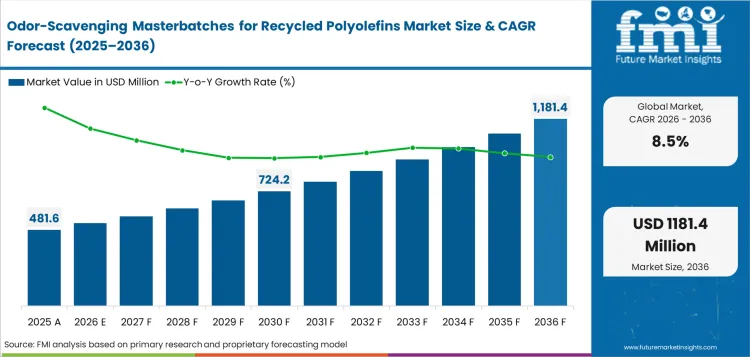
Odor-scavenging masterbatches for recycled polyolefins value stood at USD 481.6 million in 2025 and is projected to reach USD 522.5 million in 2026. Industry revenue is forecast to reach USD 1,181.4 million by 2036 at 8.5% CAGR. By form, pellet masterbatch is projected to account for 71.0% share in 2026. Direct sales are expected to hold 68.0% share of sales channel in 2026.
Summary of the Odor-Scavenging Masterbatches for Recycled Polyolefins Market
- Demand and Growth Drivers
- Packaging converters are using odor-control concentrates to raise recycled PE and PP acceptance in branded packs.
- Personal care and home care packs are creating tighter odor screening as fragrance carryover can affect consumer acceptance.
- Food-contact trials are raising demand for low-odor recycled polyolefin compounds with stronger compliance records.
- Product and Segment View
- Pellet masterbatch is forecast to account for 71.0% share in 2026, led by converters needing clean dosing on standard extrusion lines.
- Direct sales are projected to capture 68.0% share in 2026, driven by larger buyers requiring plant trials and batch support.
- Recycled PE is expected to hold 57.0% share in 2026 as films and flexible packaging carry broad PCR use.
- Geography and Competitive Outlook
- India is projected to record 11.4% CAGR by 2036, supported by plastic packaging EPR and recycler investment.
- China is expected to expand at 10.2% CAGR by 2036 due to large packaging and compounding capacity influencing recycled polyolefin adoption.
- Brazil is forecast to grow at 8.8% CAGR by 2036, driven by consumer packaging firms raising recycled resin trials.
- Ampacet and Avient shape competition through odor-control chemistry. Tosaf and BASF add converter-facing technical support.
- Analyst Opinion
- Ismail Sutaria, Principal Consultant for Packaging at FMI, says, "Odor control is a gatekeeper for recycled polyolefin adoption in visible packaging. Recyclate cost alone does not win orders if converters face smell complaints or brand rejection. Suppliers with resin-specific scavenger systems and plant trial support will shape premium recycled resin adoption."
- Odor-Scavenging Masterbatches for Recycled Polyolefins Market Value Analysis
- Value is moving from basic additive loading toward advanced recycled polyolefin resins needing sensory control before brand approval.
- Masterbatch makers link odor control with broader masterbatch supply as converters prefer single-supplier color and additive support.
- Formulators use plastic additives that reduce volatile odor while keeping melt flow and mechanical properties within converter limits.
- Operator demand depends on recycled resin qualification as odor and gel count affect order repeatability.
Key Takeaways, Market Size, and Forecast
- The odor-scavenging masterbatches for recycled polyolefins industry was valued at USD 481.6 million in 2025.
- Odor-scavenging masterbatches for recycled polyolefins market value is expected to reach USD 1,181.4 million by 2036.
- From 2026 to 2036, the sector is projected to expand at 8.5% CAGR.
- Industry is forecast to create an incremental opportunity of USD 658.9 million between 2026 and 2036.
- Pellet masterbatch is expected to account for 71.0% share of form in 2026.
- Direct sales are projected to account for 68.0% share of sales channel in 2026.
- India at 11.4% CAGR and China at 10.2% CAGR by 2036 are projected to record stronger country-level expansion.
Odor variability in recycled PE and PP is a production risk for converters seeking PCR films to pass brand and consumer screening. Film grades are moving toward scavengers that trap odor molecules inside the polymer matrix. In April 2025, Ampacet listed OdorClear 0258 with an LLDPE carrier and 8% additive loading across industrial packaging and food packaging uses. Supplier selection focuses on matching carriers and verifying food status before starting line trials. Reactive chemistry has gained value as buyers ask which odor compounds are reduced. In October 2024, Dow’s JP7576558B2 patent described 0.15% to 15% odor inhibitor and greater than 20% aldehyde reduction by normalized gas chromatography, influencing masterbatch vendors to support claims with measured carbonyl or VOC data. Process deodorization raises the proof bar for additive suppliers. In October 2025, EREMA stated that VOLEX cut VOCs by up to 40% compared with standard degassing and up to 75% compared with input material. Masterbatch formulators now need cleaner test packs that reflect additive value beyond what extrusion equipment already removes.
Odor-Scavenging Masterbatches for Recycled Polyolefins Market Definition
Odor-scavenging masterbatches for recycled polyolefins cover concentrated additive pellets or powders used to reduce unwanted smells in recycled polyethylene and polypropylene. Scope includes adsorptive mineral systems and reactive neutralizers carried in PE or PP resins. Revenue covers masterbatch sold to recyclers, compounders and converters. Additive masterbatch systems used mainly for color or processing are included only if odor control is a priced feature.
Odor-Scavenging Masterbatches for Recycled Polyolefins Market Inclusions
Scope includes odor-control concentrates for recycled PE films and recycled PP molded parts. Hybrid formulations combining odor scavengers with stabilizers are included if pricing reflects odor reduction. Masterbatches used in packaging, consumer goods and automotive interiors are covered. Direct supply and distributor sales are included if odor-control additive revenue is identifiable.
Odor-Scavenging Masterbatches for Recycled Polyolefins Market Exclusions
Scope excludes deodorizing sprays and finished consumer odor-control products. Virgin polymer additive packages are excluded unless sold for recycled polyolefin odor reduction. PET-only oxygen scavengers are excluded from core sizing. Recycling equipment and washing chemicals are outside the market boundary unless tied to masterbatch revenue.
Odor-Scavenging Masterbatches for Recycled Polyolefins Market Research Methodology
- Primary Research: FMI analysts reviewed additive selection, recycler compounding workflows and converter trial requirements across packaging and molded goods channels.
- Desk Research: Regulatory files, association statistics and supplier product evidence supported the recycled polyolefin demand view.
- Market Sizing and Forecasting: Forecast values used bottom-up additive loading assumptions, recycled polyolefin conversion checks and segment share estimates.
- Data Validation: Checks compared recycled packaging policy signals with supplier product portfolios and regional converter adoption patterns.
Why is the Odor-Scavenging Masterbatches for Recycled Polyolefins Market Growing?
- Packaging converters are adding odor scavengers as recycled PE film can carry fragrance and detergent residues into new packs.
- Compounders are pairing odor control with stabilizers as recycled PP quality varies across mixed post-consumer streams.
- Brand owners are widening recycled content trials as regulation makes PCR use harder to postpone in consumer packaging.
Recycled polyolefin use is rising as packaging rules move recycled content from a voluntary claim to a specification item. European packaging policy pushes plastic packaging recycling and recycled content targets into the next buying cycle. Odor becomes a practical barrier once recycled PE or PP enters personal care and home care packs. Aesthetic engineering of imperfect PCR packaging reflects the same shift from resin availability to consumer-facing acceptability. Suppliers gain share once odor reduction can be tested on the buyer resin stream before scale-up.
Food and personal care packaging create the main pull for odor-control concentrates. Recycled resin lots often pass melt flow checks and can fail sensory screening after storage. Recycled polyolefin compounds for food packaging need stronger odor management as converters try to protect brand experience. Such qualification work favors masterbatch suppliers able to support trial dosing and polymer compatibility. Price pressure remains clear. Rejected packaging lots cost more than additive savings.
Market Segmentation Analysis
- Pellet masterbatch is projected to capture 71.0% share in 2026, as converters can dose pellets on existing feeders without changing extrusion or molding workflows.
- Direct sales are forecast to account for 68.0% share in 2026 as larger recycled-content programs need supplier trials and complaint-risk control.
- Recycled PE is projected to hold 57.0% share in 2026 as film and flexible packaging converters need odor control across post-consumer resin streams.
- Packaging converters are expected to account for 44.0% share in 2026, as odor acceptance is prominent in consumer-facing recycled packs.
- Adsorptive scavengers are forecast to capture 42.0% share in 2026 as porous systems can bind volatile residues from wash and storage variation. Flexible packaging is projected to hold 39.0% share in 2026 as thin films expose odor issues faster than thicker molded goods.
Market segmentation has six primary groups based on chemistry, carrier resin and buyer use. Active mechanism explains whether odor is trapped or neutralized. Carrier resin shows fit with recycled PE, recycled PP and mixed polyolefin streams. Application separates films from molded goods and interior parts. End use explains whether converters, recyclers or brands influence additive selection. Recyclability-optimized polyolefin impact modifiers and odor scavengers often move together during recycled compound design.
Insights into Odor-Scavenging Masterbatches for Recycled Polyolefins Market by Active Mechanism
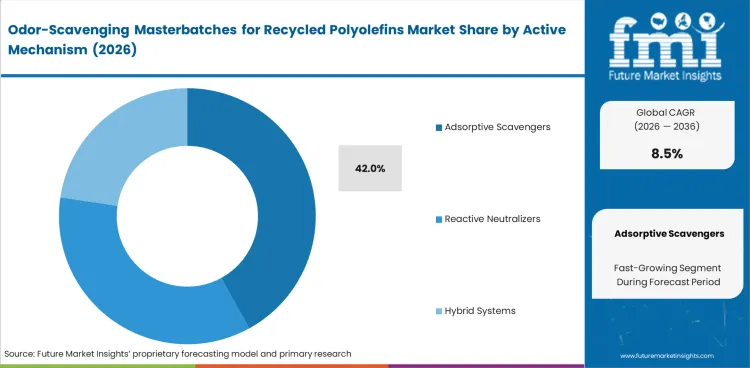
- Adsorptive scavengers are projected to account for 42.0% share in 2026 as mineral and porous additive systems can trap residual volatile compounds without forcing major process changes.
- Reactive neutralizers gain selective use in higher-value recycled PP applications as converters ask for odor reduction lasting after storage and heat exposure.
Insights into Odor-Scavenging Masterbatches for Recycled Polyolefins Market by Carrier Resin
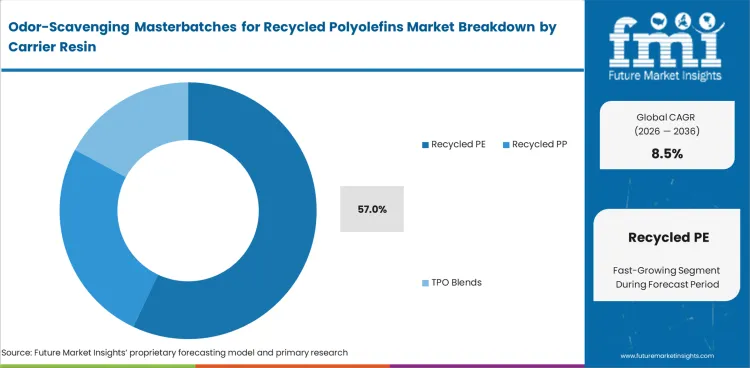
- Recycled PE is expected to hold 57.0% share in 2026, reflected by PCR film users needing odor control working across blown film and flexible packaging lines.
- Recycled PP adoption is rising in molded caps and automotive parts since compounders manage odor alongside stiffness and impact balance.
Insights into Odor-Scavenging Masterbatches for Recycled Polyolefins Market by Application
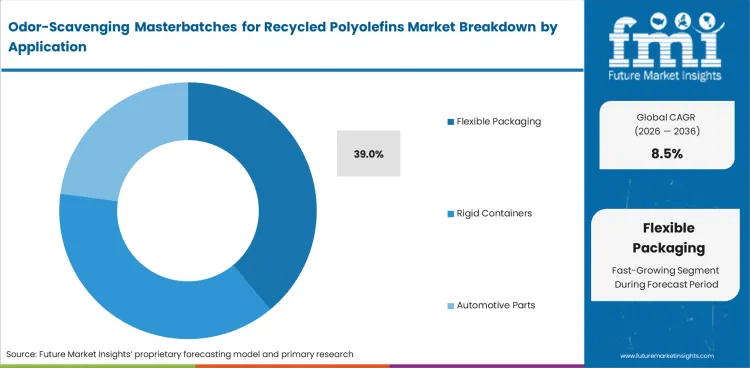
- Flexible packaging is forecast to account for 39.0% share in 2026, as film converters require low-odor PCR blends for pouches and personal care overwraps.
- Rigid containers continue to use odor-control masterbatch as bottle and closure makers test recycled polyolefins for non-food consumer packs.
Insights into Odor-Scavenging Masterbatches for Recycled Polyolefins Market by End Use
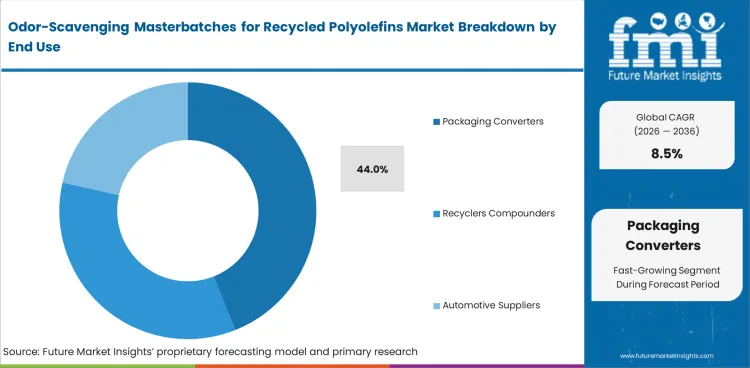
- Packaging converters are projected to account for 44.0% share in 2026, as brand audits make odor complaints a direct risk for recycled-content packaging approval.
- Automotive suppliers use odor-controlled recycled PP in interior parts as cabin trim needs lower volatile release after molding. PCR-ready automotive PP compounds show how recycled content can integrate into higher-spec molded applications.
Insights into Odor-Scavenging Masterbatches for Recycled Polyolefins Market by Form
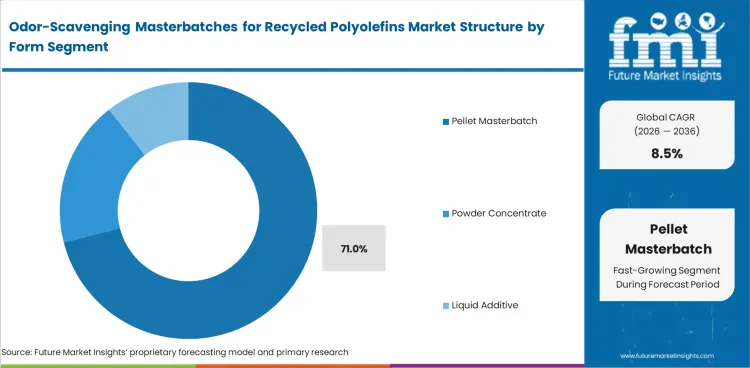
- Pellet masterbatch is expected to hold 71.0% share in 2026, as pellet dosing gives converters cleaner handling and steadier addition rates than powders.
- Powder concentrate fits compounders with controlled mixing systems as high-active odor packages can be diluted into custom resin blends.
Insights into Odor-Scavenging Masterbatches for Recycled Polyolefins Market by Sales Channel
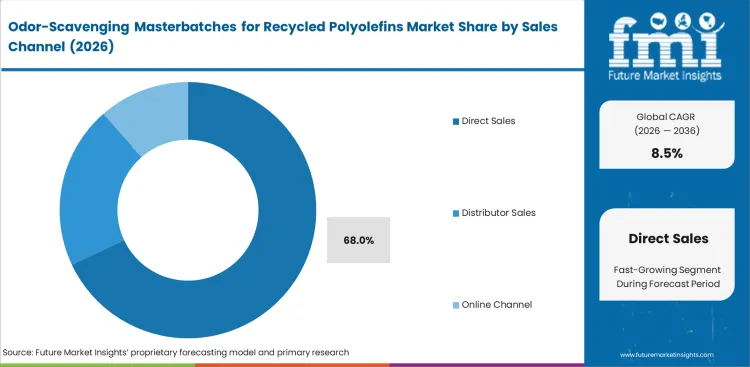
- Direct sales are projected to capture 68.0% share in 2026 as odor reduction needs resin-lot trials and plant support before commercial orders.
- Distributor sales serve smaller converters buying occasional additive volumes alongside recyclable polyolefin impact modifiers and processing aids for recycled resin blends.
Odor-Scavenging Masterbatches for Recycled Polyolefins Market Drivers, Restraints and Opportunities
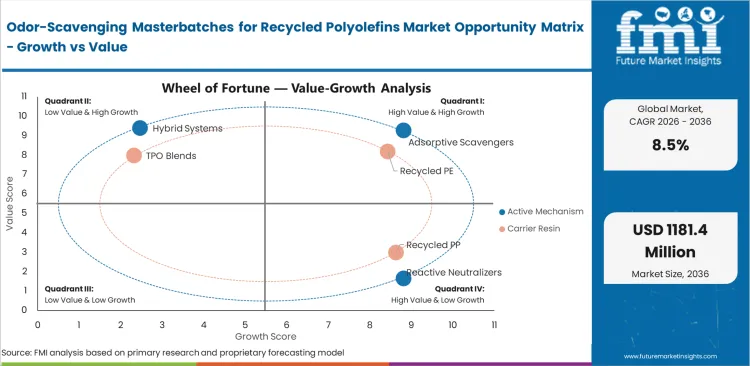
- Recycled-content rules make odor control into a qualification step for recycled PE and PP packaging.
- Feedstock variation slows wider use as residual contents in PCR can create odor during recycling and conversion.
- Hybrid additive packages are gaining value as converters need odor control with compatibility and processing support.
Regulation raises the value of low-odor recycled PE and PP as recycled content moves into everyday packaging specifications. The European Commission states that the Packaging and Packaging Waste Regulation entered into force on 11 February 2025 and generally applies from 12 August 2026. The regulation aims to make all EU packaging recyclable in an economically viable way by 2030. UK HM Revenue and Customs charges Plastic Packaging Tax on plastic packaging with less than 30% recycled content. The 2026 rate is £228.82 per tonne. Regulatory pressure does not mandate odor control. It raises the cost of failed PCR trials by pushing converters to qualify recycled content in consumer-facing packs. Ampacet’s 2025 film guide states that odor scavenger masterbatches absorb odor molecules and keep them inside the film polymer matrix. OdorClear 0258 uses an LLDPE carrier with 8% additive loading and EC food status for film uses. Tosaf’s 2025 sustainability one-pager places OdorSeal with TopFusion compatibilizers and DesiSeal moisture-control masterbatches for recycled-material use. Supplier opportunity will shift toward resin-lot testing and dosage guidance as converters seek odor control that works with mixed PCR streams before commercial scale-up.=
Regulatory Compliance Impact Analysis
Regulatory pressure makes low-odor recycled PE and PP a tighter qualification need for consumer packaging. EU PPWR entered into force on 11 February 2025 and generally applies from 12 August 2026, with rules covering packaging design and waste handling. The regulation aims to make all packaging on the EU market recyclable in an economically viable way by 2030 and safely increase recycled plastics in packaging. Converters will need recycled-polyolefin inputs meeting recyclability goals without causing odor failures during brand approval.
Sustainability Transition Analysis
Brand sustainability programs move recycled plastic packaging from material substitution toward design proof and measurable circularity. The Ellen MacArthur Foundation’s 2025 Global Commitment report states that brand and retail signatories increased reusable, recyclable or compostable plastic packaging to 72% in 2024. The report states that packaging designed for recycling rose from 83% in 2023 to 85% in 2024. Mono-material redesign and higher PCR use will increase the need for odor-scavenging masterbatches that protect recycled PE and PP packaging performance.
Analysis of Odor-Scavenging Masterbatches for Recycled Polyolefins Market by Key Countries
.webp "Top Country Growth Comparison Odor Scavenging Masterbatches For Recycled Polyolefins Market Cagr (2026 2036)")
| Country | CAGR |
|---|---|
| India | 11.4% |
| China | 10.2% |
| Brazil | 8.8% |
| United States | 8.1% |
| Germany | 7.4% |
| South Korea | 6.9% |
| Japan | 6.1% |
Source: Future Market Insights, 2026.
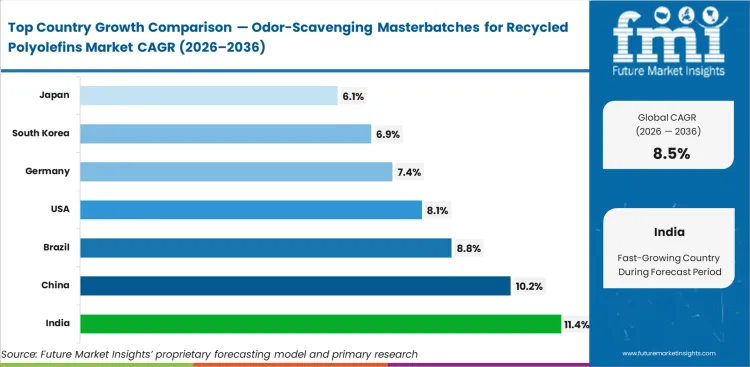
Odor-Scavenging Masterbatches for Recycled Polyolefins Market CAGR Analysis by Country
- India is projected to record 11.4% CAGR by 2036 as packaging EPR raises recycled polyolefin processing and converter qualification work.
- China is expected to expand at 10.2% CAGR by 2036 as packaging conversion scale and recycled resin compounding depth.
- Brazil is forecast to grow at 8.8% CAGR by 2036 as consumer goods packaging widens PCR trials across PE and PP formats.
- United States is expected to advance at 8.1% CAGR by 2036 as recycling investment and brand PCR targets support odor-control trials.
- Germany is projected to rise at 7.4% CAGR by 2036 through strict packaging recovery systems and mature converter screening. South Korea is forecast at 6.9% CAGR by 2036 as packaging quality standards maintain a selective recycled resin adoption. Japan is expected to post 6.1% CAGR by 2036 as quality screening supports measured use of low-odor recycled polyolefins.
Country performance differs by recycled-content regulation and converter tolerance for resin variability. India and China track above the global pace as recycling capacity and packaging conversion scale widen. Brazil and United States stay above the global line as brand programs keep PCR trials active. Germany, South Korea and Japan show more measured adoption as quality screening remains strict.
Demand Outlook for Odor-Scavenging Masterbatches for Recycled Polyolefins in India
Industry in India is projected to record 11.4% CAGR by 2036 as plastic packaging EPR raises recycler registration and converter demand for cleaner PCR. Government updates reported recycling of 207 lakh tonnes of plastic packaging waste after the EPR guidelines came into force. Policy pressure pushes recycled PE and PP toward branded packaging use. Odor-control masterbatch becomes important as converters try to reduce resin rejection before commercial supply.
- Packaging recyclers can use odor scavengers to stabilize PCR lots before selling to film and molded goods converters.
- Converter trials are expected to favor pellet concentrates since dosing control matters during smaller validation runs.
- Brand owners will screen recycled resin for smell before wider use in personal care and household packs.
Sales Analysis of Odor-Scavenging Masterbatches for Recycled Polyolefins in China
Sales in China are expected to expand at 10.2% CAGR by 2036 as large compounding and packaging capacity supporting faster PCR qualification. Recycled polyolefin use is expected to rise in flexible packaging and molded consumer goods. Local processors can adjust odor-control dosage across diverse waste streams. Export-facing converters will make supplier documentation important as buyer audits become tighter.
- Compounders can blend odor-control additives with stabilizers once recycled PP needs consistent molding performance.
- Film converters are expected to use recycled PE with odor-control pellets for non-food packaging applications.
- Large processing scale allows faster sampling cycles across resin grades and additive loading ranges.
Future Outlook for Odor-Scavenging Masterbatches for Recycled Polyolefins in Brazil
Brazil is forecast to grow at 8.8% CAGR by 2036, as consumer goods packaging creates practical interest in lower-odor PCR. Recycled PE use is expected to grow first in non-food flexible packs and household product containers. Odor-control additives help converters manage residue variation from mixed collection systems. Distributor support remains important for mid-sized processors unable to run long technical trials.
- Personal care and home care packs create demand for odor control as recycled resin odor can affect shelf acceptance.
- Local converters are expected to favor masterbatch grades compatible with common PE and PP blends.
- Flexible order volumes give regional distributors a role in early PCR additive trials.
Opportunity Analysis of Odor-Scavenging Masterbatches for Recycled Polyolefins in United States
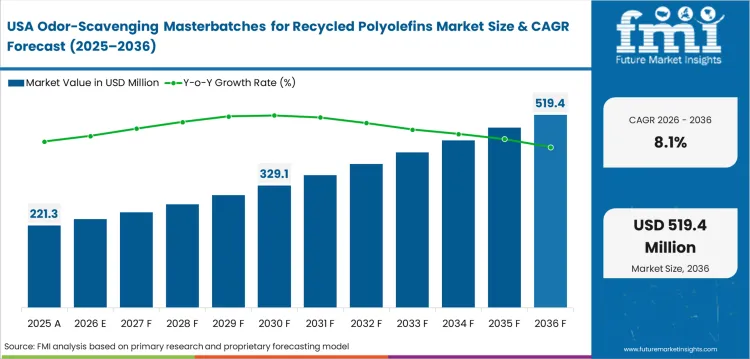
The market in the United States is expected to advance at 8.1% CAGR by 2036 as recycling infrastructure investment and brand targets raise PCR use. EPA assessment work in August 2024 identified USD 36.5 billion to USD 43.4 billion in needed recycling infrastructure investment. Better sorting and processing should raise available PCR volumes over time. Odor-control masterbatches help convert improved feedstock into customer-approved packaging resin.
- Packaging converters can use odor-control concentrates to reduce complaint risk in recycled PE film applications.
- Compounders are expected to pair odor scavengers with stabilizers for recycled PP used in durable goods.
- Brand qualification programs should reward suppliers providing trial data across resin lots and storage intervals.
Demand Analysis of Odor-Scavenging Masterbatches for Recycled Polyolefins in Germany
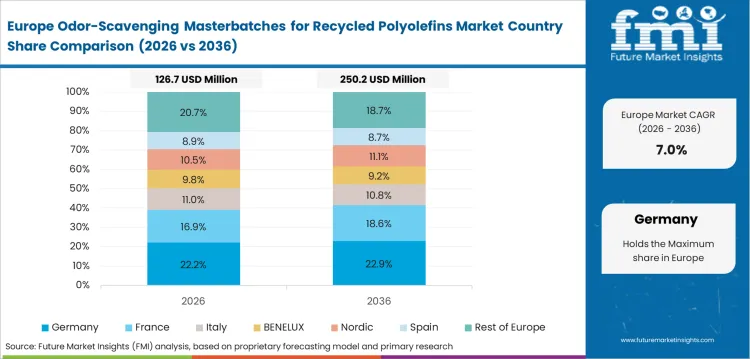
Demand in Germany is projected to rise at 7.4% CAGR by 2036 through high recycling discipline and strict converter screening. German environmental reporting placed plastic packaging recycling near 70.0% in 2024 within dual-system collection. Mature recycling systems give converters more PCR choices. Odor expectations stay demanding. Suppliers need stable performance data across packaging waste streams.
- Food-adjacent and personal care packaging users will require low-odor PCR with clear additive documentation.
- Converters are likely to test odor performance after storage before shifting larger film volumes.
- Recycler partnerships can improve lot consistency and reduce additive rework during compounding.
In-depth Analysis of Odor-Scavenging Masterbatches for Recycled Polyolefins in South Korea
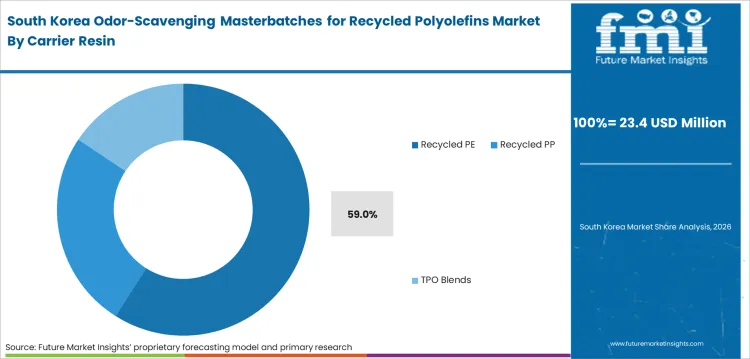
South Korea is forecast at 6.9% CAGR by 2036, as packaging quality expectations make PCR adoption selective. The country has strong plastics processing and electronics supply chains valuing consistent materials. Odor-control masterbatch use should concentrate in packaging and consumer goods first. Suppliers need to show performance without harming color or mechanical specifications.
- Consumer goods processors are expected to favor odor-control pellets preserving surface finish in molded PP parts.
- Packaging firms can widen recycled PE use once odor screening supports brand acceptance requirements.
- Local converter discipline should favor suppliers with fast lab support and resin-specific dosage guidance.
Industry Analysis of Odor-Scavenging Masterbatches for Recycled Polyolefins in Japan
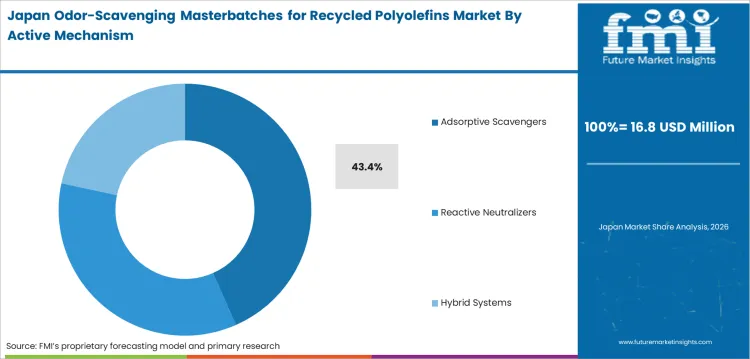
Demand in Japan is expected to post 6.1% CAGR by 2036 as high quality expectations keep recycled polyolefin use measured. Packaging and automotive processors need low-odor PCR without visible quality loss. Odor-control masterbatches can be used if recycled resin meets strict sensory and processing checks. Premium grades can gain share once suppliers document odor reduction after molding or film extrusion.
- Packaging users will prefer recycled polyolefin grades with steady odor results across storage and handling.
- Automotive interior suppliers can test impact-modified PCR plastics for automotive interiors that include odor-controlled recycled PP for non-visible components first.
- Measured adoption keeps volume below India and China. Premium technical-grade concentrates can still gain support.
Competitive Landscape and Strategic Positioning
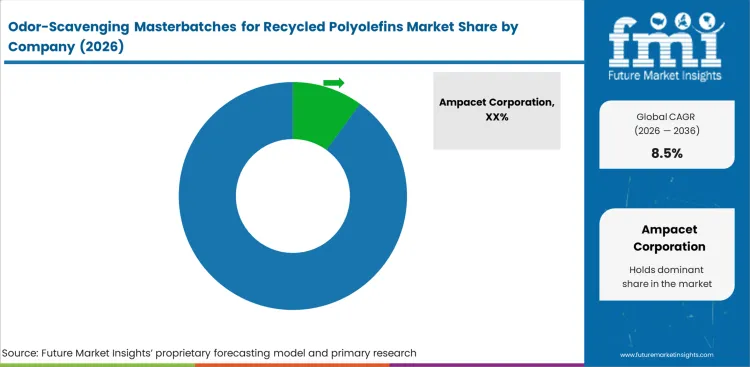
- Global additive suppliers hold an advantage through broader odor-control chemistry and stronger converter-facing trial support.
- Regional masterbatch makers compete through faster sampling and lower minimum order volumes for nearby converters.
- Polymer compounders gain influence as recycled resin packages combine odor control with stabilizers and compatibilizers.
Competition in odor-scavenging masterbatches sector is influenced by proof of odor reduction across real recycled PE and PP streams. Ampacet and Tosaf compete with dedicated odor-control masterbatch lines for post-consumer recycled materials. BASF and Avient bring wider additive platforms that support recyclate performance and converter trials. Oxygen scavenger masterbatch experience supports packaging account access because buyers already understand dosing control and shelf-life testing. Wider product depth allows suppliers to position odor control as part of a broader recycled resin performance package.
Specialist and regional suppliers protect share through practical support and faster customer response. Plastiblends and Bajaj Masterbatch serve converters needing shorter lead times and flexible order volumes. Ganga Masterbatches supports buyers that need quick grade selection for local PE and PP waste streams. UV-resistant masterbatches and odor-control grades often move through the same account teams. Supplier strength is expected to depend on test speed and carrier compatibility. Companies that tune dosage around each recycler feedstock are better placed to win repeat business.
Key Companies in the Odor-Scavenging Masterbatches for Recycled Polyolefins Market
Competition is grouped by role as global additive specialists and regional masterbatch producers serve different buyer needs.
- Global Additive Specialists: Ampacet and Avient serve large converters. BASF and Clariant support large accounts through broad additive portfolios and technical support. Ampacet has a direct odor-control position through OdorClear. BASF and Avient support recyclate quality through stabilizer and processing packages used beside odor-control concentrates.
- Polymer and Recycling Platform Suppliers: Tosaf, Dow and Borealis support recycled polyolefin processing through masterbatch knowledge and recyclate performance platforms. Tosaf has direct odor scavenger masterbatch evidence for recycled materials. Dow and Borealis influence the market through compatibilization and recycled PP platforms.
- Regional Masterbatch Producers: Plastiblends and Kingfa compete. Bajaj Masterbatch and Ganga Masterbatches add local support. Perfect Colourants competes on local converter access and faster sample cycles. These suppliers can win smaller accounts that need flexible volumes and practical dosing support before moving into larger PCR programs.
Competitive Benchmarking: Odor-Scavenging Masterbatches for Recycled Polyolefins Market
| Company | Odor Reduction Chemistry | PCR Polyolefin Compatibility | Converter Support Reach | Geographic Footprint |
|---|---|---|---|---|
| Ampacet | High | Strong | Strong | Global |
| Tosaf | High | Strong | Strong | Europe, Asia and Americas |
| Avient | Medium | Strong | Strong | Global |
| BASF | Medium | Strong | Strong | Global |
| Clariant | Medium | Strong | Strong | Global |
| Dow | Low | Strong | Medium | Global |
| Borealis | Low | Strong | Medium | Europe centered |
| Plastiblends | Medium | Medium | Medium | India and export buyers |
| Kingfa | Medium | Strong | Medium | China and India |
| Ganga Masterbatches | Medium | Medium | Low | India centered |
Source: Future Market Insights competitive analysis, 2026. Ratings reflect relative positioning based on odor reduction chemistry, PCR polyolefin compatibility and converter support reach.
Key Developments in Odor-Scavenging Masterbatches for Recycled Polyolefins Market
- In April 2024, BASF showcased IrgaCycle additive solutions at CHINAPLAS 2024 for mechanical recycling and recyclate performance improvement.
- In May 2024, Avient presented packaging additive systems at NPE 2024, including Cesa Non-PFAS Process Aid for Extrusion.
- In October 2025, Borealis advanced recycled polypropylene production through Integra Plastics and Borcycle M mechanical recycling technology.
Key Players in the Odor-Scavenging Masterbatches for Recycled Polyolefins Market
Major Global Players:
- Ampacet Corporation
- Avient Corporation
- BASF SE
- Clariant AG
- Tosaf Group
- Dow Inc.
- Borealis AG
Specialist and Regional Players:
- Plastiblends India Limited
- Kingfa Science and Technology
- Ganga Masterbatches
- Bajaj Masterbatch LLP
- Perfect Colourants and Plastics Pvt. Ltd.
- Shanghai Pret Composites
- Baerlocher GmbH
Report Scope and Coverage
| Parameter | Details |
|---|---|
| Quantitative Units | USD 522.5 million to USD 1,181.4 million, at 8.5% CAGR |
| Market Definition | Odor-control additive concentrates used in recycled PE and recycled PP processing |
| Active Mechanism | Adsorptive scavengers, reactive neutralizers, hybrid systems, encapsulated systems |
| Carrier Resin | Recycled PE, recycled PP, TPO blends, universal carrier |
| Application | Flexible packaging, rigid containers, automotive parts, consumer goods |
| End Use | Packaging converters, recyclers compounders, automotive suppliers, consumer goods |
| Form | Pellet masterbatch, powder concentrate, liquid additive |
| Sales Channel | Direct sales, distributor sales, online channel |
| Regions Covered | North America, Latin America, Western Europe, Eastern Europe, East Asia, South Asia and Pacific, Middle East and Africa |
| Countries Covered | India, China, Brazil, United States, Germany, South Korea, Japan |
| Key Companies Profiled | Ampacet, Avient, BASF, Clariant, Tosaf, Dow, Borealis |
| Forecast Period | 2026 to 2036 |
| Approach | Bottom-up additive demand model with recycled polyolefin conversion checks |
Source: Future Market Insights, 2026.
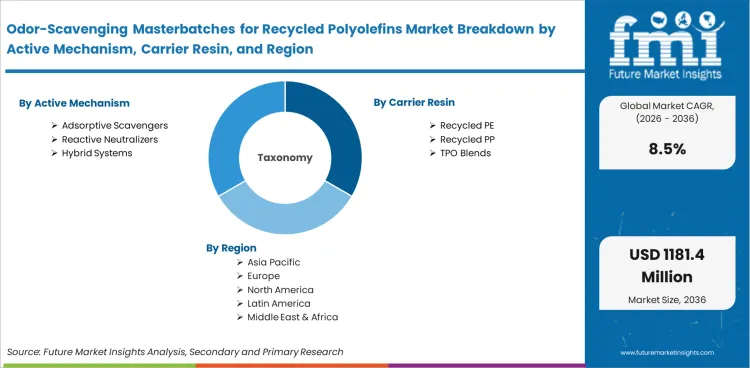
Odor-Scavenging Masterbatches for Recycled Polyolefins Market Breakdown by Active Mechanism, Carrier Resin, Application, End Use, Form, Sales Channel, and Region
Odor-Scavenging Masterbatches for Recycled Polyolefins Market Segmented by Active Mechanism:
- Adsorptive Scavengers
- Reactive Neutralizers
- Hybrid Systems
- Encapsulated Systems
Odor-Scavenging Masterbatches for Recycled Polyolefins Market Segmented by Carrier Resin:
- Recycled PE
- Recycled PP
- TPO Blends
- Universal Carrier
Odor-Scavenging Masterbatches for Recycled Polyolefins Market Segmented by Application:
- Flexible Packaging
- Rigid Containers
- Automotive Parts
- Consumer Goods
- Industrial Products
Odor-Scavenging Masterbatches for Recycled Polyolefins Market Segmented by End Use:
- Packaging Converters
- Recyclers Compounders
- Automotive Suppliers
- Consumer Goods Manufacturers
- Industrial Product Manufacturers
Odor-Scavenging Masterbatches for Recycled Polyolefins Market Segmented by Form:
- Pellet Masterbatch
- Powder Concentrate
- Liquid Additive
Odor-Scavenging Masterbatches for Recycled Polyolefins Market Segmented by Sales Channel:
- Direct Sales
- Distributor Sales
- Online Channel
Odor-Scavenging Masterbatches for Recycled Polyolefins Market by Region:
- North America
- United States
- Canada
- Mexico
- Latin America
- Brazil
- Argentina
- Rest of Latin America
- Western Europe
- Norway
- United Kingdom
- Germany
- France
- BENELUX
- Rest of Western Europe
- Eastern Europe
- Poland
- Romania
- Rest of Eastern Europe
- East Asia
- China
- Japan
- South Korea
- South Asia and Pacific
- India
- ASEAN
- Australia and New Zealand
- Rest of South Asia and Pacific
- Middle East and Africa
- Saudi Arabia
- United Arab Emirates
- Oman
- Kuwait
- South Africa
- Rest of Middle East and Africa
Research Sources and Bibliography
- Ampacet Corporation. (2025, April). Masterbatch solutions for film applications [Product guide].
- Avient Corporation. (2024, May 6). Avient brings sustainable innovation to NPE 2024.
- Avient Corporation. (2025, July 10). Avient introduces ColorMatrix™ Amosorb™ Oxyloop™: A new oxygen scavenging additive to enhance recyclability.
- BASF. (2024, April 3). BASF to showcase sustainable additive solutions at CHINAPLAS 2024.
- Borealis AG. (2025, October). Integra upgraded for recycled polypropylene with Borcycle™ M advanced mechanical recycling technology.
- Brown, A., & Börkey, P. (2024, May 24). Plastics recycled content requirements (OECD Environment Working Papers No. 236). OECD Publishing. https://doi.org/10.1787/b311ee60-en
- Clariant. (2025, June 5). Clariant launches innovative PFAS-free polymer processing aids for more sustainable polyolefin extrusion.
- Dow Global Technologies LLC. (2024, October 31). Compositions for odor control for post-consumer resins (Patent No. JP7576558B2).
- Ellen MacArthur Foundation. (2025, November 4). The Global Commitment 2025 progress report.
- EREMA Engineering Recycling Maschinen und Anlagen Ges.m.b.H. (2025, October 9). VOLEX technology reduces VOCs by 40 percent.
- European Parliament and Council of the European Union. (2025, January 22). Regulation (EU) 2025/40 of the European Parliament and of the Council of 19 December 2024 on packaging and packaging waste. EUR-Lex.
- Eurostat. (2025, October 10). Packaging waste statistics.
- HM Revenue & Customs. (2026, February 12). Plastic Packaging Tax: steps to take. GOV.UK.
- Tosaf Compounds Ltd. (2025, March). Making a sustainable impact happen [One-pager].
- USA Environmental Protection Agency. (2025, August 6). USA recycling infrastructure assessment and state data collection reports.
- Umweltbundesamt. (2026, January 27). Facts against myths: Packaging waste recycling in Germany is working.
Bibliography uses government sources, official company evidence and non-commercial recycling data relevant to recycled polyolefin and additive demand signals.
This Report Answers
- What is the current and future size of the odor-scavenging masterbatches for recycled polyolefins market?
- How fast is the odor-scavenging masterbatches for recycled polyolefins market expected to expand between 2026 and 2036?
- Which form is expected to account for the leading odor-scavenging masterbatch share in 2026?
- Which sales channel is projected to account for the leading odor-scavenging masterbatch share in 2026?
- Why are adsorptive scavengers important for recycled polyolefin odor control?
- How does recycled PE shape odor-scavenging masterbatch adoption?
- Which countries are projected to record stronger expansion during the forecast period?
- Who are the main companies active in odor-scavenging masterbatch supply?
- How does FMI define the odor-scavenging masterbatches for recycled polyolefins market scope?
- How does FMI estimate and validate the odor-scavenging masterbatch forecast?
Frequently Asked Questions
What is the global market demand for odor-scavenging masterbatches for recycled polyolefins in 2026?
In 2026, the market value is expected to reach USD 522.5 million as converters qualify recycled PE and PP for odor-sensitive packaging.
How big will the odor-scavenging masterbatches for recycled polyolefins market be in 2036?
Industry revenue is anticipated to reach USD 1,181.4 million by 2036 as PCR packaging programs require sensory control.
How much is demand expected to expand between 2026 and 2036?
Between 2026 and 2036, the sector is projected to expand at 8.5% CAGR as recycled-content rules raise additive qualification work.
Which form is expected to hold the leading share by 2026?
Pellet masterbatch is projected to represent 71.0% share in 2026, as converters prefer clean dosing on existing lines.
Which sales channel is expected to hold the leading share in 2026?
Direct sales are projected to account for 68.0% share in 2026 as large buyers need trials and technical support.
Which country records stronger expansion in the odor-scavenging masterbatches for recycled polyolefins market?
India is projected to record 11.4% CAGR by 2036 since plastic packaging EPR increases recycled resin qualification.
What does the odor-scavenging masterbatches for recycled polyolefins market include?
Scope includes additive concentrates used to reduce unwanted smells in recycled PE and PP films, containers and molded parts.
How does FMI estimate the odor-scavenging masterbatches for recycled polyolefins market forecast?
FMI uses additive loading assumptions, recycled polyolefin conversion checks and supplier evidence to validate forecast size and segment shares.
Why are adsorptive scavengers important in recycled polyolefin use?
Adsorptive scavengers trap volatile residues from post-consumer resin streams, which lowers odor risk before packaging or molded goods approval.
How long does odor-scavenging masterbatch performance need to last in packaging use?
Performance must usually hold through extrusion, warehouse storage and pack filling because odor can return after resin heat history changes.
Preview the report firsthand - request a free sample
Get SampleGet the brochure for pricing and purchase details.
Get PDFTable of Content
- Executive Summary
- Global Market Outlook
- Demand-side Trends
- Supply-side Trends
- Technology Roadmap Analysis
- Analysis and Recommendations
- Market Overview
- Market Coverage / Taxonomy
- Market Definition / Scope / Limitations
- Research Methodology
- Chapter Orientation
- Analytical Lens and Working Hypotheses
- Market Structure, Signals, and Trend Drivers
- Benchmarking and Cross-market Comparability
- Market Sizing, Forecasting, and Opportunity Mapping
- Research Design and Evidence Framework
- Desk Research Programme (Secondary Evidence)
- Company Annual and Sustainability Reports
- Peer-reviewed Journals and Academic Literature
- Corporate Websites, Product Literature, and Technical Notes
- Earnings Decks and Investor Briefings
- Statutory Filings and Regulatory Disclosures
- Technical White Papers and Standards Notes
- Trade Journals, Industry Magazines, and Analyst Briefs
- Conference Proceedings, Webinars, and Seminar Materials
- Government Statistics Portals and Public Data Releases
- Press Releases and Reputable Media Coverage
- Specialist Newsletters and Curated Briefings
- Sector Databases and Reference Repositories
- FMI Internal Proprietary Databases and Historical Market Datasets
- Subscription Datasets and Paid Sources
- Social Channels, Communities, and Digital Listening Inputs
- Additional Desk Sources
- Expert Input and Fieldwork (Primary Evidence)
- Field Techniques
- Interviews
- Surveys
- Focus Groups
- Observational and In-context Research
- Social and Community Interactions
- Stakeholder Universe Engaged
- C-suite Leaders
- Board Members
- Presidents and Vice Presidents
- R&D and Innovation Heads
- Technical Specialists
- Domain Subject-matter Experts
- Scientists
- Physicians and Other Healthcare Professionals
- Governance, Ethics, and Data Stewardship
- Research Ethics
- Data Integrity and Handling
- Field Techniques
- Tooling, Models, and Reference Databases
- Desk Research Programme (Secondary Evidence)
- Data Engineering and Model Build
- Data Acquisition and Ingestion
- Cleaning, Normalisation, and Verification
- Synthesis, Triangulation, and Analysis
- Quality Assurance and Audit Trail
- Market Background
- Market Dynamics
- Drivers
- Restraints
- Opportunity
- Trends
- Scenario Forecast
- Demand in Optimistic Scenario
- Demand in Likely Scenario
- Demand in Conservative Scenario
- Opportunity Map Analysis
- Product Life Cycle Analysis
- Supply Chain Analysis
- Investment Feasibility Matrix
- Value Chain Analysis
- PESTLE and Porter’s Analysis
- Regulatory Landscape
- Regional Parent Market Outlook
- Production and Consumption Statistics
- Import and Export Statistics
- Market Dynamics
- Micellar Casein Concentrate
- Y-o-Y Growth Trend Analysis By Product Type , 2021 to 2025
- Absolute $ Opportunity Analysis By Product Type , 2026 to 2036
- Global Market Analysis 2021 to 2025 and Forecast 2026 to 2036, By Application
- Introduction / Key Findings
- Historical Market Size Value (USD Million) Analysis By Application, 2021 to 2025
- Current and Future Market Size Value (USD Million) Analysis and Forecast By Application, 2026 to 2036
- Beverages and Smoothies
- Clinical Nutrition
- Bakery
- Meat Products
- Nutritional Powders and Bars
- Protein Fortification
- Dairy Beverages
- Supplements
- Infant Nutrition
- Fresh Dairy Products
- Cheese
- Beverages and Smoothies
- Y-o-Y Growth Trend Analysis By Application, 2021 to 2025
- Absolute $ Opportunity Analysis By Application, 2026 to 2036
- Global Market Analysis 2021 to 2025 and Forecast 2026 to 2036, By End Use
- Introduction / Key Findings
- Historical Market Size Value (USD Million) Analysis By End Use, 2021 to 2025
- Current and Future Market Size Value (USD Million) Analysis and Forecast By End Use, 2026 to 2036
- Food and Beverage Industry
- Nutraceutical Industry
- Clinical and Healthcare
- Infant Nutrition Industry
- Sports Nutrition Industry
- Food and Beverage Industry
- Y-o-Y Growth Trend Analysis By End Use, 2021 to 2025
- Absolute $ Opportunity Analysis By End Use, 2026 to 2036
- Global Market Analysis 2021 to 2025 and Forecast 2026 to 2036, By Form
- Introduction / Key Findings
- Historical Market Size Value (USD Million) Analysis By Form, 2021 to 2025
- Current and Future Market Size Value (USD Million) Analysis and Forecast By Form, 2026 to 2036
- Powder Form
- Liquid Form
- Capsule and Tablet Form
- Powder Form
- Y-o-Y Growth Trend Analysis By Form, 2021 to 2025
- Absolute $ Opportunity Analysis By Form, 2026 to 2036
- Global Market Analysis 2021 to 2025 and Forecast 2026 to 2036, By Distribution Channel
- Introduction / Key Findings
- Historical Market Size Value (USD Million) Analysis By Distribution Channel, 2021 to 2025
- Current and Future Market Size Value (USD Million) Analysis and Forecast By Distribution Channel, 2026 to 2036
- Direct Sales
- Indirect Sales
- Direct Sales
- Y-o-Y Growth Trend Analysis By Distribution Channel, 2021 to 2025
- Absolute $ Opportunity Analysis By Distribution Channel, 2026 to 2036
- Global Market Analysis 2021 to 2025 and Forecast 2026 to 2036, By Region
- Introduction
- Historical Market Size Value (USD Million) Analysis By Region, 2021 to 2025
- Current Market Size Value (USD Million) Analysis and Forecast By Region, 2026 to 2036
- North America
- Latin America
- Western Europe
- Eastern Europe
- East Asia
- South Asia and Pacific
- Middle East & Africa
- Market Attractiveness Analysis By Region
- North America Market Analysis 2021 to 2025 and Forecast 2026 to 2036, By Country
- Historical Market Size Value (USD Million) Trend Analysis By Market Taxonomy, 2021 to 2025
- Market Size Value (USD Million) Forecast By Market Taxonomy, 2026 to 2036
- By Country
- USA
- Canada
- Mexico
- By Product Type
- By Application
- By End Use
- By Form
- By Distribution Channel
- By Country
- Market Attractiveness Analysis
- By Country
- By Product Type
- By Application
- By End Use
- By Form
- By Distribution Channel
- Key Takeaways
- Latin America Market Analysis 2021 to 2025 and Forecast 2026 to 2036, By Country
- Historical Market Size Value (USD Million) Trend Analysis By Market Taxonomy, 2021 to 2025
- Market Size Value (USD Million) Forecast By Market Taxonomy, 2026 to 2036
- By Country
- Brazil
- Chile
- Rest of Latin America
- By Product Type
- By Application
- By End Use
- By Form
- By Distribution Channel
- By Country
- Market Attractiveness Analysis
- By Country
- By Product Type
- By Application
- By End Use
- By Form
- By Distribution Channel
- Key Takeaways
- Western Europe Market Analysis 2021 to 2025 and Forecast 2026 to 2036, By Country
- Historical Market Size Value (USD Million) Trend Analysis By Market Taxonomy, 2021 to 2025
- Market Size Value (USD Million) Forecast By Market Taxonomy, 2026 to 2036
- By Country
- Germany
- UK
- Italy
- Spain
- France
- Nordic
- BENELUX
- Rest of Western Europe
- By Product Type
- By Application
- By End Use
- By Form
- By Distribution Channel
- By Country
- Market Attractiveness Analysis
- By Country
- By Product Type
- By Application
- By End Use
- By Form
- By Distribution Channel
- Key Takeaways
- Eastern Europe Market Analysis 2021 to 2025 and Forecast 2026 to 2036, By Country
- Historical Market Size Value (USD Million) Trend Analysis By Market Taxonomy, 2021 to 2025
- Market Size Value (USD Million) Forecast By Market Taxonomy, 2026 to 2036
- By Country
- Russia
- Poland
- Hungary
- Balkan & Baltic
- Rest of Eastern Europe
- By Product Type
- By Application
- By End Use
- By Form
- By Distribution Channel
- By Country
- Market Attractiveness Analysis
- By Country
- By Product Type
- By Application
- By End Use
- By Form
- By Distribution Channel
- Key Takeaways
- East Asia Market Analysis 2021 to 2025 and Forecast 2026 to 2036, By Country
- Historical Market Size Value (USD Million) Trend Analysis By Market Taxonomy, 2021 to 2025
- Market Size Value (USD Million) Forecast By Market Taxonomy, 2026 to 2036
- By Country
- China
- Japan
- South Korea
- By Product Type
- By Application
- By End Use
- By Form
- By Distribution Channel
- By Country
- Market Attractiveness Analysis
- By Country
- By Product Type
- By Application
- By End Use
- By Form
- By Distribution Channel
- Key Takeaways
- South Asia and Pacific Market Analysis 2021 to 2025 and Forecast 2026 to 2036, By Country
- Historical Market Size Value (USD Million) Trend Analysis By Market Taxonomy, 2021 to 2025
- Market Size Value (USD Million) Forecast By Market Taxonomy, 2026 to 2036
- By Country
- India
- ASEAN
- Australia & New Zealand
- Rest of South Asia and Pacific
- By Product Type
- By Application
- By End Use
- By Form
- By Distribution Channel
- By Country
- Market Attractiveness Analysis
- By Country
- By Product Type
- By Application
- By End Use
- By Form
- By Distribution Channel
- Key Takeaways
- Middle East & Africa Market Analysis 2021 to 2025 and Forecast 2026 to 2036, By Country
- Historical Market Size Value (USD Million) Trend Analysis By Market Taxonomy, 2021 to 2025
- Market Size Value (USD Million) Forecast By Market Taxonomy, 2026 to 2036
- By Country
- Kingdom of Saudi Arabia
- Other GCC Countries
- Turkiye
- South Africa
- Other African Union
- Rest of Middle East & Africa
- By Product Type
- By Application
- By End Use
- By Form
- By Distribution Channel
- By Country
- Market Attractiveness Analysis
- By Country
- By Product Type
- By Application
- By End Use
- By Form
- By Distribution Channel
- Key Takeaways
- Key Countries Market Analysis
- USA
- Pricing Analysis
- Market Share Analysis, 2025
- By Product Type
- By Application
- By End Use
- By Form
- By Distribution Channel
- Canada
- Pricing Analysis
- Market Share Analysis, 2025
- By Product Type
- By Application
- By End Use
- By Form
- By Distribution Channel
- Mexico
- Pricing Analysis
- Market Share Analysis, 2025
- By Product Type
- By Application
- By End Use
- By Form
- By Distribution Channel
- Brazil
- Pricing Analysis
- Market Share Analysis, 2025
- By Product Type
- By Application
- By End Use
- By Form
- By Distribution Channel
- Chile
- Pricing Analysis
- Market Share Analysis, 2025
- By Product Type
- By Application
- By End Use
- By Form
- By Distribution Channel
- Germany
- Pricing Analysis
- Market Share Analysis, 2025
- By Product Type
- By Application
- By End Use
- By Form
- By Distribution Channel
- UK
- Pricing Analysis
- Market Share Analysis, 2025
- By Product Type
- By Application
- By End Use
- By Form
- By Distribution Channel
- Italy
- Pricing Analysis
- Market Share Analysis, 2025
- By Product Type
- By Application
- By End Use
- By Form
- By Distribution Channel
- Spain
- Pricing Analysis
- Market Share Analysis, 2025
- By Product Type
- By Application
- By End Use
- By Form
- By Distribution Channel
- France
- Pricing Analysis
- Market Share Analysis, 2025
- By Product Type
- By Application
- By End Use
- By Form
- By Distribution Channel
- India
- Pricing Analysis
- Market Share Analysis, 2025
- By Product Type
- By Application
- By End Use
- By Form
- By Distribution Channel
- ASEAN
- Pricing Analysis
- Market Share Analysis, 2025
- By Product Type
- By Application
- By End Use
- By Form
- By Distribution Channel
- Australia & New Zealand
- Pricing Analysis
- Market Share Analysis, 2025
- By Product Type
- By Application
- By End Use
- By Form
- By Distribution Channel
- China
- Pricing Analysis
- Market Share Analysis, 2025
- By Product Type
- By Application
- By End Use
- By Form
- By Distribution Channel
- Japan
- Pricing Analysis
- Market Share Analysis, 2025
- By Product Type
- By Application
- By End Use
- By Form
- By Distribution Channel
- South Korea
- Pricing Analysis
- Market Share Analysis, 2025
- By Product Type
- By Application
- By End Use
- By Form
- By Distribution Channel
- Russia
- Pricing Analysis
- Market Share Analysis, 2025
- By Product Type
- By Application
- By End Use
- By Form
- By Distribution Channel
- Poland
- Pricing Analysis
- Market Share Analysis, 2025
- By Product Type
- By Application
- By End Use
- By Form
- By Distribution Channel
- Hungary
- Pricing Analysis
- Market Share Analysis, 2025
- By Product Type
- By Application
- By End Use
- By Form
- By Distribution Channel
- Kingdom of Saudi Arabia
- Pricing Analysis
- Market Share Analysis, 2025
- By Product Type
- By Application
- By End Use
- By Form
- By Distribution Channel
- Turkiye
- Pricing Analysis
- Market Share Analysis, 2025
- By Product Type
- By Application
- By End Use
- By Form
- By Distribution Channel
- South Africa
- Pricing Analysis
- Market Share Analysis, 2025
- By Product Type
- By Application
- By End Use
- By Form
- By Distribution Channel
- USA
- Market Structure Analysis
- Competition Dashboard
- Competition Benchmarking
- Market Share Analysis of Top Players
- By Regional
- By Product Type
- By Application
- By End Use
- By Form
- By Distribution Channel
- Competition Analysis
- Competition Deep Dive
- Arla Foods Ingredients Group P/S
- Overview
- Product Portfolio
- Profitability by Market Segments (Product/Age /Sales Channel/Region)
- Sales Footprint
- Strategy Overview
- Marketing Strategy
- Product Strategy
- Channel Strategy
- Glanbia Nutritionals, Inc.
- Idaho Milk Products
- Milk Specialties Global
- FrieslandCampina
- Ingredia SA
- AMCO Proteins
- Havero Hoogwegt
- ProteinCo
- Nutrimed Healthcare Private Limited
- Arla Foods Ingredients Group P/S
- Competition Deep Dive
- Assumptions & Acronyms Used


