

- Industry Size (2026)
- USD 1.0 Bn
- Forecast (2036)
- USD 2.6 Bn
- CAGR (2026 to 2036)
- 10.0%
Recycled Ocean Plastic Performance Textile Fiber Market Forecast and Outlook 2026 to 2036
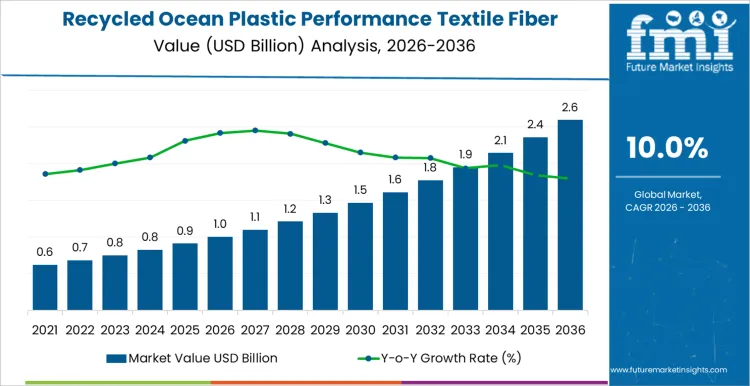
USD 1.0 billion in 2026 establishes the opening scale of the recycled ocean plastic performance textile fiber market, with the total projected to reach USD 2.6 billion by 2036 at a 10.0% CAGR. Demand is anchored in procurement policies that require verified marine waste sourcing and documented material traceability. Product teams define acceptable feedstock classes, mechanical performance thresholds, and certification scope during platform planning. Once a fabric family receives approval, later changes require renewed chain of custody review and performance confirmation. Volume growth follows expansion of branded programs that link environmental claims to audited material systems across apparel, footwear, and accessories.
Specification control shapes participation in the recycled ocean plastic performance textile fiber market through approved material lists, audit schedules, and claim governance rules maintained by brand organizations. Entry depends on evidence covering source verification, processing integrity, and consistency of delivered properties. Product families remain in service across multiple seasons because labeling permissions and disclosure obligations attach to specific constructions. Supplier rotation occurs during portfolio resets rather than routine sourcing cycles. Revenue development reflects the number of collections built on certified marine sourced content. Competitive position depends on early inclusion in design roadmaps and sustained acceptance within controlled material governance frameworks.
Recycled Ocean Plastic Performance Textile Fiber Market Quick Stats
- Recycled Ocean Plastic Performance Textile Fiber Market Value (2026): USD 1.0 billion
- Recycled Ocean Plastic Performance Textile Fiber Market Forecast Value (2036): USD 2.6 billion
- Recycled Ocean Plastic Performance Textile Fiber Market Forecast CAGR (2026-2036): 10.0%
- Leading Polymer Type in Recycled Ocean Plastic Performance Textile Fiber Market: Recycled polyester
- Key Growth Regions in Recycled Ocean Plastic Performance Textile Fiber Market: China, USA, Germany, South Korea, Japan
- Top Players in Recycled Ocean Plastic Performance Textile Fiber Market: Aquafil (ECONYL), UNIFI (REPREVE Our Ocean), Indorama Ventures, Bureo, Toray Industries, Hyosung, Far Eastern New Century
What is the Growth Forecast for the Recycled Ocean Plastic Performance Textile Fiber Market through 2036?
Material sourcing in this category begins at the waste stream rather than at the polymer plant, which shapes both supply planning and cost structure. Collection routes, sorting yield, and cleaning loss define usable feedstock volumes before any spinning decision takes place. In 2026, the recycled ocean plastic performance textile fiber market stands near USD 1.0 billion, supported by apparel, footwear, and equipment programs that lock recovered content into core specifications. Buyers evaluate this fiber through tensile retention, dye response, contamination risk, and batch consistency rather than through origin story alone. Adoption sits with brand material councils and nominated mills. The path to USD 2.6 billion by 2036 follows a 10.0% growth profile supported by broader platform inclusion and higher recycled content targets per product.
Supply chain design sets the commercial rhythm of the recycled ocean plastic performance textile fiber market. Volumes depend on long term collection agreements, preprocessing capacity, and traceability systems that satisfy audit requirements. Orders follow multi season programs rather than spot demand. Inventory policy favors secured feedstock access and continuity of qualified grades. Cost structure reflects washing, flake preparation, polymer conversion yield, and additional quality screening. Mills focus on run stability and shade consistency, since contamination events carry high rework cost. Annual values move through the mid and upper one billions during the early 2030s as more product families standardize recovered content. The rise to USD 2.6 billion by 2036 comes from wider integration across performance categories, higher usage per garment, and longer contracts that lock this fiber into permanent material specifications.
Recycled Ocean Plastic Performance Textile Fiber Market Key Takeaways
| Metric | Value |
|---|---|
| Market Value (2026) | USD 1.0 billion |
| Forecast Value (2036) | USD 2.6 billion |
| Forecast CAGR (2026-2036) | 10.0% |
How Is the Recycled Ocean Plastic Performance Textile Fiber Market Being Used to Balance Traceability, Processing Stability, and End Use Reliability?
Material streams recovered from marine environments arrive with variability that affects every downstream step. Programs using recycled ocean plastic performance textile fibers therefore begin with sorting discipline, contamination limits, and feedstock conditioning rather than with spinning targets. Pellet cleanliness, moisture control, and melt filtration determine whether extrusion runs remain stable or drift into frequent breaks and pressure alarms. Spinning teams monitor viscosity spread and gel formation because both change filament cohesion and winding behavior. Converters focus on abrasion, pilling tendency, and dye response since surface irregularities appear faster in finished fabrics. Qualification relies on repeatability across campaigns, not on peak property claims. A fiber that performs well once but inconsistently later forces conservative settings, higher waste, and longer approval cycles.
Planning around these fibers centers on risk management and documentation continuity instead of raw material substitution. Inventory segregation, batch tracking, and controlled rework loops become part of routine operations because mixed streams break traceability and complicate claims verification. Fabric producers track return rates, shade variation, and mechanical rejects to judge real performance. Finishing plants pay attention to heat history and chemical compatibility since recycled content often reacts differently from virgin inputs. Storage and handling receive more control because contamination or moisture uptake changes process behavior before spinning or knitting. Supplier approval depends on feedstock governance and process control discipline rather than on marketing narratives. Contracts define acceptance bands for variability and correction procedures. Demand grows where proof of origin, stable processing, and predictable service behavior all carry equal weight in customer acceptance and program continuity.
How do supply chain variability and performance risk shape demand in the Recycled Ocean Plastic Performance Textile Fiber Market by feedstock source and polymer type in 2026?
In the Recycled Ocean Plastic Performance Textile Fiber Market, planning starts from feedstock uncertainty rather than from spinning capacity. Collection volumes fluctuate, contamination levels vary, and shipment timing remains irregular. Programs supplying sportswear material platforms, outdoor performance apparel, and technical textile manufacturing must buffer this instability with conservative yield assumptions and wider safety stocks. By feedstock source, use spans post-consumer ocean-bound plastics, fishing nets and gear, marine litter and other sources, and blends with land-based recyclate. By polymer type, output concentrates on recycled polyester, recycled polyamide, and other recycled polymers. Portfolio design reflects risk management, not only mechanical targets or marketing claims.
Why do certain recovery streams dominate fiber input planning?
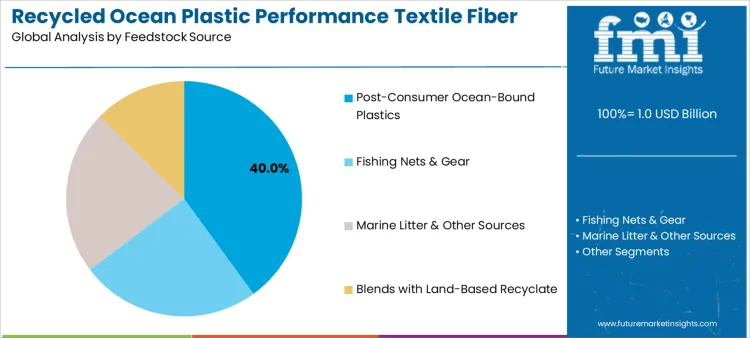
Post-consumer ocean-bound plastics represent about 40% share, driven by predictable bale geometry and more stable sorting outcomes. In sportswear material platforms, this consistency reduces filtration load swings and protects spinneret uptime. Fishing nets and gear provide higher molecular weight input useful for demanding products in outdoor performance apparel, though depolymerization or controlled reprocessing remains necessary. Marine litter and mixed sources introduce irregular shapes, salt load, and foreign polymers, which raise sorting cost and scrap. Blends with land-based recyclate smooth feed variability. Collection teams evaluate streams through moisture, ash, and polymer mix. Operations evaluate them through yield per ton and stoppage frequency.
Once a stream is selected, logistics contracts, prewashing steps, and extrusion screen packs are tuned to that profile. Any change alters residue rates and downtime forecasts. Planning then fixes campaign lengths to match the expected impurity curve. Inventory rules separate bales by origin to avoid cross contamination. Training materials assume the same debris profile during sorting. Procurement aligns multi-year contracts to secure volume. Capacity expansion follows additional lines rather than frequent stream switching. The economic result favors sources that stabilize mass balance, even when headline recovery rates appear similar across collection programs operating in different coastal regions worldwide today.
How do polymer choices follow performance engineering rather than sourcing narratives?
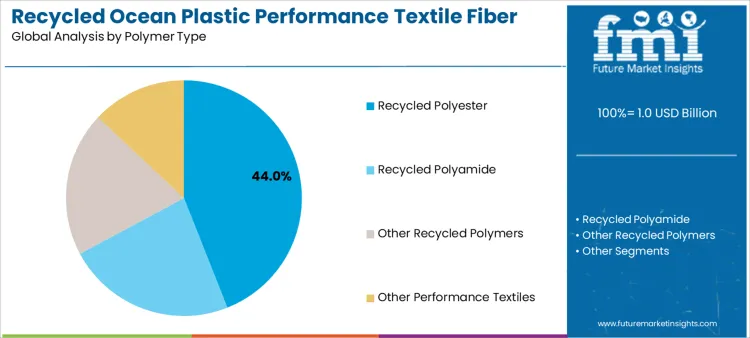
Recycled polyester represents about 44% share, reflecting its compatibility with heat setting, coating, and lamination in technical textile manufacturing. This polymer supports controlled strength retention and shade stability across repeated thermal histories. Recycled polyamide serves applications that prioritize toughness, flex fatigue, and abrasion resistance, with tighter moisture and end-group control. Other recycled polymers remain limited to niche constructions with narrower processing envelopes. Product engineers select polymers through tensile, tear, and abrasion maps. Process engineers select through dyeing response and heat tolerance. Quality teams select through storage stability and lot spread. Polymer choice follows use-case physics more than feedstock origin stories.
Once a polymer family is fixed, draw ratios, finish packages, and test limits assume that behavior. Switching family’s resets qualification matrices and customer documentation. Production planning then assigns stable slots to avoid mixed inventories. Warehousing separates families to prevent labeling errors. Service teams define inspection intervals based on expected aging modes. Sales commits delivery windows using stable yields. Orders expand by adding styles and volumes rather than by changing polymer families. Demand concentrates in platforms where performance risk is already mapped, with recycled polyester anchoring volume programs and recycled polyamide growing only inside tightly defined performance corridors.
Why Are Durable Performance Targets Supporting the Recycled Ocean Plastic Performance Textile Fiber Market?
Recycled Ocean Plastic Performance Textile Fiber Market demand is increasing because performance fabric producers and brands require fiber options that maintain strength, abrasion resistance, and moisture management while meeting material origin criteria. Fibers derived from collected ocean plastics are processed into performance filament or staple forms that can be integrated into activewear, outerwear, and technical textiles. Buyers assess recycled ocean plastic fibers based on consistent tensile properties, color response, and processing behavior on high speed spinning, weaving, and knitting lines. Value for converters lies in material traceability, reduced variability in feedstock quality, and predictable behavior in dyeing and finishing processes that support reliable production schedules.
What Constraints Are Affecting Adoption in the Recycled Ocean Plastic Performance Textile Fiber Market?
Recycled Ocean Plastic Performance Textile Fiber Market growth is affected by production control requirements, feedstock variability, and cost structure differences relative to conventional performance fibers. Ocean sourced plastics must be collected, sorted, cleaned, and processed in ways that remove contaminants while preserving polymer integrity. Variability in input streams can affect melt flow, filament consistency, and mechanical behavior if not controlled. These factors require disciplined quality systems and tighter incoming inspection. Cost variances compared to virgin performance fibers influence purchase decisions, especially in segments with tight price targets. Qualification cycles inside apparel and textile supply chains lengthen because buyers must confirm performance retention after finishing and wash cycles.
How Are Product Lines and Supply Programs Shaping the Recycled Ocean Plastic Performance Textile Fiber Market?
Recycled Ocean Plastic Performance Textile Fiber Market offerings are being structured around defined property profiles, processing recommendations, and application categories to help converters and brands make informed selections. Producers provide data on mechanical performance under load, moisture transport characteristics, and processing behavior in spinning and fabric formation. Portfolio alignment by target end use such as endurance apparel, workwear, or performance knitwear helps buyers reduce trial runs and align fiber choice with production systems. Supply programs increasingly include planned volume commitments, reliable delivery windows, and quality assurance documentation to support production planning. Technical service focuses on mapping performance properties to expected fabric outcomes and supporting consistent integration into established workflows.
What is the Demand for Recycled Ocean Plastic Performance Textile Fiber by Country?
| Country | CAGR (%) |
|---|---|
| USA | 9.7% |
| Japan | 8.5% |
| South Korea | 9.2% |
| Germany | 9.6% |
| China | 11.2% |
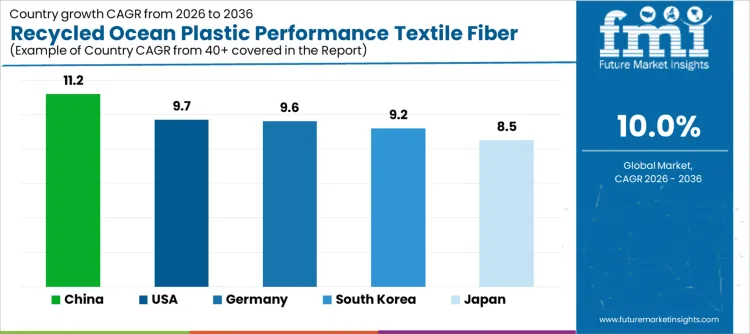
The demand for recycled ocean plastic performance textile fiber is rising across sportswear, outdoor apparel, and footwear segments where material origin, traceability, and performance must align with brand sourcing policies. China leads at 11.2% CAGR, supported by large scale textile and apparel manufacturing and integration of recycled feedstocks into export oriented supply chains. The USA grows at 9.7%, driven by strong adoption in performance apparel and footwear collections. Germany records 9.6%, shaped by technical apparel and outdoor equipment producers. South Korea advances at 9.2%, reflecting steady use in functional sportswear. Japan posts 8.5%, within a mature but quality focused performance textile market emphasizing material consistency and verified sourcing.
How Do Chain-of-Custody Controls and Performance Guarantees Shape Adoption in the Recycled Ocean Plastic Performance Textile Fiber Market in the USA?
Chain-of-custody governance is defining operating practice in the recycled ocean plastic performance textile fiber market in the United States, where expansion aligns with a 9.7% CAGR. Material entry requires verified traceability from collection through polymer conversion and proof that mechanical performance meets defined service criteria. Engineering teams review tensile retention, fatigue response, moisture behavior, and color stability after finishing. Qualification packages link environmental claims to test results and remain attached to the same fiber grade across programs. Substitution becomes rare because downstream certifications reference the same files. Volume increases when performance apparel, outdoor equipment, and protective textile programs extend ranges. Change authority remains centralized. Supplier access depends on audit outcomes and documentation depth. Production planning follows contracted program volumes. Commercial success depends on specification ownership and consistent lot behavior across multiple mills.
How Do Documentation Risk Controls Influence Material Choice in the Recycled Ocean Plastic Performance Textile Fiber Market in Japan?
Documentation risk management is steering the recycled ocean plastic performance textile fiber market in Japan along a path consistent with an 8.5% CAGR. Fiber selection is treated as a controlled variable because traceability gaps can invalidate downstream approvals. Any proposal for change enters a validation sequence covering origin verification, melt filtration stability, and yarn property retention. Engineers examine strength consistency, abrasion response, dye uptake, and processing tolerance. Approval requires evidence from production-scale runs supported by audit-ready records. Once accepted, the same fiber remains embedded in identical constructions for extended operating periods. Requalification is mandatory for deviations. Supplier participation depends on documentation completeness and inspection results. Local sources benefit from proximity to review teams. Volume growth follows measured program extensions rather than replacement cycles.
How Do Program Architecture Standards Drive Scale in the Recycled Ocean Plastic Performance Textile Fiber Market in South Korea?
Program architecture governance explains why the recycled ocean plastic performance textile fiber market in South Korea is advancing in line with a 9.2% CAGR. Development organizations define common material sets that serve several performance textile families. A single fiber decision can affect multiple products without separate site approvals. Technical assessment focuses on mechanical durability, moisture management, color fastness, and compatibility with existing finishing routes. When a grade becomes part of the approved architecture, scale follows through coordinated product introductions. Site-level changes remain limited because the architecture file governs material use. Suppliers secure positions through joint trials and documentation alignment. Output planning tracks synchronized launch schedules. Commercial results depend on early inclusion in architecture definitions and reliable execution during multi-line production ramps.
How Do Group-Wide Audit Systems Govern Access in the Recycled Ocean Plastic Performance Textile Fiber Market in Germany?
Access to production programs in Germany is controlled through group-wide audit systems, guiding the recycled ocean plastic performance textile fiber market in line with a 9.6% CAGR. Individual mills do not introduce new fibers independently. Review panels examine traceability completeness, reproducibility of properties, and compliance with internal performance standards. After approval, the same grade is released for use across several factories under uniform process rules. Volume growth follows program expansion rather than local sourcing initiatives. Supplier standing depends on audit performance and documentation discipline. Change control remains formal and tightly supervised. Capacity planning reflects coordinated group schedules. Commercial success depends on maintaining identical performance and documentation integrity across distributed manufacturing environments over extended operating periods.
How Do Template-Based Line Rollouts Accelerate Adoption in the Recycled Ocean Plastic Performance Textile Fiber Market in China?
Template-based line rollouts explain why the recycled ocean plastic performance textile fiber market in China is advancing in line with an 11.2% CAGR. Once a fiber meets defined traceability and processing stability limits in one facility, it is transferred into parallel operations with minimal redesign. Approval emphasizes consistency, throughput tolerance, and audit readiness. Expansion teams rely on standardized qualification files and commissioning procedures. Domestic suppliers hold an advantage because they can follow rapid capacity additions and site expansions. Imported materials remain concentrated in higher specification uses. Volume increases through repetition of approved constructions across sites. Commercial advantage depends on being present when a template becomes the reference configuration rather than competing for each individual production line.
How Do Suppliers Compete in the Recycled Ocean Plastic Performance Textile Fiber Market?
Traceable sourcing, recycled content verification, and fiber durability determine adoption in the Recycled Ocean Plastic Performance Textile Fiber Market. Aquafil (ECONYL), UNIFI (REPREVE Our Ocean), Indorama Ventures, Bureo, Toray Industries, Hyosung, and Far Eastern New Century compete during pilot spinning, fiber qualification, and industrial textile trials. Once integrated into apparel, technical fabrics, or nonwovens, fiber uniformity, mechanical performance, and compatibility with finishing processes anchor supplier selection. Aquafil emphasizes nylon regeneration from post-consumer and ocean waste. UNIFI delivers polyester fibers produced from reclaimed plastics. Indorama Ventures focuses on industrial-scale recycled fiber supply. Bureo targets sustainable sourcing and circular economy initiatives. Toray Industries and Hyosung supply high-performance fibers for durable applications. Far Eastern New Century offers fibers suitable for functional textiles requiring process stability.
Processing consistency, tensile strength, and performance reliability shape competitive positioning in the Recycled Ocean Plastic Performance Textile Fiber Market. Manufacturers evaluate filament diameter uniformity, elongation, dyeing response, recycled content traceability, and mechanical integrity during validation. Production teams favor suppliers capable of reproducible lots, scalable output, and technical integration support. Aquafil secures adoption through validated recycling programs and fiber performance data. UNIFI gains placements in textile applications emphasizing sustainability and traceable materials. Indorama Ventures competes in large-scale production programs requiring high recycled content. Bureo attracts adoption in niche circular economy initiatives. Toray Industries and Hyosung maintain share in high-performance apparel and industrial applications. Far Eastern New Century supports functional and durable textile programs. Market positions vary by fiber polymer type, recycled content percentage, end-use application, production scale, and regional sustainability standards.
Key Players in the Recycled Ocean Plastic Performance Textile Fiber Market
- Aquafil S.p.A. (ECONYL)
- UNIFI, Inc. (REPREVE Our Ocean)
- Indorama Ventures Public Company Limited
- Bureo, Inc.
- Toray Industries, Inc.
- Hyosung Corporation
- Far Eastern New Century Corporation
Scope of the Report
| Items | Values |
|---|---|
| Quantitative Units (2026) | USD billion |
| Feedstock Source | Post-consumer ocean-bound plastics, fishing nets and gear, marine litter and other sources, blends with land-based recyclate |
| Polymer Type | Recycled polyester, recycled polyamide, other recycled polymers |
| End Use | Sportswear and outdoor apparel, footwear and accessories, home and interior textiles, other performance textiles |
| Certification and Program | Brand and NGO partnership programs, third-party certified programs (ocean-bound, GRS), private and proprietary programs |
| Regions Covered | Asia Pacific, Europe, North America, Latin America, Middle East & Africa |
| Countries Covered | United States, Canada, Mexico, Germany, United Kingdom, France, Italy, Spain, Nordics, BENELUX, China, Japan, South Korea, India, Australia & New Zealand, ASEAN, Brazil, Chile, Saudi Arabia, Turkey, South Africa, and other regional markets |
| Key Companies Profiled | Aquafil (ECONYL), UNIFI (REPREVE Our Ocean), Indorama Ventures, Bureo, Toray Industries, Hyosung, Far Eastern New Century |
| Additional Attributes | Dollar sales by feedstock source, polymer type, end use, and certification program, chain-of-custody and traceability systems, feedstock sorting and contamination control, polymer conversion yield and filtration load, processing stability and shade consistency, qualification and reapproval cycles tied to audited material claims, batch segregation and inventory traceability, performance retention after finishing and use, and regional demand patterns driven by sportswear, outdoor apparel, footwear, and performance textile programs |
Recycled Ocean Plastic Performance Textile Fiber Market Segmentation
Feedstock Source:
- Post-Consumer Ocean-Bound Plastics
- Fishing Nets & Gear
- Marine Litter & Other Sources
- Blends with Land-Based Recyclate
Polymer Type:
- Recycled Polyester
- Recycled Polyamide
- Other Recycled Polymers
End Use:
- Sportswear & Outdoor Apparel
- Footwear & Accessories
- Home & Interior Textiles
- Other Performance Textiles
Certification and Program:
- Brand and NGO Partnership Programs
- Third-Party Certified (Ocean-Bound, GRS)
- Private/Proprietary Programs
Region
- Asia Pacific
- China
- Japan
- South Korea
- India
- Australia & New Zealand
- ASEAN
- Rest of Asia Pacific
- Europe
- Germany
- United Kingdom
- France
- Italy
- Spain
- Nordic
- BENELUX
- Rest of Europe
- North America
- United States
- Canada
- Mexico
- Latin America
- Brazil
- Chile
- Rest of Latin America
- Middle East & Africa
- Kingdom of Saudi Arabia
- Other GCC Countries
- Turkey
- South Africa
- Other African Union
- Rest of Middle East & Africa
Bibliography
- International Organization for Standardization. (2023). ISO 5157:2023 textiles — Environmental aspects — Vocabulary. ISO.
- Brown, A., & Börkey, P. (2024). Plastics recycled content requirements (OECD Environment Working Papers No. 236). OECD Publishing.
- Organisation for Economic Co-operation and Development. (2024). Global plastics outlook: Policy scenarios to 2060. OECD Publishing.
- European Commission. (2025). Packaging and packaging waste regulation (PPWR): Overview and implementation framework. Directorate-General for Environment.
Frequently Asked Questions
How big is the recycled ocean plastic performance textile fiber market in 2026?
The recycled ocean plastic performance textile fiber market is estimated to reach USD 1.0 billion in 2026.
What will be the size of the recycled ocean plastic performance textile fiber market in 2036?
The recycled ocean plastic performance textile fiber market is projected to attain a value of USD 2.6 billion by 2036.
How fast will demand for recycled ocean plastic performance textile fiber grow between 2026 and 2036?
Demand for recycled ocean plastic performance textile fiber is forecast to expand at a 10.0% CAGR between 2026 and 2036.
Which polymer type holds a leading share in the recycled ocean plastic performance textile fiber market in 2026?
Recycled polyester is expected to account for about a 44% share in 2026.
Which feedstock source contributes a major share in the recycled ocean plastic performance textile fiber market in 2026?
Post-consumer ocean-bound plastics are projected to represent about 40% of total feedstock input in 2026.
Preview the report firsthand - request a free sample
Get SampleGet the brochure for pricing and purchase details.
Get PDFTable of Content
- Executive Summary
- Global Market Outlook
- Demand-side Trends
- Supply-side Trends
- Technology Roadmap Analysis
- Analysis and Recommendations
- Market Overview
- Market Coverage / Taxonomy
- Market Definition / Scope / Limitations
- Market Background
- Market Dynamics
- Drivers
- Restraints
- Opportunity
- Trends
- Scenario Forecast
- Demand in Optimistic Scenario
- Demand in Likely Scenario
- Demand in Conservative Scenario
- Opportunity Map Analysis
- Product Life Cycle Analysis
- Supply Chain Analysis
- Investment Feasibility Matrix
- Value Chain Analysis
- PESTLE and Porter’s Analysis
- Regulatory Landscape
- Regional Parent Market Outlook
- Production and Consumption Statistics
- Import and Export Statistics
- Market Dynamics
- Global Market Analysis 2021 to 2025 and Forecast, 2026 to 2036
- Historical Market Size Value (USD Million) Analysis, 2021 to 2025
- Current and Future Market Size Value (USD Million) Projections, 2026 to 2036
- Y-o-Y Growth Trend Analysis
- Absolute $ Opportunity Analysis
- Global Market Pricing Analysis 2021 to 2025 and Forecast 2026 to 2036
- Global Market Analysis 2021 to 2025 and Forecast 2026 to 2036, By Feedstock Source
- Introduction / Key Findings
- Historical Market Size Value (USD Million) Analysis By Feedstock Source , 2021 to 2025
- Current and Future Market Size Value (USD Million) Analysis and Forecast By Feedstock Source , 2026 to 2036
- Post-Consumer Ocean-Bound Plastics
- Fishing Nets & Gear
- Marine Litter & Other Sources
- Blends with Land-Based Recyclate
- Post-Consumer Ocean-Bound Plastics
- Y-o-Y Growth Trend Analysis By Feedstock Source , 2021 to 2025
- Absolute $ Opportunity Analysis By Feedstock Source , 2026 to 2036
- Global Market Analysis 2021 to 2025 and Forecast 2026 to 2036, By Polymer Type
- Introduction / Key Findings
- Historical Market Size Value (USD Million) Analysis By Polymer Type, 2021 to 2025
- Current and Future Market Size Value (USD Million) Analysis and Forecast By Polymer Type, 2026 to 2036
- Recycled Polyester
- Recycled Polyamide
- Other Recycled Polymers
- Other Performance Textiles
- Recycled Polyester
- Y-o-Y Growth Trend Analysis By Polymer Type, 2021 to 2025
- Absolute $ Opportunity Analysis By Polymer Type, 2026 to 2036
- Global Market Analysis 2021 to 2025 and Forecast 2026 to 2036, By End Use
- Introduction / Key Findings
- Historical Market Size Value (USD Million) Analysis By End Use, 2021 to 2025
- Current and Future Market Size Value (USD Million) Analysis and Forecast By End Use, 2026 to 2036
- Sportswear & Outdoor Apparel
- Footwear & Accessories
- Home & Interior Textiles
- Sportswear & Outdoor Apparel
- Y-o-Y Growth Trend Analysis By End Use, 2021 to 2025
- Absolute $ Opportunity Analysis By End Use, 2026 to 2036
- Global Market Analysis 2021 to 2025 and Forecast 2026 to 2036, By Certification/Program
- Introduction / Key Findings
- Historical Market Size Value (USD Million) Analysis By Certification/Program, 2021 to 2025
- Current and Future Market Size Value (USD Million) Analysis and Forecast By Certification/Program, 2026 to 2036
- Brand/NGO Partnership Programs
- Third-Party Certified (Ocean-Bound, GRS)
- Private/Proprietary Programs
- Brand/NGO Partnership Programs
- Y-o-Y Growth Trend Analysis By Certification/Program, 2021 to 2025
- Absolute $ Opportunity Analysis By Certification/Program, 2026 to 2036
- Global Market Analysis 2021 to 2025 and Forecast 2026 to 2036, By Region
- Introduction
- Historical Market Size Value (USD Million) Analysis By Region, 2021 to 2025
- Current Market Size Value (USD Million) Analysis and Forecast By Region, 2026 to 2036
- North America
- Latin America
- Western Europe
- Eastern Europe
- East Asia
- South Asia and Pacific
- Middle East & Africa
- Market Attractiveness Analysis By Region
- North America Market Analysis 2021 to 2025 and Forecast 2026 to 2036, By Country
- Historical Market Size Value (USD Million) Trend Analysis By Market Taxonomy, 2021 to 2025
- Market Size Value (USD Million) Forecast By Market Taxonomy, 2026 to 2036
- By Country
- USA
- Canada
- Mexico
- By Feedstock Source
- By Polymer Type
- By End Use
- By Certification/Program
- By Country
- Market Attractiveness Analysis
- By Country
- By Feedstock Source
- By Polymer Type
- By End Use
- By Certification/Program
- Key Takeaways
- Latin America Market Analysis 2021 to 2025 and Forecast 2026 to 2036, By Country
- Historical Market Size Value (USD Million) Trend Analysis By Market Taxonomy, 2021 to 2025
- Market Size Value (USD Million) Forecast By Market Taxonomy, 2026 to 2036
- By Country
- Brazil
- Chile
- Rest of Latin America
- By Feedstock Source
- By Polymer Type
- By End Use
- By Certification/Program
- By Country
- Market Attractiveness Analysis
- By Country
- By Feedstock Source
- By Polymer Type
- By End Use
- By Certification/Program
- Key Takeaways
- Western Europe Market Analysis 2021 to 2025 and Forecast 2026 to 2036, By Country
- Historical Market Size Value (USD Million) Trend Analysis By Market Taxonomy, 2021 to 2025
- Market Size Value (USD Million) Forecast By Market Taxonomy, 2026 to 2036
- By Country
- Germany
- UK
- Italy
- Spain
- France
- Nordic
- BENELUX
- Rest of Western Europe
- By Feedstock Source
- By Polymer Type
- By End Use
- By Certification/Program
- By Country
- Market Attractiveness Analysis
- By Country
- By Feedstock Source
- By Polymer Type
- By End Use
- By Certification/Program
- Key Takeaways
- Eastern Europe Market Analysis 2021 to 2025 and Forecast 2026 to 2036, By Country
- Historical Market Size Value (USD Million) Trend Analysis By Market Taxonomy, 2021 to 2025
- Market Size Value (USD Million) Forecast By Market Taxonomy, 2026 to 2036
- By Country
- Russia
- Poland
- Hungary
- Balkan & Baltic
- Rest of Eastern Europe
- By Feedstock Source
- By Polymer Type
- By End Use
- By Certification/Program
- By Country
- Market Attractiveness Analysis
- By Country
- By Feedstock Source
- By Polymer Type
- By End Use
- By Certification/Program
- Key Takeaways
- East Asia Market Analysis 2021 to 2025 and Forecast 2026 to 2036, By Country
- Historical Market Size Value (USD Million) Trend Analysis By Market Taxonomy, 2021 to 2025
- Market Size Value (USD Million) Forecast By Market Taxonomy, 2026 to 2036
- By Country
- China
- Japan
- South Korea
- By Feedstock Source
- By Polymer Type
- By End Use
- By Certification/Program
- By Country
- Market Attractiveness Analysis
- By Country
- By Feedstock Source
- By Polymer Type
- By End Use
- By Certification/Program
- Key Takeaways
- South Asia and Pacific Market Analysis 2021 to 2025 and Forecast 2026 to 2036, By Country
- Historical Market Size Value (USD Million) Trend Analysis By Market Taxonomy, 2021 to 2025
- Market Size Value (USD Million) Forecast By Market Taxonomy, 2026 to 2036
- By Country
- India
- ASEAN
- Australia & New Zealand
- Rest of South Asia and Pacific
- By Feedstock Source
- By Polymer Type
- By End Use
- By Certification/Program
- By Country
- Market Attractiveness Analysis
- By Country
- By Feedstock Source
- By Polymer Type
- By End Use
- By Certification/Program
- Key Takeaways
- Middle East & Africa Market Analysis 2021 to 2025 and Forecast 2026 to 2036, By Country
- Historical Market Size Value (USD Million) Trend Analysis By Market Taxonomy, 2021 to 2025
- Market Size Value (USD Million) Forecast By Market Taxonomy, 2026 to 2036
- By Country
- Kingdom of Saudi Arabia
- Other GCC Countries
- Turkiye
- South Africa
- Other African Union
- Rest of Middle East & Africa
- By Feedstock Source
- By Polymer Type
- By End Use
- By Certification/Program
- By Country
- Market Attractiveness Analysis
- By Country
- By Feedstock Source
- By Polymer Type
- By End Use
- By Certification/Program
- Key Takeaways
- Key Countries Market Analysis
- USA
- Pricing Analysis
- Market Share Analysis, 2025
- By Feedstock Source
- By Polymer Type
- By End Use
- By Certification/Program
- Canada
- Pricing Analysis
- Market Share Analysis, 2025
- By Feedstock Source
- By Polymer Type
- By End Use
- By Certification/Program
- Mexico
- Pricing Analysis
- Market Share Analysis, 2025
- By Feedstock Source
- By Polymer Type
- By End Use
- By Certification/Program
- Brazil
- Pricing Analysis
- Market Share Analysis, 2025
- By Feedstock Source
- By Polymer Type
- By End Use
- By Certification/Program
- Chile
- Pricing Analysis
- Market Share Analysis, 2025
- By Feedstock Source
- By Polymer Type
- By End Use
- By Certification/Program
- Germany
- Pricing Analysis
- Market Share Analysis, 2025
- By Feedstock Source
- By Polymer Type
- By End Use
- By Certification/Program
- UK
- Pricing Analysis
- Market Share Analysis, 2025
- By Feedstock Source
- By Polymer Type
- By End Use
- By Certification/Program
- Italy
- Pricing Analysis
- Market Share Analysis, 2025
- By Feedstock Source
- By Polymer Type
- By End Use
- By Certification/Program
- Spain
- Pricing Analysis
- Market Share Analysis, 2025
- By Feedstock Source
- By Polymer Type
- By End Use
- By Certification/Program
- France
- Pricing Analysis
- Market Share Analysis, 2025
- By Feedstock Source
- By Polymer Type
- By End Use
- By Certification/Program
- India
- Pricing Analysis
- Market Share Analysis, 2025
- By Feedstock Source
- By Polymer Type
- By End Use
- By Certification/Program
- ASEAN
- Pricing Analysis
- Market Share Analysis, 2025
- By Feedstock Source
- By Polymer Type
- By End Use
- By Certification/Program
- Australia & New Zealand
- Pricing Analysis
- Market Share Analysis, 2025
- By Feedstock Source
- By Polymer Type
- By End Use
- By Certification/Program
- China
- Pricing Analysis
- Market Share Analysis, 2025
- By Feedstock Source
- By Polymer Type
- By End Use
- By Certification/Program
- Japan
- Pricing Analysis
- Market Share Analysis, 2025
- By Feedstock Source
- By Polymer Type
- By End Use
- By Certification/Program
- South Korea
- Pricing Analysis
- Market Share Analysis, 2025
- By Feedstock Source
- By Polymer Type
- By End Use
- By Certification/Program
- Russia
- Pricing Analysis
- Market Share Analysis, 2025
- By Feedstock Source
- By Polymer Type
- By End Use
- By Certification/Program
- Poland
- Pricing Analysis
- Market Share Analysis, 2025
- By Feedstock Source
- By Polymer Type
- By End Use
- By Certification/Program
- Hungary
- Pricing Analysis
- Market Share Analysis, 2025
- By Feedstock Source
- By Polymer Type
- By End Use
- By Certification/Program
- Kingdom of Saudi Arabia
- Pricing Analysis
- Market Share Analysis, 2025
- By Feedstock Source
- By Polymer Type
- By End Use
- By Certification/Program
- Turkiye
- Pricing Analysis
- Market Share Analysis, 2025
- By Feedstock Source
- By Polymer Type
- By End Use
- By Certification/Program
- South Africa
- Pricing Analysis
- Market Share Analysis, 2025
- By Feedstock Source
- By Polymer Type
- By End Use
- By Certification/Program
- USA
- Market Structure Analysis
- Competition Dashboard
- Competition Benchmarking
- Market Share Analysis of Top Players
- By Regional
- By Feedstock Source
- By Polymer Type
- By End Use
- By Certification/Program
- Competition Analysis
- Competition Deep Dive
- Aquafil (ECONYL)
- Overview
- Product Portfolio
- Profitability by Market Segments (Product/Age /Sales Channel/Region)
- Sales Footprint
- Strategy Overview
- Marketing Strategy
- Product Strategy
- Channel Strategy
- Unifi (REPREVE Our Ocean)
- Indorama Ventures
- Bureo
- Parley for the Oceans (brand collabs)
- Toray Industries
- Hyosung (regen ocean yarns)
- Seaqual Initiative
- Far Eastern New Century
- Svenska Cellulosa (via partners)
- Aquafil (ECONYL)
- Competition Deep Dive
- Assumptions & Acronyms Used
- Research Methodology


