

- Market Size (2026)
- USD 1.6 Bn
- Forecast (2036)
- USD 3.2 Bn
- CAGR (2026 to 2036)
- 7.2%
Recyclability-Optimized Impact Modifiers for Polyolefins Market Size, Forecast, and Outlook By FMI
Summary of the Recyclability-Optimized Impact Modifiers for Polyolefins Market
- Demand and Growth Drivers
- Packaging converters use polypropylene packaging films and mono-material PE structures to meet design rules without losing drop strength.
- Automotive compounders add POE and compatibilizer packages to restore recycled PP impact performance after repeated heating.
- Recyclers prefer lower-dose systems as APR guidance favors limited additive use for future recycled PP value.
- Product and Segment View
- Polypropylene is anticipated to represent 48.0% of polymer base demand in 2026 due to rigid packs and vehicle parts needing impact recovery.
- Rigid packaging is projected to hold 36.0% of application demand in 2026, driven by caps and containers facing drop tests.
- Direct technical supply is expected to secure 46.0% of channel demand in 2026 since converters depend on grade matching before trials.
- Geography and Competitive Outlook
- China is projected to record 8.6% CAGR through 2036 as local packaging conversion and vehicle output support recycled PP grades.
- India is expected to expand at 8.3% CAGR through 2036 as EPR rules push recycled plastic use in consumer packaging.
- Key players such as Dow and ExxonMobil are focusing on POE modifier depth across PP and PE systems.
- Analyst Opinion
- Nikhil Kaitwade, Principal Analyst for Chemicals and Materials at FMI, opines, “The sector is moving into a material approval role for recyclable polyolefin design. Converters now assess impact strength together with sorting behavior and recycled-content targets. Impact modifiers must improve drop resistance without weakening recycler design checks. Regulatory pressure is coming from PPWR rules in Europe and EPR programs across North America and Asia. Suppliers can gain ground through low-dose performance and repeat proof across recycled PP lots. Clients should track mono-material packaging trials and automotive recycled PP approvals through 2036.”
- Recyclability-Optimized Impact Modifiers for Polyolefins Market Value Analysis
- Material approval needs are turning recyclability-optimized impact modifiers into a defined input for polyolefin packaging and molded plastic design.
- Packaging converters are adopting these modifiers to protect drop strength while keeping mono-material structures easier to sort.
- Recycled PP and PE compounders use modifier packages to improve toughness across mixed-quality resin streams.
- Brand-owner recyclability targets support demand for additives that balance durability with cleaner end-of-life handling.
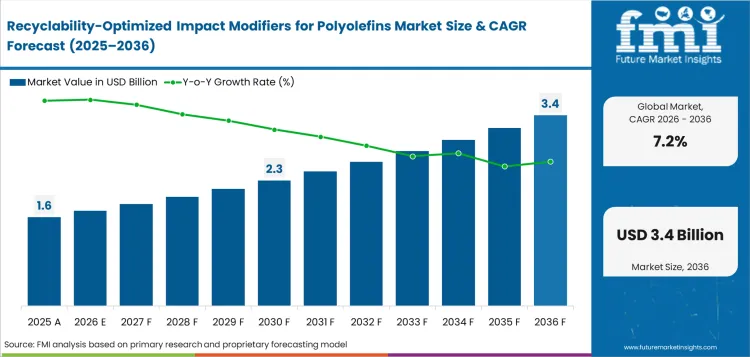
Key Takeaways, Market Size, and Forecast
- The recyclability-optimized impact modifiers for polyolefins sector stood at USD 1.5 billion in 2025 after back-calculation from the 2026 base.
- Industry value is projected to reach USD 3.2 billion by 2036 as packaging converters shift toward mono-material PE and PP structures.
- The sector is expected to expand at 7.2% CAGR from 2026 to 2036 across packaging and recycled compound applications.
- The sector is projected to create an incremental opportunity of USD 1.6 billion between 2026 and 2036.
- Mechanical recycling is expected to account for 64.0% share in 2026 as recyclers need modifiers able to protect recycled PP toughness.
- China at 8.6% CAGR and India at 8.3% CAGR are expected to record the fastest pace through 2036.
Recyclability-Optimized Impact Modifiers for Polyolefins Market Definition
The sector covers additive packages used to improve impact strength in PE and PP resin systems without reducing recyclability. Included products cover polyolefin elastomers, compatibilizer packages, MA grafts, TPO compounds, rubber modifiers, and stabilized blends. The scope includes modifiers used in packaging, automotive parts, consumer goods, crates, bins, and pipe profiles. Finished molded parts without modifier claims and non-polyolefin impact systems remain outside this study.
Recyclability-Optimized Impact Modifiers for Polyolefins Market Inclusions
The study includes polyolefin elastomers, compatibilizer packages, MA grafts, TPO compounds, rubber modifiers, stabilized blends, PE and PP bases, applications, end users, recycling paths, channels, and global geography. Market scope covers all commercially traded recyclability-optimized impact modifiers for polyolefins categorized by modifier type including polyolefin elastomers and grafted polyolefin modifiers, polyolefin type including polypropylene and polyethylene, applications including packaging and automotive parts, and additive form including pellet additives and masterbatch concentrates. Revenue scope covers 2026 to 2036 across global commercial sales into packaging and automotive uses as well as consumer goods and industrial plastic applications. Key stakeholders include modifier producers, resin producers, recyclers, packaging converters, compounders, automotive part suppliers, brand owners, testing labs, distributors, and regulatory bodies.
Recyclability-Optimized Impact Modifiers for Polyolefins Market Exclusions
The study excludes PVC impact modifiers, ABS modifiers, PET tougheners, epoxy modifiers, non-recyclable rubber blends, finished packaging, resin without modifier claims, and general antioxidants sold without impact claims.
Recyclability-Optimized Impact Modifiers for Polyolefins Market Research Methodology
- Primary Research: FMI analysts reviewed additive makers with packaging converters using PE and PP impact modifiers. Interviews focused on drop strength and design-for-recycling checks.
- Desk Research: The desk review used recycler design guidance with vehicle output data and company product pages. Sources helped define the addressable pool for recyclable PE and PP modifier use.
- Market Sizing and Forecasting: Forecast work combined recycled polyolefin compound demand with additive dose bands and application use rates. Country curves reflected vehicle output and recycler approval speed.
- Data Validation: Segment shares were checked against product claims, resin base usage, and channel behavior. Country growth rates were compared with packaging policy and compounder capacity signals before finalisation.
Why is the Recyclability-Optimized Impact Modifiers for Polyolefins Market Growing?
- EU packaging rules are making recyclability a design condition for plastic packs sold under the 2030 packaging target.
- APR PP guidance supports low-dose additive choices as it says additive use should be minimized to protect recycled material performance.
- Automotive compounders need recycled PP grades with stable toughness for TPO bumpers and door panels.
- Packaging converters are using recyclable PE and PP structures to keep drop strength as recycled content targets rise.
Policy is moving recyclability from an after-use claim into an input choice during pack design. The European Commission states PPWR entered into force on 11 February 2025 and will generally apply from 12 August 2026. The same source states all packaging on the EU market should be recyclable in an economically viable way by 2030. This date makes modifier selection part of compliance planning for PE and PP packaging. Low-dose grades gain preference as converters avoid additives which weaken future recycling options. Suppliers able to document design-guide alignment can defend early trials through 2036.
Recycled polyolefin compounds need tougher blends after sorting and heat exposure reduce part performance. OICA reported global vehicle production of 96.4 million units in 2025 after 92.7 million units in 2024. Such a vehicle output base influences demand for TPO bumper and interior part programs using recycled PP. Dow presented ENGAGE™ 11000 POE and FUSABOND™ in June 2024 for circular thermoplastics in vehicle parts. ENGAGE™ 11000 targets TPO applications such as bumpers and door panels. FUSABOND™ supports PP recyclates affected by cross-polymer contamination. Such adoption sustains a positive forecast for additives with proven recyclate support.
Market Segmentation Analysis
- Polyolefin elastomers are anticipated to lead modifier type demand with 34.0% share in 2026.
- Polypropylene leads polymer base demand with an estimated 48.0% share in 2026.
- Rigid packaging leads application demand with an expected 36.0% share in 2026.
- Mechanical recycling is likely to lead recycling path demand with 64.0% share in 2026.
The recyclability-optimized impact modifiers for polyolefins market are segmented by modifier type into polyolefin elastomers, grafted polyolefin modifiers, plastomer modifiers, recycled-content tougheners, reactive compatibilizers, and hybrid modifier packages. By polyolefin type, market is divided into polypropylene, polyethylene, recycled PP blends, recycled PE blends, TPO compounds, and mixed polyolefin streams. Based on application, market is segmented into flexible packaging, rigid packaging, automotive parts, consumer goods, industrial containers, and building products. By end use, market is segmented into packaging converters, compounders, automotive suppliers, resin producers, recyclers, and brand owners. Based on additive form, market is categorized into pellet additives, masterbatch concentrates, grafted resin blends, powder additives, and pre-compounded grades. By sales channel, market is segmented into direct technical supply, compounder supply, distributors, resin producer partnerships, and online B2B channels.
Recyclability-Optimized Impact Modifiers for Polyolefins Market Analysis by Modifier Type
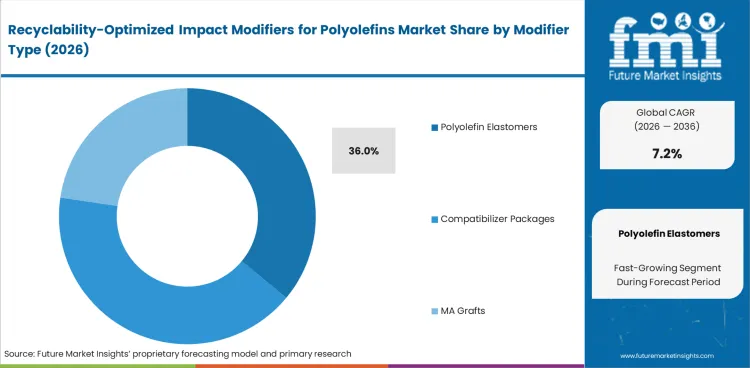
- Polyolefin elastomers are expected to account for 36.0% share in 2026, supported by strong toughness improvement in PP and PE structures without forcing multi-material packaging design.
- Packaging and automotive compounders prefer polyolefin elastomers for drop strength improvement as low-dose use helps protect recycling compatibility during material approval.
Insights into Grafted Polyolefin Modifiers Segment
- Grafted polyolefin modifiers gain use in recycled PP blends needing better bonding between uneven resin streams and mineral-filled compounds.
- Compatibility needs are important for grafted polyolefin modifiers as recycled polyolefin lots often contain mixed polymer traces after sorting and reprocessing.
Recyclability-Optimized Impact Modifiers for Polyolefins Market Analysis by Polyolefin Type
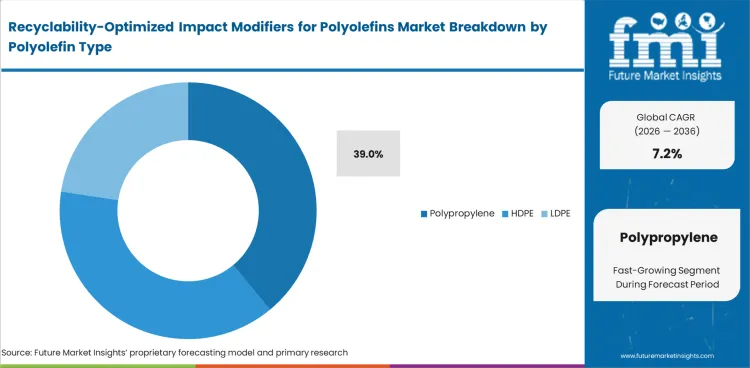
- Polypropylene is projected to represent 39.0% share in 2026 as packaging tubs and automotive parts need higher toughness after recycled content increases.
- Polypropylene remains the main demand base as converters improve growth impact without shifting away from recyclable mono-material design.
Insights into Recycled PP Blends Segment
- Recycled PP blends gain attention in molded parts requiring stable stiffness and better crack resistance after repeated heat exposure.
- Compounders use modifier packages in recycled PP to reduce brittleness across packaging and automotive applications without changing base resin identity.
Recyclability-Optimized Impact Modifiers for Polyolefins Market Analysis by Application
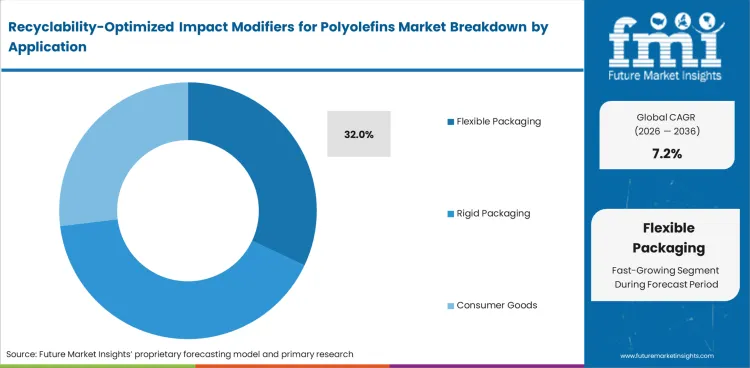
- Flexible packaging is anticipated to represent 32.0% share in 2026, influenced by mono-material PE and PP structures needing puncture resistance during handling.
- Film converters prioritize flexible packaging since impact modifiers help preserve bag strength and sealing performance after recycled content rises.
Insights into Rigid Packaging Segment
- Rigid packaging benefits from impact modifier use in tubs and caps requiring drop resistance during transport and shelf handling.
- Brand owners compare modifier grades against recycling design guidance before approving new rigid packaging structures for food and household products.
Recyclability-Optimized Impact Modifiers for Polyolefins Market Analysis by End Use
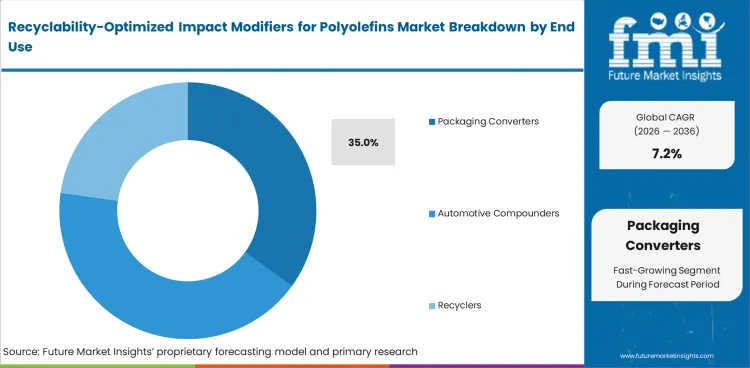
- Packaging converters are projected to secure 35.0% share in 2026, shaped by stronger pressure to meet recyclable design and recycled-content packaging goals.
- Converter demand stays high as modifier choice directly affects drop performance and recycler acceptance during packaging qualification.
Insights into Compounders Segment
- Compounders influence grade selection by adjusting modifier dosage for recycled PP and PE lots with changing melt flow behavior.
- Regional compounders gain orders from converters requiring faster batch correction during recycled-content trials and commercial material changeovers.
Recyclability-Optimized Impact Modifiers for Polyolefins Market Analysis by Additive Form
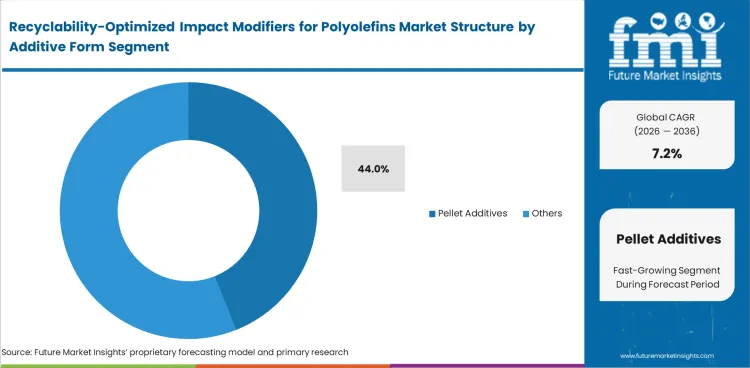
- Pellet additives are expected to make up 44.0% share in 2026, driven by simple feeding and cleaner handling during polyolefin compounding.
- Pellet formats help processors control dosing at scale due to dust reduction and batch consistency being important during recycled resin processing.
Insights into Masterbatch Concentrates Segment
- Masterbatch concentrates serve converters needing easier modifier addition across smaller production batches and customer-specific resin grades.
- Format supports faster trials as processors are able to test impact performance without changing the full compounding setup.
Recyclability-Optimized Impact Modifiers for Polyolefins Market Analysis by Sales Channel
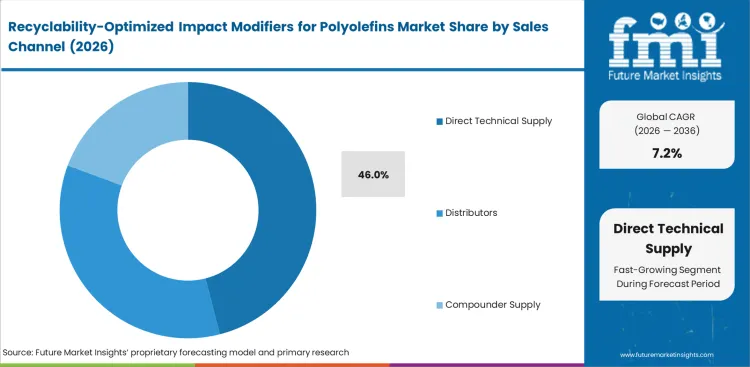
- Direct technical supply is expected to hold 46.0% share in 2026 due to large converters needing recyclability proof and formulation support.
- Direct contracts help modifier suppliers manage approval trials across mono-material packaging and recycled PP automotive programs.
Insights into Compounder Supply Segment
- Compounder supply serves processors purchasing ready-adjusted resin blends, reducing the need for modifier selection at the molding stage.
- Supply type gains adoption among mid-sized converters as compounders can provide pre-tested toughness and recycling-design support in one resin grade.
Recyclability-Optimized Impact Modifiers for Polyolefins Market Drivers, Restraints, and Opportunities
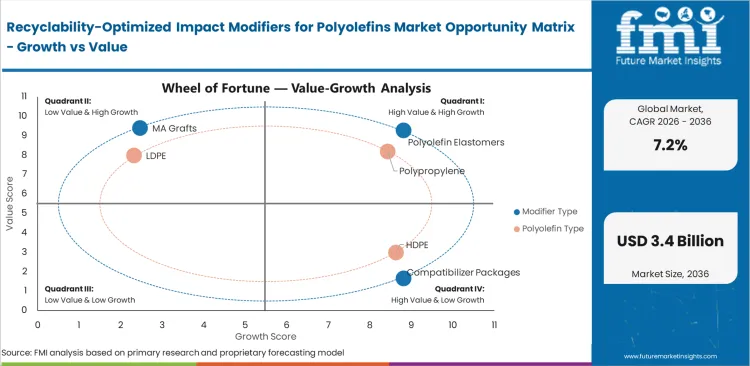
- Design-for-recycling rules are expected to favor low-dose modifiers able to keep PE and PP packaging aligned with mono-material recycling checks.
- Recyclate quality variation will slow approvals as recycled PE and PP lots can shift in melt flow and impact behavior across batches.
- Automotive recycled PP programs are expected to create stronger prospects for POE impact modifiers with part-level proof in bumpers and door panels.
Mono-material pack rules are expected to make modifier choice part of early packaging design instead of a late-stage claim. European Commission states PPWR entered into force on 11 February 2025 and will generally apply from 12 August 2026. It also reports, all packaging on the EU market is required to be recyclable in an economically viable way by 2030. Recyclability screening will influence converters toward POE systems and compatibilizer additives able to improve toughness without disrupting PE and PP recovery routes. Recyclate lot variation are likely to keep qualification slower as BASF IrgaCycle grades address processing and long-term stability in recycled PP and HDPE applications. Automotive use adds another demand path as Dow highlighted ENGAGE™ 11000 POE for TPO bumpers and door panels in June 2024. FUSABOND™ was also positioned for PP recyclates with cross-polymer contamination. Modifier suppliers with trial data across packaging and automotive recycled PP programs should gain stronger approval access through 2036.
Production Capacity and Supplier Footprint Analysis
Production capacity is expected to stay close to resin and compound centers by 2036 as recycled PE and PP grades require fast formulation support. China and the United States contribute to large conversion and automotive supply bases. Europe brings stricter packaging design pressure through PPWR. Plastics Europe reported EU plastics trade balance at -1.6 million tonnes in 2024, indicating higher external supply exposure for plastics materials and products. Supplier footprint is likely to favor modifier makers with application labs near recyclers and compounders influenced by recycled resin users requiring quick proof across impact strength and sorting checks.
Import Dependence and Trade Flow Analysis
Trade flow exposure is anticipated to follow polyolefin resin movement and recycled compound availability through 2036. Europe will require high-value POE and compatibilizer supply as PPWR moves packaging buyers toward recyclable PE and PP structures. Local circular plastics output is improving slowly as Plastics Europe placed circular plastics at 15.4% of European plastics production in 2024. North America has a larger resin supply base, while California SB 54 adds a clear packaging compliance signal for recyclable and compostable formats by 2032. Asian exporters are expected to maintain an important role in modifier and compound availability as packaging conversion capacity expands.
Regional Analysis
.webp "Top Country Growth Comparison Recyclability Optimized Impact Modifiers For Polyolefins Market Cagr (2026 2036)")
| Country | CAGR 2026 to 2036 |
|---|---|
| China | 8.6% |
| India | 8.3% |
| United States | 7.2% |
| Germany | 6.8% |
| South Korea | 6.7% |
| Japan | 6.4% |
| United Kingdom | 6.2% |
Source: Future Market Insights analysis based on primary research and public source checks in 2026.
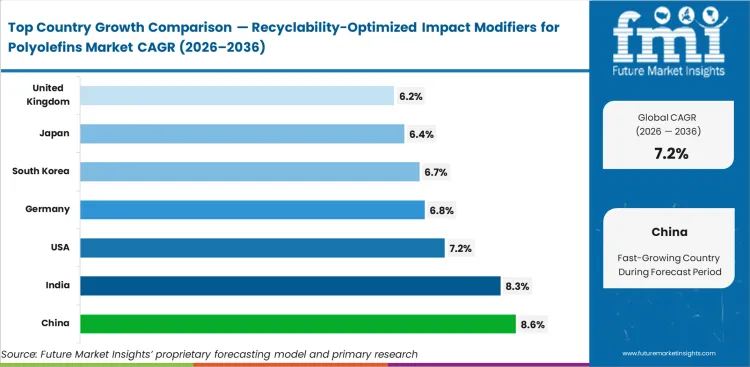
Analysis of Recyclability-Optimized Impact Modifiers for Polyolefins Market by Key Countries
- China is expected to record the fastest pace at 8.6% CAGR by 2036 due to large packaging conversion and recycled PP compounding raise modifier use.
- India is projected to follow at 8.3% CAGR by 2036, reflected by packaged goods output and local plastic conversion favoring larger additive intake.
- United States demand is projected at 7.2% CAGR by 2036 since recyclable packaging trials and automotive recycled PP approvals keep modifier use steady.
- Germany is expected to advance at 6.8% CAGR by 2036, driven by packaging waste rules and stricter compound approval checks.
- South Korea at 6.7% CAGR, Japan at 6.4% CAGR and the United Kingdom at 6.2% CAGR expand by 2036 through mature packaging systems and tighter recycled material checks.
Country growth differs with packaging conversion scale and recyclability regulation. China leads as large PE and PP conversion supports faster modifier intake. India follows as packaged goods output and local compounder activity rise from a smaller base. United States demand advances through recyclable packaging trials and automotive recycled PP approvals. Germany and the United Kingdom grow through packaging waste rules and retailer checks. South Korea and Japan maintain steadier adoption as converters refine impact strength and recycled resin quality.
Demand Outlook for Recyclability-Optimized Impact Modifiers for Polyolefins in China
Demand for recyclability-optimized impact modifiers for polyolefins in China is projected to rise at 8.6% CAGR by 2036 as large packaging conversion and recycled PP compounding increase additive use. Local converters need POE and compatibilizer grades improving toughness without weakening PE and PP recycling paths. China leads the country outlook due to its large plastic conversion base and strong domestic packaging supply.
- Large PE and PP packaging output influences repeat modifier use as pouch and rigid pack producers need stronger structures for transport handling.
- Automotive part suppliers adopt recycled PP compounds in bumpers and interior parts requiring better crack resistance after molding.
- Local compounders gain more opportunity to serve packaging and vehicle part makers needing faster samples and stable additive quality.
Demand Outlook for Recyclability-Optimized Impact Modifiers for Polyolefins in India
The sector in India is expected to expand at 8.3% CAGR by 2036, led by packaged goods output and local plastic conversion increasing modifier demand from a smaller base. Domestic converters need tougher recyclable PE and PP grades without adding complex material layers. India follows China as converter additions and recycled resin use support larger masterbatch and compound consumption.
- Packaged food and household packaging influence modifier demand as local converters shift toward recyclable PE and PP formats.
- Local compounders use compatibilizer systems to improve recycled PP behavior across molded packaging and consumer goods parts.
- Supplier opportunity improves for producers able to offer smaller trial lots and quick support for extrusion and molding lines.
Demand Outlook for Recyclability-Optimized Impact Modifiers for Polyolefins in the United States
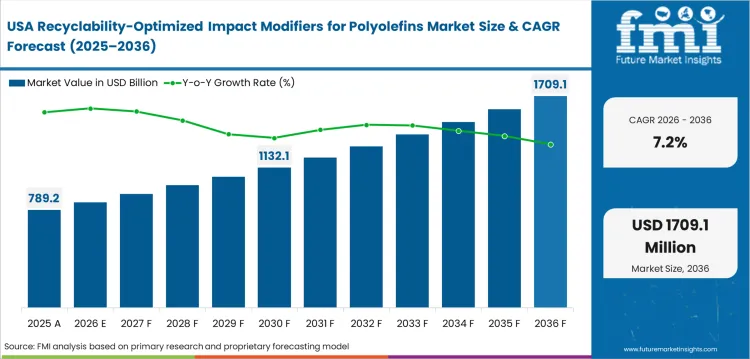
Sales of recyclability-optimized impact modifiers for polyolefins in the United States are projected to increase at 7.2% CAGR by 2036, influenced by recyclable packaging programs and recycled PP automotive approvals. Established converters need modifier systems balancing drop strength with recycler design checks. United States demand remains steady through brand packaging redesign and stronger compliance review in large consumer goods accounts.
- Recyclable PE and PP packaging projects influence demand for modifiers protecting drop strength during filling and shipment.
- Automotive suppliers require impact modifier data across recycled PP compounds used in bumpers and interior molded parts.
- Documentation needs raise supplier value as converters prefer grades backed by recycling guidance and repeat batch proof.
Demand Outlook for Recyclability-Optimized Impact Modifiers for Polyolefins in Germany
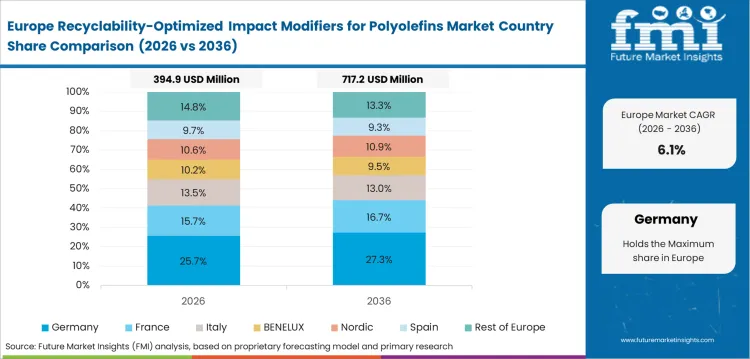
Recyclability-optimized impact modifier demand in Germany is projected to record 6.8% CAGR by 2036 as packaging waste rules and automotive recycled material checks influence additive selection. German converters focus on recyclable PE and PP structures backed by clean technical documentation. Growth is measured as the packaging base is mature and supplier approvals take longer.
- Packaging waste rules support modifiers helping mono-material PE and PP formats retain strength during transport and shelf handling.
- Automotive compounders require repeatable impact performance before recycled PP grades move into approved part programs.
- Local material testing keeps approval timelines strict as converters check sorting behavior and molded part strength before wider use.
Demand Outlook for Recyclability-Optimized Impact Modifiers for Polyolefins in South Korea
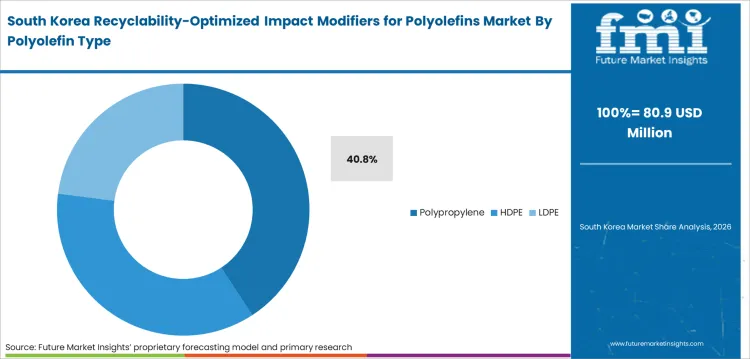
Demand for the sector in South Korea is expected to advance at 6.7% CAGR by 2036 due to export packaging and automotive plastics needing stronger recycled PP performance. Local converters focus on clean material structures and stable part quality during molding. South Korea grows through high-quality packaging and automotive compound work supporting selective modifier use.
- Export packaging programs sustain modifier introduction as converters need recyclable formats able to handle transport stress.
- Automotive plastics suppliers use recycled PP compounds requiring impact recovery for trim parts and TPO applications.
- Local converters favor modifier suppliers able to adjust loading without harming surface finish or recycling acceptance.
Demand Outlook for Recyclability-Optimized Impact Modifiers for Polyolefins in Japan
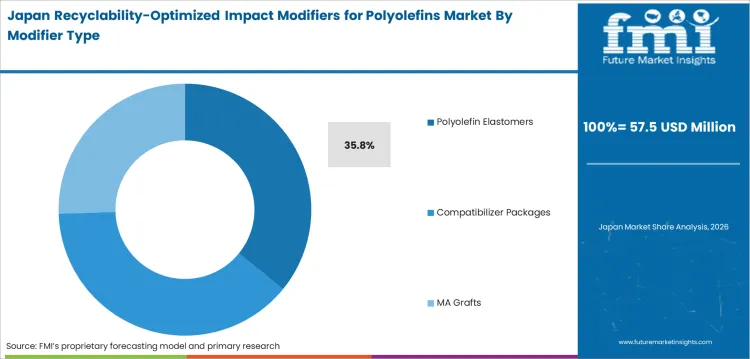
The sector in Japan is expected to post 6.4% CAGR by 2036, led by mature packaging and automotive production maintaining steady additive adoption. Japanese converters focus on reliable impact recovery and clean material behavior across recyclable polyolefin structures. Japan records a steady pace as replacement activity outweighs large new conversion capacity.
- Mature food and consumer packaging demand sustains modifier integration in PE and PP packs requiring better impact strength.
- Compounders in the country prefer additive packages with low odor and stable performance during recycled PP molding.
- Specialty packaging producers use recyclability-optimized modifiers to refine toughness without changing established material structures.
Demand Outlook for Recyclability-Optimized Impact Modifiers for Polyolefins in the United Kingdom
Industry demand in the United Kingdom is forecast to grow at 6.2% CAGR by 2036, reflected by retailer packaging checks and recycled-content goals sustaining consistent modifier adoption. Local converters depend on impact modifier systems supporting recyclable packaging claims and stable pack performance. United Kingdom adoption remains the slowest among listed countries as retailer review shapes material choices in a mature base.
- Retailer packaging checks influence modifier systems with clear documentation and consistent impact performance.
- Food and household packaging converters use modifier masterbatches to reduce cracking in recyclable PE and PP formats.
- Regional distributors serve smaller converters needing quick access to standard grades and shorter technical approval cycles.
Competitive Positioning and Strategic Supplier Strength
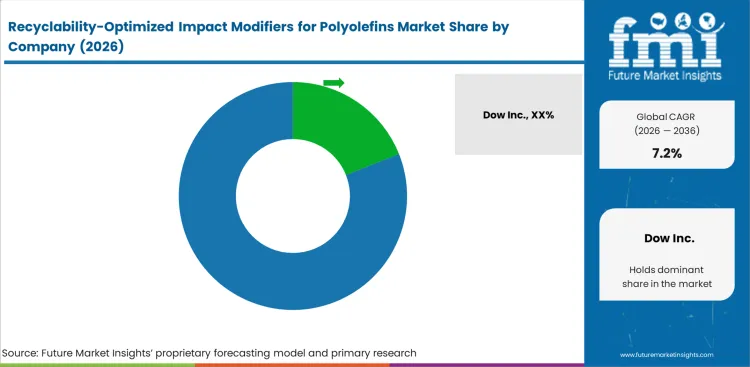
- Dow competes basis on ENGAGE™ POE and FUSABOND™ chemistry for recycled PP and TPO applications.
- ExxonMobil contributes to PE and PP blend performance through Vistamaxx™ and Exact™ polyolefin elastomer grades.
- BASF implements recycled polymer using IrgaCycle™ grades with PP and HDPE recyclates.
- Mitsui Chemicals offers TAFMER™ grades for recycled plastic impact recovery and PP modification.
Competition centers on proof in recycled resin instead of a simple modifier catalogue. Large suppliers can combine modifier chemistry with resin knowledge and application testing. Specialty grades gain access when a converter can cut dose without losing impact strength. BASF highlighted IrgaCycle™ use in recycled PP pellets and car stereo frames in April 2024. Dow linked ENGAGE™ POE and FUSABOND™ to recycled PP performance in June 2024. Application evidence is expected to stay the main supplier screen by 2036.
Key Companies in the Recyclability-Optimized Impact Modifiers for Polyolefins Market
Competition spans resin-integrated producers and additive specialists serving recycled PE and PP applications.
- Polyolefin modifier leaders: Dow and ExxonMobil compete through POE portfolios used in TPO parts and recycled PE or PP blends. Mitsui Chemicals and LG Chem add alpha-olefin copolymer and POE options for impact recovery across packaging and automotive use.
- Circular compound suppliers: LyondellBasell, SABIC, and Borealis compete through PP compounds and circular resin platforms. The group supports converters seeking recycled content grades with reliable stiffness and impact behavior.
- Recycling additive specialists: BASF and Avient support recycled plastic value through stabilizers, colorant systems, and engineered compound help. Such suppliers gain projects through trial support and material data across recycled resin streams.
Competitive Benchmarking: Recyclability-Optimized Impact Modifiers for Polyolefins Market
Company
| Recyclate Toughness Proof | PE PP Compatibility Range | Converter Trial Support | Footprint | |
|---|---|---|---|---|
| Dow | High | High | High | Global |
| ExxonMobil | High | High | High | Global |
| BASF | Moderate | High | Large | Global |
| Mitsui Chemicals | High | Large | Moderate | Global |
| LyondellBasell | Large | Large | Large | Global |
| SABIC | Large | Large | Moderate | Global |
| LG Chem | High | Moderate | Moderate | Asia centered |
| Borealis | Large | Large | Large | Europe centered |
| Avient | Moderate | Large | Large | Global |
Source: Future Market Insights competitive analysis based on public product portfolios and company activity in 2026.
Key Developments in Recyclability-Optimized Impact Modifiers for Polyolefins Market
- In April 2024, BASF showcased IrgaCycle at CHINAPLAS 2024 as an additive package for mechanical recycling and recycled plastic quality improvement.
- In June 2024, Dow presented ENGAGE 11000 POE and FUSABOND for circular thermoplastics used in automotive exterior and interior parts.
- In October 2025, Borealis said Integra Plastics was upgrading recycled polypropylene output with Borcycle M advanced mechanical recycling technology.
Key Players in the Recyclability-Optimized Impact Modifiers for Polyolefins Market
Polyolefin modifier leaders
- Dow Inc.
- ExxonMobil Chemical
- Mitsui Chemicals Inc.
- LG Chem Ltd.
Circular compound suppliers
- LyondellBasell Industries N.V.
- SABIC
- Borealis AG
- Repsol S.A.
Recycling additive specialists
- BASF SE
- Avient Corporation
- DuPont de Nemours Inc.
Report Scope and Coverage
| Item | Value |
|---|---|
| Market value in 2025 | USD 1.5 billion |
| Market value in 2026 | USD 1.6 billion |
| Market value in 2036 | USD 3.2 billion |
| CAGR from 2026 to 2036 | 7.2% |
| Quantitative units | USD billion |
| Market definition | Additives used to improve PE and PP impact strength without reducing recyclability |
| By modifier type | Polyolefin elastomers, compatibilizer packages, MA grafts, TPO compounds, rubber modifiers, stabilized blends |
| By polymer base | Polypropylene, HDPE, LDPE, LLDPE, mixed polyolefins, recycled blends |
| By application | Rigid packaging, flexible films, automotive parts, consumer goods, crates bins, pipes profiles |
| By end user | Packaging converters, automotive compounders, recyclers, brand owners, resin producers, molders |
| By recycling path | Mechanical recycling, chemical recycling, hybrid recycling, closed loop, regrind use |
| By sales channel | Direct technical supply, distributors, compounder supply, online B2B, regional agents |
| Regions covered | North America, Latin America, Europe, East Asia, South Asia and Pacific, Middle East and Africa |
| Countries covered | China, India, United States, Germany, South Korea, Japan, United Kingdom |
| Key companies profiled | Dow, ExxonMobil, BASF, Mitsui Chemicals, LyondellBasell, SABIC, LG Chem, Borealis, Avient |
| Forecast period | 2026 to 2036 |
| Approach | FMI analysis based on recycled polyolefin compound use and public source checks |
Source: Future Market Insights analysis, 2026.
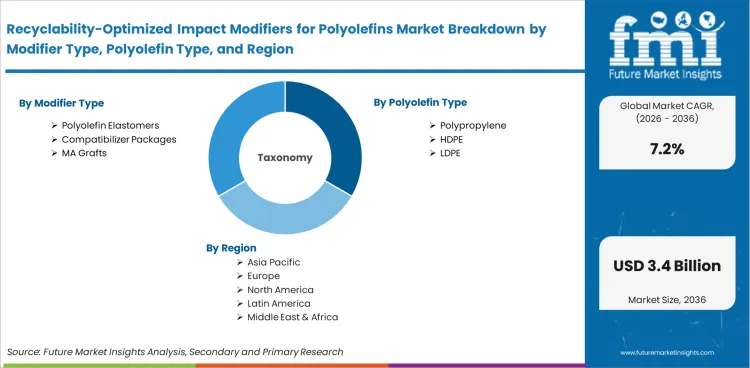
Recyclability-Optimized Impact Modifiers for Polyolefins Market Breakdown By Modifier Type, Polymer Base, Application, End User, Recycling Path, Sales Channel, and Region
Recyclability-Optimized Impact Modifiers for Polyolefins Market Segmented by Modifier Type
- Polyolefin Elastomers
- Compatibilizer Packages
- MA Grafts
- TPO Compounds
- Rubber Modifiers
- Stabilized Blends
Recyclability-Optimized Impact Modifiers for Polyolefins Market Segmented by Polymer Base
- Polypropylene
- HDPE
- LDPE
- LLDPE
- Mixed Polyolefins
- Recycled Blends
Recyclability-Optimized Impact Modifiers for Polyolefins Market Segmented by Application
- Rigid Packaging
- Flexible Films
- Automotive Parts
- Consumer Goods
- Crates Bins
- Pipes Profiles
Recyclability-Optimized Impact Modifiers for Polyolefins Market Segmented by End User
- Packaging Converters
- Automotive Compounders
- Recyclers
- Brand Owners
- Resin Producers
- Molders
Recyclability-Optimized Impact Modifiers for Polyolefins Market Segmented by Recycling Path
- Mechanical Recycling
- Chemical Recycling
- Hybrid Recycling
- Closed Loop
- Regrind Use
Recyclability-Optimized Impact Modifiers for Polyolefins Market Segmented by Sales Channel
- Direct Technical Supply
- Distributors
- Compounder Supply
- Online B2B
- Regional Agents
Recyclability-Optimized Impact Modifiers for Polyolefins Market by Region
- North America
- United States
- Canada
- Mexico
- Latin America
- Brazil
- Chile
- Rest of Latin America
- Western Europe
- Germany
- United Kingdom
- Italy
- Spain
- France
- Nordic
- BENELUX
- Rest of Western Europe
- Eastern Europe
- Poland
- Hungary
- Balkan and Baltic
- Rest of Eastern Europe
- East Asia
- China
- Japan
- South Korea
- South Asia and Pacific
- India
- ASEAN
- Australia and New Zealand
- Rest of South Asia and Pacific
- Middle East and Africa
- Kingdom of Saudi Arabia
- Other GCC Countries
- Turkiye
- South Africa
- Other African Union
- Rest of Middle East and Africa
Research Sources and Bibliography
- Association of Plastic Recyclers. (2024, March 22). PP design guidance.
- BASF. (2024, April 3). BASF to showcase sustainable additive solutions at CHINAPLAS 2024.
- Borealis. (2025, March 13). Rialti introduces PP compounds containing PCR and PIR content at PRSE 2025.
- California Department of Resources Recycling and Recovery. (2025, May 27). Plastic Pollution Prevention and Packaging Producer Responsibility Act: Report to the Legislature.
- Dow. (2024, June 19). Dow to showcase MobilityScience™ solutions for low-carbon mobility at the international VDI congress Plastics in Automotive Engineering.
- European Parliament and Council of the European Union. (2025, January 22). Regulation (EU) 2025/40 of the European Parliament and of the Council of 19 December 2024 on packaging and packaging waste.
- ExxonMobil Product Solutions. (2025, March 5). ExxonMobil Signature Polymers challenges industry to “Bring Your Impossible” at Plástico Brasil 2025.
- International Organization of Motor Vehicle Manufacturers. (2026, April 23). Auto industry growth shifted east in 2025 amid global repositioning.
- Mitsui Chemicals. (2025, September 9). Mitsui Chemicals Group to exhibit at K2025 in Düsseldorf.
- Plastics Europe. (2025, September). Plastics the Fast Facts 2025.
The bibliography is provided for reader reference and direct source checking.
This Report Answers
- How large the recyclability-optimized impact modifiers for polyolefins sector is in 2026 and how far it can rise by 2036?
- Which modifier type and polymer base hold the largest projected share positions in 2026?
- Why polyolefin elastomers and polypropylene hold the clearest lead in current additive structure?
- Why China and India lead the country growth set through 2036?
- How direct technical supply shapes access for large packaging converters and recycled PP compounders?
- Which supplier capabilities help companies defend position in recyclable PE and PP modifier supply?
- What packaging regulation and automotive recycled PP signals support the forecast method used in this study?
Frequently Asked Questions
How large is the recyclability-optimized impact modifiers for polyolefins market in 2026?
The recyclability-optimized impact modifiers for polyolefins market is expected to reach USD 1.6 billion in 2026.
What will the recyclability-optimized impact modifiers for polyolefins market be worth by 2036?
The recyclability-optimized impact modifiers for polyolefins market is forecast to reach USD 3.2 billion by 2036 as mono-material packaging expands.
What CAGR is projected for the recyclability-optimized impact modifiers for polyolefins market from 2026 to 2036?
The recyclability-optimized impact modifiers for polyolefins market is projected to expand at 7.2% CAGR from 2026 to 2036.
Which modifier type leads the recyclability-optimized impact modifiers for polyolefins market?
Polyolefin elastomers are expected to lead the recyclability-optimized impact modifiers for polyolefins market with 34.0% share in 2026.
Which polymer base leads the recyclability-optimized impact modifiers for polyolefins market?
Polypropylene is projected to lead the recyclability-optimized impact modifiers for polyolefins market with 48.0% share in 2026.
Why does China post the fastest recyclability-optimized impact modifiers for polyolefins market rise?
China is expected to record 8.6% CAGR by 2036 as packaging conversion and recycled PP compounding increase modifier use.
Preview the report firsthand - request a free sample
Get SampleGet the brochure for pricing and purchase details.
Get PDFTable of Content
- Key Takeaways
- Market Size and CAGR
- Top Growth Driver
- Fastest Growing Segment
- Leading Region
- Key Companies
- Emerging Opportunities
- Executive Summary
- Global Market Outlook
- Demand-side Trends
- Supply-side Trends
- Technology Roadmap Analysis
- Analysis and Recommendations
- Analyst Perspective (What is happening? Why now? What should investors know?)
- Key Questions Answered
- How large is the market?
- What is the CAGR?
- What are key trends?
- Which region dominates?
- Who are the leaders?
- Market Overview
- Market Coverage / Taxonomy
- Market Definition / Scope / Limitations
- Research Methodology
- Chapter Orientation
- Analytical Lens and Working Hypotheses
- Market Structure, Signals, and Trend Drivers
- Benchmarking and Cross-market Comparability
- Market Sizing, Forecasting, and Opportunity Mapping
- Research Design and Evidence Framework
- Desk Research Programme (Secondary Evidence)
- Expert Input and Fieldwork (Primary Evidence)
- Tooling, Models, and Reference Databases
- Data Engineering and Model Build
- Quality Assurance and Audit Trail
- Market Background
- Market Dynamics (Drivers, Restraints, Opportunity, Trends)
- Scenario Forecast (Optimistic, Likely, Conservative)
- Impact Analysis
- AI Impact
- Sustainability Impact
- Regulatory Impact
- Technology Impact
- Consumer / Buyer Analysis
- Purchase Drivers
- Adoption Barriers
- Buyer Journey
- Opportunity Map Analysis
- Product Life Cycle Analysis
- Supply Chain Analysis
- Investment Feasibility Matrix
- Value Chain Analysis
- PESTLE and Porter's Analysis
- Regulatory Landscape
- Regional Parent Market Outlook
- Production and Consumption Statistics
- Import and Export Statistics
- Global Market Analysis and Forecast, 2021 to 2036
- Historical Market Size Value (USD Billion) & Volume (Unit) Analysis, 2021 to 2025
- Current and Future Market Size Value (USD Billion) & Volume (Unit) Projections, 2026 to 2036
- Y-o-Y Growth Trend Analysis
- Absolute $ Opportunity Analysis
- Global Market Pricing Analysis, 2021 to 2036
- Global Market Analysis and Forecast, By Modifier Type, 2021 to 2036
- Introduction / Key Findings
- Historical Market Size Value (USD Billion) & Volume (Unit) Analysis By Modifier Type, 2021 to 2025
- Current and Future Market Size Value (USD Billion) & Volume (Unit) Analysis and Forecast By Modifier Type, 2026 to 2036
- Polyolefin Elastomers
- Compatibilizer Packages
- MA Grafts
- TPO Compounds
- Rubber Modifiers
- Stabilized Blends
- Polyolefin Elastomers
- Y-o-Y Growth Trend Analysis By Modifier Type, 2021 to 2025
- Absolute $ Opportunity Analysis By Modifier Type, 2026 to 2036
- Global Market Analysis and Forecast, By Polymer Base, 2021 to 2036
- Introduction / Key Findings
- Historical Market Size Value (USD Billion) & Volume (Unit) Analysis By Polymer Base, 2021 to 2025
- Current and Future Market Size Value (USD Billion) & Volume (Unit) Analysis and Forecast By Polymer Base, 2026 to 2036
- Polypropylene
- HDPE
- LDPE
- LLDPE
- Mixed Polyolefins
- Recycled Blends
- Polypropylene
- Y-o-Y Growth Trend Analysis By Polymer Base, 2021 to 2025
- Absolute $ Opportunity Analysis By Polymer Base, 2026 to 2036
- Global Market Analysis and Forecast, By Application, 2021 to 2036
- Introduction / Key Findings
- Historical Market Size Value (USD Billion) & Volume (Unit) Analysis By Application, 2021 to 2025
- Current and Future Market Size Value (USD Billion) & Volume (Unit) Analysis and Forecast By Application, 2026 to 2036
- Rigid Packaging
- Flexible Films
- Automotive Parts
- Consumer Goods
- Crates Bins
- Pipes Profiles
- Rigid Packaging
- Y-o-Y Growth Trend Analysis By Application, 2021 to 2025
- Absolute $ Opportunity Analysis By Application, 2026 to 2036
- Global Market Analysis and Forecast, By End User, 2021 to 2036
- Introduction / Key Findings
- Historical Market Size Value (USD Billion) & Volume (Unit) Analysis By End User, 2021 to 2025
- Current and Future Market Size Value (USD Billion) & Volume (Unit) Analysis and Forecast By End User, 2026 to 2036
- Packaging Converters
- Automotive Compounders
- Recyclers
- Brand Owners
- Resin Producers
- Molders
- Packaging Converters
- Y-o-Y Growth Trend Analysis By End User, 2021 to 2025
- Absolute $ Opportunity Analysis By End User, 2026 to 2036
- Global Market Analysis and Forecast, By Recycling Path, 2021 to 2036
- Introduction / Key Findings
- Historical Market Size Value (USD Billion) & Volume (Unit) Analysis By Recycling Path, 2021 to 2025
- Current and Future Market Size Value (USD Billion) & Volume (Unit) Analysis and Forecast By Recycling Path, 2026 to 2036
- Mechanical Recycling
- Chemical Recycling
- Hybrid Recycling
- Closed Loop
- Regrind Use
- Mechanical Recycling
- Y-o-Y Growth Trend Analysis By Recycling Path, 2021 to 2025
- Absolute $ Opportunity Analysis By Recycling Path, 2026 to 2036
- Global Market Analysis and Forecast, By Sales Channel
- Introduction / Key Findings
- Historical Market Size Value (USD Billion) & Volume (Unit) Analysis By Sales Channel, 2021 to 2025
- Current and Future Market Size Value (USD Billion) & Volume (Unit) Analysis and Forecast By Sales Channel, 2026 to 2036
- Direct Technical Supply
- Distributors
- Compounder Supply
- Online B2B
- Regional Agents
- Direct Technical Supply
- Y-o-Y Growth Trend Analysis By Sales Channel, 2021 to 2025
- Absolute $ Opportunity Analysis By Sales Channel, 2026 to 2036
- Global Market Analysis and Forecast, By Region, 2021 to 2036
- Introduction
- Historical Market Size Value (USD Billion) & Volume (Unit) Analysis By Region, 2021 to 2025
- Current Market Size Value (USD Billion) & Volume (Unit) Analysis and Forecast By Region, 2026 to 2036
- North America
- Latin America
- Western Europe
- Eastern Europe
- East Asia
- South Asia and Pacific
- Middle East & Africa
- Market Attractiveness Analysis By Region
- North America Market Analysis and Forecast, By Country, 2021 to 2036
- Historical Market Size Value (USD Billion) & Volume (Unit) Trend Analysis By Market Taxonomy, 2021 to 2025
- Market Size Value (USD Billion) & Volume (Unit) Forecast By Market Taxonomy, 2026 to 2036
- By Country
- USA
- Canada
- Mexico
- By Modifier Type
- By Polymer Base
- By Application
- By End User
- By Recycling Path
- By Sales Channel
- By Country
- Market Attractiveness Analysis
- By Country
- By Modifier Type
- By Polymer Base
- By Application
- By End User
- By Recycling Path
- By Sales Channel
- Key Takeaways
- Latin America Market Analysis and Forecast, By Country
- Historical Market Size Value (USD Billion) & Volume (Unit) Trend Analysis By Market Taxonomy, 2021 to 2025
- Market Size Value (USD Billion) & Volume (Unit) Forecast By Market Taxonomy, 2026 to 2036
- By Country
- Brazil
- Chile
- Rest of Latin America
- By Modifier Type
- By Polymer Base
- By Application
- By End User
- By Recycling Path
- By Sales Channel
- By Country
- Market Attractiveness Analysis
- By Country
- By Modifier Type
- By Polymer Base
- By Application
- By End User
- By Recycling Path
- By Sales Channel
- Key Takeaways
- Western Europe Market Analysis and Forecast, By Country
- Historical Market Size Value (USD Billion) & Volume (Unit) Trend Analysis By Market Taxonomy, 2021 to 2025
- Market Size Value (USD Billion) & Volume (Unit) Forecast By Market Taxonomy, 2026 to 2036
- By Country
- Germany
- UK
- Italy
- Spain
- France
- Nordic
- BENELUX
- Rest of Western Europe
- By Modifier Type
- By Polymer Base
- By Application
- By End User
- By Recycling Path
- By Sales Channel
- By Country
- Market Attractiveness Analysis
- By Country
- By Modifier Type
- By Polymer Base
- By Application
- By End User
- By Recycling Path
- By Sales Channel
- Key Takeaways
- Eastern Europe Market Analysis and Forecast, By Country
- Historical Market Size Value (USD Billion) & Volume (Unit) Trend Analysis By Market Taxonomy, 2021 to 2025
- Market Size Value (USD Billion) & Volume (Unit) Forecast By Market Taxonomy, 2026 to 2036
- By Country
- Russia
- Poland
- Hungary
- Balkan & Baltic
- Rest of Eastern Europe
- By Modifier Type
- By Polymer Base
- By Application
- By End User
- By Recycling Path
- By Sales Channel
- By Country
- Market Attractiveness Analysis
- By Country
- By Modifier Type
- By Polymer Base
- By Application
- By End User
- By Recycling Path
- By Sales Channel
- Key Takeaways
- East Asia Market Analysis and Forecast, By Country
- Historical Market Size Value (USD Billion) & Volume (Unit) Trend Analysis By Market Taxonomy, 2021 to 2025
- Market Size Value (USD Billion) & Volume (Unit) Forecast By Market Taxonomy, 2026 to 2036
- By Country
- China
- Japan
- South Korea
- By Modifier Type
- By Polymer Base
- By Application
- By End User
- By Recycling Path
- By Sales Channel
- By Country
- Market Attractiveness Analysis
- By Country
- By Modifier Type
- By Polymer Base
- By Application
- By End User
- By Recycling Path
- By Sales Channel
- Key Takeaways
- South Asia and Pacific Market Analysis and Forecast, By Country
- Historical Market Size Value (USD Billion) & Volume (Unit) Trend Analysis By Market Taxonomy, 2021 to 2025
- Market Size Value (USD Billion) & Volume (Unit) Forecast By Market Taxonomy, 2026 to 2036
- By Country
- India
- ASEAN
- Australia & New Zealand
- Rest of South Asia and Pacific
- By Modifier Type
- By Polymer Base
- By Application
- By End User
- By Recycling Path
- By Sales Channel
- By Country
- Market Attractiveness Analysis
- By Country
- By Modifier Type
- By Polymer Base
- By Application
- By End User
- By Recycling Path
- By Sales Channel
- Key Takeaways
- Middle East & Africa Market Analysis and Forecast, By Country
- Historical Market Size Value (USD Billion) & Volume (Unit) Trend Analysis By Market Taxonomy, 2021 to 2025
- Market Size Value (USD Billion) & Volume (Unit) Forecast By Market Taxonomy, 2026 to 2036
- By Country
- Kingdom of Saudi Arabia
- Other GCC Countries
- Türkiye
- South Africa
- Other African Union
- Rest of Middle East & Africa
- By Modifier Type
- By Polymer Base
- By Application
- By End User
- By Recycling Path
- By Sales Channel
- By Country
- Market Attractiveness Analysis
- By Country
- By Modifier Type
- By Polymer Base
- By Application
- By End User
- By Recycling Path
- By Sales Channel
- Key Takeaways
- Key Countries Market Analysis
- USA
- Pricing Analysis
- Market Share Analysis, 2025
- By Modifier Type
- By Polymer Base
- By Application
- By End User
- By Recycling Path
- By Sales Channel
- Canada
- Pricing Analysis
- Market Share Analysis, 2025
- By Modifier Type
- By Polymer Base
- By Application
- By End User
- By Recycling Path
- By Sales Channel
- Mexico
- Pricing Analysis
- Market Share Analysis, 2025
- By Modifier Type
- By Polymer Base
- By Application
- By End User
- By Recycling Path
- By Sales Channel
- Brazil
- Pricing Analysis
- Market Share Analysis, 2025
- By Modifier Type
- By Polymer Base
- By Application
- By End User
- By Recycling Path
- By Sales Channel
- Chile
- Pricing Analysis
- Market Share Analysis, 2025
- By Modifier Type
- By Polymer Base
- By Application
- By End User
- By Recycling Path
- By Sales Channel
- Germany
- Pricing Analysis
- Market Share Analysis, 2025
- By Modifier Type
- By Polymer Base
- By Application
- By End User
- By Recycling Path
- By Sales Channel
- UK
- Pricing Analysis
- Market Share Analysis, 2025
- By Modifier Type
- By Polymer Base
- By Application
- By End User
- By Recycling Path
- By Sales Channel
- Italy
- Pricing Analysis
- Market Share Analysis, 2025
- By Modifier Type
- By Polymer Base
- By Application
- By End User
- By Recycling Path
- By Sales Channel
- Spain
- Pricing Analysis
- Market Share Analysis, 2025
- By Modifier Type
- By Polymer Base
- By Application
- By End User
- By Recycling Path
- By Sales Channel
- France
- Pricing Analysis
- Market Share Analysis, 2025
- By Modifier Type
- By Polymer Base
- By Application
- By End User
- By Recycling Path
- By Sales Channel
- India
- Pricing Analysis
- Market Share Analysis, 2025
- By Modifier Type
- By Polymer Base
- By Application
- By End User
- By Recycling Path
- By Sales Channel
- ASEAN
- Pricing Analysis
- Market Share Analysis, 2025
- By Modifier Type
- By Polymer Base
- By Application
- By End User
- By Recycling Path
- By Sales Channel
- Australia & New Zealand
- Pricing Analysis
- Market Share Analysis, 2025
- By Modifier Type
- By Polymer Base
- By Application
- By End User
- By Recycling Path
- By Sales Channel
- China
- Pricing Analysis
- Market Share Analysis, 2025
- By Modifier Type
- By Polymer Base
- By Application
- By End User
- By Recycling Path
- By Sales Channel
- Japan
- Pricing Analysis
- Market Share Analysis, 2025
- By Modifier Type
- By Polymer Base
- By Application
- By End User
- By Recycling Path
- By Sales Channel
- South Korea
- Pricing Analysis
- Market Share Analysis, 2025
- By Modifier Type
- By Polymer Base
- By Application
- By End User
- By Recycling Path
- By Sales Channel
- Russia
- Pricing Analysis
- Market Share Analysis, 2025
- By Modifier Type
- By Polymer Base
- By Application
- By End User
- By Recycling Path
- By Sales Channel
- Poland
- Pricing Analysis
- Market Share Analysis, 2025
- By Modifier Type
- By Polymer Base
- By Application
- By End User
- By Recycling Path
- By Sales Channel
- Hungary
- Pricing Analysis
- Market Share Analysis, 2025
- By Modifier Type
- By Polymer Base
- By Application
- By End User
- By Recycling Path
- By Sales Channel
- Kingdom of Saudi Arabia
- Pricing Analysis
- Market Share Analysis, 2025
- By Modifier Type
- By Polymer Base
- By Application
- By End User
- By Recycling Path
- By Sales Channel
- Türkiye
- Pricing Analysis
- Market Share Analysis, 2025
- By Modifier Type
- By Polymer Base
- By Application
- By End User
- By Recycling Path
- By Sales Channel
- South Africa
- Pricing Analysis
- Market Share Analysis, 2025
- By Modifier Type
- By Polymer Base
- By Application
- By End User
- By Recycling Path
- By Sales Channel
- USA
- Market Structure Analysis
- Competition Dashboard
- Competition Benchmarking
- Market Share Analysis of Top Players
- By Regional
- By Modifier Type
- By Polymer Base
- By Application
- By End User
- By Recycling Path
- By Sales Channel
- Emerging Startups
- Innovation Benchmarking
- Competition Analysis
- Competition Deep Dive
- Dow Inc.
- Overview
- Product Portfolio
- Profitability by Market Segments (Product/Region/Sales Channel)
- Sales Footprint
- Strategy Overview
- Marketing Strategy
- Product Strategy
- Channel Strategy
- ExxonMobil Chemical
- BASF SE
- Mitsui Chemicals Inc.
- LyondellBasell Industries N.V.
- SABIC
- LG Chem Ltd.
- Borealis AG
- Avient Corporation
- Dow Inc.
- Case Studies
- Success Stories
- Recent Developments
- Competition Deep Dive
- Assumptions & Acronyms Used


