

- Industry Size (2026)
- USD 3.7 Bn
- Forecast (2036)
- USD 5.8 Bn
- CAGR (2026 to 2036)
- 4.7%
Metal Modifiers Market Forecast and Outlook By FMI
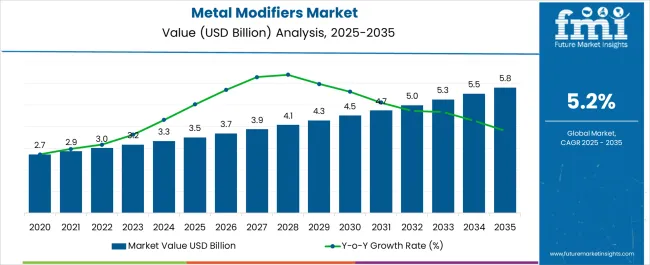
In 2025, the metal modifiers market was valued at USD 3.5 billion. Based on Future Market Insights' analysis, demand for metal modifiers is estimated to grow to USD 3.7 billion in 2026 and USD 5.8 billion by 2036. FMI projects a CAGR of 4.7% during the forecast period.
Absolute dollar growth of USD 2.3 billion over the decade signals steady incremental expansion driven by industrial maintenance requirements and corrosion prevention economics rather than transformational growth. Despite raw material price volatility and regulatory pressure on volatile organic compounds, major metal modifier manufacturers sustain profitability through formulation innovation and long-term supply contracts with industrial end users.
Summary of Metal Modifiers Market
- Metal Modifiers Market Definition:
- The industry covers chemical formulations and surface treatment agents that enhance metal surface properties including corrosion resistance, abrasion protection, and friction modification.
- Demand Drivers in the Market:
- Infrastructure aging drives maintenance and corrosion protection spending.
- Automotive lightweighting requires advanced surface treatments.
- Industrial equipment lifecycle extension economics favor metal protection.
- Key Segments Analyzed in the FMI Report:
- Type: Coatings lead with 35.0% share.
- Application: Corrosion protection dominates at 40.0% share.
- End Use Industry: Automotive leads with 30.0% share.
- Analyst Opinion at FMI:
- Nikhil Kaitwade, Principal Consultant for Chemicals and Materials at Future Market Insights, opines, "In the updated version of the Metal Modifiers Market Report for 2026 to 2036, industrial maintenance directors will find insights into how VOC regulations are reshaping coating formulation strategies and how electric vehicle production is creating new requirements for thermal management and electrical insulation modifiers. Besides this, my findings point at raw material price volatility directly impacting thin formulation margins and the shift toward waterborne and high-solids coatings enabling regulatory compliance without performance trade-offs."
- Strategic Implications/Executive Takeaways:
- Shift focus from commodity additives to application-specific formulation packages.
- Treat regulatory compliance as market access requirement rather than differentiator.
- Prioritize multifunctional modifiers combining corrosion protection with other properties.
- Methodology:
- Validated through industrial maintenance expenditure data and manufacturer shipment records.
- Zero reliance on speculative third-party market research reports.
- Based on verifiable vehicle production statistics and infrastructure investment data.
As Daniel Wussow, President-elect of Care Chemicals (and current SVP, Mobile Emissions Catalysts) at BASF, stated regarding BASF’s operating model shift, “BASF advances the transformation of its Global Business Services organization, aiming to take the next step to secure long-term cost competitiveness, resilience, and consistent service delivery for its businesses worldwide.” [1]
China (6.5% CAGR) and India (6.0% CAGR) drive new opportunities through rapid industrialization and infrastructure investment. Brazil (5.0% CAGR) contributes via growing manufacturing base and oil and gas sector requirements. Mature metal modifier markets such as Germany (5.5%), the United States (4.4%), the United Kingdom (3.9%), and Japan (3.4%) generate replacement demand through maintenance and refurbishment cycles, with volume expansion constrained by manufacturing output growth rates.
Metal Modifiers Market Definition
Metal modifiers comprise chemical formulations and surface treatment agents designed to enhance, alter, or protect the surface properties of metallic substrates. These materials include functional coatings, adhesion promoters, lubricity additives, corrosion inhibitors, and impact modifiers that improve metal performance characteristics such as durability, chemical resistance, friction behavior, and structural integrity without changing bulk material composition.
Metal Modifiers Market Inclusions
The report includes a comprehensive analysis of market dynamics, featuring Global and Regional Market Sizes (Volume and Value) and a 10-year Forecast (2026-2036). It covers segmental breakdowns by type (Coatings, Adhesives, Lubricants, Other Materials), application (Corrosion Protection, Abrasion Resistance, Friction Modification, Impact Modification), end use industry (Automotive, Aerospace & Defense, Manufacturing, Building and Infrastructure), and geographic regions.
Metal Modifiers Market Exclusions
The scope excludes bulk metal alloying additives that modify internal composition rather than surface properties, primary metal production inputs, and finished coated products. It also omits non-metallic substrate treatments and consumer-grade polishes not meeting industrial performance specifications, focusing strictly on chemical modifiers designed for industrial metal surface engineering.
Metal Modifiers Market Research Methodology
- Primary Research: Interviews were conducted with metal modifier manufacturers, industrial coating applicators, automotive OEM finishing engineers, and infrastructure maintenance contractors across major regions. Raw material suppliers clarified specialty chemical supply dynamics.
- Desk Research: Industrial production indices, infrastructure investment data, and corporate financial filings supported volume benchmarking.
- Market-Sizing and Forecasting: A hybrid top-down and bottom-up model was developed. Demand was reconstructed from industrial maintenance expenditure, vehicle production volumes, and infrastructure corrosion protection requirements, then validated against manufacturer shipment data.
- Data Validation and Update Cycle: Outputs undergo anomaly screening, variance checks across production and trade datasets, and structured peer review prior to release.
Segmental Analysis
Metal Modifiers Market Analysis by Type
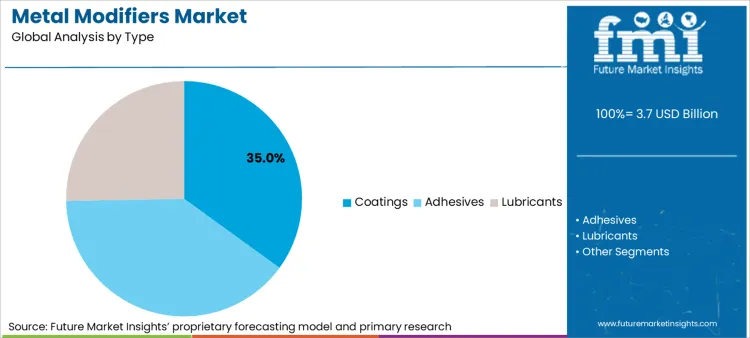
Based on FMI’s metal modifiers market report, consumption of coatings is estimated to hold 35.0% share in 2026. Growth in demand for coating-type modifiers comes from their ability to enhance surface properties such as hardness, wear resistance, and chemical protection without altering core metal composition, making them essential across automotive, aerospace, and industrial applications.
- High-Performance Industrial Coatings: AkzoNobel’s Interpon Redox range is positioned for Agricultural and Construction Equipment (ACE) with corrosion protection up to C4M in a single coat and extra-tough, durable finishes with high resistance to damage for porous and non-porous metal surfaces. [2]
- Single-Coat Productivity: Buyers favor coating modifiers that compress process steps and reduce rework by delivering corrosion performance and impact resistance in fewer layers, improving throughput and paint-line economics.
- Surface Upgrade Without Redesign: Coating-type modifiers enable specification upgrades on existing metal parts without changing alloys or fabrication routes, which lowers qualification risk in regulated end uses.
Metal Modifiers Market Analysis by Application
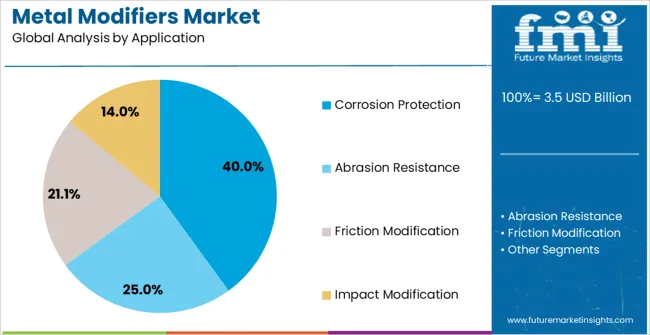
Based on FMI’s metal modifiers market report, consumption for corrosion protection applications is estimated to hold 40.0% share in 2026. Growth in corrosion protection demand comes from infrastructure maintenance requirements, marine and offshore exposure, and the economics of prevention versus repair and replacement.
- Infrastructure Protection: USACE continues to manage Mississippi River water-control and navigation infrastructure, including architectural-engineering services for water control, hydrology, and hydraulic design to extend lock-and-dam service life and protect commerce, agriculture, and energy corridors. [3]
- Automotive Underbody Protection: PPG’s Powercron 10x and Enviro-prime EPIC200X are positioned to help OEMs improve corrosion protection while reducing energy and material use, including a cited 3,500 metric tons of CO2 emissions reduction per year at Toyota Cambridge. [4]
- Lifecycle Cost Logic: Corrosion-protection demand remains structurally resilient because coating failures trigger expensive downtime and replacement cycles, so buyers prioritize proven performance, warranty confidence, and standardized application windows.
Metal Modifiers Market Drivers, Restraints, and Opportunities
Future Market Insights analysis suggests the metal modifiers market is shaped by a mature, specification-driven industrial base where demand is anchored in extending asset life, improving corrosion resistance, and meeting tighter performance requirements in automotive, infrastructure, aerospace, and general manufacturing. Estimated valuation in 2026 reflects a “durability push” as end users accelerate maintenance cycles and redesign surface protection stacks to reduce downtime, increase warranty confidence, and comply with evolving safety and environmental expectations for coated metal components.
While demand for conventional modifier chemistries remains steady in high-volume applications, value growth increasingly comes from higher-performance formulations that deliver more protection per coat, improve adhesion on complex substrates, and enable process efficiency through fewer layers or lower cure temperatures. The forecast assumes a “new normal” where growth tracks industrial production and infrastructure renewal, but mix shifts favor premium corrosion systems, abrasion-resistant coatings, and multifunctional additive packages that reduce total applied cost rather than just material price.
- Performance Upgrading: Growth is driven by surface-engineered solutions that increase hardness, wear resistance, and chemical protection without changing core alloys, enabling upgrades without requalifying base metal designs.
- Cost and Compliance Constraints: Restraints come from raw material price volatility, qualification time for new formulations, and regulatory pressure on certain solvents and additives that can raise reformulation cost and slow adoption.
- Lifecycle Economics Opportunity: Opportunity expands where preventive corrosion protection delivers clear ROI versus repair and replacement, especially in bridges, marine assets, underbody systems, and heavy equipment exposed to salt, humidity, and abrasive environments.
Regional Analysis
Based on the regional analysis, metal modifiers market is segmented into North America, Latin America, Europe, East Asia, South Asia, Oceania and Middle East & Africa across 40+ countries. The full report also offers market attractiveness analysis based on regional trends.
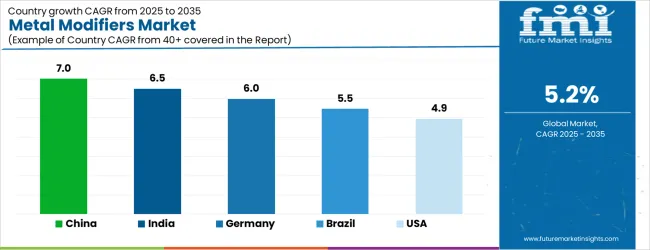
| Country | CAGR (2026 to 2036) |
|---|---|
| China | 6.5% |
| India | 6.0% |
| Germany | 5.5% |
| Brazil | 5.0% |
| United States | 4.4% |
| United Kingdom | 3.9% |
| Japan | 3.4% |
Source: Future Market Insights (FMI) analysis, based on proprietary forecasting model and primary research
North America Metal Modifiers Market Analysis
The North American market is characterized by large-scale reinvestment in domestic infrastructure and aerospace reliability requirements, which increases the need for consistent, specification-driven surface performance in industrial metals.
- United States: Demand for metal modifiers in the United States is projected to rise at a 4.4% CAGR through 2036. Growth is directly tied to historic legislative funding, where the Infrastructure Investment and Jobs Act (IIJA) is described as the largest reinvestment in USA infrastructure in generations. [5]
FMI’s report includes a detailed analysis of the growth in the North American region, along with a country-wise assessment that includes the USA and Canada. Readers can also find regional trends, regulations, and market growth based on different segments and countries in the North America region.
East Asia Metal Modifiers Market Analysis
East Asia, led by China, serves as the global manufacturing anchor, where demand is driven by scale-led automotive output and rising compliance thresholds that increase performance requirements for surface treatment and coating inputs.
- China: Leading with a 6.5% CAGR through 2036, growth is underpinned by a transition toward high-quality green development, where China’s automobile industry set records in both production and sales in 2025 and retained its top global position for the 17th consecutive year [6].
- Japan: Demand is projected to grow at a 3.4% CAGR through 2036, sustained by precision manufacturing and electronics-led specifications, where expansion in EVs, aerospace, offshore wind, and electronics is increasing high-performance requirements for advanced coatings [7].
The full report analyze the metal modifiers market across East Asia from 2021-2036, covering trends and growth drivers in China, Japan, South Korea, and Rest of East Asia. The assessment highlights trends that dictate buyer specifications and supplier qualification in the region.
South Asia Metal Modifiers Market Analysis
South Asia, led by India, represents the growth frontier, where export-linked industrial policy and localization programs are scaling high-value component manufacturing and increasing demand for modifier systems used in performance-critical metal parts.
- India: Domestic demand is accelerating at a 6.0% CAGR through 2036, supported by a surge in high-value component manufacturing, where India’s auto component exports grew 8% to USD 22.9 billion in FY25 from USD 21.2 billion in the previous fiscal [8].
- ASEAN: Regional growth is reinforced by Global Value Chain integration, where the automotive sector is described as a pathway for India to emerge as a key participant in the global value chain (GVC) [9].
The full report analyze the metal modifiers market across South Asia from 2021-2036, including India and ASEAN-linked supply networks, with attention to export momentum, localization depth, and downstream metalworking capacity additions.
Europe Metal Modifiers Market Analysis
Europe acts as a regulatory laboratory, where electrification and low-emission industrial priorities are reshaping materials selection and increasing durability and compliance requirements for surface treatment chemistries.
- Germany: Demand remains robust at a 5.5% CAGR through 2036, supported by sustained automotive production, where domestic passenger car production in 2025 was 2% above the year-earlier level at 4.15 million units [10].
- United Kingdom: The market is projected to expand at a 3.9% CAGR through 2036, supported by continued industrial modernization and specification-driven materials selection across advanced manufacturing supply chains.
FMI’s analysis of metal modifiers market in Europe consists of country-wise assessment that includes Germany, the UK, France, Italy, Spain, Nordics, Benelux and Rest of Europe. Readers can know various regulations and latest trends in the regional market.
Latin America Metal Modifiers Market Analysis
Latin America is emerging as an adoption and supply-chain expansion region, where industrial growth and export-aligned manufacturing activity increase demand for performance-consistent modifier systems.
- Brazil: A projected 5.0% CAGR through 2036 is supported by industrial scale-up and deeper participation in regional manufacturing value chains.
The report consists of a detailed analysis for the market in Brazil, Mexico, Chile, Argentina, Peru and Rest of Latin America. Readers can find detailed information about several factors, such as the pricing analysis and regional trends, which are impacting growth in the Latin America region.
Competitive Aligners for Market Players
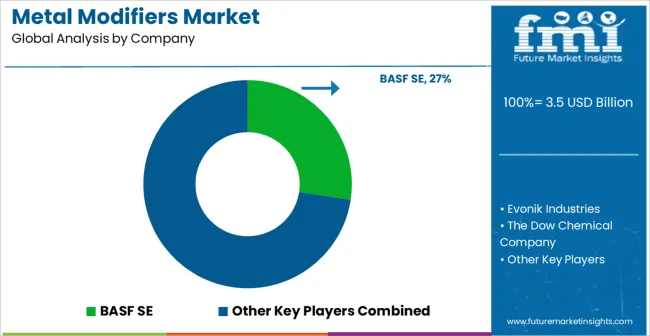
Market structure remains fragmented overall, yet practical competition is concentrated among a limited set of suppliers that can meet volume consistency, formulation repeatability, and qualification requirements across automotive, aerospace, electronics, and infrastructure end uses. A meaningful share of revenue pools with multi-chemistry producers that offer metal modifiers alongside coatings additives, surface treatment packages, and application support, while smaller formulators compete in narrow niches with limited leverage and higher demand volatility. Primary competitive variable is not peak margin capture, but specification retention through stable performance in the customer’s process window, especially under tighter environmental and worker-safety constraints.
Producers with integrated feedstock access and strong technical service absorb raw material swings more effectively and protect on-time supply during disruptions. Suppliers without integration rely on spot procurement and third-party tolling, increasing exposure to cost shocks and batch-to-batch variability that can trigger requalification risk. Compliance capability further narrows the field. Ability to supply low-VOC, low-hazard profiles with traceable documentation and consistent quality systems requires testing infrastructure and disciplined process control, creating attrition among underinvested players.
Customer concentration reinforces buyer leverage. Large OEM and Tier supply chains dual-source to avoid dependency, compressing pricing power and elevating service, lead-time, and audit readiness as differentiators.
Recent Developments
The report includes full coverage of key trends from competitive benchmarking. Some of the recent developments covered in the reports:
- In November 2025, BASF Coatings inaugurated a new automotive OEM coatings plant in Muenster, Germany, enhancing production efficiency, automation, and sustainability while strengthening its position in high-volume, high-demand color segments [11].
- In April 2025, Evonik introduced TEGO® Wet 288, a new substrate wetting additive for waterborne and radiation-cured inks, offering improved long-term stability, strong surface performance, and broad food contact compliance for packaging applications [12].
Key Players in Metal Modifiers Market
- BASF SE
- Evonik Industries AG
- The Dow Chemical Company
- Clariant AG
- AkzoNobel N.V.
- Lubrizol Corporation (Berkshire Hathaway)
- Solvay SA
- Elementis plc
- PPG Industries, Inc.
- Sherwin-Williams Company
- Axalta Coating Systems, Ltd.
- Wacker Chemie AG
- Shin-Etsu Chemical Co., Ltd.
- Momentive Performance Materials Inc.
- BYK-Chemie GmbH (Altana AG)
- Arkema SA
- Sika AG
- Henkel AG & Co. KGaA
- 3M Company
- Hempel A/S
Scope of the Report
| Metric | Value |
|---|---|
| Quantitative Units | USD 3.7 billion (2026) to USD 5.8 billion (2036), at a CAGR of 4.7% |
| Market Definition | The metal modifiers market comprises chemical formulations and surface treatment agents designed to enhance, alter, or protect surface properties of metallic substrates without changing bulk composition. This includes functional coatings, adhesion promoters, lubricity additives, corrosion inhibitors, and impact modifiers used to improve durability, chemical resistance, friction behaviour, and structural integrity in industrial metal applications. |
| Type Segmentation | Coatings, Adhesives, Lubricants, Other Materials |
| Application Coverage | Corrosion Protection, Abrasion Resistance, Friction Modification, Impact Modification |
| End Use Segmentation | Automotive, Aerospace & Defense, Manufacturing, Building and Infrastructure, Other Industries |
| Regions Covered | North America, Latin America, Europe, East Asia, South Asia, Oceania, Middle East & Africa |
| Countries Covered | United States, Canada, Mexico, Brazil, Argentina, Germany, France, United Kingdom, Italy, Spain, China, India, Japan, South Korea, Indonesia, Australia and 40 plus countries |
| Key Companies Profiled | BASF SE, Evonik Industries AG, The Dow Chemical Company, Clariant AG, AkzoNobel N.V., Lubrizol Corporation, Solvay SA, Elementis plc, PPG Industries, Inc., Sherwin-Williams Company |
| Forecast Period | 2026 to 2036 |
| Approach | Hybrid top-down and bottom-up market modelling validated through primary interviews with metal modifier manufacturers, industrial coating applicators, OEM finishing engineers, and infrastructure maintenance contractors, supported by industrial production benchmarking and shipment-level triangulation. |
Metal Modifiers Market Analysis by Segments
Type
- Coatings
- Liquid Coatings
- Powder Coatings
- Electrocoatings
- Adhesives
- Structural Adhesives
- Sealants
- Lubricants
- Solid Film Lubricants
- Liquid Lubricant Additives
- Other Materials
- Pretreatment Chemicals
- Surface Activators
- Release Agents
Application
- Corrosion Protection
- Abrasion Resistance
- Friction Modification
- Impact Modification
End Use Industry
- Automotive
- OEM Coatings
- Aftermarket Treatments
- Electric Vehicle Battery Enclosures
- Aerospace & Defense
- Aircraft Coatings
- Component Protection
- Manufacturing
- Industrial Equipment
- Machinery Components
- Building and Infrastructure
- Structural Steel
- Bridges and Highways
- Pipelines
- Other Industries
- Marine
- Oil & Gas
- Electronics
Region
- North America
- United States
- Canada
- Mexico
- Latin America
- Brazil
- Argentina
- Chile
- Colombia
- Rest of Latin America
- Europe
- Germany
- United Kingdom
- France
- Italy
- Spain
- Russia
- Nordic
- Benelux
- Rest of Europe
- East Asia
- China
- Japan
- South Korea
- South Asia & Pacific
- India
- ASEAN (Indonesia, Malaysia, Thailand, Vietnam, Philippines)
- Australia & New Zealand
- Rest of South Asia & Pacific
- Middle East & Africa
- Kingdom of Saudi Arabia
- United Arab Emirates
- Turkey
- South Africa
- Rest of Middle East & Africa
Bibliography
- [1] BASF SE. (2026). BASF Group releases preliminary figures for full year 2025
- [2] AkzoNobel. (2025). Interpon-Redox for ACE brochure (PDF). AkzoNobel.
- [3] USA Department of Defense. (2025, August 28). Contracts for Aug. 28, 2025. USA Department of Defense.
- [4] PPG Industries, Inc. (2025). Sustainably advantaged products. PPG Sustainability Report.
- [5] Metal Construction News. (2025). Inflation Reduction Act: Impact on metal construction. Metal Construction News.
- [6] China Daily. (2025). Automotive industry in China holds No. 1 spot. ChinaDaily.com.cn.
- [7] IDTechEx. (2026). Advanced coatings 2026 to 2036: Market, technologies, players. IDTechEx.
- [8] Automotive Component Manufacturers Association of India. (2025, July 8). Indian auto component industry clocks turnover of Rs. 6.73 lakh crore (USD 80.2 billion) in FY 24-25; grows at CAGR of 14% from FY20 to FY25.
- [9] [NITI Aayog. (2025). Automotive industry: Powering India’s participation in global value chains. Government of India.
- [10] Verband der Automobilindustrie (VDA). (2025). Passenger car production in 2025. VDA.
- [11] BASF SE. (2025, November). BASF Coatings launches new automotive OEM coatings plant. BASF Press Release.
- [12] Evonik Industries AG. (2025, April). Evonik launches TEGO® Wet 288 for substrate wetting of waterborne systems. Evonik Press Release.
This bibliography is provided for reader reference and is not exhaustive. The full report contains the complete reference list and detailed citations.
This Report Addresses
- Market intelligence to enable structured strategic decision-making across mature and emerging metal modifier markets
- Market size estimation and 10-year revenue forecasts from 2026 to 2036, supported by validated industrial production data and manufacturer shipment statistics
- Growth opportunity mapping across types, applications, and end-use industries with emphasis on corrosion protection and automotive applications
- Segment and regional revenue forecasts covering coatings, adhesives, lubricants, and specialty additives
- Competition strategy assessment including formulation capability breadth, regulatory compliance expertise, and technical service depth benchmarking
- Technology roadmap tracking including waterborne and high-solids coatings, multifunctional modifiers, and sustainable formulation development
- Regulatory impact analysis covering REACH, TSCA, VOC limits, and emerging market chemical registration requirements
- Market report delivery in PDF, Excel, PPT, and interactive dashboard formats for executive and operational use
Frequently Asked Questions
How large is the demand for metal modifiers in the global market in 2026?
Demand for metal modifiers in the global market is estimated to be valued at USD 3.7 billion in 2026.
What will be the market size of metal modifiers in the global market by 2036?
Market size for metal modifiers is projected to reach USD 5.8 billion by 2036.
What is the expected demand growth for metal modifiers in the global market between 2026 and 2036?
Demand for metal modifiers in the global market is expected to grow at a CAGR of 4.7% between 2026 and 2036.
Which type segment is poised to lead global sales by 2026?
Coatings are expected to be the dominant type, capturing approximately 35.0% of global market share in 2026 due to their ability to enhance surface properties without altering core metal composition.
Which application segment is projected to contribute significant share in the metal modifiers market in 2026?
In terms of application, the corrosion protection segment is projected to command 40.0% share in the metal modifiers market in 2026, driven by infrastructure maintenance requirements and recognition of preventive treatment economics.
What is driving metal modifier demand in China?
China's 6.5% CAGR is driven by continued industrialization, infrastructure investment under the 14th Five-Year Plan, and environmental compliance driving reformulation to higher-performance, lower-VOC products.
What compliance standards are referenced for China?
China's GB standards for industrial coatings and environmental protection regulations limiting VOC content are referenced as key compliance benchmarks.
What is the United States growth outlook in this report?
The United States is projected to grow at a CAGR of 4.4% during 2026 to 2036, supported by infrastructure maintenance spending under the Bipartisan Infrastructure Law and automotive production volumes.
Why is Germany's growth rate significant in this report?
Germany's 5.5% CAGR reflects automotive industry requirements for corrosion protection and surface quality, industrial machinery manufacturing, and environmental compliance driving reformulation to compliant technologies.
What type of demand dominates in mature markets?
Replacement demand through maintenance cycles and technology upgrades to compliant, high-performance formulations dominates mature markets, with volume growth constrained by industrial output rates.
What is Japan's growth outlook in this report?
Japan is projected to grow at a CAGR of 3.4% during 2026 to 2036, characterized by advanced manufacturing requirements and emphasis on high-performance modifiers for automotive and electronics applications.
Does the report cover South Korea in its regional analysis?
South Korea is included within East Asia under the regional coverage framework.
What is the main Korea-related demand theme in East Asia coverage?
Korea's demand centers on shipbuilding industry requirements for marine coatings and automotive OEM production, with emphasis on high-performance corrosion protection.
Which end-use industry is strategically important for volume growth?
Automotive remains the leading end-use industry at approximately 30% market share, with electric vehicle production creating new requirements for battery enclosure coatings and thermal management modifiers.
What are metal modifiers and what are they mainly used for?
Metal modifiers are chemical formulations and surface treatment agents designed to enhance metal surface properties including corrosion resistance, abrasion protection, and friction modification, primarily used in automotive, aerospace, manufacturing, and infrastructure applications.
What does the metal modifiers market mean in this report?
The metal modifiers market refers to global production and supply of chemical formulations designed to modify surface properties of metallic substrates for industrial applications.
What is included in the scope of this metal modifiers market report?
Scope covers metal modifiers by type (coatings, adhesives, lubricants), application (corrosion protection, abrasion resistance), end use industry (automotive, aerospace, manufacturing), and geographic regions.
What is excluded from the scope of this report?
Bulk metal alloying additives, primary metal production inputs, finished coated products, and non-metallic substrate treatments are excluded.
What does market forecast mean on this page?
Market forecast represents a model-based projection built on defined assumptions for strategic planning purposes.
How does FMI build and validate the metal modifiers market forecast?
Forecast is developed using hybrid top-down and bottom-up modeling validated through industrial production data, infrastructure investment statistics, and manufacturer shipment benchmarks.
What does zero reliance on speculative third-party market research mean here?
Primary interviews and verifiable public datasets including industrial production indices, infrastructure spending reports, and corporate financial filings are used instead of unverified syndicated market estimates.
Preview the report firsthand - request a free sample
Get SampleGet the brochure for pricing and purchase details.
Get PDFTable of Content
- Executive Summary
- Global Market Outlook
- Demand-side Trends
- Supply-side Trends
- Technology Roadmap Analysis
- Analysis and Recommendations
- Market Overview
- Market Coverage / Taxonomy
- Market Definition / Scope / Limitations
- Research Methodology
- Chapter Orientation
- Analytical Lens and Working Hypotheses
- Market Structure, Signals, and Trend Drivers
- Benchmarking and Cross-market Comparability
- Market Sizing, Forecasting, and Opportunity Mapping
- Research Design and Evidence Framework
- Desk Research Programme (Secondary Evidence)
- Company Annual and Sustainability Reports
- Peer-reviewed Journals and Academic Literature
- Corporate Websites, Product Literature, and Technical Notes
- Earnings Decks and Investor Briefings
- Statutory Filings and Regulatory Disclosures
- Technical White Papers and Standards Notes
- Trade Journals, Industry Magazines, and Analyst Briefs
- Conference Proceedings, Webinars, and Seminar Materials
- Government Statistics Portals and Public Data Releases
- Press Releases and Reputable Media Coverage
- Specialist Newsletters and Curated Briefings
- Sector Databases and Reference Repositories
- FMI Internal Proprietary Databases and Historical Market Datasets
- Subscription Datasets and Paid Sources
- Social Channels, Communities, and Digital Listening Inputs
- Additional Desk Sources
- Expert Input and Fieldwork (Primary Evidence)
- Primary Modes
- Qualitative Interviews and Expert Elicitation
- Quantitative Surveys and Structured Data Capture
- Blended Approach
- Why Primary Evidence is Used
- Field Techniques
- Interviews
- Surveys
- Focus Groups
- Observational and In-context Research
- Social and Community Interactions
- Stakeholder Universe Engaged
- C-suite Leaders
- Board Members
- Presidents and Vice Presidents
- R&D and Innovation Heads
- Technical Specialists
- Domain Subject-matter Experts
- Scientists
- Physicians and Other Healthcare Professionals
- Governance, Ethics, and Data Stewardship
- Research Ethics
- Data Integrity and Handling
- Primary Modes
- Tooling, Models, and Reference Databases
- Desk Research Programme (Secondary Evidence)
- Data Engineering and Model Build
- Data Acquisition and Ingestion
- Cleaning, Normalisation, and Verification
- Synthesis, Triangulation, and Analysis
- Quality Assurance and Audit Trail
- Market Background
- Market Dynamics
- Drivers
- Restraints
- Opportunity
- Trends
- Scenario Forecast
- Demand in Optimistic Scenario
- Demand in Likely Scenario
- Demand in Conservative Scenario
- Opportunity Map Analysis
- Product Life Cycle Analysis
- Supply Chain Analysis
- Investment Feasibility Matrix
- Value Chain Analysis
- PESTLE and Porter’s Analysis
- Regulatory Landscape
- Regional Parent Market Outlook
- Production and Consumption Statistics
- Import and Export Statistics
- Market Dynamics
- Global Market Analysis 2021 to 2025 and Forecast, 2026 to 2036
- Historical Market Size Value (USD Million) Analysis, 2021 to 2025
- Current and Future Market Size Value (USD Million) Projections, 2026 to 2036
- Y-o-Y Growth Trend Analysis
- Absolute $ Opportunity Analysis
- Global Market Pricing Analysis 2021 to 2025 and Forecast 2026 to 2036
- Global Market Analysis 2021 to 2025 and Forecast 2026 to 2036, By Type
- Introduction / Key Findings
- Historical Market Size Value (USD Million) Analysis By Type , 2021 to 2025
- Current and Future Market Size Value (USD Million) Analysis and Forecast By Type , 2026 to 2036
- Coatings
- Adhesives
- Lubricants
- Coatings
- Y-o-Y Growth Trend Analysis By Type , 2021 to 2025
- Absolute $ Opportunity Analysis By Type , 2026 to 2036
- Global Market Analysis 2021 to 2025 and Forecast 2026 to 2036, By Application
- Introduction / Key Findings
- Historical Market Size Value (USD Million) Analysis By Application, 2021 to 2025
- Current and Future Market Size Value (USD Million) Analysis and Forecast By Application, 2026 to 2036
- Corrosion Protection
- Abrasion Resistance
- Friction Modification
- Impact Modification
- Corrosion Protection
- Y-o-Y Growth Trend Analysis By Application, 2021 to 2025
- Absolute $ Opportunity Analysis By Application, 2026 to 2036
- Global Market Analysis 2021 to 2025 and Forecast 2026 to 2036, By End Use
- Introduction / Key Findings
- Historical Market Size Value (USD Million) Analysis By End Use, 2021 to 2025
- Current and Future Market Size Value (USD Million) Analysis and Forecast By End Use, 2026 to 2036
- Automotive
- Aerospace & Defense
- Manufacturing
- Building and Infrastructure
- Automotive
- Y-o-Y Growth Trend Analysis By End Use, 2021 to 2025
- Absolute $ Opportunity Analysis By End Use, 2026 to 2036
- Global Market Analysis 2021 to 2025 and Forecast 2026 to 2036, By Region
- Introduction
- Historical Market Size Value (USD Million) Analysis By Region, 2021 to 2025
- Current Market Size Value (USD Million) Analysis and Forecast By Region, 2026 to 2036
- North America
- Latin America
- Western Europe
- Eastern Europe
- East Asia
- South Asia and Pacific
- Middle East & Africa
- Market Attractiveness Analysis By Region
- North America Market Analysis 2021 to 2025 and Forecast 2026 to 2036, By Country
- Historical Market Size Value (USD Million) Trend Analysis By Market Taxonomy, 2021 to 2025
- Market Size Value (USD Million) Forecast By Market Taxonomy, 2026 to 2036
- By Country
- USA
- Canada
- Mexico
- By Type
- By Application
- By End Use
- By Country
- Market Attractiveness Analysis
- By Country
- By Type
- By Application
- By End Use
- Key Takeaways
- Latin America Market Analysis 2021 to 2025 and Forecast 2026 to 2036, By Country
- Historical Market Size Value (USD Million) Trend Analysis By Market Taxonomy, 2021 to 2025
- Market Size Value (USD Million) Forecast By Market Taxonomy, 2026 to 2036
- By Country
- Brazil
- Chile
- Rest of Latin America
- By Type
- By Application
- By End Use
- By Country
- Market Attractiveness Analysis
- By Country
- By Type
- By Application
- By End Use
- Key Takeaways
- Western Europe Market Analysis 2021 to 2025 and Forecast 2026 to 2036, By Country
- Historical Market Size Value (USD Million) Trend Analysis By Market Taxonomy, 2021 to 2025
- Market Size Value (USD Million) Forecast By Market Taxonomy, 2026 to 2036
- By Country
- Germany
- UK
- Italy
- Spain
- France
- Nordic
- BENELUX
- Rest of Western Europe
- By Type
- By Application
- By End Use
- By Country
- Market Attractiveness Analysis
- By Country
- By Type
- By Application
- By End Use
- Key Takeaways
- Eastern Europe Market Analysis 2021 to 2025 and Forecast 2026 to 2036, By Country
- Historical Market Size Value (USD Million) Trend Analysis By Market Taxonomy, 2021 to 2025
- Market Size Value (USD Million) Forecast By Market Taxonomy, 2026 to 2036
- By Country
- Russia
- Poland
- Hungary
- Balkan & Baltic
- Rest of Eastern Europe
- By Type
- By Application
- By End Use
- By Country
- Market Attractiveness Analysis
- By Country
- By Type
- By Application
- By End Use
- Key Takeaways
- East Asia Market Analysis 2021 to 2025 and Forecast 2026 to 2036, By Country
- Historical Market Size Value (USD Million) Trend Analysis By Market Taxonomy, 2021 to 2025
- Market Size Value (USD Million) Forecast By Market Taxonomy, 2026 to 2036
- By Country
- China
- Japan
- South Korea
- By Type
- By Application
- By End Use
- By Country
- Market Attractiveness Analysis
- By Country
- By Type
- By Application
- By End Use
- Key Takeaways
- South Asia and Pacific Market Analysis 2021 to 2025 and Forecast 2026 to 2036, By Country
- Historical Market Size Value (USD Million) Trend Analysis By Market Taxonomy, 2021 to 2025
- Market Size Value (USD Million) Forecast By Market Taxonomy, 2026 to 2036
- By Country
- India
- ASEAN
- Australia & New Zealand
- Rest of South Asia and Pacific
- By Type
- By Application
- By End Use
- By Country
- Market Attractiveness Analysis
- By Country
- By Type
- By Application
- By End Use
- Key Takeaways
- Middle East & Africa Market Analysis 2021 to 2025 and Forecast 2026 to 2036, By Country
- Historical Market Size Value (USD Million) Trend Analysis By Market Taxonomy, 2021 to 2025
- Market Size Value (USD Million) Forecast By Market Taxonomy, 2026 to 2036
- By Country
- Kingdom of Saudi Arabia
- Other GCC Countries
- Turkiye
- South Africa
- Other African Union
- Rest of Middle East & Africa
- By Type
- By Application
- By End Use
- By Country
- Market Attractiveness Analysis
- By Country
- By Type
- By Application
- By End Use
- Key Takeaways
- Key Countries Market Analysis
- USA
- Pricing Analysis
- Market Share Analysis, 2025
- By Type
- By Application
- By End Use
- Canada
- Pricing Analysis
- Market Share Analysis, 2025
- By Type
- By Application
- By End Use
- Mexico
- Pricing Analysis
- Market Share Analysis, 2025
- By Type
- By Application
- By End Use
- Brazil
- Pricing Analysis
- Market Share Analysis, 2025
- By Type
- By Application
- By End Use
- Chile
- Pricing Analysis
- Market Share Analysis, 2025
- By Type
- By Application
- By End Use
- Germany
- Pricing Analysis
- Market Share Analysis, 2025
- By Type
- By Application
- By End Use
- UK
- Pricing Analysis
- Market Share Analysis, 2025
- By Type
- By Application
- By End Use
- Italy
- Pricing Analysis
- Market Share Analysis, 2025
- By Type
- By Application
- By End Use
- Spain
- Pricing Analysis
- Market Share Analysis, 2025
- By Type
- By Application
- By End Use
- France
- Pricing Analysis
- Market Share Analysis, 2025
- By Type
- By Application
- By End Use
- India
- Pricing Analysis
- Market Share Analysis, 2025
- By Type
- By Application
- By End Use
- ASEAN
- Pricing Analysis
- Market Share Analysis, 2025
- By Type
- By Application
- By End Use
- Australia & New Zealand
- Pricing Analysis
- Market Share Analysis, 2025
- By Type
- By Application
- By End Use
- China
- Pricing Analysis
- Market Share Analysis, 2025
- By Type
- By Application
- By End Use
- Japan
- Pricing Analysis
- Market Share Analysis, 2025
- By Type
- By Application
- By End Use
- South Korea
- Pricing Analysis
- Market Share Analysis, 2025
- By Type
- By Application
- By End Use
- Russia
- Pricing Analysis
- Market Share Analysis, 2025
- By Type
- By Application
- By End Use
- Poland
- Pricing Analysis
- Market Share Analysis, 2025
- By Type
- By Application
- By End Use
- Hungary
- Pricing Analysis
- Market Share Analysis, 2025
- By Type
- By Application
- By End Use
- Kingdom of Saudi Arabia
- Pricing Analysis
- Market Share Analysis, 2025
- By Type
- By Application
- By End Use
- Turkiye
- Pricing Analysis
- Market Share Analysis, 2025
- By Type
- By Application
- By End Use
- South Africa
- Pricing Analysis
- Market Share Analysis, 2025
- By Type
- By Application
- By End Use
- USA
- Market Structure Analysis
- Competition Dashboard
- Competition Benchmarking
- Market Share Analysis of Top Players
- By Regional
- By Type
- By Application
- By End Use
- Competition Analysis
- Competition Deep Dive
- BASF SE
- Overview
- Product Portfolio
- Profitability by Market Segments (Product/Age /Sales Channel/Region)
- Sales Footprint
- Strategy Overview
- Marketing Strategy
- Product Strategy
- Channel Strategy
- Evonik Industries AG
- The Dow Chemical Company
- Clariant AG
- AkzoNobel N.V.
- Lubrizol Corporation (Berkshire Hathaway)
- Solvay SA
- Elementis plc
- BASF SE
- Competition Deep Dive
- Assumptions & Acronyms Used


