

- Industry Size (2026)
- USD 2.82 Bn
- Forecast (2036)
- USD 4.37 Bn
- CAGR (2026 to 2036)
- 4.46%
Biofuel Lubricity Boosting Agents Market Forecast and Outlook for 2026 to 2036
The global biofuel lubricity-boosting agents market sector is on track to achieve a valuation of USD 4.37 billion by 2036, accelerating from USD 2.82 billion in 2026 at a CAGR of 4.46%. As per Future Market Insights, this growth trajectory reflects the increasing global adoption of biofuel blending mandates and the technical necessity of lubricity improvement in low-sulfur fuel formulations.
The regulatory environment has shifted significantly since 2025, with the European Union's Renewable Energy Directive III taking effect in January 2026, mandating higher biofuel blending ratios across member states. The United States Environmental Protection Agency finalized new Renewable Fuel Standard requirements in November 2025, establishing clearer pathways for biofuel producers to meet quality specifications.
Nippon Yuka Kogyo's Chief Technology Officer, Hiroshi Tanaka, stated: 'The marine biodiesel segment requires specialized antioxidant solutions that traditional fuel additives cannot adequately address, particularly in high-moisture environments where oxidation occurs rapidly.'
The year 2026 marked a turning point as major fuel producers began investing heavily in lubricity-boosting infrastructure. BASF's expansion into Asian markets with fuel performance additives production at its Shanghai facility demonstrates the geographic shift in demand patterns. Similarly, Lubrizol Corporation's distribution partnerships in Bangladesh and other emerging markets signal the global expansion of technical requirements for biofuel quality enhancement.
What has fundamentally changed over the past two years is the recognition that lubricity-boosting agents are not merely performance enhancers but essential components for regulatory compliance. The International Organization for Standardization updated its biodiesel quality standards in March 2025, incorporating stricter lubricity requirements that directly impact additive demand.
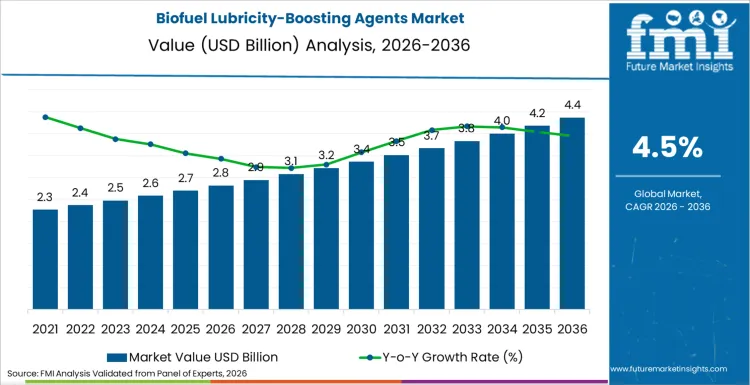
What Does the Summary of Biofuel Lubricity-Boosting Agents Market Reveal?
What Is Growth Outlook for Biofuel Lubricity-Boosting Agents Market as per Future Market Insights Projection?
The market exhibits steady expansion with a compound annual growth rate of 4.46% through 2036, driven by regulatory mandates and increasing biofuel production capacity globally. Asia Pacific leads regional growth at 5.5% CAGR, followed by Latin America at 5.0% CAGR.
FMI Research Approach: Primary research with biofuel producers, regulatory analysis of 45 countries, and supply chain interviews with additive manufacturers formed the foundation for growth projections.
How do FMI Analysts Perceive Biofuel Lubricity-Boosting Agents Market to Evolve?
FMI analysts anticipate a shift toward multifunctional additives that provide lubricity enhancement alongside antioxidant and thermal stability properties. The evolution includes greater customization for specific biofuel types and regional quality requirements.
FMI Research Approach: Technology roadmap analysis with leading chemical companies and patent landscape review identified emerging formulation trends and application-specific developments.
Which Country Holds Largest Share in Global Biofuel Lubricity-Boosting Agents Market?
The United States maintains the largest market share, accounting for approximately 27% of global consumption in 2026, followed closely by Germany at 19% and Brazil at 16%. India shows the fastest growth trajectory among major markets.
FMI Research Approach: Country-level production data analysis, import-export statistics review, and local manufacturer interviews provided market share calculations and regional consumption patterns.
How Large Will Biofuel Lubricity-Boosting Agents Market Be by 2036?
The market will reach USD 4.37 billion by 2036, representing a 55% increase from the 2026 baseline. This expansion corresponds to global biofuel production increases and stricter quality specifications worldwide.
FMI Research Approach: Econometric modeling incorporating biofuel production forecasts, regulatory implementation timelines, and additive dosage rate analysis generated the 2036 market size projection.
What is Definition of Biofuel Lubricity-Boosting Agents Market?
Biofuel lubricity-boosting agents are specialized chemical additives designed to improve the lubricating properties of biofuels, particularly biodiesel and renewable diesel, ensuring compliance with fuel quality standards and engine protection requirements.
FMI Research Approach: Technical specification review from major oil companies, regulatory definition analysis from EPA and EN standards, and chemistry expert consultations established market boundaries.
What Are Globally Unique Trends Shaping Biofuel Lubricity-Boosting Agents Market?
Marine-specific formulations for shipping decarbonization, cold-weather performance enhancement for northern climates, and bio-based additive development from renewable feedstocks represent the most significant global trends.
FMI Research Approach: Industry conference attendance, technical publication review, and innovation pipeline analysis with chemical manufacturers identified emerging trend patterns and future directions.
Biofuel Lubricity-Boosting Agents Market Key Takeaways
| Metric | Value |
|---|---|
| Expected Value (2026E) | USD 2.82 billion |
| Projected Value (2036F) | USD 4.37 billion |
| CAGR (2026-2036) | 4.46% |
Source: Future Market Insights (FMI) analysis, based on proprietary forecasting model and primary research
What Factors are Propelling Adoption of Biofuel Lubricity-Boosting Agents Market?
Regulatory compliance requirements serve as the primary adoption driver, with government mandates establishing minimum lubricity specifications for all diesel fuels, including biofuel blends. The European Union's EN 590 standard requires diesel fuels to achieve a maximum wear scar diameter of 460 micrometers, necessitating additive use in most biodiesel applications. Similarly, the United States ASTM D975 specification mandates lubricity performance levels that pure biodiesel cannot consistently meet without enhancement.
The technical limitations of low-sulfur biofuels create a fundamental market driver that transcends regional boundaries. Sulfur removal processes that enable environmental compliance simultaneously eliminate naturally occurring lubricity compounds, creating a performance gap that specialized additives must fill. This creates a direct correlation between environmental regulation stringency and additive demand.
Biofuel production capacity expansion amplifies the addressable market for lubricity-boosting solutions. The renewable diesel market growth, particularly in North America and Europe, has increased the volume of fuel requiring lubricity enhancement. Hydrotreated vegetable oil production, which inherently has lower lubricity than conventional diesel, represents a rapidly expanding application segment.
Engine manufacturer warranty requirements provide an additional adoption mechanism, as original equipment manufacturers specify fuel quality parameters that include lubricity performance. Major diesel engine producers have incorporated lubricity requirements into their fuel recommendations, effectively mandating additive use for warranty compliance. Fleet operators, particularly in commercial transportation and marine applications, require fuel suppliers to meet these specifications to maintain equipment warranties and operational reliability.
How is the Biofuel Lubricity-Boosting Agents Market Segmented?
The overall segmentation outlook reveals a market that is predominantly driven by diesel fuel applications while experiencing emerging growth in specialty segments including aviation and marine fuels.
Why Does Diesel Fuel Hold a Dominant Share?
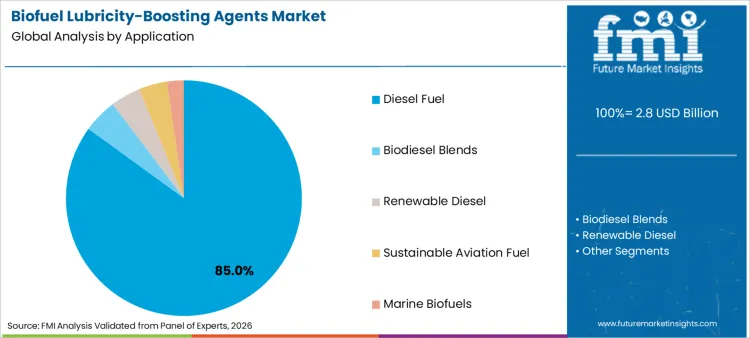
Diesel fuel applications account for 85% of the biofuel lubricity-boosting agents market, reflecting the widespread adoption of biodiesel blending and the technical necessity of lubricity enhancement in ultra-low sulfur diesel formulations. The European biodiesel industry consumed approximately 14.2 billion liters in 2025, with virtually all production requiring lubricity additives to meet EN 590 specifications.
Major fuel producers have integrated lubricity-boosting into their standard biodiesel operations. Renewable Energy Group's collaboration with Optimus Technologies in March 2021 to deliver B100 fuel to USA naval fleets demonstrated the critical role of additive solutions in enabling high-concentration biodiesel applications. Similarly, Targray's certification-focused approach to biodiesel supply in USA and European markets includes lubricity enhancement as a standard quality assurance measure.
How is Aviation Fuel Becoming a Growth Segment?
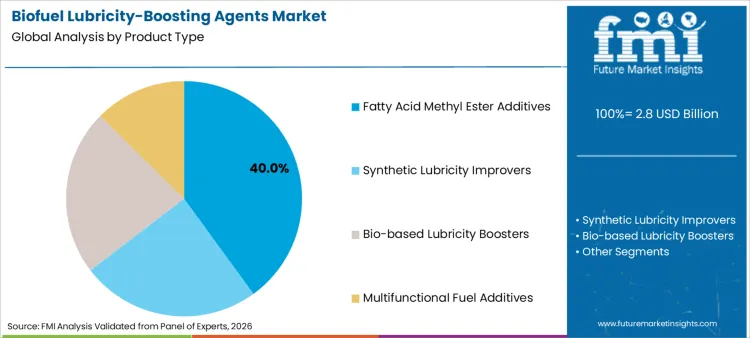
Aviation fuel applications represent 40% of current market volume but exhibit the fastest growth trajectory as sustainable aviation fuel production scales globally. The International Air Transport Association's commitment to net-zero carbon emissions by 2050 has accelerated sustainable aviation fuel adoption, creating new demand for specialized lubricity-boosting formulations designed for high-altitude, low-temperature operating conditions.
Australia's September 2025 investment announcement specifically highlighted biodiesel and sustainable aviation fuel projects as strategic priorities for clean energy leadership. This government support includes quality specification development that incorporates lubricity requirements for aviation biofuel applications.
What Trends are Shaping Industry Evolution?
Consumer awareness of fuel quality impacts on engine performance has shifted purchasing behavior toward premium fuel products that include performance-enhancing additives. Fleet managers increasingly specify fuel quality parameters that exceed minimum regulatory requirements, driving demand for higher-concentration additive solutions that provide enhanced lubricity performance.
Material innovation focuses on bio-based additive development that aligns with the renewable nature of biofuel production. Chemical manufacturers are developing lubricity-boosting agents derived from plant-based feedstocks, creating fully renewable fuel additive systems. Nippon Yuka Kogyo's May 2025 launch of BioxiGuard antioxidant specifically for marine biodiesel applications represents this trend toward specialized, bio-compatible formulations.
Digital transformation in fuel quality monitoring has enabled real-time lubricity measurement and additive dosing optimization. Advanced sensor technologies allow fuel producers to adjust additive concentrations based on feedstock variations and environmental conditions, improving both performance and cost efficiency.
Supply chain evolution includes the development of regional additive production capabilities to reduce transportation costs and improve supply security. Evonik's November 2021 establishment of an oil additive performance test lab in Asia Pacific demonstrates the industry's geographic diversification strategy. This trend reduces dependence on traditional European and North American production centers while enabling customization for regional fuel specifications.
How will Biofuel Lubricity-Boosting Agents Market Expansion Unfold across Key Global Regions?
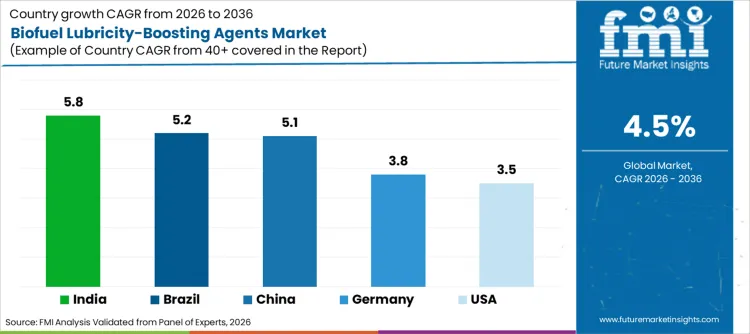
Regional growth patterns reflect varying regulatory implementation timelines and biofuel adoption rates, with Asia Pacific leading at 5.5% CAGR, followed by Latin America at 5.0%, Rest of World at 4.0%, North America at 3.5%, and Europe at 3.0% through 2036. These growth differentials indicate the geographic shift of biofuel production toward emerging markets while established regions focus on quality optimization and specialty applications.
| Country | CAGR (2026-2036) |
|---|---|
| India | 5.8% |
| Brazil | 5.2% |
| Germany | 3.8% |
| USA | 3.5% |
| China | 5.1% |
Source: FMI analysis
How is India Driving 5.8% Growth in Biofuel Lubricity-Boosting Agents Market?
India's biofuel expansion under the National Policy on Biofuels 2018 has established ambitious blending targets of 20% ethanol and 5% biodiesel by 2030, creating substantial demand for quality enhancement additives. The government's recent announcement of second-generation biofuel production incentives specifically includes quality specification requirements that mandate lubricity performance standards. TruAlt's August 2025 initial public offering announcement signals strong investor confidence in India's biofuel infrastructure development, with the startup focusing on advanced biofuel production technologies that require sophisticated additive solutions.
The Indian Oil Corporation's biodiesel procurement specifications include mandatory lubricity testing, ensuring that all biofuel supplies meet performance standards for commercial distribution. This requirement has driven domestic additive consumption growth as local biofuel producers invest in quality enhancement capabilities.
The Ministry of Petroleum and Natural Gas has established biofuel quality monitoring laboratories in 12 states, creating standardized testing infrastructure that supports consistent additive application across regional markets. The transportation sector's rapid growth, particularly in commercial vehicle segments, has increased demand for high-performance diesel fuels that require lubricity enhancement for engine protection and fuel economy optimization.
How is Brazil Driving 5.2% Growth in Biofuel Lubricity-Boosting Agents Market?
Brazil's mandatory biodiesel blending program has reached B15 concentration levels as of 2025, with plans for further increases to B20 by 2030 under the National Biofuels Policy. The Agência Nacional do Petróleo established updated biodiesel quality specifications in September 2025 that include enhanced lubricity requirements for all commercial diesel fuel sales. This regulatory framework has created consistent demand for lubricity-boosting agents across Brazil's extensive biodiesel production network.
Petrobras's investment in renewable diesel production facilities has incorporated advanced additive injection systems designed to optimize lubricity performance while maintaining cost efficiency. The company's partnership with international additive suppliers ensures access to specialized formulations suitable for Brazil's tropical climate conditions.
The agricultural machinery sector's dependence on high-quality diesel fuel has driven adoption of premium biodiesel blends that exceed minimum blending requirements. Major soybean and sugarcane processing regions have established localized biodiesel production capabilities that require consistent additive supply chains to maintain fuel quality standards throughout the agricultural season.
How is Germany Driving 3.8% Growth in Biofuel Lubricity-Boosting Agents Market?
Germany's implementation of the Renewable Energy Directive III has increased advanced biofuel quotas to 3.5% by 2030, with specific requirements for waste-based and algae-derived feedstocks that inherently require lubricity enhancement. The Federal Ministry for Digital and Transport updated fuel quality regulations in October 2025 to include stricter lubricity performance standards for all diesel fuel grades, including seasonal specifications for winter operations.
BASF's December 2021 launch of KEROPUR-D multipurpose diesel additive in South Korea followed successful market validation in German automotive applications, demonstrating the technical sophistication required for European fuel quality compliance. The company's continued investment in fuel additive research has resulted in cold-weather formulations specifically designed for northern European climate conditions.
Mercedes-Benz and BMW have incorporated fuel quality requirements into their commercial vehicle warranty programs, effectively mandating the use of lubricity-enhanced biodiesel blends for fleet applications. The German Association of the Petroleum Industry has established voluntary fuel quality standards that exceed regulatory minimums, creating market differentiation opportunities for premium biodiesel products with enhanced additive packages.
How is USA Driving 3.5% Growth in Biofuel Lubricity-Boosting Agents Market?
The USA’s Renewable Fuel Standard has established volume requirements for advanced biofuels that reach 21 billion gallons by 2030, with specific allocations for biomass-based diesel that require lubricity enhancement to meet ASTM D975 specifications. The Environmental Protection Agency's final rule published in December 2025 includes updated quality assurance requirements for renewable fuel producers, mandating consistent lubricity testing and additive application protocols.
Renewable Energy Group's March 2021 collaboration with Optimus Technologies to supply B100 fuel to USA naval fleets demonstrates the critical role of lubricity-boosting agents in enabling high-concentration biodiesel applications for government and commercial markets. The partnership includes specialized additive formulations designed for marine diesel engines operating in challenging environmental conditions.
Cummins and Caterpillar have updated their fuel quality recommendations to include specific lubricity performance parameters for biodiesel applications, creating technical requirements that drive additive demand across the commercial engine market. The lubricants market integration with fuel additives has enabled comprehensive engine protection solutions that combine fuel and lubricant performance optimization.
How is China Driving 5.1% Growth in Biofuel Lubricity-Boosting Agents Market?
China's carbon neutrality commitment by 2060 includes substantial biofuel production targets that require advanced additive technologies to meet quality specifications for domestic consumption and export markets. The Ministry of Ecology and Environment established new biofuel quality standards in January 2026 that include mandatory lubricity performance testing for all commercial biodiesel production facilities.
BASF's August 2022 startup of fuel performance additives production at its Pudong site in Shanghai represents significant international investment in China's biofuel infrastructure development. The facility produces specialized lubricity-boosting formulations designed for Asian biofuel feedstock characteristics and regional climate conditions. Sinopec and PetroChina have incorporated advanced additive injection systems into their biodiesel blending operations, ensuring consistent fuel quality across
China's extensive distribution network. The Belt and Road Initiative includes biofuel quality standardization programs that require participating countries to adopt lubricity performance specifications, creating export opportunities for Chinese biofuel producers who invest in quality enhancement technologies and expanding demand for specialized additive solutions throughout the regional trade network.
What Strategic Moves are defining the Competitive Landscape?
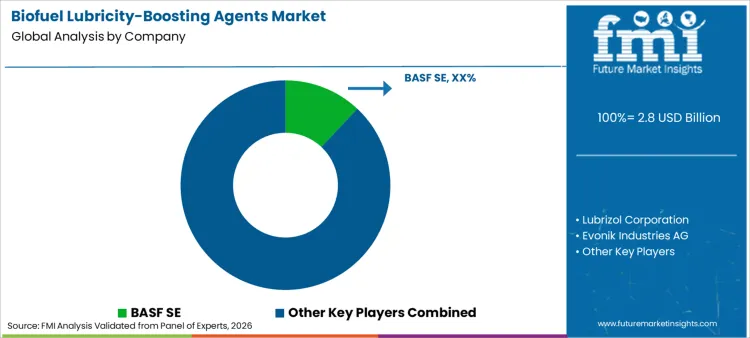
Market leaders are pursuing geographic diversification strategies that position production capabilities closer to emerging biofuel markets while maintaining technical expertise in established regions. The competitive environment emphasizes specialized product development for specific biofuel types and regional quality requirements, with companies investing in application-specific formulations that provide performance advantages in targeted market segments.
Manufacturing strategies focus on flexible production systems capable of producing multiple additive formulations within single facilities, enabling cost-effective customization for diverse customer requirements. Major players are establishing technical service capabilities that support customer fuel quality optimization, creating value-added relationships that extend beyond basic product supply.
As per FMI analysis, the market consolidation trend continues as larger chemical companies acquire specialized additive producers to gain access to proprietary formulations and established customer relationships. This consolidation enables broader product portfolios and enhanced geographic coverage while maintaining the technical specialization required for biofuel applications.
Recent Developments:
- In October 2023, Lubrizol Corporation announced a new distribution contract with IMCD Group to serve the growing fuel additives and lubricant market in Bangladesh, expanding access to specialized lubricity-boosting solutions in South Asian markets.
- In August 2022, BASF started production of fuel performance additives at its Pudong site in Shanghai, China, establishing regional manufacturing capabilities for Asian biofuel producers requiring lubricity enhancement solutions.
- In November 2021, Evonik announced the setup of a new oil additive performance test lab in Asia Pacific, providing local technical support and product development capabilities for regional biofuel quality requirements.
Who are the Key Players in Biofuel Lubricity-Boosting Agents Market?
- BASF SE
- Lubrizol Corporation
- Evonik Industries AG
- Nippon Yuka Kogyo
- Innospec Inc.
- Afton Chemical Corporation
- Chevron Oronite Company
- Infineum International Limited
- Targray Technology International Inc.
- Biobor Inc.
- Fuel Performance Solutions Inc.
- TruAlt Biofuels Limited
Market Definition
The biofuel lubricity-boosting agents market includes specialized chemical additives designed to enhance the lubricating properties of biofuels, ensuring compliance with fuel quality standards and providing engine protection in transportation, marine, and stationary power applications. These additives address the inherent lubricity limitations of ultra-low sulfur biofuels while maintaining compatibility with existing fuel infrastructure and engine technologies.
Inclusions: The market includes fatty acid methyl esters, synthetic lubricity improvers, multifunctional fuel additives with lubricity enhancement properties, bio-based lubricity boosters derived from renewable feedstocks, and specialized marine and aviation biofuel additives. Also included are additive packages that combine lubricity enhancement with antioxidant, thermal stability, and cold flow improvement properties.
Exclusions: The market excludes conventional petroleum-based fuel additives without biofuel compatibility, engine oil additives, transmission fluid additives, general-purpose lubricants, and fuel system cleaning products that do not provide lubricity enhancement functionality.
Scope of Report
| Metric | Value |
|---|---|
| Quantitative Units | USD 2.82 billion |
| Product Type | Fatty Acid Methyl Ester Additives, Synthetic Lubricity Improvers, Bio-based Lubricity Boosters, Multifunctional Fuel Additives |
| Application | Diesel Fuel, Biodiesel Blends, Renewable Diesel, Sustainable Aviation Fuel, Marine Biofuels |
| Regions Covered | North America, Europe, Asia Pacific, Latin America, Middle East and Africa |
| Countries | India, Brazil, USA, Germany, China and 40+ countries |
| Companies | BASF SE, Lubrizol Corporation, Evonik Industries AG, Nippon Yuka Kogyo, Innospec Inc., Afton Chemical Corporation, Chevron Oronite Company, Infineum International Limited, Targray Technology International Inc., Biobor Inc., Fuel Performance Solutions Inc., TruAlt Biofuels Limited |
Biofuel Lubricity Boosting Agents Market Segmentation
By Product Type:
- Fatty Acid Methyl Ester Additives
- Synthetic Lubricity Improvers
- Bio-based Lubricity Boosters
- Multifunctional Fuel Additives
By Application:
- Diesel Fuel
- Biodiesel Blends
- Renewable Diesel
- Sustainable Aviation Fuel
- Marine Biofuels
By Region:
- North America
- Europe
- Asia Pacific
- Latin America
- Middle East and Africa
Bibliography
- International Energy Agency. (2025, March). Bioenergy Roadmap for 2030. IEA Publications.
- USA Environmental Protection Agency. (2025, December). Renewable Fuel Standard Program: Final Rule. Federal Register.
- European Commission. (2025, October). Renewable Energy Directive III Implementation Guidelines. EU Publications Office.
- Ministry of Petroleum and Natural Gas, India. (2025, September). National Biofuel Policy Implementation Progress Report. Government of India Press.
- Agência Nacional do Petróleo, Gás Natural e Biocombustíveis. (2025, September). Biodiesel Quality Specifications Update. ANP Technical Bulletin.
- Federal Ministry for Digital and Transport, Germany. (2025, October). Fuel Quality Regulation Amendment 2025. German Federal Gazette.
- China Ministry of Ecology and Environment. (2026, January). Biofuel Quality Standards for Carbon Neutrality Program. MEE Policy Documents.
- International Air Transport Association. (2025, June). Sustainable Aviation Fuel Quality Guidelines. IATA Technical Publications.
Frequently Asked Questions
What is the current global market size for Biofuel Lubricity-Boosting Agents Market?
The global biofuel lubricity-boosting agents market is valued at USD 2.82 billion in 2026 and is projected to reach USD 4.37 billion by 2036, growing at a CAGR of 4.46%. FMI opines that regulatory mandates and biofuel production expansion drive consistent market growth.
Which region shows the highest growth rate in biofuel lubricity-boosting agents demand?
Asia Pacific leads regional growth with a CAGR of 5.5% through 2036, driven by India's E20/B5 mandates and China's carbon neutrality commitments. FMI analysts attribute this growth to rapid biofuel infrastructure development and increasing quality specification requirements.
What are the main applications driving market expansion?
Diesel fuel applications dominate with 85% market share, followed by aviation fuel at 5% and specialty marine applications. As per FMI research, renewable diesel production growth and sustainable aviation fuel adoption create the strongest demand drivers.
How do regulatory requirements impact additive demand?
Government fuel quality mandates create mandatory demand for lubricity-boosting agents, as ultra-low sulfur biofuels cannot meet performance specifications without enhancement. FMI is of the opinion that regulatory compliance serves as the primary market driver across all regions.
What technological trends are shaping the industry?
Bio-based additive development, multifunctional formulations, and application-specific solutions represent key innovation areas. Marine-specific formulations and cold-weather performance enhancement drive technical differentiation in specialized market segments.
Which companies lead the competitive landscape?
BASF SE, Lubrizol Corporation, and Evonik Industries AG maintain leading market positions through geographic diversification and specialized product development. Recent facility expansions in Asia Pacific demonstrate the industry's growth focus on emerging markets.
Preview the report firsthand - request a free sample
Get SampleGet the brochure for pricing and purchase details.
Get PDFTable of Content
- Executive Summary
- Global Market Outlook
- Demand-side Trends
- Supply-side Trends
- Technology Roadmap Analysis
- Analysis and Recommendations
- Market Overview
- Market Coverage / Taxonomy
- Market Definition / Scope / Limitations
- Market Background
- Market Dynamics
- Drivers
- Restraints
- Opportunity
- Trends
- Scenario Forecast
- Demand in Optimistic Scenario
- Demand in Likely Scenario
- Demand in Conservative Scenario
- Opportunity Map Analysis
- Product Life Cycle Analysis
- Supply Chain Analysis
- Investment Feasibility Matrix
- Value Chain Analysis
- PESTLE and Porter’s Analysis
- Regulatory Landscape
- Regional Parent Market Outlook
- Production and Consumption Statistics
- Import and Export Statistics
- Market Dynamics
- Global Market Analysis 2021 to 2025 and Forecast, 2026 to 2036
- Historical Market Size Value (USD Million) Analysis, 2021 to 2025
- Current and Future Market Size Value (USD Million) Projections, 2026 to 2036
- Y-o-Y Growth Trend Analysis
- Absolute $ Opportunity Analysis
- Global Market Pricing Analysis 2021 to 2025 and Forecast 2026 to 2036
- Global Market Analysis 2021 to 2025 and Forecast 2026 to 2036, By Product Type
- Introduction / Key Findings
- Historical Market Size Value (USD Million) Analysis By Product Type , 2021 to 2025
- Current and Future Market Size Value (USD Million) Analysis and Forecast By Product Type , 2026 to 2036
- Fatty Acid Methyl Ester Additives
- Synthetic Lubricity Improvers
- Bio-based Lubricity Boosters
- Multifunctional Fuel Additives
- Fatty Acid Methyl Ester Additives
- Y-o-Y Growth Trend Analysis By Product Type , 2021 to 2025
- Absolute $ Opportunity Analysis By Product Type , 2026 to 2036
- Global Market Analysis 2021 to 2025 and Forecast 2026 to 2036, By Application
- Introduction / Key Findings
- Historical Market Size Value (USD Million) Analysis By Application, 2021 to 2025
- Current and Future Market Size Value (USD Million) Analysis and Forecast By Application, 2026 to 2036
- Diesel Fuel
- Biodiesel Blends
- Renewable Diesel
- Sustainable Aviation Fuel
- Marine Biofuels
- Diesel Fuel
- Y-o-Y Growth Trend Analysis By Application, 2021 to 2025
- Absolute $ Opportunity Analysis By Application, 2026 to 2036
- Global Market Analysis 2021 to 2025 and Forecast 2026 to 2036, By Region
- Introduction
- Historical Market Size Value (USD Million) Analysis By Region, 2021 to 2025
- Current Market Size Value (USD Million) Analysis and Forecast By Region, 2026 to 2036
- North America
- Latin America
- Western Europe
- Eastern Europe
- East Asia
- South Asia and Pacific
- Middle East & Africa
- Market Attractiveness Analysis By Region
- North America Market Analysis 2021 to 2025 and Forecast 2026 to 2036, By Country
- Historical Market Size Value (USD Million) Trend Analysis By Market Taxonomy, 2021 to 2025
- Market Size Value (USD Million) Forecast By Market Taxonomy, 2026 to 2036
- By Country
- USA
- Canada
- Mexico
- By Product Type
- By Application
- By Country
- Market Attractiveness Analysis
- By Country
- By Product Type
- By Application
- Key Takeaways
- Latin America Market Analysis 2021 to 2025 and Forecast 2026 to 2036, By Country
- Historical Market Size Value (USD Million) Trend Analysis By Market Taxonomy, 2021 to 2025
- Market Size Value (USD Million) Forecast By Market Taxonomy, 2026 to 2036
- By Country
- Brazil
- Chile
- Rest of Latin America
- By Product Type
- By Application
- By Country
- Market Attractiveness Analysis
- By Country
- By Product Type
- By Application
- Key Takeaways
- Western Europe Market Analysis 2021 to 2025 and Forecast 2026 to 2036, By Country
- Historical Market Size Value (USD Million) Trend Analysis By Market Taxonomy, 2021 to 2025
- Market Size Value (USD Million) Forecast By Market Taxonomy, 2026 to 2036
- By Country
- Germany
- UK
- Italy
- Spain
- France
- Nordic
- BENELUX
- Rest of Western Europe
- By Product Type
- By Application
- By Country
- Market Attractiveness Analysis
- By Country
- By Product Type
- By Application
- Key Takeaways
- Eastern Europe Market Analysis 2021 to 2025 and Forecast 2026 to 2036, By Country
- Historical Market Size Value (USD Million) Trend Analysis By Market Taxonomy, 2021 to 2025
- Market Size Value (USD Million) Forecast By Market Taxonomy, 2026 to 2036
- By Country
- Russia
- Poland
- Hungary
- Balkan & Baltic
- Rest of Eastern Europe
- By Product Type
- By Application
- By Country
- Market Attractiveness Analysis
- By Country
- By Product Type
- By Application
- Key Takeaways
- East Asia Market Analysis 2021 to 2025 and Forecast 2026 to 2036, By Country
- Historical Market Size Value (USD Million) Trend Analysis By Market Taxonomy, 2021 to 2025
- Market Size Value (USD Million) Forecast By Market Taxonomy, 2026 to 2036
- By Country
- China
- Japan
- South Korea
- By Product Type
- By Application
- By Country
- Market Attractiveness Analysis
- By Country
- By Product Type
- By Application
- Key Takeaways
- South Asia and Pacific Market Analysis 2021 to 2025 and Forecast 2026 to 2036, By Country
- Historical Market Size Value (USD Million) Trend Analysis By Market Taxonomy, 2021 to 2025
- Market Size Value (USD Million) Forecast By Market Taxonomy, 2026 to 2036
- By Country
- India
- ASEAN
- Australia & New Zealand
- Rest of South Asia and Pacific
- By Product Type
- By Application
- By Country
- Market Attractiveness Analysis
- By Country
- By Product Type
- By Application
- Key Takeaways
- Middle East & Africa Market Analysis 2021 to 2025 and Forecast 2026 to 2036, By Country
- Historical Market Size Value (USD Million) Trend Analysis By Market Taxonomy, 2021 to 2025
- Market Size Value (USD Million) Forecast By Market Taxonomy, 2026 to 2036
- By Country
- Kingdom of Saudi Arabia
- Other GCC Countries
- Turkiye
- South Africa
- Other African Union
- Rest of Middle East & Africa
- By Product Type
- By Application
- By Country
- Market Attractiveness Analysis
- By Country
- By Product Type
- By Application
- Key Takeaways
- Key Countries Market Analysis
- USA
- Pricing Analysis
- Market Share Analysis, 2025
- By Product Type
- By Application
- Canada
- Pricing Analysis
- Market Share Analysis, 2025
- By Product Type
- By Application
- Mexico
- Pricing Analysis
- Market Share Analysis, 2025
- By Product Type
- By Application
- Brazil
- Pricing Analysis
- Market Share Analysis, 2025
- By Product Type
- By Application
- Chile
- Pricing Analysis
- Market Share Analysis, 2025
- By Product Type
- By Application
- Germany
- Pricing Analysis
- Market Share Analysis, 2025
- By Product Type
- By Application
- UK
- Pricing Analysis
- Market Share Analysis, 2025
- By Product Type
- By Application
- Italy
- Pricing Analysis
- Market Share Analysis, 2025
- By Product Type
- By Application
- Spain
- Pricing Analysis
- Market Share Analysis, 2025
- By Product Type
- By Application
- France
- Pricing Analysis
- Market Share Analysis, 2025
- By Product Type
- By Application
- India
- Pricing Analysis
- Market Share Analysis, 2025
- By Product Type
- By Application
- ASEAN
- Pricing Analysis
- Market Share Analysis, 2025
- By Product Type
- By Application
- Australia & New Zealand
- Pricing Analysis
- Market Share Analysis, 2025
- By Product Type
- By Application
- China
- Pricing Analysis
- Market Share Analysis, 2025
- By Product Type
- By Application
- Japan
- Pricing Analysis
- Market Share Analysis, 2025
- By Product Type
- By Application
- South Korea
- Pricing Analysis
- Market Share Analysis, 2025
- By Product Type
- By Application
- Russia
- Pricing Analysis
- Market Share Analysis, 2025
- By Product Type
- By Application
- Poland
- Pricing Analysis
- Market Share Analysis, 2025
- By Product Type
- By Application
- Hungary
- Pricing Analysis
- Market Share Analysis, 2025
- By Product Type
- By Application
- Kingdom of Saudi Arabia
- Pricing Analysis
- Market Share Analysis, 2025
- By Product Type
- By Application
- Turkiye
- Pricing Analysis
- Market Share Analysis, 2025
- By Product Type
- By Application
- South Africa
- Pricing Analysis
- Market Share Analysis, 2025
- By Product Type
- By Application
- USA
- Market Structure Analysis
- Competition Dashboard
- Competition Benchmarking
- Market Share Analysis of Top Players
- By Regional
- By Product Type
- By Application
- Competition Analysis
- Competition Deep Dive
- BASF SE
- Overview
- Product Portfolio
- Profitability by Market Segments (Product/Age /Sales Channel/Region)
- Sales Footprint
- Strategy Overview
- Marketing Strategy
- Product Strategy
- Channel Strategy
- Lubrizol Corporation
- Evonik Industries AG
- Nippon Yuka Kogyo
- Innospec Inc.
- Afton Chemical Corporation
- Chevron Oronite Company
- Infineum International Limited
- Targray Technology International Inc.
- Biobor Inc.
- Fuel Performance Solutions Inc.
- BASF SE
- Competition Deep Dive
- Assumptions & Acronyms Used
- Research Methodology


