

- Industry Size (2026)
- USD 155.9 Bn
- Forecast (2036)
- USD 249.1 Bn
- CAGR (2026 to 2036)
- 4.8%
Radiance-Boosting Skin Care Market Forecast and Outlook 2026 to 2036
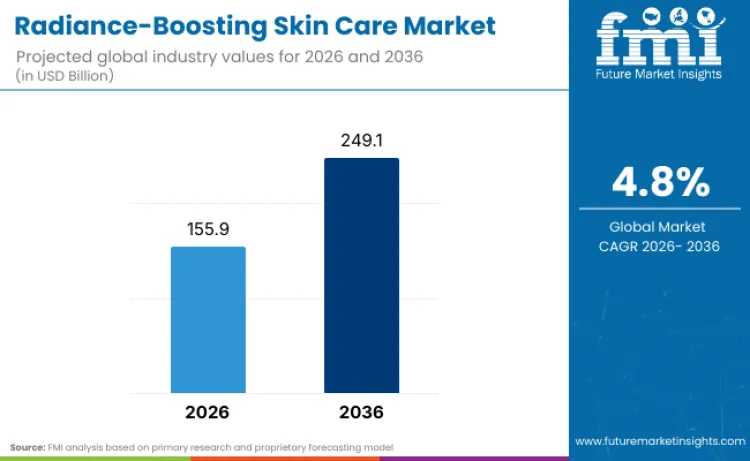
The global radiance-boosting skin care market is projected to reach a valuation of USD 155.9 billion in 2026 and expand to USD 249.1 billion by 2036, registering a steady 4.80% CAGR over the forecast period. Demand for radiance-boosting skincare, as per Future Market Insights, is being driven by a structural shift from corrective beauty routines toward preventive, longevity-oriented skin health strategies, where brightness, tone uniformity, and cellular vitality are positioned as long-term outcomes rather than short-term cosmetic effects.
Leading beauty conglomerates are actively reshaping their portfolios around skin biology, longevity science, and early intervention models. Nicolas Hieronimus, CEO of L'Oréal, articulated this strategic pivot by stating that the group will "play a quintessential role in the democratisation of longevity, empowering consumers to move from corrective to preventive care via a new understanding of skin's biological age." This executive stance underscores how radiance-boosting products are evolving into daily-use longevity tools grounded in biological age markers rather than surface-level glow.
Advances in biomarker research, ingredient science, and consumer education are reinforcing this transition. Manufacturers are increasingly aligning radiance claims with clinically validated pathways such as mitochondrial health, epidermal renewal, and oxidative stress reduction, positioning the category as a core pillar of modern preventive skincare rather than an optional enhancement segment.
Summary of Radiance-Boosting Skin Care Market
What Is Growth Outlook for Radiance-Boosting Skin Care Market as per Future Market Insights Projection?
Future Market Insights projects the radiance-boosting skin care market to expand at a CAGR of 4.8% from 2026 to 2036, increasing from USD 155.9 Billion in 2026 to USD 249.1 Billion by 2036.
FMI Research Approach: FMI proprietary forecasting model based on preventive skincare adoption, ingredient-led radiance demand, and longevity-focused beauty consumption trends.
How Do FMI Analysts Perceive Radiance-Boosting Skin Care Market to Evolve?
FMI analysts perceive the market evolving from cosmetic glow enhancement toward preventive, longevity-driven skin health, where radiance is linked to biological age and cellular vitality.
FMI Research Approach: Analysis of biomarker-based skincare innovation, longevity science integration, and preventive beauty positioning.
Which Country Holds Largest Share in Global Radiance-Boosting Skin Care Market?
China holds a significant share of the global radiance-boosting skin care market, supported by high demand for brightening actives and regulatory approval of advanced whitening ingredients.
FMI Research Approach: FMI country-level revenue modeling by ingredient approval pipelines, digital beauty penetration, and pigmentation-related demand.
How Large Will Radiance-Boosting Skin Care Market Be by 2036?
The global radiance-boosting skin care market is projected to reach USD 249.1 Billion by 2036.
FMI Research Approach: FMI long-term revenue forecast derived from serum-led consumption, premiumization, and preventive skincare uptake.
What Is Definition of Radiance-Boosting Skin Care Market?
The radiance-boosting skin care market comprises skincare products formulated to improve skin brightness, tone uniformity, and clarity through biologically active and clinically validated ingredients.
FMI Research Approach: FMI market taxonomy and inclusion-exclusion framework aligned with radiance and brightening skincare classifications.
What Are Globally Unique Trends Shaping Radiance-Boosting Skin Care Market?
Globally unique trends include vitamin C dominance, AI-driven skin assessment, and the shift toward longevity-based radiance science.
FMI Research Approach: Ingredient innovation tracking, regulatory substantiation analysis, and AI-enabled personalization adoption.
Radiance-Boosting Skin Care Market Key Takeaways
| Metric | Details |
|---|---|
| Industry Size (2026) | USD 155.9 Billion |
| Industry Value (2036) | USD 249.1 Billion |
| CAGR (2026-2036) | 4.8% |
Source: Future Market Insights (FMI) analysis, based on proprietary forecasting model and primary research
Which Factors Drive Radiance-Boosting Skin Care Adoption?
Radiance-boosting skin care adoption is being accelerated by growing consumer fatigue with complex, time-intensive routines and a clear shift toward high-efficiency products that deliver multiple benefits in a single step. As skincare regimens become more science-led, brands are under pressure to replace the traditional "10-step routine" with streamlined, performance-driven serums that address brightness, tone correction, and skin longevity simultaneously without compromising efficacy.
This demand for speed and relevance is reshaping innovation priorities across prestige beauty. Stéphane de La Faverie, CEO of The Estée Lauder Companies, confirmed this strategic pivot during the Q2 2025 earnings call, stating: "We aim to deliver fast to market, on trend innovation with an eye towards in demand subcategories, benefits and occasions." This emphasis highlights how rapid commercialization of biomarker-backed actives is becoming a competitive necessity rather than a differentiator.
The integration of scientific biomarkers into formulation design enables brands to concentrate radiance, repair, and preventive benefits into fewer products, increasing consumer adherence and purchase frequency. As a result, radiance-boosting serums are evolving from optional enhancers into foundational, high-velocity products within modern prestige skincare routines.
How is the Radiance-Boosting Skin Care Market Segmented?
The radiance-boosting skin care market is segmented by product type, ingredient profile, distribution channel, end user, and region to reflect the diverse ways consumers pursue skin brightness, tone uniformity, and visible vitality. By product type, the market includes radiance and brightening creams, serums with radiance actives such as vitamin C, exfoliating radiance masks, toners and essences, radiance-boosting cleansers, and multifunctional sunscreens with glow-enhancing benefits that serve as the primary daily-use interface. By ingredient profile, demand is structured around vitamin C and derivatives, niacinamide, alpha arbutin, tranexamic acid, peptides, antioxidants, and botanical extracts, reflecting the shift toward biologically active brightening pathways rather than optical effects alone.
By distribution channel, adoption is led by e-commerce platforms, followed by specialty beauty retail, department stores, pharmacies, and mass retail formats. By end user, women represent the largest consumer group, while men and unisex positioning are gaining traction through minimalist and performance-led routines.
FMI analysis suggests that while innovation cycles are accelerating rapidly, the market remains anchored in trusted ingredient science, highlighting a dual-track structure where fast-moving trend products coexist with clinically validated, long-term radiance solutions.
Why do Radiance / Brightening Creams hold a Dominant Share?
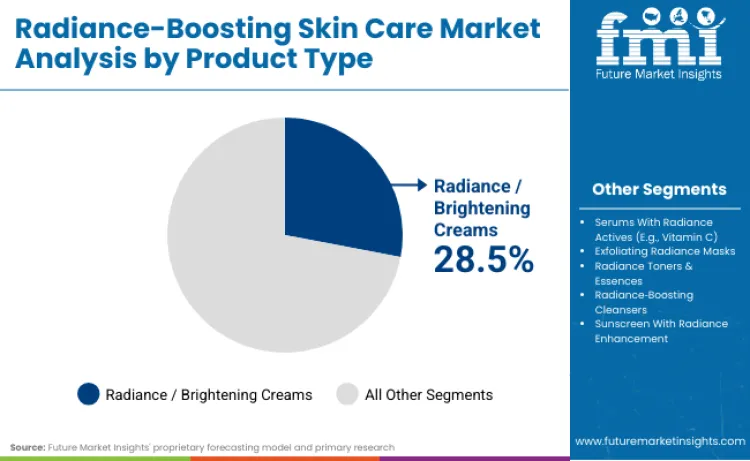
Radiance and brightening creams command a dominant 28.5% share because they remain the most trusted and accessible format for delivering visible tone correction, daily luminosity, and long-term pigmentation control within established skincare routines. Leading dermocosmetic players continue to defend this position by anchoring cream-based formulations around patented, high-efficacy actives that deliver clinically measurable results rather than short-lived cosmetic glow. This professional-grade loyalty protects the segment from displacement by generic "clean beauty" trends, as consumers increasingly prioritize proven molecules such as Thiamidol for sustained radiance outcomes.
Beiersdorf AG reinforced this scaling strategy during its Q1 2025 earnings call. Vincent Warnery, CEO of Beiersdorf, explained how these high-performance ingredients are now being expanded beyond derma channels: "Following the successful Eucerin launch in October 2024, the NIVEA rollout brings our hero ingredient to the mass market, supported by tailored formats with smaller, more affordable packaging to meet local consumer needs." This ability to translate patented science into everyday cream formats preserves category dominance while broadening mass-market penetration.
Why do Vitamin C & Derivatives Dominate Ingredient Adoption?
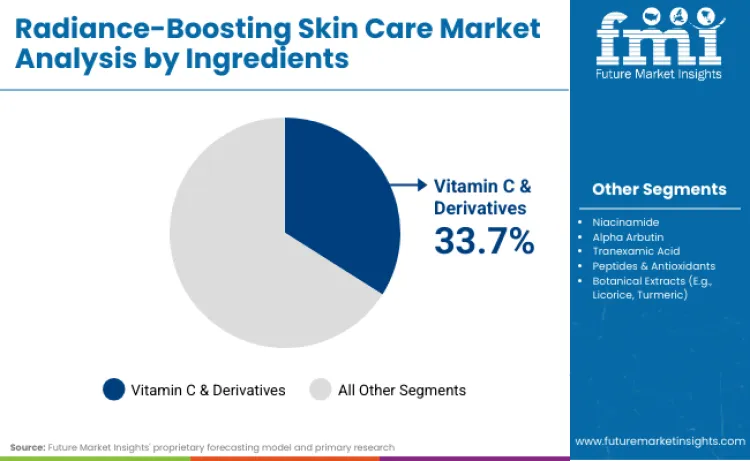
Vitamin C and its derivatives lead the radiance-boosting skin care market with a dominant 33.70% share, as they are clinically recognized for delivering early, visible improvements in brightness, tone uniformity, and oxidative stress protection. Market dynamics increasingly confirm that "early is everything" for radiance outcomes, pushing consumers toward preventive daily actives rather than corrective treatments later in life. Brands are responding by scaling Vitamin C-based formulations across accessible, high-frequency formats such as serums and boosters to capture younger users at the entry stage of their skincare journey.
This early-adoption strategy is reinforced by distribution expansion. The Estée Lauder Companies highlighted this shift in its Fiscal 2025 Full Year Results, stating: "Scaled distribution of The Ordinary in fiscal 2025, including launches in Amazon’s USA Premium Beauty store and on TikTok Shop in the UK, along with geographic expansion in Thailand, mainland China, Turkey, and, in the fourth quarter, in Brazil." These dynamics position Vitamin C as the cornerstone ingredient driving sustained growth in radiance-focused skincare.
Why Is AI-Driven Skin Assessment Reshaping Radiance and Longevity Care?
Artificial intelligence is fundamentally reshaping radiance and longevity skincare by replacing subjective consumer perception with quantifiable, high-resolution skin data captured through advanced optical and algorithmic systems. Shiseido has demonstrated this shift by developing optical measurement technologies that visualize subsurface light behavior, proving that machines can detect skin translucency and structural markers invisible to the human eye. By analyzing how different light wavelengths penetrate the epidermis, basement membrane, dermis, and collagen layer, AI enables precise evaluation of radiance, clarity, and aging drivers. This transition allows consumers to move from trial-and-error product selection to data-driven skincare decisions, accelerating adoption of performance-oriented radiance products aligned with measurable skin biology rather than surface appearance alone.
How Is Physiological Biomarker Commercialization Changing Skin Care Practice?
Radiance skincare is rapidly pivoting from visual assessment toward biological and cellular measurement as brands commercialize physiological biomarkers at scale. L'Oréal validated this shift with SkinConsult AI and Cell BioPrint, platforms that decode biological aging and skin strength within minutes. Barbara Lavernos, Deputy CEO at L’Oréal, described this breakthrough: "L'Oréal Cell BioPrint produces a personalized skin assessment in minutes including skin’s biological age and provides personalized advice on how to slow down the appearance of aging." This move transforms radiance from a cosmetic outcome into a measurable longevity indicator, enabling faster, more precise personalization of brightening and tone-correcting regimens grounded in cellular data rather than surface glow.
What Role Does Regulatory Maturation Play in Innovation and Commercial Scale?
Regulatory maturation is stabilizing investment and innovation in radiance-boosting skincare by enforcing rigorous safety substantiation and data integrity standards. Frameworks such as MoCRA are eliminating unverified ingredient proliferation and ensuring that only clinically substantiated brightening actives reach the market. Beiersdorf AG highlighted how regulatory clearance acts as a catalyst for scale, noting that following approval by China’s NMPA, Eucerin Thiamidol Serum achieved rapid commercial success in the domestic market. This regulatory clarity lowers commercialization risk for high-fidelity labs, accelerates global rollout of proven radiance actives, and reinforces consumer trust in longevity-driven skincare innovation.
What is the Radiance-Boosting Skin Care Market Regional Outlook?
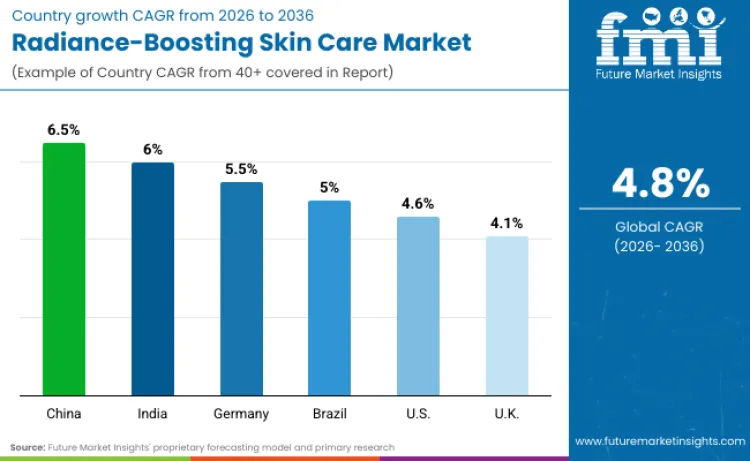
The radiance-boosting skin care market is characterized by uneven regional momentum, where emerging economies are outpacing the global average by expanding access to brightening actives and preventive skin longevity solutions, while mature markets focus on premiumization and ingredient sophistication. Although the global market grows at a 4.80% CAGR, Asia-Pacific regions are leading expansion due to rising middle-class consumption, pollution-driven pigmentation concerns, and rapid digital beauty penetration. China anchors this growth at a 6.5% CAGR, followed closely by India (6.0%), as consumers increasingly adopt vitamin C-based and multi-benefit radiance serums as part of daily routines.
In contrast, developed markets show measured but resilient growth driven by innovation rather than volume. Germany (5.5%) and Brazil (5.0%) benefit from pharmacy trust and climate-driven pigmentation needs, while the United States (4.6%) and United Kingdom (4.1%) emphasize longevity science, premium serums, and dermatologist-endorsed formulations. FMI analysis indicates that future growth will be led by Asia-led access expansion, while Western markets sustain value through advanced actives and high-engagement distribution channels.
| Country | CAGR (2026 to 2036) |
|---|---|
| China | 6.5% |
| India | 6.0% |
| Germany | 5.5% |
| Brazil | 5.0% |
| United States | 4.6% |
| United Kingdom | 4.1% |
Source: Future Market Insights (FMI) historical analysis and forecast data
Why is the India Government Standardizing Safety Protocols?
India is expanding at a 6.0% CAGR, driven by regulatory standardization that is formally restructuring the radiance-boosting skin care sector. The Cosmetics (Amendment) Rules, 2025, enforced by the Ministry of Health and Family Welfare, transition the industry from a fragmented, manual compliance system into a digital, state-level enforcement framework. This mandates batch-wise safety substantiation, ingredient traceability, and documentation for radiance and brightening claims, sharply reducing unverified formulations in the market.
The Ministry confirmed this shift in July 2025, stating that the reforms support consumer safety, transparency, and legitimate domestic innovation while strengthening export readiness. FMI analysis indicates that these rules incentivize multinational brands to localize compliant manufacturing and clinical testing in India, accelerating premium dermocosmetic penetration. As enforcement tightens, smaller informal players are being phased out, while science-backed radiance products gain consumer trust. This regulatory formalization positions India as a structurally safer, faster-growing radiance market anchored in verified efficacy rather than marketing-led claims.
How is China Deploying High-Efficacy Ingredient Infrastructure?
China anchors global growth at a 6.5% CAGR, fueled by a regulatory roadmap that prioritizes approval of New Cosmetic Ingredients (NCI) through the National Medical Products Administration. Unlike earlier frameworks focused on volume approvals, the NMPA now favors high-potency whitening and radiance actives that demonstrate superior efficacy alongside strict toxicological safety. This policy shift is accelerating the commercialization of next-generation brightening compounds while raising entry barriers for low-efficacy formulations.
The NMPA validated this direction through recent approvals, emphasizing that safety remains the top priority in ingredient evaluation while providing clarity for future registrations. FMI analysis shows that this environment attracts global R&D investment into China-specific radiance formulations, including localized serums and essence-based systems. As a result, China is evolving into a high-precision innovation hub where regulatory clearance acts as a commercial accelerant. Brands that secure early NCI approvals gain rapid scale, reinforcing China’s role as the epicenter of advanced radiance science.
Why is Brazil Focusing on Cosmetovigilance and Safety Compliance?
Brazil is growing at a 5.0% CAGR, driven by ANVISA’s enforcement of RDC 894/2024, which mandates a comprehensive Cosmetovigilance System for all cosmetic companies. This regulation requires brands to actively monitor, investigate, and assess adverse reactions, particularly for radiance and skin-lightening products that historically carried higher risk profiles. Unlike passive compliance regimes, Brazil’s system enforces real-time safety accountability across the product lifecycle.
ANVISA clarified that the system exists to protect human health by enabling timely corrective action when risks emerge. FMI analysis indicates that this epidemiological tracking is reshaping competitive dynamics, favoring brands with clinical infrastructure and post-market surveillance capabilities. As consumer awareness rises, safety transparency is becoming a purchasing driver rather than a regulatory burden. Brazil is consequently transitioning from a marketing-led radiance market to one anchored in verified safety and quality-of-life outcomes, reinforcing durable demand even amid economic volatility.
How is the US Market Maturing Around MoCRA Enforcement?
The United States maintains a 4.6% CAGR, characterized by full operationalization of the Modernization of Cosmetics Regulation Act (MoCRA). In 2025, the regulatory bottleneck shifted from basic registration to mandatory Safety Substantiation and Good Manufacturing Practices, forcing radiance brands to present clinical-grade evidence supporting brightening and tone-correction claims. This has significantly raised compliance costs but stabilized long-term market credibility.
The FDA confirmed the scale of compliance in early 2025, reporting over 9,500 active facility registrations and nearly 590,000 product listings. FMI analysis shows that MoCRA is accelerating market consolidation, advantaging large, science-backed players while eliminating non-compliant brands. As a result, USA radiance growth is now value-driven rather than volume-led, with consumers prioritizing longevity, barrier repair, and biologically validated glow. The regulatory framework has effectively transformed radiance skincare into a semi-medicalized category focused on proof, safety, and sustained performance.
Why is Germany the Lead Hub for Pharmacy-Grade Radiance Innovation?
Germany is expanding at a 5.5% CAGR, anchored by a pharmacy-dominated distribution model and one of Europe’s most restrictive ingredient safety environments. German consumers strongly prioritize clinical verification, making the market a proving ground for high-performance radiance technologies rather than trend-driven formulations. Regulatory pressure is steadily eliminating high-risk whitening agents, redirecting innovation toward epigenetic and cellular repair pathways.
Beiersdorf AG confirmed this shift in its H1 2025 results, highlighting the dominance of Eucerin’s Epigenetic Serum powered by Epicelline®. FMI analysis indicates that Germany functions as the global validation hub where pharmacy-grade success precedes international rollout. Brands that achieve leadership here gain disproportionate credibility across Europe and Latin America. Growth remains steady and defensible, reinforced by pharmacist trust, aging demographics, and demand for radiance solutions that deliver both brightness and longevity benefits.
How is the UK Pivoting to Science-Backed Glow and Body Radiance?
The United Kingdom is growing at a 4.1% CAGR, shaped by a "skin-first" consumer mindset that prioritizes clinically proven performance over routine complexity. Demand is shifting toward radiance toners, essences, and body glow solutions influenced by K-beauty science, particularly rice-based and milky formulations with barrier-support properties. Retailers such as Lookfantastic and Boots are amplifying this trend through education-led merchandising.
Lucy Gorman, CEO of THG Beauty, noted in early 2026 that consumers increasingly value performance, versatility, and reliable results over multi-step routines. FMI analysis indicates that the UK market is redefining radiance as a measurable outcome linked to skin health rather than cosmetic brightness alone. This shift supports premium pricing for science-backed products and positions the UK as a bridge market where Asian formulation logic converges with European regulatory rigor.
How is the Competition in the Radiance-Boosting Skin Care Market?
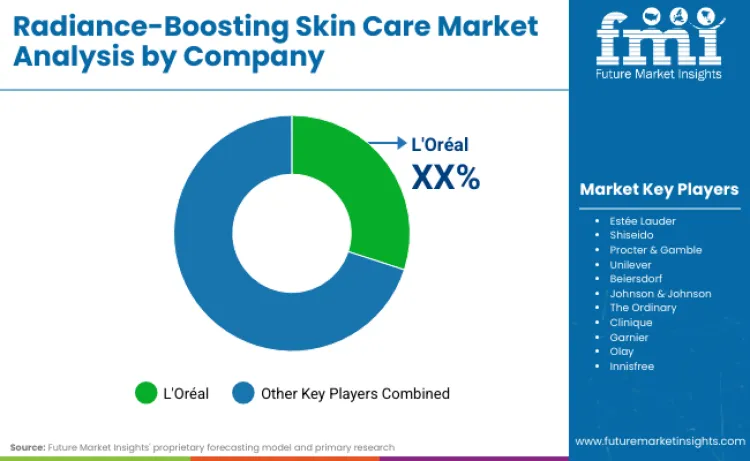
Established global players continue to protect their leadership through scale, distribution dominance, and science-led brand portfolios, but the competitive landscape is rapidly evolving. Startups and "masstige" brands are challenging this dominance by securing direct consumer engagement through social-first platforms and by demonstrating what industry leaders describe as "irresistible superiority" in product efficacy. This shift is moving competition away from heritage-led branding toward measurable performance and speed-to-market, particularly in high-growth emerging economies.
Large incumbents are responding by recalibrating their portfolios around premiumisation and proven science. Unilever has redefined its competitive front by concentrating resources on 30 Power Brands designed to capture premium demand at scale. Fernando Fernandez, CEO of Unilever, articulated this new reality in September 2025, stating: "India is the other anchor of our business, the only large exponential volume growth opportunity in the globe."
At the same time, Procter & Gamble is reinforcing "sustainable premiumization," with Shailesh Jejurikar, CEO of P&G, noting that prestige skincare and high-end grooming remain robust growth engines. Together, these dynamics show that competition is now defined by the ability to combine mass reach, premium science, and direct consumer relevance rather than brand legacy alone.
Recent Developments:
- In January 2026, L'Oréal Groupe introduced two new light-based beauty technologies at CES® 2026-the Light Straight + Multi-styler and an LED Face Mask. Both were recognized as Innovation Award honorees, reflecting L’Oréal’s continued focus on science-driven, personalized haircare and skincare innovation.
- In February 2025, The Estée Lauder Companies partnered with Serpin Pharma to develop longevity-focused skincare ingredients, applying anti-inflammatory SERPIN protein research to reduce skin irritation, sensitivity, and visible aging through biotech-driven cosmetic innovation.
Key Players in Radiance-Boosting Skin Care Market
- L'Oréal
- Estée Lauder
- Shiseido
- Procter & Gamble
- Unilever
- Beiersdorf
- Johnson & Johnson
- The Ordinary
- Clinique
- Garnier
- Olay
- Innisfree
Market Definition
The radiance-boosting skin care market refers to cosmetic and dermocosmetic products specifically formulated to enhance skin brightness, clarity, and tone uniformity while supporting long-term skin vitality. These products address concerns such as dullness, uneven pigmentation, hyperpigmentation, and early signs of aging by targeting biological pathways linked to oxidative stress, melanin regulation, and epidermal renewal. The market spans mass, masstige, premium, and dermatology-adjacent brands and includes daily-use and treatment-oriented formulations. Radiance is increasingly positioned as a marker of skin health and longevity rather than surface glow alone. Demand is driven by preventive skincare adoption, ingredient-led innovation, digital consumer education, and regulatory emphasis on safety substantiation. The market operates across online, pharmacy, specialty beauty, and mass retail channels globally.
Market Inclusion
The radiance-boosting skin care market includes creams, serums, essences, toners, masks, cleansers, and sunscreens formulated with actives that improve skin brightness and tone. Products containing ingredients such as vitamin C and derivatives, niacinamide, tranexamic acid, alpha arbutin, peptides, antioxidants, and botanical brighteners are included when positioned for radiance enhancement. The scope covers facial and body radiance products marketed to women, men, and unisex consumers, including premium and masstige brands. Distribution via e-commerce, specialty beauty retail, pharmacies, department stores, supermarkets, and dermatology-linked channels is included. Products supported by clinical testing, safety substantiation, or regulatory-compliant efficacy claims fall within scope, regardless of price tier, provided radiance improvement is a core functional objective.
Market Exclusion
The market excludes decorative cosmetics such as foundations, highlighters, powders, and color products that deliver optical brightness without biological or skincare benefit. Products positioned solely for anti-aging, moisturizing, exfoliation, acne treatment, or cleansing are excluded unless radiance enhancement is a primary claim. Prescription dermatological drugs, skin-lightening pharmaceuticals, corticosteroids, and medical depigmentation treatments regulated as drugs are not included. Oral supplements, nutricosmetics, and ingestible beauty products are excluded. Professional in-clinic aesthetic procedures, devices, and chemical peels are outside scope. Generic personal care products lacking ingredient transparency, safety substantiation, or radiance-specific positioning are excluded, as are products relying exclusively on fragrance, shimmer, or color additives to simulate glow rather than improve skin biology.
Scope of Report
| Items | Values |
|---|---|
| Quantitative Units | USD billion |
| Product Type | Radiance & Brightening Creams; Radiance Serums (Vitamin C, multi-active); Exfoliating Radiance Masks; Toners & Essences; Radiance-Boosting Cleansers; Sunscreens with Glow Enhancement |
| Ingredient Profile | Vitamin C & Derivatives; Niacinamide; Alpha Arbutin; Tranexamic Acid; Peptides & Antioxidants; Botanical Brightening Extracts |
| Distribution Channel | E-Commerce Platforms; Specialty Beauty Retail; Department Stores; Pharmacies & Drugstores; Supermarkets & Hypermarkets |
| End User | Women; Men; Unisex / All Gender |
| Technology & Science Focus | Longevity-driven brightening actives; oxidative stress reduction systems; cellular renewal boosters; biomarker-validated radiance pathways; AI-guided personalization platforms |
| Regions Covered | North America; Europe; Asia Pacific; Latin America; Middle East & Africa |
| Countries Covered | China; India; Germany; Brazil; United States; United Kingdom; Japan; South Korea; France; and 40+ additional countries |
| Key Companies Profiled | L’Oréal; Estée Lauder; Shiseido; Procter & Gamble; Unilever; Beiersdorf; Johnson & Johnson; The Ordinary; Clinique; Garnier; Olay; Innisfree |
| Additional Attributes | Dollar sales by product format and ingredient platform; clinical substantiation intensity; regulatory-driven ingredient adoption; longevity science penetration; e-commerce education-led demand; premiumization versus mass scalability dynamics |
Radiance-Boosting Skin Care Market by Segments
By Product Type:
- Radiance & Brightening Creams
- Radiance Serums with Active Brightening Ingredients (e.g., Vitamin C)
- Exfoliating Radiance Masks
- Toners & Essences
- Radiance-Boosting Cleansers
- Sunscreens with Glow Enhancement
By Ingredient Profile:
- Vitamin C & Derivatives
- Niacinamide
- Alpha Arbutin
- Tranexamic Acid
- Peptides & Antioxidants
- Botanical Brightening Extracts
By Distribution Channel:
- E-Commerce Platforms
- Specialty Beauty Retail
- Department Stores
- Pharmacies & Drugstores
- Supermarkets & Hypermarkets
By End User:
- Women
- Men
- Unisex / All Gender
By Region:
- North America
- Europe
- Asia Pacific
- Latin America
- Middle East & Africa
Bibliography
- Ministry of Health and Family Welfare, Government of India (2025). Cosmetics (Amendment) Rules, 2025: Regulatory Framework for Safety and Transparency.
- National Medical Products Administration (NMPA), China (2025). Registration and Approval of New Cosmetic Ingredients (NCI) for Whitening and Radiance.
- National Medical Products Administration (NMPA), China (2025). Registration and Approval of New Cosmetic Ingredients (NCI) for Whitening and Radiance.
Frequently Asked Questions
What is the current global market size for Radiance-Boosting Skin Care?
The global market is valued at USD 155.9 billion in 2026, driven by the shift toward preventive skin longevity, tone uniformity, and biologically validated radiance solutions.
What is the projected CAGR for the Radiance-Boosting Skin Care market?
The market is projected to grow at a 4.8% CAGR from 2026 to 2036, reflecting steady expansion anchored in ingredient science and preventive skincare adoption.
Which segment currently dominates the industry?
Radiance and brightening creams lead with a 28.5% share, while Vitamin C and its derivatives dominate ingredients with 33.7% adoption.
What are the primary drivers for adoption in emerging markets?
Rising pigmentation concerns, regulatory formalization, expanding middle-class skincare access, and rapid uptake of vitamin C–based serums in China and India are the main growth engines.
Who are the leading players in the Radiance-Boosting Skin Care space?
Key leaders include L’Oréal, Estée Lauder, Shiseido, Procter & Gamble, Unilever, Beiersdorf, Johnson & Johnson, The Ordinary, Clinique, and Garnier.
Preview the report firsthand - request a free sample
Get SampleGet the brochure for pricing and purchase details.
Get PDFTable of Content
- Executive Summary
- Global Market Outlook
- Demand Side Trends
- Supply Side Trends
- Technology Roadmap Analysis
- Analysis and Recommendations
- Market Overview
- Market Coverage / Taxonomy
- Market Definition / Scope / Limitations
- Research Methodology
- Chapter Orientation
- Analytical Lens and Working Hypotheses
- Market Structure, Signals, and Trend Drivers
- Benchmarking and Cross-market Comparability
- Market Sizing, Forecasting, and Opportunity Mapping
- Research Design and Evidence Framework
- Desk Research Programme (Secondary Evidence)
- Company Annual and Sustainability Reports
- Peer-reviewed Journals and Academic Literature
- Corporate Websites, Product Literature, and Technical Notes
- Earnings Decks and Investor Briefings
- Statutory Filings and Regulatory Disclosures
- Technical White Papers and Standards Notes
- Trade Journals, Industry Magazines, and Analyst Briefs
- Conference Proceedings, Webinars, and Seminar Materials
- Government Statistics Portals and Public Data Releases
- Press Releases and Reputable Media Coverage
- Specialist Newsletters and Curated Briefings
- Sector Databases and Reference Repositories
- FMI Internal Knowledge Base and Historical Datasets
- Subscription Datasets and Paid Sources
- Social Channels, Communities, and Digital Listening Inputs
- Additional Desk Sources
- Expert Input and Fieldwork (Primary Evidence)
- Primary Modes
- Qualitative Interviews and Expert Elicitation
- Quantitative Surveys and Structured Data Capture
- Blended Approach
- Why Primary Evidence is Used
- Field Techniques
- Interviews
- Surveys
- Focus Groups
- Observational and In-context Research
- Social and Community Interactions
- Stakeholder Universe Engaged
- C-suite Leaders
- Board Members
- Presidents and Vice Presidents
- R&D and Innovation Heads
- Technical Specialists
- Domain Subject-matter Experts
- Scientists
- Physicians and Other Healthcare Professionals
- Governance, Ethics, and Data Stewardship
- Research Ethics
- Data Integrity and Handling
- Primary Modes
- Tooling, Models, and Reference Databases
- Desk Research Programme (Secondary Evidence)
- Data Engineering and Model Build
- Data Acquisition and Ingestion
- Cleaning, Normalisation, and Verification
- Synthesis, Triangulation, and Analysis
- Quality Assurance and Audit Trail
- Market Background
- Market Dynamics
- Drivers
- Restraints
- Opportunity
- Trends
- Scenario Forecast
- Demand in Optimistic Scenario
- Demand in Likely Scenario
- Demand in Conservative Scenario
- Opportunity Map Analysis
- Product Life Cycle Analysis
- Supply Chain Analysis
- Investment Feasibility Matrix
- Value Chain Analysis
- PESTLE and Porter's Analysis
- Regulatory Landscape
- Regional Parent Market Outlook
- Production and Consumption Statistics
- Import and Export Statistics
- Market Dynamics
- Global Market Analysis 2021 to 2025 and Forecast, 2026 to 2036
- Historical Market Size Value (USD Million) Analysis, 2021 to 2025
- Current and Future Market Size Value (USD Million) Projections, 2026 to 2036
- Y-o-Y Growth Trend Analysis
- Absolute $ Opportunity Analysis
- Global Market Pricing Analysis 2021 to 2025 and Forecast 2026 to 2036
- Y-o-Y Growth Trend Analysis 2021 to 2025
- Absolute $ Opportunity Analysis 2026 to 2036
- Global Market Analysis 2021 to 2025 and Forecast 2026 to 2036, By Product Type
- Introduction / Key Findings
- Historical Market Size Value (USD Million) Analysis By Product Type, 2021 to 2025
- Current and Future Market Size Value (USD Million) Analysis and Forecast By Product Type, 2026 to 2036
- Radiance & Brightening Creams
- Radiance Serums with Active Brightening Ingredients (e.g., Vitamin C)
- Exfoliating Radiance Masks
- Toners & Essences
- Radiance-Boosting Cleansers
- Sunscreens with Glow Enhancement
- Y-o-Y Growth Trend Analysis By Product Type, 2021 to 2025
- Absolute $ Opportunity Analysis By Product Type, 2026 to 2036
- Global Market Analysis 2021 to 2025 and Forecast 2026 to 2036, By Ingredient Profile
- Introduction / Key Findings
- Historical Market Size Value (USD Million) Analysis By Ingredient Profile, 2021 to 2025
- Current and Future Market Size Value (USD Million) Analysis and Forecast By Ingredient Profile, 2026 to 2036
- Vitamin C & Derivatives
- Niacinamide
- Alpha Arbutin
- Tranexamic Acid
- Peptides & Antioxidants
- Botanical Brightening Extracts
- Y-o-Y Growth Trend Analysis By Ingredient Profile, 2021 to 2025
- Absolute $ Opportunity Analysis By Ingredient Profile, 2026 to 2036
- Global Market Analysis 2021 to 2025 and Forecast 2026 to 2036, By Distribution Channel
- Introduction / Key Findings
- Historical Market Size Value (USD Million) Analysis By Distribution Channel, 2021 to 2025
- Current and Future Market Size Value (USD Million) Analysis and Forecast By Distribution Channel, 2026 to 2036
- E-Commerce Platforms
- Specialty Beauty Retail
- Department Stores
- Pharmacies & Drugstores
- Supermarkets & Hypermarkets
- Y-o-Y Growth Trend Analysis By Distribution Channel, 2021 to 2025
- Absolute $ Opportunity Analysis By Distribution Channel, 2026 to 2036
- Global Market Analysis 2021 to 2025 and Forecast 2026 to 2036, By End User
- Introduction / Key Findings
- Historical Market Size Value (USD Million) Analysis By End User, 2021 to 2025
- Current and Future Market Size Value (USD Million) Analysis and Forecast By End User, 2026 to 2036
- Women
- Men
- Unisex / All Gender
- Y-o-Y Growth Trend Analysis By End User, 2021 to 2025
- Absolute $ Opportunity Analysis By End User, 2026 to 2036
- Global Market Analysis 2021 to 2025 and Forecast 2026 to 2036, By Region
- Introduction
- Historical Market Size Value (USD Million) Analysis By Region, 2021 to 2025
- Current Market Size Value (USD Million) Analysis and Forecast By Region, 2026 to 2036
- North America
- Latin America
- Western Europe
- Eastern Europe
- East Asia
- South Asia and Pacific
- Middle East & Africa
- Market Attractiveness Analysis By Region
- North America Market Analysis 2021 to 2025 and Forecast 2026 to 2036, By Country
- Historical Market Size Value (USD Million) Trend Analysis By Market Taxonomy, 2021 to 2025
- Market Size Value (USD Million) Forecast By Market Taxonomy, 2026 to 2036
- By Country
- USA
- Canada
- Mexico
- By Product Type
- By Ingredient Profile
- By Distribution Channel
- By End User
- By Country
- Market Attractiveness Analysis
- By Country
- By Product Type
- By Ingredient Profile
- By Distribution Channel
- By End User
- Key Takeaways
- Latin America Market Analysis 2021 to 2025 and Forecast 2026 to 2036, By Country
- Historical Market Size Value (USD Million) Trend Analysis By Market Taxonomy, 2021 to 2025
- Market Size Value (USD Million) Forecast By Market Taxonomy, 2026 to 2036
- By Country
- Brazil
- Chile
- Rest of Latin America
- By Product Type
- By Ingredient Profile
- By Distribution Channel
- By End User
- By Country
- Market Attractiveness Analysis
- By Country
- By Product Type
- By Ingredient Profile
- By Distribution Channel
- By End User
- Key Takeaways
- Western Europe Market Analysis 2021 to 2025 and Forecast 2026 to 2036, By Country
- Historical Market Size Value (USD Million) Trend Analysis By Market Taxonomy, 2021 to 2025
- Market Size Value (USD Million) Forecast By Market Taxonomy, 2026 to 2036
- By Country
- Germany
- UK
- Italy
- Spain
- France
- Nordic
- BENELUX
- Rest of Western Europe
- By Product Type
- By Ingredient Profile
- By Distribution Channel
- By End User
- By Country
- Market Attractiveness Analysis
- By Country
- By Product Type
- By Ingredient Profile
- By Distribution Channel
- By End User
- Key Takeaways
- Eastern Europe Market Analysis 2021 to 2025 and Forecast 2026 to 2036, By Country
- Historical Market Size Value (USD Million) Trend Analysis By Market Taxonomy, 2021 to 2025
- Market Size Value (USD Million) Forecast By Market Taxonomy, 2026 to 2036
- By Country
- Russia
- Poland
- Hungary
- Balkan & Baltic
- Rest of Eastern Europe
- By Product Type
- By Ingredient Profile
- By Distribution Channel
- By End User
- By Country
- Market Attractiveness Analysis
- By Country
- By Product Type
- By Ingredient Profile
- By Distribution Channel
- By End User
- Key Takeaways
- East Asia Market Analysis 2021 to 2025 and Forecast 2026 to 2036, By Country
- Historical Market Size Value (USD Million) Trend Analysis By Market Taxonomy, 2021 to 2025
- Market Size Value (USD Million) Forecast By Market Taxonomy, 2026 to 2036
- By Country
- China
- Japan
- South Korea
- By Product Type
- By Ingredient Profile
- By Distribution Channel
- By End User
- By Country
- Market Attractiveness Analysis
- By Country
- By Product Type
- By Ingredient Profile
- By Distribution Channel
- By End User
- Key Takeaways
- South Asia and Pacific Market Analysis 2021 to 2025 and Forecast 2026 to 2036, By Country
- Historical Market Size Value (USD Million) Trend Analysis By Market Taxonomy, 2021 to 2025
- Market Size Value (USD Million) Forecast By Market Taxonomy, 2026 to 2036
- By Country
- India
- ASEAN
- Australia & New Zealand
- Rest of South Asia and Pacific
- By Product Type
- By Ingredient Profile
- By Distribution Channel
- By End User
- By Country
- Market Attractiveness Analysis
- By Country
- By Product Type
- By Ingredient Profile
- By Distribution Channel
- By End User
- Key Takeaways
- Middle East & Africa Market Analysis 2021 to 2025 and Forecast 2026 to 2036, By Country
- Historical Market Size Value (USD Million) Trend Analysis By Market Taxonomy, 2021 to 2025
- Market Size Value (USD Million) Forecast By Market Taxonomy, 2026 to 2036
- By Country
- Kingdom of Saudi Arabia
- Other GCC Countries
- Turkiye
- South Africa
- Other African Union
- Rest of Middle East & Africa
- By Product Type
- By Ingredient Profile
- By Distribution Channel
- By End User
- By Country
- Market Attractiveness Analysis
- By Country
- By Product Type
- By Ingredient Profile
- By Distribution Channel
- By End User
- Key Takeaways
- Key Countries Market Analysis
- USA
- Pricing Analysis
- Market Share Analysis, 2025
- By Product Type
- By Ingredient Profile
- By Distribution Channel
- By End User
- Canada
- Pricing Analysis
- Market Share Analysis, 2025
- By Product Type
- By Ingredient Profile
- By Distribution Channel
- By End User
- Mexico
- Pricing Analysis
- Market Share Analysis, 2025
- By Product Type
- By Ingredient Profile
- By Distribution Channel
- By End User
- Brazil
- Pricing Analysis
- Market Share Analysis, 2025
- By Product Type
- By Ingredient Profile
- By Distribution Channel
- By End User
- Chile
- Pricing Analysis
- Market Share Analysis, 2025
- By Product Type
- By Ingredient Profile
- By Distribution Channel
- By End User
- Germany
- Pricing Analysis
- Market Share Analysis, 2025
- By Product Type
- By Ingredient Profile
- By Distribution Channel
- By End User
- UK
- Pricing Analysis
- Market Share Analysis, 2025
- By Product Type
- By Ingredient Profile
- By Distribution Channel
- By End User
- Italy
- Pricing Analysis
- Market Share Analysis, 2025
- By Product Type
- By Ingredient Profile
- By Distribution Channel
- By End User
- Spain
- Pricing Analysis
- Market Share Analysis, 2025
- By Product Type
- By Ingredient Profile
- By Distribution Channel
- By End User
- France
- Pricing Analysis
- Market Share Analysis, 2025
- By Product Type
- By Ingredient Profile
- By Distribution Channel
- By End User
- India
- Pricing Analysis
- Market Share Analysis, 2025
- By Product Type
- By Ingredient Profile
- By Distribution Channel
- By End User
- ASEAN
- Pricing Analysis
- Market Share Analysis, 2025
- By Product Type
- By Ingredient Profile
- By Distribution Channel
- By End User
- Australia & New Zealand
- Pricing Analysis
- Market Share Analysis, 2025
- By Product Type
- By Ingredient Profile
- By Distribution Channel
- By End User
- China
- Pricing Analysis
- Market Share Analysis, 2025
- By Product Type
- By Ingredient Profile
- By Distribution Channel
- By End User
- Japan
- Pricing Analysis
- Market Share Analysis, 2025
- By Product Type
- By Ingredient Profile
- By Distribution Channel
- By End User
- South Korea
- Pricing Analysis
- Market Share Analysis, 2025
- By Product Type
- By Ingredient Profile
- By Distribution Channel
- By End User
- Russia
- Pricing Analysis
- Market Share Analysis, 2025
- By Product Type
- By Ingredient Profile
- By Distribution Channel
- By End User
- Poland
- Pricing Analysis
- Market Share Analysis, 2025
- By Product Type
- By Ingredient Profile
- By Distribution Channel
- By End User
- Hungary
- Pricing Analysis
- Market Share Analysis, 2025
- By Product Type
- By Ingredient Profile
- By Distribution Channel
- By End User
- Kingdom of Saudi Arabia
- Pricing Analysis
- Market Share Analysis, 2025
- By Product Type
- By Ingredient Profile
- By Distribution Channel
- By End User
- Turkiye
- Pricing Analysis
- Market Share Analysis, 2025
- By Product Type
- By Ingredient Profile
- By Distribution Channel
- By End User
- South Africa
- Pricing Analysis
- Market Share Analysis, 2025
- By Product Type
- By Ingredient Profile
- By Distribution Channel
- By End User
- USA
- Market Structure Analysis
- Competition Dashboard
- Competition Benchmarking
- Market Share Analysis of Top Players
- By Regional
- By Product Type
- By Ingredient Profile
- By Distribution Channel
- By End User
- Competition Analysis
- Competition Deep Dive
- L'Oréal
- Estée Lauder
- Shiseido
- Procter & Gamble
- Unilever
- Beiersdorf
- Johnson & Johnson
- The Ordinary
- Clinique
- Garnier
- Olay
- Innisfree
- Competition Deep Dive
- Assumptions & Acronyms Used


