

- Industry Size (2026)
- USD 12.3 Bn
- Forecast (2036)
- USD 32.3 Bn
- CAGR (2026 to 2036)
- 10.1%
Algae Biofuel Prospects Market Size, Market Forecast and Outlook By FMI
In 2025, the algae biofuel prospects market was valued at USD 11.2 billion. Based on Future Market Insights' analysis, demand for algae biofuels is estimated to grow to USD 12.3 billion in 2026 and USD 32.3 billion by 2036, with a CAGR of 10.1% during the forecast period. The market is set to add USD 18.1 billion in new revenue between 2026 and 2036. In plain terms, this is transformational rather than incremental growth, as the industry more than doubles its 2025 valuation over the forecast period. Growth remains steady due to decarbonization mandates, renewable fuel blending requirements, and investment in advanced bio-refineries.
Expansion is moderated by high cultivation and processing costs, energy intensity in harvesting and lipid extraction, feedstock productivity variability, and substitution pressure from conventional biodiesel, renewable diesel, and emerging green hydrogen pathways. In January 2026, the USA Department of Energy announced 15 finalists for the 2025-2027 AlgaePrize competition, aimed at advancing commercial-scale algae production for biofuels and bioproducts [1]. The program supports yield optimization and process scalability, helping de-risk early-stage technologies. As per FMI’s analysis, sustained federal backing through initiatives such as AlgaePrize strengthens commercialization pathways and reinforces long-term growth prospects for the algae biofuel ecosystem.
Summary of Algae Biofuel Prospects Market
- Market Definition
- The market evaluates the commercial outlook for algae-derived fuels and intermediates used in transportation and industrial energy systems, focusing on scalable upstream cultivation and downstream refining pathways within the Oil & Gas transition landscape.
- Demand Drivers
- Aviation decarbonization mandates are compelling airlines and refiners to secure non-food feedstock SAF pathways to meet blending and lifecycle carbon reduction targets.
- Energy companies are investing in algae platforms to convert captured CO₂ into bio-crude, supporting upstream carbon utilization and downstream renewable fuel integration.
- National biofuel and low-carbon fuel standards in the USA, EU, and Asia are incentivizing refiners to diversify beyond crop-based biodiesel toward algae-derived feedstocks.
- Key Segments Analyzed
- By Type: Microalgae accounts for approximately 61.3% share in 2025 due to higher lipid productivity and suitability for controlled cultivation systems.
- By Application: Transportation, including sustainable aviation fuel and renewable diesel pathways represent the dominant downstream conversion routes.
- By Geography: ,North America leads due to federal funding programs and SAF offtake agreements, followed by Asia-Pacific driven by industrial bioenergy expansion.
- Analyst Opinion at FMI
- Nikhil Kaitwade, principal consultant for Oil & Gas at Future Market Insights, opines, “For energy leaders, the real inflection point in algae‑based fuels will come when upstream cultivation scale and downstream refinery integration evolve as a single, synchronized system. Only by aligning biological productivity with refinery‑grade processing can the industry unlock resilient margins and position algae as a cornerstone of next‑generation low‑carbon fuel strategy.”
- Strategic Implications/Executive Takeaways
- Integrate algae cultivation pilots with existing refinery hydroprocessing assets to reduce downstream capital duplication.
- Secure long-term SAF or renewable diesel offtake contracts to de-risk upstream capacity investments.
- Prioritize yield optimization technologies in photobioreactors and fermentation systems to improve upstream economics before large-scale rollout.
- Methodology
- Capacity expansion tracking was cross-verified with refinery integration announcements and public funding disclosures.
- Demand modeling incorporated national SAF blending targets and refinery decarbonization roadmaps.
- Forecast outputs were triangulated using supply-side project databases and downstream fuel consumption benchmarks.
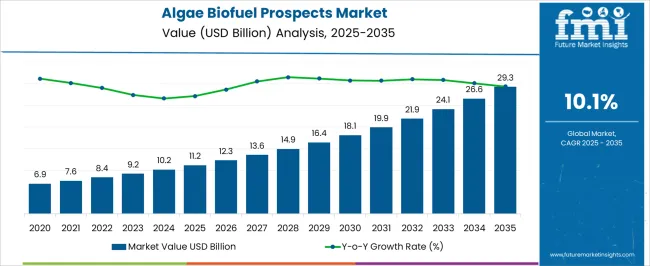
| Metric | Value |
|---|---|
| Expected Value (2026E) | USD 12.3 billion |
| Projected Value (2036F) | USD 32.3 billion |
| CAGR (2026-2036) | 10.1% |
Source: Future Market Insights-analysis driven by proprietary forecasting models and primary research
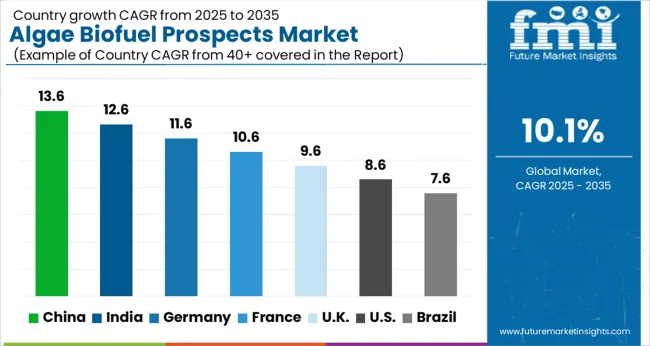
China (12.4% CAGR), is driven by state-backed carbon utilization pilots and microalgae-based industrial decarbonization programs. India (11.8% CAGR), supported by integrated bioenergy investments and pilot-scale algae-to-biocrude development under corporate net-zero commitments. Japan (11.2% CAGR), is fueled by SAF commercialization targets and industrial consortium-led algae cultivation projects. The United States (10.7% CAGR) is underpinned by federal funding initiatives such as DOE algae productivity programs and SAF blending incentives.
South Korea (10.3% CAGR) is expanding through carbon capture-linked microalgae platforms tied to hydrogen and bio-economy strategies. Germany (9.6% CAGR) is advancing through industrial biotechnology integration and EU-backed sustainable fuel mandates. The Netherlands, France, and the United Kingdom (8.5% to 9.0% CAGR range) represent mature European markets, generating replacement and technology-upgrade demand rather than rapid capacity expansion.
Segmental Analysis
Algae Biofuel Prospects Market Analysis by Product Type
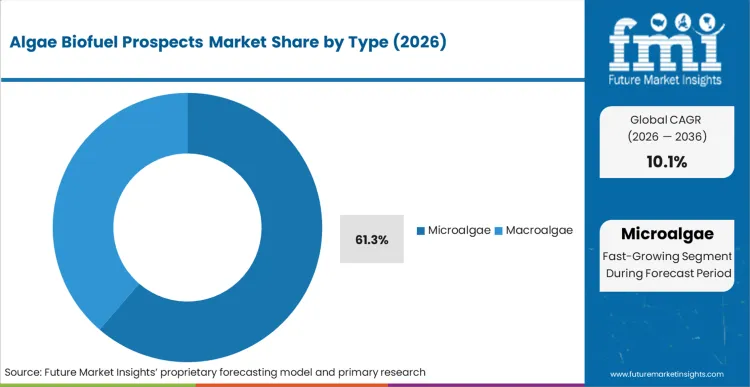
Based on FMI's algae biofuel prospects market report, consumption of microalgae is estimated to hold a 61.3% share in 2026. Microalgae dominates due to higher lipid productivity and compatibility with controlled cultivation systems, which improve feedstock consistency for hydroprocessing. For downstream refiners, this reduces input variability and improves conversion efficiency into renewable diesel and sustainable aviation fuel.
- Strategic Acquisition: In November 2025, Breakthrough Energy Ventures completed the acquisition of Viridos following its Chapter 11 restructuring, consolidating proprietary microalgae strain development under climate-focused capital [2]. This strengthens upstream genetics platforms tied to scalable fuel pathways.
- Industrial Yield Breakthrough: In April 2025, Checkerspot announced fermentation scale-up to 145 g/L using Prototheca moriformis, improving lipid productivity at industrial volumes [3]. Yield gains of this scale influence upstream cost structures and downstream blending economics.
- Cultivation Technology Advancements: Closed-loop photobioreactors and AI-driven environmental controls are increasingly being adopted by upstream producers to maximize photosynthetic efficiency and mitigate contamination risks, ensuring a more stable and commercial-scale biomass pipeline.
Algae Biofuel Prospects Market Analysis by End Use
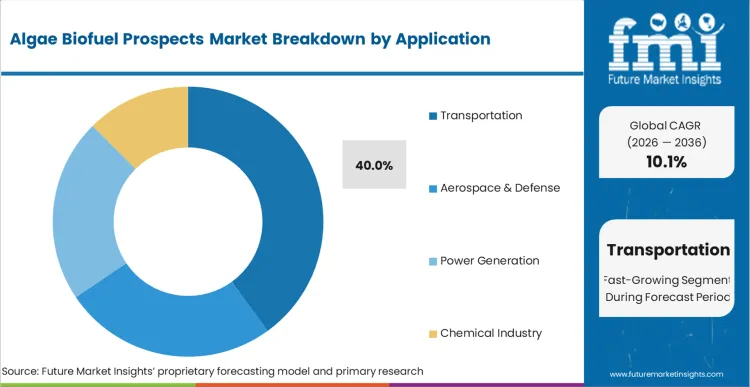
Based on FMI's algae biofuel prospects market report, transportation is estimated to hold a 40% share in 2026. Transportation leads as aviation, marine, and heavy-duty road operators seek scalable, non-food feedstocks aligned with lifecycle carbon mandates. Algae-derived fuels integrate into existing fuel logistics networks, reducing distribution friction for refiners and airlines.
- Maritime Decarbonization Pressures: As the International Maritime Organization (IMO) tightens greenhouse gas reduction targets, global shipping consortia are evaluating algae-derived marine biofuels as drop-in solutions that require zero engine modifications, expanding the end-use market beyond aviation.
- Refinery Co-processing Integration: Downstream operators are increasingly modifying existing hydrotreating infrastructure to co-process algal bio-crude alongside conventional fossil streams, minimizing capital expenditure while meeting low-carbon fuel standards.
- Portfolio Rebalancing Signal: In February 2025, Neste announced a performance improvement program that included scaling down R&D investments in algae-based fuels and Power-to-X technologies [7]. The decision reflects ongoing cost and scalability pressures affecting transportation fuel economics.
Algae Biofuel Prospects Market Drivers, Restraints, and Opportunities
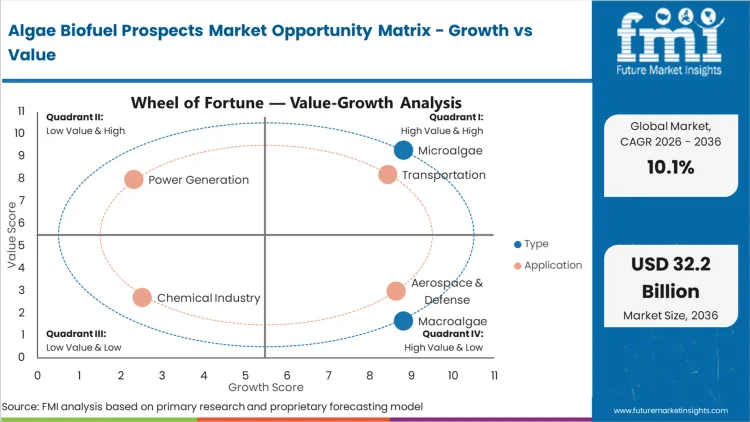
The algae biofuel prospects market remains in a structured transition phase rather than a mature commodity cycle. Historically, commercialization has been constrained by high cultivation costs and inconsistent yields, limiting deployment to pilot and demonstration scales. The current valuation reflects sustained regulatory pressure on the oil & gas sector, particularly aviation and heavy transport decarbonization mandates, which are expanding the addressable market for non-food, low-carbon feedstocks despite cost barriers.
FMI analysts observe a clear shift from research-led expansion to refinery-linked integration. Demand for first-generation crop-based biodiesel faces feedstock price volatility and land-use scrutiny, while advanced pathways such as algae-derived fuels gain policy preference. Although algae fuels command higher per-unit production costs, lifecycle carbon benefits and SAF premiums partially offset lower initial volumes, creating a value-over-volume dynamic in early commercialization stages.
- Aviation decarbonization mandates: The EU’s ReFuelEU Aviation regulation and the USA Sustainable Aviation Fuel Grand Challenge are accelerating demand for non-food SAF pathways. These policies directly favor advanced feedstocks such as algae, positioning transportation fuel blending as a primary growth engine.
- Carbon utilization integration: Energy majors are aligning algae cultivation with carbon capture projects, particularly in Asia-Pacific. China and South Korea are linking microalgae platforms with industrial CO₂ streams, enabling upstream carbon recycling tied to downstream fuel conversion.
- Capital intensity constraint: Large-scale photobioreactor deployment and harvesting systems require significant upfront investment. This structural cost barrier slows widespread adoption, keeping the market in a phased expansion cycle rather than rapid commoditization.
Regional Analysis
The regional assessment covers China, India, Japan, the United States, South Korea, Germany, the Netherlands, France, and the United Kingdom. The market is segmented geographically into North America, Asia-Pacific, and Europe, with country-level forecasts reflecting policy support, refinery integration, and biofuel deployment maturity. The full report includes comparative market attractiveness analysis across these regions and countries.
.webp "Top Country Growth Comparison Algae Biofuel Prospects Market Cagr (2026 2036)")
| Countries | Value CAGR (2026 to 2036) |
|---|---|
| China | 12.4% |
| India | 11.8% |
| Japan | 11.2% |
| USA | 10.7% |
| Germany | 9.6% |
| Netherlands | 9.0% |
| France | 8.8% |
| UK | 8.5% |
Source: Future Market Insights analysis, supported by a proprietary forecasting model and primary research
Asia-Pacific Market Analysis
Asia-Pacific functions as the upstream scale acceleration hub for algae biofuel development, combining industrial carbon capture integration with refinery expansion. China and India anchor large-scale bioenergy ambitions, while Japan focuses on aviation-linked deployment. Regional players such as Reliance Industries Limited, IHI Corporation, and Sinopec are positioning algae platforms alongside hydrogen and carbon utilization strategies to diversify low-carbon fuel portfolios.
- China: The market for algae-based fuels in China is forecast to register a CAGR of 12.4% through 2036. Growth is closely tied to the national “Dual Carbon” targets, under which Sinopec intensified microalgae-based carbon capture and biofuel pilot programs in March 2025 during its Annual Results presentation. China’s 14th Five-Year Plan framework continues to promote advanced bioenergy and CCUS integration at industrial clusters, supporting algae-linked decarbonization pathways. Unlike Western markets driven by aviation mandates, China’s model centers on state-backed industrial deployment and refinery-linked scaling.
- India: Demand for algae-derived fuels in India is estimated to expand at a CAGR of 11.8% through 2036. In May 2024, Reliance Industries Limited reported continued development of its algae-to-biocrude pilot plant and catalytic hydrothermal liquefaction technology in its FY 2023-24 Integrated Annual Report [4]. India’s National Bio-Energy Mission and emphasis on non-food feedstocks encourage diversification beyond crop-based ethanol. Private-sector refinery integration rather than government blending quotas drive growth specific to algae, positioning corporate capital expenditure as the primary expansion lever.
- Japan: Japan's algae biofuel industry is projected to witness growth at a CAGR of 11.2% through 2036. Japan’s Ministry of Economy, Trade and Industry continues to advance its Green Growth Strategy, prioritizing sustainable aviation fuel deployment. Unlike China’s state-led model, Japan’s ecosystem is consortium-driven, integrating engineering firms and aviation stakeholders under structured decarbonization roadmaps.
The comprehensive FMI report provides an in-depth analysis of the broader Asia-Pacific ecosystem, extending beyond these key players to highlight lucrative potential in South Korea and Australia. South Korea is rapidly emerging as a technology hub, with heavy corporate investment in integrating algae cultivation with existing industrial CCUS infrastructure. Australia is witnessing a steady rise in pilot projects, leveraging its vast coastlines and high solar irradiance to explore highly scalable, open-pond algae cultivation operations aimed at future export markets.
North America Market Analysis
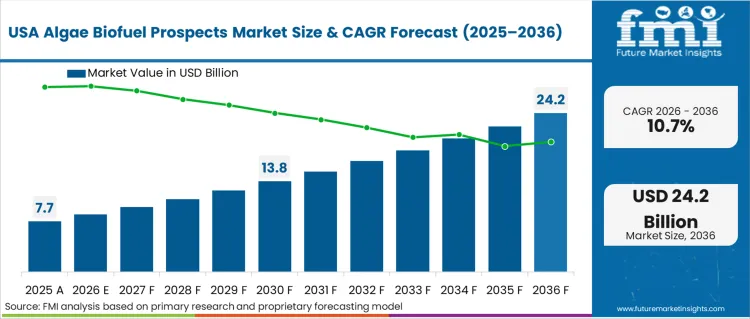
North America operates as the regulatory commercialization anchor, where federal funding and SAF incentives translate research into deployment. The United States leads innovation funding, while refinery-linked partnerships shape downstream integration. Companies such as Neste (USA operations), United Airlines, and multiple DOE-backed research consortia define competitive positioning.
- US: Algae-based fuel sales in the USA are projected to rise at a CAGR of 10.7% through 2036. In December 2024, the USA Department of Energy issued a Notice of Intent to fund USD 23 million under the SPARC and MASY programs to improve algal biomass productivity for fuel applications [6]. In January 2026, the DOE advanced commercialization support through the AlgaePrize 2025-2027 competition finalists announcement. Unlike Asia’s state-industrial integration, the USA model relies on grant-backed R&D pipelines combined with SAF procurement frameworks and Inflation Reduction Act tax incentives to stimulate private refinery adoption.
FMI’s extensive report gets in-depth on the North American landscape by analyzing additional high-potential markets like Canada and Mexico. Canada represents a highly lucrative hub driven by stringent provincial low-carbon fuel standards (such as British Columbia's LCFS), which actively pull advanced biofuels into the transport mix. Concurrently, Mexico possesses highly favorable coastal climates for year-round cultivation, positioning it as an emerging research and potential future production hub for the broader North American bio-economy.
Europe Market Analysis
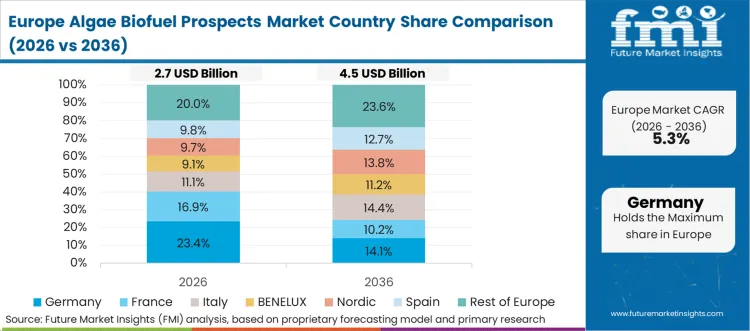
Europe acts as the policy-enforcement laboratory, where binding aviation mandates and carbon pricing mechanisms shape fuel economics. Germany anchors industrial biotechnology integration, while the Netherlands, France, and the United Kingdom represent mature replacement-demand markets. Companies such as Corbion and Neste influence downstream renewable fuel alignment within EU regulatory structures.
- Germany: Over the forecast period, algae-based fuels in Germany are set for a CAGR of 9.6% through 2036. The EU’s ReFuelEU Aviation regulation mandates increasing SAF blending across member states, directly influencing German aviation hubs. Germany’s National Hydrogen Strategy and industrial decarbonization funding programs further support algae-carbon integration research. Unlike France or the UK, Germany’s manufacturing base and export-oriented aviation sector amplify refinery-linked adoption.
- Netherlands: The Netherlands is expected to see its algae-derived fuel sector grow at a compound annual rate of 9.0% through 2036. As a major refining and logistics hub, Rotterdam supports SAF distribution under EU blending mandates. In August 2025, Corbion partnered with Kuehnle AgroSystems to commercialize algae-derived astaxanthin using fermentation platforms, reinforcing industrial biotechnology capacity. The Dutch model emphasizes logistics integration and export-oriented fuel flows.
- France: The French algae-based fuel sector is poised to expand at a CAGR of 8.8% through 2036. France implements EU SAF blending mandates through national aviation fuel policy and airport-level deployment. Public investment in bioeconomy clusters supports advanced feedstock research, though large-scale algae fuel commercialization remains limited compared to Germany’s industrial base.
- United Kingdom: The UK market for algae-derived fuels is likely to post a CAGR of 8.5% through 2036. The UK SAF Mandate framework and Jet Zero Strategy prioritize domestic production pathways. However, high capital costs and planning approvals for bio-refineries moderate near-term expansion relative to continental Europe.
FMI’s report provides an in-depth look at the wider European market, analyzing lucrative hubs outside the primary economic centers. Nordic countries, particularly Norway and Denmark, are experiencing a rise in advanced biofuel interest tied directly to their aggressive maritime decarbonization goals and strong legacy in marine biotechnology. Meanwhile, Southern European countries like Spain and Italy are recognized as potential hubs, offering ideal Mediterranean climates that lower the heating and lighting costs associated with year-round algae cultivation.
Competitive Aligners for Market Players
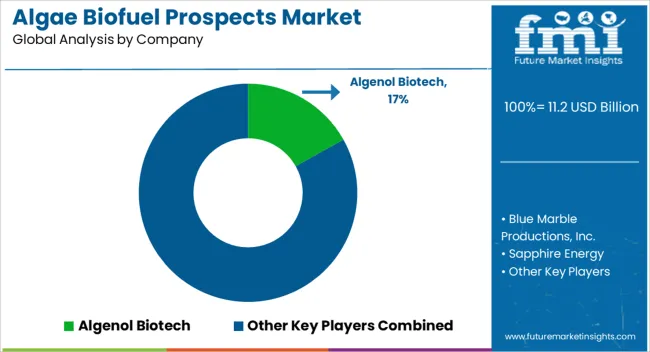
The competitive landscape for algae biofuel prospects is fragmented, with most participants operating at pilot, demonstration, or specialty-scale rather than at full commodity fuel throughput. No single producer consistently controls supply across cultivation, conversion, and distribution, so the primary competitive variable is not plant count but unit economics, measured through biomass productivity, downstream conversion yields, and the ability to secure credible offtake pathways.
Companies with structural advantage tend to win on integration and IP, not branding. Players that control strain libraries, fermentation know-how, and process analytics can push down cost per litre and reduce batch-to-batch variability, which is the main barrier for downstream refineries and fuel blenders. Firms that sit closer to end markets through partnerships, or that can allocate capacity into higher-margin co-products when fuel pricing is weak, are better insulated from the long commercialization cycle.
Buyer behaviour in this market remains procurement-led and risk-managed. Airlines, refiners, and large industrial buyers typically avoid single-supplier dependence by splitting volumes across multiple pathways and tying commitments to phased milestones. This keeps near-term pricing power with buyers, since suppliers must often prove performance, sustainability attributes, and supply reliability before contracts expand beyond limited runs.
Recent Developments
- Checkerspot partnership (Jan 2026): Checkerspot and La Fabrique Végétale announced a partnership to commercialize fermentation-derived algal oils for European personal care applications, centered on Checkerspot’s high-oleic algal oil platform and downstream formulation work in-market. This type of channel partnership supports early revenue while fuel-scale economics are still being optimized.
- Corbion restructuring (Nov 2025): Corbion unveiled its BRIGHT 2030 strategy, including a restructuring step that positions its algae activities as a more focused unit within its growth plan, reinforcing the industry move toward targeted, higher-value algae platforms while fuel pathways mature. [8]
- Pond corporate action (Oct 2025): Pond Technologies announced it entered a non-binding LOI with Find Familiar Spirits for a proposed reverse takeover, a signal of capital-market and business-model reshaping among smaller algae-linked innovators as they seek viable scaling routes. [9]
Key Players Profiled
- Algenol Biotech LLC
- Blue Marble Productions, Inc.
- Sapphire Energy, Inc.
- Culture BioSystems, Inc.
- OriginOil, Inc.
- Genifuel Corporation
- Algae Systems, LLC
- Solix BioSystems, Inc.
- Reliance Industries Limited
- AlgaEnergy, S.A.
Scope of the Report
| Metric | Value |
|---|---|
| Quantitative Units | 2026: USD 12.3 billion 2036: USD 32.3 billion CAGR (2026 to 2036): 10.1% |
| Market Definition | Market for algae-derived fuels and fuel intermediates produced from microalgae and macroalgae, processed via extraction and conversion routes into transport fuels and industrial energy/feedstock uses. |
| Type Segmentation | Microalgae; Macroalgae |
| Pathway Segmentation | Jet Fuel; Diesel; Petrol; Others |
| Application Segmentation | Transportation; Aerospace & Defense; Power Generation; Chemical Industry; Others |
| Regions Covered | North America; Europe; Asia-Pacific; Latin America; Middle East & Africa |
| Countries Covered | United States; Canada; Germany; France; United Kingdom; China; Japan; India; Brazil; South Africa |
| Key Companies Profiled | Algenol Biotech; Blue Marble Productions, Inc.; Sapphire Energy; Culture BioSystems; Origin Oils; Genifuel Corporation.; Algae Systems, LLC.; Solix; Reliance Life Sciences; AlgaEnergy |
| Forecast Period | 2026 to 2036 |
| Approach | FMI hybrid market sizing (bottom-up project and capacity signals + top-down validation against regional demand and policy drivers), supported by primary interviews and ongoing validation. |
Algae Biofuel Prospects Market Analysis by Segments
Type
- Microalgae
- Macroalgae
Pathway
- Jet Fuel
- Diesel
- Petrol
- Others
Application
- Transportation
- Aerospace & Defense
- Power Generation
- Chemical Industry
- Others
Region
- North America
- Latin America
- Europe
- Asia Pacific
- Latin America
- Middle East & Africa
Bibliography
- [1] USA Department of Energy, Office of Energy Efficiency and Renewable Energy. (2026, January 16). USA Department of Energy announces AlgaePrize 2025-2027 finalists.
- [2] Viridos. (2025, November). Company update on acquisition by Breakthrough Energy Ventures.
- [3] Checkerspot. (2025, April 28). Industrial scale-up of fermentation-based high-oleic algal oil.
- [4] Reliance Industries Limited. (2024). Integrated Annual Report FY 2023-24.
- [5] Neste. (2025, October 24). Neste extends partnership with United Airlines to bring SAF to three major airports.
- [6] USA Department of Energy, Bioenergy Technologies Office. (2024, December 27). Notice of intent to fund USD 23 million for SPARC and MASY programs.
- [7] Neste. (2025, February 13). Neste announces plans to simplify its organizational structure and operational model.
- [8] Corbion. (2025, November 20). Corbion unveils BRIGHT 2030 strategy to lead in sustainable specialty food-ingredients; outlining its strategic path and medium-term financial targets.
- [9] Pond Technologies Holdings Inc. (2025, October 28). Pond enters into letter of intent with Find Familiar Spirits in respect of a proposed reverse takeover.
This Report Addresses
- Market intelligence to enable structured strategic decision-making across mature and emerging algae biofuel markets.
- Market size estimation and 10-year revenue forecasts from 2026 to 2036, supported by validated sustainable aviation fuel mandate analysis and demonstration project pipelines.
- Growth opportunity mapping across algae types, conversion pathways, and applications with emphasis on aviation fuel and co-product integration.
- Segment and regional revenue forecasts covering transportation, aerospace and defense, and power generation applications.
- Competition strategy assessment including strain development capability, cultivation system optimization, and off-take partnership strength.
- Regulatory impact analysis covering sustainable aviation fuel mandates, renewable fuel standards, and defense procurement programs.
- Market report delivery in PDF, Excel, PPT, and interactive dashboard formats for executive and operational use.
Frequently Asked Questions
How large is the algae biofuel prospects market currently?
In 2025, the algae biofuel prospects market was valued at USD 11.2 billion.
What will the market size be in 2026?
Demand for algae biofuels is estimated to reach USD 12.3 billion in 2026.
What is the projected market value by 2036?
The market is expected to reach USD 32.3 billion by 2036.
What is the expected CAGR during the forecast period?
FMI projects a CAGR of 10.1% during the forecast period.
How much absolute revenue will the market add over the forecast period?
The market is expected to add USD 18.1 billion between 2025 and 2036.
Is this growth considered incremental or transformational?
Growth from USD 11.2 billion in 2025 to USD 32.3 billion by 2036 reflects transformational expansion rather than incremental change.
Which product type is poised to lead the market?
Microalgae is estimated to hold 61.3% share in 2025, making it the dominant product type.
How significant is the transportation segment?
Transportation is projected to account for approximately 40% share in 2026, driven by aviation and heavy-duty fuel demand.
What will demand look like in the near term?
Demand is forecast to rise from USD 11.2 billion in 2025 to USD 12.3 billion in 2026.
What will the market size be at the end of the forecast horizon?
By 2036, the algae biofuel prospects market is projected to reach USD 32.3 billion.
How fast is the market expanding compared to traditional biofuels?
With a projected CAGR of 10.1%, algae biofuels are expanding at a double-digit pace through the forecast period.
What is the base year valuation used in this study?
The base year valuation is USD 11.2 billion for 2025.
How large will the market be after the first forecast year?
In 2026, the market is expected to reach USD 12.3 billion.
What is the long-term revenue outlook for investors?
The market is projected to grow to USD 32.3 billion by 2036 at a CAGR of 10.1%.
Which segment holds the largest share today?
Microalgae leads with a 61.3% share in 2025.
How significant is early-stage expansion in monetary terms?
The increase from USD 11.2 billion in 2025 to USD 12.3 billion in 2026 reflects steady early-stage scaling.
What revenue scale can refiners expect by 2036?
Refinery-linked algae fuel pathways contribute to a projected market size of USD 32.3 billion by 2036.
How does the forecast reflect long-term structural growth?
The increase from USD 11.2 billion in 2025 to USD 32.3 billion by 2036 at a 10.1% CAGR reflects sustained structural expansion.
Preview the report firsthand - request a free sample
Get SampleGet the brochure for pricing and purchase details.
Get PDFTable of Content
- Executive Summary
- Global Market Outlook
- Demand-side Trends
- Supply-side Trends
- Technology Roadmap Analysis
- Analysis and Recommendations
- Market Overview
- Market Coverage / Taxonomy
- Market Definition / Scope / Limitations
- Research Methodology
- Chapter Orientation
- Analytical Lens and Working Hypotheses
- Market Structure, Signals, and Trend Drivers
- Benchmarking and Cross-market Comparability
- Market Sizing, Forecasting, and Opportunity Mapping
- Research Design and Evidence Framework
- Desk Research Programme (Secondary Evidence)
- Company Annual and Sustainability Reports
- Peer-reviewed Journals and Academic Literature
- Corporate Websites, Product Literature, and Technical Notes
- Earnings Decks and Investor Briefings
- Statutory Filings and Regulatory Disclosures
- Technical White Papers and Standards Notes
- Trade Journals, Industry Magazines, and Analyst Briefs
- Conference Proceedings, Webinars, and Seminar Materials
- Government Statistics Portals and Public Data Releases
- Press Releases and Reputable Media Coverage
- Specialist Newsletters and Curated Briefings
- Sector Databases and Reference Repositories
- FMI Internal Proprietary Databases and Historical Market Datasets
- Subscription Datasets and Paid Sources
- Social Channels, Communities, and Digital Listening Inputs
- Additional Desk Sources
- Expert Input and Fieldwork (Primary Evidence)
- Primary Modes
- Qualitative Interviews and Expert Elicitation
- Quantitative Surveys and Structured Data Capture
- Blended Approach
- Why Primary Evidence is Used
- Field Techniques
- Interviews
- Surveys
- Focus Groups
- Observational and In-context Research
- Social and Community Interactions
- Stakeholder Universe Engaged
- C-suite Leaders
- Board Members
- Presidents and Vice Presidents
- R&D and Innovation Heads
- Technical Specialists
- Domain Subject-matter Experts
- Scientists
- Physicians and Other Healthcare Professionals
- Governance, Ethics, and Data Stewardship
- Research Ethics
- Data Integrity and Handling
- Primary Modes
- Tooling, Models, and Reference Databases
- Desk Research Programme (Secondary Evidence)
- Data Engineering and Model Build
- Data Acquisition and Ingestion
- Cleaning, Normalisation, and Verification
- Synthesis, Triangulation, and Analysis
- Quality Assurance and Audit Trail
- Market Background
- Market Dynamics
- Drivers
- Restraints
- Opportunity
- Trends
- Scenario Forecast
- Demand in Optimistic Scenario
- Demand in Likely Scenario
- Demand in Conservative Scenario
- Opportunity Map Analysis
- Product Life Cycle Analysis
- Supply Chain Analysis
- Investment Feasibility Matrix
- Value Chain Analysis
- PESTLE and Porter’s Analysis
- Regulatory Landscape
- Regional Parent Market Outlook
- Production and Consumption Statistics
- Import and Export Statistics
- Market Dynamics
- Global Market Analysis 2021 to 2025 and Forecast, 2026 to 2036
- Historical Market Size Value (USD Million) Analysis, 2021 to 2025
- Current and Future Market Size Value (USD Million) Projections, 2026 to 2036
- Y-o-Y Growth Trend Analysis
- Absolute $ Opportunity Analysis
- Global Market Pricing Analysis 2021 to 2025 and Forecast 2026 to 2036
- Global Market Analysis 2021 to 2025 and Forecast 2026 to 2036, By Type
- Introduction / Key Findings
- Historical Market Size Value (USD Million) Analysis By Type , 2021 to 2025
- Current and Future Market Size Value (USD Million) Analysis and Forecast By Type , 2026 to 2036
- Microalgae
- Macroalgae
- Microalgae
- Y-o-Y Growth Trend Analysis By Type , 2021 to 2025
- Absolute $ Opportunity Analysis By Type , 2026 to 2036
- Global Market Analysis 2021 to 2025 and Forecast 2026 to 2036, By Application
- Introduction / Key Findings
- Historical Market Size Value (USD Million) Analysis By Application, 2021 to 2025
- Current and Future Market Size Value (USD Million) Analysis and Forecast By Application, 2026 to 2036
- Transportation
- Aerospace & Defense
- Power Generation
- Chemical Industry
- Transportation
- Y-o-Y Growth Trend Analysis By Application, 2021 to 2025
- Absolute $ Opportunity Analysis By Application, 2026 to 2036
- Global Market Analysis 2021 to 2025 and Forecast 2026 to 2036, By Region
- Introduction
- Historical Market Size Value (USD Million) Analysis By Region, 2021 to 2025
- Current Market Size Value (USD Million) Analysis and Forecast By Region, 2026 to 2036
- North America
- Latin America
- Western Europe
- Eastern Europe
- East Asia
- South Asia and Pacific
- Middle East & Africa
- Market Attractiveness Analysis By Region
- North America Market Analysis 2021 to 2025 and Forecast 2026 to 2036, By Country
- Historical Market Size Value (USD Million) Trend Analysis By Market Taxonomy, 2021 to 2025
- Market Size Value (USD Million) Forecast By Market Taxonomy, 2026 to 2036
- By Country
- USA
- Canada
- Mexico
- By Type
- By Application
- By Country
- Market Attractiveness Analysis
- By Country
- By Type
- By Application
- Key Takeaways
- Latin America Market Analysis 2021 to 2025 and Forecast 2026 to 2036, By Country
- Historical Market Size Value (USD Million) Trend Analysis By Market Taxonomy, 2021 to 2025
- Market Size Value (USD Million) Forecast By Market Taxonomy, 2026 to 2036
- By Country
- Brazil
- Chile
- Rest of Latin America
- By Type
- By Application
- By Country
- Market Attractiveness Analysis
- By Country
- By Type
- By Application
- Key Takeaways
- Western Europe Market Analysis 2021 to 2025 and Forecast 2026 to 2036, By Country
- Historical Market Size Value (USD Million) Trend Analysis By Market Taxonomy, 2021 to 2025
- Market Size Value (USD Million) Forecast By Market Taxonomy, 2026 to 2036
- By Country
- Germany
- UK
- Italy
- Spain
- France
- Nordic
- BENELUX
- Rest of Western Europe
- By Type
- By Application
- By Country
- Market Attractiveness Analysis
- By Country
- By Type
- By Application
- Key Takeaways
- Eastern Europe Market Analysis 2021 to 2025 and Forecast 2026 to 2036, By Country
- Historical Market Size Value (USD Million) Trend Analysis By Market Taxonomy, 2021 to 2025
- Market Size Value (USD Million) Forecast By Market Taxonomy, 2026 to 2036
- By Country
- Russia
- Poland
- Hungary
- Balkan & Baltic
- Rest of Eastern Europe
- By Type
- By Application
- By Country
- Market Attractiveness Analysis
- By Country
- By Type
- By Application
- Key Takeaways
- East Asia Market Analysis 2021 to 2025 and Forecast 2026 to 2036, By Country
- Historical Market Size Value (USD Million) Trend Analysis By Market Taxonomy, 2021 to 2025
- Market Size Value (USD Million) Forecast By Market Taxonomy, 2026 to 2036
- By Country
- China
- Japan
- South Korea
- By Type
- By Application
- By Country
- Market Attractiveness Analysis
- By Country
- By Type
- By Application
- Key Takeaways
- South Asia and Pacific Market Analysis 2021 to 2025 and Forecast 2026 to 2036, By Country
- Historical Market Size Value (USD Million) Trend Analysis By Market Taxonomy, 2021 to 2025
- Market Size Value (USD Million) Forecast By Market Taxonomy, 2026 to 2036
- By Country
- India
- ASEAN
- Australia & New Zealand
- Rest of South Asia and Pacific
- By Type
- By Application
- By Country
- Market Attractiveness Analysis
- By Country
- By Type
- By Application
- Key Takeaways
- Middle East & Africa Market Analysis 2021 to 2025 and Forecast 2026 to 2036, By Country
- Historical Market Size Value (USD Million) Trend Analysis By Market Taxonomy, 2021 to 2025
- Market Size Value (USD Million) Forecast By Market Taxonomy, 2026 to 2036
- By Country
- Kingdom of Saudi Arabia
- Other GCC Countries
- Turkiye
- South Africa
- Other African Union
- Rest of Middle East & Africa
- By Type
- By Application
- By Country
- Market Attractiveness Analysis
- By Country
- By Type
- By Application
- Key Takeaways
- Key Countries Market Analysis
- USA
- Pricing Analysis
- Market Share Analysis, 2025
- By Type
- By Application
- Canada
- Pricing Analysis
- Market Share Analysis, 2025
- By Type
- By Application
- Mexico
- Pricing Analysis
- Market Share Analysis, 2025
- By Type
- By Application
- Brazil
- Pricing Analysis
- Market Share Analysis, 2025
- By Type
- By Application
- Chile
- Pricing Analysis
- Market Share Analysis, 2025
- By Type
- By Application
- Germany
- Pricing Analysis
- Market Share Analysis, 2025
- By Type
- By Application
- UK
- Pricing Analysis
- Market Share Analysis, 2025
- By Type
- By Application
- Italy
- Pricing Analysis
- Market Share Analysis, 2025
- By Type
- By Application
- Spain
- Pricing Analysis
- Market Share Analysis, 2025
- By Type
- By Application
- France
- Pricing Analysis
- Market Share Analysis, 2025
- By Type
- By Application
- India
- Pricing Analysis
- Market Share Analysis, 2025
- By Type
- By Application
- ASEAN
- Pricing Analysis
- Market Share Analysis, 2025
- By Type
- By Application
- Australia & New Zealand
- Pricing Analysis
- Market Share Analysis, 2025
- By Type
- By Application
- China
- Pricing Analysis
- Market Share Analysis, 2025
- By Type
- By Application
- Japan
- Pricing Analysis
- Market Share Analysis, 2025
- By Type
- By Application
- South Korea
- Pricing Analysis
- Market Share Analysis, 2025
- By Type
- By Application
- Russia
- Pricing Analysis
- Market Share Analysis, 2025
- By Type
- By Application
- Poland
- Pricing Analysis
- Market Share Analysis, 2025
- By Type
- By Application
- Hungary
- Pricing Analysis
- Market Share Analysis, 2025
- By Type
- By Application
- Kingdom of Saudi Arabia
- Pricing Analysis
- Market Share Analysis, 2025
- By Type
- By Application
- Turkiye
- Pricing Analysis
- Market Share Analysis, 2025
- By Type
- By Application
- South Africa
- Pricing Analysis
- Market Share Analysis, 2025
- By Type
- By Application
- USA
- Market Structure Analysis
- Competition Dashboard
- Competition Benchmarking
- Market Share Analysis of Top Players
- By Regional
- By Type
- By Application
- Competition Analysis
- Competition Deep Dive
- Algenol Biotech LLC
- Overview
- Product Portfolio
- Profitability by Market Segments (Product/Age /Sales Channel/Region)
- Sales Footprint
- Strategy Overview
- Marketing Strategy
- Product Strategy
- Channel Strategy
- Blue Marble Productions, Inc.
- Sapphire Energy, Inc.
- Culture BioSystems, Inc.
- OriginOil, Inc.
- Genifuel Corporation
- Algae Systems, LLC
- Algenol Biotech LLC
- Competition Deep Dive
- Assumptions & Acronyms Used


