

- Industry Size (2026)
- USD 240 Mn
- Forecast (2036)
- USD 760 Mn
- CAGR (2026 to 2036)
- 12.2%
Algae-Polymer Bottles Market Forecast and Outlook 2026 to 2036
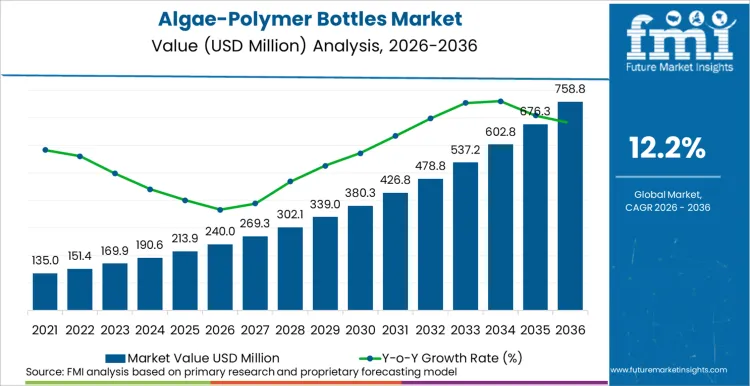
The algae-polymer bottles market revenue is likely to total USD 240 million in 2026, rising further to USD 760 million by 2036, at a CAGR of 12.2%. Future Market Insights analysis indicates this market is at an inflection point, moving from pilot-scale production and premium applications toward broader commercialization in high-volume sectors. This expansion through 2026 is supported by substantial regulatory bans on conventional plastics, significant investment in bio-industrial scaling, and growing consumer acceptance of bio-based packaging.
A pivotal driver is legislative action targeting plastic waste. The EU’s Single-Use Plastics Directive (SUPD) and its ongoing implementation phases have created a tangible market pull for compliant alternatives. Specifically, the directive’s focus on reducing plastic beverage bottles aligns directly with the functional properties of advanced algae-based polyhydroxyalkanoates (PHA) and blends, which can offer suitable barrier properties for non-carbonated beverages.
The technical trajectory is marked by partnerships bridging biotechnology and packaging engineering. In 2024, the biotechnology firm Danimer Scientific and the materials science company Loliware announced a collaborative development agreement. The partnership aims to co-develop high-performance, marine-degradable resins derived from fermented algal oils for extrusion and blow-molding bottle applications, targeting the water and functional beverage sector. This collaboration exemplifies the industry’s move to tailor material properties for specific, volume-driven applications.
Scaling production capacity is a critical focus. In its 2024 annual report, ALPLA Group, a global packaging solutions provider, detailed progress on its dedicated bio-polymer production lines. The report indicated strategic investments aimed at increasing the share of drop-in compatible bio-resins, including algae-enhanced blends, to serve the personal care and beverage packaging demands of its European brand clients seeking SUPD compliance.
Material cost reduction remains the primary challenge. The current premium for algae-based polymers over conventional PET or HDPE is significant. However, a 2025 techno-economic analysis by the European Bioplastics Association projected that achieving economies of scale through large-scale biorefineries, coupled with rising carbon credit values and plastic tax levies on virgin fossil polymers, could bridge this cost gap for targeted applications by the late 2020s.
Summary of Algae-Polymer Bottles Market
What is the Long-Term Growth Outlook for the Algae-Polymer Bottles Market?
FMI projects the global algae-polymer bottles market to expand from USD 240 million in 2026 to USD 760 million by 2036, registering a 12.2% CAGR. This robust growth reflects the convergence of regulatory pressure, technological maturation, and shifting procurement priorities among fast-moving consumer goods brands. The market is transitioning from a novel, premium solution to a viable, volume-driven alternative for specific single-use applications where biodegradability and a renewable origin are paramount value propositions.
FMI Research Approach: This projection utilizes a proprietary model integrating analysis of global plastic regulation timelines, disclosed capacity expansion plans for biopolymer producers, brand commitments to sustainable packaging, and commodity price forecasts for both algal feedstocks and conventional petrochemical resins.
How do FMI Analysts Expect the Algae-Polymer Bottles Market to Evolve Structurally?
FMI analysts anticipate a phased market evolution. Initial growth through 2030 will be concentrated in premium beverage, personal care, and niche FMCG segments where brands can absorb the green premium. Post-2030, as production scales and costs decline, penetration into high-volume, mainstream bottled water and functional beverage markets is expected to accelerate. The technology landscape will evolve from simple bio-blends toward advanced, multi-layer structures using algae-based polymers for specific barrier layers.
FMI Research Approach: Insights are derived from patent analysis in biopolymer processing, monitoring of pilot production facility announcements, and review of brand-led sustainability roadmaps that specify timelines for incorporating novel biomaterials.
Which Geographies Command Strategic Importance in the Algae-Polymer Bottles Market?
Strategic growth is concentrated in regions with aggressive regulatory frameworks and large consumer markets. The United States, Germany, and China represent the core markets, driven respectively by state-level plastic bans, the EU’s SUPD, and China’s dual-carbon policy goals. India exhibits the highest projected CAGR, fueled by its stringent new plastic waste management rules and a vast, price-conscious market that favors cost-optimized bio-processing innovations.
FMI Research Approach: Regional market sizing is based on policy analysis, domestic bio-economy investment plans, existing FMCG manufacturing density, and consumer sentiment studies regarding bio-based packaging.
What Will Be the Market Size of Algae-Polymer Bottles by 2036?
By 2036, the algae-polymer bottles market is expected to reach USD 760 million. This expansion will be sustained by the material’s potential to meet both regulatory mandates for reduced plastic waste and corporate goals for lowering Scope 3 emissions from packaging. Success hinges on overcoming current hurdles related to production cost, water barrier properties, and composting infrastructure access.
FMI Research Approach: The long-term outlook incorporates scenarios for biopolymer pricing, the rate of adoption of extended producer responsibility schemes incorporating material favorability, and the commercialization timelines for next-generation algal strains with higher polymer yields.
What are some Globally Distinct Trends Shaping the Algae-Polymer Bottles Market?
Globally, the market is shaped by the integration of carbon capture narratives, advancements in marine biodegradability certification, and the development of hybrid materials. Algae cultivation sequesters CO2, providing a powerful marketing and environmental story. Certification standards for marine and soil biodegradability are becoming crucial for credibility. Furthermore, blending algae-based polymers with other bio-polymers or minerals is key to achieving the necessary mechanical and barrier properties for bottle applications cost-effectively.
FMI Research Approach: Trend identification involves tracking life-cycle assessment publications, new certification programs from bodies like TÜV Austria (OK biodegradable MARINE), and R&D announcements on composite materials from joint ventures between algal bio-refineries and packaging converters.
Algae-Polymer Bottles Market Key Takeaways
| Metrics | Values |
|---|---|
| Expected Value (2026E) | USD 240 million |
| Projected Value (2036F) | USD 760 million |
| CAGR (2026 to 2036) | 12.2% |
Source: Future Market Insights (FMI) analysis, based on proprietary forecasting model and primary research
Why is the Algae-Polymer Bottles Market Growing?
The regulatory landscape is the most potent growth catalyst. Beyond the EU SUPD, numerous jurisdictions are implementing taxes on virgin fossil-based plastics (e.g., the UK Plastic Packaging Tax) and mandating minimum recycled or bio-based content. Algae-polymer bottles offer a compliant pathway for brands to meet these content mandates without competing directly for limited post-consumer recycled plastic streams, providing a strategic diversification in sourcing sustainable materials.
Corporate net-zero and plastic neutrality pledges are creating sustained demand pull. Major beverage and personal care corporations have publicly committed to making their packaging 100% recyclable, compostable, or reusable by specific deadlines. For applications where recycling infrastructure is unreliable or where compostability is a desired end-of-life option, algae-based bottles present a technically viable solution that aligns with these public commitments, driving R&D and pilot procurement programs.
Technological progress in algal biotechnology is improving economics and scalability. Research is focused on developing non-GMO and genetically optimized algal strains that yield higher lipid or polymer content, thrive in non-potable water, and enable cheaper harvesting methods. Simultaneously, breakthroughs in downstream processing for fermentative PHA production from algal sugars are reducing energy inputs and improving polymer purity, directly addressing two major historical cost barriers.
How is Algae-Polymer Bottles Market Segmented?
The algae-polymer bottles market segment landscape is defined by the initial focus on applications where sustainability messaging is highly valued and performance requirements can be met with current material generations. The water and functional beverage sector leads as the primary testing ground, while bottle formats dominate as the target application. Algae-based polymer blends are the predominant material choice, processed primarily through adapted extrusion and blow-molding technologies.
How is the Water and Functional Beverage Sector Driving Initial Adoption?
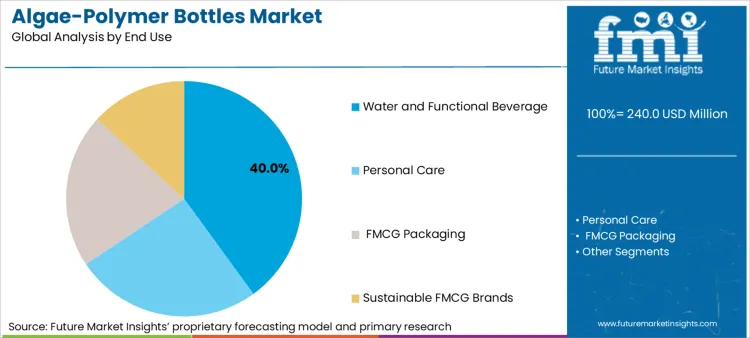
The water and functional beverage sector represents the largest end-use segment with a 40.0% share. This dominance is due to several factors: the high volume and visibility of single-use bottles in this category, intense consumer and regulatory scrutiny, and the relatively less demanding gas barrier requirements compared to carbonated soft drinks. Early brand launches, such as limited-edition water bottles for events or eco-conscious sub-brands, utilize algae-based polymers to make a definitive sustainability statement and test market acceptance.
The segment’s role as an incubator is validated by procurement strategies. Global beverage conglomerates have established dedicated sustainable packaging innovation teams that are actively engaging with biomaterial start-ups. Their primary focus is on identifying and de-risking materials that can eventually scale to meet the vast volume needs of their water portfolios, making this sector the critical bridge from lab to market.
Which Packaging Format is the Primary Focus of Material Development?
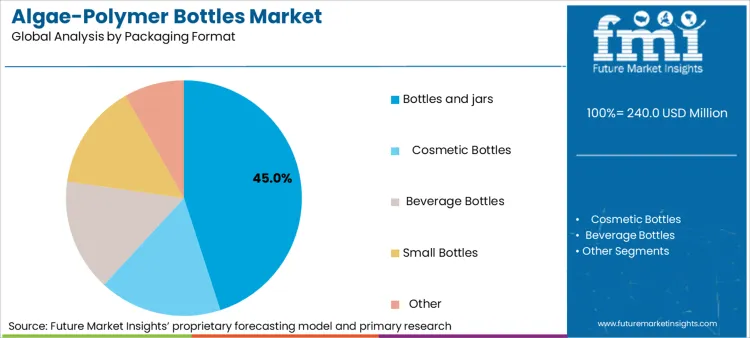
Bottles and jars constitute the largest packaging format segment with a 45.0% share. This focus is intrinsic to the material’s value proposition: replacing the most ubiquitous and problematic single-use plastic item. The technical challenge for resin developers and converters is to engineer algae-polymer blends that can reliably withstand the mechanical stresses of blow-molding, filling, capping, and distribution while maintaining clarity and shelf stability.
The format’s dominance directs R&D investment. Processing technology developers are prioritizing the adaptation of bio-polymer extrusion and blow-molding lines to handle the different melt flow and thermal characteristics of algae-based resins. Success in this format is considered the key to unlocking broader market acceptance, as it demonstrates technical parity with incumbent materials in a demanding application.
What Material Composition is Leading Current Commercial Efforts?
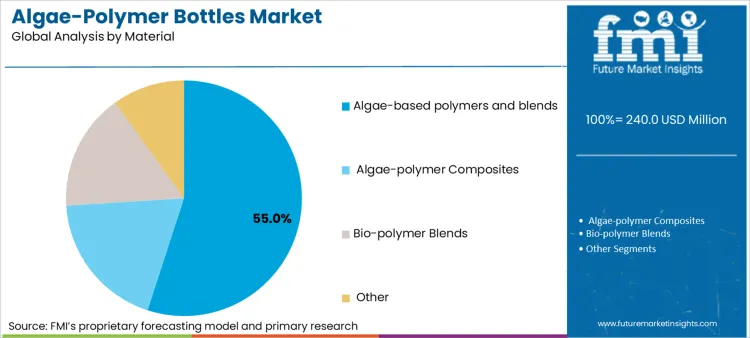
Algae-based polymers and blends form the leading material segment with a 55.0% share. Pure algae-derived polymers, such as PHA from algal fermentation, often require blending with other bio-polymers (e.g., PLA) or bio-compatible additives to achieve the necessary processability, clarity, and barrier properties for bottle applications. These blends optimize performance while maximizing the renewable, algae-based content, allowing brands to make credible claims about the bio-based origin of their packaging.
The preference for blends is an economic and technical pragmatism. It allows formulators to balance cost, performance, and biodegradability outcomes. For instance, a blend might use algae-PHA to ensure marine biodegradability while incorporating other components to improve stiffness and reduce moisture permeability, creating a fit-for-purpose material for specific bottled products.
Which Manufacturing Technology is Central to Production?
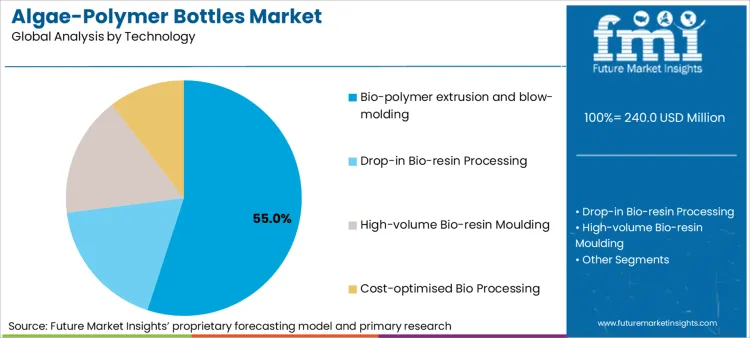
Bio-polymer extrusion and blow-molding is the dominant technology segment with a 55.0% share. This reflects the standard manufacturing process for producing plastic bottles. The industry’s challenge and focus are on adapting this widely available infrastructure to process novel bio-resins. This involves modifying screw designs in extruders for different shear sensitivity, optimizing temperature profiles to prevent degradation, and adjusting blow-molding parameters to achieve consistent wall thickness with materials that may have different melt strengths than PET.
The centrality of this technology means that compatibility with existing conversion infrastructure is a critical success factor for any new algae-polymer resin. Developers who can offer "drop-in" solutions requiring minimal retooling for bottle manufacturers will achieve faster adoption than those whose materials necessitate entirely new production lines.
What Drivers, Restraints, Opportunities, and Trends Prevail in the Algae-Polymer Bottles Market?
Market expansion is critically supported by the implementation of financial disincentives for virgin fossil plastics. Over 50 countries have now enacted some form of plastic tax or levy. These policies directly improve the cost-competitiveness of algae-based alternatives by increasing the price of the incumbent material. For corporate procurement, the total cost of ownership calculation now increasingly includes regulatory compliance costs, tipping the balance in favor of innovative biomaterials.
A fundamental restraint is the current limitation of industrial composting infrastructure. While many algae-polymers are certified as biodegradable in industrial composting facilities, the access to such facilities is highly uneven globally. Without reliable, convenient end-of-life pathways, the environmental promise of the material is compromised, and it risks being treated as contamination in recycling streams. This mismatch between material design and waste management reality poses a significant adoption hurdle.
A significant opportunity lies in leveraging algae’s carbon capture story. Algae cultivation absorbs carbon dioxide during growth. When this is coupled with life-cycle assessment methodologies that account for biogenic carbon, algae-polymer bottles can potentially offer a carbon-negative packaging solution on a cradle-to-gate basis. This powerful narrative is increasingly valuable to brands aiming for carbon neutrality and can command a premium in climate-conscious market segments.
A key technical trend is the development of multi-layer bottle structures using algae-based materials for specific functional layers. Rather than aiming for a 100% algae-based monomaterial bottle, advanced designs might use a thin inner layer of algae-PHA for food contact and biodegradability, combined with outer layers of other bio-polymers for strength and barrier. This approach optimizes performance while maximizing the utility of the algae polymer where its properties are most beneficial.
The trend toward decentralized and regionalized bio-production is gaining momentum. Instead of relying on global supply chains for feedstock, there is growing interest in cultivating algae and producing polymers locally, using regional water sources (even wastewater). This model reduces transportation emissions, supports local bio-economies, and provides a compelling "locally grown" story for brands, aligning with broader supply chain resilience goals.
Analysis of Algae-Polymer Bottles Market by Key Countries
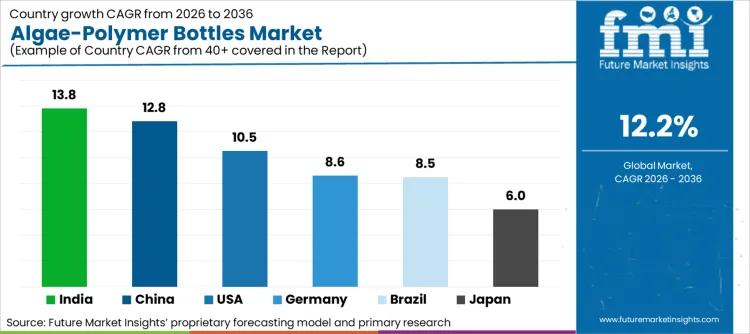
| Country | CAGR (2026-2036) |
|---|---|
| India | 13.8% |
| China | 12.8% |
| USA | 10.5% |
| Brazil | 8.5% |
| Germany | 8.6% |
| Japan | 6.0% |
Source: Future Market Insights (FMI) analysis, based on proprietary forecasting model and primary research
How are Stringent Plastic Bans and Cost Innovation Driving the Indian Market?
India is projected to expand at a 13.8% CAGR through 2036, the highest among key nations. This is propelled by the 2022 Plastic Waste Management Amendment Rules, which ban several single-use plastic items and encourage alternatives. The vast, price-sensitive Indian market favors cost-optimized bio-processing. Domestic players and research institutes are focusing on utilizing fast-growing, locally sourced algal strains and integrating production with wastewater treatment to lower feedstock costs, aiming to create an affordable algae-polymer solution for the massive domestic FMCG sector.
How is the "Dual Carbon" Goal and Industrial Policy Shaping the Chinese Market?
China’s market is growing at a 12.8% CAGR, heavily influenced by its national "Dual Carbon" (carbon peak and neutrality) strategy and the "Made in China 2025" plan for advanced materials. State-backed research initiatives and venture capital are flowing into industrial biotechnology, including algal cultivation for biofuels and materials. Domestic chemical giants are developing algae-polymer blends as part of their portfolio to serve both domestic brand sustainability mandates and for export into regulated markets like Europe, leveraging scaled manufacturing prowess.
Which Regulatory and Corporate Leadership Dynamics Define the US Market?
A patchwork of state-level regulations (e.g., California, New York) and strong corporate sustainability leadership from global brands headquartered there characterize the United States market, with a 10.5% CAGR. The absence of a unified federal plastic law has led to innovation driven by corporate procurement and voluntary commitments. The presence of leading biotechnology firms and significant venture capital investment in biomaterials creates a fertile environment for scaling startups, with initial market entry focused on premium beverage and personal care niches.
How does the EU's Regulatory Framework Steer the German Market?
Germany’s market, expanding at an 8.6% CAGR, operates within the strict framework of the EU SUPD and the German Packaging Act. German brands and retailers, with high consumer environmental awareness, are early adopters of certified sustainable packaging. The market demand is for materials that are not only bio-based but also offer clear end-of-life advantages, such as compostability under the German "Grüner Punkt" system. This favors algae-based PHAs that carry recognized compostability certifications, driving demand for high-performance, certified blends.
What Role does the Bio-Economy and Sugarcane Integration Play in Brazil?
Brazil’s market, with an 8.5% CAGR, benefits from a strong existing bio-economy centered on sugarcane ethanol. The opportunity lies in integrating algal cultivation with existing biorefinery infrastructure, using CO2 from fermentation processes to feed algae growth. This symbiotic production model can improve the overall carbon footprint and economics. Domestic resin producers are exploring hybrid blends of algae-based polymers with other well-established bio-PE from sugarcane, creating novel materials with strong regional sustainability credentials.
How do Advanced Recycling Policies Influence the Japanese Market?
Japan’s market, growing at a 6.0% CAGR, is shaped by its advanced waste management policy, which heavily emphasizes thermal recycling and mechanical recycling over biodegradability. Therefore, the adoption argument for algae-polymer bottles in Japan leans more heavily on their bio-based carbon content and potential for chemical recycling back to monomer, aligning with the national focus on circularity and resource efficiency rather than organic recovery. Material development for this market thus prioritizes compatibility with existing recycling streams.
What is the Competition Outlook for Algae-Polymer Bottles?
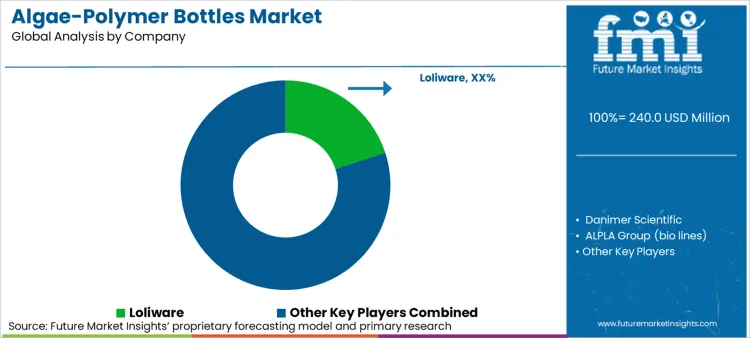
Competitive intensity is defined by the race to achieve scale, cost parity, and technical certification. The landscape features a mix of dedicated biotechnology startups specializing in algal strain development and fermentation, established chemical companies expanding into bio-based portfolios, and forward-thinking packaging converters developing processing expertise. Success requires navigating complex value chains from algal biomass cultivation to polymer synthesis, compounding, and bottle manufacturing.
Strategic partnerships are the dominant competitive mode. Biotechnology firms lack packaging market access, while large chemical and packaging companies lack novel IP. Consequently, joint development agreements, licensing deals, and equity investments are commonplace as players seek to combine strengths. The ability to form alliances with major brand owners for pilot testing and offtake agreements is particularly valuable for de-risking scale-up investments.
Key Developments
- In 2024, Danimer Scientific expanded its PHA development capabilities through the scale-up of its pilot operations in Rochester, New York, supporting process optimization and new polymer formulations for biodegradable packaging applications. While Danimer’s commercial PHA production facility remains located in Winchester, Kentucky, the company’s technology platform continues to be positioned for a range of renewable lipid feedstocks, keeping it relevant to bio-based and next-generation sustainable packaging materials used in bottles and rigid containers.
- In 2024, Loliware advanced the commercial rollout of its SEA Tech™ seaweed-derived resin platform, a bio-based and marine-degradable material system designed to replace conventional petroleum plastics. The company has positioned SEA Tech™ for scalable molded packaging applications beyond its initial foodservice formats, with rigid packaging and container concepts highlighted as part of its longer-term material roadmap.
- In 2023, ALPLA Group strengthened its commitment to circular and bio-based packaging systems by increasing investment in reusable formats and renewable material R&D, alongside its strategic involvement in fiber-based and alternative bottle platforms. This includes its majority stake in Paboco, where bio-based bottle technologies entered advanced development and early commercialization, underscoring ALPLA’s broader exploration of non-fossil polymer and hybrid material pathways relevant to algae-derived and next-generation bottle concepts.
Key Players Profiled
- Loliware
- Danimer Scientific
- ALPLA Group (bio lines)
- Kingfa Bio (subsidiary of Kingfa Sci. & Tech.)
- UFlex Limited (bio initiatives)
- Braskem (bio R&D division)
- Mitsubishi Chemical Corporation
Market Definition
The algae-polymer bottles market comprises revenue generated from the sale of bottles and jars primarily manufactured from polymers derived from algal biomass. This includes polymers directly synthesized by algae or polymers where algal oils or sugars serve as a primary feedstock for fermentation or chemical synthesis such as algal-based PHA, PLA, or bio-PET precursors. The market encompasses the value of the polymer resin tailored for bottle applications and the conversion of that resin into finished bottles.
The market scope includes rigid bottles used for water, beverages, personal care products, and certain FMCG liquids. It covers both 100% algae-based polymers and blends where algae-derived materials constitute a significant portion of the formulation. The market excludes packaging not in bottle/jar form, bio-polymers derived solely from terrestrial crops (e.g., corn, sugarcane) without algal input, and bottles made from conventional plastics with minimal algal filler content.
Scope of Report
| Items | Values |
|---|---|
| Quantitative Units | USD 240 Million |
| End-use | Water & Functional Beverages, Personal Care, FMCG Packaging, Sustainable FMCG Brands, Organic Beverages, Premium Eco Packaging |
| Packaging Format | Bottles & Jars, Cosmetic Bottles, Beverage Bottles, Small Bottles, Other |
| Material | Algae-based Polymers & Blends, Algae-polymer Composites, Bio-polymer Blends, Other |
| Technology | Bio-polymer Extrusion & Blow Moulding, Drop-in Bio-resin Processing, High-volume Bio-resin Moulding, Cost-optimised Bio Processing, Other |
| Regions Covered | North America, Europe, Asia-Pacific, Latin America, Middle East & Africa |
| Countries | USA, Germany, China, India, Brazil, Japan and 40+ countries |
| Key Companies | Loliware, Danimer Scientific, ALPLA, Kingfa Bio, UFlex, Braskem, Mitsubishi Chemical |
Source: Future Market Insights (FMI) analysis, based on proprietary forecasting model and primary research
Algae-Polymer Bottles Market Key Segments
End-use
- Water & Functional Beverages
- Personal Care
- FMCG Packaging
- Sustainable FMCG Brands
- Organic Beverages
- Premium Eco Packaging
Packaging Format
- Bottles & Jars
- Cosmetic Bottles
- Beverage Bottles
- Small Bottles
- Other
Material
- Algae-based Polymers & Blends
- Algae-polymer Composites
- Bio-polymer Blends
- Other
Technology
- Biopolymer Extrusion & Blow Moulding
- Drop-in Bio-resin Processing
- High-volume Bio-resin Moulding
- Cost-optimised Bio Processing
- Other
Region
Bibliography
- Danimer Scientific. (2024).Annual report on Form 10-K. USA Securities and Exchange Commission.
- European Bioplastics Association. (2025).Techno-economic analysis of next-generation biopolymers: Pathways to cost parity.
- Loliware. (2024, March).Loliware announces commercial launch of SEA Technology™ resin [Press release].
Frequently Asked Questions
How big is the algae-polymer bottles market in 2026?
The global algae-polymer bottles market is estimated to be valued at USD 240.0 million in 2026.
What will be the size of algae-polymer bottles market in 2036?
The market size for the algae-polymer bottles market is projected to reach USD 758.8 million by 2036.
How much will be the algae-polymer bottles market growth between 2026 and 2036?
The algae-polymer bottles market is expected to grow at a 12.2% CAGR between 2026 and 2036.
What are the key product types in the algae-polymer bottles market?
The key product types in algae-polymer bottles market are water and functional beverage , personal care, fmcg packaging and sustainable fmcg brands.
Which packaging format segment to contribute significant share in the algae-polymer bottles market in 2026?
In terms of packaging format, bottles and jars segment to command 45.0% share in the algae-polymer bottles market in 2026.
Preview the report firsthand - request a free sample
Get SampleGet the brochure for pricing and purchase details.
Get PDFTable of Content
- Executive Summary
- Global Market Outlook
- Demand-side Trends
- Supply-side Trends
- Technology Roadmap Analysis
- Analysis and Recommendations
- Market Overview
- Market Coverage / Taxonomy
- Market Definition / Scope / Limitations
- Research Methodology
- Chapter Orientation
- Analytical Lens and Working Hypotheses
- Market Structure, Signals, and Trend Drivers
- Benchmarking and Cross-market Comparability
- Market Sizing, Forecasting, and Opportunity Mapping
- Research Design and Evidence Framework
- Desk Research Programme (Secondary Evidence)
- Company Annual and Sustainability Reports
- Peer-reviewed Journals and Academic Literature
- Corporate Websites, Product Literature, and Technical Notes
- Earnings Decks and Investor Briefings
- Statutory Filings and Regulatory Disclosures
- Technical White Papers and Standards Notes
- Trade Journals, Industry Magazines, and Analyst Briefs
- Conference Proceedings, Webinars, and Seminar Materials
- Government Statistics Portals and Public Data Releases
- Press Releases and Reputable Media Coverage
- Specialist Newsletters and Curated Briefings
- Sector Databases and Reference Repositories
- FMI Internal Proprietary Databases and Historical Market Datasets
- Subscription Datasets and Paid Sources
- Social Channels, Communities, and Digital Listening Inputs
- Additional Desk Sources
- Expert Input and Fieldwork (Primary Evidence)
- Primary Modes
- Qualitative Interviews and Expert Elicitation
- Quantitative Surveys and Structured Data Capture
- Blended Approach
- Why Primary Evidence is Used
- Field Techniques
- Interviews
- Surveys
- Focus Groups
- Observational and In-context Research
- Social and Community Interactions
- Stakeholder Universe Engaged
- C-suite Leaders
- Board Members
- Presidents and Vice Presidents
- R&D and Innovation Heads
- Technical Specialists
- Domain Subject-matter Experts
- Scientists
- Physicians and Other Healthcare Professionals
- Governance, Ethics, and Data Stewardship
- Research Ethics
- Data Integrity and Handling
- Primary Modes
- Tooling, Models, and Reference Databases
- Desk Research Programme (Secondary Evidence)
- Data Engineering and Model Build
- Data Acquisition and Ingestion
- Cleaning, Normalisation, and Verification
- Synthesis, Triangulation, and Analysis
- Quality Assurance and Audit Trail
- Market Background
- Market Dynamics
- Drivers
- Restraints
- Opportunity
- Trends
- Scenario Forecast
- Demand in Optimistic Scenario
- Demand in Likely Scenario
- Demand in Conservative Scenario
- Opportunity Map Analysis
- Product Life Cycle Analysis
- Supply Chain Analysis
- Investment Feasibility Matrix
- Value Chain Analysis
- PESTLE and Porter’s Analysis
- Regulatory Landscape
- Regional Parent Market Outlook
- Production and Consumption Statistics
- Import and Export Statistics
- Market Dynamics
- Global Market Analysis 2021 to 2025 and Forecast, 2026 to 2036
- Historical Market Size Value (USD Million) Analysis, 2021 to 2025
- Current and Future Market Size Value (USD Million) Projections, 2026 to 2036
- Y-o-Y Growth Trend Analysis
- Absolute $ Opportunity Analysis
- Global Market Pricing Analysis 2021 to 2025 and Forecast 2026 to 2036
- Global Market Analysis 2021 to 2025 and Forecast 2026 to 2036, By End Use
- Introduction / Key Findings
- Historical Market Size Value (USD Million) Analysis By End Use , 2021 to 2025
- Current and Future Market Size Value (USD Million) Analysis and Forecast By End Use , 2026 to 2036
- Water and Functional Beverage
- Personal Care
- FMCG Packaging
- Sustainable FMCG Brands
- Water and Functional Beverage
- Y-o-Y Growth Trend Analysis By End Use , 2021 to 2025
- Absolute $ Opportunity Analysis By End Use , 2026 to 2036
- Global Market Analysis 2021 to 2025 and Forecast 2026 to 2036, By Packaging Format
- Introduction / Key Findings
- Historical Market Size Value (USD Million) Analysis By Packaging Format, 2021 to 2025
- Current and Future Market Size Value (USD Million) Analysis and Forecast By Packaging Format, 2026 to 2036
- Bottles and jars
- Cosmetic Bottles
- Beverage Bottles
- Small Bottles
- Other
- Bottles and jars
- Y-o-Y Growth Trend Analysis By Packaging Format, 2021 to 2025
- Absolute $ Opportunity Analysis By Packaging Format, 2026 to 2036
- Global Market Analysis 2021 to 2025 and Forecast 2026 to 2036, By Material
- Introduction / Key Findings
- Historical Market Size Value (USD Million) Analysis By Material, 2021 to 2025
- Current and Future Market Size Value (USD Million) Analysis and Forecast By Material, 2026 to 2036
- Algae-based polymers and blends
- Algae-polymer Composites
- Bio-polymer Blends
- Other
- Algae-based polymers and blends
- Y-o-Y Growth Trend Analysis By Material, 2021 to 2025
- Absolute $ Opportunity Analysis By Material, 2026 to 2036
- Global Market Analysis 2021 to 2025 and Forecast 2026 to 2036, By Technology
- Introduction / Key Findings
- Historical Market Size Value (USD Million) Analysis By Technology, 2021 to 2025
- Current and Future Market Size Value (USD Million) Analysis and Forecast By Technology, 2026 to 2036
- Bio-polymer extrusion and blow-molding
- Drop-in Bio-resin Processing
- High-volume Bio-resin Moulding
- Cost-optimised Bio Processing
- Bio-polymer extrusion and blow-molding
- Y-o-Y Growth Trend Analysis By Technology, 2021 to 2025
- Absolute $ Opportunity Analysis By Technology, 2026 to 2036
- Global Market Analysis 2021 to 2025 and Forecast 2026 to 2036, By Region
- Introduction
- Historical Market Size Value (USD Million) Analysis By Region, 2021 to 2025
- Current Market Size Value (USD Million) Analysis and Forecast By Region, 2026 to 2036
- North America
- Latin America
- Western Europe
- Eastern Europe
- East Asia
- South Asia and Pacific
- Middle East & Africa
- Market Attractiveness Analysis By Region
- North America Market Analysis 2021 to 2025 and Forecast 2026 to 2036, By Country
- Historical Market Size Value (USD Million) Trend Analysis By Market Taxonomy, 2021 to 2025
- Market Size Value (USD Million) Forecast By Market Taxonomy, 2026 to 2036
- By Country
- USA
- Canada
- Mexico
- By End Use
- By Packaging Format
- By Material
- By Technology
- By Country
- Market Attractiveness Analysis
- By Country
- By End Use
- By Packaging Format
- By Material
- By Technology
- Key Takeaways
- Latin America Market Analysis 2021 to 2025 and Forecast 2026 to 2036, By Country
- Historical Market Size Value (USD Million) Trend Analysis By Market Taxonomy, 2021 to 2025
- Market Size Value (USD Million) Forecast By Market Taxonomy, 2026 to 2036
- By Country
- Brazil
- Chile
- Rest of Latin America
- By End Use
- By Packaging Format
- By Material
- By Technology
- By Country
- Market Attractiveness Analysis
- By Country
- By End Use
- By Packaging Format
- By Material
- By Technology
- Key Takeaways
- Western Europe Market Analysis 2021 to 2025 and Forecast 2026 to 2036, By Country
- Historical Market Size Value (USD Million) Trend Analysis By Market Taxonomy, 2021 to 2025
- Market Size Value (USD Million) Forecast By Market Taxonomy, 2026 to 2036
- By Country
- Germany
- UK
- Italy
- Spain
- France
- Nordic
- BENELUX
- Rest of Western Europe
- By End Use
- By Packaging Format
- By Material
- By Technology
- By Country
- Market Attractiveness Analysis
- By Country
- By End Use
- By Packaging Format
- By Material
- By Technology
- Key Takeaways
- Eastern Europe Market Analysis 2021 to 2025 and Forecast 2026 to 2036, By Country
- Historical Market Size Value (USD Million) Trend Analysis By Market Taxonomy, 2021 to 2025
- Market Size Value (USD Million) Forecast By Market Taxonomy, 2026 to 2036
- By Country
- Russia
- Poland
- Hungary
- Balkan & Baltic
- Rest of Eastern Europe
- By End Use
- By Packaging Format
- By Material
- By Technology
- By Country
- Market Attractiveness Analysis
- By Country
- By End Use
- By Packaging Format
- By Material
- By Technology
- Key Takeaways
- East Asia Market Analysis 2021 to 2025 and Forecast 2026 to 2036, By Country
- Historical Market Size Value (USD Million) Trend Analysis By Market Taxonomy, 2021 to 2025
- Market Size Value (USD Million) Forecast By Market Taxonomy, 2026 to 2036
- By Country
- China
- Japan
- South Korea
- By End Use
- By Packaging Format
- By Material
- By Technology
- By Country
- Market Attractiveness Analysis
- By Country
- By End Use
- By Packaging Format
- By Material
- By Technology
- Key Takeaways
- South Asia and Pacific Market Analysis 2021 to 2025 and Forecast 2026 to 2036, By Country
- Historical Market Size Value (USD Million) Trend Analysis By Market Taxonomy, 2021 to 2025
- Market Size Value (USD Million) Forecast By Market Taxonomy, 2026 to 2036
- By Country
- India
- ASEAN
- Australia & New Zealand
- Rest of South Asia and Pacific
- By End Use
- By Packaging Format
- By Material
- By Technology
- By Country
- Market Attractiveness Analysis
- By Country
- By End Use
- By Packaging Format
- By Material
- By Technology
- Key Takeaways
- Middle East & Africa Market Analysis 2021 to 2025 and Forecast 2026 to 2036, By Country
- Historical Market Size Value (USD Million) Trend Analysis By Market Taxonomy, 2021 to 2025
- Market Size Value (USD Million) Forecast By Market Taxonomy, 2026 to 2036
- By Country
- Kingdom of Saudi Arabia
- Other GCC Countries
- Turkiye
- South Africa
- Other African Union
- Rest of Middle East & Africa
- By End Use
- By Packaging Format
- By Material
- By Technology
- By Country
- Market Attractiveness Analysis
- By Country
- By End Use
- By Packaging Format
- By Material
- By Technology
- Key Takeaways
- Key Countries Market Analysis
- USA
- Pricing Analysis
- Market Share Analysis, 2025
- By End Use
- By Packaging Format
- By Material
- By Technology
- Canada
- Pricing Analysis
- Market Share Analysis, 2025
- By End Use
- By Packaging Format
- By Material
- By Technology
- Mexico
- Pricing Analysis
- Market Share Analysis, 2025
- By End Use
- By Packaging Format
- By Material
- By Technology
- Brazil
- Pricing Analysis
- Market Share Analysis, 2025
- By End Use
- By Packaging Format
- By Material
- By Technology
- Chile
- Pricing Analysis
- Market Share Analysis, 2025
- By End Use
- By Packaging Format
- By Material
- By Technology
- Germany
- Pricing Analysis
- Market Share Analysis, 2025
- By End Use
- By Packaging Format
- By Material
- By Technology
- UK
- Pricing Analysis
- Market Share Analysis, 2025
- By End Use
- By Packaging Format
- By Material
- By Technology
- Italy
- Pricing Analysis
- Market Share Analysis, 2025
- By End Use
- By Packaging Format
- By Material
- By Technology
- Spain
- Pricing Analysis
- Market Share Analysis, 2025
- By End Use
- By Packaging Format
- By Material
- By Technology
- France
- Pricing Analysis
- Market Share Analysis, 2025
- By End Use
- By Packaging Format
- By Material
- By Technology
- India
- Pricing Analysis
- Market Share Analysis, 2025
- By End Use
- By Packaging Format
- By Material
- By Technology
- ASEAN
- Pricing Analysis
- Market Share Analysis, 2025
- By End Use
- By Packaging Format
- By Material
- By Technology
- Australia & New Zealand
- Pricing Analysis
- Market Share Analysis, 2025
- By End Use
- By Packaging Format
- By Material
- By Technology
- China
- Pricing Analysis
- Market Share Analysis, 2025
- By End Use
- By Packaging Format
- By Material
- By Technology
- Japan
- Pricing Analysis
- Market Share Analysis, 2025
- By End Use
- By Packaging Format
- By Material
- By Technology
- South Korea
- Pricing Analysis
- Market Share Analysis, 2025
- By End Use
- By Packaging Format
- By Material
- By Technology
- Russia
- Pricing Analysis
- Market Share Analysis, 2025
- By End Use
- By Packaging Format
- By Material
- By Technology
- Poland
- Pricing Analysis
- Market Share Analysis, 2025
- By End Use
- By Packaging Format
- By Material
- By Technology
- Hungary
- Pricing Analysis
- Market Share Analysis, 2025
- By End Use
- By Packaging Format
- By Material
- By Technology
- Kingdom of Saudi Arabia
- Pricing Analysis
- Market Share Analysis, 2025
- By End Use
- By Packaging Format
- By Material
- By Technology
- Turkiye
- Pricing Analysis
- Market Share Analysis, 2025
- By End Use
- By Packaging Format
- By Material
- By Technology
- South Africa
- Pricing Analysis
- Market Share Analysis, 2025
- By End Use
- By Packaging Format
- By Material
- By Technology
- USA
- Market Structure Analysis
- Competition Dashboard
- Competition Benchmarking
- Market Share Analysis of Top Players
- By Regional
- By End Use
- By Packaging Format
- By Material
- By Technology
- Competition Analysis
- Competition Deep Dive
- Loliware
- Overview
- Product Portfolio
- Profitability by Market Segments (Product/Age /Sales Channel/Region)
- Sales Footprint
- Strategy Overview
- Marketing Strategy
- Product Strategy
- Channel Strategy
- Danimer Scientific
- ALPLA Group (bio lines)
- Kingfa Bio (subsidiary of Kingfa Sci. & Tech.)
- UFlex Limited (bio initiatives)
- Braskem (bio R&D division)
- Mitsubishi Chemical Corporation
- Loliware
- Competition Deep Dive
- Assumptions & Acronyms Used


