

- Industry Size (2026)
- USD 48.0 Bn
- Forecast (2036)
- USD 69.6 Bn
- CAGR (2026 to 2036)
- 3.8%
PET Bottles Market Forecast and Outlook (2026 to 2036)
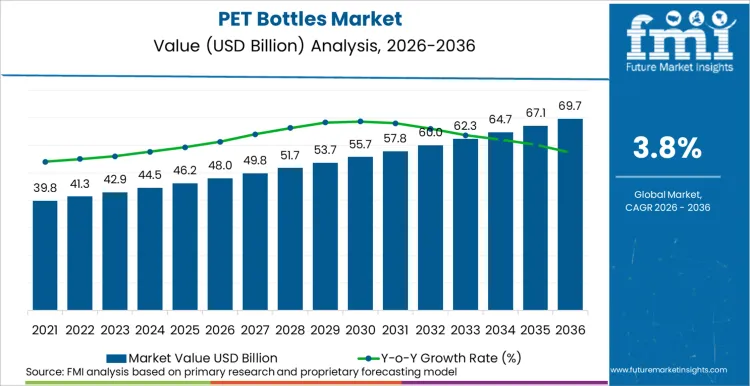
In 2025, the PET bottles market was valued at USD 46.2 billion. Based on Future Market Insights' analysis, demand for PET bottles is estimated to grow to USD 48.0 billion in 2026 and USD 69.6 billion by 2036. FMI projects a CAGR of 3.8% during the forecast period.
Absolute dollar growth of USD 21.7 billion over the decade reflects steady volume expansion tied to global beverage consumption growth, offset partially by lightweighting trends that reduce resin per bottle. The EU's mandate for 25% recycled content by 2025 and 30% by 2030, combined with California's SB 54 requiring 65% source reduction or recycling by 2032, has made rPET procurement capability a competitive necessity. Chemical recycling investment is accelerating to close the gap between mandated recycled content requirements and mechanical recycling supply limitations.
As D K Agarwal, CEO of Indorama Ventures, stated regarding the acquisition of Ngoc Nghia in Vietnam, 'This acquisition is complementary to our long-term strategy of extending our global footprint and resilient business platform.'
India (5.2% CAGR) and Southeast Asia (4.8% CAGR) lead growth through rising packaged water and soft drink consumption. China (4.0% CAGR) benefits from food-grade PET demand and domestic recycling infrastructure investment. The United States (3.5% CAGR) grows through beverage sector recovery and rPET content compliance. Germany (3.2% CAGR) and the United Kingdom (3.0% CAGR) generate demand anchored by deposit-return system expansion and brand-owner recycled content commitments.
PET Bottles Market Market Definition
The PET bottles market covers the manufacture, sale, and recycling of bottles made from polyethylene terephthalate resin, used for packaging beverages, food, personal care products, pharmaceuticals, and household chemicals. The market includes virgin PET and recycled PET (rPET) bottle production across all capacity ranges.
PET Bottles Market Market Inclusions
The report covers global and regional market sizes by revenue for the 2026 to 2036 forecast period. It includes segmental breakdowns by capacity, application, and colour. Pricing analysis by virgin versus rPET content, recycling infrastructure mapping, and regulatory compliance tracking are included.
PET Bottles Market Market Exclusions
The scope excludes PET preforms sold as intermediates before blow-molding, PET film and sheet products, and polyester fibre applications. Non-bottle rigid PET containers such as thermoformed trays are outside scope unless produced on bottle blow-molding lines.
PET Bottles Market Research Methodology
Primary Research: Interviews were conducted with PET resin producers, bottle converters, beverage brand owners, recycling operators, and packaging procurement managers across North America, Europe, India, and Southeast Asia.
Desk Research: PET resin production capacity databases, bottle deposit-return system statistics, EU recycled content mandate filings, and beverage industry packaging commitments supported demand benchmarking.
Market-Sizing and Forecasting: A hybrid model combined top-down beverage consumption forecasts with bottom-up bottle conversion capacity and resin pricing data, validated against converter revenue disclosures and resin trade statistics.
Data Validation and Update Cycle: Outputs undergo anomaly screening, variance checks across resin production and bottle shipment datasets, and structured peer review prior to release.
Summary of PET Bottles Market
Power in the PET bottles value chain is concentrated among vertically integrated resin-to-bottle producers. Indorama Ventures, Alpla, and Plastipak Holdings control both PET resin production and bottle conversion capacity, enabling them to manage feedstock cost volatility and guarantee recycled content supply to brand owners. As per FMI, beverage companies such as Coca-Cola and PepsiCo hold buyer leverage through volume procurement contracts, but their own recycled content pledges create counter-dependency on rPET suppliers who can deliver food-grade recycled resin at scale.
Pricing asymmetry reflects the virgin-versus-rPET cost gap. Food-grade rPET trades at a premium of 10 to 30% over virgin PET in Europe due to collection, sorting, and reprocessing costs, while in markets without deposit-return infrastructure the premium can exceed 40%. FMI analysts note that brand owners absorb the rPET premium to meet regulatory targets and ESG commitments, but pass a portion through to retail shelf pricing, which constrains volume growth in price-sensitive emerging markets.
Sourcing fragility centres on post-consumer PET collection rates and chemical recycling capacity. Mechanical recycling alone cannot meet the 30% recycled content mandate taking effect in the EU by 2030, creating a supply-demand gap that chemical recycling investment is intended to fill. Collection rates vary from over 90% in deposit-return markets like Germany to below 30% in markets without formal collection infrastructure, creating uneven rPET availability across geographies.
Brand and compliance risks are tied to greenwashing enforcement and recycled content verification. Regulators in the EU and California require auditable chain-of-custody documentation proving recycled content percentages. FMI opines that bottle converters and brand owners who invest in blockchain-based or mass-balance verified rPET supply chains will face lower regulatory disruption risk than those relying on unverified recycled content claims.
Geographic leverage differs by regulatory and collection infrastructure maturity. Europe leads in mandated recycled content, with deposit-return systems in Germany and the Nordics achieving the highest collection rates globally. North America is driven by California's SB 54 and brand-owner voluntary pledges. Asia Pacific is the volume growth engine, with India and Southeast Asia generating first-time packaged beverage demand. Latin America is an emerging collection and recycling market.
For C-suite executives in packaging and beverages, the PET bottles market through 2036 rewards companies that secure rPET supply through backward integration into recycling, invest in chemical recycling capacity to bridge the mechanical recycling gap, and build auditable recycled content documentation systems. Virgin PET cost leadership alone will not satisfy the regulatory and brand requirements that now define market access.
Key Industry Highlights
Inexpensive Nature of PET Drives its Demand across Various Industries
PET bottles are affordable since they tend to be inexpensive to manufacture when compared to some alternatives such as glass and aluminum. The processes of manufacturing PET are inexpensive, making it a prime choice for industries that produce higher volumes of products including beverages and home products.
PET bottles also happen to be lightweight, meaning that it costs less to transport them along long distances and is easy to handle in production and distribution. All this reduces both manufacturing and transportation costs, making PET a favorite among companies seeking to cut costs but still want to provide products with strong, reliable packaging.
High Recyclability of PET Spurs Demand Owing to Rising Sustainability Concerns
PET, being one of the most frequently recycled plastics, plays an important role in enhancing sustainability. In fact, with an increasing number of companies incorporating PET to meet the goals set towards a better environment, and following regulation norms. This has led to curb plastic waste to a great extent. A higher concern from the consumer end is forcing companies to shift toward a greener option and move ahead in search of sustainable ways.
The circular economy model, which recycles and reuses materials, is now on the rise, encouraging PET bottles to be used. This increases their use towards creating less waste in the world while using less virgin plastic, making the packaging more sustainable. In general, the recyclability of PET bottles, clean consumer demand for eco-friendly materials, and the support for a circular economy are pushing the applications of PET bottles in packaging.
Competition for Alternative Packaging Solutions May Limit Usage of PET Bottles
Competition from aluminum cans, glass bottles, as well as other flexible packaging formats is increasing for the reason that these alternatives look more environmentally friendly, or they guarantee better protection for the products. Aluminum cans are very recyclable, and in most cases, glass bottles are sought after for their premium image and their ability to maintain the taste and flavor of the beverage. Pouches, as well as other flexible alternatives to bottles, are lighter and cheaper to ship.
At the least in some premium and conscience markets, environmental awareness of consumers and brands will raise demand for such alternatives. PET bottles' share may thus be lost in the markets due to the increasing use of its alternatives over the years.
2021 to 2025 Global PET Bottles Sales Outlook Compared to Demand Forecast from 2026 to 2036
The PET bottle sales showed a consistent rise from 2021 through 2025 due to robust demand for beverages, food packaging, and household products. It reflected the sustainability trend, where the market remained stable as rPET and eco-friendly packaging solutions continued to move in the direction of growth. These positive factors helped the market maintain momentum and recover swiftly from the pandemic's disruptions.
By the period 2026 to 2036, significant growth of PET bottles in terms of usage can be estimated mainly due to population growth within the urban setting and increased packaged consumption, in addition to rising environmentally friendly packaging requirements. Shift in demand based on regulatory influences and sustainable initiatives toward the practice of the circular economy with growing innovations for biodegradable materials will drive demand in future.
Market Concentration
Tier 1 companies comprise market leaders capturing significant market share in global market. These market leaders are characterized by high production capacity and a wide product portfolio. These market leaders are distinguished by their extensive expertise in manufacturing across multiple packaging formats and a broad geographical reach, underpinned by a robust consumer base.
They provide a wide range of series including recycling and manufacturing utilizing the latest technology and meeting the regulatory standards providing the highest quality. Prominent companies within tier 1 include Gerresheimer AG, Amcor plc, Berry Global Group, Inc., Alpha Packaging, Inc. among others.
Tier 2 companies include mid-size players having presence in specific regions and highly influencing the local market. These are characterized by a strong presence overseas and strong market knowledge. These market players have good technology and ensure regulatory compliance but may not have advanced technology and wide global reach.
Prominent companies in tier 2 include SILGAN PLASTICS LLC, Sidel, Ampacet Corporation, Toyo Seikan Co., Ltd., Graham Packaging Company, Southeastern Container, Greiner Packaging, EPOPACK, AMPAK GROUP, Livia Polymer Products Pvt. Ltd., and Esterform Ltd.
Tier 3 includes the majority of small-scale companies operating at the local presence and serving niche markets. These companies are notably oriented towards fulfilling local market demands and are consequently classified within the tier 3 share segment. They are small-scale players and have limited geographical reach. Tier 3, within this context, is recognized as an unorganized market, denoting a sector characterized by a lack of extensive structure and formalization when compared to organized competitors.
Country-wise Insights
The section below covers the future forecast for the PET bottles market in terms of countries. Information on key countries in several parts of the globe, including North America, Latin America, East Asia, South Asia and Pacific, Western Europe, Eastern Europe and MEA is provided. USA is anticipated to remain at the forefront in North America, with a CAGR of 2.6% through 2036. In Europe, Germany is projected to witness a CAGR of 2.1% by 2036.
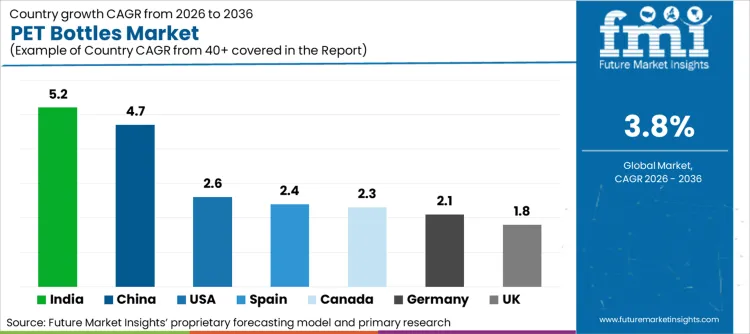
| Countries | Value CAGR (2026 to 2036) |
|---|---|
| USA | 2.6% |
| Germany | 2.1% |
| China | 4.7% |
| UK | 1.8% |
| Spain | 2.4% |
| India | 5.2% |
| Canada | 2.3% |
Increased Beverage Consumption in the USA Spurs Demand for PET Bottles
High demand in the USA market for bottled beverages drives PET bottle demand. Normally drinks like water, soft drinks and juice are packed commonly in PET bottles which are convenient as well as durable. For instance, beverages of the Coca-Cola range, Sprite, minute maid, etc. are packed in PET bottles which are very light in weight and give the consumers an excellent view of the product.
Similarly, the PET bottles are being selected for water brands Poland Spring and Pure Life by Nestlé Waters, serving the need for portable hydration options desired by the modern-day customer. The widespread preference for ready-to-drink beverages continues to drive the growth of PET bottle consumption in the beverage sector.
Stringent Packaging Regulations in Germany Raises Demand for Recyclable PET Bottles
In Europe, Germany has some of the strictest environmental regulations about packaging waste being very high on the priority list. The government has adopted legal enforcement that put measures on companies regarding collecting, recycling, and minimizing plastic waste. These regulatory actions often induce companies to use a higher proportion of recycled raw materials. For example, most of them now use rPET, for making their packaging.
As the regulations have been sanctioned that only eco-responsible materials may be utilized in the production of packaging, a trend toward more ecologically friendly packaging is suddenly gaining acceptance within German companies. Well-established recycling systems that work alongside consumer environmental awareness in a country have pushed demand for bottles made from PET.
Category-wise Insights
The section contains information about the leading segments in the industry. In terms of technology, injection stretch blow molding is estimated to account for a share of 59.8% by 2036. By capacity, 50 to 100 ml are projected to dominate by holding a share of 50.7% by the end 2036.
High Preference for Inject Stretch Blow Molding Technology Because of its Precision & Efficiency
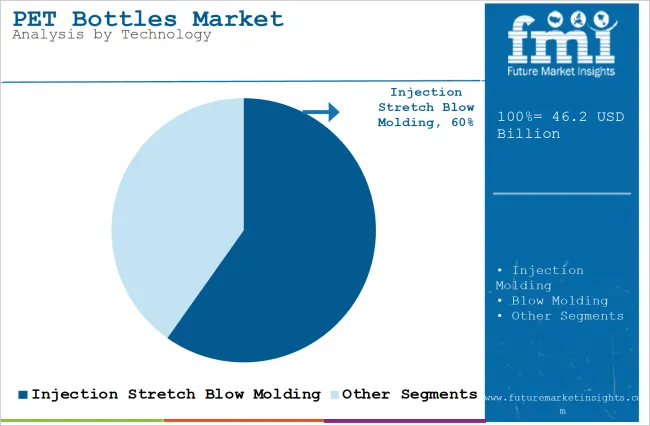
| Technology | Injection Stretch Blow Molding |
|---|---|
| Market Share (2036) | 59.8% |
PET bottles are majorly made using injection stretch blow molding technology because they offer a combination of benefits like precision, efficiency, and versatility. With this technology lightweight, durable bottles with high clarity can be made. These bottles are then used on a large scale for beverages and consumer products.
ISBM provides high molding accuracy, thus ensuring that bottle quality is uniform, and it can easily manufacture bottles in any shape and size. Furthermore, it has excellent resistance to internal pressure, so it is used in carbonated drinks. The process also provides an opportunity for very high customization, along with material wastage, thus being a greener and more economical mass production technique.
500 ML to 1 liters used More Owing to Its Combination of Convenience and Flexibility
| Capacity | 500 ml to 1 liter |
|---|---|
| Market Share (2036) | 43.6% |
PET bottles of 500 ml to 1-liter capacities are more commonly used than the others because of convenience, flexibility, and value. These are single-serve packaging, so the range can easily be met by a diverse consumer base. Be it for water, soda, or juices, these volumes are the ones mostly consumed as everyday hydration on-the-go beverages.
They are made at low unit costs, and also their transportation costs are the lowest, giving an edge to any soft drinks brand that needs to compete in the market. They are very ideal for consumers, providing the exact amount of beverage without adding any bulk. This combination of practicality and consumer preference makes 500 ml to 1-litre PET bottles the most dominant choice in the beverage industry.
Competitive Landscape
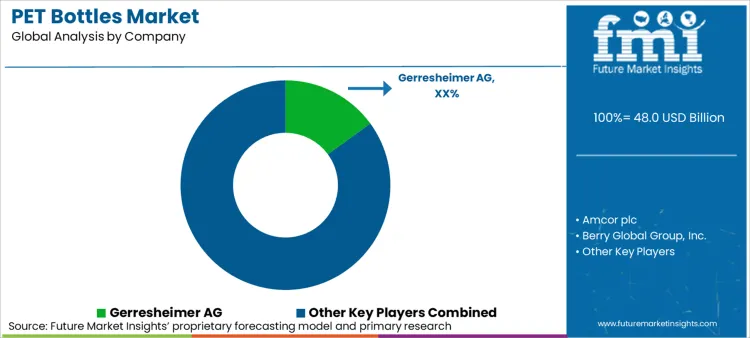
Key players of PET bottles industry are developing and launching new products in the market. They are integrating with different firms and extending their geographical presence. Few of them are also collaborating and partnering with local brands and start-up companies for new product development.
Recent Developments
- The report includes full coverage of key trends from competitive benchmarking. Some of the recent developments covered in the report:
- In February 2026, Sidel highlighted the success of its EvoBLOW XL system for producing large-format PET containers up to 10 litres, enabling a shift toward bulk water and edible oil formats.
- In January 2026, Indorama Ventures and Plastipak reported a surge in chemical recycling investments, with processes breaking PET into original monomers for infinite recyclability.
- In 2025, Indorama Ventures completed the acquisition of Ngoc Nghia in Vietnam to expand its PET packaging footprint in Southeast Asia.
- In 2025, Mars, Inc. announced a multi-billion dollar USA infrastructure investment, with CFO Claus Aagaard describing it as building a stronger, more resilient business.
- In 2025, the European Parliament confirmed the 30% mandatory recycled content target for PET beverage bottles effective from 2030.
Key Players in PET Bottles Market
- Gerresheimer AG
- Amcor plc
- Berry Global Group, Inc.
- Alpha Packaging, Inc.
- SILGAN PLASTICS LLC
- Sidel
- Ampacet Corporation
- Toyo Seikan Co., Ltd.
- Graham Packaging Company
- Southeastern Container
- Greiner Packaging
- EPOPACK
- AMPAK GROUP
- Livia Polymer Products Pvt. Ltd.
- Esterform Ltd
Scope of the Report
| Metric | Value |
|---|---|
| Quantitative Units | USD 48.0 billion (2026) to USD 69.6 billion (2036), at a CAGR of 3.8% |
| Market Definition | Covers manufacture, sale, and recycling of polyethylene terephthalate bottles for beverages, food, personal care, pharmaceuticals, and household applications. |
| Capacity Segmentation | Up to 500 ml, 500 ml to 1 Litre, 1 to 2 Litres, Above 2 Litres |
| Application Segmentation | Beverages, Food, Personal Care and Cosmetics, Pharmaceuticals, Household Care, Others |
| Regions Covered | North America, Latin America, Europe, East Asia, South Asia, Oceania, Middle East and Africa |
| Countries Covered | United States, Germany, France, United Kingdom, China, India, Japan, Indonesia, Brazil, Mexico, Vietnam and 40 plus countries |
| Key Companies Profiled | Indorama Ventures, Alpla, Plastipak Holdings, Amcor, Berry Global, Sidel, RETAL Industries, Resilux, Koksan Pet, Graham Packaging |
| Forecast Period | 2026 to 2036 |
| Approach | Hybrid top-down and bottom-up modeling validated through primary interviews with PET resin producers, bottle converters, and beverage brand packaging procurement |
PET Bottles Industry Segmentation
By Cap Type:
In terms of cap type, the market for PET bottles is divided into screw caps, flip-top caps, pump dispensers, snap-on caps and tamper-evident caps.
By Capacity:
In terms of capacity, the market for PET bottles is segmented into less than 500 ml, 500 ml to 1 liter, 1 to 2 liters and more than 2 liters.
By Technology:
Multiple technologies used for manufacturing PET bottles include injection molding, blow molding and injection stretch blow molding.
By End Use:
End users of PET bottles include food, beverages, pharmaceuticals, cosmetics & personal care, household products, automotive and others. Food further includes edible oils, sauces & dressings, condiments and ready-to-eat meals. Beverages includes water, carbonated soft drinks (CSDs), juices, alcoholic beverages, sports and energy drinks. Pharmaceuticals includes liquid medicines/ syrup and vitamins & supplements. Cosmetics & personal is sub-segmented into shampoos & conditioners, lotion & creams, hand sanitizers, perfumes and deodorants. Household products includes cleaning solution, detergents and air fresheners. Automotive includes coolant & antifreeze solutions, windshield washer fluids and lubricants.
By Region:
Key countries of North America, Latin America, East Asia, South Asia and Pacific, Western Europe, Eastern Europe, Middle East and Africa are covered.
Bibliography
- Sidel. (2026). EvoBLOW XL System for Large-Format PET Containers. February 2026.
- Indorama Ventures / Plastipak. (2026). Chemical Recycling Investment Report. January 2026.
- Indorama Ventures. (2025). Acquisition of Ngoc Nghia in Vietnam.
- Mars, Inc. (2025). US Infrastructure Investment Announcement. Corporate Press Release.
- European Parliament. (2025). Packaging and Packaging Waste Regulation: Recycled Content Targets.
- California Legislature. (2022). SB 54: Plastic Pollution Prevention and Packaging Producer Responsibility Act.
- PET Resin Association. (2025). Global PET Production Capacity Report.
- Ellen MacArthur Foundation. (2025). Global Commitment Progress Report.
- World Bank. (2025). What a Waste 2.0: Global Snapshot of Solid Waste Management.
- Future Market Insights. (2026). PET Bottles Market Report.
- Future Market Insights. (2025). rPET Market.
- Future Market Insights. (2025). Plastic Bottle Market.
- Future Market Insights. (2025). Beverage Packaging Market.
Frequently Asked Questions
How large is the PET bottles market in 2026?
The global PET bottles market is estimated at USD 48.0 billion in 2026.
What will the market size be by 2036?
The market is projected to reach USD 69.6 billion by 2036.
What is the expected CAGR?
Demand is expected to grow at a CAGR of 3.8% between 2026 and 2036.
Which application leads?
Beverages hold the largest application share, with water and carbonated soft drinks driving the highest volumes.
Which region is growing fastest?
India at 5.2% CAGR, driven by rising packaged water and soft drink consumption.
What drives rPET demand?
EU mandated recycled content thresholds and brand-owner sustainability commitments are the primary drivers.
Preview the report firsthand - request a free sample
Get SampleGet the brochure for pricing and purchase details.
Get PDFTable of Content
- Executive Summary
- Global Market Outlook
- Demand-side Trends
- Supply-side Trends
- Technology Roadmap Analysis
- Analysis and Recommendations
- Market Overview
- Market Coverage / Taxonomy
- Market Definition / Scope / Limitations
- Research Methodology
- Chapter Orientation
- Analytical Lens and Working Hypotheses
- Market Structure, Signals, and Trend Drivers
- Benchmarking and Cross-market Comparability
- Market Sizing, Forecasting, and Opportunity Mapping
- Research Design and Evidence Framework
- Desk Research Programme (Secondary Evidence)
- Company Annual and Sustainability Reports
- Peer-reviewed Journals and Academic Literature
- Corporate Websites, Product Literature, and Technical Notes
- Earnings Decks and Investor Briefings
- Statutory Filings and Regulatory Disclosures
- Technical White Papers and Standards Notes
- Trade Journals, Industry Magazines, and Analyst Briefs
- Conference Proceedings, Webinars, and Seminar Materials
- Government Statistics Portals and Public Data Releases
- Press Releases and Reputable Media Coverage
- Specialist Newsletters and Curated Briefings
- Sector Databases and Reference Repositories
- FMI Internal Proprietary Databases and Historical Market Datasets
- Subscription Datasets and Paid Sources
- Social Channels, Communities, and Digital Listening Inputs
- Additional Desk Sources
- Expert Input and Fieldwork (Primary Evidence)
- Primary Modes
- Qualitative Interviews and Expert Elicitation
- Quantitative Surveys and Structured Data Capture
- Blended Approach
- Why Primary Evidence is Used
- Field Techniques
- Interviews
- Surveys
- Focus Groups
- Observational and In-context Research
- Social and Community Interactions
- Stakeholder Universe Engaged
- C-suite Leaders
- Board Members
- Presidents and Vice Presidents
- R&D and Innovation Heads
- Technical Specialists
- Domain Subject-matter Experts
- Scientists
- Physicians and Other Healthcare Professionals
- Governance, Ethics, and Data Stewardship
- Research Ethics
- Data Integrity and Handling
- Primary Modes
- Tooling, Models, and Reference Databases
- Desk Research Programme (Secondary Evidence)
- Data Engineering and Model Build
- Data Acquisition and Ingestion
- Cleaning, Normalisation, and Verification
- Synthesis, Triangulation, and Analysis
- Quality Assurance and Audit Trail
- Market Background
- Market Dynamics
- Drivers
- Restraints
- Opportunity
- Trends
- Scenario Forecast
- Demand in Optimistic Scenario
- Demand in Likely Scenario
- Demand in Conservative Scenario
- Opportunity Map Analysis
- Product Life Cycle Analysis
- Supply Chain Analysis
- Investment Feasibility Matrix
- Value Chain Analysis
- PESTLE and Porter’s Analysis
- Regulatory Landscape
- Regional Parent Market Outlook
- Production and Consumption Statistics
- Import and Export Statistics
- Market Dynamics
- Global Market Analysis 2021 to 2025 and Forecast, 2026 to 2036
- Historical Market Size Value (USD Million) Analysis, 2021 to 2025
- Current and Future Market Size Value (USD Million) Projections, 2026 to 2036
- Y-o-Y Growth Trend Analysis
- Absolute $ Opportunity Analysis
- Global Market Pricing Analysis 2021 to 2025 and Forecast 2026 to 2036
- Global Market Analysis 2021 to 2025 and Forecast 2026 to 2036, By Capacity
- Introduction / Key Findings
- Historical Market Size Value (USD Million) Analysis By Capacity , 2021 to 2025
- Current and Future Market Size Value (USD Million) Analysis and Forecast By Capacity , 2026 to 2036
- 500 ml to 1 liter
- Less than 500 ml
- 500 ml to 1 liter
- 500 ml to 1 liter
- Y-o-Y Growth Trend Analysis By Capacity , 2021 to 2025
- Absolute $ Opportunity Analysis By Capacity , 2026 to 2036
- Global Market Analysis 2021 to 2025 and Forecast 2026 to 2036, By Technology
- Introduction / Key Findings
- Historical Market Size Value (USD Million) Analysis By Technology, 2021 to 2025
- Current and Future Market Size Value (USD Million) Analysis and Forecast By Technology, 2026 to 2036
- Injection Molding
- Blow Molding
- Injection Stretch Blow Molding
- Injection Molding
- Y-o-Y Growth Trend Analysis By Technology, 2021 to 2025
- Absolute $ Opportunity Analysis By Technology, 2026 to 2036
- Global Market Analysis 2021 to 2025 and Forecast 2026 to 2036, By Region
- Introduction
- Historical Market Size Value (USD Million) Analysis By Region, 2021 to 2025
- Current Market Size Value (USD Million) Analysis and Forecast By Region, 2026 to 2036
- North America
- Latin America
- Western Europe
- Eastern Europe
- East Asia
- South Asia and Pacific
- Middle East & Africa
- Market Attractiveness Analysis By Region
- North America Market Analysis 2021 to 2025 and Forecast 2026 to 2036, By Country
- Historical Market Size Value (USD Million) Trend Analysis By Market Taxonomy, 2021 to 2025
- Market Size Value (USD Million) Forecast By Market Taxonomy, 2026 to 2036
- By Country
- USA
- Canada
- Mexico
- By Capacity
- By Technology
- By Country
- Market Attractiveness Analysis
- By Country
- By Capacity
- By Technology
- Key Takeaways
- Latin America Market Analysis 2021 to 2025 and Forecast 2026 to 2036, By Country
- Historical Market Size Value (USD Million) Trend Analysis By Market Taxonomy, 2021 to 2025
- Market Size Value (USD Million) Forecast By Market Taxonomy, 2026 to 2036
- By Country
- Brazil
- Chile
- Rest of Latin America
- By Capacity
- By Technology
- By Country
- Market Attractiveness Analysis
- By Country
- By Capacity
- By Technology
- Key Takeaways
- Western Europe Market Analysis 2021 to 2025 and Forecast 2026 to 2036, By Country
- Historical Market Size Value (USD Million) Trend Analysis By Market Taxonomy, 2021 to 2025
- Market Size Value (USD Million) Forecast By Market Taxonomy, 2026 to 2036
- By Country
- Germany
- UK
- Italy
- Spain
- France
- Nordic
- BENELUX
- Rest of Western Europe
- By Capacity
- By Technology
- By Country
- Market Attractiveness Analysis
- By Country
- By Capacity
- By Technology
- Key Takeaways
- Eastern Europe Market Analysis 2021 to 2025 and Forecast 2026 to 2036, By Country
- Historical Market Size Value (USD Million) Trend Analysis By Market Taxonomy, 2021 to 2025
- Market Size Value (USD Million) Forecast By Market Taxonomy, 2026 to 2036
- By Country
- Russia
- Poland
- Hungary
- Balkan & Baltic
- Rest of Eastern Europe
- By Capacity
- By Technology
- By Country
- Market Attractiveness Analysis
- By Country
- By Capacity
- By Technology
- Key Takeaways
- East Asia Market Analysis 2021 to 2025 and Forecast 2026 to 2036, By Country
- Historical Market Size Value (USD Million) Trend Analysis By Market Taxonomy, 2021 to 2025
- Market Size Value (USD Million) Forecast By Market Taxonomy, 2026 to 2036
- By Country
- China
- Japan
- South Korea
- By Capacity
- By Technology
- By Country
- Market Attractiveness Analysis
- By Country
- By Capacity
- By Technology
- Key Takeaways
- South Asia and Pacific Market Analysis 2021 to 2025 and Forecast 2026 to 2036, By Country
- Historical Market Size Value (USD Million) Trend Analysis By Market Taxonomy, 2021 to 2025
- Market Size Value (USD Million) Forecast By Market Taxonomy, 2026 to 2036
- By Country
- India
- ASEAN
- Australia & New Zealand
- Rest of South Asia and Pacific
- By Capacity
- By Technology
- By Country
- Market Attractiveness Analysis
- By Country
- By Capacity
- By Technology
- Key Takeaways
- Middle East & Africa Market Analysis 2021 to 2025 and Forecast 2026 to 2036, By Country
- Historical Market Size Value (USD Million) Trend Analysis By Market Taxonomy, 2021 to 2025
- Market Size Value (USD Million) Forecast By Market Taxonomy, 2026 to 2036
- By Country
- Kingdom of Saudi Arabia
- Other GCC Countries
- Turkiye
- South Africa
- Other African Union
- Rest of Middle East & Africa
- By Capacity
- By Technology
- By Country
- Market Attractiveness Analysis
- By Country
- By Capacity
- By Technology
- Key Takeaways
- Key Countries Market Analysis
- USA
- Pricing Analysis
- Market Share Analysis, 2025
- By Capacity
- By Technology
- Canada
- Pricing Analysis
- Market Share Analysis, 2025
- By Capacity
- By Technology
- Mexico
- Pricing Analysis
- Market Share Analysis, 2025
- By Capacity
- By Technology
- Brazil
- Pricing Analysis
- Market Share Analysis, 2025
- By Capacity
- By Technology
- Chile
- Pricing Analysis
- Market Share Analysis, 2025
- By Capacity
- By Technology
- Germany
- Pricing Analysis
- Market Share Analysis, 2025
- By Capacity
- By Technology
- UK
- Pricing Analysis
- Market Share Analysis, 2025
- By Capacity
- By Technology
- Italy
- Pricing Analysis
- Market Share Analysis, 2025
- By Capacity
- By Technology
- Spain
- Pricing Analysis
- Market Share Analysis, 2025
- By Capacity
- By Technology
- France
- Pricing Analysis
- Market Share Analysis, 2025
- By Capacity
- By Technology
- India
- Pricing Analysis
- Market Share Analysis, 2025
- By Capacity
- By Technology
- ASEAN
- Pricing Analysis
- Market Share Analysis, 2025
- By Capacity
- By Technology
- Australia & New Zealand
- Pricing Analysis
- Market Share Analysis, 2025
- By Capacity
- By Technology
- China
- Pricing Analysis
- Market Share Analysis, 2025
- By Capacity
- By Technology
- Japan
- Pricing Analysis
- Market Share Analysis, 2025
- By Capacity
- By Technology
- South Korea
- Pricing Analysis
- Market Share Analysis, 2025
- By Capacity
- By Technology
- Russia
- Pricing Analysis
- Market Share Analysis, 2025
- By Capacity
- By Technology
- Poland
- Pricing Analysis
- Market Share Analysis, 2025
- By Capacity
- By Technology
- Hungary
- Pricing Analysis
- Market Share Analysis, 2025
- By Capacity
- By Technology
- Kingdom of Saudi Arabia
- Pricing Analysis
- Market Share Analysis, 2025
- By Capacity
- By Technology
- Turkiye
- Pricing Analysis
- Market Share Analysis, 2025
- By Capacity
- By Technology
- South Africa
- Pricing Analysis
- Market Share Analysis, 2025
- By Capacity
- By Technology
- USA
- Market Structure Analysis
- Competition Dashboard
- Competition Benchmarking
- Market Share Analysis of Top Players
- By Regional
- By Capacity
- By Technology
- Competition Analysis
- Competition Deep Dive
- Gerresheimer AG
- Overview
- Product Portfolio
- Profitability by Market Segments (Product/Age /Sales Channel/Region)
- Sales Footprint
- Strategy Overview
- Marketing Strategy
- Product Strategy
- Channel Strategy
- Amcor plc
- Berry Global Group, Inc.
- Alpha Packaging, Inc.
- SILGAN PLASTICS LLC
- Sidel
- Ampacet Corporation
- Gerresheimer AG
- Competition Deep Dive
- Assumptions & Acronyms Used


