

- Market Size (2026)
- USD 540.1 Mn
- Forecast (2036)
- USD 863.2 Mn
- CAGR (2026 to 2036)
- 4.8%
Petroleum Fuel Dyes and Markers Market Size, Market Forecast and Outlook By FMI
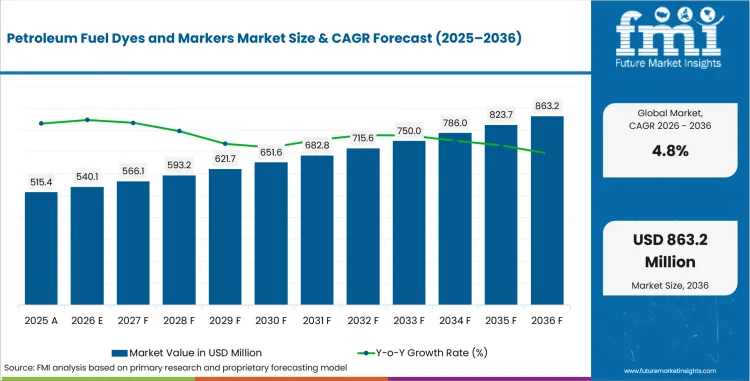
The petroleum fuel dyes and markers market was valued at USD 515.4 million in 2025. The market is set to reach USD 540.1 million by 2026-end and grow at a CAGR of 4.8% between 2026-2036 to reach USD 863.2 million by 2036. Powder will dominate with a 51.0% share, while Water Soluble will lead with a 56.0% share.
Key Takeaways, Market Size, and Forecast
- 2026 Market Size: USD 540.1 million
- 2036 Market Size: USD 863.2 million
- Forecast CAGR: 4.8% from 2026 to 2036
- Absolute $ Opportunity: USD 323.1 million between 2026 and 2036
- Leading Technology Segment: Water Soluble
- Water Soluble Share in 2026: 56.0%
- Fastest-growing Country: USA
- USA CAGR: 5.0% through 2036
| Parameter | Details |
|---|---|
| Market Size in 2026 (Value) | USD 540.1 million |
| Market Forecast in 2036 (Value) | USD 863.2 million |
| CAGR (2026 to 2036) | 4.8% |
| Years Considered | 2021 to 2036 |
| Base Year | 2025 |
| Forecast Period | 2026 to 2036 |
| Units Considered | Value (USD Million) |
| Leading Sub-Region | USA |
Summary of the Petroleum Fuel Dyes and Markers Market
- Demand and Growth Drivers
- Demand for Petroleum Fuel Dyes and Markers products is shaped by fuel tax enforcement requirements, anti-adulteration regulations, and refinery product identification mandates across major petroleum-producing and consuming regions.
- Growth reflects increasing adoption of molecular marker and authentication technologies, driven by government enforcement investment and supply chain integrity requirements.
- Adoption is increasing due to tightening fuel quality regulations, anti-fraud initiatives, and the shift toward advanced water-soluble and covert marker formulations.
- Product and Segment View
- Powder is expected to lead the physical type segment, accounting for 51.0% of demand in 2026, supported by established procurement patterns.
- Water Soluble holds the leading position in the technology segment, accounting for 56.0% of demand in 2026, supported by established procurement patterns.
- Refineries accounts for the largest share of the end use segment, supported by established procurement patterns.
- Geography and Competitive Outlook
- USA is expected to lead growth at 5.0% CAGR through 2036, supported by expanding demand and favorable conditions.
- South Korea is projected to grow at 4.9% CAGR, reflecting strong institutional demand.
- Companies with established distribution and multi-regional presence are expected to strengthen competitive positioning.
- Analyst Opinion
- Nikhil Kaitwade, Principal Consultant at FMI says, 'Companies that combine advanced marker chemistry with multi-jurisdictional regulatory expertise and refinery supply chain integration are likely to strengthen positions as enforcement investment expands.'
- The petroleum fuel dyes and markers category is evolving toward consolidated, specification-led procurement and distribution.
- Adoption is supported by increasing awareness of performance benefits, compliance requirements, and cost-effectiveness considerations.
- Demand is underpinned by regional capacity investment, expanding distribution, and growing organized channel participation.
Petroleum Fuel Dyes and Markers Market Definition
The petroleum fuel dyes and markers market includes all commercially supplied dye, pigment, and molecular marker products used for petroleum fuel identification, tax enforcement, and supply chain authentication across refinery, distribution, and retail applications.
Petroleum Fuel Dyes and Markers Market Inclusions
Market scope encompasses all commercially traded products categorized by Physical Type (Traceable Powder Dyes, High Stability Powder Markers, Fuel Identification Powders), Technology (Hydrophilic Dye Systems, Fuel Dilution Tracking Solutions, Rapid Dispersion Markers), End Use (Upstream Refining Units, Fuel Processing Plants, Quality Control Labs), Fuel Type (Petrol Based Fuels, High Octane Fuel Systems, Automotive Fuel Marking), Product Type (Azo Based Colorants, High Stability Fuel Dyes, Industrial Marker Dyes). Revenue coverage spans 2026 to 2036 across North America, Latin America, Europe, East Asia, South Asia and Pacific, and Middle East and Africa.
Petroleum Fuel Dyes and Markers Market Exclusions
The scope does not include raw unprocessed inputs, custom prototypes, or products outside the defined segmentation taxonomy.
Petroleum Fuel Dyes and Markers Market Research Methodology
- Primary Research:FMI analysts conducted interviews with manufacturers, distributors, procurement specialists, and end users to validate demand patterns and pricing.
- Desk Research:Combined data from trade associations, regulatory filings, company disclosures, and industry datasets to establish baseline parameters.
- Market Sizing and Forecasting:Bottom-up aggregation across segments, applications, and regional adoption curves, triangulated with top-down indicators.
- Data Validation:Cross-checked quarterly against production data, trade statistics, and manufacturer-reported shipment volumes.
Why is the Petroleum Fuel Dyes and Markers Market Growing?
- Structural demand growth is driven by expanding end-use requirements, rising specification standards, and increasing procurement across organized channels.
- USA leads growth at 5.0% CAGR, reflecting capacity expansion, favorable conditions, and increasing adoption.
- Water Soluble accounts for 56.0% of the technology segment, supported by established demand.
The petroleum fuel dyes and markers market is expanding at 4.8% CAGR from 2026 to 2036 as fuel tax enforcement, anti-adulteration regulation, and supply chain authentication requirements drive procurement. Governments are investing in advanced marker technology to combat fuel fraud.
Supply-side dynamics are shaped by specialty chemical manufacturing capabilities, regulatory compliance requirements, and technology development in molecular marker systems. Producers are investing in water-soluble, lower-toxicity formulations to meet tightening environmental standards.
Market Segmentation Analysis
- Powder is expected to lead the physical type segment at 51.0% share, reflecting established demand.
- Water Soluble holds the leading position in the technology segment at 56.0% share, reflecting established demand.
- Refineries accounts for the largest share of the end use segment, reflecting established demand.
The petroleum fuel dyes and markers market is segmented by Physical Type, Technology, End Use, Fuel Type, Product Type. Each axis reflects distinct demand drivers and competitive dynamics.
Insights into the Powder Physical Type Segment
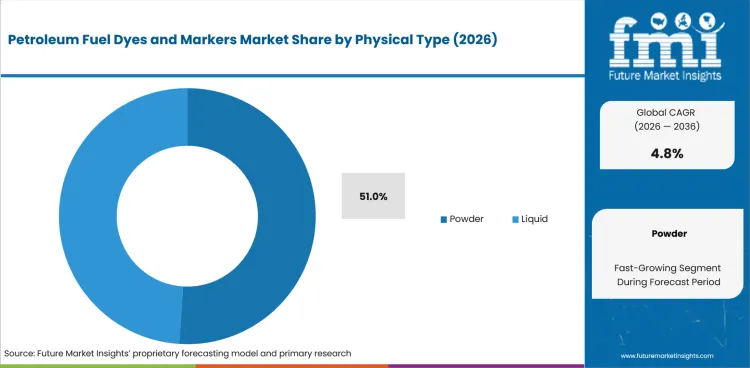
Powder holds the leading position within the physical type segment, accounting for 51.0% of the segment in 2026. Demand is concentrated where established requirements and cost-effectiveness drive procurement. Key sub-categories include Traceable Powder Dyes, High Stability Powder Markers, Fuel Identification Powders.
Growth reflects increasing adoption across mature and emerging markets, with buyers prioritizing quality, compliance, and competitive pricing.
Insights into the Water Soluble Technology Segment
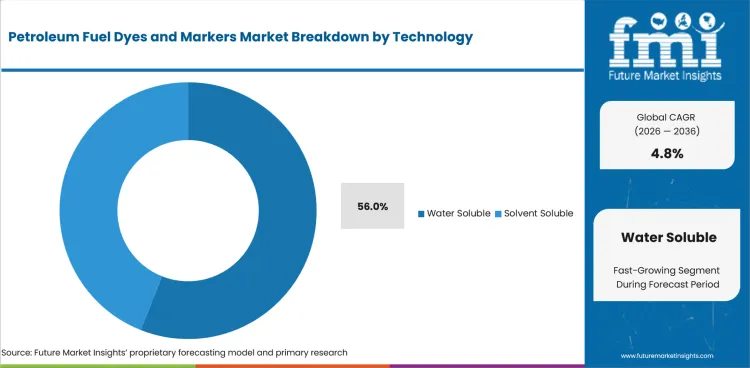
Water Soluble holds the leading position within the technology segment, accounting for 56.0% of the segment in 2026. Demand is concentrated where established requirements and cost-effectiveness drive procurement. Key sub-categories include Hydrophilic Dye Systems, Fuel Dilution Tracking Solutions, Rapid Dispersion Markers.
Growth reflects increasing adoption across mature and emerging markets, with buyers prioritizing quality, compliance, and competitive pricing.
Petroleum Fuel Dyes and Markers Market Drivers, Restraints, and Opportunities
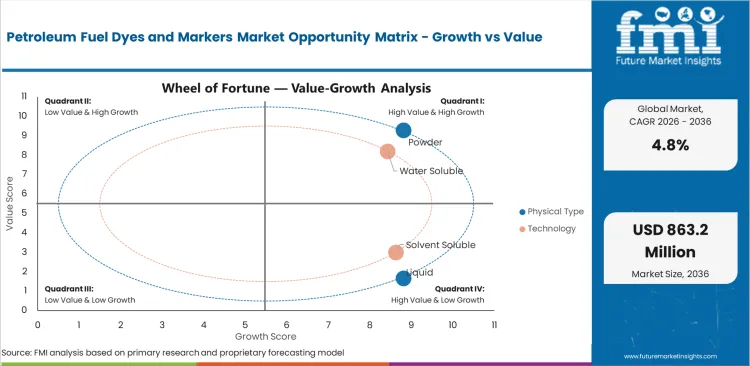
- Expanding end-use demand and specification requirements are creating structured procurement opportunities.
- Higher input costs and integration complexity are limiting margin expansion in price-sensitive segments.
- Regulatory shifts and technology advancement are opening new growth avenues for certified suppliers.
The petroleum fuel dyes and markers market is experiencing balanced growth driven by structural demand, partially offset by cost pressures.
Regulatory Enforcement Demand
Growth is anchored in government fuel tax enforcement mandates, anti-adulteration regulation, and supply chain authentication requirements across refinery and distribution networks.
Chemical Compliance and Formulation Pressures
Adoption of advanced marker technology is constrained by REACH and environmental compliance costs, formulation complexity, and the need for covert markers compatible with diverse fuel chemistries.
Authentication Technology Opportunities
Molecular marker and forensic authentication technologies are creating new product categories and expanding the addressable market beyond traditional visible dye marking.
Analysis of Petroleum Fuel Dyes and Markers Market By Key Countries
.webp "Top Country Growth Comparison Petroleum Fuel Dyes And Markers Market Cagr (2026 2036)")
| Country | CAGR |
|---|---|
| USA | 5.0% |
| South Korea | 4.9% |
| EU | 4.8% |
| UK | 4.6% |
| Japan | 4.5% |
Source: FMI analysis based on primary research and proprietary forecasting model
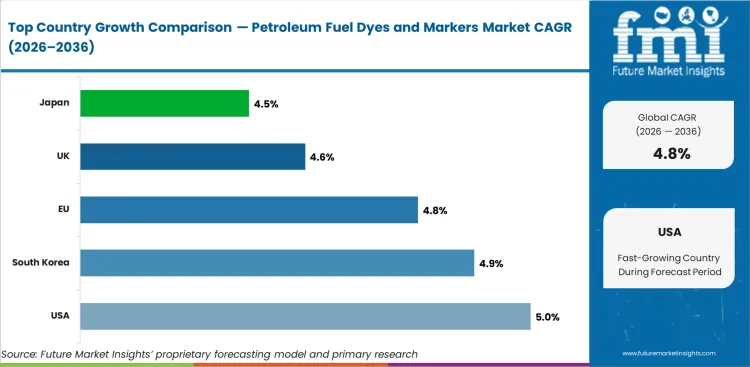
- USA leads growth at 5.0% CAGR, driven by expanding demand and favorable conditions.
- South Korea is projected to grow at 4.9% CAGR, supported by institutional demand.
- EU at 4.8% CAGR reflects rising adoption and supply chain investment.
The global petroleum fuel dyes and markers market is projected to expand at 4.8% CAGR from 2026 to 2036. The analysis covers more than 30 countries.
Demand Outlook for Petroleum Fuel Dyes and Markers Market in USA
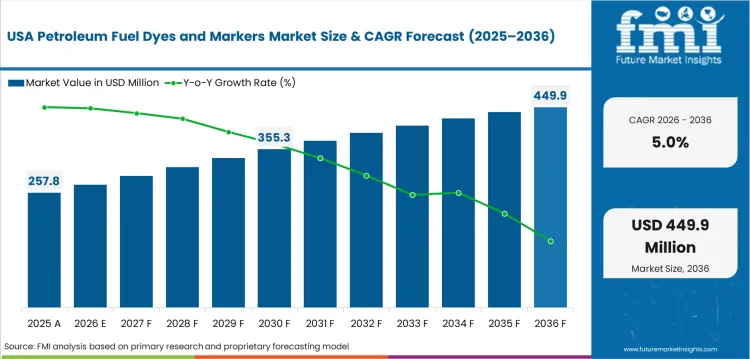
Demand is shaped by IRS fuel tax enforcement requirements and EPA fuel identification regulations that mandate the use of dye and chemical marker systems to distinguish taxed and untaxed petroleum products across US refinery, distribution, and retail channels. The USA is projected to grow at 5.0% CAGR through 2036, the fastest among covered markets, as tightening fuel adulteration enforcement, growing adoption of water-soluble molecular marker technology, and refinery capacity utilization drive procurement of azo dye and marker products.
- IRS fuel tax enforcement mandates dye marking of off-road diesel and untaxed fuel products, creating structured regulatory demand for petroleum fuel dye procurement.
- EPA fuel identification requirements and state-level adulteration enforcement are expanding adoption of molecular marker technology for supply chain authentication.
- Refinery capacity investment and fuel distribution infrastructure maintenance are sustaining replacement procurement cycles for dye and marker chemical products.
Future Outlook for Petroleum Fuel Dyes and Markers Market in South Korea
Domestic chemical manufacturing capabilities for azo dyes and water-soluble marker compounds position South Korean producers as both domestic suppliers and regional exporters of petroleum fuel identification products to East and Southeast Asian refineries. South Korea is projected to grow at 4.9% CAGR through 2036 as government fuel tax enforcement, petroleum product quality monitoring, and stable supplier relationships in Korean refinery procurement sustain demand for powder and liquid fuel dye formulations.
- Domestic chemical manufacturing capabilities enable cost-competitive production of azo dye and molecular marker products for refinery and distribution applications.
- Government fuel tax enforcement and petroleum product authentication requirements drive regulatory demand for dye and marker systems at Korean refineries.
- Stable supplier relationships and quality certification requirements in Korean refinery procurement create durable positions for established fuel dye manufacturers.
Opportunity Analysis of Petroleum Fuel Dyes and Markers Market in EU
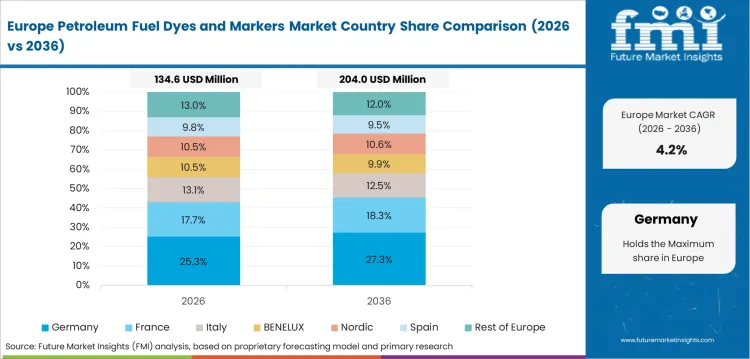
EU Fuel Quality Directive requirements and European Commission tax marking regulations define the compliance framework for petroleum fuel dye and marker products used across EU member state refinery, distribution, and enforcement systems. The EU market is projected to grow at 4.8% CAGR through 2036 as fuel tax harmonization, anti-fraud enforcement investment, and adoption of advanced molecular marker technology drive procurement across European refinery and distribution networks.
- EU Fuel Quality Directive and tax marking regulations mandate dye identification of rebated fuel products across all EU member state distribution networks.
- Anti-fraud enforcement investment by EU customs and tax authorities is driving adoption of advanced molecular marker technology for fuel authentication.
- REACH chemical registration requirements are shaping fuel dye formulation chemistry toward compliant, lower-toxicity alternatives across European markets.
In-depth Analysis of Petroleum Fuel Dyes and Markers Market in UK
HMRC (HM Revenue and Customs) fuel duty enforcement infrastructure and post-Brexit chemical regulations create the regulatory environment for petroleum fuel dye and marker products used across UK refinery, distribution, and retail channels. The UK is projected to grow at 4.6% CAGR through 2036 as fuel adulteration enforcement, Northern Ireland Protocol fuel marking requirements, and adoption of advanced authentication marker technology sustain procurement.
- HMRC fuel duty enforcement mandates red dye marking of rebated diesel and kerosene, creating structured regulatory demand for fuel dye procurement.
- Northern Ireland Protocol fuel marking requirements create additional compliance complexity for cross-border petroleum product distribution.
- Post-Brexit UK REACH regulations create separate chemical registration requirements that influence fuel dye and marker product sourcing strategies.
Sales Analysis of Petroleum Fuel Dyes and Markers Market in Japan
The petroleum fuel dyes and markers market in Japan is mature, with established procurement relationships between JX Nippon, ENEOS, and Idemitsu refineries and certified fuel dye suppliers, where JIS chemical standards and long qualification cycles sustain a high-specification market environment. Japan is projected to grow at 4.5% CAGR through 2036 as fuel tax enforcement, refinery maintenance cycles, and adoption of advanced marker technology for fuel authentication sustain procurement.
- JIS chemical product standards and strict quality specifications create high compliance barriers for fuel dye and marker market entry in Japan.
- Established refinery procurement relationships with JX Nippon and ENEOS sustain durable competitive positions for certified fuel dye suppliers.
- Long supplier qualification cycles and procurement loyalty patterns in Japanese refinery operations create stable demand for established marker product lines.
Competitive Landscape and Strategic Positioning
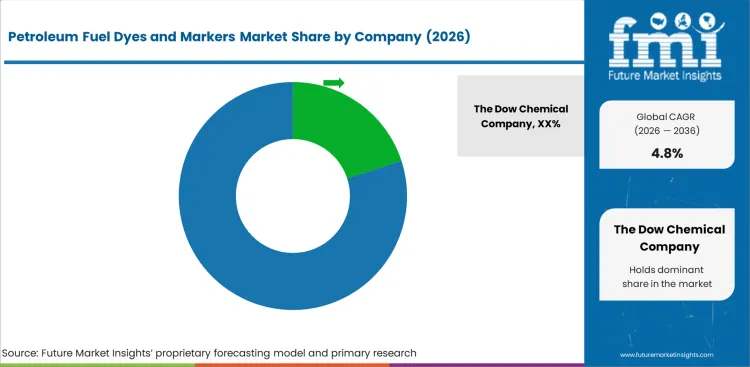
- The Dow Chemical Company maintains a strong position through broad coverage and established networks.
- BASF SE and SGS SA compete on product breadth, technical capabilities, and reliability.
- Emerging players target specialty applications and underserved markets.
The Dow Chemical Company holds a leading position through integrated capabilities and broad coverage.
BASF SE and SGS SA compete through specialization and regional strength.
Barriers include regulatory requirements, capital-intensive production, and established supply chains.
Key Companies in the Petroleum Fuel Dyes and Markers Market
Key global companies leading the petroleum fuel dyes and markers market include:
- The Dow Chemical Company, BASF SE, SGS SA, Innospec have strong infrastructure and broad product portfolios.
- SBZ Corporation, Johnson Matthey, Authentix, Inc. have established regional leadership through application expertise.
- John Hogg Technical Solutions Ltd., NALCO Champion Ecolab Inc., United Color Manufacturing, Inc. represent emerging participants targeting specialty applications.
Competitive Benchmarking: Petroleum Fuel Dyes and Markers Market
| Company | Product Breadth | Physical Type Strength | Distribution Reach | Geographic Footprint |
|---|---|---|---|---|
| The Dow Chemical Company | High | High | Strong | Global |
| BASF SE | High | High | Strong | Global |
| SGS SA | Medium | High | Moderate | Regional |
| Innospec | Medium | High | Moderate | Regional |
| SBZ Corporation | Medium | High | Moderate | Regional |
| Johnson Matthey | Medium | Medium | Low | Regional |
| Authentix, Inc. | Medium | Medium | Low | Regional |
| John Hogg Technical Solutions Ltd. | Medium | Medium | Low | Regional |
| NALCO Champion Ecolab Inc. | Medium | Medium | Low | Regional |
| United Color Manufacturing, Inc. | Medium | Medium | Low | Regional |
Source: Future Market Insights competitive analysis, 2026.
Key Developments in Petroleum Fuel Dyes and Markers Market
- In 2025, The Dow Chemical Company expanded its product portfolio with new configurations targeting high-growth application segments.
- In 2025, BASF SE strengthened distribution through strategic partnerships with regional channel partners.
Key Players in the Petroleum Fuel Dyes and Markers Market
Major Global Players
- The Dow Chemical Company
- BASF SE
- SGS SA
- Innospec
- SBZ Corporation
- Johnson Matthey
- Authentix, Inc.
Emerging Players/Startups
- John Hogg Technical Solutions Ltd.
- NALCO Champion Ecolab Inc.
- United Color Manufacturing, Inc.
- Sunbelt Corporation
- Marquard and Bahls AG Mabanaft Group
- Fuel Theft Solutions Ltd.
- Pylam Products Company, Inc.
- Spectronics Corporation
- Chemours Company
Report Scope and Coverage
| Parameter | Details |
|---|---|
| Market size by 2036 | USD 863.2 million |
| Growth rate | 4.8% CAGR (2026 to 2036) |
| Forecast period | 2026 to 2036 |
| Base year value (2026) | USD 540.1 million |
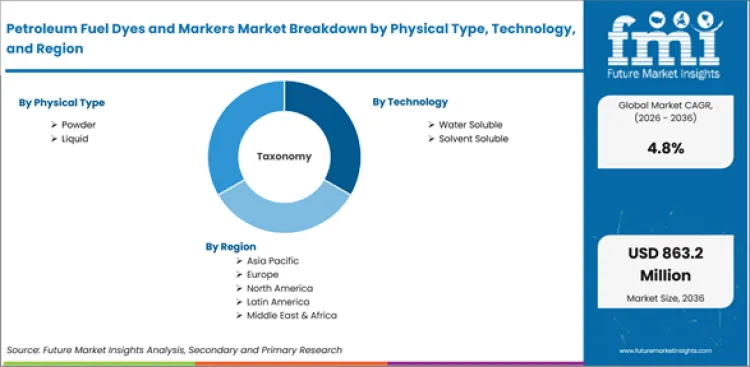
| By Physical Type | Powder, Liquid |
| By Technology | Water Soluble, Solvent Soluble |
| By End Use | Refineries, Commercial, Fuel Stations, Retail Stores, Institutional, Laboratories, Certification Agencies |
| By Fuel Type | Gasoline, Diesel, Aviation Fuel, Fuel Oils, Lubricants and Greases, Other Distillates |
| By Product Type | Azo Dyes, Anthraquinone Dyes, Ethyl Dyes, Fluorescent Dyes, Markers and Tracers |
| Regions covered | North America, Latin America, Europe, East Asia, South Asia and Pacific, Middle East and Africa |
| Countries covered | South Korea, USA, EU, UK, Japan, 30 plus countries |
| Key companies profiled | The Dow Chemical Company, BASF SE, SGS SA, Innospec, SBZ Corporation, Johnson Matthey, Authentix, Inc., John Hogg Technical Solutions Ltd., NALCO Champion Ecolab Inc., United Color Manufacturing, Inc. |
| Approach | Hybrid bottom-up and top-down methodology starting with verified transaction data, projecting adoption velocity across segments and regions. |
Petroleum Fuel Dyes and Markers Market Segmentation By Physical Type, Technology, End Use, Fuel Type
Petroleum Fuel Dyes and Markers Market Segmented by Physical Type:
- Powder
- Traceable Powder Dyes
- High Stability Powder Markers
- Fuel Identification Powders
- Traceable Powder Dyes
- Liquid
- Soluble Liquid Dyes
- Injection Grade Fuel Markers
- Blending Compatible Liquids
- Soluble Liquid Dyes
Petroleum Fuel Dyes and Markers Market Segmented by Technology:
- Water Soluble
- Hydrophilic Dye Systems
- Fuel Dilution Tracking Solutions
- Rapid Dispersion Markers
- Hydrophilic Dye Systems
- Solvent Soluble
- Oil Compatible Dye Systems
- Hydrocarbon Based Markers
- Long Retention Tracers
- Oil Compatible Dye Systems
Petroleum Fuel Dyes and Markers Market Segmented by End Use:
- Refineries
- Upstream Refining Units
- Fuel Processing Plants
- Quality Control Labs
- Upstream Refining Units
- Commercial
- Fleet Fuel Management
- Transport Fuel Monitoring
- Industrial Fuel Consumption
- Fleet Fuel Management
- Fuel Stations
- Retail Fuel Dispensers
- Automated Pump Systems
- Fuel Authentication Points
- Retail Fuel Dispensers
- Retail Stores
- Distribution Channels
- Fuel Additive Retail Sales
- Small Scale Fuel Suppliers
- Distribution Channels
- Institutional
- Government and Defense Fuel Systems
- Bulk Fuel Storage Facilities
- Controlled Fuel Distribution
- Government and Defense Fuel Systems
- Laboratories
- Testing and Certification Labs
- Fuel Quality Analysis
- Compliance Testing Centers
- Testing and Certification Labs
- Certification Agencies
- Regulatory Bodies
- Fuel Authentication Authorities
- Taxation and Compliance Units
- Regulatory Bodies
Petroleum Fuel Dyes and Markers Market Segmented by Fuel Type:
- Gasoline
- Petrol Based Fuels
- High Octane Fuel Systems
- Automotive Fuel Marking
- Petrol Based Fuels
- Diesel
- Heavy Fuel Oils
- Commercial Diesel Systems
- Transport Fuel Tracking
- Heavy Fuel Oils
- Aviation Fuel
- Jet Fuel Systems
- Aircraft Fuel Authentication
- Aviation Safety Compliance
- Jet Fuel Systems
- Fuel Oils
- Industrial Fuel Oils
- Marine Fuel Tracking
- Power Generation Fuels
- Industrial Fuel Oils
- Lubricants and Greases
- Industrial Lubrication Fluids
- Machine Oil Tracking Systems
- Equipment Maintenance Fluids
- Industrial Lubrication Fluids
- Other Distillates
- Refined Hydrocarbon Products
- Specialty Fuel Fractions
- Chemical Feedstocks
- Refined Hydrocarbon Products
Petroleum Fuel Dyes and Markers Market Segmented by Product Type:
- Azo Dyes
- Azo Based Colorants
- High Stability Fuel Dyes
- Industrial Marker Dyes
- Azo Based Colorants
- Anthraquinone Dyes
- Polycyclic Dye Systems
- High Temperature Stable Dyes
- Long Lasting Fuel Markers
- Polycyclic Dye Systems
- Ethyl Dyes
- Alkyl Based Dye Compounds
- Fuel Blending Markers
- Rapid Identification Dyes
- Alkyl Based Dye Compounds
- Fluorescent Dyes
- Light Reactive Markers
- Security Based Fuel Tracers
- Anti Theft Detection Dyes
- Light Reactive Markers
- Markers and Tracers
- Fuel Authentication Agents
- Trace Level Identification Systems
- Anti Adulteration Solutions
- Fuel Authentication Agents
Petroleum Fuel Dyes and Markers Market by Region:
- North America
- USA
- Canada
- Mexico
- Latin America
- Brazil
- Chile
- Rest of Latin America
- Western Europe
- Germany
- UK
- Italy
- Spain
- France
- Nordic
- BENELUX
- Rest of Western Europe
- Eastern Europe
- Russia
- Poland
- Hungary
- Balkan & Baltic
- Rest of Eastern Europe
- East Asia
- China
- Japan
- South Korea
- South Asia and Pacific
- India
- ASEAN
- Australia & New Zealand
- Rest of South Asia and Pacific
- Middle East & Africa
- Kingdom of Saudi Arabia
- Other GCC Countries
- Turkiye
- South Africa
- Other African Union
- Rest of Middle East & Africa
Research Sources and Bibliography
- 1. European Commission. (2024). EU Fuel Quality Directive and Tax Marking Regulations. EC.
- 2. USA Internal Revenue Service. (2025). IRS Fuel Tax Enforcement and Dye Marking Requirements. IRS.
- 3. European Chemicals Agency. (2024). ECHA REACH Chemical Registration Database. ECHA.
- 4. International Organization for Standardization. (2024). ISO Petroleum Product Testing Standards. ISO.
- 5. Organisation for Economic Co-operation and Development. (2025). OECD Revenue Statistics: Fuel Tax Enforcement. OECD.
This bibliography is provided for reader reference.
This Report Answers
- Estimating the size of the market and revenue potential from 2026 to 2036.
- Segmentation by physical type, technology, end use, fuel type.
- Regional and country-level insights across more than 30 markets.
- Analysis of demand drivers, restraints, and growth opportunities.
- Competitive landscape assessment and company benchmarking.
- Identification of high-growth segments and investment opportunities.
- Supply chain analysis and procurement pattern evaluation.
- Delivery of data in PDF and Excel formats.
Frequently Asked Questions
How big is the petroleum fuel dyes and markers market in 2026?
The global petroleum fuel dyes and markers market is estimated to be valued at USD 540.1 million in 2026.
What will be the size of petroleum fuel dyes and markers market in 2036?
The market size for the petroleum fuel dyes and markers market is projected to reach USD 863.2 million by 2036.
How much will be the petroleum fuel dyes and markers market growth between 2026 and 2036?
The petroleum fuel dyes and markers market is expected to grow at a 4.8% CAGR between 2026 and 2036.
What are the key Physical types in the petroleum fuel dyes and markers market?
The key product types in petroleum fuel dyes and markers market are Powder and Liquid.
Which technology segment is expected to contribute significant share in the petroleum fuel dyes and markers market in 2026?
In terms of technology, water soluble segment is expected to command 56.0% share in the petroleum fuel dyes and markers market in 2026.
Preview the report firsthand - request a free sample
Get SampleGet the brochure for pricing and purchase details.
Get PDFTable of Content
- Executive Summary
- Global Market Outlook
- Demand-side Trends
- Supply-side Trends
- Technology Roadmap Analysis
- Market Overview
- Market Coverage / Taxonomy
- Market Definition / Scope / Limitations
- Research Methodology
- Chapter Orientation
- Analytical Lens and Working Hypotheses
- Market Structure, Signals, and Trend Drivers
- Benchmarking and Cross-market Comparability
- Market Sizing, Forecasting, and Opportunity Mapping
- Research Design and Evidence Framework
- Desk Research Programme (Secondary Evidence)
- Company Annual and Sustainability Reports
- Peer-reviewed Journals and Academic Literature
- Corporate Websites, Product Literature, and Technical Notes
- Earnings Decks and Investor Briefings
- Trade Journals, Industry Magazines, and Analyst Briefs
- Conference Proceedings, Webinars, and Seminar Materials
- Government Statistics Portals and Public Data Releases
- Press Releases and Reputable Media Coverage
- Specialist Newsletters and Curated Briefings
- Sector Databases and Reference Repositories
- FMI Internal Proprietary Databases and Historical Market Datasets
- Subscription Datasets and Paid Sources
- Social Channels, Communities, and Digital Listening Inputs
- Additional Desk Sources
- Expert Input and Fieldwork (Primary Evidence)
- Primary Modes
- Qualitative Interviews and Expert Elicitation
- Quantitative Surveys and Structured Data Capture
- Blended Approach
- Why Primary Evidence is Used
- Field Techniques
- Interviews
- Surveys
- Focus Groups
- Observational and In-context Research
- Social and Community Interactions
- Stakeholder Universe Engaged
- C-suite Leaders
- Board Members
- Presidents and Vice Presidents
- R&D and Innovation Heads
- Technical Specialists
- Domain Subject-matter Experts
- Scientists
- Physicians and Other Healthcare Professionals
- Governance, Ethics, and Data Stewardship
- Research Ethics
- Data Integrity and Handling
- Primary Modes
- Tooling, Models, and Reference Databases
- Desk Research Programme (Secondary Evidence)
- Data Engineering and Model Build
- Data Acquisition and Ingestion
- Cleaning, Normalisation, and Verification
- Synthesis, Triangulation, and Analysis
- Quality Assurance and Audit Trail
- Market Background
- Market Dynamics
- Drivers
- Restraints
- Opportunity
- Trends
- Scenario Forecast
- Demand in Optimistic Scenario
- Demand in Likely Scenario
- Demand in Conservative Scenario
- Opportunity Map Analysis
- Product Life Cycle Analysis
- Supply Chain Analysis
- Investment Feasibility Matrix
- Value Chain Analysis
- PESTLE and Porter’s Analysis
- Regulatory Landscape
- Regional Parent Market Outlook
- Production and Consumption Statistics
- Import and Export Statistics
- Market Dynamics
- Global Market Analysis 2021 to 2025 and Forecast, 2026 to 2036
- Historical Market Size Value (USD Million) Analysis, 2021 to 2025
- Current and Future Market Size Value (USD Million) Projections, 2026 to 2036
- Y to o to Y Growth Trend Analysis
- Absolute $ Opportunity Analysis
- Global Market Pricing Analysis 2021 to 2025 and Forecast 2026 to 2036
- Global Market Analysis 2021 to 2025 and Forecast 2026 to 2036, By Physical Type
- Introduction / Key Findings
- Historical Market Size Value (USD Million) Analysis By Physical Type , 2021 to 2025
- Current and Future Market Size Value (USD Million) Analysis and Forecast By Physical Type , 2026 to 2036
- Powder
- Traceable Powder Dyes
- High Stability Powder Markers
- Fuel Identification Powders
- Traceable Powder Dyes
- Liquid
- Soluble Liquid Dyes
- Injection Grade Fuel Markers
- Blending Compatible Liquids
- Soluble Liquid Dyes
- Powder
- Y to o to Y Growth Trend Analysis By Physical Type , 2021 to 2025
- Absolute $ Opportunity Analysis By Physical Type , 2026 to 2036
- Global Market Analysis 2021 to 2025 and Forecast 2026 to 2036, By Technology
- Introduction / Key Findings
- Historical Market Size Value (USD Million) Analysis By Technology, 2021 to 2025
- Current and Future Market Size Value (USD Million) Analysis and Forecast By Technology, 2026 to 2036
- Water Soluble
- Hydrophilic Dye Systems
- Fuel Dilution Tracking Solutions
- Rapid Dispersion Markers
- Hydrophilic Dye Systems
- Solvent Soluble
- Oil Compatible Dye Systems
- Hydrocarbon Based Markers
- Long Retention Tracers
- Oil Compatible Dye Systems
- Water Soluble
- Y to o to Y Growth Trend Analysis By Technology, 2021 to 2025
- Absolute $ Opportunity Analysis By Technology, 2026 to 2036
- Global Market Analysis 2021 to 2025 and Forecast 2026 to 2036, By End Use
- Introduction / Key Findings
- Historical Market Size Value (USD Million) Analysis By End Use, 2021 to 2025
- Current and Future Market Size Value (USD Million) Analysis and Forecast By End Use, 2026 to 2036
- Refineries
- Upstream Refining Value (USD Million)s
- Fuel Processing Plants
- Quality Control Labs
- Upstream Refining Value (USD Million)s
- Commercial
- Fleet Fuel Management
- Transport Fuel Monitoring
- Industrial Fuel Consumption
- Fleet Fuel Management
- Fuel Stations
- Retail Fuel Dispensers
- Automated Pump Systems
- Fuel Authentication Points
- Retail Fuel Dispensers
- Retail Stores
- Distribution Channels
- Fuel Additive Retail Sales
- Small Scale Fuel Suppliers
- Distribution Channels
- Institutional
- Government and Defense Fuel Systems
- Bulk Fuel Storage Facilities
- Controlled Fuel Distribution
- Government and Defense Fuel Systems
- Laboratories
- Testing and Certification Labs
- Fuel Quality Analysis
- Compliance Testing Centers
- Testing and Certification Labs
- Certification Agencies
- Regulatory Bodies
- Fuel Authentication Authorities
- Taxation and Compliance Value (USD Million)s
- Regulatory Bodies
- Refineries
- Y to o to Y Growth Trend Analysis By End Use, 2021 to 2025
- Absolute $ Opportunity Analysis By End Use, 2026 to 2036
- Global Market Analysis 2021 to 2025 and Forecast 2026 to 2036, By Fuel Type
- Introduction / Key Findings
- Historical Market Size Value (USD Million) Analysis By Fuel Type, 2021 to 2025
- Current and Future Market Size Value (USD Million) Analysis and Forecast By Fuel Type, 2026 to 2036
- Gasoline
- Petrol Based Fuels
- High Octane Fuel Systems
- Automotive Fuel Marking
- Petrol Based Fuels
- Diesel
- Heavy Fuel Oils
- Commercial Diesel Systems
- Transport Fuel Tracking
- Heavy Fuel Oils
- Aviation Fuel
- Jet Fuel Systems
- Aircraft Fuel Authentication
- Aviation Safety Compliance
- Jet Fuel Systems
- Fuel Oils
- Industrial Fuel Oils
- Marine Fuel Tracking
- Power Generation Fuels
- Industrial Fuel Oils
- Lubricants and Greases
- Industrial Lubrication Fluids
- Machine Oil Tracking Systems
- Equipment Maintenance Fluids
- Industrial Lubrication Fluids
- Other Distillates
- Refined Hydrocarbon Products
- Specialty Fuel Fractions
- Chemical Feedstocks
- Refined Hydrocarbon Products
- Gasoline
- Y to o to Y Growth Trend Analysis By Fuel Type, 2021 to 2025
- Absolute $ Opportunity Analysis By Fuel Type, 2026 to 2036
- Global Market Analysis 2021 to 2025 and Forecast 2026 to 2036, By Product Type
- Introduction / Key Findings
- Historical Market Size Value (USD Million) Analysis By Product Type, 2021 to 2025
- Current and Future Market Size Value (USD Million) Analysis and Forecast By Product Type, 2026 to 2036
- Azo Dyes
- Azo Based Colorants
- High Stability Fuel Dyes
- Industrial Marker Dyes
- Azo Based Colorants
- Anthraquinone Dyes
- Polycyclic Dye Systems
- High Temperature Stable Dyes
- Long Lasting Fuel Markers
- Polycyclic Dye Systems
- Ethyl Dyes
- Alkyl Based Dye Compounds
- Fuel Blending Markers
- Rapid Identification Dyes
- Alkyl Based Dye Compounds
- Fluorescent Dyes
- Light Reactive Markers
- Security Based Fuel Tracers
- Anti Theft Detection Dyes
- Light Reactive Markers
- Markers and Tracers
- Fuel Authentication Agents
- Trace Level Identification Systems
- Anti Adulteration Solutions
- Fuel Authentication Agents
- Azo Dyes
- Y to o to Y Growth Trend Analysis By Product Type, 2021 to 2025
- Absolute $ Opportunity Analysis By Product Type, 2026 to 2036
- Global Market Analysis 2021 to 2025 and Forecast 2026 to 2036, By Region
- Introduction
- Historical Market Size Value (USD Million) Analysis By Region, 2021 to 2025
- Current Market Size Value (USD Million) Analysis and Forecast By Region, 2026 to 2036
- North America
- Latin America
- Western Europe
- Eastern Europe
- East Asia
- South Asia and Pacific
- Middle East & Africa
- Market Attractiveness Analysis By Region
- North America Market Analysis 2021 to 2025 and Forecast 2026 to 2036, By Country
- Historical Market Size Value (USD Million) Trend Analysis By Market Taxonomy, 2021 to 2025
- Market Size Value (USD Million) Forecast By Market Taxonomy, 2026 to 2036
- By Country
- USA
- Canada
- Mexico
- By Physical Type
- By Technology
- By End Use
- By Fuel Type
- By Product Type
- By Country
- Market Attractiveness Analysis
- By Country
- By Physical Type
- By Technology
- By End Use
- By Fuel Type
- By Product Type
- Key Takeaways
- Latin America Market Analysis 2021 to 2025 and Forecast 2026 to 2036, By Country
- Historical Market Size Value (USD Million) Trend Analysis By Market Taxonomy, 2021 to 2025
- Market Size Value (USD Million) Forecast By Market Taxonomy, 2026 to 2036
- By Country
- Brazil
- Chile
- Rest of Latin America
- By Physical Type
- By Technology
- By End Use
- By Fuel Type
- By Product Type
- By Country
- Market Attractiveness Analysis
- By Country
- By Physical Type
- By Technology
- By End Use
- By Fuel Type
- By Product Type
- Key Takeaways
- Western Europe Market Analysis 2021 to 2025 and Forecast 2026 to 2036, By Country
- Historical Market Size Value (USD Million) Trend Analysis By Market Taxonomy, 2021 to 2025
- Market Size Value (USD Million) Forecast By Market Taxonomy, 2026 to 2036
- By Country
- Germany
- UK
- Italy
- Spain
- France
- Nordic
- BENELUX
- Rest of Western Europe
- By Physical Type
- By Technology
- By End Use
- By Fuel Type
- By Product Type
- By Country
- Market Attractiveness Analysis
- By Country
- By Physical Type
- By Technology
- By End Use
- By Fuel Type
- By Product Type
- Key Takeaways
- Eastern Europe Market Analysis 2021 to 2025 and Forecast 2026 to 2036, By Country
- Historical Market Size Value (USD Million) Trend Analysis By Market Taxonomy, 2021 to 2025
- Market Size Value (USD Million) Forecast By Market Taxonomy, 2026 to 2036
- By Country
- Russia
- Poland
- Hungary
- Balkan & Baltic
- Rest of Eastern Europe
- By Physical Type
- By Technology
- By End Use
- By Fuel Type
- By Product Type
- By Country
- Market Attractiveness Analysis
- By Country
- By Physical Type
- By Technology
- By End Use
- By Fuel Type
- By Product Type
- Key Takeaways
- East Asia Market Analysis 2021 to 2025 and Forecast 2026 to 2036, By Country
- Historical Market Size Value (USD Million) Trend Analysis By Market Taxonomy, 2021 to 2025
- Market Size Value (USD Million) Forecast By Market Taxonomy, 2026 to 2036
- By Country
- China
- Japan
- South Korea
- By Physical Type
- By Technology
- By End Use
- By Fuel Type
- By Product Type
- By Country
- Market Attractiveness Analysis
- By Country
- By Physical Type
- By Technology
- By End Use
- By Fuel Type
- By Product Type
- Key Takeaways
- South Asia and Pacific Market Analysis 2021 to 2025 and Forecast 2026 to 2036, By Country
- Historical Market Size Value (USD Million) Trend Analysis By Market Taxonomy, 2021 to 2025
- Market Size Value (USD Million) Forecast By Market Taxonomy, 2026 to 2036
- By Country
- India
- ASEAN
- Australia & New Zealand
- Rest of South Asia and Pacific
- By Physical Type
- By Technology
- By End Use
- By Fuel Type
- By Product Type
- By Country
- Market Attractiveness Analysis
- By Country
- By Physical Type
- By Technology
- By End Use
- By Fuel Type
- By Product Type
- Key Takeaways
- Middle East & Africa Market Analysis 2021 to 2025 and Forecast 2026 to 2036, By Country
- Historical Market Size Value (USD Million) Trend Analysis By Market Taxonomy, 2021 to 2025
- Market Size Value (USD Million) Forecast By Market Taxonomy, 2026 to 2036
- By Country
- Kingdom of Saudi Arabia
- Other GCC Countries
- Turkiye
- South Africa
- Other African Union
- Rest of Middle East & Africa
- By Physical Type
- By Technology
- By End Use
- By Fuel Type
- By Product Type
- By Country
- Market Attractiveness Analysis
- By Country
- By Physical Type
- By Technology
- By End Use
- By Fuel Type
- By Product Type
- Key Takeaways
- Key Countries Market Analysis
- USA
- Pricing Analysis
- Market Share Analysis, 2025
- By Physical Type
- By Technology
- By End Use
- By Fuel Type
- By Product Type
- Canada
- Pricing Analysis
- Market Share Analysis, 2025
- By Physical Type
- By Technology
- By End Use
- By Fuel Type
- By Product Type
- Mexico
- Pricing Analysis
- Market Share Analysis, 2025
- By Physical Type
- By Technology
- By End Use
- By Fuel Type
- By Product Type
- Brazil
- Pricing Analysis
- Market Share Analysis, 2025
- By Physical Type
- By Technology
- By End Use
- By Fuel Type
- By Product Type
- Chile
- Pricing Analysis
- Market Share Analysis, 2025
- By Physical Type
- By Technology
- By End Use
- By Fuel Type
- By Product Type
- Germany
- Pricing Analysis
- Market Share Analysis, 2025
- By Physical Type
- By Technology
- By End Use
- By Fuel Type
- By Product Type
- UK
- Pricing Analysis
- Market Share Analysis, 2025
- By Physical Type
- By Technology
- By End Use
- By Fuel Type
- By Product Type
- Italy
- Pricing Analysis
- Market Share Analysis, 2025
- By Physical Type
- By Technology
- By End Use
- By Fuel Type
- By Product Type
- Spain
- Pricing Analysis
- Market Share Analysis, 2025
- By Physical Type
- By Technology
- By End Use
- By Fuel Type
- By Product Type
- France
- Pricing Analysis
- Market Share Analysis, 2025
- By Physical Type
- By Technology
- By End Use
- By Fuel Type
- By Product Type
- India
- Pricing Analysis
- Market Share Analysis, 2025
- By Physical Type
- By Technology
- By End Use
- By Fuel Type
- By Product Type
- ASEAN
- Pricing Analysis
- Market Share Analysis, 2025
- By Physical Type
- By Technology
- By End Use
- By Fuel Type
- By Product Type
- Australia & New Zealand
- Pricing Analysis
- Market Share Analysis, 2025
- By Physical Type
- By Technology
- By End Use
- By Fuel Type
- By Product Type
- China
- Pricing Analysis
- Market Share Analysis, 2025
- By Physical Type
- By Technology
- By End Use
- By Fuel Type
- By Product Type
- Japan
- Pricing Analysis
- Market Share Analysis, 2025
- By Physical Type
- By Technology
- By End Use
- By Fuel Type
- By Product Type
- South Korea
- Pricing Analysis
- Market Share Analysis, 2025
- By Physical Type
- By Technology
- By End Use
- By Fuel Type
- By Product Type
- Russia
- Pricing Analysis
- Market Share Analysis, 2025
- By Physical Type
- By Technology
- By End Use
- By Fuel Type
- By Product Type
- Poland
- Pricing Analysis
- Market Share Analysis, 2025
- By Physical Type
- By Technology
- By End Use
- By Fuel Type
- By Product Type
- Hungary
- Pricing Analysis
- Market Share Analysis, 2025
- By Physical Type
- By Technology
- By End Use
- By Fuel Type
- By Product Type
- Kingdom of Saudi Arabia
- Pricing Analysis
- Market Share Analysis, 2025
- By Physical Type
- By Technology
- By End Use
- By Fuel Type
- By Product Type
- Turkiye
- Pricing Analysis
- Market Share Analysis, 2025
- By Physical Type
- By Technology
- By End Use
- By Fuel Type
- By Product Type
- South Africa
- Pricing Analysis
- Market Share Analysis, 2025
- By Physical Type
- By Technology
- By End Use
- By Fuel Type
- By Product Type
- USA
- Market Structure Analysis
- Competition Dashboard
- Competition Benchmarking
- Market Share Analysis of Top Players
- By Regional
- By Physical Type
- By Technology
- By End Use
- By Fuel Type
- By Product Type
- Competition Analysis
- Competition Deep Dive
- The Dow Chemical Company
- Overview
- Product Portfolio
- Profitability by Market Segments (Product/Age /Sales Channel/Region)
- Sales Footprint
- Strategy Overview
- Marketing Strategy
- Product Strategy
- Channel Strategy
- BASF SE
- SGS SA
- Innospec
- SBZ Corporation
- Johnson Matthey
- Authentix, Inc.
- John Hogg Technical Solutions Ltd.
- NALCO Champion Ecolab Inc.
- Value (USD Million)ed Color Manufacturing, Inc.
- Sunbelt Corporation
- Marquard and Bahls AG Mabanaft Group
- Fuel Theft Solutions Ltd.
- Pylam Products Company, Inc.
- Spectronics Corporation
- Chemours Company
- The Dow Chemical Company
- Competition Deep Dive
- Assumptions & Acronyms Used


