

- Industry Size (2025)
- USD 380.9 Mn
- Forecast (2035)
- USD 522 Mn
- CAGR (2025 to 2035)
- 3.2%
Handheld Electrostatic Meter Market Forecast and Outlook (2025-2035)
The global handheld electrostatic meter market is valued at USD 380.9 million in 2025. It is slated to reach USD 522 million by 2035, recording an absolute increase of USD 141.1 million over the forecast period. This translates into a total growth of 37.0%, with the market forecast to expand at a compound annual growth rate (CAGR) of 3.2% between 2025 and 2035. The overall market size is expected to grow by nearly 1.37X during the same period, supported by increasing demand for static control solutions in electronics manufacturing, growing adoption of electrostatic measurement devices in cleanroom environments, and rising emphasis on quality control and product protection across diverse industrial, manufacturing, and research applications.
Between 2025 and 2030, the handheld electrostatic meter market is projected to expand from USD 380.9 million to USD 445.9 million, resulting in a value increase of USD 65.0 million, which represents 46.1% of the total forecast growth for the decade. This phase of development will be shaped by increasing electronics miniaturization and sensitivity to electrostatic discharge, rising implementation of comprehensive ESD control programs, and growing demand for portable measurement instruments in semiconductor fabrication and precision assembly operations. Electronics manufacturers and quality control professionals are expanding their electrostatic monitoring capabilities to address the growing demand for reliable measurement solutions that ensure product protection and manufacturing compliance.
Quick Stats for Handheld Electrostatic Meter Market
- Handheld Electrostatic Meter Market Value (2025): USD 380.9 million
- Handheld Electrostatic Meter Market Forecast Value (2035): USD 522 million
- Handheld Electrostatic Meter Market Forecast CAGR: 3.2%
- Leading Measurement Range in Handheld Electrostatic Meter Market: Low-Range
- Key Growth Regions in Handheld Electrostatic Meter Market: East Asia, Europe, and North America
- Key Players in Handheld Electrostatic Meter Market: SMC, Keyence, Simco-Ion, Prostat Corporation, Trek, Koganei Corporation
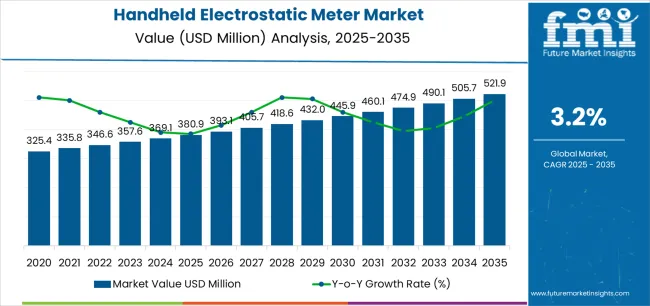
From 2030 to 2035, the market is forecast to grow from USD 445.9 million to USD 522 million, adding another USD 76.1 million, which constitutes 53.9% of the overall ten-year expansion. This period is expected to be characterized by the expansion of advanced packaging technologies and flexible electronics manufacturing, the development of wireless connectivity and data logging capabilities in measurement instruments, and the growth of specialized applications for pharmaceutical cleanrooms and aerospace component handling. The growing adoption of smart manufacturing principles and digital quality management systems will drive demand for handheld electrostatic meters with enhanced measurement accuracy and integration features.
Between 2020 and 2025, the handheld electrostatic meter market experienced steady growth, driven by increasing awareness of electrostatic discharge risks in manufacturing environments and growing recognition of portable measurement devices as essential tools for maintaining static control programs and ensuring product quality in diverse electronics and industrial applications. The market developed as production managers and quality engineers recognized the potential for handheld electrostatic meter technology to enable rapid field measurements, support troubleshooting activities, and validate static control effectiveness while meeting stringent quality requirements. Technological advancement in sensor technology and display systems began emphasizing the critical importance of maintaining measurement precision and user-friendly operation in challenging industrial environments.
Handheld Electrostatic Meter Market Key Takeaways
| Metric | Value |
|---|---|
| Estimated Value in (2025E) | USD 380.9 million |
| Forecast Value in (2035F) | USD 522 million |
| Forecast CAGR (2025 to 2035) | 3.2% |
Why is the Handheld Electrostatic Meter Market Growing?
Market expansion is being supported by the increasing global demand for electrostatic discharge protection in electronics manufacturing driven by component miniaturization and sensitivity increases, alongside the corresponding need for portable measurement instruments that can deliver accurate readings, enable field verification, and maintain operational convenience across various semiconductor fabrication, electronics assembly, cleanroom, and quality control applications. Modern manufacturing facilities and research laboratories are increasingly focused on implementing handheld electrostatic meter solutions that can improve measurement accessibility, enhance monitoring coverage, and provide consistent performance in demanding operating conditions.
The growing emphasis on comprehensive ESD control programs and regulatory compliance requirements is driving demand for handheld electrostatic meters that can support verification activities, enable troubleshooting capabilities, and ensure thorough monitoring across multiple measurement points and operational areas. Industrial manufacturers' preference for measurement instruments that combine portability with accuracy credentials and user-friendly operation is creating opportunities for innovative electrostatic meter implementations. The rising influence of cleanroom manufacturing adoption and advanced electronics production is also contributing to increased adoption of handheld electrostatic meters that can provide superior measurement capabilities without compromising operational flexibility or measurement reliability.
How Is the Handheld Electrostatic Meter Market Segmented by Measurement Range, Application, and Region?
The market is segmented by measurement range, application, and region. By measurement range, the market is divided into low-range and high-range. Based on application, the market is categorized into automotive, electronics manufacturing, printing and packaging, and others. Regionally, the market is divided into East Asia, Europe, North America, South Asia, Latin America, Middle East & Africa, and Eastern Europe.
By Measurement Range, the Low-Range Segment Leads the Market
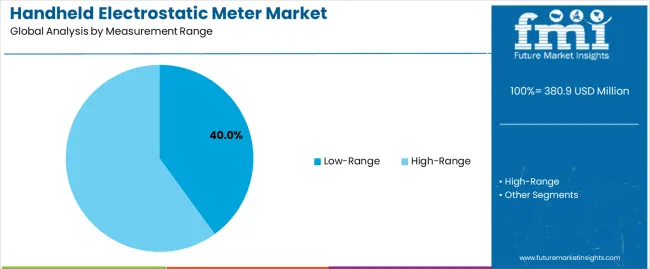
The low-range segment is projected to maintain its leading position with 40% market share in the handheld electrostatic meter market in 2025, reaffirming its role as the preferred measurement category for electronics manufacturing and general industrial ESD control applications. Quality control professionals and production technicians increasingly utilize low-range electrostatic meters for their appropriate measurement sensitivity, excellent suitability for common industrial voltages, and proven effectiveness in monitoring typical static charge conditions while maintaining operational practicality. Low-range measurement technology's proven effectiveness and application versatility directly address the industry requirements for accessible static monitoring and practical ESD control verification solutions across diverse manufacturing environments and operational scenarios.
This measurement segment forms the foundation of modern ESD control programs, as it represents the measurement range with the greatest applicability across multiple industrial sectors and established utility record across various monitoring applications and facility types. Manufacturing industry investments in static control technologies continue to strengthen adoption among quality departments and production facilities. With operational pressures requiring improved product protection and reduced defect rates, low-range electrostatic meters align with both measurement objectives and practical requirements, making them the central component of comprehensive ESD management strategies.
By Application, the Automotive Segment Dominates Market Demand
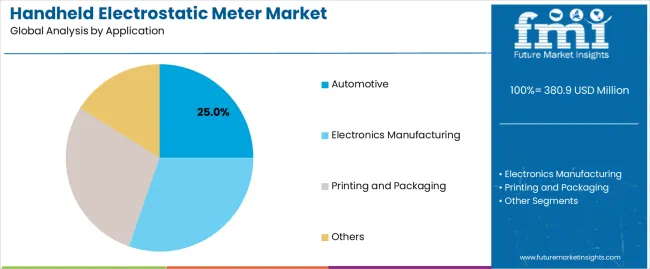
The automotive application segment is projected to represent the 25% market share of handheld electrostatic meter demand in 2025, underscoring its critical role as the primary driver for electrostatic measurement technology adoption across vehicle electronics assembly, component manufacturing, and quality control operations. Automotive manufacturers prefer handheld electrostatic meters for production monitoring due to their exceptional portability capabilities, field measurement benefits, and ability to verify static control effectiveness across diverse production areas from electronics assembly to paint finishing while supporting quality objectives and equipment protection. Positioned as essential instruments for modern automotive manufacturing, handheld electrostatic meters offer both operational advantages and quality assurance benefits.
The segment is supported by continuous innovation in automotive electronics integration and the growing availability of ruggedized meter designs that enable reliable performance with enhanced durability and simplified operation. Additionally, automotive manufacturers are investing in comprehensive static control programs to support increasingly sensitive electronic systems and stringent quality standards for competitive vehicle production. As automotive electronics complexity accelerates and production requirements increase, the automotive application will continue to dominate the market while supporting advanced measurement utilization and quality control optimization strategies.
What Are the Main Drivers, Restraints, and Emerging Trends Influencing the Handheld Electrostatic Meter Market?
The handheld electrostatic meter market is advancing steadily due to increasing demand for ESD protection solutions driven by electronics component sensitivity and growing adoption of comprehensive static control programs that require portable measurement technologies providing accurate monitoring capabilities and operational flexibility benefits across diverse manufacturing, assembly, cleanroom, and quality assurance applications. However, the market faces challenges, including competition from continuous monitoring systems and fixed installation instruments, calibration requirements and maintenance considerations, and operational constraints related to measurement accuracy limitations and environmental interference factors. Innovation in wireless connectivity and intelligent data management continues to influence product development and market expansion patterns.
Expansion of Semiconductor Manufacturing and Advanced Packaging Technologies
The growing complexity of semiconductor manufacturing is driving demand for specialized measurement instruments that address stringent static control requirements including ultra-low voltage detection, high measurement accuracy for sensitive components, and reliable performance in controlled cleanroom environments. Semiconductor fabrication facilities require advanced handheld electrostatic meters that deliver precise measurements while maintaining contamination control and operational convenience. Manufacturing engineers are increasingly recognizing the competitive advantages of portable measurement capability for process verification and equipment qualification, creating opportunities for innovative meter designs specifically developed for semiconductor industry applications.
Integration of Wireless Connectivity and Data Logging Capabilities
Modern handheld electrostatic meter manufacturers are incorporating wireless communication technologies and comprehensive data logging functions to enhance measurement traceability, optimize quality documentation, and support digital quality management objectives through automated data collection and centralized monitoring platforms. Leading companies are developing connected measurement instruments with cloud integration, implementing digital reporting systems, and advancing software platforms that streamline compliance documentation and enable trend analysis. These technologies improve operational efficiency while enabling new service opportunities, including remote monitoring programs, predictive maintenance indicators, and comprehensive facility assessments. Advanced digital integration also allows manufacturers to support regulatory compliance objectives and quality management systems beyond traditional measurement functionality.
Development of Multi-Function Instruments and Integrated Measurement Solutions
The expansion of comprehensive ESD control programs is driving demand for versatile measurement instruments with multiple sensing capabilities and integrated assessment functions that address diverse monitoring requirements. These advanced applications require sophisticated handheld meters with combined measurement parameters that exceed traditional single-function instruments, creating premium market segments with differentiated value propositions. Manufacturers are investing in advanced sensor integration and multi-parameter measurement capabilities to serve comprehensive static control programs while supporting operational efficiency in quality assurance and facility management activities.
How Are Leading Countries Driving Growth in the Handheld Electrostatic Meter Market?
| Country | CAGR (2025-2035) |
|---|---|
| China | 4.3% |
| India | 4.0% |
| Germany | 3.7% |
| Brazil | 3.4% |
| USA | 3.0% |
| UK | 2.7% |
| Japan | 2.4% |
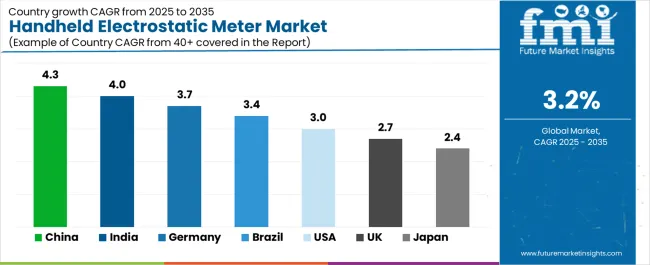
The handheld electrostatic meter market is experiencing solid growth globally, with China leading at a 4.3% CAGR through 2035, driven by expanding electronics manufacturing capacity, growing semiconductor fabrication infrastructure, and increasing adoption of comprehensive ESD control programs in modern production facilities. India follows at 4.0%, supported by rapid electronics industry growth, expanding automotive component manufacturing, and rising investment in quality control infrastructure.
Germany shows growth at 3.7%, emphasizing precision measurement technology, automotive electronics manufacturing, and stringent quality management systems. Brazil demonstrates 3.4% growth, supported by automotive production development, electronics assembly expansion, and industrial quality improvement initiatives. The USA records 3.0%, focusing on semiconductor manufacturing, aerospace quality control, and replacement of legacy measurement equipment. The UK exhibits 2.7% growth, emphasizing electronics manufacturing and pharmaceutical cleanroom applications. Japan shows 2.4% growth, supported by precision electronics production and established quality control practices.
The report covers an in-depth analysis of 40+ countries top-performing countries are highlighted below.
How Is Semiconductor and Electronics Manufacturing Expansion Powering Market Growth in China?
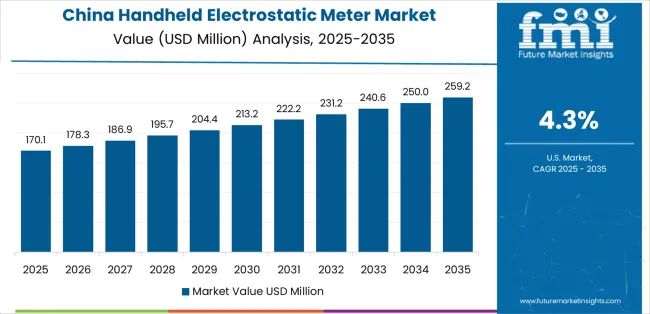
Revenue from handheld electrostatic meters in China is projected to exhibit exceptional growth with a CAGR of 4.3% through 2035, driven by expanding electronics manufacturing infrastructure and rapidly growing semiconductor production capacity supported by government Made in China 2025 initiatives and technology sector development programs. The country's massive electronics assembly sector expansion and increasing investment in advanced manufacturing technologies are creating substantial demand for electrostatic measurement solutions. Major electronics manufacturers and measurement instrument suppliers are establishing comprehensive production and distribution capabilities to serve both domestic markets and export opportunities.
- Government support for semiconductor industry development and electronics manufacturing advancement is driving demand for handheld electrostatic meters throughout major production regions and technology clusters across semiconductor fabs, electronics assembly facilities, and component manufacturing centers.
- Strong electronics sector growth and an expanding network of modern manufacturing facilities are supporting the rapid adoption of portable measurement technologies among manufacturers seeking enhanced quality control and ESD protection capabilities.
Why Is Industrial Modernization Strengthening Market Adoption in India?
Revenue from handheld electrostatic meters in India is expanding at a CAGR of 4.0%, supported by the country's rapid electronics manufacturing growth, expanding automotive component sector, and increasing demand for quality control instruments in manufacturing and assembly applications. The country's comprehensive industrial infrastructure development and technological advancement are driving sophisticated measurement capabilities throughout diverse manufacturing sectors. Leading electronics companies and quality equipment suppliers are establishing extensive distribution and technical support facilities to address growing domestic demand.
- Rising electronics production capacity and expanding manufacturing operations are creating opportunities for handheld electrostatic meter adoption across assembly operations, quality control departments, and production monitoring activities in major industrial regions and technology parks.
- Growing government focus on electronics manufacturing promotion and quality improvement initiatives is driving adoption of professional measurement instruments among manufacturers seeking enhanced product protection and compliance capabilities.
How Does Precision Engineering Support Market Leadership in Germany?
Revenue from handheld electrostatic meters in Germany is expanding at a CAGR of 3.7%, supported by the country's leadership in precision measurement technology, advanced automotive electronics manufacturing, and strong emphasis on comprehensive quality management systems. The nation's sophisticated industrial infrastructure and engineering excellence are driving advanced measurement capabilities throughout high-technology manufacturing sectors. Leading measurement instrument manufacturers and quality control specialists are investing extensively in advanced electrostatic measurement technologies and application solutions.
- Advanced automotive electronics integration and precision manufacturing requirements are creating demand for high-accuracy measurement instruments among automotive suppliers and electronics manufacturers seeking superior quality assurance and process control capabilities.
- Strong quality culture and growing focus on Industry 4.0 integration are supporting the adoption of intelligent measurement systems and connected quality monitoring technologies across manufacturing facilities throughout major industrial regions.
Why Is Automotive Production Advancing Market Development in Brazil?
Revenue from handheld electrostatic meters in Brazil is expanding at a CAGR of 3.4%, supported by the country's established automotive sector, growing electronics assembly operations, and increasing emphasis on manufacturing quality improvement and international competitiveness. The nation's industrial development and production efficiency focus are driving demand for reliable measurement instruments. Automotive manufacturers and electronics companies are investing in quality control equipment upgrades and measurement capability enhancement to improve production standards.
- Automotive electronics production and expanding manufacturing facilities are creating demand for portable measurement systems among manufacturers seeking improved quality control efficiency and static discharge protection.
- Strong industrial sector and growing quality awareness are supporting the adoption of handheld electrostatic meter technologies in diverse manufacturing applications across major industrial centers.
How Are Semiconductor and Aerospace Quality Standards Driving Market Growth in United States?
Revenue from handheld electrostatic meters in the USA is expanding at a CAGR of 3.0%, supported by the country's focus on semiconductor manufacturing development, established aerospace quality requirements, and growing emphasis on domestic electronics production and supply chain resilience. The nation's advanced technology sectors and quality excellence standards are driving demand for sophisticated measurement solutions. Semiconductor facilities and aerospace manufacturers are investing in measurement equipment upgrades and quality system enhancements to address evolving industry requirements.
- Semiconductor manufacturing expansion and electronics production growth are creating demand for precision measurement instruments among manufacturers seeking enhanced static control verification and quality assurance capabilities.
- Strong aerospace sector and growing domestic manufacturing initiatives are driving adoption of professional-grade electrostatic measurement technologies in critical manufacturing and quality control across major technology and aerospace centers.
How Do Electronics Manufacturing and Cleanroom Applications Boost Market Expansion in United Kingdom?
Revenue from handheld electrostatic meters in the UK is expanding at a CAGR of 2.7%, driven by the country's electronics manufacturing activities, pharmaceutical cleanroom requirements, and increasing investment in precision measurement technologies. The UK's quality standards emphasis and regulated industry presence are supporting investment in measurement technologies. Electronics manufacturers and pharmaceutical facilities are establishing quality control programs incorporating comprehensive static monitoring equipment.
- Electronics production operations and pharmaceutical cleanroom requirements are creating demand for reliable measurement equipment supporting quality objectives and regulatory compliance.
- Strong regulatory environment and quality management focus are driving the utilization of handheld electrostatic meter technologies throughout manufacturing facilities and controlled environments.
How Is Precision Manufacturing Culture Reinforcing Market Stability in Japan?
Revenue from handheld electrostatic meters in Japan is expanding at a CAGR of 2.4%, supported by the country's leadership in precision electronics manufacturing, established quality control culture, and sophisticated measurement technology expertise. Japan's technological sophistication and manufacturing excellence are driving demand for high-precision measurement instruments. Electronics manufacturers and quality equipment companies are investing in specialized capabilities for advanced measurement applications.
- Advanced electronics production and precision assembly requirements are creating opportunities for specialized measurement instruments throughout semiconductor manufacturing, display production, and precision component assembly facilities.
- Strong quality management tradition and technology-focused manufacturing culture are driving adoption of high-performance measurement technologies meeting stringent accuracy and reliability standards.
How Are Industrial Investments Accelerating Market Progress Across Europe?
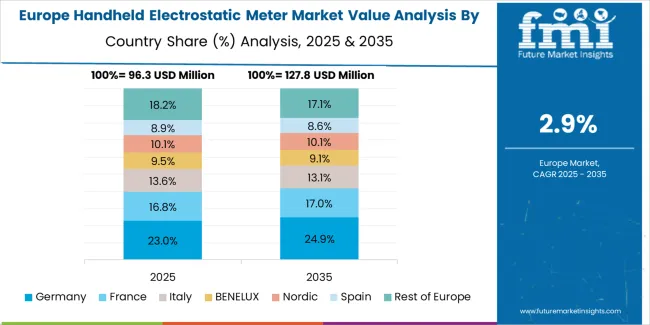
The handheld electrostatic meter market in Europe is projected to grow from USD 134.2 million in 2025 to USD 181.4 million by 2035, registering a CAGR of 3.1% over the forecast period. Germany is expected to maintain leadership with a 31.2% market share in 2025, moderating to 30.6% by 2035, supported by precision measurement technology leadership, automotive electronics manufacturing, and strong quality management infrastructure.
The UK follows with 17.8% in 2025, projected at 17.5% by 2035, driven by electronics manufacturing, pharmaceutical cleanroom applications, and comprehensive quality control requirements. France holds 15.3% in 2025, reaching 15.5% by 2035 on the back of automotive production and industrial quality systems. Italy commands 11.9% in 2025, rising slightly to 12.1% by 2035, while Spain accounts for 9.2% in 2025, reaching 9.4% by 2035 aided by electronics assembly and automotive component production.
The Netherlands maintains 6.1% in 2025, up to 6.3% by 2035 due to semiconductor equipment manufacturing and precision technology sectors. The Rest of Europe region, including Nordics, Central & Eastern Europe, and other markets, is anticipated to hold 8.5% in 2025 and 8.6% by 2035, reflecting steady adoption in emerging manufacturing markets and quality infrastructure development programs.
How Competitive Is the Global Handheld Electrostatic Meter Market and What Shapes Its Strategic Landscape?
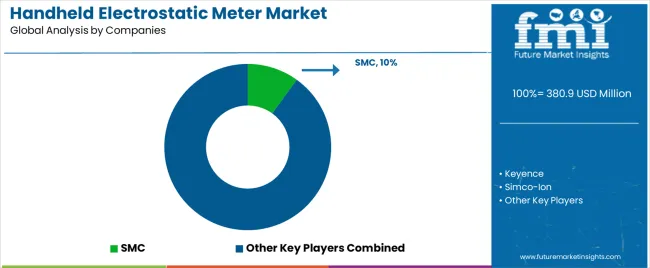
The handheld electrostatic meter market is characterized by competition among established measurement instrument manufacturers, specialized static control equipment providers, and diversified industrial instrumentation companies. Companies are investing in sensor technology advancement, wireless connectivity integration, product portfolio expansion, and application-specific design development to deliver high-performance, reliable, and user-friendly electrostatic measurement solutions. Innovation in multi-parameter measurement capabilities, data management platforms, and ruggedized instrument designs is central to strengthening market position and competitive advantage.
SMC leads the market with comprehensive static control solutions with a focus on industrial automation applications, integrated measurement systems, and diverse instrument configurations across multiple manufacturing sectors. Keyence provides innovative measurement technology with emphasis on precision sensors and automated quality control systems. Simco-Ion offers specialized static control equipment with comprehensive ESD management solutions for electronics and industrial applications.
Prostat Corporation delivers professional-grade measurement instruments with focus on calibration services and quality assurance support. Trek specializes in precision electrostatic measurement technology for research and advanced manufacturing applications. Koganei Corporation provides pneumatic and static control components with comprehensive automation solutions. Desco Industries offers extensive ESD control products including measurement instruments for electronics manufacturing. Extech Instruments delivers portable test equipment with diverse measurement capabilities. Monroe Electronics specializes in electrostatic measurement and monitoring systems. Electro-Tech Systems focuses on static control and measurement solutions for industrial applications. ACL Staticide provides comprehensive static control products and measurement instruments for electronics and cleanroom environments.
Handheld Electrostatic Meter Market - Stakeholder Contribution Framework
Handheld electrostatic meters represent a specialized measurement instrument segment within industrial quality control applications, projected to grow from USD 380.9 million in 2025 to USD 522 million by 2035 at a 3.2% CAGR. These portable measurement devices for electrostatic field and surface voltage detection serve as critical quality control instruments in electronics manufacturing, semiconductor fabrication, cleanroom operations, and industrial production environments where static discharge protection, measurement verification, and quality assurance are essential. Market expansion is driven by increasing electronics component sensitivity, growing ESD control program adoption, expanding semiconductor manufacturing infrastructure, and rising demand for portable measurement solutions across diverse manufacturing, assembly, pharmaceutical, and research applications.
How Industrial Regulators Could Strengthen Measurement Standards and ESD Control Performance?
- Measurement Accuracy Standards: Establish comprehensive technical specifications for handheld electrostatic meters, including measurement range requirements, accuracy tolerances, calibration protocols, and performance verification procedures that ensure consistent reliability across electronics manufacturing, cleanroom, automotive, and industrial quality control applications.
- Calibration and Traceability Requirements: Develop regulatory frameworks for measurement instrument certification, requiring manufacturers to demonstrate calibration procedures, measurement traceability, and periodic verification protocols that ensure measurement accuracy and regulatory compliance.
- Quality Assurance Requirements: Implement mandatory testing protocols for electrostatic meter performance, including accuracy verification, environmental influence assessment, and long-term stability validation that ensure instrument reliability and measurement confidence across operational conditions.
- ESD Control Program Guidelines: Create specialized standards for static control verification procedures, addressing measurement point selection, frequency requirements, documentation protocols, and corrective action thresholds specific to electronics manufacturing and sensitive component handling.
- Innovation Support Programs: Provide regulatory facilitation and financial incentives for research and development of next-generation measurement technologies that improve accuracy capabilities, reduce operational complexity, and enable advanced static control in manufacturing sectors.
How Industry Associations Could Advance Technology Standards and Market Development?
- Measurement Best Practices: Develop comprehensive technical guidelines for electrostatic meter selection, calibration procedures, measurement techniques, and documentation requirements that maximize measurement reliability, ensure program effectiveness, and maintain cost-effectiveness across diverse industrial ESD control applications.
- Performance Standardization: Establish industry-wide metrics for instrument evaluation, including measurement accuracy assessment, environmental stability testing, user interface effectiveness, and battery performance characteristics that enable comparative analysis and objective product selection.
- Technical Training Programs: Create specialized education initiatives for quality technicians, production supervisors, and ESD coordinators covering electrostatic fundamentals, measurement principles, instrument operation, and troubleshooting techniques across various industrial applications.
- Calibration Standards Development: Develop standardized calibration methodologies, reference voltage sources, verification procedures, and documentation formats that facilitate consistent measurement accuracy and regulatory compliance.
- Cross-Industry Collaboration: Facilitate partnerships between instrument manufacturers, electronics companies, standards organizations, and research institutions to advance measurement technology, address emerging application challenges, and accelerate innovation in static control systems.
How Handheld Electrostatic Meter Manufacturers Could Drive Innovation and Market Leadership?
- Advanced Sensor Technology: Invest in precision sensing elements, temperature compensation systems, electromagnetic interference rejection, and measurement algorithm development that improve accuracy capabilities while maintaining instrument reliability and cost competitiveness in global markets.
- Smart Instrument Development: Develop next-generation meters with wireless connectivity, cloud data integration, automated reporting capabilities, and predictive calibration indicators for intelligent quality management systems.
- User Experience Enhancement: Implement intuitive interface designs with clear displays, simplified operation procedures, ergonomic handling characteristics, and comprehensive user guidance that optimize measurement efficiency and reduce operator training requirements.
- Application Technical Support: Establish comprehensive customer service capabilities providing measurement protocol development, troubleshooting assistance, calibration services, and technical expertise that strengthen customer relationships and enable successful ESD program implementation.
- Global Distribution Excellence: Develop regional service centers, authorized calibration facilities, reliable logistics networks, and responsive technical support that ensure consistent instrument availability, minimize downtime, and support customer quality requirements worldwide.
How End-User Industries Could Optimize Measurement Programs and Quality Performance?
- Strategic Instrument Selection: Conduct comprehensive assessments of measurement requirements, environmental conditions, accuracy needs, and operational constraints to optimize electrostatic meter selection and achieve desired monitoring capabilities while managing equipment costs.
- Measurement Program Development: Implement systematic approaches to static control verification, including measurement point identification, frequency determination, documentation procedures, and corrective action protocols that maximize program effectiveness and support quality objectives.
- Calibration Management Programs: Develop scheduled calibration protocols, verification procedures, and instrument maintenance strategies that ensure consistent measurement accuracy, extend instrument service life, and maintain regulatory compliance throughout quality operations.
- Training and Competency Development: Establish comprehensive training programs for personnel covering measurement principles, proper instrument operation, data interpretation techniques, and troubleshooting procedures that ensure consistent measurement quality.
- Supplier Collaboration: Maintain strategic partnerships with instrument manufacturers for technical support, calibration services, technology upgrades, and application optimization guidance that maximize measurement program value.
How Research Institutions Could Enable Technology Advancement?
- Fundamental Research: Conduct scientific investigations into electrostatic field measurement principles, sensor response mechanisms, environmental interference factors, and calibration methodologies that advance fundamental understanding and enable breakthrough innovations.
- Sensor Technology Development: Develop novel sensing technologies, including advanced field-effect sensors, optical detection methods, and multi-parameter measurement systems that improve measurement capabilities while maintaining instrument practicality and economic viability.
- Application Innovation: Investigate emerging applications for electrostatic measurement in flexible electronics manufacturing, pharmaceutical processing, aerospace component handling, and advanced materials production that create new market opportunities and expand technology utilization potential.
- Calibration and Metrology Research: Provide advanced calibration services utilizing primary standards, traceability verification, uncertainty assessment methodologies, and performance validation that enable measurement accuracy and regulatory compliance.
- Industry Knowledge Transfer: Facilitate technology commercialization through collaborative research projects, technical publications, industry workshops, and training programs that accelerate innovation adoption and strengthen industry-academia partnerships.
How Investors and Financial Enablers Could Support Market Growth and Innovation?
- Manufacturing Capacity Investment: Provide capital for measurement instrument production facilities, sensor fabrication equipment, and calibration laboratory development that address growing market demand while improving manufacturing efficiency and product consistency.
- Innovation Financing: Fund research and development of breakthrough measurement technologies, including wireless sensing systems, artificial intelligence integration, and advanced calibration capabilities that address current market limitations and create competitive advantages.
- Quality Infrastructure Support: Finance end-user quality control programs, measurement system upgrades, and ESD control infrastructure development that accelerate market adoption and strengthen demand for electrostatic measurement instruments in manufacturing operations.
- Market Expansion Enablement: Support strategic acquisitions, regional service network establishment, calibration facility development, and technical support capabilities that accelerate geographic expansion and strengthen competitive positions in high-growth markets.
- Technology Commercialization: Provide early-stage funding for innovative instrument designs, startup companies developing novel measurement technologies, and technology transfer programs that bring academic research into commercial applications.
Who Are the Leading Companies Driving Innovation in the Handheld Electrostatic Meter Market?
- SMC
- Keyence
- Simco-Ion
- Prostat Corporation
- Trek
- Koganei Corporation
- Desco Industries
- Extech Instruments
- Monroe Electronics
- Electro-Tech Systems
- ACL Staticide
What Defines the Analytical Scope, Coverage, and Framework of the Handheld Electrostatic Meter Market Report?
| Items | Values |
|---|---|
| Quantitative Units (2025) | USD 380.9 million |
| Measurement Range | Low-Range, High-Range |
| Application | Automotive, Electronics Manufacturing, Printing and Packaging, Others |
| Regions Covered | East Asia, Europe, North America, South Asia, Latin America, Middle East & Africa, Eastern Europe |
| Countries Covered | China, India, Germany, Brazil, USA, UK, Japan, and 40+ countries |
| Key Companies Profiled | SMC, Keyence, Simco-Ion, Prostat Corporation, Trek, Koganei Corporation |
| Additional Attributes | Dollar sales by measurement range and application category, regional demand trends, competitive landscape, technological advancements in electrostatic measurement, calibration innovation, sensor technology development, and measurement accuracy optimization |
How Is the Handheld Electrostatic Meter Market Structured Across Measurement Range, Application, and Regional Segments?
Measurement Range:
- Low-Range
- High-Range
Application:
- Automotive
- Electronics Manufacturing
- Printing and Packaging
- Others
Region:
East Asia
- China
- Japan
- South Korea
- Taiwan
- Rest of East Asia
Europe
- Germany
- UK
- France
- Italy
- Spain
- Netherlands
- Nordic
- BENELUX
- Rest of Europe
North America
- USA
- Canada
- Mexico
South Asia
- India
- Pakistan
- Bangladesh
- Rest of South Asia
Latin America
- Brazil
- Argentina
- Chile
- Rest of Latin America
Middle East & Africa
- Kingdom of Saudi Arabia
- Other GCC Countries
- Turkey
- South Africa
- Other African Union
- Rest of Middle East & Africa
Eastern Europe
- Russia
- Poland
- Czech Republic
- Rest of Eastern Europe
Frequently Asked Questions
How big is the handheld electrostatic meter market in 2025?
The global handheld electrostatic meter market is estimated to be valued at USD 380.9 million in 2025.
What will be the size of handheld electrostatic meter market in 2035?
The market size for the handheld electrostatic meter market is projected to reach USD 521.9 million by 2035.
How much will be the handheld electrostatic meter market growth between 2025 and 2035?
The handheld electrostatic meter market is expected to grow at a 3.2% CAGR between 2025 and 2035.
What are the key product types in the handheld electrostatic meter market?
The key product types in handheld electrostatic meter market are low-range and high-range.
Which application segment to contribute significant share in the handheld electrostatic meter market in 2025?
In terms of application, automotive segment to command 25.0% share in the handheld electrostatic meter market in 2025.
Preview the report firsthand - request a free sample
Get SampleGet the brochure for pricing and purchase details.
Get PDFTable of Content
- Executive Summary
- Global Market Outlook
- Demand-side Trends
- Supply-side Trends
- Technology Roadmap Analysis
- Analysis and Recommendations
- Market Overview
- Market Coverage / Taxonomy
- Market Definition / Scope / Limitations
- Market Background
- Market Dynamics
- Drivers
- Restraints
- Opportunity
- Trends
- Scenario Forecast
- Demand in Optimistic Scenario
- Demand in Likely Scenario
- Demand in Conservative Scenario
- Opportunity Map Analysis
- Product Life Cycle Analysis
- Supply Chain Analysis
- Investment Feasibility Matrix
- Value Chain Analysis
- PESTLE and Porter’s Analysis
- Regulatory Landscape
- Regional Parent Market Outlook
- Production and Consumption Statistics
- Import and Export Statistics
- Market Dynamics
- Global Market Analysis 2020 to 2024 and Forecast, 2025 to 2035
- Historical Market Size Value (USD Million) Analysis, 2020 to 2024
- Current and Future Market Size Value (USD Million) Projections, 2025 to 2035
- Y-o-Y Growth Trend Analysis
- Absolute $ Opportunity Analysis
- Global Market Pricing Analysis 2020 to 2024 and Forecast 2025 to 2035
- Global Market Analysis 2020 to 2024 and Forecast 2025 to 2035, By Measurement Range
- Introduction / Key Findings
- Historical Market Size Value (USD Million) Analysis By Measurement Range , 2020 to 2024
- Current and Future Market Size Value (USD Million) Analysis and Forecast By Measurement Range , 2025 to 2035
- Low-Range
- High-Range
- Y-o-Y Growth Trend Analysis By Measurement Range , 2020 to 2024
- Absolute $ Opportunity Analysis By Measurement Range , 2025 to 2035
- Global Market Analysis 2020 to 2024 and Forecast 2025 to 2035, By Application
- Introduction / Key Findings
- Historical Market Size Value (USD Million) Analysis By Application, 2020 to 2024
- Current and Future Market Size Value (USD Million) Analysis and Forecast By Application, 2025 to 2035
- Automotive
- Electronics Manufacturing
- Printing and Packaging
- Others
- Y-o-Y Growth Trend Analysis By Application, 2020 to 2024
- Absolute $ Opportunity Analysis By Application, 2025 to 2035
- Global Market Analysis 2020 to 2024 and Forecast 2025 to 2035, By Region
- Introduction
- Historical Market Size Value (USD Million) Analysis By Region, 2020 to 2024
- Current Market Size Value (USD Million) Analysis and Forecast By Region, 2025 to 2035
- North America
- Latin America
- Western Europe
- Eastern Europe
- East Asia
- South Asia and Pacific
- Middle East & Africa
- Market Attractiveness Analysis By Region
- North America Market Analysis 2020 to 2024 and Forecast 2025 to 2035, By Country
- Historical Market Size Value (USD Million) Trend Analysis By Market Taxonomy, 2020 to 2024
- Market Size Value (USD Million) Forecast By Market Taxonomy, 2025 to 2035
- By Country
- USA
- Canada
- Mexico
- By Measurement Range
- By Application
- By Country
- Market Attractiveness Analysis
- By Country
- By Measurement Range
- By Application
- Key Takeaways
- Latin America Market Analysis 2020 to 2024 and Forecast 2025 to 2035, By Country
- Historical Market Size Value (USD Million) Trend Analysis By Market Taxonomy, 2020 to 2024
- Market Size Value (USD Million) Forecast By Market Taxonomy, 2025 to 2035
- By Country
- Brazil
- Chile
- Rest of Latin America
- By Measurement Range
- By Application
- By Country
- Market Attractiveness Analysis
- By Country
- By Measurement Range
- By Application
- Key Takeaways
- Western Europe Market Analysis 2020 to 2024 and Forecast 2025 to 2035, By Country
- Historical Market Size Value (USD Million) Trend Analysis By Market Taxonomy, 2020 to 2024
- Market Size Value (USD Million) Forecast By Market Taxonomy, 2025 to 2035
- By Country
- Germany
- UK
- Italy
- Spain
- France
- Nordic
- BENELUX
- Rest of Western Europe
- By Measurement Range
- By Application
- By Country
- Market Attractiveness Analysis
- By Country
- By Measurement Range
- By Application
- Key Takeaways
- Eastern Europe Market Analysis 2020 to 2024 and Forecast 2025 to 2035, By Country
- Historical Market Size Value (USD Million) Trend Analysis By Market Taxonomy, 2020 to 2024
- Market Size Value (USD Million) Forecast By Market Taxonomy, 2025 to 2035
- By Country
- Russia
- Poland
- Hungary
- Balkan & Baltic
- Rest of Eastern Europe
- By Measurement Range
- By Application
- By Country
- Market Attractiveness Analysis
- By Country
- By Measurement Range
- By Application
- Key Takeaways
- East Asia Market Analysis 2020 to 2024 and Forecast 2025 to 2035, By Country
- Historical Market Size Value (USD Million) Trend Analysis By Market Taxonomy, 2020 to 2024
- Market Size Value (USD Million) Forecast By Market Taxonomy, 2025 to 2035
- By Country
- China
- Japan
- South Korea
- By Measurement Range
- By Application
- By Country
- Market Attractiveness Analysis
- By Country
- By Measurement Range
- By Application
- Key Takeaways
- South Asia and Pacific Market Analysis 2020 to 2024 and Forecast 2025 to 2035, By Country
- Historical Market Size Value (USD Million) Trend Analysis By Market Taxonomy, 2020 to 2024
- Market Size Value (USD Million) Forecast By Market Taxonomy, 2025 to 2035
- By Country
- India
- ASEAN
- Australia & New Zealand
- Rest of South Asia and Pacific
- By Measurement Range
- By Application
- By Country
- Market Attractiveness Analysis
- By Country
- By Measurement Range
- By Application
- Key Takeaways
- Middle East & Africa Market Analysis 2020 to 2024 and Forecast 2025 to 2035, By Country
- Historical Market Size Value (USD Million) Trend Analysis By Market Taxonomy, 2020 to 2024
- Market Size Value (USD Million) Forecast By Market Taxonomy, 2025 to 2035
- By Country
- Kingdom of Saudi Arabia
- Other GCC Countries
- Turkiye
- South Africa
- Other African Union
- Rest of Middle East & Africa
- By Measurement Range
- By Application
- By Country
- Market Attractiveness Analysis
- By Country
- By Measurement Range
- By Application
- Key Takeaways
- Key Countries Market Analysis
- USA
- Pricing Analysis
- Market Share Analysis, 2024
- By Measurement Range
- By Application
- Canada
- Pricing Analysis
- Market Share Analysis, 2024
- By Measurement Range
- By Application
- Mexico
- Pricing Analysis
- Market Share Analysis, 2024
- By Measurement Range
- By Application
- Brazil
- Pricing Analysis
- Market Share Analysis, 2024
- By Measurement Range
- By Application
- Chile
- Pricing Analysis
- Market Share Analysis, 2024
- By Measurement Range
- By Application
- Germany
- Pricing Analysis
- Market Share Analysis, 2024
- By Measurement Range
- By Application
- UK
- Pricing Analysis
- Market Share Analysis, 2024
- By Measurement Range
- By Application
- Italy
- Pricing Analysis
- Market Share Analysis, 2024
- By Measurement Range
- By Application
- Spain
- Pricing Analysis
- Market Share Analysis, 2024
- By Measurement Range
- By Application
- France
- Pricing Analysis
- Market Share Analysis, 2024
- By Measurement Range
- By Application
- India
- Pricing Analysis
- Market Share Analysis, 2024
- By Measurement Range
- By Application
- ASEAN
- Pricing Analysis
- Market Share Analysis, 2024
- By Measurement Range
- By Application
- Australia & New Zealand
- Pricing Analysis
- Market Share Analysis, 2024
- By Measurement Range
- By Application
- China
- Pricing Analysis
- Market Share Analysis, 2024
- By Measurement Range
- By Application
- Japan
- Pricing Analysis
- Market Share Analysis, 2024
- By Measurement Range
- By Application
- South Korea
- Pricing Analysis
- Market Share Analysis, 2024
- By Measurement Range
- By Application
- Russia
- Pricing Analysis
- Market Share Analysis, 2024
- By Measurement Range
- By Application
- Poland
- Pricing Analysis
- Market Share Analysis, 2024
- By Measurement Range
- By Application
- Hungary
- Pricing Analysis
- Market Share Analysis, 2024
- By Measurement Range
- By Application
- Kingdom of Saudi Arabia
- Pricing Analysis
- Market Share Analysis, 2024
- By Measurement Range
- By Application
- Turkiye
- Pricing Analysis
- Market Share Analysis, 2024
- By Measurement Range
- By Application
- South Africa
- Pricing Analysis
- Market Share Analysis, 2024
- By Measurement Range
- By Application
- USA
- Market Structure Analysis
- Competition Dashboard
- Competition Benchmarking
- Market Share Analysis of Top Players
- By Regional
- By Measurement Range
- By Application
- Competition Analysis
- Competition Deep Dive
- SMC
- Overview
- Product Portfolio
- Profitability by Market Segments (Product/Age /Sales Channel/Region)
- Sales Footprint
- Strategy Overview
- Marketing Strategy
- Product Strategy
- Channel Strategy
- Keyence
- Simco-Ion
- Prostat Corporation
- Trek
- Koganei Corporation
- Desco Industries
- Extech Instruments
- Monroe Electronics
- Electro-Tech Systems
- ACL Staticide
- SMC
- Competition Deep Dive
- Assumptions & Acronyms Used
- Research Methodology


