

- Market Size (2026)
- USD 652.7 Mn
- Forecast (2036)
- USD 1147.0 Mn
- CAGR (2026 to 2036)
- 5.8%
How big is Pet Shampoo Market in 2026?
Pet shampoo market size stood at USD 616.9 million in 2025, reaches USD 652.7 million in 2026 and is projected at USD 1,147.0 million by 2036. Demand for pet shampoo is set to expand at a 5.8% CAGR from 2026 to 2036, as pet owners shift spending toward grooming formulas built for skin health and coat care.
Sales of pet shampoo are rising alongside a broader move to premium pet care. Pets now live in 95 million US households, with dogs present in 71 million homes and cats in 53 million, the American Pet Products Association reported in the 2026 State of the Industry data [1]. Veterinary care and grooming products took the largest share of dog and cat owner budgets in 2025, each above a quarter of total spending [1]. At Superzoo 2025, show organizers noted that premiumization is reshaping buyer expectations, with pets treated as an extension of owner identity and grooming moving from basic maintenance toward wellness-focused care [2]. FMI puts natural and organic formulas in the lead with a 55% share in 2026, as owners pay more for gentle, allergy-friendly ingredients. Rising spending on skin and coat health is anticipated to keep sales of pet shampoo rising over the forecast period.
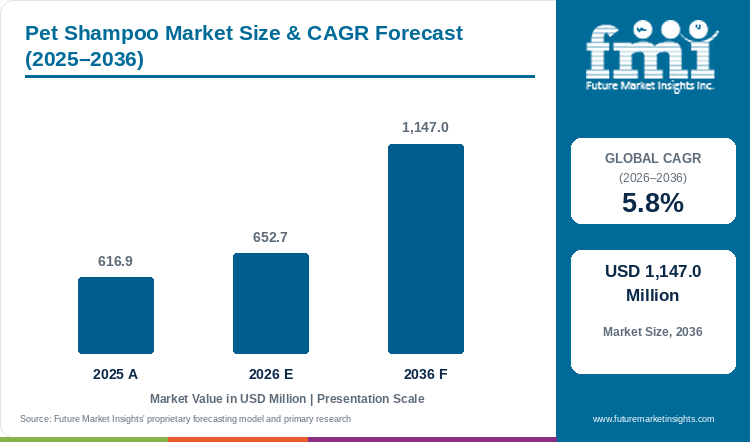
Key Market Trends & Insights
- By product type, natural and organic formulas lead with 55% of 2026 sales, as pet owners seek gentle, allergy-friendly cleansers over chemical-based options.
- By treatment type, cleaning shampoo holds 55% of 2026 sales. Specialty and medicated formulas covering anti-dandruff, anti-itch, anti-fungal and anti-bacterial needs make up the remaining 45%.
- By pet type, dogs hold 65% of 2026 sales, owing to higher dog ownership rates and more frequent grooming routines compared with other pets.pet toys
- By sales channel, offline retail collects 80% of 2026 sales, and pet specialty stores and hypermarkets will keep most shoppers testing scent and texture before buying through 2036.
- By end user, household pet owners account for 72% of 2026 sales. Professional groomers tied to the broader pet grooming category and veterinary clinics add the remaining 28% through bulk and clinical-grade purchases.
Regional Highlights
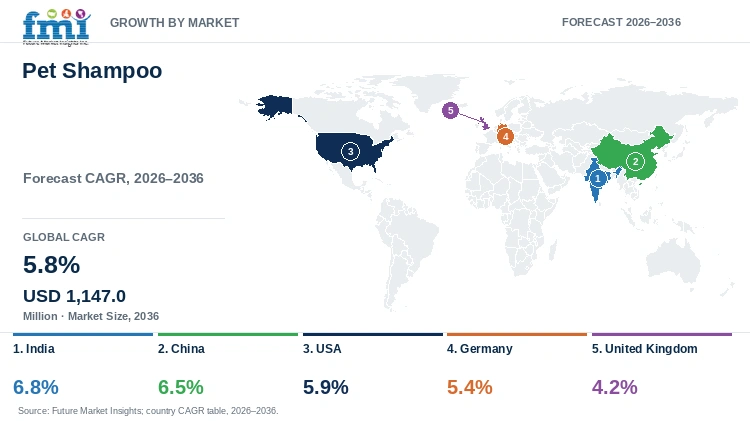
- India leads growth among the profiled countries at 6.8% CAGR from 2026 to 2036.
- China and USA follow at 6.5% and 5.9% respectively, and the United Kingdom records the slowest profiled pace at 4.2% through 2036.
- US households with pets reached 95 million in 2025, giving the country the broadest grooming product base among profiled markets, according to APPA data reported by GlobalPETS in July 2026 [1].
Market Size & Forecast
Table 1: Market Size and Forecast for the Pet Shampoo Market (USD million and percentage), 2025 to 2036
| Metric | Value |
|---|---|
| 2025 Market Size | USD 616.9 million |
| Estimated Market Size in 2026 | USD 652.7 million |
| Projected Market Size by 2036 | USD 1,147.0 million |
| CAGR, 2026 to 2036 | 5.8% |
| Added Revenue, 2026 to 2036 | USD 494.3 million |
| Market Expansion Multiple | 1.76x |
Most pet shampoo purchases now carry a premium label. Buyers pay more for formulas built around skin health, coat condition and scent variety not plain cleaning. Grooming and veterinary-adjacent spending took a large share of total pet budgets in 2025 [1]. Growth of the pet shampoo market is tracking a wider premiumization trend across pet care, a shift noted at Superzoo 2025 toward self-expression for pets [2]. High prices for specialty formulas can still slow purchases among budget-conscious owners. Rising pet ownership and a steady shift toward natural ingredients are anticipated to drive most sales through 2036.
Premiumization Opportunity Across Natural Formulas
Sales of pet shampoo are shifting toward premium, natural formulas as owners treat pets as family members. Natural and organic shampoo already holds 55% of product type sales in 2026, well ahead of chemical-based formulas. Pet owner budgets in the United States put grooming and personal care products among the top spending categories in 2025, alongside food and veterinary care [1]. At Superzoo 2025, trade visitors saw chemical-free dye stations placed next to professional grooming tools, a sign that clean-label claims are moving from a niche shelf tag to a mainstream buying factor [2]. FMI expects brands that pair natural ingredient lists with dermatologist or veterinary language to capture most of the premium shelf space opening up through 2036.
Pet ownership growth gives premium shampoo brands a wider base to sell into. Dogs are present in 71 million US households and cats in 53 million, both up year over year through 2025, per APPA data published by GlobalPETS in July 2026 [1]. Younger owners are driving much of this growth, with Gen Z and Millennial dog owners up 7% year over year and Gen Z cat owners up 15% [1]. These younger households tend to buy on ingredient lists and skin-health claims ahead of price, based on the premiumization pattern seen across pet care at Superzoo 2025 [2]. Cleaning shampoo still leads treatment-type sales on routine bathing frequency, while anti-dandruff, anti-itch and anti-fungal formulas together make up the remaining 45% of 2026 treatment-type sales. India and China lead profiled country growth, with CAGRs of 6.8% and 6.5% through 2036, as pet ownership expands fastest in these markets. The United Kingdom grows slowest among profiled countries at a 4.2% CAGR by 2036, reflecting a more mature pet ownership base.[1][1][2]
Table 2: Pet Ownership and Premiumization Indicators for the Pet Shampoo Market (percentage changes, household counts, USD and share values), mixed reporting years from 2025 to 2026
| Indicator | Data Point | Market Relevance | Source |
|---|---|---|---|
| US pet-owning households, 2025 | 95 million households; dogs in 71 million, cats in 53 million | A wider pet-owning base lifts the pool of pet shampoo buyers. | [1] |
| US dog and cat owner budgets, 2025 | Veterinary care exceeds a quarter of total spending for dog and cat owners alike | Grooming now ranks among the largest categories of pet spending. | [1] |
| Younger US pet owner growth, 2025 | Gen Z dog owners up 7% year over year; Gen Z cat owners up 15% | Younger owners widen the base for natural and premium formulas. | [1] |
| Superzoo 2025 grooming trend | Chemical-free formulation displays shown alongside professional grooming tools | Clean-label claims are moving into mainstream grooming retail. | [2] |
| Superzoo 2025 premiumization trend | Premiumization reshaping buyer expectations across pet care | Owners are paying more for wellness-focused pet products. | [2] |
| Natural and organic product type share, 2026 | 55% of product type sales | Natural formulas lead buyer preference over chemical-based shampoo. | Future Market Insights |
| Dog ownership growth, 2025 | 71 million US households, up from 67 million a year earlier | Growing dog ownership supports steady demand for dog shampoo. | [1] |
| Cat ownership growth, 2025 | 53 million US households, up from 51 million a year earlier | Rising cat ownership supports growth in cat-specific formulas. | [1] |
| Offline retail sales channel share, 2026 | 80% of sales channel demand | In-store testing keeps offline retail the main buying channel. | Future Market Insights |
| Household pet owner end user share, 2026 | 72% of end user sales | Home grooming between professional visits drives most purchases. | Future Market Insights |
Table 3: Pet Household and Spending Benchmarks for the Pet Shampoo Market (mixed units), reporting year 2025
| Indicator | Reported value | Related figure | Source |
|---|---|---|---|
| Pet shampoo market, 2025 to 2026 | USD 616.9 million to USD 652.7 million | 5.8% CAGR, 2026 to 2036 | Future Market Insights |
| US pet-owning households, 2025 | 95 million | Dogs in 71 million, cats in 53 million | [1] |
| US dog owner spending share, 2025 | Veterinary care about 31% of spending | Food share fell from 29% to 27% year over year | [1] |
| US cat owner spending share, 2025 | Products 39%, food 29%, veterinary care 28% | Unchanged from 2024 | [1] |
| Gen Z and Millennial pet owner growth, 2025 | Dog owners up 7% (Gen Z and Millennial); cat owners up 15% (Gen Z) | Millennial cat owners up 10% | [1] |
| Superzoo 2025 grooming positioning | Grooming described as moving from maintenance to artistry | Chemical-free displays placed beside professional tools | [2] |
| Natural and organic product type share, 2026 | 55% | Chemical-based formulas hold the remaining 45% | Future Market Insights |
| Dog pet type share, 2026 | 65% | Cats 27%, other pets 8% | Future Market Insights |
Analyst Perspective
"Pet shampoo brands that pair natural ingredient claims with clear skin-health language will capture most of the premium shelf space opening up as younger pet owners spend more on grooming. Offline retail will keep the largest share of sales through 2036, but brands that also build an online presence will reach these younger buyers first."
- Rahul Pandita, Principal Consultant, Future Market Insights.
How is the pet shampoo market segmented?
The pet shampoo market is studied across five commercial segments plus region, namely product type, treatment type, pet type, sales channel and end user. In 2026, natural and organic formulas hold 55%, cleaning shampoo 55%, dogs 65%, offline channels 80% and household pet owners 72% of respective segment sales.
By product type: natural and organic formulas, and chemical-based formulas.
By treatment type: cleaning shampoo, anti-dandruff and anti-itching formulas, anti-fungal and anti-bacterial formulas, and other specialty treatments.
By pet type: dogs, cats, and other pets.
By sales channel: offline retail, and online retail.
By end user: household pet owners, and professional groomers and veterinary clinics.
By region: North America, Latin America, Western Europe, Eastern Europe, East Asia, South Asia and Pacific, and Middle East and Africa.
Why do natural and organic formulas lead product type sales?
Natural and organic formulas will hold 55% of product type sales in 2026, as owners move away from chemical-based cleansers.
Table 4: Product Type Share for the Pet Shampoo Market (percentage share), 2026
| Product Type | Share (2026) |
|---|---|
| Natural and Organic Formulas | 55% |
| Chemical-Based Formulas | 45% |
| Total | 100% |
Table 5: Product Type Leadership and Market Growth for the Pet Shampoo Market (segment and CAGR percentage), 2026 to 2036
| Metric | Value |
|---|---|
| Global CAGR (2026 to 2036) | 5.8% |
| Leading Segment | Natural and Organic Formulas |
Demand for natural and organic pet shampoo is rising, as owners move away from harsh chemical cleansers toward gentle, allergy-friendly formulas. FMI finds that natural and organic formulas account for 55% of product type sales in 2026. Chemical-based shampoo still serves budget-conscious buyers and heavy-duty cleaning needs. Clean-label claims are moving into the mainstream of pet grooming, a shift visible at Superzoo 2025 through chemical-free dye and formulation displays placed beside standard grooming gear [2]. Wider availability of plant-based, sulfate-free formulas is anticipated to keep this segment ahead through 2036.
- Natural and organic formulas hold 55% of product type sales in 2026, since owners increasingly check ingredient lists before buying.
- Buyers comparing natural shampoo should check for sulfate-free and fragrance-free labels, as these factors matter most for pets with sensitive skin.
Why does cleaning shampoo lead treatment type sales?
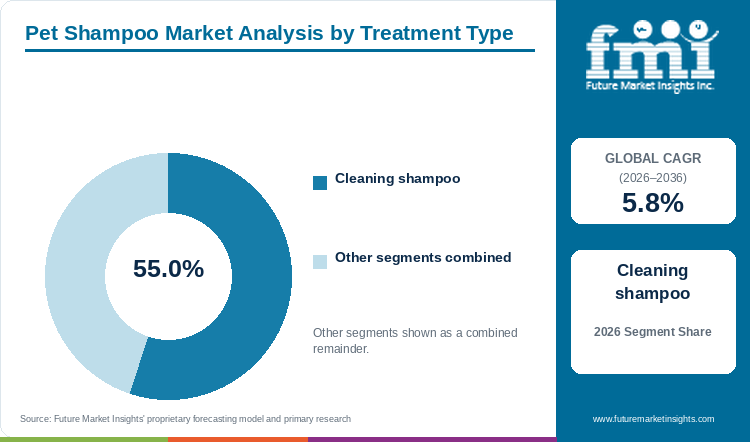
Cleaning shampoo holds 55% of treatment type sales in 2026, and specialty and medicated formulas make up the remaining 45%.
Sales of cleaning shampoo follow basic bathing frequency, as most pet owners wash pets for routine hygiene, not for a specific skin condition. FMI estimates that cleaning shampoo holds 55% of treatment type sales in 2026. Anti-dandruff, anti-itch, anti-fungal and anti-bacterial formulas together make up the remaining 45%, as owners turn to medicated options once a skin issue appears. Grooming routines are shifting toward broader wellness care, a pattern noted across pet product categories at Superzoo 2025 [2]. Wider combination of cleaning and skin-care benefits in one bottle is expected to narrow the gap between these treatment types.
- Cleaning shampoo holds 55% of treatment type sales in 2026, as routine bathing remains the main reason owners buy pet shampoo.
- Specialty and medicated formulas deserve a check against a veterinarian's advice before use, since skin conditions can need a specific active ingredient.
Why do dogs lead pet type sales?
Dogs make up 65% of pet type sales in 2026, owing to higher dog ownership and more frequent grooming routines.
Demand for dog shampoo is rising, as dogs are present in more US households than any other pet. FMI data shows dogs making up 65% of pet type sales in 2026. Cats hold 27% of sales, with grooming needs tied to indoor coat care, and other pets such as rabbits and small mammals round out the remaining 8%. Dogs are present in 71 million US households, up from 67 million a year earlier, according to APPA data reported by GlobalPETS in July 2026 [1]. Rising spending on pet food and grooming together points to a broader pet humanization pattern. Growing dog ownership among younger households is expected to keep this segment ahead of other pet types through 2036.
- Dogs make up 65% of pet type sales in 2026, and higher dog ownership among younger owners will keep this segment in front.
- Cat owners should look for tear-free, low-residue formulas, as cats groom themselves between baths and can ingest leftover product.
Why does offline retail lead sales channel demand?
Offline retail captures 80% of sales channel demand in 2026, owing to in-store scent and formula testing before purchase.
Most pet owners still buy shampoo in store, since scent and texture testing before purchase stays common. FMI estimates that offline retail captures 80% of sales channel demand in 2026. Pet specialty stores and hypermarkets carry the widest range of scents and formulas, and online retail serves buyers restocking a known brand. Younger pet owners are growing fastest as a share of dog and cat owners and are more likely to shop online once a preferred formula is set [1]. Wider product variety in physical stores will keep offline retail as the main channel through 2036.
- Offline retail captures 80% of sales channel demand in 2026, supported by in-store scent and formula testing.
- Online buyers often prefer subscription refills, as repeat purchases of a known formula need less testing before checkout.
What gives household pet owners the lead in end user demand?
Household pet owners hold 72% of end user sales in 2026, as buyers want convenient formulas for home bathing.
Household pet owners buy most pet shampoo for routine home grooming between professional visits. Household pet owners hold 72% of sales by end user in 2026, as per FMI. Professional groomers and veterinary clinics buy in bulk and favor clinical-grade and medicated formulas. Grooming has moved from simple upkeep toward a wellness routine for many owners, a shift noted across the pet category at Superzoo 2025 [2]. Demand from professional groomers is anticipated to grow alongside pet humanization trends, and household buyers are set to keep most sales.
- Household pet owners want convenient, multi-use formulas for home bathing, giving this group 72% of end user sales in 2026.
- Professional groomers and veterinary clinics deserve a separate product line check, as clinical-grade formulas often carry different dilution and safety guidance.
What are the drivers, restraints, and opportunities in the pet shampoo market?
Pet humanization and premium grooming spending push owners toward natural formulas, limited awareness in rural markets slows specialty sales, and online retail opens the main opportunity for direct owner relationships.
- Driver: Key drivers of the pet shampoo market include pet humanization and rising spending on premium grooming products as owners treat pets as family members.
- Restraint: Limited awareness of specialty and medicated shampoo in rural and developing markets slows sales of pet shampoo outside major cities.
- Opportunity: Rising online retail and subscription refill models open growth for pet shampoo brands building direct relationships with younger pet owners.
Younger Pet Owners Speed Up Premium Purchases
Pet ownership among younger households keeps rising, widening the buyer base for premium grooming formulas. Gen Z and Millennial dog owners grew 7% year over year through 2025, and Gen Z cat owners grew 15%, according to APPA data reported by GlobalPETS in July 2026 [1]. Younger owners are moving spending toward natural and specialty formulas instead of plain cleaning shampoo. Sales of premium pet shampoo are anticipated to grow fastest among these younger buyer segments through 2036.
Awareness Gaps Limit Specialty Formula Sales
Limited awareness of medicated and specialty shampoo slows sales outside major pet care markets. Many owners outside large cities still default to basic cleaning shampoo for routine bathing, without exposure to anti-dandruff or sensitive-skin lines carried mainly in pet specialty stores and online. Wider distribution in general retail channels could narrow this gap over the forecast period.
Online Retail Builds a Direct Owner Relationship
Online retail is opening a new growth path for pet shampoo brands. Grooming is shifting from a one-time purchase toward a wellness routine, a shift visible across pet product categories at Superzoo 2025 [2]. Subscription and refill models let brands keep a direct link with owners between purchases. Brands building loyalty programs around natural and specialty formulas stand to gain new online orders through 2036.pet dietary supplements[2]
Which country CAGRs are profiled in the pet shampoo market?
Sales of pet shampoo in India grow fastest among the five profiled countries, at a 6.8% CAGR between 2026 and 2036. The United Kingdom posts the slowest rate, a 4.2% CAGR over the same period. Across all five, rising pet ownership and a shift toward natural and specialty formulas support most of the growth.
Table 6: Country CAGRs and Primary Growth Levers for the Pet Shampoo Market (CAGR percentage), 2026 to 2036
| Country | CAGR (2026-2036) | Primary Growth Lever |
|---|---|---|
| India | 6.8% | Affordable natural formulas for a growing urban pet-owning base |
| China | 6.5% | Premium natural brands for younger urban pet owners |
| USA | 5.9% | Natural and sensitive-skin formulas for younger dog and cat owners |
| Germany | 5.4% | Dermatologically tested, fragrance-free formulas |
| United Kingdom | 4.2% | Specialty and subscription channel growth in a mature pet ownership base |
Source: Future Market Insights
India Pet Shampoo Market Outlook (2026-2036)
Pet ownership in India is rising alongside urbanization and a growing middle class with more disposable income for pet care. Demand for affordable natural shampoo is growing as more urban households adopt dogs and cats as companion pets. India leads profiled country growth with a 6.8% CAGR for 2026 to 2036, as grooming habits shift from occasional home washing to regular use of dedicated pet shampoo. Price-sensitive buyers still favor smaller pack sizes, which keeps average spending per household below levels seen in mature markets.
Key takeaway: Affordable natural formulas in smaller pack sizes will draw most Indian pet shampoo spending.
China Pet Shampoo Market Outlook (2026-2036)
Pet ownership in China is expanding fastest in urban areas, as smaller households increasingly keep a dog or cat as a companion animal. China is set for the second-fastest rate among profiled countries, a 6.5% CAGR through 2036, as pet owners move from basic soap substitutes to dedicated shampoo brands. Younger Chinese pet owners favor imported and premium domestic brands with natural ingredient claims over older, chemical-heavy formulas.
Key takeaway: Premium natural brands targeting younger urban pet owners will draw most Chinese pet shampoo spending.
USA Pet Shampoo Market Outlook (2026-2036)
Pets are present in 95 million US households, with dogs in 71 million homes and cats in 53 million, according to APPA data reported by GlobalPETS in July 2026 [1]. Grooming and personal care products took a large share of pet owner budgets in 2025, close behind food and veterinary care [1]. US sales of pet shampoo are set for a 5.9% CAGR over 2026 to 2036, led by natural and specialty formula growth among younger dog and cat owners.
Key takeaway: Natural and sensitive-skin formulas aimed at younger dog and cat owners form the main US opening.
Germany Pet Shampoo Market Outlook (2026-2036)
Germany is projected to add pet shampoo sales at a 5.4% CAGR through 2036. German pet owners show a steady preference for premium, dermatologically tested grooming products, in line with the broader European shift toward natural and sensitive-skin formulas. Demand for fragrance-free and hypoallergenic shampoo is growing as owners pay closer attention to ingredient lists.
Key takeaway: Dermatologically tested, fragrance-free formulas will set the pace of German pet shampoo purchases.
United Kingdom Pet Shampoo Market Outlook (2026-2036)
The United Kingdom posts the lowest profiled CAGR, at 4.2% from 2026 to 2036, reflecting an already mature pet ownership base with slower household growth than in India or China. UK pet owners still favor natural and organic formulas, keeping average spending per bottle higher even as volume growth stays modest. Specialty retailers and online subscription services are expected to carry most of the incremental sales in this market.
Key takeaway: Specialty and subscription channels will carry most of the UK's modest pet shampoo growth.
Who are the notable companies in the pet shampoo market?
Spectrum Brands Inc., Petco Animal Supplies, Inc., Earthbath, Wahl Clipper Corporation, Petkin Inc., Earthwhile Endeavours, Inc., Barklogic, Wildwash, 4-Legger, and TropiClean are the leading companies profiled in this market.
As per FMI, pet shampoo brands come from the United States, the United Kingdom and other markets and differ in ingredient positioning, channel reach and pet type focus. Spectrum Brands Inc., Petco Animal Supplies, Inc. and Earthbath concentrate on natural and specialty formulas sold through pet specialty and mass retail. Wahl Clipper Corporation and Petkin Inc. supply grooming tool and shampoo lines together. Earthwhile Endeavours, Inc., Barklogic, Wildwash, 4-Legger and TropiClean complete the supplier set with natural, boutique and multi-channel grooming lines.
- Natural and specialty formula leaders: Spectrum Brands Inc., Petco Animal Supplies, Inc. and Earthbath supply shampoo built around natural and skin-care positioning.
- Grooming tool and shampoo suppliers: Wahl Clipper Corporation and Petkin Inc. pair shampoo lines with grooming hardware.
- Natural and boutique brands: Earthwhile Endeavours, Inc., Barklogic, Wildwash, 4-Legger and TropiClean supply natural and specialty pet shampoo through pet specialty and online channels.
Competitive Benchmarking: Pet Shampoo Market
Table 7: Competitive Benchmarking for the Pet Shampoo Market (qualitative capability ratings), 2026
| Company | Formula Range | Channel Reach | Natural Positioning | Service Reach |
|---|---|---|---|---|
| Spectrum Brands Inc. | High | High | Medium | High |
| Petco Animal Supplies, Inc. | High | High | Medium | High |
| Earthbath | Medium | Medium | High | Medium |
| Wahl Clipper Corporation | Medium | High | Low | High |
| Petkin Inc. | Medium | Medium | Medium | Medium |
| Earthwhile Endeavours, Inc. | Low | Low | High | Low |
| Barklogic | Low | Low | Medium | Low |
| Wildwash | Low | Low | Medium | Low |
| 4-Legger | Low | Low | High | Low |
| TropiClean | Medium | Medium | Medium | Medium |
Companies scoring High show broad, publicly documented activity across the pet shampoo range; Medium marks a narrower or more recent record; Low reflects limited public documentation for pet shampoo. Spectrum Brands Inc. is rated on the natural and specialty shampoo range, and Wahl Clipper Corporation on the combined grooming tool and shampoo line.
Key Developments in the Pet Shampoo Market
- Pet ownership in the United States reached 95 million households in 2025, with dog and cat ownership both rising year over year, according to the American Pet Products Association's 2026 State of the Industry data [1].
- Superzoo 2025 showed grooming moving from basic maintenance toward wellness and self-expression, with chemical-free formulation on display alongside professional grooming tools [2].
- Younger pet owners drove much of the household growth reported for 2025, with Gen Z dog owners up 7% year over year and Gen Z cat owners up 15% [1].
- Pet owner budgets in 2025 placed veterinary care among the largest categories of spending, close to food [1].[1]
Key Players in the Pet Shampoo Market
Natural and Specialty Formula Leaders
- Spectrum Brands Inc.
- Petco Animal Supplies, Inc.
- Earthbath
- 4-Legger
Grooming Tool and Shampoo Suppliers
- Wahl Clipper Corporation
- Petkin Inc.
- TropiClean
Natural and Boutique Brands
- Earthwhile Endeavours, Inc.
- Barklogic
- Wildwash
Pet Shampoo Market - Report Scope
Table 8: Report Scope for the Pet Shampoo Market (coverage fields and definitions), 2026 to 2036
| Coverage field | Report scope |
|---|---|
| Market breakdown | Product type; treatment type; pet type; sales channel; end user; region |
| Quantitative units | USD million |
| Market definition | Sales of pet shampoo formulas sold through offline and online retail for dogs, cats and other pets, covering cleaning, anti-dandruff, anti-itching, anti-fungal, anti-bacterial and other specialty treatment types. Pet grooming tools, pet food and veterinary medicated treatments sold separately from shampoo are excluded. |
| Regions covered | North America; Latin America; Western Europe; Eastern Europe; East Asia; South Asia and Pacific; Middle East and Africa |
| Countries covered | India; China; USA; Germany; United Kingdom |
| Key companies profiled | Spectrum Brands Inc., Petco Animal Supplies, Inc., Earthbath, Wahl Clipper Corporation, Petkin Inc., Earthwhile Endeavours, Inc., Barklogic, Wildwash, 4-Legger, TropiClean |
| Forecast period | 2026 to 2036 |
| Approach | The model ties bottom-up volumes to top-down estimates, reconciling pet-owning household counts, spending share by category, channel data, brand activity and country-level pet ownership growth, checked against industry association data and primary interviews. |
Pet Shampoo Market - Research Methodology
Table 9: Research Methodology for the Pet Shampoo Market (research methods and approach), 2026 edition
| Method | Approach |
|---|---|
| Primary Research | Primary research includes interviews with pet shampoo brand managers, pet specialty retailers, groomers and veterinary clinic staff. Interviews cover ingredient preference, channel split, spending patterns and new formula launches. |
| Desk Research | Desk research draws on brand filings, product launch releases, pet industry association data, trade event reporting and pet ownership statistics. |
| Market Sizing and Forecasting | Sizing starts from the 2025 market value and adds pet-owning household growth, spending share per category, segment splits and country-level pet care growth. |
| Data Validation | Each estimate is tested against pet industry association disclosures, household ownership data and primary interviews. Pet grooming tools and veterinary medicated treatments stay outside market value, so no revenue is counted twice. |
Pet Shampoo Market by Segments
Pet Shampoo Market segmented by Product Type:
- Natural and organic formulas
- Chemical-based formulas
Pet Shampoo Market segmented by Treatment Type:
- Cleaning shampoo
- Anti-dandruff and anti-itching formulas
- Anti-fungal and anti-bacterial formulas
- Other specialty treatments
Pet Shampoo Market segmented by Pet Type:
- Dogs
- Cats
- Other pets
Pet Shampoo Market segmented by Sales Channel:
- Offline retail
- Online retail
Pet Shampoo Market segmented by End User:
- Household pet owners
- Professional groomers and veterinary clinics
Pet Shampoo Market by Region
- North America
- United States
- Canada
- Latin America
- Brazil
- Mexico
- Argentina
- Chile
- Western Europe
- Germany
- France
- United Kingdom
- Italy
- Spain
- Benelux
- Nordics
- Eastern Europe
- Poland
- Czech Republic
- Romania
- Hungary
- East Asia
- China
- Japan
- South Korea
- India
- South Asia and Pacific
- ASEAN
- Australia and New Zealand
- Middle East and Africa
- GCC Countries
- South Africa
- Türkiye
- Israel
Research Sources and Bibliography
- [1] American Pet Products Association (APPA), via GlobalPETS. (2026, July 28). 2010-2025: US Pet Ownership Shifts After 15 Years of Steady Growth.https://globalpetindustry.com/news/2010-2025-us-pet-ownership-shifts-after-15-years-of-steady-growth/
- [2] ForceBrands. (2025, September 11). Trends Spotted at Superzoo 2025: Implications for the Future of Pet Businesses.https://forcebrands.com/blog/trends-spotted-at-superzoo-2025-implications-for-the-future-of-pet-businesses
This Report Answers
- What value will pet shampoo sales reach in 2026?
- By 2036, what market value will pet shampoo reach?
- Which product type takes the largest share of sales?
- Which treatment type and pet type do owners favor?
- Which profiled countries show the fastest growth in pet shampoo sales?
- Which brands lead the supply of pet shampoo to pet owners?
Frequently Asked Questions
What is the pet shampoo market worth in 2026?
Pet shampoo sales are valued at USD 652.7 million in 2026, according to FMI. The market will reach USD 1,147.0 million by 2036 as pet owners spend more on natural and specialty grooming formulas.
What CAGR is projected for the pet shampoo market through 2036?
FMI projects a 5.8% CAGR for the pet shampoo market from 2026 to 2036. Rising pet ownership and premiumization in grooming habits will support much of this growth.
Which product type holds a leading share in 2026?
Natural and organic formulas will hold 55% of product type sales in 2026. Owners increasingly choose gentle, allergy-friendly shampoo over chemical-based options.
Which pet type holds a leading share in 2026?
Dogs will account for 65% of pet type sales in 2026. Dog ownership keeps growing among younger households, widening the buyer base for dog-specific formulas.
Which country has a leading growth outlook through 2036?
India leads the profiled countries with a 6.8% CAGR for pet shampoo sales over 2026 to 2036. Rising urban pet ownership and growing middle-class spending support this pace.
Who are the key companies in the pet shampoo market?
Key companies include Spectrum Brands Inc., Petco Animal Supplies, Inc., Earthbath, Wahl Clipper Corporation, Petkin Inc., Earthwhile Endeavours, Inc., Barklogic, Wildwash, 4-Legger, and TropiClean. These brands compete on ingredient positioning, channel reach and pet type focus.
Preview the report firsthand - request a free sample
Get SampleGet the brochure for pricing and purchase details.
Get PDFTable of Content
- Key Takeaways
- Market Size and CAGR
- Top Growth Driver
- Fastest Growing Segment
- Leading Region
- Key Companies
- Emerging Opportunities
- Executive Summary
- Global Market Outlook
- Demand-side Trends
- Supply-side Trends
- Technology Roadmap Analysis
- Analysis and Recommendations
- Analyst Perspective (What is happening? Why now? What should investors know?)
- Key Questions Answered
- How large is the market?
- What is the CAGR?
- What are key trends?
- Which region dominates?
- Who are the leaders?
- Market Overview
- Market Coverage / Taxonomy
- Market Definition / Scope / Limitations
- Research Methodology
- Chapter Orientation
- Analytical Lens and Working Hypotheses
- Market Structure, Signals, and Trend Drivers
- Benchmarking and Cross-market Comparability
- Market Sizing, Forecasting, and Opportunity Mapping
- Research Design and Evidence Framework
- Desk Research Programme (Secondary Evidence)
- Expert Input and Fieldwork (Primary Evidence)
- Tooling, Models, and Reference Databases
- Data Engineering and Model Build
- Quality Assurance and Audit Trail
- Market Background
- Market Dynamics (Drivers, Restraints, Opportunity, Trends)
- Scenario Forecast (Optimistic, Likely, Conservative)
- Impact Analysis
- AI Impact
- Sustainability Impact
- Regulatory Impact
- Technology Impact
- Consumer / Buyer Analysis
- Purchase Drivers
- Adoption Barriers
- Buyer Journey
- Opportunity Map Analysis
- Product Life Cycle Analysis
- Supply Chain Analysis
- Investment Feasibility Matrix
- Value Chain Analysis
- PESTLE and Porter's Analysis
- Regulatory Landscape
- Regional Parent Market Outlook
- Production and Consumption Statistics
- Import and Export Statistics
- Global Market Analysis and Forecast, 2021 to 2036
- Historical Market Size Value (USD Million) Analysis, 2021 to 2025
- Current and Future Market Size Value (USD Million) Projections, 2026 to 2036
- Y-o-Y Growth Trend Analysis
- Absolute $ Opportunity Analysis
- Global Market Pricing Analysis, 2021 to 2036
- Global Market Analysis and Forecast, By Product Type, 2021 to 2036
- Introduction / Key Findings
- Historical Market Size Value (USD Million) Analysis By Product Type, 2021 to 2025
- Current and Future Market Size Value (USD Million) Analysis and Forecast By Product Type, 2026 to 2036
- Natural and organic formulas
- Chemical-based formulas
- Y-o-Y Growth Trend Analysis By Product Type, 2021 to 2025
- Absolute $ Opportunity Analysis By Product Type, 2026 to 2036
- Global Market Analysis and Forecast, By Treatment Type, 2021 to 2036
- Introduction / Key Findings
- Historical Market Size Value (USD Million) Analysis By Treatment Type, 2021 to 2025
- Current and Future Market Size Value (USD Million) Analysis and Forecast By Treatment Type, 2026 to 2036
- Cleaning shampoo
- Anti-dandruff and anti-itching formulas
- Anti-fungal and anti-bacterial formulas
- Other specialty treatments
- Y-o-Y Growth Trend Analysis By Treatment Type, 2021 to 2025
- Absolute $ Opportunity Analysis By Treatment Type, 2026 to 2036
- Global Market Analysis and Forecast, By Pet Type, 2021 to 2036
- Introduction / Key Findings
- Historical Market Size Value (USD Million) Analysis By Pet Type, 2021 to 2025
- Current and Future Market Size Value (USD Million) Analysis and Forecast By Pet Type, 2026 to 2036
- Dogs
- Cats
- Other pets
- Y-o-Y Growth Trend Analysis By Pet Type, 2021 to 2025
- Absolute $ Opportunity Analysis By Pet Type, 2026 to 2036
- Global Market Analysis and Forecast, By Sales Channel, 2021 to 2036
- Introduction / Key Findings
- Historical Market Size Value (USD Million) Analysis By Sales Channel, 2021 to 2025
- Current and Future Market Size Value (USD Million) Analysis and Forecast By Sales Channel, 2026 to 2036
- Offline retail
- Online retail
- Y-o-Y Growth Trend Analysis By Sales Channel, 2021 to 2025
- Absolute $ Opportunity Analysis By Sales Channel, 2026 to 2036
- Global Market Analysis and Forecast, By End User, 2021 to 2036
- Introduction / Key Findings
- Historical Market Size Value (USD Million) Analysis By End User, 2021 to 2025
- Current and Future Market Size Value (USD Million) Analysis and Forecast By End User, 2026 to 2036
- Household pet owners
- Professional groomers and veterinary clinics
- Y-o-Y Growth Trend Analysis By End User, 2021 to 2025
- Absolute $ Opportunity Analysis By End User, 2026 to 2036
- Global Market Analysis and Forecast, By Region, 2021 to 2036
- Introduction
- Historical Market Size Value (USD Million) Analysis By Region, 2021 to 2025
- Current Market Size Value (USD Million) Analysis and Forecast By Region, 2026 to 2036
- North America
- Latin America
- Western Europe
- Eastern Europe
- East Asia
- South Asia and Pacific
- Middle East and Africa
- Market Attractiveness Analysis By Region
- North America Market Analysis and Forecast, By Country, 2021 to 2036
- Historical Market Size Value (USD Million) Trend Analysis By Market Taxonomy, 2021 to 2025
- Market Size Value (USD Million) Forecast By Market Taxonomy, 2026 to 2036
- By Country
- United States
- Canada
- By Product Type
- By Treatment Type
- By Pet Type
- By Sales Channel
- By End User
- By Country
- Market Attractiveness Analysis
- By Country
- By Product Type
- By Treatment Type
- By Pet Type
- By Sales Channel
- By End User
- Key Takeaways
- Latin America Market Analysis and Forecast, By Country
- Historical Market Size Value (USD Million) Trend Analysis By Market Taxonomy, 2021 to 2025
- Market Size Value (USD Million) Forecast By Market Taxonomy, 2026 to 2036
- By Country
- Brazil
- Mexico
- Argentina
- Chile
- By Product Type
- By Treatment Type
- By Pet Type
- By Sales Channel
- By End User
- By Country
- Market Attractiveness Analysis
- By Country
- By Product Type
- By Treatment Type
- By Pet Type
- By Sales Channel
- By End User
- Key Takeaways
- Western Europe Market Analysis and Forecast, By Country
- Historical Market Size Value (USD Million) Trend Analysis By Market Taxonomy, 2021 to 2025
- Market Size Value (USD Million) Forecast By Market Taxonomy, 2026 to 2036
- By Country
- Germany
- France
- United Kingdom
- Italy
- Spain
- Benelux
- Nordics
- By Product Type
- By Treatment Type
- By Pet Type
- By Sales Channel
- By End User
- By Country
- Market Attractiveness Analysis
- By Country
- By Product Type
- By Treatment Type
- By Pet Type
- By Sales Channel
- By End User
- Key Takeaways
- Eastern Europe Market Analysis and Forecast, By Country
- Historical Market Size Value (USD Million) Trend Analysis By Market Taxonomy, 2021 to 2025
- Market Size Value (USD Million) Forecast By Market Taxonomy, 2026 to 2036
- By Country
- Poland
- Czech Republic
- Romania
- Hungary
- By Product Type
- By Treatment Type
- By Pet Type
- By Sales Channel
- By End User
- By Country
- Market Attractiveness Analysis
- By Country
- By Product Type
- By Treatment Type
- By Pet Type
- By Sales Channel
- By End User
- Key Takeaways
- East Asia Market Analysis and Forecast, By Country
- Historical Market Size Value (USD Million) Trend Analysis By Market Taxonomy, 2021 to 2025
- Market Size Value (USD Million) Forecast By Market Taxonomy, 2026 to 2036
- By Country
- China
- Japan
- South Korea
- India
- By Product Type
- By Treatment Type
- By Pet Type
- By Sales Channel
- By End User
- By Country
- Market Attractiveness Analysis
- By Country
- By Product Type
- By Treatment Type
- By Pet Type
- By Sales Channel
- By End User
- Key Takeaways
- South Asia and Pacific Market Analysis and Forecast, By Country
- Historical Market Size Value (USD Million) Trend Analysis By Market Taxonomy, 2021 to 2025
- Market Size Value (USD Million) Forecast By Market Taxonomy, 2026 to 2036
- By Country
- ASEAN
- Australia and New Zealand
- By Product Type
- By Treatment Type
- By Pet Type
- By Sales Channel
- By End User
- By Country
- Market Attractiveness Analysis
- By Country
- By Product Type
- By Treatment Type
- By Pet Type
- By Sales Channel
- By End User
- Key Takeaways
- Middle East and Africa Market Analysis and Forecast, By Country
- Historical Market Size Value (USD Million) Trend Analysis By Market Taxonomy, 2021 to 2025
- Market Size Value (USD Million) Forecast By Market Taxonomy, 2026 to 2036
- By Country
- GCC Countries
- South Africa
- Türkiye
- Israel
- By Product Type
- By Treatment Type
- By Pet Type
- By Sales Channel
- By End User
- By Country
- Market Attractiveness Analysis
- By Country
- By Product Type
- By Treatment Type
- By Pet Type
- By Sales Channel
- By End User
- Key Takeaways
- Key Countries Market Analysis
- United States
- Pricing Analysis
- Market Share Analysis, 2025
- By Product Type
- By Treatment Type
- By Pet Type
- By Sales Channel
- By End User
- Canada
- Pricing Analysis
- Market Share Analysis, 2025
- By Product Type
- By Treatment Type
- By Pet Type
- By Sales Channel
- By End User
- Mexico
- Pricing Analysis
- Market Share Analysis, 2025
- By Product Type
- By Treatment Type
- By Pet Type
- By Sales Channel
- By End User
- Brazil
- Pricing Analysis
- Market Share Analysis, 2025
- By Product Type
- By Treatment Type
- By Pet Type
- By Sales Channel
- By End User
- Chile
- Pricing Analysis
- Market Share Analysis, 2025
- By Product Type
- By Treatment Type
- By Pet Type
- By Sales Channel
- By End User
- Germany
- Pricing Analysis
- Market Share Analysis, 2025
- By Product Type
- By Treatment Type
- By Pet Type
- By Sales Channel
- By End User
- United Kingdom
- Pricing Analysis
- Market Share Analysis, 2025
- By Product Type
- By Treatment Type
- By Pet Type
- By Sales Channel
- By End User
- Italy
- Pricing Analysis
- Market Share Analysis, 2025
- By Product Type
- By Treatment Type
- By Pet Type
- By Sales Channel
- By End User
- Spain
- Pricing Analysis
- Market Share Analysis, 2025
- By Product Type
- By Treatment Type
- By Pet Type
- By Sales Channel
- By End User
- France
- Pricing Analysis
- Market Share Analysis, 2025
- By Product Type
- By Treatment Type
- By Pet Type
- By Sales Channel
- By End User
- India
- Pricing Analysis
- Market Share Analysis, 2025
- By Product Type
- By Treatment Type
- By Pet Type
- By Sales Channel
- By End User
- ASEAN
- Pricing Analysis
- Market Share Analysis, 2025
- By Product Type
- By Treatment Type
- By Pet Type
- By Sales Channel
- By End User
- Australia and New Zealand
- Pricing Analysis
- Market Share Analysis, 2025
- By Product Type
- By Treatment Type
- By Pet Type
- By Sales Channel
- By End User
- China
- Pricing Analysis
- Market Share Analysis, 2025
- By Product Type
- By Treatment Type
- By Pet Type
- By Sales Channel
- By End User
- Japan
- Pricing Analysis
- Market Share Analysis, 2025
- By Product Type
- By Treatment Type
- By Pet Type
- By Sales Channel
- By End User
- South Korea
- Pricing Analysis
- Market Share Analysis, 2025
- By Product Type
- By Treatment Type
- By Pet Type
- By Sales Channel
- By End User
- Poland
- Pricing Analysis
- Market Share Analysis, 2025
- By Product Type
- By Treatment Type
- By Pet Type
- By Sales Channel
- By End User
- Hungary
- Pricing Analysis
- Market Share Analysis, 2025
- By Product Type
- By Treatment Type
- By Pet Type
- By Sales Channel
- By End User
- Türkiye
- Pricing Analysis
- Market Share Analysis, 2025
- By Product Type
- By Treatment Type
- By Pet Type
- By Sales Channel
- By End User
- South Africa
- Pricing Analysis
- Market Share Analysis, 2025
- By Product Type
- By Treatment Type
- By Pet Type
- By Sales Channel
- By End User
- United States
- Market Structure Analysis
- Competition Dashboard
- Competition Benchmarking
- Market Share Analysis of Top Players
- By Regional
- By Product Type
- By Treatment Type
- By Pet Type
- By Sales Channel
- By End User
- Emerging Startups
- Innovation Benchmarking
- Competition Analysis
- Competition Deep Dive
- Spectrum Brands Inc.
- Overview
- Product Portfolio
- Profitability by Market Segments
- Sales Footprint
- Strategy Overview
- Marketing Strategy
- Product Strategy
- Channel Strategy
- Petco Animal Supplies, Inc.
- Earthbath
- Wahl Clipper Corporation
- Petkin Inc.
- Earthwhile Endeavours, Inc.
- Barklogic
- Wildwash
- 4-Legger
- TropiClean
- Spectrum Brands Inc.
- Case Studies
- Success Stories
- Recent Developments
- Competition Deep Dive
- Assumptions & Acronyms Used


