

- Industry Size (2026)
- USD 3.5 Bn
- Forecast (2036)
- USD 7.1 Bn
- CAGR (2026 to 2036)
- 7.3%
Carpet and Rug Shampoo Market Size, Market Forecast and Outlook By FMI
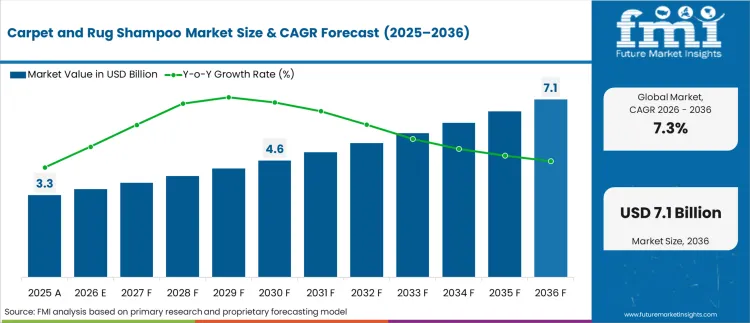
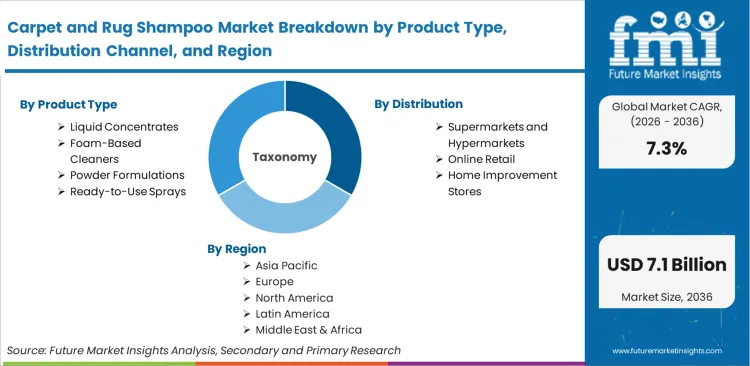
In 2025, revenue from the carpet and rug shampoo market was worth USD 3.2 billion. The market is forecast to grow to USD 3.5 billion in 2026 and reach USD 7.1 billion by 2036. Over the forecast timeframe, the industry is set to grow at a CAGR of 7.3%.
The carpet and rug shampoo market is expanding as commercial floor care budgets rise across hospitality, healthcare, and corporate office environments. Facility managers are tightening cleaning protocols to extend carpet life and reduce premature replacement costs. Deep extraction shampoos with low-foam chemistry are gaining traction as they improve fiber appearance while minimizing residue buildup that attracts soil. In large hotel chains and co-working spaces, outsourcing contracts increasingly specify scheduled carpet shampoo cycles to meet hygiene benchmarks. This structured procurement approach is driving consistent institutional demand beyond seasonal household cleaning purchases.
Summary of Carpet and Rug Shampoo Market
- Carpet and Rug Shampoo Market Definition
- The industry comprises specialized cleaning formulations developed for maintaining textile floor coverings across residential homes, commercial office spaces, hospitality facilities, and automotive interior applications.
- Demand Drivers in the Market
- Growing pet ownership increases demand for odor-control and stain-removal carpet shampoo formulations suited for frequent spot treatment.
- Heightened awareness of indoor allergens supports adoption of deep-cleaning solutions compatible with extraction machines.
- Advancements in concentrated product formats lower packaging usage while preserving effective soil removal performance.
- Key Segments Analyzed in the Report
- Product Type: Liquid Concentrates (39%) versus foam cleaners, powder systems, and ready-to-use formats.
- Distribution Channel: Supermarkets and Hypermarkets (41%) versus online retail and specialty cleaning stores.
- Geography: High-growth Asia Pacific versus mature North American and European markets.
- Analyst Opinion at FMI
- Nandini Roy Choudhury, Senior Consultant for Consumer Products at Future Market Insights, comments, "The updated Carpet and Rug Shampoo Market Report for 2026 to 2036 outlines evolving formulation priorities that combine high stain-removal capability with controlled residue levels across synthetic and natural carpet fibers. My research highlights that enzyme-driven chemistries are redefining brand differentiation, while compliance with pH-balanced standards could create entry constraints for value-tier manufacturers without established specialty surfactant partnerships."
- Strategic Implications/Executive Takeaways
- Refine product narratives around material-specific cleaning compatibility rather than broad-spectrum efficacy claims.
- Integrate refill-based concentrates as the standard packaging direction across mainstream and premium ranges.
- Expand controlled-laboratory residue assessment protocols to limit soil rebound and strengthen repurchase intent.
- Methodology
- Validated through direct retail sales data and household cleaning frequency surveys.
- Zero reliance on speculative home care trend forecasting.
- Based on verifiable brand performance metrics and verified distribution agreements.
Residential renovation activity is another growth factor. Homeowners investing in wall-to-wall carpeting and area rugs are allocating higher spending toward maintenance products that preserve texture and color. Pet ownership rates and allergy sensitivity concerns are influencing purchases of pet stain removers and odor control products. Concentrated liquid formats are favored as they reduce per-use cost and align with rising adoption of upright carpet cleaning machines. Private label expansion in supermarkets is improving category visibility and price competitiveness, accelerating penetration in mid-income households.
Product innovation is reshaping competitive positioning. Manufacturers are introducing quick-dry formulations that cut drying time to under two hours, addressing downtime concerns in commercial properties. Plant-derived surfactants and phosphate-free blends are supporting compliance with wastewater discharge norms in North America and Europe. Brands are strengthening distribution through online platforms that bundle shampoos with cleaning equipment, increasing average order value. Subscription models for professional cleaning contractors are stabilizing repeat purchase cycles, creating predictable revenue streams across the supply chain.
Companies are focusing on enhancing their product portfolios to strengthen their geographical footprint. In 2024, Reckitt Benckiser Group Plc unveiled to focus majorly on market-leading Powerbrands to establish itself as a prominent consumer health and hygiene company. “Today we announce an important step forward to firmly establish Reckitt as a world-class consumer health and hygiene company, with one of the strongest growth and margin profiles in the industry. Our core portfolio of market-leading Powerbrands, and simpler, more effective organisation positions us to better serve our consumers and customers. This will deliver attractive long-term value creation for Reckitt’s shareholders through our earnings model and cash returns. Kris Licht, Chief Executive Officer, said. [1]
Carpet and Rug Shampoo Market Key Takeaways
| Metric | Value |
|---|---|
| Market Value (2026) | USD 3.5 billion |
| Market Forecast Value (2036) | USD 7.1 billion |
| Forecast CAGR (2026-2036) | 7.3% |
Source: FMI analysis based on proprietary forecasting model and primary research
Carpet and Rug Shampoo Market Definition
Carpet and rug shampoo constitutes a specialized floor care category designed for effective cleaning of textile-based surfaces in residential and institutional settings. The market includes global production and supply of purpose-built cleaning solutions formulated with active surfactant blends, spot-treatment additives, and deodorizing technologies intended to restore carpet and rug hygiene performance.
Carpet and Rug Shampoo Market Inclusions
The report provides an in-depth assessment of market dynamics, outlining Global and Regional Market Sizes in both Volume and Value terms, along with a 10-year Forecast from 2026 to 2036. It presents detailed segmentation by product type, covering Foam-Based Cleaners, Liquid Concentrates, Powder Formulations, and Ready-to-Use Sprays. The analysis further examines distribution channels including Supermarkets and Hypermarkets, Online Retail, Home Improvement Stores, and Specialty Cleaning Retailers, and evaluates applications across Residential Cleaning, Commercial Facilities, Hospitality Services, and Automotive Interiors.
Carpet and Rug Shampoo Market Exclusions
The scope excludes general-purpose floor cleaners, hard surface maintenance products, industrial textile processing chemicals, and professional-grade steam cleaning services. It does not include cleaning equipment manufacturers, carpet installation services, or fiber treatment technology providers. The assessment is limited to finished consumer-ready and commercial-grade shampoo formulations intended for carpet and rug cleaning and their direct retail sale. Carpet repair services and used cleaning equipment marketplaces with minimal brand differentiation are outside the study coverage.
Carpet and Rug Shampoo Market Research Methodology
- Primary Research: Interviews were conducted with cleaning product manufacturers, retail buyers, janitorial supply distributors, facility management professionals, and floor covering industry representatives across major markets. Cleaning chemistry consultants clarified formulation standards and performance testing requirements.
- Desk Research: Consumer purchase data from retail analytics platforms, household cleaning frequency surveys from consumer research firms, and import/export statistics from trade organizations supported market benchmarking.
- Market-Sizing and Forecasting: A hybrid top-down and bottom-up model was developed. Demand was reconstructed from brand sales figures, retail inventory turnover data, and commercial facility cleaning supply volumes, then validated against manufacturing output capacity and distribution network coverage.
- Data Validation and Update Cycle: Outputs undergo variance checks across retail and wholesale datasets, cross-verification with cleaning industry associations, and structured expert review prior to release.
Segmental Analysis
Carpet and Rug Shampoo Market Analysis by Product Type
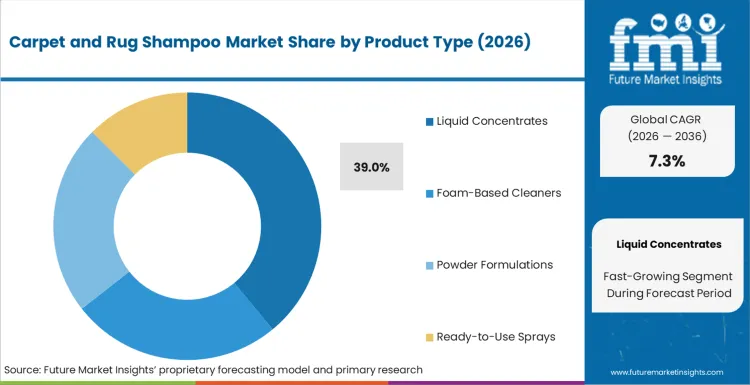
The liquid concentrates segment is anticipated to register 39% share in 2026. Liquid concentrates of carpet and rug shampoo are widely sold due to cost efficiency and logistics advantage. Concentrated formats deliver higher dilution ratios, enabling users to generate multiple cleaning cycles from a single bottle. This lowers per-application cost for households and commercial cleaning contractors managing large carpeted areas. Bulk procurement teams in hotels and facility management firms prefer concentrates as they reduce storage space requirements and freight expenses.
- Machine Compatibility Engineering: Manufacturers are integrating low-foam surfactant systems tailored for upright and canister extraction machines, minimizing motor strain and residue buildup while meeting performance expectations among households and contract cleaning operators.
- Fiber Protection Enhancement: Formulations are being developed with color-safe stabilizers and anti-resoiling polymers that safeguard carpet texture and dye integrity, strengthening long-term maintenance outcomes and supporting premium positioning across residential and commercial applications.
Carpet and Rug Shampoo Market Analysis by Distribution Channel
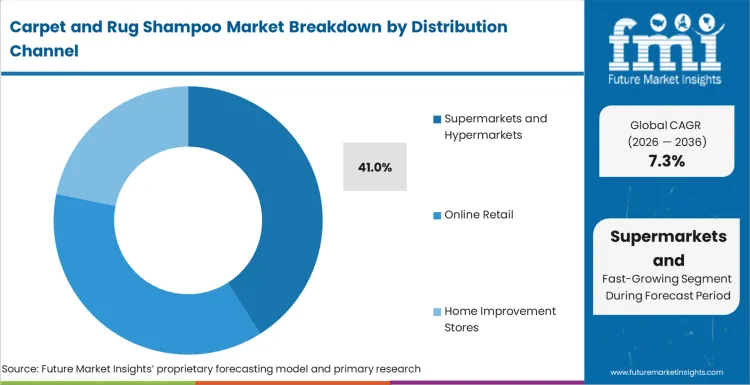
The supermarkets and hypermarkets segment is expected to garner a 41% market share in 2026. Carpet and rug shampoo achieves high sales penetration in supermarkets and hypermarkets due to organized shelf placement within home care sections that improve product visibility. Retailers allocate end-cap displays during festive and cleaning seasons, raising category awareness. Bulk pack availability and private-label concentrate options attract price-sensitive buyers seeking value per wash.
- In-Store Demonstration Visibility: Large-format retailers occasionally conduct product demonstrations or display machine compatibility guides near cleaning equipment sections. This builds consumer confidence in performance claims. Physical packaging interaction allows buyers to review usage instructions and dilution ratios before checkout.
- Multi-Brand Assortment Depth: These outlets carry a broad portfolio of economy, mid-range, and premium carpet shampoo brands. The assortment enables side-by-side comparison of concentration strength, fragrance options, and fiber suitability. Such variety supports informed purchasing decisions and encourages brand switching within the same retail visit.
Carpet and Rug Shampoo Market Drivers, Restraints, and Opportunities
Rising indoor air quality compliance standards and allergen management protocols are strengthening demand for specialized carpet and rug shampoo formulations. Public health guidance from agencies such as the U.S. Environmental Protection Agency and similar regulatory bodies in Europe emphasizes particulate and allergen reduction within enclosed environments, encouraging periodic deep extraction cleaning. [2] Growth in wall-to-wall carpet installation across multifamily housing projects and premium hospitality properties is expanding maintenance cycles. Pet adoption rates in North America and parts of Asia are increasing high-frequency stain treatment needs. Enzyme-based surfactant systems and anti-resoiling polymer technologies are enhancing performance differentiation across fiber-specific applications.
Market expansion faces restraints linked to substitution by multi-surface cleaners and rental-based carpet cleaning services. Consumer perception that general-purpose floor cleaners can address light stains limits specialized shampoo uptake. Price sensitivity in developing economies affects adoption of premium, fiber-safe formulations. Storage space constraints in small households reduce bulk purchase frequency. Environmental scrutiny of synthetic surfactants and fragrance additives increases compliance costs for manufacturers. Fluctuating raw material prices for specialty enzymes and polymers influence margin stability. Limited consumer awareness regarding fiber-specific compatibility further slows penetration in price-driven and rural retail markets.
Opportunities are emerging from concentrated refill formats and sustainable packaging initiatives. Demand for biodegradable surfactant blends and low-VOC formulations aligns with eco-conscious purchasing behavior. E-commerce platforms enable direct brand education on fiber compatibility and machine usage. Growth in commercial facility management contracts creates recurring procurement potential for institutional-grade products. Technological advancements in anti-resoiling polymers extend cleaning intervals, improving value perception. Private-label expansion within organized retail opens competitive pricing pathways. Emerging markets with rising carpet adoption in urban housing projects present untapped distribution prospects for mid-tier and professional-grade shampoo manufacturers.
Regional Analysis
Based on regional analysis, the carpet and rug shampoo market is segmented into North America, Latin America, Europe, East Asia, South Asia, Oceania and Middle East & Africa across 40 countries. The full report also offers market attractiveness analysis based on regional trends.
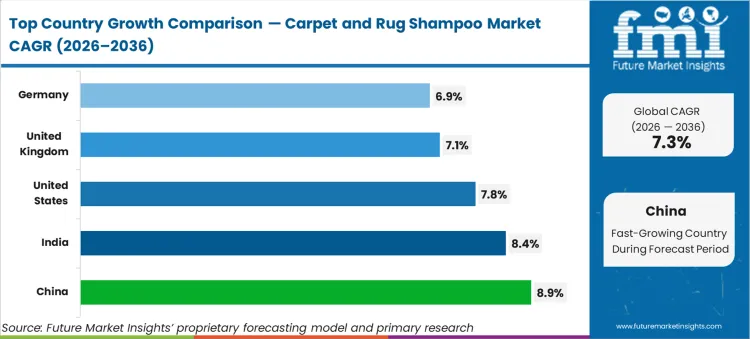
.webp "Top Country Growth Comparison Carpet And Rug Shampoo Market Cagr (2026 2036)")
| Country | CAGR (2026 to 2036) |
|---|---|
| United States | 7.8% |
| Germany | 6.9% |
| China | 8.9% |
| India | 8.4% |
| United Kingdom | 7.1% |
Source: Market analysis based on proprietary forecasting model and primary research
North America Carpet and Rug Shampoo Market Analysis
Growth in professional cleaning services and rental extraction machines strengthens repeat product usage in North America. Large retail chains and warehouse clubs provide strong shelf presence and private-label alternatives, encouraging competitive pricing. Consumer preference for enzyme-based, low-residue solutions that support indoor air quality standards further contributes to sustained regional demand. Wall-to-wall carpeting remains common in suburban homes, supporting routine deep-cleaning demand. Rising pet ownership across the region increases the need for odor-neutralizing and stain-targeting formulations.
- United States: The sales of carpet and rug shampoo in the United States are projected to expand at 7.8% CAGR from 2026 to 2036. Growth is driven by pet ownership trends and increased cleaning frequency requirements across residential categories. The World Animal Foundation has reported that 94 million households own a pet in the country. [3] Suburban housing patterns continue to support high carpet installation rates, sustaining routine maintenance demand. Elevated pet ownership levels across American households increase frequency of stain and odor treatment purchases. Growth in do-it-yourself cleaning culture, supported by upright and portable extraction machines, encourages repeat shampoo consumption. Consumer preference for enzyme-based and low-VOC formulations aligned with indoor air quality awareness further reinforces USA market momentum.
The report presents an in-depth evaluation of expansion across North America, supported by a country-level study of the United States and Canada. It outlines household cleaning product usage patterns, shifts in purchasing behavior, and structural changes within retail formats.
Asia Pacific Carpet and Rug Shampoo Market Analysis
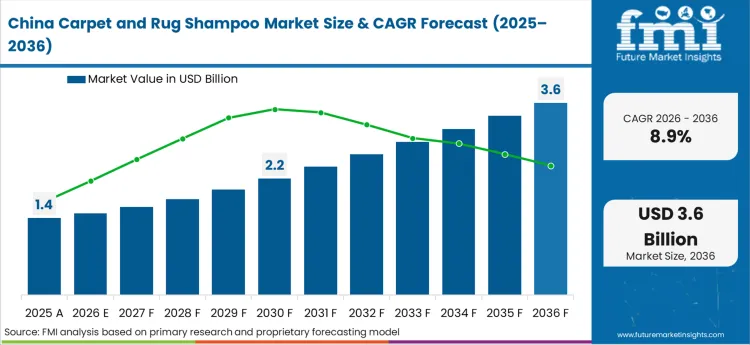
The Asia Pacific carpet and rug shampoo market is gaining traction due to rising urban housing development and increasing adoption of area rugs in apartments and premium residences. Expanding middle-class income levels are supporting expenditure on specialized home care products. Growing hospitality infrastructure across Southeast Asia and Australia is increasing institutional demand for carpet maintenance solutions.
- China: The Chinese carpet and rug shampoo market is slated to grow at 8.9% CAGR during the study period. E-commerce dominance through major digital retail platforms enhances product accessibility and brand comparison. In 2024, the State Council of the People’s Republic of China reported that online retail sales increased by 9.8% year on year to reach 7.1 trillion yuan (USD 996 billion). [4] Expanding domestic production of home care chemicals improves pricing competitiveness. Heightened consumer focus on indoor cleanliness and hygiene standards further sustains demand across metropolitan regions.
- India: The sales of carpet and rug shampoo in India are estimated to expand at 8.4% CAGR during the forecast period. The India carpet and rug shampoo market is advancing due to rising urbanization and growth in residential projects under Pradhan Mantri Awas Yojana. [5] Increasing disposable income among middle-class households is supporting expenditure on specialized home care products. Expansion of organized hospitality chains and corporate office spaces is creating consistent demand for carpet maintenance solutions.
The comprehensive study evaluates the carpet and rug shampoo market across East and South Asia between 2021 and 2036. It provides country-level insights for China, Japan, South Korea, India, Singapore, and Australia, outlining shifts in home care routines and deep-cleaning frequency patterns. The report reviews purchasing behavior across urban households and commercial users, including hospitality and facility management segments. It maps the development of supermarkets, specialty cleaning stores, and expanding e-commerce platforms that influence product accessibility.
Europe Carpet and Rug Shampoo Market Analysis
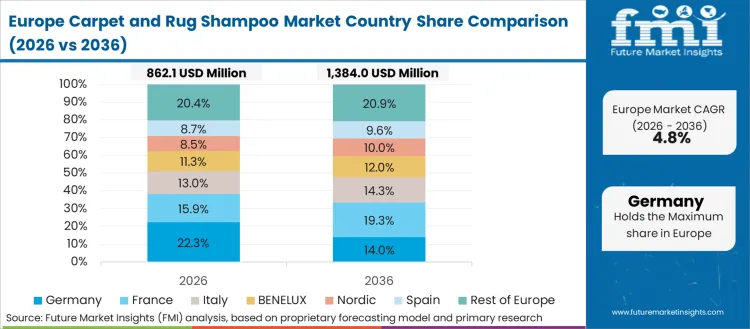
The Europe carpet and rug shampoo market is growing due to sustained demand for textile floor coverings in residential properties across the UK, Germany, France, and the Nordics. High standards for indoor hygiene in commercial offices, hotels, and healthcare facilities are encouraging periodic deep-cleaning routines. Growth in pet ownership across Western Europe is supporting repeat purchases of odor-control and stain-removal formulations.
- Germany: Demand for carpet and rug shampoo in Germany is slated to grow at 6.9% CAGR during the study period. Strict chemical compliance requirements under national and EU frameworks are influencing development of low-emission and biodegradable surfactant systems. Strong presence of organized retail chains and private-label offerings supports price-sensitive purchasing. Consumer preference for environmentally responsible, fiber-safe cleaning solutions further sustains demand across the German market.
- United Kingdom: Sales of carpet and rug shampoo in the United Kingdom are estimated to expand at 7.1% CAGR from 2026 to 2036. Regulatory oversight under U.K. chemical compliance frameworks aligned with REACH standards is influencing formulation development toward low-VOC and biodegradable surfactant systems. Retail concentration within major supermarket groups strengthens private-label competition and price-tier segmentation. Expansion of click-and-collect grocery services and online home care sales platforms enhances accessibility.
The European carpet and rug shampoo market assessment delivers country-level evaluation across the United Kingdom, Germany, France, Italy, Spain, the Netherlands, and Scandinavia. It examines household and institutional cleaning demand shaped by flooring preferences, rental housing density, and hospitality refurbishment cycles.
Competitive Landscape for Carpet and Rug Shampoo Market Players
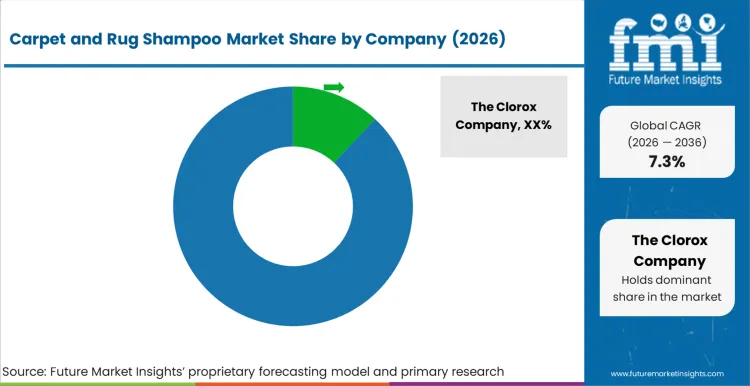
The competitive landscape of the carpet and rug shampoo market is characterized by the presence of multinational home care companies, specialized carpet cleaning brands, and private-label retailers competing across performance, pricing, and distribution depth. Leading players focus on enzyme-based stain removal systems, low-foam surfactant blends, and residue-minimizing formulations to strengthen product differentiation. Brand recognition and machine compatibility claims remain central to competitive positioning, particularly in developed markets with high carpet penetration.
Private-label expansion within supermarkets and hypermarkets intensifies price-tier segmentation, challenging premium branded offerings. Companies invest in fragrance variety, fiber-specific variants such as wool-safe and synthetic-compatible solutions, and concentrated refill packs to improve shelf efficiency and margin control. Strategic partnerships with carpet cleaner equipment manufacturers enhance cross-category visibility and reinforce machine-safe credibility.
Digital retail platforms are enabling niche and eco-focused brands to gain traction through direct-to-consumer education on formulation transparency and biodegradable ingredients. Competitive intensity is further shaped by raw material sourcing capabilities, regulatory compliance in low-VOC chemistries, and innovation in anti-resoiling polymer technology. Overall, differentiation through performance validation, sustainability positioning, and retail penetration strategies defines the evolving competitive structure of the market.
Recent Developments
The report includes comprehensive coverage of key industry developments and competitive positioning:
- In January 2026, the Clorox Company entered into a definitive agreement to acquire GOJO Industries, a prominent name in skin health and hygiene solutions. This deal is set to help Clorox enhance its B2B reach and capabilities. [6]
Key Players in Carpet and Rug Shampoo Market
- The Clorox Company
- The Procter & Gamble Company
- Evonik Industries AG
- S. C. Johnson & Son, Inc.
- 3M Company
- Reckitt Benckiser Group plc
- Bissell Inc.
Scope of the Report
| Metric | Value |
|---|---|
| Quantitative Units | USD 3.5 billion (2026) to USD 7.1 billion (2036), at a CAGR of 7.3% |
| Market Definition | The carpet and rug shampoo market comprises the global development, production, and distribution of specialized cleaning formulations including liquid concentrates, foam cleaners, and powder systems designed for textile floor covering maintenance across residential and commercial applications. |
| Product Type Segmentation | Foam-Based Cleaners, Liquid Concentrates, Powder Formulations, Ready-to-Use Sprays |
| Distribution Channel Coverage | Supermarkets and Hypermarkets, Online Retail, Home Improvement Stores, Specialty Cleaning Retailers |
| Application Segmentation | Residential Cleaning, Commercial Facilities, Hospitality Services, Automotive Interiors |
| Regions Covered | North America, Latin America, Europe, East Asia, South Asia, Oceania, Middle East and Africa |
| Countries Covered | United States, Canada, United Kingdom, Germany, France, China, Japan, India, Brazil, UAE and 40 countries |
| Key Companies Profiled | The Clorox Company, The Procter & Gamble Company, Evonik Industries AG, S. C. Johnson & Son, Inc., 3M Company, Reckitt Benckiser Group plc, Bissell Inc. |
| Forecast Period | 2026 to 2036 |
| Approach | Hybrid top down and bottom up market modeling validated through retail sales tracking and household cleaning surveys, supported by distribution network verification and purchase frequency analysis |
Carpet and Rug Shampoo Market Analysis by Segments
Product Type:
- Foam-Based Cleaners
- Liquid Concentrates
- Powder Formulations
- Ready-to-Use Sprays
Distribution Channel:
- Supermarkets and Hypermarkets
- Online Retail
- Home Improvement Stores
- Specialty Cleaning Retailers
- Others (janitorial supply distributors, direct sales)
Application:
- Residential Cleaning
- Commercial Facilities
- Hospitality Services
- Automotive Interiors
Region:
- Asia Pacific
- China
- Japan
- South Korea
- India
- Australia
- Singapore
- Thailand
- Rest of Asia Pacific
- Europe
- United Kingdom
- Germany
- France
- Italy
- Spain
- Netherlands
- Scandinavia
- Switzerland
- Rest of Europe
- North America
- United States
- Canada
- Latin America
- Brazil
- Mexico
- Argentina
- Rest of Latin America
- Middle East & Africa
- United Arab Emirates
- Saudi Arabia
- South Africa
- Israel
- Rest of Middle East & Africa
Bibliography
- [1] Reckitt Benckiser Group Plc. (2024, July 24). Reckitt to sharpen its portfolio and simplify organisation for accelerated growth and value creation.
- [2] USA Environmental Protection Agency. (2025, January 13). New report celebrates EPA’s unprecedented successes under Biden-Harris administrations’ Investing in America Agenda.
- [3] World Animal Foundation. (2026). Pet ownership statistics 2026 - Latest numbers and trends.
- [4] The State Council Information Office of the People’s Republic of China. (2024, July 19). China’s e-commerce sector reports robust growth.
- [5] Ministry of Housing and Urban Affairs, Government of India. (n.d.). Pradhan Mantri Awas Yojana - Urban (PMAY-MIS).
- [6] The Clorox Company. (2026, January 22). Clorox announces acquisition of GOJO Industries, makers of Purell®, market leader in skin health and hygiene.
This bibliography is provided for reader reference and is not exhaustive. The full report contains the complete reference list and detailed citations.
This Report Addresses
- Market intelligence to enable strategic decision making across established and emerging cleaning product markets
- Market size estimation and 10-year revenue forecasts from 2026 to 2036, supported by validated retail sales data and household cleaning surveys
- Growth opportunity mapping across product types and application segments with emphasis on formulation optimization
- Segment and regional revenue forecasts covering liquid concentrates, foam cleaners, powder formulations, and retail distribution networks
- Competition strategy assessment including product differentiation requirements, formulation positioning, and distribution channel optimization
- Product development tracking including enzyme technology innovations, residue-free formulation trends, and concentrated format capabilities
- Market access analysis covering retail partnerships, cleaning equipment compatibility, and commercial facility supply programs
- Market report delivery in PDF, Excel, PPT, and interactive dashboard formats for executive and operational use
Frequently Asked Questions
How large is the demand for Carpet and Rug Shampoo in the global market in 2026?
Demand for Carpet and Rug Shampoo in the global market is estimated to be valued at USD 3.5 billion in 2026.
What will be the market size of Carpet and Rug Shampoo in the global market by 2036?
Market size for Carpet and Rug Shampoo is projected to reach USD 7.1 billion by 2036.
What is the expected demand growth for Carpet and Rug Shampoo in the global market between 2026 and 2036?
Demand for Carpet and Rug Shampoo in the global market is expected to grow at a CAGR of 7.3% between 2026 and 2036.
Which Product Type is poised to lead global sales by 2026?
Liquid Concentrates is expected to be the dominant product type, capturing approximately 39.0% of global market share in 2026 due to dilution control features and cost-per-use economics.
How significant is the role of Supermarkets and Hypermarkets in driving Carpet and Rug Shampoo adoption in 2026?
Supermarkets and hypermarkets represent a primary distribution channel, projected to hold approximately 41% share of the total market in 2026 as promotional pricing programs and cross-category merchandising maintain physical retail relevance.
What is Driving Carpet and Rug Shampoo Demand in the United States?
Pet ownership trends and increased cleaning frequency requirements across residential categories are driving growth.
What Consumer Trends are Referenced for the United States?
Indoor air quality awareness and allergen reduction priorities are referenced as key consumer behavior shifts.
What is the United States Growth Outlook in this Report?
The United States is projected to grow at a CAGR of 7.8% during 2026 to 2036.
Why is Europe described as Important for Cleaning Product Development in this Report?
Growth is driven by environmental formulation regulations and rental housing maintenance standards that establish product safety specifications.
What Type of Product Development Dominates in Europe?
Biodegradable formulations with eco-friendly surfactant systems and low-residue properties dominate regional market segments.
What is Germany Growth Outlook in this Report?
Germany is projected to expand at a CAGR of 6.9% during 2026 to 2036.
Does the Report Cover China in its Regional Analysis?
China is included within East Asia under the regional scope of analysis.
What are the Sources referred to for analyzing the Market in China?
Carpet ownership data, urban housing statistics, and domestic brand performance tracking covering purchase patterns, price sensitivity analysis, and formulation preference evolution are cited as primary reference sources.
What is the Main Development Theme Linked to China in Asia Coverage?
Asia Pacific development is associated with rising disposable income enabling carpet adoption and cleaning product category expansion across urban apartment markets.
Does the Report Cover India in its Regional Analysis?
India is included within South Asia under the regional coverage framework.
What is the Main India Related Development Theme in Asia Coverage?
Expanding middle-class purchasing power creating foundation for carpet ownership and cleaning product adoption through cost-effective manufacturing methods is emphasized.
Which Distribution Strategies are Strategically Important for Asia Pacific Market Entry?
Modern retail partnerships and online marketplace integration are prioritized for cost-effective brand building across regional markets.
What is Carpet and Rug Shampoo and What is It Mainly Used For?
Carpet and rug shampoo involves specialized cleaning formulations primarily used for textile floor covering maintenance including residential homes, commercial office spaces, hospitality facilities, and automotive interior applications.
What does Carpet and Rug Shampoo Market Mean in this Report?
Carpet and rug shampoo market refers to global development, manufacturing, and retail distribution of cleaning solutions across various application categories and user segments.
What is Included in the Scope of this Carpet and Rug Shampoo Market Report?
Scope covers products by formulation type, key distribution channels such as supermarkets and online platforms, and application segments including residential cleaning, commercial facilities, and hospitality services.
What is Excluded from the Scope of this Report?
General-purpose floor cleaners, hard surface maintenance products, industrial textile processing chemicals, and professional-grade steam cleaning services are excluded unless part of carpet shampoo product offerings.
What does Market Forecast Mean on this Page?
Market forecast represents model-based projections built on retail sales trends and carpet ownership assumptions for strategic planning purposes.
How is the Carpet and Rug Shampoo Market Forecast Built and Validated?
Forecast is developed using hybrid modeling validated through retail point-of-sale data, household cleaning frequency surveys, and distribution network verification.
What does Zero Reliance on Speculative Third Party Market Research Mean Here?
Market analysis is based on verifiable sales figures, cleaning product adoption data, and maintenance frequency patterns rather than speculative household trend predictions.
Preview the report firsthand - request a free sample
Get SampleGet the brochure for pricing and purchase details.
Get PDFTable of Content
- Executive Summary
- Global Market Outlook
- Demand-side Trends
- Supply-side Trends
- Technology Roadmap Analysis
- Analysis and Recommendations
- Market Overview
- Market Coverage / Taxonomy
- Market Definition / Scope / Limitations
- Research Methodology
- Chapter Orientation
- Analytical Lens and Working Hypotheses
- Market Structure, Signals, and Trend Drivers
- Company Annual and Sustainability Reports
- Peer-reviewed Journals and Academic Literature
- Corporate Websites, Product Literature, and Technical Notes
- Earnings Decks and Investor Briefings
- Statutory Filings and Regulatory Disclosures
- Technical White Papers and Standards Notes
- Trade Journals, Industry Magazines, and Analyst Briefs
- Conference Proceedings, Webinars, and Seminar Materials
- Government Statistics Portals and Public Data Releases
- Press Releases and Reputable Media Coverage
- Specialist Newsletters and Curated Briefings
- Sector Databases and Reference Repositories
- FMI Internal Proprietary Databases and Historical Market Datasets
- Subscription Datasets and Paid Sources
- Social Channels, Communities, and Digital Listening Inputs
- Additional Desk Sources
- Expert Input and Fieldwork (Primary Evidence)
- Primary Modes
- Qualitative Interviews and Expert Elicitation
- Quantitative Surveys and Structured Data Capture
- Blended Approach
- Why Primary Evidence is Used
- Field Techniques
- Interviews
- Surveys
- Focus Groups
- Observational and In-context Research
- Social and Community Interactions
- Stakeholder Universe Engaged
- C-suite Leaders
- Board Members
- Presidents and Vice Presidents
- R&D and Innovation Heads
- Technical Specialists
- Domain Subject-matter Experts
- Scientists
- Physicians and Other Healthcare Professionals
- Governance, Ethics, and Data Stewardship
- Research Ethics
- Data Integrity and Handling
- Primary Modes
- Tooling, Models, and Reference Databases
- Data Engineering and Model Build
- Data Acquisition and Ingestion
- Cleaning, Normalisation, and Verification
- Synthesis, Triangulation, and Analysis
- Quality Assurance and Audit Trail
- Market Background
- Market Dynamics
- Drivers
- Restraints
- Opportunity
- Trends
- Scenario Forecast
- Demand in Optimistic Scenario
- Demand in Likely Scenario
- Demand in Conservative Scenario
- Opportunity Map Analysis
- Product Life Cycle Analysis
- Supply Chain Analysis
- Investment Feasibility Matrix
- Value Chain Analysis
- PESTLE and Porter’s Analysis
- Regulatory Landscape
- Regional Parent Market Outlook
- Production and Consumption Statistics
- Import and Export Statistics
- Market Dynamics
- Global Market Analysis 2021 to 2025 and Forecast, 2026 to 2036
- Historical Market Size Value (USD Million) Analysis, 2021 to 2025
- Current and Future Market Size Value (USD Million) Projections, 2026 to 2036
- Y-o-Y Growth Trend Analysis
- Absolute $ Opportunity Analysis
- Global Market Pricing Analysis 2021 to 2025 and Forecast 2026 to 2036
- Global Market Analysis 2021 to 2025 and Forecast 2026 to 2036, By Product Type
- Introduction / Key Findings
- Historical Market Size Value (USD Million) Analysis By Product Type , 2021 to 2025
- Current and Future Market Size Value (USD Million) Analysis and Forecast By Product Type , 2026 to 2036
- Liquid Concentrates
- Foam-Based Cleaners
- Powder Formulations
- Ready-to-Use Sprays
- Liquid Concentrates
- Y-o-Y Growth Trend Analysis By Product Type , 2021 to 2025
- Absolute $ Opportunity Analysis By Product Type , 2026 to 2036
- Global Market Analysis 2021 to 2025 and Forecast 2026 to 2036, By Distribution Channel
- Introduction / Key Findings
- Historical Market Size Value (USD Million) Analysis By Distribution Channel, 2021 to 2025
- Current and Future Market Size Value (USD Million) Analysis and Forecast By Distribution Channel, 2026 to 2036
- Supermarkets and Hypermarkets
- Online Retail
- Home Improvement Stores
- Supermarkets and Hypermarkets
- Y-o-Y Growth Trend Analysis By Distribution Channel, 2021 to 2025
- Absolute $ Opportunity Analysis By Distribution Channel, 2026 to 2036
- Global Market Analysis 2021 to 2025 and Forecast 2026 to 2036, By Region
- Introduction
- Historical Market Size Value (USD Million) Analysis By Region, 2021 to 2025
- Current Market Size Value (USD Million) Analysis and Forecast By Region, 2026 to 2036
- North America
- Latin America
- Western Europe
- Eastern Europe
- East Asia
- South Asia and Pacific
- Middle East & Africa
- Market Attractiveness Analysis By Region
- North America Market Analysis 2021 to 2025 and Forecast 2026 to 2036, By Country
- Historical Market Size Value (USD Million) Trend Analysis By Market Taxonomy, 2021 to 2025
- Market Size Value (USD Million) Forecast By Market Taxonomy, 2026 to 2036
- By Country
- USA
- Canada
- Mexico
- By Product Type
- By Distribution Channel
- By Country
- Market Attractiveness Analysis
- By Country
- By Product Type
- By Distribution Channel
- Key Takeaways
- Latin America Market Analysis 2021 to 2025 and Forecast 2026 to 2036, By Country
- Historical Market Size Value (USD Million) Trend Analysis By Market Taxonomy, 2021 to 2025
- Market Size Value (USD Million) Forecast By Market Taxonomy, 2026 to 2036
- By Country
- Brazil
- Chile
- Rest of Latin America
- By Product Type
- By Distribution Channel
- By Country
- Market Attractiveness Analysis
- By Country
- By Product Type
- By Distribution Channel
- Key Takeaways
- Western Europe Market Analysis 2021 to 2025 and Forecast 2026 to 2036, By Country
- Historical Market Size Value (USD Million) Trend Analysis By Market Taxonomy, 2021 to 2025
- Market Size Value (USD Million) Forecast By Market Taxonomy, 2026 to 2036
- By Country
- Germany
- UK
- Italy
- Spain
- France
- Nordic
- BENELUX
- Rest of Western Europe
- By Product Type
- By Distribution Channel
- By Country
- Market Attractiveness Analysis
- By Country
- By Product Type
- By Distribution Channel
- Key Takeaways
- Eastern Europe Market Analysis 2021 to 2025 and Forecast 2026 to 2036, By Country
- Historical Market Size Value (USD Million) Trend Analysis By Market Taxonomy, 2021 to 2025
- Market Size Value (USD Million) Forecast By Market Taxonomy, 2026 to 2036
- By Country
- Russia
- Poland
- Hungary
- Balkan & Baltic
- Rest of Eastern Europe
- By Product Type
- By Distribution Channel
- By Country
- Market Attractiveness Analysis
- By Country
- By Product Type
- By Distribution Channel
- Key Takeaways
- East Asia Market Analysis 2021 to 2025 and Forecast 2026 to 2036, By Country
- Historical Market Size Value (USD Million) Trend Analysis By Market Taxonomy, 2021 to 2025
- Market Size Value (USD Million) Forecast By Market Taxonomy, 2026 to 2036
- By Country
- China
- Japan
- South Korea
- By Product Type
- By Distribution Channel
- By Country
- Market Attractiveness Analysis
- By Country
- By Product Type
- By Distribution Channel
- Key Takeaways
- South Asia and Pacific Market Analysis 2021 to 2025 and Forecast 2026 to 2036, By Country
- Historical Market Size Value (USD Million) Trend Analysis By Market Taxonomy, 2021 to 2025
- Market Size Value (USD Million) Forecast By Market Taxonomy, 2026 to 2036
- By Country
- India
- ASEAN
- Australia & New Zealand
- Rest of South Asia and Pacific
- By Product Type
- By Distribution Channel
- By Country
- Market Attractiveness Analysis
- By Country
- By Product Type
- By Distribution Channel
- Key Takeaways
- Middle East & Africa Market Analysis 2021 to 2025 and Forecast 2026 to 2036, By Country
- Historical Market Size Value (USD Million) Trend Analysis By Market Taxonomy, 2021 to 2025
- Market Size Value (USD Million) Forecast By Market Taxonomy, 2026 to 2036
- By Country
- Kingdom of Saudi Arabia
- Other GCC Countries
- Turkiye
- South Africa
- Other African Union
- Rest of Middle East & Africa
- By Product Type
- By Distribution Channel
- By Country
- Market Attractiveness Analysis
- By Country
- By Product Type
- By Distribution Channel
- Key Takeaways
- Key Countries Market Analysis
- USA
- Pricing Analysis
- Market Share Analysis, 2025
- By Product Type
- By Distribution Channel
- Canada
- Pricing Analysis
- Market Share Analysis, 2025
- By Product Type
- By Distribution Channel
- Mexico
- Pricing Analysis
- Market Share Analysis, 2025
- By Product Type
- By Distribution Channel
- Brazil
- Pricing Analysis
- Market Share Analysis, 2025
- By Product Type
- By Distribution Channel
- Chile
- Pricing Analysis
- Market Share Analysis, 2025
- By Product Type
- By Distribution Channel
- Germany
- Pricing Analysis
- Market Share Analysis, 2025
- By Product Type
- By Distribution Channel
- UK
- Pricing Analysis
- Market Share Analysis, 2025
- By Product Type
- By Distribution Channel
- Italy
- Pricing Analysis
- Market Share Analysis, 2025
- By Product Type
- By Distribution Channel
- Spain
- Pricing Analysis
- Market Share Analysis, 2025
- By Product Type
- By Distribution Channel
- France
- Pricing Analysis
- Market Share Analysis, 2025
- By Product Type
- By Distribution Channel
- India
- Pricing Analysis
- Market Share Analysis, 2025
- By Product Type
- By Distribution Channel
- ASEAN
- Pricing Analysis
- Market Share Analysis, 2025
- By Product Type
- By Distribution Channel
- Australia & New Zealand
- Pricing Analysis
- Market Share Analysis, 2025
- By Product Type
- By Distribution Channel
- China
- Pricing Analysis
- Market Share Analysis, 2025
- By Product Type
- By Distribution Channel
- Japan
- Pricing Analysis
- Market Share Analysis, 2025
- By Product Type
- By Distribution Channel
- South Korea
- Pricing Analysis
- Market Share Analysis, 2025
- By Product Type
- By Distribution Channel
- Russia
- Pricing Analysis
- Market Share Analysis, 2025
- By Product Type
- By Distribution Channel
- Poland
- Pricing Analysis
- Market Share Analysis, 2025
- By Product Type
- By Distribution Channel
- Hungary
- Pricing Analysis
- Market Share Analysis, 2025
- By Product Type
- By Distribution Channel
- Kingdom of Saudi Arabia
- Pricing Analysis
- Market Share Analysis, 2025
- By Product Type
- By Distribution Channel
- Turkiye
- Pricing Analysis
- Market Share Analysis, 2025
- By Product Type
- By Distribution Channel
- South Africa
- Pricing Analysis
- Market Share Analysis, 2025
- By Product Type
- By Distribution Channel
- USA
- Market Structure Analysis
- Competition Dashboard
- Competition Benchmarking
- Market Share Analysis of Top Players
- By Regional
- By Product Type
- By Distribution Channel
- Competition Analysis
- Competition Deep Dive
- The Clorox Company
- Overview
- Product Portfolio
- Profitability by Market Segments (Product/Age /Sales Channel/Region)
- Sales Footprint
- Strategy Overview
- Marketing Strategy
- Product Strategy
- Channel Strategy
- The Procter & Gamble Company
- Evonik Industries AG
- S. C. Johnson & Son, Inc.
- 3M Company
- Reckitt Benckiser Group plc
- Bissell Inc.
- The Clorox Company
- Competition Deep Dive
- Assumptions & Acronyms Used


