

- Industry Size (2026)
- USD 344.2 Bn
- Forecast (2036)
- USD 560.7 Bn
- CAGR (2026 to 2036)
- 5.2%
Flooring and Carpets Market Forecast and Outlook 2026 to 2036
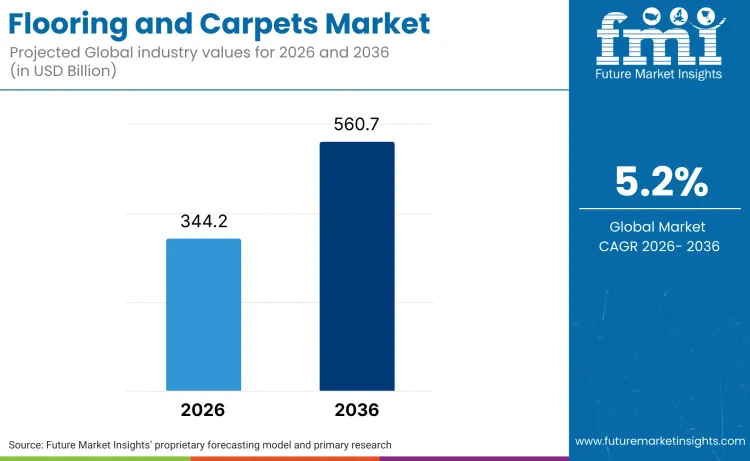
The global flooring and carpets sector is poised to record a valuation of USD 344.2 billion in 2026, advancing toward USD 560.7 billion by 2036, representing a steady 5.2% CAGR. This trajectory is fundamentally reshaped by a "renovation-in-place" dynamic, where the decoupling of flooring sales from new housing turnover becomes the primary engine of revenue. As existing home sales in key markets like the United States fall to multi-decade lows, homeowners are increasingly investing in high-quality upgrades to improve their living environments without moving. The operational landscape is tightening; Victoria PLC’s commissioning of a new ceramics line in Spain is expected to deliver a €15 million annual earnings improvement, signaling that efficiency and automation are now critical prerequisites for profitability in a high-cost manufacturing environment.
Commercial sector is undergoing a rigorous optimization phase, prioritizing "Flooring as a Service" models that guarantee material retrieval and recycling. This dual focus on residential renovation and commercial circularity is expected to sustain consistent growth, despite the headwinds facing the broader construction industry. The financial implications of this strategic pivot are already evident in the capital allocation strategies of major industry players. Laurel Hurd, CEO of Interface Inc., noted in February 2025: "We delivered impressive results in 2024, reflecting the early achievements of our One Interface strategy. We saw growth across all product categories, largely driven by continued momentum in the Americas, where our combined selling strategy has exceeded our expectations." This success validates the industry's shift toward integrated selling propositions that combine aesthetics with verifiable carbon reductions.
Summary of Flooring and Carpets Market
What Is the Growth Outlook for the Flooring and Carpets Market as per Future Market Insights Projection?
Future Market Insights projects the global flooring and carpets market to grow from USD 344.2 billion in 2026 to USD 560.7 billion by 2036, representing a 5.2% CAGR over the forecast period.
FMI Research Approach: Based on FMI’s proprietary global modeling framework incorporating residential renovation indices, commercial retrofitting cycles, and raw material price volatility assessments across key petrochemical and bio-based supply chains.
How Do FMI Analysts Perceive the Flooring and Carpets Market to Evolve?
FMI analysts perceive the market transitioning away from commoditized PVC and virgin synthetic fibers toward bio-native materials and closed-loop recycling systems.
FMI Research Approach: Developed using analysis of corporate sustainability roadmaps (Interface, Tarkett), venture capital flows into material science startups (Simplifyber, EnviraBoard), and patent filings related to recycling technologies.
Which Country Holds the Largest Share in the Global Flooring and Carpets Market?
China holds a dominant value share, supported by a massive urbanization drive and a projected 7.0% CAGR, driven by the government's "Healthy China 2030" mandates promoting non-toxic building materials.
FMI Research Approach: Built using country-level construction output data, analysis of domestic manufacturing capacity, and mapping of regulatory shifts regarding volatile organic compound (VOC) emissions in indoor environments.
How Large Will the Flooring and Carpets Market Be by 2036?
The global flooring and carpets market is expected to reach USD 560.7 billion by 2036, with the Carpets segment currently commanding a 33.90% share.
FMI Research Approach: Long-term forecasts rely on demographic trends (household formation rates), disposable income projections for home improvement, and the scaling of advanced manufacturing technologies like digital printing.
What Is the Definition of the Flooring and Carpets Market?
The flooring and carpets market encompasses revenue generated from the manufacturing and sale of permanent and semi-permanent floor covering products for residential, commercial, and industrial applications. This includes soft coverings like broadloom carpets and rugs, as well as hard surfaces like vinyl, wood, laminate, and ceramics.
FMI Research Approach: Definition structured using FMI’s segmentation taxonomy covering product types, sales channels, and end-user verticals. It explicitly includes revenue from material sales while excluding installation services unless bundled directly by the manufacturer.
What Are Globally Unique Trends Shaping the Flooring and Carpets Market?
Globally, the sector is shaped by the "Circular Commercialization" trend, where major OEMs are implementing take-back programs to secure recycled feedstock, and the rise of "Bio-Native" startups challenging petrochemical dominance.
FMI Research Approach: Insights derived from global impact reports (Mohawk, Shaw), tracking of EU Green Deal implications for construction products, and competitive analysis of emerging deep-tech material companies.
Flooring and Carpets Market Key Takeaways
| Metric | Details |
|---|---|
| Industry Size (2026) | USD 344.2 billion |
| Industry Value (2036) | USD 560.7 billion |
| CAGR (2026-2036) | 5.2% |
Source: Future Market Insights (FMI) analysis, based on proprietary forecasting model and primary research.
How Is the
The shift from linear production to circular systems is no longer a niche aspiration but a core operational imperative for leading flooring manufacturers. Jim Brunk, CFO of Mohawk Industries, stated in February 2025: "At Mohawk, we see understanding and mitigating climate risk as not just a challenge, but as a critical factor in protecting long-term business value. Our financial strategy is rooted in making smart investments today to ensure we can navigate tomorrow’s disruptions and capture tomorrow’s opportunities with confidence." This strategic alignment is driving massive investments in recycling infrastructure, such as Mohawk's industry-first technology for recycling MDF and laminate floors. By closing the loop on material flows, companies are not only reducing their reliance on volatile virgin raw materials but also positioning themselves as essential partners for commercial clients seeking to meet their own net-zero commitments.
How is the Flooring and Carpets Market Segmented?
The flooring and carpets market is segmented by product type, sales channel, and end user, providing a granular view of the industry's diverse revenue streams. It is segmented by product type into carpets, rugs, tiles, vinyl flooring, wood flooring, laminate flooring, and others, catering to a wide spectrum of aesthetic and functional requirements. The residential segment currently holds the largest share at 45%, driven by the continuous cycle of home improvement and the desire for personalized living spaces. In terms of sales channels, specialty stores dominate with a 38% share, as consumers continue to value the tactile experience and expert advice offered by dedicated showrooms when making significant investment decisions for their homes. This segmentation highlights the resilience of traditional retail formats even as digital influence grows, particularly for complex hard surface flooring products that require precise specification.
Why do Carpets hold a dominant share?
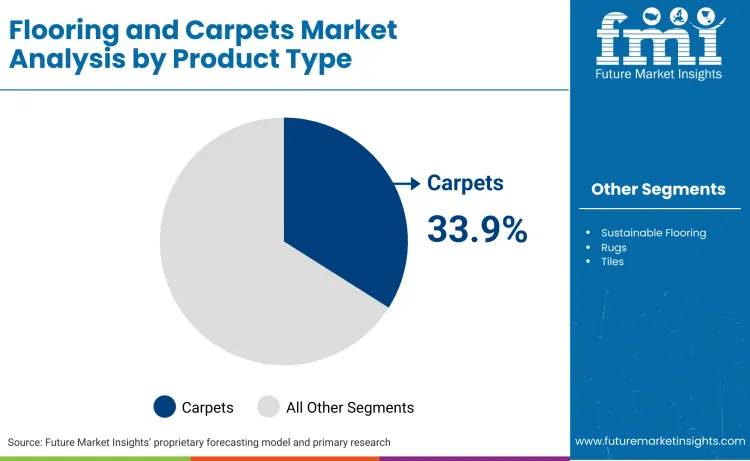
Carpets command 33.90% of the market, maintaining their stronghold due to their unmatched acoustic properties and comfort, particularly in the residential carpet roll segment. HUD's American Housing Survey (2023) reports that 52% of U.S. homes still feature wall-to-wall carpets as primary flooring, especially in bedrooms (68%), underscoring persistent demand for soft surfaces amid hard flooring trends. Despite the rise of hard surfaces, the demand for soft flooring remains robust in bedrooms and hospitality settings where warmth and noise reduction are paramount.
Innovation is revitalizing this category; Mohawk's PET Premier collections, manufactured using their patented Continuum process, have successfully capitalized on consumer preferences for sustainable, stain-resistant carpet and rug options made from recycled plastic bottles. This ability to combine luxury performance with an eco-friendly narrative is ensuring that carpets remain a vital component of the modern interior design palette, preventing the category from becoming obsolete in the face of changing trends.
Why are Specialty Stores leading sales?
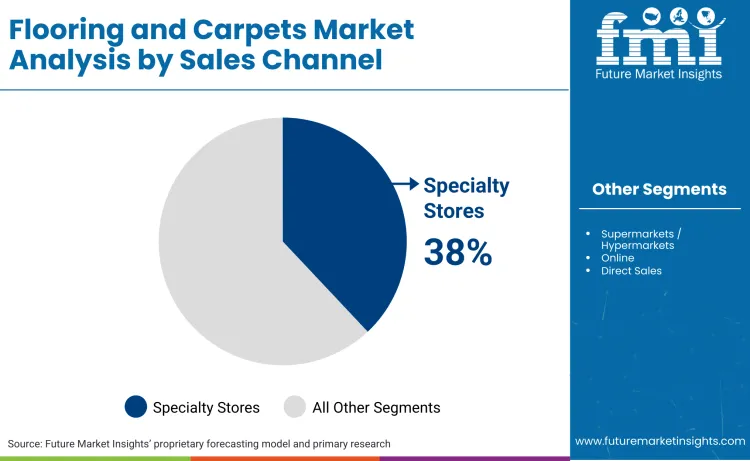
Specialty stores hold a 38% market share, serving as the primary destination for consumers seeking high-value luxury vinyl tile flooring and authentic wood products. The U.S. Census Bureau's 2024 retail trade data shows specialty home furnishings stores generated $28.5 billion in sales (up 4.2% YoY), outpacing general home centers by emphasizing expert advice for complex installs. Unlike generalist home improvement centers, these outlets offer deep category expertise and installation services that are crucial for minimizing post-purchase dissatisfaction.
The complexity of modern flooring systems, such as floating floor mechanisms and specialized underlayments, requires a level of consultative selling that mass-market retailers struggle to provide. As the market shifts toward premiumization, specialty retailers are better positioned to showcase high-end textile floorings and bespoke designs, justifying their dominance in the channel mix by delivering a superior customer experience that builds long-term trust and loyalty.
Why Is Material Innovation Accelerating?
The material footprint of flooring is undergoing a radical transformation as deep-tech startups challenge the petrochemical status quo with bio-based alternatives. Simplifyber, for instance, unveiled the first cellulose-based shoe upper in September 2024 after raising Series A funding, a technology that is directly applicable to creating molded, bio-native nonwoven floor covers. EnviraBoard secured seed funding in July 2024 to develop building boards from recycled paper sludge, offering a circular alternative to traditional HDF cores used in wood plastic composite floorings. These innovations are not mere novelties but represent a fundamental shift toward materials that are regenerative by design. Paul Young, SVP Segments & Innovation at Tarkett North America, emphasized this holistic approach in May 2024: "Tarkett takes a holistic view with flooring designed to help build environmental health and human health at every step today and tomorrow."
What is the Regional Outlook for Flooring and Carpets Market?
The global market exhibits distinct regional drivers, from urbanization-led growth in Asia to renovation-led stability in the West, creating a complex tapestry of opportunities. China is projected to lead with a 7.0% CAGR, driven by government health mandates, while India follows with 6.7% as infrastructure development accelerates. The mature markets of Germany (5.5%), the USA (5.2%), and the UK (4.9%) are pivoting toward sustainable retrofitting and energy-efficient building upgrades to drive value growth.
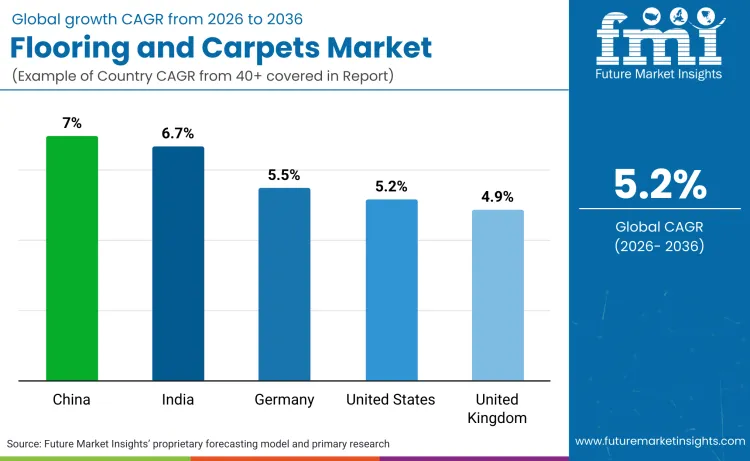
| Country | CAGR (2026 to 2036) |
|---|---|
| China | 7.0% |
| India | 6.7% |
| Germany | 5.5% |
| United States | 5.2% |
| United Kingdom | 4.9% |
Source: FMI historical analysis and forecast data.
Why is China the Fastest Growing Market?
The flooring and carpets market in China is projected to expand at a Compound Annual Growth Rate (CAGR) of 7.0% through 2036, fueled by the government's "Healthy China 2030" initiative which mandates strict controls on indoor air quality. This regulatory pressure is driving a massive shift away from cheap, high-VOC materials toward certified sustainable vinyl flooring and formaldehyde-free wood products. Continued urbanization and the rising middle class are creating a booming demand for premium interior finishes in residential developments. The market is also seeing a surge in domestic production capabilities, allowing local manufacturers to compete on quality with international brands while maintaining cost advantages, effectively creating a self-sustaining ecosystem of high-growth consumption and production.
Why is India Seeing Infrastructure-Led Growth?
The market in India is anticipated to register a Compound Annual Growth Rate (CAGR) of 6.7%, driven largely by rapid urbanization and significant government investment in public infrastructure. As commercial hubs and residential townships expand, there is a growing need for durable concrete floor coatings and affordable modular flooring solutions. The "Make in India" initiative is further bolstering the sector by encouraging indigenous manufacturing of fireclay tiles and carpets, reducing reliance on imports. Burgeoning hospitality and corporate sectors are creating a niche but expanding market for high-end, aesthetic flooring solutions, pushing the industry to adopt global design standards and modernize its product offerings to cater to an increasingly sophisticated clientele.
Why is the USA Pivoting to Renovation?
The flooring and carpets market in the United States is forecast to grow at a Compound Annual Growth Rate (CAGR) of 5.2%, heavily influenced by the "lock-in" effect where homeowners are retaining existing properties due to mortgage rate dynamics. This has spurred a robust "renovation-in-place" trend, where disposable income is redirected toward upgrading hard surface flooring and carpets to modernize living spaces. Mohawk Industries noted in 2024 that existing U.S. home sales fell to a 30-year low, yet residential remodeling remained a key revenue stream. Consequently, the market is characterized by a high demand for premium, DIY-friendly products like luxury vinyl tile flooring that offer a high return on investment for homeowners looking to increase their property value without entering the housing market.
Why is Germany Focusing on Sustainable Retrofitting?
The market in Germany is poised to register a Compound Annual Growth Rate (CAGR) of 5.5%, reflecting a stringent focus on sustainability and energy efficiency in building materials. The demand for modular flooring that can be easily replaced and recycled is high, driven by EU Green Deal regulations. However, the sector faces challenges; Tarkett reported a slowdown in demand in the EMEA region in 2024, particularly in the wood segment, leading to asset impairments. Despite these short-term headwinds, the long-term trajectory is positive, supported by a cultural preference for high-quality, long-lasting materials and a robust industrial sector requiring specialized floor screeds and technical flooring solutions that meet rigorous environmental standards.
Why is the UK Market Driven by Housing Efficiency?
The flooring and carpets market in the United Kingdom is anticipated to register a Compound Annual Growth Rate (CAGR) of 4.9%, driven by the urgent need to address the chronic housing shortfall and improve the energy efficiency of existing stock. With housing completions falling to just 217,911 in 2024, the focus has shifted to maximizing the value of current assets through refurbishment. Startups like Wull Technologies are capitalizing on this by developing sheep wool-based insulation for flooring underlayment, addressing both thermal efficiency and acoustic needs. This trend is creating a specific demand for bamboo engineered wood and other eco-friendly alternatives that contribute to higher Energy Performance Certificate (EPC) ratings, which are becoming increasingly critical for property valuation and rental compliance in the UK market.
How Is Competition Evolving in the Flooring and Carpets Market?
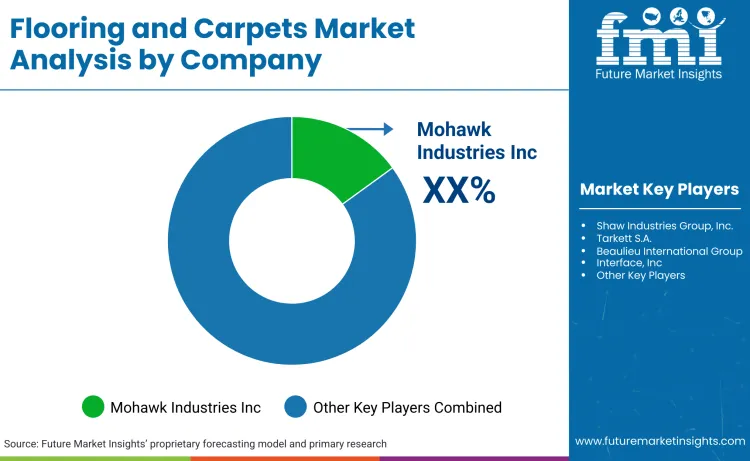
The competitive outlook is driven by a wave of strategic consolidation and operational optimization as major players seek to defend margins in a high-cost environment. Victoria PLC exemplified this trend in November 2025 by commissioning a state-of-the-art ceramics line. Geoff Wilding, Executive Chairman of Victoria PLC, stated: "This is an enormous milestone for the ceramics business - our line has been designed and built to deliver unmatched efficiency, precision and quality. We already have a talented and committed team in place who have been able to hit the ground running and, as CEO of the Division, I’m extremely proud of what we’re doing at Keraben." This move highlights how capex is being deployed not just for expansion, but for survival through efficiency.
Companies are focusing on de-leveraging; Interface Inc. repaid $115 million of debt in 2024, prioritizing balance sheet health over aggressive expansion to navigate the economic uncertainty. Strategic acquisitions continue to reshape the market, particularly in high-growth niches like sports surfacing. Tarkett actively expanded its footprint by acquiring Benchmark, PCC, and Mid-Atlantic between late 2024 and early 2025, strengthening its dominance in the healthcare flooring and sports infrastructure segments.
Targeted M&A strategy allows incumbents to diversify their revenue streams beyond the cyclical residential market. The competitive field is expanding to include service-based differentiators, with companies like Shaw Industries leveraging their "sustain[HUMAN]ability" strategy to offer carpet and upholstery cleaning services and maintenance programs that extend product life and deepen customer relationships.
Key Developments:
- In January 2026, Versatrim acquired Artistic Finishes, a provider of custom finishes and accessories for flooring. This strategic move combines expertise in molding and trim solutions, enhancing Versatrim's product offerings and service capabilities in the flooring market to better serve retailers and manufacturers.
- In January 2025, Mohawk Industries introduced the Data Tide modular carpet collection, featuring biophilic patterns inspired by environmental data visualizations. This launch emphasizes sustainable design and innovation, targeting commercial spaces with eco-friendly, customizable carpet tiles to meet growing demand for green building materials.
- In August 2025, Beaulieu International Group partnered with Digimarc to implement digital watermarks as a scalable solution for Digital Product Passports in the flooring industry. This collaboration advances traceability and sustainability in carpet production, enabling compliance with regulations and enhancing supply chain transparency for global markets.
Key Players in Flooring and Carpets Market
- Mohawk Industries, Inc.
- Shaw Industries Group, Inc.
- Tarkett S.A.
- Beaulieu International Group
- Interface, Inc.
- Victoria PLC
- Armstrong Flooring
- Forbo Holdings AG
- Gerflor
- Mannington Mills, Inc.
Market Definition
The flooring and carpets market is defined as the aggregate of commercial activities related to the design, manufacturing, distribution, and sale of material coverings applied to the floor structure of a building to provide a finished walking surface. It encompasses a diverse range of products including textile coverings like broadloom carpets, carpet tiles, and area rugs, as well as resilient and hard surface options such as vinyl sheets, luxury vinyl tiles (LVT), linoleum, ceramic tiles, laminate, natural stone, and engineered or solid wood. The market value is derived from the manufacturer-level revenue generated from the sale of these goods to residential, commercial, industrial, and institutional end-users. The market is characterized by its dual role in providing both functional durability and aesthetic enhancement to interior and exterior spaces.
The scope of this market explicitly includes revenue streams from the sale of primary flooring materials and essential installation accessories when sold as a bundled system by the manufacturer. This covers sustainable and bio-based flooring alternatives, acoustic underlayments, and specialized floor coatings used in industrial applications. It also includes the burgeoning sector of "Flooring as a Service" where revenue is generated through leasing or maintenance contracts that ensure circular retrieval of materials. Furthermore, the market sizing incorporates spending on niche segments such as sports surfacing, raised access flooring for data centers, and safety flooring for healthcare environments. Revenue from export activities and sales through all major channels, including direct-to-consumer, specialty retail, and contract dealerships, is included in the total market valuation.
The market explicitly excludes revenue generated from the standalone installation services provided by third-party contractors that are not directly affiliated with the flooring manufacturer. It also excludes the raw material extraction industries (e.g., lumber logging, petrochemical refining) unless these operations are vertically integrated within the flooring company's reported revenue. General cleaning and janitorial services for floors are excluded unless they are part of a specific manufacturer-led maintenance warranty program. Additionally, temporary floor coverings used for events or construction site protection, which are not intended as permanent or semi-permanent fixtures, are excluded from the market valuation. Finally, the market excludes the sale of sub-floor construction materials like structural concrete or plywood decking that form the base building structure.
Scope of Report
| Items | Values |
|---|---|
| Quantitative Units (2026) | USD 344.2 billion |
| Product Type | Carpets & Rugs, Tiles (Ceramic, Porcelain, Stone), Vinyl Flooring (LVT, VCT, Sheet Vinyl), Wood Flooring (Solid, Engineered), Laminate Flooring, Others (Linoleum, Rubber, Cork, Bamboo) |
| Sales Channel | Specialty Stores, Home Centers / DIY Stores, Online Retail, Direct Sales / Contract, Supermarkets / Hypermarkets |
| End User | Residential, Commercial (Office, Hospitality, Healthcare, Education, Retail), Industrial |
| Material & Technology Focus | Bio-based and recycled materials, low-VOC and formaldehyde-free formulations, closed-loop recycling systems, digital printing and modular flooring technologies |
| Regions Covered | North America, Europe, Asia Pacific, Latin America, Middle East & Africa |
| Countries Covered | China, India, United States, Germany, United Kingdom, and 40+ countries |
| Key Companies Profiled | Mohawk Industries, Shaw Industries Group, Tarkett S.A., Beaulieu International Group, Interface Inc., Victoria PLC, Armstrong Flooring, Forbo Holdings AG, Gerflor, Mannington Mills |
| Additional Attributes | Revenue analysis by product type and sales channel, renovation-driven demand assessment, residential versus commercial share analysis (Residential 45%), carpet segment dominance evaluation (33.90% share), circular economy and take-back program adoption, regulatory impact analysis (EU Green Deal, indoor VOC limits), bio-native material innovation tracking, automation and manufacturing efficiency benchmarking, and competitive positioning across global flooring OEMs
|
Flooring and Carpets Market by Segments
By Product Type:
- Carpets and Rugs
- Tiles (Ceramic, Porcelain, Stone)
- Vinyl Flooring (LVT, VCT, Sheet Vinyl)
- Wood Flooring (Solid, Engineered)
- Laminate Flooring
- Others (Linoleum, Rubber, Cork, Bamboo)
By Sales Channel:
- Specialty Stores
- Home Centers / DIY Stores
- Online Retail
- Direct Sales / Contract
- Supermarkets / Hypermarkets
By End User:
- Residential
- Commercial (Office, Hospitality, Healthcare, Education, Retail)
- Industrial
By Region:
- North America
- Europe
- Asia Pacific
- Latin America
- Middle East & Africa
Bibliography
- Bureau of Economic Analysis. (2024). Personal consumption expenditures: Housing and household equipment categories. BEA.
- Eurostat. (2024). Production in construction and housing completions. European Commission.
- Office for National Statistics. (2024). Construction output and new housing statistics. ONS.
- Ministry of Housing and Urban Affairs, Government of India. (2024). Urban housing and infrastructure development statistics. Government of India.
- National Bureau of Statistics of China. (2025). Real estate development and residential floor space completed. Government of China.
- Statistics Canada. (2024). Building permits and residential construction investment. Government of Canada.
- Australian Bureau of Statistics. (2024). Building activity and dwelling approvals. ABS.
- International Energy Agency. (2024). Buildings sector energy use and materials efficiency. IEA.
- European Chemicals Agency. (2024). Restrictions and guidance on substances in construction materials and floor coverings. ECHA.
Frequently Asked Questions
What is the current global market size for Flooring and Carpets?
The global market is valued at USD 344.2 billion in 2026, driven by sustained residential renovation activity and the commercial sector's shift toward sustainable retrofitting.
What is the projected CAGR for the Flooring and Carpets market?
The market is projected to grow at a steady 5.2% CAGR from 2026 to 2036, supported by material innovation and the adoption of circular economy principles.
Which product segment dominates the market?
Carpets hold the largest share at 33.90%, maintaining dominance due to their comfort, acoustic benefits, and recent innovations in sustainable fiber technology.
Which country is experiencing the fastest growth?
China is growing at the fastest rate of 7.0%, fueled by rapid urbanization and government mandates for healthy, non-toxic building materials.
Who are the leading players in the Flooring and Carpets market?
Mohawk Industries leads with a 15% market share, followed by major global players like Shaw Industries, Tarkett, Beaulieu International Group, and Interface Inc.
Preview the report firsthand - request a free sample
Get SampleGet the brochure for pricing and purchase details.
Get PDFTable of Content
- Executive Summary
- Global Market Outlook
- Demand Side Trends
- Supply Side Trends
- Technology Roadmap Analysis
- Analysis and Recommendations
- Market Overview
- Market Coverage / Taxonomy
- Market Definition / Scope / Limitations
- Research Methodology
- Chapter Orientation
- Analytical Lens and Working Hypotheses
- Market Structure, Signals, and Trend Drivers
- Benchmarking and Cross-market Comparability
- Market Sizing, Forecasting, and Opportunity Mapping
- Research Design and Evidence Framework
- Desk Research Programme (Secondary Evidence)
- Company Annual and Sustainability Reports
- Peer-reviewed Journals and Academic Literature
- Corporate Websites, Product Literature, and Technical Notes
- Earnings Decks and Investor Briefings
- Statutory Filings and Regulatory Disclosures
- Technical White Papers and Standards Notes
- Trade Journals, Industry Magazines, and Analyst Briefs
- Conference Proceedings, Webinars, and Seminar Materials
- Government Statistics Portals and Public Data Releases
- Press Releases and Reputable Media Coverage
- Specialist Newsletters and Curated Briefings
- Sector Databases and Reference Repositories
- FMI Internal Knowledge Base and Historical Datasets
- Subscription Datasets and Paid Sources
- Social Channels, Communities, and Digital Listening Inputs
- Additional Desk Sources
- Expert Input and Fieldwork (Primary Evidence)
- Primary Modes
- Qualitative Interviews and Expert Elicitation
- Quantitative Surveys and Structured Data Capture
- Blended Approach
- Why Primary Evidence is Used
- Field Techniques
- Interviews
- Surveys
- Focus Groups
- Observational and In-context Research
- Social and Community Interactions
- Stakeholder Universe Engaged
- C-suite Leaders
- Board Members
- Presidents and Vice Presidents
- R&D and Innovation Heads
- Technical Specialists
- Domain Subject-matter Experts
- Scientists
- Physicians and Other Healthcare Professionals
- Governance, Ethics, and Data Stewardship
- Research Ethics
- Data Integrity and Handling
- Primary Modes
- Tooling, Models, and Reference Databases
- Desk Research Programme (Secondary Evidence)
- Data Engineering and Model Build
- Data Acquisition and Ingestion
- Cleaning, Normalisation, and Verification
- Synthesis, Triangulation, and Analysis
- Quality Assurance and Audit Trail
- Market Background
- Market Dynamics
- Drivers
- Restraints
- Opportunity
- Trends
- Scenario Forecast
- Demand in Optimistic Scenario
- Demand in Likely Scenario
- Demand in Conservative Scenario
- Opportunity Map Analysis
- Product Life Cycle Analysis
- Supply Chain Analysis
- Investment Feasibility Matrix
- Value Chain Analysis
- PESTLE and Porter's Analysis
- Regulatory Landscape
- Regional Parent Market Outlook
- Production and Consumption Statistics
- Import and Export Statistics
- Market Dynamics
- Global Market Analysis 2021 to 2025 and Forecast, 2026 to 2036
- Historical Market Size Value (USD Billion) Analysis, 2021 to 2025
- Current and Future Market Size Value (USD Billion) Projections, 2026 to 2036
- Y-o-Y Growth Trend Analysis
- Absolute $ Opportunity Analysis
- Global Market Pricing Analysis 2021 to 2025 and Forecast 2026 to 2036
- Y-o-Y Growth Trend Analysis 2021 to 2025
- Absolute $ Opportunity Analysis 2026 to 2036
- Global Market Analysis 2021 to 2025 and Forecast 2026 to 2036, By Product Type
- Introduction / Key Findings
- Historical Market Size Value (USD Billion) Analysis By Product Type, 2021 to 2025
- Current and Future Market Size Value (USD Billion) Analysis and Forecast By Product Type, 2026 to 2036
- Carpets and Rugs
- Tiles (Ceramic, Porcelain, Stone)
- Vinyl Flooring (LVT, VCT, Sheet Vinyl)
- Wood Flooring (Solid, Engineered)
- Laminate Flooring
- Others (Linoleum, Rubber, Cork, Bamboo)
- Y-o-Y Growth Trend Analysis By Product Type, 2021 to 2025
- Absolute $ Opportunity Analysis By Product Type, 2026 to 2036
- Global Market Analysis 2021 to 2025 and Forecast 2026 to 2036, By Sales Channel
- Introduction / Key Findings
- Historical Market Size Value (USD Billion) Analysis By Sales Channel, 2021 to 2025
- Current and Future Market Size Value (USD Billion) Analysis and Forecast By Sales Channel, 2026 to 2036
- Specialty Stores
- Home Centers / DIY Stores
- Online Retail
- Direct Sales / Contract
- Supermarkets / Hypermarkets
- Y-o-Y Growth Trend Analysis By Sales Channel, 2021 to 2025
- Absolute $ Opportunity Analysis By Sales Channel, 2026 to 2036
- Global Market Analysis 2021 to 2025 and Forecast 2026 to 2036, By End User
- Introduction / Key Findings
- Historical Market Size Value (USD Billion) Analysis By End User, 2021 to 2025
- Current and Future Market Size Value (USD Billion) Analysis and Forecast By End User, 2026 to 2036
- Residential
- Commercial
- Industrial
- Y-o-Y Growth Trend Analysis By End User, 2021 to 2025
- Absolute $ Opportunity Analysis By End User, 2026 to 2036
- Global Market Analysis 2021 to 2025 and Forecast 2026 to 2036, By Region
- Introduction
- Historical Market Size Value (USD Billion) Analysis By Region, 2021 to 2025
- Current Market Size Value (USD Billion) Analysis and Forecast By Region, 2026 to 2036
- North America
- Latin America
- Western Europe
- Eastern Europe
- East Asia
- South Asia and Pacific
- Middle East & Africa
- Market Attractiveness Analysis By Region
- North America Market Analysis 2021 to 2025 and Forecast 2026 to 2036, By Country
- Historical Market Size Value (USD Billion) Trend Analysis By Market Taxonomy, 2021 to 2025
- Market Size Value (USD Billion) Forecast By Market Taxonomy, 2026 to 2036
- By Country
- USA
- Canada
- Mexico
- By Product Type
- By Sales Channel
- By End User
- By Country
- Market Attractiveness Analysis
- By Country
- By Product Type
- By Sales Channel
- By End User
- Key Takeaways
- Latin America Market Analysis 2021 to 2025 and Forecast 2026 to 2036, By Country
- Historical Market Size Value (USD Billion) Trend Analysis By Market Taxonomy, 2021 to 2025
- Market Size Value (USD Billion) Forecast By Market Taxonomy, 2026 to 2036
- By Country
- Brazil
- Chile
- Rest of Latin America
- By Product Type
- By Sales Channel
- By End User
- By Country
- Market Attractiveness Analysis
- By Country
- By Product Type
- By Sales Channel
- By End User
- Key Takeaways
- Western Europe Market Analysis 2021 to 2025 and Forecast 2026 to 2036, By Country
- Historical Market Size Value (USD Billion) Trend Analysis By Market Taxonomy, 2021 to 2025
- Market Size Value (USD Billion) Forecast By Market Taxonomy, 2026 to 2036
- By Country
- Germany
- UK
- Italy
- Spain
- France
- Nordic
- BENELUX
- Rest of Western Europe
- By Product Type
- By Sales Channel
- By End User
- By Country
- Market Attractiveness Analysis
- By Country
- By Product Type
- By Sales Channel
- By End User
- Key Takeaways
- Eastern Europe Market Analysis 2021 to 2025 and Forecast 2026 to 2036, By Country
- Historical Market Size Value (USD Billion) Trend Analysis By Market Taxonomy, 2021 to 2025
- Market Size Value (USD Billion) Forecast By Market Taxonomy, 2026 to 2036
- By Country
- Russia
- Poland
- Hungary
- Balkan & Baltic
- Rest of Eastern Europe
- By Product Type
- By Sales Channel
- By End User
- By Country
- Market Attractiveness Analysis
- By Country
- By Product Type
- By Sales Channel
- By End User
- Key Takeaways
- East Asia Market Analysis 2021 to 2025 and Forecast 2026 to 2036, By Country
- Historical Market Size Value (USD Billion) Trend Analysis By Market Taxonomy, 2021 to 2025
- Market Size Value (USD Billion) Forecast By Market Taxonomy, 2026 to 2036
- By Country
- China
- Japan
- South Korea
- By Product Type
- By Sales Channel
- By End User
- By Country
- Market Attractiveness Analysis
- By Country
- By Product Type
- By Sales Channel
- By End User
- Key Takeaways
- South Asia and Pacific Market Analysis 2021 to 2025 and Forecast 2026 to 2036, By Country
- Historical Market Size Value (USD Billion) Trend Analysis By Market Taxonomy, 2021 to 2025
- Market Size Value (USD Billion) Forecast By Market Taxonomy, 2026 to 2036
- By Country
- India
- ASEAN
- Australia & New Zealand
- Rest of South Asia and Pacific
- By Product Type
- By Sales Channel
- By End User
- By Country
- Market Attractiveness Analysis
- By Country
- By Product Type
- By Sales Channel
- By End User
- Key Takeaways
- Middle East & Africa Market Analysis 2021 to 2025 and Forecast 2026 to 2036, By Country
- Historical Market Size Value (USD Billion) Trend Analysis By Market Taxonomy, 2021 to 2025
- Market Size Value (USD Billion) Forecast By Market Taxonomy, 2026 to 2036
- By Country
- Kingdom of Saudi Arabia
- Other GCC Countries
- Turkiye
- South Africa
- Other African Union
- Rest of Middle East & Africa
- By Product Type
- By Sales Channel
- By End User
- By Country
- Market Attractiveness Analysis
- By Country
- By Product Type
- By Sales Channel
- By End User
- Key Takeaways
- Key Countries Market Analysis
- USA
- Pricing Analysis
- Market Share Analysis, 2025
- By Product Type
- By Sales Channel
- By End User
- Canada
- Pricing Analysis
- Market Share Analysis, 2025
- By Product Type
- By Sales Channel
- By End User
- Mexico
- Pricing Analysis
- Market Share Analysis, 2025
- By Product Type
- By Sales Channel
- By End User
- Brazil
- Pricing Analysis
- Market Share Analysis, 2025
- By Product Type
- By Sales Channel
- By End User
- Chile
- Pricing Analysis
- Market Share Analysis, 2025
- By Product Type
- By Sales Channel
- By End User
- Germany
- Pricing Analysis
- Market Share Analysis, 2025
- By Product Type
- By Sales Channel
- By End User
- UK
- Pricing Analysis
- Market Share Analysis, 2025
- By Product Type
- By Sales Channel
- By End User
- Italy
- Pricing Analysis
- Market Share Analysis, 2025
- By Product Type
- By Sales Channel
- By End User
- Spain
- Pricing Analysis
- Market Share Analysis, 2025
- By Product Type
- By Sales Channel
- By End User
- France
- Pricing Analysis
- Market Share Analysis, 2025
- By Product Type
- By Sales Channel
- By End User
- India
- Pricing Analysis
- Market Share Analysis, 2025
- By Product Type
- By Sales Channel
- By End User
- ASEAN
- Pricing Analysis
- Market Share Analysis, 2025
- By Product Type
- By Sales Channel
- By End User
- Australia & New Zealand
- Pricing Analysis
- Market Share Analysis, 2025
- By Product Type
- By Sales Channel
- By End User
- China
- Pricing Analysis
- Market Share Analysis, 2025
- By Product Type
- By Sales Channel
- By End User
- Japan
- Pricing Analysis
- Market Share Analysis, 2025
- By Product Type
- By Sales Channel
- By End User
- South Korea
- Pricing Analysis
- Market Share Analysis, 2025
- By Product Type
- By Sales Channel
- By End User
- Russia
- Pricing Analysis
- Market Share Analysis, 2025
- By Product Type
- By Sales Channel
- By End User
- Poland
- Pricing Analysis
- Market Share Analysis, 2025
- By Product Type
- By Sales Channel
- By End User
- Hungary
- Pricing Analysis
- Market Share Analysis, 2025
- By Product Type
- By Sales Channel
- By End User
- Kingdom of Saudi Arabia
- Pricing Analysis
- Market Share Analysis, 2025
- By Product Type
- By Sales Channel
- By End User
- Turkiye
- Pricing Analysis
- Market Share Analysis, 2025
- By Product Type
- By Sales Channel
- By End User
- South Africa
- Pricing Analysis
- Market Share Analysis, 2025
- By Product Type
- By Sales Channel
- By End User
- USA
- Market Structure Analysis
- Competition Dashboard
- Competition Benchmarking
- Market Share Analysis of Top Players
- By Regional
- By Product Type
- By Sales Channel
- By End User
- Competition Analysis
- Competition Deep Dive
- Mohawk Industries, Inc.
- Shaw Industries Group, Inc.
- Tarkett S.A.
- Beaulieu International Group
- Interface, Inc.
- Victoria PLC
- Armstrong Flooring
- Forbo Holdings AG
- Gerflor
- Mannington Mills, Inc.
- Competition Deep Dive
- Assumptions & Acronyms Used


