

- Industry Size (2025)
- USD 1998.6 Mn
- Forecast (2035)
- USD 4356.4 Mn
- CAGR (2025 to 2035)
- 8.1%
Chromatin Modifiers Market Forecast and Outlook 2025 to 2035
Chromatin modifiers market is projected to reach USD 4,356.4 million by 2035, recording an absolute increase of USD 2,357.8 million over the forecast period. This market is valued at USD 1,998.6 million in 2025 and is set to rise at a CAGR of 8.1% during the assessment period.
Overall demand is expected to expand by nearly 2.1 times, supported by accelerating adoption of epigenetic-targeting therapeutics in oncology and rare-disease pipelines, increased investment in precision-medicine platforms, growing clinical evidence validating chromatin-associated drug targets, and expanding application of epigenome-editing tools in both academic and commercial research.
Quick Stats for Chromatin Modifiers Market
- Chromatin Modifiers Market Value (2025): USD 1,998.6 million
- Chromatin Modifiers Market Forecast Value (2035): USD 4,356.4 million
- Chromatin Modifiers Market Forecast CAGR: 8.1%
- Leading Market Segment in Chromatin Modifiers Market: Academic & research institutes 42.6% share driven by multi-omics infrastructure expansion and high adoption of chromatin profiling workflows
- Key Growth Regions in Chromatin Modifiers Market: North America, Europe, and Asia Pacific
- Top Players in Chromatin Modifiers Market: Active Motif, EpiCypher, Merck MilliporeSigma, Thermo Fisher Scientific, Abcam
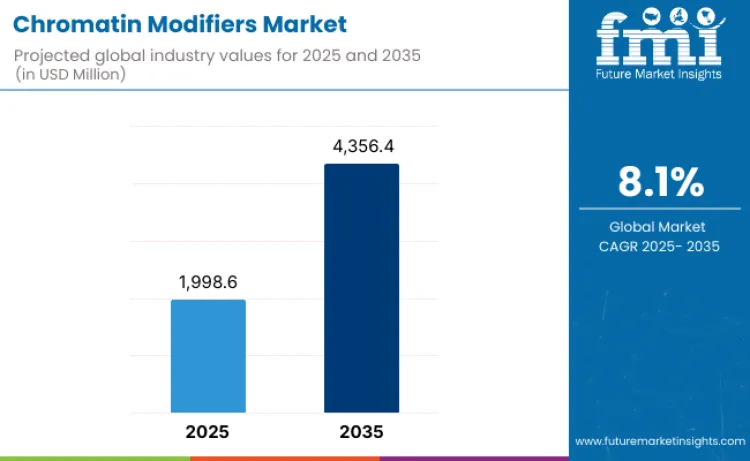
Chromatin Modifiers Market Key Takeaways
| Metric | Value |
| Market Value (2025) | USD 1,998.6 million |
| Market Forecast Value (2035) | USD 4,356.4 million |
| Forecast CAGR (2025 to 2035) | 8.1% |
Chromatin Modifiers Market Year-over-Year Forecast (2025-2035)
Technological advancements in chromatin-imaging platforms, single-cell epigenomics, ATAC-seq-driven regulatory element profiling, and CRISPR-based epigenome editors are reshaping the landscape. Modern R&D systems integrate high-throughput screening, computational histone-pattern interpretation, and 3D chromatin conformation mapping to identify druggable regulatory nodes. Clinical programs increasingly incorporate pharmacodynamic biomarkers, liquid-biopsy-based methylation signatures, and chromatin accessibility indices to support patient selection and response monitoring.
Government precision-medicine initiatives and oncology-research funding strengthen growth. Leading academic centers and translational institutes worldwide are investing in multi-omics infrastructure to advance chromatin biology research, while large pharmaceutical companies expand partnerships with biotech innovators developing next-generation epigenetic modulators.
Between 2025 and 2030, chromatin modifiers market is projected to expand from USD 1,998.6 million to USD 2,950.7 million, resulting in a value increase of USD 952.1 million, which represents 40.4% of total forecast growth for the decade. This phase will be shaped by rising adoption of epigenetic-based oncology therapies, accelerating clinical translation of chromatin-targeting mechanisms, and expanding integration of multi-omics platforms for drug discovery and patient selection.
From 2030 to 2035, growth is forecast to expand from USD 2,950.7 million to USD 4,356.4 million, adding another USD 1,405.7 million, which constitutes 59.6% of overall ten-year expansion. This period is expected to be characterized by commercialization of next-generation epigenetic modulators, including target-selective chromatin remodeling complex inhibitors, programmable CRISPR-based transcriptional regulators, and combination regimens that synergize with immune-oncology and targeted therapy platforms.
Why Is the Chromatin Modifiers Market Growing Worldwide?
The chromatin modifiers market grows by enabling researchers and clinicians to regulate gene expression and cellular programming at the epigenetic level, unlocking novel therapeutic pathways for diseases driven by transcriptional dysregulation and aberrant chromatin states. Pharmaceutical and biotechnology companies face mounting pressure to address tumor resistance, relapse biology, and heterogeneity challenges across oncology and hematology, with chromatin-targeting drugs demonstrating 30-50% improvement in response rates in defined biomarker-selected patient subsets compared to conventional therapies alone.
Expanding adoption of epigenomic profiling tools, single-cell chromatin accessibility assays, and multi-omics-driven patient-stratification models is creating demand for chromatin-modulating therapies that deliver durable disease control and overcome limitations of traditional gene-targeted approaches. Government-backed precision-medicine programs and cancer-research funding initiatives are accelerating investment in epigenetic therapeutics across academic centers, translational institutes, and biopharma R&D pipelines, where chromatin remodeling agents play a direct role in modulating tumor microenvironment dynamics, immune activation, and treatment sensitivity.
How Are the Chromatin Modifiers Market Segmented by Product Type, Application, End User and Region?
Chromatin modifiers market is segmented by product type, application, end user and region. By product type, it includes enzyme inhibitors & chemical probes, antibodies & detection reagents, assay kits & platforms, chromatin remodeling and nucleosome reagents, and nucleosome/histone substrates & standards. Based on application, it is categorized into drug discovery & screening, ChIP/ATAC sample prep & epigenome profiling, biomarker & translational research, and basic epigenetics research. By end user, it is divided into pharma & biotech companies, academic & research institutes, CROs/CDMOs, and clinical labs & hospitals. Regionally, it is divided into Asia Pacific, Europe, North America, Latin America, and Middle East & Africa.
By Product Type, Enzyme Inhibitors & Chemical Probes Account for 28.7% Share
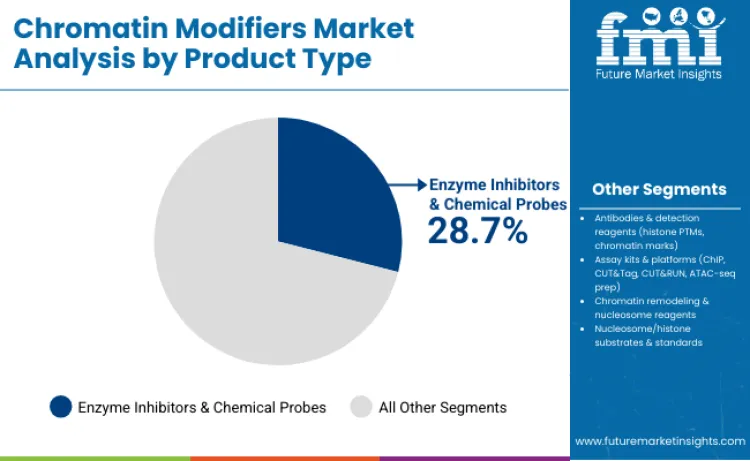
Enzyme inhibitors and chemical probes dominate the chromatin modifiers market with 28.7% share in 2025, encompassing HDAC, HAT, DNMT, HMT, KDM, and BET modulators essential for regulating histone acetylation, methylation, and chromatin accessibility in oncology and translational research. Their leadership reflects their ability to reverse aberrant epigenetic states and validate therapeutic targets. Antibodies and detection reagents hold 24.1%, supporting histone-PTM mapping. Assay kits and platforms such as ChIP, CUT&Tag, CUT&RUN, and ATAC-seq represent 19.6%. Chromatin-remodeling reagents account for 14.8%, while nucleosome and histone standards hold 12.8%.
Key advantages driving the enzyme inhibitor & chemical probe segment include:
- Essential tool for validating chromatin regulatory pathways and therapeutic target classes in oncology and genetic diseases
- Enables modulation of histone marks and chromatin accessibility with high mechanistic specificity
By Application, Drug Discovery & Screening Leads with 34.5% Share
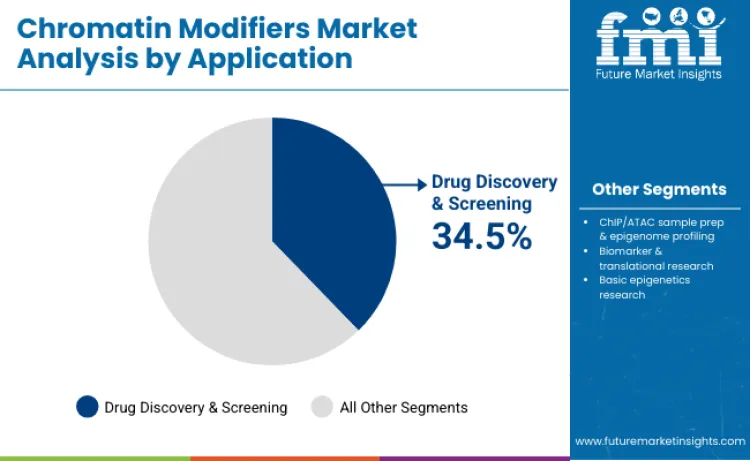
Drug discovery and screening applications lead the chromatin modifiers market with 34.5% share in 2025, driven by global expansion of epigenetic therapy pipelines and multi-omics-enabled early-stage R&D. Strong uptake in oncology and rare-disease programs reinforces this segment’s leadership as researchers target chromatin modulation for pathway activation and tumor reprogramming. ChIP/ATAC sample prep and epigenome profiling methods hold 29.7%, fueled by rising use of chromatin accessibility and histone-mark mapping. Biomarker and translational research accounts for 18.6%, while basic epigenetics research represents 17.2%, supporting discovery of regulatory elements and chromatin enzymes.
Key dynamics supporting application preferences include:
- Surging oncology pipelines utilizing epigenetic modulators and transcriptional reprogramming strategies
- Growing reliance on ATAC-seq, ChIP-seq, and CUT&Tag workflows in phenotyping and mechanism-of-action studies
By End User, Academic & Research Institutes Represent 42.6% Share
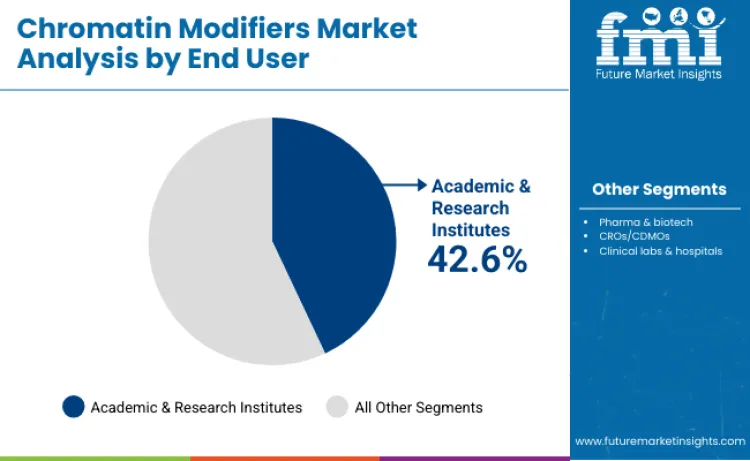
Academic and research institutes lead the chromatin modifiers market with 42.6% share in 2025, driven by widespread use of chromatin-biology reagents and epigenome-profiling platforms across global universities, cancer centers, and translational institutes. These groups advance mechanistic discovery, pathway mapping, and target validation supported by government funding and multi-omics infrastructure. Pharma and biotech companies hold 37.9%, integrating chromatin-modulation tools into oncology, immuno-oncology, and biomarker-driven development. CROs/CDMOs account for 12.8% through outsourced functional epigenomics and screening services, while clinical labs and hospitals represent 6.7% amid growing adoption of methylation diagnostics and monitoring tools.
Key factors supporting end-user segment leadership include:
- High concentration of epigenetic research grants and precision-medicine funding in academia
- Extensive mechanistic validation and disease-modeling work conducted in universities and cancer centers
What Are the Major Drivers, Restraints, and Emerging Trends Influencing the Chromatin Modifiers Market?
The chromatin modifiers market is driven by rising precision-medicine adoption and expanding understanding of disease-specific regulatory mechanisms. Oncology and rare-disease pipelines increasingly prioritize epigenetic modulation, with global cancer R&D investments growing 8-12% annually and requiring chromatin-acting tools that support transcriptional reprogramming, immune priming, and therapy-resistance reversal. Rapid uptake of single-cell epigenomics and multi-omics platforms further accelerates demand as researchers employ ATAC-seq, ChIP-seq, CUT&RUN, and methylation workflows to map regulatory elements. Expanding pharmaceutical collaborations and VC-backed epigenetic pipelines increase procurement of enzyme inhibitors, chromatin assays, and nucleosome-based discovery tools.
What Restraints Limit Broad Adoption of Chromatin Modifiers?
Market restraints include high acquisition and implementation costs associated with advanced epigenomic platforms, as sequencing workflows, high-specificity antibodies, and enzyme inhibitor libraries demand substantial budgets compared with conventional molecular tools. Technical complexity creates barriers for laboratories shifting from gene-expression assays, since chromatin biology requires specialized protocols and 100-300 hours of training for reproducible results across single-cell and bulk methods. Biological variability and context-dependent epigenetic responses complicate data interpretation. Evolving regulatory frameworks for epigenetic therapeutics and companion diagnostics require extensive validation evidence, delaying clinical uptake and slowing commercialization timelines for new epigenetic tools.
What Emerging Trends Are Shaping the Future of the Chromatin Modifiers Market?
Key trends show accelerated adoption in Asia-Pacific markets, especially China and India, supported by national precision-medicine programs, genomic-infrastructure expansion, and multi-omics research funding that increases access to advanced chromatin technologies. Technological innovation centers on locus-specific epigenome editing, AI-enabled chromatin-state interpretation, and scalable high-sensitivity ATAC and ChIP workflows reshaping reagent design. Market dynamics may shift as low-cost sequencing kits, open-source epigenomic tools, and integrated CRISPR-based epigenetic activation/silencing platforms reduce reliance on premium reagents. These advances could consolidate discovery workflows and redirect purchasing toward unified epigenetic-engineering systems offering broader functional capabilities.
How Are Leading Countries Driving Growth in the Chromatin Modifiers Market?
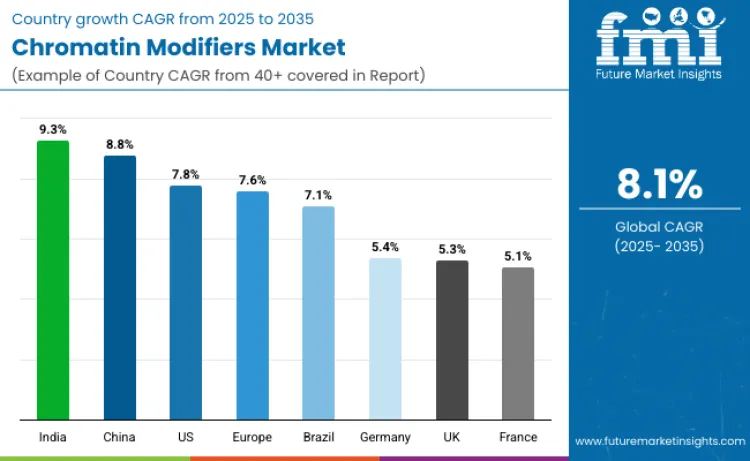
| Country/Region | CAGR (2025-2035) |
|---|---|
| India | 9.3% |
| China | 8.8% |
| USA | 7.8% |
| Europe | 7.6% |
| Brazil | 7.1% |
| Germany | 5.4% |
| UK | 5.3% |
| France | 5.1% |
The chromatin modifiers landscape is expanding rapidly, led by India (9.3%) through growth in precision-medicine programs, national genomics missions, and cancer research infrastructure. China (8.8%) follows with government-funded multi-omics initiatives and rising adoption of single-cell epigenomics and drug-screening platforms. The USA (7.8%) maintains strong momentum through advanced biotech ecosystems and oncology pipelines, while Europe (7.6%) benefits from established research clusters and Horizon-funded initiatives. Brazil (7.1%) records steady adoption, and Germany (5.4%), the UK (5.3%), and France (5.1%) continue progressing through active pharmaceutical and academic epigenetics programs.
The report covers an in-depth analysis of 40+ countries top-performing countries are highlighted below.
How Is Epigenomics Infrastructure Accelerating Growth in China?
China shows one of the strongest growth trajectories in the chromatin modifiers market, supported by a CAGR of 8.8% through 2035. Momentum is driven by large national precision-medicine investments, expanding oncology and rare-disease pipelines, and rapid deployment of multi-omics and single-cell sequencing infrastructure across leading research hospitals and academic clusters. Growth is concentrated in Beijing, Shanghai, Shenzhen, and Guangzhou, where cancer institutes and biotech companies integrate chromatin-biology platforms for drug discovery, biomarker development, and mechanistic studies. National genomics programs, innovation parks, and government-backed incubators accelerate adoption through expanding venture funding and global biopharma partnerships.
Key market factors:
- Rapid expansion of national precision-medicine and cancer-genomics initiatives, with large-scale patient cohorts enabling advanced epigenomic biomarker discovery and drug-response research
- Government support through Biotech Industrial Parks and National Key R&D Programs, offering infrastructure grants and multi-omics funding to academic and translational labs
Why Are Precision-Medicine Programs Enhancing Adoption in India?
India’s chromatin modifiers market is accelerating across biomedical hubs, translational institutes, and academic laboratories, supported by a CAGR of 9.3% through 2035. Growth is driven by national precision-medicine initiatives, genomics programs, and expanding cancer research capacity. Academic centers increasingly adopt chromatin-profiling assays, epigenetic inhibitors, and nucleosome-mapping platforms for biomarker discovery, immuno-oncology studies, and early drug development. Rapid expansion in molecular biology and bioinformatics education, rising cancer-research funding, and integration of epigenomic workflows strengthen adoption. Genome India and national biomedical innovation programs further boost demand for high-quality epigenetic reagents across academic and hospital-affiliated labs.
Key market factors:
- Leading life-science clusters including Bangalore, Hyderabad, Mumbai, and Pune driving epigenomics adoption across cancer research labs, academic centers, and biotech innovation ecosystems
- Government-backed initiatives such as Genome India Mission and Biotechnology Industry Research Assistance Council (BIRAC) providing funding support, training, and infrastructure to scale epigenetics research
How Does Scientific Rigor Sustain Leadership in Germany?
Germany’s advanced biomedical research ecosystem shows strong adoption of chromatin biology and epigenetic technologies, with documented improvements in translational efficiency and data reproducibility through standardized chromatin-profiling workflows across cancer centers, immunology institutes, and academic molecular biology labs. Leading hubs such as Berlin, Munich, Heidelberg, and Frankfurt integrate chromatin-modifying tools with established functional genomics platforms, supported by Germany’s precision-science culture and clinical-research excellence. Researchers prioritize assay reliability, validated antibodies, and reagent reproducibility, driving demand for premium chromatin tools. Steady market growth continues, supported by a CAGR of 5.4% and expanding academic-industry collaborations.
- Strategic collaborations between European reagent distributors and global epigenetic technology developers ensuring high-quality supply chains, validated antibodies, and technical support for complex epigenomic workflows
- Integration of chromatin-modifying reagents with leading European single-cell, sequencing, and functional-genomics ecosystems supporting end-to-end discovery-to-clinical-translation workflows.
Why Is Expanding Biomedical Research Capacity Fueling Demand in Brazil?
Brazil’s chromatin modifiers market is expanding rapidly, supported by strong growth in oncology research programs, increasing establishment of molecular biology laboratories, and a rising community of translational scientists focused on epigenetics. With a CAGR of 7.1% through 2035, momentum is driven by precision-medicine initiatives, investment in public cancer institutes, and broad adoption of chromatin-analysis workflows across São Paulo, Rio de Janeiro, Brasília, and Campinas. Academic labs increasingly use chromatin modifiers, histone-modification antibodies, and epigenomic profiling kits for biomarker and immunotherapy research. Access is strengthened through scientific distributors, university-industry collaborations, and procurement from global biotechnology suppliers.
Leading market segments:
- Academic cancer biology labs and immunology research groups adopting epigenomic tools for tumor microenvironment studies, treatment-resistance mapping, and biomarker discovery
- Technology partnerships with global reagent providers offering localized supply channels, training support, and financing options to address procurement budget constraints
How Do Established Research Networks Strengthen Performance in United States?
The USA chromatin modifiers market shows mature adoption supported by leading cancer research centers, biotech hubs, and established pharmaceutical development programs, with strong integration across institutions such as MD Anderson, Dana-Farber, Memorial Sloan Kettering, Stanford, and Harvard-affiliated centers. Growth remains robust, driven by a CAGR of 7.8% through 2035, supported by expanding epigenetic oncology pipelines, widespread use of single-cell and multi-omics platforms, and sustained federal and private funding. Major sequencing, bioinformatics, and reagent companies across Massachusetts, California, and North Carolina enable seamless integration of chromatin tools with computational and translational research workflows.
- Established scientific distribution and core-facility networks providing reliable access to high-quality chromatin reagents, sequencing platforms, and technical support for complex epigenomic workflows
- Collaboration between federal research agencies, oncology consortia, and biopharma companies enabling rapid validation, data sharing, and feedback integration for next-generation chromatin-targeting tools
How Is Epigenetics Research Expansion Supporting Growth in United Kingdom?
In leading UK biomedical clusters such as London, Cambridge, Oxford, and Manchester, academic institutes, cancer centers, and biotech spin-outs are expanding adoption of chromatin-modification and epigenomic profiling workflows to accelerate oncology discovery, immuno-oncology research, and rare-disease studies. Documented programs show notable gains in experimental reproducibility and faster biomarker-validation cycles. The market grows steadily with a CAGR of 5.3% through 2035, supported by the UK’s strong life-sciences ecosystem, National Genomics Programme investments, and advanced multi-omic infrastructure. Research teams increasingly deploy chromatin accessibility assays, histone-mark mapping, and enzymatic epigenetic toolkits to advance translational research.
Market development factors:
- Academic oncology and molecular-biology labs adopting ChIP-seq, ATAC-seq, and single-cell epigenomics workflows with structured training and protocol standardization initiatives across leading universities
- Educational partnerships between UK research institutes, Wellcome-funded centers, and global reagent suppliers providing preferential academic pricing and post-doctoral access incentives for chromatin research tools
How Are Life-Sciences Investments Advancing Market Expansion Across Europe?
Europe’s chromatin modifiers market is set to grow from USD 429.7 million in 2025 to USD 897.4 million by 2035 at a CAGR of 7.6%, driven by expanding epigenetics research capacity and integration of chromatin-profiling technologies across leading academic and translational centers.
Germany leads with 26.8% in 2025, easing to 26.2% by 2035, supported by strong oncology research networks in Berlin, Munich, and Heidelberg. France rises from 19.7% to 20.1% through active immuno-oncology and epigenetic drug-development programs. Italy increases from 11.4% to 11.6%, while Spain advances from 8.6% to 8.8%. The Netherlands maintains 6.4%, and the Rest of Europe expands from 4.7% to 4.9% amid growing Nordic and Central/Eastern European adoption.
High-Fidelity Epigenomic Precision Dominates Requirements in Japan
Japan’s chromatin modifiers market reflects a mature, rigor-driven research ecosystem, marked by advanced integration of high-fidelity chromatin profiling platforms and validated epigenetic reagents across oncology, stem-cell, and neuroscience laboratories. Strong emphasis on precision, biomarker reproducibility, and mechanistic validation fuels demand for premium chromatin-modulation tools meeting strict scientific performance standards.
Leading university and cancer institutes in Tokyo, Osaka, Kyoto, and Kobe routinely deploy single-cell ATAC workflows, ChIP-seq libraries, and validated histone-modification antibodies within translational pipelines. Japan’s research culture prioritizes data integrity and methodological reliability, driving adoption of reagents with proven specificity and consistent performance. Advanced labs apply chromatin-editing tools and fine-resolution assays across cancer epigenomics, neurodevelopmental research, and iPSC-based functional modeling.
International Epigenomic Technology Providers Lead Advanced Research Support in South Korea
South Korea’s chromatin modifiers market is expanding through strong participation from global molecular biology and sequencing technology providers, which maintain significant presence via specialized reagent portfolios, core-facility partnerships, and advanced technical-training programs supporting cancer epigenomics and immune-modulation research. Demand is rising for precision-genomics and single-cell epigenetic tools as leading institutions, including Seoul National University Hospital, Korea University Medical Center, and KAIST, integrate chromatin-modulation reagents and high-resolution profiling kits into national precision-medicine frameworks.
Regional distributors and academic core labs strengthen adoption through partnerships with major USA, European, and Japanese manufacturers, providing localized support for ATAC-seq, CUT&Tag, and ChIP workflows. Increasing collaboration between multinational providers and Korean research consortia fosters hybrid commercialization and knowledge-transfer models aligned with domestic translational priorities.
How Competitive Is the Global Chromatin Modifiers Market and What Defines Its Structure?
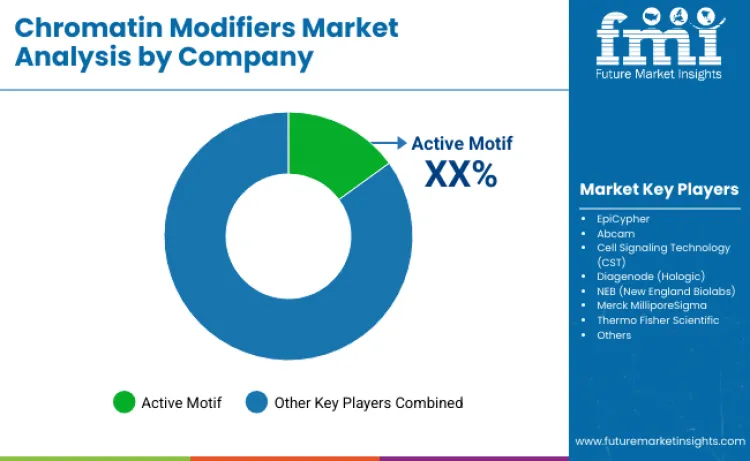
The chromatin modifiers market is moderately concentrated, led by a small group of established players with strong reagent portfolios, validated assay platforms, and deep academic partnerships. Active Motif holds a leading position, supported by its extensive range of ChIP-grade antibodies, histone-modification reagents, and integrated assay kits widely used in chromatin-mapping and transcriptional-regulation studies. Alongside Active Motif, EpiCypher and Merck MilliporeSigma maintain competitive strength through proprietary nucleosome substrate technologies, high-quality antibody libraries, and reliable chromatin-assay systems optimized for single-cell, ChIP, and ATAC workflows.
Thermo Fisher Scientific, Abcam, and New England Biolabs act as strong challengers, leveraging broad product diversity, automation-ready reagents, and robust distribution networks that support academic, CRO, and biopharma customers. Cell Signaling Technology and Diagenode focus on specialized chromatin-state interrogation and histone-mark detection with high citation credibility. Emerging suppliers across Asia-Pacific add competitive pressure through cost-efficient assay kits and scalable epigenetics workflows. Market dynamics favor companies offering reproducible performance, global reach, and data-validated solutions supporting complete chromatin-analysis pipelines.
Key Players in the Chromatin Modifiers Market
- EpiCypher
- Active Motif
- Abcam
- Cell Signaling Technology (CST)
- Diagenode (Hologic)
- NEB (New England Biolabs)
- Merck MilliporeSigma
- Thermo Fisher Scientific
- Others
Scope of the Report
| Items | Values |
|---|---|
| Quantitative Units | USD 1,998.6 million |
| Product Type | Enzyme inhibitors & chemical probes (HDAC, HAT, DNMT, HMT, KDM, BET), Antibodies & detection reagents (histone PTMs, chromatin marks), Assay kits & platforms (ChIP, CUT&Tag, CUT&RUN, ATAC- seq prep), Chromatin remodeling & nucleosome reagents, Nucleosome/histone substrates & standards |
| Application | Drug discovery & screening, ChIP /ATAC sample prep & epigenome profiling, Biomarker & translational research, Basic epigenetics research |
| End User | Pharma & biotech, Academic & research institutes, CROs/CDMOs, Clinical labs & hospitals |
| Regions Covered | Asia Pacific, Europe, North America, Latin America, Middle East & Africa |
| Country Covered | China, India, Germany, Brazil, USA, UK, Japan, and 40+ countries |
| Key Companies Profiled | EpiCypher, Active Motif, Abcam, Cell Signaling Technology (CST), Diagenode (Hologic), NEB (New England Biolabs), Merck MilliporeSigma,Thermo Fisher Scientific, Others |
| Additional Attributes | Dollar sales by product type and application, regional trends across North America, Europe, and Asia-Pacific, competitive landscape of chromatin-modifying reagent manufacturers, assay validation benchmarks, integration with sequencing and multi-omics workflows, innovations in histone-modification detection, and advanced kits optimized for single-cell, CUT&Tag, CUT&RUN, and ATAC- seq applications. |
Chromatin Modifiers Market by Segments
By Product Type:
- Enzyme inhibitors & chemical probes (HDAC, HAT, DNMT, HMT, KDM, BET)
- Antibodies & detection reagents (histone PTMs, chromatin marks)
- Assay kits & platforms (ChIP, CUT&Tag, CUT&RUN, ATAC-seq prep)
- Chromatin remodeling & nucleosome reagents
- Nucleosome/histone substrates & standards
By Application:
- Drug discovery & screening
- ChIP/ATAC sample prep & epigenome profiling
- Biomarker & translational research
- Basic epigenetics research
By End User:
- Pharma & biotech
- Academic & research institutes
- CROs/CDMOs
- Clinical labs & hospitals
By Region:
- Asia Pacific
- China
- India
- Japan
- South Korea
- Vietnam
- Australia & New Zealand
- ASEAN
- Rest of Asia Pacific
- Europe
- Germany
- United Kingdom
- France
- Italy
- Spain
- Netherlands
- Nordic
- BENELUX
- Rest of Europe
- North America
- United States
- Canada
- Mexico
- Latin America
- Brazil
- Argentina
- Rest of Latin America
- Middle East & Africa
- Kingdom of Saudi Arabia
- Other GCC Countries
- Turkey
- South Africa
- Other African Union
- Rest of Middle East & Africa
Frequently Asked Questions
How big is the chromatin modifiers market in 2025?
The global chromatin modifiers market is valued at USD 1,998.6 million in 2025.
What will the size of the chromatin modifiers market be in 2035?
The market is projected to reach USD 4,356.4 million by 2035.
How fast will the chromatin modifiers market grow between 2025 and 2035?
The market will grow at a CAGR of 8.1% from 2025 to 2035.
Which segment leads the chromatin modifiers market in 2025?
Academic & research institutes lead the market with a 42.6% share in 2025.
Who are the major players in the chromatin modifiers market?
Key players include Active Motif, EpiCypher, Merck MilliporeSigma, Thermo Fisher Scientific, and Abcam.
Preview the report firsthand - request a free sample
Get SampleGet the brochure for pricing and purchase details.
Get PDFTable of Content
- Executive Summary
- Regional Level Market Outlook
- Demand-side Trends
- Supply-side Trends
- Technology Roadmap Analysis
- Analysis and Recommendations
- Market Overview
- Market Coverage / Taxonomy
- Market Definition / Scope / Limitations
- Market Background
- Market Dynamics
- Drivers
- Restraints
- Opportunity
- Trends
- Scenario Forecast
- Demand in Optimistic Scenario
- Demand in Likely Scenario
- Demand in Conservative Scenario
- Opportunity Assessment
- Market Dynamics
- Investment Feasibility Matrix
- PESTLE and Porter’s Analysis
- Regulatory Landscape
- By Key Regions
- By Key Countries
- Regional Parent Market Outlook
- Technological Innovation
- Regional Level Chromatin Modifiers Market Analysis 2020–2024 and Forecast 2025–2035
- Historical Market Size US$ Mn Analysis, 2020–2024
- Current and Future Market Size US$ Mn Projections, 2025–2035
- Y-o-Y Growth Trend Analysis
- Absolute $ Opportunity Analysis
- Regional Level Market Analysis by Product Type
- Introduction / Key Findings
- Historical Market Size US$ Mn Analysis By Product Type, 2020–2024
- Current and Future Market Size US$ Mn Analysis and Forecast By Product Type, 2025–2035
- Enzyme inhibitors & chemical probes (HDAC, HAT, DNMT, HMT, KDM, BET)
- Antibodies & detection reagents (histone PTMs, chromatin marks)
- Assay kits & platforms (ChIP, CUT&Tag, CUT&RUN, ATAC-seq prep)
- Chromatin remodeling & nucleosome reagents
- Nucleosome/histone substrates & standards
- Y-o-Y Growth Trend Analysis By Product Type
- Absolute $ Opportunity Analysis By Product Type
- Regional Level Market Analysis by Application
- Introduction / Key Findings
- Historical Market Size US$ Mn Analysis By Application, 2020–2024
- Current and Future Market Size US$ Mn Analysis and Forecast By Application, 2025–2035
- Drug discovery & screening
- ChIP/ATAC sample prep & epigenome profiling
- Biomarker & translational research
- Basic epigenetics research
- Y-o-Y Growth Trend Analysis By Application
- Absolute $ Opportunity Analysis By Application
- Regional Level Market Analysis by End User
- Introduction / Key Findings
- Historical Market Size US$ Mn Analysis By End User, 2020–2024
- Current and Future Market Size US$ Mn Analysis and Forecast By End User, 2025–2035
- Pharma & biotech
- Academic & research institutes
- CROs / CDMOs
- Clinical labs & hospitals
- Y-o-Y Growth Trend Analysis By End User
- Absolute $ Opportunity Analysis By End User
- Regional Level Market Analysis by Region
- Introduction
- Historical Market Size US$ Mn Analysis By Region, 2020–2024
- Current Market Size US$ Mn Analysis and Forecast By Region, 2025–2035
- North America
- Latin America
- East Asia
- South Asia
- Western Europe
- Eastern Europe
- Middle East & Africa
- Market Attractiveness Analysis By Region
- Country-Level Market Analysis – North America
- Historical Market Size by Market Taxonomy
- Market Size Forecast by Market Taxonomy
- By Country
- U.S.
- Canada
- Mexico
- By Product Type
- By Application
- By End User
- By Country
- Market Attractiveness Analysis
- By Country
- By Product Type
- By Application
- By End User
- Key Takeaways
- Latin America Market Analysis
- Historical Market Size by Market Taxonomy
- Market Size Forecast by Market Taxonomy
- By Country
- Brazil
- Argentina
- Rest of Latin America
- By Product Type
- By Application
- By End User
- By Country
- Market Attractiveness Analysis
- By Country
- By Product Type
- By Application
- By End User
- Key Takeaways
- East Asia Market Analysis
- Historical Market Size by Market Taxonomy
- Market Size Forecast by Market Taxonomy
- By Country
- China
- Japan
- South Korea
- By Product Type
- By Application
- By End User
- By Country
- Market Attractiveness Analysis
- By Country
- By Product Type
- By Application
- By End User
- Key Takeaways
- South Asia Market Analysis
- Historical Market Size by Market Taxonomy
- Market Size Forecast by Market Taxonomy
- By Country
- India
- ASEAN Countries
- Australia & New Zealand
- Rest of South Asia
- By Product Type
- By Application
- By End User
- By Country
- Market Attractiveness Analysis
- By Country
- By Product Type
- By Application
- By End User
- Key Takeaways
- Western Europe Market Analysis
- Historical Market Size by Market Taxonomy
- Market Size Forecast by Market Taxonomy
- By Country
- Germany
- U.K.
- France
- Italy
- Spain
- BENELUX
- Nordic Countries
- Rest of Western Europe
- By Product Type
- By Application
- By End User
- By Country
- Market Attractiveness Analysis
- By Country
- By Product Type
- By Application
- By End User
- Key Takeaways
- Eastern Europe Market Analysis
- Historical Market Size by Market Taxonomy
- Market Size Forecast by Market Taxonomy
- By Country
- Russia
- Hungary
- Poland
- Rest of Eastern Europe
- By Product Type
- By Application
- By End User
- By Country
- Market Attractiveness Analysis
- By Country
- By Product Type
- By Application
- By End User
- Key Takeaways
- Middle East & Africa Market Analysis
- Historical Market Size by Market Taxonomy
- Market Size Forecast by Market Taxonomy
- By Country
- Saudi Arabia
- Other GCC Countries
- Türkiye
- South Africa
- Rest of MEA
- By Product Type
- By Application
- By End User
- By Country
- Market Attractiveness Analysis
- By Country
- By Product Type
- By Application
- By End User
- Key Takeaways
- Market Structure Analysis
- Competition Dashboard
- Competition Benchmarking
- Market Share Analysis of Top Players
- By Regional
- By Product Type
- By Application
- By End User
- Competition Analysis
- Competition Deep Dive
- EpiCypher
- Overview
- Key Financials
- Key Developments
- Global/Regional Footprint
- Strategy Overview
- Marketing Strategy
- SWOT
- Analyst Comment
- Active Motif
- Overview
- Key Financials
- Key Developments
- Global/Regional Footprint
- Strategy Overview
- Marketing Strategy
- SWOT
- Analyst Comment
- Abcam
- Overview
- Key Financials
- Key Developments
- Global/Regional Footprint
- Strategy Overview
- Marketing Strategy
- SWOT
- Analyst Comment
- Cell Signaling Technology (CST)
- Overview
- Key Financials
- Key Developments
- Global/Regional Footprint
- Strategy Overview
- Marketing Strategy
- SWOT
- Analyst Comment
- Diagenode (Hologic)
- Overview
- Key Financials
- Key Developments
- Global/Regional Footprint
- Strategy Overview
- Marketing Strategy
- SWOT
- Analyst Comment
- NEB (New England Biolabs)
- Overview
- Key Financials
- Key Developments
- Global/Regional Footprint
- Strategy Overview
- Marketing Strategy
- SWOT
- Analyst Comment
- Merck MilliporeSigma
- Overview
- Key Financials
- Key Developments
- Global/Regional Footprint
- Strategy Overview
- Marketing Strategy
- SWOT
- Analyst Comment
- Thermo Fisher Scientific
- Overview
- Key Financials
- Key Developments
- Global/Regional Footprint
- Strategy Overview
- Marketing Strategy
- SWOT
- Analyst Comment
- EpiCypher
- Competition Deep Dive
- Assumptions & Acronyms Used
- Research Methodology


