

- Industry Size (2025)
- USD 606.0 Mn
- Forecast (2035)
- USD 987.0 Mn
- CAGR (2025 to 2035)
- 5.0%
Heat-Treated NiTi Endodontic File Market Forecast and Outlook 2025 to 2035
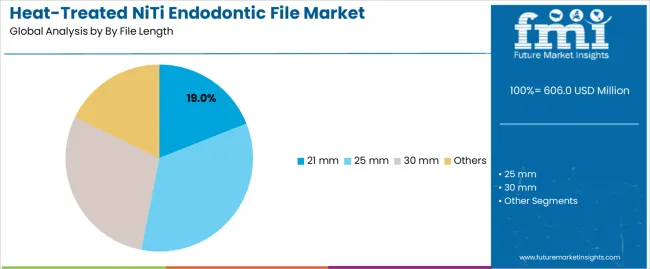
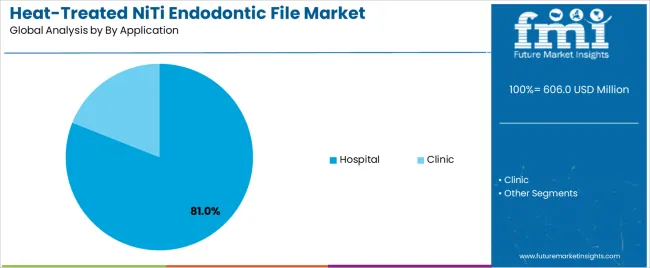
The global heat-treated NiTi endodontic file market is forecasted to grow from USD 606.0 million in 2025 to approximately USD 987.0 million by 2035, recording an absolute increase of USD 381.0 million over the forecast period. Demand translates into a total growth of 62.9%, with the market forecast to expand at a CAGR of 5.0% between 2025 and 2035. Sales of heat-treated NiTi endodontic files are being propelled by rising incidence of dental caries requiring root canal therapy, broader adoption of minimally invasive endodontic protocols, and expanding dental care infrastructure in emerging markets. The 25 mm file length segment dominates with 69.7% share in 2025, while hospital procurement accounts for 81.0% of application demand, where complex cases and high procedure volumes require premium instrument performance. Thermal processing and controlled memory metallurgy are being positioned as key product differentiators because flexibility, cyclic fatigue resistance, and cutting consistency are demanded for curved canal anatomies.
Regional opportunity is concentrated in Asia Pacific where China and India are posting high growth rates of 6.8% and 6.3% CAGR respectively, supported by dental clinic modernization and rising endodontic specialization. Germany, the United States, and Brazil provide stable demand driven by clinical quality standards and endodontic training programs. Technology trends include reciprocating motion optimization, single file systems for simplified protocols, and surface treatment innovations such as gold thermal processing to improve debris removal and cutting efficiency. Market constraints include cost sensitivity in general practice settings, single use paradigm pressures, and the learning curve associated with advanced rotary systems. Competitive advantage is being secured through clinical education programs, validated performance data, and integrated supply chain capabilities that ensure instrument availability and practitioner support.
Quick Stats for Heat-Treated NiTi Endodontic File Market
- Heat-Treated NiTi Endodontic File Market Value (2025): USD 606.0 million
- Heat-Treated NiTi Endodontic File Market Forecast Value (2035): USD 987.0 million
- Heat-Treated NiTi Endodontic File Market CAGR: 5.0%
- Leading Segment by File Length (2025): 25 mm (69.7%)
- Leading Segment by Application (2025): Hospital (81%)
- Key Growth Regions: Asia Pacific, Europe, and North America
- Top Companies by Market Share: Dentsply, Kerr Dental, VDW
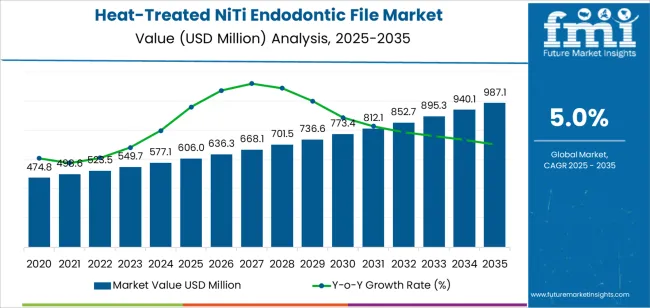
Dental clinic modernization programs and growing endodontic specialization across established and developing markets are creating steady demand for heat-treated NiTi files that provide superior clinical performance and improved patient outcomes. Asia Pacific markets demonstrate particularly strong growth potential, supported by expanding dental care accessibility and increasing adoption of rotary endodontic systems that necessitate advanced file technologies capable of navigating curved canals and reducing procedural complications in routine and complex endodontic cases.
Heat-Treated NiTi Endodontic File Market Key Takeaways
| Metric | Value |
|---|---|
| Market Value (2025) | USD 606.0 million |
| Market Forecast Value (2035) | USD 987.0 million |
| Forecast CAGR (2025-2035) | 5.0% |
Why is the Heat-Treated NiTi Endodontic File Market Growing?
| DENTAL CARE EXPANSION TRENDS | CLINICAL PERFORMANCE REQUIREMENTS | TECHNOLOGY & QUALITY STANDARDS |
|---|---|---|
|
|
|
Heat-Treated NiTi Endodontic File Market Segmentation
| Category | Segments Covered |
|---|---|
| By File Length | 21 mm, 25 mm, 30 mm, Others |
| By Application | Hospital, Clinic |
| By Region | North America, Europe, Asia Pacific, Latin America, Middle East & Africa |
Heat-Treated NiTi Endodontic File Market Analysis by File Length
| Segment | 2025 to 2035 Outlook |
|---|---|
| 21 mm |
|
| 25 mm |
|
| 30 mm |
|
| Others |
|
Heat-Treated NiTi Endodontic File Market Analysis by Application
| Segment | 2025 to 2035 Outlook |
|---|---|
| Hospital |
|
| Clinic |
|
DRIVERS
| DRIVERS | RESTRAINTS | KEY TRENDS |
|---|---|---|
|
|
|
Analysis of Heat-Treated NiTi Endodontic File Market by Key Countries
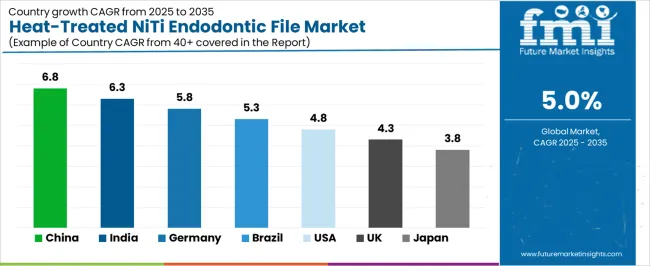
| Country | CAGR (2025-2035) |
|---|---|
| China | 6.8% |
| India | 6.3% |
| Germany | 5.8% |
| Brazil | 5.3% |
| United States | 4.8% |
| United Kingdom | 4.3% |
| Japan | 3.8% |
China Leads Global Market Growth with Dental Care Infrastructure Expansion
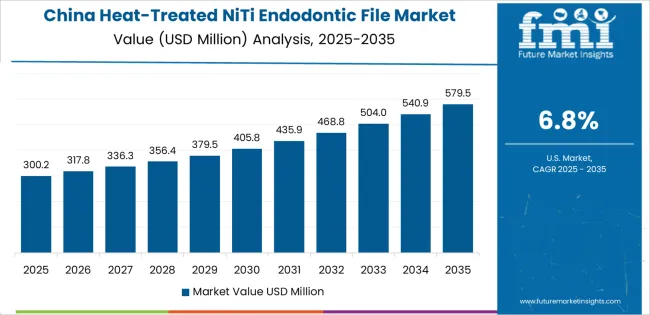
Revenue from Heat-Treated NiTi Endodontic Files in China is projected to exhibit strong growth, expanding at a CAGR of 6.8% to reach significant market value by 2035, driven by expanding dental care infrastructure and comprehensive oral health awareness programs creating substantial opportunities for endodontic instrument suppliers across hospital dental departments, private dental clinics, and specialized endodontic practices. The country's established dental education system and expanding middle-class healthcare spending are creating significant demand for both standard and advanced heat-treated file systems. Major dental hospitals and private practice groups are establishing comprehensive endodontic capabilities to support growing treatment demand and quality improvement initiatives.
- Dental hospital expansion and endodontic department development are supporting widespread adoption of heat-treated NiTi files across clinical operations, driving demand for quality instrumentation
- Private dental practice growth and specialization development are creating substantial opportunities for file suppliers offering comprehensive product portfolios and clinical support capabilities
- Dental education advancement and clinical training programs are facilitating adoption of rotary endodontic techniques throughout major urban dental markets
India Demonstrates Strong Market Potential with Healthcare Modernization
India is expanding at a CAGR of 6.3% to reach substantial levels by 2035, supported by extensive dental care expansion and comprehensive healthcare infrastructure development creating steady demand for endodontic instruments across diverse clinical categories and practice settings. The country's growing dental graduate population and expanding private practice infrastructure are driving demand for heat-treated file solutions that provide reliable clinical performance while supporting cost-effective endodontic practice. International dental companies and domestic distributors are investing in market development capabilities to support product availability and clinical education initiatives.
- Dental practice expansion and endodontic training program development are creating opportunities for heat-treated files across diverse applications requiring clinical reliability and competitive pricing
- Healthcare insurance expansion and dental awareness programs are driving investments in quality endodontic instrumentation supporting treatment outcome improvement throughout major metropolitan regions
- Dental specialization growth and clinical protocol advancement are enhancing demand for premium file systems throughout private practice and institutional settings
Germany Maintains Leadership with Clinical Excellence Standards
Germany is projected to grow at a CAGR of 5.8% to reach substantial levels by 2035, supported by the country's leadership in dental healthcare and advanced endodontic education requiring sophisticated instrumentation for university dental clinics, specialized endodontic practices, and comprehensive dental care centers. German dental professionals are implementing advanced heat-treated file systems that support stringent clinical protocols, evidence-based practice, and comprehensive quality standards. The market is characterized by focus on clinical outcomes, instrument quality, and compliance with stringent dental healthcare and safety standards.
- University dental hospital operations and endodontic specialty practices are prioritizing advanced file technologies that demonstrate superior clinical performance and reliability while meeting German quality and regulatory standards
- Dental continuing education programs and clinical protocol advancement initiatives are driving adoption of heat-treated instruments that support evidence-based endodontic techniques and outcome optimization
- Research and development programs for endodontic technology are facilitating adoption of specialized file designs and thermomechanical processing innovations throughout major dental education and clinical centers
Brazil Focuses on Dental Care Accessibility Enhancement
Demand for Heat-Treated NiTi Endodontic Files in Brazil is projected to expand at a CAGR of 5.3% to reach meaningful levels by 2035, driven by dental healthcare expansion and increasing endodontic treatment accessibility supporting instrument adoption in private practices and public dental facilities. The country's developing dental care infrastructure and growing private practice sector are creating demand for heat-treated file solutions that support clinical requirements and cost standards. Dental distributors and clinical education providers are maintaining capabilities to support diverse practitioner requirements and technique training initiatives.
- Private dental practice growth and endodontic specialization programs are supporting demand for heat-treated files that meet contemporary clinical performance and reliability standards
- Dental healthcare modernization and clinical technique advancement programs are creating opportunities for instrumentation that provides operational support and predictable clinical outcomes
- Professional education initiatives and clinical protocol development programs are facilitating adoption of rotary endodontic techniques throughout major dental markets
United States Expands Market with Endodontic Specialization
The United States is growing at a CAGR of 4.8% to reach substantial levels by 2035, driven by endodontic specialty practice expansion and dental technology adoption creating constant opportunities for instrument suppliers serving both specialist endodontists and general practitioners performing endodontic procedures. The country's extensive endodontic specialist base and established dental product market are creating demand for heat-treated file solutions that support advanced clinical techniques while maintaining efficiency standards. Dental manufacturers and distribution partners are developing comprehensive clinical education capabilities to support product adoption and technique optimization.
- Endodontic specialty practice operations and advanced treatment protocols are facilitating adoption of premium heat-treated files capable of supporting complex case requirements and specialized clinical techniques
- General dentistry continuing education and endodontic technique training programs are enhancing demand for user-friendly file systems that support predictable outcomes and reduced complication rates
- Dental service organization expansion and group practice standardization initiatives are creating opportunities for instrument suppliers with comprehensive product portfolios and clinical support capabilities across American dental markets
United Kingdom Advances Dental Healthcare Standards
Demand for Heat-Treated NiTi Endodontic Files in United Kingdom is projected to grow at a CAGR of 4.3% by 2035, supported by National Health Service dental programs and private dental practice development creating opportunities for endodontic instrument suppliers across public and private dental sectors. The country's established dental education system and developing endodontic specialty recognition are driving demand for heat-treated file solutions that support clinical quality while meeting procurement requirements. Dental distributors and clinical training organizations are implementing capabilities to support practitioner education and product adoption optimization.
- NHS dental services and private practice operations are supporting adoption of heat-treated files across facilities requiring quality instrumentation and reliable clinical performance
- Postgraduate dental education programs and endodontic training initiatives are driving investments in advanced file systems that support contemporary treatment techniques and outcome improvement
- Dental practice modernization and clinical protocol advancement programs are facilitating adoption of rotary endodontic systems throughout general practice and specialty settings
Japan Maintains Premium Clinical Standards
Japan is projected to expand at a CAGR of 3.8% by 2035, driven by precision dental healthcare and clinical excellence standards supporting advanced endodontic instrument adoption and comprehensive quality assurance applications. The country's sophisticated dental care requirements and established endodontic education capabilities are creating demand for high-quality heat-treated file systems that support stringent clinical standards and reliability protocols. Dental manufacturers and technical specialists are maintaining comprehensive development capabilities to support diverse clinical requirements and technique optimization initiatives.
- University dental hospital operations and endodontic specialty practices are supporting demand for instrumentation that meets exacting clinical performance and quality standards
- Clinical excellence initiatives and evidence-based practice programs are creating opportunities for specialized heat-treated files that provide superior flexibility and fracture resistance
- Dental technology advancement programs and instrument innovation initiatives are facilitating adoption of advanced thermomechanical processing and file design optimization capabilities throughout major dental education and clinical centers
What is the market split by country in Europe?
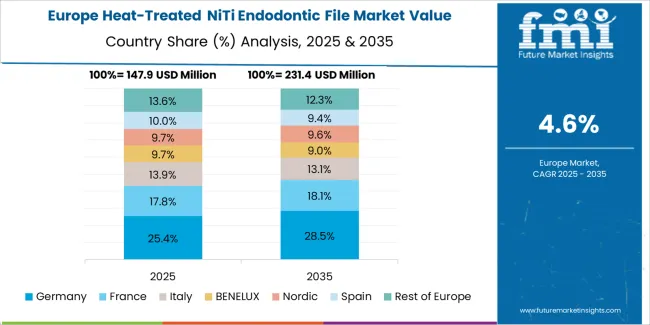
The heat-treated NiTi endodontic file market in Europe is projected to grow from USD 168.5 million in 2025 to USD 275.8 million by 2035, registering a CAGR of 5.1% over the forecast period. Germany is expected to maintain its leadership position with a 34.4% market share in 2025, declining slightly to 33.8% by 2035, supported by its advanced dental education infrastructure and comprehensive endodontic specialty development serving university dental clinics, specialist practices, and general dental care centers.
France follows with a 22.7% share in 2025, projected to reach 23.2% by 2035, driven by comprehensive dental healthcare system and endodontic education programs supporting advanced instrumentation adoption. The United Kingdom holds a 18.9% share in 2025, expected to maintain 18.6% by 2035 with dental education excellence and mixed public-private dental sector. Italy commands a 15.3% share, while Spain accounts for 7.1% in 2025. The Rest of Europe region is anticipated to gain momentum, expanding its collective share from 1.6% to 2.4% by 2035, attributed to increasing endodontic technique adoption in Nordic countries and emerging Eastern European dental markets implementing advanced rotary instrumentation technologies.
Clinical Excellence Defines Japanese Market Standards
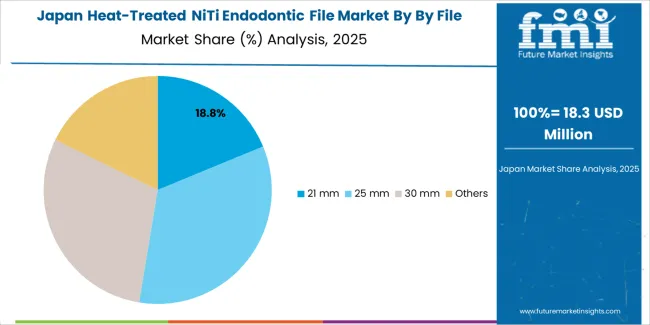
Japanese heat-treated NiTi endodontic file operations reflect the country's precision dental care standards and sophisticated endodontic education requirements. Major dental universities including Tokyo Medical and Dental University, Osaka University, and leading endodontic specialty practices maintain rigorous instrument evaluation processes focusing clinical performance validation, fracture resistance testing, and comprehensive quality documentation. This creates structured market conditions favoring established dental instrument manufacturers with proven clinical track records and comprehensive research documentation.
The Japanese market demonstrates advanced endodontic technique adoption, with significant investment in microscope-assisted endodontics and specialized rotary systems requiring heat-treated files optimized for complex canal anatomy and demanding clinical applications. Practitioners require detailed instrument specifications and clinical evidence that align with Japanese dental excellence standards, driving demand for sophisticated technical service capabilities and continuous clinical education collaboration.
Regulatory oversight emphasizes medical device quality standards and clinical safety requirements, with dental instrument regulations requiring comprehensive biocompatibility documentation and performance validation systems. The endodontic file procurement framework creates advantages for suppliers with established regulatory approvals, comprehensive clinical testing data, and proven quality management systems meeting Japanese medical device standards.
Supply chain relationships focus on long-term clinical partnerships rather than transactional procurement approaches. Japanese dental institutions and specialty practices typically maintain established supplier relationships with instrument manufacturers, focusing collaborative clinical research, joint technique development, and continuous product improvement rather than competitive pricing cycles. This stability supports application-specific file development and design optimization investments tailored to Japanese endodontic practice requirements and clinical outcome expectations.
Education Excellence Drives South Korean Market Development
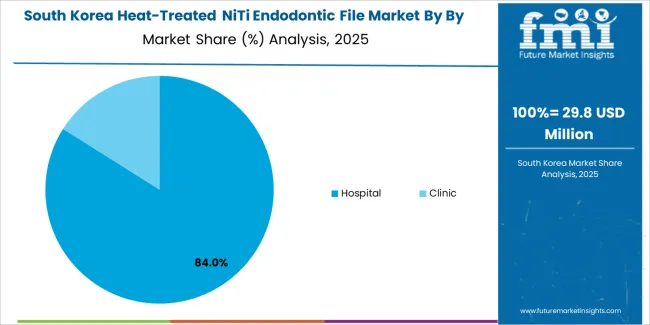
South Korean heat-treated NiTi endodontic file operations reflect the country's advanced dental education system and expanding specialty practice development. Major dental schools including Seoul National University School of Dentistry, Yonsei University, and growing endodontic specialty practices drive sophisticated instrument procurement strategies, establishing relationships with global dental manufacturers to secure clinically validated files for teaching programs, specialty training, and clinical practice supporting both domestic dental care advancement and regional clinical leadership.
The Korean market demonstrates particular strength in applying advanced endodontic techniques to complex clinical cases, with practitioners integrating heat-treated files into microscope-assisted procedures, retreatment protocols, and challenging anatomical situations. This clinical focus creates demand for premium file systems optimized for superior flexibility and equipment supporting comprehensive endodontic treatment capabilities in specialty practice environments.
Regulatory frameworks emphasize medical device safety standards and quality requirements, with dental instrument regulations requiring comprehensive performance validation and biocompatibility documentation. File selection processes require clinical evidence and performance data, creating structured evaluation frameworks that favor established manufacturers with clinical research expertise and proven endodontic application experience.
Clinical collaboration between Korean dental educators and instrument suppliers focuses on technique optimization and clinical outcome improvement, with development initiatives targeting procedural efficiency enhancement and complication rate reduction. Korean dental institutions invest in advanced clinical research capabilities and evidence-based practice implementation supporting instrument evaluation optimization and treatment protocol validation, positioning the market for continued advancement as endodontic education evolves and specialty practice sophistication increases.
What factors define the competitive landscape of the heat-treated NiTi endodontic file market?
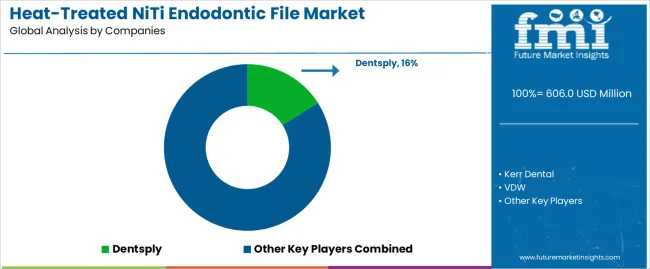
Profit pools consolidate around manufacturers demonstrating thermomechanical processing expertise and comprehensive clinical education infrastructure serving endodontic specialists and quality-focused general practitioners where instrument performance and professional support relationships command premium positioning. Value migrates from conventional NiTi products toward advanced heat-treated systems and controlled memory files where superior flexibility, enhanced fracture resistance, and comprehensive clinical validation create practitioner loyalty. Several operational models define competitive dynamics: global dental instrument manufacturers leveraging comprehensive product portfolios and worldwide clinical education networks; specialized endodontic companies focusing on advanced file technology and technique development; dental distributors providing product availability and clinical training support; and regional manufacturers pursuing volume through competitive pricing in emerging dental markets.
Switching costs remain moderate to substantial depending on practitioner familiarity with specific file systems, established clinical protocols, and rotary motor compatibility requirements. Brand loyalty develops through clinical experience, educational relationships, and technique mastery creating barriers to competitive displacement despite instrument consumable nature. Competitive advantages accrue to manufacturers maintaining vertical integration across NiTi alloy processing, file manufacturing, and clinical research enabling innovation leadership and quality control optimization.
Market structure demonstrates concentration among established dental instrument companies controlling significant share through brand recognition, clinical evidence generation, and professional education investment while regional suppliers compete in price-sensitive emerging markets. Distribution complexity creates multi-tier channel structures with dental distributors, specialty endodontic suppliers, and direct practitioner sales coexisting depending on market maturity and practitioner preferences. Technology differentiation focuses on thermomechanical processing innovation, surface treatment advancement, and file geometry optimization supporting enhanced clinical performance across diverse endodontic applications.
Key Players in the Heat-Treated NiTi Endodontic File Market
- Dentsply
- Kerr Dental
- VDW
- COLTENE
- Mani
- Brasseler
- EdgeEndo
- Micro-Mega
- Yirui
- SANI
- LM-Instruments
- Huizhou Videya Technology
Scope of the Report
| Items | Values |
|---|---|
| Quantitative Units | USD 606.0 million |
| File Length | 21 mm, 25 mm, 30 mm, Others |
| Application | Hospital, Clinic |
| Regions Covered | North America, Latin America, Europe, Asia Pacific, Middle East & Africa |
| Key Countries Covered | United States, Germany, China, India, Brazil, United Kingdom, Japan, and other countries |
| Key Companies Profiled | Dentsply, Kerr Dental, VDW, COLTENE, Mani, Brasseler, EdgeEndo, Micro-Mega, Yirui, SANI, LM-Instruments, Huizhou Videya Technology |
| Additional Attributes | Revenue analysis by file length and application segment, regional market dynamics, competitive landscape assessment, thermomechanical processing technology trends, controlled memory innovation patterns, and clinical technique advancement driving endodontic outcome improvement, procedural safety enhancement, and treatment efficiency optimization |
Heat-Treated NiTi Endodontic File Market Segmentation
By File Length
- 21 mm
- 25 mm
- 30 mm
- Others
By Application
- Hospital
- Clinic
By Region
- North America
- Europe
- Asia Pacific
- Latin America
- Middle East & Africa
Frequently Asked Questions
How big is the heat-treated NiTi endodontic file market in 2025?
The global heat-treated NiTi endodontic file market is estimated to be valued at USD 606.0 million in 2025.
What will be the size of heat-treated NiTi endodontic file market in 2035?
The market size for the heat-treated NiTi endodontic file market is projected to reach USD 987.1 million by 2035.
How much will be the heat-treated NiTi endodontic file market growth between 2025 and 2035?
The heat-treated NiTi endodontic file market is expected to grow at a 5.0% CAGR between 2025 and 2035.
What are the key product types in the heat-treated NiTi endodontic file market?
The key product types in heat-treated NiTi endodontic file market are 21 mm, 25 mm, 30 mm and others.
Which by application segment to contribute significant share in the heat-treated NiTi endodontic file market in 2025?
In terms of by application, hospital segment to command 81.0% share in the heat-treated NiTi endodontic file market in 2025.
Preview the report firsthand - request a free sample
Get SampleGet the brochure for pricing and purchase details.
Get PDFTable of Content
- Executive Summary
- Global Market Outlook
- Demand-side Trends
- Supply-side Trends
- Technology Roadmap Analysis
- Analysis and Recommendations
- Market Overview
- Market Coverage / Taxonomy
- Market Definition / Scope / Limitations
- Market Background
- Market Dynamics
- Drivers
- Restraints
- Opportunity
- Trends
- Scenario Forecast
- Demand in Optimistic Scenario
- Demand in Likely Scenario
- Demand in Conservative Scenario
- Opportunity Map Analysis
- Product Life Cycle Analysis
- Supply Chain Analysis
- Investment Feasibility Matrix
- Value Chain Analysis
- PESTLE and Porter’s Analysis
- Regulatory Landscape
- Regional Parent Market Outlook
- Production and Consumption Statistics
- Import and Export Statistics
- Market Dynamics
- Global Market Analysis 2020 to 2024 and Forecast, 2025 to 2035
- Historical Market Size Value (USD Million) Analysis, 2020 to 2024
- Current and Future Market Size Value (USD Million) Projections, 2025 to 2035
- Y-o-Y Growth Trend Analysis
- Absolute $ Opportunity Analysis
- Global Market Pricing Analysis 2020 to 2024 and Forecast 2025 to 2035
- Global Market Analysis 2020 to 2024 and Forecast 2025 to 2035, By By File Length
- Introduction / Key Findings
- Historical Market Size Value (USD Million) Analysis By By File Length , 2020 to 2024
- Current and Future Market Size Value (USD Million) Analysis and Forecast By By File Length , 2025 to 2035
- 21 mm
- 25 mm
- 30 mm
- Others
- Y-o-Y Growth Trend Analysis By By File Length , 2020 to 2024
- Absolute $ Opportunity Analysis By By File Length , 2025 to 2035
- Global Market Analysis 2020 to 2024 and Forecast 2025 to 2035, By By Application
- Introduction / Key Findings
- Historical Market Size Value (USD Million) Analysis By By Application, 2020 to 2024
- Current and Future Market Size Value (USD Million) Analysis and Forecast By By Application, 2025 to 2035
- Hospital
- Clinic
- Y-o-Y Growth Trend Analysis By By Application, 2020 to 2024
- Absolute $ Opportunity Analysis By By Application, 2025 to 2035
- Global Market Analysis 2020 to 2024 and Forecast 2025 to 2035, By Region
- Introduction
- Historical Market Size Value (USD Million) Analysis By Region, 2020 to 2024
- Current Market Size Value (USD Million) Analysis and Forecast By Region, 2025 to 2035
- North America
- Latin America
- Western Europe
- Eastern Europe
- East Asia
- South Asia and Pacific
- Middle East & Africa
- Market Attractiveness Analysis By Region
- North America Market Analysis 2020 to 2024 and Forecast 2025 to 2035, By Country
- Historical Market Size Value (USD Million) Trend Analysis By Market Taxonomy, 2020 to 2024
- Market Size Value (USD Million) Forecast By Market Taxonomy, 2025 to 2035
- By Country
- USA
- Canada
- Mexico
- By By File Length
- By By Application
- By Country
- Market Attractiveness Analysis
- By Country
- By By File Length
- By By Application
- Key Takeaways
- Latin America Market Analysis 2020 to 2024 and Forecast 2025 to 2035, By Country
- Historical Market Size Value (USD Million) Trend Analysis By Market Taxonomy, 2020 to 2024
- Market Size Value (USD Million) Forecast By Market Taxonomy, 2025 to 2035
- By Country
- Brazil
- Chile
- Rest of Latin America
- By By File Length
- By By Application
- By Country
- Market Attractiveness Analysis
- By Country
- By By File Length
- By By Application
- Key Takeaways
- Western Europe Market Analysis 2020 to 2024 and Forecast 2025 to 2035, By Country
- Historical Market Size Value (USD Million) Trend Analysis By Market Taxonomy, 2020 to 2024
- Market Size Value (USD Million) Forecast By Market Taxonomy, 2025 to 2035
- By Country
- Germany
- UK
- Italy
- Spain
- France
- Nordic
- BENELUX
- Rest of Western Europe
- By By File Length
- By By Application
- By Country
- Market Attractiveness Analysis
- By Country
- By By File Length
- By By Application
- Key Takeaways
- Eastern Europe Market Analysis 2020 to 2024 and Forecast 2025 to 2035, By Country
- Historical Market Size Value (USD Million) Trend Analysis By Market Taxonomy, 2020 to 2024
- Market Size Value (USD Million) Forecast By Market Taxonomy, 2025 to 2035
- By Country
- Russia
- Poland
- Hungary
- Balkan & Baltic
- Rest of Eastern Europe
- By By File Length
- By By Application
- By Country
- Market Attractiveness Analysis
- By Country
- By By File Length
- By By Application
- Key Takeaways
- East Asia Market Analysis 2020 to 2024 and Forecast 2025 to 2035, By Country
- Historical Market Size Value (USD Million) Trend Analysis By Market Taxonomy, 2020 to 2024
- Market Size Value (USD Million) Forecast By Market Taxonomy, 2025 to 2035
- By Country
- China
- Japan
- South Korea
- By By File Length
- By By Application
- By Country
- Market Attractiveness Analysis
- By Country
- By By File Length
- By By Application
- Key Takeaways
- South Asia and Pacific Market Analysis 2020 to 2024 and Forecast 2025 to 2035, By Country
- Historical Market Size Value (USD Million) Trend Analysis By Market Taxonomy, 2020 to 2024
- Market Size Value (USD Million) Forecast By Market Taxonomy, 2025 to 2035
- By Country
- India
- ASEAN
- Australia & New Zealand
- Rest of South Asia and Pacific
- By By File Length
- By By Application
- By Country
- Market Attractiveness Analysis
- By Country
- By By File Length
- By By Application
- Key Takeaways
- Middle East & Africa Market Analysis 2020 to 2024 and Forecast 2025 to 2035, By Country
- Historical Market Size Value (USD Million) Trend Analysis By Market Taxonomy, 2020 to 2024
- Market Size Value (USD Million) Forecast By Market Taxonomy, 2025 to 2035
- By Country
- Kingdom of Saudi Arabia
- Other GCC Countries
- Turkiye
- South Africa
- Other African Union
- Rest of Middle East & Africa
- By By File Length
- By By Application
- By Country
- Market Attractiveness Analysis
- By Country
- By By File Length
- By By Application
- Key Takeaways
- Key Countries Market Analysis
- USA
- Pricing Analysis
- Market Share Analysis, 2024
- By By File Length
- By By Application
- Canada
- Pricing Analysis
- Market Share Analysis, 2024
- By By File Length
- By By Application
- Mexico
- Pricing Analysis
- Market Share Analysis, 2024
- By By File Length
- By By Application
- Brazil
- Pricing Analysis
- Market Share Analysis, 2024
- By By File Length
- By By Application
- Chile
- Pricing Analysis
- Market Share Analysis, 2024
- By By File Length
- By By Application
- Germany
- Pricing Analysis
- Market Share Analysis, 2024
- By By File Length
- By By Application
- UK
- Pricing Analysis
- Market Share Analysis, 2024
- By By File Length
- By By Application
- Italy
- Pricing Analysis
- Market Share Analysis, 2024
- By By File Length
- By By Application
- Spain
- Pricing Analysis
- Market Share Analysis, 2024
- By By File Length
- By By Application
- France
- Pricing Analysis
- Market Share Analysis, 2024
- By By File Length
- By By Application
- India
- Pricing Analysis
- Market Share Analysis, 2024
- By By File Length
- By By Application
- ASEAN
- Pricing Analysis
- Market Share Analysis, 2024
- By By File Length
- By By Application
- Australia & New Zealand
- Pricing Analysis
- Market Share Analysis, 2024
- By By File Length
- By By Application
- China
- Pricing Analysis
- Market Share Analysis, 2024
- By By File Length
- By By Application
- Japan
- Pricing Analysis
- Market Share Analysis, 2024
- By By File Length
- By By Application
- South Korea
- Pricing Analysis
- Market Share Analysis, 2024
- By By File Length
- By By Application
- Russia
- Pricing Analysis
- Market Share Analysis, 2024
- By By File Length
- By By Application
- Poland
- Pricing Analysis
- Market Share Analysis, 2024
- By By File Length
- By By Application
- Hungary
- Pricing Analysis
- Market Share Analysis, 2024
- By By File Length
- By By Application
- Kingdom of Saudi Arabia
- Pricing Analysis
- Market Share Analysis, 2024
- By By File Length
- By By Application
- Turkiye
- Pricing Analysis
- Market Share Analysis, 2024
- By By File Length
- By By Application
- South Africa
- Pricing Analysis
- Market Share Analysis, 2024
- By By File Length
- By By Application
- USA
- Market Structure Analysis
- Competition Dashboard
- Competition Benchmarking
- Market Share Analysis of Top Players
- By Regional
- By By File Length
- By By Application
- Competition Analysis
- Competition Deep Dive
- Dentsply
- Overview
- Product Portfolio
- Profitability by Market Segments (Product/Age /Sales Channel/Region)
- Sales Footprint
- Strategy Overview
- Marketing Strategy
- Product Strategy
- Channel Strategy
- Kerr Dental
- VDW
- COLTENE
- Mani
- Brasseler
- EdgeEndo
- Micro-Mega
- Yirui
- SANI
- LM-Instruments
- Huizhou Videya Technology
- Dentsply
- Competition Deep Dive
- Assumptions & Acronyms Used
- Research Methodology


