

- Industry Size (2026)
- USD 197.0 Mn
- Forecast (2036)
- USD 409.8 Mn
- CAGR (2026 to 2036)
- 7.60%
Impact-Resistant Composite Radome Structures for High-Bandwidth Antennas Market Size, Market Forecast and Outlook By FMI
The impact-resistant composite radome structures sector was valued at USD 183.1 million in 2025 and is projected to reach USD 197.0 million in 2026. The market is expected to expand at a CAGR of 7.60% through 2036. This outlook is tied to airline investment in onboard connectivity, where radome materials must support signal transmission without creating avoidable aerodynamic penalty. That requirement is keeping high-transmissivity composite designs central to product selection.
Summary of Impact-Resistant Composite Radome Structures for High-Bandwidth Antennas Market
- The market is forecast to reach USD 409.8 million by 2036, reflecting sustained investment in high-bandwidth aircraft connectivity systems.
- The market is expected to grow at a CAGR of 7.6% from 2026 to 2036, driven by Ka/Ku-band antenna deployments and fleet-wide connectivity upgrades.
- The market was valued at USD 183.1 million in 2025 and is projected to reach USD 197.0 million in 2026 as upgrade cycles accelerate.
- The forecast period represents an incremental opportunity of USD 212.8 million, underlining the niche but expanding nature of this aerospace composite segment.
- Commercial aircraft account for 52.0% of platform demand in 2026, supported by large fleet sizes and the prioritization of inflight connectivity in passenger service offerings.
- Ka-band applications hold 44.0% of the frequency band segment, as higher-frequency satellite broadband requires radomes with superior RF transparency.
- Sandwich composite and honeycomb-core designs capture 48.0% of the material segment, reflecting the need to balance impact resistance, low weight, and aerodynamic performance.
- Mechanically steered antennas dominate with a 57.0% share in 2026, as certified gimballed systems remain prevalent across existing commercial and mission aircraft fleets.
- Line-fit installations represent 54.0% of total demand, supported by OEM preference for factory-integrated radomes that simplify certification and lifecycle management.
- China leads geographic growth at an 8.8% CAGR, followed by the United States (8.3%) and the UAE (8.1%), driven by fleet modernization and premium connectivity expectations.
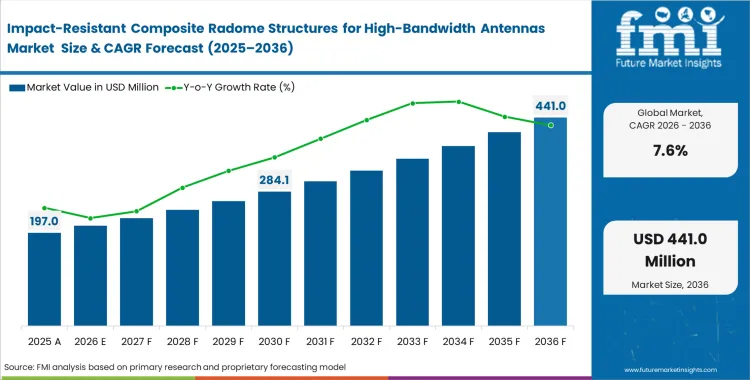
Key Takeaways, Market Size, and Forecast
- 2025 market size: USD 183.1 million
- 2026 market size: USD 197.0 million
- 2036 forecast: USD 409.8 million
- CAGR: 7.60%
- Top platform: Commercial aircraft (52.0%)
- Top frequency band: Ka-band (44.0%)
- Top material: Sandwich composites (48.0%)
- Top antenna type: Mechanically steered (57.0%)
- Top installation: Line-fit (54.0%)
- Top growth market: China (8.8% CAGR)
Key Takeaways
| Metric | Details |
|---|---|
| Industry Size (2026) | USD 197.0 million |
| Industry Value (2036) | USD 409.8 million |
| CAGR (2026 to 2036) | 7.60% |
Source: Future Market Insights (FMI) analysis, based on proprietary forecasting model and primary research
Airlines are under pressure to provide gigabit-class passenger internet without adding unnecessary fuel burn. Older glass-fiber enclosures can reduce radio frequency performance in modern Ka-band tracking units, which makes material choice more commercially important. Specifying an impact-resistant aircraft radome built with quartz or other specialized laminates helps reduce that bandwidth constraint. Delays in this shift can leave aircraft satcom radome systems performing below the standard now expected on competing fleets.
Clearing qualification changes buying behavior across the airline base. Once original equipment manufacturers approve a specific hybrid layup for bird-strike resistance, that housing often becomes the preferred standard across narrow-body fleet programs. Suppliers that miss those early certifications usually struggle to enter later purchasing cycles, because replacement, maintenance, and fleet commonality decisions tend to follow the approved baseline for years.
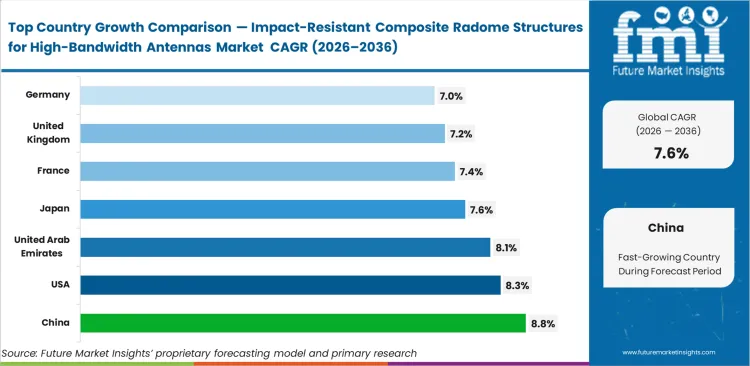
China is projected to expand at a CAGR of 8.8% from 2026 to 2036, supported by continued domestic fleet modernization. The United States follows at 8.3% over the same period, as airlines continue integrating broadband antenna housings across active upgrade programs. The United Arab Emirates is expected to record 8.1% CAGR during 2026 to 2036, reflecting strong demand for premium passenger connectivity. Japan is likely to advance at 7.6% through the forecast period, while France and the United Kingdom are set to register 7.4% and 7.2%, respectively. Germany is projected to post 7.0% CAGR between 2026 and 2036, indicating that satellite hardware upgrades are moving forward at different speeds across these aviation markets.
Segmental Analysis
Impact-Resistant Composite Radome Structures for High-Bandwidth Antennas Market Analysis by Platform
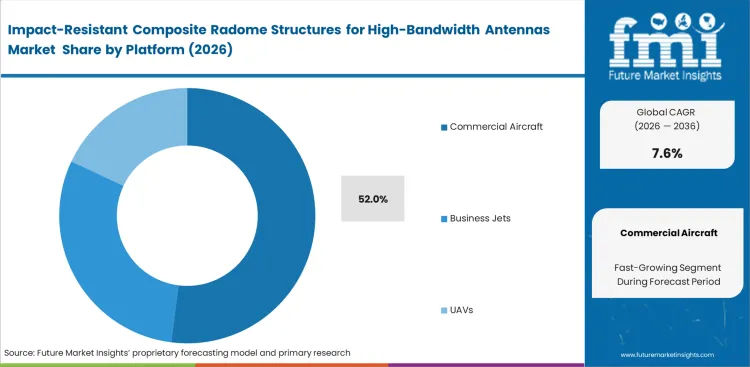
Airlines favor factory-level integration because post-delivery modification work can reduce aircraft availability and raise installation cost. Original equipment manufacturers fix composite specifications early in the assembly cycle, which makes approval timing commercially important for suppliers seeking line-fit positions. Any aerospace radome entering evaluation must meet hail-resistance requirements without adding excess weight to the airframe. Within this setting, commercial aircraft are projected to account for 52.0% share in 2026. Certified line-fit status gives suppliers a clear advantage because uncertified replacements can create airworthiness complications later in service. Suppliers left outside early program inclusion are more often pushed into retrofit channels, where pricing is tighter and long-term revenue visibility is weaker.
- Initial validation: Original equipment manufacturers set aerodynamic and kinetic impact requirements early in the aircraft design cycle. Airlines generally rely on those baseline certifications instead of pursuing separate compliance work for each housing option.
- Kinetic testing: Bird-strike testing is used to confirm whether the composite can retain integrity under high-velocity impact. Materials that show micro-fractures during these trials usually require resin or layup changes before qualification can continue.
- Fleet standardization: Airlines often prefer one approved cover design across narrow-body aircraft to simplify maintenance planning. Keeping fewer housing geometries in service reduces spare-parts burden and improves repair consistency.
Impact-Resistant Composite Radome Structures for High-Bandwidth Antennas Market Analysis by Frequency Band
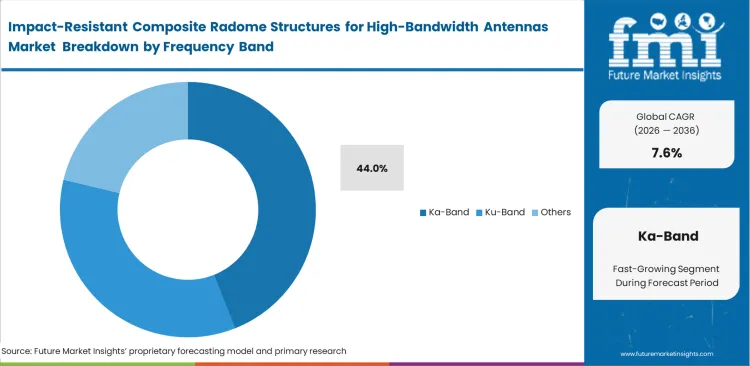
Passenger connectivity expectations are forcing a reassessment of enclosure materials used with high-frequency antenna systems. Legacy fiberglass laminates can create meaningful attenuation at higher frequencies, which reduces the value of costly onboard bandwidth. Ka-band configurations are expected to account for 44.0% share in 2026. Material selection around satellite phased array antenna installations also requires careful control of wall thickness, since signal performance can weaken quickly when composite build-up is not optimized. Airlines using poorly tuned enclosures are more likely to face service-quality complaints, especially on routes where broadband performance is part of the premium travel proposition.
- Bandwidth preservation: Legacy glass fiber can reduce signal quality at higher frequencies, which creates a bottleneck for inflight Wi-Fi performance. Quartz-based materials are preferred where stronger radio transparency is needed to maintain data throughput.
- Thermal loading: High-power transmitters generate heat beneath the protective shell, so composite layups must retain physical stability under repeated thermal cycling. Material reliability under these conditions remains an important part of long-term product evaluation.
- Surface degradation: Atmospheric dust can create micro-abrasions over time, and those surface changes may gradually affect radio frequency transparency. Operators monitor this wear closely because early replacement is often less disruptive than allowing connectivity performance to deteriorate in service.
Impact-Resistant Composite Radome Structures for High-Bandwidth Antennas Market Analysis by Material
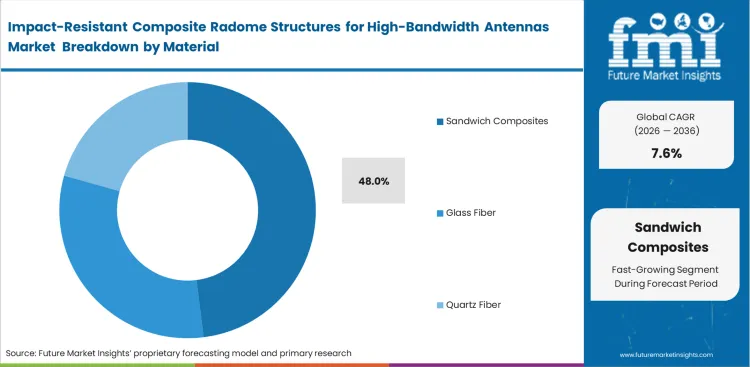
Engineers designing next-generation aerospace enclosures have to balance impact resistance with signal performance. Sandwich composites are expected to account for 48.0% share in 2026 because they can absorb kinetic loads through core deformation instead of concentrating damage on the outer face. Newer antenna configurations also favor these layups where mounting stability is important for alignment control. Repair remains a practical trade-off, since damaged honeycomb cores are harder to restore in service than solid laminates. Solid covers can simplify maintenance work, but the added weight raises fuel cost over repeated flight cycles.
- Weight economics: Material selection is assessed against lifetime operating cost, not purchase price alone. Honeycomb layups reduce weight more effectively, and that improvement supports better fuel efficiency across commercial flight schedules.
- Hidden moisture: Poorly sealed sandwich cores can trap condensation during repeated altitude cycles. Regular inspection is important because unnoticed moisture ingress can freeze and lead to internal delamination over time.
- Lifecycle calculation: Advanced hybrid laminates can remain in service longer, which improves replacement intervals and changes the ownership-cost equation. Higher initial cost is easier to justify when the part offers a longer usable life and fewer replacement events.
Impact-Resistant Composite Radome Structures for High-Bandwidth Antennas Market Analysis by Antenna Type
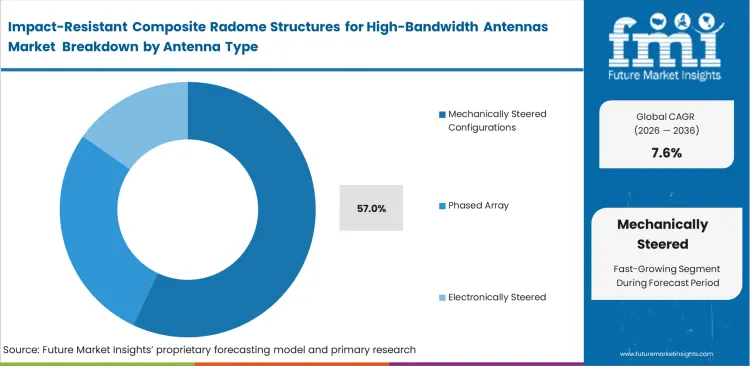
Airlines upgrading older fleets often stay with mature antenna systems because maintenance schedules, spare parts planning, and certification requirements are already well understood. Rotating dish setups also need larger covers to provide the swept-volume clearance those assemblies require. Mechanically steered configurations are expected to account for 57.0% share in 2026. Flat panel adoption involves more than changing the antenna itself, since drag performance, mounting design, and fuselage re-certification all affect the economics of transition. Lower-profile enclosures can reduce aerodynamic penalty, but many operators retain mechanically steered formats because a new mount architecture demands added engineering time and capital.
- Volume clearance: Rotating dish systems require larger internal cavity space inside the enclosure. Housing design must allow enough clearance to prevent component contact during steep pitch movement and normal antenna operation.
- Drag penalties: Bulbous covers disturb airflow over the fuselage, which increases aerodynamic drag. Fuel-burn impact from these older shapes is closely reviewed when replacement decisions are being assessed.
- Transition friction: Phased array systems support much lower-profile enclosures, but the shift involves more than changing the cover itself. Operators must weigh aerodynamic savings against the cost of replacing installed cabin network hardware and completing the related integration work.
Impact-Resistant Composite Radome Structures for High-Bandwidth Antennas Market Analysis by Installation
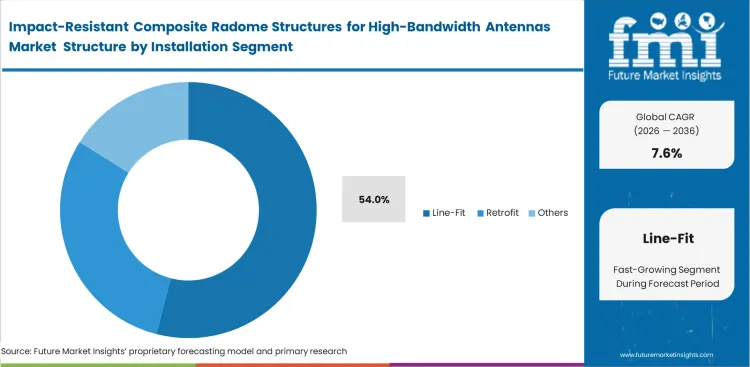
Aircraft manufacturers keep close control over fuselage modifications because any change affects safety, load distribution, and certification scope. Factory integration is favored because it allows cleaner aerodynamic fit and better load management from the start of assembly. Line-fit installations are expected to account for 54.0% share in 2026. Suppliers also need to stay aligned with aircraft build schedules, which makes delivery timing as important as product performance. Retrofit work is harder to scale because aircraft already in service usually require separate approvals and longer validation cycles before modification can proceed. Suppliers concentrated only in retrofit programs often face slower order conversion and less predictable long-term revenue flow.
- Assembly alignment: Production schedules need to stay in step with aircraft assembly timing. Any mismatch in enclosure delivery can disrupt installation sequencing and create avoidable delays later in the build process.
- Compliance bundling: Approval as part of the wider aircraft program removes the need for a separate standalone qualification path. This reduces documentation work and speeds up the path to installation.
- Aftermarket barriers: Retrofit installation usually requires aircraft-specific modification approval after delivery. The process takes time, adds technical documentation burden, and makes post-delivery programs harder to execute at scale.
Impact-Resistant Composite Radome Structures for High-Bandwidth Antennas Market Drivers, Restraints, and Opportunities
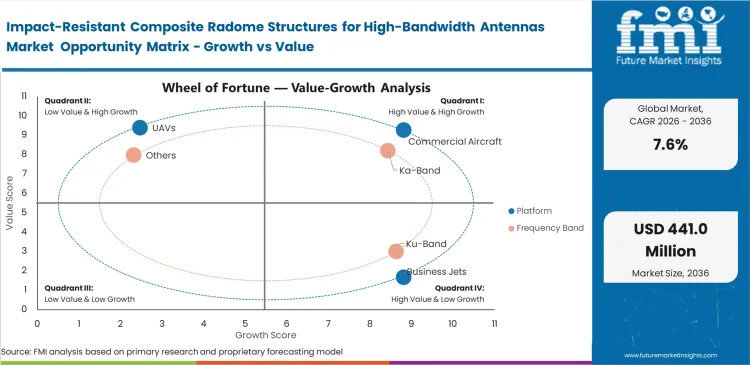
Airlines are replacing older communication hardware because uninterrupted onboard internet access now forms part of the service standard on premium routes. Ka-band terminal deployment also increases the importance of enclosure material, since quartz-based composites are better able to limit signal attenuation than older glass fiber covers. Aircraft operating with legacy housings face a higher risk of bandwidth constraints, which can weaken the onboard experience on routes and broadband quality influences customer choice. Delays in qualifying higher-transparency enclosures can also hold back upgrade programs and reduce competitiveness where connectivity performance carries commercial weight.
Supplemental Type Certificate approval for new airframe modifications remains a key restraint in these programs. New composite designs must clear extensive bird-strike validation before installation on a commercial fuselage, and that keeps approval timelines long even when capital allocation is already in place. Physical testing still carries more weight than theoretical modeling in this process, which limits how quickly suppliers can move from design work to certification. Long approval cycles often slow program execution and delay fleet-wide connectivity upgrades.
Opportunities in the Impact-Resistant Composite Radome Structures for High-Bandwidth Antennas Market
- Modular attachment interfaces: Universal mounting brackets make enclosure replacement faster and reduce the amount of sealing work required after removal. This can shorten turnaround time when a damaged unit needs to be exchanged.
- Low-profile hybrid layups: Aramid and quartz fibers are being combined to produce thinner covers with better balance between strength and signal transparency. Lower-profile designs also help reduce aerodynamic drag, which improves operating efficiency over time.
- Passive thermal management: Some suppliers are integrating cooling pathways into the composite shell itself to manage heat more effectively. This helps avionics hardware maintain stable performance without relying as heavily on heavier active cooling systems.
Regional Analysis
Based on regional analysis, Impact-Resistant Composite Radome Structures for High-Bandwidth Antennas is segmented into North America, Europe, Asia Pacific, and Middle East and Africa across 40 plus countries.
.webp "Top Country Growth Comparison Impact Resistant Composite Radome Structures For High Bandwidth Antennas Market Cagr (2026 2036)")
| Country | CAGR (2026 to 2036) |
|---|---|
| China | 8.8% |
| United States | 8.3% |
| United Arab Emirates | 8.1% |
| Japan | 7.6% |
| France | 7.4% |
| United Kingdom | 7.2% |
| Germany | 7.0% |
Source: Future Market Insights (FMI) analysis, based on proprietary forecasting model and primary research
Asia Pacific Impact-Resistant Composite Radome Structures for High-Bandwidth Antennas Market Analysis
Asia Pacific airlines are expanding fleets to serve rising domestic passenger volumes, and that is lifting requirements for broadband-ready radome systems on new aircraft. Many carriers are moving directly toward advanced Ka-band connectivity programs instead of extending older Ku-band configurations across future deliveries. Material selection is becoming more deliberate as airlines and OEM-linked buyers look for enclosures that support signal performance, impact protection, and lower maintenance exposure. Regional composite suppliers are also widening production capacity, which is improving local sourcing options for aircraft programs that previously depended more heavily on Western supply.
- China: The market for impact-resistant composite radome structures in China is projected to expand at a CAGR of 8.8% through 2036. Local manufacturing capacity strengthens the country’s position by cutting lead times and reducing exposure to international logistics delays. Narrow-body fleet additions are keeping line-fit communication terminal demand firm, especially on aircraft allocated to dense domestic networks. Airlines are placing more value on broadband capability at induction stage, since connectivity has become part of service positioning rather than a later upgrade decision.
- Japan: Japan is expected to record a CAGR of 7.6% in this market over the forecast period. That keeps material quality and installation reliability central to sourcing decisions. Business-heavy travel flows continue to support demand for stable, high-speed inflight connectivity, particularly on routes where service consistency carries commercial weight. Regional composite suppliers also pay closer attention to radome performance when antenna configurations require cleaner signal transmission and tighter fitment tolerance.
FMI’s analysis covers detailed demand assessment across major Asia Pacific aviation markets, with particular attention to China, Japan, South Korea, India, and Southeast Asia, where fleet additions and connectivity upgrades continue to influence radome purchasing.
North America Impact-Resistant Composite Radome Structures for High-Bandwidth Antennas Market Analysis
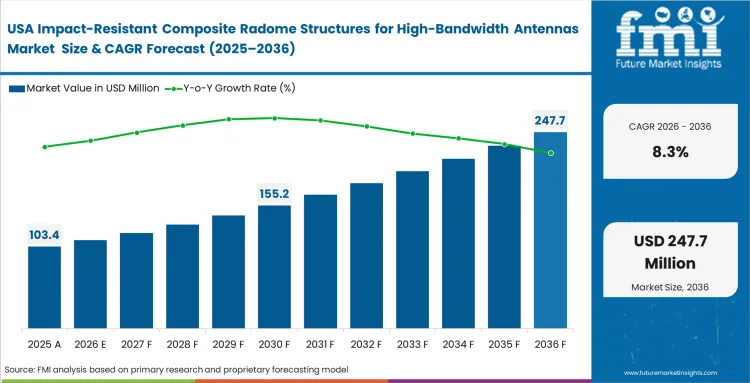
North American adoption is being shaped by fleet modernization programs across major carriers and by continued investment in inflight connectivity quality. Airlines are under pressure to improve gate-to-gate broadband performance, which makes radome design, signal efficiency, and installation timing more commercially relevant. Supply teams also prefer line-fit integration on large aircraft orders because it avoids the cost and downtime associated with later retrofit work. Suppliers that meet domestic certification requirements are in a stronger position to participate in these programs.
- United States: High aircraft utilization and dense domestic traffic keep connectivity hardware investment active across the airline sector. Fleet planning teams are paying closer attention to protective covers that reduce signal loss and support consistent broadband performance across high-frequency routes. The United States is forecast to register an 8.3% CAGR in the market during the study period. Suppliers with aviation authority approvals and airline qualification status are likely to remain ahead in fleet-wide sourcing decisions.
FMI’s report includes detailed analysis of North America, especially the United States and Canada, where fleet modernization programs, certification requirements, and airline broadband upgrade cycles remain central to market expansion.
Europe Impact-Resistant Composite Radome Structures for High-Bandwidth Antennas Market Analysis
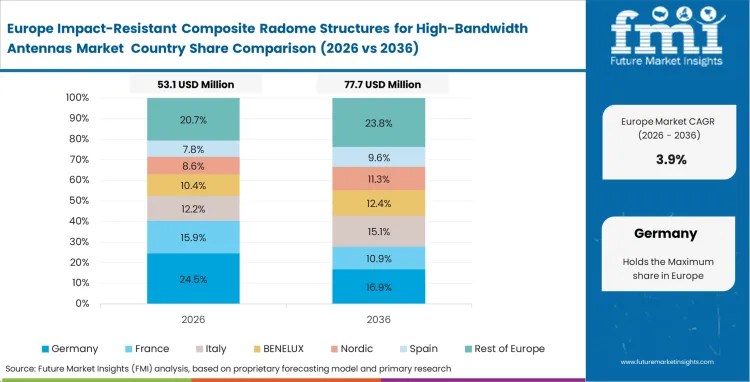
European aircraft programs continue to place weight reduction and aerodynamic efficiency high on the selection criteria for external components, including radome systems. Connectivity requirements matter, but airlines also evaluate how the enclosure affects drag, installation fit, and long-term operating cost. OEM-linked production schedules leave little room for sourcing delays, which gives an advantage to suppliers that can meet both technical and delivery requirements. Material development in the region is therefore tied closely to certification discipline and production coordination, not only to broadband performance.
- France: Supplier access to major aircraft assembly activity supports faster coordination with OEM production teams and improves the commercial case for line-fit radome programs. Delivery timing matters as much as material performance when aircraft build schedules are tight. France is expected to post a CAGR of 7.4% in the market through 2036. That keeps the country commercially important for suppliers aligned with aircraft manufacturing programs.
- United Kingdom: The country’s satellite communications base supports demand across both commercial and mission-oriented aircraft applications, particularly where operators require compatibility across multiple operating bands. Maintenance teams also value enclosure options that work across varied terminal formats because that reduces replacement complications later. The United Kingdom market is likely to grow at a CAGR of 7.2% during the assessment period. Specialized communications capability should keep the country relevant in higher-specification radome demand.
- Germany: The market for impact-resistant composite radome structures in Germany is anticipated to rise at a CAGR of 7.0% through 2036. Precision in design and manufacturing will remain central to supplier selection. Material engineering standards and weight targets continue to shape Commercial decisions in Germany, especially for exposed components that must balance physical protection with aerodynamic control. Aircraft programs are showing stronger interest in advanced core designs and hybrid laminate approaches for that reason.
FMI’s report provides extensive coverage of Europe’s aircraft radome outlook, including France, the United Kingdom, Germany, Italy, and Spain, where OEM alignment, material engineering standards, and line-fit schedules shape market activity.
Middle East and Africa Impact-Resistant Composite Radome Structures for High-Bandwidth Antennas Market Analysis
Long-haul airline competition in the Middle East is keeping inflight broadband quality high on the buying agenda, since connectivity remains part of the premium service promise. Operating conditions also make durability more important in this region because aircraft move through wide temperature shifts and demanding ground environments. More attention is therefore being placed on thermal resistance, maintenance behavior, and service continuity when radome materials and designs are evaluated. Retrofit activity across the wider region is developing more gradually as older aircraft change operators and connectivity upgrades are introduced in stages.
- United Arab Emirates: Premium carriers in the UAE operate aircraft in conditions that place repeated stress on external materials, particularly when high ground temperatures are followed by cold cruise-altitude exposure. Supplier teams look for radome systems that can handle thermal fatigue without creating recurring maintenance burden. The UAE is projected to witness a CAGR of 8.1% in this market through 2036. Suppliers that can demonstrate durability under these operating conditions are in a stronger position to secure long-term airline contracts.
FMI’s study examines demand across the Middle East and Africa, with focus on the United Arab Emirates, Saudi Arabia, Qatar, and South Africa, where long-haul airline operations, harsh environmental exposure, and retrofit requirements affect adoption patterns.
Competitive Aligners for Market Players
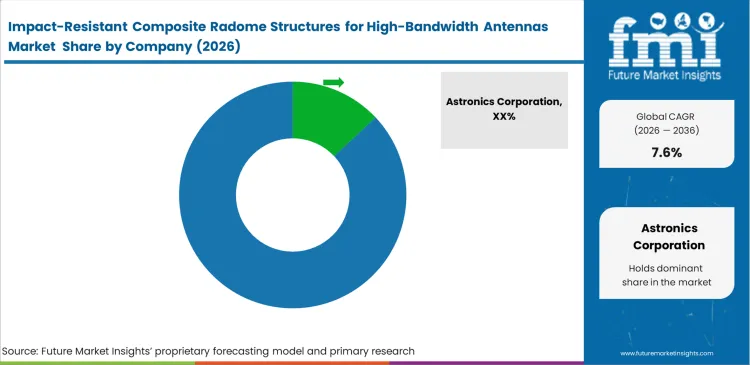
Competition is shaped more by certification timing and OEM access than by material development alone. Astronics Corporation and Airbus benefit from early integration into factory assembly programs, which gives them stronger control over design acceptance and commercial terms. Suppliers without those OEM relationships are pushed toward smaller retrofit opportunities, where volumes are less predictable and pricing pressure is higher. Success in this market depends heavily on clearing regulatory approvals efficiently and aligning with aircraft production schedules, often more than on offering the lowest unit cost.
Established suppliers benefit from proprietary transmissivity testing chambers and long records of kinetic impact data built over years of qualification work. Communications & Power Industries maintains a strong position partly because it has accumulated extensive radio frequency modeling archives tied to certified applications. Testing any new satellite component requires substantial capital spending on validation equipment, and that raises the entry barrier for newer suppliers. Challengers also need comparable empirical data sets to satisfy risk-conscious aviation authorities that their composite layups can meet established safety expectations. Without that historical testing base, regulatory approval usually takes longer and commercial entry becomes far more difficult.
Airlines shifting toward phased array systems are changing the fuselage space and profile requirements for broadband installations. That change is forcing legacy. Satellite communication components to move away from mature rotating-dish enclosure formats that were designed for earlier antenna architectures. Suppliers now need to rework production lines around lower-profile covers that better match flat-panel configurations. Those that move slowly risk losing relevance as commercial fleets reduce reliance on older, higher-drag external designs.
Key Players in Impact-Resistant Composite Radome Structures for High-Bandwidth Antennas Market
- Astronics Corporation
- Communications & Power Industries
- Honeywell Aerospace Technologies
- ThinKom Solutions
- Gogo
- Safran Passenger Innovations
- Airbus
Scope of the Report
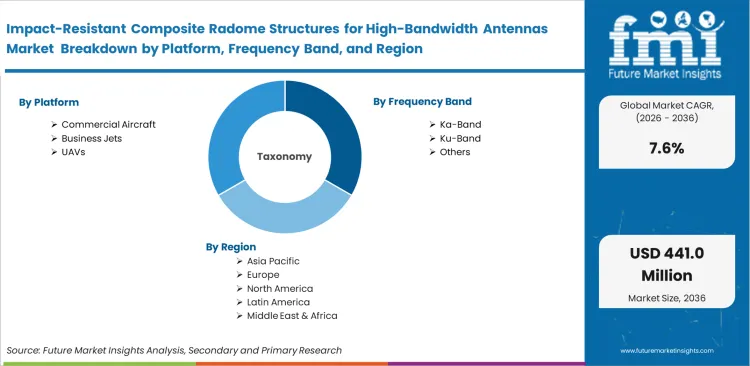
| Metric | Value |
|---|---|
| Quantitative Units | USD 197.0 million to USD 409.8 million, at a CAGR of 7.60% |
| Market Definition | Impact-resistant composite radomes function as protective aviation enclosures engineered to shield high-bandwidth antennas from kinetic damage while allowing unimpeded radio frequency transmission. These aviation components utilize specialized layups like quartz or aramid to survive hail and bird strikes. Category parameters strictly require materials delivering both physical protection and minimal signal insertion loss. They eliminate bandwidth bottlenecks across Ka-band and Ku-band tracking systems, enabling modern commercial and military fleets to maintain gigabit internet speeds without suffering fuel burn penalties. |
| Segmentation | By Platform, By Frequency Band, By Material, By Antenna Type, By Installation, and Region |
| Regions Covered | North America, Latin America, Europe, East Asia, South Asia & Pacific, Middle East & Africa |
| Countries Covered | United States, China, United Arab Emirates, Japan, France, United Kingdom, Germany |
| Key Companies Profiled | Astronics Corporation, Communications & Power Industries, Honeywell Aerospace Technologies, ThinKom Solutions, Gogo, Safran Passenger Innovations, Airbus |
| Forecast Period | 2026 to 2036 |
| Approach | Quantitative modeling based on commercial aircraft delivery schedules and retrofit backlogs. Independent cross-referencing against major aerospace tier-1 supplier earnings reports and composite material production volumes ensures accurate valuation trajectories. Analysts validate these models against historical aviation authority certification timelines. |
Source: Future Market Insights (FMI) analysis, based on proprietary forecasting model and primary research
Impact-Resistant Composite Radome Structures for High-Bandwidth Antennas Market Analysis by Segments
By Platform
- Commercial aircraft
- Business jets
- Special mission
- Military aircraft
- UAVs
By Frequency Band
- Ka-band
- Ku-band
- Multi-band
- X-band
By Material
- Sandwich composites
- Glass fiber
- Quartz fiber
- Aramid fiber
- Hybrid laminates
By Antenna Type
- Mechanically steered
- Phased array
- Electronically steered
By Installation
- Line-fit
- Retrofit
- Tail-mount
- Fuselage-mount
By Region
- North America
- Latin America
- Europe
- East Asia
- South Asia & Pacific
- Middle East & Africa
Bibliography
- European Union Aviation Safety Agency. (2025, April 7). Certification Memorandum CM-S-013: Installation of antennas on large aircraft.
- Federal Aviation Administration. (2024, June 14). Transport airplane metallic and composite structures working group recommendation report.
- Federal Aviation Administration. (2024, December 31). Significant wildlife strikes to civil aircraft in the United States, 1990-2024.
- International Air Transport Association. (2025, January 30). Global air passenger demand reaches record high in 2024.
- International Civil Aviation Organization. (2025, July 16). Frequency spectrum requirements for aviation satellite communications.
This bibliography is provided for reader reference. The full FMI report contains the complete reference list with primary source documentation.
This Report Addresses
- Regulatory certification delays impacting line-fit integration timelines.
- Aerodynamic drag penalties associated with legacy mechanically steered dome shapes.
- Material transition economics shifting fleets from glass fiber to advanced quartz laminates.
- Signal attenuation challenges specific to Ka-band frequency deployments.
- Core moisture ingress vulnerabilities inside honeycomb sandwich composites.
- Airline fleet standardization strategies driving modular bracket adoption.
- Retrofit friction caused by Supplemental Type Certificate acquisition barriers.
- Original equipment manufacturer leverage dictating factory-level hardware specifications.
Frequently Asked Questions
What is the current valuation of this category?
Valuation reached USD 183.1 million in 2025, reflecting massive capital allocated toward upgrading legacy commercial satellite terminals.
Why do commercial aircraft dominate platform share?
Commercial aircraft is anticipated to capture 52.0% share in 2026. Massive global fleets demand gigabit internet, forcing continuous communication hardware upgrades.
How does Ka-band shape material requirements?
Ka-band is expected to hold 44.0% share in 2026. High frequencies suffer severe signal loss through fiberglass, forcing adoption of expensive quartz layups.
What advantage do sandwich composites offer?
In 2026, Sandwich layups are poised to hold 48.0% share. Honeycomb cores absorb kinetic energy through internal deformation, preventing catastrophic outer skin shattering.
Why do mechanically steered antennas maintain high share?
Mechanically steered units is expected to command 57.0% share in 2026. Fleet managers delay expensive hardware overhauls, accepting drag penalties over complete replacements.
What creates friction for retrofit installations?
Post-delivery modifications require complex Supplemental Type Certificates to prove fuselage cuts will not compromise airframe safety standards.
How does China drive demand expansion?
China is set to expand at an 8.8% CAGR through 2036. Aviation authorities mandate rapid fleet modernization, pulling line-fit hardware into regional assembly.
What specific operational risk do honeycomb cores carry?
Improperly sealed edges allow moisture ingress. Trapped water freezes at high altitudes, causing undetectable internal delamination.
Why do airlines demand modular attachment brackets?
Fleet directors resist vendor lock-in. Universal mounting plates allow maintenance crews to swap failing hardware without airframe modifications.
How does thermal dissipation affect material choice?
Satellite transmitters generate intense localized heat. Avionics technicians require composite shells that maintain rigidity under extreme thermal stress.
Why is quartz fiber replacing traditional fiberglass?
Quartz possesses vastly superior radio frequency transparency. Network engineers require this clarity to prevent data bottlenecks during flight.
How do original equipment manufacturers control purchasing?
Aircraft builders bundle component approvals into broader airframe certifications, creating immense regulatory hurdles for aftermarket parts suppliers.
What role do bird strikes play in engineering?
Kinetic impact resilience defines minimum thickness. Aviation directives require enclosures to survive specific velocity impacts without shedding debris.
How does aerodynamic drag influence purchasing?
Bulbous legacy domes disrupt laminar airflow. Airline financial officers compare long-term fuel waste against upfront phased-array upgrade costs.
Why do United States operators aggressively retrofit?
United States adoption grows at an 8.3% CAGR. Intense domestic competition makes inflight connectivity a primary brand differentiator.
What delays new material adoption?
Regulators require empirical kinetic testing. Material scientists cannot rely solely on software modeling, adding years to development cycles.
How do military requirements differ from commercial?
Defense teams require multi-band compatibility for reconnaissance missions. Stealth properties occasionally supersede pure transmission efficiency.
What causes micro-abrasion degradation?
Atmospheric dust scours outer surfaces over thousands of flight hours, causing gradual radio frequency transparency loss.
Why do airlines over-provision satellite bandwidth?
Passenger perception dictates brand loyalty. Network architects buy excess capacity to prevent buffering during peak usage windows.
How does the United Arab Emirates environment affect components?
Desert operations expose aircraft to extreme ground heat. Hardware must survive severe thermal shock during high-altitude cruising.
What forces consolidation among component suppliers?
Testing and certification costs require massive capital reserves. Smaller material innovators struggle to fund requisite aviation approval processes.
Why do business jets require unique form factors?
Smaller fuselages offer less mounting surface area. Engineers must shrink terminal footprints while maintaining sufficient satellite tracking capability.
Preview the report firsthand - request a free sample
Get SampleGet the brochure for pricing and purchase details.
Get PDFTable of Content
- Executive Summary
- Global Market Outlook
- Demand-side Trends
- Supply-side Trends
- Technology Roadmap Analysis
- Analysis and Recommendations
- Market Overview
- Market Coverage / Taxonomy
- Market Definition / Scope / Limitations
- Research Methodology
- Chapter Orientation
- Analytical Lens and Working Hypotheses
- Market Structure, Signals, and Trend Drivers
- Benchmarking and Cross-market Comparability
- Market Sizing, Forecasting, and Opportunity Mapping
- Research Design and Evidence Framework
- Desk Research Programme (Secondary Evidence)
- Company Annual and Sustainability Reports
- Peer-reviewed Journals and Academic Literature
- Corporate Websites, Product Literature, and Technical Notes
- Earnings Decks and Investor Briefings
- Statutory Filings and Regulatory Disclosures
- Technical White Papers and Standards Notes
- Trade Journals, Industry Magazines, and Analyst Briefs
- Conference Proceedings, Webinars, and Seminar Materials
- Government Statistics Portals and Public Data Releases
- Press Releases and Reputable Media Coverage
- Specialist Newsletters and Curated Briefings
- Sector Databases and Reference Repositories
- FMI Internal Proprietary Databases and Historical Market Datasets
- Subscription Datasets and Paid Sources
- Social Channels, Communities, and Digital Listening Inputs
- Additional Desk Sources
- Expert Input and Fieldwork (Primary Evidence)
- Primary Modes
- Qualitative Interviews and Expert Elicitation
- Quantitative Surveys and Structured Data Capture
- Blended Approach
- Why Primary Evidence is Used
- Field Techniques
- Interviews
- Surveys
- Focus Groups
- Observational and In-context Research
- Social and Community Interactions
- Stakeholder Universe Engaged
- C-suite Leaders
- Board Members
- Presidents and Vice Presidents
- R&D and Innovation Heads
- Technical Specialists
- Domain Subject-matter Experts
- Scientists
- Physicians and Other Healthcare Professionals
- Governance, Ethics, and Data Stewardship
- Research Ethics
- Data Integrity and Handling
- Primary Modes
- Tooling, Models, and Reference Databases
- Desk Research Programme (Secondary Evidence)
- Data Engineering and Model Build
- Data Acquisition and Ingestion
- Cleaning, Normalisation, and Verification
- Synthesis, Triangulation, and Analysis
- Quality Assurance and Audit Trail
- Market Background
- Market Dynamics
- Drivers
- Restraints
- Opportunity
- Trends
- Scenario Forecast
- Demand in Optimistic Scenario
- Demand in Likely Scenario
- Demand in Conservative Scenario
- Opportunity Map Analysis
- Product Life Cycle Analysis
- Supply Chain Analysis
- Investment Feasibility Matrix
- Value Chain Analysis
- PESTLE and Porter’s Analysis
- Regulatory Landscape
- Regional Parent Market Outlook
- Production and Consumption Statistics
- Import and Export Statistics
- Market Dynamics
- Global Market Analysis 2021 to 2025 and Forecast, 2026 to 2036
- Historical Market Size Value (USD Million) Analysis, 2021 to 2025
- Current and Future Market Size Value (USD Million) Projections, 2026 to 2036
- Y-o-Y Growth Trend Analysis
- Absolute $ Opportunity Analysis
- Global Market Pricing Analysis 2021 to 2025 and Forecast 2026 to 2036
- Global Market Analysis 2021 to 2025 and Forecast 2026 to 2036, By Platform
- Introduction / Key Findings
- Historical Market Size Value (USD Million) Analysis By Platform , 2021 to 2025
- Current and Future Market Size Value (USD Million) Analysis and Forecast By Platform , 2026 to 2036
- Commercial Aircraft
- Business Jets
- UAVs
- Commercial Aircraft
- Y-o-Y Growth Trend Analysis By Platform , 2021 to 2025
- Absolute $ Opportunity Analysis By Platform , 2026 to 2036
- Global Market Analysis 2021 to 2025 and Forecast 2026 to 2036, By Frequency Band
- Introduction / Key Findings
- Historical Market Size Value (USD Million) Analysis By Frequency Band, 2021 to 2025
- Current and Future Market Size Value (USD Million) Analysis and Forecast By Frequency Band, 2026 to 2036
- Ka-Band
- Ku-Band
- Others
- Ka-Band
- Y-o-Y Growth Trend Analysis By Frequency Band, 2021 to 2025
- Absolute $ Opportunity Analysis By Frequency Band, 2026 to 2036
- Global Market Analysis 2021 to 2025 and Forecast 2026 to 2036, By Material
- Introduction / Key Findings
- Historical Market Size Value (USD Million) Analysis By Material, 2021 to 2025
- Current and Future Market Size Value (USD Million) Analysis and Forecast By Material, 2026 to 2036
- Sandwich Composites
- Glass Fiber
- Quartz Fiber
- Sandwich Composites
- Y-o-Y Growth Trend Analysis By Material, 2021 to 2025
- Absolute $ Opportunity Analysis By Material, 2026 to 2036
- Global Market Analysis 2021 to 2025 and Forecast 2026 to 2036, By Antenna Type
- Introduction / Key Findings
- Historical Market Size Value (USD Million) Analysis By Antenna Type, 2021 to 2025
- Current and Future Market Size Value (USD Million) Analysis and Forecast By Antenna Type, 2026 to 2036
- Mechanically Steered Configurations
- Phased Array
- Electronically Steered
- Mechanically Steered Configurations
- Y-o-Y Growth Trend Analysis By Antenna Type, 2021 to 2025
- Absolute $ Opportunity Analysis By Antenna Type, 2026 to 2036
- Global Market Analysis 2021 to 2025 and Forecast 2026 to 2036, By Installation
- Introduction / Key Findings
- Historical Market Size Value (USD Million) Analysis By Installation, 2021 to 2025
- Current and Future Market Size Value (USD Million) Analysis and Forecast By Installation, 2026 to 2036
- Line-Fit
- Retrofit
- Others
- Line-Fit
- Y-o-Y Growth Trend Analysis By Installation, 2021 to 2025
- Absolute $ Opportunity Analysis By Installation, 2026 to 2036
- Global Market Analysis 2021 to 2025 and Forecast 2026 to 2036, By Region
- Introduction
- Historical Market Size Value (USD Million) Analysis By Region, 2021 to 2025
- Current Market Size Value (USD Million) Analysis and Forecast By Region, 2026 to 2036
- North America
- Latin America
- Western Europe
- Eastern Europe
- East Asia
- South Asia and Pacific
- Middle East & Africa
- Market Attractiveness Analysis By Region
- North America Market Analysis 2021 to 2025 and Forecast 2026 to 2036, By Country
- Historical Market Size Value (USD Million) Trend Analysis By Market Taxonomy, 2021 to 2025
- Market Size Value (USD Million) Forecast By Market Taxonomy, 2026 to 2036
- By Country
- USA
- Canada
- Mexico
- By Platform
- By Frequency Band
- By Material
- By Antenna Type
- By Installation
- By Country
- Market Attractiveness Analysis
- By Country
- By Platform
- By Frequency Band
- By Material
- By Antenna Type
- By Installation
- Key Takeaways
- Latin America Market Analysis 2021 to 2025 and Forecast 2026 to 2036, By Country
- Historical Market Size Value (USD Million) Trend Analysis By Market Taxonomy, 2021 to 2025
- Market Size Value (USD Million) Forecast By Market Taxonomy, 2026 to 2036
- By Country
- Brazil
- Chile
- Rest of Latin America
- By Platform
- By Frequency Band
- By Material
- By Antenna Type
- By Installation
- By Country
- Market Attractiveness Analysis
- By Country
- By Platform
- By Frequency Band
- By Material
- By Antenna Type
- By Installation
- Key Takeaways
- Western Europe Market Analysis 2021 to 2025 and Forecast 2026 to 2036, By Country
- Historical Market Size Value (USD Million) Trend Analysis By Market Taxonomy, 2021 to 2025
- Market Size Value (USD Million) Forecast By Market Taxonomy, 2026 to 2036
- By Country
- Germany
- UK
- Italy
- Spain
- France
- Nordic
- BENELUX
- Rest of Western Europe
- By Platform
- By Frequency Band
- By Material
- By Antenna Type
- By Installation
- By Country
- Market Attractiveness Analysis
- By Country
- By Platform
- By Frequency Band
- By Material
- By Antenna Type
- By Installation
- Key Takeaways
- Eastern Europe Market Analysis 2021 to 2025 and Forecast 2026 to 2036, By Country
- Historical Market Size Value (USD Million) Trend Analysis By Market Taxonomy, 2021 to 2025
- Market Size Value (USD Million) Forecast By Market Taxonomy, 2026 to 2036
- By Country
- Russia
- Poland
- Hungary
- Balkan & Baltic
- Rest of Eastern Europe
- By Platform
- By Frequency Band
- By Material
- By Antenna Type
- By Installation
- By Country
- Market Attractiveness Analysis
- By Country
- By Platform
- By Frequency Band
- By Material
- By Antenna Type
- By Installation
- Key Takeaways
- East Asia Market Analysis 2021 to 2025 and Forecast 2026 to 2036, By Country
- Historical Market Size Value (USD Million) Trend Analysis By Market Taxonomy, 2021 to 2025
- Market Size Value (USD Million) Forecast By Market Taxonomy, 2026 to 2036
- By Country
- China
- Japan
- South Korea
- By Platform
- By Frequency Band
- By Material
- By Antenna Type
- By Installation
- By Country
- Market Attractiveness Analysis
- By Country
- By Platform
- By Frequency Band
- By Material
- By Antenna Type
- By Installation
- Key Takeaways
- South Asia and Pacific Market Analysis 2021 to 2025 and Forecast 2026 to 2036, By Country
- Historical Market Size Value (USD Million) Trend Analysis By Market Taxonomy, 2021 to 2025
- Market Size Value (USD Million) Forecast By Market Taxonomy, 2026 to 2036
- By Country
- India
- ASEAN
- Australia & New Zealand
- Rest of South Asia and Pacific
- By Platform
- By Frequency Band
- By Material
- By Antenna Type
- By Installation
- By Country
- Market Attractiveness Analysis
- By Country
- By Platform
- By Frequency Band
- By Material
- By Antenna Type
- By Installation
- Key Takeaways
- Middle East & Africa Market Analysis 2021 to 2025 and Forecast 2026 to 2036, By Country
- Historical Market Size Value (USD Million) Trend Analysis By Market Taxonomy, 2021 to 2025
- Market Size Value (USD Million) Forecast By Market Taxonomy, 2026 to 2036
- By Country
- Kingdom of Saudi Arabia
- Other GCC Countries
- Turkiye
- South Africa
- Other African Union
- Rest of Middle East & Africa
- By Platform
- By Frequency Band
- By Material
- By Antenna Type
- By Installation
- By Country
- Market Attractiveness Analysis
- By Country
- By Platform
- By Frequency Band
- By Material
- By Antenna Type
- By Installation
- Key Takeaways
- Key Countries Market Analysis
- USA
- Pricing Analysis
- Market Share Analysis, 2025
- By Platform
- By Frequency Band
- By Material
- By Antenna Type
- By Installation
- Canada
- Pricing Analysis
- Market Share Analysis, 2025
- By Platform
- By Frequency Band
- By Material
- By Antenna Type
- By Installation
- Mexico
- Pricing Analysis
- Market Share Analysis, 2025
- By Platform
- By Frequency Band
- By Material
- By Antenna Type
- By Installation
- Brazil
- Pricing Analysis
- Market Share Analysis, 2025
- By Platform
- By Frequency Band
- By Material
- By Antenna Type
- By Installation
- Chile
- Pricing Analysis
- Market Share Analysis, 2025
- By Platform
- By Frequency Band
- By Material
- By Antenna Type
- By Installation
- Germany
- Pricing Analysis
- Market Share Analysis, 2025
- By Platform
- By Frequency Band
- By Material
- By Antenna Type
- By Installation
- UK
- Pricing Analysis
- Market Share Analysis, 2025
- By Platform
- By Frequency Band
- By Material
- By Antenna Type
- By Installation
- Italy
- Pricing Analysis
- Market Share Analysis, 2025
- By Platform
- By Frequency Band
- By Material
- By Antenna Type
- By Installation
- Spain
- Pricing Analysis
- Market Share Analysis, 2025
- By Platform
- By Frequency Band
- By Material
- By Antenna Type
- By Installation
- France
- Pricing Analysis
- Market Share Analysis, 2025
- By Platform
- By Frequency Band
- By Material
- By Antenna Type
- By Installation
- India
- Pricing Analysis
- Market Share Analysis, 2025
- By Platform
- By Frequency Band
- By Material
- By Antenna Type
- By Installation
- ASEAN
- Pricing Analysis
- Market Share Analysis, 2025
- By Platform
- By Frequency Band
- By Material
- By Antenna Type
- By Installation
- Australia & New Zealand
- Pricing Analysis
- Market Share Analysis, 2025
- By Platform
- By Frequency Band
- By Material
- By Antenna Type
- By Installation
- China
- Pricing Analysis
- Market Share Analysis, 2025
- By Platform
- By Frequency Band
- By Material
- By Antenna Type
- By Installation
- Japan
- Pricing Analysis
- Market Share Analysis, 2025
- By Platform
- By Frequency Band
- By Material
- By Antenna Type
- By Installation
- South Korea
- Pricing Analysis
- Market Share Analysis, 2025
- By Platform
- By Frequency Band
- By Material
- By Antenna Type
- By Installation
- Russia
- Pricing Analysis
- Market Share Analysis, 2025
- By Platform
- By Frequency Band
- By Material
- By Antenna Type
- By Installation
- Poland
- Pricing Analysis
- Market Share Analysis, 2025
- By Platform
- By Frequency Band
- By Material
- By Antenna Type
- By Installation
- Hungary
- Pricing Analysis
- Market Share Analysis, 2025
- By Platform
- By Frequency Band
- By Material
- By Antenna Type
- By Installation
- Kingdom of Saudi Arabia
- Pricing Analysis
- Market Share Analysis, 2025
- By Platform
- By Frequency Band
- By Material
- By Antenna Type
- By Installation
- Turkiye
- Pricing Analysis
- Market Share Analysis, 2025
- By Platform
- By Frequency Band
- By Material
- By Antenna Type
- By Installation
- South Africa
- Pricing Analysis
- Market Share Analysis, 2025
- By Platform
- By Frequency Band
- By Material
- By Antenna Type
- By Installation
- USA
- Market Structure Analysis
- Competition Dashboard
- Competition Benchmarking
- Market Share Analysis of Top Players
- By Regional
- By Platform
- By Frequency Band
- By Material
- By Antenna Type
- By Installation
- Competition Analysis
- Competition Deep Dive
- Astronics Corporation
- Overview
- Product Portfolio
- Profitability by Market Segments (Product/Age /Sales Channel/Region)
- Sales Footprint
- Strategy Overview
- Marketing Strategy
- Product Strategy
- Channel Strategy
- Communications & Power Industries
- Honeywell Aerospace Technologies
- ThinKom Solutions
- Gogo
- Safran Passenger Innovations
- Astronics Corporation
- Competition Deep Dive
- Assumptions & Acronyms Used


