

- Market Size (2026)
- USD 0.9 Bn
- Forecast (2036)
- USD 1.7 Bn
- CAGR (2026 to 2036)
- 6.1%
Composite Crossmember and Driveline Support Systems Market Size, Forecast, and Outlook By FMI
Summary of the Composite Crossmember and Driveline Support Systems Market
- Demand and Growth Drivers
- EV platform design is propelling the demand for lighter support structures as battery weight raises pressure on underbody systems.
- Corrosion exposure gives composite crossmembers a practical role in road-facing parts that face water and stone impact.
- E-axle packaging is changing support load paths, which makes molded composite brackets more useful in selected vehicle programs.
- Product and Segment View
- Transmission crossmembers are expected to stay the leading product type as they support driveline loads and frame connection points.
- Glass fiber composites are likely to hold wider use because they offer a workable balance between stiffness and part cost.
- Compression molding is preferred for serial support parts that need repeatable shape and controlled cycle time.
- Geography and Competitive Outlook
- China is expected to stay the fastest-growing country market as NEV platform activity expands local use of lightweight support parts.
- India and Mexico offer steady growth scope as vehicle production clusters increase demand for validated chassis components.
- Suppliers with molding skill and joining accuracy are better placed to win OEM programs than material-only vendors.
- Analyst Opinion
- Nikhil Kaitwade, Principal Consultant at FMI says, “Our team of analysts are observing that composite crossmembers and driveline support systems moving into selective platform work. Automakers are targeting support locations that add weight and face corrosion exposure. Cost pressure will keep glass fiber and hybrid structures ahead of full carbon fiber parts. Suppliers with molded structural design skill and metal-composite joining capability will hold an advantage.”
- Composite Crossmember and Driveline Support Systems Market Value Analysis
- Composite support systems create value by reducing underbody weight without changing the full vehicle platform.
- EV platforms promote steady use for composite support parts as e-axles need lighter and stiffer mounting points.
- OEM direct supply stays important as these parts need platform approval before serial vehicle production.
- Supplier pricing depends on molding skill and joining accuracy since structural parts need repeatable fatigue performance.
Key Takeaways, Market Size, and Forecast
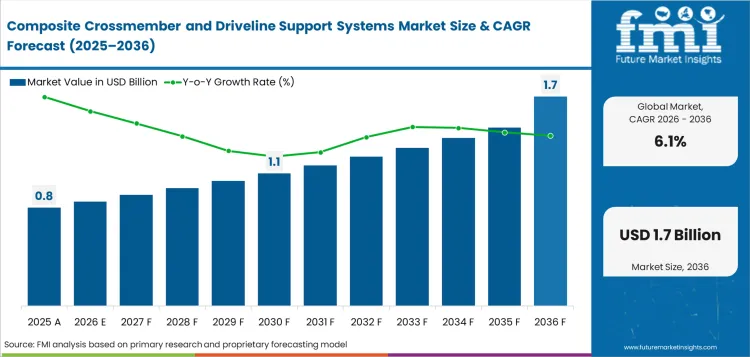
- Composite crossmember and driveline support systems market was valued at USD 0.8 billion in 2025 based on chassis content allocation.
- By 2036, industry is forecast to reach USD 1.7 billion as automakers replace selected metal support parts.
- From 2026 to 2036, the market is expected to expand at 6.1% CAGR.
- Incremental opportunity is projected at USD 0.8 billion over the 2026 to 2036 forecast window.
- Transmission crossmembers are projected to represent 38.0% of product demand in 2026 as support load requirements shape part selection.
- Cost and stiffness balance keeps glass fiber composites in the lead with 46.0% of material demand in 2026.
- China (7.4% CAGR) and India (7.1% CAGR) are predicted to record steady CAGR through 2036 as NEV platform activity and local vehicle production expand.
Underbody support parts face new pressure as driveline layouts become lighter, more compact and more packaging-sensitive. Magna’s composite structural assembly data launched in Q1 2026 shows a clear benchmark because carbon fiber with modified vinyl ester resin can cut mass by 34% versus stamped steel. Crossmember suppliers can use that performance logic where steel support brackets carry weight penalties. Driveline service parts also need clearer functional definition. Neapco’s 2025 catalog describes center support as a rolling bearing element surrounded by rubber and mounted in a bracket configuration. That definition matters because composite support systems must still manage bearing loads, vibration isolation and mounting accuracy. Magna’s 75 kg eDrive with 20% lower height adds another design signal. Compact electrified drivelines are likely to favor lighter support structures with tighter geometry.
Composite Crossmember and Driveline Support Systems Market Definition
Composite crossmember and driveline support systems include molded or hybrid structural parts used to hold transmission units and e-axles. These systems stabilize differential assemblies and center bearing points across the vehicle underbody.
Composite Crossmember and Driveline Support Systems Market Inclusions
Market scope includes transmission crossmembers, driveline brackets, differential carriers, bearing supports, integrated modules, glass fiber composites, carbon fiber composites, hybrid composites, thermoplastic composites, natural fiber composites, OEM direct supply, Tier supplier programs, aftermarket replacement, motorsport channels, and all covered regions. Market participants include automakers and Tier 1 chassis suppliers. Composite material producers, structural molders, driveline module suppliers, testing labs, and aftermarket service networks are included.
Composite Crossmember and Driveline Support Systems Market Exclusions
Market scope excludes metallic-only crossmembers, steel subframes, aluminum castings without composite reinforcement, complete axle assemblies, propeller shafts, gearboxes, suspension arms, battery enclosures and decorative composite parts.
Composite Crossmember and Driveline Support Systems Market Research Methodology
- Primary Research: FMI analysts reviewed structural component programs with chassis suppliers and composite molders. Discussions covered validation cycles and OEM sourcing patterns for support parts.
- Desk Research: Desk work covered vehicle production data and lightweight material guidance. Supplier portfolios and official company developments were reviewed for structural component activity.
- Market Sizing and Forecasting: The model combined vehicle production, support part content per platform, average selling price and material mix by country. Forecasts used separate adoption curves for passenger vehicles and light commercial vehicles.
- Data Validation: Forecasts were checked against vehicle production growth and chassis supplier activity. Composite adoption was cross-checked across carbon fiber composites and adjacent structural parts.
Why is the Composite Crossmember and Driveline Support Systems Market Growing?
- Automakers need lighter support structures as battery mass adds pressure on underbody design.
- Composite parts reduce corrosion exposure in support locations facing water and stone impact.
- EV platforms create new driveline mounting points around e-axles and compact drive units.
- OEMs need molded parts that combine stiffness and acoustic control in one support module.
Global vehicle production gives composite crossmembers and driveline support systems a clear volume base. Lightweighting decides which underbody support parts move from metal to composite formats. OICA reported that global vehicle production increased from 92.7 million units in 2024 to 96.4 million units in 2025. That higher platform volume gives chassis engineers more programs to test molded support parts. Composite crossmembers gain when one molded structure can replace separate metal pieces and reduce assembly work.
Weight reduction stays central as OEMs redesign support points around battery packs and compact driveline layouts. Driveline support parts are useful targets because they carry load and face road exposure. Composite formats help when the part must resist stone impact and moisture without adding coating steps. Support systems that meet stiffness and fatigue needs can move beyond prototype use. Supplier advantage comes from repeatable molding and validated joining accuracy.
Market Segmentation Analysis
- Transmission crossmembers are projected to take 38.0% of product type in 2026 as driveline mounting points need stable load support.
- A practical cost profile places glass fiber composites at 46.0% in 2026.
- Passenger vehicles are anticipated to form the leading vehicle type base, with 52.0% share supported by platform volume and tooling recovery.
- Within manufacturing process, compression molding is forecast at 41.0% because shaped support parts need repeatable geometry.
- OEM direct supply is expected to lead sales channel at 68.0% as platform-stage validation controls sourcing.
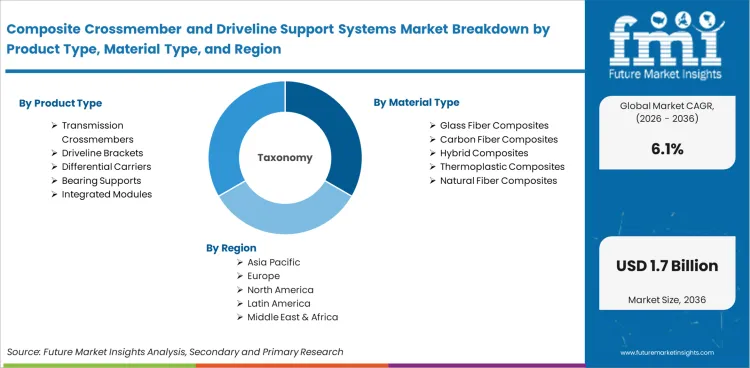
The composite crossmember and driveline support systems market is segmented by product type, material type, vehicle type, manufacturing process, sales channel, and region. Product type includes transmission crossmembers, driveline brackets, differential carriers, bearing supports, and integrated modules. material type includes glass fiber composites, carbon fiber composites, hybrid composites, thermoplastic composites, and natural fiber composites. vehicle type includes passenger vehicles, light commercial vehicles, heavy trucks, performance vehicles, and electric platforms. manufacturing process includes compression molding, resin transfer molding, pultrusion, injection molding, and prepreg layup. sales channel includes oem direct supply, tier supplier programs, aftermarket replacement, and motorsport channels.
Insights into the Transmission Crossmembers Product Type Segment
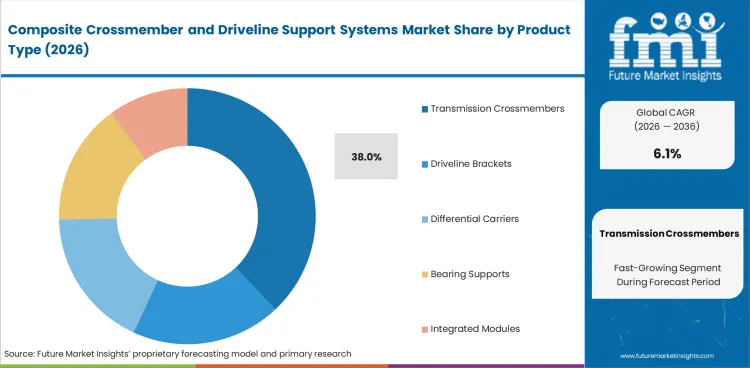
- Transmission crossmembers are forecast to hold around 38.0% share in 2026. The segment leads because transmission and e-drive support points need stable load transfer across the underbody.
- Composite designs help reduce part weight when one molded structure can replace separate metal pieces.
Insights into the Glass Fiber Composites Material Type Segment
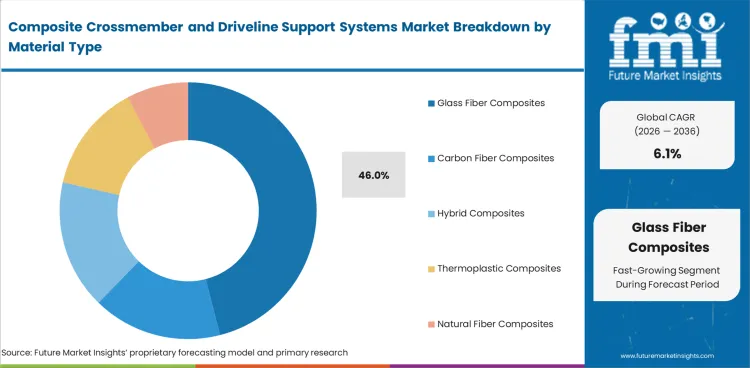
- Glass fiber composites is expected to hold a 46.0% share by 2026, because the material offers workable stiffness at a lower cost than carbon fiber.
- Composites gain interestThermoplastic composites draw interest as recyclability and faster cycle time influence supplier choice. Hybrid Composites suit support parts that need metal inserts at load points.
Insights into the Passenger Vehicles Vehicle Type Segment
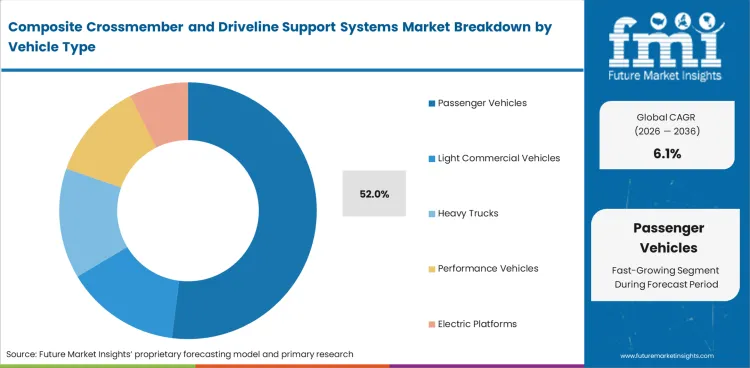
- Passenger Vehicles form the leading vehicle type base at 52.0% in 2026. High platform volume helps OEMs recover tooling cost across larger production runs. Composite crossmembers gain earlier acceptance when part geometry can be reused across shared vehicle architectures.
- Light Commercial Vehicles offer a different value route. Electric Platforms create future demand as battery mass increases underbody weight pressure.
Insights into the Compression Molding Manufacturing Process Segment
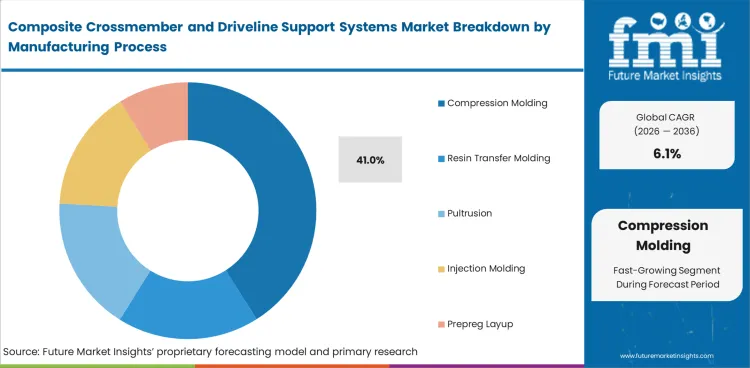
- By manufacturing process, compression molding is assessed at 41.0% by 2026, owing to the fact that shaped support parts need repeatable cycle time and stable dimensional control.
- Resin transfer molding remains useful for higher-spec components that need tighter fiber placement. Injection molding supports selected thermoplastic parts with shorter cycles. Prepreg Layup stays limited to performance vehicles and motorsport use.
Insights into the OEM Direct Supply Sales Channel Segment
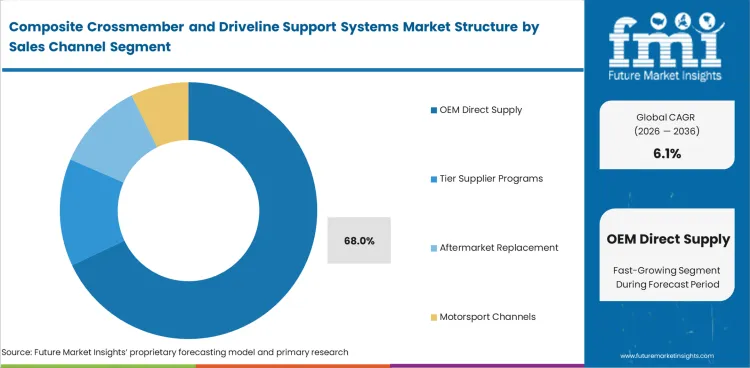
- OEM direct supply is predicted to hold around 68.0% share in 2026. Structural support systems need platform approval before serial production. Automakers remain directly involved in sourcing.
- Tier Supplier Programs support module-level integration across chassis and driveline assemblies.
Composite Crossmember and Driveline Support Systems Market Drivers, Restraints, and Opportunities
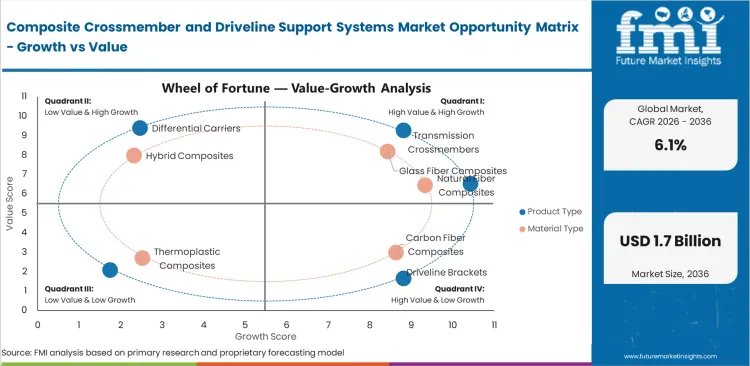
- EV mass pressure increases the need for structural composites in support locations that remove weight without platform redesign.
- Road-facing corrosion exposure gives composite crossmembers an advantage over coated metal parts in selected underbody positions.
- High tooling cost restrains adoption when annual platform volume cannot support molded part economics.
- Hybrid metal-composite assemblies create opportunity for suppliers that can bond and validate parts within one workflow.
EV Underbody Mass Offset
EV platforms create a direct mass challenge for chassis engineers. Battery packs add weight low in the vehicle and push engineers to remove mass from nearby support structures. IEA reported in May 2025 that EV battery demand grew to over 950.0 GWh in 2024 and was 25.0% higher than 2023. Higher battery demand points to more EV platforms with heavier underbody systems. Crossmembers become practical weight-saving targets when engineers can reduce mass without changing crash load paths. Suppliers need repeatable molding and stable attachment points before OEMs approve serial use.
Composite Joining Validation
Composite support systems face a harder validation path than non-load-bearing parts. Engineers must prove joint strength and fatigue life before replacing a stamped metal support. In December 2025, Röchling Automotive said it would produce a thermoplastic composite Intrusion Protection Plate for an entire European OEM platform starting in 2027. The part uses continuous glass fiber reinforcement and protects EV batteries from stone impact. Road-facing composite structures need impact resistance and reliable attachment behavior. Suppliers with validated joining capability can move more programs beyond prototype work.
Tooling Cost Discipline
Cost is the main restraint for wider composite use in support structures. Composite molds and validation work need enough platform volume before savings are clear at program level. BENTELER Group opened a Beijing module plant in October 2025 with more than 23,000.0 square meters of area and 350,000.0 units of annual capacity. Structural chassis parts need serial volume to justify tooling and validation expense. OEMs will prefer suppliers that match weight savings with predictable part cost and repeatable production quality.
Analysis of Composite Crossmember and Driveline Support Systems Market by Key Countries
.webp "Top Country Growth Comparison Composite Crossmember And Driveline Support Systems Market Cagr (2026 2036)")
| Country | CAGR |
|---|---|
| China | 7.4% |
| India | 7.1% |
| Mexico | 6.8% |
| United States | 6.2% |
| Germany | 5.7% |
| South Korea | 5.6% |
| Japan | 5.3% |
Source: FMI analysis based on primary research and proprietary forecasting model.
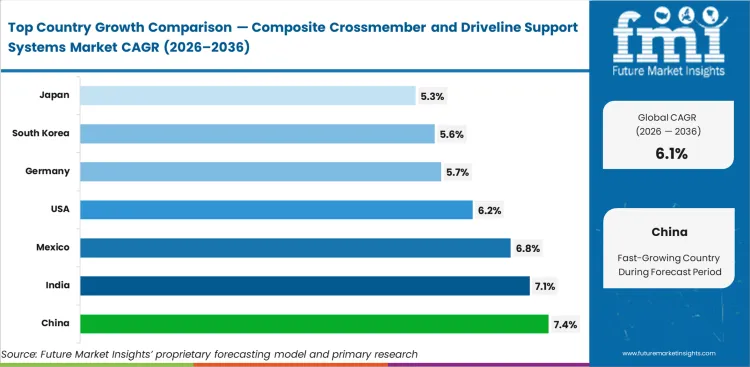
Composite Crossmember and Driveline Support Systems Market CAGR Analysis by Country
- China’s 7.4% CAGR during 2026 to 2036 reflects faster NEV platform renewal and higher local chassis module activity.
- India is set to advance at 7.1% CAGR across the forecast period as domestic SUV and EV programs raise demand for lighter support parts.
- Mexico records 6.8% CAGR over 2026 to 2036 through North American sourcing depth and export-based vehicle assembly.
- A demand outlook of 6.2% CAGR places the United States near the global average due to truck platform redesign and emissions compliance pressure.
- Germany’s 5.7% CAGR through the forecast window reflects selective use of composite supports in premium EV programs.
- South Korea is assessed at 5.6% CAGR for 2026 to 2036 as compact EV platforms need refined driveline support structures.
- Japan moves at 5.3% CAGR during the study period as strict durability approval slows wider material switching.
- Global demand is projected to grow at 6.1% CAGR in the assessment period.
Demand Outlook for Composite Crossmember and Driveline Support Systems Market in China
China’s market benefits from large vehicle production scale and fast NEV platform renewal. A 7.4% CAGR reflects wider use of localized driveline modules and composite underbody parts. Shanghai and Jiangsu supply chains give component makers access to EV assembly programs. Beijing-based chassis module activity adds another support point for structural parts. Composite crossmembers gain value when OEMs need lighter support structures without changing the full platform. Suppliers with local molding capacity can reduce lead time and improve platform approval speed.
- Shanghai EV programs give suppliers early access to underbody support trials near vehicle assembly sites.
- Jiangsu’s composite and auto parts base helps reduce lead time for molded structural supports.
- Beijing Benz activity supports module-level sourcing for chassis parts linked to local assembly.
Sales Analysis of Composite Crossmember and Driveline Support Systems Market in India
India’s market is shaped by rising passenger vehicle output and local sourcing needs. Domestic SUV programs create a clear base for structural support parts that reduce underbody weight. The 7.1% growth outlook across the study period reflects expanding electric and export platforms. Pune and Chakan support chassis supplier activity near large assembly hubs. Gujarat adds EV program depth through battery and vehicle investments. Composite support systems gain when suppliers can offer mold capacity and testing close to OEM engineering teams.
- Pune gives composite molders access to vehicle engineering teams and chassis supplier networks.
- Chakan supports serial part trials because several passenger vehicle plants operate near supplier parks.
- Gujarat EV investment improves the case for lighter driveline supports in locally assembled platforms.
Demand Analysis of Composite Crossmember and Driveline Support Systems Market in Mexico
Mexico’s role reflects North American assembly supply chains and export-based vehicle programs. Coahuila and Nuevo León support pickup and SUV platforms that need high-load underbody parts. Localized chassis sourcing places Mexico at 6.8% across the ten-year forecast. Bajío production corridors help suppliers serve assembly sites across central Mexico. Composite crossmembers can gain if local molders meet North American validation requirements. Shorter supply lines would improve OEM direct sourcing for structural support systems.
- Coahuila supports pickup platform work that needs durable crossmembers for heavier vehicle duty cycles.
- Nuevo León connects suppliers with cross-border logistics for North American chassis programs.
- Bajío assembly corridors improve response time for tooling changes and validation samples.
Opportunity Analysis of Composite Crossmember and Driveline Support Systems Market in the United States
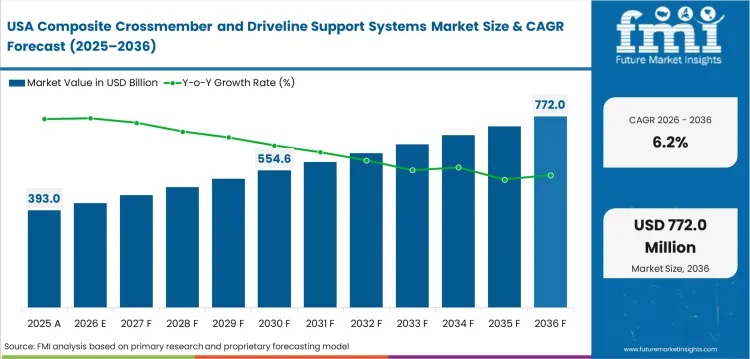
United States demand reflects truck platform engineering and emissions compliance pressure. OEM review of mass reduction options places the country at 6.2% growth for 2026 to 2036. Michigan engineering centers give suppliers access to early platform decisions. Kentucky and Tennessee assembly corridors create demand for validated support structures in pickup and SUV programs. Composite support parts gain value when they reduce corrosion exposure and part count. Domestic testing capacity helps suppliers respond before platform freeze.
- Michigan engineering centers help suppliers enter chassis design reviews before production sourcing decisions.
- Kentucky truck assembly programs create demand for support parts that balance weight and durability.
- Tennessee EV activity improves supplier interest in molded supports for compact electric driveline layouts.
Future Outlook for Composite Crossmember and Driveline Support Systems Market in Germany
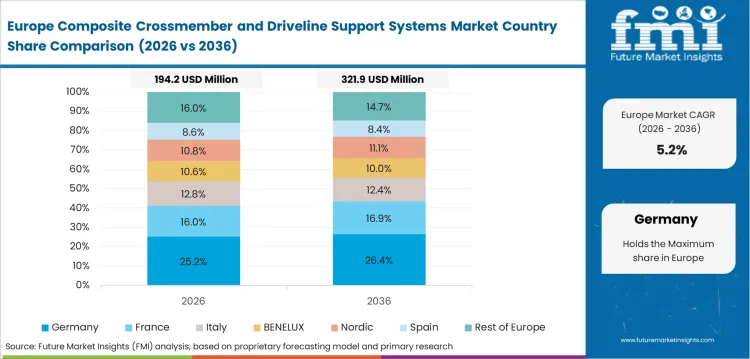
Germany’s market reflects premium EV engineering and high-value chassis programs. Selective use of composite supports gives Germany a 5.7% CAGR across the forecast timeline. Bavaria and Baden-Württemberg offer deep driveline engineering capacity. Lower Saxony adds production depth for electric vehicle programs. German OEMs move carefully because support parts need fatigue proof and repeatable quality. Suppliers with hybrid metal-composite capability can gain in programs that require high stiffness and lower mass.
- Bavaria supports premium EV programs that can absorb higher validation cost for lightweight support parts.
- Baden-Württemberg gives suppliers access to driveline engineering teams and chassis testing capability.
- Lower Saxony production depth creates room for composite parts used in electric vehicle platforms.
Demand Outlook for Composite Crossmember and Driveline Support Systems Market in South Korea
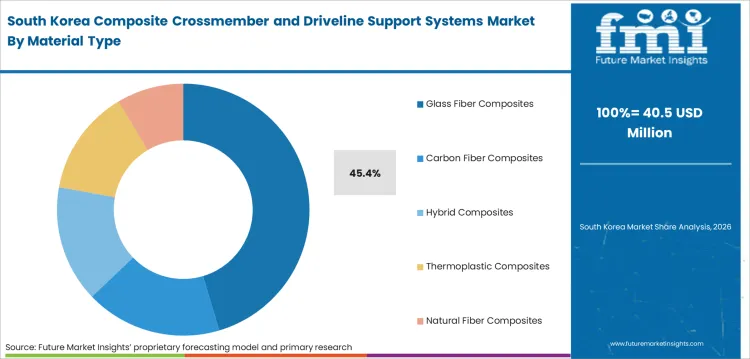
South Korea’s market reflects compact EV design and driveline refinement needs. Hyundai and Kia platform programs keep focus on vibration control and packaging around e-drive units. Local composite joining gains support a 5.6% path over the study window. Ulsan supports electric vehicle production with dense supplier activity. Gwangju provides component capacity for crossover and light vehicle platforms. Composite support systems gain value when they help control noise and support compact driveline layouts.
- Ulsan gives suppliers access to high-volume vehicle programs that need repeatable underbody support parts.
- Gwangju component capacity supports smaller crossover platforms with compact driveline layouts.
- Korean electronics capability helps testing teams track vibration behavior during support part validation.
In-depth Analysis of Composite Crossmember and Driveline Support Systems Market in Japan
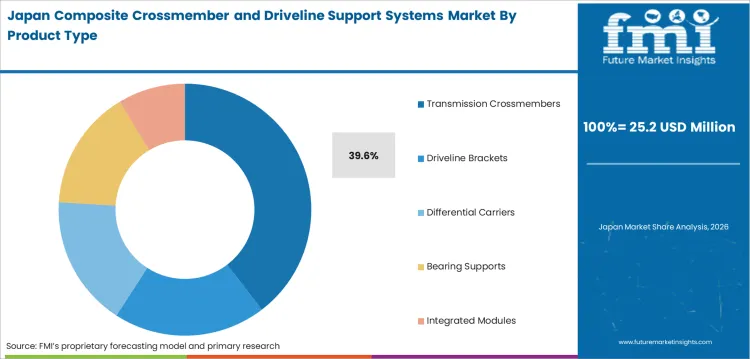
Japan’s adoption path is shaped by durability proof and conservative material approval. Aichi remains central to powertrain and chassis engineering decisions across Japanese OEM programs. Careful material approval keeps Japan at 5.3% over the 2026 to 2036 period. Kyushu production programs give suppliers a route into export platforms. Yokohama engineering events help material and component suppliers show validated support parts. Wider use depends on repeat quality and recycling proof for thermoplastic composite structures.
- Aichi links suppliers with powertrain engineering teams that set driveline support specifications.
- Kyushu production programs support export models that can test lighter underbody structures.
- Yokohama technical events give composite suppliers a route to show validated parts to Japanese OEMs.
Competitive Landscape and Strategic Positioning
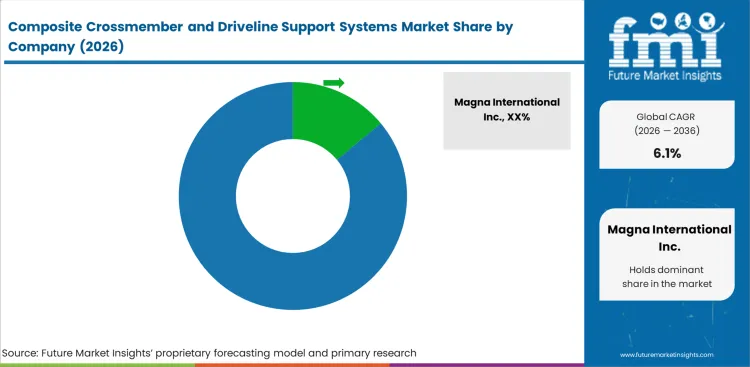
- Competition is moderately concentrated because structural support parts need design validation and OEM program access.
- Magna, Gestamp, and BENTELER compete through chassis engineering depth and global production reach.
- Röchling Automotive and SGL Carbon compete through composite processing and hybrid component know-how.
- Entry barriers are high since fatigue testing and OEM platform approval require time and capital.
Competitive positioning depends on chassis engineering depth and validation support. Gestamp’s official product scope covers body and chassis components, giving Gestamp a practical role in structural support programs. Composite crossmembers need proof of load behavior before OEM approval. Suppliers with platform engineering access are better placed than material-only vendors.
Lightweight structure suppliers compete through underbody design knowledge and assembly capability. Martinrea International Inc. lists lightweight structures as a core product area. The focus aligns with composite crossmember and driveline support demand. Structural support parts need part design and joining accuracy before sourcing decisions are finalized.
Composite specialists have a separate route into this market through material processing and molded part know-how. Mubea presents composite components as part of its official product scope. Composite suppliers must prove fatigue behavior and attachment stability before these parts move into serial vehicle programs.
Key Companies in the Composite Crossmember and Driveline Support Systems Market
- Chassis System Leaders include Magna International Inc., Gestamp Automoción, BENTELER Group, and Martinrea International Inc. Magna has carbon fiber structural assembly capability. Gestamp brings chassis and large-format structure work.
- Composite Specialists include Röchling Automotive, SGL Carbon SE, Hexcel Corporation, and Mubea Group. Röchling works with thermoplastic composite automotive structures.
- Driveline Interface Suppliers include Nexteer Automotive and ZF Friedrichshafen AG. Nexteer focuses on NVH and mass reduction. ZF’s AxTrax 2.0 integrates driveline components in a compact electric axle system.
Competitive Benchmarking: Composite Crossmember and Driveline Support Systems Market
| Company | Composite Structural Design | Driveline Interface Support | OEM Validation Depth | Geographic Footprint |
|---|---|---|---|---|
| Magna International Inc. | High | Strong | Strong | Global |
| Gestamp Automoción | Medium | Strong | Strong | Global |
| BENTELER Group | Medium | Strong | Strong | Global |
| Martinrea International Inc. | Medium | Medium | Strong | North America and Europe |
| Röchling Automotive | High | Medium | Strong | Global |
| SGL Carbon SE | High | Medium | Medium | Europe and North America |
| Hexcel Corporation | High | Medium | Medium | Global |
| Nexteer Automotive | Low | High | Strong | Global |
| ZF Friedrichshafen AG | Low | High | Strong | Global |
| Mubea Group | Medium | Medium | Moderate | Europe and Americas |
Source: Future Market Insights competitive analysis, 2026.
Key Developments in Composite Crossmember and Driveline Support Systems Market
- In May 2025, SGL Carbon SE received Ford Motor Company’s Q1 supplier award for its Ort im Innkreis site.
- In October 2025, Martinrea International Inc. acquired the assets of Lyseon North America Inc.
Key Players in the Composite Crossmember and Driveline Support Systems Market
Chassis System Leaders
- Magna International Inc.
- Gestamp Automoción
- BENTELER Group
- Martinrea International Inc.
Composite Specialists
- Röchling Automotive
- SGL Carbon SE
- Hexcel Corporation
- Mubea Group
Driveline Interface Suppliers
- Nexteer Automotive
- ZF Friedrichshafen AG
Report Scope and Coverage
| Parameter | Details |
|---|---|
| Quantitative Units | USD 0.9 billion to USD 1.7 billion at 6.1% CAGR from 2026 to 2036 |
| Market Definition | Composite crossmember and driveline support systems include molded or hybrid structural parts used to support transmissions and e-axles. |
| Regions Covered | North America, Latin America, Europe, East Asia, South Asia and Pacific, Middle East and Africa |
| Countries Covered | China, India, Mexico, United States, Germany, South Korea, Japan, 30+ countries |
| Key Companies Profiled | Magna International Inc., Gestamp Automoción, BENTELER Group, Martinrea International Inc., Röchling Automotive, SGL Carbon SE, Hexcel Corporation |
| Forecast Period | 2026 to 2036 |
| Approach | Hybrid bottom-up and top-down methodology starting with verified transaction data and platform-level component content allocation |
Composite Crossmember and Driveline Support Systems Market by Segments
Composite Crossmember and Driveline Support Systems Market Segmented by Product Type
- Transmission Crossmembers
- Driveline Brackets
- Differential Carriers
- Bearing Supports
- Integrated Modules
Composite Crossmember and Driveline Support Systems Market Segmented by Material Type
- Glass Fiber Composites
- Carbon Fiber Composites
- Hybrid Composites
- Thermoplastic Composites
- Natural Fiber Composites
Composite Crossmember and Driveline Support Systems Market Segmented by Vehicle Type
- Passenger Vehicles
- Light Commercial Vehicles
- Heavy Trucks
- Performance Vehicles
- Electric Platforms
Composite Crossmember and Driveline Support Systems Market Segmented by Manufacturing Process
- Compression Molding
- Resin Transfer Molding
- Pultrusion
- Injection Molding
- Prepreg Layup
Composite Crossmember and Driveline Support Systems Market Segmented by Sales Channel
- OEM Direct Supply
- Tier Supplier Programs
- Aftermarket Replacement
- Motorsport Channels
Composite Crossmember and Driveline Support Systems Market by Region
- North America
- United States
- Canada
- Mexico
- Latin America
- Brazil
- Chile
- Rest of Latin America
- Western Europe
- Germany
- UK
- Italy
- Spain
- France
- Nordic
- BENELUX
- Rest of Western Europe
- Eastern Europe
- Russia
- Poland
- Hungary
- Balkan and Baltic
- Rest of Eastern Europe
- East Asia
- China
- Japan
- South Korea
- South Asia and Pacific
- India
- ASEAN
- Australia and New Zealand
- Rest of South Asia and Pacific
- Middle East and Africa
- Kingdom of Saudi Arabia
- Other GCC Countries
- Turkiye
- South Africa
- Other African Union
- Rest of Middle East and Africa
Research Sources and Bibliography
- International Energy Agency. (2025, May 14). Electric vehicle batteries. IEA.
- International Organization of Motor Vehicle Manufacturers. (2026, April 23). Auto industry growth shifted east in 2025 amid global repositioning. OICA.
- Röchling Automotive. (2025, December 2). Röchling Automotive supplies intrusion protection for a major European OEM. Röchling.
- BENTELER Group. (2025, October 23). BENTELER strengthens presence and partnerships in China. BENTELER.
- SGL Carbon SE. (2025, May 13). SGL Carbon receives Q1 award from Ford Motor Company. SGL Carbon.
- Martinrea International Inc. (2025, October 20). Martinrea International Inc. acquires assets of Lyseon North America Inc. Martinrea International Inc.
- USA Environmental Protection Agency. (2024, March 29). Final rule: Greenhouse gas emissions standards for heavy-duty vehicles, Phase 3. EPA.
Bibliography is provided for reader reference and includes government, official association, and company sources used in the article.
This Report Answers
- What is the current and future value of the composite crossmember and driveline support systems market from 2026 to 2036?
- What CAGR is expected for composite crossmember and driveline support systems demand during the forecast period?
- Which product type is projected to lead composite crossmember and driveline support systems demand in 2026?
- Which material type is expected to hold the leading share in composite support systems applications?
- What factors are increasing composite support use in transmission and e-axle mounting points?
- How do emissions rules and EV weight pressure affect supplier selection?
- Which countries are forecast to grow fastest in composite crossmember and driveline support systems?
- Which companies are positioned across chassis structures and composite support parts?
- How does FMI define the composite crossmember and driveline support systems market scope?
- What forecasting approach was used to estimate demand from 2026 to 2036?
Frequently Asked Questions
What is the current and future value of the composite crossmember and driveline support systems market from 2026 to 2036?
The composite crossmember and driveline support systems market is valued at USD 0.9 billion in 2026 and is forecast to reach USD 1.7 billion by 2036.
What CAGR is expected for the composite crossmember and driveline support systems market during the forecast period?
The market is projected to expand at 6.1% CAGR from 2026 to 2036 as OEMs review lighter chassis support parts.
Which product type segment is projected to lead composite crossmember and driveline support systems demand in 2026?
Transmission crossmembers are projected to lead product demand with 38.0% share in 2026 due to driveline mounting needs.
Which material type is expected to hold the leading share in composite crossmember and driveline support systems?
Glass fiber composites are estimated to hold 46.0% of material demand because they balance stiffness and cost for serial vehicle programs.
What factors are increasing composite support use in transmission and e-axle mounting points?
Battery weight and compact e-axle layouts are pushing OEMs to reduce underbody mass through validated composite support parts.
How do OEM approvals affect composite crossmember and driveline support systems supplier selection?
OEM approvals favor suppliers that can prove fatigue strength and stable attachment performance before parts enter serial production.
Which countries are expected to grow fastest in the composite crossmember and driveline support systems market?
China and India are expected to grow fastest due to NEV platform activity and rising local vehicle production.
Which companies are positioned across chassis structures and composite support systems?
Magna International Inc., Gestamp Automoción, BENTELER Group, and Martinrea International Inc. are positioned across chassis structures. Röchling Automotive and Hexcel Corporation add composite capability.
How does FMI define the composite crossmember and driveline support systems market scope?
FMI defines the market as molded or hybrid structural parts used to support transmissions, e-axles, differential assemblies and driveline mounting points.
What forecasting approach was used to estimate composite crossmember and driveline support systems demand from 2026 to 2036?
FMI used vehicle production, part content, material mix, supplier interviews and platform validation checks to estimate demand from 2026 to 2036.
Preview the report firsthand - request a free sample
Get SampleGet the brochure for pricing and purchase details.
Get PDFTable of Content
- Key Takeaways
- Market Size and CAGR
- Top Growth Driver
- Fastest Growing Segment
- Leading Region
- Key Companies
- Emerging Opportunities
- Executive Summary
- Global Market Outlook
- Demand-side Trends
- Supply-side Trends
- Technology Roadmap Analysis
- Analysis and Recommendations
- Analyst Perspective (What is happening? Why now? What should investors know?)
- Key Questions Answered
- How large is the market?
- What is the CAGR?
- What are key trends?
- Which region dominates?
- Who are the leaders?
- Market Overview
- Market Coverage / Taxonomy
- Market Definition / Scope / Limitations
- Research Methodology
- Chapter Orientation
- Analytical Lens and Working Hypotheses
- Market Structure, Signals, and Trend Drivers
- Benchmarking and Cross-market Comparability
- Market Sizing, Forecasting, and Opportunity Mapping
- Research Design and Evidence Framework
- Desk Research Programme (Secondary Evidence)
- Expert Input and Fieldwork (Primary Evidence)
- Tooling, Models, and Reference Databases
- Data Engineering and Model Build
- Quality Assurance and Audit Trail
- Market Background
- Market Dynamics (Drivers, Restraints, Opportunity, Trends)
- Scenario Forecast (Optimistic, Likely, Conservative)
- Impact Analysis
- AI Impact
- Sustainability Impact
- Regulatory Impact
- Technology Impact
- Consumer / Buyer Analysis
- Purchase Drivers
- Adoption Barriers
- Buyer Journey
- Opportunity Map Analysis
- Product Life Cycle Analysis
- Supply Chain Analysis
- Investment Feasibility Matrix
- Value Chain Analysis
- PESTLE and Porter's Analysis
- Regulatory Landscape
- Regional Parent Market Outlook
- Production and Consumption Statistics
- Import and Export Statistics
- Global Market Analysis and Forecast, 2021 to 2036
- Historical Market Size Value (USD Billion) & Volume (Unit) Analysis, 2021 to 2025
- Current and Future Market Size Value (USD Billion) & Volume (Unit) Projections, 2026 to 2036
- Y-o-Y Growth Trend Analysis
- Absolute $ Opportunity Analysis
- Global Market Pricing Analysis, 2021 to 2036
- Global Market Analysis and Forecast, By Product Type, 2021 to 2036
- Introduction / Key Findings
- Historical Market Size Value (USD Billion) & Volume (Unit) Analysis By Product Type, 2021 to 2025
- Current and Future Market Size Value (USD Billion) & Volume (Unit) Analysis and Forecast By Product Type, 2026 to 2036
- Transmission Crossmembers
- Driveline Brackets
- Differential Carriers
- Bearing Supports
- Integrated Modules
- Transmission Crossmembers
- Y-o-Y Growth Trend Analysis By Product Type, 2021 to 2025
- Absolute $ Opportunity Analysis By Product Type, 2026 to 2036
- Global Market Analysis and Forecast, By Material Type, 2021 to 2036
- Introduction / Key Findings
- Historical Market Size Value (USD Billion) & Volume (Unit) Analysis By Material Type, 2021 to 2025
- Current and Future Market Size Value (USD Billion) & Volume (Unit) Analysis and Forecast By Material Type, 2026 to 2036
- Glass Fiber Composites
- Carbon Fiber Composites
- Hybrid Composites
- Thermoplastic Composites
- Natural Fiber Composites
- Glass Fiber Composites
- Y-o-Y Growth Trend Analysis By Material Type, 2021 to 2025
- Absolute $ Opportunity Analysis By Material Type, 2026 to 2036
- Global Market Analysis and Forecast, By Vehicle Type, 2021 to 2036
- Introduction / Key Findings
- Historical Market Size Value (USD Billion) & Volume (Unit) Analysis By Vehicle Type, 2021 to 2025
- Current and Future Market Size Value (USD Billion) & Volume (Unit) Analysis and Forecast By Vehicle Type, 2026 to 2036
- Passenger Vehicles
- Light Commercial Vehicles
- Heavy Trucks
- Performance Vehicles
- Electric Platforms
- Passenger Vehicles
- Y-o-Y Growth Trend Analysis By Vehicle Type, 2021 to 2025
- Absolute $ Opportunity Analysis By Vehicle Type, 2026 to 2036
- Global Market Analysis and Forecast, By Manufacturing Process, 2021 to 2036
- Introduction / Key Findings
- Historical Market Size Value (USD Billion) & Volume (Unit) Analysis By Manufacturing Process, 2021 to 2025
- Current and Future Market Size Value (USD Billion) & Volume (Unit) Analysis and Forecast By Manufacturing Process, 2026 to 2036
- Compression Molding
- Resin Transfer Molding
- Pultrusion
- Injection Molding
- Prepreg Layup
- Compression Molding
- Y-o-Y Growth Trend Analysis By Manufacturing Process, 2021 to 2025
- Absolute $ Opportunity Analysis By Manufacturing Process, 2026 to 2036
- Global Market Analysis and Forecast, By Sales Channel, 2021 to 2036
- Introduction / Key Findings
- Historical Market Size Value (USD Billion) & Volume (Unit) Analysis By Sales Channel, 2021 to 2025
- Current and Future Market Size Value (USD Billion) & Volume (Unit) Analysis and Forecast By Sales Channel, 2026 to 2036
- OEM Direct Supply
- Tier Supplier Programs
- Aftermarket Replacement
- Motorsport Channels
- OEM Direct Supply
- Y-o-Y Growth Trend Analysis By Sales Channel, 2021 to 2025
- Absolute $ Opportunity Analysis By Sales Channel, 2026 to 2036
- Global Market Analysis and Forecast, By Region, 2021 to 2036
- Introduction
- Historical Market Size Value (USD Billion) & Volume (Unit) Analysis By Region, 2021 to 2025
- Current Market Size Value (USD Billion) & Volume (Unit) Analysis and Forecast By Region, 2026 to 2036
- North America
- Latin America
- Western Europe
- Eastern Europe
- East Asia
- South Asia and Pacific
- Middle East & Africa
- Market Attractiveness Analysis By Region
- North America Market Analysis and Forecast, By Country, 2021 to 2036
- Historical Market Size Value (USD Billion) & Volume (Unit) Trend Analysis By Market Taxonomy, 2021 to 2025
- Market Size Value (USD Billion) & Volume (Unit) Forecast By Market Taxonomy, 2026 to 2036
- By Country
- USA
- Canada
- Mexico
- By Product Type
- By Material Type
- By Vehicle Type
- By Manufacturing Process
- By Sales Channel
- By Country
- Market Attractiveness Analysis
- By Country
- By Product Type
- By Material Type
- By Vehicle Type
- By Manufacturing Process
- By Sales Channel
- Key Takeaways
- Latin America Market Analysis and Forecast, By Country
- Historical Market Size Value (USD Billion) & Volume (Unit) Trend Analysis By Market Taxonomy, 2021 to 2025
- Market Size Value (USD Billion) & Volume (Unit) Forecast By Market Taxonomy, 2026 to 2036
- By Country
- Brazil
- Chile
- Rest of Latin America
- By Product Type
- By Material Type
- By Vehicle Type
- By Manufacturing Process
- By Sales Channel
- By Country
- Market Attractiveness Analysis
- By Country
- By Product Type
- By Material Type
- By Vehicle Type
- By Manufacturing Process
- By Sales Channel
- Key Takeaways
- Western Europe Market Analysis and Forecast, By Country
- Historical Market Size Value (USD Billion) & Volume (Unit) Trend Analysis By Market Taxonomy, 2021 to 2025
- Market Size Value (USD Billion) & Volume (Unit) Forecast By Market Taxonomy, 2026 to 2036
- By Country
- Germany
- UK
- Italy
- Spain
- France
- Nordic
- BENELUX
- Rest of Western Europe
- By Product Type
- By Material Type
- By Vehicle Type
- By Manufacturing Process
- By Sales Channel
- By Country
- Market Attractiveness Analysis
- By Country
- By Product Type
- By Material Type
- By Vehicle Type
- By Manufacturing Process
- By Sales Channel
- Key Takeaways
- Eastern Europe Market Analysis and Forecast, By Country
- Historical Market Size Value (USD Billion) & Volume (Unit) Trend Analysis By Market Taxonomy, 2021 to 2025
- Market Size Value (USD Billion) & Volume (Unit) Forecast By Market Taxonomy, 2026 to 2036
- By Country
- Russia
- Poland
- Hungary
- Balkan & Baltic
- Rest of Eastern Europe
- By Product Type
- By Material Type
- By Vehicle Type
- By Manufacturing Process
- By Sales Channel
- By Country
- Market Attractiveness Analysis
- By Country
- By Product Type
- By Material Type
- By Vehicle Type
- By Manufacturing Process
- By Sales Channel
- Key Takeaways
- East Asia Market Analysis and Forecast, By Country
- Historical Market Size Value (USD Billion) & Volume (Unit) Trend Analysis By Market Taxonomy, 2021 to 2025
- Market Size Value (USD Billion) & Volume (Unit) Forecast By Market Taxonomy, 2026 to 2036
- By Country
- China
- Japan
- South Korea
- By Product Type
- By Material Type
- By Vehicle Type
- By Manufacturing Process
- By Sales Channel
- By Country
- Market Attractiveness Analysis
- By Country
- By Product Type
- By Material Type
- By Vehicle Type
- By Manufacturing Process
- By Sales Channel
- Key Takeaways
- South Asia and Pacific Market Analysis and Forecast, By Country
- Historical Market Size Value (USD Billion) & Volume (Unit) Trend Analysis By Market Taxonomy, 2021 to 2025
- Market Size Value (USD Billion) & Volume (Unit) Forecast By Market Taxonomy, 2026 to 2036
- By Country
- India
- ASEAN
- Australia & New Zealand
- Rest of South Asia and Pacific
- By Product Type
- By Material Type
- By Vehicle Type
- By Manufacturing Process
- By Sales Channel
- By Country
- Market Attractiveness Analysis
- By Country
- By Product Type
- By Material Type
- By Vehicle Type
- By Manufacturing Process
- By Sales Channel
- Key Takeaways
- Middle East & Africa Market Analysis and Forecast, By Country
- Historical Market Size Value (USD Billion) & Volume (Unit) Trend Analysis By Market Taxonomy, 2021 to 2025
- Market Size Value (USD Billion) & Volume (Unit) Forecast By Market Taxonomy, 2026 to 2036
- By Country
- Kingdom of Saudi Arabia
- Other GCC Countries
- Türkiye
- South Africa
- Other African Union
- Rest of Middle East & Africa
- By Product Type
- By Material Type
- By Vehicle Type
- By Manufacturing Process
- By Sales Channel
- By Country
- Market Attractiveness Analysis
- By Country
- By Product Type
- By Material Type
- By Vehicle Type
- By Manufacturing Process
- By Sales Channel
- Key Takeaways
- Key Countries Market Analysis
- USA
- Pricing Analysis
- Market Share Analysis, 2025
- By Product Type
- By Material Type
- By Vehicle Type
- By Manufacturing Process
- By Sales Channel
- Canada
- Pricing Analysis
- Market Share Analysis, 2025
- By Product Type
- By Material Type
- By Vehicle Type
- By Manufacturing Process
- By Sales Channel
- Mexico
- Pricing Analysis
- Market Share Analysis, 2025
- By Product Type
- By Material Type
- By Vehicle Type
- By Manufacturing Process
- By Sales Channel
- Brazil
- Pricing Analysis
- Market Share Analysis, 2025
- By Product Type
- By Material Type
- By Vehicle Type
- By Manufacturing Process
- By Sales Channel
- Chile
- Pricing Analysis
- Market Share Analysis, 2025
- By Product Type
- By Material Type
- By Vehicle Type
- By Manufacturing Process
- By Sales Channel
- Germany
- Pricing Analysis
- Market Share Analysis, 2025
- By Product Type
- By Material Type
- By Vehicle Type
- By Manufacturing Process
- By Sales Channel
- UK
- Pricing Analysis
- Market Share Analysis, 2025
- By Product Type
- By Material Type
- By Vehicle Type
- By Manufacturing Process
- By Sales Channel
- Italy
- Pricing Analysis
- Market Share Analysis, 2025
- By Product Type
- By Material Type
- By Vehicle Type
- By Manufacturing Process
- By Sales Channel
- Spain
- Pricing Analysis
- Market Share Analysis, 2025
- By Product Type
- By Material Type
- By Vehicle Type
- By Manufacturing Process
- By Sales Channel
- France
- Pricing Analysis
- Market Share Analysis, 2025
- By Product Type
- By Material Type
- By Vehicle Type
- By Manufacturing Process
- By Sales Channel
- India
- Pricing Analysis
- Market Share Analysis, 2025
- By Product Type
- By Material Type
- By Vehicle Type
- By Manufacturing Process
- By Sales Channel
- ASEAN
- Pricing Analysis
- Market Share Analysis, 2025
- By Product Type
- By Material Type
- By Vehicle Type
- By Manufacturing Process
- By Sales Channel
- Australia & New Zealand
- Pricing Analysis
- Market Share Analysis, 2025
- By Product Type
- By Material Type
- By Vehicle Type
- By Manufacturing Process
- By Sales Channel
- China
- Pricing Analysis
- Market Share Analysis, 2025
- By Product Type
- By Material Type
- By Vehicle Type
- By Manufacturing Process
- By Sales Channel
- Japan
- Pricing Analysis
- Market Share Analysis, 2025
- By Product Type
- By Material Type
- By Vehicle Type
- By Manufacturing Process
- By Sales Channel
- South Korea
- Pricing Analysis
- Market Share Analysis, 2025
- By Product Type
- By Material Type
- By Vehicle Type
- By Manufacturing Process
- By Sales Channel
- Russia
- Pricing Analysis
- Market Share Analysis, 2025
- By Product Type
- By Material Type
- By Vehicle Type
- By Manufacturing Process
- By Sales Channel
- Poland
- Pricing Analysis
- Market Share Analysis, 2025
- By Product Type
- By Material Type
- By Vehicle Type
- By Manufacturing Process
- By Sales Channel
- Hungary
- Pricing Analysis
- Market Share Analysis, 2025
- By Product Type
- By Material Type
- By Vehicle Type
- By Manufacturing Process
- By Sales Channel
- Kingdom of Saudi Arabia
- Pricing Analysis
- Market Share Analysis, 2025
- By Product Type
- By Material Type
- By Vehicle Type
- By Manufacturing Process
- By Sales Channel
- Türkiye
- Pricing Analysis
- Market Share Analysis, 2025
- By Product Type
- By Material Type
- By Vehicle Type
- By Manufacturing Process
- By Sales Channel
- South Africa
- Pricing Analysis
- Market Share Analysis, 2025
- By Product Type
- By Material Type
- By Vehicle Type
- By Manufacturing Process
- By Sales Channel
- USA
- Market Structure Analysis
- Competition Dashboard
- Competition Benchmarking
- Market Share Analysis of Top Players
- By Regional
- By Product Type
- By Material Type
- By Vehicle Type
- By Manufacturing Process
- By Sales Channel
- Emerging Startups
- Innovation Benchmarking
- Competition Analysis
- Competition Deep Dive
- Magna International Inc.
- Overview
- Product Portfolio
- Profitability by Market Segments (Product/Region/Sales Channel)
- Sales Footprint
- Strategy Overview
- Marketing Strategy
- Product Strategy
- Channel Strategy
- Gestamp Automoción
- BENTELER Group
- Martinrea International Inc.
- Röchling Automotive
- SGL Carbon SE
- Hexcel Corporation
- Mubea Group
- Nexteer Automotive
- ZF Friedrichshafen AG
- Magna International Inc.
- Case Studies
- Success Stories
- Recent Developments
- Competition Deep Dive
- Assumptions & Acronyms Used


