

- Industry Size (2026)
- USD 0.6 Bn
- Forecast (2036)
- USD 2.0 Bn
- CAGR (2026 to 2036)
- 12.8%
Advanced Composite Fuselage Panel Systems for Next-Gen Narrow-Bodies Market Size, Market Forecast and Outlook By FMI
The advanced composite fuselage panel systems for next-gen narrow-bodies market was valued at USD 0.5 billion in 2025. Sector is expected to secure USD 0.6 billion in 2026. The market revenue is set to expand at a CAGR of 12.8% during the forecast period, and reach a valuation of USD 2.0 billion in 2036. Aggressive narrow-body production ramp-ups force aerospace manufacturers to secure qualified composite panel capacity early. Capital allocation decisions are increasingly shaped by broader progress in composite airframes and by adjacent retrofit economics visible in winglet retrofit kits.
Manufacturers face substantial pressure to secure supply chain capacity for high-rate single-aisle production platforms. Failure to participate in early qualification phases for these future aircraft translates into the loss of decades of guaranteed serial production volume. Initiatives by companies require Tier-1 suppliers to demonstrate the capability to manufacture large composite structures at rates exceeding around 60 aircraft per month
Summary of Advanced Composite Fuselage Panel Systems for Next-Gen Narrow-Bodies Market
- The market is estimated at USD 0.5 billion in 2025.
- The market is projected to reach USD 2.0 billion by 2036.
- The market is expected to grow at a CAGR of 12.8% from 2026 to 2036.
- The forecast period represents an incremental opportunity of USD 1.4 billion.
- The market is expected to reach USD 0.6 billion in 2026.
- Aft fuselage panels lead by panel type with a 34.0% share in 2026.
- Thermoset CFRP dominates by material system with a 55.0% share in 2026.
- OEM line-fit shipsets lead by end use with an 88.0% share in 2026.
- China (13.9%), Canada (13.6%), and the United States (13.3%) are among the fastest-growing markets.
- Key companies in the market include Airbus Atlantic, Spirit AeroSystems, GKN Aerospace, Daher, Hexcel, Toray Advanced Composites, and Syensqo.
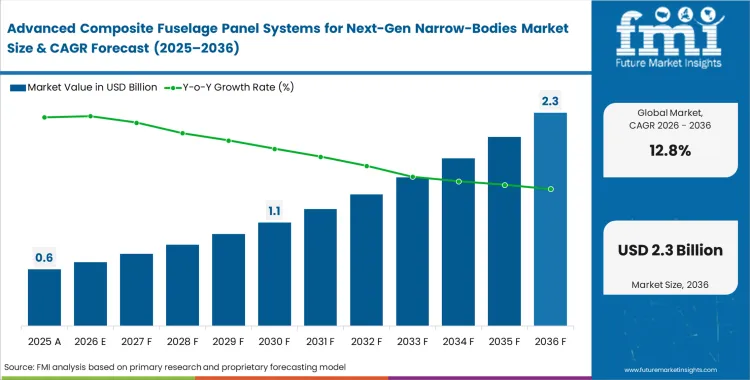
Advanced Composite Fuselage Panel Systems for Next-Gen Narrow-Bodies Market Key Takeaways
| Metric | Details |
|---|---|
| Industry Size (2026) | USD 0.6 billion |
| Industry Value (2036) | USD 2.0 billion |
| CAGR (2026-2036) | 12.8% |
Source: Future Market Insights (FMI) analysis, based on proprietary forecasting model and primary research
Engineering leadership must immediately determine whether to commit significant capital investment to automated fiber placement for legacy thermosets or take a risk on press-formed thermoplastics. FMI's analysis suggests this competitive pressure channels immediate funding toward manufacturing demonstrators because demonstrating rate-capability carries greater importance than achieving marginal weight savings. Progress in composite airframes significantly influences these capital deployment decisions across global supply chains. Comparable sourcing logic is already visible in adjacent areas such as hybrid exterior components and belly fairing kits.
The attainment of high-rate narrow-body production becomes feasible following the certification of out-of-autoclave thermoplastic welding for primary pressurized structures by aerospace regulatory bodies. Tier-1 manufacturers immediately transition operations from localized demonstrator cells to full-scale assembly lines. Certification functions as a catalyst, eliminating current curing bottlenecks and fundamentally changing the integration process of fuselage sections. Approval of this specific milestone allows original equipment manufacturers to align composite production speeds with established metallic assembly rhythms. Similar rate-enabling thinking also influences external aerostructure upgrade niches such as pylon fairing retrofit kits.
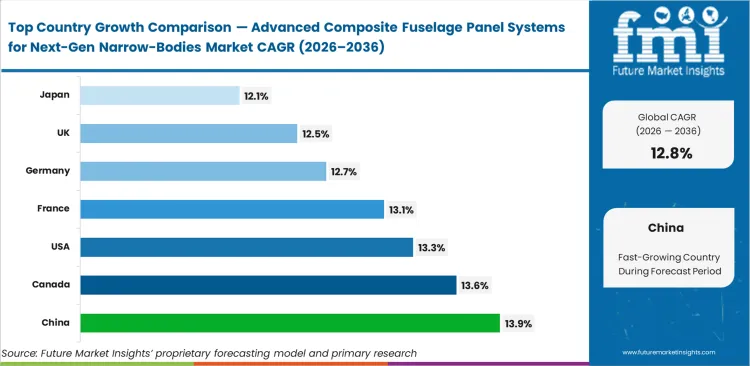
China is estimated to record 13.9% CAGR during 2026 to 2036, supported by localized narrow-body development. Canada is projected at 13.6% CAGR over the same period owing to its A220 manufacturing base. Expansion is estimated at 13.3% CAGR in the United States, 13.1% in France, 12.7% in Germany, 12.5% in the United Kingdom, and 12.1% in Japan during the forecast period. Transatlantic production strategy still points to a divide between thermoset optimization in Europe and higher-rate manufacturing development across North America.
Segmental Analysis
Advanced Composite Fuselage Panel Systems for Next-Gen Narrow-Bodies Market Analysis by Panel Type
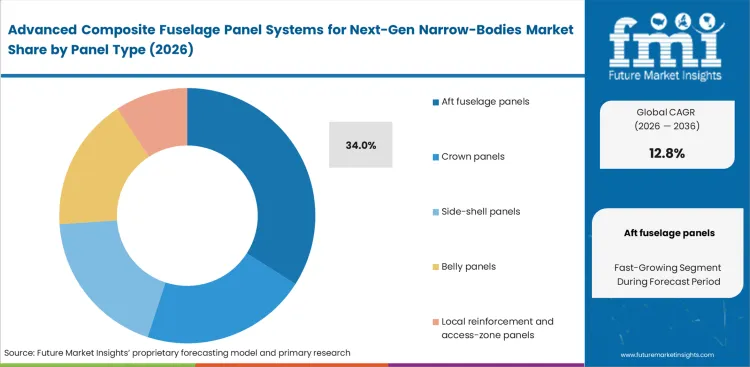
Tail sections connect to metallic center barrels at these essential interfaces. The aft fuselage panels segment is predicted to account for 34.0% revenue share in 2026, due to established tail-cone transition area designs and active serial production line integration. Factors contributing include composite material adoption for weight reduction, optimized panel integration for aerodynamic efficiency, and increasing demand for larger cargo door cutouts in narrow-body aircraft configurations. General aerospace observers frequently misinterpret aft panel dominance.
This dominance actually limits supply chain exposure to genuine high-rate primary assembly difficulties. Supply-chain planning in this segment increasingly overlaps with investments in exterior digital twin platforms and emerging material pathways tied to composite materials using PCR. Suppliers easily assert composite expertise utilizing this approach. Solving harder side-shell pressurization problems is completely avoided. Companies postponing investment in side-shell and crown panel tooling face the risk of losing Tier-1 status. Original equipment manufacturers ultimately require fully integrated composite center sections.
- Initial aft adoption: Engineers target aft fuselage zones to avoid complex pressurization certification processes during early program phases. Procurement departments secure valuable weight reductions while shielding supply chains from highest-risk compliance failures.
- Side-shell integration hurdles: The side-shell segment demands perfect damage tolerance characteristics to survive ground support equipment impacts. Manufacturing leads face severe tooling costs to produce these highly contoured panels.
- Crown panel continuous loading: Crown panels endure constant tension loads during flight pressurization cycles. Design chiefs must specify specialized fiber orientations in this area. This forces facilities to upgrade automated tape laying equipment.
Advanced Composite Fuselage Panel Systems for Next-Gen Narrow-Bodies Market Analysis by Material System
Rigorous material out-time limitations considerably complicate existing manufacturing processes. Similar constraints regarding established materials affect adjacent niches such as low-temperature cure coatings. The thermoset CFRP segment is set to hold 55.0% revenue share in 2026. Factors supporting compound growth include vast existing certification libraries and safe regulatory choices under extreme thermal cycling, established infrastructure, and superior damage tolerance.
Thermoset materials maintain dominance because standardized, expedited approval procedures are absent. Regulatory bodies experience difficulty approving primary assemblies constructed using welded thermoplastics rapidly. A Tier-1 supplier prematurely transitioning to thermoplastics incurs devastating financial exposure. This exposure arises from capital equipment investments becoming unusable. Complete reliance on thermosets restricts future maximum production output levels. A transition to parallel supply chains accommodating dual materials is the eventual expectation for suppliers.
- Thermoset data reliance: Decades of accumulated flight data establish thermoset carbon fiber reinforced polymer as the safest regulatory choice. Certification managers avoid program delays, utilizing materials with established performance curves under extreme thermal cycling.
- Thermoplastic cycle speed: Thermoplastic composites eliminate lengthy autoclave curing bottlenecks completely. Production leads slash part manufacturing times from days to hours. This fundamentally alters factory floor throughput capabilities.
- Hybrid transition strategies: Hybrid composite-metal laminates offer targeted reinforcement in high-stress joint areas. Design engineers deploy specialized materials solving localized fastener pull-through issues without redesigning entire composite panels.
Advanced Composite Fuselage Panel Systems for Next-Gen Narrow-Bodies Market Analysis by Manufacturing Route
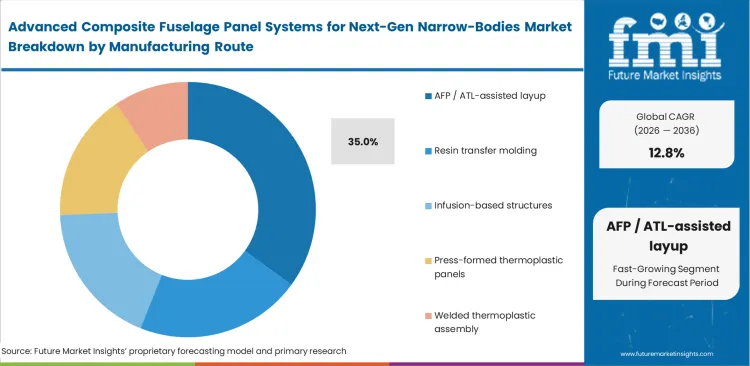
The integration of smart composite layup machines dictates ultimate factory throughput capability. Maximum Automated Fiber Placement (AFP) throughput frequently establishes a hidden bottleneck further down the line. Manual inspection methodologies are incapable of keeping pace with the rates of robotic material deposition. Facilities need to implement automated non-destructive inspection systems in conjunction with automated fiber placement, including architectures linked to fuselage corrosion monitoring sensors. Failure to implement this results in substantial work-in-progress inventory accumulation. This accumulation eliminates precise cycle-time benefits promised by the equipment initially. The AFP / ATL-assisted layup segment is anticipated to hold 35.0% share in 2026. Supporting factors include automated high-rate aerostructure manufacturing fit, absolute fiber placement repeatability, reduced material waste, superior composite quality, and lower labor expenses.
- Capital equipment justification: AFP machinery demands significant upfront capital expenditure and strict environmental regulation. Factory operations departments validate these investments exclusively through secured long-term, high-volume serial production contracts.
- Inspection rate mismatches: Robotic material deposition significantly exceeds established manual ultrasonic inspection procedures. Quality assurance management must rapidly incorporate automated inline scanning technologies to preempt severe bottlenecks.
- Welded assembly disruption: Thermoplastic welded assembly removes numerous mechanical fasteners from fuselage sections. Assembly line supervision dramatically reduces integration duration. Extensive trial-and-error engineering work is necessary for initial tooling calibration.
Advanced Composite Fuselage Panel Systems for Next-Gen Narrow-Bodies Market Analysis by Program Position
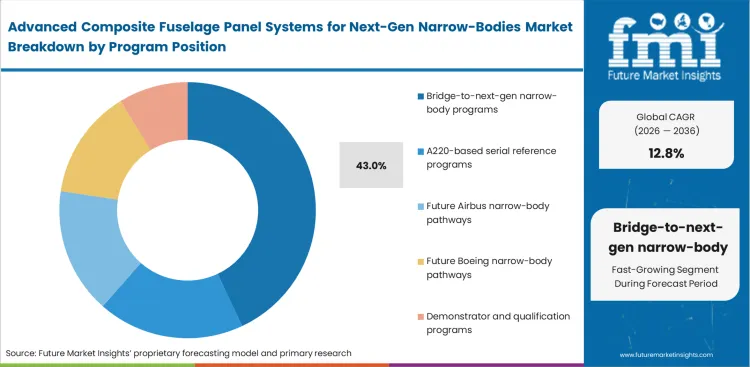
Suppliers deliberately incur losses on these bridge programs. This strategy secures exclusive bidding rights for subsequent high-volume single-aisle platforms. The bridge-to-next-gen narrow-body programs segment is set to record 43.0% share in 2026. Factors supporting compound growth include crucial validation steps for future platforms and subsidized initial demonstrator funding, rising demand for lightweight materials to improve fuel efficiency, increased investment in automation for faster and more cost-effective production, and regulatory push for lower emissions and noise levels. Similar bridge-to-certification behavior is increasingly visible in related advanced air mobility categories such as air-taxi exterior components. Original equipment manufacturers and government agencies heavily subsidize initial demonstrator programs. Research and development departments secure critical funding to build full-scale functional fuselage sections.
- Demonstrator funding models: OEMs and government agencies heavily subsidize initial demonstrator programs, reducing technical risk. Research departments secure critical funding to build full-scale functional fuselage sections before commercial program launch.
- Bridge program qualification: Bridge programs provide vital flight hours for novel composite assemblies. Certification managers rely on this real-world operational data, satisfying conservative aviation regulatory authorities effectively.
- Future pathway positioning: Securing positions on future Airbus or Boeing pathways guarantees decades of steady revenue. Strategic account departments leverage successful demonstrator outcomes, negotiating favorable long-term serial production pricing.
Advanced Composite Fuselage Panel Systems for Next-Gen Narrow-Bodies Market Analysis by End Use
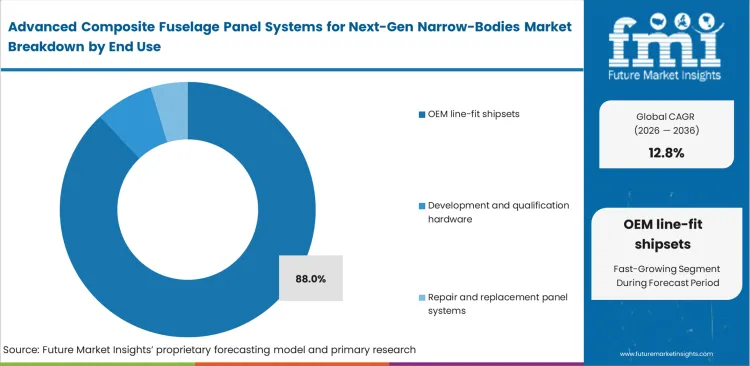
Modern repairable composite leading edge components demonstrate different aftermarket strategies entirely. Most industry models overestimate composite aftermarket revenue significantly. The OEM line-fit shipsets segment is expected to hold an 88.0% revenue share in 2026. Factors supporting compound growth include primary aircraft assembly requirements and rigid just-in-time delivery schedules, rising fuel efficiency targets, increasing passenger capacity needs, and lightweight material adoption. Major fuselage damage typically results in aircraft write-offs rather than panel replacements. Maintenance repair organizations face massive inventory carrying costs for rare replacement parts. Line-fit shipsets require flawless delivery synchronization with OEM final assembly lines. Logistics departments face severe financial penalties for supply disruptions.
- Just-in-time constraints: Line-fit shipsets require flawless delivery synchronization with OEM final assembly lines. Logistics departments face severe financial penalties for supply disruptions delaying aircraft rollout.
- Qualification hardware waste: Development hardware consumes massive amounts of expensive aerospace-grade raw materials. Manufacturing engineering leads must balance destructive testing requirements against soaring prototype production costs.
- Repair protocol complexity: Composite panel repair demands specialized environmental controls and curing equipment. Airline maintenance departments struggle to perform complex fixes efficiently during standard overnight hangar visits.
Advanced Composite Fuselage Panel Systems for Next-Gen Narrow-Bodies Market Drivers, Restraints, and Opportunities
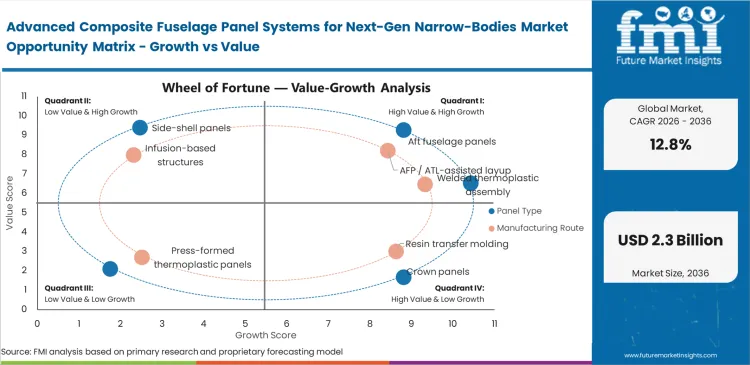
High narrow-body production rate targets compel manufacturing engineering departments to revamp legacy assembly methodologies. Commercial aviation demand requires original equipment manufacturers to increase single-aisle production toward 75 to 100 aircraft monthly. Metallic airframe assembly simply cannot achieve these rates. Scaling up demands unsustainable facility expansions and significant manual labor increases. Postponing investment in automated thermoplastic stamping or rapid-cure thermosets guarantees future financial losses. Suppliers face losing position on the next major commercial aircraft platform.
Certification friction represents a significant regulatory barrier decelerating immediate high-rate composite adoption. Aviation regulatory authorities require exhaustive damage tolerance and fatigue data. Approval of novel out-of-autoclave manufacturing processes for primary pressurized sections is mandatory. Certification managers encounter multi-year delays attempting validation of thermoplastic welded joints. Comparison of these new joints against established metallic fastener baselines is necessary. Conducting extensive coupon testing, sub-component trials, and full-scale barrel pressurization tests depletes engineering resources. Original equipment manufacturers are anticipated to temporarily pause launching clean-sheet narrow-body designs. Stretching existing metallic platforms is preferred until standardized compliance pathways emerge.
Opportunities in the Advanced Composite Fuselage Panel Systems for Next-Gen Narrow-Bodies Market
- Thermoplastic welding standardization: Engineering departments establish reliable induction or resistance welding parameters. This eliminates thousands of mechanical fasteners, capturing massive assembly time savings. Standardization processes lower production costs significantly across the entire aerospace supply chain.
- Automated inline inspection: Quality assurance leads deploy robotic aircraft fuselage corrosion monitoring sensors directly onto Automated Fiber Placement (AFP) heads. Ultrasonic scanners prevent post-cure bottlenecks efficiently. This integration guarantees consistent high-rate production without sacrificing quality control measures.
- Out-of-autoclave resin development: Materials science chiefs formulate low-temperature cure thermosets matching autoclave-cured mechanical properties. This allows suppliers to avoid massive capital infrastructure upgrades completely. Manufacturers adopt advanced resins to increase factory throughput remarkably.
Regional Analysis
Based on regional analysis, the advanced composite fuselage panel systems for next-gen narrow-bodies market is segmented into North America, Europe, Asia Pacific, Latin America, and Middle East & Africa.
.webp "Top Country Growth Comparison Advanced Composite Fuselage Panel Systems For Next Gen Narrow Bodies Market Cagr (2026 2036)")
| Country | CAGR (2026 to 2036) |
|---|---|
| China | 13.9% |
| Canada | 13.6% |
| United States | 13.3% |
| France | 13.1% |
| Germany | 12.7% |
| United Kingdom | 12.5% |
| Japan | 12.1% |
Source: Future Market Insights (FMI) analysis, based on proprietary forecasting model and primary research
North America Advanced Composite Fuselage Panel Systems for Next-Gen Narrow-Bodies Market Analysis
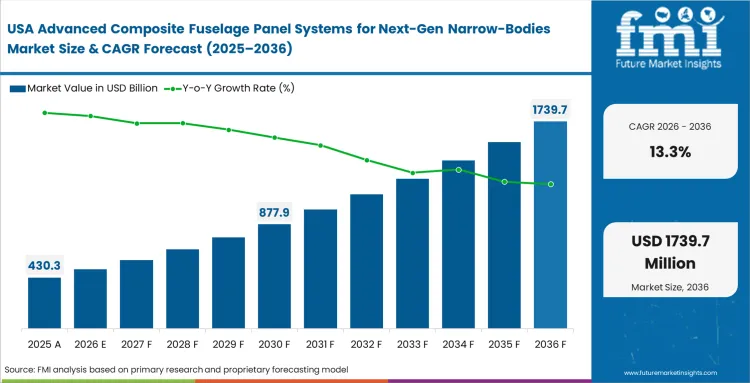
Federal funding allocations through the HiCAM program force North American Tier-1 suppliers to prioritize manufacturing velocity over absolute mass reduction. Aerostructures engineering departments must validate out-of-autoclave curing and thermoplastic press-forming before European competitors monopolize the underlying intellectual property. Meeting these high output targets requires raw material producers and panel assemblers to physically integrate their operations to match elevated assembly speeds.
- Canada: Operating active serial production lines for A220 forward and aft sections gives local aerostructures facilities a distinct operational advantage. The market for advanced composite fuselage panel systems in Canada is expected to grow at a CAGR of 13.6% by 2036. Manufacturing directors use this live environment to refine automated lay-up procedures and capture defect data that competitors running only test articles lack. This real-world production pedigree guarantees Canadian suppliers a prime position in upcoming clean-sheet narrow-body procurement cycles.
- United States: Adoption of composite fuselage panels in the United States is forecast to register a 13.3% CAGR over the study period. Hitting production targets exceeding 60 aircraft per month forces domestic composite suppliers to overhaul their capital equipment strategies entirely. Research departments apply federal grant money to construct full-scale thermoplastic barrel sections directly on the factory floor to test high-rate manufacturing concepts. Perfecting these ambitious throughput models determines which suppliers survive the next commercial aircraft ramp-up.
Europe Advanced Composite Fuselage Panel Systems for Next-Gen Narrow-Bodies Market Analysis
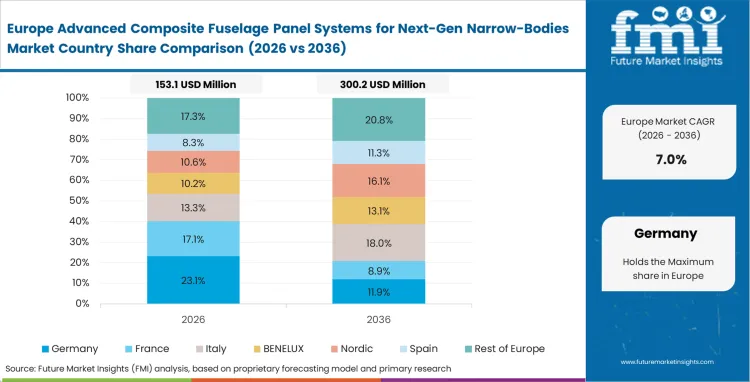
Clean Aviation directives force European engineering departments to redesign structural architecture from the ground up to meet strict recycling mandates. Regional supply chains favor thermoplastics to solve end-of-life material recovery while embedding aircraft systems directly into primary panels. Procurement officers offset the financial risk of rapid-forming and advanced welding technologies by relying on the continent's dense network of specialized composite research institutes to absorb early-stage development costs. The commercial objective is securing global control over highly integrated, multifunctional smart assemblies.
- France: Centralizing automated panel manufacturing hubs within tight geographic clusters cuts logistical friction during final fuselage barrel integration. Supply chain directors are retraining legacy metal-working populations to handle high-volume composite production without slowing delivery cadences. Demand for advanced composite fuselage panel systems in France is anticipated to rise at a CAGR of 13.1% through 2036. Keeping the entire structural integration sequence localized protects prime contractors from unpredictable cross-border supply chain disruptions.
- Germany: Perfecting thermoplastic induction welding gives local suppliers a distinct structural cost advantage over rivals still relying on traditional mechanical fastening. Germany is expected to post a CAGR of 12.7% in composite fuselage panel adoption during the forecast period. Heavy financial allocations toward advanced welding research allow engineering teams to compress assembly times for complex, multifunctional aerostructures. Retaining this specific technical edge is exactly how German Tier-1s plan to defend their margins on future narrow-body platforms.
- United Kingdom: The advanced composite fuselage panel systems industry in the United Kingdom is likely to grow at a CAGR of 12.5% during the assessment period. Subsidized full-scale demonstrator programs allow domestic suppliers to test new composite manufacturing concepts without bearing the entire research and development cost. Program managers use these government-backed facilities to defend their preferred-supplier status with major OEMs against increasingly capable overseas competitors. Keeping this sensitive intellectual property onshore ensures local research centers continue to dictate the structural architecture of next-generation aircraft.
Asia Pacific Advanced Composite Fuselage Panel Systems for Next-Gen Narrow-Bodies Market Analysis
State-backed commercial aviation ambitions finance a broad expansion of composite manufacturing infrastructure across the region. Local engineering groups direct capital toward optimizing automated fiber placement to bypass the learning curve associated with legacy metallic assembly entirely. Suppliers are abandoning basic build-to-print sub-contracting to focus on original composite structural design. Introducing recycled content into these new production lines positions the Asian supply base to pass upcoming global sustainability audits with minimal operational friction.
- China: Domestic aviation authorities deploy state capital to force absolute independence across the localized composite supply chain. Adoption of advanced composite fuselage panels in China is anticipated to increase at a CAGR of 13.9% through 2036. The intent is to master high-rate thermoplastic production to directly challenge the established Western aerospace duopoly on future narrow-body programs. Controlling the raw material all the way through to final barrel assembly guarantees that domestic aircraft programs remain immune to foreign trade restrictions.
- Japan: A near-monopoly over the supply of high-performance carbon fiber precursors gives domestic material science firms unparalleled control over global aerospace specifications. Procurement executives worldwide rely entirely on Japanese innovation to hit the extreme weight-reduction targets demanded by next-generation airframes. Japan is set to record a 12.1% CAGR in advanced composite fuselage panel adoption during the forecast period. By securing essential roles early in international demonstrator programs, local suppliers guarantee their proprietary materials are written into the absolute baseline of future aircraft architectures.
Competitive Aligners for Market Players
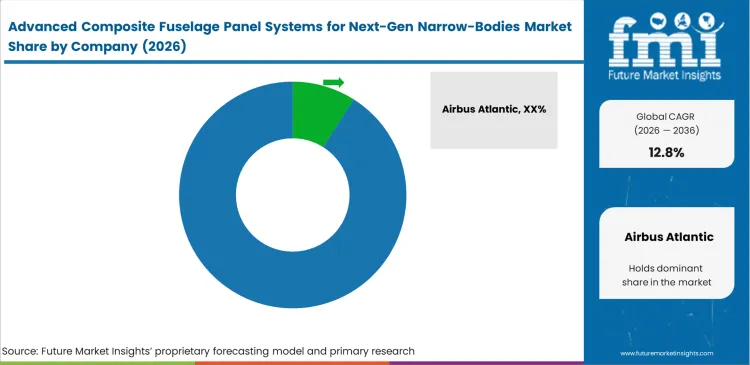
High-rate manufacturing proof has become the main competitive threshold in composite fuselage panel programs. Suppliers are no longer judged only on material capability or prototype quality. Platform selection increasingly depends on whether a bidder can show stable output, repeatable quality, and acceptable cost control at production scale. Competitive positioning is therefore shaped by access to serial manufacturing data, demonstrator evidence, and the ability to translate engineering claims into rate-ready industrial performance. A visually strong prototype may help early discussions, but it carries little weight if scale-up risk remains unresolved.
Incumbent advantage still rests on certification depth, validated material history, and early influence over design specifications. Long-established suppliers enter these competitions with broader statistical allowable databases, deeper process knowledge, and stronger familiarity with aviation approval pathways than newer challengers. New entrants may assemble advanced composite manufacturing capability, but primary fuselage panel work remains difficult to win without proven certification support and traceable performance evidence. Competitive tension also centers on specification control, since suppliers that place materials and engineering support early in the design cycle are better positioned to shape platform decisions in their favor. Aircraft OEMs manage that risk by backing competing demonstrator paths rather than allowing one supplier group to dominate a critical structure category too early.
Key Players in Advanced Composite Fuselage Panel Systems for Next-Gen Narrow-Bodies Market
- Airbus Atlantic
- Spirit AeroSystems
- GKN Aerospace
- Daher
- Hexcel
- Toray Advanced Composites
- Syensqo
Scope of the Report
| Metric | Value |
|---|---|
| Quantitative Units | USD 0.6 billion to USD 2.0 billion, at a CAGR of 12.8% |
| Market Definition | This sector comprises advanced composite primary fuselage sections engineered for future high-rate single-aisle aircraft. They satisfy rigorous pressurization requirements perfectly. They enable assembly speeds matching or exceeding metallic production rates. |
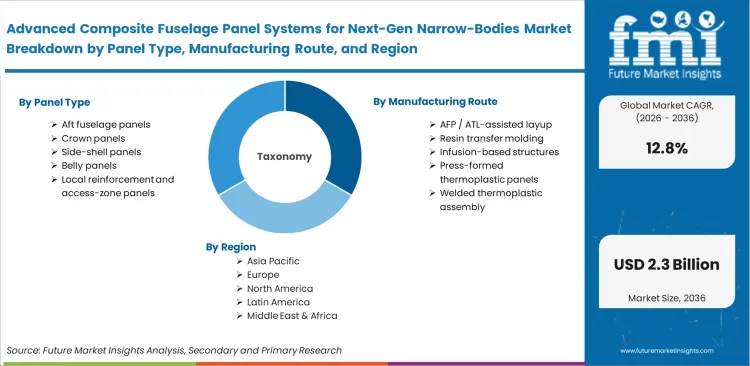
| Segmentation | Panel Type, Material System, Manufacturing Route, Program Position, End Use, Region |
| Regions Covered | North America, Europe, Asia Pacific, Latin America, Middle East & Africa |
| Countries Covered | United States, Canada, Germany, United Kingdom, France, Italy, Spain, China, Japan, South Korea, Taiwan, Singapore, Brazil, Mexico, Argentina, GCC Countries, South Africa, Israel, Rest of Middle East & Africa |
| Key Companies Profiled | Airbus Atlantic, Spirit AeroSystems, GKN Aerospace, Daher, Hexcel, Toray Advanced Composites, Syensqo |
| Forecast Period | 2026 to 2036 |
| Approach | Baseline established through current demonstrator funding, projected narrow-body build rates, and direct interviews with advanced aerostructures manufacturing leads. |
Source: Future Market Insights (FMI) analysis, based on proprietary forecasting model and primary research
Advanced Composite Fuselage Panel Systems for Next-Gen Narrow-Bodies Market Analysis by Segments
Panel Type
- Aft fuselage panels
- Crown panels
- Side-shell panels
- Belly panels
- Local reinforcement and access-zone panels
Material System
- Thermoset CFRP
- Thermoplastic CFRP
- Hybrid composite-metal laminates
- Sandwich composite structures
- Other advanced composite systems
Manufacturing Route
- AFP / ATL-assisted layup
- Resin transfer molding
- Infusion-based structures
- Press-formed thermoplastic panels
- Welded thermoplastic assembly
Program Position
- Bridge-to-next-gen narrow-body programs
- A220-based serial reference programs
- Future Airbus narrow-body pathways
- Future Boeing narrow-body pathways
- Demonstrator and qualification programs
End Use
- OEM line-fit shipsets
- Development and qualification hardware
- Repair and replacement panel systems
Region
- North America
- United States
- Canada
- Europe
- Germany
- United Kingdom
- France
- Italy
- Spain
- Asia Pacific
- China
- Japan
- South Korea
- Taiwan
- Singapore
- Latin America
- Brazil
- Mexico
- Argentina
- Middle East & Africa
- GCC Countries
- South Africa
- Israel
- Rest of Middle East & Africa
Bibliography
- Federal Aviation Administration. (2024, Jun). Transport airplane metallic and composite structures working group recommendation report (Rev. A). USA Department of Transportation.
- Kordas, P. D., Lampeas, G. N., & Fotopoulos, K. T. (2024, February). Numerical investigation of an experimental setup for thermoplastic fuselage panel testing in combined loading. Aerospace, 11(3), 175.
- Martín, I., Fernández, K., Cuenca, J., Muñoz, K., & Anaya, S. (2025, April). Design and manufacturing of thermoplastic curved fuselage panel for large passenger aircraft. Revista de Materiales Compuestos, 8.
- Mou, H., Xie, J., Feng, Z., Shi, X., & Gao, F. (2024, July). Review on the crashworthiness design and evaluation of fuselage structure for occupant survivability. Progress in Aerospace Sciences.
- Meng, Z., Liu, J., Ren, X., & Dai, J. (2026, January). Assessment of damage prediction models for composite stiffened panels under multi-point low-velocity impact and compression-after-impact. Composite Structures.
This bibliography is provided for reader reference. The full FMI report contains the complete reference list with primary source documentation.
This Report Addresses
- Aerostructures procurement departments securing capacity for high-rate single-aisle platforms.
- Engineering leads transitioning from legacy thermoset layup to thermoplastic press-forming.
- Quality assurance managers implementing automated inline inspection for AFP machinery.
- Strategic account departments bidding on NASA HiCAM and European multifunctional demonstrators.
- Tooling engineering managers designing molds adaptable for both composite curing and forming.
- Supply chain departments negotiating long-term aerospace-grade carbon fiber contracts.
- Material science chiefs formulating out-of-autoclave resin systems to bypass curing bottlenecks.
- Chief manufacturing engineers integrating welded assembly techniques to eliminate mechanical fasteners.
Frequently Asked Questions
What are advanced composite fuselage panel systems for next-gen narrow-bodies?
These systems comprise advanced exterior assemblies formulated from carbon fiber reinforced polymers. They are designed specifically to handle pressurized cabin loads. They support rapid manufacturing cycles on future single-aisle commercial aircraft perfectly.
Why are narrow-body aircraft moving toward composite fuselage panels?
Aerospace manufacturers must achieve aggressive weight reduction goals. They are simultaneously ramping production rates toward 75 to 100 aircraft per month. Metallic assembly techniques simply cannot sustain this target long-term.
Which companies are active in advanced composite fuselage panel systems?
Major Tier-1 aerospace participants leading assembly development include Airbus Atlantic, Spirit AeroSystems, and GKN Aerospace. Specialized materials firms like Toray Advanced Composites and Syensqo support them heavily.
What role does thermoplastic composite technology play in future narrow-body aircraft?
Thermoplastics eliminate lengthy autoclave curing bottlenecks completely. Production leads utilize these materials to enable rapid press-forming and automated welding. This drastically slashes part manufacturing times from days to hours.
Why is high-rate composite manufacturing critical for next-generation single-aisle programs?
High-rate capabilities determine commercial viability definitively. Original equipment manufacturers refuse to launch clean-sheet designs without supply chain guarantees. Suppliers must guarantee 60-plus aircraft per month production speeds matching existing rhythms.
How large can the advanced composite fuselage panel systems valuation become by 2036?
Cumulative revenue is expected to hit USD 2.0 billion by 2036. This expansion occurs as initial demonstrator programs transition into full-scale serial production. This supports upcoming clean-sheet single-aisle aircraft platforms.
How do composite fuselage panels versus aluminum panels compare in performance?
Composite systems provide superior fatigue resistance and damage tolerance profiles compared to aluminum. They enable significant weight reductions particularly in highly loaded aft and center-barrel assembly sections.
Why do aft fuselage panels lead the segment?
Aft panels secure a 34.0% share representing lower-risk unpressurized zones. Engineering departments use these areas to validate composite manufacturing processes before tackling highly complex pressurized side-shell assemblies.
Why does thermoset CFRP maintain dominance?
Thermoset systems hold a 55.0% share due to decades of established fatigue data. Certification managers refuse to abandon these verified materials until thermoplastic welding receives standardized regulatory approval pathways.
How does AFP/ATL influence manufacturing?
Automated fiber placement captures a 35.0% share by ensuring absolute material compaction consistency. Factory operations departments demand this automation to meet aggressive production rates while eliminating manual layup defects entirely.
Why does China show rapid compound growth?
China expands at a 13.9% CAGR as domestic aerospace authorities mandate supply chain independence. Heavy state investments in advanced composite tooling aim to support future indigenous commercial aircraft iterations directly.
How does Canadian production position itself?
Canada grows at a 13.6% CAGR by leveraging active A220 composite rear fuselage lines. Manufacturing leads use this real-world serial production experience to refine processes for upcoming clean-sheet programs.
What friction slows immediate thermoplastic adoption?
Lack of standardized certification pathways for large-scale welded assemblies stalls deployment. Tier-1 suppliers hesitate to commit massive capital to press-forming equipment until regulatory bodies clarify compliance requirements.
How do bridge programs shape supplier strategy?
Bridge programs command a 43.0% share by providing essential flight-hour validation. Supply chain departments absorb initial losses here to guarantee their positions on highly lucrative future serial production platforms.
What role do demonstrator projects play?
Demonstrators prove high-rate manufacturing feasibility at full scale. Engineering leads must show they can build assemblies quickly. Rate-capability now outweighs minor weight savings in OEM sourcing evaluations completely.
How does inspection technology impact throughput?
Manual ultrasonic testing cannot match robotic layup speeds. Quality assurance leads must deploy automated inline scanning. Massive work-in-progress bottlenecks destroy the cycle-time advantages of AFP machinery otherwise.
Why are aftermarket applications limited here?
OEM line-fit shipsets dominate with an 88.0% share because primary fuselage damage usually triggers aircraft write-offs. Maintenance departments find carrying inventory for rare complex composite panel replacements financially unviable.
How do material limits threaten OEMs?
Aerospace-grade carbon fiber supply constraints loom as production rates surge. Procurement officers must lock in precursor supply contracts now to avoid severe material shortages during the next-generation narrow-body ramp-up phase.
What advantage do incumbent suppliers hold?
Established players possess vast proprietary material allowables databases. New entrants struggle to compete because they cannot bypass the years of exhaustive statistical testing required for primary assembly certification.
How do Europe strategies differ from North America approaches?
Europe manufacturing departments focus on multifunctional thermoplastic integration to combine systems. North America leads prioritize pure rate-enabling technologies aiming to hit NASA aggressive 60-plus aircraft per month targets.
What is the impact of out-of-autoclave curing?
Out-of-autoclave resins eliminate massive capital infrastructure bottlenecks. Material science teams formulating these systems allow suppliers to scale production volume without building entirely new refrigerated storage and curing facilities.
How do fasteners influence assembly design?
Metallic fasteners add weight and create localized stress concentrations. Design chiefs push thermoplastic welding primarily to eliminate thousands of these mechanical joints vastly accelerating final assembly line speeds.
Why is tooling adaptation critical?
Capital equipment investments span decades in commercial aerospace. Tooling engineering managers must design adaptable molds handling current thermoset processes while remaining viable for future thermoplastic press-forming upgrades.
How do sustainability mandates shape material choice?
Environmental regulations push European supply chains heavily toward thermoplastics. Procurement officers favor these materials because they offer clear recycling pathways for factory scrap aligning with strict aerospace sustainability targets.
Preview the report firsthand - request a free sample
Get SampleGet the brochure for pricing and purchase details.
Get PDFTable of Content
- Executive Summary
- Global Market Outlook
- Demand-side Trends
- Supply-side Trends
- Technology Roadmap Analysis
- Analysis and Recommendations
- Market Overview
- Market Coverage / Taxonomy
- Market Definition / Scope / Limitations
- Research Methodology
- Chapter Orientation
- Analytical Lens and Working Hypotheses
- Market Structure, Signals, and Trend Drivers
- Benchmarking and Cross-market Comparability
- Market Sizing, Forecasting, and Opportunity Mapping
- Research Design and Evidence Framework
- Desk Research Programme (Secondary Evidence)
- Company Annual and Sustainability Reports
- Peer-reviewed Journals and Academic Literature
- Corporate Websites, Product Literature, and Technical Notes
- Earnings Decks and Investor Briefings
- Statutory Filings and Regulatory Disclosures
- Technical White Papers and Standards Notes
- Trade Journals, Industry Magazines, and Analyst Briefs
- Conference Proceedings, Webinars, and Seminar Materials
- Government Statistics Portals and Public Data Releases
- Press Releases and Reputable Media Coverage
- Specialist Newsletters and Curated Briefings
- Sector Databases and Reference Repositories
- FMI Internal Proprietary Databases and Historical Market Datasets
- Subscription Datasets and Paid Sources
- Social Channels, Communities, and Digital Listening Inputs
- Additional Desk Sources
- Expert Input and Fieldwork (Primary Evidence)
- Primary Modes
- Qualitative Interviews and Expert Elicitation
- Quantitative Surveys and Structured Data Capture
- Blended Approach
- Why Primary Evidence is Used
- Field Techniques
- Interviews
- Surveys
- Focus Groups
- Observational and In-context Research
- Social and Community Interactions
- Stakeholder Universe Engaged
- C-suite Leaders
- Board Members
- Presidents and Vice Presidents
- R&D and Innovation Heads
- Technical Specialists
- Domain Subject-matter Experts
- Scientists
- Physicians and Other Healthcare Professionals
- Governance, Ethics, and Data Stewardship
- Research Ethics
- Data Integrity and Handling
- Primary Modes
- Tooling, Models, and Reference Databases
- Desk Research Programme (Secondary Evidence)
- Data Engineering and Model Build
- Data Acquisition and Ingestion
- Cleaning, Normalisation, and Verification
- Synthesis, Triangulation, and Analysis
- Quality Assurance and Audit Trail
- Market Background
- Market Dynamics
- Drivers
- Restraints
- Opportunity
- Trends
- Scenario Forecast
- Demand in Optimistic Scenario
- Demand in Likely Scenario
- Demand in Conservative Scenario
- Opportunity Map Analysis
- Product Life Cycle Analysis
- Supply Chain Analysis
- Investment Feasibility Matrix
- Value Chain Analysis
- PESTLE and Porter’s Analysis
- Regulatory Landscape
- Regional Parent Market Outlook
- Production and Consumption Statistics
- Import and Export Statistics
- Market Dynamics
- Global Market Analysis 2021 to 2025 and Forecast, 2026 to 2036
- Historical Market Size Value (USD Million) Analysis, 2021 to 2025
- Current and Future Market Size Value (USD Million) Projections, 2026 to 2036
- Y-o-Y Growth Trend Analysis
- Absolute $ Opportunity Analysis
- Global Market Pricing Analysis 2021 to 2025 and Forecast 2026 to 2036
- Global Market Analysis 2021 to 2025 and Forecast 2026 to 2036, By Panel Type
- Introduction / Key Findings
- Historical Market Size Value (USD Million) Analysis By Panel Type , 2021 to 2025
- Current and Future Market Size Value (USD Million) Analysis and Forecast By Panel Type , 2026 to 2036
- Aft fuselage panels
- Crown panels
- Side-shell panels
- Belly panels
- Local reinforcement and access-zone panels
- Aft fuselage panels
- Y-o-Y Growth Trend Analysis By Panel Type , 2021 to 2025
- Absolute $ Opportunity Analysis By Panel Type , 2026 to 2036
- Global Market Analysis 2021 to 2025 and Forecast 2026 to 2036, By Manufacturing Route
- Introduction / Key Findings
- Historical Market Size Value (USD Million) Analysis By Manufacturing Route, 2021 to 2025
- Current and Future Market Size Value (USD Million) Analysis and Forecast By Manufacturing Route, 2026 to 2036
- AFP / ATL-assisted layup
- Resin transfer molding
- Infusion-based structures
- Press-formed thermoplastic panels
- Welded thermoplastic assembly
- AFP / ATL-assisted layup
- Y-o-Y Growth Trend Analysis By Manufacturing Route, 2021 to 2025
- Absolute $ Opportunity Analysis By Manufacturing Route, 2026 to 2036
- Global Market Analysis 2021 to 2025 and Forecast 2026 to 2036, By Program Position
- Introduction / Key Findings
- Historical Market Size Value (USD Million) Analysis By Program Position, 2021 to 2025
- Current and Future Market Size Value (USD Million) Analysis and Forecast By Program Position, 2026 to 2036
- Bridge-to-next-gen narrow-body programs
- A220-based serial reference programs
- Future Airbus narrow-body pathways
- Future Boeing narrow-body pathways
- Demonstrator and qualification programs
- Bridge-to-next-gen narrow-body programs
- Y-o-Y Growth Trend Analysis By Program Position, 2021 to 2025
- Absolute $ Opportunity Analysis By Program Position, 2026 to 2036
- Global Market Analysis 2021 to 2025 and Forecast 2026 to 2036, By End Use
- Introduction / Key Findings
- Historical Market Size Value (USD Million) Analysis By End Use, 2021 to 2025
- Current and Future Market Size Value (USD Million) Analysis and Forecast By End Use, 2026 to 2036
- OEM line-fit shipsets
- Development and qualification hardware
- Repair and replacement panel systems
- OEM line-fit shipsets
- Y-o-Y Growth Trend Analysis By End Use, 2021 to 2025
- Absolute $ Opportunity Analysis By End Use, 2026 to 2036
- Global Market Analysis 2021 to 2025 and Forecast 2026 to 2036, By Region
- Introduction
- Historical Market Size Value (USD Million) Analysis By Region, 2021 to 2025
- Current Market Size Value (USD Million) Analysis and Forecast By Region, 2026 to 2036
- North America
- Latin America
- Western Europe
- Eastern Europe
- East Asia
- South Asia and Pacific
- Middle East & Africa
- Market Attractiveness Analysis By Region
- North America Market Analysis 2021 to 2025 and Forecast 2026 to 2036, By Country
- Historical Market Size Value (USD Million) Trend Analysis By Market Taxonomy, 2021 to 2025
- Market Size Value (USD Million) Forecast By Market Taxonomy, 2026 to 2036
- By Country
- USA
- Canada
- Mexico
- By Panel Type
- By Manufacturing Route
- By Program Position
- By End Use
- By Country
- Market Attractiveness Analysis
- By Country
- By Panel Type
- By Manufacturing Route
- By Program Position
- By End Use
- Key Takeaways
- Latin America Market Analysis 2021 to 2025 and Forecast 2026 to 2036, By Country
- Historical Market Size Value (USD Million) Trend Analysis By Market Taxonomy, 2021 to 2025
- Market Size Value (USD Million) Forecast By Market Taxonomy, 2026 to 2036
- By Country
- Brazil
- Chile
- Rest of Latin America
- By Panel Type
- By Manufacturing Route
- By Program Position
- By End Use
- By Country
- Market Attractiveness Analysis
- By Country
- By Panel Type
- By Manufacturing Route
- By Program Position
- By End Use
- Key Takeaways
- Western Europe Market Analysis 2021 to 2025 and Forecast 2026 to 2036, By Country
- Historical Market Size Value (USD Million) Trend Analysis By Market Taxonomy, 2021 to 2025
- Market Size Value (USD Million) Forecast By Market Taxonomy, 2026 to 2036
- By Country
- Germany
- UK
- Italy
- Spain
- France
- Nordic
- BENELUX
- Rest of Western Europe
- By Panel Type
- By Manufacturing Route
- By Program Position
- By End Use
- By Country
- Market Attractiveness Analysis
- By Country
- By Panel Type
- By Manufacturing Route
- By Program Position
- By End Use
- Key Takeaways
- Eastern Europe Market Analysis 2021 to 2025 and Forecast 2026 to 2036, By Country
- Historical Market Size Value (USD Million) Trend Analysis By Market Taxonomy, 2021 to 2025
- Market Size Value (USD Million) Forecast By Market Taxonomy, 2026 to 2036
- By Country
- Russia
- Poland
- Hungary
- Balkan & Baltic
- Rest of Eastern Europe
- By Panel Type
- By Manufacturing Route
- By Program Position
- By End Use
- By Country
- Market Attractiveness Analysis
- By Country
- By Panel Type
- By Manufacturing Route
- By Program Position
- By End Use
- Key Takeaways
- East Asia Market Analysis 2021 to 2025 and Forecast 2026 to 2036, By Country
- Historical Market Size Value (USD Million) Trend Analysis By Market Taxonomy, 2021 to 2025
- Market Size Value (USD Million) Forecast By Market Taxonomy, 2026 to 2036
- By Country
- China
- Japan
- South Korea
- By Panel Type
- By Manufacturing Route
- By Program Position
- By End Use
- By Country
- Market Attractiveness Analysis
- By Country
- By Panel Type
- By Manufacturing Route
- By Program Position
- By End Use
- Key Takeaways
- South Asia and Pacific Market Analysis 2021 to 2025 and Forecast 2026 to 2036, By Country
- Historical Market Size Value (USD Million) Trend Analysis By Market Taxonomy, 2021 to 2025
- Market Size Value (USD Million) Forecast By Market Taxonomy, 2026 to 2036
- By Country
- India
- ASEAN
- Australia & New Zealand
- Rest of South Asia and Pacific
- By Panel Type
- By Manufacturing Route
- By Program Position
- By End Use
- By Country
- Market Attractiveness Analysis
- By Country
- By Panel Type
- By Manufacturing Route
- By Program Position
- By End Use
- Key Takeaways
- Middle East & Africa Market Analysis 2021 to 2025 and Forecast 2026 to 2036, By Country
- Historical Market Size Value (USD Million) Trend Analysis By Market Taxonomy, 2021 to 2025
- Market Size Value (USD Million) Forecast By Market Taxonomy, 2026 to 2036
- By Country
- Kingdom of Saudi Arabia
- Other GCC Countries
- Turkiye
- South Africa
- Other African Union
- Rest of Middle East & Africa
- By Panel Type
- By Manufacturing Route
- By Program Position
- By End Use
- By Country
- Market Attractiveness Analysis
- By Country
- By Panel Type
- By Manufacturing Route
- By Program Position
- By End Use
- Key Takeaways
- Key Countries Market Analysis
- USA
- Pricing Analysis
- Market Share Analysis, 2025
- By Panel Type
- By Manufacturing Route
- By Program Position
- By End Use
- Canada
- Pricing Analysis
- Market Share Analysis, 2025
- By Panel Type
- By Manufacturing Route
- By Program Position
- By End Use
- Mexico
- Pricing Analysis
- Market Share Analysis, 2025
- By Panel Type
- By Manufacturing Route
- By Program Position
- By End Use
- Brazil
- Pricing Analysis
- Market Share Analysis, 2025
- By Panel Type
- By Manufacturing Route
- By Program Position
- By End Use
- Chile
- Pricing Analysis
- Market Share Analysis, 2025
- By Panel Type
- By Manufacturing Route
- By Program Position
- By End Use
- Germany
- Pricing Analysis
- Market Share Analysis, 2025
- By Panel Type
- By Manufacturing Route
- By Program Position
- By End Use
- UK
- Pricing Analysis
- Market Share Analysis, 2025
- By Panel Type
- By Manufacturing Route
- By Program Position
- By End Use
- Italy
- Pricing Analysis
- Market Share Analysis, 2025
- By Panel Type
- By Manufacturing Route
- By Program Position
- By End Use
- Spain
- Pricing Analysis
- Market Share Analysis, 2025
- By Panel Type
- By Manufacturing Route
- By Program Position
- By End Use
- France
- Pricing Analysis
- Market Share Analysis, 2025
- By Panel Type
- By Manufacturing Route
- By Program Position
- By End Use
- India
- Pricing Analysis
- Market Share Analysis, 2025
- By Panel Type
- By Manufacturing Route
- By Program Position
- By End Use
- ASEAN
- Pricing Analysis
- Market Share Analysis, 2025
- By Panel Type
- By Manufacturing Route
- By Program Position
- By End Use
- Australia & New Zealand
- Pricing Analysis
- Market Share Analysis, 2025
- By Panel Type
- By Manufacturing Route
- By Program Position
- By End Use
- China
- Pricing Analysis
- Market Share Analysis, 2025
- By Panel Type
- By Manufacturing Route
- By Program Position
- By End Use
- Japan
- Pricing Analysis
- Market Share Analysis, 2025
- By Panel Type
- By Manufacturing Route
- By Program Position
- By End Use
- South Korea
- Pricing Analysis
- Market Share Analysis, 2025
- By Panel Type
- By Manufacturing Route
- By Program Position
- By End Use
- Russia
- Pricing Analysis
- Market Share Analysis, 2025
- By Panel Type
- By Manufacturing Route
- By Program Position
- By End Use
- Poland
- Pricing Analysis
- Market Share Analysis, 2025
- By Panel Type
- By Manufacturing Route
- By Program Position
- By End Use
- Hungary
- Pricing Analysis
- Market Share Analysis, 2025
- By Panel Type
- By Manufacturing Route
- By Program Position
- By End Use
- Kingdom of Saudi Arabia
- Pricing Analysis
- Market Share Analysis, 2025
- By Panel Type
- By Manufacturing Route
- By Program Position
- By End Use
- Turkiye
- Pricing Analysis
- Market Share Analysis, 2025
- By Panel Type
- By Manufacturing Route
- By Program Position
- By End Use
- South Africa
- Pricing Analysis
- Market Share Analysis, 2025
- By Panel Type
- By Manufacturing Route
- By Program Position
- By End Use
- USA
- Market Structure Analysis
- Competition Dashboard
- Competition Benchmarking
- Market Share Analysis of Top Players
- By Regional
- By Panel Type
- By Manufacturing Route
- By Program Position
- By End Use
- Competition Analysis
- Competition Deep Dive
- Airbus Atlantic
- Overview
- Product Portfolio
- Profitability by Market Segments (Product/Age /Sales Channel/Region)
- Sales Footprint
- Strategy Overview
- Marketing Strategy
- Product Strategy
- Channel Strategy
- Spirit AeroSystems
- GKN Aerospace
- Daher
- Hexcel
- Toray Advanced Composites
- Syensqo
- Airbus Atlantic
- Competition Deep Dive
- Assumptions & Acronyms Used


