

- Industry Size (2026)
- USD 450.0 Mn
- Forecast (2036)
- USD 840.0 Mn
- CAGR (2026 to 2036)
- 6.40%
Lightweight Composite External Access Panels and Doors Market Size, Market Forecast and Outlook By FMI
The lightweight composite external access panels and doors valuation market secured a valuation of USD 420.0 million in 2025. Sector revenue is anticipated to surpass USD 450.0 million in 2026, expanding at a 6.40% CAGR during the forecast period. Investment in payload optimization is expected to lift the market valueto USD 840.0 million by 2036, as airlines continue to prioritize lower airframe weight to manage fuel costs.
Summary for Lightweight Composite External Access Panels and Doors Market
- The market is forecast to reach USD 840.0 million by 2036.
- The market is expected to grow at a CAGR of 6.40% from 2026 to 2036.
- The market was estimated at USD 420.0 million in 2025.
- The market is projected to reach USD 450.0 million in 2026.
- The forecast period represents an incremental opportunity of USD 390.0 million.
- Commercial aircraft lead the end-use segment with a 54.0% share in 2026.
- Fuel access doors dominate by application with a 29.0% share in 2026.
- Carbon fiber epoxy leads by material with a 48.0% share in 2026.
- China is the fastest-growing market at 8.1%, followed by India at 7.6% and the United States at 5.9%.
- The market is driven by aircraft lightweighting, fuel efficiency requirements, and increasing composite adoption in aerostructures.
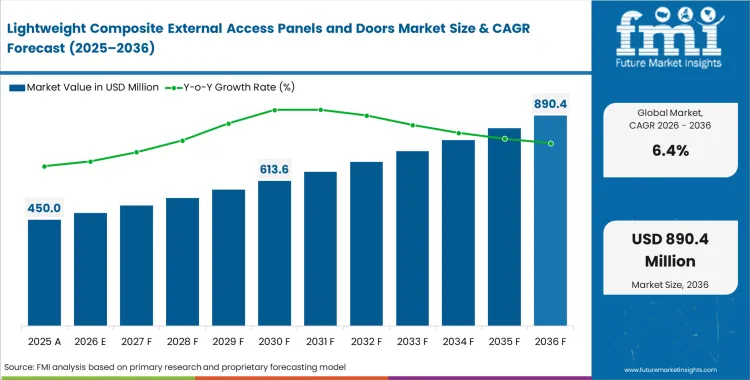
Procurement directors at major aerospace OEMs face intense pressure to validate composite aircraft access doors over legacy aluminum panels across next-generation commercial fleets. Relying on metallic covers forces operators into costly corrosion inspection cycles and adds parasitic weight that directly reduces payload capacity. Choosing aerospace lightweight materials becomes an operational necessity rather than a design preference, with delays in qualification immediately resulting in lost supplier contracts on new aircraft platforms. Certified aerospace composite panel manufacturers mastering complex geometries command premium pricing while legacy metal fabricators lose buyer contracts rapidly.
Once type-certificate holders validate carbon fiber access panels for primary fuel tank entry, mass adoption across secondary service hatches follows quickly. Certification provides necessary regulatory precedent, substantially reducing compliance friction for subsequent non-metallic implementations across fuselage sections. Early adopters establish proprietary layup techniques that competitors struggle to replicate without extensive testing delays.
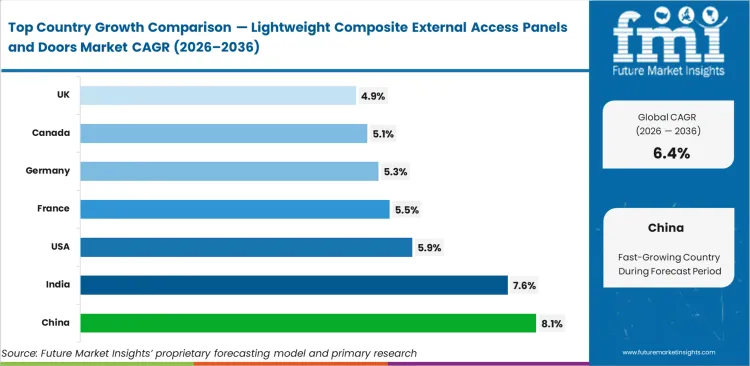
Regional variation continues to reflect one basic divide: markets with stronger domestic composite manufacturing capacity are moving faster than those still dependent on imported finished assemblies. China is expected to post 8.1% CAGR in 2026 to 2036 as domestic aircraft programs push harder on supply chain localization for lightweight aerostructure doors. Localized MRO build-out and fleet expansion are keeping India on a 7.6% growth path over the same period. Established OEM production lines transitioning toward next-generation airframes support 5.9% CAGR in the United States. France and Germany are projected at 5.5% and 5.3%, respectively, backed by continued European commitment to non-metallic component integration. Canada is estimated to expand at 5.1% during the forecast period, while the United Kingdom is likely to record 4.9% CAGR through 2036.
Lightweight Composite External Access Panels and Doors Market Key Takeaways
| Metric | Details |
|---|---|
| Industry Size (2026) | USD 450 million |
| Industry Value (2036) | USD 840 million |
| CAGR (2026 to 2036) | 6.40% |
Source: Future Market Insights (FMI) analysis, based on proprietary forecasting model and primary research
Segmental Analysis
Lightweight Composite External Access Panels and Doors Market Analysis by Aircraft type
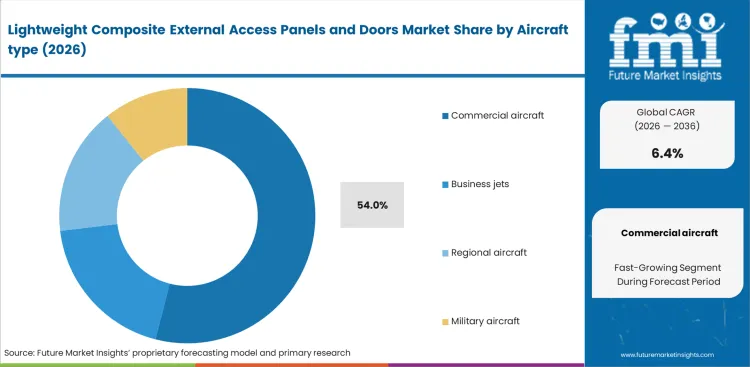
Commercial aircraft delivery backlogs dominate forward-looking procurement cycles for tier-1 component suppliers. It is expected to command for 54.0% share in 2026. Fleet planning directors at major airlines prioritize next-generation narrowbody aircraft equipped with maximum lightweight components to minimize fuel burn per passenger mile. Replacing standard metallic components with composite aircraft access panels yields measurable payload capacity improvements over a standard 25-year airframe lifecycle. What standard weight-saving calculations often ignore is how composite airframes reduce required engine thrust, thereby extending engine time-on-wing. MRO facility managers who fail to adapt their repair protocols for extensive commercial composite assemblies face significant operational delays and potential loss of airline service contracts. Transitioning these repair workflows requires specialized training and controlled environment facilities.
- Initial specification: Fleet planning directors evaluate total weight savings against initial acquisition costs. Achieving positive lifecycle economics validates initial adoption decisions.
- Factory integration: Assembly line supervisors monitor fitment tolerances during final aircraft integration. Consistent dimensional accuracy prevents costly manual rework at final assembly stations.
- Operational renewal: Airline maintenance chiefs track component durability across thousands of flight cycles. Superior fatigue resistance justifies long-term standardized composite panel procurement.
Lightweight Composite External Access Panels and Doors Market Analysis by Product
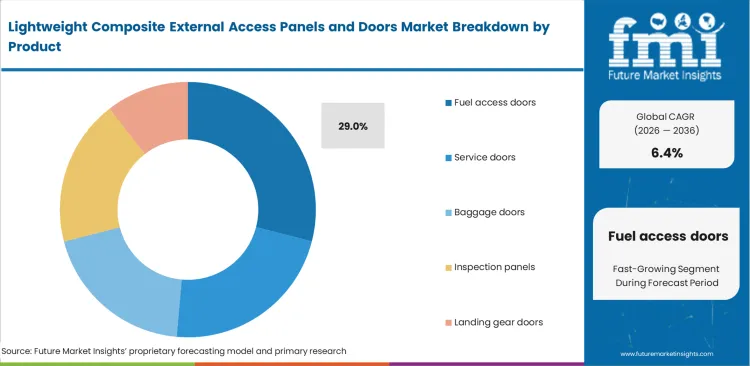
Legacy aluminum inspection covers fail to provide necessary corrosion resistance for components constantly exposed to harsh aviation fluids. The fuel access doors are anticipated to secure 29.0% share in 2026. Wing engineering leads recognize integrating composite covers eliminates galvanic corrosion typical in traditional metallic-to-metallic fastening, especially in high-moisture fuel tank environments. Transitioning to these non-metallic covers extends mandatory inspection intervals, directly improving aircraft availability. One detail often overlooked is that composite inspection panels require specialized conductive coatings to maintain aircraft fairings lightning strike protection continuity, adding complexity to manufacturing processes. Tooling engineers unable to achieve tight dimensional tolerances on these complex layups risk complete part rejection during final assembly quality checks. Securing precision tooling capabilities dictates supplier survival in this specific product tier.
- Galvanic corrosion prevention: Non-metallic materials eliminate electrochemical degradation at fastener points. Maintenance crews avoid extensive rework schedules previously required for metallic access doors.
- Impact delamination risks: High-energy tool drops during routine maintenance create hidden internal material damage. NDT technicians must deploy specialized ultrasonic inspection equipment to verify panel integrity.
- Protective coating requirements: Proper application of conductive surface films remains mandatory for certification. Manufacturing leads face severe production bottlenecks if coating stations underperform.
Lightweight Composite External Access Panels and Doors Market Analysis by Material
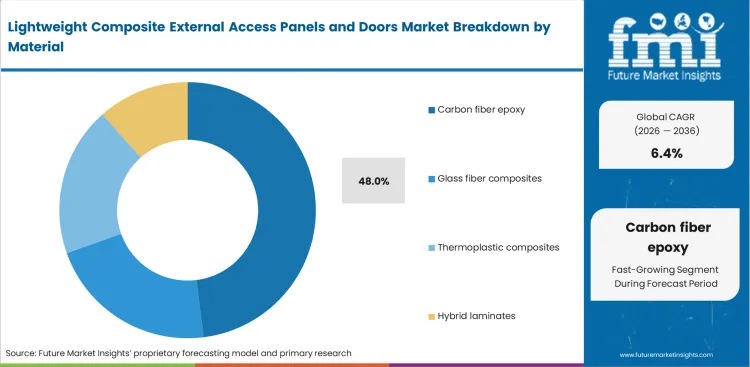
Exceptional fatigue resistance drives selection of specific resin matrices for high-stress aerospace access panels. The carbon fiber epoxy is expected to hold for 48.0% share in 2026. Material science directors specify this exact combination because it delivers predictable mechanical performance across extreme temperature fluctuations experienced during typical flight cycles. Integrating this material allows airframers to reduce fastener count around access cutouts, streamlining final assembly operations. One hidden reality is that high performance composites out-of-time limits in freezers dictate production rhythms more than actual layup time, forcing suppliers to optimize inventory management precisely. Procurement managers failing to secure dedicated cold-storage supply chains face severe manufacturing bottlenecks. Maintaining rigorous material handling protocols separates profitable tier-1 fabricators from struggling secondary suppliers.
- Resin formulation chemistry: Specific epoxy blends provide required toughness for repetitive cyclic loading. Material scientists validate these formulations to ensure long-term component survival.
- Prepreg shelf life: Raw material temperature sensitivity constrains factory storage durations. Operations managers must coordinate raw material deliveries precisely with daily layup schedules.
- Automated tape laying: Advanced robotic fabrication replaces manual laminating processes for high-volume panels. Manufacturing vice presidents rely on automation to stabilize unit costs.
Lightweight Composite External Access Panels and Doors Market Analysis by Sales channel
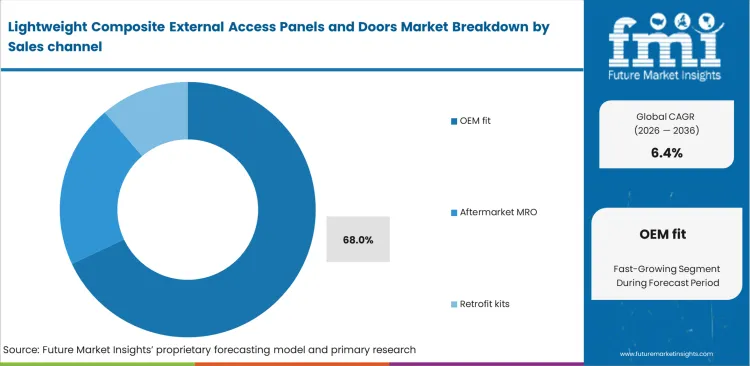
Component sourcing managers must choose between integrating panels during initial airframe construction or supplying aftermarket channels. OEM fit is predicted for 68.0% share in 2026. Aircraft program directors mandate complete composite integration at factory levels to ensure all aerodynamic surfaces meet stringent type-certificate performance guarantees. Factory installation guarantees perfect dimensional matching with surrounding composite skins, eliminating step-and-gap issues common with aftermarket replacements. Interestingly, high OEM share obscures a growing secondary space where specialized fabricators reverse-engineer OEM designs to produce commercial aircraft mro replacement panels. Suppliers ignoring aftermarket replacement cycles leave high-margin recurring revenue entirely to specialized independent repair stations. Cultivating direct airline relationships for replacement parts offers higher profit margins than highly negotiated factory supply contracts.
- Initial factory delivery: Component suppliers align production batches with airframer master schedules. Logistics coordinators avoid severe financial penalties by maintaining perfect delivery reliability.
- MRO inventory stocking: Independent repair stations require immediate access to common replacement panels. Supply chain directors build regional distribution centers to capture urgent AOG orders.
- Legacy fleet retrofits: Airline engineering teams upgrade older airframes with modern composite access doors. Program managers capture additional revenue by offering complete upgrade kits.
Lightweight Composite External Access Panels and Doors Market Analysis by End use
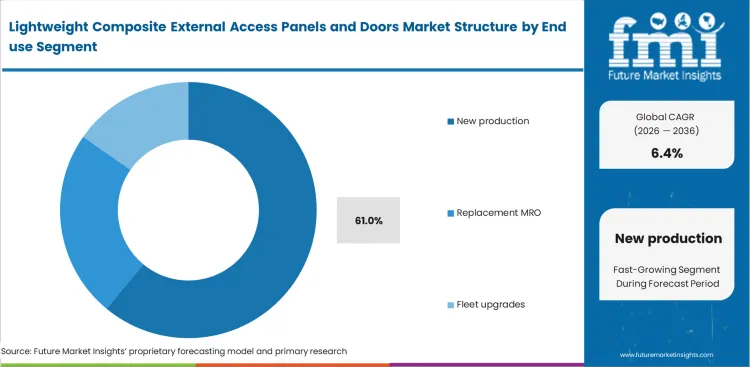
Achieving targeted production ramp-up rates depends entirely on securing consistent component deliveries from tier-1 integrators. The new production is likely to account for 61.0% share in 2026. Supply chain vice presidents negotiate multi-year agreements to guarantee access to sufficient composite panel volumes for scheduled assembly line positions. Locking in these long-term contracts shields airframers from spot-market material shortages and price volatility. Behind this dominant share figure lies a reality that new production panels often require manual hand-finishing to meet final aerodynamic smoothness criteria, counteracting investments in automated aircraft seals equipment. Manufacturers relying purely on manual finishing face strict production rate limits that cap potential revenue growth.
- Raw material procurement: Bulk purchasing strategies generate measurable unit cost reductions. Finance directors calculate these savings to maintain competitive bidding positions.
- Secondary machining costs: Trimming complex cured laminates consumes expensive consumable tooling rapidly. Production supervisors track tool wear precisely to prevent unexpected manufacturing stoppages.
- Lifecycle cost models: Higher initial purchase prices offset long-term maintenance expenditures. Airline purchasing agents use total ownership calculations to justify composite panel selections.
Lightweight Composite External Access Panels and Doors Market Drivers, Restraints, and Opportunities
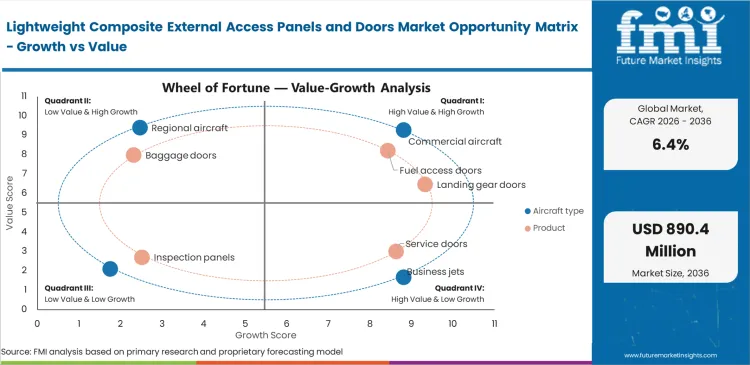
Airline payload targets are pushing engineering teams to remove avoidable weight from new narrowbody designs, and external access hardware is one of the areas under close review. Comparing composite access doors with metallic alternatives shows clear weight savings when those reductions are multiplied across the many access points built into each airframe. That improvement carries direct commercial value because fuel-burn commitments and operating-cost guarantees influence fleet awards. Aerospace access door manufacturers are therefore being asked to qualify composite designs for more complex geometries that were previously left to aluminum or titanium parts.
Certification remains a meaningful barrier to wider supplier entry. Primary and semi-critical access panels still require extensive fatigue, impact, and damage-tolerance validation before they can move into production. Digital twin tools can shorten early design work, but they do not remove the need for physical coupon and destructive testing, and that keeps development cycles long. Incumbent suppliers benefit from that approval burden, while newer entrants face slower adoption paths for novel thermoplastic materials.
Opportunities in the Lightweight Composite External Access Panels and Doors Market
- Out-of-autoclave processing: Tooling engineers implementing vacuum-bag-only curing methods bypass expensive autoclave bottlenecks. Manufacturing directors reduce capital expenditure requirements significantly.
- Thermoplastic welding integration: Advanced joining techniques eliminate mechanical fasteners entirely. Design leads achieve smoother aerostructure surfaces reducing parasitic drag.
- Embedded sensor networks: Integrating structural health monitoring fibers during layup creates intelligent access hatches. Maintenance chiefs shift from scheduled inspections to predictive replacement models.
Regional Analysis
Based on regional analysis, Lightweight Composite External Access Panels and Doors is segmented into Asia Pacific, North America, and Europe across 40 plus countries.
.webp "Top Country Growth Comparison Lightweight Composite External Access Panels And Doors Market Cagr (2026 2036)")
| Country | CAGR (2026 to 2036) |
|---|---|
| China | 8.1% |
| India | 7.6% |
| United States | 5.9% |
| France | 5.5% |
| Germany | 5.3% |
| Canada | 5.1% |
| United Kingdom | 4.9% |
Source: Future Market Insights (FMI) analysis, based on proprietary forecasting model and primary research
Asia Pacific Lightweight Composite External Access Panels and Doors Market Analysis
Asia Pacific remains the fastest-expanding production base for lightweight composite external access panels and doors as local aircraft manufacturing programs scale and regional suppliers move further into qualified aerostructure work. Procurement decisions across the region are closely tied to localization rules, tariff treatment, and the need to build domestic aerospace capability rather than rely on imported assemblies. That shift buying patterns toward local composite fabricators, joint manufacturing arrangements, and regional repair support. MRO networks are also upgrading composite inspection and repair capacity as newer aircraft platforms enter service, which keeps both OEM and replacement demand active across the region.
- China: Lightweight composite external access panels and doors market in China is set to expand at an 8.1% CAGR through 2036. State-backed aircraft programs are expanding domestic composite fabrication capacity, and local sourcing requirements continue to favor suppliers with production inside the country. Companies that establish in-country manufacturing and qualification support are better placed to secure long-duration supply positions on commercial aircraft programs.
- India: Rapid fleet addition is putting pressure on maintenance capacity, and that is lifting demand for composite access panels and doors alongside repair capability. The market in India is likely to advance at a 7.6% CAGR through 2036 as airlines, MRO operators, and distribution partners shorten turnaround times for replacement parts. Suppliers with local inventory access and repair support are in a stronger position to win urgent orders.
FMI's report includes Japan and South Korea. Mature aerospace manufacturing ecosystems in these nations focus on highly automated precision composite fabrication for premium widebody aircraft platforms.
North America Lightweight Composite External Access Panels and Doors Market Analysis
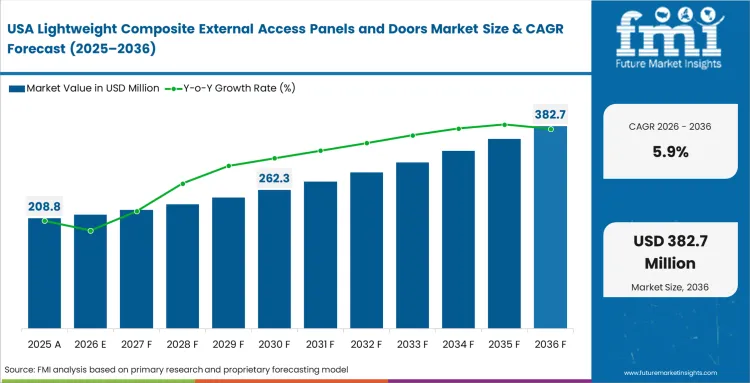
North America remains a core production and replacement market because commercial aerospace output, supplier depth, and MRO activity are all well established. Demand is linked to final assembly schedules, long-term materials planning, and the need to maintain part consistency across large production runs. Composite access doors and panels are also gaining relevance in fleet maintenance as operators replace older metallic components during heavy checks and life-extension work. Suppliers that maintain delivery discipline, qualification reliability, and repeatable part quality remain better positioned in this region.
- United States: The United States market is expected to post a 5.9% CAGR through 2036, supported by large commercial aerospace programs and rising interest in faster-cycle composite manufacturing. OEMs are pushing suppliers to improve cure times, production efficiency, and dimensional accuracy without compromising qualification standards. That keeps advanced material processing and dependable delivery performance central to supplier selection.
- Canada: Regional aircraft manufacturing and specialized aerostructure work continue to support demand across Canada. Lightweight composite external access panels and doors demand in the country is expected to rise at a 5.1% CAGR over the forecast period, with cold-weather durability and impact performance remaining important design considerations. Suppliers that can meet those operating conditions gain an advantage in program-specific applications.
FMI's report includes Mexico. Cross-border aerospace manufacturing continues to support component production through cost-efficient fabrication combined with North American quality and certification requirements.
Europe Lightweight Composite External Access Panels and Doors Market Analysis
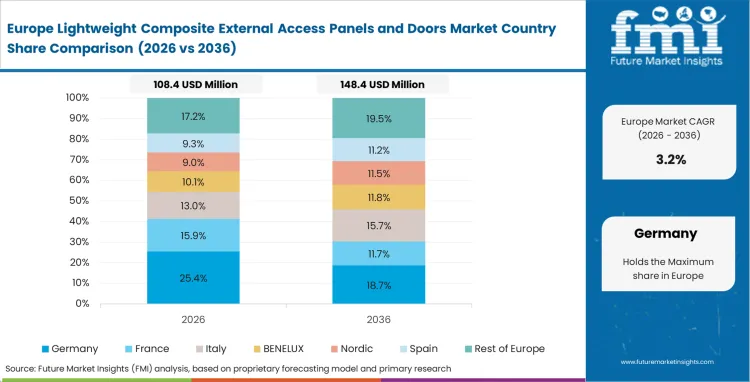
Europe remains an important market for this category because the region combines airframe production, aerostructure specialization, and advanced composite engineering capability. Procurement is shaped by environmental compliance, chemical restrictions, process qualification, and close coordination with final assembly programs. Composite suppliers also face added pressure to reduce material waste, improve process efficiency, and maintain certification discipline as customers tighten expectations around both quality and production economics. Smaller manufacturers can participate, but qualification cost and compliance burden still favor established aerospace suppliers with proven program experience.
- France: Close proximity to final assembly activity keeps France central to high-value composite panel and door manufacturing. The market for lightweight composite external access panels and doors in France is forecast to expand at a 5.5% CAGR through 2036 as suppliers align layup, curing, and inspection operations with airframer production needs. Local manufacturing presence also reduces handling risk for finished composite parts.
- Germany: Automated process development continues to influence supplier competitiveness in Germany, where manufacturers are investing in repeatable resin infusion and precision tooling methods. The country is likely to record 5.3% CAGR in the lightweight composite external access panels and doors market through 2036. Producers that reduce manual variation and improve production consistency are better placed to serve higher-volume aerospace programs.
- United Kingdom: Wing-focused aerospace manufacturing keeps demand concentrated in technically demanding access covers and panel assemblies. Design and tooling teams work to very tight dimensional requirements, and suppliers that meet those standards can secure durable program positions. The United Kingdom is expected to register a 4.9% CAGR in this market through 2036. That reflects a steady pipeline tied to specialized aerostructure applications.
FMI's report includes Italy and Spain. Both countries support the regional supply base through specialized aerostructure fabrication and composite subassembly production linked to broader European aircraft programs.
Competitive Aligners for Market Players
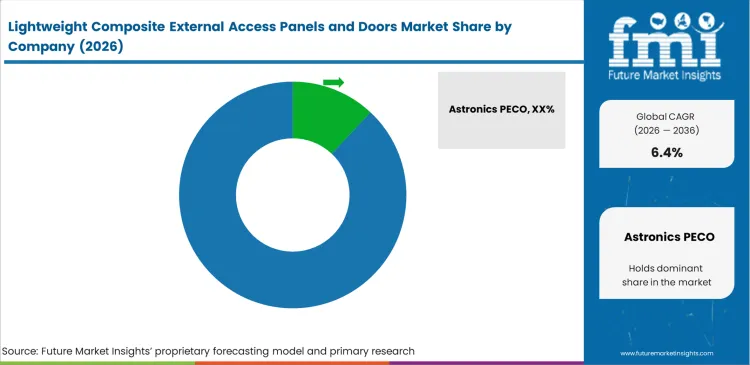
Competition in this market is shaped more by supply-chain position than by open-price bidding. Entry remains difficult because buyers place higher value on qualification certainty, tooling readiness, and engineering integration with major airframe programs than on headline cost alone. Suppliers already embedded in prime contractor structures hold an advantage when broader door and panel packages are awarded, since that reduces coordination effort, keeps model alignment tighter, and lowers disruption risk during production.
A different competitive path is emerging around process innovation and manufacturing flexibility. Faster production cycles, tighter cost control, and better suitability for complex access-door programs are improving the position of suppliers investing in out-of-autoclave routes and more automated resin transfer molding lines. That advantage becomes more relevant where newer thermoplastic door concepts and weldable, lower-fastener panel designs offer airframe designers greater manufacturing choice. Suppliers with deeper dependence on conventional epoxy processing can take longer to adjust when platform preferences begin to move toward newer materials and fabrication methods.
Aftermarket support adds a separate competitive test once components enter airline service. Warranty coverage and dependable repair response carry weight because grounded aircraft create immediate operational pressure for carriers. Local composite repair capability near major airline hubs strengthens supplier positioning in those cases, especially when maintenance teams are deciding between field repair and full replacement after delamination or panel damage. Suppliers that cannot support that decision close to the aircraft are less likely to secure direct airline purchasing opportunities.
Key Players in Lightweight Composite External Access Panels and Doors Market
- Astronics PECO
- Sonaca
- Daher
- Latécoère
- GKN Aerospace
- Hutchinson
- Triumph Group
Scope of the Report
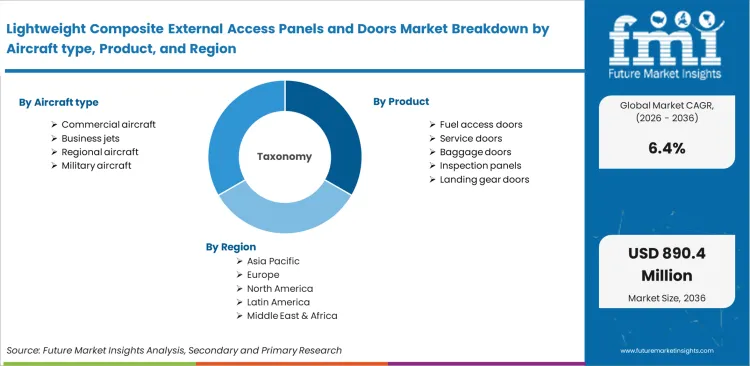
| Metric | Value |
| Quantitative Units | USD 450 million to USD 840 million, at a CAGR of 6.40% |
| Market Definition | Defining this sector requires focusing on non-metallic, load-bearing exterior covers designed for routine aircraft maintenance entry. These exterior maintenance access panels must withstand aerodynamic pressures, environmental extremes, and frequent opening cycles without losing dimensional tolerance. |
| Segmentation | Aircraft type, Product, Material, Sales channel, End use, and Region |
| Regions Covered | North America, Latin America, Europe, Asia Pacific, Middle East and Africa |
| Countries Covered | United States, Canada, Brazil, Mexico, Germany, United Kingdom, France, Italy, Spain, China, Japan, South Korea, India, GCC Countries, South Africa |
| Key Companies Profiled | Astronics PECO, Sonaca, Daher, Latécoère, GKN Aerospace, Hutchinson, Triumph Group |
| Forecast Period | 2026 to 2036 |
| Approach | Annual commercial aircraft delivery schedules and established MRO replacement cycle metrics |
Source: Future Market Insights (FMI) analysis, based on proprietary forecasting model and primary research
Lightweight Composite External Access Panels and Doors Market Analysis by Segments
Aircraft type
- Commercial aircraft
- Business jets
- Regional aircraft
- Military aircraft
Product
- Fuel access doors
- Service doors
- Baggage doors
- Inspection panels
- Landing gear doors
Material
- Carbon fiber epoxy
- Glass fiber composites
- Thermoplastic composites
- Hybrid laminates
Sales channel
- OEM fit
- Aftermarket MRO
- Retrofit kits
End use
- New production
- Replacement MRO
- Fleet upgrades
Region
- North America
- Latin America
- Europe
- Asia Pacific
- Middle East and Africa
Bibliography
- Airbus SE. (2026, February 19). Airbus reports Full-Year (FY) 2025 results.
- Bombardier Inc. (2026, February 12). Bombardier exceeds all 2025 guidance metrics and successfully completes its turnaround plan.
- Boeing. (2026, January 27). Boeing reports fourth quarter results.
- Chang, Z., Ren, Y., Li, X., Yan, K., Wang, Z., & Zhao, Y. (2024, November 01). Assembly deformation prediction of aircraft composite panel considering manufacturing variation and actual assembly process. The International Journal of Advanced Manufacturing Technology.
- Embraer S.A. (2026, March 6). EMBRAER earnings release: 4Q25 & FY25.
This bibliography is provided for reader reference. The full FMI report contains the complete reference list with primary source documentation.
This Report Addresses
- Carbon fiber epoxy resin limitations affecting high-volume component manufacturing.
- OEM procurement strategies targeting next-generation narrowbody commercial aircraft production lines.
- Galvanic corrosion prevention mechanisms driving metal-to-composite panel transition rates.
- Thermoplastic welding adoption curves influencing secondary structural component design requirements.
- Regional MRO capability expansion requirements supporting global commercial fleet modernization.
- Certification barriers extending development timelines for primary load-bearing aerospace covers.
- Tooling tolerance specifications dictating supplier qualification status among major airframers.
- Localized sourcing mandates reshaping component supply chains across Asian manufacturing hubs.
Frequently Asked Questions
What are lightweight composite external access panels and doors in aircraft?
Non-metallic, load-bearing exterior covers grant routine maintenance access, eliminating parasitic weight and preventing galvanic corrosion across airframes.
Why are composite access doors replacing metallic alternatives?
Replacing legacy aluminum doors with composite layups prevents galvanic corrosion, extends inspection intervals, and increases payload capacity.
How large is the lightweight composite external access panels and doors market?
Industry revenue reaches USD 450 million in 2026, advancing toward USD 840 million by 2036.
Which product type leads this component category today?
Fuel access doors capture the largest procurement volumes to eliminate corrosion risks within enclosed aviation fuel tanks.
How does China drive localized sourcing?
State-owned aerospace integrators mandate foreign tier-1 suppliers to partner with domestic composite fabricators to secure long-term contracts.
What creates aftermarket panel demand?
Maintenance chiefs order immediate composite replacements from independent fabricators following ramp damage to prevent aircraft-on-ground delays.
Why do OEMs dominate sales channels?
Aircraft program directors require complete factory integration to guarantee dimensional matching, preventing step-and-gap airflow disruptions entirely.
How does manual finishing impact supply?
Strict aerodynamic smoothness criteria require manual surface finishing, creating severe production bottlenecks that cap automated layup efficiencies.
What restricts carbon fiber prepreg usage?
Raw material temperature sensitivity limits factory storage durations, forcing operations managers to perfectly synchronize freezer inventory withdrawals.
How do European sustainability mandates affect suppliers?
Multinational consortiums enforce zero-waste manufacturing, requiring chemical suppliers to formulate restricted-compound-free epoxy resins for aerospace access panels.
Which companies make composite aircraft access doors?
Established tier-1 integrators include Astronics PECO, Sonaca, Daher, Latécoère, GKN Aerospace, Hutchinson, and Triumph Group.
What separates France from Germany in production?
France centralizes complex layup operations near assembly lines, while Germany pioneers automated resin infusion techniques through research.
How does galvanic corrosion influence design?
Non-metallic materials eliminate electrochemical degradation at fastener points, allowing maintenance crews to avoid extensive metallic rework schedules.
What forces MRO capability expansion in India?
Rapid commercial fleet growth pushes facility directors to invest heavily in specialized composite repair training and infrastructure.
Why do prime contractors prefer single suppliers?
Procurement directors award comprehensive packages to proven tier-1 suppliers, bypassing lengthy qualification phases that block untested entrants.
How does cold weather affect material selection?
Procurement managers prioritize specific composite matrices demonstrating superior impact resistance under freezing conditions for regional aircraft structures.
What drives automated tape laying adoption?
Manufacturing vice presidents rely on robotic fabrication to stabilize unit costs across high-volume narrowbody aircraft production batches.
Why do independent repair stations stock panels?
Supply chain directors build regional distribution centers near airline hubs to capture lucrative urgent aircraft-on-ground component orders.
How does lightning strike protection complicate manufacturing?
Aerospace access panels require specialized conductive surface coatings to maintain strict aircraft electrical continuity and certification requirements.
What dictates supplier survival in this tier?
Securing precision tooling capabilities prevents complete part rejection during final assembly, rapidly determining profitability for component manufacturers.
How do fleet upgrades generate revenue?
Component suppliers capture high-margin revenue by engineering complete retrofit modification kits to replace heavy metallic inspection covers.
Why do new entrants struggle?
Incumbent suppliers leverage proprietary tooling libraries and deeply integrated digital thread connections to block untested market competitors.
What role do NDT technicians play?
Technicians deploy specialized ultrasonic equipment to verify internal structural integrity following high-energy tool drops during routine maintenance.
How does thermal expansion affect design?
Designers engineer complex fastening solutions to prevent joint fatigue caused by thermal mismatch during high-altitude cruise cycles.
Preview the report firsthand - request a free sample
Get SampleGet the brochure for pricing and purchase details.
Get PDFTable of Content
- Executive Summary
- Global Market Outlook
- Demand-side Trends
- Supply-side Trends
- Technology Roadmap Analysis
- Analysis and Recommendations
- Market Overview
- Market Coverage / Taxonomy
- Market Definition / Scope / Limitations
- Research Methodology
- Chapter Orientation
- Analytical Lens and Working Hypotheses
- Market Structure, Signals, and Trend Drivers
- Benchmarking and Cross-market Comparability
- Market Sizing, Forecasting, and Opportunity Mapping
- Research Design and Evidence Framework
- Desk Research Programme (Secondary Evidence)
- Company Annual and Sustainability Reports
- Peer-reviewed Journals and Academic Literature
- Corporate Websites, Product Literature, and Technical Notes
- Earnings Decks and Investor Briefings
- Statutory Filings and Regulatory Disclosures
- Technical White Papers and Standards Notes
- Trade Journals, Industry Magazines, and Analyst Briefs
- Conference Proceedings, Webinars, and Seminar Materials
- Government Statistics Portals and Public Data Releases
- Press Releases and Reputable Media Coverage
- Specialist Newsletters and Curated Briefings
- Sector Databases and Reference Repositories
- FMI Internal Proprietary Databases and Historical Market Datasets
- Subscription Datasets and Paid Sources
- Social Channels, Communities, and Digital Listening Inputs
- Additional Desk Sources
- Expert Input and Fieldwork (Primary Evidence)
- Primary Modes
- Qualitative Interviews and Expert Elicitation
- Quantitative Surveys and Structured Data Capture
- Blended Approach
- Why Primary Evidence is Used
- Field Techniques
- Interviews
- Surveys
- Focus Groups
- Observational and In-context Research
- Social and Community Interactions
- Stakeholder Universe Engaged
- C-suite Leaders
- Board Members
- Presidents and Vice Presidents
- R&D and Innovation Heads
- Technical Specialists
- Domain Subject-matter Experts
- Scientists
- Physicians and Other Healthcare Professionals
- Governance, Ethics, and Data Stewardship
- Research Ethics
- Data Integrity and Handling
- Primary Modes
- Tooling, Models, and Reference Databases
- Desk Research Programme (Secondary Evidence)
- Data Engineering and Model Build
- Data Acquisition and Ingestion
- Cleaning, Normalisation, and Verification
- Synthesis, Triangulation, and Analysis
- Quality Assurance and Audit Trail
- Market Background
- Market Dynamics
- Drivers
- Restraints
- Opportunity
- Trends
- Scenario Forecast
- Demand in Optimistic Scenario
- Demand in Likely Scenario
- Demand in Conservative Scenario
- Opportunity Map Analysis
- Product Life Cycle Analysis
- Supply Chain Analysis
- Investment Feasibility Matrix
- Value Chain Analysis
- PESTLE and Porter’s Analysis
- Regulatory Landscape
- Regional Parent Market Outlook
- Production and Consumption Statistics
- Import and Export Statistics
- Market Dynamics
- Global Market Analysis 2021 to 2025 and Forecast, 2026 to 2036
- Historical Market Size Value (USD Million) Analysis, 2021 to 2025
- Current and Future Market Size Value (USD Million) Projections, 2026 to 2036
- Y-o-Y Growth Trend Analysis
- Absolute $ Opportunity Analysis
- Global Market Pricing Analysis 2021 to 2025 and Forecast 2026 to 2036
- Global Market Analysis 2021 to 2025 and Forecast 2026 to 2036, By Aircraft type
- Introduction / Key Findings
- Historical Market Size Value (USD Million) Analysis By Aircraft type , 2021 to 2025
- Current and Future Market Size Value (USD Million) Analysis and Forecast By Aircraft type , 2026 to 2036
- Commercial aircraft
- Business jets
- Regional aircraft
- Military aircraft
- Commercial aircraft
- Y-o-Y Growth Trend Analysis By Aircraft type , 2021 to 2025
- Absolute $ Opportunity Analysis By Aircraft type , 2026 to 2036
- Global Market Analysis 2021 to 2025 and Forecast 2026 to 2036, By Product
- Introduction / Key Findings
- Historical Market Size Value (USD Million) Analysis By Product, 2021 to 2025
- Current and Future Market Size Value (USD Million) Analysis and Forecast By Product, 2026 to 2036
- Fuel access doors
- Service doors
- Baggage doors
- Inspection panels
- Landing gear doors
- Fuel access doors
- Y-o-Y Growth Trend Analysis By Product, 2021 to 2025
- Absolute $ Opportunity Analysis By Product, 2026 to 2036
- Global Market Analysis 2021 to 2025 and Forecast 2026 to 2036, By Material
- Introduction / Key Findings
- Historical Market Size Value (USD Million) Analysis By Material, 2021 to 2025
- Current and Future Market Size Value (USD Million) Analysis and Forecast By Material, 2026 to 2036
- Carbon fiber epoxy
- Glass fiber composites
- Thermoplastic composites
- Hybrid laminates
- Carbon fiber epoxy
- Y-o-Y Growth Trend Analysis By Material, 2021 to 2025
- Absolute $ Opportunity Analysis By Material, 2026 to 2036
- Global Market Analysis 2021 to 2025 and Forecast 2026 to 2036, By Sales channel
- Introduction / Key Findings
- Historical Market Size Value (USD Million) Analysis By Sales channel, 2021 to 2025
- Current and Future Market Size Value (USD Million) Analysis and Forecast By Sales channel, 2026 to 2036
- OEM fit
- Aftermarket MRO
- Retrofit kits
- OEM fit
- Y-o-Y Growth Trend Analysis By Sales channel, 2021 to 2025
- Absolute $ Opportunity Analysis By Sales channel, 2026 to 2036
- Global Market Analysis 2021 to 2025 and Forecast 2026 to 2036, By End use
- Introduction / Key Findings
- Historical Market Size Value (USD Million) Analysis By End use, 2021 to 2025
- Current and Future Market Size Value (USD Million) Analysis and Forecast By End use, 2026 to 2036
- New production
- Replacement MRO
- Fleet upgrades
- New production
- Y-o-Y Growth Trend Analysis By End use, 2021 to 2025
- Absolute $ Opportunity Analysis By End use, 2026 to 2036
- Global Market Analysis 2021 to 2025 and Forecast 2026 to 2036, By Region
- Introduction
- Historical Market Size Value (USD Million) Analysis By Region, 2021 to 2025
- Current Market Size Value (USD Million) Analysis and Forecast By Region, 2026 to 2036
- North America
- Latin America
- Western Europe
- Eastern Europe
- East Asia
- South Asia and Pacific
- Middle East & Africa
- Market Attractiveness Analysis By Region
- North America Market Analysis 2021 to 2025 and Forecast 2026 to 2036, By Country
- Historical Market Size Value (USD Million) Trend Analysis By Market Taxonomy, 2021 to 2025
- Market Size Value (USD Million) Forecast By Market Taxonomy, 2026 to 2036
- By Country
- USA
- Canada
- Mexico
- By Aircraft type
- By Product
- By Material
- By Sales channel
- By End use
- By Country
- Market Attractiveness Analysis
- By Country
- By Aircraft type
- By Product
- By Material
- By Sales channel
- By End use
- Key Takeaways
- Latin America Market Analysis 2021 to 2025 and Forecast 2026 to 2036, By Country
- Historical Market Size Value (USD Million) Trend Analysis By Market Taxonomy, 2021 to 2025
- Market Size Value (USD Million) Forecast By Market Taxonomy, 2026 to 2036
- By Country
- Brazil
- Chile
- Rest of Latin America
- By Aircraft type
- By Product
- By Material
- By Sales channel
- By End use
- By Country
- Market Attractiveness Analysis
- By Country
- By Aircraft type
- By Product
- By Material
- By Sales channel
- By End use
- Key Takeaways
- Western Europe Market Analysis 2021 to 2025 and Forecast 2026 to 2036, By Country
- Historical Market Size Value (USD Million) Trend Analysis By Market Taxonomy, 2021 to 2025
- Market Size Value (USD Million) Forecast By Market Taxonomy, 2026 to 2036
- By Country
- Germany
- UK
- Italy
- Spain
- France
- Nordic
- BENELUX
- Rest of Western Europe
- By Aircraft type
- By Product
- By Material
- By Sales channel
- By End use
- By Country
- Market Attractiveness Analysis
- By Country
- By Aircraft type
- By Product
- By Material
- By Sales channel
- By End use
- Key Takeaways
- Eastern Europe Market Analysis 2021 to 2025 and Forecast 2026 to 2036, By Country
- Historical Market Size Value (USD Million) Trend Analysis By Market Taxonomy, 2021 to 2025
- Market Size Value (USD Million) Forecast By Market Taxonomy, 2026 to 2036
- By Country
- Russia
- Poland
- Hungary
- Balkan & Baltic
- Rest of Eastern Europe
- By Aircraft type
- By Product
- By Material
- By Sales channel
- By End use
- By Country
- Market Attractiveness Analysis
- By Country
- By Aircraft type
- By Product
- By Material
- By Sales channel
- By End use
- Key Takeaways
- East Asia Market Analysis 2021 to 2025 and Forecast 2026 to 2036, By Country
- Historical Market Size Value (USD Million) Trend Analysis By Market Taxonomy, 2021 to 2025
- Market Size Value (USD Million) Forecast By Market Taxonomy, 2026 to 2036
- By Country
- China
- Japan
- South Korea
- By Aircraft type
- By Product
- By Material
- By Sales channel
- By End use
- By Country
- Market Attractiveness Analysis
- By Country
- By Aircraft type
- By Product
- By Material
- By Sales channel
- By End use
- Key Takeaways
- South Asia and Pacific Market Analysis 2021 to 2025 and Forecast 2026 to 2036, By Country
- Historical Market Size Value (USD Million) Trend Analysis By Market Taxonomy, 2021 to 2025
- Market Size Value (USD Million) Forecast By Market Taxonomy, 2026 to 2036
- By Country
- India
- ASEAN
- Australia & New Zealand
- Rest of South Asia and Pacific
- By Aircraft type
- By Product
- By Material
- By Sales channel
- By End use
- By Country
- Market Attractiveness Analysis
- By Country
- By Aircraft type
- By Product
- By Material
- By Sales channel
- By End use
- Key Takeaways
- Middle East & Africa Market Analysis 2021 to 2025 and Forecast 2026 to 2036, By Country
- Historical Market Size Value (USD Million) Trend Analysis By Market Taxonomy, 2021 to 2025
- Market Size Value (USD Million) Forecast By Market Taxonomy, 2026 to 2036
- By Country
- Kingdom of Saudi Arabia
- Other GCC Countries
- Turkiye
- South Africa
- Other African Union
- Rest of Middle East & Africa
- By Aircraft type
- By Product
- By Material
- By Sales channel
- By End use
- By Country
- Market Attractiveness Analysis
- By Country
- By Aircraft type
- By Product
- By Material
- By Sales channel
- By End use
- Key Takeaways
- Key Countries Market Analysis
- USA
- Pricing Analysis
- Market Share Analysis, 2025
- By Aircraft type
- By Product
- By Material
- By Sales channel
- By End use
- Canada
- Pricing Analysis
- Market Share Analysis, 2025
- By Aircraft type
- By Product
- By Material
- By Sales channel
- By End use
- Mexico
- Pricing Analysis
- Market Share Analysis, 2025
- By Aircraft type
- By Product
- By Material
- By Sales channel
- By End use
- Brazil
- Pricing Analysis
- Market Share Analysis, 2025
- By Aircraft type
- By Product
- By Material
- By Sales channel
- By End use
- Chile
- Pricing Analysis
- Market Share Analysis, 2025
- By Aircraft type
- By Product
- By Material
- By Sales channel
- By End use
- Germany
- Pricing Analysis
- Market Share Analysis, 2025
- By Aircraft type
- By Product
- By Material
- By Sales channel
- By End use
- UK
- Pricing Analysis
- Market Share Analysis, 2025
- By Aircraft type
- By Product
- By Material
- By Sales channel
- By End use
- Italy
- Pricing Analysis
- Market Share Analysis, 2025
- By Aircraft type
- By Product
- By Material
- By Sales channel
- By End use
- Spain
- Pricing Analysis
- Market Share Analysis, 2025
- By Aircraft type
- By Product
- By Material
- By Sales channel
- By End use
- France
- Pricing Analysis
- Market Share Analysis, 2025
- By Aircraft type
- By Product
- By Material
- By Sales channel
- By End use
- India
- Pricing Analysis
- Market Share Analysis, 2025
- By Aircraft type
- By Product
- By Material
- By Sales channel
- By End use
- ASEAN
- Pricing Analysis
- Market Share Analysis, 2025
- By Aircraft type
- By Product
- By Material
- By Sales channel
- By End use
- Australia & New Zealand
- Pricing Analysis
- Market Share Analysis, 2025
- By Aircraft type
- By Product
- By Material
- By Sales channel
- By End use
- China
- Pricing Analysis
- Market Share Analysis, 2025
- By Aircraft type
- By Product
- By Material
- By Sales channel
- By End use
- Japan
- Pricing Analysis
- Market Share Analysis, 2025
- By Aircraft type
- By Product
- By Material
- By Sales channel
- By End use
- South Korea
- Pricing Analysis
- Market Share Analysis, 2025
- By Aircraft type
- By Product
- By Material
- By Sales channel
- By End use
- Russia
- Pricing Analysis
- Market Share Analysis, 2025
- By Aircraft type
- By Product
- By Material
- By Sales channel
- By End use
- Poland
- Pricing Analysis
- Market Share Analysis, 2025
- By Aircraft type
- By Product
- By Material
- By Sales channel
- By End use
- Hungary
- Pricing Analysis
- Market Share Analysis, 2025
- By Aircraft type
- By Product
- By Material
- By Sales channel
- By End use
- Kingdom of Saudi Arabia
- Pricing Analysis
- Market Share Analysis, 2025
- By Aircraft type
- By Product
- By Material
- By Sales channel
- By End use
- Turkiye
- Pricing Analysis
- Market Share Analysis, 2025
- By Aircraft type
- By Product
- By Material
- By Sales channel
- By End use
- South Africa
- Pricing Analysis
- Market Share Analysis, 2025
- By Aircraft type
- By Product
- By Material
- By Sales channel
- By End use
- USA
- Market Structure Analysis
- Competition Dashboard
- Competition Benchmarking
- Market Share Analysis of Top Players
- By Regional
- By Aircraft type
- By Product
- By Material
- By Sales channel
- By End use
- Competition Analysis
- Competition Deep Dive
- Astronics PECO
- Overview
- Product Portfolio
- Profitability by Market Segments (Product/Age /Sales Channel/Region)
- Sales Footprint
- Strategy Overview
- Marketing Strategy
- Product Strategy
- Channel Strategy
- Sonaca
- Daher
- Latécoère
- GKN Aerospace
- Hutchinson
- Triumph Group
- Astronics PECO
- Competition Deep Dive
- Assumptions & Acronyms Used


