

- Industry Size (2026)
- USD 5.1 Bn
- Forecast (2036)
- USD 8.5 Bn
- CAGR (2026 to 2036)
- 5.25%
Lightweight Aluminum Aerosol Cans Market Size, Market Forecast and Outlook By FMI
The lightweight aluminum aerosol cans market was valued at USD 4.8 billion in 2025. The industry is expected to reach USD 5.1 billion in 2026 at a CAGR of 5.25% during the forecast period. Demand outlook carries the market valuation to USD 8.5 billion by 2036 as sustainable monobloc economics reach mid-tier cosmetic brands that previously deferred packaging upgrades.
Strict corporate sustainability mandates targeting the elimination of multi-material plastics force fast-moving consumer goods procurement teams to transition high-volume product lines to impact-extruded formats. Packaging engineers redesigning premium personal care dispensers must deploy materials capable of withstanding high internal propellant pressures while maintaining 100% recyclability. Procurement directors who delay the transition to infinitely recyclable alloys face an impending regulatory disqualification window in European and North American retail channels. This architectural pivot guarantees structural integrity during e-commerce transit while significantly reducing the overall carbon footprint of the finished product.
Summary of Lightweight Aluminum Aerosol Cans Market
- Lightweight Aluminum Aerosol Cans Market Definition
- Lightweight aluminum aerosol cans are precision-engineered monobloc containers built to withstand internal propellant pressure while offering 100% material recyclability. The structural dependency that defines this boundary is the absolute requirement for the container to maintain burst resistance while utilizing the minimum possible alloy thickness.
- Demand Drivers in the Market
- Corporate sustainability mandates compel personal care procurement directors to replace unrecyclable multi-material plastic dispensers with infinitely recyclable monobloc aluminum.
- E-commerce fulfillment logistics force brand owners to specify high-strength, impact-resistant packaging that prevents accidental discharge and leakage during transit.
- Strict environmental regulations targeting volatile organic compound emissions require the adoption of advanced internal barrier coatings that are uniquely compatible with extruded aluminum surfaces.
- Key Segments Analyzed in the FMI Report
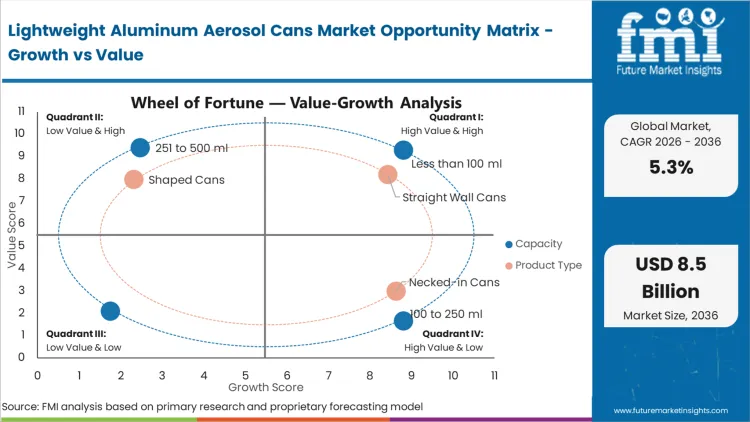
- 100 to 250 ml: 44.5% share in 2026, driven by optimal retail shelf dimensioning and widespread standardization across the deodorant and hairspray categories.
- Necked-in Cans: 58.2% share in 2026, reflecting the mechanical necessity of reducing the top diameter to accommodate standard, cost-effective actuator valves.
- China: 8.5% compound growth, anchored by massive investments in new high-speed extrusion lines to supply domestic and export personal care sectors.
- Analyst Opinion at FMI
- Ismail Sutaria, Principal Consultant for Packaging Materials, opines, "In my analysis, I have observed that the true bottleneck in sustainable packaging modernization is not aluminum supply, but the constrained availability of specialized impact-extrusion tooling required for complex shapes. Facilities attempting to run bespoke can designs over legacy manufacturing lines face unavoidable structural micro-fractures that trigger immediate quality assurance rejections. Procurement directors who continue demanding complex geometric can designs without securing dedicated extrusion capacity well in advance will find themselves unable to meet the aggressive plastic-reduction timelines required for next-generation product launches."
- Strategic Implications / Executive Takeaways
- Metal packaging suppliers must invest in advanced internal coating technologies to qualify for impending pharmaceutical and sensitive-skin cosmetic contracts.
- Cosmetic brand managers should redesign their graphic artwork to leverage the native brushed metallic finish, thereby reducing secondary labeling materials.
- Manufacturing facility directors must develop specialized inline pressure testing competencies to prove absolute burst-resistance guarantees during the production phase.
- Methodology
- Primary Research: FMI conducted detailed technical interviews with principal packaging architects, material scientists, and cosmetic supply chain directors across 40 countries to validate material adoption timelines.
- Desk Research: Analysts aggregated public standards documentation from packaging associations, corporate hardware launch sheets, and national circular economy grant programs.
- Market-Sizing and Forecasting: The model applies a bottom-up methodology starting with global installed base metrics for personal care product lines and projecting the conversion rate to aluminum standards.
- Data Validation and Update Cycle: Segment forecasts undergo cross-validation against quarterly alloy shipment volumes for industrial packaging applications.
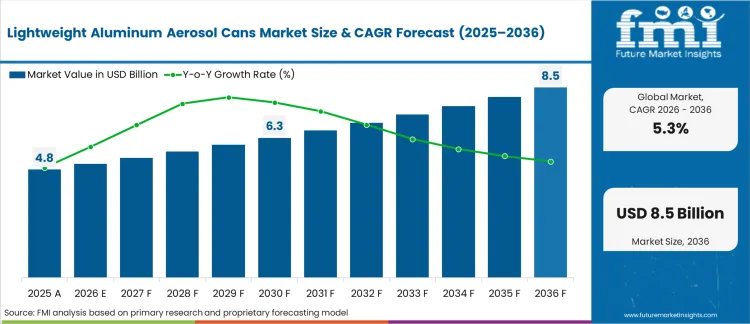
Lightweight Aluminum Aerosol Cans Market Key Takeaways
| Metric | Details |
|---|---|
| Industry Size (2026) | USD 5.1 billion |
| Industry Value (2036) | USD 8.5 billion |
| CAGR (2026-2036) | 5.25% |
Source: Future Market Insights (FMI) analysis, based on proprietary forecasting model and primary research
The definitive inflection point occurs when automated digital printing directly on extruded metal achieves cost parity with secondary plastic labeling. Tooling engineers must secure specialized extrusion capacity for complex can shaping within the next eighteen months to accommodate major retail planogram resets. Facilities mastering this bespoke geometry transition establish a permanent competitive advantage in capturing premium cosmetic contracts.
As global fast-moving consumer goods networks navigate this transition, China sets the pace with an 8.5% CAGR, followed by India at 7.8% as both nations leverage greenfield manufacturing investments to bypass legacy retrofit hurdles. South Korea advances at a 6.5% rate, supported by its massive domestic skincare export industry. The United States registers a 5.2% expansion while Germany tracks at 4.8%, both driven by stringent extended producer responsibility laws. Japan expands at a 4.5% trajectory anchored by established material recovery infrastructure. The UK maintains a steady 4.1% pace as personal care brands finalize the phase-out of legacy tinplate steel formats.
Lightweight Aluminum Aerosol Cans Market Definition
Lightweight aluminum aerosol cans encompass impact-extruded, monobloc metal containers designed specifically to dispense liquid or foam products under pressure. The category relies on high-strength alloys that maintain critical burst-pressure ratings while significantly reducing the overall weight of the container compared to legacy steel alternatives.
Lightweight Aluminum Aerosol Cans Market Inclusions
The market scope includes single-piece aluminum aerosol cans manufactured via the impact extrusion process. Internal protective linings, integrated pressure valves, and specialized shaped configurations designed for premium brand differentiation are fully incorporated. High-pressure dispensing formats utilizing both liquefied and compressed gas propellants fall within the defined boundaries.
Lightweight Aluminum Aerosol Cans Market Exclusions
Three-piece tinplate steel cans and multi-component rigid plastic spray bottles are explicitly excluded from this valuation. Standard unpressurized aluminum beverage cans lacking specific actuator valve crimping capabilities and specialized thick-walled industrial gas cylinders fall outside the defined parameters.
Lightweight Aluminum Aerosol Cans Market Research Methodology
- Primary Research: Analysts engaged with cosmetic packaging engineers, high-speed filling line operators, and corporate sustainability directors to map the specific decision gates triggering monobloc metal upgrades.
- Desk Research: The data collection phase aggregated compliance roadmaps from the International Aluminum Institute, regional packaging recycling mandates, and major cosmetic vendor guidelines.
- Market-Sizing and Forecasting: The baseline value derives from a bottom-up aggregation of impact-extruded can shipments, applying region-specific modernization curves to project the future adoption velocity.
- Data Validation and Update Cycle: Projections are rigorously tested against publicly reported capital expenditure guidance from the leading global metal packaging conglomerates.
Segmental Analysis
Lightweight Aluminum Aerosol Cans Market Analysis by Capacity
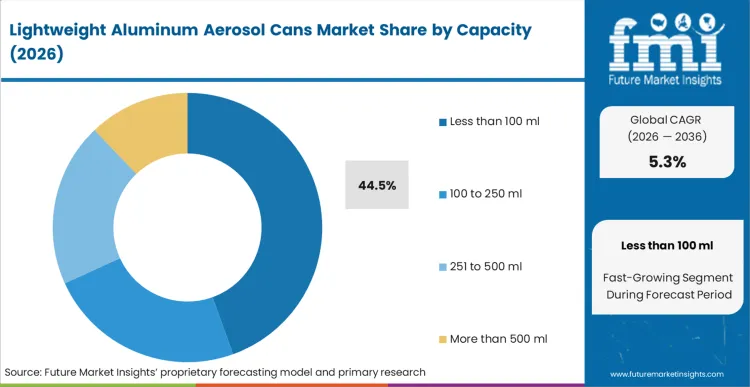
Standardized retail shelving constraints and consumer ergonomic preferences dictate the dominant container sizes across the personal care industry. The 100 to 250 ml category captures a commanding 44.5% share in 2026, directly reflecting the optimal balance between manufacturing material costs and adequate product volume for daily-use items. Cosmetics manufacturers standardizing on this specific volume metric bypass the logistical inefficiencies associated with custom shipping cartons. According to FMI's estimates, brand managers specifying these mid-range formats streamline their global supply chains and significantly reduce secondary packaging waste. Utilizing this capacity tier ensures seamless integration with advanced protective transit solutions during e-commerce fulfillment. Facility directors who ignore this established sizing standard face immediate exclusion from major automated retail distribution networks.
- Inventory optimization: Standardizing on mid-tier capacities allows contract fillers to minimize changeover times between different product runs on the factory floor.
- Shelf visibility: Retail merchandisers allocate prime, eye-level positioning to these specific dimensions because they maximize the visual impact within tight retail planograms.
- Travel compliance: Formats approaching the lower end of this spectrum satisfy international aviation security regulations for carry-on liquids, directly serving the frequent traveler demographic.
Lightweight Aluminum Aerosol Cans Market Analysis by Product Type
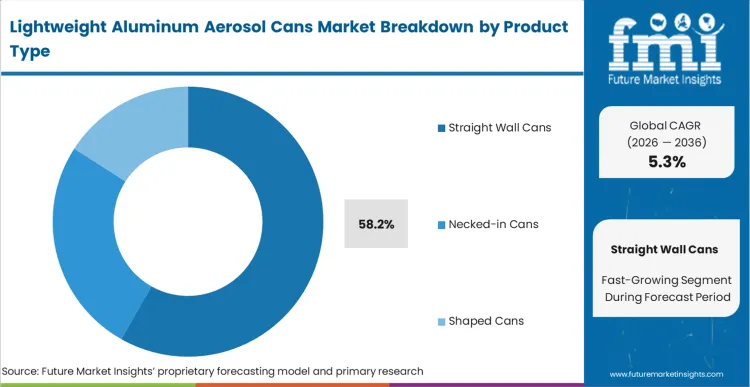
Cost-efficiency in the final assembly phase forces brands to utilize standardized dispensing valves across multiple product lines. Necked-in Cans secure a dominant 58.2% share in 2026, as the tapered top section allows manufacturers to utilize smaller, less expensive actuator caps without compromising the total internal volume. Packaging engineers incorporating this specific taper eliminate the need for custom wide-diameter closures. Based on FMI's assessment, production facilities transitioning to this geometry realize measurable reductions in their overall unit component costs. These structural designs are engineered from specialized aluminum flat products to ensure consistent metal flow during the heavy impact extrusion process. Filling plant operators failing to calibrate their crimping machinery for precise neck tolerances suffer catastrophic leakage rates during the pressurization stage.
- Actuator compatibility: Tapered top profiles universally accept standard one-inch mounting cups, radically simplifying the procurement of generic dispensing valves.
- Structural rigidity: The geometric reduction at the shoulder inherently increases the vertical crush resistance of the container during high-speed automated palletization.
- Material savings: Reducing the diameter of the required closure cap directly strips unnecessary plastic weight out of the final assembled product.
Lightweight Aluminum Aerosol Cans Market Analysis by End Use
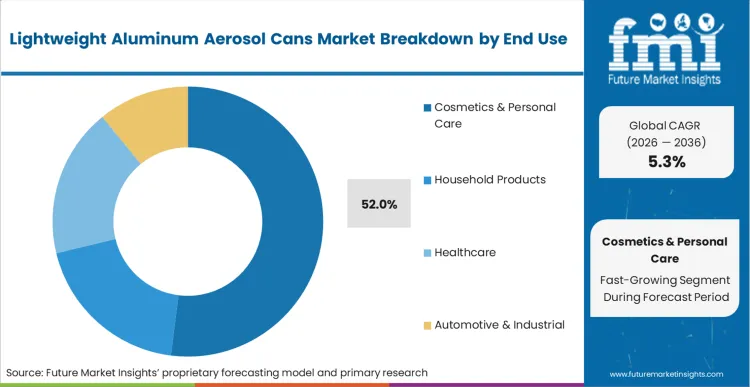
The intersection of high-pressure delivery requirements and premium brand positioning uniquely shapes consumption within specific retail verticals. Cosmetics & Personal Care accounts for a leading 52.0% segment share in 2026, as beauty brands face relentless consumer pressure to adopt infinitely recyclable primary containers. Product formulation chemists developing sensitive skincare foams require inert internal environments that only specialized monobloc coatings can provide. As per FMI's projection, the convergence of clean-beauty initiatives with sophisticated metallic printing techniques amplifies the demand for extruded biodegradable packaging alternatives alongside metal geometries. Formulators failing to qualify their chemical interactions with advanced internal epoxy linings risk immediate product recalls due to propellant degradation.
- Chemical inertness: Proprietary internal lacquers prevent aggressive active ingredients in antiperspirants from reacting with the bare metallic shell over extended shelf lives.
- Tactile premiumization: Direct-to-metal offset printing provides high-end cosmetic brands with a luxurious, cool-to-the-touch finish that adhesive paper labels cannot replicate.
- Moisture resistance: Rust-proof monobloc construction guarantees flawless aesthetic integrity when consumers store these products in highly humid bathroom environments.
Lightweight Aluminum Aerosol Cans Market Analysis by Propellant Type
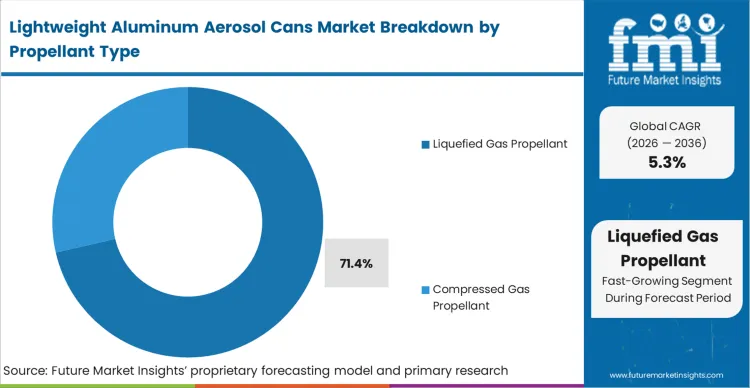
The fundamental physics of consistent spray atomization dictate the specific internal pressure mechanisms deployed by contract fillers. Liquefied Gas Propellant captures 71.4% of the market share in 2026 by maintaining constant internal pressure from the first spray until the container is completely empty. Formulation scientists utilizing this mechanism achieve a fine, dry mist that evaporates rapidly upon contact with the skin. In FMI's view, the integration of these specific propellants with precision dispensing valves dictates the ultimate user experience. Brands operating without this consistent pressure architecture face severe consumer backlash as product sputtering ruins the application process.
- Pressure equilibrium: As the liquid product depletes, the liquefied propellant instantly expands into a gas to fill the void, ensuring the exact same spray force every time the actuator is depressed.
- Droplet optimization: The rapid expansion of the gas violently shatters the liquid product into microscopic particles, creating the ultra-fine mist required for premium hairsprays.
- Volume efficiency: Propellants stored in a liquid state occupy a fraction of the space required by compressed gases, allowing the container to hold significantly more actual usable product.
Lightweight Aluminum Aerosol Cans Market Drivers, Restraints, and Opportunities
Strict environmental regulations targeting single-use plastics force major fast-moving consumer goods companies to overhaul their legacy supply chains. Corporate sustainability directors facing aggressive 2030 circular economy deadlines must transition entire portfolios of personal care products to infinitely recyclable monobloc aluminum. This regulatory pressure renders multi-material plastic spray bottles structurally obsolete. Brands that fail to execute this material transition lose access to critical retail shelf space in environmentally progressive regions. The shift toward standardized aerosol formats guarantees continuous demand for high-quality extruded metal containers.
The extreme capital intensity required to construct new impact extrusion manufacturing lines creates severe bottlenecks during periods of rapid demand spikes. Plant managers attempting to scale production face long lead times for specialized heavy machinery, limiting their ability to quickly satisfy new cosmetic brand contracts. This manufacturing friction forces mid-tier brands to accept extended delivery schedules, severely complicating their product launch timelines. Companies reliant on imported aluminum sheets and coils for their feedstock often encounter localized pricing volatility that compresses their operating margins.
Opportunities in the Lightweight Aluminum Aerosol Cans Market
- Inline Digital Printing: Advanced digital decoration technologies enable packaging engineers to execute microscopic graphic changes on the fly without stopping the production line. This capability allows regional marketing directors to deploy hyper-localized promotional campaigns.
- High-Speed Line Integration: The deployment of next-generation high-speed aerosol filling lines dramatically accelerates the throughput of complex shaped cans. Facility managers leveraging this automation drastically lower their per-unit operating costs.
- Sustainable Actuator Solutions: The development of sustainable mono-material closures that match the recyclability profile of the aluminum base creates a fully circular product. Procurement teams integrating these matched components solve the final remaining environmental objection from strict regulatory bodies.
Regional Analysis
Based on the regional analysis, the Lightweight Aluminum Aerosol Cans market is segmented into North America, Latin America, Europe, East Asia, South Asia, Oceania and Middle East & Africa across 40+ countries.
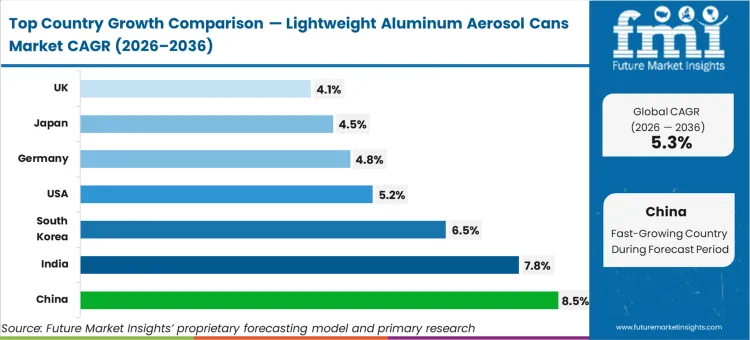
| Country | CAGR (2026 to 2036) |
|---|---|
| China | 8.5% |
| India | 7.8% |
| South Korea | 6.5% |
| USA | 5.2% |
| Germany | 4.8% |
| Japan | 4.5% |
| UK | 4.1% |
Source: Future Market Insights (FMI) analysis, based on proprietary forecasting model and primary research
Asia Pacific Lightweight Aluminum Aerosol Cans Market Analysis
Rapid industrialization across the Asia Pacific manufacturing corridor accelerates the displacement of legacy tinplate packaging formats. Facility directors constructing massive new personal care filling plants specify monobloc aluminum to satisfy strict export quality standards mandated by Western retail chains. FMI analysts opine that this aggressive infrastructure investment completely bypasses the retrofit phases required in older markets. By standardizing on advanced metal forming capabilities, regional manufacturers establish a globally competitive export base for finished cosmetic products. This massive scaling of liquid containment capacity firmly anchors the region's dominant growth profile.
- China: China's sprawling cosmetic export sector deploys highly automated filling lines requiring containers with exact dimensional tolerances to prevent costly machine jams. Plant managers specify rigid impact-extruded monoblocs to ensure high-speed processing without structural deformation. The immense scale of domestic primary metal refining chemicals provides local manufacturers with highly cost-advantaged raw material feedstocks. This structural advantage drives an 8.5% CAGR for lightweight aluminum aerosol cans in China. Suppliers lacking verified quality assurance records for high-pressure containment lose access to the region's most lucrative contract filling operations.
- India: Rapidly expanding organized retail networks in India require fast-moving consumer goods to withstand severe logistical handling and extreme temperature variations during transit. Procurement directors must deploy robust metal containers to eliminate the leakage and spoilage rates historically associated with rigid plastics. The national initiative to formalize domestic manufacturing capabilities heavily incentivizes the production of high-grade structural alloys suitable for complex extrusion. India's market expands at a 7.8% CAGR as brand owners systematically upgrade their deodorant portfolios. Packaging vendors failing to deliver rust-proof internal coatings face immediate disqualification from major national distribution contracts.
- South Korea: South Korea's premium skincare and cosmetics industry operates under incredibly high aesthetic standards that demand flawless metallic finishes and complex geometric container shapes. Packaging engineers mandate impact-extruded aluminum because it provides the ultimate canvas for sophisticated direct-to-metal lithographic printing. The concentration of globally recognized K-beauty brands necessitates continuous innovation in proprietary container tooling to maintain shelf differentiation. South Korea advances at a 6.5% compound rate as these visual differentiation standards become the baseline for all new product launches. Extrusion specialists unable to master complex shoulder tapering forfeit access to the next generation of premium cosmetic packaging contracts.
- Japan: Stringent domestic waste sorting and recycling laws in Japan dictate the absolute necessity of utilizing mono-material packaging wherever mechanically feasible. Corporate sustainability officers mandate aluminum over multi-layer plastics because the national recovery infrastructure processes metal with near-perfect efficiency. The highly mature domestic personal care sector relies on these premium containers to justify elevated retail price points in a saturated demographic environment. Japan tracks a 4.5% annual growth rate reflecting this established, high-value replacement cycle. Foreign packaging suppliers lacking documented compliance with the Japanese Industrial Standards for pressure vessels fail to penetrate this highly regulated procurement ecosystem.
FMI's report includes extensive coverage of the broader Asia Pacific packaging landscape. The prevailing pattern across these nations is the rapid localization of contract filling operations, which forces brand owners to secure reliable regional sources for high-quality metal containers.
North America Lightweight Aluminum Aerosol Cans Market Analysis
Legislative initiatives targeting plastic waste reduction across North America systematically force consumer goods conglomerates to overhaul their legacy packaging portfolios. Corporate sustainability teams leading these massive material transitions face strict board-level directives to demonstrate measurable progress toward 100% recyclable product lines. FMI's analysis indicates that the highly consolidated nature of the domestic retail sector accelerates this shift, as dominant supermarket chains penalize brands utilizing unrecyclable formats. Implementing a standardized aluminum supply chain provides the necessary scale to absorb the higher initial unit costs associated with metal packaging. The success of this transition relies heavily on continuous investments in automated packaging machinery capable of handling delicate aluminum walls without denting.
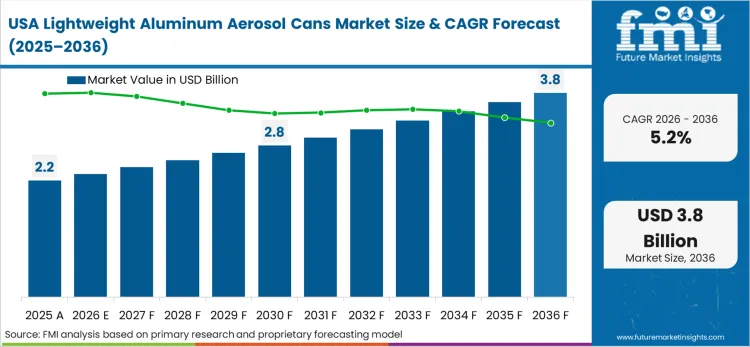
- USA: The United States personal care sector faces mounting pressure from state-level extended producer responsibility laws that heavily tax the use of virgin rigid plastics. Packaging procurement leads must deploy infinitely recyclable aluminum monoblocs to mitigate these escalating compliance costs and satisfy consumer demands for sustainable products. Major investments in domestic rolling mills and recycling facilities ensure a stable, closed-loop supply of the specialized alloy slugs required for extrusion. The USA follows a 5.2% compound trajectory to 2036 as major brands execute their public sustainability commitments. Can manufacturers lacking verified life-cycle analysis documentation for their rigid metal formats face immediate exclusion from major national retail planograms.
FMI's report includes detailed analysis of the North American market, incorporating the Canadian and Mexican packaging sectors. A defining structural dynamic is the heavy reliance on cross-border supply chains, where empty aluminum containers are frequently manufactured in Mexico and shipped to contract filling facilities in the United States Midwest.
Europe Lightweight Aluminum Aerosol Cans Market Analysis
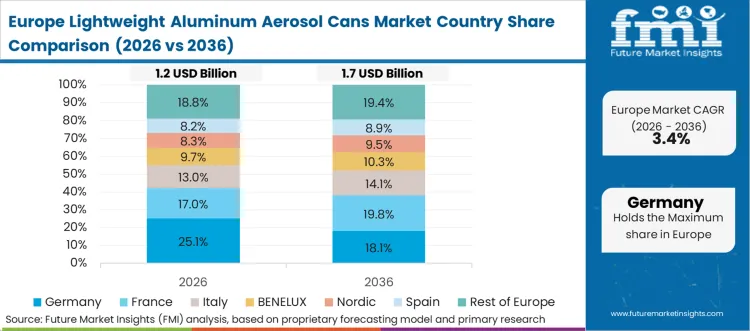
Aggressive circular economy directives issued by the European Commission actively penalize the deployment of packaging materials that cannot be efficiently recovered and reprocessed. Packaging architects redesigning legacy product lines must utilize materials that integrate seamlessly into existing municipal recycling streams without requiring complex consumer separation. This strict regulatory environment forces the rapid abandonment of multi-material plastic dispensers in favor of pure aluminum structures. Upgrading the primary packaging material provides brands with the necessary environmental credentials to operate within the highly regulated European retail landscape. Compliance managers recognize that utilizing any material other than metal or glass severely limits their ability to compete across borderless European markets.
- Germany: Germany's strict Duales System packaging recovery framework dictates heavy financial penalties for brands introducing non-recyclable materials into the consumer waste stream. Logistics directors must specify mono-material aluminum containers because their high scrap value inherently subsidizes the municipal collection process. The heavy concentration of advanced machine tool manufacturing provides domestic can makers with unparalleled access to precision extrusion technologies, driving continuous improvements in wall-thickness reduction. Germany's 4.8% annual expansion rate reflects the systematic optimization of this highly mature consumer goods containment sector. Metal forming vendors targeting the domestic cosmetics industry must guarantee micro-gram weight consistency before securing long-term supply agreements.
- UK: The United Kingdom's plastic packaging tax programs require fast-moving consumer goods companies to aggressively audit and eliminate unnecessary polymers from their supply chains. Packaging technologists deploying new aerosol formats mandate aluminum to completely bypass the taxation associated with low-recyclability plastics. The shift toward premium grooming products among domestic consumers supports the higher price points required to justify the transition to impact-extruded metal. This regulatory and consumer pressure anchors the UK's 4.1% CAGR as legacy tinplate and plastic formats are systematically phased out. Extrusion suppliers unable to demonstrate significant reductions in their own manufacturing carbon footprints forfeit qualification for major supermarket private-label contracts.
FMI's report encompasses the broader European regulatory environment, evaluating markets in France, Italy, and Spain. The dominant structural force across these territories is the mandatory compliance with strict aerosol dispenser safety directives, ensuring all lightweighted containers maintain absolute structural integrity under extreme thermal conditions.
Competitive Aligners for Market Players
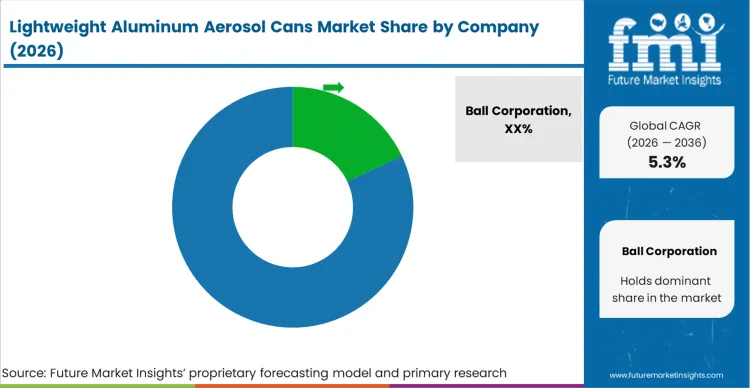
The global market is highly concentrated among a select group of multinational conglomerates capable of deploying the massive capital expenditure required to build high-speed impact extrusion lines. This oligopolistic structure exists because the technical barriers to entry are extreme, requiring precise metallurgical expertise and complex tooling engineering to achieve the micro-millimeter wall tolerances demanded by modern lightweighting initiatives. Leading companies including Ball Corporation, Trivium Packaging, and Crown Holdings Inc., leverage their massive economies of scale to dominate the global supply of multi-layer cylindrical formats and aluminum monoblocs. Buyers primarily distinguish between these qualified suppliers based on their ability to offer localized manufacturing capacity near major contract filling hubs, thereby minimizing the shipment of empty volume.
The most dominant players maintain their market position through continuous innovation in proprietary can shaping and advanced internal coating technologies. Companies like Ardagh Group S.A. and TUBEX GmbH possess specific structural advantages in their ability to execute highly complex, asymmetrical geometric designs that premium cosmetic brands demand for shelf differentiation. This technological moat persists because developing the specialized extrusion dies and matching the high-speed printing mandrels requires decades of institutional engineering knowledge. Challengers attempting to replicate these specialty decorative tins or complex aluminum shapes must invest heavily in boutique tooling firms just to achieve baseline qualification. The practical implication is that emerging packaging suppliers must focus on standard cylindrical formats before attempting to compete in the high-margin customized segment.
Global fast-moving consumer goods companies actively deploy multi-vendor qualification strategies to prevent pricing lock-in from these dominant packaging conglomerates. The deliberate standardization structurally limits the pricing power of the major packaging vendors, forcing them to compete aggressively on delivery reliability and sustainability metrics rather than proprietary sizing. The primary structural tension exists between the packaging manufacturers' desire to sell highly customized, margin-rich shapes and the buyers' mandate for interchangeable, cost-effective standard containers. Over the forecast period, flexible foil alternatives and rigid monobloc suppliers will face intense pressure to deliver custom aesthetic finishes on standard interchangeable geometries to satisfy both competing requirements.
Key Players in Lightweight Aluminum Aerosol Cans Market
- Ball Corporation
- Crown Holdings Inc.
- Ardagh Group S.A.
- Trivium Packaging
- CCL Container
- TUBEX GmbH
- Montebello Packaging
Scope of the Report
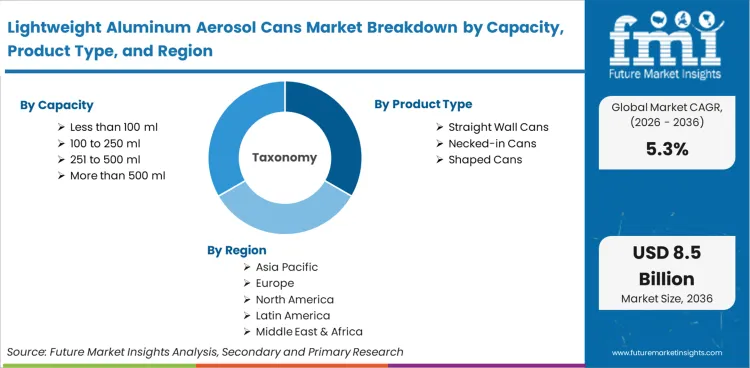
| Metric | Value |
|---|---|
| Quantitative Units | USD 5.1 billion to USD 8.5 billion, at a CAGR of 5.25% |
| Market Definition | Lightweight aluminum aerosol cans encompass impact-extruded, monobloc metal containers designed to dispense liquid or foam products under pressure. |
| Capacity Segmentation | Less than 100 ml, 100 to 250 ml, 251 to 500 ml, More than 500 ml |
| Product Type Segmentation | Straight Wall Cans, Necked-in Cans, Shaped Cans |
| End Use Segmentation | Cosmetics & Personal Care, Household Products, Healthcare, Automotive & Industrial |
| Propellant Type Segmentation | Liquefied Gas Propellant, Compressed Gas Propellant |
| Regions Covered | North America, Latin America, Europe, East Asia, South Asia, Oceania, Middle East & Africa |
| Countries Covered | China, India, USA, Germany, South Korea, Japan, UK, and 40 plus countries |
| Key Companies Profiled | Ball Corporation, Crown Holdings Inc., Ardagh Group S.A., Trivium Packaging, CCL Container, TUBEX GmbH, Montebello Packaging |
| Forecast Period | 2026 to 2036 |
| Approach | FMI analysts conducted primary interviews with packaging engineers and procurement directors to map decision gates triggering monobloc metal upgrades. The baseline value derives from a bottom-up aggregation of impact-extruded can shipments, applying region-specific modernization curves. |
Source: Future Market Insights (FMI) analysis, based on proprietary forecasting model and primary research
Lightweight Aluminum Aerosol Cans Market Analysis by Segments
Capacity:
- Less than 100 ml
- 100 to 250 ml
- 251 to 500 ml
- More than 500 ml
Product Type:
- Straight Wall Cans
- Necked-in Cans
- Shaped Cans
End Use:
- Cosmetics & Personal Care
- Household Products
- Healthcare
- Automotive & Industrial
Propellant Type:
- Liquefied Gas Propellant
- Compressed Gas Propellant
Region:
- North America
- USA
- Canada
- Mexico
- Latin America
- Brazil
- Mexico
- Rest of Latin America
- Europe
- Germany
- UK
- France
- Italy
- Spain
- Rest of Europe
- East Asia
- China
- Japan
- South Korea
- South Asia
- India
- Rest of South Asia
- Oceania
- Australia
- New Zealand
- Middle East & Africa
- GCC Countries
- South Africa
- Rest of Middle East & Africa
Bibliography
- European Parliament and Council of the European Union. (2025, January 22). Regulation (EU) 2025/40 of the European Parliament and of the Council of 19 December 2024 on packaging and packaging waste, amending Regulation (EU) 2019/1020 and Directive (EU) 2019/904, and repealing Directive 94/62/EC. Official Journal of the European Union, L, 2025/40.
- United Nations Economic Commission for Europe. (2025). Recommendations on the transport of dangerous goods: Model regulations (Rev. 24, Vol. I).
- International Aluminium Institute. (2024). Global recycling league table: Phase one report.
- European Aluminium. (2025, May). Environmental profile report 2024: Executive summary.
- United Nations Economic Commission for Europe. (2025). ADR 2025: European Agreement concerning the International Carriage of Dangerous Goods by Road.
- Organisation for Economic Co-operation and Development. (2024, June). Monitoring progress towards a resource-efficient and circular economy. OECD Publishing.
This bibliography is provided for reader reference. The full FMI report contains the complete reference list with primary source documentation.
This Report Addresses
- Market sizing and quantitative forecast metrics detailing the revenue trajectory for lightweight aluminum aerosol cans across global personal care, household, healthcare, and industrial applications through 2036.
- Segmentation analysis mapping demand patterns across capacity bands, can geometries, end-use categories, and propellant systems while evaluating the technical requirements driving lightweight monobloc adoption.
- Regional deployment intelligence comparing greenfield extrusion and filling investments in Asia Pacific with replacement-driven demand and regulatory modernization across Europe and North America.
- Regulatory compliance assessment analyzing how packaging recyclability mandates, plastic reduction policies, and aerosol safety requirements accelerate the transition from tinplate and rigid plastic formats toward aluminum monobloc solutions.
- Competitive posture evaluation tracking how leading metal packaging manufacturers differentiate through localized production footprints, advanced can shaping capabilities, internal coating technologies, and decoration innovation.
- Capital project strategic guidance defining the exact procurement priorities, extrusion tooling requirements, pressure-resistance standards, and line-integration needs required for next-generation lightweight aerosol packaging programs.
- Supply chain vulnerability analysis identifying the specific bottlenecks in aluminum slug availability, impact-extrusion capacity, coating qualification, and cross-border empty can logistics that extend commercialization timelines.
- Custom data delivery formats encompassing interactive dashboards, raw Excel datasets, and comprehensive PDF narrative reports.
Frequently Asked Questions
How large is the demand for Lightweight Aluminum Aerosol Cans in the global market in 2026?
Demand for Lightweight Aluminum Aerosol Cans in the global market is estimated to be valued at USD 5.1 billion in 2026.
What will be the market size of Lightweight Aluminum Aerosol Cans in the global market by 2036?
Market size for Lightweight Aluminum Aerosol Cans is projected to reach USD 8.5 billion by 2036.
What is the expected demand growth for Lightweight Aluminum Aerosol Cans in the global market between 2026 and 2036?
Demand for Lightweight Aluminum Aerosol Cans is expected to grow at a CAGR of 5.25% between 2026 and 2036.
Which Capacity is poised to lead global sales by 2026?
100 to 250 ml accounts for 44.5% in 2026 as retail merchandisers standardize on this volume to maximize shelf visibility while minimizing secondary packaging complexity.
How significant is the role of Necked-in Cans in driving Lightweight Aluminum Aerosol Cans adoption in 2026?
Necked-in Cans represents 58.2% of segment share as contract fillers deploy smaller, cost-effective actuator valves without reducing overall internal capacity.
What is driving demand in China?
China's cosmetic export sector operates highly automated filling lines, forcing manufacturers to specify dimensionally precise aluminum monoblocs that prevent machine jams and support high-speed production.
What compliance standards or regulations are referenced for Germany?
Germany's packaging recovery environment is shaped by the strict Duales System framework, which penalizes non-recyclable materials and favors mono-material aluminum formats with high scrap value.
What is the China growth outlook in this report?
China is projected to grow at a CAGR of 8.5% during 2026 to 2036.
Why is North America described as a priority region in this report?
North America is treated as a priority region because plastic waste reduction initiatives and retail sustainability mandates force major consumer goods companies to transition toward recyclable aluminum packaging.
What type of demand dominates in North America?
Demand heavily focuses on replacing legacy rigid plastic dispensers with standardized monobloc aluminum formats that satisfy sustainability commitments and regional packaging compliance pressures.
What is India's growth outlook in this report?
India is projected to expand at a CAGR of 7.8% during 2026 to 2036.
Does the report cover USA in its regional analysis?
Yes, USA is included within North America under the regional scope of analysis.
What are the sources referred to for analyzing USA?
State-level extended producer responsibility laws, domestic recycling investments, and packaging sustainability initiatives form the analytical basis.
What is the main demand theme linked to USA in its region coverage?
Rising pressure to reduce virgin plastic use and strengthen circular packaging systems forces the adoption of infinitely recyclable aluminum monobloc containers.
Does the report cover Germany in its regional analysis?
Yes, Germany is included within Europe under the regional coverage framework.
What is the main Germany related demand theme in its region coverage?
Strict recovery economics and high-value municipal recycling systems encourage the use of pure extruded aluminum containers that support mono-material packaging compliance.
Which product formats or configurations are strategically important for Asia Pacific supply chains?
Impact-extruded monobloc cans with precise dimensional tolerances and complex shaped geometries are strategically important for Asia Pacific supply chains.
What is Lightweight Aluminum Aerosol Cans and what is it mainly used for?
Lightweight Aluminum Aerosol Cans are impact-extruded monobloc metal containers designed for pressurized dispensing. They are mainly used for cosmetics, personal care, household, healthcare, and industrial aerosol products.
What does Lightweight Aluminum Aerosol Cans mean in this report?
The scope encompasses specialized aluminum aerosol containers built to withstand internal propellant pressure while reducing material weight and maintaining recyclability.
What is included in the scope of this Lightweight Aluminum Aerosol Cans report?
The market covers single-piece aluminum aerosol cans, internal protective linings, integrated pressure valves, shaped can formats, and products using liquefied or compressed gas propellants.
What is excluded from the scope of this report?
Three-piece tinplate steel cans, rigid plastic spray bottles, unpressurized aluminum beverage cans, and thick-walled industrial gas cylinders are explicitly excluded.
What does market forecast mean on this page?
The market forecast represents a model-based projection built on defined packaging conversion and adoption assumptions for strategic planning purposes.
How does FMI build and validate the Lightweight Aluminum Aerosol Cans forecast?
The model applies a bottom-up methodology starting with impact-extruded can shipments and cross-validates projections against publicly reported capital expenditure guidance from leading metal packaging companies.
What does zero reliance on speculative third-party market research mean here?
Primary interviews, verified corporate disclosures, and official industry and regulatory documentation are used exclusively instead of unverified syndicated estimates.
Preview the report firsthand - request a free sample
Get SampleGet the brochure for pricing and purchase details.
Get PDFTable of Content
- Key Takeaways
- Market Size and CAGR
- Top Growth Driver
- Fastest Growing Segment
- Leading Region
- Key Companies
- Emerging Opportunities
- Executive Summary
- Global Market Outlook
- Demand-side Trends
- Supply-side Trends
- Technology Roadmap Analysis
- Analysis and Recommendations
- Analyst Perspective (What is happening? Why now? What should investors know?)
- Key Questions Answered
- How large is the market?
- What is the CAGR?
- What are key trends?
- Which region dominates?
- Who are the leaders?
- Market Overview
- Market Coverage / Taxonomy
- Market Definition / Scope / Limitations
- Research Methodology
- Chapter Orientation
- Analytical Lens and Working Hypotheses
- Market Structure, Signals, and Trend Drivers
- Benchmarking and Cross-market Comparability
- Market Sizing, Forecasting, and Opportunity Mapping
- Research Design and Evidence Framework
- Desk Research Programme (Secondary Evidence)
- Expert Input and Fieldwork (Primary Evidence)
- Tooling, Models, and Reference Databases
- Data Engineering and Model Build
- Quality Assurance and Audit Trail
- Market Background
- Market Dynamics (Drivers, Restraints, Opportunity, Trends)
- Scenario Forecast (Optimistic, Likely, Conservative)
- Impact Analysis
- AI Impact
- Sustainability Impact
- Regulatory Impact
- Technology Impact
- Consumer / Buyer Analysis
- Purchase Drivers
- Adoption Barriers
- Buyer Journey
- Opportunity Map Analysis
- Product Life Cycle Analysis
- Supply Chain Analysis
- Investment Feasibility Matrix
- Value Chain Analysis
- PESTLE and Porter's Analysis
- Regulatory Landscape
- Regional Parent Market Outlook
- Production and Consumption Statistics
- Import and Export Statistics
- Global Market Analysis and Forecast, 2021 to 2036
- Historical Market Size Value (USD Billion) & Volume (Unit) Analysis, 2021 to 2025
- Current and Future Market Size Value (USD Billion) & Volume (Unit) Projections, 2026 to 2036
- Y-o-Y Growth Trend Analysis
- Absolute $ Opportunity Analysis
- Global Market Pricing Analysis, 2021 to 2036
- Global Market Analysis and Forecast, By Capacity, 2021 to 2036
- Introduction / Key Findings
- Historical Market Size Value (USD Billion) & Volume (Unit) Analysis By Capacity, 2021 to 2025
- Current and Future Market Size Value (USD Billion) & Volume (Unit) Analysis and Forecast By Capacity, 2026 to 2036
- Less than 100 ml
- 100 to 250 ml
- 251 to 500 ml
- More than 500 ml
- Less than 100 ml
- Y-o-Y Growth Trend Analysis By Capacity, 2021 to 2025
- Absolute $ Opportunity Analysis By Capacity, 2026 to 2036
- Global Market Analysis and Forecast, By Product Type:, 2021 to 2036
- Introduction / Key Findings
- Historical Market Size Value (USD Billion) & Volume (Unit) Analysis By Product Type:, 2021 to 2025
- Current and Future Market Size Value (USD Billion) & Volume (Unit) Analysis and Forecast By Product Type:, 2026 to 2036
- Straight Wall Cans
- Necked-in Cans
- Shaped Cans
- Straight Wall Cans
- Y-o-Y Growth Trend Analysis By Product Type:, 2021 to 2025
- Absolute $ Opportunity Analysis By Product Type:, 2026 to 2036
- Global Market Analysis and Forecast, By End Use:, 2021 to 2036
- Introduction / Key Findings
- Historical Market Size Value (USD Billion) & Volume (Unit) Analysis By End Use:, 2021 to 2025
- Current and Future Market Size Value (USD Billion) & Volume (Unit) Analysis and Forecast By End Use:, 2026 to 2036
- Cosmetics & Personal Care
- Household Products
- Healthcare
- Automotive & Industrial
- Cosmetics & Personal Care
- Y-o-Y Growth Trend Analysis By End Use:, 2021 to 2025
- Absolute $ Opportunity Analysis By End Use:, 2026 to 2036
- Global Market Analysis and Forecast, By Propellant Type:, 2021 to 2036
- Introduction / Key Findings
- Historical Market Size Value (USD Billion) & Volume (Unit) Analysis By Propellant Type:, 2021 to 2025
- Current and Future Market Size Value (USD Billion) & Volume (Unit) Analysis and Forecast By Propellant Type:, 2026 to 2036
- Liquefied Gas Propellant
- Compressed Gas Propellant
- Liquefied Gas Propellant
- Y-o-Y Growth Trend Analysis By Propellant Type:, 2021 to 2025
- Absolute $ Opportunity Analysis By Propellant Type:, 2026 to 2036
- Global Market Analysis and Forecast, By Region, 2021 to 2036
- Introduction
- Historical Market Size Value (USD Billion) & Volume (Unit) Analysis By Region, 2021 to 2025
- Current Market Size Value (USD Billion) & Volume (Unit) Analysis and Forecast By Region, 2026 to 2036
- North America
- Latin America
- Western Europe
- Eastern Europe
- East Asia
- South Asia and Pacific
- Middle East & Africa
- Market Attractiveness Analysis By Region
- North America Market Analysis and Forecast, By Country, 2021 to 2036
- Historical Market Size Value (USD Billion) & Volume (Unit) Trend Analysis By Market Taxonomy, 2021 to 2025
- Market Size Value (USD Billion) & Volume (Unit) Forecast By Market Taxonomy, 2026 to 2036
- By Country
- USA
- Canada
- Mexico
- By Capacity
- By Product Type:
- By End Use:
- By Propellant Type:
- By Country
- Market Attractiveness Analysis
- By Country
- By Capacity
- By Product Type:
- By End Use:
- By Propellant Type:
- Key Takeaways
- Latin America Market Analysis and Forecast, By Country
- Historical Market Size Value (USD Billion) & Volume (Unit) Trend Analysis By Market Taxonomy, 2021 to 2025
- Market Size Value (USD Billion) & Volume (Unit) Forecast By Market Taxonomy, 2026 to 2036
- By Country
- Brazil
- Chile
- Rest of Latin America
- By Capacity
- By Product Type:
- By End Use:
- By Propellant Type:
- By Country
- Market Attractiveness Analysis
- By Country
- By Capacity
- By Product Type:
- By End Use:
- By Propellant Type:
- Key Takeaways
- Western Europe Market Analysis and Forecast, By Country
- Historical Market Size Value (USD Billion) & Volume (Unit) Trend Analysis By Market Taxonomy, 2021 to 2025
- Market Size Value (USD Billion) & Volume (Unit) Forecast By Market Taxonomy, 2026 to 2036
- By Country
- Germany
- UK
- Italy
- Spain
- France
- Nordic
- BENELUX
- Rest of Western Europe
- By Capacity
- By Product Type:
- By End Use:
- By Propellant Type:
- By Country
- Market Attractiveness Analysis
- By Country
- By Capacity
- By Product Type:
- By End Use:
- By Propellant Type:
- Key Takeaways
- Eastern Europe Market Analysis and Forecast, By Country
- Historical Market Size Value (USD Billion) & Volume (Unit) Trend Analysis By Market Taxonomy, 2021 to 2025
- Market Size Value (USD Billion) & Volume (Unit) Forecast By Market Taxonomy, 2026 to 2036
- By Country
- Russia
- Poland
- Hungary
- Balkan & Baltic
- Rest of Eastern Europe
- By Capacity
- By Product Type:
- By End Use:
- By Propellant Type:
- By Country
- Market Attractiveness Analysis
- By Country
- By Capacity
- By Product Type:
- By End Use:
- By Propellant Type:
- Key Takeaways
- East Asia Market Analysis and Forecast, By Country
- Historical Market Size Value (USD Billion) & Volume (Unit) Trend Analysis By Market Taxonomy, 2021 to 2025
- Market Size Value (USD Billion) & Volume (Unit) Forecast By Market Taxonomy, 2026 to 2036
- By Country
- China
- Japan
- South Korea
- By Capacity
- By Product Type:
- By End Use:
- By Propellant Type:
- By Country
- Market Attractiveness Analysis
- By Country
- By Capacity
- By Product Type:
- By End Use:
- By Propellant Type:
- Key Takeaways
- South Asia and Pacific Market Analysis and Forecast, By Country
- Historical Market Size Value (USD Billion) & Volume (Unit) Trend Analysis By Market Taxonomy, 2021 to 2025
- Market Size Value (USD Billion) & Volume (Unit) Forecast By Market Taxonomy, 2026 to 2036
- By Country
- India
- ASEAN
- Australia & New Zealand
- Rest of South Asia and Pacific
- By Capacity
- By Product Type:
- By End Use:
- By Propellant Type:
- By Country
- Market Attractiveness Analysis
- By Country
- By Capacity
- By Product Type:
- By End Use:
- By Propellant Type:
- Key Takeaways
- Middle East & Africa Market Analysis and Forecast, By Country
- Historical Market Size Value (USD Billion) & Volume (Unit) Trend Analysis By Market Taxonomy, 2021 to 2025
- Market Size Value (USD Billion) & Volume (Unit) Forecast By Market Taxonomy, 2026 to 2036
- By Country
- Kingdom of Saudi Arabia
- Other GCC Countries
- Türkiye
- South Africa
- Other African Union
- Rest of Middle East & Africa
- By Capacity
- By Product Type:
- By End Use:
- By Propellant Type:
- By Country
- Market Attractiveness Analysis
- By Country
- By Capacity
- By Product Type:
- By End Use:
- By Propellant Type:
- Key Takeaways
- Key Countries Market Analysis
- USA
- Pricing Analysis
- Market Share Analysis, 2025
- By Capacity
- By Product Type:
- By End Use:
- By Propellant Type:
- Canada
- Pricing Analysis
- Market Share Analysis, 2025
- By Capacity
- By Product Type:
- By End Use:
- By Propellant Type:
- Mexico
- Pricing Analysis
- Market Share Analysis, 2025
- By Capacity
- By Product Type:
- By End Use:
- By Propellant Type:
- Brazil
- Pricing Analysis
- Market Share Analysis, 2025
- By Capacity
- By Product Type:
- By End Use:
- By Propellant Type:
- Chile
- Pricing Analysis
- Market Share Analysis, 2025
- By Capacity
- By Product Type:
- By End Use:
- By Propellant Type:
- Germany
- Pricing Analysis
- Market Share Analysis, 2025
- By Capacity
- By Product Type:
- By End Use:
- By Propellant Type:
- UK
- Pricing Analysis
- Market Share Analysis, 2025
- By Capacity
- By Product Type:
- By End Use:
- By Propellant Type:
- Italy
- Pricing Analysis
- Market Share Analysis, 2025
- By Capacity
- By Product Type:
- By End Use:
- By Propellant Type:
- Spain
- Pricing Analysis
- Market Share Analysis, 2025
- By Capacity
- By Product Type:
- By End Use:
- By Propellant Type:
- France
- Pricing Analysis
- Market Share Analysis, 2025
- By Capacity
- By Product Type:
- By End Use:
- By Propellant Type:
- India
- Pricing Analysis
- Market Share Analysis, 2025
- By Capacity
- By Product Type:
- By End Use:
- By Propellant Type:
- ASEAN
- Pricing Analysis
- Market Share Analysis, 2025
- By Capacity
- By Product Type:
- By End Use:
- By Propellant Type:
- Australia & New Zealand
- Pricing Analysis
- Market Share Analysis, 2025
- By Capacity
- By Product Type:
- By End Use:
- By Propellant Type:
- China
- Pricing Analysis
- Market Share Analysis, 2025
- By Capacity
- By Product Type:
- By End Use:
- By Propellant Type:
- Japan
- Pricing Analysis
- Market Share Analysis, 2025
- By Capacity
- By Product Type:
- By End Use:
- By Propellant Type:
- South Korea
- Pricing Analysis
- Market Share Analysis, 2025
- By Capacity
- By Product Type:
- By End Use:
- By Propellant Type:
- Russia
- Pricing Analysis
- Market Share Analysis, 2025
- By Capacity
- By Product Type:
- By End Use:
- By Propellant Type:
- Poland
- Pricing Analysis
- Market Share Analysis, 2025
- By Capacity
- By Product Type:
- By End Use:
- By Propellant Type:
- Hungary
- Pricing Analysis
- Market Share Analysis, 2025
- By Capacity
- By Product Type:
- By End Use:
- By Propellant Type:
- Kingdom of Saudi Arabia
- Pricing Analysis
- Market Share Analysis, 2025
- By Capacity
- By Product Type:
- By End Use:
- By Propellant Type:
- Türkiye
- Pricing Analysis
- Market Share Analysis, 2025
- By Capacity
- By Product Type:
- By End Use:
- By Propellant Type:
- South Africa
- Pricing Analysis
- Market Share Analysis, 2025
- By Capacity
- By Product Type:
- By End Use:
- By Propellant Type:
- USA
- Market Structure Analysis
- Competition Dashboard
- Competition Benchmarking
- Market Share Analysis of Top Players
- By Regional
- By Capacity
- By Product Type:
- By End Use:
- By Propellant Type:
- Emerging Startups
- Innovation Benchmarking
- Competition Analysis
- Competition Deep Dive
- Ball Corporation
- Overview
- Product Portfolio
- Profitability by Market Segments (Product/Region/Sales Channel)
- Sales Footprint
- Strategy Overview
- Marketing Strategy
- Product Strategy
- Channel Strategy
- Crown Holdings Inc.
- Ardagh Group S.A.
- Trivium Packaging
- CCL Container
- TUBEX GmbH
- Montebello Packaging
- Ball Corporation
- Case Studies
- Success Stories
- Recent Developments
- Competition Deep Dive
- Assumptions & Acronyms Used


