

- Industry Size (2026)
- USD 4.01 Bn
- Forecast (2036)
- USD 6.8 Bn
- CAGR (2026 to 2036)
- 5.40%
Aluminum Foil Containers Market Size, Market Forecast and Outlook By FMI
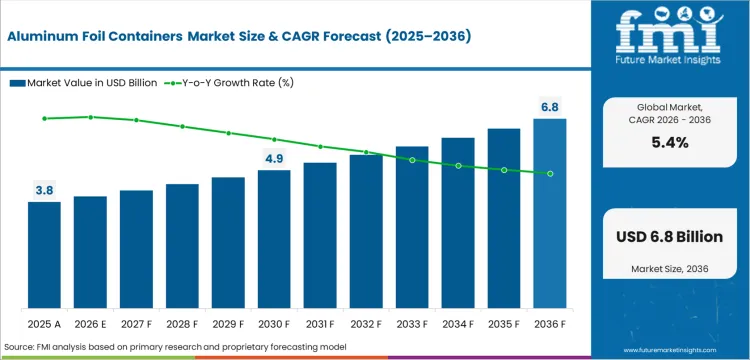
Aluminum foil containers market is expected to expand from USD 4.01 billion in 2026 to USD 6.8 billion by 2036. The market is anticipated to register a 5.40% CAGR during the forecast period. Trays are likely to lead with a 44.0% share, while Food & Beverage is projected to account for 62.0% of application demand in 2026.
Summary of the Aluminum Foil Containers Market
- Demand and Growth Drivers
- Food delivery and catering networks are raising use of ovenable packaging formats.
- Recyclable metal packaging is gaining preference as plastic restrictions tighten.
- Cloud kitchens need containers with strong heat retention and leak protection.
- Catering operators prefer disposable metal formats to reduce cleaning workloads.
- Product and Segment View
- Trays lead due to strong use in meal transport and institutional foodservice.
- Bowls and cups gain traction across desserts and ready-to-heat meals.
- Alloy 8011 remains important due to strength during deep-draw forming.
- Coated formats are gaining use for acidic and refrigerated food items.
- Geography and Competitive Outlook
- Asia Pacific is likely to remain the fastest-growing regional base.
- India and China benefit from urban food delivery and local production scale.
- Europe favors recyclable formats due to stronger circular economy rules.
- Competition depends on stamping capacity, alloy access, and recycling credentials.
- Analyst Opinion
- Ismail Sutaria, Principal Consultant for Packaging, opines that aluminum foil container suppliers must focus on recyclable alloy sourcing, local stamping capacity, and lightweight formats. Foodservice chains are likely to favor vendors that offer stable supply, heat-seal compatibility, and audit-ready recycling claims.
- Aluminum Foil Containers Market Value Analysis
- Aluminum foil containers are moving from standard takeaway packs into compliance-ready foodservice formats.
- Demand is likely to rise as meal delivery operators need heat-safe packaging.
- Adoption is gaining support from recyclable material preference across foodservice channels.
- Spending is anticipated to be backed by trays, coated bowls, and local stamping capacity.
Key Takeaways, Market Size, and Forecast
- Aluminum foil containers sales are expected to reach USD 4.01 billion in 2026.
- By 2036, the market is projected to reach USD 6.8 billion.
- From 2026 to 2036, the market is anticipated to expand at a 5.40% CAGR.
- Trays are likely to lead the product type segment with 44.0% share in 2026.
- Food & Beverage is projected to account for 62.0% of application share in 2026.
- Foodservice/Catering is expected to hold 38.0% of end use demand in 2026.
- India is forecast to record the fastest country-level growth at 7.2% CAGR through 2036.
Demand spans multiple geographies with varied growth trajectories reflecting local industrial policies. China anticipates a 6.8% CAGR, while India projects a 7.2% CAGR based on rapid urbanization and food delivery expansion. USA demand tracks a 4.6% CAGR, Germany shows a 4.1% CAGR, and Japan records a 3.6% CAGR. UK volumes rise at a 4.3% CAGR, and France expects a 4.0% CAGR through assessment timelines. Supplier investments target high-growth zones to optimize freight logistics.
Aluminum Foil Containers Market Definition
Aluminum foil containers represent formed metal receptacles engineered for packaging, heating, and transporting consumable goods. Manufacturers utilize dedicated alloy grades, predominantly 8011 and 1235, achieving required structural integrity and thermal conductivity. Designs encompass trays, bowls, and plates tailored for distinct thermal retention needs. Formats withstand extreme temperature variations, allowing seamless transition from freezing environments to conventional ovens without structural degradation.
Aluminum Foil Containers Market Inclusions
Coverage incorporates all rigid and semi-rigid formed aluminium receptacles utilized across commercial and household applications. Revenue assessments track sales of multi-compartment trays, baking plates, and lidded catering bowls. Valuations include containers utilizing crimped closures or heat-sealed foil lids. Product tracking encompasses both bare aluminium surfaces and specialized coated formats designed for high-acidity food containment.
Aluminum Foil Containers Market Exclusions
Flexible aluminium foil rolls sold for generic wrapping fall outside current valuation scopes. Metal cans designed for pressurized beverages or long-term canned food storage remain excluded from tracking parameters. Paperboard containers featuring ultra-thin interior foil laminates do not qualify as primary aluminium containers. Reusable solid aluminium cookware and industrial bulk storage vats are omitted from final revenue calculations.
Aluminum Foil Containers Market Research Methodology
- Primary Research: Analyst teams conduct structured interviews with packaging directors, procurement heads, and extrusion plant managers to validate demand cycles.
- Desk Research: Aggregation of regulator bulletins, corporate earnings disclosures, and sustainability certifications forms baseline quantitative models.
- Market-Sizing and Forecasting: Bottom-up capacity analysis pairs with top-down application growth rates to generate precise valuation ranges.
- Data Validation and Update Cycle: Proprietary algorithms cross-reference input costs against regional trade shipment logs to verify pricing assumptions before publication.
Segmental Analysis
Aluminum Foil Containers Market Analysis by Product Type
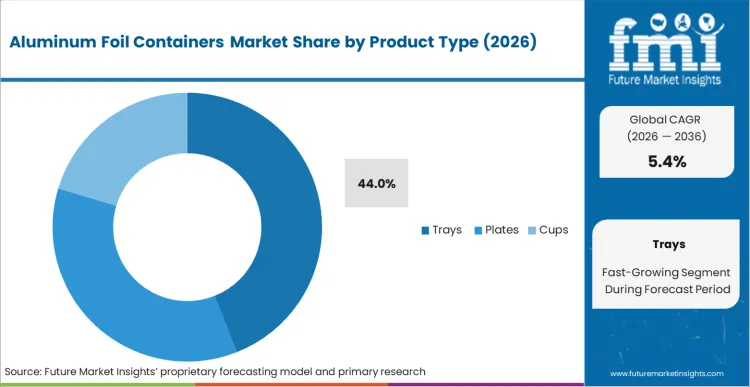
High adoption rates across commercial catering networks requiring compartmentalized meal transport help trays command 44.0% of total volume in 2026, fulfilling critical operational requirements for institutional food providers. Multi-cavity designs prevent cross-contamination during transit, and extrusion techniques yield precise wall thicknesses, reducing material waste during manufacturing. As per FMI's projection, standardizing tray dimensions enables operators to automate filling and sealing processes, cutting labor dependencies. Supplier portfolios expand to include advanced ribbed structures providing enhanced rigidity for heavy meal portions.
- Procurement shift: Buyers recalibrate decisions when plastic alternatives fail heat-resistance tests. Pactiv Evergreen launching next-generation recyclable trays validates market maturity [3]. Transitioning to metal substrates accelerates replacement cycles across institutional buyers.
- Capacity constraint: High-tonnage stamping presses dictate production output ceilings for standard plates . Specialized vendors invest heavily in automation to resolve backlog friction by 2028 [4]. Fulfilling bulk orders requires localized warehousing near major urban centers.
- Application gate: Cup formats gain traction where single-serve dessert packaging demands moisture barriers. D&W Fine Pack integrating automated stamping for high-volume foil bowls demonstrates required capital deployment [5]. Securing large bakery contracts depends entirely on delivering defect-free rim structures.
Aluminum Foil Containers Market Analysis by Application
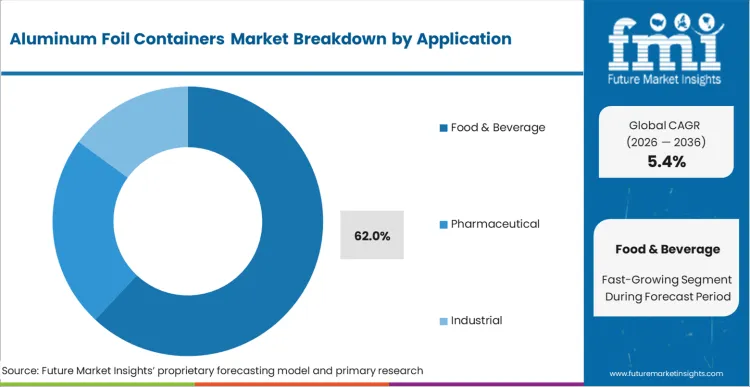
Food & Beverage applications dominate with a 62.0% share in 2026, anchored by expanding off-premise dining consumption habits. Thermal retention properties make metal packaging indispensable for preserving meal quality over extended delivery routes. Barrier characteristics block oxygen and ultraviolet light, extending shelf life for retail-ready baked goods. FMI analysts opine that pharmaceutical buyers represent an emerging growth vector, utilizing specialized micro-containers for temperature-sensitive sample transport. Contamination risks push clinical operators toward sterile, single-use metal formats.
- Regulatory trigger: Stringent food safety standards mandate non-reactive packaging surfaces. U.S. Food and Drug Administration guidelines on sustainable materials outline clear compliance pathways [6]. Vendors achieving audit-ready status secure preferred placement in national retail distributions.
- Technology adoption: Integration of heat-sealable foil lids replaces traditional crimped board covers. Automated lines reduce spillage events during transit phases [7]. Manufacturers prioritizing seal integrity capture lucrative contracts from premium restaurant chains.
- Cost physics: Bulk industrial applications demand high-gauge alloy formulations to withstand stacking pressure. Heavy-duty containers protect components during intercontinental shipping routes [8]. Securing such accounts requires producers to guarantee stringent crush-resistance metrics.
Aluminum Foil Containers Market Analysis by End Use
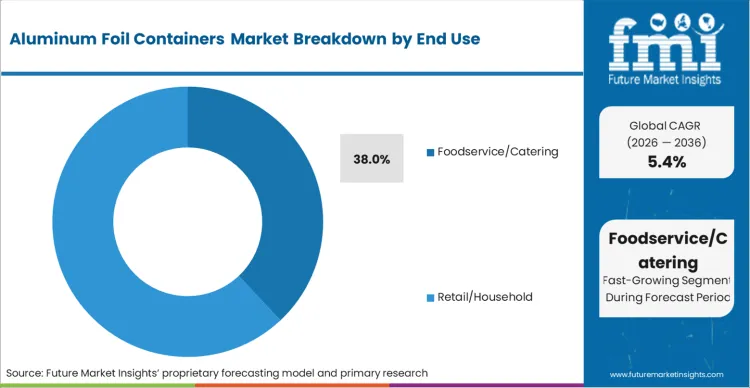
High-volume meal preparation requires packaging capable of enduring flash-freezing and rapid reheating without transferring off-flavors. Metal containers streamline kitchen workflows by eliminating secondary plating steps. According to FMI's estimates, retail household segments exhibit steady volume consumption linked to holiday baking and domestic meal preparation trends. Foodservice/Catering sectors account for 38.0% of demand in 2026, fueled by systemic shifts toward decentralized cloud kitchen operations. Convenience factors drive consumer preference for disposable roasting pans during peak seasonal events.
- Operational friction: Washing reusable catering equipment incurs prohibitive labor and water utility expenses. Utilizing disposable metal solutions bypasses cleaning bottlenecks entirely [9]. Caterers shifting entirely to single-use formats realize immediate workflow acceleration.
- Adoption mechanism: Retail environments prioritize shelf-stacking efficiency and visual product appeal. European Aluminium Foil Association demand trends highlight growing preference for colored exterior finishes [10]. Brands utilizing distinctive container aesthetics achieve faster inventory turnover.
- Supply-side response: Geographic proximity determines win rates for high-frequency catering clients. Building regional stamping facilities reduces carbon footprints associated with transporting empty containers. Localized fulfillment networks defend incumbent market shares against offshore imports.
Aluminum Foil Containers Market Analysis by Alloy Type
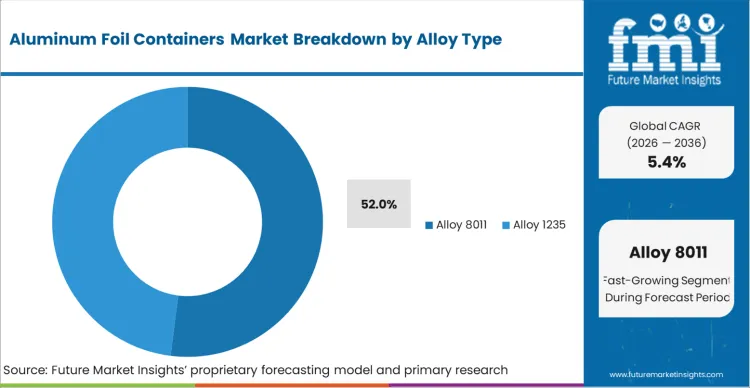
Favored for superior elongation characteristics essential during deep-draw manufacturing, iron and silicon alloying elements enhance tensile strength to help Alloy 8011 capture a 52.0% market share in 2026, effectively preventing sidewall tearing during high-speed stamping operations. Material consistency allows manufacturers to reduce overall container weight while maintaining structural performance. Alloy 1235 finds specific utility in low-stress applications requiring maximum flexibility, such as shallow plates and specific lid structures.
- Material specification: Deep-cavity roasting pans require robust metallurgical properties to avoid fracture. Hulamin Containers achieving 100% post-consumer recycled content certification for Alloy 8011 reshapes sourcing criteria. Purchasing managers mandate sustainable alloy streams to hit internal emission targets.
- Production metric: Foil rolling mills optimize output speeds when processing standard 1235 compositions. Uniform grain structures minimize defect rates during wide-web processing. Mills maintaining tight thickness tolerances secure long-term contracts from converter facilities.
- Performance gate: High-acidity foods necessitate specialized barrier coatings applied directly to base alloys. Coated containers prevent galvanic corrosion during prolonged refrigeration periods. Chemical resistance guarantees brand integrity for acidic frozen meal applications.
Aluminum Foil Containers Market Drivers, Restraints, and Opportunities
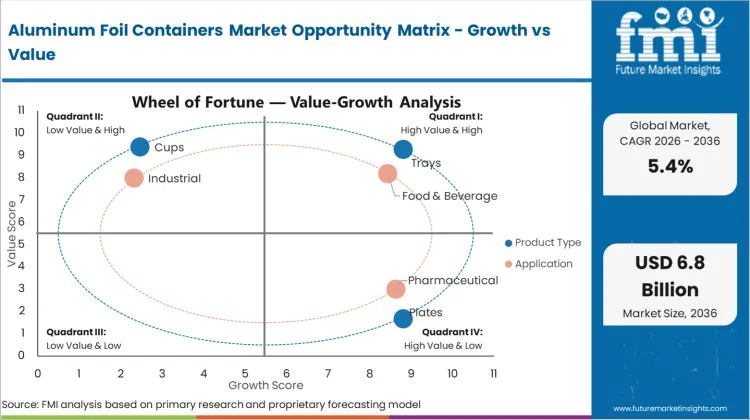
Stringent single-use plastic reduction mandates force catering networks to adopt infinitely recyclable metal alternatives. Regulators penalize polystyrene usage across food delivery ecosystems, triggering urgent procurement shifts toward compliant substrates. Foodservice operators overhaul packaging portfolios, seeking aluminum options that satisfy environmental audits while maintaining thermal performance. Upgrading supply chains requires substantial forward planning, prompting national restaurant chains to execute multi-year volume commitments. Securing guaranteed supply protects buyers from spot market shortages during critical transition phases.
Metal cost volatility restrains profit margins for independent container converters operating without raw material hedges. Sudden fluctuations in global aluminum indices compress margins before pricing adjustments reach end-users. Manufacturers mitigate raw material exposure by standardizing container dimensions, allowing rapid shifts between suppliers without retooling presses. Flexible Packaging Association reports highlight index-linked pricing contracts as primary defense mechanisms against commodity spikes [11]. Implementing automated scrap recovery systems on stamping lines recaptures valuable material, offsetting base cost inflation. Operational efficiency remains paramount for defending unit economics in competitive bidding scenarios.
- Recycling Infrastructure Expansion: Waste management syndicates expanding localized aluminum sorting capabilities benefit municipal buyers. Advanced optical sorters recover higher percentages of contaminated food containers, increasing scrap availability.
- Lightweighting Technologies: Engineering teams developing ribbed sidewall geometries assist mid-market converters. Novelis announcing 50 USD Million Asian capacity expansion ensures advanced lightweight coils reach regional markets.
- Premium Coating Innovations: Chemical suppliers introducing BPA-free, high-temperature coatings empower retail food brands. D&W Fine Pack integrating automated stamping for high-volume foil bowls accelerates deployment of coated formats.
Regional Analysis
Based on regional analysis, Aluminum Foil Containers market is segmented into North America, Latin America, Europe, East Asia, South Asia, Oceania and Middle East & Africa across 40+ countries. Full report also offers market attractiveness analysis based on regional trends.
.webp "Top Country Growth Comparison Aluminum Foil Containers Market Cagr (2026 2036)")
| Country | CAGR (2026 to 2036) |
|---|---|
| China | 6.8% |
| India | 7.2% |
| USA | 4.6% |
| Germany | 4.1% |
| Japan | 3.6% |
| UK | 4.3% |
| France | 4.0% |
Source: Future Market Insights, 2026
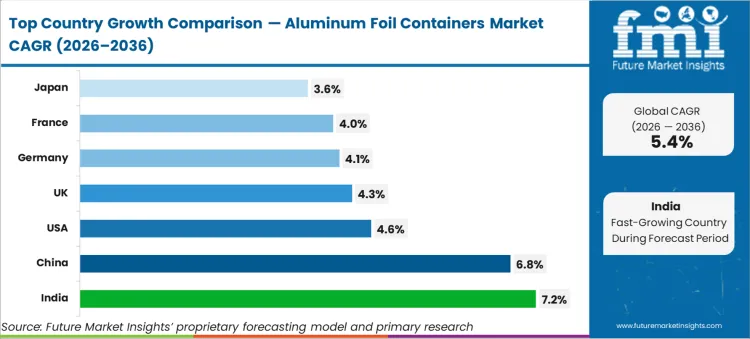
Asia Pacific Aluminum Foil Containers Market Analysis
Rapid urbanization and expanding middle-class demographics drive unprecedented demand for off-premise dining solutions. Urban food delivery networks necessitate leak-proof thermal retention packaging to maintain meal integrity across congested traffic grids. Local stamping facilities scale operations to meet volume demands from aggressive cloud kitchen franchisors. National Bureau of Statistics of China outlines manufacturing sector growth pushing material outputs upward. Regional converters heavily invest in high-cavity tooling to maximize throughput per press cycle. Localizing supply reduces freight dependencies, granting regional players distinct pricing advantages over imported alternatives.
- China: Demand for packaging in China is set to grow at 6.8% CAGR through 2036, supported by massive urban delivery ecosystems before procurement cycles translate into higher deployment volumes. National Bureau of Statistics of China manufacturing metrics validate required industrial capacity scaling. High-volume stamping operations benefit from localized raw material availability.
- India: India is expected to record 7.2% CAGR in container demand over 2026 to 2036. Urban food delivery networks necessitate leak-proof thermal retention formats. Pactiv Evergreen launching next-generation recyclable trays validates market maturity and infrastructure readiness. Buyers secure stable pricing corridors through long-term volume commitments.
- Japan: Japan Aluminium Association metrics show high foil utilization rates in bento packaging ecosystems. Transitioning toward sustainable formats justifies technology refresh decisions across Japan, yielding a 3.6% CAGR. Upgraded vendor shortlists benefit local producers capable of high-volume stamping.
FMI’s report includes comprehensive tracking of emerging capacity deployments across South Korea and Indonesia. Shifting consumer preference toward pre-packaged convenience meals dictates rapid production line upgrades across these zones. Tracking new rolling mill commissions remains critical for assessing future material availability.
North America Aluminum Foil Containers Market Analysis
Established retail baking traditions and mature catering sectors anchor steady volumetric consumption across North America. Heavy-duty roasting pans dominate seasonal retail channels, requiring robust alloy specifications to ensure consumer safety. Institutional operators prioritize stackable designs to optimize limited commercial kitchen storage footprints. U.S. Food and Drug Administration guidelines on sustainable materials outline clear compliance pathways for regional operators [12]. Consolidating supply bases forces smaller converters to specialize in niche geometries to avoid direct price competition with massive conglomerates. Pactiv Evergreen launching next-generation recyclable trays captures attention from national grocery chains [13]. Upgrading legacy stamping equipment remains a primary capital expenditure focus for established vendors.
- USA: The USA packaging sector is poised to expand at 4.6% CAGR during 2026 to 2036 because robust seasonal retail baking drives consistent volume, which lifts utilization rates and justifies technology refreshing decisions. For example, Pactiv Evergreen launched next-generation recyclable trays demonstrates active vendor modernization. Procurement teams mandate strict defect tolerances to prevent automated filling line jams.
FMI’s report includes detailed assessments of shifting trade flows affecting Canada and Mexico. Cross-border material sourcing strategies dictate competitive pricing capabilities for regional stamping facilities. Monitoring tariff adjustments provides vital foresight regarding base aluminum coil costs.
Europe Aluminum Foil Containers Market Analysis
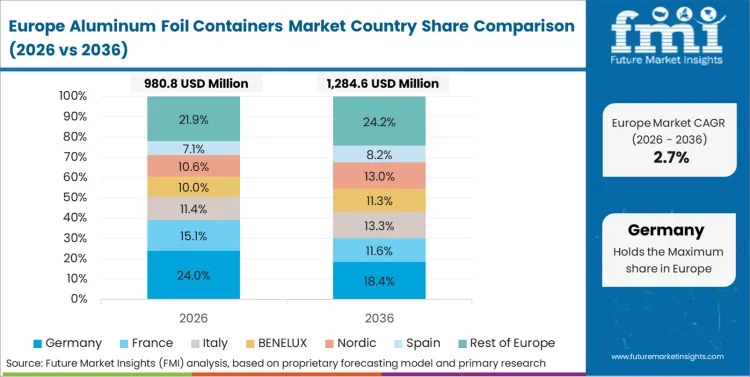
Aggressive circular economy directives force European food retailers to eliminate non-recyclable plastic packaging from store shelves. Metal containers achieve preferred status due to infinitely recyclable properties and established municipal collection infrastructure. Bakery segments adopt smooth-wall foil formats to facilitate gas-flushing techniques, extending product shelf life organically. Converters invest in precision tooling to eliminate sharp rim edges, improving consumer safety profiles. Hulamin Containers achieving 100% post-consumer recycled content certification for Alloy 8011 reshapes regional sourcing criteria.
- Germany: Strict municipal sorting mandates prioritize easily recyclable metal formats over mixed-material plastics. Germany is likely to see container revenues increase at 4.1% CAGR during 2026 to 2036, given aggressive circular economy directives and resulting push for capacity upgrades. Vendor shortlists narrow to suppliers offering verified lifecycle emission data.
- UK: The outlook for meal transport in UK indicates a 4.3% CAGR from 2026 to 2036 as premium retail environments demand aesthetic smooth-wall designs, strengthening demand from both public programs and private operators. Securing contracts requires flawless rim integrity for heat-sealing applications.
- France: Over 2026 to 2036, catering packaging in France is projected to grow at 4.0% CAGR, reflecting localized bans on single-use plastics that steadily raise adoption intensity in core end users. Stamping facilities target high-end bakery accounts with specialized coated formats.
FMI’s report includes deep structural evaluations of changing consumer habits across Italy and Spain. Surging demand for ready-to-eat ovenable meals dictates immediate supply chain recalibrations. Aligning production capabilities with European environmental taxonomy remains essential for market participants.
Competitive Aligners for Market Players
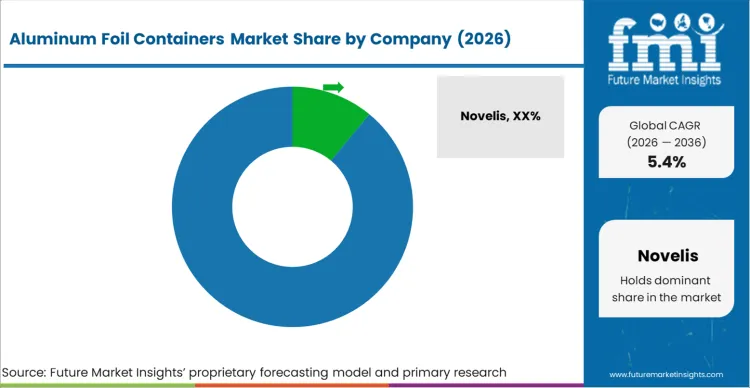
Time‑to‑serve has become a decisive competitive advantage as localization mandates reshape delivery risk profiles. Buyers increasingly favor suppliers that can support multi‑site operations with standardized designs and nearby service hubs, enabling greater schedule reliability and faster backlog resolution.
Price discipline is tightening as volatility in base metal markets elevates floor costs and compresses discount margins. In February 2025, the Flexible Packaging Association reported a 4.0% adjustment in index‑linked pricing structures for rigid formats. As a result, suppliers are restructuring tiered price lists and bundling volumes, while buyers move toward indexed contracts to protect unit economics from commodity swings.
Competitive dynamics are intensifying as sustainability requirements raise the minimum qualifying threshold for suppliers. In March 2025, Hulamin Containers achieved full certification for 100% post‑consumer recycled content, setting a new benchmark for compliance. Vendors with verified sustainability credentials now renew contracts more quickly during budgeting cycles, improving their win rates by reducing the friction typically associated with environmental audits.
Recent Developments
Report includes full coverage of key trends from competitive benchmarking. Some recent developments covered in reports:
- In March 2025, D&W Fine Pack integrated automated stamping for high-volume foil bowls to accelerate production throughput [14].
- In August 2025, Constantia Flexibles announced a €50 million investment to expand its aluminum foil rolling mill in Austria, increasing production capacity by 30% to reach 90,000 tons annually [15].
Key Players in Aluminum Foil Containers Market
- Novelis
- Pactiv
- Trinidad Benham Corporation
- Hulamin Containers
- D&W Fine Pack
- Penny Plate
- Handi-Foil Corporation
Scope of the Report
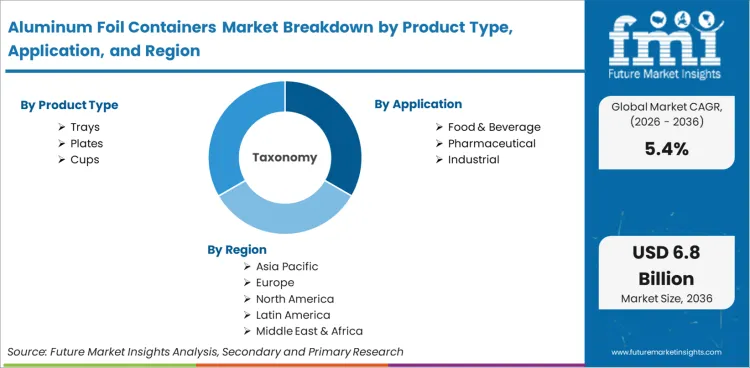
| Metric | Value |
|---|---|
| Quantitative Units | 4.01 USD Billion to 6.8 USD Billion, 5.40% |
| Market Definition | Formed metal receptacles engineered for packaging and transporting consumable goods. |
| Product Type Segmentation | Trays, Plates, Cups, Bowls, Others |
| Application Segmentation | Food & Beverage, Pharmaceutical, Industrial, Institutional, Others |
| Application Coverage | Foodservice/Catering, Retail/Household |
| Regions Covered | Asia Pacific, Europe, North America, Latin America, Middle East & Africa |
| Countries Covered | China, India, Japan, Germany, UK, France, USA |
| Key Companies Profiled | Novelis, Pactiv, Trinidad Benham Corporation, Hulamin Containers |
| Forecast Period | 2026 to 2036 |
| Approach | Primary interviews and verifiable public datasets. |
Source: Future Market Insights (FMI) analysis, based on proprietary forecasting model and primary research.
Aluminum Foil Containers Market Analysis by Segments
Product Type
- Trays
- Plates
- Cups
- Bowls
- Others
Application
- Food & Beverage
- Pharmaceutical
- Industrial
- Institutional
- Others
End Use
- Foodservice/Catering
- Retail/Household
Alloy Type
- Alloy 8011
- Alloy 1235
Region
- Asia Pacific
- India
- China
- Japan
- South Korea
- Indonesia
- Australia & New Zealand
- ASEAN
- Rest of Asia Pacific
- Europe
- Germany
- Italy
- France
- United Kingdom
- Spain
- Benelux
- Nordics
- Central & Eastern Europe
- Rest of Europe
- North America
- United States
- Canada
- Mexico
- Latin America
- Brazil
- Argentina
- Chile
- Rest of Latin America
- Middle East & Africa
- Kingdom of Saudi Arabia
- United Arab Emirates
- South Africa
- Turkey
- Rest of Middle East & Africa
Bibliography
- [1] Global Environmental Management Initiative (GEMI). (2025). Closed-Loop Recycling Verification in Packaging Supply Chains.
- [2] European Aluminium Foil Association. (2025, November 12). Aluminium foil market in the third quarter of 2025: weaker European demand, exports support overall performance [Press release].
- [3] Pactiv Evergreen Inc. (2025). Corporate Announcement: Next-Generation Recyclable Aluminum Tray Rollout.
- [4] Association for Packaging and Processing Technologies. (2025). Capital Automation Trends in Metal Container Stamping.
- [5] D&W Fine Pack. (2025). Operations Update: Automated Stamping Lines for High-Volume Foil Bowls.
- [6] U.S. Food and Drug Administration (FDA). (2025). Regulatory Guidance Document: Sustainable Packaging Materials for Foodservice Operators.
- [7] Institute of Packaging Professionals (IoPP). (2025). Spillage Reduction through Automated Heat-Sealing Lidding Systems.
- [8] International Safe Transit Association (ISTA). (2025). Crush-Resistance Standards for Industrial Shipping Containers.
- [9] Foodservice Equipment & Supplies (FE&S) Magazine. (2025). Cost-Benefit Analysis of Single-Use vs. Reusable Kitchen Formats.
- [10] European Aluminium Foil Association (EAFA). (2025). Market Insights: Retail Preferences for Distinctive Container Aesthetics.
- [11] Flexible Packaging Association (FPA). (2025). Commodity Hedging and Index-Linked Contracting Strategies in Rigid Foil.
- [12] U.S. Food and Drug Administration (FDA). (2025). Compliance Pathways for North American Food Packaging Manufacturers.
- [13] Pactiv Evergreen Inc. (2025). Case Study: Securing National Grocery Partnerships via Sustainable Packaging.
- [14] D&W Fine Pack. (2025). Q1 Performance Report: Throughput Acceleration via Facility Automation.
- [15] Constantia Flexibles. (2025, August 12). Expansion of the rolling mill: Constantia Flexibles focuses on growth at its largest plant worldwide in Austria.
This Report Addresses
- Market intelligence to enable structured strategic decision-making across the aluminum foil containers market, covering demand across foodservice, retail, bakery, ready meals, and catering applications.
- Market size estimation and 10-year revenue forecasts from 2026 to 2036, supported by validated aluminum consumption data, food packaging production benchmarks, and conversion capacity analysis.
- Growth opportunity mapping across product types including compartmental containers, lidded trays, takeaway containers, and oven-ready meal trays, with emphasis on recyclability and lightweighting trends.
- Segment and regional revenue forecasts covering key end-use sectors such as QSR chains, institutional catering, airline catering, meal kit providers, and organized retail.
- Competition strategy assessment including capacity expansion strategies, backward integration in aluminum rolling, private-label manufacturing, and sustainability positioning.
- Technology roadmap tracking including advanced rolling technologies, gauge optimization, embossing and coating innovations, and compatibility with recyclable and fiber-based lids.
- Regulatory impact analysis covering food contact material compliance, recycling mandates, extended producer responsibility frameworks, and regional packaging waste regulations.
- Market report delivery in PDF, Excel, PPT, and interactive dashboard formats for packaging manufacturers, foodservice operators, procurement heads, and strategic planners.
Frequently Asked Questions
How large is the demand for Aluminum Foil Containers in the global market in 2026?
Demand registers at 4.01 USD Billion in 2026.
What will be the market size of Aluminum Foil Containers in the global market by 2036?
Market size scales to 6.8 USD Billion by 2036.
What is the expected demand growth for Aluminum Foil Containers in the global market between 2026 and 2036?
Growth tracks a 5.40% CAGR over the assessment period.
Which Product Type is poised to lead global sales by 2026?
Trays command 44.0% share based on high adoption across institutional meal transport networks.
How significant is the role of Food & Beverage in driving Aluminum Foil Containers adoption in 2026?
Food & Beverage drives 62.0% share due to widespread expansion of off-premise dining logistics.
What is driving demand in China?
Massive urban delivery ecosystems and localized raw material availability accelerate regional adoption.
What compliance standards or regulations are referenced for China?
National Bureau of Statistics of China manufacturing metrics validate industrial capacity scaling.
What is the China growth outlook in this report?
China anticipates a 6.8% CAGR.
Why is North America described as a priority region in this report?
Established retail baking traditions and mature catering sectors anchor steady volumetric consumption.
What type of demand dominates in North America?
Heavy-duty roasting pans dominate seasonal retail channels, requiring robust alloy specifications.
What is India growth outlook in this report?
India is projected to record a 7.2% CAGR.
Does the report cover USA in its regional analysis?
Yes, USA is covered under North America.
What are the sources referred to for analyzing USA?
Corporate capacity announcements and federal regulatory guidelines anchor the analysis.
What is the main demand theme linked to USA in its region coverage?
Robust seasonal retail baking drives consistent volume and justifies technology refresh decisions.
Does the report cover Germany in its regional analysis?
Yes, Germany falls under Europe.
What is the main Germany related demand theme in its region coverage?
Strict municipal sorting mandates prioritize easily recyclable metal formats over plastics.
Which product formats or configurations are strategically important for Asia Pacific supply chains?
High-cavity tooling formats for bulk food delivery applications remain strategically vital.
What is Aluminum Foil Containers and what is it mainly used for?
Formed metal receptacles engineered for packaging, heating, and transporting consumable goods.
What does Aluminum Foil Containers mean in this report?
Rigid and semi-rigid formed aluminium receptacles utilized across commercial and household applications.
What is included in the scope of this Aluminum Foil Containers report?
Multi-compartment trays, baking plates, and lidded catering bowls.
What is excluded from the scope of this report?
Flexible aluminium foil rolls sold for generic wrapping fall outside current scopes.
What does market forecast mean on this page?
A model-based projection tracking expected sales volumes and revenues.
How does FMI build and validate the Aluminum Foil Containers forecast?
Bottom-up capacity analysis pairs with top-down application growth rates validated through primary interviews.
What does zero reliance on speculative third party market research mean here?
Forecasts depend strictly on verifiable public datasets, corporate disclosures, and direct industry dialogue.
Preview the report firsthand - request a free sample
Get SampleGet the brochure for pricing and purchase details.
Get PDFTable of Content
- Executive Summary
- Global Market Outlook
- Demand-side Trends
- Supply-side Trends
- Technology Roadmap Analysis
- Analysis and Recommendations
- Market Overview
- Market Coverage / Taxonomy
- Market Definition / Scope / Limitations
- Research Methodology
- Chapter Orientation
- Analytical Lens and Working Hypotheses
- Market Structure, Signals, and Trend Drivers
- Benchmarking and Cross-market Comparability
- Market Sizing, Forecasting, and Opportunity Mapping
- Research Design and Evidence Framework
- Desk Research Programme (Secondary Evidence)
- Company Annual and Sustainability Reports
- Peer-reviewed Journals and Academic Literature
- Corporate Websites, Product Literature, and Technical Notes
- Earnings Decks and Investor Briefings
- Statutory Filings and Regulatory Disclosures
- Technical White Papers and Standards Notes
- Trade Journals, Industry Magazines, and Analyst Briefs
- Conference Proceedings, Webinars, and Seminar Materials
- Government Statistics Portals and Public Data Releases
- Press Releases and Reputable Media Coverage
- Specialist Newsletters and Curated Briefings
- Sector Databases and Reference Repositories
- FMI Internal Proprietary Databases and Historical Market Datasets
- Subscription Datasets and Paid Sources
- Social Channels, Communities, and Digital Listening Inputs
- Additional Desk Sources
- Expert Input and Fieldwork (Primary Evidence)
- Primary Modes
- Qualitative Interviews and Expert Elicitation
- Quantitative Surveys and Structured Data Capture
- Blended Approach
- Why Primary Evidence is Used
- Field Techniques
- Interviews
- Surveys
- Focus Groups
- Observational and In-context Research
- Social and Community Interactions
- Stakeholder Universe Engaged
- C-suite Leaders
- Board Members
- Presidents and Vice Presidents
- R&D and Innovation Heads
- Technical Specialists
- Domain Subject-matter Experts
- Scientists
- Physicians and Other Healthcare Professionals
- Governance, Ethics, and Data Stewardship
- Research Ethics
- Data Integrity and Handling
- Primary Modes
- Tooling, Models, and Reference Databases
- Desk Research Programme (Secondary Evidence)
- Data Engineering and Model Build
- Data Acquisition and Ingestion
- Cleaning, Normalisation, and Verification
- Synthesis, Triangulation, and Analysis
- Quality Assurance and Audit Trail
- Market Background
- Market Dynamics
- Drivers
- Restraints
- Opportunity
- Trends
- Scenario Forecast
- Demand in Optimistic Scenario
- Demand in Likely Scenario
- Demand in Conservative Scenario
- Opportunity Map Analysis
- Product Life Cycle Analysis
- Supply Chain Analysis
- Investment Feasibility Matrix
- Value Chain Analysis
- PESTLE and Porter’s Analysis
- Regulatory Landscape
- Regional Parent Market Outlook
- Production and Consumption Statistics
- Import and Export Statistics
- Market Dynamics
- Global Market Analysis 2021 to 2025 and Forecast, 2026 to 2036
- Historical Market Size Value (USD Billion) Analysis, 2021 to 2025
- Current and Future Market Size Value (USD Billion) Projections, 2026 to 2036
- Y-o-Y Growth Trend Analysis
- Absolute $ Opportunity Analysis
- Global Market Pricing Analysis 2021 to 2025 and Forecast 2026 to 2036
- Global Market Analysis 2021 to 2025 and Forecast 2026 to 2036, By Product Type
- Introduction / Key Findings
- Historical Market Size Value (USD Billion) Analysis By Product Type , 2021 to 2025
- Current and Future Market Size Value (USD Billion) Analysis and Forecast By Product Type , 2026 to 2036
- Trays
- Plates
- Cups
- Trays
- Y-o-Y Growth Trend Analysis By Product Type , 2021 to 2025
- Absolute $ Opportunity Analysis By Product Type , 2026 to 2036
- Global Market Analysis 2021 to 2025 and Forecast 2026 to 2036, By Application
- Introduction / Key Findings
- Historical Market Size Value (USD Billion) Analysis By Application, 2021 to 2025
- Current and Future Market Size Value (USD Billion) Analysis and Forecast By Application, 2026 to 2036
- Food & Beverage
- Pharmaceutical
- Industrial
- Food & Beverage
- Y-o-Y Growth Trend Analysis By Application, 2021 to 2025
- Absolute $ Opportunity Analysis By Application, 2026 to 2036
- Global Market Analysis 2021 to 2025 and Forecast 2026 to 2036, By End Use
- Introduction / Key Findings
- Historical Market Size Value (USD Billion) Analysis By End Use, 2021 to 2025
- Current and Future Market Size Value (USD Billion) Analysis and Forecast By End Use, 2026 to 2036
- Foodservice/Catering
- Retail/Household
- Foodservice/Catering
- Y-o-Y Growth Trend Analysis By End Use, 2021 to 2025
- Absolute $ Opportunity Analysis By End Use, 2026 to 2036
- Global Market Analysis 2021 to 2025 and Forecast 2026 to 2036, By Alloy Type
- Introduction / Key Findings
- Historical Market Size Value (USD Billion) Analysis By Alloy Type, 2021 to 2025
- Current and Future Market Size Value (USD Billion) Analysis and Forecast By Alloy Type, 2026 to 2036
- Alloy 8011
- Alloy 1235
- Alloy 8011
- Y-o-Y Growth Trend Analysis By Alloy Type, 2021 to 2025
- Absolute $ Opportunity Analysis By Alloy Type, 2026 to 2036
- Global Market Analysis 2021 to 2025 and Forecast 2026 to 2036, By Region
- Introduction
- Historical Market Size Value (USD Billion) Analysis By Region, 2021 to 2025
- Current Market Size Value (USD Billion) Analysis and Forecast By Region, 2026 to 2036
- North America
- Latin America
- Western Europe
- Eastern Europe
- East Asia
- South Asia and Pacific
- Middle East & Africa
- Market Attractiveness Analysis By Region
- North America Market Analysis 2021 to 2025 and Forecast 2026 to 2036, By Country
- Historical Market Size Value (USD Billion) Trend Analysis By Market Taxonomy, 2021 to 2025
- Market Size Value (USD Billion) Forecast By Market Taxonomy, 2026 to 2036
- By Country
- USA
- Canada
- Mexico
- By Product Type
- By Application
- By End Use
- By Alloy Type
- By Country
- Market Attractiveness Analysis
- By Country
- By Product Type
- By Application
- By End Use
- By Alloy Type
- Key Takeaways
- Latin America Market Analysis 2021 to 2025 and Forecast 2026 to 2036, By Country
- Historical Market Size Value (USD Billion) Trend Analysis By Market Taxonomy, 2021 to 2025
- Market Size Value (USD Billion) Forecast By Market Taxonomy, 2026 to 2036
- By Country
- Brazil
- Chile
- Rest of Latin America
- By Product Type
- By Application
- By End Use
- By Alloy Type
- By Country
- Market Attractiveness Analysis
- By Country
- By Product Type
- By Application
- By End Use
- By Alloy Type
- Key Takeaways
- Western Europe Market Analysis 2021 to 2025 and Forecast 2026 to 2036, By Country
- Historical Market Size Value (USD Billion) Trend Analysis By Market Taxonomy, 2021 to 2025
- Market Size Value (USD Billion) Forecast By Market Taxonomy, 2026 to 2036
- By Country
- Germany
- UK
- Italy
- Spain
- France
- Nordic
- BENELUX
- Rest of Western Europe
- By Product Type
- By Application
- By End Use
- By Alloy Type
- By Country
- Market Attractiveness Analysis
- By Country
- By Product Type
- By Application
- By End Use
- By Alloy Type
- Key Takeaways
- Eastern Europe Market Analysis 2021 to 2025 and Forecast 2026 to 2036, By Country
- Historical Market Size Value (USD Billion) Trend Analysis By Market Taxonomy, 2021 to 2025
- Market Size Value (USD Billion) Forecast By Market Taxonomy, 2026 to 2036
- By Country
- Russia
- Poland
- Hungary
- Balkan & Baltic
- Rest of Eastern Europe
- By Product Type
- By Application
- By End Use
- By Alloy Type
- By Country
- Market Attractiveness Analysis
- By Country
- By Product Type
- By Application
- By End Use
- By Alloy Type
- Key Takeaways
- East Asia Market Analysis 2021 to 2025 and Forecast 2026 to 2036, By Country
- Historical Market Size Value (USD Billion) Trend Analysis By Market Taxonomy, 2021 to 2025
- Market Size Value (USD Billion) Forecast By Market Taxonomy, 2026 to 2036
- By Country
- China
- Japan
- South Korea
- By Product Type
- By Application
- By End Use
- By Alloy Type
- By Country
- Market Attractiveness Analysis
- By Country
- By Product Type
- By Application
- By End Use
- By Alloy Type
- Key Takeaways
- South Asia and Pacific Market Analysis 2021 to 2025 and Forecast 2026 to 2036, By Country
- Historical Market Size Value (USD Billion) Trend Analysis By Market Taxonomy, 2021 to 2025
- Market Size Value (USD Billion) Forecast By Market Taxonomy, 2026 to 2036
- By Country
- India
- ASEAN
- Australia & New Zealand
- Rest of South Asia and Pacific
- By Product Type
- By Application
- By End Use
- By Alloy Type
- By Country
- Market Attractiveness Analysis
- By Country
- By Product Type
- By Application
- By End Use
- By Alloy Type
- Key Takeaways
- Middle East & Africa Market Analysis 2021 to 2025 and Forecast 2026 to 2036, By Country
- Historical Market Size Value (USD Billion) Trend Analysis By Market Taxonomy, 2021 to 2025
- Market Size Value (USD Billion) Forecast By Market Taxonomy, 2026 to 2036
- By Country
- Kingdom of Saudi Arabia
- Other GCC Countries
- Turkiye
- South Africa
- Other African Union
- Rest of Middle East & Africa
- By Product Type
- By Application
- By End Use
- By Alloy Type
- By Country
- Market Attractiveness Analysis
- By Country
- By Product Type
- By Application
- By End Use
- By Alloy Type
- Key Takeaways
- Key Countries Market Analysis
- USA
- Pricing Analysis
- Market Share Analysis, 2025
- By Product Type
- By Application
- By End Use
- By Alloy Type
- Canada
- Pricing Analysis
- Market Share Analysis, 2025
- By Product Type
- By Application
- By End Use
- By Alloy Type
- Mexico
- Pricing Analysis
- Market Share Analysis, 2025
- By Product Type
- By Application
- By End Use
- By Alloy Type
- Brazil
- Pricing Analysis
- Market Share Analysis, 2025
- By Product Type
- By Application
- By End Use
- By Alloy Type
- Chile
- Pricing Analysis
- Market Share Analysis, 2025
- By Product Type
- By Application
- By End Use
- By Alloy Type
- Germany
- Pricing Analysis
- Market Share Analysis, 2025
- By Product Type
- By Application
- By End Use
- By Alloy Type
- UK
- Pricing Analysis
- Market Share Analysis, 2025
- By Product Type
- By Application
- By End Use
- By Alloy Type
- Italy
- Pricing Analysis
- Market Share Analysis, 2025
- By Product Type
- By Application
- By End Use
- By Alloy Type
- Spain
- Pricing Analysis
- Market Share Analysis, 2025
- By Product Type
- By Application
- By End Use
- By Alloy Type
- France
- Pricing Analysis
- Market Share Analysis, 2025
- By Product Type
- By Application
- By End Use
- By Alloy Type
- India
- Pricing Analysis
- Market Share Analysis, 2025
- By Product Type
- By Application
- By End Use
- By Alloy Type
- ASEAN
- Pricing Analysis
- Market Share Analysis, 2025
- By Product Type
- By Application
- By End Use
- By Alloy Type
- Australia & New Zealand
- Pricing Analysis
- Market Share Analysis, 2025
- By Product Type
- By Application
- By End Use
- By Alloy Type
- China
- Pricing Analysis
- Market Share Analysis, 2025
- By Product Type
- By Application
- By End Use
- By Alloy Type
- Japan
- Pricing Analysis
- Market Share Analysis, 2025
- By Product Type
- By Application
- By End Use
- By Alloy Type
- South Korea
- Pricing Analysis
- Market Share Analysis, 2025
- By Product Type
- By Application
- By End Use
- By Alloy Type
- Russia
- Pricing Analysis
- Market Share Analysis, 2025
- By Product Type
- By Application
- By End Use
- By Alloy Type
- Poland
- Pricing Analysis
- Market Share Analysis, 2025
- By Product Type
- By Application
- By End Use
- By Alloy Type
- Hungary
- Pricing Analysis
- Market Share Analysis, 2025
- By Product Type
- By Application
- By End Use
- By Alloy Type
- Kingdom of Saudi Arabia
- Pricing Analysis
- Market Share Analysis, 2025
- By Product Type
- By Application
- By End Use
- By Alloy Type
- Turkiye
- Pricing Analysis
- Market Share Analysis, 2025
- By Product Type
- By Application
- By End Use
- By Alloy Type
- South Africa
- Pricing Analysis
- Market Share Analysis, 2025
- By Product Type
- By Application
- By End Use
- By Alloy Type
- USA
- Market Structure Analysis
- Competition Dashboard
- Competition Benchmarking
- Market Share Analysis of Top Players
- By Regional
- By Product Type
- By Application
- By End Use
- By Alloy Type
- Competition Analysis
- Competition Deep Dive
- Novelis
- Overview
- Product Portfolio
- Profitability by Market Segments (Product/Age /Sales Channel/Region)
- Sales Footprint
- Strategy Overview
- Marketing Strategy
- Product Strategy
- Channel Strategy
- Pactiv
- Trinidad Benham Corporation
- Hulamin Containers
- D&W Fine Pack
- Penny Plate
- Handi-Foil Corporation
- Novelis
- Competition Deep Dive
- Assumptions & Acronyms Used


