

- Industry Size (2026)
- USD 1234.3 Mn
- Forecast (2036)
- USD 1935.3 Mn
- CAGR (2026 to 2036)
- 4.6%
Aluminum Body Panel Fasteners Market Forecast and Outlook 2026 to 2036
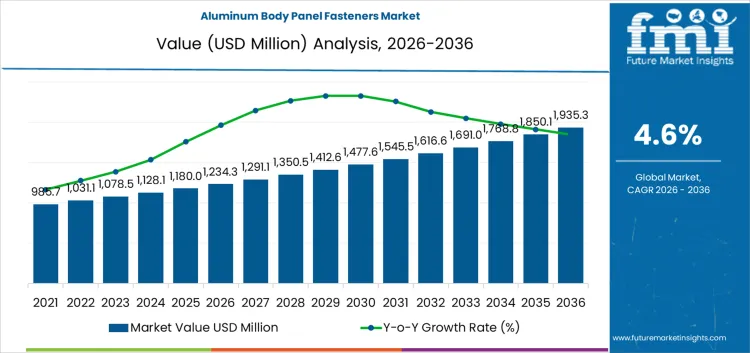
The aluminum body panel fasteners market is likely to be valued at USD 1,234.3 million in 2026 and is forecasted to reach USD 1,935.3 million by 2036 at a CAGR of 4.6%. Value formation is anchored in structural joining requirements created by the shift toward aluminum-intensive body architectures rather than in discretionary component substitution. Every aluminum panel introduced into body-in-white, closures, or exterior assemblies requires fasteners engineered to manage joint integrity, galvanic behavior, and dimensional stability. Unit demand scales with aluminum surface area per vehicle, joining point density, and automation compatibility within body assembly lines, linking revenue progression directly to material mix decisions at the platform level.
Progression over the forecast period reflects manufacturing discipline and validation constraints more than rapid design turnover. Aluminum-compatible fasteners carry higher material, coating, and process control costs compared with conventional steel alternatives, limiting aggressive price expansion. Joint performance validation under crash loading, fatigue cycling, and corrosion exposure extends qualification timelines and reduces substitution velocity. Platform-specific joining strategies restrict full standardization, sustaining parallel fastener specifications across vehicle programs. Replacement demand is tied primarily to collision repair protocols and controlled service procedures rather than routine wear. Procurement priorities emphasize dimensional consistency, coating reliability, and long-term supply continuity, reinforcing steady value accumulation driven by structural necessity rather than volume volatility or feature-led differentiation.
Quick Stats for Aluminum Body Panel Fasteners Market
- Aluminum Body Panel Fasteners Market Value (2026): USD 1,234.3 million
- Aluminum Body Panel Fasteners Market Forecast Value (2036): USD 1,935.3 million
- Aluminum Body Panel Fasteners Market Forecast CAGR 2026 to 2036: 4.6%
- Leading Fastener Type by Demand Share: Self-Piercing Rivets (SPR)
- Fastest-Growing Countries: China, India, Mexico, Germany, South Korea
- Top Players in Global Demand: Böllhoff, Stanley Engineered Fastening, LISI Automotive, KAMAX, Würth Automotive, Bossard Group, SFS Group, PennEngineering, Bulten, Fontana Gruppo
Aluminum Body Panel Fasteners Market Key Takeaways
| Metric | Value |
|---|---|
| Market Value (2026) | USD 1,234.3 million |
| Market Forecast Value (2036) | USD 1,935.3 million |
| Forecast CAGR 2026 to 2036 | 4.6% |
Why is the Demand for Aluminum Body Panel Fasteners Growing?
Demand for aluminum body panel fasteners is rising as automakers and commercial vehicle manufacturers shift to lightweight materials to improve fuel economy and reduce emissions footprint. Aluminum body panels deliver weight savings but require fasteners engineered for metal compatibility, thread integrity, and corrosion resistance in mixed metal assemblies. Engineers specify fasteners that meet performance criteria for tensile strength, vibration tolerance, and precision fit to maintain panel alignment and structural integrity under dynamic loads. Procurement teams assess material grade, protective coating, and manufacturing quality to ensure parts align with assembly protocols and serviceability expectations in high volume production environments.
Vehicle designers integrate fasteners with stamping and joining processes to support consistent build quality across platform variants, and bodyin-white teams evaluate joint performance under crash and durability tests. Adoption of advanced driver assistance systems and electrified powertrains reinforces use of aluminum structures to offset battery mass, driving demand for compatible fastener technologies. Supply chain planners coordinate inventories that support sequenced assembly operations and minimize line stoppages due to part shortages. Maintenance and repair networks require access to certified replacement fasteners that preserve original fit and finish during collision repair and scheduled service. These technical and operational priorities support sustained uptake of aluminum body panel fasteners in evolving mobility segments.
How Are the Segments Classified in the Aluminum Body Panel Fasteners Market?
Demand for aluminum body panel fasteners is shaped by light weighting objectives, mixed-material body construction, and structural joining reliability requirements. Vehicle manufacturers adopt aluminum panels to reduce mass while maintaining crash performance and dimensional stability. Fastener selection prioritizes joint strength, corrosion resistance, and compatibility with aluminum substrates. Assembly automation and cycle time efficiency influence fastening technology choice. Segment classification reflects differentiation by fastener design, material composition, and vehicle positioning. Structure highlights how joining method, fastener metallurgy, and vehicle class influence specification preferences, production scalability, and adoption intensity across modern automotive body-in-white architectures.
Which Fastener Type Represents the Largest Share of Demand?
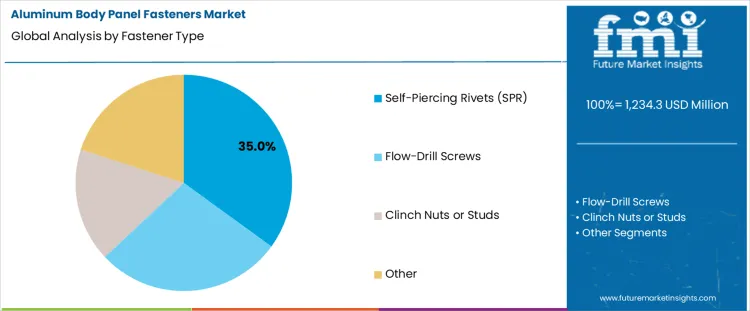
Self-piercing rivets hold 35.0%, representing the largest share among fastener types due to suitability for aluminum sheet joining. SPR technology enables joining without pre-drilled holes, preserving material integrity and surface quality. High joint strength and repeatability support structural body applications. Automation compatibility aligns with high-volume production requirements. Flow-drill screws provide threaded joints with localized heat generation. Clinch nuts and studs support detachable joints with lower structural contribution. Fastener type segmentation reflects preference for permanent, high-strength joining solutions optimized for aluminum-intensive body structures.
Key Points
- Self-piercing rivets enable strong joints without pre-drilling.
- Automation compatibility supports high-volume body assembly.
- Other fasteners address threaded or detachable joint needs.
Which Material Accounts for the Highest Share of Demand?

Aluminum fasteners hold 44.0%, representing the largest share among materials due to galvanic compatibility with aluminum panels. Material matching reduces corrosion risk and supports long-term joint durability. Weight reduction benefits align with lightweight body design objectives. Aluminum fasteners provide adequate strength for panel attachment applications. High-strength steel fasteners deliver higher load capacity with increased corrosion management needs. Stainless steel supports corrosion resistance with higher cost and weight. Material segmentation reflects preference for lightweight, corrosion-compatible solutions supporting aluminum body construction strategies.
Key Points
- Aluminum fasteners reduce galvanic corrosion risk.
- Lightweight properties support vehicle mass reduction.
- Other materials address strength or corrosion priorities.
Which Vehicle Class Drives the Largest Share of Demand?
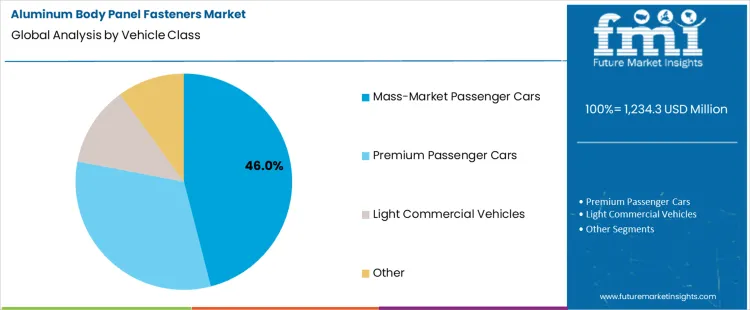
Mass-market passenger cars hold 46.0%, representing the largest share among vehicle classes adopting aluminum body panel fasteners. Volume production programs increasingly integrate aluminum panels for efficiency gains. Cost-effective fastening solutions support scalability across high-output manufacturing lines. Structural performance requirements balance strength and material efficiency. Premium passenger cars adopt advanced fastening with higher aluminum content and tighter tolerances. Light commercial vehicles apply aluminum selectively for payload optimization. Vehicle class segmentation reflects concentration of fastener demand within high-volume passenger platforms driving scale adoption of aluminum body construction techniques.
Key Points
- Mass-market cars drive high-volume fastener consumption.
- Aluminum panels support efficiency-focused design strategies.
- Other vehicle classes apply aluminum based on positioning and payload needs.
What are the Key Dynamics in the Aluminum Body Panel Fasteners Market?
Demand for aluminum body panel fasteners reflects lightweight construction requirements and mixed-material body architectures in modern vehicles. Adoption spans passenger vehicles, commercial vehicles, and electric platforms using aluminum-intensive body structures. Global scope aligns with vehicle mass reduction targets, corrosion resistance needs, and structural integrity expectations. Usage centers on mechanical fasteners, self-piercing rivets, flow-drill screws, and hybrid fastening solutions compatible with aluminum panels.
How do lightweight body design and mixed-material assembly shape adoption?
Vehicle manufacturers adopt aluminum panels to reduce mass and improve efficiency without compromising structural performance. Demand increases as mixed-material bodies combine aluminum with steel, composites, and polymers. Conventional welding proves unsuitable for many aluminum joints, driving reliance on specialized fasteners. Self-piercing rivets and flow-drill screws enable high-strength joints without pre-drilling or thermal distortion. Fastener selection affects crash energy management and dimensional stability of body assemblies. Compatibility with automated body-in-white processes supports high-volume production. Corrosion management between dissimilar materials reinforces use of coated and insulated fasteners. Adoption reflects manufacturing necessity rather than discretionary design choice.
How do cost pressure, process complexity, and validation requirements influence market scalability?
Aluminum-compatible fasteners carry higher unit cost than conventional steel fasteners. Demand sensitivity rises where vehicle segments face strict cost targets. Tooling investment for specialized fastening equipment increases capital burden. Process control requirements remain tight to avoid galvanic corrosion and joint inconsistency. Validation for fatigue, crash performance, and environmental exposure extends development timelines. Repair complexity affects aftermarket acceptance and service cost. Platform-specific joint design limits standardization benefits. Supply chain dependence on precision fastener manufacturing constrains rapid scaling across diverse vehicle architectures.
How Is Demand for Aluminum Body Panel Fasteners Evolving Globally?
Demand for aluminum body panel fasteners is expanding globally due to light weighting strategies, corrosion resistance requirements, and structural integrity needs in modern vehicle platforms. Usage aligns with increased aluminum content in body-in-white, closures, and exterior panels across passenger and commercial vehicles. OEMs specify fasteners compatible with mixed-material joining, vibration resistance, and long-term durability. Electrification reinforces aluminum adoption to offset battery mass. Growth rates in China at 5.4%, India at 5.2%, Mexico at 4.4%, Germany at 4.2%, and South Korea at 4.0% indicate sustained expansion driven by material substitution, platform redesign cycles, and lifecycle servicing.
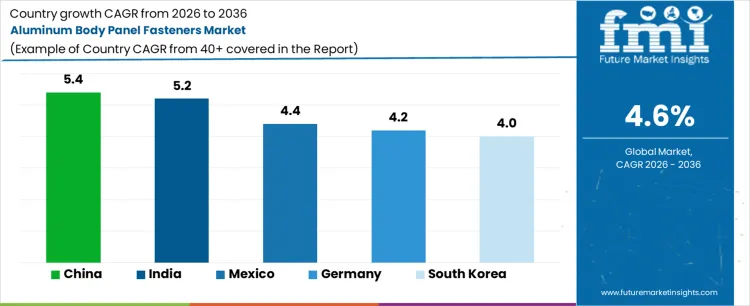
| Country | CAGR (%) |
|---|---|
| China | 5.4% |
| India | 5.2% |
| Mexico | 4.4% |
| Germany | 4.2% |
| South Korea | 4.0% |
What Is Driving Strong Growth of Aluminum Body Panel Fasteners in China?
Aluminum body panel fastener demand in China is growing at a CAGR of 5.4%, supported by rapid aluminum adoption across high-volume vehicle platforms. OEMs increase aluminum usage in closures and exterior panels to reduce curb weight and improve efficiency. High production volumes amplify fastener demand per platform. Mixed-material architectures require specialized fasteners to manage galvanic corrosion and joint integrity. Domestic fastener manufacturing supports scale and cost control. Regulatory efficiency targets reinforce lightweight body design. Demand growth reflects platform-level material shifts rather than incremental styling updates.
- High aluminum penetration in body and closure panels
- Large vehicle production volumes amplifying fastener demand
- Mixed-material joining and corrosion management needs
- Strong domestic aluminum and fastener supply chains
Why Is India Showing Accelerated Expansion in Aluminum Fastener Demand?
Aluminum body panel fastener demand in India is expanding at a CAGR of 5.2%, driven by gradual light weighting across cost-sensitive vehicle segments. OEMs selectively introduce aluminum panels in hoods, tailgates, and structural reinforcements to meet efficiency norms. Fasteners must balance strength, corrosion resistance, and cost efficiency. Localization of component manufacturing supports adoption at scale. Increasing export-oriented vehicle programs require compliance with global material standards. Demand growth reflects phased material substitution aligned with platform refresh cycles.
- Selective aluminum use in closures and panels
- Cost-efficient fastener specifications for mass segments
- Localization supporting scale manufacturing
- Export programs requiring global material compliance
How Is Mexico Shaping Demand for Aluminum Body Panel Fasteners?
Aluminum body panel fastener demand in Mexico is growing at a CAGR of 4.4%, influenced by regional vehicle manufacturing for export markets. Assembly plants integrate aluminum panels to meet weight and emission requirements of destination regions. Fastener specifications align with OEM global standards for strength and corrosion resistance. High production consistency supports stable OEM demand. Supplier integration within North American supply chains facilitates standardized fastener usage. Demand growth reflects export platform continuity rather than domestic vehicle consumption expansion.
- Export-oriented vehicle assembly operations
- Alignment with North American OEM specifications
- Consistent production volumes supporting stable demand
- Integrated regional automotive supply chains
What Factors Are Sustaining Aluminum Fastener Demand in Germany?
Aluminum body panel fastener demand in Germany is expanding at a CAGR of 4.2%, shaped by engineering-led lightweight construction practices. Premium and performance vehicles incorporate extensive aluminum body structures. Fasteners require precise tolerances to support structural rigidity and noise control. Stringent corrosion and durability standards influence material and coating selection. Platform redesign cycles introduce incremental aluminum content rather than abrupt shifts. Demand growth reflects continuous engineering optimization within mature production systems.
- High aluminum usage in premium vehicle bodies
- Tight tolerance requirements for structural integrity
- Strict corrosion and durability standards
- Incremental platform-level material optimization
Why Is South Korea Experiencing Steady Growth in Aluminum Fastener Demand?
Aluminum body panel fastener demand in South Korea is growing at a CAGR of 4.0%, supported by global platform strategies and material efficiency targets. OEMs integrate aluminum panels to balance performance, safety, and cost. Fasteners support mixed steel-aluminum assemblies with controlled joining performance. Export-focused vehicle production drives adherence to international standards. Strong supplier coordination enables consistent quality across high-volume models. Growth remains steady, reflecting standardized material strategies rather than aggressive light weighting shifts.
- Global platform strategies incorporating aluminum panels
- Mixed-material joining performance requirements
- Export-driven adherence to international standards
- Strong OEM-supplier coordination across volumes
What is the competitive landscape of demand for the aluminum body panel fasteners market globally?
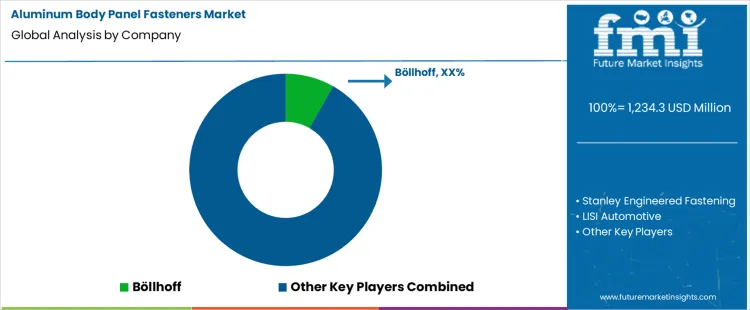
Demand for aluminum body panel fasteners is driven by light weighting mandates, fuel efficiency targets, and electrification trends that raise aluminum usage in vehicle body structures. Fasteners must provide secure joints, corrosion resistance in mixed metal assemblies, dimensional precision, and compatibility with automated assembly processes. Buyers evaluate clamping force reliability, material quality, coating performance, and ease of integration with rivet, bolt, and self-piercing joining techniques. Procurement teams prioritize suppliers with proven OEM qualifications, global manufacturing footprints, and quality systems aligned with automotive standards such as IATF 16949. Trend in the global market reflects rising adoption of aluminum in body panels, door structures, and closures to reduce mass while maintaining structural integrity.
Böllhoff holds leading positioning through engineered fastening systems and aluminum-compatible fasteners used by global automotive OEMs, supported by application engineering and supply continuity. Stanley Engineered Fastening supports demand with a broad portfolio of fasteners, blind rivets, and joining solutions optimized for lightweight assemblies. LISI Automotive contributes precision fasteners and installation systems designed for corrosion resistance and durability in aluminum structures. KAMAX participates with high-strength fasteners and joining hardware tailored to mixed material vehicle body applications. Würth Automotive supplies diversified fastening components with global service networks and quality assurance programs. Competitive differentiation depends on material performance under mixed metals, joint integrity, production consistency, and ability to support automated assembly systems.
Key Players in the Aluminum Body Panel Fasteners Market
- Böllhoff
- Stanley Engineered Fastening
- LISI Automotive
- KAMAX
- Würth Automotive
- Bossard Group
- SFS Group
- PennEngineering
- Bulten
- Fontana Gruppo
Scope of the Report
| Items | Values |
|---|---|
| Quantitative Units | USD million |
| Fastener Type | Self-Piercing Rivets (SPR); Flow-Drill Screws; Clinch Nuts or Studs; Other |
| Material | Aluminum; High-Strength Steel; Stainless Steel; Other |
| Vehicle Class | Mass-Market Passenger Cars; Premium Passenger Cars; Light Commercial Vehicles; Other |
| Sales Channel | OEM Direct; Tier-1 Modules; Aftermarket; Other |
| Regions Covered | Asia Pacific, Europe, North America, Latin America, Middle East & Africa |
| Countries Covered | China, India, Mexico, Germany, South Korea, and 40+ countries |
| Key Companies Profiled | Böllhoff; Stanley Engineered Fastening; LISI Automotive; KAMAX; Würth Automotive; Bossard Group; SFS Group; PennEngineering; Bulten; Fontana Gruppo |
| Additional Attributes | Dollar sales by fastener type and vehicle class; adoption trends for self-piercing rivets and flow-drill screws in mixed-material aluminum body structures; joint strength, fatigue resistance, and corrosion performance metrics; compatibility with aluminum-steel joining and adhesive bonding processes; cycle time, automation readiness, and tool wear considerations in body-in-white assembly; aftermarket replacement and repairability constraints; compliance with OEM crash performance, durability standards, and lightweighting targets influencing aluminum body panel fastener selection. |
Aluminum Body Panel Fasteners Market by Segment
Fastener Type:
- Self-Piercing Rivets (SPR)
- Flow-Drill Screws
- Clinch Nuts or Studs
- Other
Material:
- Aluminum
- High-Strength Steel
- Stainless Steel
- Other
Vehicle Class:
- Mass-Market Passenger Cars
- Premium Passenger Cars
- Light Commercial Vehicles
- Other
Sales Channel:
- OEM Direct
- Tier-1 Modules
- Aftermarket
- Other
Region:
- Asia Pacific
- China
- Japan
- South Korea
- India
- Australia & New Zealand
- ASEAN
- Rest of Asia Pacific
- Europe
- Germany
- United Kingdom
- France
- Italy
- Spain
- Nordic
- BENELUX
- Rest of Europe
- North America
- United States
- Canada
- Mexico
- Latin America
- Brazil
- Chile
- Rest of Latin America
- Middle East & Africa
- Kingdom of Saudi Arabia
- Other GCC Countries
- Turkey
- South Africa
- Other African Union
- Rest of Middle East & Africa
Bibliography
European Parliament and Council of the European Union. (2019, November 27). Regulation (EU) 2019/2144 on type-approval requirements for motor vehicles and their trailers, and systems, components and separate technical units intended therefor, as regards general safety and the protection of vehicle occupants and vulnerable road users, amending Regulation (EU) 2018/858. Official Journal of the European Union. (Consolidated text available via EUR-Lex.)
United Nations Economic Commission for Europe. (1995, October 16). UN Regulation No. 94: Uniform provisions concerning the approval of vehicles with regard to the protection of the occupants in the event of a frontal collision. UNECE (WP.29).
United Nations Economic Commission for Europe. (2015, June 25). UN Regulation No. 135: Uniform provisions concerning the approval of vehicles with regard to their pole side impact performance (PSI). UNECE (WP.29).
International Organization for Standardization. (2018). ISO 12944-9: Paints and varnishes — Corrosion protection of steel structures by protective paint systems — Part 9: Offshore and related structures. ISO
Frequently Asked Questions
How big is the aluminum body panel fasteners market in 2026?
The global aluminum body panel fasteners market is estimated to be valued at USD 1,234.3 million in 2026.
What will be the size of aluminum body panel fasteners market in 2036?
The market size for the aluminum body panel fasteners market is projected to reach USD 1,935.3 million by 2036.
How much will be the aluminum body panel fasteners market growth between 2026 and 2036?
The aluminum body panel fasteners market is expected to grow at a 4.6% CAGR between 2026 and 2036.
What are the key product types in the aluminum body panel fasteners market?
The key product types in aluminum body panel fasteners market are self-piercing rivets (spr), flow-drill screws, clinch nuts or studs and other.
Which material segment to contribute significant share in the aluminum body panel fasteners market in 2026?
In terms of material, aluminum segment to command 44.0% share in the aluminum body panel fasteners market in 2026.
Preview the report firsthand - request a free sample
Get SampleGet the brochure for pricing and purchase details.
Get PDFTable of Content
- Executive Summary
- Global Market Outlook
- Demand-side Trends
- Supply-side Trends
- Technology Roadmap Analysis
- Analysis and Recommendations
- Market Overview
- Market Coverage / Taxonomy
- Market Definition / Scope / Limitations
- Market Background
- Market Dynamics
- Drivers
- Restraints
- Opportunity
- Trends
- Scenario Forecast
- Demand in Optimistic Scenario
- Demand in Likely Scenario
- Demand in Conservative Scenario
- Opportunity Map Analysis
- Product Life Cycle Analysis
- Supply Chain Analysis
- Investment Feasibility Matrix
- Value Chain Analysis
- PESTLE and Porter’s Analysis
- Regulatory Landscape
- Regional Parent Market Outlook
- Production and Consumption Statistics
- Import and Export Statistics
- Market Dynamics
- Global Market Analysis 2021 to 2025 and Forecast, 2026 to 2036
- Historical Market Size Value (USD Million) Analysis, 2021 to 2025
- Current and Future Market Size Value (USD Million) Projections, 2026 to 2036
- Y-o-Y Growth Trend Analysis
- Absolute $ Opportunity Analysis
- Global Market Pricing Analysis 2021 to 2025 and Forecast 2026 to 2036
- Global Market Analysis 2021 to 2025 and Forecast 2026 to 2036, By Fastener Type
- Introduction / Key Findings
- Historical Market Size Value (USD Million) Analysis By Fastener Type , 2021 to 2025
- Current and Future Market Size Value (USD Million) Analysis and Forecast By Fastener Type , 2026 to 2036
- Self-Piercing Rivets (SPR)
- Flow-Drill Screws
- Clinch Nuts or Studs
- Other
- Self-Piercing Rivets (SPR)
- Y-o-Y Growth Trend Analysis By Fastener Type , 2021 to 2025
- Absolute $ Opportunity Analysis By Fastener Type , 2026 to 2036
- Global Market Analysis 2021 to 2025 and Forecast 2026 to 2036, By Material
- Introduction / Key Findings
- Historical Market Size Value (USD Million) Analysis By Material, 2021 to 2025
- Current and Future Market Size Value (USD Million) Analysis and Forecast By Material, 2026 to 2036
- Aluminum
- High-Strength Steel
- Stainless Steel
- Other
- Aluminum
- Y-o-Y Growth Trend Analysis By Material, 2021 to 2025
- Absolute $ Opportunity Analysis By Material, 2026 to 2036
- Global Market Analysis 2021 to 2025 and Forecast 2026 to 2036, By Vehicle Class
- Introduction / Key Findings
- Historical Market Size Value (USD Million) Analysis By Vehicle Class, 2021 to 2025
- Current and Future Market Size Value (USD Million) Analysis and Forecast By Vehicle Class, 2026 to 2036
- Mass-Market Passenger Cars
- Premium Passenger Cars
- Light Commercial Vehicles
- Other
- Mass-Market Passenger Cars
- Y-o-Y Growth Trend Analysis By Vehicle Class, 2021 to 2025
- Absolute $ Opportunity Analysis By Vehicle Class, 2026 to 2036
- Global Market Analysis 2021 to 2025 and Forecast 2026 to 2036, By Sales Channel
- Introduction / Key Findings
- Historical Market Size Value (USD Million) Analysis By Sales Channel, 2021 to 2025
- Current and Future Market Size Value (USD Million) Analysis and Forecast By Sales Channel, 2026 to 2036
- OEM Direct
- Tier-1 Modules
- Aftermarket
- Other
- OEM Direct
- Y-o-Y Growth Trend Analysis By Sales Channel, 2021 to 2025
- Absolute $ Opportunity Analysis By Sales Channel, 2026 to 2036
- Global Market Analysis 2021 to 2025 and Forecast 2026 to 2036, By Region
- Introduction
- Historical Market Size Value (USD Million) Analysis By Region, 2021 to 2025
- Current Market Size Value (USD Million) Analysis and Forecast By Region, 2026 to 2036
- North America
- Latin America
- Western Europe
- Eastern Europe
- East Asia
- South Asia and Pacific
- Middle East & Africa
- Market Attractiveness Analysis By Region
- North America Market Analysis 2021 to 2025 and Forecast 2026 to 2036, By Country
- Historical Market Size Value (USD Million) Trend Analysis By Market Taxonomy, 2021 to 2025
- Market Size Value (USD Million) Forecast By Market Taxonomy, 2026 to 2036
- By Country
- USA
- Canada
- Mexico
- By Fastener Type
- By Material
- By Vehicle Class
- By Sales Channel
- By Country
- Market Attractiveness Analysis
- By Country
- By Fastener Type
- By Material
- By Vehicle Class
- By Sales Channel
- Key Takeaways
- Latin America Market Analysis 2021 to 2025 and Forecast 2026 to 2036, By Country
- Historical Market Size Value (USD Million) Trend Analysis By Market Taxonomy, 2021 to 2025
- Market Size Value (USD Million) Forecast By Market Taxonomy, 2026 to 2036
- By Country
- Brazil
- Chile
- Rest of Latin America
- By Fastener Type
- By Material
- By Vehicle Class
- By Sales Channel
- By Country
- Market Attractiveness Analysis
- By Country
- By Fastener Type
- By Material
- By Vehicle Class
- By Sales Channel
- Key Takeaways
- Western Europe Market Analysis 2021 to 2025 and Forecast 2026 to 2036, By Country
- Historical Market Size Value (USD Million) Trend Analysis By Market Taxonomy, 2021 to 2025
- Market Size Value (USD Million) Forecast By Market Taxonomy, 2026 to 2036
- By Country
- Germany
- UK
- Italy
- Spain
- France
- Nordic
- BENELUX
- Rest of Western Europe
- By Fastener Type
- By Material
- By Vehicle Class
- By Sales Channel
- By Country
- Market Attractiveness Analysis
- By Country
- By Fastener Type
- By Material
- By Vehicle Class
- By Sales Channel
- Key Takeaways
- Eastern Europe Market Analysis 2021 to 2025 and Forecast 2026 to 2036, By Country
- Historical Market Size Value (USD Million) Trend Analysis By Market Taxonomy, 2021 to 2025
- Market Size Value (USD Million) Forecast By Market Taxonomy, 2026 to 2036
- By Country
- Russia
- Poland
- Hungary
- Balkan & Baltic
- Rest of Eastern Europe
- By Fastener Type
- By Material
- By Vehicle Class
- By Sales Channel
- By Country
- Market Attractiveness Analysis
- By Country
- By Fastener Type
- By Material
- By Vehicle Class
- By Sales Channel
- Key Takeaways
- East Asia Market Analysis 2021 to 2025 and Forecast 2026 to 2036, By Country
- Historical Market Size Value (USD Million) Trend Analysis By Market Taxonomy, 2021 to 2025
- Market Size Value (USD Million) Forecast By Market Taxonomy, 2026 to 2036
- By Country
- China
- Japan
- South Korea
- By Fastener Type
- By Material
- By Vehicle Class
- By Sales Channel
- By Country
- Market Attractiveness Analysis
- By Country
- By Fastener Type
- By Material
- By Vehicle Class
- By Sales Channel
- Key Takeaways
- South Asia and Pacific Market Analysis 2021 to 2025 and Forecast 2026 to 2036, By Country
- Historical Market Size Value (USD Million) Trend Analysis By Market Taxonomy, 2021 to 2025
- Market Size Value (USD Million) Forecast By Market Taxonomy, 2026 to 2036
- By Country
- India
- ASEAN
- Australia & New Zealand
- Rest of South Asia and Pacific
- By Fastener Type
- By Material
- By Vehicle Class
- By Sales Channel
- By Country
- Market Attractiveness Analysis
- By Country
- By Fastener Type
- By Material
- By Vehicle Class
- By Sales Channel
- Key Takeaways
- Middle East & Africa Market Analysis 2021 to 2025 and Forecast 2026 to 2036, By Country
- Historical Market Size Value (USD Million) Trend Analysis By Market Taxonomy, 2021 to 2025
- Market Size Value (USD Million) Forecast By Market Taxonomy, 2026 to 2036
- By Country
- Kingdom of Saudi Arabia
- Other GCC Countries
- Turkiye
- South Africa
- Other African Union
- Rest of Middle East & Africa
- By Fastener Type
- By Material
- By Vehicle Class
- By Sales Channel
- By Country
- Market Attractiveness Analysis
- By Country
- By Fastener Type
- By Material
- By Vehicle Class
- By Sales Channel
- Key Takeaways
- Key Countries Market Analysis
- USA
- Pricing Analysis
- Market Share Analysis, 2025
- By Fastener Type
- By Material
- By Vehicle Class
- By Sales Channel
- Canada
- Pricing Analysis
- Market Share Analysis, 2025
- By Fastener Type
- By Material
- By Vehicle Class
- By Sales Channel
- Mexico
- Pricing Analysis
- Market Share Analysis, 2025
- By Fastener Type
- By Material
- By Vehicle Class
- By Sales Channel
- Brazil
- Pricing Analysis
- Market Share Analysis, 2025
- By Fastener Type
- By Material
- By Vehicle Class
- By Sales Channel
- Chile
- Pricing Analysis
- Market Share Analysis, 2025
- By Fastener Type
- By Material
- By Vehicle Class
- By Sales Channel
- Germany
- Pricing Analysis
- Market Share Analysis, 2025
- By Fastener Type
- By Material
- By Vehicle Class
- By Sales Channel
- UK
- Pricing Analysis
- Market Share Analysis, 2025
- By Fastener Type
- By Material
- By Vehicle Class
- By Sales Channel
- Italy
- Pricing Analysis
- Market Share Analysis, 2025
- By Fastener Type
- By Material
- By Vehicle Class
- By Sales Channel
- Spain
- Pricing Analysis
- Market Share Analysis, 2025
- By Fastener Type
- By Material
- By Vehicle Class
- By Sales Channel
- France
- Pricing Analysis
- Market Share Analysis, 2025
- By Fastener Type
- By Material
- By Vehicle Class
- By Sales Channel
- India
- Pricing Analysis
- Market Share Analysis, 2025
- By Fastener Type
- By Material
- By Vehicle Class
- By Sales Channel
- ASEAN
- Pricing Analysis
- Market Share Analysis, 2025
- By Fastener Type
- By Material
- By Vehicle Class
- By Sales Channel
- Australia & New Zealand
- Pricing Analysis
- Market Share Analysis, 2025
- By Fastener Type
- By Material
- By Vehicle Class
- By Sales Channel
- China
- Pricing Analysis
- Market Share Analysis, 2025
- By Fastener Type
- By Material
- By Vehicle Class
- By Sales Channel
- Japan
- Pricing Analysis
- Market Share Analysis, 2025
- By Fastener Type
- By Material
- By Vehicle Class
- By Sales Channel
- South Korea
- Pricing Analysis
- Market Share Analysis, 2025
- By Fastener Type
- By Material
- By Vehicle Class
- By Sales Channel
- Russia
- Pricing Analysis
- Market Share Analysis, 2025
- By Fastener Type
- By Material
- By Vehicle Class
- By Sales Channel
- Poland
- Pricing Analysis
- Market Share Analysis, 2025
- By Fastener Type
- By Material
- By Vehicle Class
- By Sales Channel
- Hungary
- Pricing Analysis
- Market Share Analysis, 2025
- By Fastener Type
- By Material
- By Vehicle Class
- By Sales Channel
- Kingdom of Saudi Arabia
- Pricing Analysis
- Market Share Analysis, 2025
- By Fastener Type
- By Material
- By Vehicle Class
- By Sales Channel
- Turkiye
- Pricing Analysis
- Market Share Analysis, 2025
- By Fastener Type
- By Material
- By Vehicle Class
- By Sales Channel
- South Africa
- Pricing Analysis
- Market Share Analysis, 2025
- By Fastener Type
- By Material
- By Vehicle Class
- By Sales Channel
- USA
- Market Structure Analysis
- Competition Dashboard
- Competition Benchmarking
- Market Share Analysis of Top Players
- By Regional
- By Fastener Type
- By Material
- By Vehicle Class
- By Sales Channel
- Competition Analysis
- Competition Deep Dive
- Böllhoff
- Overview
- Product Portfolio
- Profitability by Market Segments (Product/Age /Sales Channel/Region)
- Sales Footprint
- Strategy Overview
- Marketing Strategy
- Product Strategy
- Channel Strategy
- Stanley Engineered Fastening
- LISI Automotive
- KAMAX
- Würth Automotive
- Bossard Group
- SFS Group
- PennEngineering
- Bulten
- Fontana Gruppo
- Böllhoff
- Competition Deep Dive
- Assumptions & Acronyms Used
- Research Methodology


