

- Industry Size (2026)
- USD 6.8 Bn
- Forecast (2036)
- USD 9.8 Bn
- CAGR (2026 to 2036)
- 3.7%
Aluminum Pipe Market Forecast and Outlook By FMI
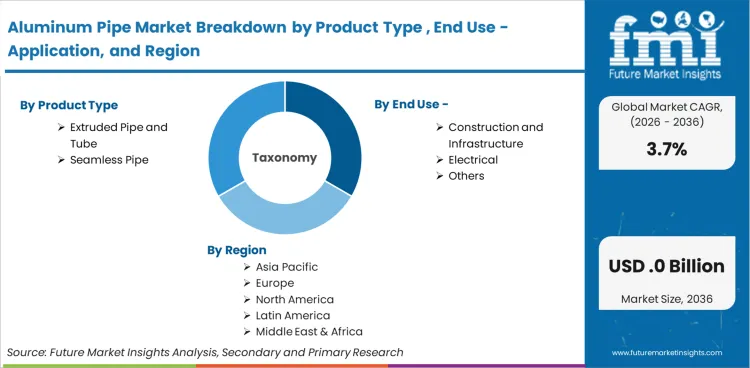
The aluminum pipe market is estimated at USD 6.6 billion in 2025, reaches USD 6.8 billion in 2026, and is projected to advance to USD 9.8 billion by 2036 at a CAGR of 3.7%. Extruded pipe and tube formats lead in 2026 because the manufacturing base, alloy familiarity, and fabrication flexibility remain strongest there. The 6xxx alloy family continues to account for the largest share, supported by a practical mix of corrosion resistance, workability, and strength. Construction, transport, HVAC, and industrial systems remain the major demand anchors. Market growth is being supported by lightweighting, corrosion-resistant infrastructure, and the broad utility of aluminum extrusions in fluid-handling and structural applications.
Summary of Aluminum Pipe Market
- Key Drivers
- Aluminum pipe is often preferred where buyers want lower weight, good corrosion resistance, and easier handling during installation or fabrication.
- Extruded aluminum formats are already well established across North American and global supply chains, which reduces specification risk and makes adoption easier for end users.
- Aluminum is widely recyclable, and that strengthens its position in sectors where procurement decisions are increasingly influenced by circularity goals and embodied carbon considerations.
- Key Segments Analyzed in the Report
- Alloy type: 6xxx series, 5xxx series, 2xxx and 7xxx series, others
- Product type: seamless pipe, welded pipe, extruded pipe and tube
- End use: construction, automotive and transportation, HVAC & refrigeration, industrial equipment, electrical, others
- Region: North America, Latin America, Western Europe, Eastern Europe, East Asia, South Asia & Pacific, and Middle East & Africa
- Analyst Opinion
- Nikhil Kaitwade, Principal Consultant at Future Market Insights says, “This is not a spectacular-growth market, but it is a resilient one. Aluminum pipe keeps winning where designers want a workable balance between weight, corrosion performance, fabrication convenience, and lifecycle value.”
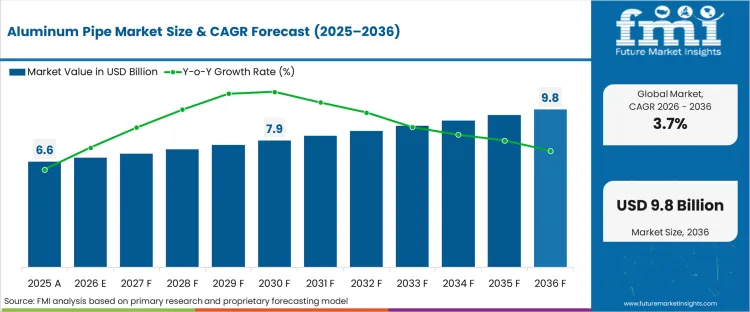
Aluminum Pipe Market Definition
The aluminum pipe market includes aluminum and aluminum-alloy pipe and tube products used for fluid conveyance, structural support, heat transfer, and related applications across industrial, commercial, and transport sectors. The market covers seamless, welded, and extruded formats sold into end-use systems where aluminum’s strength-to-weight and corrosion profile matter.
Aluminum Pipe Market Inclusions
- Revenue from aluminum pipe and tube sold into industrial, building, transport, and thermal-management uses
- Extruded, seamless, and welded formats used for conveyance or structural duty
- Application-specific finishing and fabrication revenue where attached to pipe supply
Aluminum Pipe Market Exclusions
- Flat-rolled sheet, plate, and foil with no pipe or tube function
- Pure structural profiles that are not pipe or tube products
- Plastic or composite piping sold as substitutes
Aluminum Pipe Market Research Methodology
This study evaluates the aluminum pipe market using supplier data on extrusions and pipe formats, standards references for aluminum-alloy tubing, and industry information on the sustainability and manufacturing profile of extruded aluminum. Market sizing reflects end-use demand, extrusion intensity, replacement patterns, and the broad installed base of aluminum pipe and tube applications. This study evaluates the aluminum pipe market using supplier data on extrusions and pipe formats, standards references for aluminum-alloy tubing, and industry information on the sustainability and manufacturing profile of extruded aluminum. Market sizing reflects end-use demand, extrusion intensity, replacement patterns, and the broad installed base of aluminum pipe and tube applications. FMI triangulates findings through a combination of secondary research, supplier benchmarking, and internal analysis of segment-level demand patterns across key end-use industries.
Key Drivers, Restraints, and Trends in Aluminum Pipe Market
Drivers
Demand in the aluminum pipe market is being supported by the material’s low weight, corrosion resistance, and manufacturing versatility. Aluminum pipe is used where buyers need a metal solution that is easier to handle and transport than heavier alternatives, while still offering reliable durability in service. Its compatibility with extrusion-based manufacturing also supports wider specification across industrial, construction, transport, and utility applications.
Restraints
The market faces a few practical constraints. One is exposure to aluminum price volatility, which can affect procurement decisions in cost-sensitive applications. Another is substitution pressure from plastics, carbon steel, and stainless steel, depending on the end-use environment and required performance. Aluminum pipe can also face limits in applications that demand very high pressure resistance or where buyers prioritize lower upfront material cost over weight and corrosion advantages.
Trends
A major trend in the aluminum pipe market is the growing preference for recyclable and lower-carbon material choices. Procurement teams in infrastructure, transportation, and industrial manufacturing are giving more attention to circularity and embodied carbon, which supports the use of aluminum in certain pipe and tube applications. Another important trend is the continued use of extruded formats that allow greater dimensional consistency and production flexibility across a wide range of end uses.
Segmental Analysis
Aluminum Pipe Market Analysis by Product Type Segment
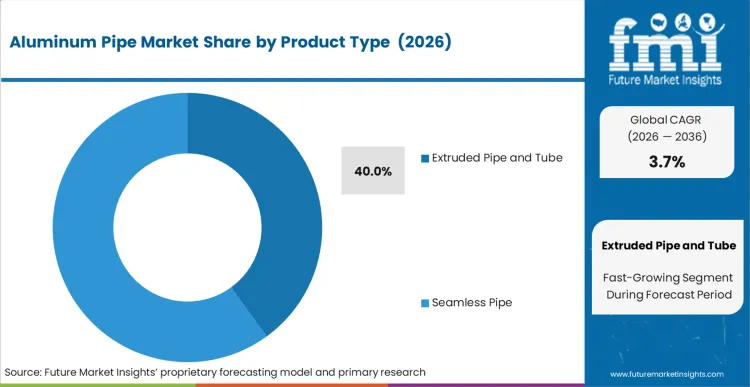
Extruded pipe and tube are projected to hold the leading share of 40% in 2026. The segment leads because extrusion remains the most scalable and commercially efficient production route for standard aluminum pipe and tube formats used across industrial and construction applications. It supports broad dimensional flexibility, steady throughput, and cost control across high-volume runs. The segment also benefits from the wide use of extruded profiles in applications where corrosion resistance, manageable weight, and fabrication ease matter more than extreme pressure performance.
Aluminum Pipe Market Analysis by End Use or Application
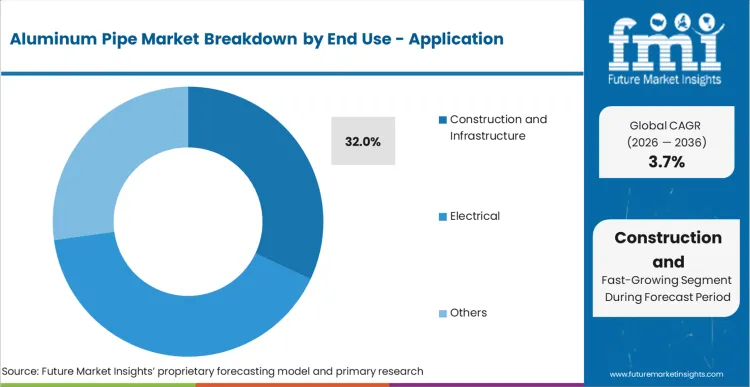
Construction and infrastructure are expected to account for 32% of the aluminum pipe market in 2026. This segment remains the largest end-use block because aluminum pipe offers a practical balance of corrosion resistance, installation efficiency, and service durability in selected fluid handling, structural, and utility applications. Demand is supported by its suitability for lightweight building systems, architectural installations, drainage-related uses, and infrastructure components where lower maintenance and recyclability strengthen the material case.
Competitive Aligners for Market Players
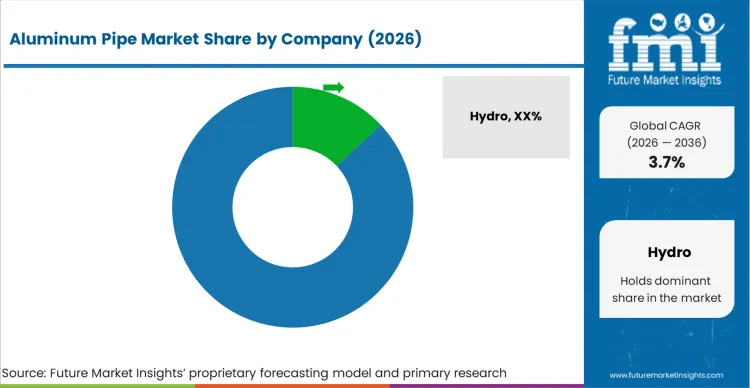
Competitive advantage in the aluminum pipe market is not defined by product breadth alone. Buyers place greater weight on alloy availability, dimensional consistency, surface finishing capability, fabrication support, and dependable lead times across fragmented order patterns. The strongest suppliers combine extrusion scale with application engineering, custom profile capability, and stable delivery performance for construction, industrial, and transport customers. Market leadership is therefore being built around operating reliability, downstream value-added processing, and the ability to serve both standard and semi-custom demand without quality drift.
Key Players in Aluminum Pipe Market
- Hydro
- Constellium SE
- Kaiser Aluminum
- Arconic Corporation
- Jindal Aluminium
- Tri-State Aluminum
- Norsk Hydro ASA
- Hindalco Industries Limited
- China Zhongwang
- Bonnell Aluminum
Strategic Outlook by FMI on Aluminum Pipe Market
The aluminum pipe market is set for steady rather than rapid expansion. Stronger growth will likely come from infrastructure renewal, HVAC, EV-adjacent thermal systems, and customer demand for lighter and more corrosion-resistant solutions that still fit established fabrication routes.
Scope of the Report
| Metric | Value |
|---|---|
| Market Value | USD 6.6 billion in 2025 to USD 9.8 billion by 2036 |
| CAGR | 3.7% from 2026 to 2036 |
| Base Year | 2025 |
| Forecast Period | 2026 to 2036 |
| Alloy Type Segmentation | 6xxx Series, 5xxx Series, 2xxx and 7xxx Series, Others |
| Product Type Segmentation | Seamless Pipe, Welded Pipe, Extruded Pipe and Tube |
| End Use Segmentation | Construction, Automotive and Transportation, HVAC & Refrigeration, Industrial Equipment, Electrical, Others |
| Regions Covered | North America, Latin America, Western Europe, Eastern Europe, East Asia, South Asia & Pacific, and Middle East & Africa |
Bibliography
- The Aluminum Association. Current. Green Building Resources.
- The Aluminum Association. 2022. Environmental Product Declaration: Extruded Aluminum.
- ASTM International. 2022. ASTM B210/B210M. Standard Specification for Aluminum and Aluminum-Alloy Drawn Seamless Tubes.
- Tri-State Aluminum. Current. Extruded Aluminum Round Tube and Pipe.
- ASM International. 2023. Aluminum Extrusion and Wire Drawing. In Aluminum: Technology, Industry, and Applications.
Frequently Asked Questions
What is driving growth in the aluminum pipe market?
Growth is being driven by lightweighting, corrosion resistance, recyclability, and the broad availability of extruded aluminum formats.
Which segment leads the aluminum pipe market?
Extruded pipe and tube lead because extrusion remains the most scalable and flexible route for common aluminum pipe applications.
Why are 6xxx series alloys important in the aluminum pipe market?
They offer a useful balance of strength, corrosion resistance, and fabrication ease across many industrial and building uses.
What restrains the aluminum pipe market?
Price volatility, substitution from plastics or stainless steel, and application-specific pressure limits all restrain faster growth.
Which regions are important in the aluminum pipe market?
All major industrial regions matter, with North America and Asia especially important because of extrusion capacity and end-use demand.
What is the outlook for the aluminum pipe market through 2036?
The outlook is steady, supported by infrastructure, HVAC, transport, and sustainability-led material selection.
Preview the report firsthand - request a free sample
Get SampleGet the brochure for pricing and purchase details.
Get PDFTable of Content
- Executive Summary
- Global Market Outlook
- Demand-side Trends
- Technology Roadmap Analysis
- Analysis and Recommendations
- Market Overview
- Market Coverage / Taxonomy
- Market Definition / Scope / Limitations
- Research Methodology
- Chapter Orientation
- Analytical Lens and Working Hypotheses
- Market Structure, Signals, and Trend Drivers
- Research Design and Evidence Framework
- Desk Research Programme (Secondary Evidence)
- Company Annual and Sustainability Reports
- Peer-reviewed Journals and Academic Literature
- Corporate Websites, Product Literature, and Technical Notes
- Earnings Decks and Investor Briefings
- Statutory Filings and Regulatory Disclosures
- Technical White Papers and Standards Notes
- Trade Journals, Industry Magazines, and Analyst Briefs
- Conference Proceedings, Webinars, and Seminar Materials
- Government Statistics Portals and Public Data Releases
- Press Releases and Reputable Media Coverage
- Specialist Newsletters and Curated Briefings
- Sector Databases and Reference Repositories
- FMI Internal Proprietary Databases and Historical Market Datasets
- Subscription Datasets and Paid Sources
- Social Channels, Communities, and Digital Listening Inputs
- Additional Desk Sources
- Expert Input and Fieldwork (Primary Evidence)
- Primary Modes
- Qualitative Interviews and Expert Elicitation
- Quantitative Surveys and Structured Data Capture
- Blended Approach
- Why Primary Evidence is Used
- Field Techniques
- Interviews
- Surveys
- Focus Groups
- Observational and In-context Research
- Social and Community Interactions
- Stakeholder Universe Engaged
- C-suite Leaders
- Board Members
- Presidents and Vice Presidents
- R&D and Innovation Heads
- Technical Specialists
- Domain Subject-matter Experts
- Scientists
- Physicians and Other Healthcare Professionals
- Governance, Ethics, and Data Stewardship
- Research Ethics
- Data Integrity and Handling
- Primary Modes
- Tooling, Models, and Reference Databases
- Desk Research Programme (Secondary Evidence)
- Data Engineering and Model Build
- Data Acquisition and Ingestion
- Cleaning, Normalisation, and Verification
- Synthesis, Triangulation, and Analysis
- Quality Assurance and Audit Trail
- Market Background
- Market Dynamics
- Drivers
- Restraints
- Opportunity
- Trends
- Scenario Forecast
- Demand in Optimistic Scenario
- Demand in Likely Scenario
- Demand in Conservative Scenario
- Opportunity Map Analysis
- Product Life Cycle Analysis
- Supply Chain Analysis
- Investment Feasibility Matrix
- Value Chain Analysis
- PESTLE and Porter’s Analysis
- Regulatory Landscape
- Regional Parent Market Outlook
- Production and Consumption Statistics
- Import and Export Statistics
- Market Dynamics
- Global Market Analysis 2021 to 2025 and Forecast, 2026 to 2036
- Historical Market Size Value (USD Million) Analysis, 2021 to 2025
- Current and Future Market Size Value (USD Million) Projections, 2026 to 2036
- Y-o-Y Growth Trend Analysis
- Absolute $ Opportunity Analysis
- Global Market Pricing Analysis 2021 to 2025 and Forecast 2026 to 2036
- Global Market Analysis 2021 to 2025 and Forecast 2026 to 2036, By Product Type
- Introduction / Key Findings
- Historical Market Size Value (USD Million) Analysis By Product Type , 2021 to 2025
- Current and Future Market Size Value (USD Million) Analysis and Forecast By Product Type , 2026 to 2036
- Extruded Pipe and Tube
- Seamless Pipe
- Extruded Pipe and Tube
- Y-o-Y Growth Trend Analysis By Product Type , 2021 to 2025
- Absolute $ Opportunity Analysis By Product Type , 2026 to 2036
- Global Market Analysis 2021 to 2025 and Forecast 2026 to 2036, By End Use - Application
- Introduction / Key Findings
- Historical Market Size Value (USD Million) Analysis By End Use - Application, 2021 to 2025
- Current and Future Market Size Value (USD Million) Analysis and Forecast By End Use - Application, 2026 to 2036
- Construction and Infrastructure
- Electrical
- Others
- Construction and Infrastructure
- Y-o-Y Growth Trend Analysis By End Use - Application, 2021 to 2025
- Absolute $ Opportunity Analysis By End Use - Application, 2026 to 2036
- Global Market Analysis 2021 to 2025 and Forecast 2026 to 2036, By Region
- Introduction
- Historical Market Size Value (USD Million) Analysis By Region, 2021 to 2025
- Current Market Size Value (USD Million) Analysis and Forecast By Region, 2026 to 2036
- North America
- Latin America
- Western Europe
- Eastern Europe
- East Asia
- South Asia and Pacific
- Middle East & Africa
- Market Attractiveness Analysis By Region
- North America Market Analysis 2021 to 2025 and Forecast 2026 to 2036, By Country
- Historical Market Size Value (USD Million) Trend Analysis By Market Taxonomy, 2021 to 2025
- Market Size Value (USD Million) Forecast By Market Taxonomy, 2026 to 2036
- By Country
- USA
- Canada
- Mexico
- By Product Type
- By End Use - Application
- By Country
- Market Attractiveness Analysis
- By Country
- By Product Type
- By End Use - Application
- Key Takeaways
- Latin America Market Analysis 2021 to 2025 and Forecast 2026 to 2036, By Country
- Historical Market Size Value (USD Million) Trend Analysis By Market Taxonomy, 2021 to 2025
- Market Size Value (USD Million) Forecast By Market Taxonomy, 2026 to 2036
- By Country
- Brazil
- Chile
- Rest of Latin America
- By Product Type
- By End Use - Application
- By Country
- Market Attractiveness Analysis
- By Country
- By Product Type
- By End Use - Application
- Key Takeaways
- Western Europe Market Analysis 2021 to 2025 and Forecast 2026 to 2036, By Country
- Historical Market Size Value (USD Million) Trend Analysis By Market Taxonomy, 2021 to 2025
- Market Size Value (USD Million) Forecast By Market Taxonomy, 2026 to 2036
- By Country
- Germany
- UK
- Italy
- Spain
- France
- Nordic
- BENELUX
- Rest of Western Europe
- By Product Type
- By End Use - Application
- By Country
- Market Attractiveness Analysis
- By Country
- By Product Type
- By End Use - Application
- Key Takeaways
- Eastern Europe Market Analysis 2021 to 2025 and Forecast 2026 to 2036, By Country
- Historical Market Size Value (USD Million) Trend Analysis By Market Taxonomy, 2021 to 2025
- Market Size Value (USD Million) Forecast By Market Taxonomy, 2026 to 2036
- By Country
- Russia
- Poland
- Hungary
- Balkan & Baltic
- Rest of Eastern Europe
- By Product Type
- By End Use - Application
- By Country
- Market Attractiveness Analysis
- By Country
- By Product Type
- By End Use - Application
- Key Takeaways
- East Asia Market Analysis 2021 to 2025 and Forecast 2026 to 2036, By Country
- Historical Market Size Value (USD Million) Trend Analysis By Market Taxonomy, 2021 to 2025
- Market Size Value (USD Million) Forecast By Market Taxonomy, 2026 to 2036
- By Country
- China
- Japan
- South Korea
- By Product Type
- By End Use - Application
- By Country
- Market Attractiveness Analysis
- By Country
- By Product Type
- By End Use - Application
- Key Takeaways
- South Asia and Pacific Market Analysis 2021 to 2025 and Forecast 2026 to 2036, By Country
- Historical Market Size Value (USD Million) Trend Analysis By Market Taxonomy, 2021 to 2025
- Market Size Value (USD Million) Forecast By Market Taxonomy, 2026 to 2036
- By Country
- India
- ASEAN
- Australia & New Zealand
- Rest of South Asia and Pacific
- By Product Type
- By End Use - Application
- By Country
- Market Attractiveness Analysis
- By Country
- By Product Type
- By End Use - Application
- Key Takeaways
- Middle East & Africa Market Analysis 2021 to 2025 and Forecast 2026 to 2036, By Country
- Historical Market Size Value (USD Million) Trend Analysis By Market Taxonomy, 2021 to 2025
- Market Size Value (USD Million) Forecast By Market Taxonomy, 2026 to 2036
- By Country
- Kingdom of Saudi Arabia
- Other GCC Countries
- Turkiye
- South Africa
- Other African Union
- Rest of Middle East & Africa
- By Product Type
- By End Use - Application
- By Country
- Market Attractiveness Analysis
- By Country
- By Product Type
- By End Use - Application
- Key Takeaways
- Key Countries Market Analysis
- USA
- Pricing Analysis
- Market Share Analysis, 2025
- By Product Type
- By End Use - Application
- Canada
- Pricing Analysis
- Market Share Analysis, 2025
- By Product Type
- By End Use - Application
- Mexico
- Pricing Analysis
- Market Share Analysis, 2025
- By Product Type
- By End Use - Application
- Brazil
- Pricing Analysis
- Market Share Analysis, 2025
- By Product Type
- By End Use - Application
- Chile
- Pricing Analysis
- Market Share Analysis, 2025
- By Product Type
- By End Use - Application
- Germany
- Pricing Analysis
- Market Share Analysis, 2025
- By Product Type
- By End Use - Application
- UK
- Pricing Analysis
- Market Share Analysis, 2025
- By Product Type
- By End Use - Application
- Italy
- Pricing Analysis
- Market Share Analysis, 2025
- By Product Type
- By End Use - Application
- Spain
- Pricing Analysis
- Market Share Analysis, 2025
- By Product Type
- By End Use - Application
- France
- Pricing Analysis
- Market Share Analysis, 2025
- By Product Type
- By End Use - Application
- India
- Pricing Analysis
- Market Share Analysis, 2025
- By Product Type
- By End Use - Application
- ASEAN
- Pricing Analysis
- Market Share Analysis, 2025
- By Product Type
- By End Use - Application
- Australia & New Zealand
- Pricing Analysis
- Market Share Analysis, 2025
- By Product Type
- By End Use - Application
- China
- Pricing Analysis
- Market Share Analysis, 2025
- By Product Type
- By End Use - Application
- Japan
- Pricing Analysis
- Market Share Analysis, 2025
- By Product Type
- By End Use - Application
- South Korea
- Pricing Analysis
- Market Share Analysis, 2025
- By Product Type
- By End Use - Application
- Russia
- Pricing Analysis
- Market Share Analysis, 2025
- By Product Type
- By End Use - Application
- Poland
- Pricing Analysis
- Market Share Analysis, 2025
- By Product Type
- By End Use - Application
- Hungary
- Pricing Analysis
- Market Share Analysis, 2025
- By Product Type
- By End Use - Application
- Kingdom of Saudi Arabia
- Pricing Analysis
- Market Share Analysis, 2025
- By Product Type
- By End Use - Application
- Turkiye
- Pricing Analysis
- Market Share Analysis, 2025
- By Product Type
- By End Use - Application
- South Africa
- Pricing Analysis
- Market Share Analysis, 2025
- By Product Type
- By End Use - Application
- USA
- Market Structure Analysis
- Competition Dashboard
- Competition Benchmarking
- Market Share Analysis of Top Players
- By Regional
- By Product Type
- By End Use - Application
- Competition Analysis
- Competition Deep Dive
- Hydro
- Overview
- Product Portfolio
- Profitability by Market Segments (Product/Age /Sales Channel/Region)
- Sales Footprint
- Strategy Overview
- Marketing Strategy
- Product Strategy
- Channel Strategy
- Constellium SE
- Kaiser Aluminum
- Arconic Corporation
- Jindal Aluminium
- Tri-State Aluminum
- Hydro
- Competition Deep Dive
- Assumptions & Acronyms Used


