

- Market Size (2026)
- USD 22.4 Bn
- Forecast (2036)
- USD 36.8 Bn
- CAGR (2026 to 2036)
- 5.1%
How big is the Fluid Conveyance Systems Market in 2026?
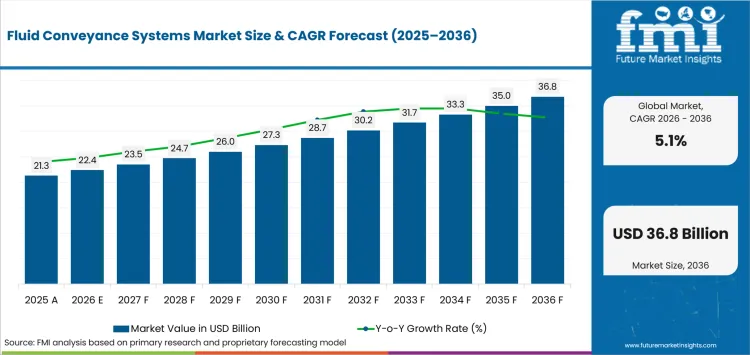
USD 22.4 billion in 2026, reaching USD 36.8 billion by 2036 at a 5.1% CAGR
The fluid conveyance systems market was valued at USD 21.3 billion in 2025. The market is set to reach USD 22.4 billion by 2026-end and grow at a CAGR of 5.1% between 2026-2036 to reach USD 36.8 billion by 2036. Tubes-Pipes will dominate with a 58.6% share, while Metals will lead with a 64.1% share.
Fluid conveyance system procurement is shaped by oil and gas pipeline requirements, industrial processing infrastructure, and water utility expansion. Demand reflects investment in metal, rubber, and composite tubes, pipes, hoses, and fittings for transporting fluids across pressure ranges. Buyers include plant engineers, pipeline operators, and water utility procurement teams evaluating pressure rating, material compatibility, and corrosion resistance.
Growth reflects sustained infrastructure investment in pipeline networks, water treatment facilities, and industrial processing plants. American Water Works Association confirmed updated pipe material standards in its 2025 release, supporting procurement of metal and composite conveyance systems for water utility infrastructure.
Differentiation in this market rests on pressure rating range, material grade breadth, and distribution network coverage. Eaton and Parker-Hannifin lead through comprehensive fluid power and conveyance portfolios, while Cooper Fluids and Purvis Industries gain preference where regional distribution proximity and fluid system engineering drive procurement.
Key Takeaways of Fluid Conveyance Systems Market
- Oil and gas pipeline expansion is expected to sustain fluid conveyance procurement for transportation and processing applications.
- Tubes And Pipes is expected to account for 58.6% of product type demand in 2026 because pipeline and processing infrastructure generate the highest unit consumption.
- Metals is projected to hold 64.1% of raw material demand in 2026, driven by steel and stainless steel pipe specifications for oil and gas and industrial applications.
- Oil And Gas Transportation is anticipated to represent 36.0% of application demand in 2026, supported by upstream and midstream pipeline infrastructure.
- China leads with a 6.8% CAGR through 2036 as industrial infrastructure and pipeline expansion sustain fluid conveyance procurement.
- Eaton and Parker-Hannifin are expected to compete through comprehensive fluid power and conveyance portfolios.
Analyst Perspective
"Buyers are expected to judge tubes-pipes on performance and total cost of ownership rather than headline price. Fluid conveyance adoption is expected to depend on infrastructure investment cycles and industrial processing expansion. Suppliers that combine pressure rating range with material grade breadth and regional distribution are likely to secure plant-level conveyance contracts. Market success is projected to depend on meeting pipeline integrity and processing safety requirements across oil and gas, water, and industrial applications."
- Nikhil Kaitwade, Principal Consultant at Future Market Insights
Why is the Fluid Conveyance Systems Market growing?
Rising Tubes-Pipes and Metals demand across industrial end users
- Fluid-conveyance demand follows plant fluid-handling requirements and pipe and hose replacement rather than speculative capacity buying.
- China leads growth at 6.8% CAGR as industrial infrastructure and pipeline expansion sustain fluid conveyance procurement.
- Metals holds 64.1% of raw material revenue, indicating where standardization is concentrating buyer spend.
Because conveyance systems must match pressure and media, fluid-conveyance spend concentrates with suppliers offering material breadth, custom engineering, and reliable supply.
How is the Fluid Conveyance Systems Market segmented?
The fluid conveyance systems industry is segmented by product type, raw material types, application, pressure rating, end user, and region.
The fluid conveyance systems market is segmented by product type, raw material types, application, pressure rating, end user, and region. By product type, the market covers tubes and pipes, hoses, fittings and couplings. By raw material types, the market covers metals, rubber, plastic, composites, stainless steel, and thermoplastics. By application, the market covers oil and gas transportation, water and wastewater, chemical processing, and food and beverage. By pressure rating, the market covers medium pressure systems, low pressure systems, and high pressure systems. By end user, the market covers industrial sector, oil and gas sector, water utilities, and food processing. Regions include North America, Latin America, Western Europe, Eastern Europe, East Asia, South Asia and Pacific, and the Middle East and Africa.
How do tubes and pipes shape demand within the product type category?
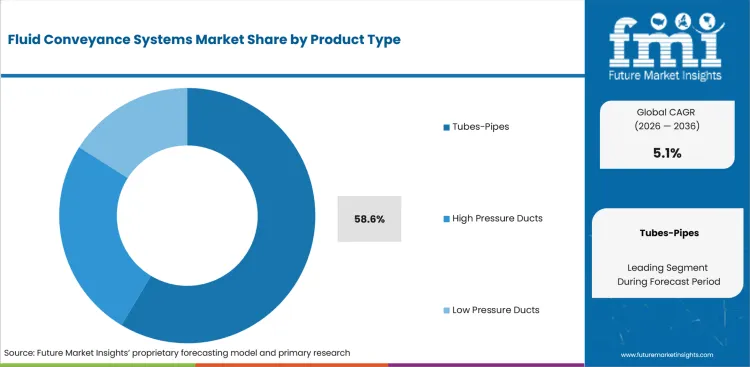
Tubes and pipes decide who controls the purchase and how the product reaches the account; together they determine integration effort, maintenance burden, and lifecycle cost across plant environments. Demand concentrates here because pipeline and processing infrastructure generate the highest fluid conveyance consumption.
- Tubes And Pipes is expected to account for 58.6% of product type demand in 2026 because pipeline and processing infrastructure generate the highest fluid conveyance consumption.
- Metals is projected to hold 64.1% of raw material demand as steel and stainless steel specifications dominate oil and gas and industrial pipe procurement.
What supports oil and gas transportation application demand?
Oil and gas transportation application shapes buyer requirements because segment choice here determines integration effort, maintenance burden, and lifecycle cost across plant environments. Demand concentrates here because upstream production and midstream pipeline networks generate sustained pipe and fitting procurement.
- Oil And Gas Transportation is anticipated to represent 36.0% of application demand in 2026 because upstream production and midstream pipeline networks generate sustained pipe and fitting procurement.
- Industrial Sector is forecast to hold 42.0% of end-user demand as chemical processing and manufacturing facilities require fluid conveyance infrastructure.
How do pressure rating and end user shape procurement?
Pressure rating and end user decide who controls the purchase and how the product reaches the account; together they determine integration effort, maintenance burden, and lifecycle cost across plant environments. Demand concentrates here because most industrial and utility fluid conveyance operates within medium pressure specifications.
- Medium Pressure Systems is expected to hold 43.0% of pressure rating demand because most industrial and utility fluid conveyance operates within medium pressure specifications.
- Industrial Sector is anticipated to account for 42.0% of end-user demand as manufacturing and processing plant operations sustain pipe, hose, and fitting procurement.
What are the drivers, restraints, and opportunities in the Fluid Conveyance Systems Market?
Near-term procurement is shaped by pipeline infrastructure investment, water utility expansion, and industrial processing growth.
- Driver: Infrastructure investment in pipeline networks and water treatment facilities is expected to push fluid conveyance procurement across oil and gas, industrial, and utility sectors.
- Restraint: Steel and metal raw material price volatility is likely to slow procurement if pipe and fitting pricing exceeds project budget allocations.
- Opportunity: Composite and thermoplastic pipe adoption for corrosion-resistant applications is expected to open supplier access if non-metallic conveyance meets pressure and chemical compatibility requirements.
Infrastructure investment is expected to increase conveyance procurement. Parker-Hannifin reported in its 2025 annual filing that its fluid connectors division maintained growth across industrial and oil and gas applications.
Metal price volatility is expected to pressure procurement budgets. World Steel Association reported in 2025 that steel pricing remained subject to trade policy and raw material cost fluctuations.
Composite pipe creates a practical route by offering corrosion resistance without metal weight. Bonded Fiberglass reported in 2025 that its fiberglass pipe systems expanded deployments across chemical processing and water infrastructure applications.
Which country CAGRs are profiled in the Fluid Conveyance Systems Market?
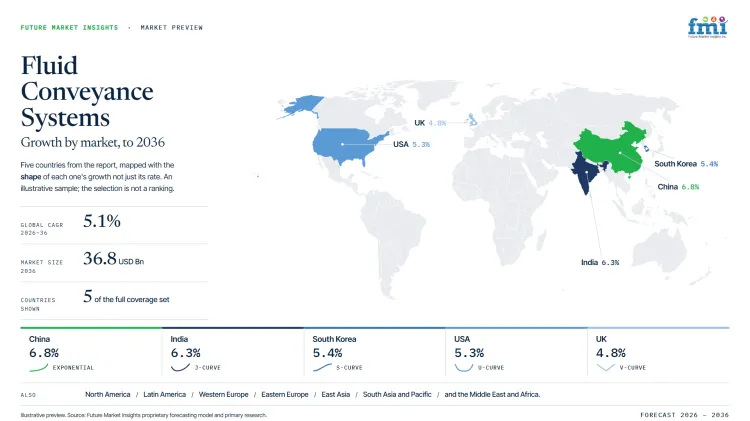
China 6.8%, India 6.3%, South Korea 5.4%, USA 5.3%, UK 4.8% through 2036
| Country | CAGR (2026 to 2036) |
|---|---|
| China | 6.8% |
| India | 6.3% |
| South Korea | 5.4% |
| USA | 5.3% |
| UK | 4.8% |
Source: FMI's proprietary forecasting model and primary research. 5 of the countries covered in the full report are shown here as a representative subset.
How do country-level CAGRs compare in the Fluid Conveyance Systems Market?
The country comparison spans 2.0 percentage points and reveals three distinct growth groups across the fluid conveyance systems market. China and India form the upper tier with a 0.5-point difference, while South Korea and the United States create a closely aligned middle group separated by only 0.1 percentage point. The United Kingdom remains at the lower end with a 0.5-point gap from the United States.
- China leads the comparison at a 6.8% CAGR through 2036, supported by plant automation upgrades, industrial policy support for domestic equipment and dense manufacturing clusters, which sustain replacement and expansion demand.
- India follows at a 6.3% CAGR, remaining 0.5 percentage points below China. Manufacturing capacity expansion, infrastructure programs and price-sensitive plant buyers support high-volume demand with disciplined margins.
- South Korea records a 5.4% CAGR, creating a 0.9-percentage-point gap from India. Dense industrial clusters, high automation intensity and adoption of upgraded equipment support concentrated demand.
- The United States grows at a 5.3% CAGR, only 0.1 percentage point below South Korea. Plant modernization, reshoring investment and replacement of aging installed equipment support demand across process and discrete industries.
- The United Kingdom records a 4.8% CAGR, remaining 0.5 percentage points below the United States. Replacement of aging plant equipment, standards-driven specifications and service-led purchasing support steady market development.
Comparable CAGRs can still produce different market conditions. Differences in industrial investment, automation intensity, infrastructure development, equipment replacement cycles, material selection and custom-engineered system adoption influence fluid conveyance systems demand across countries. The full report provides country-level CAGR analysis across major regions and individual markets within the fluid conveyance systems market.
Country-wise Analysis
- China's process-plant expansion and infrastructure investment anchor fluid-conveyance demand. The Fluid Conveyance Systems Market in China is projected to record a 6.8% CAGR during the assessment period, supported by process-plant expansion and infrastructure investment. Metal tubes and pipes lead raw-material demand in 2026, concentrating spend on pressure-rated conveyance. Subsidized domestic fluid conveyance systems brands constrain pricing for international suppliers. Suppliers of fluid conveyance systems win by placing local service depots, pricing competitively against domestic brands, and matching protocols on installed systems.
- India's manufacturing capacity build-out and infrastructure programs are widening fluid conveyance systems demand. Demand draws on infrastructure investment in pipeline networks and water treatment facilities. Sales in India are forecast to expand at a 6.3% CAGR by 2036, supported by fluid conveyance systems capacity build-out and infrastructure programs. Margin-disciplined Indian buyers extend payback scrutiny before multi-site fluid conveyance systems awards. Suppliers of fluid conveyance systems convert multi-site accounts with local service reach, competitive lifecycle cost, and financing-friendly terms.
- Korean fluid conveyance systems demand sits in dense industrial clusters that adopt upgraded equipment quickly. The market outlook in South Korea is anticipated to advance at a 5.4% CAGR over the assessment period, supported by dense fluid conveyance systems clusters and high automation intensity. Fast Korean technology cycles raise the service-response bar for foreign fluid conveyance systems suppliers. Suppliers of fluid conveyance systems hold positions through fast technical response and integration with advanced factory systems.
- US fluid conveyance systems demand runs on modernization and reshoring investment replacing aging installed equipment. Demand in the United States is forecast to rise at a 5.3% CAGR over the forecast period, supported by fluid conveyance systems modernization and reshoring investment. Legacy-system integration extends fluid conveyance systems commissioning and delays replacement decisions. Suppliers of fluid conveyance systems win upgrade budgets through service coverage, legacy-integration support, and documented reliability.
- UK fluid conveyance systems demand is replacement-led with standards-driven specification and service-led purchasing. Adoption in the United Kingdom is estimated to expand at a 4.8% CAGR through 2036, supported by fluid conveyance systems replacement cycles and standards-driven specification. Risk-averse UK plant buyers extend trials before displacing incumbent fluid conveyance systems. Suppliers of fluid conveyance systems win specification-led accounts with strong local service partners and documented compliance.
Who are the notable companies in the Fluid Conveyance Systems Market?
Eaton Corporation, Parker-Hannifin Corporation, Cooper Fluids Systems, Purvis Industries, Ltd., Donald Engineering are the notable companies shaping this market.
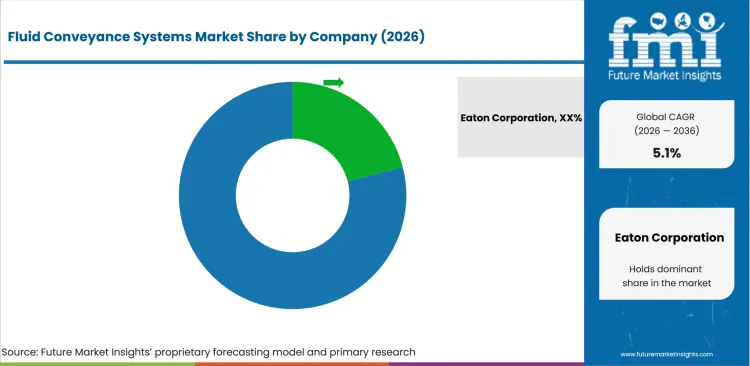
The field concentrates around fluid-system suppliers that pair conveyance engineering with material breadth and plant supply access. Global fluid power and conveyance companies compete across Hydraulic and fluid systems and Fluid power and conveyance throughout established accounts. Fluid system distribution and engineering companies emphasize Fluid distribution systems and Fluid power distribution, while specialty pipe and fitting manufacturers serve regional demand through Fiberglass pipe systems and Industrial hose and fittings. A workable entry is a composite-pipe or custom-conveyance niche, or a regional supply model for a specific fluid service. Growth then depends on pressure qualification, parts availability, and commissioning support across each launch territory. Breadth pays off through engineers who design fluid systems across materials and support installed conveyance across plants.
- Eaton Corporation and Parker-Hannifin Corporation combine Hydraulic and fluid systems and Fluid power and conveyance across multiple national markets. Their edge comes from hydraulic and fluid-system breadth with custom engineering.
- Cooper Fluids Systems, Purvis Industries, Ltd. and Donald Engineering follow focused routes across Fluid distribution systems, Fluid power distribution and Custom fluid systems. Their commercial edge comes from fiberglass and custom-conveyance niches rather than one standardized product line.
Competitive Benchmarking: Fluid Conveyance Systems Market
| Company | Portfolio Relevance | Conveyance Focus | Account Access | Service Reach |
|---|---|---|---|---|
| Eaton Corporation | High | Hydraulic and fluid systems | Strong | Global |
| Parker-Hannifin Corporation | High | Fluid power and conveyance | Strong | Global |
| Cooper Fluids Systems | Medium | Fluid distribution systems | Strong | Regional |
| Purvis Industries, Ltd. | Medium | Fluid power distribution | Moderate | Regional |
| Donald Engineering | Medium | Custom fluid systems | Moderate | Regional |
Source: Future Market Insights competitive analysis, 2026. Ratings reflect relative portfolio relevance, workflow or project fit, service capability, and geographic reach.
Key Developments in the Fluid Conveyance Systems Market
- In July 2026, Danfoss Power Solutions signed a definitive agreement to acquire Alfagomma, a Vimercate, Italy-based hose and fittings manufacturer with approximately EUR 600 million in sales, 4,500 employees, and 28 production sites across brands including Alfagomma, Dunlop Hiflex, and Argus.
- In July 2026, industry reports indicated that competing bidders for Alfagomma, which had been in receivership since May 2025 following a shareholder deadlock, included Gates Industrial, Parker-Hannifin, Michelin, and Trelleborg, with the Danfoss deal expected to close in Q4 2026.
- In December 2025, Danfoss Power Solutions completed the acquisition of Hydro Holding SpA, an Italian hose-fittings manufacturer, folding it into the Fluid Conveyance division as a new "Hydro" business unit.
- In 2024, Danfoss's Fluid Conveyance division posted EUR 1.2 billion in sales with approximately 5,300 employees, a business built largely on the 2021 acquisition of Eaton's former Hydraulics/fluid conveyance operations, including the Aeroquip and Weatherhead brands.
Key Players in the Fluid Conveyance Systems Market
Global fluid power and conveyance companies
- Eaton Corporation
- Parker-Hannifin Corporation
Fluid system distribution and engineering companies
- Cooper Fluids Systems
- Purvis Industries, Ltd.
- Donald Engineering
Specialty pipe and fitting manufacturers
- Gulf Controls Company
- Leading Edge Hydraulics
Fluid Conveyance Systems Market: Report Scope
| Coverage field | Report scope |
|---|---|
| Market breakdown | Product type, raw material types, application, pressure rating, end user, and region. |
| Market Definition | Fluid conveyance systems include metal, rubber, plastic, and composite tubes, pipes, hoses, fittings, and couplings for oil and gas, water, chemical processing, and food industry fluid transportation applications. |
| Regions Covered | North America, Latin America, Western Europe, Eastern Europe, East Asia, South Asia and Pacific, and the Middle East and Africa. |
| Countries Covered | United States, China, India, South Korea, United Kingdom, and Japan. |
| Key Companies Profiled | Eaton Corporation, Parker-Hannifin Corporation, Cooper Fluids Systems, Purvis Industries, Ltd., Donald Engineering, Gulf Controls Company. |
| Forecast Period | 2026 to 2036. |
| Approach | FMI used primary interviews, source validation, and proprietary demand modeling. |
Source: Future Market Insights, analysis driven by proprietary forecasting models and primary research
Fluid Conveyance Systems Market: Research Methodology
| Method | Approach |
|---|---|
| Primary Research | FMI interviewed fluid conveyance systems suppliers, buyers, and procurement leads. |
| Desk Research | Government releases, regulator updates, company filings, and product pages. |
| Market Sizing | Forecast model linked 2026 anchors to demand drivers and country conditions. |
| Data Validation | Forecast values checked against ten-year CAGR formula. |
Source: Future Market Insights (FMI) analysis
Market Segmentation Analysis
Fluid Conveyance Systems Market Segmented by Product Type:
- Tubes-Pipes
- Metal Fluid Transfer Pipes
- High Strength Fluid Transport
- Improved Corrosion Resistance
- Flexible Industrial Tubing Systems
- Enhanced Installation Flexibility
- Reliable Fluid Flow Performance
- Metal Fluid Transfer Pipes
- High Pressure Ducts
- Reinforced Pressure Duct Systems
- Enhanced Pressure Handling Capability
- Improved Industrial Safety
- Heavy Duty Hydraulic Ducts
- Reliable High Flow Operations
- Reduced Leakage Risks
- Reinforced Pressure Duct Systems
- Low Pressure Ducts
- Low Pressure Ventilation Ducts
- Improved Airflow Management
- Enhanced Energy Efficiency
- Flexible Utility Duct Systems
- Cost Effective Fluid Conveyance
- Improved Maintenance Accessibility
- Low Pressure Ventilation Ducts
Fluid Conveyance Systems Market Segmented by Raw Material Types:
- Metals
- Stainless Steel Fluid Systems
- High Pressure Resistance
- Improved Mechanical Strength
- Aluminum Conveyance Structures
- Lightweight Fluid Transport Support
- Enhanced Operational Efficiency
- Stainless Steel Fluid Systems
- Ceramic
- High Temperature Ceramic Pipes
- Enhanced Thermal Resistance
- Improved Chemical Stability
- Industrial Ceramic Conveyance Systems
- Corrosion Resistant Performance
- Long Service Lifespan
- High Temperature Ceramic Pipes
- Fiberglass
- Fiberglass Reinforced Pipes
- Lightweight Structural Design
- Enhanced Durability Performance
- Composite Fiberglass Ducts
- Improved Corrosion Protection
- Reduced Maintenance Costs
- Fiberglass Reinforced Pipes
- Concrete
- Precast Concrete Pipelines
- High Structural Stability
- Improved Underground Durability
- Reinforced Concrete Duct Systems
- Reliable Municipal Infrastructure Support
- Enhanced Long Term Performance
- Precast Concrete Pipelines
- Plastic
- PVC Fluid Conveyance Pipes
- Cost Effective Fluid Transport
- Improved Chemical Resistance
- HDPE Flexible Duct Systems
- Enhanced Leak Prevention
- Improved Installation Efficiency
- PVC Fluid Conveyance Pipes
- Others
Fluid Conveyance Systems Market Segmented by Application:
- Oil And Gas Transportation
- Crude Oil Pipeline Systems
- High Pressure Fluid Transfer
- Enhanced Operational Safety
- Natural Gas Conveyance Networks
- Reliable Long Distance Distribution
- Improved Energy Efficiency
- Crude Oil Pipeline Systems
- Water And Wastewater Management
- Municipal Water Pipeline Systems
- Improved Water Distribution Efficiency
- Enhanced Infrastructure Reliability
- Industrial Wastewater Conveyance
- Corrosion Resistant Fluid Handling
- Enhanced Environmental Compliance
- Municipal Water Pipeline Systems
- Industrial Processing
- Chemical Processing Fluid Systems
- Enhanced Chemical Resistance
- Improved Process Safety
- Manufacturing Fluid Conveyance Networks
- Reliable Production Line Operations
- Improved Operational Efficiency
- Chemical Processing Fluid Systems
- HVAC And Ventilation
- Commercial Air Duct Systems
- Improved Indoor Airflow Management
- Enhanced Energy Optimization
- Industrial Ventilation Networks
- Reliable Temperature Regulation
- Enhanced Workplace Safety
- Commercial Air Duct Systems
Fluid Conveyance Systems Market Segmented by Pressure Rating:
- Medium Pressure Systems
- Industrial Fluid Transfer Systems
- Balanced Pressure Handling Capability
- Enhanced Operational Reliability
- Commercial Hydraulic Networks
- Improved Performance Efficiency
- Reduced Leakage Risks
- Industrial Fluid Transfer Systems
- Low Pressure Systems
- Building Utility Conveyance
- Cost Effective Fluid Distribution
- Improved Installation Simplicity
- Ventilation And Drainage Systems
- Reliable Everyday Operations
- Enhanced Maintenance Accessibility
- Building Utility Conveyance
- High Pressure Systems
- Oil And Gas High Pressure Pipelines
- Enhanced Structural Strength
- Improved Flow Efficiency
- Heavy Duty Hydraulic Conveyance
- Reliable Extreme Condition Operations
- Enhanced Safety Performance
- Oil And Gas High Pressure Pipelines
Fluid Conveyance Systems Market Segmented by End User:
- Industrial Sector
- Manufacturing Facilities
- Enhanced Production Fluid Management
- Improved Operational Continuity
- Chemical And Petrochemical Plants
- Reliable Hazardous Fluid Handling
- Enhanced Process Efficiency
- Manufacturing Facilities
- Commercial Sector
- Commercial Building Infrastructure
- Improved HVAC Performance
- Enhanced Utility Distribution
- Data Centers And Smart Buildings
- Reliable Cooling Fluid Networks
- Enhanced Energy Management
- Commercial Building Infrastructure
- Municipal Sector
- City Water Distribution Authorities
- Improved Public Utility Infrastructure
- Enhanced Water Supply Reliability
- Urban Wastewater Management Agencies
- Efficient Sewage Conveyance Operations
- Enhanced Environmental Sustainability
- City Water Distribution Authorities
- Energy And Utilities
- Power Generation Facilities
- Reliable Cooling Water Circulation
- Enhanced Plant Efficiency
- Renewable Energy Infrastructure
- Improved Thermal Management Support
- Enhanced Sustainable Operations
- Power Generation Facilities
Fluid Conveyance Systems Market by Region:
- North America
- USA
- Canada
- Mexico
- Latin America
- Brazil
- Chile
- Rest of Latin America
- Western Europe
- Germany
- UK
- Italy
- Spain
- France
- Nordic
- BENELUX
- Rest of Western Europe
- Eastern Europe
- Russia
- Poland
- Hungary
- Balkan & Baltic
- Rest of Eastern Europe
- East Asia
- China
- Japan
- South Korea
- South Asia and Pacific
- India
- ASEAN
- Australia & New Zealand
- Rest of South Asia and Pacific
- Middle East & Africa
- Kingdom of Saudi Arabia
- Other GCC Countries
- Türkiye
- South Africa
- Other African Union
- Rest of Middle East & Africa
Research Sources and Bibliography
- 1. American Water Works Association. (2025). Pipe Material Standards Update.
- 2. Parker-Hannifin Corporation. (2025). Fluid Connectors Division Annual Report.
- 3. Eaton Corporation. (2025). Hydraulic and Fluid Conveyance Portfolio Update.
- 4. World Steel Association. (2025). Steel Pricing and Trade Trends.
- 5. National Infrastructure Pipeline India. (2025). Water and Industrial Infrastructure Investment.
- 6. Korea Petrochemical Industry Association. (2025). Processing Equipment Procurement.
- 7. Japan Fluid Power Association. (2025). Fluid Conveyance Market Assessment.
- 8. China Petroleum and Chemical Industry Federation. (2025). Pipeline and Processing Standards.
This bibliography uses primary government and company sources.
This Report Answers
- What is the estimated 2026 value of the fluid conveyance systems market?
- What market value is projected by 2036?
- What CAGR is forecast from 2026 to 2036?
- Which product type is expected to account for a notable 2026 share?
- Which countries are profiled for CAGR comparison?
- Which companies are notable in the competitive landscape?
Frequently Asked Questions
How big is the Fluid Conveyance Systems Market in 2026?
The Fluid Conveyance Systems Market is valued at USD 22.4 billion in 2026 and is forecast to reach USD 36.8 billion by 2036, expanding at a 5.1% CAGR. The Fluid Conveyance Systems Market grew from USD 21.3 billion in 2025, with Tubes-Pipes holding 58.6% of product type demand in 2026.
What is the CAGR of the Fluid Conveyance Systems Market from 2026 to 2036?
The Fluid Conveyance Systems Market is projected to grow at a CAGR of 5.1% between 2026 and 2036, supported by sustained infrastructure investment in pipeline networks, water treatment facilities, and industrial processing plants. Tubes-Pipes holds 58.6% of Fluid Conveyance Systems Market product type demand in 2026, while Metals leads raw material types with 64.1% in 2026.
Which product type leads the Fluid Conveyance Systems Market?
Tubes-Pipes accounts for 58.6% of the Fluid Conveyance Systems Market by product type in 2026, driven by sustained infrastructure investment in pipeline networks, water treatment facilities, and industrial processing plants. The Fluid Conveyance Systems Market grows at a 5.1% CAGR through 2036, while Metals leads raw material types with 64.1% in 2026.
How much will the Fluid Conveyance Systems Market add between 2026 and 2036?
The Fluid Conveyance Systems Market is set to add USD 14.4 billion between 2026 and 2036, growing from USD 22.4 billion to USD 36.8 billion at a 5.1% CAGR. Metals leads raw material types with 64.1% of Fluid Conveyance Systems Market revenue in 2026, anchoring that incremental demand.
Who are the leading companies in the Fluid Conveyance Systems Market?
The Fluid Conveyance Systems Market profiles 8 key companies in 2026, led by Eaton Corporation, Parker-Hannifin Corporation, Cooper Fluids Systems, Purvis Industries, Ltd., and Donald Engineering. These suppliers compete across product type, where Tubes-Pipes holds 58.6% of Fluid Conveyance Systems Market demand in 2026.
Preview the report firsthand - request a free sample
Get SampleGet the brochure for pricing and purchase details.
Get PDFTable of Content
- Key Takeaways
- Market Size and CAGR
- Top Growth Driver
- Fastest Growing Segment
- Leading Region
- Key Companies
- Emerging Opportunities
- Executive Summary
- Global Market Outlook
- Demand-side Trends
- Supply-side Trends
- Technology Roadmap Analysis
- Analysis and Recommendations
- Analyst Perspective (What is happening? Why now? What should investors know?)
- Key Questions Answered
- How large is the market?
- What is the CAGR?
- What are key trends?
- Which region dominates?
- Who are the leaders?
- Market Overview
- Market Coverage / Taxonomy
- Market Definition / Scope / Limitations
- Research Methodology
- Chapter Orientation
- Analytical Lens and Working Hypotheses
- Market Structure, Signals, and Trend Drivers
- Benchmarking and Cross-market Comparability
- Market Sizing, Forecasting, and Opportunity Mapping
- Research Design and Evidence Framework
- Desk Research Programme (Secondary Evidence)
- Expert Input and Fieldwork (Primary Evidence)
- Tooling, Models, and Reference Databases
- Data Engineering and Model Build
- Quality Assurance and Audit Trail
- Market Background
- Market Dynamics (Drivers, Restraints, Opportunity, Trends)
- Scenario Forecast (Optimistic, Likely, Conservative)
- Impact Analysis
- AI Impact
- Sustainability Impact
- Regulatory Impact
- Technology Impact
- Consumer / Buyer Analysis
- Purchase Drivers
- Adoption Barriers
- Buyer Journey
- Opportunity Map Analysis
- Product Life Cycle Analysis
- Supply Chain Analysis
- Investment Feasibility Matrix
- Value Chain Analysis
- PESTLE and Porter's Analysis
- Regulatory Landscape
- Regional Parent Market Outlook
- Production and Consumption Statistics
- Import and Export Statistics
- Global Market Analysis and Forecast, 2021 to 2036
- Historical Market Size Value (USD Billion) Analysis, 2021 to 2025
- Current and Future Market Size Value (USD Billion) Projections, 2026 to 2036
- Y-o-Y Growth Trend Analysis
- Absolute $ Opportunity Analysis
- Global Market Pricing Analysis, 2021 to 2036
- Global Market Analysis and Forecast, By Product Type, 2021 to 2036
- Introduction / Key Findings
- Historical Market Size Value (USD Billion) Analysis By Product Type, 2021 to 2025
- Current and Future Market Size Value (USD Billion) Analysis and Forecast By Product Type, 2026 to 2036
- Tubes-Pipes
- Metal Fluid Transfer Pipes
- Flexible Industrial Tubing Systems
- High Pressure Ducts
- Reinforced Pressure Duct Systems
- Heavy Duty Hydraulic Ducts
- Low Pressure Ducts
- Low Pressure Ventilation Ducts
- Flexible Utility Duct Systems
- Tubes-Pipes
- Y-o-Y Growth Trend Analysis By Product Type, 2021 to 2025
- Absolute $ Opportunity Analysis By Product Type, 2026 to 2036
- Global Market Analysis and Forecast, By Raw Material Types, 2021 to 2036
- Introduction / Key Findings
- Historical Market Size Value (USD Billion) Analysis By Raw Material Types, 2021 to 2025
- Current and Future Market Size Value (USD Billion) Analysis and Forecast By Raw Material Types, 2026 to 2036
- Metals
- Stainless Steel Fluid Systems
- Aluminum Conveyance Structures
- Ceramic
- High Temperature Ceramic Pipes
- Industrial Ceramic Conveyance Systems
- Fiberglass
- Fiberglass Reinforced Pipes
- Composite Fiberglass Ducts
- Concrete
- Precast Concrete Pipelines
- Reinforced Concrete Duct Systems
- Plastic
- PVC Fluid Conveyance Pipes
- HDPE Flexible Duct Systems
- Others
- Metals
- Y-o-Y Growth Trend Analysis By Raw Material Types, 2021 to 2025
- Absolute $ Opportunity Analysis By Raw Material Types, 2026 to 2036
- Global Market Analysis and Forecast, By Application, 2021 to 2036
- Introduction / Key Findings
- Historical Market Size Value (USD Billion) Analysis By Application, 2021 to 2025
- Current and Future Market Size Value (USD Billion) Analysis and Forecast By Application, 2026 to 2036
- Oil And Gas Transportation
- Crude Oil Pipeline Systems
- Natural Gas Conveyance Networks
- Water And Wastewater Management
- Municipal Water Pipeline Systems
- Industrial Wastewater Conveyance
- Industrial Processing
- Chemical Processing Fluid Systems
- Manufacturing Fluid Conveyance Networks
- HVAC And Ventilation
- Commercial Air Duct Systems
- Industrial Ventilation Networks
- Oil And Gas Transportation
- Y-o-Y Growth Trend Analysis By Application, 2021 to 2025
- Absolute $ Opportunity Analysis By Application, 2026 to 2036
- Global Market Analysis and Forecast, By Pressure Rating, 2021 to 2036
- Introduction / Key Findings
- Historical Market Size Value (USD Billion) Analysis By Pressure Rating, 2021 to 2025
- Current and Future Market Size Value (USD Billion) Analysis and Forecast By Pressure Rating, 2026 to 2036
- Medium Pressure Systems
- Industrial Fluid Transfer Systems
- Commercial Hydraulic Networks
- Low Pressure Systems
- Building Utility Conveyance
- Ventilation And Drainage Systems
- High Pressure Systems
- Oil And Gas High Pressure Pipelines
- Heavy Duty Hydraulic Conveyance
- Medium Pressure Systems
- Y-o-Y Growth Trend Analysis By Pressure Rating, 2021 to 2025
- Absolute $ Opportunity Analysis By Pressure Rating, 2026 to 2036
- Global Market Analysis and Forecast, By End User, 2021 to 2036
- Introduction / Key Findings
- Historical Market Size Value (USD Billion) Analysis By End User, 2021 to 2025
- Current and Future Market Size Value (USD Billion) Analysis and Forecast By End User, 2026 to 2036
- Industrial Sector
- Manufacturing Facilities
- Chemical And Petrochemical Plants
- Commercial Sector
- Commercial Building Infrastructure
- Data Centers And Smart Buildings
- Municipal Sector
- City Water Distribution Authorities
- Urban Wastewater Management Agencies
- Energy And Utilities
- Power Generation Facilities
- Renewable Energy Infrastructure
- Industrial Sector
- Y-o-Y Growth Trend Analysis By End User, 2021 to 2025
- Absolute $ Opportunity Analysis By End User, 2026 to 2036
- Global Market Analysis and Forecast, By Region, 2021 to 2036
- Introduction
- Historical Market Size Value (USD Billion) Analysis By Region, 2021 to 2025
- Current Market Size Value (USD Billion) Analysis and Forecast By Region, 2026 to 2036
- North America
- Latin America
- Western Europe
- Eastern Europe
- East Asia
- South Asia and Pacific
- Middle East & Africa
- Market Attractiveness Analysis By Region
- North America Market Analysis and Forecast, By Country, 2021 to 2036
- Historical Market Size Value (USD Billion) Trend Analysis By Market Taxonomy, 2021 to 2025
- Market Size Value (USD Billion) Forecast By Market Taxonomy, 2026 to 2036
- By Country
- USA
- Canada
- By Product Type
- By Raw Material Types
- By Application
- By Pressure Rating
- By End User
- By Country
- Market Attractiveness Analysis
- By Country
- By Product Type
- By Raw Material Types
- By Application
- By Pressure Rating
- By End User
- Key Takeaways
- Latin America Market Analysis and Forecast, By Country
- Historical Market Size Value (USD Billion) Trend Analysis By Market Taxonomy, 2021 to 2025
- Market Size Value (USD Billion) Forecast By Market Taxonomy, 2026 to 2036
- By Country
- Brazil
- Mexico
- Chile
- Rest of Latin America
- By Product Type
- By Raw Material Types
- By Application
- By Pressure Rating
- By End User
- By Country
- Market Attractiveness Analysis
- By Country
- By Product Type
- By Raw Material Types
- By Application
- By Pressure Rating
- By End User
- Key Takeaways
- Western Europe Market Analysis and Forecast, By Country
- Historical Market Size Value (USD Billion) Trend Analysis By Market Taxonomy, 2021 to 2025
- Market Size Value (USD Billion) Forecast By Market Taxonomy, 2026 to 2036
- By Country
- Germany
- UK
- Italy
- Spain
- France
- Nordic
- BENELUX
- Rest of Western Europe
- By Product Type
- By Raw Material Types
- By Application
- By Pressure Rating
- By End User
- By Country
- Market Attractiveness Analysis
- By Country
- By Product Type
- By Raw Material Types
- By Application
- By Pressure Rating
- By End User
- Key Takeaways
- Eastern Europe Market Analysis and Forecast, By Country
- Historical Market Size Value (USD Billion) Trend Analysis By Market Taxonomy, 2021 to 2025
- Market Size Value (USD Billion) Forecast By Market Taxonomy, 2026 to 2036
- By Country
- Russia
- Poland
- Hungary
- Balkan & Baltic
- Rest of Eastern Europe
- By Product Type
- By Raw Material Types
- By Application
- By Pressure Rating
- By End User
- By Country
- Market Attractiveness Analysis
- By Country
- By Product Type
- By Raw Material Types
- By Application
- By Pressure Rating
- By End User
- Key Takeaways
- East Asia Market Analysis and Forecast, By Country
- Historical Market Size Value (USD Billion) Trend Analysis By Market Taxonomy, 2021 to 2025
- Market Size Value (USD Billion) Forecast By Market Taxonomy, 2026 to 2036
- By Country
- China
- Japan
- South Korea
- By Product Type
- By Raw Material Types
- By Application
- By Pressure Rating
- By End User
- By Country
- Market Attractiveness Analysis
- By Country
- By Product Type
- By Raw Material Types
- By Application
- By Pressure Rating
- By End User
- Key Takeaways
- South Asia and Pacific Market Analysis and Forecast, By Country
- Historical Market Size Value (USD Billion) Trend Analysis By Market Taxonomy, 2021 to 2025
- Market Size Value (USD Billion) Forecast By Market Taxonomy, 2026 to 2036
- By Country
- India
- ASEAN
- Australia & New Zealand
- Rest of South Asia and Pacific
- By Product Type
- By Raw Material Types
- By Application
- By Pressure Rating
- By End User
- By Country
- Market Attractiveness Analysis
- By Country
- By Product Type
- By Raw Material Types
- By Application
- By Pressure Rating
- By End User
- Key Takeaways
- Middle East & Africa Market Analysis and Forecast, By Country
- Historical Market Size Value (USD Billion) Trend Analysis By Market Taxonomy, 2021 to 2025
- Market Size Value (USD Billion) Forecast By Market Taxonomy, 2026 to 2036
- By Country
- Kingdom of Saudi Arabia
- Other GCC Countries
- Türkiye
- South Africa
- Other African Union
- Rest of Middle East & Africa
- By Product Type
- By Raw Material Types
- By Application
- By Pressure Rating
- By End User
- By Country
- Market Attractiveness Analysis
- By Country
- By Product Type
- By Raw Material Types
- By Application
- By Pressure Rating
- By End User
- Key Takeaways
- Key Countries Market Analysis
- USA
- Pricing Analysis
- Market Share Analysis, 2025
- By Product Type
- By Raw Material Types
- By Application
- By Pressure Rating
- By End User
- Canada
- Pricing Analysis
- Market Share Analysis, 2025
- By Product Type
- By Raw Material Types
- By Application
- By Pressure Rating
- By End User
- Mexico
- Pricing Analysis
- Market Share Analysis, 2025
- By Product Type
- By Raw Material Types
- By Application
- By Pressure Rating
- By End User
- Brazil
- Pricing Analysis
- Market Share Analysis, 2025
- By Product Type
- By Raw Material Types
- By Application
- By Pressure Rating
- By End User
- Chile
- Pricing Analysis
- Market Share Analysis, 2025
- By Product Type
- By Raw Material Types
- By Application
- By Pressure Rating
- By End User
- Germany
- Pricing Analysis
- Market Share Analysis, 2025
- By Product Type
- By Raw Material Types
- By Application
- By Pressure Rating
- By End User
- UK
- Pricing Analysis
- Market Share Analysis, 2025
- By Product Type
- By Raw Material Types
- By Application
- By Pressure Rating
- By End User
- Italy
- Pricing Analysis
- Market Share Analysis, 2025
- By Product Type
- By Raw Material Types
- By Application
- By Pressure Rating
- By End User
- Spain
- Pricing Analysis
- Market Share Analysis, 2025
- By Product Type
- By Raw Material Types
- By Application
- By Pressure Rating
- By End User
- France
- Pricing Analysis
- Market Share Analysis, 2025
- By Product Type
- By Raw Material Types
- By Application
- By Pressure Rating
- By End User
- India
- Pricing Analysis
- Market Share Analysis, 2025
- By Product Type
- By Raw Material Types
- By Application
- By Pressure Rating
- By End User
- ASEAN
- Pricing Analysis
- Market Share Analysis, 2025
- By Product Type
- By Raw Material Types
- By Application
- By Pressure Rating
- By End User
- Australia & New Zealand
- Pricing Analysis
- Market Share Analysis, 2025
- By Product Type
- By Raw Material Types
- By Application
- By Pressure Rating
- By End User
- China
- Pricing Analysis
- Market Share Analysis, 2025
- By Product Type
- By Raw Material Types
- By Application
- By Pressure Rating
- By End User
- Japan
- Pricing Analysis
- Market Share Analysis, 2025
- By Product Type
- By Raw Material Types
- By Application
- By Pressure Rating
- By End User
- South Korea
- Pricing Analysis
- Market Share Analysis, 2025
- By Product Type
- By Raw Material Types
- By Application
- By Pressure Rating
- By End User
- Russia
- Pricing Analysis
- Market Share Analysis, 2025
- By Product Type
- By Raw Material Types
- By Application
- By Pressure Rating
- By End User
- Poland
- Pricing Analysis
- Market Share Analysis, 2025
- By Product Type
- By Raw Material Types
- By Application
- By Pressure Rating
- By End User
- Hungary
- Pricing Analysis
- Market Share Analysis, 2025
- By Product Type
- By Raw Material Types
- By Application
- By Pressure Rating
- By End User
- Kingdom of Saudi Arabia
- Pricing Analysis
- Market Share Analysis, 2025
- By Product Type
- By Raw Material Types
- By Application
- By Pressure Rating
- By End User
- Türkiye
- Pricing Analysis
- Market Share Analysis, 2025
- By Product Type
- By Raw Material Types
- By Application
- By Pressure Rating
- By End User
- South Africa
- Pricing Analysis
- Market Share Analysis, 2025
- By Product Type
- By Raw Material Types
- By Application
- By Pressure Rating
- By End User
- USA
- Market Structure Analysis
- Competition Dashboard
- Competition Benchmarking
- Market Share Analysis of Top Players
- By Regional
- By Product Type
- By Raw Material Types
- By Application
- By Pressure Rating
- By End User
- Emerging Startups
- Innovation Benchmarking
- Competition Analysis
- Competition Deep Dive
- Eaton Corporation
- Overview
- Product Portfolio
- Profitability by Market Segments
- Sales Footprint
- Strategy Overview
- Marketing Strategy
- Product Strategy
- Channel Strategy
- Parker-Hannifin Corporation
- Cooper Fluids Systems
- Purvis Industries, Ltd.
- Donald Engineering
- USD Bned Fiberglass of America, Inc.
- Leading Edge Hydraulics
- Royal Industries, Inc.
- Gulf Controls Company
- Eaton Corporation
- Case Studies
- Success Stories
- Recent Developments
- Competition Deep Dive
- Assumptions & Acronyms Used


