

- Industry Size (2026)
- USD 260.8 Mn
- Forecast (2036)
- USD 458.3 Mn
- CAGR (2026 to 2036)
- 5.8%
Pipe Alignment Clamps Market Size, Market Forecast and Outlook By FMI
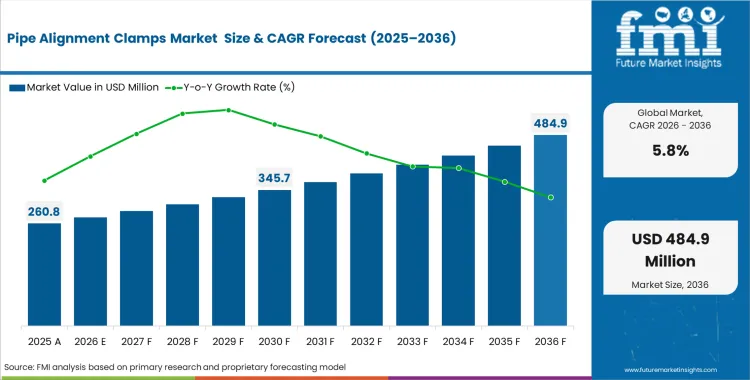
The pipe alignment clamps market was valued at USD 246.5 million in 2025 and is projected to reach USD 260.8 million in 2026. The market is expected to expand at a CAGR of 5.8% during 2026 to 2036, with total valuation projected at USD 458.3 million by 2036. Growth is linked to tightening weld quality requirements in high-pressure pipelines, where precise joint alignment is essential to meet safety and performance standards.
Summary of Pipe Alignment Clamps Market
- The market is estimated at USD 246.5 million in 2025.
- The market is projected to reach USD 458.3 million by 2036.
- The market is expected to grow at a CAGR of 5.8% from 2026 to 2036.
- The forecast period represents an incremental opportunity of USD 197.5 million.
- External alignment clamps lead the type segment with a 47% share.
- 12-36 inch pipes dominate the diameter segment with a 44% share.
- Oil and gas pipelines lead the end-use segment with a 39% share.
- Manual operation leads the operation segment with a 58% share.
- Water infrastructure (24%) and industrial piping (22%) are key supporting end-use segments.
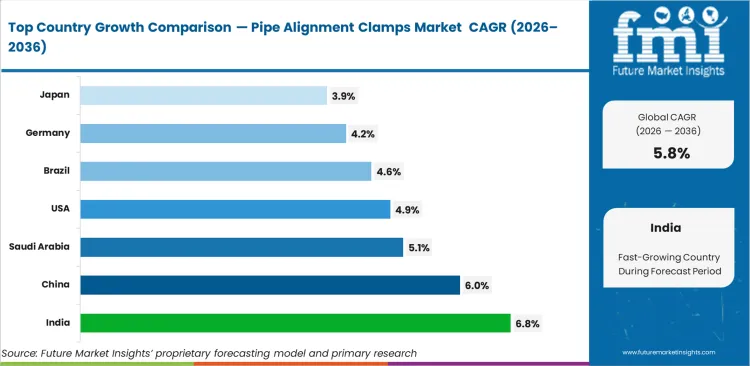
- India (6.8%), China (6.0%), and Saudi Arabia (5.1%) are among the fastest-growing markets.
Precision in pipe alignment is becoming increasingly important as welding tolerances continue to tighten. Traditional manual fit-up techniques often introduce minor distortions, particularly in thin-wall pipe sections, which can compromise weld quality. Automated clamping solutions help maintain exact positioning during joint preparation, ensuring uniform alignment across the weld interface. This improves consistency and reduces the risk of defects. Use of these systems lowers rework frequency and supports dimensional accuracy across extended pipeline installations. Projects operating under strict inspection and certification requirements are accelerating adoption, as even small alignment errors can lead to costly delays and corrective actions.
Digital traceability requirements are influencing equipment selection across pipeline construction projects. Weld documentation and verification processes require consistent and repeatable alignment conditions before welding begins. Pneumatic and automated clamp systems support this requirement by enabling controlled positioning and integration with inspection workflows. Equipment that supports verification and inspection readiness is gaining preference in large-scale infrastructure projects.
India is estimated to record a CAGR of 6.8% in the pipe alignment clamps market during 2026 to 2036, supported by expansion of urban water and utility networks. China is projected to grow at 6.0%, driven by energy infrastructure development including LNG facilities. Saudi Arabia is expected to register 5.1%, followed by the United States at 4.9%, Brazil at 4.6%, Germany at 4.2%, and Japan at 3.9%. Growth patterns reflect new pipeline installations in developing regions and upgrade activities in established markets.
Segmental Analysis
Pipe Alignment Clamps Market Analysis by Clamp Type
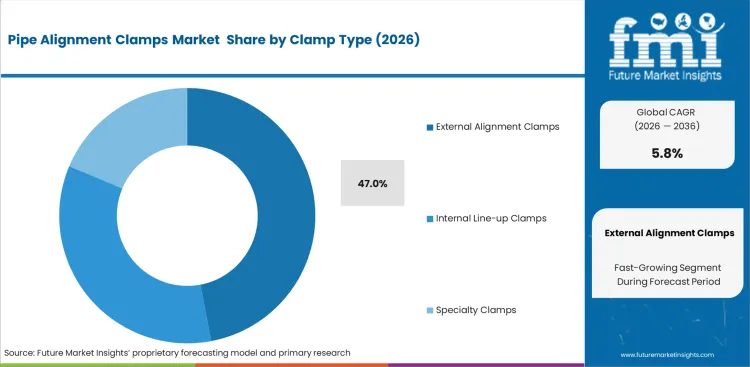
Automated root-pass buggies require completely clear internal passages to function properly. This physical clearance requirement is anticipated to hold around 47.0% external alignment clamps market share in 2026. When weighing external vs internal line up clamps, welding superintendents specify these outer-mounted units to maintain unobstructed access for complex internal welding materials. Choosing a rugged external cage allows rapid repositioning without disconnecting vital air supply hoses inside dark pipe sections. What supply chain managers consistently overlook is that aggressive external teeth cause severe anti-corrosion coating damage during tensioning. EPC contractors delaying investments in specialized non-marring contact pads face massive secondary remediation costs before burying any line.
- Automated equipment clearance: Outer-mounted fixtures keep central passages entirely open for sophisticated inspection robots. Welding engineers eliminate costly delays associated with extracting internal machinery after every pass.
- Coating remediation penalties: Aggressive clamping teeth crush factory-applied epoxy coatings during maximum compression. Quality control inspectors force immediate manual recoating protocols that negatively impact daily progress metrics.
- Extreme weather resilience: Simple mechanical cages survive sub-zero temperatures that routinely freeze delicate internal pneumatic valves. Lay-barge operators favor exposed designs that permit immediate visual inspection and rapid field maintenance.
Pipe Alignment Clamps Market Analysis by Pipe Diameter
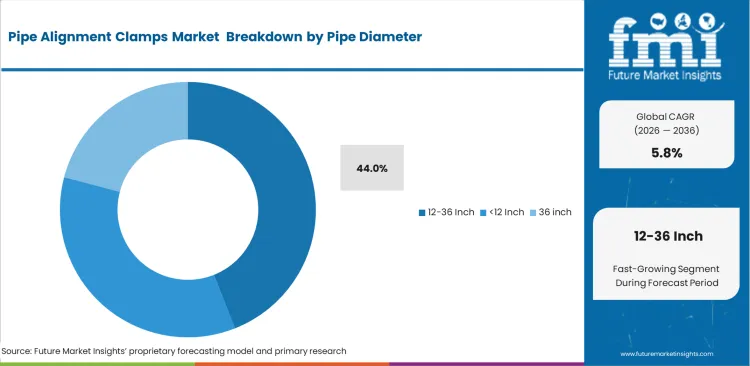
Equipment sizing depends on compatibility with commonly available lifting systems and site handling constraints. Mid-range diameters between 12-36 inches are widely used due to their alignment with standard construction equipment capabilities. This segment is likely to hold 44.0% share of pipe alignment clamp usage in 2026. Proper sizing ensures safe handling and prevents structural stress during positioning. Field modifications introduce risk by altering load distribution, reducing equipment reliability. Installation conditions, especially in constrained urban environments, further influence diameter selection and clamp configuration.
- Machinery payload matching: Intermediate fixture weights correspond precisely to widely available right-of-way lifting equipment. Fleet managers avoid renting specialized heavy-lift cranes just to maneuver alignment tools.
- Field modification risks: Crews frequently grind stop-blocks to force standard clamps over oversized thick-wall sections. Safety supervisors must constantly police equipment yards to scrap compromised holding fixtures.
- Urban navigation constraints: Mid-sized pipes represent absolute maximum diameters manageable within congested municipal utility trenches. Trenching foremen mandate modular clamps that dismantle easily when shoring boxes limit lateral movement.
Pipe Alignment Clamps Market Analysis by End Use
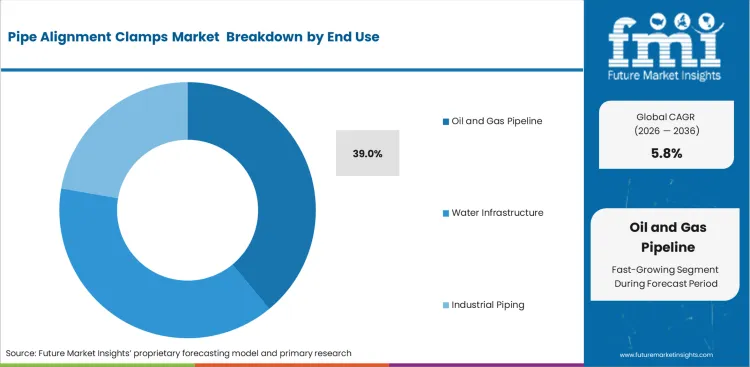
Strict leak-prevention requirements in energy transport systems influence equipment selection across pipeline construction. Alignment accuracy is treated as a critical factor to ensure proper weld fit-up before joining operations. Oil and gas pipeline applications are expected to account for 39.0% share of the pipe alignment clamps market in 2026, reflecting the need for precise joint preparation in high-pressure systems. Use of controlled clamping systems helps reduce weld defects and minimizes the risk of rework during installation.
Application-specific pressure control remains important in clamp selection. Excessive clamping force on thin-wall pipes can introduce deformation near beveled edges, affecting weld integrity. Matching clamping force with material strength helps prevent stress-related defects during fit-up. Proper calibration of alignment tools supports consistent weld quality and reduces the likelihood of structural issues during pipeline operation.
- Defect rate minimization: Perfect concentricity drastically reduces expensive ultrasonic testing failures on critical transmission lines. Quality assurance heads secure maximum project bonuses by eliminating weld rejection rework.
- Yield strength mismatches: Applying excessive hydraulic tonnage onto high-strength thin-wall materials creates invisible localized buckling. Metallurgical engineers must calibrate pressure relief valves to prevent permanent dimensional distortion.
- Continuous lay-barge operations: Offshore installations demand uninterrupted pipe feeding to maximize daily vessel mileage. Marine superintendents integrate sophisticated alignment stations that cycle in seconds rather than minutes.
Pipe Alignment Clamps Market Analysis by Operation
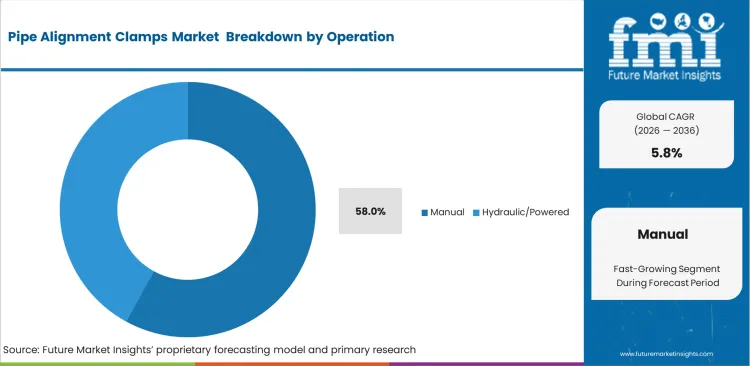
Strict urban noise and emission regulations severely restrict combustion-engine power units on municipal sites. Environmental compliance is anticipated to keep the manual operation at a 58.0% share in 2026. When deciding between manual vs hydraulic pipe alignment clamps, site foremen deploy simple chain and toggle setups to align municipal water feeds without requiring diesel packs. Relying on muscle-powered ratchets eliminates constant maintenance overhead associated with torn fluid hoses. Manufacturers tracking hands free safety tools often miss that manual clamp prevalence stems directly from union contracts limiting heavy hydraulic deployment near open excavations. Trench supervisors attempting to force powered systems into restricted zones face immediate work stoppages from safety auditors.
- Emission zone compliance: Hand-cranked fixtures generate zero exhaust fumes inside deep underground vaults. Environmental health officers mandate mechanical clamping to prevent hazardous gas accumulation during confined space entries.
- Hydraulic hose vulnerability: Dragging pressurized lines across sharp rocky terrain guarantees eventual fluid blowouts. Maintenance crews prefer purely mechanical options to avoid hauling messy spill-containment kits.
- Labor contract restrictions: Specific collective bargaining agreements prohibit mechanized handling for smaller joint assemblies. Project managers must navigate complex work rules when assigning powered alignment gear.
Pipe Alignment Clamps Market Drivers, Restraints, and Opportunities
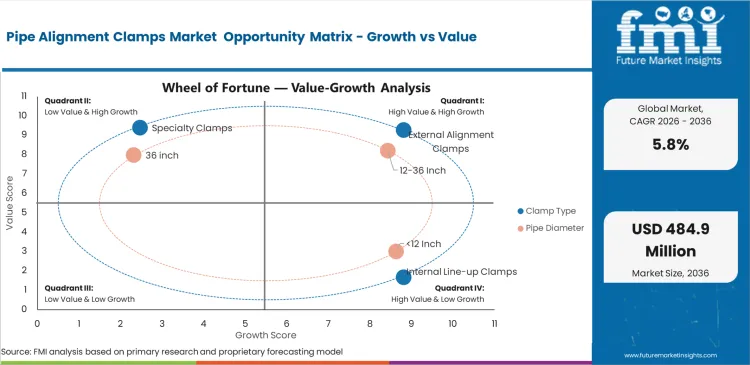
Mandatory defect-rate thresholds on advanced hydrogen networks force pipeline superintendents to abandon traditional rigging methods immediately. Missing a single out-of-roundness parameter on a critical flexible pipes joint triggers multi-day repair protocols that destroy project margins. Precision hydraulic staging modules become absolutely essential to eliminate human fatigue from initial fit-up operations. This regulatory reality shortens standard replacement cycles significantly, pushing companies consulting a pipe alignment clamp procurement checklist to rapidly upgrade mechanical fleets to verifiable powered systems.
Incompatible compressor infrastructure on aging lay-barges severely slows transition efforts toward internal pneumatic systems. Upgrading a decades-old vessel requires entirely new high-volume air lines that snake through complex bulkheads. Fleet engineering directors struggle to justify retrofitting downtime just to accommodate modern alignment modules. Limited deck space creates difficult compromises where crews continue using slower external cages simply because ships cannot support pneumatic internal demands.
Opportunities in the Pipe Alignment Clamps Industry
- Active telemetry integration: Embedding strain gauges directly into contact shoes provides real-time pressure feedback. Quality control managers gain unalterable digital proof that fit-up forces never exceeded metallurgical yield limits.
- Non-marring pad materials: Developing advanced polymer contact points eliminates secondary epoxy repair work. Pipeline operators save thousands of hours previously wasted fixing damaged anti-corrosion coatings.
- Modular battery electrification: Replacing tethered hydraulic packs with high-torque lithium-ion actuators removes dangerous tripping hazards. Safety directors unlock safer trench environments without sacrificing high-tonnage clamping capabilities.
Regional Analysis
Based on regional analysis, Pipe Alignment Clamps Market is segmented into North America, Latin America, Western Europe, Eastern Europe, Asia Pacific, Middle East, and Africa across 40 plus countries.
.webp "Top Country Growth Comparison Pipe Alignment Clamps Market Cagr (2026 2036)")
| Country | CAGR (2026 to 2036) |
|---|---|
| India | 6.8% |
| China | 6.0% |
| Saudi Arabia | 5.1% |
| USA | 4.9% |
| Brazil | 4.6% |
| Germany | 4.2% |
| Japan | 3.9% |
Source: Future Market Insights (FMI) analysis, based on proprietary forecasting model and primary research
Asia Pacific Pipe Alignment Clamps Market Analysis
Rapid urbanization forces municipal contractors to navigate incredibly narrow infrastructure corridors where traditional side-booms cannot operate. Space constraints compel site engineers to utilize modular clamping hardware that dismantles rapidly for manual transport.
- India: India is likely to record 6.8% CAGR in the pipe alignment clamps market during 2026 to 2036. Dense urban infrastructure limits the use of large-scale installation machinery across municipal pipeline projects. Contractors depend on compact clamp systems that can be deployed quickly within narrow trench corridors. Lightweight modular designs improve handling efficiency across multiple job sites. Frequent repositioning between adjacent work zones requires equipment that supports rapid assembly and disassembly. Installation timelines are closely tied to public infrastructure usage, increasing the need for faster execution. These conditions continue to support steady demand for portable and adaptable clamping systems.
- China: Large-scale inland pipeline projects in China require alignment systems capable of handling thick-walled pipes under continuous operational load. Mechanized clamps ensure consistent root-gap accuracy across long-distance welding operations. EPC contractors rely on equipment that maintains precision without interruption across extended installation cycles. The pipe alignment clamps market in China is projected to expand at 6.0% CAGR through 2036. Equipment durability and load-bearing capacity remain key selection criteria. Continuous pipeline construction across energy corridors sustains demand for high-performance alignment systems designed for heavy industrial use.
- Japan: Labor shortages across Japan’s industrial workforce drive the adoption of automated pipe alignment systems. Plant operators prioritize equipment that reduces reliance on highly skilled pipefitters. Self-centering clamp systems improve alignment accuracy and minimize manual adjustments during welding operations. Growth in Japan is anticipated to reach 3.9% over the 2026 to 2036 period, reflecting steady adoption across automated facilities. Equipment design focuses on preventing alignment errors and ensuring consistent joint quality. Ease of use remains critical in environments where workforce constraints affect installation efficiency. These factors support continued demand for precision-driven clamping solutions.
Middle East and Africa Pipe Alignment Clamps Market Analysis
Severe desert operating conditions quickly destroy delicate electro-hydraulic seals, shifting procurement heavily toward ultra-durable pneumatic or mechanical solutions. Sand intrusion makes field-repairability an absolute highest priority for regional pipeline operators.
- Saudi Arabia: Saudi Arabia is expected to witness 5.1% CAGR in the pipe alignment clamps market from 2026 to 2036. Large-scale oil and gas pipeline networks extend across remote desert regions where maintenance access remains limited. Equipment selection focuses on rugged mechanical clamps that can be repaired using basic tools in field conditions. Sand intrusion and high temperatures require systems with minimal sensitivity to environmental damage. Operators maintain spare inventories to avoid operational delays during breakdowns. Reliability and ease of maintenance define procurement decisions across pipeline projects. These requirements continue to support demand for durable and serviceable clamping systems.
North America Pipe Alignment Clamps Market Analysis
Stringent environmental reviews drastically limit right-of-way widths for new transmission lines across mature landscapes. Environmental compliance forces contractors to utilize automated internals that eliminate external trenching space requirements.
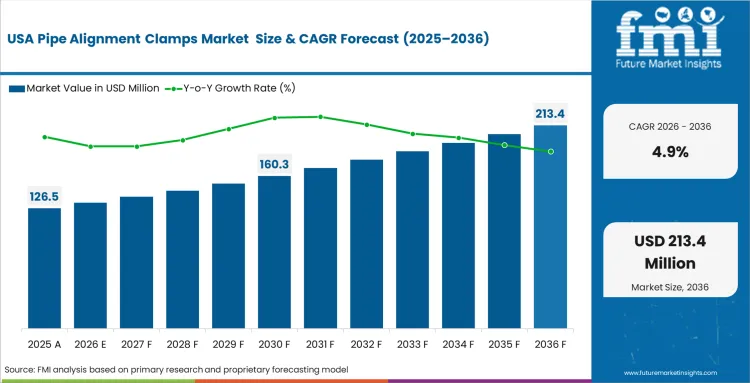
- USA: The pipe alignment clamps market in the United States is driven by ongoing replacement of aging pipeline infrastructure, especially in dense urban environments and beneath active road networks. Installation in these conditions requires compact and highly adaptable alignment tools capable of operating within confined spaces without disrupting surrounding infrastructure. Retrofit-focused projects emphasize speed and reduced surface impact. Clamps that support quicker fit-up and joint completion help minimize downtime in high-traffic areas and reduce excavation scope. Equipment selection is also shaped by strict safety and environmental regulations, particularly in utility and energy applications where compliance remains critical. The market is estimated to expand at a CAGR of 4.9% during 2026 to 2036, reflecting steady demand for efficient and adaptable alignment solutions across retrofit-driven pipeline projects in the United States.
Western Europe Pipe Alignment Clamps Market Analysis
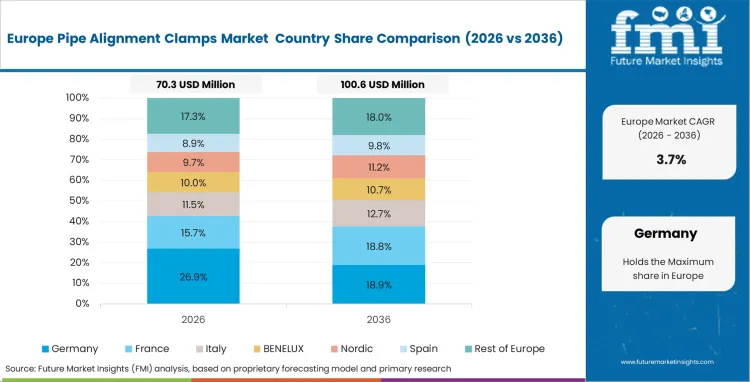
Industrial and energy infrastructure across Western Europe is undergoing gradual modernization. Equipment selection is influenced by safety compliance and operational precision requirements. Manufacturers focus on systems that support controlled installation processes while maintaining alignment accuracy across varying pipe specifications.
- Germany: Germany’s pipe alignment clamps market is likely to expand at 4.2% CAGR during the 2026 to 2036 period. Industrial pipeline upgrades require alignment systems that integrate with controlled installation workflows. Contractors prioritize clamps that ensure consistent joint positioning across high-specification pipelines. Equipment reliability and repeatable performance remain key considerations in procurement. Automation is gradually introduced to improve precision in industrial environments. These upgrades align with broader efforts to modernize manufacturing and energy infrastructure. Demand remains steady across sectors requiring accurate and efficient pipeline installation systems.
FMI's report includes detailed analysis covering Canada, Mexico, and Australia. Specialized applications involving subsea flowlines accelerate heavy-duty pneumatic adoption far faster than generalized infrastructure metrics indicate.
Competitive Aligners for Market Players
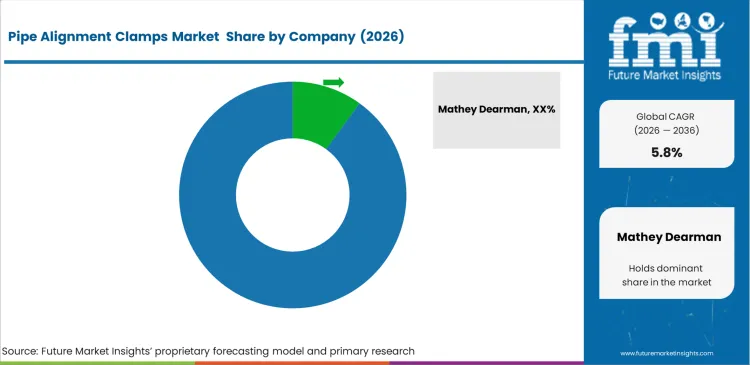
Field performance under extreme conditions defines supplier differentiation in this segment. Alignment clamps used on uneven terrain or large-diameter pipe sections must withstand significant side-loading without deformation. Manufacturers such as Mathey Dearman and CRC-Evans secure higher-value contracts by using forged structural components that offer greater strength and resistance to failure under load. Replicating this level of durability requires extensive material testing and long-term performance validation across harsh environments.
Service capability also plays a major role in supplier preference. Contractors operating in remote or offshore locations rely on fast access to spare parts and maintenance support. Suppliers with established distribution networks and the ability to deliver replacement components quickly maintain stronger relationships with field teams. Reliability over repeated usage cycles becomes more important than initial purchase cost, especially in demanding pipeline construction environments.
Standardization requirements are shaping equipment design and selection. Pipeline operators increasingly specify uniform pneumatic connections and compatible fittings to allow integration across different equipment sources. This approach reduces dependency on single suppliers and simplifies maintenance logistics. As interoperability increases, competition shifts toward alignment precision, operating speed, and durability. Emerging developments also point toward integration of alignment verification with digital inspection systems, enabling real-time validation during welding operations.
Key Players in Pipe Alignment Clamps Market
- Mathey Dearman
- Sawyer Mfg
- CRC-Evans
- TAG Pipe Equipment
- Rothenberger
- REMS
- Hi-Force
Scope of the Report
| Metric | Value |
|---|---|
| Quantitative Units | USD 260.8 million to USD 458.3 million, at a CAGR of 5.8% |
| Market Definition | Pipe alignment clamps function as rigid staging fixtures that secure cylindrical sections into precise concentricity to correct ovality prior to welding. |
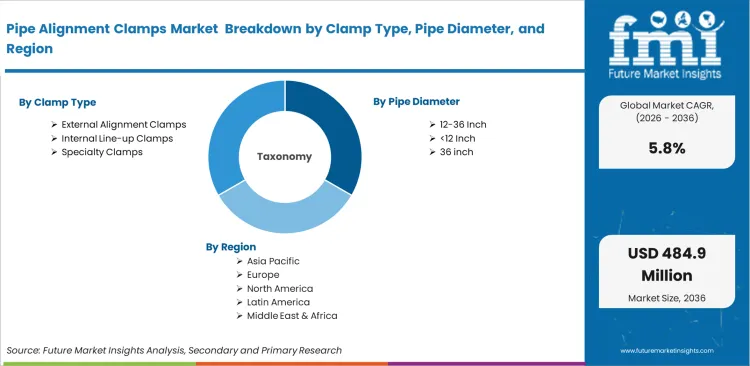
| Segmentation | By Clamp Type, Pipe Diameter, End Use, and Operation |
| Regions Covered | North America, Latin America, Western Europe, Eastern Europe, Asia Pacific, Middle East, and Africa |
| Countries Covered | USA, Germany, Saudi Arabia, China, India, Japan, Brazil |
| Key Companies Profiled | Mathey Dearman, Sawyer Mfg, CRC-Evans, TAG Pipe Equipment, Rothenberger, REMS, Hi-Force |
| Forecast Period | 2026 to 2036 |
| Approach | Top-down pipeline infrastructure tracking cross-referenced with equipment defect rate analysis |
Source: Future Market Insights (FMI) analysis, based on proprietary forecasting model and primary research
Pipe Alignment Clamps Market Analysis by Segments
Clamp Type
- External Alignment Clamps
- Internal Line-up Clamps
- Specialty Clamps
Pipe Diameter
- <12 inch
- 12-36 inch
- 36 inch
End Use
- Oil & Gas Pipelines
- Water Infrastructure
- Industrial Piping
- Other
Operation
- Manual
- Hydraulic/Powered
Region
- North America
- USA
- Canada
- Latin America
- Brazil
- Mexico
- Rest of Latin America
- Western Europe
- Germany
- UK
- France
- Spain
- Italy
- Rest of Western Europe
- Eastern Europe
- Russia
- Poland
- Rest of Eastern Europe
- Asia Pacific
- China
- India
- Japan
- Australia
- ASEAN
- Rest of Asia Pacific
- Middle East
- Saudi Arabia
- GCC Countries
- Rest of Middle East
- Africa
- South Africa
- North Africa
- Rest of Africa
Bibliography
- European Commission, Joint Research Centre. (2024). EU Industrial R&D Investment Scoreboard 2024. Publications Office of the European Union.
- Mathey Dearman. (2026). Pipe Alignment & Reforming Clamps.
- USA Department of Transportation, Pipeline and Hazardous Materials Safety Administration (PHMSA). (2026). Safety advisory on weld misalignment and fit‑up defects in pipeline construction and repair.
- Rothenberger. (2026). Clamping device for electro-sleeve welding, short x 160mm.
- USA Department of Transportation, Pipeline and Hazardous Materials Safety Administration (PHMSA). (2026). Pipeline safety regulations and guidance.
This bibliography is provided for reader reference. The full FMI report contains the complete reference list with primary source documentation.
This Report Addresses
- Defect rate minimization driving pneumatic tool adoption.
- Coating remediation penalties hidden within external cage usage.
- Field modification risks associated with mid-tier side-boom operations.
- Thermal expansion delays caused by localized micro-buckling.
- Interoperability constraints shaping corporate procurement logic.
- Labor contract restrictions preserving manual equipment deployment.
- Sand intrusion vulnerabilities dictating Middle Eastern bids.
- Active telemetry integration transforming basic staging fixtures.
Frequently Asked Questions
What are pipe alignment clamps used for?
Pipe alignment clamps function as rigid mechanical or hydraulic staging fixtures that secure two cylindrical sections in perfect concentricity prior to welding. They correct ovality and maintain uniform gaps between pipe ends to eliminate manual fit-up errors.
How do pipe alignment clamps work in field welding?
These specialized tools wrap around or expand inside the pipe joints to lock them in place. This strict staging ensures structural integrity and effectively prevents micro-deformations during high-pressure joining.
What is the size of the pipe alignment clamps market?
Total revenue is projected to hit USD 458.3 million by 2036. This growth signals permanent structural shifts toward digitized joint verification across high-pressure transmission networks globally.
Which clamp type leads the market?
External alignment clamps account for 47.0% of demand. Automated root-pass buggies require completely clear internal passages, forcing welding engineers to deploy outer-mounted fixtures to keep the center open for inspection robots.
Why do manual clamps still hold the larger share?
Manual operation retains a 58.0% share because strict urban noise and emission regulations severely restrict combustion-engine power units. Hand-cranked fixtures generate zero exhaust fumes, making them mandatory inside deep underground vaults.
Which countries are growing fastest in this market?
Advancing at 6.8% compound rate through 2036, India is set to rise as sector navigate incredibly narrow infrastructure corridors. Water grid developers source extremely compact alignment gear to fit inside tight shoring boxes where heavy machinery fails.
Who are the leading pipe alignment clamp suppliers?
Key innovators dominating the sector include Mathey Dearman, Sawyer Mfg, CRC-Evans, TAG Pipe Equipment, Rothenberger, REMS, and Hi-Force. These companies compete heavily on field durability and forged component resilience.
What is the difference between external and internal line-up clamps?
External fixtures mount on the outside of the pipe to keep internal passages clear for welding materials and robots, while internal clamps expand outward from inside the pipe to provide immense reforming pressure on extremely thick-wall applications.
How should buyers choose clamp size by pipe diameter?
Sizes between 12 and 36 inches capture 44.0% of total volume because construction managers deploy this exact class to align flawlessly with the lifting envelopes of standard, readily available side-boom tractors on mid-tier projects.
Why is oil and gas the largest end-use segment?
Uncompromising compliance and zero-tolerance regulatory environments regarding hydrocarbon leaks force Oil & Gas Pipelines to secure 39.0% share. Precision pneumatic line-up tools drastically cut costly cut-outs caused by weld defects.
What structural friction slows down pneumatic upgrades?
Incompatible compressor infrastructure on aging lay-barges severely slows transition momentum. Upgrading decades-old vessels requires entirely new high-volume air lines, creating retrofitting delays fleet engineering directors struggle to justify.
How do large buyers resist vendor lock-in?
Corporate procurement teams mandate standardized pneumatic connection fittings across all acquired hardware. Refusing proprietary air hose couplings forces established suppliers to compete strictly on cycle speed rather than artificial interoperability barriers.
Why are forged components critical for top-tier suppliers?
Heavy pipe segments resting on steep gradients exert massive side-loading forces. Forged components prevent snapping during these uneven fit-ups, providing metallurgical resilience that cheap cast alternatives simply cannot replicate.
How do extreme temperatures impact equipment choice?
Sub-zero arctic conditions routinely freeze delicate internal pneumatic valves. Lay-barge operators in these climates favor simple mechanical external cages that permit immediate visual inspection and rapid field maintenance.
What hidden cost plagues external cage deployments?
Aggressive clamping teeth crush factory-applied epoxy coatings during maximum compression. Quality control inspectors force immediate manual recoating protocols, adding massive secondary remediation expenses that procurement models frequently ignore.
Why do hydraulic forces cause micro-buckling?
Applying excessive hydraulic tonnage onto high-strength thin-wall materials creates invisible localized deformations near beveled edges. Metallurgical engineers must precisely calibrate pressure relief valves to prevent permanent structural distortion.
How do smart clamps improve quality control?
Embedding strain gauges directly into contact shoes provides real-time pressure feedback. Quality control managers gain unalterable digital proof that fit-up forces never exceeded metallurgical yield limits during joint staging processes.
Why is sand intrusion a critical Middle Eastern factor?
Severe desert conditions quickly reduce delicate electro-hydraulic seals. Maintenance directors in Saudi Arabia stockpile simple mechanical fixtures that local crews can rebuild using basic hand tools rather than awaiting imported replacement modules.
How do offshore installations differ from overland methods?
Marine superintendents maximize daily vessel mileage through continuous pipe feeding. Offshore installations demand highly sophisticated internal alignment stations that execute perfect concentricity in seconds, keeping expensive lay-barges moving constantly.
What causes thermal expansion delays during clamping?
Low-bid mechanical rigs often lock rigidly without accounting for extreme heat input. As multi-pass welding progresses, thermal expansion alters joint geometry, forcing crews to pause for forty-five minutes to recalibrate clamping pressure.
Why are non-marring pads gaining traction?
Developing advanced polymer contact points completely eliminates secondary epoxy repair work. Pipeline operators save thousands of expensive labor hours previously wasted fixing damaged anti-corrosion coatings near weld zones.
What role does ultrasonic testing play in adoption?
Mandatory defect-rate thresholds on advanced hydrogen lines require flawless root-pass integrity. Precision hydraulic staging modules become absolutely essential to eliminate human fatigue and guarantee zero out-of-roundness defects before testing begins.
Why do field modifications present safety risks?
Crews frequently grind stop-blocks to force standard 36-inch clamps over slightly oversized thick-wall sections. Safety supervisors must aggressively police equipment yards to scrap compromised fixtures before they fail under heavy tension.
How does battery electrification change trench operations?
Replacing tethered hydraulic packs with high-torque lithium-ion actuators removes dangerous tripping hazards. Safety directors unlock safer trench environments without sacrificing high-tonnage clamping capabilities required for heavy pipe.
Preview the report firsthand - request a free sample
Get SampleGet the brochure for pricing and purchase details.
Get PDFTable of Content
- Executive Summary
- Global Market Outlook
- Demand-side Trends
- Supply-side Trends
- Technology Roadmap Analysis
- Analysis and Recommendations
- Market Overview
- Market Coverage / Taxonomy
- Market Definition / Scope / Limitations
- Research Methodology
- Chapter Orientation
- Analytical Lens and Working Hypotheses
- Market Structure, Signals, and Trend Drivers
- Benchmarking and Cross-market Comparability
- Market Sizing, Forecasting, and Opportunity Mapping
- Research Design and Evidence Framework
- Desk Research Programme (Secondary Evidence)
- Company Annual and Sustainability Reports
- Peer-reviewed Journals and Academic Literature
- Corporate Websites, Product Literature, and Technical Notes
- Earnings Decks and Investor Briefings
- Statutory Filings and Regulatory Disclosures
- Technical White Papers and Standards Notes
- Trade Journals, Industry Magazines, and Analyst Briefs
- Conference Proceedings, Webinars, and Seminar Materials
- Government Statistics Portals and Public Data Releases
- Press Releases and Reputable Media Coverage
- Specialist Newsletters and Curated Briefings
- Sector Databases and Reference Repositories
- FMI Internal Proprietary Databases and Historical Market Datasets
- Subscription Datasets and Paid Sources
- Social Channels, Communities, and Digital Listening Inputs
- Additional Desk Sources
- Expert Input and Fieldwork (Primary Evidence)
- Primary Modes
- Qualitative Interviews and Expert Elicitation
- Quantitative Surveys and Structured Data Capture
- Blended Approach
- Why Primary Evidence is Used
- Field Techniques
- Interviews
- Surveys
- Focus Groups
- Observational and In-context Research
- Social and Community Interactions
- Stakeholder Universe Engaged
- C-suite Leaders
- Board Members
- Presidents and Vice Presidents
- R&D and Innovation Heads
- Technical Specialists
- Domain Subject-matter Experts
- Scientists
- Physicians and Other Healthcare Professionals
- Governance, Ethics, and Data Stewardship
- Research Ethics
- Data Integrity and Handling
- Primary Modes
- Tooling, Models, and Reference Databases
- Desk Research Programme (Secondary Evidence)
- Data Engineering and Model Build
- Data Acquisition and Ingestion
- Cleaning, Normalisation, and Verification
- Synthesis, Triangulation, and Analysis
- Quality Assurance and Audit Trail
- Market Background
- Market Dynamics
- Drivers
- Restraints
- Opportunity
- Trends
- Scenario Forecast
- Demand in Optimistic Scenario
- Demand in Likely Scenario
- Demand in Conservative Scenario
- Opportunity Map Analysis
- Product Life Cycle Analysis
- Supply Chain Analysis
- Investment Feasibility Matrix
- Value Chain Analysis
- PESTLE and Porter’s Analysis
- Regulatory Landscape
- Regional Parent Market Outlook
- Production and Consumption Statistics
- Import and Export Statistics
- Market Dynamics
- Global Market Analysis 2021 to 2025 and Forecast, 2026 to 2036
- Historical Market Size Value (USD Million) Analysis, 2021 to 2025
- Current and Future Market Size Value (USD Million) Projections, 2026 to 2036
- Y-o-Y Growth Trend Analysis
- Absolute $ Opportunity Analysis
- Global Market Pricing Analysis 2021 to 2025 and Forecast 2026 to 2036
- Global Market Analysis 2021 to 2025 and Forecast 2026 to 2036, By Clamp Type
- Introduction / Key Findings
- Historical Market Size Value (USD Million) Analysis By Clamp Type , 2021 to 2025
- Current and Future Market Size Value (USD Million) Analysis and Forecast By Clamp Type , 2026 to 2036
- External Alignment Clamps
- Internal Line-up Clamps
- Specialty Clamps
- External Alignment Clamps
- Y-o-Y Growth Trend Analysis By Clamp Type , 2021 to 2025
- Absolute $ Opportunity Analysis By Clamp Type , 2026 to 2036
- Global Market Analysis 2021 to 2025 and Forecast 2026 to 2036, By Pipe Diameter
- Introduction / Key Findings
- Historical Market Size Value (USD Million) Analysis By Pipe Diameter, 2021 to 2025
- Current and Future Market Size Value (USD Million) Analysis and Forecast By Pipe Diameter, 2026 to 2036
- 12-36 Inch
- <12 Inch
- 36 inch
- 12-36 Inch
- Y-o-Y Growth Trend Analysis By Pipe Diameter, 2021 to 2025
- Absolute $ Opportunity Analysis By Pipe Diameter, 2026 to 2036
- Global Market Analysis 2021 to 2025 and Forecast 2026 to 2036, By End Use
- Introduction / Key Findings
- Historical Market Size Value (USD Million) Analysis By End Use, 2021 to 2025
- Current and Future Market Size Value (USD Million) Analysis and Forecast By End Use, 2026 to 2036
- Oil and Gas Pipeline
- Water Infrastructure
- Industrial Piping
- Oil and Gas Pipeline
- Y-o-Y Growth Trend Analysis By End Use, 2021 to 2025
- Absolute $ Opportunity Analysis By End Use, 2026 to 2036
- Global Market Analysis 2021 to 2025 and Forecast 2026 to 2036, By Operation
- Introduction / Key Findings
- Historical Market Size Value (USD Million) Analysis By Operation, 2021 to 2025
- Current and Future Market Size Value (USD Million) Analysis and Forecast By Operation, 2026 to 2036
- Manual
- Hydraulic/Powered
- Manual
- Y-o-Y Growth Trend Analysis By Operation, 2021 to 2025
- Absolute $ Opportunity Analysis By Operation, 2026 to 2036
- Global Market Analysis 2021 to 2025 and Forecast 2026 to 2036, By Region
- Introduction
- Historical Market Size Value (USD Million) Analysis By Region, 2021 to 2025
- Current Market Size Value (USD Million) Analysis and Forecast By Region, 2026 to 2036
- North America
- Latin America
- Western Europe
- Eastern Europe
- East Asia
- South Asia and Pacific
- Middle East & Africa
- Market Attractiveness Analysis By Region
- North America Market Analysis 2021 to 2025 and Forecast 2026 to 2036, By Country
- Historical Market Size Value (USD Million) Trend Analysis By Market Taxonomy, 2021 to 2025
- Market Size Value (USD Million) Forecast By Market Taxonomy, 2026 to 2036
- By Country
- USA
- Canada
- Mexico
- By Clamp Type
- By Pipe Diameter
- By End Use
- By Operation
- By Country
- Market Attractiveness Analysis
- By Country
- By Clamp Type
- By Pipe Diameter
- By End Use
- By Operation
- Key Takeaways
- Latin America Market Analysis 2021 to 2025 and Forecast 2026 to 2036, By Country
- Historical Market Size Value (USD Million) Trend Analysis By Market Taxonomy, 2021 to 2025
- Market Size Value (USD Million) Forecast By Market Taxonomy, 2026 to 2036
- By Country
- Brazil
- Chile
- Rest of Latin America
- By Clamp Type
- By Pipe Diameter
- By End Use
- By Operation
- By Country
- Market Attractiveness Analysis
- By Country
- By Clamp Type
- By Pipe Diameter
- By End Use
- By Operation
- Key Takeaways
- Western Europe Market Analysis 2021 to 2025 and Forecast 2026 to 2036, By Country
- Historical Market Size Value (USD Million) Trend Analysis By Market Taxonomy, 2021 to 2025
- Market Size Value (USD Million) Forecast By Market Taxonomy, 2026 to 2036
- By Country
- Germany
- UK
- Italy
- Spain
- France
- Nordic
- BENELUX
- Rest of Western Europe
- By Clamp Type
- By Pipe Diameter
- By End Use
- By Operation
- By Country
- Market Attractiveness Analysis
- By Country
- By Clamp Type
- By Pipe Diameter
- By End Use
- By Operation
- Key Takeaways
- Eastern Europe Market Analysis 2021 to 2025 and Forecast 2026 to 2036, By Country
- Historical Market Size Value (USD Million) Trend Analysis By Market Taxonomy, 2021 to 2025
- Market Size Value (USD Million) Forecast By Market Taxonomy, 2026 to 2036
- By Country
- Russia
- Poland
- Hungary
- Balkan & Baltic
- Rest of Eastern Europe
- By Clamp Type
- By Pipe Diameter
- By End Use
- By Operation
- By Country
- Market Attractiveness Analysis
- By Country
- By Clamp Type
- By Pipe Diameter
- By End Use
- By Operation
- Key Takeaways
- East Asia Market Analysis 2021 to 2025 and Forecast 2026 to 2036, By Country
- Historical Market Size Value (USD Million) Trend Analysis By Market Taxonomy, 2021 to 2025
- Market Size Value (USD Million) Forecast By Market Taxonomy, 2026 to 2036
- By Country
- China
- Japan
- South Korea
- By Clamp Type
- By Pipe Diameter
- By End Use
- By Operation
- By Country
- Market Attractiveness Analysis
- By Country
- By Clamp Type
- By Pipe Diameter
- By End Use
- By Operation
- Key Takeaways
- South Asia and Pacific Market Analysis 2021 to 2025 and Forecast 2026 to 2036, By Country
- Historical Market Size Value (USD Million) Trend Analysis By Market Taxonomy, 2021 to 2025
- Market Size Value (USD Million) Forecast By Market Taxonomy, 2026 to 2036
- By Country
- India
- ASEAN
- Australia & New Zealand
- Rest of South Asia and Pacific
- By Clamp Type
- By Pipe Diameter
- By End Use
- By Operation
- By Country
- Market Attractiveness Analysis
- By Country
- By Clamp Type
- By Pipe Diameter
- By End Use
- By Operation
- Key Takeaways
- Middle East & Africa Market Analysis 2021 to 2025 and Forecast 2026 to 2036, By Country
- Historical Market Size Value (USD Million) Trend Analysis By Market Taxonomy, 2021 to 2025
- Market Size Value (USD Million) Forecast By Market Taxonomy, 2026 to 2036
- By Country
- Kingdom of Saudi Arabia
- Other GCC Countries
- Turkiye
- South Africa
- Other African Union
- Rest of Middle East & Africa
- By Clamp Type
- By Pipe Diameter
- By End Use
- By Operation
- By Country
- Market Attractiveness Analysis
- By Country
- By Clamp Type
- By Pipe Diameter
- By End Use
- By Operation
- Key Takeaways
- Key Countries Market Analysis
- USA
- Pricing Analysis
- Market Share Analysis, 2025
- By Clamp Type
- By Pipe Diameter
- By End Use
- By Operation
- Canada
- Pricing Analysis
- Market Share Analysis, 2025
- By Clamp Type
- By Pipe Diameter
- By End Use
- By Operation
- Mexico
- Pricing Analysis
- Market Share Analysis, 2025
- By Clamp Type
- By Pipe Diameter
- By End Use
- By Operation
- Brazil
- Pricing Analysis
- Market Share Analysis, 2025
- By Clamp Type
- By Pipe Diameter
- By End Use
- By Operation
- Chile
- Pricing Analysis
- Market Share Analysis, 2025
- By Clamp Type
- By Pipe Diameter
- By End Use
- By Operation
- Germany
- Pricing Analysis
- Market Share Analysis, 2025
- By Clamp Type
- By Pipe Diameter
- By End Use
- By Operation
- UK
- Pricing Analysis
- Market Share Analysis, 2025
- By Clamp Type
- By Pipe Diameter
- By End Use
- By Operation
- Italy
- Pricing Analysis
- Market Share Analysis, 2025
- By Clamp Type
- By Pipe Diameter
- By End Use
- By Operation
- Spain
- Pricing Analysis
- Market Share Analysis, 2025
- By Clamp Type
- By Pipe Diameter
- By End Use
- By Operation
- France
- Pricing Analysis
- Market Share Analysis, 2025
- By Clamp Type
- By Pipe Diameter
- By End Use
- By Operation
- India
- Pricing Analysis
- Market Share Analysis, 2025
- By Clamp Type
- By Pipe Diameter
- By End Use
- By Operation
- ASEAN
- Pricing Analysis
- Market Share Analysis, 2025
- By Clamp Type
- By Pipe Diameter
- By End Use
- By Operation
- Australia & New Zealand
- Pricing Analysis
- Market Share Analysis, 2025
- By Clamp Type
- By Pipe Diameter
- By End Use
- By Operation
- China
- Pricing Analysis
- Market Share Analysis, 2025
- By Clamp Type
- By Pipe Diameter
- By End Use
- By Operation
- Japan
- Pricing Analysis
- Market Share Analysis, 2025
- By Clamp Type
- By Pipe Diameter
- By End Use
- By Operation
- South Korea
- Pricing Analysis
- Market Share Analysis, 2025
- By Clamp Type
- By Pipe Diameter
- By End Use
- By Operation
- Russia
- Pricing Analysis
- Market Share Analysis, 2025
- By Clamp Type
- By Pipe Diameter
- By End Use
- By Operation
- Poland
- Pricing Analysis
- Market Share Analysis, 2025
- By Clamp Type
- By Pipe Diameter
- By End Use
- By Operation
- Hungary
- Pricing Analysis
- Market Share Analysis, 2025
- By Clamp Type
- By Pipe Diameter
- By End Use
- By Operation
- Kingdom of Saudi Arabia
- Pricing Analysis
- Market Share Analysis, 2025
- By Clamp Type
- By Pipe Diameter
- By End Use
- By Operation
- Turkiye
- Pricing Analysis
- Market Share Analysis, 2025
- By Clamp Type
- By Pipe Diameter
- By End Use
- By Operation
- South Africa
- Pricing Analysis
- Market Share Analysis, 2025
- By Clamp Type
- By Pipe Diameter
- By End Use
- By Operation
- USA
- Market Structure Analysis
- Competition Dashboard
- Competition Benchmarking
- Market Share Analysis of Top Players
- By Regional
- By Clamp Type
- By Pipe Diameter
- By End Use
- By Operation
- Competition Analysis
- Competition Deep Dive
- Mathey Dearman
- Overview
- Product Portfolio
- Profitability by Market Segments (Product/Age /Sales Channel/Region)
- Sales Footprint
- Strategy Overview
- Marketing Strategy
- Product Strategy
- Channel Strategy
- Sawyer Mfg
- CRC-Evans
- TAG Pipe Equipment
- Rothenberger
- Mathey Dearman
- Competition Deep Dive
- Assumptions & Acronyms Used


