

- Industry Size (2026)
- USD 32 Bn
- Forecast (2036):
- USD 57.9 Bn
- CAGR (2026 to 2036)
- 6.1%
Lightweight Polymers Market Forecast and Outlook 2026 to 2036
In 2026, the lightweight polymers market is likely to be valued at USD 32 billion and is expected to reach USD 57.9 billion by 2036, implying a CAGR of 6.1%. The economic case for these materials is tied to weight reduction targets in transportation, packaging, and consumer products rather than to resin substitution alone. Automakers, appliance makers, and equipment manufacturers treat mass reduction as a way to manage energy use, handling cost, and component count. Demand therefore concentrates in sectors where weight has a measurable impact on operating cost or regulatory compliance. Regions with strong automotive, aerospace, and appliance manufacturing bases account for a disproportionate share of consumption.
Material selection decisions are shaped by tooling compatibility, recyclability rules, and long term supply assurance rather than by unit resin price. Once a polymer grade is validated for a structural or semi structural part, it is usually locked into the design for the life of the platform due to requalification and tooling costs. Processing yield, cycle time, and scrap rates influence real economics more than headline material pricing. Adoption progresses through platform refresh cycles and packaging redesigns, not through rapid replacement of conventional plastics across all applications. The market grows through incremental penetration of weight sensitive designs and regulatory driven efficiency programs rather than through uniform material substitution.
Quick Stats for Lightweight Polymers Market
- Lightweight Polymers Market Value (2026): USD 32 billion
- Lightweight Polymers Market Forecast Value (2036): USD 57.9 billion
- Lightweight Polymers Market Forecast CAGR 2026 to 2036: 6.1%
- Leading Type in Lightweight Polymers Market: Polypropylene (PP)
- Key Growth Regions in Lightweight Polymers Market: Asia Pacific, North America, Europe
- Top Players in Lightweight Polymers Market: LyondellBasell, ExxonMobil Chemical, BASF, Dow, SABIC, Covestro, Celanese
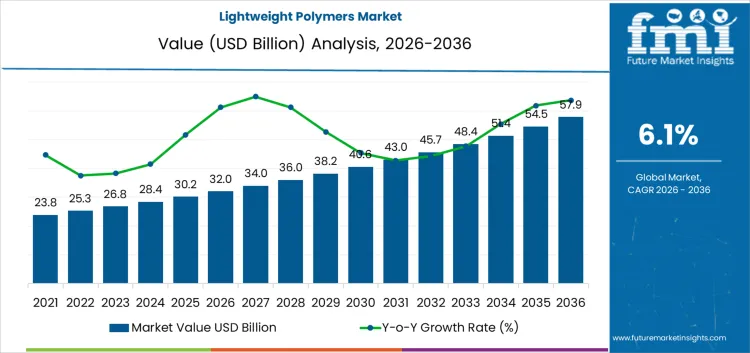
What is the Growth Forecast for Lightweight Polymers Market through 2036?
The lightweight polymers segment is expanding as material substitution becomes a long-term design strategy across automotive, packaging, electronics, and industrial equipment, rather than a short-term cost-saving approach. In the early phase, growth is driven by lightweighting targets that begin influencing material selection in vehicles, appliances, and consumer goods. Regulatory pressure on fuel efficiency, rising logistics costs, and efforts to reduce material usage per unit produced strengthen demand and encourage manufacturers to shift away from heavier materials.
As adoption deepens, lightweight polymers move from being niche alternatives to becoming standard design choices in many applications. This is especially visible in automotive interiors, under-the-hood components, and rigid packaging, where polymers support durability, performance, and weight reduction simultaneously. Growth in this stage is shaped more by increasing substitution rates than by overall manufacturing volume.
Over the long term, expansion is supported by platform-level design decisions and broader integration across industrial sectors, including mobility systems, electrical equipment, and infrastructure components. Lightweight polymers steadily gain share in more structural and semi-structural applications, not just housings and covers. Continued progress in processing technologies, design-for-weight approaches, and total cost of ownership advantages will sustain momentum, making the segment’s trajectory primarily driven by efficiency goals and regulation-led transformation rather than short-term material cycles.
Lightweight Polymers Market Key Takeaways
| Metric | Value |
|---|---|
| Market Value (2026) | USD 32 billion |
| Forecast Value (2036) | USD 57.9 billion |
| Forecast CAGR 2026 to 2036 | 6.1% |
How Is the Lightweight Polymers Market Influencing Material Selection Across Industries?
Lightweight polymers are increasingly used to reduce component weight, improve energy efficiency, and enhance structural performance in automotive, aerospace, and consumer product applications. Historically, manufacturers relied on metals or conventional plastics, which added weight, limited design flexibility, and increased energy consumption. Modern lightweight polymers combine high strength-to-weight ratios, chemical resistance, and thermal stability to support complex designs, long-term durability, and efficient manufacturing processes.
Automotive OEMs, aerospace suppliers, and industrial product designers prioritize material performance, processing adaptability, and reliability under operational stress. Early adoption focused on high-performance vehicles and aircraft components, while current demand spans industrial machinery, consumer electronics, and packaging, driven by efficiency improvements, design optimization, and product longevity. Mechanical strength, thermal tolerance, and process compatibility influence supplier selection.
Reducing component mass while maintaining functional integrity is shaping market growth. Compared with traditional materials, lightweight polymers allow intricate geometries, corrosion resistance, and faster assembly without compromising performance. Cost structures depend on polymer formulation, additive integration, and fabrication methods, concentrating margins among suppliers capable of delivering consistent, high-quality materials. Manufacturers adopt these polymers to lower energy requirements, improve product functionality, and expand design possibilities. By 2036, lightweight polymers are expected to support next-generation vehicle bodies, aerospace structures, and industrial components, enabling reduced operational costs, enhanced performance, and versatile product architectures unique to each application.
What Factors Are Shaping the Demand for Lightweight Polymers Market, Segment wise by Polymer Type and Application, in 2026?
The Lightweight Polymers Market is structured by material selection logic and by end-use performance requirements rather than by density metrics alone. By polymer type, demand in the Lightweight Polymers Market is distributed across polypropylene, polyethylene, polystyrene, and engineering polymers including polyamide, polycarbonate, and polybutylene terephthalate. By application, demand in the Lightweight Polymers Market is organized around automotive components, aerospace structures, packaging materials, and consumer goods. These segments represent distinct decision frameworks governed by qualification cost, process compatibility, regulatory exposure, and production scale.
How Do Substitution Risk and Process Compatibility Shape Polymer Type Selection in the Lightweight Polymers Market?
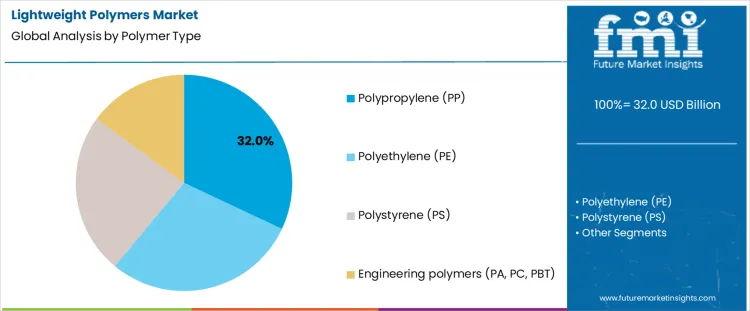
Polypropylene accounts for 32% of demand in the Lightweight Polymers Market primarily because it offers a favorable balance between weight reduction, mechanical performance, and processing continuity. In many industrial contexts, the principal constraint on material substitution is not performance, but the cost and risk associated with requalification of tooling, suppliers, and manufacturing processes. Polypropylene allows weight reduction while maintaining compatibility with established injection molding and extrusion systems, thereby limiting disruption to validated production lines. This characteristic positions polypropylene as a transition material in many substitution programs.
Polyethylene and polystyrene remain concentrated in applications where impact resistance or cost efficiency dominates material choice. Engineering polymers such as polyamide, polycarbonate, and polybutylene terephthalate are specified in environments with higher thermal, mechanical, or regulatory requirements, but their adoption is constrained by higher material costs, more demanding processing conditions, and longer qualification cycles. The structure of the Lightweight Polymers Market is therefore determined less by theoretical performance hierarchy and more by organizational tolerance for manufacturing change and validation expenditure.
Why Does Automotive Continue to Represent the Largest Application Segment in the Lightweight Polymers Market?
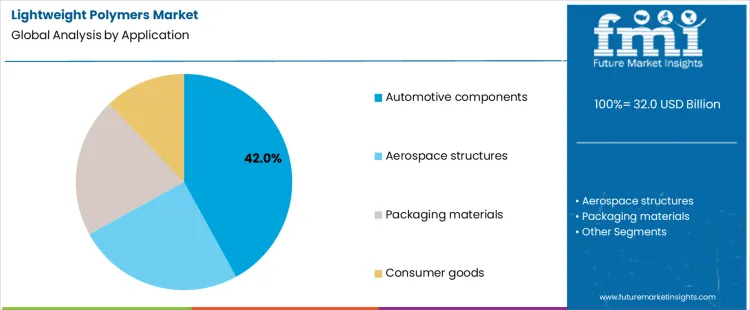
Automotive components represent 42% of demand in the Lightweight Polymers Market because vehicle manufacturers face sustained regulatory and economic pressure to reduce mass at the system level. Weight reduction influences fuel efficiency, emissions compliance, electric vehicle range, and component integration strategies. As a result, material selection in automotive programs is treated as a core engineering variable rather than as a secondary cost optimization exercise. The scale of automotive production also allows manufacturers to absorb the costs associated with material qualification, tooling modification, and supplier realignment.
Packaging and consumer goods account for significant volumes but are governed primarily by cost, recyclability, and surface properties rather than by structural mass optimization. Aerospace applications involve advanced lightweight materials but operate under low production volumes and extended certification cycles, which limits annual material turnover. The automotive sector occupies a distinct position characterized by high production volume, frequent model refresh cycles, and continuous regulatory pressure. This combination sustains a structurally higher rate of material substitution activity and explains the dominant share of automotive components within the Lightweight Polymers Market.
How Are the Key Dynamics Reshaping the Lightweight Polymers Market?
This market is being shaped by weight reduction targets, conservative qualification cycles, and the steady shift toward standardized material platforms. Lightweight polymers are specified to reduce energy use, improve handling, and enable new designs, but adoption depends on proving durability, processability, and long term supply stability. At the same time, large manufacturers are narrowing their approved material lists to simplify sourcing and compliance. This creates a market where growth comes from being written into platform material standards and new product architectures rather than from opportunistic substitution, and where scale follows program launches more than short term price movements.
Why Is Weight Reduction Driving the Lightweight Polymers Market?
Across automotive, appliances, electronics, and industrial equipment, mass is treated as a design penalty. Lower weight improves energy efficiency, simplifies installation, and reduces shipping and handling cost. In many products, it also enables larger assemblies or more features within the same structural limits. Lightweight polymers help designers replace metal or heavier plastics without redesigning entire systems. Once a part family is converted and validated, the material choice is replicated across models and sites. Demand therefore follows new platform introductions and redesign cycles rather than routine part replacement or small, isolated engineering changes.
What Is Slowing the Lightweight Polymers Market?
Material change carries risk. Lightweight polymers often require new tooling settings, different joining methods, and revised validation for strength, creep, heat resistance, or chemical exposure. In regulated or warranty sensitive products, this triggers long test programs and committee reviews. Cost is also scrutinized, especially where weight savings do not translate directly into revenue or compliance benefits. Supply consistency and recyclability questions can further delay approval. Because many existing designs already meet requirements, organizations wait for major redesign windows. These factors keep adoption paced by engineering cycles, not by raw material availability.
How Are Material Platforms Changing the Lightweight Polymers Market?
Procurement and engineering are moving toward platform material strategies. Large OEMs increasingly define approved polymer families that cover multiple applications and performance ranges. Lightweight grades that enter these families gain access to repeat volume across many products without being requalified each time. This shifts competition toward documentation quality, processing support, and long term supply reliability. Suppliers focus on fitting into these frameworks rather than selling one off substitutions. Over time, demand becomes tied to platform refresh schedules and corporate material standards instead of individual part level decisions.
What is the Demand for Lightweight Polymers by Country?
| Country | CAGR (%) |
|---|---|
| USA | 5.8% |
| UK | 5.5% |
| China | 6.8% |
| India | 7.0% |
| Brazil | 6.0% |
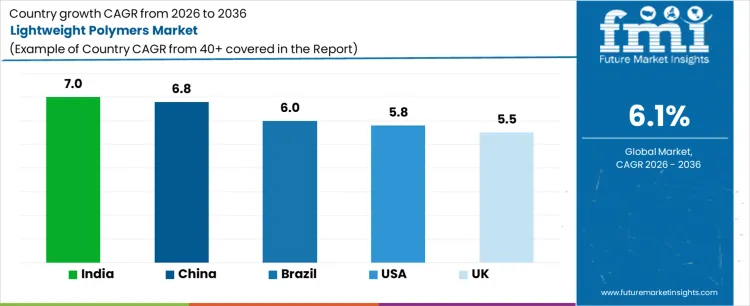
Demand for lightweight polymers is rising as manufacturers in automotive, packaging, and consumer goods sectors adopt materials that reduce product weight, enhance performance, and improve efficiency. India leads with a 7.0% CAGR, driven by growing automotive production, industrial applications, and adoption in consumer products. China follows at 6.8%, supported by large-scale manufacturing and integration of lightweight polymers in industrial and commercial applications. Brazil records 6.0% growth, shaped by demand in packaging and manufacturing sectors. The USA grows at 5.8%, influenced by replacement demand and adoption in transportation and consumer products. The UK shows 5.5% CAGR, reflecting steady use of lightweight polymers across multiple industries.
How is the United States experiencing growth in the Lightweight Polymers Market?
United States is recording a CAGR of 5.8%, with demand coming from automotive suppliers, packaging converters, and consumer goods manufacturers working with lightweight polymers. Material selection decisions focus on weight reduction, processing stability, and compliance with established performance standards. Automotive platforms use these materials for interior parts, under hood components, and structural inserts where mass control affects efficiency targets. Packaging producers apply lightweight polymers to reduce transport loads and improve line speeds. Resin producers invest in compounding capacity, application testing, and technical support teams. Procurement teams evaluate materials through long production trials and certification programs. Production volumes track vehicle output, packaged goods demand, and appliance manufacturing schedules. Regional manufacturing clusters support steady contract based supply relationships. Capital spending follows multi-year platform planning cycles rather than short term demand fluctuations.
How is the United Kingdom experiencing growth in the Lightweight Polymers Market?
United Kingdom is recording a CAGR of 5.5%, with consumption driven by automotive assembly plants, medical device producers, and packaging manufacturers using lightweight polymers. Design engineers focus on material consistency, molding behavior, and predictable performance under regulated use conditions. Vehicle interior programs use these materials to manage component mass and assembly efficiency. Healthcare equipment producers apply lightweight polymers in housings, disposables, and mobility aids. Processing companies invest in tooling upgrades, material testing capability, and operator training. Supply contracts favor vendors offering stable delivery schedules and technical documentation. Manufacturing volumes remain tied to export oriented production and domestic replacement demand. Regional production centers in England and the Midlands account for most throughput. Purchasing strategies emphasize reliability, traceability, and long term supplier support rather than frequent material switching.
How is China experiencing growth in the Lightweight Polymers Market?
China is recording a CAGR of 6.8%, supported by large scale manufacturing in automotive, consumer electronics, appliances, and packaging that relies on lightweight polymers. Material adoption follows programs focused on weight control, cost management, and high volume processing efficiency. Domestic resin producers expand capacity for compounding, modification, and application specific grades. Assembly plants integrate these materials into housings, structural frames, and internal components across multiple product categories. Engineering teams concentrate on cycle time optimization, defect reduction, and tooling life management. Regional industrial clusters in coastal and central zones concentrate most consumption. Procurement processes involve long qualification periods and batch testing. Export oriented production supports consistent baseline demand. Capacity planning aligns with equipment utilization targets and multi-product platform strategies across manufacturing groups.
How is India experiencing growth in the Lightweight Polymers Market?
India is recording a CAGR of 7%, with usage expanding across automotive parts manufacturing, consumer appliances, electrical components, and packaging based on lightweight polymers. Component makers focus on materials that support cost control, stable molding, and tolerance management under variable plant conditions. Vehicle suppliers apply these materials in interior panels, housings, and functional brackets. Appliance and electronics producers use them to simplify assembly and manage transport weight. Domestic resin suppliers increase compounding output and regional distribution reach. Processing firms invest in tool maintenance, operator training, and quality inspection systems. Demand growth follows industrial capacity additions and supplier localization programs. Purchasing decisions link closely to contract awards from large manufacturers. Production volumes track output from automotive and durable goods assembly plants across several industrial corridors.
How is Brazil experiencing growth in the Lightweight Polymers Market?
Brazil is recording a CAGR of 6%, with demand coming from automotive suppliers, packaging producers, appliance manufacturers, and infrastructure related product lines using lightweight polymers. Material choice emphasizes durability, process reliability, and performance under local operating conditions. Vehicle assembly plants use these materials for interior systems, trim components, and functional housings. Packaging converters apply them to reduce transport loads and improve line efficiency. Import dependence influences pricing structures and inventory planning. Local compounders expand blending and distribution capability to support regional processors. Engineering teams focus on consistent quality and tooling compatibility. Consumption centers around major industrial regions in the south and southeast. Purchasing strategies prioritize stable supply agreements and technical service access. Capacity expansion follows confirmed production programs rather than speculative volume projections.
How Are Key Producers Shaping the Lightweight Polymers Market Through Material Performance and Application Scope?
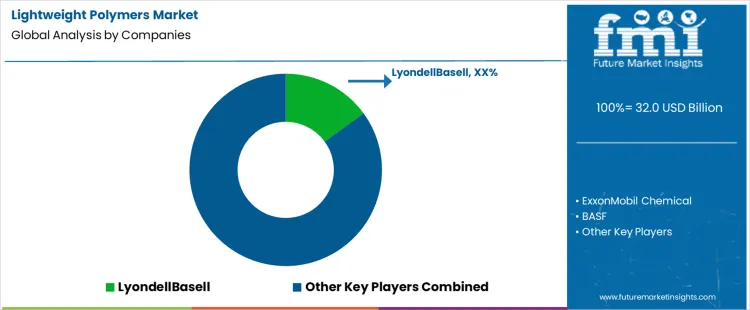
Materials suppliers in the lightweight polymers market emphasize formulations that balance low density, mechanical strength, and processing versatility for automotive, packaging, and consumer goods. LyondellBasell develops polyolefin and engineered polymer grades tailored for weight reduction in structural components and thin‑wall parts, supported by global production capacity. ExxonMobil Chemical provides high‑performance resins engineered for stiffness and impact resistance, enabling manufacturers to replace heavier materials without compromising durability. BASF supplies specialty polyamides and high‑performance polymers with targeted reinforcement chemistries to address demanding thermal and load conditions. Dow delivers polymer solutions engineered for consistent processing behavior across extrusion, injection molding, and foaming applications. SABIC focuses on lightweight polymer compounds optimized for automotive exterior and interior parts, balancing performance with recyclability.
Covestro contributes high‑strength thermoplastic polyurethanes and polycarbonates designed for structural applications where weight savings contribute to energy efficiency. Celanese supplies engineered polymers that combine stiffness, thermal stability, and low weight for consumer electronics housings and industrial parts. Other regional and niche producers provide tailored polymer blends optimized for specific end uses such as food‑contact packaging or high‑throughput molded components. Competitive differentiation arises from intrinsic material properties, ability to support design flexibility, and integration with processing technologies such as additive manufacturing and advanced composites. Suppliers that couple validated performance data, process support, and regional production networks are positioned to meet demand from manufacturers pursuing lightweighting strategies across sectors where reducing mass enhances fuel economy, lowers energy consumption, or improves product ergonomics.
Key Players in the Lightweight Polymers Market
- LyondellBasell
- ExxonMobil Chemical
- BASF
- Dow
- SABIC
- Covestro
- Celanese
Scope of the Report
| Items | Values |
|---|---|
| Quantitative Units (2026) | USD billion |
| Polymer Type | Polypropylene (PP), Polyethylene (PE), Polystyrene (PS), Engineering polymers (PA, PC, PBT) |
| Application | Automotive components, Aerospace structures, Packaging materials, Consumer goods |
| Region | Asia Pacific, Europe, North America, Latin America, Middle East & Africa |
| Countries Covered | China, Japan, South Korea, India, Australia & New Zealand, ASEAN, Germany, United Kingdom, France, Italy, Spain, Nordic, BENELUX, United States, Canada, Mexico, Brazil, Chile, Saudi Arabia, Turkey, South Africa, and other regional markets |
| Key Companies Profiled | LyondellBasell, ExxonMobil Chemical, BASF, Dow, SABIC, Covestro, Celanese |
| Additional Attributes | Dollar sales by polymer type and application; demand led by automotive and packaging; growth driven by weight reduction targets and regulatory efficiency programs; adoption tied to platform redesign cycles, qualification costs, and tooling compatibility; replacement of heavier materials over time rather than rapid full substitution. |
Lightweight Polymers Market Segmentation
Polymer Type:
- Polypropylene (PP)
- Polyethylene (PE)
- Polystyrene (PS)
- Engineering polymers (PA, PC, PBT)
Application:
- Automotive components
- Aerospace structures
- Packaging materials
- Consumer goods
Region
- Asia Pacific
- China
- Japan
- South Korea
- India
- Australia & New Zealand
- ASEAN
- Rest of Asia Pacific
- Europe
- Germany
- United Kingdom
- France
- Italy
- Spain
- Nordic
- BENELUX
- Rest of Europe
- North America
- United States
- Canada
- Mexico
- Latin America
- Brazil
- Chile
- Rest of Latin America
- Middle East & Africa
- Kingdom of Saudi Arabia
- Other GCC Countries
- Turkey
- South Africa
- Other African Union
- Rest of Middle East & Africa
References
- Organisation for Economic Co-operation and Development. (2025). Regional plastics outlook for Southeast and East Asia: Circular design and resource efficiency in polymer production. OECD Publishing.
- United Nations Environment Programme. (2025). Global plastics policy framework and sustainable materials transition report. UNEP.
- International Council on Clean Transportation. (2025). Lightweighting in the automotive industry as a pathway to energy efficiency and reduced emissions. ICCT.
Frequently Asked Questions
How big is the lightweight polymers market in 2026?
The global lightweight polymers market is estimated to be valued at USD 32.0 billion in 2026.
What will be the size of lightweight polymers market in 2036?
The market size for the lightweight polymers market is projected to reach USD 57.9 billion by 2036.
How much will be the lightweight polymers market growth between 2026 and 2036?
The lightweight polymers market is expected to grow at a 6.1% CAGR between 2026 and 2036.
What are the key product types in the lightweight polymers market?
The key product types in lightweight polymers market are polypropylene (pp) , polyethylene (pe), polystyrene (ps) and engineering polymers (pa, pc, pbt).
Which application segment to contribute significant share in the lightweight polymers market in 2026?
In terms of application, automotive components segment to command 42.0% share in the lightweight polymers market in 2026.
Preview the report firsthand - request a free sample
Get SampleGet the brochure for pricing and purchase details.
Get PDFTable of Content
- Executive Summary
- Global Market Outlook
- Demand-side Trends
- Supply-side Trends
- Technology Roadmap Analysis
- Analysis and Recommendations
- Market Overview
- Market Coverage / Taxonomy
- Market Definition / Scope / Limitations
- Market Background
- Market Dynamics
- Drivers
- Restraints
- Opportunity
- Trends
- Scenario Forecast
- Demand in Optimistic Scenario
- Demand in Likely Scenario
- Demand in Conservative Scenario
- Opportunity Map Analysis
- Product Life Cycle Analysis
- Supply Chain Analysis
- Investment Feasibility Matrix
- Value Chain Analysis
- PESTLE and Porter’s Analysis
- Regulatory Landscape
- Regional Parent Market Outlook
- Production and Consumption Statistics
- Import and Export Statistics
- Market Dynamics
- Global Market Analysis 2021 to 2025 and Forecast, 2026 to 2036
- Historical Market Size Value (USD Million) Analysis, 2021 to 2025
- Current and Future Market Size Value (USD Million) Projections, 2026 to 2036
- Y-o-Y Growth Trend Analysis
- Absolute $ Opportunity Analysis
- Global Market Pricing Analysis 2021 to 2025 and Forecast 2026 to 2036
- Global Market Analysis 2021 to 2025 and Forecast 2026 to 2036, By Polymer Type
- Introduction / Key Findings
- Historical Market Size Value (USD Million) Analysis By Polymer Type , 2021 to 2025
- Current and Future Market Size Value (USD Million) Analysis and Forecast By Polymer Type , 2026 to 2036
- Polypropylene (PP)
- Polyethylene (PE)
- Polystyrene (PS)
- Engineering polymers (PA, PC, PBT)
- Polypropylene (PP)
- Y-o-Y Growth Trend Analysis By Polymer Type , 2021 to 2025
- Absolute $ Opportunity Analysis By Polymer Type , 2026 to 2036
- Global Market Analysis 2021 to 2025 and Forecast 2026 to 2036, By Application
- Introduction / Key Findings
- Historical Market Size Value (USD Million) Analysis By Application, 2021 to 2025
- Current and Future Market Size Value (USD Million) Analysis and Forecast By Application, 2026 to 2036
- Automotive components
- Aerospace structures
- Packaging materials
- Consumer goods
- Automotive components
- Y-o-Y Growth Trend Analysis By Application, 2021 to 2025
- Absolute $ Opportunity Analysis By Application, 2026 to 2036
- Global Market Analysis 2021 to 2025 and Forecast 2026 to 2036, By Region
- Introduction
- Historical Market Size Value (USD Million) Analysis By Region, 2021 to 2025
- Current Market Size Value (USD Million) Analysis and Forecast By Region, 2026 to 2036
- North America
- Latin America
- Western Europe
- Eastern Europe
- East Asia
- South Asia and Pacific
- Middle East & Africa
- Market Attractiveness Analysis By Region
- North America Market Analysis 2021 to 2025 and Forecast 2026 to 2036, By Country
- Historical Market Size Value (USD Million) Trend Analysis By Market Taxonomy, 2021 to 2025
- Market Size Value (USD Million) Forecast By Market Taxonomy, 2026 to 2036
- By Country
- USA
- Canada
- Mexico
- By Polymer Type
- By Application
- By Country
- Market Attractiveness Analysis
- By Country
- By Polymer Type
- By Application
- Key Takeaways
- Latin America Market Analysis 2021 to 2025 and Forecast 2026 to 2036, By Country
- Historical Market Size Value (USD Million) Trend Analysis By Market Taxonomy, 2021 to 2025
- Market Size Value (USD Million) Forecast By Market Taxonomy, 2026 to 2036
- By Country
- Brazil
- Chile
- Rest of Latin America
- By Polymer Type
- By Application
- By Country
- Market Attractiveness Analysis
- By Country
- By Polymer Type
- By Application
- Key Takeaways
- Western Europe Market Analysis 2021 to 2025 and Forecast 2026 to 2036, By Country
- Historical Market Size Value (USD Million) Trend Analysis By Market Taxonomy, 2021 to 2025
- Market Size Value (USD Million) Forecast By Market Taxonomy, 2026 to 2036
- By Country
- Germany
- UK
- Italy
- Spain
- France
- Nordic
- BENELUX
- Rest of Western Europe
- By Polymer Type
- By Application
- By Country
- Market Attractiveness Analysis
- By Country
- By Polymer Type
- By Application
- Key Takeaways
- Eastern Europe Market Analysis 2021 to 2025 and Forecast 2026 to 2036, By Country
- Historical Market Size Value (USD Million) Trend Analysis By Market Taxonomy, 2021 to 2025
- Market Size Value (USD Million) Forecast By Market Taxonomy, 2026 to 2036
- By Country
- Russia
- Poland
- Hungary
- Balkan & Baltic
- Rest of Eastern Europe
- By Polymer Type
- By Application
- By Country
- Market Attractiveness Analysis
- By Country
- By Polymer Type
- By Application
- Key Takeaways
- East Asia Market Analysis 2021 to 2025 and Forecast 2026 to 2036, By Country
- Historical Market Size Value (USD Million) Trend Analysis By Market Taxonomy, 2021 to 2025
- Market Size Value (USD Million) Forecast By Market Taxonomy, 2026 to 2036
- By Country
- China
- Japan
- South Korea
- By Polymer Type
- By Application
- By Country
- Market Attractiveness Analysis
- By Country
- By Polymer Type
- By Application
- Key Takeaways
- South Asia and Pacific Market Analysis 2021 to 2025 and Forecast 2026 to 2036, By Country
- Historical Market Size Value (USD Million) Trend Analysis By Market Taxonomy, 2021 to 2025
- Market Size Value (USD Million) Forecast By Market Taxonomy, 2026 to 2036
- By Country
- India
- ASEAN
- Australia & New Zealand
- Rest of South Asia and Pacific
- By Polymer Type
- By Application
- By Country
- Market Attractiveness Analysis
- By Country
- By Polymer Type
- By Application
- Key Takeaways
- Middle East & Africa Market Analysis 2021 to 2025 and Forecast 2026 to 2036, By Country
- Historical Market Size Value (USD Million) Trend Analysis By Market Taxonomy, 2021 to 2025
- Market Size Value (USD Million) Forecast By Market Taxonomy, 2026 to 2036
- By Country
- Kingdom of Saudi Arabia
- Other GCC Countries
- Turkiye
- South Africa
- Other African Union
- Rest of Middle East & Africa
- By Polymer Type
- By Application
- By Country
- Market Attractiveness Analysis
- By Country
- By Polymer Type
- By Application
- Key Takeaways
- Key Countries Market Analysis
- USA
- Pricing Analysis
- Market Share Analysis, 2025
- By Polymer Type
- By Application
- Canada
- Pricing Analysis
- Market Share Analysis, 2025
- By Polymer Type
- By Application
- Mexico
- Pricing Analysis
- Market Share Analysis, 2025
- By Polymer Type
- By Application
- Brazil
- Pricing Analysis
- Market Share Analysis, 2025
- By Polymer Type
- By Application
- Chile
- Pricing Analysis
- Market Share Analysis, 2025
- By Polymer Type
- By Application
- Germany
- Pricing Analysis
- Market Share Analysis, 2025
- By Polymer Type
- By Application
- UK
- Pricing Analysis
- Market Share Analysis, 2025
- By Polymer Type
- By Application
- Italy
- Pricing Analysis
- Market Share Analysis, 2025
- By Polymer Type
- By Application
- Spain
- Pricing Analysis
- Market Share Analysis, 2025
- By Polymer Type
- By Application
- France
- Pricing Analysis
- Market Share Analysis, 2025
- By Polymer Type
- By Application
- India
- Pricing Analysis
- Market Share Analysis, 2025
- By Polymer Type
- By Application
- ASEAN
- Pricing Analysis
- Market Share Analysis, 2025
- By Polymer Type
- By Application
- Australia & New Zealand
- Pricing Analysis
- Market Share Analysis, 2025
- By Polymer Type
- By Application
- China
- Pricing Analysis
- Market Share Analysis, 2025
- By Polymer Type
- By Application
- Japan
- Pricing Analysis
- Market Share Analysis, 2025
- By Polymer Type
- By Application
- South Korea
- Pricing Analysis
- Market Share Analysis, 2025
- By Polymer Type
- By Application
- Russia
- Pricing Analysis
- Market Share Analysis, 2025
- By Polymer Type
- By Application
- Poland
- Pricing Analysis
- Market Share Analysis, 2025
- By Polymer Type
- By Application
- Hungary
- Pricing Analysis
- Market Share Analysis, 2025
- By Polymer Type
- By Application
- Kingdom of Saudi Arabia
- Pricing Analysis
- Market Share Analysis, 2025
- By Polymer Type
- By Application
- Turkiye
- Pricing Analysis
- Market Share Analysis, 2025
- By Polymer Type
- By Application
- South Africa
- Pricing Analysis
- Market Share Analysis, 2025
- By Polymer Type
- By Application
- USA
- Market Structure Analysis
- Competition Dashboard
- Competition Benchmarking
- Market Share Analysis of Top Players
- By Regional
- By Polymer Type
- By Application
- Competition Analysis
- Competition Deep Dive
- LyondellBasell
- Overview
- Product Portfolio
- Profitability by Market Segments (Product/Age /Sales Channel/Region)
- Sales Footprint
- Strategy Overview
- Marketing Strategy
- Product Strategy
- Channel Strategy
- ExxonMobil Chemical
- BASF
- Dow
- SABIC
- Covestro
- Celanese
- LyondellBasell
- Competition Deep Dive
- Assumptions & Acronyms Used
- Research Methodology


