

- Industry Size (2026)
- USD 2.1 Bn
- Forecast (2036)
- USD 5.9 Bn
- CAGR (2026 to 2036)
- 10.9%
Lightweighting Optimized PCR Resin Market Forecast and Outlook 2026 to 2036
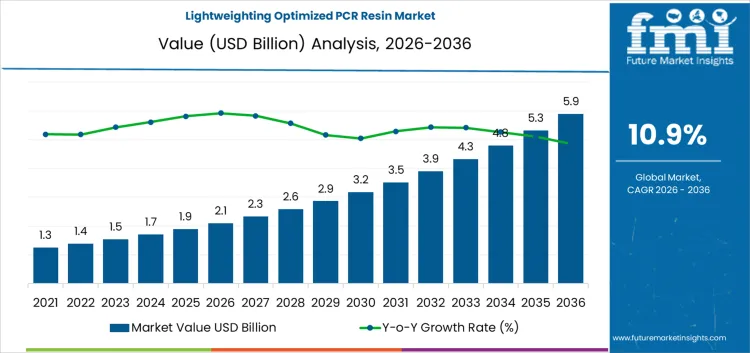
The lightweighting optimized PCR resin market is set to reach USD 2.1 billion in 2026 and is projected to expand to USD 5.9 billion by 2036, growing at a CAGR of 10.9%. This growth is driven by the increasing demand for lightweight materials in automotive and industrial applications. PCR resins designed for lightweighting provide improved strength-to-weight ratios, enabling manufacturers to reduce overall product weight while maintaining performance standards. The adoption of these materials supports efficiency improvements in fuel consumption and operational performance, particularly in transportation and automotive sectors.
Industries are increasingly focusing on PCR resins optimized for lightweighting to meet regulatory and consumer demands for improved efficiency. These resins are suitable for components such as automotive panels, interior parts, and industrial housings where weight reduction is critical. Advances in polymer formulation and processing allow recycled resins to deliver consistent mechanical properties and thermal stability. As manufacturers seek materials that combine reduced weight with performance reliability, lightweighting optimized PCR resins are expected to see significant adoption. Growth is supported by innovations that enhance material properties and expand applications across multiple sectors, including automotive, industrial equipment, and consumer products.
Quick Stats of the Lightweighting Optimized PCR Resin Market
- Lightweighting Optimized PCR Resin Market Value (2026): USD 2.1 billion
- Lightweighting Optimized PCR Resin Market Forecast Value (2036): USD 5.9 billion
- Lightweighting Optimized PCR Resin Market Forecast CAGR 2026 to 2036: 10.9%
- Lightweighting Optimized PCR Resin Market Leading Resin Type: Low-density high-stiffness resins (48% Market Share)
- Lightweighting Optimized PCR Resin Market Key Growth Regions: Asia Pacific, North America, Latin America, Middle East & Africa
- Lightweighting Optimized PCR Resin Market Top Players: LyondellBasell, Avient, Celanese, Kingfa, Sinopec, Reliance Industries, Braskem, Prime Polymer
What is the Growth Forecast for Lightweighting Optimized PCR Resin Market through 2036?
The lightweighting optimized PCR resin market is anticipated to reach USD 2.1 billion in 2026 and USD 5.9 billion by 2036, reflecting a compound annual growth rate (CAGR) of 10.9%. Between 2020 and 2026, the market grows from USD 1.2 billion to USD 2.1 billion, driven by demand for lighter and more energy-efficient automotive components. Regional adoption demonstrates variation, with North America and Europe leading due to stringent fuel efficiency and safety regulations, while Asia Pacific shows rapid expansion supported by cost-effective production and growing automotive manufacturing capacity. Manufacturers increasingly employ lightweight PCR resins to enhance vehicle performance and meet evolving environmental requirements.
Regulatory oversight, compliance costs, and certification complexity significantly influence adoption and vendor positioning. Stringent standards in developed regions promote the use of certified PCR resins but increase operational expenditures for compliance. Certification requirements in emerging markets present adoption challenges, as administrative and testing burdens are comparatively higher. Between 2026 and 2034, market value rises from USD 2.3 billion to USD 4.8 billion, reflecting the combined impact of regulatory mandates and cost considerations. Vendors that optimize compliance processes and demonstrate adherence to standards are better positioned to capture regional opportunities, particularly in North America and Europe, while gradual alignment with global standards drives adoption in emerging economies.
Lightweighting Optimized PCR Resin Market Key Takeaways
| Metric | Value |
|---|---|
| Market Value (2026) | USD 2.1 billion |
| Forecast Value (2036) | USD 5.9 billion |
| Forecast CAGR 2026 to 2036 | 10.9% |
What Are the Key Factors Driving Growth in the Lightweighting Optimized PCR Resin Market?
Growth in the Lightweighting Optimized PCR Resin Market is linked to increasing demand for materials that reduce overall vehicle weight while meeting performance and regulatory standards. Automotive manufacturers are actively pursuing weight reduction strategies to improve fuel efficiency in internal combustion vehicles and extend driving range in electric vehicles. Lightweighting optimized post consumer recycled (PCR) resins are being specified for interior and exterior components where reduced mass can yield measurable efficiency gains. Applications include instrument panels, door modules, trim pieces, and underbody components. Procurement teams at original equipment manufacturers (OEMs) are updating material selection criteria to include mass targets coupled with mechanical property requirements. In North America, Europe, and Asia Pacific, fuel economy standards and emissions regulations influence design strategies, prompting engineers to consider lighter materials that also comply with impact and durability benchmarks. Tier suppliers are adjusting production lines to process PCR resins that meet these revised specifications.
Market expansion is also observable in cost management and regulatory alignment practices within the automotive supply chain. Resin pricing dynamics have heightened scrutiny of material costs, driving interest in alternatives that support weight related objectives without introducing supply instability. OEMs are issuing detailed material qualification requirements that include mass efficiency, mechanical strength, and compatibility with existing manufacturing methods. Collaboration between compounders and recycling firms is contributing to improved consistency in PCR feedstock properties, enabling better prediction of material performance in end uses. Outside automotive, other sectors such as consumer appliances and industrial equipment are evaluating lightweighting optimized PCR resins to meet product performance and cost targets, similar to adoption patterns seen in the PCR plastic packaging. These combined procurement preferences and application opportunities are expected to sustain market growth for PCR resins tailored to lightweighting goals across multiple industries.
What Are the Key Segments in the Lightweighting Optimized PCR Resin Market?
Lightweighting Optimized PCR resins are divided into Resin Type and Material segments, with Low-density high-stiffness resins capturing 48% of the Resin Type market and PCR-PP / PCR-PA holding 55% of the Material segment. Demand for these segments is fueled by the automotive industry’s focus on reducing vehicle weight while maintaining stiffness, durability, and impact resistance. Low-density resins are increasingly applied in structural panels, dashboards, and door trims, where performance under thermal and mechanical stress is critical. PCR polymer blends provide eco-efficient alternatives to virgin plastics, allowing manufacturers to meet regulatory efficiency standards and integrate recycled content in high-value automotive components. Growth is influenced by processability, performance, and compliance requirements.
How Do Low-Density High-Stiffness Resins Influence Component Performance and Adoption?
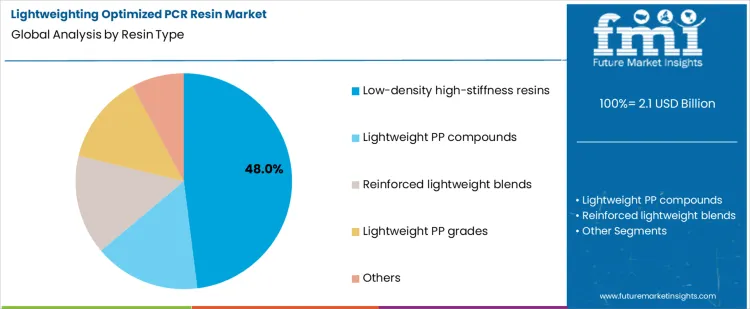
Structural and functional components in vehicles often rely on Low-Density High-Stiffness Resins, which hold 48% of the Resin Type segment. These resins deliver high modulus and low density, enabling lightweight automotive interiors, semi-structural panels, and load-bearing trims. Designers select these materials for their ability to resist vibration, maintain dimensional stability, and perform under thermal cycling typical of vehicle operation. Incorporation of reinforcing fillers, compatibilizers, and stabilizers allows precise tuning of stiffness, strength, and processability. Applications extend to dashboards, console structures, and door panels where maintaining mechanical integrity and crash performance while reducing weight is essential.
Performance demands drive the adoption of low-density resins in lightweighting programs, as automakers prioritize efficiency without sacrificing structural reliability. Production requires careful compounding to ensure uniform filler distribution, consistent mechanical behavior, and optimal flow for injection molding. Constraints include sensitivity to temperature variation, recycled feedstock inconsistencies, and challenges in producing complex geometries. Engineering teams are addressing these issues through improved compounding, process monitoring, and material formulations. As lightweighting requirements intensify for fuel-efficient and electric vehicles, low-density high-stiffness resins are increasingly integrated across interior and semi-structural components.
What Role Do PCR-PP and PCR-PA Polymers Play in Lightweighting Optimized Automotive Resins?
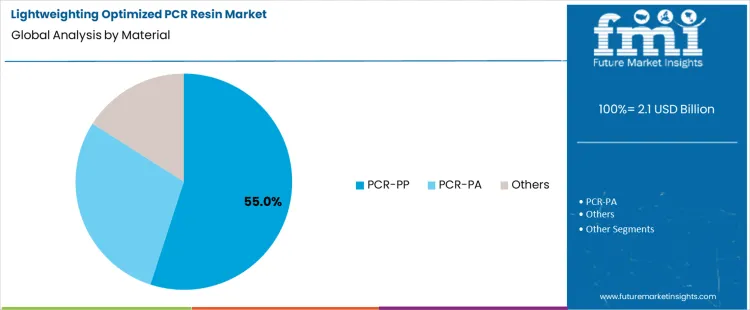
Automotive manufacturers rely on PCR-PP and PCR-PA polymers, which account for 55% of the Material segment, to achieve eco-efficient lightweighting. PCR-PP offers flexibility, chemical resistance, and low density, while PCR-PA provides stiffness, heat resistance, and dimensional stability. These polymers are engineered for dashboards, door trims, and semi-structural components where high mechanical performance is required. Blending PCR-PP with PCR-PA allows customization of rigidity, impact resistance, and thermal behavior, ensuring compliance with safety and performance standards. Their compatibility with fillers and additives expands the potential applications in lightweight, recycled interior components.
Eco-efficiency and performance requirements drive the increasing use of PCR-PP and PCR-PA. Automakers seek polymers that reduce environmental impact while maintaining structural and thermal properties. Manufacturing constraints include variations in recycled feedstock, moisture sensitivity, and potential warpage during injection molding. Advanced recycling, material sorting, and compatibilization techniques address these challenges, improving quality consistency. As electric and fuel-efficient vehicle programs expand, the adoption of PCR-PP and PCR-PA is expected to rise sharply. These polymers provide a balance of lightweighting, mechanical performance, and recycled content integration, establishing them as a critical component in automotive interior and semi-structural applications.
How Are OEM Procurement Strategies Driving Demand for Lightweighting Optimized PCR Resins?
Automotive OEMs are increasingly specifying lightweighting optimized PCR resins to reduce vehicle curb weight while meeting performance targets for structural and semi-structural components. Procurement teams assess recycled resin grades based on metrics such as specific strength, flexural modulus, and thermal stability under assembly conditions. Suppliers that provide detailed test reports, certificates of analysis, and validated molding trials for parts like seat frames, under-hood brackets, and interior supports gain preference. Cost evaluations consider not only material pricing but also mass reduction benefits that lower fuel consumption and emissions compliance costs. Long-term contracts with consistent performance supply are increasingly shaping sourcing decisions in this segment.
What Material Quality and Production Constraints Are Limiting Adoption of Lightweighting Optimized PCR Resins?
Consistency in mechanical properties remains a challenge for recycled resins intended for lightweighting applications. Variations in post-consumer feedstock composition, contamination levels, and thermal history can impact crystallinity, tensile strength, and impact resistance, affecting part performance. Compounding processes require precise formulation to achieve targeted stiffness-to-weight ratios, while ensuring dimensional stability during injection molding. Validation protocols for structural parts involve extensive mechanical testing and lifecycle evaluation, which lengthen qualification timelines. Capacity limitations at specialized compounding facilities further constrain volume availability. These factors, combined with regulatory requirements for recycled content verification, restrict the pace at which lightweighting PCR resins are incorporated into new vehicle platforms.
How Are Design and Application Strategies Shaping Trends in Lightweighting Optimized PCR Resins?
Design engineers are increasingly integrating lightweighting optimized PCR resins into components where mass reduction provides measurable performance gains, such as instrument panels, HVAC housings, and door modules. Material selection is guided by simulation-based evaluation of stiffness, vibration damping, and thermal behavior, ensuring that recycled resins meet part-specific requirements. Cross-sectional geometries and rib placements are optimized according to resin property data to preserve structural integrity while reducing weight. Collaborative agreements between recyclers and OEMs facilitate batch certification and property consistency. Predictive modeling tools are now used to anticipate processing behavior, enabling engineers to design lightweight components without compromising durability or assembly precision.
How Is the Demand Shaping for Lightweighting Optimized PCR Resins Across Key Countries?
| Country | CAGR (%) |
|---|---|
| Germany | 10.2% |
| USA | 9.4% |
| China | 13.6% |
| India | 14.2% |
| Brazil | 9.0% |
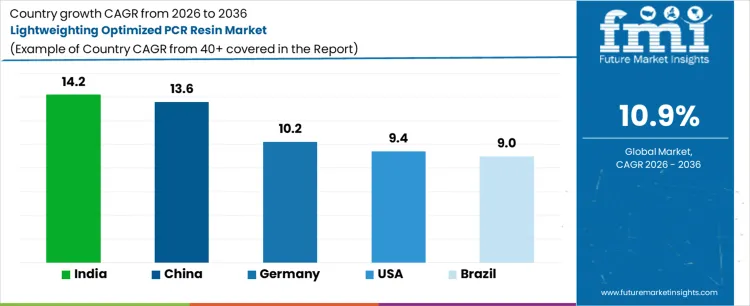
The lightweighting optimized post-consumer recycled (PCR) resins market is witnessing substantial growth across major automotive and manufacturing regions. India leads with a 14.2% CAGR, driven by the push for fuel-efficient vehicles, rising adoption of lightweight materials, and growing regulatory support for eco-efficient polymers. China follows at 13.6%, supported by large-scale automotive production and government incentives for materials that reduce vehicle weight and carbon emissions. Germany records a 10.2% CAGR, reflecting the integration of lightweight PCR resins in premium automotive applications and compliance with stringent European standards. The USA shows steady growth at 9.4%, fueled by the automotive industry's focus on reducing vehicle weight while maintaining performance. Brazil, with a 9.0% CAGR, demonstrates gradual uptake, driven by emerging adoption of lightweight PCR solutions in local automotive manufacturing and structural applications.
What Is Driving Demand for Lightweighting Optimized PCR Resins in Germany?
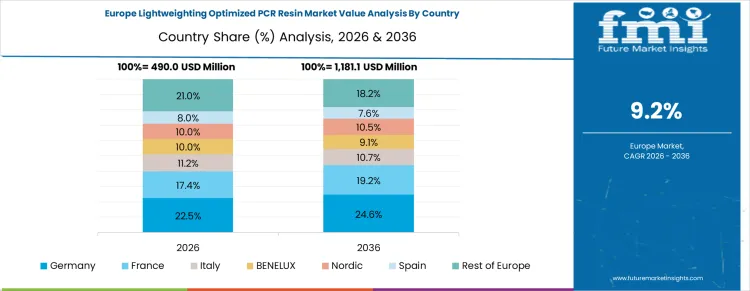
Demand for lightweighting optimized PCR resins in Germany is projected to grow at a CAGR of 10.2%. The country’s automotive sector, recognized for high-quality engineering, is increasingly incorporating eco-efficient materials to reduce vehicle weight and improve efficiency. The adoption of recycled plastics that meet performance and durability requirements is gaining traction, particularly in passenger cars and electric vehicles. Germany’s strict environmental regulations, combined with incentives for eco-efficient manufacturing, further encourage the integration of lightweight PCR resins in vehicle components. Ongoing investments in polymer technology and recycling infrastructure are enhancing the efficiency and performance of these resins. As a result, Germany remains a leading market for lightweight, eco-friendly automotive materials.
- Automotive sector focuses on reducing vehicle weight and improving efficiency.
- Environmental regulations drive adoption of lightweight PCR resins.
- Investment in recycling technologies enhances material performance.
How Is the Lightweighting Optimized PCR Resins Market is Evolving in the USA?
Sales of lightweighting optimized PCR resins in the USA are expected to grow at a CAGR of 9.4%. With the expansion of electric vehicles and increased focus on fuel efficiency, manufacturers are adopting high-performance PCR resins to reduce component weight. Government policies promoting recycling, eco-efficiency, and environmental compliance encourage the use of these materials across automotive applications. Advanced material technologies and innovations in resin processing are improving durability while maintaining lightweight properties. Consumer demand for greener, energy-efficient vehicles also contributes to market growth. As manufacturers continue to integrate eco-efficient materials in safety-critical and interior components, the USA is expected to see steady expansion in lightweighting optimized PCR resin adoption.
- Electric vehicle adoption increases demand for lightweight materials.
- Government eco-efficiency policies encourage recycled resin use.
- Advances in material technology improve strength and durability.
What Factors Are Supporting Growth of Lightweighting Optimized PCR Resins in China?
Outlook on lightweighting optimized PCR resins in China indicates a CAGR of 13.6%. China’s rapidly growing automotive market, particularly electric vehicle production, is driving demand for lightweight, eco-efficient materials. The government’s emphasis on circular economy practices and environmental eco-efficiency is encouraging manufacturers to incorporate PCR resins in vehicle components. Lightweighting strategies are critical for enhancing fuel efficiency and reducing emissions, further reinforcing the adoption of these resins. Technological advancements in polymer processing, combined with investments in recycling infrastructure, ensure that materials meet performance and durability standards. Consumer demand for greener vehicles and regulatory support position China as a global leader in the adoption of lightweighting optimized PCR resins.
- Automotive growth in China drives demand for eco-efficient resins.
- Government circular economy initiatives encourage PCR adoption.
- Polymer technology innovations improve material performance.
How Is India Accelerating the Adoption of Lightweighting Optimized PCR Resins?
Industry in India for lightweighting optimized PCR resins is projected to grow at a CAGR of 14.2%. The country’s expanding automotive and electric vehicle sectors are driving demand for high-performance, lightweight recycled materials. Manufacturers are increasingly integrating PCR resins in vehicle interiors and safety-critical components to improve efficiency and reduce emissions. Government policies promoting recycling and eco-efficient manufacturing practices are contributing to the growth of the market. Consumer awareness about environmental impact and fuel efficiency is further encouraging adoption. Investments in polymer innovation and advanced processing technologies ensure that lightweight PCR resins meet performance standards. India is expected to emerge as one of the fastest-growing markets for these materials globally.
- Electric vehicle growth increases demand for lightweight materials.
- Government policies support recycling and eco-efficiency initiatives.
- Advanced polymer technologies enhance material efficiency and durability.
What Is Driving the Demand for Lightweighting Optimized PCR Resins in Brazil?
Outlook on lightweighting optimized PCR resins in Brazil indicates a CAGR of 9%. The country’s automotive industry is adopting lightweight recycled materials to improve vehicle performance and reduce environmental impact. The adoption of PCR resins in interior and structural components is increasing as manufacturers focus on fuel efficiency and eco-efficiency. Government initiatives supporting recycling and eco-friendly production further encourage the use of these materials. Consumer demand for greener vehicles and increased awareness of environmental issues are contributing to market growth. Investments in polymer technology and material processing are ensuring that lightweight PCR resins meet safety and durability standards. Brazil’s automotive sector is positioned for steady expansion in this market.
- Growing automotive sector drives demand for lightweight, eco-efficient materials.
- Government initiatives encourage recycling and eco-friendly production.
- Polymer technology investments enhance material performance and durability.
What Distinguishes Competitors in the Lightweighting Optimized PCR Resin Market?
LyondellBasell competes with Lightweighting Optimized Post Consumer Recycled (PCR) resins formulated for reduced density without loss of mechanical strength. Its CirculenRecover™ PCR materials are targeted at structural and semi structural automotive applications where mass reduction directly influences efficiency. Product literature highlights controlled modulus and tensile strength that support thinner wall sections while maintaining impact performance. Avient advances PCR based engineered compounds that combine lightweight fillers with recycled polymer matrices to reduce part mass. Avient’s offerings are specified with documented density reductions and processing performance for interior and exterior components. Celanese positions PCR polyester and polyolefin blends tailored for lightweighting with defined stiffness to weight ratios validated in application testing. Kingfa contributes with lightweight PCR TPO and PP compounds that meet automotive standards for flexural properties and cycle time efficiency in injection molding. Sinopec’s participation emphasizes scaling low density recycled resins through optimized catalytic pathways that yield feedstocks suitable for lightweight applications.
Reliance Industries supplies PCR base resins engineered for compounding into lightweight blends, with emphasis on reproducible rheology and consistent pellet quality for high speed processing. Braskem markets lightweight PCR polypropylene grades with specific gravity advantages that support reduced material use in non structural components such as covers and housings. Prime Polymer competes with PCR enhanced copolymer resins designed for improved stiffness at lower weight, with technical specifications highlighting performance retention under thermal and mechanical stress. Competitive differentiation hinges on specific product performance metrics such as specific strength, impact resistance at reduced density, and compatibility with existing processing equipment. Suppliers emphasize documented test results that correlate reduced part weight with maintained durability criteria, allowing engineers to integrate recycled resins without compromising component performance. Market positioning also reflects ability to meet regulatory and OEM eco-efficiency targets while preserving material processing predictability at scale.
Key Players in the Lightweighting Optimized PCR Resin Market
- LyondellBasell
- Avient
- Celanese
- Kingfa
- Sinopec
- Reliance Industries
- Braskem
- Prime Polymer
Scope of the Report
| Items | Values |
|---|---|
| Quantitative Units (2026) | USD billion |
| End-use | Structural & Semi-Structural Parts, Interior & Exterior Components, EV & Mass Platforms, Cost-Sensitive Vehicles, Automotive Assemblies, High-Performance Vehicles |
| Resin Type | Low-Density High-Stiffness Resins, Lightweight PP Compounds, Reinforced Lightweight Blends, Lightweight PP Grades, Others |
| Material | PCR-PP and PCR-PA, PCR-PP, Others |
| Technology | Mineral Optimization & Foaming Technology, Downgauging & Structural Foams, High-Throughput Compounding, Cost-Efficient Lightweighting, Others |
| Regions Covered | Asia Pacific, Europe, North America, Latin America, Middle East & Africa |
| Countries Covered | China, Japan, South Korea, India, Australia & New Zealand, ASEAN, Germany, United Kingdom, France, Italy, Spain, Nordic, BENELUX, United States, Canada, Mexico, Brazil, Chile, Saudi Arabia, Turkey, South Africa, and other regional markets |
| Key Companies Profiled | LyondellBasell, Avient, Celanese, Kingfa, Sinopec, Reliance Industries, Braskem, Prime Polymer |
| Additional Attributes | Dollar sales by end-use, resin type, material, and technology, low-density high-stiffness resins representing the leading resin type due to strength-to-weight advantages, PCR-PP and PCR-PA representing the core material base because of balance between low density, stiffness, and thermal stability, demand driven by vehicle lightweighting targets and fuel efficiency and EV range requirements, procurement shaped by mass reduction targets combined with mechanical performance validation, performance economics influenced by compounding quality, filler optimization, and feedstock consistency, increasing use in dashboards, door modules, underbody parts, and semi-structural components, and competitive positioning based on documented density reduction, specific strength retention, and compatibility with high-volume automotive processing systems. |
Lightweighting Optimized PCR Resin Market Segmentation
End-use:
- Structural & semi-structural parts
- Interior & exterior components
- EV & mass platforms
- Cost-sensitive vehicles
- Automotive assemblies
- High-performance vehicles
Resin Type:
- Low-density high-stiffness resins
- Lightweight PP compounds
- Reinforced lightweight blends
- Lightweight PP grades
- Others
Material:
- PCR-PP
- PCR-PA
- Others
Technology:
- Mineral optimization & foaming tech
- Downgauging & structural foams
- High-throughput compounding
- Cost-efficient lightweighting
- Others
Region
- Asia Pacific
- China
- Japan
- South Korea
- India
- Australia & New Zealand
- ASEAN
- Rest of Asia Pacific
- Europe
- Germany
- United Kingdom
- France
- Italy
- Spain
- Nordic
- BENELUX
- Rest of Europe
- North America
- United States
- Canada
- Mexico
- Latin America
- Brazil
- Chile
- Rest of Latin America
- Middle East & Africa
- Kingdom of Saudi Arabia
- Other GCC Countries
- Turkey
- South Africa
- Other African Union
- Rest of Middle East & Africa
Bibliography
- Organisation for Economic Co-operation and Development. (2024). Policy scenarios for eliminating plastic pollution by 2040. OECD Publishing.
- European Commission. (2023). Proposal for a regulation of the European Parliament and of the Council on circularity requirements for vehicle design and on management of end-of-life vehicles, amending Regulations (EU) 2018/858 and 2019/1020 and repealing Directives 2000/53/EC and 2005/64/EC (COM/2023/451 final). European Union.
- United Nations Environment Programme. (2025). Plastic pollution global overview. UNEP.
Frequently Asked Questions
How big is the lightweighting optimized pcr resin market in 2026?
The global lightweighting optimized pcr resin market is estimated to be valued at USD 2.1 billion in 2026.
What will be the size of lightweighting optimized pcr resin market in 2036?
The market size for the lightweighting optimized pcr resin market is projected to reach USD 5.9 billion by 2036.
How much will be the lightweighting optimized pcr resin market growth between 2026 and 2036?
The lightweighting optimized pcr resin market is expected to grow at a 10.9% CAGR between 2026 and 2036.
What are the key product types in the lightweighting optimized pcr resin market?
The key product types in lightweighting optimized pcr resin market are structural & semi-structural parts, interior & exterior components, ev & mass platforms, cost-sensitive vehicles, automotive assemblies and high-performance vehicles.
Which resin type segment to contribute significant share in the lightweighting optimized pcr resin market in 2026?
In terms of resin type, low-density high-stiffness resins segment to command 48.0% share in the lightweighting optimized pcr resin market in 2026.
Preview the report firsthand - request a free sample
Get SampleGet the brochure for pricing and purchase details.
Get PDFTable of Content
- Executive Summary
- Global Market Outlook
- Demand-side Trends
- Supply-side Trends
- Technology Roadmap Analysis
- Analysis and Recommendations
- Market Overview
- Market Coverage / Taxonomy
- Market Definition / Scope / Limitations
- Market Background
- Market Dynamics
- Drivers
- Restraints
- Opportunity
- Trends
- Scenario Forecast
- Demand in Optimistic Scenario
- Demand in Likely Scenario
- Demand in Conservative Scenario
- Opportunity Map Analysis
- Product Life Cycle Analysis
- Supply Chain Analysis
- Investment Feasibility Matrix
- Value Chain Analysis
- PESTLE and Porter’s Analysis
- Regulatory Landscape
- Regional Parent Market Outlook
- Production and Consumption Statistics
- Import and Export Statistics
- Market Dynamics
- Global Market Analysis 2021 to 2025 and Forecast, 2026 to 2036
- Historical Market Size Value (USD Million) Analysis, 2021 to 2025
- Current and Future Market Size Value (USD Million) Projections, 2026 to 2036
- Y-o-Y Growth Trend Analysis
- Absolute $ Opportunity Analysis
- Global Market Pricing Analysis 2021 to 2025 and Forecast 2026 to 2036
- Global Market Analysis 2021 to 2025 and Forecast 2026 to 2036, By End-use
- Introduction / Key Findings
- Historical Market Size Value (USD Million) Analysis By End-use , 2021 to 2025
- Current and Future Market Size Value (USD Million) Analysis and Forecast By End-use , 2026 to 2036
- Structural & semi-structural parts
- Interior & exterior components
- EV & mass platforms
- Cost-sensitive vehicles
- Automotive assemblies
- High-performance vehicles
- Structural & semi-structural parts
- Y-o-Y Growth Trend Analysis By End-use , 2021 to 2025
- Absolute $ Opportunity Analysis By End-use , 2026 to 2036
- Global Market Analysis 2021 to 2025 and Forecast 2026 to 2036, By Resin Type
- Introduction / Key Findings
- Historical Market Size Value (USD Million) Analysis By Resin Type, 2021 to 2025
- Current and Future Market Size Value (USD Million) Analysis and Forecast By Resin Type, 2026 to 2036
- Low-density high-stiffness resins
- Lightweight PP compounds
- Reinforced lightweight blends
- Lightweight PP grades
- Others
- Low-density high-stiffness resins
- Y-o-Y Growth Trend Analysis By Resin Type, 2021 to 2025
- Absolute $ Opportunity Analysis By Resin Type, 2026 to 2036
- Global Market Analysis 2021 to 2025 and Forecast 2026 to 2036, By Material
- Introduction / Key Findings
- Historical Market Size Value (USD Million) Analysis By Material, 2021 to 2025
- Current and Future Market Size Value (USD Million) Analysis and Forecast By Material, 2026 to 2036
- PCR-PP
- PCR-PA
- Others
- PCR-PP
- Y-o-Y Growth Trend Analysis By Material, 2021 to 2025
- Absolute $ Opportunity Analysis By Material, 2026 to 2036
- Global Market Analysis 2021 to 2025 and Forecast 2026 to 2036, By Technology
- Introduction / Key Findings
- Historical Market Size Value (USD Million) Analysis By Technology, 2021 to 2025
- Current and Future Market Size Value (USD Million) Analysis and Forecast By Technology, 2026 to 2036
- Mineral optimization & foaming tech
- Downgauging & structural foams
- High-throughput compounding
- Cost-efficient lightweighting
- Others
- Mineral optimization & foaming tech
- Y-o-Y Growth Trend Analysis By Technology, 2021 to 2025
- Absolute $ Opportunity Analysis By Technology, 2026 to 2036
- Global Market Analysis 2021 to 2025 and Forecast 2026 to 2036, By 0.36
- Introduction / Key Findings
- Historical Market Size Value (USD Million) Analysis By 0.36, 2021 to 2025
- Current and Future Market Size Value (USD Million) Analysis and Forecast By 0.36, 2026 to 2036
- 0.28
- 0.22
- 0.1
- 0.02
- 0.02
- 0.28
- Y-o-Y Growth Trend Analysis By 0.36, 2021 to 2025
- Absolute $ Opportunity Analysis By 0.36, 2026 to 2036
- Global Market Analysis 2021 to 2025 and Forecast 2026 to 2036, By Region
- Introduction
- Historical Market Size Value (USD Million) Analysis By Region, 2021 to 2025
- Current Market Size Value (USD Million) Analysis and Forecast By Region, 2026 to 2036
- North America
- Latin America
- Western Europe
- Eastern Europe
- East Asia
- South Asia and Pacific
- Middle East & Africa
- Market Attractiveness Analysis By Region
- North America Market Analysis 2021 to 2025 and Forecast 2026 to 2036, By Country
- Historical Market Size Value (USD Million) Trend Analysis By Market Taxonomy, 2021 to 2025
- Market Size Value (USD Million) Forecast By Market Taxonomy, 2026 to 2036
- By Country
- USA
- Canada
- Mexico
- By End-use
- By Resin Type
- By Material
- By Technology
- By 0.36
- By Country
- Market Attractiveness Analysis
- By Country
- By End-use
- By Resin Type
- By Material
- By Technology
- By 0.36
- Key Takeaways
- Latin America Market Analysis 2021 to 2025 and Forecast 2026 to 2036, By Country
- Historical Market Size Value (USD Million) Trend Analysis By Market Taxonomy, 2021 to 2025
- Market Size Value (USD Million) Forecast By Market Taxonomy, 2026 to 2036
- By Country
- Brazil
- Chile
- Rest of Latin America
- By End-use
- By Resin Type
- By Material
- By Technology
- By 0.36
- By Country
- Market Attractiveness Analysis
- By Country
- By End-use
- By Resin Type
- By Material
- By Technology
- By 0.36
- Key Takeaways
- Western Europe Market Analysis 2021 to 2025 and Forecast 2026 to 2036, By Country
- Historical Market Size Value (USD Million) Trend Analysis By Market Taxonomy, 2021 to 2025
- Market Size Value (USD Million) Forecast By Market Taxonomy, 2026 to 2036
- By Country
- Germany
- UK
- Italy
- Spain
- France
- Nordic
- BENELUX
- Rest of Western Europe
- By End-use
- By Resin Type
- By Material
- By Technology
- By 0.36
- By Country
- Market Attractiveness Analysis
- By Country
- By End-use
- By Resin Type
- By Material
- By Technology
- By 0.36
- Key Takeaways
- Eastern Europe Market Analysis 2021 to 2025 and Forecast 2026 to 2036, By Country
- Historical Market Size Value (USD Million) Trend Analysis By Market Taxonomy, 2021 to 2025
- Market Size Value (USD Million) Forecast By Market Taxonomy, 2026 to 2036
- By Country
- Russia
- Poland
- Hungary
- Balkan & Baltic
- Rest of Eastern Europe
- By End-use
- By Resin Type
- By Material
- By Technology
- By 0.36
- By Country
- Market Attractiveness Analysis
- By Country
- By End-use
- By Resin Type
- By Material
- By Technology
- By 0.36
- Key Takeaways
- East Asia Market Analysis 2021 to 2025 and Forecast 2026 to 2036, By Country
- Historical Market Size Value (USD Million) Trend Analysis By Market Taxonomy, 2021 to 2025
- Market Size Value (USD Million) Forecast By Market Taxonomy, 2026 to 2036
- By Country
- China
- Japan
- South Korea
- By End-use
- By Resin Type
- By Material
- By Technology
- By 0.36
- By Country
- Market Attractiveness Analysis
- By Country
- By End-use
- By Resin Type
- By Material
- By Technology
- By 0.36
- Key Takeaways
- South Asia and Pacific Market Analysis 2021 to 2025 and Forecast 2026 to 2036, By Country
- Historical Market Size Value (USD Million) Trend Analysis By Market Taxonomy, 2021 to 2025
- Market Size Value (USD Million) Forecast By Market Taxonomy, 2026 to 2036
- By Country
- India
- ASEAN
- Australia & New Zealand
- Rest of South Asia and Pacific
- By End-use
- By Resin Type
- By Material
- By Technology
- By 0.36
- By Country
- Market Attractiveness Analysis
- By Country
- By End-use
- By Resin Type
- By Material
- By Technology
- By 0.36
- Key Takeaways
- Middle East & Africa Market Analysis 2021 to 2025 and Forecast 2026 to 2036, By Country
- Historical Market Size Value (USD Million) Trend Analysis By Market Taxonomy, 2021 to 2025
- Market Size Value (USD Million) Forecast By Market Taxonomy, 2026 to 2036
- By Country
- Kingdom of Saudi Arabia
- Other GCC Countries
- Turkiye
- South Africa
- Other African Union
- Rest of Middle East & Africa
- By End-use
- By Resin Type
- By Material
- By Technology
- By 0.36
- By Country
- Market Attractiveness Analysis
- By Country
- By End-use
- By Resin Type
- By Material
- By Technology
- By 0.36
- Key Takeaways
- Key Countries Market Analysis
- USA
- Pricing Analysis
- Market Share Analysis, 2025
- By End-use
- By Resin Type
- By Material
- By Technology
- By 0.36
- Canada
- Pricing Analysis
- Market Share Analysis, 2025
- By End-use
- By Resin Type
- By Material
- By Technology
- By 0.36
- Mexico
- Pricing Analysis
- Market Share Analysis, 2025
- By End-use
- By Resin Type
- By Material
- By Technology
- By 0.36
- Brazil
- Pricing Analysis
- Market Share Analysis, 2025
- By End-use
- By Resin Type
- By Material
- By Technology
- By 0.36
- Chile
- Pricing Analysis
- Market Share Analysis, 2025
- By End-use
- By Resin Type
- By Material
- By Technology
- By 0.36
- Germany
- Pricing Analysis
- Market Share Analysis, 2025
- By End-use
- By Resin Type
- By Material
- By Technology
- By 0.36
- UK
- Pricing Analysis
- Market Share Analysis, 2025
- By End-use
- By Resin Type
- By Material
- By Technology
- By 0.36
- Italy
- Pricing Analysis
- Market Share Analysis, 2025
- By End-use
- By Resin Type
- By Material
- By Technology
- By 0.36
- Spain
- Pricing Analysis
- Market Share Analysis, 2025
- By End-use
- By Resin Type
- By Material
- By Technology
- By 0.36
- France
- Pricing Analysis
- Market Share Analysis, 2025
- By End-use
- By Resin Type
- By Material
- By Technology
- By 0.36
- India
- Pricing Analysis
- Market Share Analysis, 2025
- By End-use
- By Resin Type
- By Material
- By Technology
- By 0.36
- ASEAN
- Pricing Analysis
- Market Share Analysis, 2025
- By End-use
- By Resin Type
- By Material
- By Technology
- By 0.36
- Australia & New Zealand
- Pricing Analysis
- Market Share Analysis, 2025
- By End-use
- By Resin Type
- By Material
- By Technology
- By 0.36
- China
- Pricing Analysis
- Market Share Analysis, 2025
- By End-use
- By Resin Type
- By Material
- By Technology
- By 0.36
- Japan
- Pricing Analysis
- Market Share Analysis, 2025
- By End-use
- By Resin Type
- By Material
- By Technology
- By 0.36
- South Korea
- Pricing Analysis
- Market Share Analysis, 2025
- By End-use
- By Resin Type
- By Material
- By Technology
- By 0.36
- Russia
- Pricing Analysis
- Market Share Analysis, 2025
- By End-use
- By Resin Type
- By Material
- By Technology
- By 0.36
- Poland
- Pricing Analysis
- Market Share Analysis, 2025
- By End-use
- By Resin Type
- By Material
- By Technology
- By 0.36
- Hungary
- Pricing Analysis
- Market Share Analysis, 2025
- By End-use
- By Resin Type
- By Material
- By Technology
- By 0.36
- Kingdom of Saudi Arabia
- Pricing Analysis
- Market Share Analysis, 2025
- By End-use
- By Resin Type
- By Material
- By Technology
- By 0.36
- Turkiye
- Pricing Analysis
- Market Share Analysis, 2025
- By End-use
- By Resin Type
- By Material
- By Technology
- By 0.36
- South Africa
- Pricing Analysis
- Market Share Analysis, 2025
- By End-use
- By Resin Type
- By Material
- By Technology
- By 0.36
- USA
- Market Structure Analysis
- Competition Dashboard
- Competition Benchmarking
- Market Share Analysis of Top Players
- By Regional
- By End-use
- By Resin Type
- By Material
- By Technology
- By 0.36
- Competition Analysis
- Competition Deep Dive
- LyondellBasell
- Overview
- Product Portfolio
- Profitability by Market Segments (Product/Age /Sales Channel/Region)
- Sales Footprint
- Strategy Overview
- Marketing Strategy
- Product Strategy
- Channel Strategy
- Avient
- Celanese
- Kingfa
- Sinopec
- Reliance Industries
- Braskem
- Prime Polymer
- LyondellBasell
- Competition Deep Dive
- Assumptions & Acronyms Used
- Research Methodology


