

- Industry Size (2026)
- USD 2980.0 Mn
- Forecast (2036)
- USD 6199.2 Mn
- CAGR (2026 to 2036)
- 7.6%
Engineered Virgin-Equivalent PCR Resin Market Forecast and Outlook 2026 to 2036
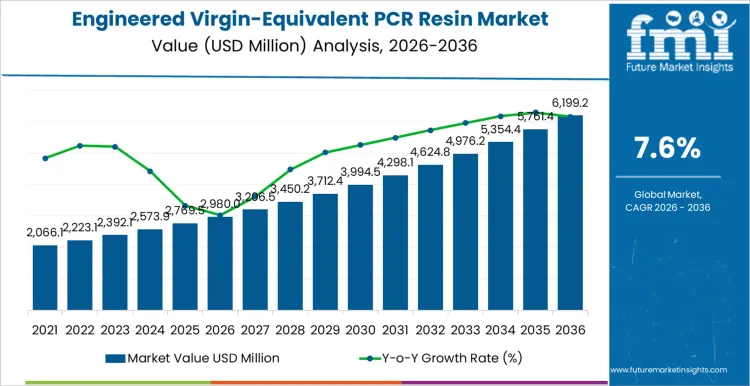
The engineered virgin-equivalent PCR resin market is forecasted to be valued at USD 2,980.0 million in 2026, and reach USD 6,199.2 million by 2036, at a 7.6% CAGR. Growth reflects rising substitution of virgin polymers with post-consumer recycled resins engineered to deliver comparable mechanical strength, thermal stability, and surface quality across regulated and performance-critical applications. Momentum is shaped by converging pressures from recycled content mandates, OEM sustainability targets, and advances in compounding, compatibilization, and feedstock purification. Automotive interiors, consumer electronics housings, and rigid packaging increasingly specify engineered PCR grades where dimensional stability, impact resistance, and processing consistency are non-negotiable. Adoption is further supported by improved feedstock sorting, odor control, and melt flow consistency, enabling converters to deploy PCR resins without disrupting cycle times, aesthetics, or long-term durability expectations.
Quick Stats for Engineered Virgin-Equivalent PCR Resin Market
- Engineered Virgin-Equivalent PCR Resin Market Value (2026): USD 2,980.0 million
- Engineered Virgin-Equivalent PCR Resin Market Forecast Value (2036): USD 6,199.2 million
- Engineered Virgin-Equivalent PCR Resin Market Forecast CAGR 2026 to 2036: 7.6%
- Leading Resin Type by Demand Share: Polyethylene
- Fastest-Growing Countries: India, China, Brazil, USA, Germany
- Top Players in Global Demand: SABIC, Dow Inc., Braskem, ExxonMobil, Lyondell Basell
Engineered Virgin-Equivalent PCR Resin Market Key Takeaways
| Metric | Value |
|---|---|
| Market Value (2026) | USD 2,980.0 million |
| Market Forecast Value (2036) | USD 6,199.2 million |
| Forecast CAGR 2026 to 2036 | 7.6% |
Why is the Demand for Engineered Virgin Equivalent PCR Resin Market Growing?
Manufacturers in sectors such as automotive, consumer electronics, and durable goods are increasingly specifying engineered virgin equivalent PCR resin because these materials deliver performance close to virgin polymers while meeting sustainability commitments. Components like under the hood brackets, housing for electrical modules, and structural clips require tensile strength, impact resistance, and heat deflection that engineered PCR grades can now achieve through advanced compounding and compatibilizer technologies. OEMs under pressure to increase recycled content to meet corporate environmental, social, and governance targets are shifting procurement toward engineered PCR to satisfy both performance and sustainability criteria. Larger converters in packaging and consumer products use engineered virgin equivalent PCR in high clarity rigid containers, closures, and caps where material consistency is essential to maintain barrier properties and drop performance.
Engineered virgin equivalent PCR resin demand is also driven by regional regulatory mandates requiring minimum recycled content in plastics placed on market. Polymer recyclers scale post consumer feedstock processing to supply consistent, contaminant controlled PCR suitable for engineering applications, reducing reliance on landfill or incineration. Processing teams in molding operations adjust parameters to maximize mechanical properties without compromising cycle time or part dimensional stability. Material scientists conduct application specific validation to ensure engineered PCR meets stringent automotive and industrial standards that govern fatigue, creep, and thermal aging performance.
How Is the Engineered Virgin-Equivalent PCR Resin Industry Segmented by Resin Type, Performance Level, and Application?
Demand for engineered virgin-equivalent PCR resins is shaped by regulatory recycled content targets, brand sustainability commitments, and performance parity requirements. Manufacturers seek recycled materials that meet mechanical, aesthetic, and processing benchmarks comparable to virgin polymers. Advances in sorting, compounding, and additive packages support tighter specification control. Segmentation by resin type, performance level, and application explains how material choice and end-use requirements influence adoption across packaging, automotive, consumer goods, and construction categories.
Which Resin Type Holds the Largest Share in Engineered Virgin-Equivalent PCR Resins?
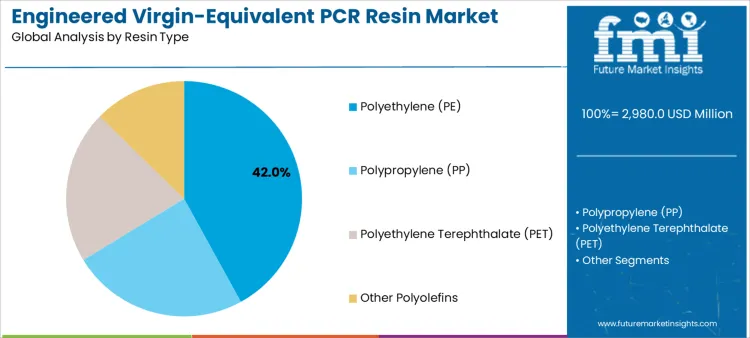
Polyethylene holds 42.0%, reflecting broad use across rigid and flexible packaging and compatibility with established recycling streams. Polypropylene accounts for 35.0%, supported by demand for stiffness, chemical resistance, and lightweighting in molded components. Polyethylene terephthalate represents 12.0%, applied where clarity and barrier properties are required. Other polyolefins hold 8.0%, addressing niche performance needs and blended formulations. Resin-type segmentation reflects alignment between polymer properties, recyclability, and end-use processing requirements.
Key Points
- Polyethylene benefits from mature recycling infrastructure.
- Polypropylene supports structural and lightweight applications.
- PET serves clarity-driven packaging requirements.
How Does Performance Level Influence Adoption of Engineered PCR Resins?
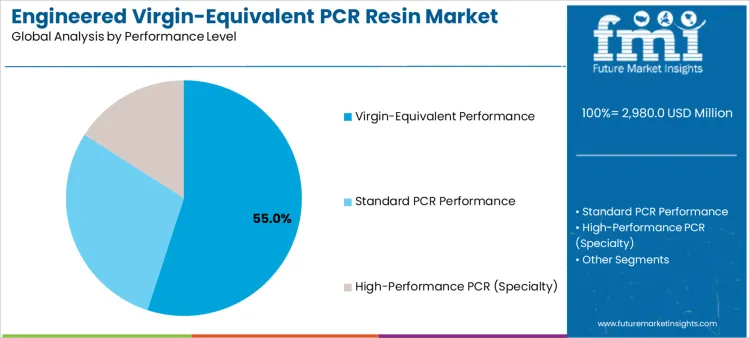
Virgin-equivalent performance represents 55.0%, driven by applications requiring minimal compromise in strength, appearance, and processability. Standard PCR performance accounts for 30.0%, used where cost optimization and sustainability targets outweigh premium specifications. High-performance PCR represents 15.0%, applied in specialty uses demanding enhanced impact resistance, heat stability, or tight tolerances. Performance-level segmentation reflects differing acceptance thresholds across industries balancing sustainability objectives with functional risk management.
Key Points
- Virgin-equivalent grades enable drop-in substitution.
- Standard PCR supports cost-sensitive applications.
- Specialty PCR addresses demanding performance envelopes.
Which Applications Drive Demand for Engineered Virgin-Equivalent PCR Resins?
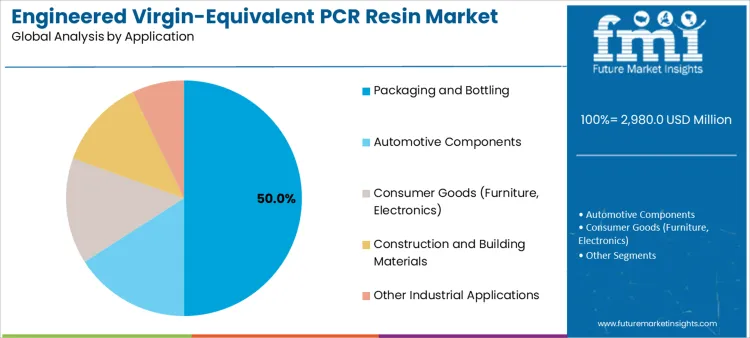
Packaging and bottling account for 50.0%, reflecting regulatory mandates and brand commitments for recycled content without performance loss. Automotive components represent 24.0%, using engineered PCR for interior and non-critical structural parts. Consumer goods hold 16.0%, supporting durability and surface quality in furniture and electronics housings. Construction and building materials account for 6.0%, prioritizing longevity and consistency. Other industrial applications represent 4.0%, covering specialized molded parts. Application segmentation highlights concentration of demand where scale, compliance, and performance parity converge.
Key Points
- Packaging leads due to recycled content requirements.
- Automotive adoption focuses on controlled component scopes.
- Consumer goods emphasize durability and aesthetics.
What are the Key Dynamics in the engineered virgin equivalent PCR resin market?
Demand within the engineered virgin equivalent post consumer recycled (PCR) resin market is driven by specific performance targets and sustainability mandates within durable and semi durable goods sectors. Engineered PCR resins must replicate mechanical, thermal, and aesthetic properties of virgin polymers while supporting circular economy commitments. Adoption is particularly strong in automotive interior components, consumer electronics housings, and appliance casings where material performance under load, dimensional stability, and surface quality are critical. Buyers prioritize grades with consistent melt flow, impact resistance, and long term aging behavior that align with established engineering specifications.
How do automotive and electronics performance requirements shape material selection?
In automotive applications, engineered virgin equivalent PCR resins are selected to meet high requirements for dimensional stability, heat resistance, and impact performance in components such as instrument panels, door trims, and under hood brackets. OEMs specify PCR grades that maintain stiffness and elongation characteristics comparable to virgin counterparts to ensure safety and fitment during service life. Electronics manufacturers demand PCR resins that deliver smooth surface finish, consistent color balance, and resistance to thermal cycling in devices such as laptops, monitors, and smart appliances. Performance in flame retardancy and electrical insulation within defined testing standards is central when PCR materials substitute virgin polymers. Resin suppliers work to tailor formulations that balance recycled content levels with engineered performance targets to satisfy both sustainability goals and engineering criteria.
What do processing behavior and supply consistency imply for market growth?
Engineered virgin equivalent PCR resin market growth is influenced by processing challenges and the need for reliable feedstock quality. PCR resins must exhibit stable melt flow behavior during injection molding, extrusion, or thermoforming to meet tight tolerances without increasing scrap rates. Variability in PCR feedstock, if not controlled, can cause fluctuation in mechanical properties, surface defects, or odor, which limits adoption in precision applications. Consistent supply of high quality PCR pellets with controlled contaminant levels shapes procurement strategies for tier suppliers and OEMs. Price competitiveness relative to virgin resin depends on scale of recycling operations, sorting technology, and post processing refinement that minimize degradation. Regulatory emphasis on recycled content targets in certain regions further drives engineered PCR adoption while exposing supply chain gaps in homogeneous, high performance PCR streams.
How Is Demand for the Engineered Virgin Equivalent PCR Resin Market Evolving Globally?
Global demand for engineered virgin equivalent PCR (Post-Consumer Recycled) resins is rising as manufacturers increasingly prioritize sustainability in packaging and product design. Growth reflects the shift towards circular economy models, driven by consumer and regulatory demands for reduced plastic waste. The market is expanding across automotive, consumer goods, and packaging industries where cost-effective, high-performance resins are needed for functional and durable applications. India records 8.1% CAGR, China records 7.8% CAGR, Brazil records 7.4% CAGR, USA records 6.3% CAGR, and Germany records 6.0% CAGR. Adoption is driven by regulatory requirements, brand sustainability goals, and rising demand for eco-friendly packaging solutions.
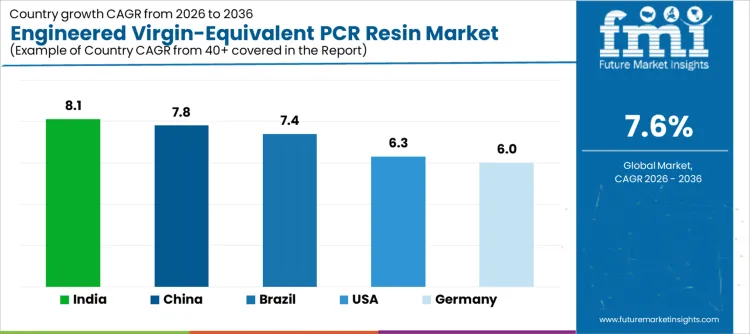
| Country | CAGR (%) |
|---|---|
| India | 8.1% |
| China | 7.8% |
| Brazil | 7.4% |
| USA | 6.3% |
| Germany | 6.0% |
What is driving growth of engineered virgin equivalent PCR resin demand in India?
Demand for engineered virgin equivalent PCR resin in India is expanding as industries increasingly adopt recycled content to meet sustainability targets. Growth at 8.1% CAGR reflects rising use in packaging, automotive, and consumer goods sectors seeking to reduce virgin plastic usage. Regulatory mandates on plastic waste reduction, coupled with increasing consumer demand for eco-friendly products, accelerate the adoption of PCR resins. Manufacturers focus on maintaining resin quality, strength, and cost-effectiveness while meeting performance standards. Local production capabilities of PCR resins improve, making them more accessible for both large and small manufacturers. Demand remains concentrated within packaging and consumer goods.
- Growing regulatory requirements for recycled content
- Increasing consumer demand for sustainable products
- Development of local PCR resin production facilities
- Focus on maintaining resin performance at competitive costs
Why is China seeing expansion in engineered virgin equivalent PCR resin adoption?
Engineered virgin equivalent PCR resin demand in China is rising as the country ramps up recycling initiatives and circular economy practices. Growth at 7.8% CAGR reflects strong adoption across packaging, automotive, and electronics sectors, driven by the need to meet stringent environmental policies and reduce plastic waste. Local regulations pushing for higher use of recycled content in packaging and consumer products encourage the integration of PCR resins in production. Major brands in China prioritize PCR-based solutions to align with sustainability goals while maintaining material performance and cost-efficiency. Demand is also fueled by growing consumer awareness of environmental impact.
- Strict government regulations on plastic waste management
- Industry push for increased use of recycled content
- Consumer awareness of sustainability and eco-friendly products
- Increased local manufacturing of PCR resins
What factors are shaping engineered virgin equivalent PCR resin sales in Brazil?
Sales of engineered virgin equivalent PCR resins in Brazil are increasing as the packaging industry transitions towards more sustainable solutions. Growth at 7.4% CAGR reflects the need for eco-friendly materials across packaging, automotive, and consumer goods. With increasing plastic waste concerns and a push towards a circular economy, manufacturers in Brazil are adopting PCR resins to comply with emerging regulations and align with international sustainability standards. The demand for recycled materials is further supported by consumer preferences for environmentally responsible products. Producers of PCR resins in Brazil are scaling up production to meet the growing demand for high-performance, cost-effective recycled plastics.
- Regulatory pressure for sustainable packaging solutions
- Consumer demand for eco-conscious products
- Circular economy initiatives and sustainability goals
- Local production of PCR resins for cost-effectiveness
How is the USA supporting growth of engineered virgin equivalent PCR resin demand?
Engineered virgin equivalent PCR resin market demand in the USA is advancing as regulatory frameworks and brand commitments to sustainability drive adoption across various sectors. Growth at 6.3% CAGR reflects strong use in packaging, automotive, and consumer goods, where companies seek to reduce their carbon footprint by integrating more recycled content into their products. Increased focus on the circular economy and sustainability practices pushes industries to incorporate PCR resins without sacrificing performance and quality. Demand is fueled by governmental mandates, environmental initiatives, and the growing eco-conscious consumer base that values brands prioritizing recyclable and recycled materials.
- Strong regulatory support for sustainable practices
- Corporate sustainability initiatives driving adoption
- Consumer preference for products with recycled content
- Investment in PCR resin manufacturing capacity
What is driving expansion of engineered virgin equivalent PCR resin demand in Germany?
Demand for engineered virgin equivalent PCR resins in Germany is rising as the country leads the EU’s sustainability and waste reduction initiatives. Growth at 6.0% CAGR reflects Germany's commitment to a circular economy and high recycling rates in the packaging and automotive sectors. With rigorous government regulations pushing for increased use of recycled materials, manufacturers in Germany are adopting PCR resins to meet both legal requirements and sustainability objectives. Brands are prioritizing eco-friendly packaging solutions, and local PCR resin production is increasing to meet the demand for cost-effective, high-quality recycled plastics.
- EU regulations on plastic waste and recycling
- Strong focus on circular economy models
- High demand for eco-friendly packaging solutions
- Localized production of PCR resins to meet market demand
What is the competitive landscape of demand for the engineered virgin-equivalent PCR resin market globally?
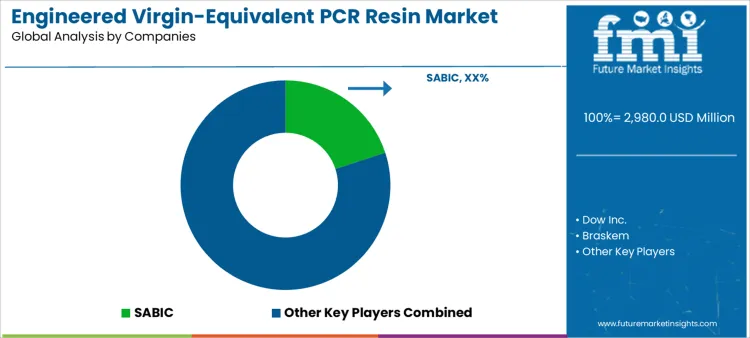
The engineered virgin-equivalent PCR resin market is highly competitive, with SABIC leading the charge through its innovative polymer solutions designed for high-performance applications while maintaining sustainability goals. The company’s strength lies in its ability to offer PCR resins that deliver virgin-like quality, which is essential for manufacturers seeking a balance between recyclability and performance in various end-use products. Dow Inc. closely follows with a strong portfolio that emphasizes high-quality post-consumer recycled resins, offering manufacturers an alternative to virgin plastic without compromising on the desired physical properties of the material.
Braskem stands out by positioning itself as a leader in bio-based and recycled polyethylene, bringing both sustainability and performance to the forefront. The company's ability to offer engineered PCR resins for high-demand applications like packaging and automotive parts provides it with a competitive advantage. ExxonMobil’s extensive global reach and strong market presence make it a significant player in this space, supplying resins that meet rigorous performance and environmental standards. LyondellBasell complements this competitive landscape with advanced recycling technologies that convert post-consumer plastic into high-quality resins with consistent performance metrics, addressing both consumer demand and environmental concerns.
Key Players in the Engineered Virgin-Equivalent PCR Resin Market
- SABIC
- Dow Inc.
- Braskem
- ExxonMobil
- LyondellBasell
- Others
Scope of the Report
| Items | Values |
|---|---|
| Quantitative Units | USD million |
| Resin Type | Polyethylene (PE); Polypropylene (PP); Polyethylene Terephthalate (PET); Other Polyolefins |
| Performance Level | Virgin-Equivalent Performance; Standard PCR Performance; High-Performance PCR (Specialty) |
| Application | Packaging and Bottling; Automotive Components; Consumer Goods (Furniture, Electronics); Construction and Building Materials; Other Industrial Applications |
| Regions Covered | Asia Pacific, Europe, North America, Latin America, Middle East & Africa |
| Countries Covered | India, China, Brazil, USA, Germany, and 40+ countries |
| Key Companies Profiled | SABIC; Dow Inc.; Braskem; ExxonMobil; LyondellBasell; Others |
| Additional Attributes | Dollar sales by resin type, performance level, and application; efficiency in delivering virgin-equivalent performance across recycled polyethylene, polypropylene, and PET in packaging, automotive, and construction sectors; quality control in specialty PCR grades for high-performance applications; role in circular economy and sustainable materials sourcing; procurement dynamics influenced by shifting regulations, cost-benefit analysis, and long-term supplier collaborations. |
Engineered Virgin-Equivalent PCR Resin Market by Segment
Resin Type:
- Polyethylene (PE)
- Polypropylene (PP)
- Polyethylene Terephthalate (PET)
- Other Polyolefins
Performance Level:
- Virgin-Equivalent Performance
- Standard PCR Performance
- High-Performance PCR (Specialty)
Application:
- Packaging and Bottling
- Automotive Components
- Consumer Goods (Furniture, Electronics)
- Construction and Building Materials
- Other Industrial Applications
Region:
- Asia Pacific
- China
- Japan
- South Korea
- India
- Australia & New Zealand
- ASEAN
- Rest of Asia Pacific
- Europe
- Germany
- United Kingdom
- France
- Italy
- Spain
- Nordic
- BENELUX
- Rest of Europe
- North America
- United States
- Canada
- Mexico
- Latin America
- Brazil
- Chile
- Rest of Latin America
- Middle East & Africa
- Kingdom of Saudi Arabia
- Other GCC Countries
- Turkey
- South Africa
- Other African Union
- Rest of Middle East & Africa
Bibliography
- European Commission. (2023). Proposal for a regulation on packaging and packaging waste (PPWR): Recycled content requirements and material performance considerations. Publications Office of the European Union.
- International Organization for Standardization. (2023). Plastics - Environmental aspects - Recycling, material circularity, and quality requirements for post-consumer recycled polymers (ISO/TR 21960:2023). ISO.
- McClements, D. J., & Grossmann, L. (2023). Designing sustainable polymer materials for circular economy applications: Performance equivalence and material engineering challenges. Annual Review of Chemical and Biomolecular Engineering, 14, 321-345.
- PlasticsEurope. (2024). Plastics circularity and recycled polymer quality for high-performance applications. PlasticsEurope Association.
- Ragaert, K., Delva, L., & Van Geem, K. (2023). Mechanical and chemical recycling of solid plastic waste: Performance limitations and design routes toward virgin-equivalent materials. Waste Management, 160, 1-15.
- USA. Environmental Protection Agency. (2023). Advancing sustainable materials management: Facts and figures on plastics recycling and PCR quality. EPA Office of Resource Conservation and Recovery.
Frequently Asked Questions
How big is the engineered virgin-equivalent pcr resin market in 2026?
The global engineered virgin-equivalent pcr resin market is estimated to be valued at USD 2,980.0 million in 2026.
What will be the size of engineered virgin-equivalent pcr resin market in 2036?
The market size for the engineered virgin-equivalent pcr resin market is projected to reach USD 6,199.2 million by 2036.
How much will be the engineered virgin-equivalent pcr resin market growth between 2026 and 2036?
The engineered virgin-equivalent pcr resin market is expected to grow at a 7.6% CAGR between 2026 and 2036.
What are the key product types in the engineered virgin-equivalent pcr resin market?
The key product types in engineered virgin-equivalent pcr resin market are polyethylene (pe), polypropylene (pp), polyethylene terephthalate (pet) and other polyolefins.
Which performance level segment to contribute significant share in the engineered virgin-equivalent pcr resin market in 2026?
In terms of performance level, virgin-equivalent performance segment to command 55.0% share in the engineered virgin-equivalent pcr resin market in 2026.
Preview the report firsthand - request a free sample
Get SampleGet the brochure for pricing and purchase details.
Get PDFTable of Content
- Executive Summary
- Global Market Outlook
- Demand-side Trends
- Supply-side Trends
- Technology Roadmap Analysis
- Analysis and Recommendations
- Market Overview
- Market Coverage / Taxonomy
- Market Definition / Scope / Limitations
- Market Background
- Market Dynamics
- Drivers
- Restraints
- Opportunity
- Trends
- Scenario Forecast
- Demand in Optimistic Scenario
- Demand in Likely Scenario
- Demand in Conservative Scenario
- Opportunity Map Analysis
- Product Life Cycle Analysis
- Supply Chain Analysis
- Investment Feasibility Matrix
- Value Chain Analysis
- PESTLE and Porter’s Analysis
- Regulatory Landscape
- Regional Parent Market Outlook
- Production and Consumption Statistics
- Import and Export Statistics
- Market Dynamics
- Global Market Analysis 2021 to 2025 and Forecast, 2026 to 2036
- Historical Market Size Value (USD Million) Analysis, 2021 to 2025
- Current and Future Market Size Value (USD Million) Projections, 2026 to 2036
- Y-o-Y Growth Trend Analysis
- Absolute $ Opportunity Analysis
- Global Market Pricing Analysis 2021 to 2025 and Forecast 2026 to 2036
- Global Market Analysis 2021 to 2025 and Forecast 2026 to 2036, By Resin Type
- Introduction / Key Findings
- Historical Market Size Value (USD Million) Analysis By Resin Type, 2021 to 2025
- Current and Future Market Size Value (USD Million) Analysis and Forecast By Resin Type, 2026 to 2036
- Polyethylene (PE)
- Polypropylene (PP)
- Polyethylene Terephthalate (PET)
- Other Polyolefins
- Polyethylene (PE)
- Y-o-Y Growth Trend Analysis By Resin Type, 2021 to 2025
- Absolute $ Opportunity Analysis By Resin Type, 2026 to 2036
- Global Market Analysis 2021 to 2025 and Forecast 2026 to 2036, By Performance Level
- Introduction / Key Findings
- Historical Market Size Value (USD Million) Analysis By Performance Level, 2021 to 2025
- Current and Future Market Size Value (USD Million) Analysis and Forecast By Performance Level, 2026 to 2036
- Virgin-Equivalent Performance
- Standard PCR Performance
- High-Performance PCR (Specialty)
- Virgin-Equivalent Performance
- Y-o-Y Growth Trend Analysis By Performance Level, 2021 to 2025
- Absolute $ Opportunity Analysis By Performance Level, 2026 to 2036
- Global Market Analysis 2021 to 2025 and Forecast 2026 to 2036, By Application
- Introduction / Key Findings
- Historical Market Size Value (USD Million) Analysis By Application, 2021 to 2025
- Current and Future Market Size Value (USD Million) Analysis and Forecast By Application, 2026 to 2036
- Packaging and Bottling
- Automotive Components
- Consumer Goods (Furniture, Electronics)
- Construction and Building Materials
- Other Industrial Applications
- Packaging and Bottling
- Y-o-Y Growth Trend Analysis By Application, 2021 to 2025
- Absolute $ Opportunity Analysis By Application, 2026 to 2036
- Global Market Analysis 2021 to 2025 and Forecast 2026 to 2036, By Region
- Introduction
- Historical Market Size Value (USD Million) Analysis By Region, 2021 to 2025
- Current Market Size Value (USD Million) Analysis and Forecast By Region, 2026 to 2036
- North America
- Latin America
- Western Europe
- Eastern Europe
- East Asia
- South Asia and Pacific
- Middle East & Africa
- Market Attractiveness Analysis By Region
- North America Market Analysis 2021 to 2025 and Forecast 2026 to 2036, By Country
- Historical Market Size Value (USD Million) Trend Analysis By Market Taxonomy, 2021 to 2025
- Market Size Value (USD Million) Forecast By Market Taxonomy, 2026 to 2036
- By Country
- USA
- Canada
- Mexico
- By Resin Type
- By Performance Level
- By Application
- By Country
- Market Attractiveness Analysis
- By Country
- By Resin Type
- By Performance Level
- By Application
- Key Takeaways
- Latin America Market Analysis 2021 to 2025 and Forecast 2026 to 2036, By Country
- Historical Market Size Value (USD Million) Trend Analysis By Market Taxonomy, 2021 to 2025
- Market Size Value (USD Million) Forecast By Market Taxonomy, 2026 to 2036
- By Country
- Brazil
- Chile
- Rest of Latin America
- By Resin Type
- By Performance Level
- By Application
- By Country
- Market Attractiveness Analysis
- By Country
- By Resin Type
- By Performance Level
- By Application
- Key Takeaways
- Western Europe Market Analysis 2021 to 2025 and Forecast 2026 to 2036, By Country
- Historical Market Size Value (USD Million) Trend Analysis By Market Taxonomy, 2021 to 2025
- Market Size Value (USD Million) Forecast By Market Taxonomy, 2026 to 2036
- By Country
- Germany
- UK
- Italy
- Spain
- France
- Nordic
- BENELUX
- Rest of Western Europe
- By Resin Type
- By Performance Level
- By Application
- By Country
- Market Attractiveness Analysis
- By Country
- By Resin Type
- By Performance Level
- By Application
- Key Takeaways
- Eastern Europe Market Analysis 2021 to 2025 and Forecast 2026 to 2036, By Country
- Historical Market Size Value (USD Million) Trend Analysis By Market Taxonomy, 2021 to 2025
- Market Size Value (USD Million) Forecast By Market Taxonomy, 2026 to 2036
- By Country
- Russia
- Poland
- Hungary
- Balkan & Baltic
- Rest of Eastern Europe
- By Resin Type
- By Performance Level
- By Application
- By Country
- Market Attractiveness Analysis
- By Country
- By Resin Type
- By Performance Level
- By Application
- Key Takeaways
- East Asia Market Analysis 2021 to 2025 and Forecast 2026 to 2036, By Country
- Historical Market Size Value (USD Million) Trend Analysis By Market Taxonomy, 2021 to 2025
- Market Size Value (USD Million) Forecast By Market Taxonomy, 2026 to 2036
- By Country
- China
- Japan
- South Korea
- By Resin Type
- By Performance Level
- By Application
- By Country
- Market Attractiveness Analysis
- By Country
- By Resin Type
- By Performance Level
- By Application
- Key Takeaways
- South Asia and Pacific Market Analysis 2021 to 2025 and Forecast 2026 to 2036, By Country
- Historical Market Size Value (USD Million) Trend Analysis By Market Taxonomy, 2021 to 2025
- Market Size Value (USD Million) Forecast By Market Taxonomy, 2026 to 2036
- By Country
- India
- ASEAN
- Australia & New Zealand
- Rest of South Asia and Pacific
- By Resin Type
- By Performance Level
- By Application
- By Country
- Market Attractiveness Analysis
- By Country
- By Resin Type
- By Performance Level
- By Application
- Key Takeaways
- Middle East & Africa Market Analysis 2021 to 2025 and Forecast 2026 to 2036, By Country
- Historical Market Size Value (USD Million) Trend Analysis By Market Taxonomy, 2021 to 2025
- Market Size Value (USD Million) Forecast By Market Taxonomy, 2026 to 2036
- By Country
- Kingdom of Saudi Arabia
- Other GCC Countries
- Turkiye
- South Africa
- Other African Union
- Rest of Middle East & Africa
- By Resin Type
- By Performance Level
- By Application
- By Country
- Market Attractiveness Analysis
- By Country
- By Resin Type
- By Performance Level
- By Application
- Key Takeaways
- Key Countries Market Analysis
- USA
- Pricing Analysis
- Market Share Analysis, 2025
- By Resin Type
- By Performance Level
- By Application
- Canada
- Pricing Analysis
- Market Share Analysis, 2025
- By Resin Type
- By Performance Level
- By Application
- Mexico
- Pricing Analysis
- Market Share Analysis, 2025
- By Resin Type
- By Performance Level
- By Application
- Brazil
- Pricing Analysis
- Market Share Analysis, 2025
- By Resin Type
- By Performance Level
- By Application
- Chile
- Pricing Analysis
- Market Share Analysis, 2025
- By Resin Type
- By Performance Level
- By Application
- Germany
- Pricing Analysis
- Market Share Analysis, 2025
- By Resin Type
- By Performance Level
- By Application
- UK
- Pricing Analysis
- Market Share Analysis, 2025
- By Resin Type
- By Performance Level
- By Application
- Italy
- Pricing Analysis
- Market Share Analysis, 2025
- By Resin Type
- By Performance Level
- By Application
- Spain
- Pricing Analysis
- Market Share Analysis, 2025
- By Resin Type
- By Performance Level
- By Application
- France
- Pricing Analysis
- Market Share Analysis, 2025
- By Resin Type
- By Performance Level
- By Application
- India
- Pricing Analysis
- Market Share Analysis, 2025
- By Resin Type
- By Performance Level
- By Application
- ASEAN
- Pricing Analysis
- Market Share Analysis, 2025
- By Resin Type
- By Performance Level
- By Application
- Australia & New Zealand
- Pricing Analysis
- Market Share Analysis, 2025
- By Resin Type
- By Performance Level
- By Application
- China
- Pricing Analysis
- Market Share Analysis, 2025
- By Resin Type
- By Performance Level
- By Application
- Japan
- Pricing Analysis
- Market Share Analysis, 2025
- By Resin Type
- By Performance Level
- By Application
- South Korea
- Pricing Analysis
- Market Share Analysis, 2025
- By Resin Type
- By Performance Level
- By Application
- Russia
- Pricing Analysis
- Market Share Analysis, 2025
- By Resin Type
- By Performance Level
- By Application
- Poland
- Pricing Analysis
- Market Share Analysis, 2025
- By Resin Type
- By Performance Level
- By Application
- Hungary
- Pricing Analysis
- Market Share Analysis, 2025
- By Resin Type
- By Performance Level
- By Application
- Kingdom of Saudi Arabia
- Pricing Analysis
- Market Share Analysis, 2025
- By Resin Type
- By Performance Level
- By Application
- Turkiye
- Pricing Analysis
- Market Share Analysis, 2025
- By Resin Type
- By Performance Level
- By Application
- South Africa
- Pricing Analysis
- Market Share Analysis, 2025
- By Resin Type
- By Performance Level
- By Application
- USA
- Market Structure Analysis
- Competition Dashboard
- Competition Benchmarking
- Market Share Analysis of Top Players
- By Regional
- By Resin Type
- By Performance Level
- By Application
- Competition Analysis
- Competition Deep Dive
- SABIC
- Overview
- Product Portfolio
- Profitability by Market Segments (Product/Age /Sales Channel/Region)
- Sales Footprint
- Strategy Overview
- Marketing Strategy
- Product Strategy
- Channel Strategy
- Dow Inc.
- Braskem
- ExxonMobil
- LyondellBasell
- Others
- SABIC
- Competition Deep Dive
- Assumptions & Acronyms Used
- Research Methodology


