

- Industry Size (2026)
- USD 920.0 Mn
- Forecast (2036)
- USD 3380.0 Mn
- CAGR (2026 to 2036)
- 13.90%
Predictive Analytics Solutions for PCR Resin Quality Market Forecast and Outlook 2026 to 2036
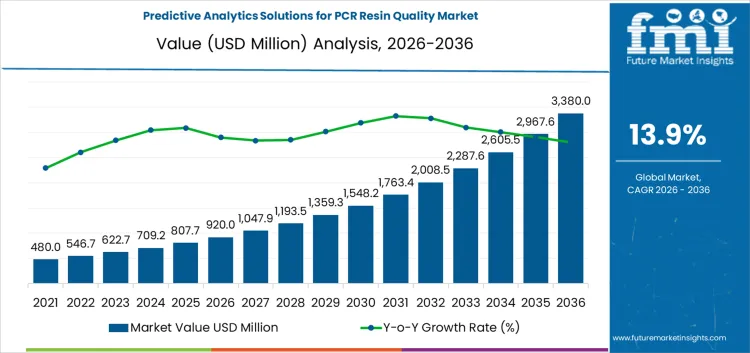
The predictive analytics solutions for PCR resin quality market is forecasted to be USD 920.0 million in 2026, is set to reach USD 3,380.0 million by 2036, and is expected to expand at a 13.9% CAGR. Expansion is being driven by capital being allocated toward platforms that can reduce resin-grade uncertainty without slowing plant throughput. ROI timelines are being judged against avoided costs off-spec pellets, customer chargebacks, rework, and line downtime so deployments are being prioritized where prediction can be tied to immediate operating decisions such as blending recipes, extrusion settings, and shipment release.
Capital intensity is being shaped by integration scope: lightweight layers that sit on historians and lab systems are being funded quickly, while full inline prediction with sensors, edge compute, and closed-loop control is being financed only when payback can be shown within standard upgrade cycles. Investment selectivity is being reinforced by data readiness, because model performance is being limited by inconsistent sampling, fragmented traceability, and weak feedback loops from converters.
Quick Stats for Predictive Analytics Solutions for PCR Resin Quality Market
- Predictive Analytics Solutions for PCR Resin Quality Market Value (2026): USD 920.0 Million
- Predictive Analytics Solutions for PCR Resin Quality Market Forecast Value (2036): USD 3,380.0 Million
- Predictive Analytics Solutions for PCR Resin Quality Market Forecast CAGR 2026 to 2036: 13.90%
- Leading Analytics Type in Predictive Analytics Solutions for PCR Resin Quality Market: AI-Based Quality Analytics
- Key Growth Regions in Predictive Analytics Solutions for PCR Resin Quality Market: Asia Pacific, Latin America, Middle East & Africa
- Top Key Players in Predictive Analytics Solutions for PCR Resin Quality Market: Aspen Technology, Inc., Seeq Corporation, Siemens AG, AVEVA Group plc, Huawei Cloud, SUPCON Technology Co., Ltd., Yokogawa Electric Corporation
Predictive Analytics Solutions for PCR Resin Quality Market Key Takeaways
| Metric | Value |
|---|---|
| Industry Value (2026) | USD 920.0 Million |
| Forecast Value (2036) | USD 3,380.0 Million |
| Forecast CAGR 2026 to 2036 | 13.90% |
How is the Global Predictive Analytics Solutions for PCR Resin Quality Market Advancing?
The global predictive analytics solutions for PCR resin quality market is advancing rapidly, driven by increasing quality variability in recycled resin supply chains. PCR resins often exhibit fluctuations in melt flow index, contamination levels, color consistency, and mechanical properties, creating challenges for converters and brand owners seeking consistent material performance. Predictive analytics solutions are being adopted to anticipate quality deviations and optimize processing decisions before production issues occur.
A key driver supporting market growth is the rising demand for higher reliability in PCR resin applications. Packaging, consumer goods, and industrial manufacturers are increasingly integrating PCR content into performance-sensitive products, making early detection of quality risks critical. Predictive analytics platforms analyze historical resin data, real-time process inputs, and supplier performance metrics to forecast quality outcomes and reduce batch rejection rates.
Expansion of data-driven recycling operations is further contributing to market adoption. Recyclers and compounders are deploying analytics tools to correlate feedstock composition, processing parameters, and output quality, enabling continuous process optimization and improved yield. These insights support better material blending, process control, and customer-specific grade management.
Technological advancements are strengthening market implementation. Machine learning models, cloud-based analytics platforms, and integration with laboratory testing and production systems are improving prediction accuracy and scalability. As PCR resin usage increases and quality expectations tighten, predictive analytics solutions are expected to become essential tools for managing resin performance across recycled material supply chains over the forecast period.
What Is the Segment-Wise Overview of the Predictive Analytics Solutions for PCR Resin Quality Market?
The predictive analytics solutions for PCR resin quality market is driven by the need to reduce quality variability and improve confidence in recycled resin performance. PCR quality prediction and grading leads the end-use segment with a 45% share, as recyclers and compounders prioritize early identification of material properties such as melt flow, contamination levels, and mechanical performance. By analytics type, AI-based quality analytics dominate with a 47% share, reflecting growing reliance on machine-learning models to analyze multi-variable process and material data. Together, these segments highlight a market focused on proactive quality management, data-driven decision-making, and scaling PCR adoption by improving consistency and predictability of recycled resin outputs.
Why Does PCR Quality Prediction & Grading Lead the Predictive Analytics Solutions for PCR Resin Quality Market?
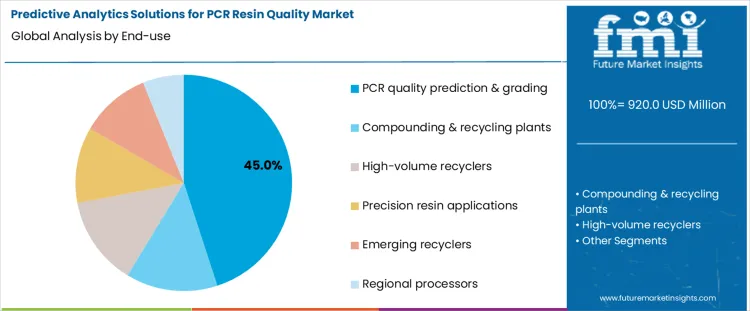
PCR quality prediction and grading account for 45% of market demand because recycled resin streams exhibit high variability in feedstock composition, processing conditions, and end properties. Accurate prediction of resin quality before compounding or conversion is critical to avoid production disruptions, rejected batches, and customer complaints. Predictive analytics tools enable recyclers and processors to assess key quality parameters early in the process, allowing material segregation, blending optimization, or corrective actions. This capability is particularly important for applications with tight performance tolerances, such as packaging and consumer goods. As buyers demand more reliable PCR inputs, quality prediction and grading systems become essential for building trust, reducing risk, and enabling broader PCR usage across industries.
How Do AI-Based Quality Analytics Drive the Predictive Analytics Solutions for PCR Resin Quality Market?
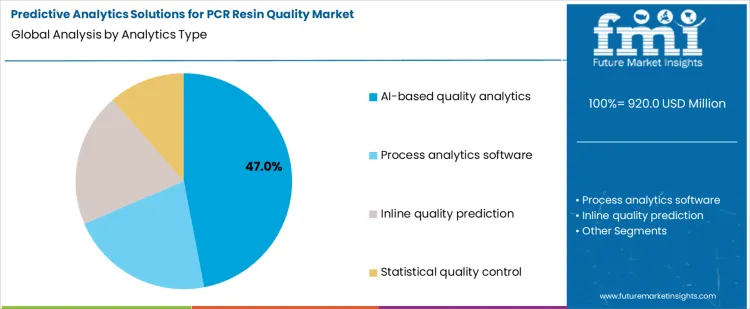
AI-based quality analytics represent 47% of analytics type demand, making them the leading technology in the predictive analytics solutions for PCR resin quality market. These systems use machine-learning algorithms to correlate process data, sensor inputs, and historical quality outcomes to predict resin performance in real time. AI models can handle complex, non-linear relationships that traditional statistical tools struggle to capture, improving prediction accuracy. They also adapt continuously as new data is introduced, enhancing robustness across different feedstocks and operating conditions. As recycling operations scale and quality requirements tighten, AI-based analytics provide the speed, flexibility, and precision needed to manage PCR quality at industrial scale, reinforcing their market leadership.
What Are the Key Dynamics for the Predictive Analytics Solutions for PCR Resin Quality Market?
PCR resins often show fluctuations in melt flow index, contamination levels, color, and mechanical strength, creating processing and performance risks. Predictive analytics solutions use historical production data, sensor inputs, and machine learning models to forecast quality deviations before material is processed or shipped. Key market dynamics include rising PCR usage targets, tighter performance specifications from converters, and increasing rejection costs linked to inconsistent resin quality. As recyclers and manufacturers seek better control over material consistency, predictive analytics is becoming a critical tool for quality stabilization.
Why Is the Predictive Analytics Solutions for PCR Resin Quality Market Growing?
The predictive analytics solutions for PCR resin quality market is growing as PCR resin demand increases across packaging, automotive, and consumer goods applications that require predictable material behavior. Quality-related disruptions such as batch rejection, line stoppages, and product recalls are driving investment in data-driven quality forecasting tools. Growth in advanced recycling facilities and compounding operations is generating large volumes of process data, enabling effective deployment of predictive models. Manufacturers are also under pressure to reduce reliance on extensive downstream testing by identifying risks earlier in the process. As PCR resin supply chains scale and diversify, predictive analytics solutions are increasingly adopted to support consistent production planning, cost control, and customer compliance.
How Are the Key Drivers Shaping the Predictive Analytics Solutions for PCR Resin Quality Market?
Key drivers shaping the predictive analytics solutions for PCR resin quality market include increasing integration of sensors, laboratory data, and process control systems across recycling and compounding lines. Predictive models can correlate feedstock sources, processing conditions, and output quality, enabling proactive adjustments. Brand owners and converters are influencing adoption by requiring tighter quality assurance and documentation from PCR suppliers. Advances in artificial intelligence, cloud analytics, and digital twins are improving prediction accuracy and deployment speed. Integration with manufacturing execution systems allows real-time decision support. These drivers are shifting quality management from reactive testing to proactive risk prevention, positioning predictive analytics as a core capability within PCR resin production operations.
What is the Growth Outlook for the Predictive Analytics Solutions for PCR Resin Quality Market by Country?
| Country | CAGR (%) |
|---|---|
| India | 16.0% |
| Indonesia | 15.8% |
| Brazil | 14.4% |
| Vietnam | 14.0% |
| Philippines | 13.6% |
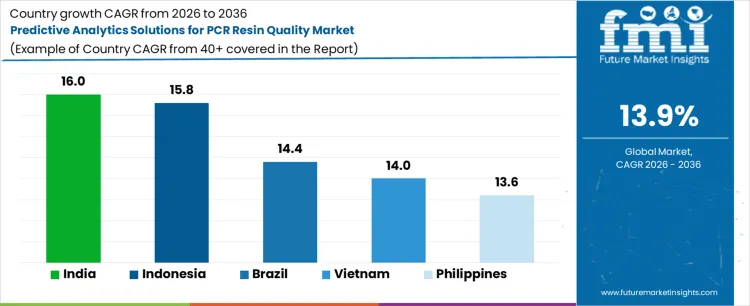
The predictive analytics solutions for PCR resin quality market is expanding as recyclers prioritize consistency, yield optimization, and buyer confidence. India leads with a 16.0% CAGR, driven by rapid PCR adoption and quality assurance needs. Indonesia follows at 15.8%, supported by export-focused recycling operations. Brazil grows at 14.4%, reflecting rising demand for consistent PCR resins. Vietnam records 14.0% growth, driven by its role as a PCR export hub. The Philippines expands at 13.6%, supported by gradual scaling of recycling operations. As PCR applications expand, predictive analytics is becoming a core tool for resin quality management.
Why Is the Predictive Analytics Solutions for PCR Resin Quality Market Expanding Rapidly in India?
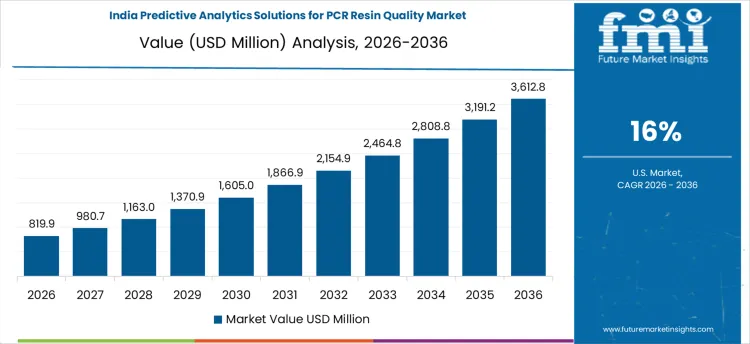
Demand for predictive analytics solutions for PCR resin quality in India is expanding at a CAGR of 16.0%. Packaging converters and recyclers are facing increasing pressure to deliver consistent PCR resin quality across batches. Predictive analytics platforms help identify variability in feedstock composition, contamination risk, and processing outcomes before material conversion. Growing PCR usage in food, personal care, and household packaging is strengthening demand for data-driven quality assurance tools. Integration of analytics with sorting, washing, and extrusion lines is improving yield predictability. Indian recyclers are adopting analytics to reduce rejection rates and improve customer confidence. Expansion of organized recycling facilities and compliance-driven reporting is further supporting adoption. As PCR demand scales faster than manual quality control capabilities, predictive analytics solutions are becoming critical for resin quality management in India.
What Is Driving Predictive Analytics Solutions for PCR Resin Quality Market Growth in Indonesia?
Demand for predictive analytics solutions for PCR resin quality in Indonesia is expanding at a CAGR of 15.8%. High variability in post-consumer plastic collection increases quality risks for PCR resin producers. Predictive analytics tools help recyclers anticipate resin performance based on feedstock origin, sorting efficiency, and processing parameters. Export-oriented PCR producers rely on analytics to meet strict quality specifications from international buyers. Adoption is increasing among recyclers seeking to optimize throughput while minimizing off-spec material. Integration with traceability and plant monitoring systems strengthens decision-making across production stages. Growth of centralized recycling facilities is supporting wider deployment of analytics platforms. As Indonesia strengthens PCR production for global markets, demand for predictive analytics solutions is expected to grow steadily.
Why Is the Predictive Analytics Solutions for PCR Resin Quality Market Gaining Traction in Brazil?
Demand for predictive analytics solutions for PCR resin quality in Brazil is expanding at a CAGR of 14.4%. Recyclers and packaging producers are focusing on improving resin consistency to support broader PCR adoption. Predictive analytics platforms help identify process deviations and forecast resin properties before pelletization. Growth of PCR use in consumer goods and rigid packaging is increasing the need for reliable quality prediction. Multinational brand requirements are driving adoption of advanced quality analytics. Integration with laboratory testing and production data improves quality control efficiency. While adoption is led by larger recyclers, mid-sized operators are gradually adopting analytics to remain competitive. As Brazil’s PCR market matures, demand for predictive analytics solutions is expected to rise consistently.
What Is Supporting Growth of the Predictive Analytics Solutions for PCR Resin Quality Market in Vietnam?
Demand for predictive analytics solutions for PCR resin quality in Vietnam is expanding at a CAGR of 14.0%. Vietnam’s role as a PCR processing and export hub increases the importance of consistent resin quality. Predictive analytics tools enable recyclers to manage feedstock variability and meet buyer-specific performance requirements. Adoption is driven by export-oriented packaging and textile applications that require stable resin properties. Integration with digital traceability and production monitoring systems improves transparency and confidence. Growth of industrial-scale recycling facilities supports deployment of analytics platforms. Manufacturers are prioritizing data-driven quality control to reduce shipment rejections. As Vietnam strengthens its PCR export position, demand for predictive analytics solutions is expected to remain strong.
Why Is the Predictive Analytics Solutions for PCR Resin Quality Market Developing Steadily in the Philippines?
Demand for predictive analytics solutions for PCR resin quality in the Philippines is expanding at a CAGR of 13.6%. Recycling operations are gradually scaling, creating increased focus on quality predictability and process control. Predictive analytics platforms help recyclers anticipate resin quality outcomes and optimize processing parameters. Export-linked packaging applications are increasing the need for data-backed quality assurance. Adoption is supported by growing involvement of multinational recyclers and brand owners. Integration with sorting and extrusion data improves operational decision-making. While market size remains smaller compared to regional peers, adoption momentum is building. As PCR production capabilities expand, demand for predictive analytics solutions for resin quality in the Philippines is expected to grow steadily.
How Are Vendors Competing in the Predictive Analytics Solutions for PCR Resin Quality Market?
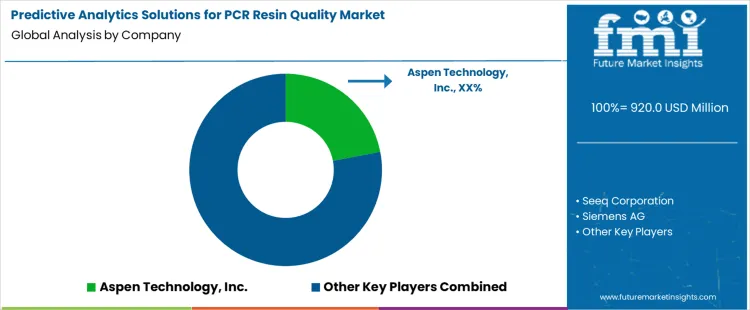
Competition in the predictive analytics solutions for PCR resin quality market is being driven by how reliably process variability, contamination risk, and property drift are predicted before downstream conversion losses occur. Aspen Technology, Inc. positions its solutions around advanced process modeling and real-time optimization, with product brochures emphasizing hybrid models that combine first-principles simulation with machine learning. These tools are being marketed as decision engines embedded into recycling and compounding operations, enabling early correction of melt flow, viscosity, and impurity deviations. Siemens AG and AVEVA Group plc are competing through integrated industrial analytics stacks. Their brochures highlight closed-loop quality monitoring, historian-driven analytics, and tight linkage with plant automation systems, reinforcing value for large-scale recyclers and resin processors.
Seeq Corporation is competing through speed and accessibility. Its product materials focus on rapid time-series analytics, no-code modeling, and collaborative diagnostics for quality engineers. Predictive insights are being framed as operational tools rather than data science projects. Huawei Cloud and SUPCON Technology Co., Ltd. are leveraging cloud-native analytics and industrial AI platforms. Their brochures emphasize scalable model deployment, edge-to-cloud data flow, and suitability for high-throughput recycling facilities, particularly in Asia. Emphasis is placed on anomaly detection and yield stabilization rather than laboratory-grade precision, aligning offerings with volume-driven PCR production environments.
Yokogawa Electric Corporation is competing through measurement fidelity and control reliability. Product brochures highlight advanced sensors, process analyzers, and predictive control systems that anchor analytics in validated plant data. Across the market, predictive analytics solutions are being positioned as quality assurance layers that reduce batch rejection, stabilize PCR resin grades, and improve buyer confidence. Competitive advantage is being defined less by algorithm novelty and more by how seamlessly predictions are embedded into daily operations, audit workflows, and commercial grade certification processes.
Key Players in Predictive Analytics Solutions for PCR Resin Quality Market
- Aspen Technology, Inc.
- Seeq Corporation
- Siemens AG
- AVEVA Group plc
- Huawei Cloud
- SUPCON Technology Co., Ltd.
- Yokogawa Electric Corporation
Scope of Report
| Attributes | Description |
|---|---|
| Quantitative Unit (2026) | USD Million |
| End-use | PCR Quality Prediction & Grading, Compounding & Recycling Plants, High-Volume Recyclers, Precision Resin Applications, Emerging Recyclers, Regional Processors |
| Analytics Type | AI-Based Quality Analytics, Process Analytics Software, Inline Quality Prediction, Statistical Quality Control |
| Regions Covered | Asia Pacific, Europe, North America, Latin America, Middle East & Africa |
| Countries Covered | China, Japan, South Korea, India, Australia & New Zealand, ASEAN, Rest of Asia Pacific, Germany, United Kingdom, France, Italy, Spain, Nordic, BENELUX, Rest of Europe, United States, Canada, Mexico, Brazil, Chile, Rest of Latin America, Kingdom of Saudi Arabia, Other GCC Countries, Turkey, South Africa, Other African Union, Rest of Middle East & Africa |
| Key Companies Profiled | Aspen Technology, Inc., Seeq Corporation, Siemens AG, AVEVA Group plc, Huawei Cloud, SUPCON Technology Co., Ltd., Yokogawa Electric Corporation |
| Additional Attributes | Dollar sales by end-use and analytics type; regional market size and forecast analysis; growth outlook across major regions; adoption trends for predictive analytics in PCR resin quality management; assessment of data accuracy, model reliability, process integration complexity, and demand patterns across recycling, compounding, and high-precision resin production environments. |
Predictive Analytics Solutions for PCR Resin Quality Market by Key Segments
End-use:
- PCR quality prediction & grading
- Compounding & recycling plants
- High-volume recyclers
- Precision resin applications
- Emerging recyclers
- Regional processors
Analytics Type:
- AI-based quality analytics
- Process analytics software
- Inline quality prediction
- Statistical quality control
Region:
- Asia Pacific
- China
- Japan
- South Korea
- India
- Australia & New Zealand
- ASEAN
- Rest of Asia Pacific
- Europe
- Germany
- United Kingdom
- France
- Italy
- Spain
- Nordic
- BENELUX
- Rest of Europe
- North America
- United States
- Canada
- Mexico
- Latin America
- Brazil
- Chile
- Rest of Latin America
- Middle East & Africa
- Kingdom of Saudi Arabia
- Other GCC Countries
- Turkey
- South Africa
- Other African Union
- Rest of Middle East & Africa
Bibliography
- International Organization for Standardization. (2024). ISO 22095: Chain of custody — General terminology and models. ISO.
- Organization for Economic Co-operation and Development. (2024). Plastics recycled content requirements (ENV/WKP(2024)6). OECD Publishing.
- United Nations Environment Programme. (2023). Turning off the tap: How the world can end plastic pollution and create a circular economy. UNEP.
Frequently Asked Questions
How big is the predictive analytics solutions for PCR resin quality market in 2026?
The global predictive analytics solutions for PCR resin quality market is estimated to be valued at USD 920.0 million in 2026.
What will be the size of predictive analytics solutions for PCR resin quality market in 2036?
The market size for the predictive analytics solutions for PCR resin quality market is projected to reach USD 3,380.0 million by 2036.
How much will be the predictive analytics solutions for PCR resin quality market growth between 2026 and 2036?
The predictive analytics solutions for PCR resin quality market is expected to grow at a 13.9% CAGR between 2026 and 2036.
What are the key end-use segments in the predictive analytics solutions for PCR resin quality market?
The key end-use segments in predictive analytics solutions for PCR resin quality market are PCR quality prediction & grading, compounding & recycling plants, high-volume recyclers, precision resin applications, emerging recyclers and regional processors.
Which analytics type segment to contribute significant share in the predictive analytics solutions for PCR resin quality market in 2026?
In terms of analytics type, AI-based quality analytics segment to command 47.0% share in the predictive analytics solutions for PCR resin quality market in 2026.
Preview the report firsthand - request a free sample
Get SampleGet the brochure for pricing and purchase details.
Get PDFTable of Content
- Executive Summary
- Global Market Outlook
- Demand-side Trends
- Supply-side Trends
- Technology Roadmap Analysis
- Analysis and Recommendations
- Market Overview
- Market Coverage / Taxonomy
- Market Definition / Scope / Limitations
- Market Background
- Market Dynamics
- Drivers
- Restraints
- Opportunity
- Trends
- Scenario Forecast
- Demand in Optimistic Scenario
- Demand in Likely Scenario
- Demand in Conservative Scenario
- Opportunity Map Analysis
- Product Life Cycle Analysis
- Supply Chain Analysis
- Investment Feasibility Matrix
- Value Chain Analysis
- PESTLE and Porter’s Analysis
- Regulatory Landscape
- Regional Parent Market Outlook
- Production and Consumption Statistics
- Import and Export Statistics
- Market Dynamics
- Global Market Analysis 2021 to 2025 and Forecast, 2026 to 2036
- Historical Market Size Value (USD Million) Analysis, 2021 to 2025
- Current and Future Market Size Value (USD Million) Projections, 2026 to 2036
- Y-o-Y Growth Trend Analysis
- Absolute $ Opportunity Analysis
- Global Market Pricing Analysis 2021 to 2025 and Forecast 2026 to 2036
- Global Market Analysis 2021 to 2025 and Forecast 2026 to 2036, By End-use
- Introduction / Key Findings
- Historical Market Size Value (USD Million) Analysis By End-use, 2021 to 2025
- Current and Future Market Size Value (USD Million) Analysis and Forecast By End-use, 2026 to 2036
- PCR quality prediction & grading
- Compounding & recycling plants
- High-volume recyclers
- Precision resin applications
- Emerging recyclers
- Regional processors
- PCR quality prediction & grading
- Y-o-Y Growth Trend Analysis By End-use, 2021 to 2025
- Absolute $ Opportunity Analysis By End-use, 2026 to 2036
- Global Market Analysis 2021 to 2025 and Forecast 2026 to 2036, By Analytics Type
- Introduction / Key Findings
- Historical Market Size Value (USD Million) Analysis By Analytics Type, 2021 to 2025
- Current and Future Market Size Value (USD Million) Analysis and Forecast By Analytics Type, 2026 to 2036
- AI-based quality analytics
- Process analytics software
- Inline quality prediction
- Statistical quality control
- AI-based quality analytics
- Y-o-Y Growth Trend Analysis By Analytics Type, 2021 to 2025
- Absolute $ Opportunity Analysis By Analytics Type, 2026 to 2036
- Global Market Analysis 2021 to 2025 and Forecast 2026 to 2036, By Region
- Introduction
- Historical Market Size Value (USD Million) Analysis By Region, 2021 to 2025
- Current Market Size Value (USD Million) Analysis and Forecast By Region, 2026 to 2036
- North America
- Latin America
- Western Europe
- Eastern Europe
- East Asia
- South Asia and Pacific
- Middle East & Africa
- Market Attractiveness Analysis By Region
- North America Market Analysis 2021 to 2025 and Forecast 2026 to 2036, By Country
- Historical Market Size Value (USD Million) Trend Analysis By Market Taxonomy, 2021 to 2025
- Market Size Value (USD Million) Forecast By Market Taxonomy, 2026 to 2036
- By Country
- USA
- Canada
- Mexico
- By End-use
- By Analytics Type
- By Country
- Market Attractiveness Analysis
- By Country
- By End-use
- By Analytics Type
- Key Takeaways
- Latin America Market Analysis 2021 to 2025 and Forecast 2026 to 2036, By Country
- Historical Market Size Value (USD Million) Trend Analysis By Market Taxonomy, 2021 to 2025
- Market Size Value (USD Million) Forecast By Market Taxonomy, 2026 to 2036
- By Country
- Brazil
- Chile
- Rest of Latin America
- By End-use
- By Analytics Type
- By Country
- Market Attractiveness Analysis
- By Country
- By End-use
- By Analytics Type
- Key Takeaways
- Western Europe Market Analysis 2021 to 2025 and Forecast 2026 to 2036, By Country
- Historical Market Size Value (USD Million) Trend Analysis By Market Taxonomy, 2021 to 2025
- Market Size Value (USD Million) Forecast By Market Taxonomy, 2026 to 2036
- By Country
- Germany
- UK
- Italy
- Spain
- France
- Nordic
- BENELUX
- Rest of Western Europe
- By End-use
- By Analytics Type
- By Country
- Market Attractiveness Analysis
- By Country
- By End-use
- By Analytics Type
- Key Takeaways
- Eastern Europe Market Analysis 2021 to 2025 and Forecast 2026 to 2036, By Country
- Historical Market Size Value (USD Million) Trend Analysis By Market Taxonomy, 2021 to 2025
- Market Size Value (USD Million) Forecast By Market Taxonomy, 2026 to 2036
- By Country
- Russia
- Poland
- Hungary
- Balkan & Baltic
- Rest of Eastern Europe
- By End-use
- By Analytics Type
- By Country
- Market Attractiveness Analysis
- By Country
- By End-use
- By Analytics Type
- Key Takeaways
- East Asia Market Analysis 2021 to 2025 and Forecast 2026 to 2036, By Country
- Historical Market Size Value (USD Million) Trend Analysis By Market Taxonomy, 2021 to 2025
- Market Size Value (USD Million) Forecast By Market Taxonomy, 2026 to 2036
- By Country
- China
- Japan
- South Korea
- By End-use
- By Analytics Type
- By Country
- Market Attractiveness Analysis
- By Country
- By End-use
- By Analytics Type
- Key Takeaways
- South Asia and Pacific Market Analysis 2021 to 2025 and Forecast 2026 to 2036, By Country
- Historical Market Size Value (USD Million) Trend Analysis By Market Taxonomy, 2021 to 2025
- Market Size Value (USD Million) Forecast By Market Taxonomy, 2026 to 2036
- By Country
- India
- ASEAN
- Australia & New Zealand
- Rest of South Asia and Pacific
- By End-use
- By Analytics Type
- By Country
- Market Attractiveness Analysis
- By Country
- By End-use
- By Analytics Type
- Key Takeaways
- Middle East & Africa Market Analysis 2021 to 2025 and Forecast 2026 to 2036, By Country
- Historical Market Size Value (USD Million) Trend Analysis By Market Taxonomy, 2021 to 2025
- Market Size Value (USD Million) Forecast By Market Taxonomy, 2026 to 2036
- By Country
- Kingdom of Saudi Arabia
- Other GCC Countries
- Turkiye
- South Africa
- Other African Union
- Rest of Middle East & Africa
- By End-use
- By Analytics Type
- By Country
- Market Attractiveness Analysis
- By Country
- By End-use
- By Analytics Type
- Key Takeaways
- Key Countries Market Analysis
- USA
- Pricing Analysis
- Market Share Analysis, 2025
- By End-use
- By Analytics Type
- Canada
- Pricing Analysis
- Market Share Analysis, 2025
- By End-use
- By Analytics Type
- Mexico
- Pricing Analysis
- Market Share Analysis, 2025
- By End-use
- By Analytics Type
- Brazil
- Pricing Analysis
- Market Share Analysis, 2025
- By End-use
- By Analytics Type
- Chile
- Pricing Analysis
- Market Share Analysis, 2025
- By End-use
- By Analytics Type
- Germany
- Pricing Analysis
- Market Share Analysis, 2025
- By End-use
- By Analytics Type
- UK
- Pricing Analysis
- Market Share Analysis, 2025
- By End-use
- By Analytics Type
- Italy
- Pricing Analysis
- Market Share Analysis, 2025
- By End-use
- By Analytics Type
- Spain
- Pricing Analysis
- Market Share Analysis, 2025
- By End-use
- By Analytics Type
- France
- Pricing Analysis
- Market Share Analysis, 2025
- By End-use
- By Analytics Type
- India
- Pricing Analysis
- Market Share Analysis, 2025
- By End-use
- By Analytics Type
- ASEAN
- Pricing Analysis
- Market Share Analysis, 2025
- By End-use
- By Analytics Type
- Australia & New Zealand
- Pricing Analysis
- Market Share Analysis, 2025
- By End-use
- By Analytics Type
- China
- Pricing Analysis
- Market Share Analysis, 2025
- By End-use
- By Analytics Type
- Japan
- Pricing Analysis
- Market Share Analysis, 2025
- By End-use
- By Analytics Type
- South Korea
- Pricing Analysis
- Market Share Analysis, 2025
- By End-use
- By Analytics Type
- Russia
- Pricing Analysis
- Market Share Analysis, 2025
- By End-use
- By Analytics Type
- Poland
- Pricing Analysis
- Market Share Analysis, 2025
- By End-use
- By Analytics Type
- Hungary
- Pricing Analysis
- Market Share Analysis, 2025
- By End-use
- By Analytics Type
- Kingdom of Saudi Arabia
- Pricing Analysis
- Market Share Analysis, 2025
- By End-use
- By Analytics Type
- Turkiye
- Pricing Analysis
- Market Share Analysis, 2025
- By End-use
- By Analytics Type
- South Africa
- Pricing Analysis
- Market Share Analysis, 2025
- By End-use
- By Analytics Type
- USA
- Market Structure Analysis
- Competition Dashboard
- Competition Benchmarking
- Market Share Analysis of Top Players
- By Regional
- By End-use
- By Analytics Type
- Competition Analysis
- Competition Deep Dive
- Aspen Technology, Inc.
- Overview
- Product Portfolio
- Profitability by Market Segments (Product/Age /Sales Channel/Region)
- Sales Footprint
- Strategy Overview
- Marketing Strategy
- Product Strategy
- Channel Strategy
- Seeq Corporation
- Siemens AG
- AVEVA Group plc
- Huawei Cloud
- SUPCON Technology Co., Ltd.
- Yokogawa Electric Corporation
- Aspen Technology, Inc.
- Competition Deep Dive
- Assumptions & Acronyms Used
- Research Methodology


