

- Industry Size (2026)
- USD 1680.0 Mn
- Forecast (2036)
- USD 5217.8 Mn
- CAGR (2026 to 2036)
- 12.0%
Transparent PCR Resin in Beauty Packaging Market Forecast and Outlook 2026 to 2036
The transparent PCR resin in beauty packaging is projected to reach USD 1,680.0 million in 2026 and is forecasted to expand to USD 5,217.8 million by 2036, at a CAGR of 12.0% during the forecast period. Growth reflects increasing adoption of recycled PET and PETG resins that deliver high optical clarity while supporting sustainability targets across skincare, cosmetics, and haircare packaging. Beauty brands prioritize transparent formats for bottles and jars where product visibility, color neutrality, and surface finish directly influence consumer perception and brand positioning.
Advancements in resin purification, decontamination, and intrinsic viscosity control enable transparent PCR materials to meet strict haze, gloss, and color consistency requirements during blow molding and injection molding. Packaging converters increasingly qualify these materials through spectrophotometric testing and accelerated aging to ensure visual stability over shelf life. Regulatory guidance on recycled content and retailer sustainability scorecards further support procurement, particularly among premium and masstige beauty brands. Expansion is driven by performance equivalence to virgin plastics rather than growth in packaging volumes, positioning transparent PCR resin as a structural material choice for long-term packaging strategies.
Quick Stats for Transparent PCR Resin in Beauty Packaging Market
- Transparent PCR Resin in Beauty Packaging Market Value (2026): USD 1,680.0 million
- Transparent PCR Resin in Beauty Packaging Market Forecast Value (2036): USD 5,217.8 million
- Transparent PCR Resin in Beauty Packaging Market Forecast CAGR (2026-2036): 12.0%
- Leading Packaging Format by Demand Share: Bottles & jars
- Fastest-Growing Countries: India, China, USA, Germany, Japan
- Top Players in Global Demand: ALPLA, Quadpack, Aptar Beauty, HCP Packaging, Zhejiang Sun-Rain
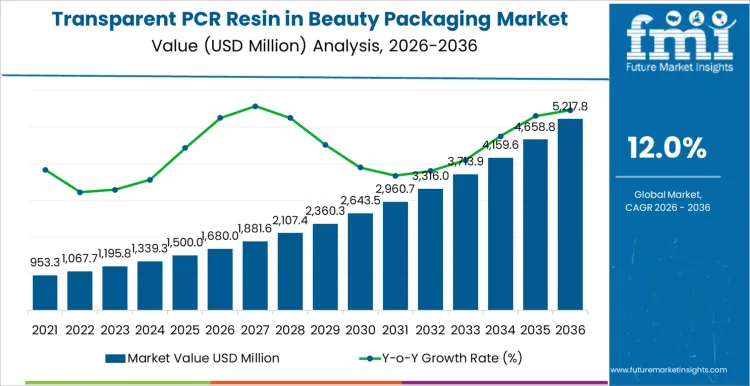
Transparent PCR Resin in Beauty Packaging Market Key Takeaways
| Metric | Value |
|---|---|
| Market Value (2026) | USD 1,680.0 million |
| Market Forecast Value (2036) | USD 5,217.8 million |
| Forecast CAGR (2026-2036) | 12.0% |
Why is the Demand for Transparent PCR Resin in Beauty Packaging Growing?
Beauty brands are increasingly using transparent PCR resin in packaging to align sustainability messaging with premium visual appeal in products such as serums, facial mists, and clear lotion bottles where clarity matters. Post-consumer recycled PET and recycled polypropylene grades engineered for transparency help maintain optical qualities that influence perceived product value on shelf, while also supporting corporate environmental commitments. Packaging teams in cosmetics and personal care categories require PCR resins that deliver consistent clarity and color neutrality, particularly for light-colored or crystal-clear formats where any haze or tint could detract from brand aesthetics. Converters specify resin whiteness index and haze thresholds that must be met during extrusion and blow molding to ensure uniform visual outcomes in large production runs.
Regulatory and retailer expectations around recycled content are driving procurement of transparent PCR resin in beauty packaging as well. Several markets have introduced mandates or voluntary guidelines encouraging minimum recycled content in plastic packaging, prompting beauty firms to requalify materials that meet both performance and compliance criteria. Material scientists focus on contaminant removal and controlled intrinsic viscosity to preserve mechanical properties while avoiding yellowing during processing. Quality control protocols often involve spectrophotometric evaluation of clarity and colorfast performance after UV exposure and accelerated aging. Ingredient and packaging engineers work closely to balance barrier performance and recyclability, enabling adoption in both primary packaging (bottles, jars) and secondary components (sleeves, caps).
How Is the Transparent PCR Resin in Beauty Packaging Industry Segmented by Packaging Format, Material, and End Use?
Demand for transparent PCR resin in beauty packaging is driven by sustainability commitments, visual merchandising requirements, and premium shelf differentiation. Brand owners seek recycled materials that maintain clarity, gloss, and color neutrality comparable to virgin plastics. Packaging selection depends on moldability, surface finish, and compatibility with decoration processes. Segmentation by packaging format, material, and end use explains how recycled transparency solutions are adopted across skincare, cosmetics, and emerging beauty brands with differing aesthetic and performance expectations.
Which Packaging Format Holds the Largest Share in Transparent PCR Beauty Packaging?
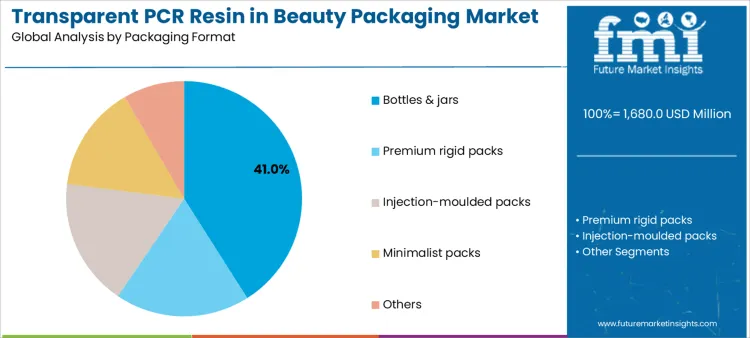
Bottles and jars account for 41.0%, reflecting dominant use in skincare and cosmetic formulations requiring visibility and product protection. These formats support consistent wall thickness, reliable sealing, and broad compatibility with pumps and closures. Adoption is strongest where branding relies on product appearance and tactile quality. Premium rigid packs, injection-moulded packs, minimalist packs, and other formats support differentiated positioning without disclosed share values. Packaging-format segmentation highlights concentration in standardized containers where transparency and recyclate performance must align with high-volume production requirements.
Key Points
- Bottles and jars remain central to beauty packaging formats.
- Transparency supports product visibility and branding.
- Standard geometries ease PCR integration.
How Does Material Selection Influence Transparent PCR Resin Adoption?
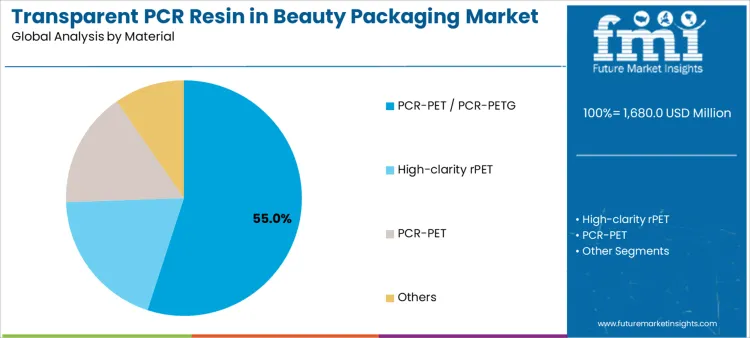
PCR-PET and PCR-PETG represent 55.0%, driven by superior clarity retention, mechanical strength, and processing familiarity. These materials support high-gloss finishes and consistent color control critical for beauty applications. High-clarity rPET, PCR-PET variants, and other materials address specialized design or cost objectives without disclosed share distribution. Material-based segmentation reflects emphasis on optical performance, recyclability compatibility, and suitability for premium cosmetic packaging aesthetics.
Key Points
- PCR-PET and PETG deliver high optical clarity.
- Material choice supports premium surface finish.
- Processing familiarity reduces production risk.
Which End Uses Drive Demand for Transparent PCR Resin in Beauty Packaging?
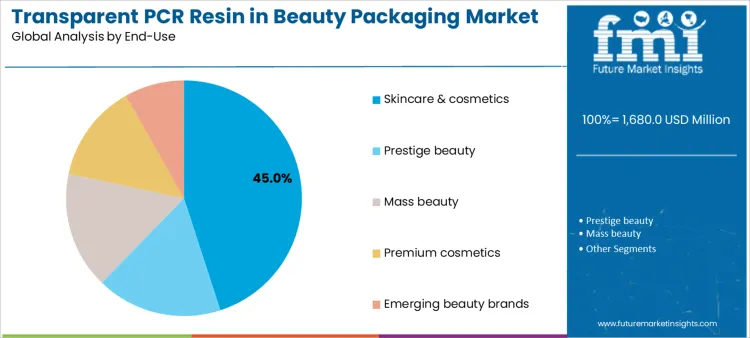
Skincare and cosmetics account for 45.0%, reflecting high packaging turnover and strong emphasis on sustainable branding. These products rely on clear containers to convey formulation quality and texture. Prestige beauty, mass beauty, premium cosmetics, and emerging beauty brands contribute to demand without quantified shares. End-use segmentation shows concentration where sustainability messaging, visual appeal, and scale intersect, enabling transparent PCR resins to replace virgin plastics without compromising brand presentation.
Key Points
- Skincare and cosmetics lead adoption volumes.
- Visual appeal remains critical for brand identity.
- Sustainability commitments accelerate PCR usage.
What are the Key Dynamics in the transparent PCR Resin in Beauty Packaging Market?
Demand in the transparent post-consumer recycled (PCR) resin market for beauty packaging is driven by premium cosmetic and personal care brands targeting sustainability commitments while preserving clarity and aesthetic appeal. Beauty packaging formats such as clear bottles, jars, and display caps require PCR resins that maintain optical transparency, color consistency, and surface quality at levels comparable to virgin materials. Suppliers focus on grades that deliver uniform gloss, low haze, and minimal color shift during processing to support premium branding and consumer perception.
How do aesthetic and performance expectations in beauty formats influence adoption?
Beauty product developers place exacting demands on transparent PCR resins because packaging aesthetics significantly affect perceived product quality. Clear shampoo and conditioner bottles must retain brilliance and clarity after injection molding and during filling operations, resisting yellowing or cloudiness that can occur when recycled feedstock contains trace impurities. Facial serums, toners, and body mists packaged in transparent PCR bottles require resins with high purity and controlled melt flow to produce thin walls without distortion or optical defects. Closure components and pump assemblies that incorporate transparent PCR elements must mate precisely with dispensing systems, preserving fit and function. Brands targeting luxe positioning evaluate PCR resin batches for surface smoothness and color uniformity to avoid detracting from design and label presentation, even at elevated PCR content levels.
How do feedstock quality constraints and processing considerations affect market growth?
Market growth for transparent PCR resins in beauty packaging is influenced by the technical challenge of sourcing consistently high-quality recycled feedstock and by processing variables that affect optical performance. Sorting and purification operations must eliminate contaminants, pigments, and multilayer film residues that cause haze or color variation in finished products. Resin producers invest in advanced decontamination and clarification processes to deliver transparent PCR grades with minimal chromatic distortion, which adds cost relative to standard recycled resins. Processing conditions such as melt temperature, shear rate, and residence time in molding equipment must be tightly controlled to avoid introducing stress or birefringence that can impair clarity. Price sensitivity arises when premium PCR grades command a cost premium while competing with virgin resins that already meet optical benchmarks. Regional differences in recycled content labeling rules and food-contact or cosmetic-contact compliance expectations influence where specific transparent PCR grades can be deployed without extensive qualification, shaping procurement strategies for global beauty brands.
How Is Demand for the Transparent PCR Resin in Beauty Packaging Market Evolving Globally?
Global demand for transparent PCR resin in beauty packaging is accelerating as personal care brands pursue sustainability without compromising visual clarity. Growth reflects rising use of recycled plastics in premium skincare, haircare, and cosmetics where transparency signals purity and quality. Regulatory pressure on virgin plastic reduction and brand-level recycled content commitments shape adoption patterns. Demand expansion remains closely tied to advancements in resin purification, odor control, and color consistency. India records 15.6% CAGR, China records 14.8% CAGR, USA records 11.4% CAGR, Germany records 11.0% CAGR, and Japan records 9.8% CAGR. Market momentum is driven by performance equivalence requirements rather than packaging volume growth.
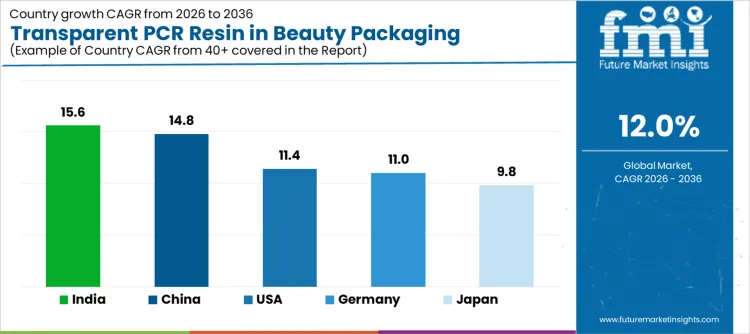
| Country | CAGR (%) |
|---|---|
| India | 15.6% |
| China | 14.8% |
| USA | 11.4% |
| Germany | 11.0% |
| Japan | 9.8% |
What is driving growth of transparent PCR resin demand in India?
Demand for transparent PCR resin in beauty packaging in India is expanding as personal care brands integrate recycled content across mass and premium product lines. Growth at 15.6% CAGR reflects rising use in bottles, jars, and closures for skincare and haircare products requiring high visual clarity. Rapid growth of domestic beauty brands increases focus on sustainable packaging differentiation. Processing improvements addressing haze, odor, and contamination improve adoption feasibility. Cost sensitivity favors blends achieving clarity with moderate PCR inclusion rates. Demand remains concentrated within urban-focused beauty brands scaling distribution through organized retail and e-commerce channels.
- Expansion of domestic beauty brands
- Rising recycled content commitments
- Focus on visual clarity and aesthetics
- Growth of organized personal care retail
Why is China seeing expansion in transparent PCR resin adoption for beauty packaging?
Transparent PCR resin demand in beauty packaging in China is rising as large personal care manufacturers align packaging strategies with sustainability targets. Growth at 14.8% CAGR reflects strong uptake in skincare and cosmetic containers sold through premium and mass-market channels. High-volume production environments require consistent color, gloss, and mechanical performance from PCR resins. Regulatory pressure on plastic usage accelerates recycled material integration. Domestic resin suppliers scale advanced washing and decontamination technologies to support clarity requirements. Demand remains centered on centralized packaging converters serving national and export-oriented beauty brands.
- High-volume beauty packaging production
- Regulatory pressure on virgin plastics
- Advancements in PCR purification technology
- Strong demand for clear cosmetic containers
What factors are shaping transparent PCR resin sales in the USA?
Sales of transparent PCR resin in beauty packaging in the USA are increasing as global beauty brands implement recycled content goals. Growth at 11.4% CAGR reflects adoption across skincare, fragrance, and haircare packaging requiring premium appearance. Brand risk management drives strict performance and consistency requirements for recycled resins. Retailer sustainability scorecards influence packaging material choices. Processing innovations improving optical clarity and odor neutrality support broader use. Demand is driven by portfolio-wide packaging transitions rather than new beauty product launches.
- Brand-level recycled content commitments
- Retail sustainability requirements
- Emphasis on premium packaging aesthetics
- Need for consistent resin performance
How is Germany supporting growth of transparent PCR resin demand in beauty packaging?
Demand for transparent PCR resin in beauty packaging in Germany is advancing as sustainability regulations tighten across consumer goods packaging. Growth at 11.0% CAGR reflects strong adoption within skincare and cosmetic packaging emphasizing recyclability and visual quality. Circular economy frameworks increase pressure to replace virgin plastics. German converters prioritize PCR resins meeting strict clarity, safety, and traceability standards. Technological leadership in recycling supports availability of high-quality transparent PCR materials. Demand remains linked to regulatory compliance and premium brand positioning rather than packaging format expansion.
- Circular economy driven packaging mandates
- High standards for material traceability
- Focus on premium cosmetic packaging
- Advanced recycling infrastructure support
What is driving expansion of transparent PCR resin demand in Japan?
Demand for transparent PCR resin in beauty packaging in Japan is rising as brands balance sustainability with strict aesthetic expectations. Growth at 9.8% CAGR reflects usage in skincare and cosmetics packaging where clarity and surface finish remain critical. Consumer sensitivity to packaging quality influences conservative PCR adoption rates. Manufacturers focus on high-purity recycled resins minimizing color shift and odor. Regulatory emphasis on waste reduction supports gradual integration. Demand remains concentrated within premium beauty brands prioritizing controlled material substitution strategies.
- Strong focus on packaging quality standards
- Gradual integration of recycled content
- Emphasis on high-purity PCR resins
- Regulatory push for waste reduction
What is the competitive landscape of demand for the transparent PCR resin in beauty packaging market globally?
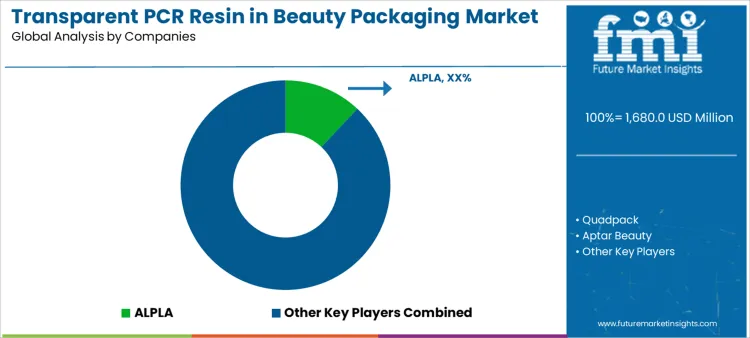
Visual clarity expectations in skincare and cosmetics are shaping demand for transparent PCR resin that matches virgin aesthetics. Brand owners and packaging engineers assess haze control, color neutrality, gloss retention, and resistance to stress whitening in pumps, bottles, and jars. Buyer assessment includes compatibility with fragrance oils, alcohols, and active ingredients, along with recyclability claims and food-contact-adjacent safety standards often applied to cosmetics. Procurement behavior prioritizes suppliers capable of delivering consistent optical quality across variable recyclate streams, supporting premium shelf presentation. Trend in the transparent PCR resin in beauty packaging market reflects brand pressure to combine sustainability claims with luxury appearance parity.
ALPLA leads competitive positioning through bottle-to-bottle and beauty-grade PCR programs delivering high transparency at scale. Quadpack competes by pairing PCR resin sourcing with design-led packaging optimized for premium cosmetic brands. Aptar Beauty maintains relevance by integrating transparent PCR into dispensing systems where clarity and functional precision are both critical. HCP Packaging supports demand with decorative packaging solutions that preserve visual clarity while increasing recycled content. Zhejiang Sun-Rain participates by supplying regionally competitive transparent PCR packaging components for mass and masstige beauty segments. Competitive differentiation centers on optical consistency, material compatibility with formulations, supply reliability, and ability to meet premium brand specifications.
Key Players in the Transparent PCR Resin in Beauty Packaging Market
- ALPLA
- Quadpack
- Aptar Beauty
- HCP Packaging
- Zhejiang Sun-Rain
- Zijiang
- Toyo Seikan
- Yoshino Kogyosho
- Others
Scope of the Report
| Items | Values |
|---|---|
| Quantitative Units | USD million |
| Packaging Format | Bottles & jars; Premium rigid packs; Injection-moulded packs; Minimalist packs; Others |
| Material | PCR-PET / PCR-PETG; High-clarity rPET; PCR-PET; Others |
| End-Use | Skincare & cosmetics; Prestige beauty; Mass beauty; Premium cosmetics; Emerging beauty brands |
| Regions Covered | Asia Pacific, Europe, North America, Latin America, Middle East & Africa |
| Countries Covered | India, China, USA, Germany, Japan, and 40+ countries |
| Key Companies Profiled | ALPLA; Quadpack; Aptar Beauty; HCP Packaging; Zhejiang Sun-Rain; Zijiang; Toyo Seikan; Yoshino Kogyosho; Others |
| Additional Attributes | Dollar sales by packaging format, material, and end-use; effectiveness of high-clarity rPET and PCR-PET in providing transparent packaging for beauty products; performance in ensuring aesthetic appeal and durability under various environmental conditions; impact of minimalist pack designs on consumer preferences and brand positioning; procurement dynamics shaped by sustainability goals and increasing demand for recyclable beauty packaging solutions. |
Transparent PCR Resin in Beauty Packaging Market by Segment
Packaging Format:
- Bottles & jars
- Premium rigid packs
- Injection-moulded packs
- Minimalist packs
- Others
Material:
- PCR-PET / PCR-PETG
- High-clarity rPET
- PCR-PET
- Others
End-Use:
- Skincare & cosmetics
- Prestige beauty
- Mass beauty
- Premium cosmetics
- Emerging beauty brands
Region:
- Asia Pacific
- China
- Japan
- South Korea
- India
- Australia & New Zealand
- ASEAN
- Rest of Asia Pacific
- Europe
- Germany
- United Kingdom
- France
- Italy
- Spain
- Nordic
- BENELUX
- Rest of Europe
- North America
- United States
- Canada
- Mexico
- Latin America
- Brazil
- Chile
- Rest of Latin America
- Middle East & Africa
- Kingdom of Saudi Arabia
- Other GCC Countries
- Turkey
- South Africa
- Other African Union
- Rest of Middle East & Africa
Bibliography
- International Organization for Standardization. (2023). Plastics — Recycled plastics — Determination of optical properties including haze and color (ISO 23900:2023). International Organization for Standardization.
- European Commission. (2023). Plastic packaging waste: Recycled content requirements and material quality considerations under the Packaging and Packaging Waste Regulation proposal. Publications Office of the European Union.
- Plastics Recyclers Europe. (2024). Design for recycling guidelines for high-clarity PET packaging in cosmetics and personal care. Plastics Recyclers Europe AISBL.
Frequently Asked Questions
How big is the transparent PCR resin in beauty packaging market in 2026?
The global transparent PCR resin in beauty packaging market is estimated to be valued at USD 1,680.0 million in 2026.
What will be the size of transparent PCR resin in beauty packaging market in 2036?
The market size for the transparent PCR resin in beauty packaging market is projected to reach USD 5,217.8 million by 2036.
How much will be the transparent PCR resin in beauty packaging market growth between 2026 and 2036?
The transparent PCR resin in beauty packaging market is expected to grow at a 12.0% CAGR between 2026 and 2036.
What are the key product types in the transparent PCR resin in beauty packaging market?
The key product types in transparent PCR resin in beauty packaging market are bottles & jars, premium rigid packs, injection-moulded packs, minimalist packs and others.
Which material segment to contribute significant share in the transparent PCR resin in beauty packaging market in 2026?
In terms of material, the PCR-PET/PCR-PETG segment is expected to command 55.0% share in the transparent PCR resin in beauty packaging market in 2026.
Preview the report firsthand - request a free sample
Get SampleGet the brochure for pricing and purchase details.
Get PDFTable of Content
- Executive Summary
- Global Market Outlook
- Demand-side Trends
- Supply-side Trends
- Technology Roadmap Analysis
- Analysis and Recommendations
- Market Overview
- Market Coverage / Taxonomy
- Market Definition / Scope / Limitations
- Market Background
- Market Dynamics
- Drivers
- Restraints
- Opportunity
- Trends
- Scenario Forecast
- Demand in Optimistic Scenario
- Demand in Likely Scenario
- Demand in Conservative Scenario
- Opportunity Map Analysis
- Product Life Cycle Analysis
- Supply Chain Analysis
- Investment Feasibility Matrix
- Value Chain Analysis
- PESTLE and Porter’s Analysis
- Regulatory Landscape
- Regional Parent Market Outlook
- Production and Consumption Statistics
- Import and Export Statistics
- Market Dynamics
- Global Market Analysis 2021 to 2025 and Forecast, 2026 to 2036
- Historical Market Size Value (USD Million) Analysis, 2021 to 2025
- Current and Future Market Size Value (USD Million) Projections, 2026 to 2036
- Y-o-Y Growth Trend Analysis
- Absolute $ Opportunity Analysis
- Global Market Pricing Analysis 2021 to 2025 and Forecast 2026 to 2036
- Global Market Analysis 2021 to 2025 and Forecast 2026 to 2036, By Packaging Format
- Introduction / Key Findings
- Historical Market Size Value (USD Million) Analysis By Packaging Format , 2021 to 2025
- Current and Future Market Size Value (USD Million) Analysis and Forecast By Packaging Format , 2026 to 2036
- Bottles & jars
- Premium rigid packs
- Injection-moulded packs
- Minimalist packs
- Others
- Bottles & jars
- Y-o-Y Growth Trend Analysis By Packaging Format , 2021 to 2025
- Absolute $ Opportunity Analysis By Packaging Format , 2026 to 2036
- Global Market Analysis 2021 to 2025 and Forecast 2026 to 2036, By Material
- Introduction / Key Findings
- Historical Market Size Value (USD Million) Analysis By Material, 2021 to 2025
- Current and Future Market Size Value (USD Million) Analysis and Forecast By Material, 2026 to 2036
- PCR-PET / PCR-PETG
- High-clarity rPET
- PCR-PET
- Others
- PCR-PET / PCR-PETG
- Y-o-Y Growth Trend Analysis By Material, 2021 to 2025
- Absolute $ Opportunity Analysis By Material, 2026 to 2036
- Global Market Analysis 2021 to 2025 and Forecast 2026 to 2036, By End-Use
- Introduction / Key Findings
- Historical Market Size Value (USD Million) Analysis By End-Use, 2021 to 2025
- Current and Future Market Size Value (USD Million) Analysis and Forecast By End-Use, 2026 to 2036
- Skincare & cosmetics
- Prestige beauty
- Mass beauty
- Premium cosmetics
- Emerging beauty brands
- Skincare & cosmetics
- Y-o-Y Growth Trend Analysis By End-Use, 2021 to 2025
- Absolute $ Opportunity Analysis By End-Use, 2026 to 2036
- Global Market Analysis 2021 to 2025 and Forecast 2026 to 2036, By Region
- Introduction
- Historical Market Size Value (USD Million) Analysis By Region, 2021 to 2025
- Current Market Size Value (USD Million) Analysis and Forecast By Region, 2026 to 2036
- North America
- Latin America
- Western Europe
- Eastern Europe
- East Asia
- South Asia and Pacific
- Middle East & Africa
- Market Attractiveness Analysis By Region
- North America Market Analysis 2021 to 2025 and Forecast 2026 to 2036, By Country
- Historical Market Size Value (USD Million) Trend Analysis By Market Taxonomy, 2021 to 2025
- Market Size Value (USD Million) Forecast By Market Taxonomy, 2026 to 2036
- By Country
- USA
- Canada
- Mexico
- By Packaging Format
- By Material
- By End-Use
- By Country
- Market Attractiveness Analysis
- By Country
- By Packaging Format
- By Material
- By End-Use
- Key Takeaways
- Latin America Market Analysis 2021 to 2025 and Forecast 2026 to 2036, By Country
- Historical Market Size Value (USD Million) Trend Analysis By Market Taxonomy, 2021 to 2025
- Market Size Value (USD Million) Forecast By Market Taxonomy, 2026 to 2036
- By Country
- Brazil
- Chile
- Rest of Latin America
- By Packaging Format
- By Material
- By End-Use
- By Country
- Market Attractiveness Analysis
- By Country
- By Packaging Format
- By Material
- By End-Use
- Key Takeaways
- Western Europe Market Analysis 2021 to 2025 and Forecast 2026 to 2036, By Country
- Historical Market Size Value (USD Million) Trend Analysis By Market Taxonomy, 2021 to 2025
- Market Size Value (USD Million) Forecast By Market Taxonomy, 2026 to 2036
- By Country
- Germany
- UK
- Italy
- Spain
- France
- Nordic
- BENELUX
- Rest of Western Europe
- By Packaging Format
- By Material
- By End-Use
- By Country
- Market Attractiveness Analysis
- By Country
- By Packaging Format
- By Material
- By End-Use
- Key Takeaways
- Eastern Europe Market Analysis 2021 to 2025 and Forecast 2026 to 2036, By Country
- Historical Market Size Value (USD Million) Trend Analysis By Market Taxonomy, 2021 to 2025
- Market Size Value (USD Million) Forecast By Market Taxonomy, 2026 to 2036
- By Country
- Russia
- Poland
- Hungary
- Balkan & Baltic
- Rest of Eastern Europe
- By Packaging Format
- By Material
- By End-Use
- By Country
- Market Attractiveness Analysis
- By Country
- By Packaging Format
- By Material
- By End-Use
- Key Takeaways
- East Asia Market Analysis 2021 to 2025 and Forecast 2026 to 2036, By Country
- Historical Market Size Value (USD Million) Trend Analysis By Market Taxonomy, 2021 to 2025
- Market Size Value (USD Million) Forecast By Market Taxonomy, 2026 to 2036
- By Country
- China
- Japan
- South Korea
- By Packaging Format
- By Material
- By End-Use
- By Country
- Market Attractiveness Analysis
- By Country
- By Packaging Format
- By Material
- By End-Use
- Key Takeaways
- South Asia and Pacific Market Analysis 2021 to 2025 and Forecast 2026 to 2036, By Country
- Historical Market Size Value (USD Million) Trend Analysis By Market Taxonomy, 2021 to 2025
- Market Size Value (USD Million) Forecast By Market Taxonomy, 2026 to 2036
- By Country
- India
- ASEAN
- Australia & New Zealand
- Rest of South Asia and Pacific
- By Packaging Format
- By Material
- By End-Use
- By Country
- Market Attractiveness Analysis
- By Country
- By Packaging Format
- By Material
- By End-Use
- Key Takeaways
- Middle East & Africa Market Analysis 2021 to 2025 and Forecast 2026 to 2036, By Country
- Historical Market Size Value (USD Million) Trend Analysis By Market Taxonomy, 2021 to 2025
- Market Size Value (USD Million) Forecast By Market Taxonomy, 2026 to 2036
- By Country
- Kingdom of Saudi Arabia
- Other GCC Countries
- Turkiye
- South Africa
- Other African Union
- Rest of Middle East & Africa
- By Packaging Format
- By Material
- By End-Use
- By Country
- Market Attractiveness Analysis
- By Country
- By Packaging Format
- By Material
- By End-Use
- Key Takeaways
- Key Countries Market Analysis
- USA
- Pricing Analysis
- Market Share Analysis, 2025
- By Packaging Format
- By Material
- By End-Use
- Canada
- Pricing Analysis
- Market Share Analysis, 2025
- By Packaging Format
- By Material
- By End-Use
- Mexico
- Pricing Analysis
- Market Share Analysis, 2025
- By Packaging Format
- By Material
- By End-Use
- Brazil
- Pricing Analysis
- Market Share Analysis, 2025
- By Packaging Format
- By Material
- By End-Use
- Chile
- Pricing Analysis
- Market Share Analysis, 2025
- By Packaging Format
- By Material
- By End-Use
- Germany
- Pricing Analysis
- Market Share Analysis, 2025
- By Packaging Format
- By Material
- By End-Use
- UK
- Pricing Analysis
- Market Share Analysis, 2025
- By Packaging Format
- By Material
- By End-Use
- Italy
- Pricing Analysis
- Market Share Analysis, 2025
- By Packaging Format
- By Material
- By End-Use
- Spain
- Pricing Analysis
- Market Share Analysis, 2025
- By Packaging Format
- By Material
- By End-Use
- France
- Pricing Analysis
- Market Share Analysis, 2025
- By Packaging Format
- By Material
- By End-Use
- India
- Pricing Analysis
- Market Share Analysis, 2025
- By Packaging Format
- By Material
- By End-Use
- ASEAN
- Pricing Analysis
- Market Share Analysis, 2025
- By Packaging Format
- By Material
- By End-Use
- Australia & New Zealand
- Pricing Analysis
- Market Share Analysis, 2025
- By Packaging Format
- By Material
- By End-Use
- China
- Pricing Analysis
- Market Share Analysis, 2025
- By Packaging Format
- By Material
- By End-Use
- Japan
- Pricing Analysis
- Market Share Analysis, 2025
- By Packaging Format
- By Material
- By End-Use
- South Korea
- Pricing Analysis
- Market Share Analysis, 2025
- By Packaging Format
- By Material
- By End-Use
- Russia
- Pricing Analysis
- Market Share Analysis, 2025
- By Packaging Format
- By Material
- By End-Use
- Poland
- Pricing Analysis
- Market Share Analysis, 2025
- By Packaging Format
- By Material
- By End-Use
- Hungary
- Pricing Analysis
- Market Share Analysis, 2025
- By Packaging Format
- By Material
- By End-Use
- Kingdom of Saudi Arabia
- Pricing Analysis
- Market Share Analysis, 2025
- By Packaging Format
- By Material
- By End-Use
- Turkiye
- Pricing Analysis
- Market Share Analysis, 2025
- By Packaging Format
- By Material
- By End-Use
- South Africa
- Pricing Analysis
- Market Share Analysis, 2025
- By Packaging Format
- By Material
- By End-Use
- USA
- Market Structure Analysis
- Competition Dashboard
- Competition Benchmarking
- Market Share Analysis of Top Players
- By Regional
- By Packaging Format
- By Material
- By End-Use
- Competition Analysis
- Competition Deep Dive
- ALPLA
- Overview
- Product Portfolio
- Profitability by Market Segments (Product/Age /Sales Channel/Region)
- Sales Footprint
- Strategy Overview
- Marketing Strategy
- Product Strategy
- Channel Strategy
- Quadpack
- Aptar Beauty
- HCP Packaging
- Zhejiang Sun-Rain
- Zijiang
- Toyo Seikan
- Yoshino Kogyosho
- Others
- ALPLA
- Competition Deep Dive
- Assumptions & Acronyms Used
- Research Methodology


