

- Market Size (2026)
- USD 167.53 Bn
- Forecast (2036)
- USD 297.21 Bn
- CAGR (2026 to 2036)
- 5.9%
Transparent Plastic Packaging Market Size, Market Forecast and Outlook By FMI
The transparent plastic packaging market was valued at USD 158.2 billion in 2025. The market is set to reach USD 167.5 billion by 2026-end and grow at a CAGR of 5.9% between 2026-2036 to reach USD 297.2 billion by 2036. Rigid will dominate with a 54.2% share, while Injection moulding will lead with a 47.6%% share.
Summary of the Transparent Plastic Packaging Market
- Demand and Growth Drivers
- Food safety requirements and e-commerce logistics expansion are likely to support demand through the forecast period.
- Sustainability mandates and material innovation are expected to remain consistent growth drivers from 2026 to 2036.
- Private label growth and regional production expansion are expected to create additional procurement opportunities.
- Product and Segment View
- Rigid is likely to remain the leading product segment, accounting for 54.2% of demand in 2026.
- Injection moulding is expected to account for 47.6% of the technology category, supported by established adoption patterns.
- Growth across segments is expected to remain uneven, with sustainability-compliant and e-commerce-optimized categories outpacing legacy alternatives.
- Geography and Competitive Outlook
- China is likely to lead growth at 8% CAGR, reflecting consumer market expansion and manufacturing growth.
- India at 7.4% CAGR represents the second-fastest growth corridor.
- Companies that combine production efficiency with distribution reach and material innovation are likely to strengthen competitive positioning.
- Analyst Opinion
- The transparent plastic packaging market is evolving toward sustainability-compliant formats driven by regulation and consumer preference. Companies that invest in recycled content capability and e-commerce packaging design are better positioned to capture incremental demand. Strategic capital allocation toward sustainability compliance and regional production is likely to define competitive outcomes over the forecast period.
- Growth is concentrated in regions where consumer markets and manufacturing capacity are growing.
- Adoption is increasing due to e-commerce growth, food safety requirements, and consumer preference for product visibility.
- The market is expected to create USD 129.68 billion in incremental opportunity between 2026 and 2036.

Key Takeaways, Market Size, and Forecast
- The transparent plastic packaging market was valued at USD 158.20 billion in 2025.
- By 2036, the Transparent Plastic Packaging Market is expected to be worth USD 297.21 billion.
- From 2026 to 2036, the market is projected to expand at a CAGR of 5.9%.
- The market is projected to create an incremental opportunity of USD 129.68 billion between 2026 and 2036.
- In 2026, Rigid is expected to account for 54.2% of the product, driven by e-commerce growth, food safety requirements, and consumer preference for product visibility.
- China (8%) and India (7.4%) are two of the fastest growing markets in the world.
Transparent Plastic Packaging Market Definition
The transparent plastic packaging market encompasses all commercially traded products, solutions, and services categorized by product, technology, material, end use. The market covers revenue generated from sales across North America, Latin America, Europe, East Asia, South Asia and Pacific, Middle East and Africa during the forecast period from 2026 to 2036.
Transparent Plastic Packaging Market Inclusions
Market scope includes all transparent plastic packaging products and services sold through commercial channels, covering Rigid, _Bottles & Jars, _Caps & Closures, _Trays & Containers, _Others, Flexible, _Bags, _Pouches, _Wraps & Films, _Others; Injection moulding, Thermoforming, Extrusion moulding, Blow molding, Others; Polyethylene (PE), Polyethylene Terephthalate (PET), Polyvinyl chloride (PVC), Polystyrene (PS), Polycarbonate (PC), Polypropylene (PP), Polymethyl methacrylate (PMMA), Others ( polyamide and TPU); Food & Beverage, Pharmaceuticals, Personal & household care, Industrial packaging, Others. Revenue is tracked from 2026 to 2036 across all identified regions and countries.
Transparent Plastic Packaging Market Exclusions
The scope excludes non-commercial transactions, internal transfers, prototype or research-stage products, and non-transparent packaging formats and industrial bulk containers. Government-funded research programs without commercial procurement are also excluded.
Transparent Plastic Packaging Market Research Methodology
- Primary Research: Interviews with packaging converters, brand owners, and retail procurement teams across key markets.
- Desk Research: Analysis of packaging consumption data, trade statistics, and regulatory filings.
- Market Sizing and Forecasting: Bottom-up aggregation of packaging consumption volumes, trade data, and end-user procurement patterns, with regional adoption curves and top-down validation.
- Data Validation: Cross-checked quarterly against packaging production statistics and trade flow data.
Why is the Transparent Plastic Packaging Market Growing?
- Food safety requirements, e-commerce growth, and sustainability mandates are expanding the addressable market, supporting a CAGR of 5.9% through 2036.
- China leads growth at 8% owing to consumer market expansion and manufacturing capacity growth.
- Rigid accounts for 54.2% of the product segment, reflecting dominant material and format preferences in high-volume applications.
Regulatory requirements for food contact materials are tightening across major markets, driving specification changes in transparent plastic packaging. Migration limits, chemical restrictions, and traceability requirements are increasing compliance costs and technical complexity. Companies that invest in compliant material formulations and testing capabilities gain specification advantages. The regulatory landscape varies by jurisdiction, creating complexity for global packaging suppliers.
The expansion of online retail is changing packaging requirements for transparent plastic formats. E-commerce shipments require packaging that combines product visibility with protection during transit. Dimensional optimization for shipping efficiency and damage resistance are becoming key specification criteria. This shift creates demand for packaging formats that perform across both retail display and e-commerce logistics channels.
Environmental regulations and consumer sustainability expectations are driving material innovation in transparent plastic packaging. Recycled content mandates, recyclability requirements, and biodegradable alternatives are changing material specifications. The transition creates both cost pressure and differentiation opportunity for producers that develop compliant solutions ahead of regulatory deadlines. Brand owners are increasingly specifying sustainability criteria in procurement requirements.
Market Segmentation Analysis
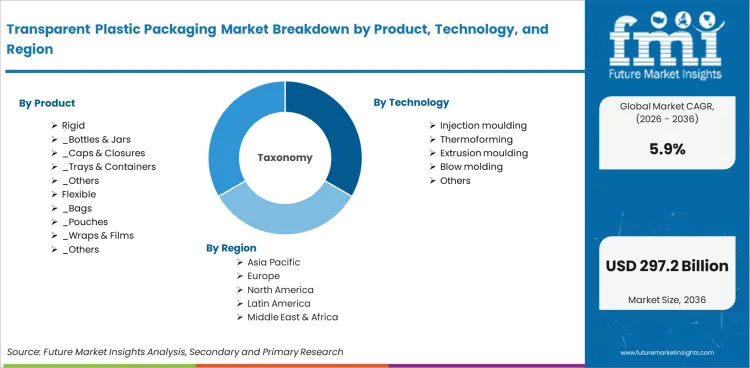
- The transparent plastic packaging market is segmented by product, technology, material, end use, covering all commercially relevant categories.
- Rigid Packaging maintains the largest share at 54.2% of the product segment in 2026.
- Injection moulding accounts for 47.6% of the technology category.
The transparent plastic packaging market segmentation reflects the distribution of demand across product categories and end-user groups. Market structure is concentrated in the top segments, with Rigid and Injection moulding accounting for the majority of revenue.
Insights into the Rigid Segment
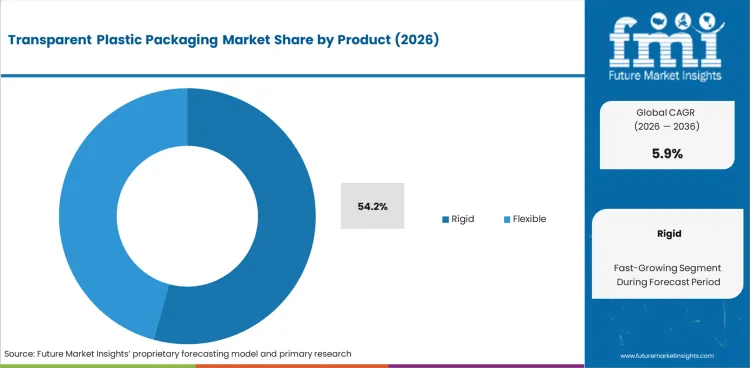
Rigid accounts for 54.2% of the product segment in 2026. Demand for this category reflects dominant material specifications in high-volume food and beverage applications. Growth in this segment is expected to remain consistent through the forecast period.
Insights into the Injection moulding Segment
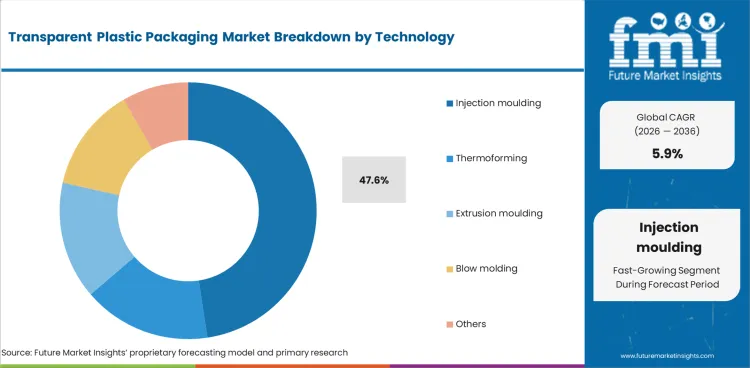
Injection moulding accounts for 47.6% of the technology segment in 2026. Demand for this category reflects shifting processing specifications and manufacturing preferences. Growth in this segment is expected to remain consistent through the forecast period.
Transparent Plastic Packaging Market Drivers, Restraints, and Opportunities
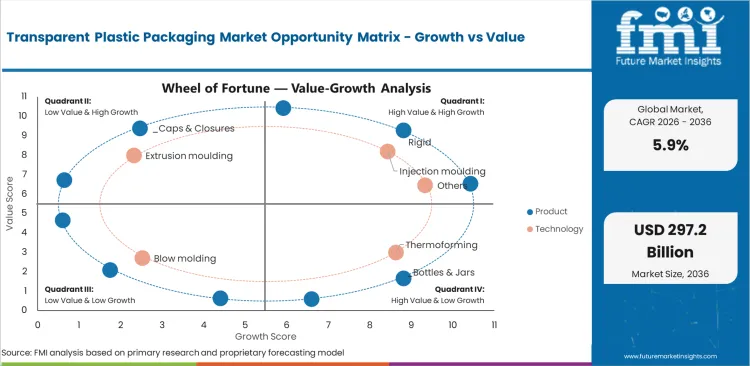
- Food safety regulations and e-commerce expansion are creating structured demand.
- Sustainability compliance costs and raw material price volatility remain the primary restraints.
- Circular economy mandates and smart packaging innovation represent the most significant growth opportunities through 2036.
The transparent plastic packaging market continues to expand as e-commerce growth, food safety requirements, and consumer preference for product visibility create sustained demand. Growth is tempered by competitive pricing pressure and sustainability compliance costs in certain segments.
Food Safety Regulations Drive Specification Upgrades
Regulatory requirements for food contact materials are tightening across major markets, driving specification changes in transparent plastic packaging. Migration limits, chemical restrictions, and traceability requirements are increasing compliance costs and technical complexity. Companies that invest in compliant material formulations and testing capabilities gain specification advantages. The regulatory landscape varies by jurisdiction, creating complexity for global packaging suppliers.
E-commerce Growth Reshapes Packaging Requirements
The expansion of online retail is changing packaging requirements for transparent plastic formats. E-commerce shipments require packaging that combines product visibility with protection during transit. Dimensional optimization for shipping efficiency and damage resistance are becoming key specification criteria. This shift creates demand for packaging formats that perform across both retail display and e-commerce logistics channels.
Sustainability Pressure Accelerates Material Innovation
Environmental regulations and consumer sustainability expectations are driving material innovation in transparent plastic packaging. Recycled content mandates, recyclability requirements, and biodegradable alternatives are changing material specifications. The transition creates both cost pressure and differentiation opportunity for producers that develop compliant solutions ahead of regulatory deadlines. Brand owners are increasingly specifying sustainability criteria in procurement requirements.
Rigid-to-Flexible Conversion Shifts Market Economics
The ongoing conversion from rigid to flexible packaging formats in certain applications is changing market economics. Flexible formats offer material efficiency, reduced weight, and lower transportation costs. This conversion is gradual and application-dependent, with food and personal care categories showing the fastest transition. Producers that offer both rigid and flexible capabilities benefit from broader addressable markets.
Analysis of Transparent Plastic Packaging Market By Key Countries
.webp "Top Country Growth Comparison Transparent Plastic Packaging Market Cagr (2026 2036)")
| Country | CAGR |
|---|---|
| China | 8% |
| India | 7.4% |
| Germany | 6.8% |
| Brazil | 6.2% |
| USA | 5.6% |
| UK | 5% |
| Japan | 4.4% |
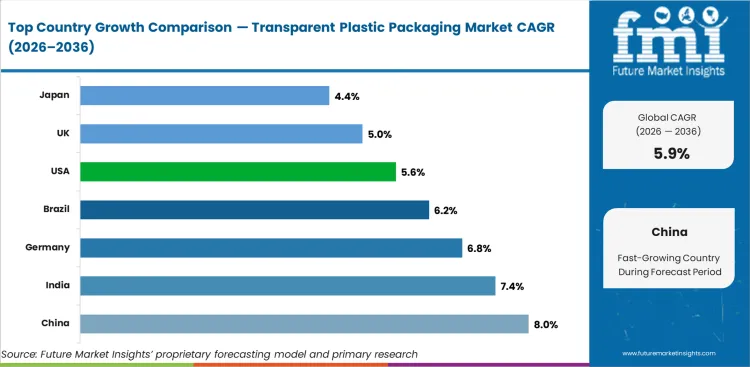
- China leads at 8% CAGR.
- India at 7.4% CAGR represents the second-fastest growth corridor.
- Germany (6.8%) and Brazil (6.2%) show sustained growth.
The global transparent plastic packaging market is expected to expand at a CAGR of 5.9% from 2026 to 2036. The analysis covers more than 30 countries, with the primary markets detailed below.
Demand Outlook for Transparent Plastic Packaging Market in China
- China is projected to register a CAGR of 8% through 2036. Demand reflects expanding food and beverage packaging requirements, e-commerce logistics growth, and increasing consumer preference for product visibility in retail formats.
- Food safety regulations are driving specification upgrades across packaging categories.
- E-commerce expansion is creating demand for protective and display-compatible packaging formats.
- Retail shelf competition is supporting adoption of transparent packaging for product differentiation.
Future Outlook for Transparent Plastic Packaging Market in India
- India is projected to register a CAGR of 7.4% through 2036. Demand reflects expanding food and beverage packaging requirements, e-commerce logistics growth, and increasing consumer preference for product visibility in retail formats.
- Food safety regulations are driving specification upgrades across packaging categories.
- E-commerce expansion is creating demand for protective and display-compatible packaging formats.
- Retail shelf competition is supporting adoption of transparent packaging for product differentiation.
Opportunity Analysis of Transparent Plastic Packaging Market in Germany
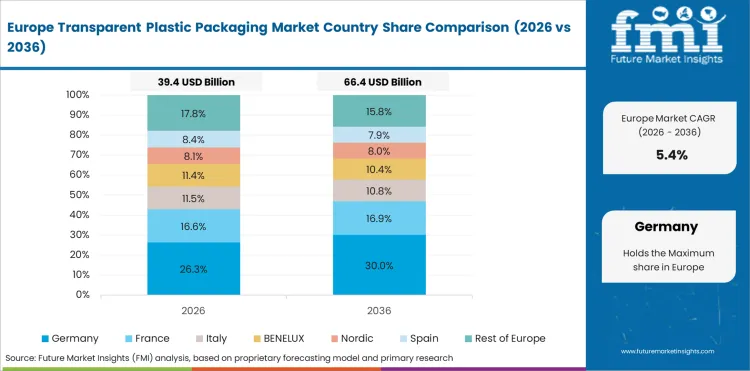
- Germany is projected to register a CAGR of 6.8% through 2036. Demand reflects expanding food and beverage packaging requirements, e-commerce logistics growth, and increasing consumer preference for product visibility in retail formats.
- Food safety regulations are driving specification upgrades across packaging categories.
- E-commerce expansion is creating demand for protective and display-compatible packaging formats.
- Retail shelf competition is supporting adoption of transparent packaging for product differentiation.
In-depth Analysis of Transparent Plastic Packaging Market in Brazil
- Brazil is projected to register a CAGR of 6.2% through 2036. Demand reflects expanding food and beverage packaging requirements, e-commerce logistics growth, and increasing consumer preference for product visibility in retail formats.
- Food safety regulations are driving specification upgrades across packaging categories.
- E-commerce expansion is creating demand for protective and display-compatible packaging formats.
- Retail shelf competition is supporting adoption of transparent packaging for product differentiation.
Sales Analysis of Transparent Plastic Packaging Market in USA

- USA is projected to register a CAGR of 5.6% through 2036. Demand reflects expanding food and beverage packaging requirements, e-commerce logistics growth, and increasing consumer preference for product visibility in retail formats.
- Food safety regulations are driving specification upgrades across packaging categories.
- E-commerce expansion is creating demand for protective and display-compatible packaging formats.
- Retail shelf competition is supporting adoption of transparent packaging for product differentiation.
Growth Analysis of Transparent Plastic Packaging Market in UK
- UK is projected to register a CAGR of 5% through 2036. Demand reflects expanding food and beverage packaging requirements, e-commerce logistics growth, and increasing consumer preference for product visibility in retail formats.
- Food safety regulations are driving specification upgrades across packaging categories.
- E-commerce expansion is creating demand for protective and display-compatible packaging formats.
- Retail shelf competition is supporting adoption of transparent packaging for product differentiation.
Competitive Landscape and Strategic Positioning
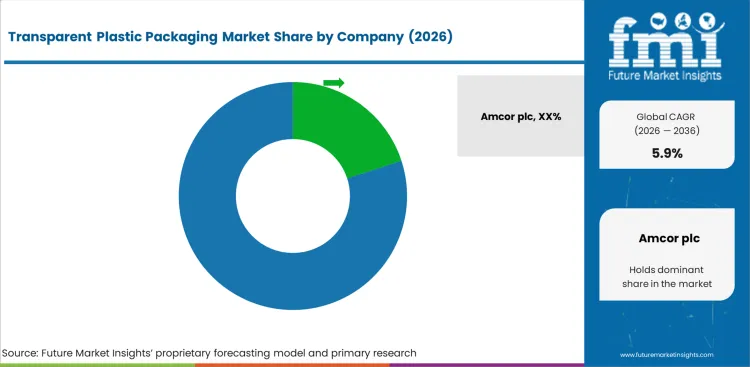
- Amcor plc maintains a strong position through production capacity and global distribution.
- Berry Global, Inc. and Sonoco Products Company compete through specialized capabilities and targeted market focus.
- New entrants are targeting sustainable packaging formats and regional markets.
- The competitive landscape reflects a mix of global players with broad portfolios and regional specialists with deep expertise. Market concentration is moderate, with the top 5 companies accounting for a significant share of revenue.
- Amcor plc leads through manufacturing scale and multi-regional production infrastructure.
- Barriers to entry include production equipment investment, food contact certifications, and established distribution relationships.
Key Companies in the Transparent Plastic Packaging Market
Key global companies in the transparent plastic packaging market include:
- Amcor plc, Berry Global, Inc., Sonoco Products Company, CCL Industries, Inc. maintain strong market positions through established infrastructure and multi-regional capabilities.
- Mondi plc, Constantia Flexibles, Sealed Air Corporation have established regional positions through specialized capabilities.
- Coveris, Winpak Ltd., Genpak, Anchor Packaging, Graham Packaging Company, Chantler Packaging Inc., HIP LIK, Yi Jian Xing Glue Box represent emerging participants with growth potential.
Competitive Benchmarking: Transparent Plastic Packaging Market
| Company | Product Range | Manufacturing Scale | Distribution Network | Innovation Pipeline |
|---|---|---|---|---|
| Amcor plc | High | High | Strong | Global |
| Berry Global, Inc. | High | High | Strong | Global |
| Sonoco Products Company | High | Medium | Strong | Global |
| CCL Industries, Inc. | Medium | Medium | Moderate | Global |
| Mondi plc | Medium | Medium | Moderate | Regional |
| Constantia Flexibles | Medium | Low | Moderate | Regional |
| Sealed Air Corporation | Low | Low | Moderate | Regional |
| Coveris | Low | Low | Limited | Niche |
| Winpak Ltd. | Low | Low | Limited | Niche |
| Genpak | Low | Low | Limited | Niche |
Source: Future Market Insights competitive analysis, 2026
Key Players in the Transparent Plastic Packaging Market
Major Global Players
- Amcor plc
- Berry Global, Inc.
- Sonoco Products Company
- CCL Industries, Inc.
- Mondi plc
- Constantia Flexibles
- Sealed Air Corporation
Emerging Players/Startups
- Coveris
- Winpak Ltd.
- Genpak
- Anchor Packaging
- Graham Packaging Company
- Chantler Packaging Inc.
- HIP LIK
- Yi Jian Xing Glue Box
Report Scope and Coverage
| Parameter | Details |
|---|---|
| Quantitative Units | USD 167.53 Billion to USD 297.21 Billion, at a CAGR of 5.9% |
| Market Definition | The transparent plastic packaging market encompasses transparent plastic packaging products and services across product, technology, material, end use. |
| Regions Covered | North America, Latin America, Europe, East Asia, South Asia and Pacific, Middle East and Africa |
| Countries Covered | China, India, Germany, Brazil, USA, UK, Japan, 30 plus countries |
| Key Companies Profiled | Amcor plc, Berry Global, Inc., Sonoco Products Company, CCL Industries, Inc., Mondi plc, Constantia Flexibles, Sealed Air Corporation, Coveris, Winpak Ltd., Genpak, Anchor Packaging, Graham Packaging Company, Chantler Packaging Inc., HIP LIK, Yi Jian Xing Glue Box |
| Forecast Period | 2026 to 2036 |
| Approach | Hybrid bottom-up and top-down methodology starting with verified transaction data, projecting adoption velocity across segments and regions. |
Segmentation
Transparent Plastic Packaging Market Segmented by Product:
- Rigid
- Bottles & Jars
- Caps & Closures
- Trays & Containers
- Others
- Flexible
- Bags
- Pouches
- Wraps & Films
- Others
Transparent Plastic Packaging Market Segmented by Technology:
- Injection moulding
- Thermoforming
- Extrusion moulding
- Blow molding
- Others
Transparent Plastic Packaging Market Segmented by Material:
- Polyethylene (PE)
- Polyethylene Terephthalate (PET)
- Polyvinyl chloride (PVC)
- Polystyrene (PS)
- Polycarbonate (PC)
- Polypropylene (PP)
- Polymethyl methacrylate (PMMA)
- Others ( polyamide and TPU)
Transparent Plastic Packaging Market Segmented by End Use:
- Food & Beverage
- Pharmaceuticals
- Personal & household care
- Industrial packaging
- Others
Transparent Plastic Packaging Market by Region:
- North America
- USA
- Canada
- Mexico
- Latin America
- Brazil
- Chile
- Rest of Latin America
- Western Europe
- Germany
- UK
- Italy
- Spain
- France
- Nordic
- BENELUX
- Rest of Western Europe
- Eastern Europe
- Russia
- Poland
- Hungary
- Balkan & Baltic
- Rest of Eastern Europe
- East Asia
- China
- Japan
- South Korea
- South Asia and Pacific
- India
- ASEAN
- Australia & New Zealand
- Rest of South Asia and Pacific
- Middle East & Africa
- Kingdom of Saudi Arabia
- Other GCC Countries
- Turkiye
- South Africa
- Other African Union
- Rest of Middle East & Africa
Research Sources and Bibliography
- World Packaging Organisation. (2025). Global Packaging Industry Statistics. WPO.
- Food and Agriculture Organization. (2025). FAO Food Safety and Packaging Standards. FAO.
- Organisation for Economic Co-operation and Development. (2025). OECD Trade in Goods Statistics. OECD.
- United Nations Industrial Development Organization. (2025). UNIDO Manufacturing Statistics. UNIDO.
- International Organization for Standardization. (2025). ISO Standards for Packaging Materials. ISO.
This bibliography is provided for reader reference. The full Future Market Insights report contains the complete reference list with publication dates, URLs, and supporting data for all cited works.
This Report Answers
- Estimating the size of the transparent plastic packaging market and revenue potential from 2026 to 2036.
- Segmentation by product, technology, material, end use.
- Regional insights across more than 30 markets.
- Analysis of packaging format trends and material innovation.
- Competitive landscape assessment and company benchmarking.
- Identification of investment opportunities across product segments and geographic markets.
- Supply chain and distribution channel tracking.
- Delivery of data in PDF and Excel formats.
Frequently Asked Questions
What is the global market demand for Transparent Plastic Packaging Market in 2026?
In 2026, the global transparent plastic packaging market is expected to be valued at USD 167.53 billion.
How big is the Transparent Plastic Packaging Market expected to be in 2036?
By 2036, the transparent plastic packaging market is projected to reach USD 297.21 billion.
What is the expected growth rate for the Transparent Plastic Packaging Market between 2026 and 2036?
The transparent plastic packaging market is projected to grow at a CAGR of 5.9% from 2026 to 2036.
Which product segment is expected to lead in 2026?
Rigid is expected to account for 54.2% of the product segment in 2026, supported by e-commerce growth, food safety requirements, and consumer preference for product visibility.
What is driving demand in China?
China is projected to grow at 8% CAGR through 2036, supported by food and beverage industry expansion and e-commerce growth.
What is driving demand in India?
India is projected to grow at 7.4% CAGR through 2036, driven by manufacturing expansion and regulatory compliance requirements.
What does FMI mean by Transparent Plastic Packaging Market definition?
The transparent plastic packaging market includes all commercially traded products and solutions categorized by product, technology, material, end use, across the forecast period from 2026 to 2036.
How does FMI build and validate the Transparent Plastic Packaging Market forecast?
Forecasting uses a hybrid bottom-up and top-down methodology, starting with packaging consumption volumes, trade data, and end-user procurement patterns and cross-checking against industry statistics and manufacturer disclosures.
Preview the report firsthand - request a free sample
Get SampleGet the brochure for pricing and purchase details.
Get PDFTable of Content
- Executive Summary
- Global Market Outlook
- Demand-side Trends
- Supply-side Trends
- Technology Roadmap Analysis
- Analysis and Recommendations
- Market Overview
- Market Coverage / Taxonomy
- Market Definition / Scope / Limitations
- Research Methodology
- Chapter Orientation
- Analytical Lens and Working Hypotheses
- Market Structure, Signals, and Trend Drivers
- Benchmarking and Cross-market Comparability
- Market Sizing, Forecasting, and Opportunity Mapping
- Research Design and Evidence Framework
- Desk Research Programme (Secondary Evidence)
- Company Annual and Sustainability Reports
- Peer-reviewed Journals and Academic Literature
- Corporate Websites, Product Literature, and Technical Notes
- Earnings Decks and Investor Briefings
- Statutory Filings and Regulatory Disclosures
- Technical White Papers and Standards Notes
- Trade Journals, Industry Magazines, and Analyst Briefs
- Conference Proceedings, Webinars, and Seminar Materials
- Government Statistics Portals and Public Data Releases
- Press Releases and Reputable Media Coverage
- Specialist Newsletters and Curated Briefings
- Sector Databases and Reference Repositories
- FMI Internal Proprietary Databases and Historical Market Datasets
- Subscription Datasets and Paid Sources
- Social Channels, Communities, and Digital Listening Inputs
- Additional Desk Sources
- Expert Input and Fieldwork (Primary Evidence)
- Primary Modes
- Qualitative Interviews and Expert Elicitation
- Quantitative Surveys and Structured Data Capture
- Blended Approach
- Why Primary Evidence is Used
- Field Techniques
- Interviews
- Surveys
- Focus Groups
- Observational and In-context Research
- Social and Community Interactions
- Stakeholder Universe Engaged
- C-suite Leaders
- Board Members
- Presidents and Vice Presidents
- R&D and Innovation Heads
- Technical Specialists
- Domain Subject-matter Experts
- Scientists
- Physicians and Other Healthcare Professionals
- Governance, Ethics, and Data Stewardship
- Research Ethics
- Data Integrity and Handling
- Primary Modes
- Tooling, Models, and Reference Databases
- Desk Research Programme (Secondary Evidence)
- Data Engineering and Model Build
- Data Acquisition and Ingestion
- Cleaning, Normalisation, and Verification
- Synthesis, Triangulation, and Analysis
- Quality Assurance and Audit Trail
- Market Background
- Market Dynamics
- Drivers
- Restraints
- Opportunity
- Trends
- Scenario Forecast
- Demand in Optimistic Scenario
- Demand in Likely Scenario
- Demand in Conservative Scenario
- Opportunity Map Analysis
- Product Life Cycle Analysis
- Supply Chain Analysis
- Investment Feasibility Matrix
- Value Chain Analysis
- PESTLE and Porter’s Analysis
- Regulatory Landscape
- Regional Parent Market Outlook
- Production and Consumption Statistics
- Import and Export Statistics
- Market Dynamics
- Global Market Analysis 2021 to 2025 and Forecast, 2026 to 2036
- Historical Market Size Value (USD Million) Analysis, 2021 to 2025
- Current and Future Market Size Value (USD Million) Projections, 2026 to 2036
- Y-o-Y Growth Trend Analysis
- Absolute $ Opportunity Analysis
- Global Market Pricing Analysis 2021 to 2025 and Forecast 2026 to 2036
- Global Market Analysis 2021 to 2025 and Forecast 2026 to 2036, By Product
- Introduction / Key Findings
- Historical Market Size Value (USD Million) Analysis By Product, 2021 to 2025
- Current and Future Market Size Value (USD Million) Analysis and Forecast By Product, 2026 to 2036
- Rigid
- Bottles & Jars
- Caps & Closures
- Trays & Containers
- Others
- Flexible
- Bags
- Pouches
- Wraps & Films
- Others
- Rigid
- Y-o-Y Growth Trend Analysis By Product, 2021 to 2025
- Absolute $ Opportunity Analysis By Product, 2026 to 2036
- Global Market Analysis 2021 to 2025 and Forecast 2026 to 2036, By Technology
- Introduction / Key Findings
- Historical Market Size Value (USD Million) Analysis By Technology, 2021 to 2025
- Current and Future Market Size Value (USD Million) Analysis and Forecast By Technology, 2026 to 2036
- Injection moulding
- Thermoforming
- Extrusion moulding
- Blow molding
- Others
- Injection moulding
- Y-o-Y Growth Trend Analysis By Technology, 2021 to 2025
- Absolute $ Opportunity Analysis By Technology, 2026 to 2036
- Global Market Analysis 2021 to 2025 and Forecast 2026 to 2036, By Material
- Introduction / Key Findings
- Historical Market Size Value (USD Million) Analysis By Material, 2021 to 2025
- Current and Future Market Size Value (USD Million) Analysis and Forecast By Material, 2026 to 2036
- Polyethylene (PE)
- Polyethylene Terephthalate (PET)
- Polyvinyl chloride (PVC)
- Polystyrene (PS)
- Polycarbonate (PC)
- Polypropylene (PP)
- Polymethyl methacrylate (PMMA)
- Others ( polyamide and TPU)
- Polyethylene (PE)
- Y-o-Y Growth Trend Analysis By Material, 2021 to 2025
- Absolute $ Opportunity Analysis By Material, 2026 to 2036
- Global Market Analysis 2021 to 2025 and Forecast 2026 to 2036, By End Use
- Introduction / Key Findings
- Historical Market Size Value (USD Million) Analysis By End Use, 2021 to 2025
- Current and Future Market Size Value (USD Million) Analysis and Forecast By End Use, 2026 to 2036
- Food & Beverage
- Pharmaceuticals
- Personal & household care
- Industrial packaging
- Others
- Food & Beverage
- Y-o-Y Growth Trend Analysis By End Use, 2021 to 2025
- Absolute $ Opportunity Analysis By End Use, 2026 to 2036
- Global Market Analysis 2021 to 2025 and Forecast 2026 to 2036, By Region
- Introduction
- Historical Market Size Value (USD Million) Analysis By Region, 2021 to 2025
- Current Market Size Value (USD Million) Analysis and Forecast By Region, 2026 to 2036
- North America
- Latin America
- Western Europe
- Eastern Europe
- East Asia
- South Asia and Pacific
- Middle East & Africa
- Market Attractiveness Analysis By Region
- North America Market Analysis 2021 to 2025 and Forecast 2026 to 2036, By Country
- Historical Market Size Value (USD Million) Trend Analysis By Market Taxonomy, 2021 to 2025
- Market Size Value (USD Million) Forecast By Market Taxonomy, 2026 to 2036
- By Country
- USA
- Canada
- Mexico
- By Product
- By Technology
- By Material
- By End Use
- By Country
- Market Attractiveness Analysis
- By Country
- By Product
- By Technology
- By Material
- By End Use
- Key Takeaways
- Latin America Market Analysis 2021 to 2025 and Forecast 2026 to 2036, By Country
- Historical Market Size Value (USD Million) Trend Analysis By Market Taxonomy, 2021 to 2025
- Market Size Value (USD Million) Forecast By Market Taxonomy, 2026 to 2036
- By Country
- Brazil
- Chile
- Rest of Latin America
- By Product
- By Technology
- By Material
- By End Use
- By Country
- Market Attractiveness Analysis
- By Country
- By Product
- By Technology
- By Material
- By End Use
- Key Takeaways
- Western Europe Market Analysis 2021 to 2025 and Forecast 2026 to 2036, By Country
- Historical Market Size Value (USD Million) Trend Analysis By Market Taxonomy, 2021 to 2025
- Market Size Value (USD Million) Forecast By Market Taxonomy, 2026 to 2036
- By Country
- Germany
- UK
- Italy
- Spain
- France
- Nordic
- BENELUX
- Rest of Western Europe
- By Product
- By Technology
- By Material
- By End Use
- By Country
- Market Attractiveness Analysis
- By Country
- By Product
- By Technology
- By Material
- By End Use
- Key Takeaways
- Eastern Europe Market Analysis 2021 to 2025 and Forecast 2026 to 2036, By Country
- Historical Market Size Value (USD Million) Trend Analysis By Market Taxonomy, 2021 to 2025
- Market Size Value (USD Million) Forecast By Market Taxonomy, 2026 to 2036
- By Country
- Russia
- Poland
- Hungary
- Balkan & Baltic
- Rest of Eastern Europe
- By Product
- By Technology
- By Material
- By End Use
- By Country
- Market Attractiveness Analysis
- By Country
- By Product
- By Technology
- By Material
- By End Use
- Key Takeaways
- East Asia Market Analysis 2021 to 2025 and Forecast 2026 to 2036, By Country
- Historical Market Size Value (USD Million) Trend Analysis By Market Taxonomy, 2021 to 2025
- Market Size Value (USD Million) Forecast By Market Taxonomy, 2026 to 2036
- By Country
- China
- Japan
- South Korea
- By Product
- By Technology
- By Material
- By End Use
- By Country
- Market Attractiveness Analysis
- By Country
- By Product
- By Technology
- By Material
- By End Use
- Key Takeaways
- South Asia and Pacific Market Analysis 2021 to 2025 and Forecast 2026 to 2036, By Country
- Historical Market Size Value (USD Million) Trend Analysis By Market Taxonomy, 2021 to 2025
- Market Size Value (USD Million) Forecast By Market Taxonomy, 2026 to 2036
- By Country
- India
- ASEAN
- Australia & New Zealand
- Rest of South Asia and Pacific
- By Product
- By Technology
- By Material
- By End Use
- By Country
- Market Attractiveness Analysis
- By Country
- By Product
- By Technology
- By Material
- By End Use
- Key Takeaways
- Middle East & Africa Market Analysis 2021 to 2025 and Forecast 2026 to 2036, By Country
- Historical Market Size Value (USD Million) Trend Analysis By Market Taxonomy, 2021 to 2025
- Market Size Value (USD Million) Forecast By Market Taxonomy, 2026 to 2036
- By Country
- Kingdom of Saudi Arabia
- Other GCC Countries
- Turkiye
- South Africa
- Other African Union
- Rest of Middle East & Africa
- By Product
- By Technology
- By Material
- By End Use
- By Country
- Market Attractiveness Analysis
- By Country
- By Product
- By Technology
- By Material
- By End Use
- Key Takeaways
- Key Countries Market Analysis
- USA
- Pricing Analysis
- Market Share Analysis, 2025
- By Product
- By Technology
- By Material
- By End Use
- Canada
- Pricing Analysis
- Market Share Analysis, 2025
- By Product
- By Technology
- By Material
- By End Use
- Mexico
- Pricing Analysis
- Market Share Analysis, 2025
- By Product
- By Technology
- By Material
- By End Use
- Brazil
- Pricing Analysis
- Market Share Analysis, 2025
- By Product
- By Technology
- By Material
- By End Use
- Chile
- Pricing Analysis
- Market Share Analysis, 2025
- By Product
- By Technology
- By Material
- By End Use
- Germany
- Pricing Analysis
- Market Share Analysis, 2025
- By Product
- By Technology
- By Material
- By End Use
- UK
- Pricing Analysis
- Market Share Analysis, 2025
- By Product
- By Technology
- By Material
- By End Use
- Italy
- Pricing Analysis
- Market Share Analysis, 2025
- By Product
- By Technology
- By Material
- By End Use
- Spain
- Pricing Analysis
- Market Share Analysis, 2025
- By Product
- By Technology
- By Material
- By End Use
- France
- Pricing Analysis
- Market Share Analysis, 2025
- By Product
- By Technology
- By Material
- By End Use
- India
- Pricing Analysis
- Market Share Analysis, 2025
- By Product
- By Technology
- By Material
- By End Use
- ASEAN
- Pricing Analysis
- Market Share Analysis, 2025
- By Product
- By Technology
- By Material
- By End Use
- Australia & New Zealand
- Pricing Analysis
- Market Share Analysis, 2025
- By Product
- By Technology
- By Material
- By End Use
- China
- Pricing Analysis
- Market Share Analysis, 2025
- By Product
- By Technology
- By Material
- By End Use
- Japan
- Pricing Analysis
- Market Share Analysis, 2025
- By Product
- By Technology
- By Material
- By End Use
- South Korea
- Pricing Analysis
- Market Share Analysis, 2025
- By Product
- By Technology
- By Material
- By End Use
- Russia
- Pricing Analysis
- Market Share Analysis, 2025
- By Product
- By Technology
- By Material
- By End Use
- Poland
- Pricing Analysis
- Market Share Analysis, 2025
- By Product
- By Technology
- By Material
- By End Use
- Hungary
- Pricing Analysis
- Market Share Analysis, 2025
- By Product
- By Technology
- By Material
- By End Use
- Kingdom of Saudi Arabia
- Pricing Analysis
- Market Share Analysis, 2025
- By Product
- By Technology
- By Material
- By End Use
- Turkiye
- Pricing Analysis
- Market Share Analysis, 2025
- By Product
- By Technology
- By Material
- By End Use
- South Africa
- Pricing Analysis
- Market Share Analysis, 2025
- By Product
- By Technology
- By Material
- By End Use
- USA
- Market Structure Analysis
- Competition Dashboard
- Competition Benchmarking
- Market Share Analysis of Top Players
- By Regional
- By Product
- By Technology
- By Material
- By End Use
- Competition Analysis
- Competition Deep Dive
- Amcor plc
- Overview
- Product Portfolio
- Profitability by Market Segments (Product/Age /Sales Channel/Region)
- Sales Footprint
- Strategy Overview
- Marketing Strategy
- Product Strategy
- Channel Strategy
- Berry Global, Inc.
- Sonoco Products Company
- CCL Industries, Inc.
- Mondi plc
- Constantia Flexibles
- Sealed Air Corporation
- Coveris
- Winpak Ltd.
- Genpak
- Anchor Packaging
- Graham Packaging Company
- Chantler Packaging Inc.
- HIP LIK
- Yi Jian Xing Glue Box
- Amcor plc
- Competition Deep Dive
- Assumptions & Acronyms Used


