

- Industry Size (2026)
- USD 4.7 Bn
- Forecast (2036)
- 8.1%
- CAGR
- USD 10.2 Bn (2026 to 2036)
Advanced-Recycled Polyolefin Resins for Consumer and Industrial Applications Market Size, Market Forecast and Outlook By FMI
The advanced-recycled polyolefin resins for consumer and industrial applications market was valued at USD 4.3 billion in 2025. Demand outlook is set to hit USD 4.7 billion in 2026 at a CAGR of 8.1% during the forecast period. Valuation is expected to reach USD 10.2 billion through 2036 as certified circular polyolefin resin producers scale mass-balance commercialization alongside upgraded mechanical capacity.
Summary of Advanced-Recycled Polyolefin Resins for Consumer and Industrial Applications Market
- Market Snapshot
- The advanced-recycled polyolefin resins for consumer and industrial applications market is valued at USD 4.3 billion in 2025. It is projected to reach USD 10.2 billion by 2036.
- The industry is expected to grow at an 8.1% CAGR from 2026 to 2036. This expansion creates an incremental opportunity of USD 5.5 billion over the period.
- The sector remains a specification-driven recycled-resin category. Purity, traceability, consistent melt performance, and converter compatibility matter more than low-cost commodity scrap supply.
- Mass-balance certification, advanced mechanical upgrading, and chemical recycling routes increasingly shape sector dynamics. These routes let suppliers position recycled PE and PP closer to virgin-grade performance.
- Demand and Growth Drivers
- Demand is rising rapidly. Recycled-content regulation and procurement requirements move recycled polyolefins from voluntary sustainability programs into operating requirements across packaging-adjacent consumer and industrial plastics.
- Higher-purity recycled PE and PP are seeing stronger adoption. Converters need more stable pellets and compounds for repeatable processing in consumer goods, rigid packaging, and industrial molded parts.
- Capacity additions and portfolio launches from major polyolefin suppliers including Borealis, SABIC, ExxonMobil, Dow, TotalEnergies, and INEOS support growth. These companies expand commercial availability across advanced-mechanical and chemically recycled grades.
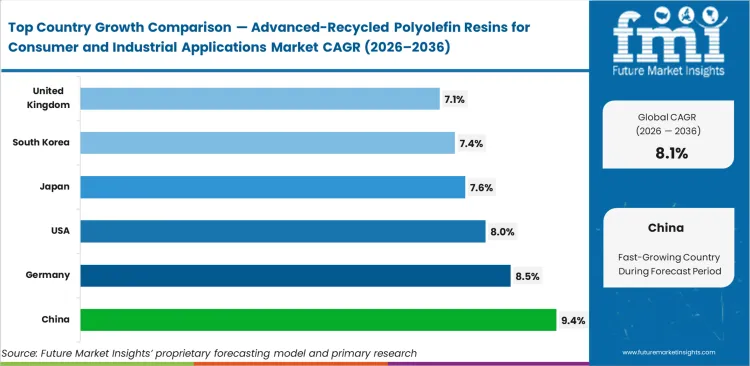
- China leads at a 9.4% CAGR. India follows at a 9.1% CAGR. Germany posts an 8.5% CAGR. The United States registers an 8.0% CAGR. Japan posts a 7.6% CAGR. South Korea tracks at a 7.4% CAGR. The United Kingdom follows at a 7.1% CAGR.
- Feedstock-quality variability, price competition from virgin polyolefins, qualification timelines for higher-spec applications, and uneven collection and sorting infrastructure moderate overall growth.
- Product and Segment View
- The sector covers recycled polyethylene and polypropylene resins, plus selected TPO blends. Production occurs mainly through advanced mechanical upgrading, pyrolysis-linked circular production, and solvent-based purification. Operations sell these materials largely as pellets, compounds, or flakes.
- Buyers use these materials across consumer goods, industrial packaging, automotive parts, and construction products. These buyers want recycled content without giving up process stability.
- The recycled PE segment leads the resin type category with a 55.0% share. The large polyethylene waste stream and broad use in films, containers, and molded goods support this dominant share.
- The advanced mechanical segment leads the recycling route category with a 57.0% share. This share reflects a larger installed base and lower near-term commercialization barrier versus solvent-based and pyrolysis-derived routes.
- The Pellets segment leads the form category with a 64.0% share. Pelletized output is the preferred traded format for extrusion, film, blow molding, and injection molding converters.
- The consumer goods segment leads the application category with a 38.0% share. Consumer-facing producers face the earliest and most visible recycled-content pressure while still demanding upgraded aesthetics and performance.
- The scope includes recycled PE and PP resins for consumer and industrial conversion. It excludes virgin-only polyolefins, non-polyolefin recyclates such as PET, and waste-management services stopping before resin-grade output.
- Geography and Competitive Outlook
- China, India, and Germany are the fastest-growing national markets in this study. The United States remains a stable high-value demand base due to scale, regulation, and advanced-recycling investment.
- Portfolio launches, mass-balance-certified circular grades, converter partnerships, and route diversification between advanced mechanical and chemical recycling shape overall competition.
- Borealis AG, LyondellBasell Industries, SABIC, ExxonMobil, Dow, TotalEnergies, and INEOS Olefins & Polymers Europe are among the key participants. They compete on scale, certification, quality consistency, and downstream converter relationships.
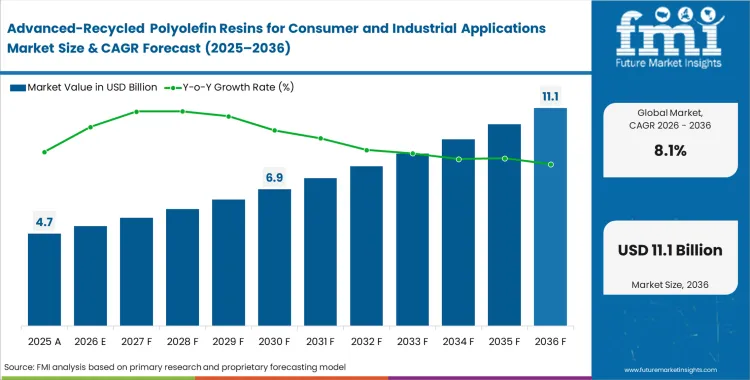
| Metric | Details |
|---|---|
| Industry Size (2026) | USD 4.7 billion |
| Industry Value (2036) | USD 10.2 billion |
| CAGR (2026 to 2036) | 8.1% |
Source: Future Market Insights (FMI) analysis, based on proprietary forecasting model and primary research
Packaging officers employed by large international consumer product companies encounter forthcoming requirements for post-consumer recycled content incorporation. These mandatory regulations necessitate achieving material performance levels equivalent to, and completely indistinguishable from, traditional fossil-fuel-derived alternatives. Selection of advanced recycled polyolefin resins requires prioritizing the consistent melt flow characteristics across production lots, rather than focusing solely on the pure unit cost of the material. Failure to successfully complete this material qualification process within the necessary timeframe introduces significant risks, including potential production line downtime for the packaging operations. It also jeopardizes the achievement of stated corporate sustainability commitments and targets. Procurement departments often overlook a critical purchasing factor. Securing a reliable supply of high-purity material mandates establishing long-term, multi-year offtake agreements with manufacturers. Leading producers of recycled polyolefin resin typically avoid engaging in transactional spot purchases to ensure overall supply chain stability. An economic comparison evaluating advanced recycled polyolefin resin against virgin resin must account for the hidden qualification and validation costs.
The successful commercialization and large-scale deployment of chemically recycled polyolefin resins establish a permanent alteration in the fundamental supply dynamics of the industry. Major, tier-one petrochemical manufacturers are now capable of achieving continuous, high-volume output of these circular economy materials. Downstream product converters possess the capability to integrate these materials without needing to perform costly modifications to their currently installed extrusion processing equipment. Mid-sized processors, choosing to wait for complete regulatory harmonization concerning mass-balance accounting methodologies, find themselves in a precarious position. This hesitation causes difficulty in securing preferential material allocation from the foremost suppliers of ISCC PLUS certified polyolefin resin. Adopting these advanced materials early serves to mitigate the potential for future supply chain disruptions and ensures ongoing, uninterrupted production capacity for essential industrial applications.
Regional growth is projected to diverge structurally from 2026 to 2036, with China forecast to expand at a 9.4% CAGR on the back of chemical recycling platform scale and downstream conversion throughput, Germany estimated to grow at an 8.5% CAGR supported by mature collection efficiency and regulatory enforcement, the United States expected to advance at an 8.0% CAGR driven by state‑level compliance frameworks and infrastructure investment, Japan projected to post a 7.6% CAGR reflecting stringent material qualification regimes and manufacturing precision requirements, South Korea forecast to track at a 7.4% CAGR underpinned by vertically integrated industrial ecosystems, and the United Kingdom estimated to grow at a 7.1% CAGR due to fiscal compliance mechanisms and recycled‑content enforcement through 2036.
Segmental Analysis
Advanced-Recycled Polyolefin Resins for Consumer and Industrial Applications Market Analysis by Resin Type
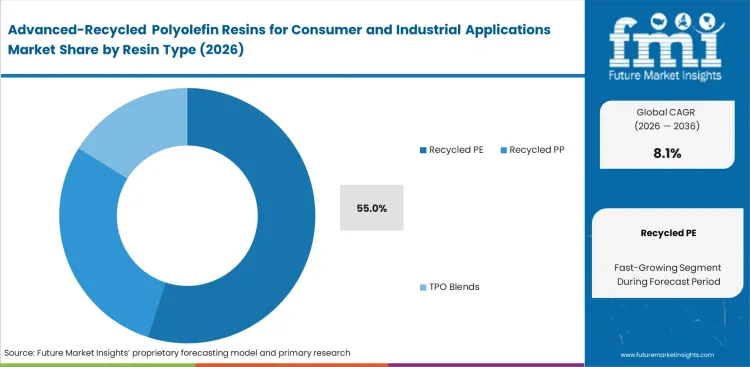
High-density and linear low-density streams dominate post-consumer recovery networks globally. Rigid packaging designers at consumer brands favor these grades. They integrate easily into blow molding lines without catastrophic cycle time losses. Achieving consistent stress-crack resistance requires meticulous sorting before the upgrading phase. Upgraded polyethylene commands a premium. The recycled PE segment holds 55.0% revenue share in 2026, due to massive feedstock availability in film and container streams. Generalists miss a crucial point regarding value. The true value lies entirely in odor volatile reduction rather than mechanical strength. Failing to secure low-odor grades forces formulators to rely on polyolefin odor removal additives. This reliance adds unacceptable margin pressure. Specifying recycled PE for industrial packaging bypasses some sensory constraints. It retains strict drop-impact requirements instead. Manufacturers prioritize material stability guaranteeing flawless continuous production.
- Contamination mitigation: Meticulous sorting and washing remove legacy additives from baled waste. Quality control technicians avoid complete batch rejection.
- Odor profile control: Advanced devolatilization strips out organic residues from previous food contact. Packaging engineers gain materials suitable for sensitive personal care applications.
- Stress-crack resistance: Specialized blending protocols restore mechanical integrity lost during initial product lifetimes. Procurement departments secure reliable materials for demanding rigid container formats.
Advanced-Recycled Polyolefin Resins for Consumer and Industrial Applications Market Analysis by Recycling Route
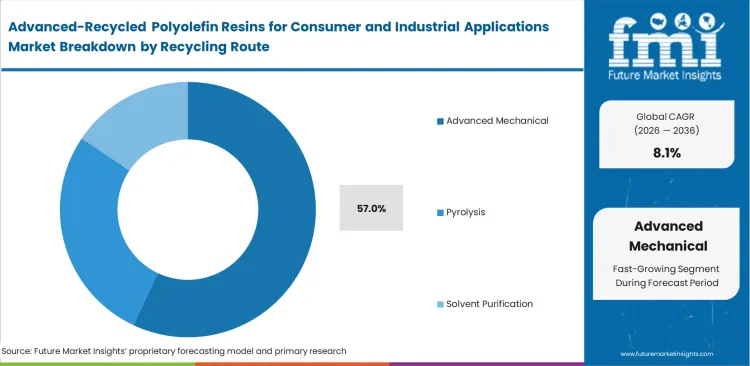
Physical upgrading systems represent the most mature pathway. They convert baled waste into usable material efficiently. The advanced mechanical segment captures a 57.0% share in 2026, owing to massive established footprint and proven commercial reliability. Facility operations managers prefer this route. It avoids immense capital expenditure required for pyrolysis reactors. Securing high-quality rigid bale supply remains the primary operational headache for physical recyclers. The unstated advantage of physical processing involves bypassing ongoing regulatory controversy. This controversy surrounds chemical mass-balance accounting frameworks. Delaying investment in advanced sorting optics leaves recyclers producing low-value dark pellets. These pellets are completely unsuitable for premium applications. Procurement departments comparing advanced mechanical and chemical recycling for polyolefins often overlook a major drawback. They miss the severe yield loss inherent in chemical recycling of multilayer polyolefin films.
- Optical sorting efficiency: Near-infrared sensors separate distinct polymer types at high speeds. Sorting facility managers reduce cross-contamination rates dramatically.
- Intensive hot washing: High-friction washing circuits remove glues and labels from rigid flakes. Plant operators prevent extruder screen-pack blinding during pelletization phases.
- Vacuum devolatilization: Deep vacuum systems extract trapped gases during melt filtration. Extrusion engineers prevent porosity defects in final molded products.
Advanced-Recycled Polyolefin Resins for Consumer and Industrial Applications Market Analysis by Form
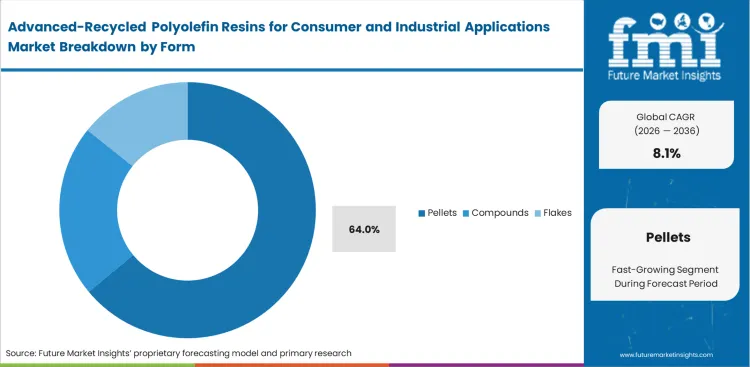
Extrusion and injection molding operations require feedstocks flowing identically to virgin fossil materials. Drop-in compatibility dictates market dominance. Conversion plant managers cannot afford to reconfigure entire material handling systems. Irregular flakes require completely different processing parameters. FMI observes achieving consistent bulk density guarantees smooth feeding into hopper systems. Processors pay substantial premiums for pelletized material on factory floors. This premium prevents retraining machine operators on new temperature profiles. Converters attempting cost reductions by processing raw flakes directly face massive downtime. They experience unacceptable scrap rates during high-speed production runs. The pellets segment holds a dominant 64.0% share in 2026, attributed to essential drop-in compatibility requirements for existing extrusion equipment. Securing reliable recycled polyolefin pellets suppliers for consumer products ensures strict compliance. It guarantees rigorous melt-flow testing for recycled polyolefin compounds for food packaging.
- Melt filtration stabilization: Fine mesh screens capture microscopic contaminants before die faces. Maintenance supervisors avoid catastrophic damage to expensive injection molds.
- Bulk density homogenization: Standardized cutting geometries produce uniform pellet sizes. Logistics managers optimize silo storage and pneumatic conveying systems.
- Lot-to-lot blending: Large homogenization silos mix multiple batches averaging out property variations. Quality assurance departments guarantee consistent shrinkage rates for molded parts.
Advanced-Recycled Polyolefin Resins for Consumer and Industrial Applications Market Analysis by Application
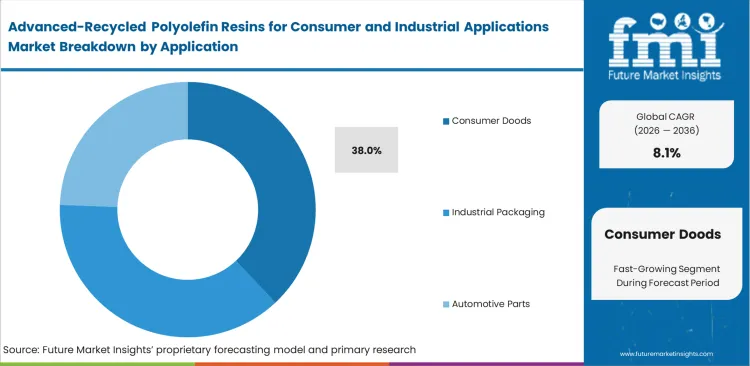
Intense regulatory scrutiny and public sustainability pledges force fast-moving brand owners to substitute fossil plastics aggressively. This intense pressure propels segment growth rapidly. Packaging procurement departments must secure reliable volumes of upgraded resins to meet corporate 2030 targets. Passing European Food Safety Authority evaluations remains the critical barrier for food-contact applications. Consumer demand is practically infinite today. The consumer goods segment accounts for 38.0% share in 2026, owing to immense pressure from sustainability pledges and immediate regulatory mandates. Actual adoption is severely constrained by global shortages of food-grade certified supply. Brands failing to secure long-term offtake agreements miss compliance deadlines. They face potential access restrictions in heavily regulated jurisdictions. Analyzing flexible film PCR for personal care presents distinct contamination challenges. Sourcing recycled PP for automotive parts faces similar qualification hurdles regarding long-term thermal stability.
- Food-contact qualification: Stringent challenge testing proves processing removes intentional contaminants. Regulatory compliance officers secure necessary approvals for direct food packaging.
- Aesthetic color matching: High-purity natural or white pellets allow for precise masterbatch coloring. Brand managers maintain visual consistency across global product lines.
- Drop-impact performance: Specialized formulations ensure bottles survive logistics and retail handling. Supply chain departments avoid costly product loss and retailer chargebacks.
Advanced-Recycled Polyolefin Resins for Consumer and Industrial Applications Market Drivers, Restraints, and Opportunities
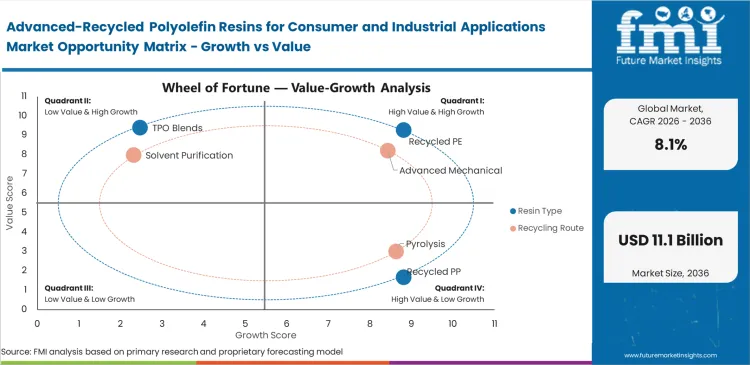
State-level post-consumer content mandates force rigid packaging designers to act immediately. They must qualify circular polyolefin resins to maintain market access. Procurement departments at multinational consumer brands treat recycled material as a strict requirement. It serves as a license to operate in key regions. Delaying qualification of these advanced materials risks outright exclusion. It also risks severe financial penalties under evolving extended producer responsibility frameworks. The rapid approach of legislative deadlines creates massive urgency. Conversion facilities scramble to lock in dedicated supply from tier-one petrochemical producers. They act before competitors absorb all available premium-grade capacity. Long-term agreements are essential to secure continuous high-quality production runs.
Severe lot-to-lot inconsistency in melt flow indexes slows adoption. Plant managers encounter massive friction running variable batches on high-speed lines. These lines are optimized for highly predictable fossil-derived resins. This variation forces constant temperature and pressure adjustments by machine operators. These frequent changes destroy production economics and reduce overall throughput. Blending strategies provide a partial fix for these manufacturing issues. They require substantial onsite silo infrastructure. Many mid-tier converters lack this specialized equipment entirely. This equipment deficit limits their processing capabilities preventing them from entering premium sustainable markets.
Opportunities in the Advanced-Recycled Polyolefin Resins for Consumer and Industrial Applications Market
- Mass balance polyolefin resins: Scaling pyrolysis and solvent purification allows petrochemical firms to offer virgin-equivalent certified materials. Polymer scientists overcome mechanical limitations associated with traditional processing. These breakthroughs enable broader application possibilities.
- Closed-loop supply partnerships: Establishing direct waste recovery agreements with major retailers guarantees consistent feedstock. Facility managers insulate operations from spot-market price volatility. This strategy secures closed loop recycled polymers auto components.
- Construction material substitution: Specifying recycled polyolefin for construction products opens massive volume channels. Sourcing departments seeking alternatives gain viable low-cost options. These non-aesthetic applications absorb large quantities of lower-grade recycled output.
Regional Analysis
Based on regional analysis, the advanced-recycled polyolefin resins for consumer and industrial applications market is segmented into North America, Europe, Asia Pacific, Latin America, and Middle East & Africa.
.webp "Top Country Growth Comparison Advanced Recycled Polyolefin Resins For Consumer And Industrial Applications Market Cagr (2026 2036)")
| Country | CAGR (2026 to 2036) |
|---|---|
| China | 9.4% |
| Germany | 8.5% |
| United States | 8.0% |
| Japan | 7.6% |
| South Korea | 7.4% |
| United Kingdom | 7.1% |
Source: Future Market Insights (FMI) analysis, based on proprietary forecasting model and primary research
North America Advanced-Recycled Polyolefin Resins for Consumer and Industrial Applications Market Analysis
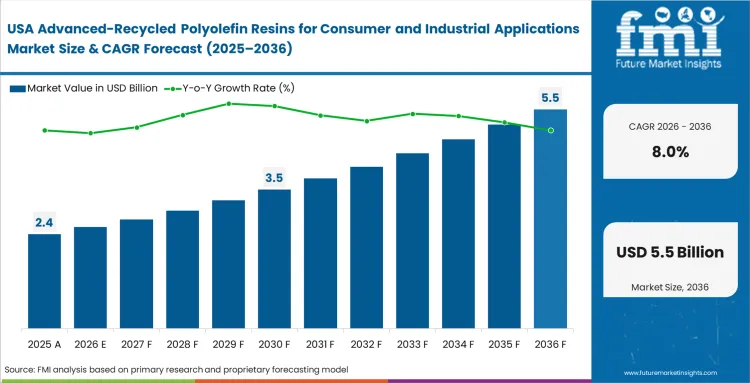
Accelerating state-level post-consumer content laws drive a fragmented but highly lucrative regulatory environment. Packaging procurement departments navigate conflicting requirements across different jurisdictions. These departments default to the strictest available standards to ensure compliance. FMI analysis indicates massive investments by tier-one petrochemical producers and focus on scaling advanced chemical complexes along the Gulf Coast. Finding sufficient high-quality bale supply domestically remains a critical bottleneck. Finding this supply impacts mechanical recyclers operating outside major metropolitan centers significantly. These geographic constraints shape the overall regional investment strategy toward mass-balance systems.
- United States: Legislative mandates in key states force multinational brands to reformulate primary packaging architectures. The United States sector is growing at an 8.0% CAGR, owing to state-level infrastructure investments and strict packaging regulations. Polymer scientists ensure blending recycled resins does not compromise high-speed filling performance. Relying heavily on chemical platforms allows domestic suppliers to promise virgin-like performance for demanding applications.
Europe Advanced-Recycled Polyolefin Resins for Consumer and Industrial Applications Market Analysis
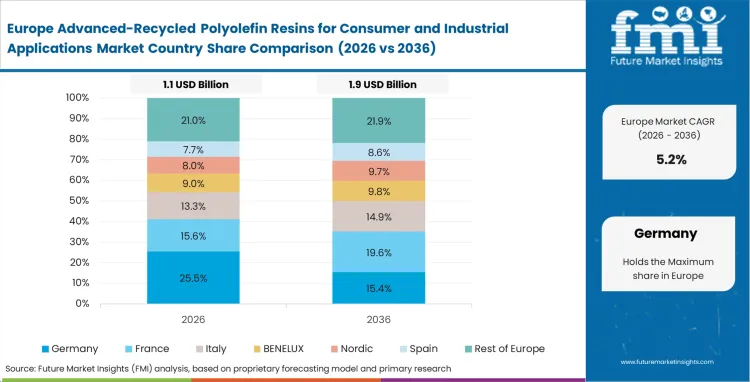
Circularity mandates from Brussels define the substitution pace across every major industrial sector. Compliance officers prioritize physical traceability and rigorous certification over simple cost considerations. Installed physical upgrading capacity is highly mature across the continent. This maturity pushes the region to focus heavily on chemical pathways. These pathways handle complex multilayer flexible waste efficiently. Securing ISCC PLUS certification is a strict prerequisite. Suppliers need it to sell into premium consumer packaging tiers. Regional governments strictly enforce these new documentation standards across the supply chain.
- Germany: Germany sector revenue expands at an 8.5% CAGR, and this expansion depends on highly efficient municipal sorting infrastructure and strict government policies. Mature collection systems provide a stable baseline of sorted waste for advanced upgrading facilities. Rigid packaging designers leverage high-quality feedstock pushing inclusion rates well above mandated minimums. The robust ecosystem positions local firms as primary exporters of premium food-grade recyclates.
- United Kingdom: The United Kingdom revenue is growing at a 7.1% CAGR, and this steady advance is supported by explicit fiscal mechanisms driving corporate behavioral changes. Plastic packaging tax implementation creates direct financial penalties. These penalties punish companies relying solely on virgin fossil resins. Financial controllers push procurement teams exceeding nearly 30.0% recycled content thresholds optimizing tax liabilities. Explicit fiscal mechanisms accelerate adoption far faster than voluntary corporate pledges achieved historically.
Asia Pacific Advanced-Recycled Polyolefin Resins for Consumer and Industrial Applications Market Analysis
Huge domestic conversion scale intersects directly with rapid state-backed investments in chemical infrastructure. Major petrochemical producers race to commercialize pyrolysis operations. These operations feed the immense regional electronics and packaging sectors. Facility operations managers prioritize securing certification to satisfy export requirements. Upgrading capabilities vary wildly between tier-one integrated facilities and smaller regional processors. Integrating design for recycling packaging principles represents the next technical frontier. Regional contract manufacturers demand flawless cosmetic finishes to satisfy global electronics brands completely.
- China: Rapid build-outs of pyrolysis infrastructure provide vital feedstocks for massive plastics processing sectors. China revenue surges at a 9.4% CAGR, fueled by massive state-backed investments in chemical recycling mega-facilities. Procurement officers at contract manufacturers require traceable resins satisfying international client demands. Domestic suppliers validating mass-balance tracking systems gain immediate preferential supplier status globally.
- Japan: Stringent quality expectations dictate slow but highly systematic qualification processes for advanced recyclates. Packaging engineers demand flawless aesthetic properties before approving substitution for virgin material. This rigorous environment forces local suppliers to perfect devolatilization and optical sorting technologies. Japan expands at a 7.6% CAGR, supported by uncompromising domestic quality standards and high-end technological integration.
- South Korea: South Korea registers a 7.4% CAGR, and this increase depends on vertical integration by domestic industrial conglomerates. Major chaebols integrate petrochemical production with waste management networks securing dedicated supply loops. Corporate strategy departments leverage closed ecosystems guaranteeing consistent feedstock for premium applications. This vertical integration creates high barriers to entry for independent recycling firms.
Competitive Aligners for Market Players
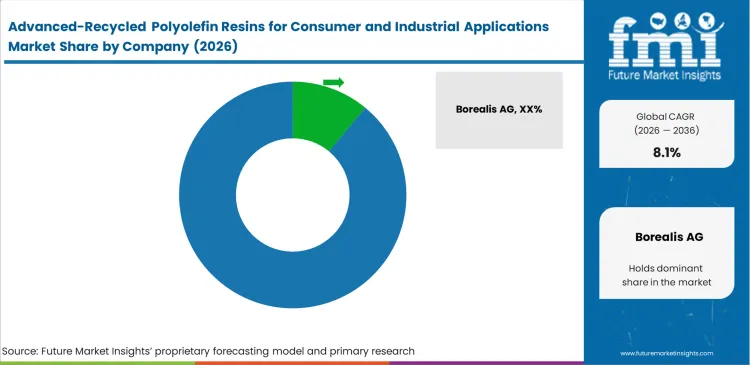
Competition in this sector diverges fundamentally from traditional virgin polymer production. Securing consistent feedstock is vastly more complex than piping in natural gas. Companies leverage massive balance sheets acquiring specialized mechanical recycling firms. They move aggressively internalizing waste streams. Procurement departments at major converters base vendor selections on supply security. They prioritize lot-to-lot melt flow consistency rather than pure spot pricing. The capacity guaranteeing long-term volumes of food-grade certified material creates a massive moat. This moat protects against smaller independent operations. Tracking advanced recycled polyolefin resin key players reveals rapid consolidation.
Established petrochemical giants possess overwhelming advantages blending recycled streams with massive volumes. This virgin resin blending masks slight impurities efficiently. These incumbents deploy proprietary recyclable polyolefin impact modifiers. These modifiers correct mechanical deficiencies inherent in multiple-pass post-consumer plastics. Pure-play recycling challengers face an uphill battle. They must build sophisticated optical sorting and devolatilization capabilities. They do this simply producing base resin accepted on trial bases. Building reliable uncontaminated bale supply networks takes years of relationship building.
Large multinational packaging converters resist becoming captive to a single chemical platform. They aggressively qualify multiple mass-balance suppliers simultaneously. These buyers utilize immense purchasing leverage forcing suppliers into transparent pricing models. This strategy decouples recycled premiums from volatile fossil feedstock indices. Regional physical recyclers perfect highly specific applications to survive. Low-odor grades for cosmetics help them carve out defensible niches. Tier-one producers find these specialized niches too small to target effectively. Reviewing advanced recycled polyolefin resin segmentation strategies shows specialized applications yield higher margins.
Key Players in Advanced-Recycled Polyolefin Resins for Consumer and Industrial Applications Market
- Borealis AG
- LyondellBasell Industries
- SABIC
- ExxonMobil
- Dow
- TotalEnergies
- INEOS Olefins & Polymers Europe
Scope of the Report
| Metric | Value |
|---|---|
| Quantitative Units | USD 4.7 billion to USD 10.2 billion, at a CAGR of 8.1% |
| Market Definition | Advanced-recycled polyolefins constitute polyethylene and polypropylene recovered from waste and upgraded to near-virgin quality. These resins bridge raw waste recovery and demanding industrial conversion. |
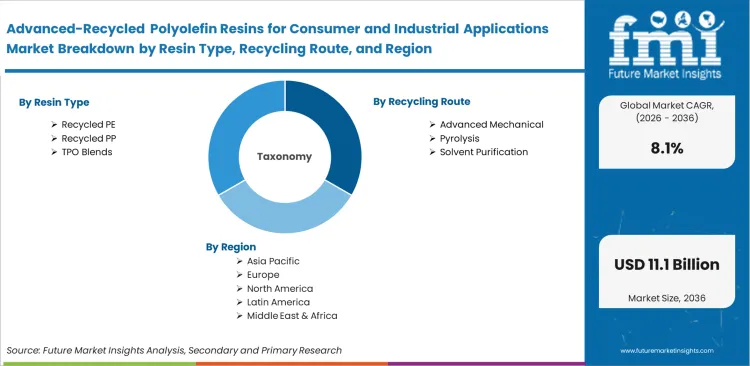
| Segmentation | Resin Type, Recycling Route, Form, Application, and Region |
| Regions Covered | North America, Europe, Asia Pacific, Latin America, Middle East & Africa |
| Countries Covered | United States, Canada, Germany, United Kingdom, France, Italy, Spain, China, Japan, South Korea, Taiwan, Singapore, Brazil, Mexico, Argentina, GCC Countries, South Africa, Israel, Rest of Middle East & Africa |
| Key Companies Profiled | Borealis AG, LyondellBasell Industries, SABIC, ExxonMobil, Dow, TotalEnergies, INEOS Olefins & Polymers Europe |
| Forecast Period | 2026 to 2036 |
| Approach | Installed chemical and physical upgrading capacity baselines |
Source: Future Market Insights (FMI) analysis, based on proprietary forecasting model and primary research
Advanced-Recycled Polyolefin Resins for Consumer and Industrial Applications Market Analysis by Segments
Resin Type
- Recycled PE
- Recycled PP
- TPO Blends
Recycling Route
- Advanced Mechanical
- Pyrolysis
- Solvent Purification
Form
- Pellets
- Compounds
- Flakes
Application
- Consumer Goods
- Industrial Packaging
- Automotive Parts
- Construction Products
Region
- North America
- United States
- Canada
- Europe
- Germany
- United Kingdom
- France
- Italy
- Spain
- Asia Pacific
- China
- Japan
- South Korea
- Taiwan
- Singapore
- Latin America
- Brazil
- Mexico
- Argentina
- Middle East & Africa
- GCC Countries
- South Africa
- Israel
- Rest of Middle East & Africa
Bibliography
- SABIC. (2024, May). NPE2024: SABIC showcasing progress in plastic innovation for a more sustainable future. SABIC.
- USA Environmental Protection Agency. (2024, November). National strategy to prevent plastic pollution. USA EPA.
- European Commission. (2025, February). Commission Notice - Application of Regulation (EU) 2025/40 of the European Parliament and of the Council on packaging and packaging waste. EUR-Lex.
- USA Food and Drug Administration. (2025, November). Submissions on post-consumer recycled (PCR) plastics for food-contact articles.
- European Food Safety Authority. (2026, February). Recycled plastic materials. EFSA.
- Cecon, V. S., Pham, T., Curtzwiler, G., & Vorst, K. (2024, October). Assessment of Different Application Grades of Post-Consumer Recycled (PCR) Polyolefins from Material Recovery Facilities (MRFs) in the United States. ACS Applied Polymer Materials, 6(21).
This bibliography is provided for reader reference. The full FMI report contains the complete reference list with primary source documentation.
This Report Addresses
- Supply security dynamics regarding fast-moving consumer goods packaging procurement.
- Lot-to-lot melt flow consistency challenges affecting high-speed extrusion lines.
- Mass-balance certification bottlenecks constraining chemical recycling commercialization.
- Odor devolatilization requirements concerning premium personal care packaging applications.
- Post-consumer rigid bale sourcing constraints facing mechanical upcycling facilities.
- Food-contact qualification hurdles limiting European rigid packaging converters.
- Vertical integration strategies by petrochemical giants acquiring recycling operators.
- Pricing decoupling between physical traceable resins and fossil feedstock indices.
Frequently Asked Questions
What are advanced recycled polyolefin resins?
They represent processed polyethylene and polypropylene waste streams upgraded through physical or chemical pathways to approach virgin-like specifications. This bridges post-consumer plastic recovery and high-performance downstream conversion.
How big is the advanced recycled polyolefin resins sector in 2026?
FMI assesses demand at USD 4.7 billion in 2026. This figure signals a permanent shift where major consumer brands move from voluntary pilot projects to mandated procurement of traceable circular polymers across primary product lines.
What is the CAGR of advanced recycled polyolefin resins from 2026 to 2036?
Sales are poised to expand at an 8.1% CAGR through 2036. This trajectory reflects massive capital deployment required scaling pyrolysis and solvent purification infrastructure capable of meeting stringent purity requirements.
What is the difference between advanced mechanical and chemical recycling for polyolefins?
Physical upgrading relies on high-friction washing and optical sorting to decontaminate plastics. Chemical pathways break down polymers into molecular feedstocks to rebuild entirely new resins via mass-balance accounting.
Which resin type leads in advanced recycled polyolefin resin segmentation?
Recycled PE holds a commanding 55.0% position. Massive feedstock availability from existing rigid container and film recovery networks provides necessary raw material scale for profitable continuous operations.
Which countries are growing fastest in advanced recycled polyolefin resins demand?
China leads at a 9.4% CAGR driven by rapid state-backed infrastructure build-outs. Germany advances strongly fueled by mature collection systems forcing fast-moving consumer goods companies to secure traceable recyclates.
Which companies lead as advanced recycled polyolefin resin key players?
Borealis AG, LyondellBasell Industries, SABIC, ExxonMobil, Dow, TotalEnergies, and INEOS Olefins & Polymers Europe dominate by leveraging massive balance sheets to internalize waste streams and offer mass-balance certified products.
Why is advanced recycled resin demand in consumer goods rising?
Intense regulatory pressure and public sustainability pledges force brand owners substituting fossil plastics aggressively. Packaging procurement departments must secure reliable volumes avoiding market access restrictions in heavily legislated jurisdictions.
Can advanced recycled polyolefins replace virgin plastics in high-spec applications?
Yes, substitution requires meticulous lot-to-lot melt flow testing and devolatilization to prevent odor transfer. Chemical pathways offer virgin-equivalent performance via mass-balance tracking, completely bypassing sensory limitations of physical recycling.
What are the key challenges in scaling advanced recycled PE and PP?
Severe inconsistency in batch-to-batch melt flow properties creates massive headaches for machine operators. Processing variable recycled flakes on lines optimized for highly predictable fossil-derived resins destroys production economics.
Why do converters prefer pelletized form factors?
Extrusion and injection molding plant managers absolutely require standardized bulk density and consistent melt filtration. This avoids catastrophic downtime on high-speed manufacturing equipment designed for uniform virgin pellets.
What is the true bottleneck in the supply chain?
Generalists assume overall collection volume limits growth. Actual constraints involve severe shortages of food-grade certified output. Odor profiles and mechanical inconsistencies eliminate vast majorities of physically recycled batches from high-value applications.
How do mass-balance tracking systems benefit suppliers?
Validating tracking systems allows domestic suppliers to gain immediate preferential status with global electronics brands. It provides recognized mechanisms claiming circularity without requiring dedicated physically segregated manufacturing lines.
Why is ISCC PLUS certification critical in Europe?
Compliance officers prioritize rigorous mass-balance certification over simple cost considerations. Securing this specific verification is a non-negotiable prerequisite for any petrochemical supplier attempting to sell chemically processed output into premium packaging tiers.
How does the United Kingdom tax policy impact procurement?
Explicit plastic packaging taxes create direct financial penalties relying on fossil resins. Financial controllers actively push procurement teams exceeding 30.0% recycled content thresholds, optimizing tax liabilities and accelerating adoption faster than voluntary pledges.
What risk do brand owners face without long-term offtake agreements?
Companies relying solely on spot availability miss 2030 compliance deadlines. Premium-grade capacity remains highly constrained. Securing dedicated supply loops ensures uninterrupted production of compliant packaging.
Why is drop-impact performance crucial for rigid packaging?
Specialized formulations must ensure containers survive complex logistics and retail handling. Supply chain departments reject any recycled blend compromising integrity, seeking to avoid costly product loss and retailer chargebacks.
How do suppliers correct mechanical deficiencies in post-consumer plastics?
Incumbent producers deploy proprietary impact modifiers and blending protocols restoring integrity lost during initial product lifecycles. This capability allows offering resins approaching virgin-like specifications.
What dictates the slow qualification process in Japan?
Stringent quality expectations demand flawless aesthetic properties before engineers approve substitution. This rigorous environment forces local recycling operations perfecting washing and devolatilization technologies meeting uncompromising domestic standards.
What makes securing high-purity supply a multi-year challenge?
Buyers fight over very small pools of genuinely virgin-like material. Until chemical plants achieve continuous stable runs, procurement teams lock in future capacity today guaranteeing material availability for strict legislative deadlines.
How do mid-tier converters secure adequate supply?
Smaller processors struggle winning allocation from major integrated suppliers. They cultivate deep relationships with regional physical recyclers perfecting highly specific applications, ensuring reliable delivery outside tier-one networks.
What role does optical sorting play in profitability?
Near-infrared sensors determine the ultimate value of output. Facility managers underinvesting in precise polymer separation produce low-value mixed dark pellets, missing out completely on massive premiums commanded by natural and white grades.
Preview the report firsthand - request a free sample
Get SampleGet the brochure for pricing and purchase details.
Get PDFTable of Content
- Executive Summary
- Global Market Outlook
- Demand-side Trends
- Supply-side Trends
- Technology Roadmap Analysis
- Analysis and Recommendations
- Market Overview
- Market Coverage / Taxonomy
- Market Definition / Scope / Limitations
- Research Methodology
- Chapter Orientation
- Analytical Lens and Working Hypotheses
- Market Structure, Signals, and Trend Drivers
- Benchmarking and Cross-market Comparability
- Market Sizing, Forecasting, and Opportunity Mapping
- Research Design and Evidence Framework
- Desk Research Programme (Secondary Evidence)
- Company Annual and Sustainability Reports
- Peer-reviewed Journals and Academic Literature
- Corporate Websites, Product Literature, and Technical Notes
- Earnings Decks and Investor Briefings
- Statutory Filings and Regulatory Disclosures
- Technical White Papers and Standards Notes
- Trade Journals, Industry Magazines, and Analyst Briefs
- Conference Proceedings, Webinars, and Seminar Materials
- Government Statistics Portals and Public Data Releases
- Press Releases and Reputable Media Coverage
- Specialist Newsletters and Curated Briefings
- Sector Databases and Reference Repositories
- FMI Internal Proprietary Databases and Historical Market Datasets
- Subscription Datasets and Paid Sources
- Social Channels, Communities, and Digital Listening Inputs
- Additional Desk Sources
- Expert Input and Fieldwork (Primary Evidence)
- Primary Modes
- Qualitative Interviews and Expert Elicitation
- Quantitative Surveys and Structured Data Capture
- Blended Approach
- Why Primary Evidence is Used
- Field Techniques
- Interviews
- Surveys
- Focus Groups
- Observational and In-context Research
- Social and Community Interactions
- Stakeholder Universe Engaged
- C-suite Leaders
- Board Members
- Presidents and Vice Presidents
- R&D and Innovation Heads
- Technical Specialists
- Domain Subject-matter Experts
- Scientists
- Physicians and Other Healthcare Professionals
- Governance, Ethics, and Data Stewardship
- Research Ethics
- Data Integrity and Handling
- Primary Modes
- Tooling, Models, and Reference Databases
- Desk Research Programme (Secondary Evidence)
- Data Engineering and Model Build
- Data Acquisition and Ingestion
- Cleaning, Normalisation, and Verification
- Synthesis, Triangulation, and Analysis
- Quality Assurance and Audit Trail
- Market Background
- Market Dynamics
- Drivers
- Restraints
- Opportunity
- Trends
- Scenario Forecast
- Demand in Optimistic Scenario
- Demand in Likely Scenario
- Demand in Conservative Scenario
- Opportunity Map Analysis
- Product Life Cycle Analysis
- Supply Chain Analysis
- Investment Feasibility Matrix
- Value Chain Analysis
- PESTLE and Porter’s Analysis
- Regulatory Landscape
- Regional Parent Market Outlook
- Production and Consumption Statistics
- Import and Export Statistics
- Market Dynamics
- Global Market Analysis 2021 to 2025 and Forecast, 2026 to 2036
- Historical Market Size Value (USD Million) Analysis, 2021 to 2025
- Current and Future Market Size Value (USD Million) Projections, 2026 to 2036
- Y-o-Y Growth Trend Analysis
- Absolute $ Opportunity Analysis
- Global Market Pricing Analysis 2021 to 2025 and Forecast 2026 to 2036
- Global Market Analysis 2021 to 2025 and Forecast 2026 to 2036, By Resin Type
- Introduction / Key Findings
- Historical Market Size Value (USD Million) Analysis By Resin Type , 2021 to 2025
- Current and Future Market Size Value (USD Million) Analysis and Forecast By Resin Type , 2026 to 2036
- Recycled PE
- Recycled PP
- TPO Blends
- Recycled PE
- Y-o-Y Growth Trend Analysis By Resin Type , 2021 to 2025
- Absolute $ Opportunity Analysis By Resin Type , 2026 to 2036
- Global Market Analysis 2021 to 2025 and Forecast 2026 to 2036, By Recycling Route
- Introduction / Key Findings
- Historical Market Size Value (USD Million) Analysis By Recycling Route, 2021 to 2025
- Current and Future Market Size Value (USD Million) Analysis and Forecast By Recycling Route, 2026 to 2036
- Advanced Mechanical
- Pyrolysis
- Solvent Purification
- Advanced Mechanical
- Y-o-Y Growth Trend Analysis By Recycling Route, 2021 to 2025
- Absolute $ Opportunity Analysis By Recycling Route, 2026 to 2036
- Global Market Analysis 2021 to 2025 and Forecast 2026 to 2036, By Form
- Introduction / Key Findings
- Historical Market Size Value (USD Million) Analysis By Form, 2021 to 2025
- Current and Future Market Size Value (USD Million) Analysis and Forecast By Form, 2026 to 2036
- Pellets
- Compounds
- Flakes
- Pellets
- Y-o-Y Growth Trend Analysis By Form, 2021 to 2025
- Absolute $ Opportunity Analysis By Form, 2026 to 2036
- Global Market Analysis 2021 to 2025 and Forecast 2026 to 2036, By Application
- Introduction / Key Findings
- Historical Market Size Value (USD Million) Analysis By Application, 2021 to 2025
- Current and Future Market Size Value (USD Million) Analysis and Forecast By Application, 2026 to 2036
- Consumer Doods
- Industrial Packaging
- Automotive Parts
- Consumer Doods
- Y-o-Y Growth Trend Analysis By Application, 2021 to 2025
- Absolute $ Opportunity Analysis By Application, 2026 to 2036
- Global Market Analysis 2021 to 2025 and Forecast 2026 to 2036, By Region
- Introduction
- Historical Market Size Value (USD Million) Analysis By Region, 2021 to 2025
- Current Market Size Value (USD Million) Analysis and Forecast By Region, 2026 to 2036
- North America
- Latin America
- Western Europe
- Eastern Europe
- East Asia
- South Asia and Pacific
- Middle East & Africa
- Market Attractiveness Analysis By Region
- North America Market Analysis 2021 to 2025 and Forecast 2026 to 2036, By Country
- Historical Market Size Value (USD Million) Trend Analysis By Market Taxonomy, 2021 to 2025
- Market Size Value (USD Million) Forecast By Market Taxonomy, 2026 to 2036
- By Country
- USA
- Canada
- Mexico
- By Resin Type
- By Recycling Route
- By Form
- By Application
- By Country
- Market Attractiveness Analysis
- By Country
- By Resin Type
- By Recycling Route
- By Form
- By Application
- Key Takeaways
- Latin America Market Analysis 2021 to 2025 and Forecast 2026 to 2036, By Country
- Historical Market Size Value (USD Million) Trend Analysis By Market Taxonomy, 2021 to 2025
- Market Size Value (USD Million) Forecast By Market Taxonomy, 2026 to 2036
- By Country
- Brazil
- Chile
- Rest of Latin America
- By Resin Type
- By Recycling Route
- By Form
- By Application
- By Country
- Market Attractiveness Analysis
- By Country
- By Resin Type
- By Recycling Route
- By Form
- By Application
- Key Takeaways
- Western Europe Market Analysis 2021 to 2025 and Forecast 2026 to 2036, By Country
- Historical Market Size Value (USD Million) Trend Analysis By Market Taxonomy, 2021 to 2025
- Market Size Value (USD Million) Forecast By Market Taxonomy, 2026 to 2036
- By Country
- Germany
- UK
- Italy
- Spain
- France
- Nordic
- BENELUX
- Rest of Western Europe
- By Resin Type
- By Recycling Route
- By Form
- By Application
- By Country
- Market Attractiveness Analysis
- By Country
- By Resin Type
- By Recycling Route
- By Form
- By Application
- Key Takeaways
- Eastern Europe Market Analysis 2021 to 2025 and Forecast 2026 to 2036, By Country
- Historical Market Size Value (USD Million) Trend Analysis By Market Taxonomy, 2021 to 2025
- Market Size Value (USD Million) Forecast By Market Taxonomy, 2026 to 2036
- By Country
- Russia
- Poland
- Hungary
- Balkan & Baltic
- Rest of Eastern Europe
- By Resin Type
- By Recycling Route
- By Form
- By Application
- By Country
- Market Attractiveness Analysis
- By Country
- By Resin Type
- By Recycling Route
- By Form
- By Application
- Key Takeaways
- East Asia Market Analysis 2021 to 2025 and Forecast 2026 to 2036, By Country
- Historical Market Size Value (USD Million) Trend Analysis By Market Taxonomy, 2021 to 2025
- Market Size Value (USD Million) Forecast By Market Taxonomy, 2026 to 2036
- By Country
- China
- Japan
- South Korea
- By Resin Type
- By Recycling Route
- By Form
- By Application
- By Country
- Market Attractiveness Analysis
- By Country
- By Resin Type
- By Recycling Route
- By Form
- By Application
- Key Takeaways
- South Asia and Pacific Market Analysis 2021 to 2025 and Forecast 2026 to 2036, By Country
- Historical Market Size Value (USD Million) Trend Analysis By Market Taxonomy, 2021 to 2025
- Market Size Value (USD Million) Forecast By Market Taxonomy, 2026 to 2036
- By Country
- India
- ASEAN
- Australia & New Zealand
- Rest of South Asia and Pacific
- By Resin Type
- By Recycling Route
- By Form
- By Application
- By Country
- Market Attractiveness Analysis
- By Country
- By Resin Type
- By Recycling Route
- By Form
- By Application
- Key Takeaways
- Middle East & Africa Market Analysis 2021 to 2025 and Forecast 2026 to 2036, By Country
- Historical Market Size Value (USD Million) Trend Analysis By Market Taxonomy, 2021 to 2025
- Market Size Value (USD Million) Forecast By Market Taxonomy, 2026 to 2036
- By Country
- Kingdom of Saudi Arabia
- Other GCC Countries
- Turkiye
- South Africa
- Other African Union
- Rest of Middle East & Africa
- By Resin Type
- By Recycling Route
- By Form
- By Application
- By Country
- Market Attractiveness Analysis
- By Country
- By Resin Type
- By Recycling Route
- By Form
- By Application
- Key Takeaways
- Key Countries Market Analysis
- USA
- Pricing Analysis
- Market Share Analysis, 2025
- By Resin Type
- By Recycling Route
- By Form
- By Application
- Canada
- Pricing Analysis
- Market Share Analysis, 2025
- By Resin Type
- By Recycling Route
- By Form
- By Application
- Mexico
- Pricing Analysis
- Market Share Analysis, 2025
- By Resin Type
- By Recycling Route
- By Form
- By Application
- Brazil
- Pricing Analysis
- Market Share Analysis, 2025
- By Resin Type
- By Recycling Route
- By Form
- By Application
- Chile
- Pricing Analysis
- Market Share Analysis, 2025
- By Resin Type
- By Recycling Route
- By Form
- By Application
- Germany
- Pricing Analysis
- Market Share Analysis, 2025
- By Resin Type
- By Recycling Route
- By Form
- By Application
- UK
- Pricing Analysis
- Market Share Analysis, 2025
- By Resin Type
- By Recycling Route
- By Form
- By Application
- Italy
- Pricing Analysis
- Market Share Analysis, 2025
- By Resin Type
- By Recycling Route
- By Form
- By Application
- Spain
- Pricing Analysis
- Market Share Analysis, 2025
- By Resin Type
- By Recycling Route
- By Form
- By Application
- France
- Pricing Analysis
- Market Share Analysis, 2025
- By Resin Type
- By Recycling Route
- By Form
- By Application
- India
- Pricing Analysis
- Market Share Analysis, 2025
- By Resin Type
- By Recycling Route
- By Form
- By Application
- ASEAN
- Pricing Analysis
- Market Share Analysis, 2025
- By Resin Type
- By Recycling Route
- By Form
- By Application
- Australia & New Zealand
- Pricing Analysis
- Market Share Analysis, 2025
- By Resin Type
- By Recycling Route
- By Form
- By Application
- China
- Pricing Analysis
- Market Share Analysis, 2025
- By Resin Type
- By Recycling Route
- By Form
- By Application
- Japan
- Pricing Analysis
- Market Share Analysis, 2025
- By Resin Type
- By Recycling Route
- By Form
- By Application
- South Korea
- Pricing Analysis
- Market Share Analysis, 2025
- By Resin Type
- By Recycling Route
- By Form
- By Application
- Russia
- Pricing Analysis
- Market Share Analysis, 2025
- By Resin Type
- By Recycling Route
- By Form
- By Application
- Poland
- Pricing Analysis
- Market Share Analysis, 2025
- By Resin Type
- By Recycling Route
- By Form
- By Application
- Hungary
- Pricing Analysis
- Market Share Analysis, 2025
- By Resin Type
- By Recycling Route
- By Form
- By Application
- Kingdom of Saudi Arabia
- Pricing Analysis
- Market Share Analysis, 2025
- By Resin Type
- By Recycling Route
- By Form
- By Application
- Turkiye
- Pricing Analysis
- Market Share Analysis, 2025
- By Resin Type
- By Recycling Route
- By Form
- By Application
- South Africa
- Pricing Analysis
- Market Share Analysis, 2025
- By Resin Type
- By Recycling Route
- By Form
- By Application
- USA
- Market Structure Analysis
- Competition Dashboard
- Competition Benchmarking
- Market Share Analysis of Top Players
- By Regional
- By Resin Type
- By Recycling Route
- By Form
- By Application
- Competition Analysis
- Competition Deep Dive
- Borealis AG
- Overview
- Product Portfolio
- Profitability by Market Segments (Product/Age /Sales Channel/Region)
- Sales Footprint
- Strategy Overview
- Marketing Strategy
- Product Strategy
- Channel Strategy
- LyondellBasell Industries
- SABIC
- ExxonMobil
- Dow
- TotalEnergies
- Borealis AG
- Competition Deep Dive
- Assumptions & Acronyms Used


