

- Industry Size (2026)
- USD 4.6 Bn
- Forecast (2036)
- USD 10.3 Bn
- CAGR (2026 to 2036)
- 8.4%
Certified Circular Polyolefin Packaging Resins Market Outlook and Forecast 2026 to 2036
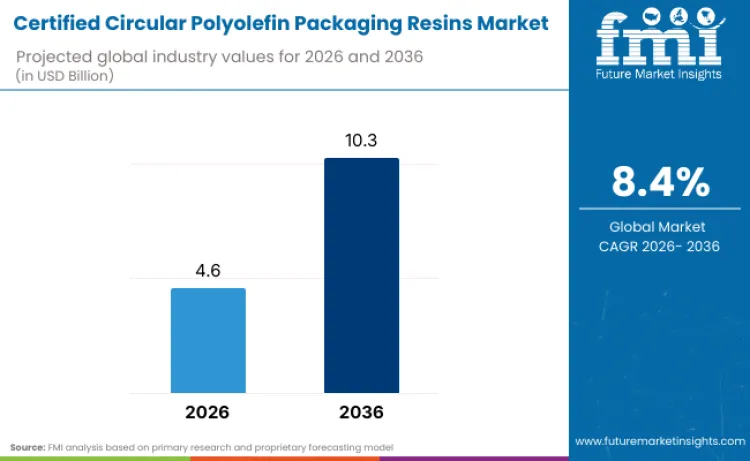
The certified circular polyolefin packaging resins market will likely total USD 4.6 billion in 2026, and is expected to increase to USD 10.3 billion by 2036, registering a CAGR of 8.4%. FMI forecasts that this industry is moving away from its earlier positioning as a sustainability-driven niche and is now establishing itself as a structurally relevant growth segment within the plastics and packaging industry.
By 2026, large brand owners, reshaping demand behaviour and guiding supply-side investment decisions, are influencing less by voluntary commitments and more by the combined effects of regulatory enforcement and strategic adoption the market’s direction.
A major inflection point for the market is the enforcement of new regulatory frameworks aimed at expanding recycling and recycled-content use in packaging. Across Europe and North America, policy mechanisms designed to raise recycled-content thresholds and strengthen material recovery systems are increasingly shaping sector dynamics.
These requirements are driving structural demand for circular PE and PP, effectively redefining certified circular resins as compliance-critical materials rather than optional sustainability upgrades. Regulatory instruments such as extended producer responsibility schemes and recycled-content mandates are anchoring long-term demand for circular polyolefins across major packaging end-use sectors.
From a supply perspective, the market has entered a phase of accelerated commercialization and capacity expansion. Leading global resin producers, including SABIC, Borealis, and LyondellBasell, have largely moved beyond pilot-scale initiatives and are now supplying certified circular resins at commercial volumes.
Certification systems such as ISCC PLUS, combined with mass-balance accounting methodologies, are enabling these producers to deliver recycled-content materials that meet performance standards comparable to virgin resins. This level of material consistency is particularly important for high-performance applications, including food-contact packaging and medical uses, which have historically been constrained by the quality limitations of conventional mechanical recycling.
Summary of the Certified Circular Polyolefin Packaging Resins Market
What is the Growth Outlook for the Certified Circular Polyolefin Packaging Resins Market as per Future Market Insights?
Future Market Insights projects the certified circular polyolefin packaging resins market to grow at a CAGR of 8.4% from 2026 to 2036, expanding from USD 4.6 billion in 2026 to USD 10.3 billion by 2036. Growth is being driven by the enforcement of recycled-content mandates, extended producer responsibility frameworks, and tighter packaging regulations that are converting certified circular resins from sustainability-led alternatives into compliance-critical materials.
FMI Research Approach: FMI proprietary forecasting model based on recycled-content regulation timelines, certification adoption rates, and polyolefin penetration across regulated packaging formats.
How do FMI Analysts Interpret the Evolution of the Certified Circular Polyolefin Packaging Resins Market?
FMI analysts interpret the market as transitioning from voluntary sustainability positioning toward regulation-governed material adoption. Certified circular polyethylene and polypropylene resins are increasingly specified as baseline inputs in packaging portfolios, with procurement decisions anchored in traceability, auditability, and long-term supply security rather than brand-led environmental commitments.
FMI Research Approach: Analysis of regulatory enforcement mechanisms, certification frameworks, and procurement behavior across global packaging supply chains.
Which Regions and Countries are Shaping Demand for Certified Circular Polyolefin Packaging Resins?
Demand is being shaped primarily by North America, Western Europe, and parts of East Asia, where recycled-content mandates and producer responsibility rules are most advanced. The United States is moving toward operational-scale adoption through standards alignment and advanced recycling deployment, while the UK and EU markets are enforcing circular resin uptake through taxation and regulation. Emerging markets such as Brazil are driving demand through reverse logistics mandates and compliance-led material substitution.
FMI Research Approach: Country-level regulatory analysis combined with packaging production exposure and certification uptake assessment.
How big is the Certified Circular Polyolefin Packaging Resins Market Expected to be by 2036?
By 2036, the global certified circular polyolefin packaging resins market is expected to reach USD 10.3 billion, supported by expanding integration of certified circular PE and PP across rigid and flexible packaging applications where regulatory exposure, recycled-content thresholds, and compliance verification increasingly determine material selection.
FMI Research Approach: Long-term revenue modeling linked to certification-based substitution rates, packaging material intensity, and regulatory-driven demand stability.
What defines the Certified Circular Polyolefin Packaging Resins Market?
The certified circular polyolefin packaging resins market comprises polyethylene and polypropylene resins produced using recycled or circular feedstocks and verified under recognized certification schemes. These materials are designed for packaging applications where recycled content, traceability, and compliance with circular economy regulations are mandatory while maintaining performance parity with virgin polyolefins.
FMI Research Approach: FMI market taxonomy and inclusion-exclusion framework.
What are the Key Global Trends Influencing the Certified Circular Polyolefin Packaging Resins Market?
Key global trends include the dominance of mass-balance certification pathways, rising adoption of circular resins in rigid packaging formats, and the normalization of certified circular materials within core resin portfolios of major producers. Regulatory enforcement, rather than sustainability signaling, is anchoring demand, while capacity expansion by global polyolefin producers is improving material consistency and supply reliability across high-compliance packaging applications.
FMI Research Approach: Regulatory analysis, certification route tracking, and packaging end-use adoption assessment.
Certified Circular Polyolefin Packaging Resins Market Key Takeaways
| Metric | Value |
|---|---|
| Expected Value (2026E) | USD 4.6 billion |
| Projected Value (2036F) | USD 10.3 billion |
| CAGR (2026-2036) | 8.4% |
Source: FMI analysis based on primary research and proprietary forecasting model
Why is the Certified Circular Polyolefin Packaging Resins Market Growing?
By 2026, the certified circular polyolefin resins market is no longer shaped by voluntary sustainability positioning. It is governed by regulation, synchronized capacity deployment, and contract-backed demand security. This period represents a clear inflection point in which circular resins move from being a strategic differentiator to becoming a structural requirement embedded in procurement decisions, pricing frameworks, and portfolio planning across the global packaging value chain. Circularity expectations are no longer negotiated on a brand-by-brand basis but are increasingly standardized and enforced through formal market mechanisms, changing how material value is defined and captured.
In Europe, the transition from directive-based guidance to a directly enforceable regulation materially alters market behavior. The implementation of the Packaging and Packaging Waste Regulation in August 2026 removes national interpretation flexibility and compresses compliance timelines across member states. Resin producers and brand owners are required to align with uniform recyclability and recycled content thresholds.
Circularity therefore shifts upstream into resin formulation, traceability systems, and certification pathways rather than being managed through packaging design choices or limited product ranges. For polyethylene and polypropylene grades used in food, beverage, and healthcare packaging, regulatory compliance becomes a prerequisite for market access rather than a premium attribute or optional feature.
What is the Segment Profile of the Certified Circular Polyolefin Packaging Resins Market?
Why Does Mass-Balance Certification Dominate Adoption Pathways in Circular Polyolefin Resins?
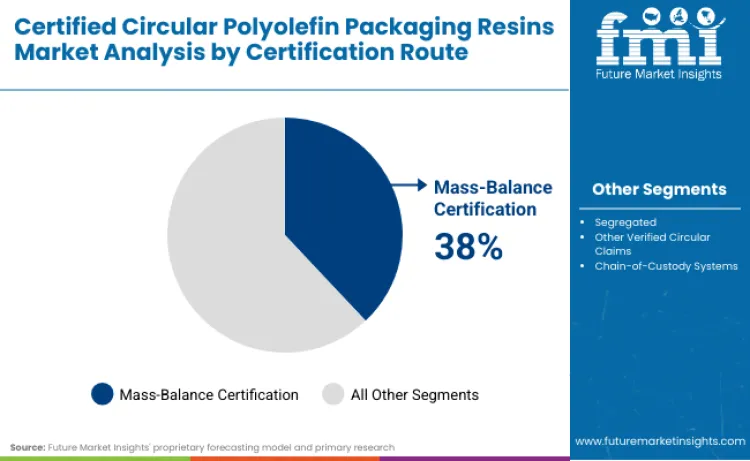
Mass-balance certified material accounts for 38% of certification routes because it aligns most closely with existing polyolefin production infrastructure. Large resin producers are able to integrate certified circular feedstocks into steam crackers and polymerization assets without disrupting throughput or capital efficiency. This compatibility allows converters and brand owners to claim certified circular content while maintaining established supplier relationships and resin specifications across polyethylene and polypropylene grades.
The 38% share is also reinforced by procurement behavior among global packaging buyers that prioritize continuity of supply and audit-ready documentation. Mass-balance certification supports scalable volumes under recognized schemes while enabling Scope 3 reporting and packaging compliance disclosures. For many multinational users, the ability to secure verified circular claims at industrial scale outweighs the limitations around physical traceability, keeping mass-balance routes commercially dominant.
What Makes Rigid Packaging the Primary Demand Center for Certified Circular Polyolefins?
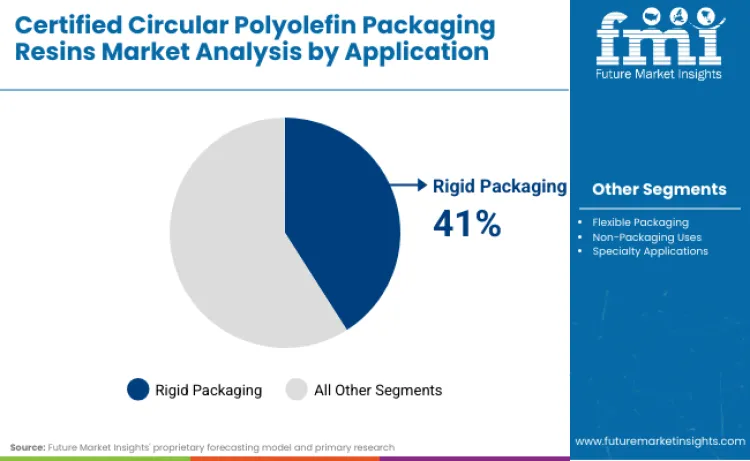
Rigid packaging represents 41% of application demand due to its concentration in high-volume, compliance-sensitive product categories such as food containers, household goods, and personal care packaging. These formats rely heavily on polypropylene and high-density polyethylene where certified circular grades can be introduced without compromising mechanical performance, dimensional stability, or regulatory conformity. Brand owners are prioritizing circular resin integration in rigid formats because product specifications are more standardized and easier to qualify at scale.
The 41% share also reflects regulatory and retailer scrutiny that is most acute in rigid packaging categories with visible consumer exposure. Packaging weight, recyclability labeling, and recycled content targets are increasingly enforced at the container level rather than secondary packaging. As a result, rigid packaging has become the preferred entry point for certified circular polyolefins, supporting faster adoption cycles and repeat purchasing once material approvals are secured.
What Drives the Certified Circular Polyolefin Packaging Resins Market?
The certified circular polyolefin packaging resins market in 2026 is shaped less by ambition and more by obligation. Regulatory pressure has moved from policy discussion into day-to-day commercial reality for packaging producers and brand owners. Plastic taxes, recycled content rules, and producer responsibility schemes are tightening across Europe and parts of the global market. For many companies, certified circular resins are no longer a reputational choice. They function as a compliance tool needed to protect market access and manage regulatory exposure. Demand is increasingly anchored in legal risk rather than sustainability signaling.
Material performance expectations continue to limit how far this shift can travel. Food contact and healthcare packaging demand consistent purity, process stability, and safety assurance. These requirements favor advanced and upgraded recycling routes that can deliver predictable outputs. Cost remains the main constraint. Energy intensity and capital requirements keep circular polyolefins priced well above virgin alternatives. Adoption is therefore concentrated in applications where compliance risk outweighs cost sensitivity, rather than across mass-market packaging.
Supply conditions add another layer of friction. Waste feedstock quality and availability remain uneven, especially outside mature collection systems. This inconsistency lowers plant utilization and complicates investment decisions for large recycling assets. Many existing mechanical recycling facilities are also misaligned with newer material designs, particularly complex multilayer and circular film structures. The result is a gap between what material innovation promises and what installed infrastructure can realistically process at scale.
What is the Country-wise Profile of the Certified Circular Polyolefin Packaging Resins Market?
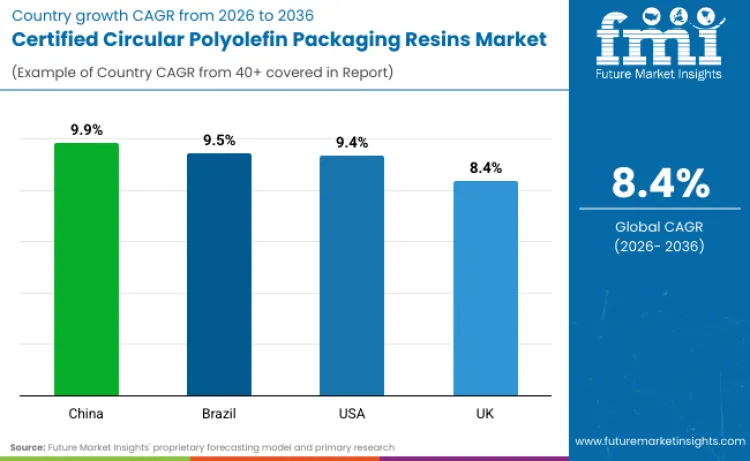
| Country | CAGR (2026-2036) |
|---|---|
| USA | 9.4% |
| UK | 8.4% |
| China | 9.9% |
| Brazil | 9.5% |
Source: Future Market Insights - analysis driven by proprietary forecasting models and primary research
How are Regulatory Reinterpretation and Standards Architecture Reshaping USA’s Certified Circular Polyolefin Packaging Resins Market?
In the United States, the market for certified circular polyolefin packaging resins is moving beyond small-scale trials and into operational execution. Major producers are no longer treating circularity as a parallel sustainability track but as an integrated part of long-term portfolio planning. Dow’s positioning of advanced recycling within its core packaging strategy reflects this shift, with partnerships structured to secure multiple feedstock routes rather than rely on a single technology or supplier model. This approach signals a clear intent to build resilient, certifiable supply capable of supporting polyethylene and polypropylene packaging at commercial scale.
Regulatory interpretation is beginning to align more closely with this industrial direction. Ongoing reassessment of how advanced recycling technologies are classified under federal environmental frameworks has the potential to ease permitting uncertainty that has historically slowed capacity deployment. At the same time, standards-setting activity is becoming more technically grounded. Efforts to formalize reference materials, data validation, and safety protocols for recovered polymers are strengthening confidence across the value chain. Together, these shifts are reducing execution risk for producers while improving downstream acceptance of certified circular claims.
Can Brazil’s Reverse Logistics Mandate Translate Policy Enforcement into Scalable Circular Polyolefin Supply?
Brazil’s circular polyolefin market is being shaped primarily by regulatory obligation rather than discretionary sustainability targets. The national reverse logistics framework assigns clear responsibility for plastic packaging recovery and recycled content usage, effectively tying compliance to continued market participation. For packaging producers and brand owners, certified circular polyethylene and polypropylene have become functional requirements, not branding tools, as regulatory exposure increasingly defines commercial viability.
Supply development is therefore advancing through a pragmatic, transitional pathway. Braskem’s role is central, not only through recycling-linked initiatives but also through expanded access to bio-attributed materials that meet certification requirements while domestic waste systems continue to evolve. This dual-material strategy reflects structural realities in collection efficiency and feedstock consistency. Rather than delaying market development, Brazil’s approach allows circular content adoption to progress in parallel with infrastructure maturation.
Is the UK Plastic Packaging Tax Functioning as a De Facto Certification Enforcement Tool?
In the United Kingdom, fiscal policy has become the primary driver of circular polyolefin demand. The Plastic Packaging Tax has shifted procurement behavior by directly penalizing non-compliant polyethylene and polypropylene packaging, making certification a cost-control issue rather than a voluntary commitment. As a result, purchasing decisions are increasingly anchored in verified recycled content rather than sustainability messaging.
Regulatory attention is now concentrating on verification mechanics. Movement toward mandatory certification for tax relief reflects a clear departure from self-reported compliance, placing greater emphasis on traceability and auditability. In parallel, regulatory acceptance of mass balance accounting for chemically recycled plastics provides clarity for advanced recycling investments. This combination of enforcement and methodological recognition is reinforcing the UK’s position as a rules-led market where circular polyolefin demand is anchored in policy certainty.
How Is China’s State-Directed Materials Policy Reorienting Demand for Circular Polyolefins in Packaging Applications?
China’s circular polyolefin market is advancing through centralized policy coordination rather than brand-led demand signals. National industrial planning has explicitly identified recycled plastics utilization as a priority, with packaging applications selected for their ability to absorb volume without introducing excessive technical or safety complexity. This targeted approach reflects an emphasis on scale and controllability over broad-based certification adoption.
Producers are responding accordingly. State-aligned chemical groups are repositioning parts of their portfolios toward recycled and circular materials that align with policy objectives, while mechanical recycling remains the dominant near-term pathway. Chemically recycled polyolefins are expected to expand more selectively through government-backed demonstration projects rather than open-market competition. Procurement guidance embedded in policy further supports demand visibility, indicating that China’s circular polyolefin growth will be driven by institutional coordination rather than voluntary market signal.
How is the Competitive Landscape in the Certified Circular Polyolefin Packaging Resins Market?
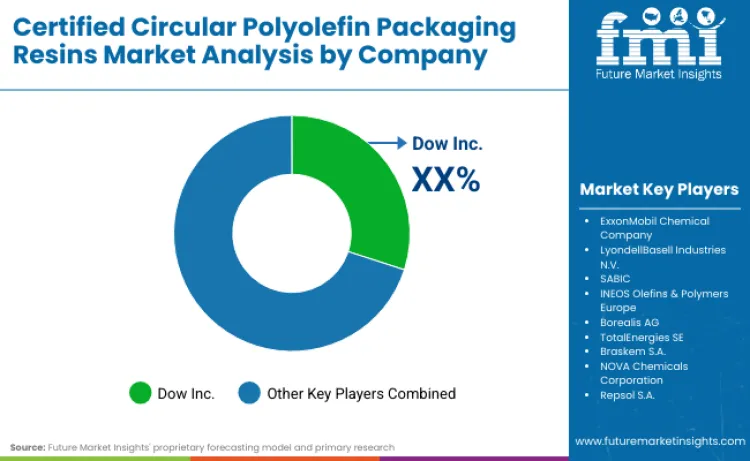
The certified circular polyolefin packaging resins market has moved beyond symbolic sustainability commitments and into a phase defined by operational control and commercial consequence. What initially revolved around selective pilots and brand-facing announcements is now shaped by a more pragmatic reassessment of risk and supply security. Leading polymer producers are prioritizing direct access to recycling infrastructure, recognizing that credible circular offerings depend less on intent and more on guaranteed feedstock availability.
Dow Inc. reflects this shift through an acquisition-driven strategy focused on internalizing mechanical recycling capacity rather than relying on fragmented third-party networks. In Europe, Borealis has advanced circular polyolefin production from demonstration-scale initiatives into sustained industrial output, embedding circular grades into core portfolio planning. These moves signal a structural change in how circular materials are positioned, no longer treated as peripheral sustainability products but as operational extensions of conventional polymer businesses.
Demand-side dynamics have reinforced this transition, particularly as brand owners move from experimentation toward routine specification of circular materials. Commercial validation has accelerated through partnerships that emphasize functional performance rather than environmental signaling. SABIC has played a central role by leveraging mass-balance certification to address quality and consistency challenges associated with mechanically recycled polyolefins.
This approach has enabled wider adoption in food, beverage, and personal care packaging, where regulatory scrutiny and performance expectations remain high. As circular polyolefins enter these applications, they are increasingly evaluated using the same criteria as virgin resins, including processability, reliability, and supply continuity. This normalization is quietly reshaping procurement behavior, with circular content becoming embedded in standard material frameworks rather than treated as a premium or experimental alternative.
Key Players Profiled
- Dow Inc.
- ExxonMobil Chemical Company
- LyondellBasell Industries N.V.
- SABIC
- INEOS Olefins & Polymers Europe
- Borealis AG
- TotalEnergies SE
- Braskem S.A.
- NOVA Chemicals Corporation
- Repsol S.A.
Market Definition
The certified circular polyolefin packaging resins market comprises polyethylene and polypropylene resins produced using recycled or circular feedstocks and verified through recognized certification schemes. These materials are designed for packaging applications where recycled content, traceability, and compliance with circular economy regulations are increasingly mandatory. Certified circular polyolefins are positioned as compliance-critical inputs that support regulatory adherence while maintaining performance comparable to virgin resins.
The report includes certified circular PE and PP resins supplied under mass-balance, segregated, and other verified chain-of-custody systems for use in rigid and flexible packaging applications. It covers resins qualified for food, beverage, personal care, household, and selected healthcare packaging, with assessment across major regions where recycled-content mandates, extended producer responsibility schemes, and packaging regulations influence material demand and procurement behavior .
The scope excludes uncertified recycled polyolefins, virgin fossil-based polyolefin resins without circular attribution, and bio-based materials not linked to recognized circular certification frameworks. It also excludes non-packaging end uses, downstream packaging conversion activities, recycling equipment, and waste collection or sorting operations outside certified resin supply boundaries.
Scope of Report
| Items | Values |
|---|---|
| Quantitative Units (2026) | USD 0.8 billion |
| Certification Route | Mass-Balance Certified, Segregated, Other Verified Circular Claims, Chain-of-Custody Systems |
| Application | Rigid Packaging, Flexible Packaging, Non-Packaging Uses, Specialty Applications |
| Regions Covered | North America, Western Europe, Eastern Europe, East Asia, South Asia & Pacific, Latin America, Middle East & Africa |
| Countries Covered | USA, UK, Brazil and 40+ Countries |
| Key Companies Profiled | Dow Inc., ExxonMobil Chemical Company, LyondellBasell Industries N.V., SABIC, INEOS Olefins & Polymers Europe, Borealis AG, TotalEnergies SE, Braskem S.A., NOVA Chemicals Corporation, Repsol S.A. |
Certified Circular Polyolefin Packaging Resins Market by Key Segments
Certification Route:
- Mass-Balance Certified
- Segregated
- Other Verified Circular Claims
- Chain-of-Custody Systems
Application:
- Rigid Packaging
- Flexible Packaging
- Non-Packaging Uses
- Specialty Applications
Region:
- North America
- Western Europe
- Eastern Europe
- East Asia
- South Asia & Pacific
- Latin America
- Middle East & Africa
Bibliography
- International Sustainability and Carbon Certification. (2024). ISCC PLUS system document: Traceability and chain of custody requirements. ISCC System GmbH.
- Organisation for Economic Co-operation and Development. (2024). Global policies for plastics circularity: Design, recycling, and recycled content mandates. OECD Publishing.
- USA Environmental Protection Agency. (2024). Advanced recycling technologies and regulatory classification under USA environmental law. Office of Resource Conservation and Recovery.
- PlasticsEurope. (2024). Circular polyolefins and mass balance certification in packaging applications. PlasticsEurope Association of Plastics Manufacturers.
- Ellen MacArthur Foundation. (2024). Global commitment progress report: Scaling circular plastics in packaging. Ellen MacArthur Foundation.
Frequently Asked Questions
How big is the certified circular polyolefin packaging resins market?
The market is valued at around USD 4.6 billion in 2026, reflecting the transition of certified circular polyethylene and polypropylene from niche sustainability materials into mainstream packaging inputs.
Why are certified circular polyolefins becoming essential in packaging applications?
These materials are increasingly required to meet recycled-content mandates, plastic taxes, and extended producer responsibility rules, making certification a condition for regulatory compliance rather than a voluntary sustainability choice.
Which packaging formats are driving the highest demand for certified circular polyolefins?
Rigid packaging leads adoption due to its high regulatory exposure in food, household, and personal care applications, where performance stability and audit-ready recycled content are critical.
How do regional packaging regulations influence market demand?
Europe and the UK are enforcing circular resin use through binding regulation and taxation, while North America is scaling adoption through certification alignment and advanced recycling. Emerging markets such as Brazil are driving demand through reverse-logistics mandates.
What limits faster penetration of certified circular polyolefin resins in packaging?
Higher costs compared to virgin resins, uneven waste feedstock quality, and capacity constraints in recycling infrastructure continue to limit adoption, particularly in price-sensitive packaging segments.
Preview the report firsthand - request a free sample
Get SampleGet the brochure for pricing and purchase details.
Get PDFTable of Content
- Executive Summary
- Market Outlook and Forecast (2026-2036)
- Why is the Certified Circular Polyolefin Packaging Resins Market Growing?
- Regulatory Enforcement and Compliance Mandates
- Transition from Voluntary to Obligation-led Adoption
- Capacity Expansion and Commercial-scale Certification
- What is the Segment Profile of the Certified Circular Polyolefin Packaging Resins Market?
- By Certification Route
- By Application
- What Drives the Certified Circular Polyolefin Packaging Resins Market?
- Regulatory Drivers
- Material Performance Constraints
- Cost and Infrastructure Barriers
- Supply-side Limitations
- What is the Country-wise Profile of the Certified Circular Polyolefin Packaging Resins Market?
- United States
- Brazil
- United Kingdom
- China
- How is the Competitive Landscape in the Certified Circular Polyolefin Packaging Resins Market?
- Key Players Profiled
- Dow Inc.
- ExxonMobil Chemical Company
- LyondellBasell Industries N.V.
- SABIC
- INEOS Olefins & Polymers Europe
- Borealis AG


