

- Industry Size (2026)
- USD 4.7 Bn
- Forecast (2036)
- USD 10.2 Bn
- CAGR (2026 to 2036)
- 8.1%
Advanced Recycled Polyolefin Resins Market Outlook and Forecast (2026-2036)
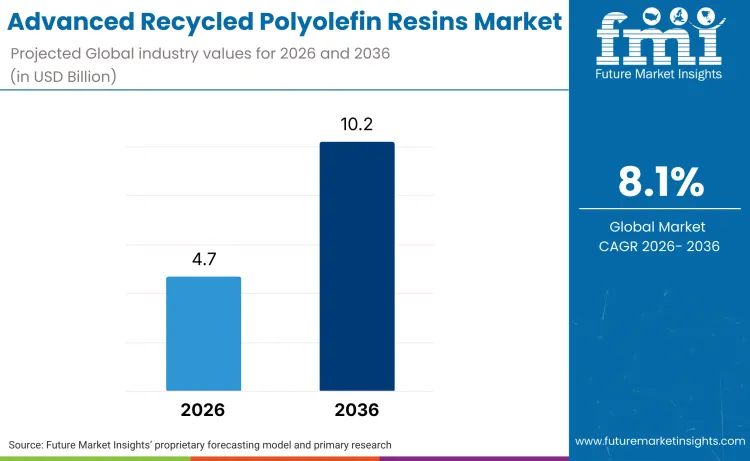
The advanced recycled polyolefin resins market is likely to total USD 4.7 billion in 2026, and is expected to advance at an 8.1% CAGR to reach USD 10.2 billion. Growth is scaled through commercial facilities, driven by a combination of tighter regulation, clearer brand commitments on recycled content, and sustained investment in circular polymer infrastructure across major production hubs. Growth in this segment is no longer tracking traditional virgin polyolefin demand patterns, reflecting a fundamental shift in how recycled materials are positioned within supply chains.
Momentum is influenced by the technical limits of conventional mechanical recycling. While mechanically recycled polyolefins remain widely used in non-food and industrial applications, issues such as contamination, material degradation, and compliance with food-contact standards continue to restrict broader use.
These constraints are pushing producers and converters to look beyond mechanical routes. Chemical recycling technologies, particularly pyrolysis and depolymerization, are gaining traction as practical pathways for generating higher-purity recycled feedstock suitable for more demanding applications.
Competition within the market is intensifying as large, integrated petrochemical companies move to secure early positions in certified circular supply chains. Investment is focused on building chemical recycling capacity and linking it directly to existing polymer production assets through mass balance systems. This strategy allows recycled inputs to be introduced without disrupting established manufacturing processes, lowering adoption barriers for downstream users while improving utilization of existing infrastructure.
Demand remains strongest in regions with established regulatory frameworks and active enforcement, where sustainability criteria influence procurement decisions. Manufacturing-oriented economies continue to absorb the largest volumes, supported by packaging, automotive, electronics, and durable goods production. However, expansion is not without friction. High capital requirements, inconsistent feedstock supply, and operational complexity continue to shape the pace and direction of market development.
Summary of Advanced Recycled Polyolefin Resins Market
What is Growth Outlook for Advanced Recycled Polyolefin Resins Market as per Future Market Insights Projection?
Future Market Insights projects the advanced recycled polyolefin resins market to expand at a CAGR of 8.1% from 2026 to 2036, increasing from USD 4.7 billion in 2026 to USD 10.2 billion by 2036.
FMI Research Approach: FMI proprietary forecasting model integrating regulatory recycled-content mandates, chemical recycling capacity deployment, and mass-balance certified polyolefin adoption across packaging and industrial value chains.
How do FMI Analysts Perceive Advanced Recycled Polyolefin Resins Market to Evolve?
FMI analysts perceive the market evolving from voluntary sustainability-driven adoption toward regulation-locked circular polymer supply, where access to certified, high-purity recycled feedstock becomes a prerequisite for participation in regulated packaging and consumer goods segments. Growth is increasingly shaped by chemical recycling scale-up and integration with existing petrochemical infrastructure rather than incremental mechanical recycling improvements.
FMI Research Approach: Assessment of packaging regulations, brand compliance timelines, and investment patterns in advanced recycling technologies including pyrolysis and depolymerisation.
Which Country Holds Largest Share in Global Advanced Recycled Polyolefin Resins Market?
China holds a leading share in the global advanced recycled polyolefin resins market, supported by large-scale petrochemical integration, state-directed circular economy policy, and accelerated deployment of chemical recycling capacity linked to domestic polymer production.
FMI Research Approach: Country-level modeling based on petrochemical capacity, advanced recycling integration rates, and regulatory alignment with circular material mandates.
How Large will the Advanced Recycled Polyolefin Resins Market Be by 2036?
The global advanced recycled polyolefin resins market is projected to reach USD 10.2 billion by 2036.
FMI Research Approach: Long-term revenue forecasting derived from regulated packaging demand, secured offtake agreements, and scale efficiencies achieved through refinery- and cracker-integrated recycling platforms.
What is the Definition of Advanced Recycled Polyolefin Resins Market?
The advanced recycled polyolefin resins market comprises recycled polypropylene and polyethylene resins produced through advanced mechanical upgrading and chemical recycling pathways, designed to deliver higher purity, molecular consistency, and application-ready performance compared with conventional mechanically recycled polyolefins.
FMI Research Approach: FMI market taxonomy and inclusion-exclusion framework covering certified mass-balance recycled resins, chemical recycling outputs, and performance-grade recycled polyolefins used in regulated and high-specification applications.
What are some Globally Unique Trends Shaping Advanced Recycled Polyolefin Resins Market?
Globally unique trends include the commercialisation of chemical recycling at scale, rising reliance on mass-balance certification systems, and increasing treatment of recycled polyolefin access as a regulatory risk-management issue rather than a sustainability preference for packaging converters and brand owners.
FMI Research Approach: Synthesis of regulatory enforcement trends, petrochemical integration strategies, and traceability requirements across major polyolefin-consuming regions.
Advanced Recycled Polyolefin Resins Market Key Takeaways
| Metric | Value |
|---|---|
| Expected Value (2026E) | USD 4.7 billion |
| Projected Value (2036F) | USD 10.2 billion |
| CAGR (2026-2036) | 8.1% |
Source: Future Market Insights-analysis driven by proprietary forecasting models and primary research
Why are Advanced Recycled Polyolefin Resins Sales Growing?
The global advanced recycled polyolefin resins market is entering a phase where sustainability objectives are embedded directly into operating requirements. Across packaging, consumer goods, and industrial plastics, regulation is reshaping procurement strategy, investment sequencing, and material qualification processes. Market momentum is no longer dependent on voluntary brand commitments. Growth is being driven by enforceable compliance obligations that require certified recycled supply to be secured ahead of implementation timelines.
In Europe, the shift toward a unified packaging regulation has replaced fragmented national approaches with a single enforceable framework. This change has created a clear commercial deadline for converters and brand owners, who are prioritizing early access to compliant recycled polyolefin volumes. Supply security is increasingly treated as a regulatory risk issue rather than a sustainability enhancement. A similar pattern is visible in North America, where state-level recycled content mandates are becoming more restrictive. These requirements are accelerating long-term offtake agreements as buyers recognize that existing mechanical recycling capacity cannot consistently meet volume and performance standards required for regulated applications.
Chemical recycling technologies such as pyrolysis address these limitations by converting heterogeneous plastic waste into feedstocks compatible with conventional polymer production systems. As operating scale increases, cost structures are narrowing the gap with virgin resin economics, supporting capital-intensive investment decisions. The commissioning of large-scale molecular recycling facilities reflects a shift toward continuous commercial output.
Traceability and verification mechanisms have become essential market infrastructure. Rising regulatory scrutiny has made auditable proof of recycled content origin and allocation a requirement for brand owners and retailers. Mass balance certification systems supported by digital tracking and audit frameworks are gaining acceptance as a practical compliance solution within complex production networks.
How is the Advanced Recycled Polyolefin Resins Industry Segmented?
Demand concentration in the advanced recycled polyolefins market is anchored around materials that combine scale compatibility with performance upgradability. On the polymer side, recycled polypropylene has emerged as the primary volume and value anchor due to its balance of mechanical recyclability and application breadth. From an application perspective, packaging continues to absorb the largest share of advanced recycled polyolefins, driven by regulatory mandates, brand commitments, and rapid qualification cycles. Together, these two segments define the structural core of market expansion through 2036.
Why does Recycled Polypropylene Dominate the Polymer Type Landscape?
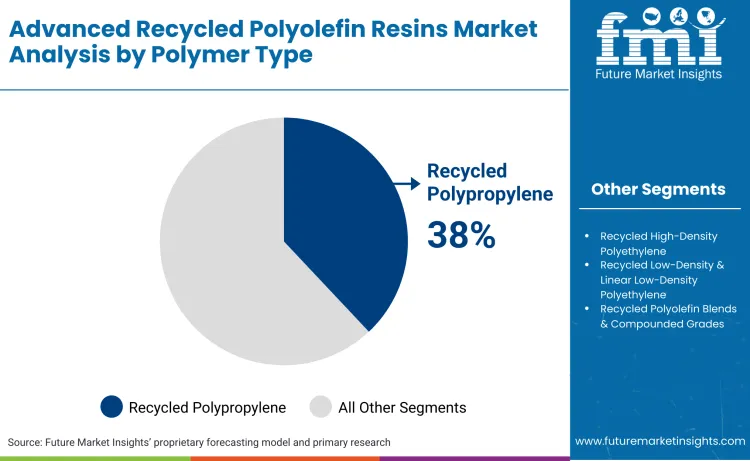
Recycled polypropylene accounts for 38% of total demand within the advanced recycled polyolefins market, positioning it as the leading polymer category. This dominance is rooted in polypropylene’s inherently favourable recycling profile, including high stiffness retention, thermal stability, and compatibility with advanced mechanical recycling upgrades such as melt filtration, deodorisation, and additive restoration. Compared with polyethylene variants, rPP is more frequently specified in applications where dimensional stability and impact resistance are critical, enabling recycled grades to displace virgin resin in higher-value uses rather than remaining confined to downcycled flows.
A further contributor to rPP’s leadership is its rapid acceptance across regulated and semi-regulated applications. Advanced rPP grades are increasingly qualified for food-contact packaging, automotive interiors, and durable consumer goods, particularly in Europe and East Asia. These applications reward material consistency and predictable processing behaviour, both of which have improved significantly through closed-loop collection systems and compatibilised rPP compounds. As a result, rPP has transitioned from being a secondary recycled option to a strategic material class, absorbing a disproportionate share of capital investment and technology upgrades within the advanced recycling ecosystem.
What Makes Packaging the Primary Application Driver for Advanced Recycled Polyolefins?
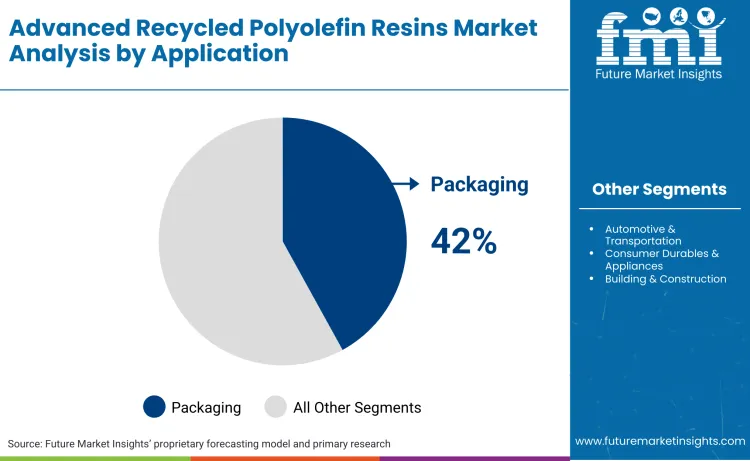
Packaging represents around 42% of total advanced recycled polyolefin consumption, making it the single largest application segment. This leadership is structurally enforced rather than cyclical. Regulatory frameworks, particularly in Europe and parts of Asia, mandate minimum recycled content thresholds in plastic packaging, accelerating the shift from commodity recyclates toward advanced, specification-grade recycled polyolefins. These requirements have pushed converters and brand owners to prioritise high-purity rPP and rPE grades capable of meeting mechanical, aesthetic, and compliance benchmarks simultaneously.
Beyond regulation, packaging benefits from shorter qualification timelines and faster volume scalability compared with automotive or construction applications. Rigid packaging, closures, and selected flexible formats can integrate advanced recycled polyolefins with limited tooling changes, allowing rapid uptake once material consistency is proven. This has made packaging the first large-scale commercial outlet for chemically recycled and hybrid-upgraded polyolefins as well. As advanced recycling capacities expand through the forecast period, packaging is expected to remain the primary demand sink, anchoring baseline volumes while higher-margin applications scale more selectively.
What Drivers, Restraints, Challenges, and Trends affect Demand for Advanced Recycled Polyolefin Resins?
The global advanced recycled polyolefin resins market is being reshaped by regulatory pressure and brand requirements tied to food grade and high purity recycled content. Advanced recycling enables molecular regeneration of polyolefins, allowing recycled material to meet food contact and performance standards across multiple use cycles. This technical capability reduces dependence on high quality waste streams that traditionally constrained mechanical recycling. Demand is increasingly anchored in FMCG companies and packaging converters that must meet recycled content targets without compromising safety, consistency, or functional performance.
Cost remains the primary limiting factor. Advanced recycling routes, particularly pyrolysis of mixed plastic waste, continue to carry a substantial cost premium compared with virgin fossil based polyolefins. In Europe, production costs for advanced recycled material remain more than double those of virgin resin. This gap restricts adoption largely to premium packaging segments and to supply secured through long term offtake agreements with brand owners. Market uptake remains dependent on regulatory incentives, sustainability linked procurement policies, and brand driven commitments rather than price based substitution.
On the supply side, producers are prioritizing scale and integration with existing refining and petrochemical infrastructure. Co locating advanced recycling units within established sites supports mass balance certification, lowers logistics costs, and shortens commercialization timelines. Integration also improves feedstock access and strengthens offtake security. Projects linked to large refining and polymer platforms demonstrate how scale is becoming central to improving unit economics and reducing operational risk.
Country-wise Analysis
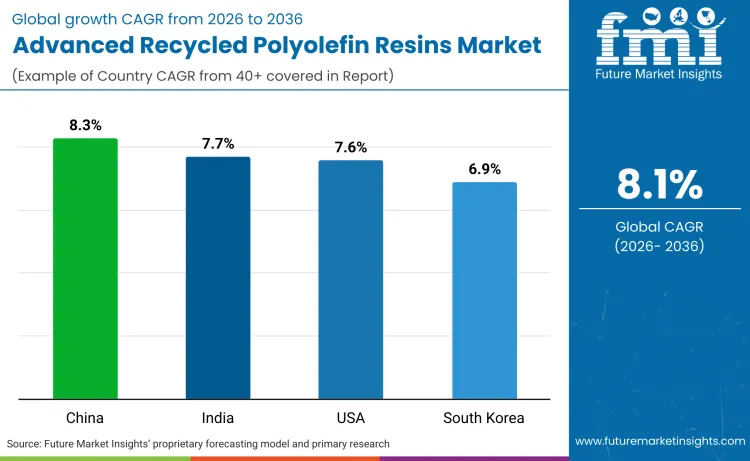
| Country | CAGR (2026-2036) |
|---|---|
| India | 7.7% |
| China | 8.3% |
| USA | 7.6% |
| South Korea | 6.9% |
Source: FMI’s proprietary forecasting model and primary research
How are Regulatory Mandates and Petrochemical Circularity Strategies Reshaping India’s Advanced Recycled Polyolefin Resin Growth Trajectory?
India’s advanced recycled polyolefin resin market is being reshaped by a clear shift from advisory sustainability guidance to enforceable regulatory obligation. Policy action led by the Ministry of Environment, Forest and Climate Change has moved recycled polymers into the core of compliance planning for chemicals and packaging producers. Mandatory recycling obligations and recycled-content requirements across packaging applications have established a legally anchored demand base.
Industrial response has been tightly aligned with this regulatory certainty. Reliance Industries Limited has integrated circular feedstocks into its broader Oil-to-Chemicals strategy, signaling that recycled polymers are being treated as long-term structural inputs rather than transitional solutions. This convergence of policy enforcement and capital deployment reduces execution risk for advanced recycling projects.
Why is China’s Advanced Recycling Market Transitioning from Volume Recovery to High-Value Polyolefin Circularity?
China’s advanced recycled polyolefin resin market is moving beyond waste recovery toward material upgrading and industrial substitution. Direction from the Ministry of Ecology and Environment has narrowed the focus onto technologies capable of producing high-specification recycled outputs suitable for demanding downstream uses. Policy emphasis has shifted from diversion metrics toward material performance, positioning advanced recycling as a tool for strengthening domestic polymer value chains rather than managing waste volumes.
This transition has been reinforced through system-wide regulatory consolidation under the State Council of the People's Republic of China, which links resource recirculation mandates with the phaseout of inefficient manufacturing capacity. State-aligned producers such as Sinopec Group are translating these priorities into industrial-scale projects that validate advanced recycling as a feedstock replacement pathway.
Can Regulatory Reclassification and Capital-Intensive Scale unlock USA’s Advanced Polyolefin Recycling Opportunity?
In USA, expansion of advanced recycled polyolefin resins is being shaped less by mandated demand and more by regulatory interpretation and capital discipline. A critical variable remains the ongoing reassessment by the United States Environmental Protection Agency regarding how advanced recycling facilities are classified under existing air quality frameworks. Recognition of these assets as manufacturing infrastructure rather than waste management operations would materially reduce permitting friction and shorten development timelines.
Market participation has skewed toward companies with the financial capacity to manage regulatory uncertainty. ExxonMobil has positioned advanced recycling within its higher-value chemicals strategy, treating recycled polyolefins as performance-driven inputs rather than sustainability-led commodities. This approach enables monetization through specialized applications instead of volume-based markets.
How is South Korea Leveraging Industrial Clusters to Monetize Advanced Polyolefin Recycling at Scale?
South Korea’s advanced recycled polyolefin resin market is defined by tight industrial integration rather than standalone project development. SK Geo Centric has anchored a cluster-based model that embeds advanced recycling within existing petrochemical infrastructure, consolidating feedstock sourcing, processing, and polymer upgrading.
Downstream demand is being reinforced through portfolio realignment by major materials producers. LG Chem has identified circular polymers as a core growth pillar, while technology validation partnerships between SK Geo Centric and Loop Industries have demonstrated the ability to produce near-virgin-quality recycled resins.
Competitive Landscape
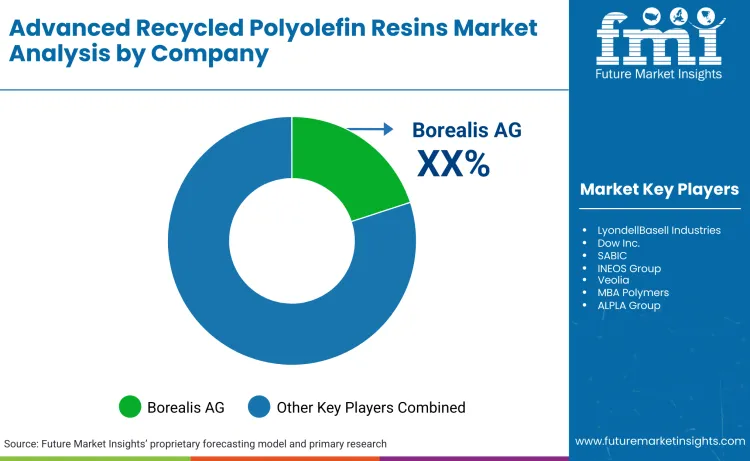
As the advanced recycled polyolefin market moves through 2026, supply availability is increasingly determined by how existing petrochemical assets are operated, not by new capacity coming online. Most advanced recycling output now depends on recycled hydrocarbons being co-fed into established refineries and steam crackers. This approach delivers scale, but it also anchors rPO production to the maintenance schedules of legacy fossil-based units. Turnarounds, partial outages, and restart inefficiencies have therefore become a practical constraint on certified and food-contact rPO availability.
In North America, production is largely concentrated in major integrated sites operated by ExxonMobil and LyondellBasell. These complexes follow fixed multi-year maintenance cycles for crackers, hydrotreating units, and hydrogen systems. Because recycled feedstocks are still a secondary stream within these assets, rPO volumes are often more exposed during maintenance events. Even short shutdowns can reduce certified output disproportionately, as mass balance allocation becomes tighter during unit downtime and subsequent ramp-up phases.
Europe faces a similar issue, but with less operational buffer. Advanced recycling capacity is spread across fewer sites, and platforms operated by SABIC, TotalEnergies, and BASF operate under stricter permitting and regulatory constraints. This limits the ability to shift or compress maintenance schedules. Planned turnarounds in 2026 are expected to cause periodic shortages of high-purity and food-grade rPO, even where annual capacity figures remain unchanged on paper.
Key Players Profiled
- Borealis AG
- LyondellBasell Industries
- Dow Inc.
- SABIC
- INEOS Group
- Veolia
- MBA Polymers
- ALPLA Group
- Omya AG
- Banyan Nation
Market Definition
The advanced recycled polyolefin resins market comprises recycled polypropylene and polyethylene grades produced through advanced mechanical upgrading and chemical recycling pathways such as pyrolysis and depolymerisation. These resins are engineered to deliver higher purity, molecular consistency, and application-ready performance compared with conventional mechanically recycled polyolefins. The market reflects the industrialisation of circular polyolefin supply, where recycled feedstocks are integrated into established polymer and petrochemical production systems to serve regulated and performance-sensitive applications.
The report covers advanced mechanically recycled and chemically recycled polyolefin resins supplied under certified mass-balance or traceability frameworks. It includes recycled polypropylene, recycled HDPE, LDPE, LLDPE, and compounded polyolefin grades used in packaging, automotive and transportation, consumer durables, electrical and electronics, building and construction, and industrial products. Commercial-scale production integrated with refining, steam cracking, or polymer compounding infrastructure is fully within scope.
Excluded from the market are virgin polyolefin resins and conventional mechanically recycled polyolefins limited to low-specification or downcycled applications. The scope also excludes non-polyolefin plastics, plastic waste collection and sorting activities that do not result in resin-grade output, finished plastic products or components, and pilot-scale or experimental recycling technologies without consistent commercial resin production.
Scope of Report
| Items | Values |
|---|---|
| Quantitative Units (2026) | USD 4.7 billion |
| Polymer Type | Recycled Polypropylene, Recycled High-Density Polyethylene, Recycled Low-Density & Linear Low-Density Polyethylene, Recycled Polyolefin Blends & Compounded Grades |
| Application | Packaging, Automotive & Transportation, Consumer Durables & Appliances, Building & Construction, Electrical & Electronics, Industrial & Logistics Products |
| Regions Covered | North America, Western Europe, Eastern Europe, East Asia, South Asia & Pacific, Latin America, Middle East & Africa |
| Countries Covered | India, China, USA, South Korea and 40+ Countries |
| Key Companies Profiled | Borealis AG, LyondellBasell Industries, Dow Inc., SABIC, INEOS Group, Veolia, MBA Polymers, ALPLA Group, Omya AG, Banyan Nation |
Source: FMI analysis based on primary research and proprietary forecasting model
Key Segments Covered
Polymer Type
- Recycled Polypropylene
- Recycled High-Density Polyethylene
- Recycled Low-Density & Linear Low-Density Polyethylene
- Recycled Polyolefin Blends & Compounded Grades
Application
- Packaging
- Automotive & Transportation
- Consumer Durables & Appliances
- Building & Construction
- Electrical & Electronics
- Industrial & Logistics Products
Region
- North America
- Western Europe
- Eastern Europe
- East Asia
- South Asia & Pacific
- Latin America
- Middle East & Africa
Bibliography
- Al-Salem, S. M., Lettieri, P., & Baeyens, J. (2024). Recycling and recovery routes of plastic solid waste (PSW): A review. Waste Management, 176, 45-62.
- BASF SE. (2025). Chemical recycling of polyolefins: Technical pathways and mass balance implementation. BASF Polymer Research White Paper.
- CEPII Plastics & Petrochemicals Research Consortium. (2024). Advanced recycling integration into existing polyolefin value chains. Industrial Circularity Report.
- Sinopec Group. (2025). Chemical recycling deployment and circular polymer strategy. Corporate Sustainability and Technology Report.
- Veolia Environnement S.A. (2026). Scaling chemical recycling for high-purity polyolefin production. Circular Polymers Technology Brief.
Frequently Asked Questions
How large is the advanced recycled polyolefin resins market serving packaging applications?
The market is valued at around USD 4.7 billion in 2026, with packaging representing the largest and most structurally anchored application for advanced recycled polyolefins.
Why is packaging the primary demand driver for advanced recycled polyolefin resins?
Packaging demand is driven by enforceable recycled-content mandates and packaging regulations that require higher-purity recycled materials capable of meeting performance and compliance thresholds.
Which packaging formats are adopting advanced recycled polyolefins most rapidly?
Rigid packaging leads adoption due to faster qualification cycles, standardized specifications, and strong regulatory scrutiny in food, household, and personal care packaging.
How do advanced recycled polyolefins differ from conventional mechanically recycled resins in packaging use?
Advanced recycled polyolefins offer higher purity, improved consistency, and greater suitability for regulated packaging applications, including food contact, where conventional recyclates face contamination and performance limits.
What factors limit faster penetration of advanced recycled polyolefins in packaging?
Higher material costs, capital-intensive recycling infrastructure, and dependence on long-term offtake agreements continue to restrict adoption, particularly in price-sensitive packaging segments.
Preview the report firsthand - request a free sample
Get SampleGet the brochure for pricing and purchase details.
Get PDFTable of Content
- Executive Summary
- Advanced Recycled Polyolefin Resins Market Outlook and Forecast (2026-2036)
- Why are Advanced Recycled Polyolefin Resins Sales Growing?
- Regulation-led Recycled Content Enforcement
- Limits of Conventional Mechanical Recycling
- Scale-up of Chemical Recycling Infrastructure
- Traceability and Mass Balance Certification Adoption
- How is the Advanced Recycled Polyolefin Resins Industry Segmented?
- By Polymer Type
- By Application
- By Region
- What Drivers, Restraints, Challenges, and Trends affect Demand?
- Food-grade and High-purity Compliance Requirements
- Cost Premiums versus Virgin Polyolefins
- Petrochemical Integration and Scale Economics
- Country-wise Analysis
- India
- China
- United States
- South Korea
- Competitive Landscape
- Key Players Profiled
- Borealis AG
- LyondellBasell Industries
- Dow Inc.
- SABIC
- INEOS Group
- Veolia
- MBA Polymers
- ALPLA Group
- Omya AG
- Banyan Nation
- Market Definition
- Scope of Report
- Key Segments Covered
- Bibliography
- Frequently Asked Questions (FAQs)


