

- Market Size (2026)
- USD 105.9 Bn
- Forecast (2036)
- USD 204.42 Bn
- CAGR (2026 to 2036)
- 6.8%
Advanced Automotive Materials Market Size, Market Forecast and Outlook By FMI
Summary of the Advanced Automotive Materials Market
- Demand and Growth Drivers
- Vehicle lightweighting mandates and fuel efficiency regulations across the EU, US, and China are driving material substitution toward high-strength steel, aluminum, and composite alternatives.
- Electric vehicle production growth is reshaping material demand, with battery enclosure requirements, thermal management needs, and range optimization creating new specification requirements.
- Cost pressure across automotive OEM supply chains is constraining adoption of premium materials (carbon fiber, advanced composites), concentrating volume growth in high-strength steel and engineered plastics.
- Product and Segment View
- High-strength steel is expected to account for 41.9% of the metals segment in 2026, reflecting its cost-performance balance for structural lightweighting.
- Nylon holds 36.4% of the engineered plastics segment, driven by under-hood, interior trim, and structural component applications.
- Carbon fiber reinforced plastic leads the composites segment, though adoption remains concentrated in premium vehicles due to cost.
- Geography and Competitive Outlook
- South Korea leads growth at 6.6%, driven by concentrated automotive production and aggressive EV platform development by Hyundai-Kia.
- Europe and North America represent the largest material consumption markets, with OEM lightweighting programs and regulatory pressure sustaining demand.
- Companies that combine material science R&D with automotive OEM qualification and tier-1 supply chain integration are positioned for long-term procurement relationships.
- Analyst Opinion
- 'Material suppliers that can offer cost-competitive lightweighting solutions with OEM-qualified processing characteristics will capture the largest share of the transition. South Korea and the USA represent the most active material adoption corridors as EV production scales,' says Nikhil Kaitwade, Principal Consultant at FMI.
- The advanced automotive materials market reflects the automotive industry's structural shift toward lighter, stronger, and more thermally efficient materials.
- Adoption is increasing due to tightening emissions regulations, EV range optimization requirements, and consumer demand for efficient vehicles.
- Demand is further supported by battery enclosure and thermal management material requirements specific to electric and hybrid platforms.
- Pricing dynamics reflect raw material commodity cycles, carbon fiber production constraints, and OEM procurement pressure.
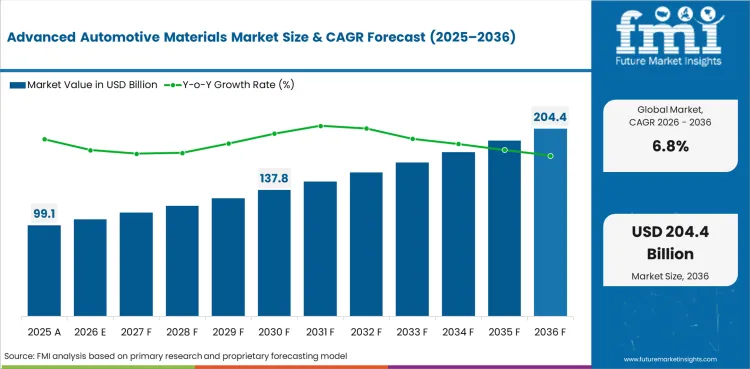
Key Takeaways, Market Size, and Forecast
- The advanced automotive materials market was valued at USD 99.14 billion in 2025.
- The market is projected to reach USD 105.9 billion in 2026 and USD 204.42 billion by 2036, growing at a CAGR of 6.8%.
- By 2036, the Advanced Automotive Materials Market is expected to be worth USD 204.42 billion.
- From 2026 to 2036, the market is projected to expand at a CAGR of 6.8%.
- The market is projected to create an incremental opportunity of USD 98.54 billion between 2026 and 2036.
- In 2026, high-strength steel is expected to account for 41.9% of the metals segment, driven by demand for vehicle lightweighting while maintaining structural performance.
- Nylon leads the polymers segment with a 36.4% share.
- South Korea (6.6%) and the USA (6.5%) are two of the fastest growing markets in the world.
Advanced Automotive Materials Market Definition
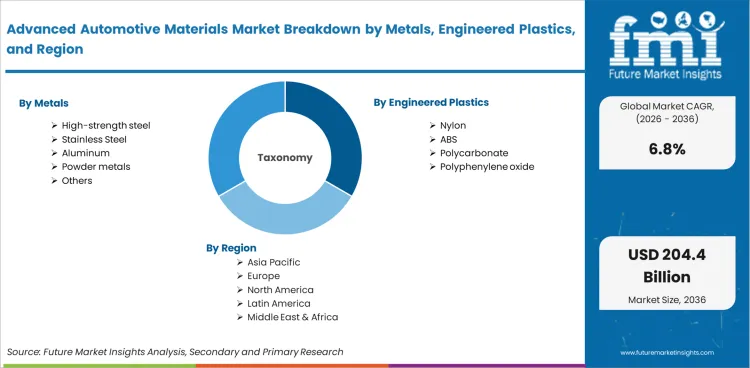
The advanced automotive materials market covers metals (high-strength steel, stainless steel, aluminum, powder metals), engineered plastics (nylon, ABS, polycarbonate, polyphenylene oxide), thermoplastic elastomers (vulcanizates, polyolefin, polyurethanes, styrene block copolymer, copolyester elastomer), and composites (carbon fiber reinforced plastic, glass fiber reinforced plastic) used across automotive applications.
Advanced Automotive Materials Market Inclusions
Market scope encompasses all commercially traded advanced automotive materials categorized by metals, engineered plastics, thermoplastic elastomers, and composites. Revenue projections span from 2026 to 2036.
Advanced Automotive Materials Market Exclusions
The scope does not include conventional mild steel, raw commodity metals before automotive-grade processing, or electronic materials (semiconductors, battery cell materials).
Advanced Automotive Materials Market Research Methodology
- Primary Research: FMI analysts conducted interviews with automotive OEM material engineers, tier-1 suppliers, steel and aluminum producers, and composite manufacturers across key markets.
- Desk Research: Combined data from automotive production forecasts, material science publications, OEM lightweighting program disclosures, and emissions regulation documentation.
- Market Sizing and Forecasting: Bottom-up aggregation from automotive production volumes by platform type, material content per vehicle estimates, and regional OEM procurement data.
- Data Validation: Cross-checked quarterly against global automotive production data, material commodity pricing, and OEM financial disclosures.
Why is the Advanced Automotive Materials Market Growing?
- Vehicle lightweighting regulations in the EU, US, and China are driving material substitution toward high-strength steel, aluminum, and engineered plastics.
- Electric vehicle production growth is creating new material demand for battery enclosures, thermal management, and lightweight structural platforms.
- South Korea leads growth at 6.6%, driven by concentrated automotive OEM production and aggressive EV platform material adoption.
The advanced automotive materials market is expanding as regulatory pressure, EV production growth, and OEM lightweighting programs drive material substitution. High-strength steel remains the volume leader due to its cost-performance balance.
Electric vehicle platforms are reshaping material demand profiles. Battery enclosures require materials combining structural strength, thermal management, and crash energy absorption.
Composite materials offer the highest weight reduction potential but remain constrained by production cost and cycle time. Adoption is concentrated in premium and performance vehicle segments.
Market Segmentation Analysis
- High-strength steel holds 41.9% of the metals segment, reflecting its cost-performance balance for structural lightweighting.
- Nylon accounts for 36.4% of engineered plastics, driven by under-hood and structural applications requiring heat resistance.
- Carbon fiber reinforced plastic leads composites but remains concentrated in premium vehicles due to cost.
The advanced automotive materials market is segmented by metals, engineered plastics, thermoplastic elastomers, composites.
Insights into the High-Strength Steel Segment
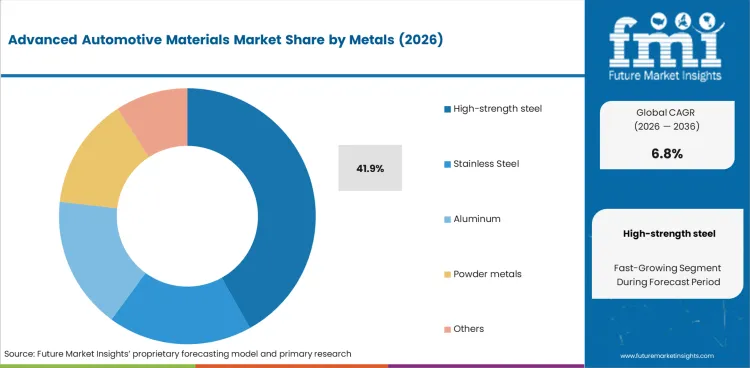
In 2026, high-strength steel is expected to account for 41.9% of the metals segment. Demand is driven by cost-competitive weight reduction combined with crashworthiness performance.
Advanced high-strength steel (AHSS) and ultra-high-strength steel (UHSS) grades are gaining adoption in body-in-white structural components and door intrusion beams.
Insights into the Nylon Engineered Plastics Segment
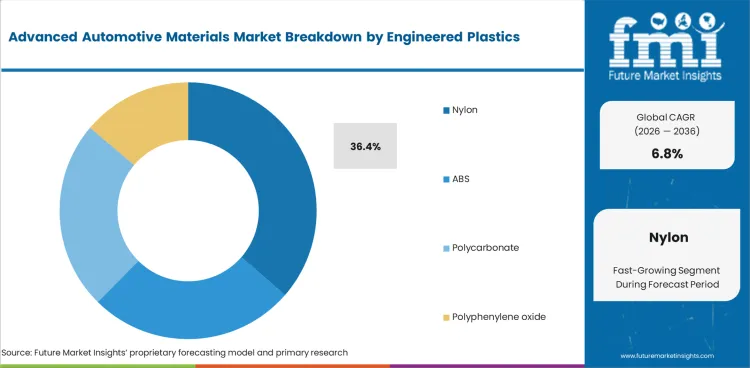
Nylon accounts for 36.4% of the engineered plastics segment in 2026. Under-hood applications (intake manifolds, engine covers) and structural interior components drive steady procurement.
Glass-fiber-reinforced nylon grades are replacing metal components in semi-structural applications where weight reduction and corrosion resistance justify transition.
Advanced Automotive Materials Market Drivers, Restraints, and Opportunities
- Emissions regulations and lightweighting mandates are driving material substitution from conventional steel toward advanced metals, plastics, and composites.
- Raw material commodity price volatility and carbon fiber production capacity constraints create cost and supply risks.
- EV platform production growth is creating new material demand for battery enclosures, thermal management, and lightweight structures.
The advanced automotive materials market continues to expand as demand, regulatory, and competitive factors shape growth dynamics.
Regulatory-Driven Lightweighting
Demand reflects tightening CO2 emissions standards that require vehicle weight reduction. OEMs are substituting conventional mild steel with high-strength steel, aluminum, and engineered plastics.
Raw Material Cost and Supply Dynamics
Supply is shaped by commodity price cycles for steel and aluminum, carbon fiber production constraints, and resin feedstock pricing. OEMs manage cost exposure through long-term supply agreements.
EV-Specific Material Requirements
Growth reflects electric vehicle production scaling that creates demand for battery enclosure materials, thermal interface materials, and lightweight structural platforms.
Analysis of Advanced Automotive Materials Market By Key Countries
.webp "Top Country Growth Comparison Advanced Automotive Materials Market Cagr (2026 2036)")
| Country | CAGR |
|---|---|
| South Korea | 6.6% |
| USA | 6.5% |
| European Union | 6.3% |
| UK | 6.1% |
| Japan | 6.0% |
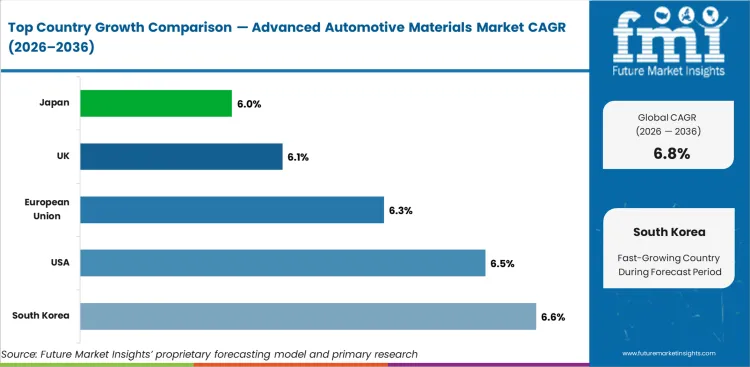
- South Korea leads with 6.6% CAGR, driven by concentrated automotive production and EV platform development.
- The USA at 6.5% reflects large automotive production and EV transition programs.
- Japan (6.3%) sustains growth through established automotive manufacturing and materials innovation.
- Germany (6.1%) shows demand from EU lightweighting regulations and premium automotive manufacturing.
The global advanced automotive materials market is expected to grow at a rate of 6.8% per year from 2026 to 2036. The study covers more than 30 countries, and the main markets are listed below.
Demand Outlook for Advanced Automotive Materials Market in South Korea
South Korea is projected to grow at 6.6% through 2036. Concentrated automotive OEM production and aggressive EV platform development drive material demand growth.
- Automotive OEM production is concentrated.
- EV platform development drives new material demand.
- Lightweight material adoption is accelerating.
Future Outlook for Advanced Automotive Materials Market in USA
USA is projected to grow at 6.5% through 2036. Large automotive production base, EV transition programs, and lightweighting regulations sustain material demand.
- Large production base creates volume demand.
- EV transition programs reshape material mix.
- Lightweighting regulations drive substitution.
Opportunity Analysis of Advanced Automotive Materials Market in European Union
European Union is projected to grow at 6.3% through 2036. Established automotive manufacturing and materials innovation support demand for advanced metals and composites.
- Automotive manufacturing base is strong.
- Materials innovation supports adoption.
- EV production growth creates new demand.
In-depth Analysis of Advanced Automotive Materials Market in UK
UK is projected to grow at 6.1% through 2036. EU lightweighting regulations and premium automotive manufacturing drive demand for advanced materials.
- EU regulations drive material substitution.
- Premium automotive manufacturing creates demand.
- Composites adoption is growing in performance segments.
Sales Analysis of Advanced Automotive Materials Market in Japan
Japan is projected to grow at 6.0% through 2036. Growing automotive production and EV penetration support demand for lightweight materials.
- Automotive production is growing.
- EV penetration creates material demand.
- Advanced material adoption is increasing.
Competitive Landscape and Strategic Positioning
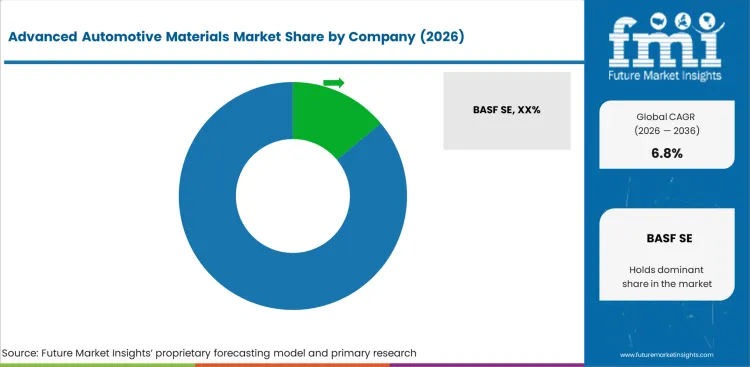
- BASF SE holds a leading position in engineered plastics and thermoplastic elastomers, supported by global R&D and OEM qualification.
- ArcelorMittal and Alcoa Corporation lead in advanced steel and aluminum supply with established OEM relationships.
- Barriers include OEM material qualification timelines, automotive-grade certification, and long-term supply agreement requirements.
- BASF SE leads in engineered plastics and thermoplastic elastomers with a broad automotive portfolio and deep OEM design-in relationships.
- ArcelorMittal dominates advanced high-strength steel through processing innovation, global scale, and established automotive supply programs.
- Toray Industries and SGL Carbon lead in carbon fiber and composite materials, though adoption remains concentrated in premium segments.
Covestro AG and DSM Engineering Materials provide polycarbonate, nylon, and specialty engineering plastic solutions.
Key Companies in the Advanced Automotive Materials Market
Key global companies leading the advanced automotive materials market include:
- BASF SE (Germany), ArcelorMittal (Luxembourg), Toray Industries (Japan), and Covestro AG (Germany) lead with material science R&D, OEM qualification, and global supply.
- Alcoa Corporation (USA), SGL Carbon (Germany), and DSM Engineering Materials (Netherlands) maintain positions through specialty materials expertise.
- DuPont (USA) serves automotive markets with high-performance polymer and composite solutions.
Competitive Benchmarking: Advanced Automotive Materials Market
| Company | Material Portfolio | OEM Qualification | Production Scale | R&D Capability |
|---|---|---|---|---|
| BASF SE | High | High | Strong | High |
| ArcelorMittal | Medium | High | Strong | High |
| Toray Industries | Medium | High | Moderate | High |
| Covestro AG | Medium | High | Strong | High |
| Alcoa Corporation | Medium | High | Strong | Medium |
| SGL Carbon | Low | Medium | Moderate | High |
| DSM Engineering | Medium | High | Moderate | High |
| DuPont | Medium | High | Strong | High |
Source: Future Market Insights competitive analysis, 2026.
Key Developments in Advanced Automotive Materials Market
- In 2025, ArcelorMittal launched a new ultra-high-strength steel grade for EV battery enclosure applications targeting European and North American OEMs.
- In 2025, BASF SE expanded its glass-fiber-reinforced nylon production capacity for automotive structural applications.
Key Players in the Advanced Automotive Materials Market
Major Global Players
- BASF SE
- ArcelorMittal
- Toray Industries Inc.
- Covestro AG
- Alcoa Corporation
- SGL Carbon
- DSM Engineering Materials
Emerging Players/Startups
- Novelis Inc.
- Teijin Limited
- Hexcel Corporation
- Solvay SA
- Lanxess AG
Report Scope and Coverage
| Parameter | Details |
|---|---|
| Quantitative Units | USD 105.88 billion to USD 204.42 billion, at a CAGR of 6.8% |
| Market Definition | The advanced automotive materials market covers metals (high-strength steel, stainless steel, aluminum, powder metals), engineered plastics (nylon, ABS, polycarbonate, polyphenylene oxide), thermoplas... |
| Regions Covered | North America, Latin America, Europe, East Asia, South Asia and Pacific, Middle East and Africa |
| Countries Covered | South Korea, USA, European Union, UK, Japan, 30 plus countries |
| Key Companies Profiled | BASF SE, ArcelorMittal, Toray Industries Inc., Covestro AG, Alcoa Corporation, SGL Carbon, DSM Engineering Materials, DuPont |
| Forecast Period | 2026 to 2036 |
| Approach | Hybrid bottom-up and top-down methodology starting with verified transaction data, projecting adoption velocity across segments and regions. |
Segmentation
Advanced Automotive Materials Market Market Segmented by Metals:
- High-strength steel
- Stainless Steel
- Aluminum
- Powder metals
- Others
Advanced Automotive Materials Market Market Segmented by Engineered Plastics:
- Nylon
- ABS
- Polycarbonate
- Polyphenylene oxide
Advanced Automotive Materials Market Market Segmented by Thermoplastic Elastomers:
- Thermoplastic vulcanizates
- Thermoplastic polyolefin
- Thermoplastic polyurethanes
- Styrene block copolymer
- Copolyester elastomer
- Others
Advanced Automotive Materials Market Market Segmented by Composites:
- Carbon fiber reinforced plastic
- Glass fiber reinforced plastic
Advanced Automotive Materials Market Market by Region:
- North America
- USA
- Canada
- Mexico
- Latin America
- Brazil
- Chile
- Rest of Latin America
- Western Europe
- Germany
- UK
- Italy
- Spain
- France
- Nordic
- BENELUX
- Rest of Western Europe
- Eastern Europe
- Russia
- Poland
- Hungary
- Balkan & Baltic
- Rest of Eastern Europe
- East Asia
- China
- Japan
- South Korea
- South Asia and Pacific
- India
- ASEAN
- Australia & New Zealand
- Rest of South Asia and Pacific
- Middle East & Africa
- Kingdom of Saudi Arabia
- Other GCC Countries
- Turkiye
- South Africa
- Other African Union
- Rest of Middle East & Africa
Research Sources and Bibliography
- 1. International Energy Agency. (2025). Global EV Outlook: Material Demand Analysis. IEA.
- 2. European Commission. (2024). EU CO2 Emission Standards for Passenger Vehicles. EC.
- 3. USA Environmental Protection Agency. (2024). Light-Duty Vehicle Greenhouse Gas Standards. EPA.
- 4. World Steel Association. (2025). Steel in Automotive Applications. WSA.
- 5. International Aluminium Institute. (2025). Aluminium in Automotive Manufacturing. IAI.
This bibliography is provided for reader reference. The full Future Market Insights report contains the complete reference list with publication dates, URLs, and supporting data for all cited works.
This Report Answers
- Estimating the size of the market and revenue projections from 2026 to 2036.
- Segmentation by metals, engineered plastics, thermoplastic elastomers, composites.
- Insights about more than 30 regional markets.
- Analysis of sourcing, technology, and competitive dynamics.
- Assessment of the competitive landscape.
- Identification of investment opportunities across key segments.
- Supply chain and procurement analysis.
- Delivery of data in PDF and Excel formats.
Frequently Asked Questions
What is the global market demand for Advanced Automotive Materials in 2026?
In 2026, the global advanced automotive materials market is expected to be worth USD 105.88 billion.
How big will the Advanced Automotive Materials Market be in 2036?
By 2036, the advanced automotive materials market is expected to be worth USD 204.42 billion.
How much is demand expected to grow?
Between 2026 and 2036, demand is expected to grow at a CAGR of 6.8%.
Which metals segment is likely to lead by 2026?
High-strength steel is expected to account for 41.9% of the metals segment in 2026.
What is causing demand to rise in South Korea?
South Korea is projected to grow at 6.6% through 2036, driven by concentrated automotive production and EV platform development.
What is causing demand to rise in USA?
USA is projected to grow at 6.5% through 2036, supported by large automotive production and EV transition programs.
What does this report mean by 'Advanced Automotive Materials Market definition'?
The advanced automotive materials market covers metals, engineered plastics, thermoplastic elastomers, and composites used in automotive lightweighting and structural applications.
How does FMI make the forecast?
Forecasting models use bottom-up aggregation from automotive production volumes and material content estimates, validated against OEM procurement data.
Preview the report firsthand - request a free sample
Get SampleGet the brochure for pricing and purchase details.
Get PDFTable of Content
- Executive Summary
- Global Market Outlook
- Demand-side Trends
- Supply-side Trends
- Technology Roadmap Analysis
- Market Overview
- Market Coverage / Taxonomy
- Market Definition / Scope / Limitations
- Research Methodology
- Chapter Orientation
- Analytical Lens and Working Hypotheses
- Market Structure, Signals, and Trend Drivers
- Benchmarking and Cross-market Comparability
- Market Sizing, Forecasting, and Opportunity Mapping
- Research Design and Evidence Framework
- Company Annual and Sustainability Reports
- Peer-reviewed Journals and Academic Literature
- Corporate Websites, Product Literature, and Technical Notes
- Earnings Decks and Investor Briefings
- Statutory Filings and Regulatory Disclosures
- Technical White Papers and Standards Notes
- Trade Journals, Industry Magazines, and Analyst Briefs
- Conference Proceedings, Webinars, and Seminar Materials
- Government Statistics Portals and Public Data Releases
- Press Releases and Reputable Media Coverage
- Specialist Newsletters and Curated Briefings
- Sector Databases and Reference Repositories
- FMI Internal Proprietary Databases and Historical Market Datasets
- Subscription Datasets and Paid Sources
- Social Channels, Communities, and Digital Listening Inputs
- Additional Desk Sources
- Expert Input and Fieldwork (Primary Evidence)
- Primary Modes
- Qualitative Interviews and Expert Elicitation
- Quantitative Surveys and Structured Data Capture
- Blended Approach
- Why Primary Evidence is Used
- Field Techniques
- Interviews
- Surveys
- Focus Groups
- Observational and In-context Research
- Social and Community Interactions
- Stakeholder Universe Engaged
- C-suite Leaders
- Board Members
- Presidents and Vice Presidents
- R&D and Innovation Heads
- Technical Specialists
- Domain Subject-matter Experts
- Data Engineering and Model Build
- Data Acquisition and Ingestion
- Cleaning, Normalisation, and Verification
- Synthesis, Triangulation, and Analysis
- Quality Assurance and Audit Trail
- Market Background
- Market Dynamics
- Drivers
- Restraints
- Opportunity
- Trends
- Scenario Forecast
- Demand in Optimistic Scenario
- Demand in Likely Scenario
- Demand in Conservative Scenario
- Opportunity Map Analysis
- Product Life Cycle Analysis
- Supply Chain Analysis
- Investment Feasibility Matrix
- Value Chain Analysis
- PESTLE and Porter’s Analysis
- Regulatory Landscape
- Regional Parent Market Outlook
- Production and Consumption Statistics
- Import and Export Statistics
- Market Dynamics
- Global Market Analysis 2021 to 2025 and Forecast, 2026 to 2036
- Historical Market Size Value (USD Million) Analysis, 2021 to 2025
- Current and Future Market Size Value (USD Million) Projections, 2026 to 2036
- Y-o-Y Growth Trend Analysis
- Absolute $ Opportunity Analysis
- Global Market Pricing Analysis 2021 to 2025 and Forecast 2026 to 2036
- Global Market Analysis 2021 to 2025 and Forecast 2026 to 2036, By Metals
- Introduction / Key Findings
- Historical Market Size Value (USD Million) Analysis By Metals , 2021 to 2025
- Current and Future Market Size Value (USD Million) Analysis and Forecast By Metals , 2026 to 2036
- High-strength steel
- Stainless Steel
- Aluminum
- Powder metals
- Others
- High-strength steel
- Y-o-Y Growth Trend Analysis By Metals , 2021 to 2025
- Absolute $ Opportunity Analysis By Metals , 2026 to 2036
- Global Market Analysis 2021 to 2025 and Forecast 2026 to 2036, By Engineered Plastics
- Introduction / Key Findings
- Historical Market Size Value (USD Million) Analysis By Engineered Plastics, 2021 to 2025
- Current and Future Market Size Value (USD Million) Analysis and Forecast By Engineered Plastics, 2026 to 2036
- Nylon
- ABS
- Polycarbonate
- Polyphenylene oxide
- Nylon
- Y-o-Y Growth Trend Analysis By Engineered Plastics, 2021 to 2025
- Absolute $ Opportunity Analysis By Engineered Plastics, 2026 to 2036
- Global Market Analysis 2021 to 2025 and Forecast 2026 to 2036, By Thermoplastic Elastomers
- Introduction / Key Findings
- Historical Market Size Value (USD Million) Analysis By Thermoplastic Elastomers, 2021 to 2025
- Current and Future Market Size Value (USD Million) Analysis and Forecast By Thermoplastic Elastomers, 2026 to 2036
- Thermoplastic vulcanizates
- Thermoplastic polyolefin
- Thermoplastic polyurethanes
- Styrene block copolymer
- Copolyester elastomer
- Others
- Thermoplastic vulcanizates
- Y-o-Y Growth Trend Analysis By Thermoplastic Elastomers, 2021 to 2025
- Absolute $ Opportunity Analysis By Thermoplastic Elastomers, 2026 to 2036
- Global Market Analysis 2021 to 2025 and Forecast 2026 to 2036, By Composites
- Introduction / Key Findings
- Historical Market Size Value (USD Million) Analysis By Composites, 2021 to 2025
- Current and Future Market Size Value (USD Million) Analysis and Forecast By Composites, 2026 to 2036
- Carbon fiber reinforced plastic
- Glass fiber reinforced plastic
- Carbon fiber reinforced plastic
- Y-o-Y Growth Trend Analysis By Composites, 2021 to 2025
- Absolute $ Opportunity Analysis By Composites, 2026 to 2036
- Global Market Analysis 2021 to 2025 and Forecast 2026 to 2036, By Region
- Introduction
- Historical Market Size Value (USD Million) Analysis By Region, 2021 to 2025
- Current Market Size Value (USD Million) Analysis and Forecast By Region, 2026 to 2036
- North America
- Latin America
- Western Europe
- Eastern Europe
- East Asia
- South Asia and Pacific
- Middle East & Africa
- Market Attractiveness Analysis By Region
- North America Market Analysis 2021 to 2025 and Forecast 2026 to 2036, By Country
- Historical Market Size Value (USD Million) Trend Analysis By Market Taxonomy, 2021 to 2025
- Market Size Value (USD Million) Forecast By Market Taxonomy, 2026 to 2036
- By Country
- USA
- Canada
- Mexico
- By Metals
- By Engineered Plastics
- By Thermoplastic Elastomers
- By Composites
- By Country
- Market Attractiveness Analysis
- By Country
- By Metals
- By Engineered Plastics
- By Thermoplastic Elastomers
- By Composites
- Key Takeaways
- Latin America Market Analysis 2021 to 2025 and Forecast 2026 to 2036, By Country
- Historical Market Size Value (USD Million) Trend Analysis By Market Taxonomy, 2021 to 2025
- Market Size Value (USD Million) Forecast By Market Taxonomy, 2026 to 2036
- By Country
- Brazil
- Chile
- Rest of Latin America
- By Metals
- By Engineered Plastics
- By Thermoplastic Elastomers
- By Composites
- By Country
- Market Attractiveness Analysis
- By Country
- By Metals
- By Engineered Plastics
- By Thermoplastic Elastomers
- By Composites
- Key Takeaways
- Western Europe Market Analysis 2021 to 2025 and Forecast 2026 to 2036, By Country
- Historical Market Size Value (USD Million) Trend Analysis By Market Taxonomy, 2021 to 2025
- Market Size Value (USD Million) Forecast By Market Taxonomy, 2026 to 2036
- By Country
- Germany
- UK
- Italy
- Spain
- France
- Nordic
- BENELUX
- Rest of Western Europe
- By Metals
- By Engineered Plastics
- By Thermoplastic Elastomers
- By Composites
- By Country
- Market Attractiveness Analysis
- By Country
- By Metals
- By Engineered Plastics
- By Thermoplastic Elastomers
- By Composites
- Key Takeaways
- Eastern Europe Market Analysis 2021 to 2025 and Forecast 2026 to 2036, By Country
- Historical Market Size Value (USD Million) Trend Analysis By Market Taxonomy, 2021 to 2025
- Market Size Value (USD Million) Forecast By Market Taxonomy, 2026 to 2036
- By Country
- Russia
- Poland
- Hungary
- Balkan & Baltic
- Rest of Eastern Europe
- By Metals
- By Engineered Plastics
- By Thermoplastic Elastomers
- By Composites
- By Country
- Market Attractiveness Analysis
- By Country
- By Metals
- By Engineered Plastics
- By Thermoplastic Elastomers
- By Composites
- Key Takeaways
- East Asia Market Analysis 2021 to 2025 and Forecast 2026 to 2036, By Country
- Historical Market Size Value (USD Million) Trend Analysis By Market Taxonomy, 2021 to 2025
- Market Size Value (USD Million) Forecast By Market Taxonomy, 2026 to 2036
- By Country
- China
- Japan
- South Korea
- By Metals
- By Engineered Plastics
- By Thermoplastic Elastomers
- By Composites
- By Country
- Market Attractiveness Analysis
- By Country
- By Metals
- By Engineered Plastics
- By Thermoplastic Elastomers
- By Composites
- Key Takeaways
- South Asia and Pacific Market Analysis 2021 to 2025 and Forecast 2026 to 2036, By Country
- Historical Market Size Value (USD Million) Trend Analysis By Market Taxonomy, 2021 to 2025
- Market Size Value (USD Million) Forecast By Market Taxonomy, 2026 to 2036
- By Country
- India
- ASEAN
- Australia & New Zealand
- Rest of South Asia and Pacific
- By Metals
- By Engineered Plastics
- By Thermoplastic Elastomers
- By Composites
- By Country
- Market Attractiveness Analysis
- By Country
- By Metals
- By Engineered Plastics
- By Thermoplastic Elastomers
- By Composites
- Key Takeaways
- Middle East & Africa Market Analysis 2021 to 2025 and Forecast 2026 to 2036, By Country
- Historical Market Size Value (USD Million) Trend Analysis By Market Taxonomy, 2021 to 2025
- Market Size Value (USD Million) Forecast By Market Taxonomy, 2026 to 2036
- By Country
- Kingdom of Saudi Arabia
- Other GCC Countries
- Turkiye
- South Africa
- Other African Union
- Rest of Middle East & Africa
- By Metals
- By Engineered Plastics
- By Thermoplastic Elastomers
- By Composites
- By Country
- Market Attractiveness Analysis
- By Country
- By Metals
- By Engineered Plastics
- By Thermoplastic Elastomers
- By Composites
- Key Takeaways
- Key Countries Market Analysis
- USA
- Pricing Analysis
- Market Share Analysis, 2025
- By Metals
- By Engineered Plastics
- By Thermoplastic Elastomers
- By Composites
- Canada
- Pricing Analysis
- Market Share Analysis, 2025
- By Metals
- By Engineered Plastics
- By Thermoplastic Elastomers
- By Composites
- Mexico
- Pricing Analysis
- Market Share Analysis, 2025
- By Metals
- By Engineered Plastics
- By Thermoplastic Elastomers
- By Composites
- Brazil
- Pricing Analysis
- Market Share Analysis, 2025
- By Metals
- By Engineered Plastics
- By Thermoplastic Elastomers
- By Composites
- Chile
- Pricing Analysis
- Market Share Analysis, 2025
- By Metals
- By Engineered Plastics
- By Thermoplastic Elastomers
- By Composites
- Germany
- Pricing Analysis
- Market Share Analysis, 2025
- By Metals
- By Engineered Plastics
- By Thermoplastic Elastomers
- By Composites
- UK
- Pricing Analysis
- Market Share Analysis, 2025
- By Metals
- By Engineered Plastics
- By Thermoplastic Elastomers
- By Composites
- Italy
- Pricing Analysis
- Market Share Analysis, 2025
- By Metals
- By Engineered Plastics
- By Thermoplastic Elastomers
- By Composites
- Spain
- Pricing Analysis
- Market Share Analysis, 2025
- By Metals
- By Engineered Plastics
- By Thermoplastic Elastomers
- By Composites
- France
- Pricing Analysis
- Market Share Analysis, 2025
- By Metals
- By Engineered Plastics
- By Thermoplastic Elastomers
- By Composites
- India
- Pricing Analysis
- Market Share Analysis, 2025
- By Metals
- By Engineered Plastics
- By Thermoplastic Elastomers
- By Composites
- ASEAN
- Pricing Analysis
- Market Share Analysis, 2025
- By Metals
- By Engineered Plastics
- By Thermoplastic Elastomers
- By Composites
- Australia & New Zealand
- Pricing Analysis
- Market Share Analysis, 2025
- By Metals
- By Engineered Plastics
- By Thermoplastic Elastomers
- By Composites
- China
- Pricing Analysis
- Market Share Analysis, 2025
- By Metals
- By Engineered Plastics
- By Thermoplastic Elastomers
- By Composites
- Japan
- Pricing Analysis
- Market Share Analysis, 2025
- By Metals
- By Engineered Plastics
- By Thermoplastic Elastomers
- By Composites
- South Korea
- Pricing Analysis
- Market Share Analysis, 2025
- By Metals
- By Engineered Plastics
- By Thermoplastic Elastomers
- By Composites
- Russia
- Pricing Analysis
- Market Share Analysis, 2025
- By Metals
- By Engineered Plastics
- By Thermoplastic Elastomers
- By Composites
- Poland
- Pricing Analysis
- Market Share Analysis, 2025
- By Metals
- By Engineered Plastics
- By Thermoplastic Elastomers
- By Composites
- Hungary
- Pricing Analysis
- Market Share Analysis, 2025
- By Metals
- By Engineered Plastics
- By Thermoplastic Elastomers
- By Composites
- Kingdom of Saudi Arabia
- Pricing Analysis
- Market Share Analysis, 2025
- By Metals
- By Engineered Plastics
- By Thermoplastic Elastomers
- By Composites
- Turkiye
- Pricing Analysis
- Market Share Analysis, 2025
- By Metals
- By Engineered Plastics
- By Thermoplastic Elastomers
- By Composites
- South Africa
- Pricing Analysis
- Market Share Analysis, 2025
- By Metals
- By Engineered Plastics
- By Thermoplastic Elastomers
- By Composites
- USA
- Market Structure Analysis
- Competition Dashboard
- Competition Benchmarking
- Market Share Analysis of Top Players
- By Regional
- By Metals
- By Engineered Plastics
- By Thermoplastic Elastomers
- By Composites
- Competition Analysis
- Competition Deep Dive
- BASF SE
- Overview
- Product Portfolio
- Profitability by Market Segments (Product/Age /Sales Channel/Region)
- Sales Footprint
- Strategy Overview
- Marketing Strategy
- Product Strategy
- Channel Strategy
- ArcelorMittal
- Toray Industries Inc.
- Covestro AG
- Alcoa Corporation
- SGL Carbon
- DSM Engineering Materials
- DuPont
- BASF SE
- Competition Deep Dive
- Primary Modes
- Assumptions & Acronyms Used


