

- Industry Size (2026)
- USD 2.7 Bn
- Forecast (2036)
- USD 4.4 Bn
- CAGR (2026 to 2036)
- 46.0%
High-Solids Acrylic Polyol Resins for Low-VOC Industrial Coatings Market Size, Market Forecast and Outlook By FMI
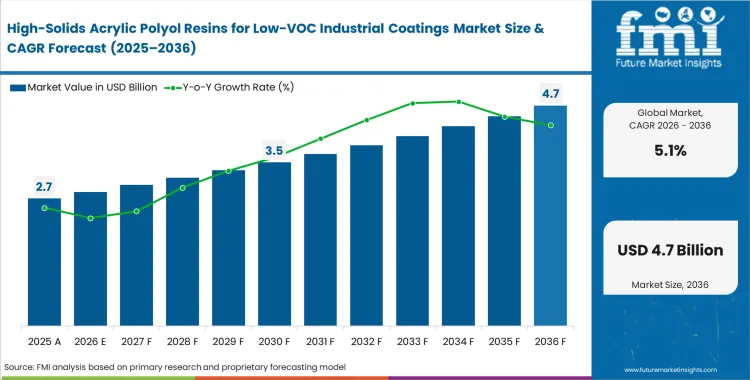
The high-solids acrylic polyol resins for low-VOC industrial coatings market was valued at USD 2.5 billion in 2025. Sector is estimated to cross USD 2.7 billion in 2026 at a CAGR of 5.10% during the forecast period. Market value is projected to reach USD 4.4 billion by 2036, supported by tighter VOC-control requirements and continued use of high-solids acrylic polyol resins in industrial coatings, where viscosity control and application performance must be preserved.
Summary of High-Solids Acrylic Polyol Resins for Low-VOC Industrial Coatings Market
- Market Snapshot
- The high-solids acrylic polyol resins in the low-VOC industrial coatings market are estimated to be USD 2.54 billion in 2025 and projected to be USD 4.39 billion in 2036.
- The market is projected to rise at a 5.1 % CAGR between 2026 and 2036, which will provide an incremental opportunity of approximately USD 1.72 billion in the period.
- This is a formulation based specialty resin market tied mainly to industrial metal, protective, wood, and selected refinish coatings where VOC compliance and film performance have to coexist.
- Competitive advantage is based on resin architecture, solids loading, control of viscosity, cure response as well as compatibility with low-VOC 2K systems rather than on the price of commodities.
- Demand and Growth Drivers
- The demand is increasing due to the fact that industrial coating formulators are moving towards lower emission systems whilst not compromising completely on the appearance, adhesion and longevity required of the solventborne performance coatings.
- Adoption 2K polyurethane systems are still the highest since acrylic polyols strike a balance between weatherability, hardness, retention of gloss and workable levels of VOCs in metal and protective use.
- Regulatory pressure on VOC emissions in the United States and Europe remains a factor in continuing to drive reformulation investment even in established markets of coatings.
- India is expected to record the fastest CAGR at 6.4% from 2026 to 2036, followed by China at 6.0%, Mexico at 5.2%, South Korea at 4.9%, the United States at 4.8%, Germany at 4.2%, and Japan at 3.7%.
- Moderating growth includes the resin-cost sensitivity, application-window limitations at extremely high solids as well as the substitution pressure by waterborne, powder and alternative low-emission chemistries.
- Product and Segment View
- The market includes high-solids acrylic polyol resins with primary applications in low-VOC industrial coating formulations where soluble performance or hybrid performance is still required by the formulators and not the transition to either waterborne or powder systems.
- 65-75% solids is estimated to have a 46 % stake in the solids-content sector in 2026 because it offers a realistic compromise between the reduction of VOCs and viscosity regulation.
- Within the category of coating systems, 2K polyurethane is projected to have 54 % of the market in 2026 due to its continued prevalence as the path to industrial applications of metal and protective topcoats.
- Metal coatings are expected to seize a 38 % of the application market in 2026, which will be backed by constant application in direct-to-metal systems, machinery, components, and fabricated items.
- General industrial is estimated to capture 31 % of the end-use market in 2026, and this indicates the wide installed base in terms of machinery, equipment, fabricated metal, and maintenance coating.
- Asia Pacific will lead the regional segment by an estimated share 41 % in 2026, supported by manufacturing concentration and further coating reformulation of the export-oriented industries.
- Scope consists of resins sold as industrial low-VOC liquid coating, but not finished coating sales, powder binders as a separate category, and unrelated architectural acrylic dispensations.
- Geography and Competitive Outlook
- The country markets in this model are growing fast with China, India and Mexico leading, with the United States and Germany being steady high-value demand centers.
- Competition is also moderately concentrated around large resin and coatings-material platforms that have deep formulation support, regional manufacturing footprint, and high capability of OEM / industrial qualification.
- Key participants include allnex, BASF, Covestro, Arkema, Dow, ELANTAS, and Evonik, with allnex the likeliest scale leader in this niche at an estimated 14% share.
- Market structure favors suppliers that can support low-VOC performance claims across multiple industrial substrates rather than suppliers offering only narrow laboratory-grade chemistry.
Formulation work centers on balancing viscosity, film build, and emissions compliance within increasingly tighter VOC limits. Coatings resin selection in automotive and general industrial coatings increasingly favors grades that deliver target film build with lower dependence on exempt solvents. Slower reformulation can prolong compliance risk and limit flexibility in facilities operating under tighter emissions controls. Evaluating the low-VOC industrial coatings resin market often miscalculates how minor shifts in hydroxyl values dictate curing kinetics on automated lines. Such a formulation mismatch can reduce process consistency and affect throughput efficiency
Once a high-solids coating resin platform is qualified, supplier switching becomes more limited because revalidation adds cost, time, and technical risk. Qualification cycles lock suppliers into multi-year agreements because global pu coatings require extensive validation against corrosion and weathering standards. Early-stage qualification therefore supports more stable volume visibility ahead of broader production ramp-up.
Among key countries in the market, India is expected to rise with a 6.4% CAGR from 2026 to 2036, supported by expanding fabrication capacity and cleaner spray‑line installations at greenfield sites. China is forecast to grow at 6.0% as emissions‑control policies continue to reshape industrial coating practices. Mexico is projected to register a 5.2% CAGR, driven by export manufacturing and regulatory alignment with end‑market requirements. South Korea’s sector is estimated to expand at 4.9%, supported by heavy machinery and marine coatings demand. The United States is expected to grow at 4.8% due to ongoing air‑quality compliance needs and stable maintenance activity, while Germany is projected at 4.2% as established industrial networks refine low‑VOC coating systems. Japan is anticipated to grow at a more modest 3.7%, reflecting a highly mature industrial coatings landscape.
Segmental Analysis
High-Solids Acrylic Polyol Resins for Low-VOC Industrial Coatings Market Analysis by Solids Content
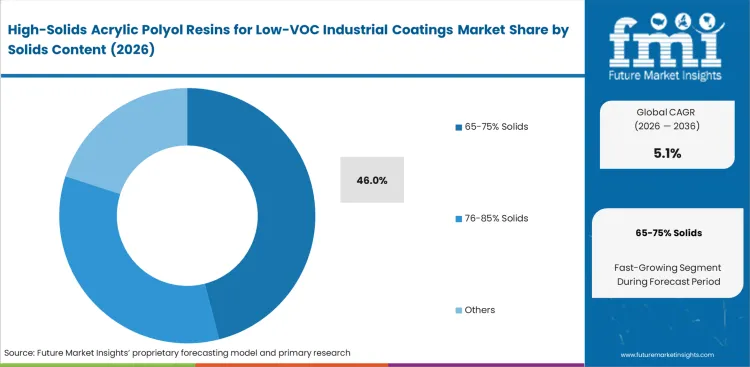
Material selection in this segment is shaped first by viscosity behavior at the spray gun nozzle. The 65-75% solids category is estimated to account for 46.0% share in 2026 because it offers the most workable balance between VOC compliance and compatibility with conventional application equipment. Moving beyond this range often introduces added process cost, either through the need for heated spray systems or through reactive diluents that can alter curing behavior. Mid-tier fabrication sites usually favor resin systems that can run through existing pneumatic lines without hardware modification, which keeps adoption centered on this solids window. Pure volume comparisons in acrylic resins do not fully capture the operating risk at this threshold, since formulations near 75% solids can still run into blistering when flash-off timing is not controlled properly on faster conveyor lines.
- Gun compatibility: Mid-range solids formulations are expected to remain preferred because they pass through standard nozzle configurations without major pressure-side modification. Existing line setup can therefore be preserved without adding avoidable capital cost.
- Solvent entrapment: Tight flash-off margins can leave residual volatiles beneath the cured film when production speeds outrun process control. Surface blistering then raises rejection rates and can force complete stripping and recoating.
- Lifecycle calculation: Applied cost is estimated to remain more favorable in this segment even when theoretical coverage is lower than ultra-high-solids alternatives. Lower rejection risk and fewer process disruptions often offset modestly higher resin pricing.
High-Solids Acrylic Polyol Resins for Low-VOC Industrial Coatings Market Analysis by Coating System
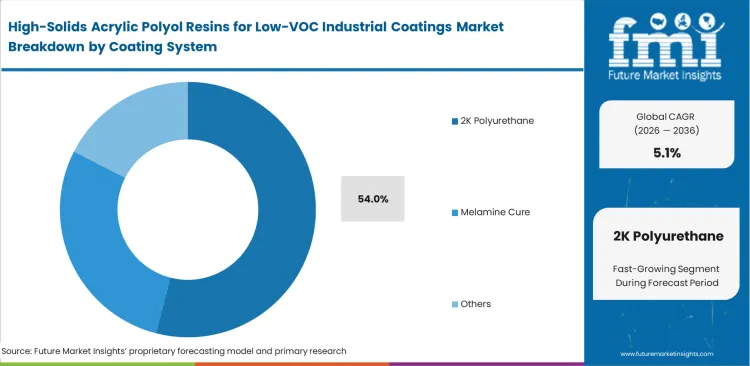
Crosslink density remains central to chemical resistance in coatings exposed to demanding service conditions. Heavy machinery and related industrial applications continue to rely on 2K polyurethane systems because they deliver the weathering stability, hardness profile, and physical durability required in harsher operating environments. Performance in this segment depends on tight stoichiometric control between the hydroxyl-functional acrylic polymer and the isocyanate hardener, which makes formulation discipline important from batching through application. Catalyst selection also shapes day-to-day usability, since the system must preserve enough pot life for smooth line operation while still developing hardness quickly enough for handling and stacking. 2K polyurethane is estimated to account for 54.0% share of the coating-system segment, reflecting its established position in applications where durability carries more weight than processing simplicity. Moisture sensitivity during application remains a practical constraint, as uncontrolled humidity can reduce gloss retention and create seasonal quality variation in facilities without climate control. Execution at the line level matters as much as 2K polyurethane acrylic polyol resin chemistry in sustaining coating consistency and long-term field performance.
- Mixing accuracy: Multi-component plural spray systems require exact volumetric metering to achieve complete crosslinking. Poor calibration can leave soft or partially cured films moving downstream before the coating has fully set.
- Pot-life constraints: Viscosity begins to build as soon as highly catalyzed systems are mixed in the line. Unplanned stoppages can then force rapid flushing to avoid blockage, cleanup loss, and downtime.
- Curing acceleration: Advanced catalyst packages remain important because they shorten return-to-service time without fully sacrificing usable pot life. Faster hardness development also allows earlier stacking of heavily coated parts and reduces floor-space pressure in production environments.
High-Solids Acrylic Polyol Resins for Low-VOC Industrial Coatings Market Analysis by Application
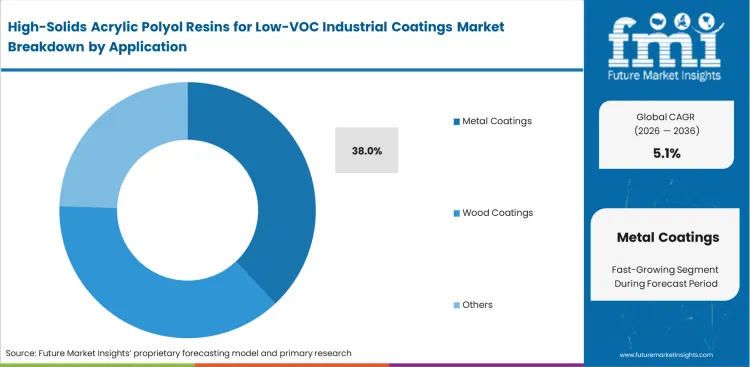
Corrosion resistance remains the main performance requirement across structural steel applications, which keeps metal coatings commercially significant in this market. Demand in this segment is shaped by the need to meet salt-spray performance standards while maintaining adhesion across differently prepared metal surfaces and enough flexibility to withstand thermal movement in service. Metal coatings are anticipated to capture 38.0% share of the application segment in 2026, reflecting broad demand across steel structures, fabricated components, machinery, and related industrial assets. Edge coverage adds another layer of specialty coatings additives, as film pullback during curing can leave corners and exposed angles vulnerable to early rusting.
- Edge retention: Liquid coatings tend to recede from sharp corners during flash-off as surface tension pulls the film away from exposed angles. Rheology control remains important, as weak edge build can shorten protection life at the most exposed points.
- Preparation tolerance: Field-applied systems rarely benefit from laboratory-grade substrate cleanliness. Resin systems with better tolerance for imperfect blasting conditions are more likely to preserve adhesion over longer service cycles.
- Cathodic disbondment: Harsh service environments often rely on multi-coat systems in which acrylic topcoats must remain compatible with zinc-rich primer layers. Intercoat adhesion becomes critical, as separation across layers can compromise the full protective build.
High-Solids Acrylic Polyol Resins for Low-VOC Industrial Coatings Market Analysis by End Use
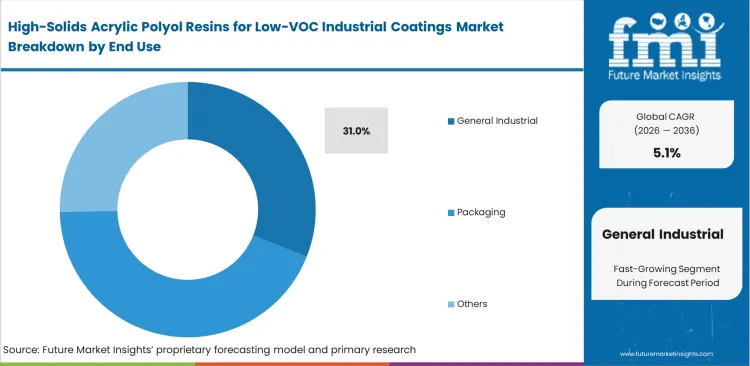
Broad applicability across varied manufacturing settings keeps general industrial demand important in this market. Coating systems in this segment are expected to perform across a wide mix of uses, from electrical enclosures to factory machinery, without forcing frequent changes in resin selection or line practice. General industrial is likely to account for 31.0% share of the end-use segment in 2026, reflecting the value placed on formulation flexibility, broad substrate coverage, and stable day-to-day processing. Anti-corrosion coatings also need fast touch-dry response in high-volume job shops, where slower curing can interrupt throughput and create avoidable line backups. Finish consistency remains a practical challenge in highly catalyzed formulations, where shifts in exotherm across batch sizes or ambient conditions can alter gloss and create visible mismatch at final inspection. Demand in this segment remains strongest for resin systems that combine broad usability with stable appearance and predictable plant-floor execution, which keeps formulation discipline important when developing an acrylic polyol resin for protective coatings.
- Inventory rationalization: Versatile polyol platforms can accept multiple hardener types to adjust cure speed across different production needs. Fewer master resin codes help reduce warehouse complexity while still supporting varied customer specifications.
- Color matching: General manufacturing often requires precise color consistency across separate production runs. Resin clarity and stable wetting behavior remain important, as pigment instability can lead to flocculation, finish variation, and rework.
- Throughput velocity: High-volume facilities depend on rapid hardness development to keep coated parts moving through packing and shipment stages. Faster handling strength helps reduce line congestion and lowers the risk of surface damage during immediate crating.
High-Solids Acrylic Polyol Resins for Low-VOC Industrial Coatings Market Drivers, Restraints, and Opportunities
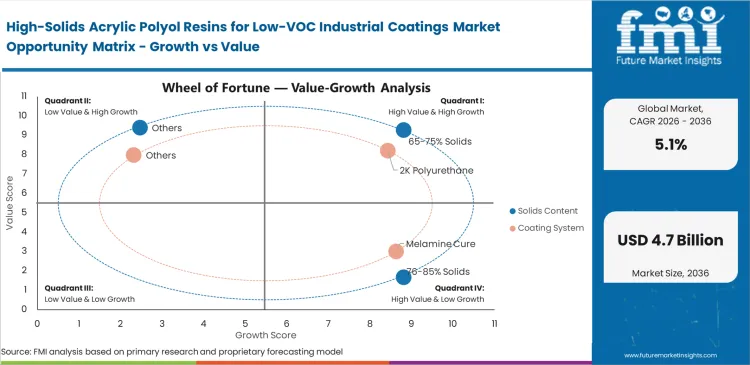
Strict environmental legislation imposes non-negotiable limits on volatile emissions at large manufacturing sites. Factory environmental officers face steep financial penalties and potential shutdown orders if their spray booths exceed permitted thresholds. This pressure forces immediate transition away from legacy formulations regardless of raw material cost differences. Debates regarding high-solids coatings vs waterborne coatings often resolve in favor of high-solids when existing drying oven footprints cannot accommodate extended water evaporation cycles. Delaying compliance planning leaves plant managers scrambling to qualify unfamiliar resin systems under emergency timelines, often resulting in compromised finish quality and disrupted production schedules.
High viscosity inherent to concentrated polymer networks creates significant application friction. Operators accustomed to spraying thin, highly reduced paints struggle to atomize high-solids material evenly without causing severe orange-peel textures. This persists structurally because upgrading to high-pressure, heated plural-component spray hardware demands massive capital expenditure. While novel reactive diluents offer partial viscosity reduction, they introduce complex curing dynamics that many mid-tier job shops lack the technical expertise to manage effectively. Comparing low-VOC solventborne vs waterborne industrial coatings reveals that both does not completely friction-free drop-in solution for legacy application hardware. This is a reality that keeps solventborne architectures competitive against waterborne acrylic resin platforms.
Opportunities in the High-Solids Acrylic Polyol Resins for Low-VOC Industrial Coatings Market
- Rheology modification: Utilizing advanced coating additives controls sag resistance in heavy film builds. Formulation chemists achieve single-coat coverage without dripping.
- Bio-based polyol integration: Sourcing monomers from renewable feedstocks satisfies emerging corporate sustainability mandates. Procurement teams secure long-term contracts with eco-conscious original equipment manufacturers.
- Low-temperature curing: Engineering resin backbones that crosslink at ambient temperatures reduces oven energy consumption. Facility managers drastically lower utility overheads while maintaining line speeds.
Regional Analysis
.webp "Top Country Growth Comparison High Solids Acrylic Polyol Resins For Low Voc Industrial Coatings Market Cagr (2026 2036)")
Based on regional analysis, High-Solids Acrylic Polyol Resins for Low-VOC Industrial Coatings is segmented into Asia Pacific, Europe, North America, Latin America, and Middle East & Africa across 40 plus countries.
| Country | CAGR (2026 to 2036) |
|---|---|
| India | 6.4% |
| China | 6.0% |
| Mexico | 5.2% |
| South Korea | 4.9% |
| United States | 4.8% |
| Germany | 4.2% |
| Japan | 3.7% |
Source: Future Market Insights (FMI) analysis, based on proprietary forecasting model and primary research
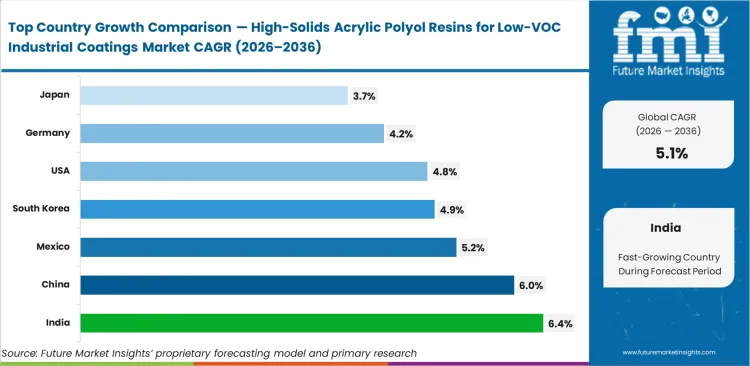
Asia Pacific High-Solids Acrylic Polyol Resins for Low-VOC Industrial Coatings Market Analysis
Industrial expansion across Asia Pacific keeps this region central to demand for high-solids acrylic polyol resins in low-VOC industrial coatings. New manufacturing sites across developing hubs are more likely to install low-emission spray infrastructure from the outset, which reduces the retrofit burden that weighs on older production bases. Regional suppliers also adapt resin formulations to local cost structures, substrate conditions, and performance requirements rather than relying on one uniform global specification. China's acrylic polyol resin remains especially influential in this regional balance, as shifts in its acrylic polyol resin demand and production position can affect pricing across the broader Asia Pacific supply chain.
- India: New capacity in automotive and metal-fabrication industries is allowing high-solids coating systems to be integrated at the plant-design stage rather than introduced through later retrofits. Demand for high-solids acrylic polyol resins in India is anticipated to rise at a CAGR of 6.4% from 2026 to 2036, supported by greenfield manufacturing investment and cleaner spray-line installation. This leaves the market better positioned to adopt advanced formulations without the operating constraints tied to older equipment layouts.
- China: Emissions compliance remains a major force in coating reformulation across industrial production clusters. The market for high-solids acrylic polyol resins in China is expected to record a CAGR of 6.0% through 2036 as manufacturers shift toward compliant systems that can satisfy coating-performance requirements without relying on more solvent-heavy formulations. Early qualification in regulated industrial chains can strengthen a supplier's position in a market where scale and approval timing both matter.
- South Korea: Heavy machinery and marine end uses keep coating performance standards high, especially where export-facing production depends on durable finishes and weathering consistency. These applications continue to support demand for high-solids acrylic polyol resins, with the South Korea market estimated to expand at a CAGR of 4.9% from 2026 to 2036. Specification compliance carries more weight than simple cost comparison in this market, which keeps resin selection closely tied to long service life and weathering reliability.
- Japan: Mature industrial networks and established coating lines make replacement cycles slower than in faster-build manufacturing markets. High-solids acrylic polyol resins market in Japan is projected to expand at a CAGR of 3.7% from the forecast period, reflecting a market driven by incremental process improvement than by full system replacement. Efficiency gains within installed infrastructure continue to matter more here than rapid shifts toward entirely new coating platforms.
FMI's report includes detailed tracking for Southeast Asian manufacturing centers. Expanding export capabilities in these areas necessitates alignment with international environmental compliance frameworks, including emerging standards for bio acrylic industrial floor coatings. Vietnam also warrants close attention in the regional outlook, as export-sector growth and continued industrial expansion are increasing demand for manufacturing equipment, technologies, and plant systems tied to industrial production.
North America High-Solids Acrylic Polyol Resins for Low-VOC Industrial Coatings Market Analysis
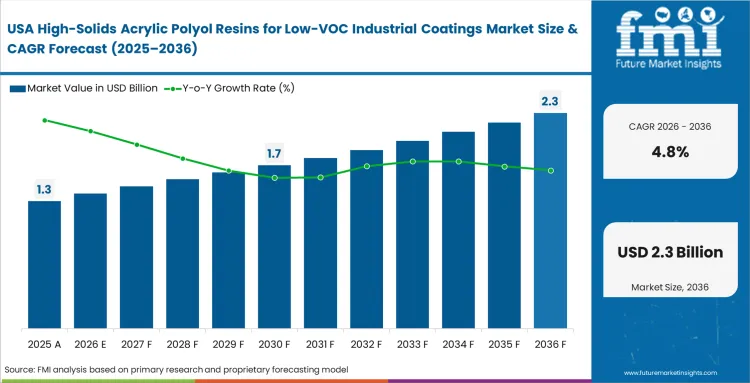
Air-quality regulation remains the main factor shaping resin formulation strategy across North America. Compliance requirements are not applied uniformly across the region, which forces coating suppliers to manage product portfolios around a patchwork of state, district, and end-market standards. Much of the commercial challenge lies in maintaining broader industrial coating lines while still meeting tighter local VOC limits in manufacturing corridors with stricter enforcement. Demand for the United States industrial coatings resin remains closely tied to how effectively suppliers and applicators manage these regional compliance differences.
- United States: District-level VOC limits continue to reshape established industrial finish lines, particularly in markets where approved coating systems must be updated to remain compliant. Demand for high-solids acrylic polyol resins in the United States is expected to rise at a CAGR of 4.8%, as reformulation activity continues across regulated industrial applications. Materials approval cycles carry operational weight in this market, since outdated coating systems can delay line continuity and narrow usable product options.
- Mexico: Export-oriented assembly activity keeps coating selection closely aligned with destination-market standards and North American OEM requirements. Cross-border manufacturing linkages and the need to meet external specification standards are expected to support demand for high-solids acrylic polyol resins in Mexico, which is estimated to expand at a CAGR of 5.2% through 2036. This keeps local application practices closely tied to the process expectations of international production networks.
FMI's report includes analysis of Canadian industrial sectors. Harsh environmental exposure in northern operations requires specialized low-temperature curing capabilities alongside standard compliance.
Europe High-Solids Acrylic Polyol Resins for Low-VOC Industrial Coatings Market Analysis
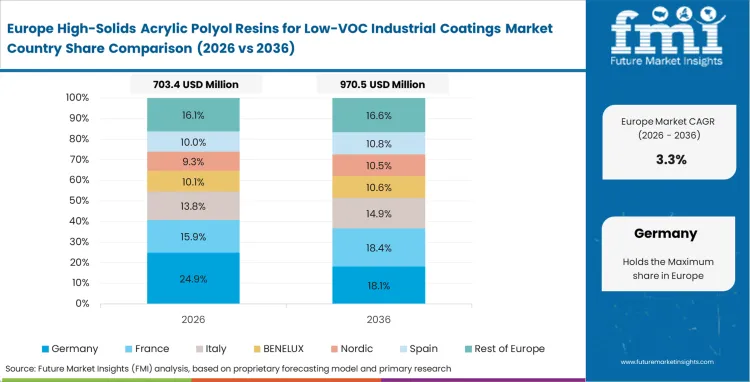
Regulatory pressure in Europe extends beyond conventional VOC reduction and increasingly covers broader questions around chemical profile, lifecycle impact, and long-term sustainability claims. Resin selection in this region is influenced not only by emissions compliance but also by the need to align with evolving expectations around formulation safety, disposal profile, and environmental positioning. This keeps product development more demanding for suppliers serving Europe's industrial coatings markets, where future compliance risk can matter almost as much as current technical performance. Regional demand is shaped by a market environment in which formulation durability, regulatory resilience, and sustainability alignment are evaluated together.
- Germany: Established automotive and industrial manufacturing networks keep process consistency at the center of resin qualification. The market for high-solids acrylic polyol resins in Germany is anticipated to rise at a CAGR of 4.2% from 2026 to 2036, supported by mature low-emission coating infrastructure and the continued use of highly automated finishing lines. Batch-to-batch consistency carries more weight here than experimental formulation change, since coating systems must run reliably across tightly controlled production environments. Suppliers in the German low-VOC coatings resin space compete as much on process stability as on chemistry performance.
FMI's report includes broader European Union compliance tracking. Ecolabel revisions continually reshape how regional suppliers market their sustainability credentials to industrial buyers. France also merits attention in the regional outlook, as industrial coatings demand continues to benefit from automotive, general industrial, and refinishing activity while low-VOC resin adoption remains aligned with tighter environmental positioning in the coatings value chain.
Competitive Aligners for Market Players
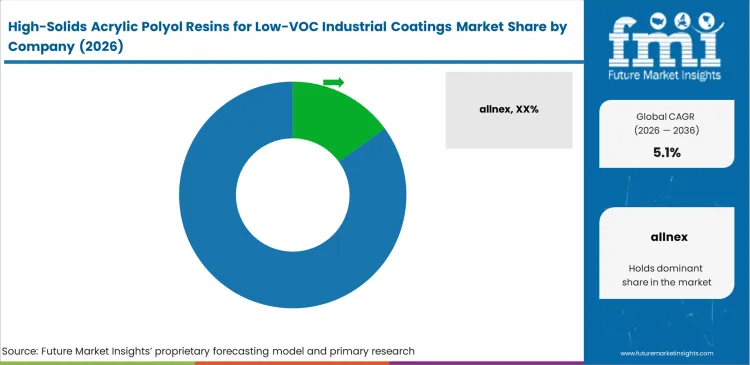
Technical capability sets the entry threshold in this market, but supplier retention depends more on the quality of field support than on resin chemistry alone. Buyers with high-throughput coating lines tend to favor suppliers that can resolve process disruptions quickly at the plant level, especially when gloss loss, blistering, or cure instability appears during seasonal humidity shifts. Immediate adjustment of catalyst balance or application settings often matters more than a delayed laboratory recommendation, since downtime and coating rejection carry direct operating costs. Suppliers of high-solids acrylic polyol resins depend not only on formulation performance, but also on how effectively technical support can stabilize production under real operating conditions
Established suppliers also benefit from broad installed bases and long validation histories in demanding service environments. Companies such as BASF and Covestro possess decades of real-world weathering data proving their resins survive aggressive environments. Challengers struggle because pfas-free powder coatings and alternative technologies lack this long-term empirical backing. New entrants face a slower path to approval because resin qualification is tied closely to operating reliability and long-cycle asset protection. Manufacturer preference in this market remains strongly influenced by proven in-service performance rather than by untested formulation claims.
Large industrial paint manufacturers consolidate purchasing power to force price concessions, yet remain highly vulnerable to supply disruptions. Multiple resin variants are often qualified to reduce the risk of production disruption when monomer availability tightens or specific supply streams come under pressure. This dynamic forces top acrylic polyol resin manufacturers like Arkema and Dow to maintain redundant manufacturing assets globally. Major buyers constantly balance the desire for volume discounts against the operational necessity of maintaining diverse, geographically distributed supply networks to ensure uninterrupted factory operations.
Key Players in High-Solids Acrylic Polyol Resins for Low-VOC Industrial Coatings Market
- allnex
- BASF
- Covestro
- Arkema
- Dow
- ELANTAS
- Evonik
Scope of the Report
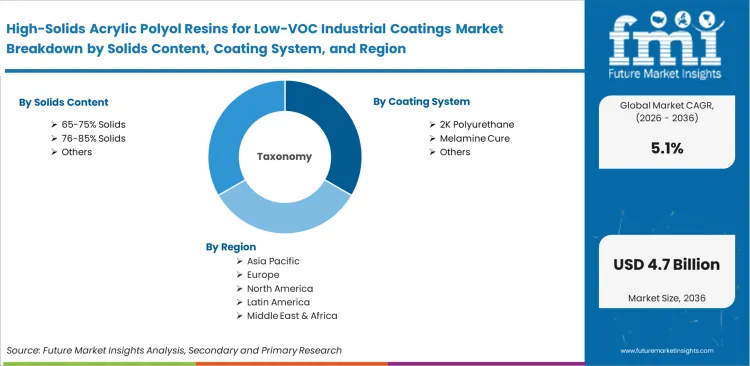
| Metric | Value |
|---|---|
| Quantitative Units | USD 2.7 Billion to USD 4.4 Billion, at a CAGR of 5.10% |
| Market Definition | This category covers engineered synthetic polymers featuring dense hydroxyl functionality and high non-volatile content. These resins enable formulation of industrial protective finishes that satisfy stringent atmospheric emission regulations without sacrificing application viscosity or cured film performance. |
| Segmentation | By Solids Content, Coating System, Application, End Use |
| Regions Covered | Asia Pacific, Europe, North America, Latin America, Middle East & Africa |
| Countries Covered | China, India, United States, Germany, Japan, South Korea, Mexico |
| Key Companies Profiled | allnex, BASF, Covestro, Arkema, Dow, ELANTAS, Evonik |
| Forecast Period | 2026 to 2036 |
| Approach | Total volume of hydroxyl-functional liquid resins shipped to industrial paint formulators. |
Source: Future Market Insights (FMI) analysis, based on proprietary forecasting model and primary research
High-Solids Acrylic Polyol Resins for Low-VOC Industrial Coatings Market Analysis by Segments
Solids Content
- 65-75% solids
- 76-85% solids
- Above 85% solids
Coating System
- 2K polyurethane
- Melamine cure
- Hybrid systems
Application
- Metal coatings
- Protective coatings
- Wood coatings
- Plastic coatings
End Use
- General industrial
- Automotive refinish
- ACE equipment
- Packaging
Region
- Asia Pacific
- Europe
- North America
- Latin America
- Middle East & Africa
Bibliography
- American Coatings Association, & PaintCare Inc. (2024, May). Petition of American Coatings Association, Inc. and PaintCare Inc. to include paints in the universal waste program under the Resource Conservation and Recovery Act. USA Environmental Protection Agency.
- ELANTAS Europe. (2025). Special coatings - Product portfolio of ELANTAS Europe.
- European Commission, Joint Research Centre. (2026). Final preliminary report on the revision of the EU Ecolabel criteria for indoor and outdoor paints and varnishes. Publications Office of the European Union.
- PPG Industries, Inc. (2025). 2024 Annual Report and Form 10-K.
- Arkema. (2024, June 7). The path forward to safer 2K paints: Low VOC and NISO innovations.
This bibliography is provided for reader reference. The full FMI report contains the complete reference list with primary source documentation.
This Report Addresses
- Hydroxyl value optimization requirements facing formulation chemists aiming for rapid cure timelines.
- Viscosity constraints disrupting standard spray application protocols at major fabrication facilities.
- Regulatory thresholds forcing immediate transition away from legacy solvent-borne systems.
- Pot-life management strategies utilized by floor supervisors operating plural-component equipment.
- Catalyst packaging required to balance hardness development against required open times.
- Regional mandates shaping raw material sourcing decisions across North American and European lines.
- Intercoat adhesion challenges encountered by contractors applying multi-layer protective systems.
- Quality control metrics utilized by specification engineers verifying long-term environmental durability.
Frequently Asked Questions
What is the baseline valuation for this sector?
Current assessments position the value at USD 2.7 billion in 2026. This establishes the financial foundation as massive industrial operations execute mandatory transitions away from high-solvent formulations.
What structural condition supports future demand?
Revenue tracks toward USD 4.4 billion by 2036. Strict regional emission regulations permanently disqualify legacy systems, forcing continuous consumption of compliant high-solids architectures.
Why does the 65-75% solids tier dominate formulation choices?
This specific range commands 46.0% share because it perfectly balances regulatory compliance against existing equipment capabilities. Formulators rely on this viscosity sweet spot to avoid demanding expensive hardware upgrades from their clients.
What forces the preference for 2K polyurethane systems?
Holding 54.0% share, these two-component setups deliver crosslink density that single-pack systems cannot match. Specification engineers require this exact chemistry to survive aggressive industrial weathering and chemical exposure.
Why do metal applications consume significant volumes?
Generating 38.0% share, structural steel protection demands extreme anti-corrosion properties. Corrosion engineers specify heavy film builds that only these advanced polyol resins can achieve without trapping destructive solvents.
What operational reality sustains general industrial usage?
General manufacturing operations capture 31.0% share. Plant managers require versatile platforms capable of protecting varied equipment while supporting rapid throughput speeds on crowded assembly lines.
What creates the growth gap between India and Japan?
India expands at 6.4% as Greenfield industrial sites install modern spray hardware capable of handling high-viscosity resins natively. Japan progresses at 3.7% because mature, established networks focus entirely on incremental optimization.
Why does Mexico exhibit strong adoption rates?
Registering 5.2% growth, Mexican manufacturing facilities align closely with North American export requirements. Cross-border supply chains dictate that locally applied finishes match destination-market environmental specifications.
How do qualification cycles protect incumbents?
Infrastructure firms require extensive real-world weathering data before specifying new materials. This multi-year requirement prevents challengers from easily displacing entrenched suppliers possessing deep historical testing archives.
Why do large buyers split their resin sourcing?
Procurement directors qualify multiple suppliers specifically to mitigate supply chain vulnerabilities. Operating diverse sourcing networks ensures factory lines continue running even if specific monomer shortages strike one supplier.
What limits the adoption of ultra-high solids?
Hardware requirements remain the primary constraint. Mid-tier job shops refuse the massive capital expenditures required to install heated, plural-component lines capable of spraying heavily concentrated polymer networks.
How does humidity impact these systems?
Moisture reacts unpredictably with isocyanate hardeners during application. Applicators lacking climate-controlled facilities experience severe gloss variations and potential adhesion failure when ambient conditions fluctuate.
What drives the need for extended pot life?
Highly catalyzed formulas begin curing immediately inside delivery lines. Operators demand extended open times to prevent expensive equipment blockages during necessary line stoppages or color changeovers.
Why is edge retention critical in metal coatings?
Liquid films naturally pull back from sharp corners during flash-off. Formulators engineer specific rheology profiles to lock the resin precisely in place, preventing premature rust at vulnerable structural angles.
How do curing accelerators alter production?
Specialized catalysts decouple working time from final hardness development. Plant managers utilize these packages to drastically compress return-to-service timelines, allowing earlier stacking of heavy components.
What influences formulation in the United States?
District-level air quality boards continually lower permissible emission limits. R&D directors must constantly adjust regional product lines to maintain legal compliance across fragmented state-level regulatory maps.
How do European regulations differ?
European directives increasingly assess total lifecycle toxicity rather than just point-of-use emissions. Resin producers must engineer entire architectures anticipating future chemical restrictions on specific monomer usage.
What defines success in protective coatings?
Field tolerance dictates actual viability. Formulations that perform perfectly in laboratories often fail when contractors apply them over imperfectly prepared substrates under difficult ambient environmental conditions.
Preview the report firsthand - request a free sample
Get SampleGet the brochure for pricing and purchase details.
Get PDFTable of Content
- Executive Summary
- Global Market Outlook
- Demand-side Trends
- Supply-side Trends
- Technology Roadmap Analysis
- Analysis and Recommendations
- Market Overview
- Market Coverage / Taxonomy
- Market Definition / Scope / Limitations
- Research Methodology
- Chapter Orientation
- Analytical Lens and Working Hypotheses
- Market Sizing, Forecasting, and Opportunity Mapping
- Research Design and Evidence Framework
- Desk Research Programme (Secondary Evidence)
- Company Annual and Sustainability Reports
- Peer-reviewed Journals and Academic Literature
- Corporate Websites, Product Literature, and Technical Notes
- Earnings Decks and Investor Briefings
- Statutory Filings and Regulatory Disclosures
- Technical White Papers and Standards Notes
- Trade Journals, Industry Magazines, and Analyst Briefs
- Conference Proceedings, Webinars, and Seminar Materials
- Government Statistics Portals and Public Data Releases
- Press Releases and Reputable Media Coverage
- Specialist Newsletters and Curated Briefings
- Sector Databases and Reference Repositories
- FMI Internal Proprietary Databases and Historical Market Datasets
- Subscription Datasets and Paid Sources
- Social Channels, Communities, and Digital Listening Inputs
- Additional Desk Sources
- Expert Input and Fieldwork (Primary Evidence)
- Primary Modes
- Qualitative Interviews and Expert Elicitation
- Quantitative Surveys and Structured Data Capture
- Blended Approach
- Why Primary Evidence is Used
- Observational and In-context Research
- Social and Community Interactions
- Primary Modes
- Stakeholder Universe Engaged
- C-suite Leaders
- Board Members
- Presidents and Vice Presidents
- R&D and Innovation Heads
- Technical Specialists
- Domain Subject-matter Experts
- Scientists
- Physicians and Other Healthcare Professionals
- Governance, Ethics, and Data Stewardship
- Research Ethics
- Data Integrity and Handling
- Desk Research Programme (Secondary Evidence)
- Tooling, Models, and Reference Databases
- Data Engineering and Model Build
- Data Acquisition and Ingestion
- Cleaning, Normalisation, and Verification
- Synthesis, Triangulation, and Analysis
- Quality Assurance and Audit Trail
- Market Background
- Market Dynamics
- Drivers
- Restraints
- Opportunity
- Trends
- Scenario Forecast
- Demand in Optimistic Scenario
- Demand in Likely Scenario
- Demand in Conservative Scenario
- Opportunity Map Analysis
- Product Life Cycle Analysis
- Supply Chain Analysis
- Investment Feasibility Matrix
- Value Chain Analysis
- PESTLE and Porter’s Analysis
- Regulatory Landscape
- Regional Parent Market Outlook
- Production and Consumption Statistics
- Import and Export Statistics
- Market Dynamics
- Global Market Analysis 2021 to 2025 and Forecast, 2026 to 2036
- Historical Market Size Value (USD Million) Analysis, 2021 to 2025
- Current and Future Market Size Value (USD Million) Projections, 2026 to 2036
- Y-o-Y Growth Trend Analysis
- Absolute $ Opportunity Analysis
- Global Market Pricing Analysis 2021 to 2025 and Forecast 2026 to 2036
- Global Market Analysis 2021 to 2025 and Forecast 2026 to 2036, By Solids Content
- Introduction / Key Findings
- Historical Market Size Value (USD Million) Analysis By Solids Content , 2021 to 2025
- Current and Future Market Size Value (USD Million) Analysis and Forecast By Solids Content , 2026 to 2036
- 65-75% Solids
- 76-85% Solids
- Others
- 65-75% Solids
- Y-o-Y Growth Trend Analysis By Solids Content , 2021 to 2025
- Absolute $ Opportunity Analysis By Solids Content , 2026 to 2036
- Global Market Analysis 2021 to 2025 and Forecast 2026 to 2036, By Coating System
- Introduction / Key Findings
- Historical Market Size Value (USD Million) Analysis By Coating System, 2021 to 2025
- Current and Future Market Size Value (USD Million) Analysis and Forecast By Coating System, 2026 to 2036
- 2K Polyurethane
- Melamine Cure
- Others
- 2K Polyurethane
- Y-o-Y Growth Trend Analysis By Coating System, 2021 to 2025
- Absolute $ Opportunity Analysis By Coating System, 2026 to 2036
- Global Market Analysis 2021 to 2025 and Forecast 2026 to 2036, By Application
- Introduction / Key Findings
- Historical Market Size Value (USD Million) Analysis By Application, 2021 to 2025
- Current and Future Market Size Value (USD Million) Analysis and Forecast By Application, 2026 to 2036
- Metal Coatings
- Wood Coatings
- Others
- Metal Coatings
- Y-o-Y Growth Trend Analysis By Application, 2021 to 2025
- Absolute $ Opportunity Analysis By Application, 2026 to 2036
- Global Market Analysis 2021 to 2025 and Forecast 2026 to 2036, By End Use
- Introduction / Key Findings
- Historical Market Size Value (USD Million) Analysis By End Use, 2021 to 2025
- Current and Future Market Size Value (USD Million) Analysis and Forecast By End Use, 2026 to 2036
- General Industrial
- Packaging
- Others
- General Industrial
- Y-o-Y Growth Trend Analysis By End Use, 2021 to 2025
- Absolute $ Opportunity Analysis By End Use, 2026 to 2036
- Global Market Analysis 2021 to 2025 and Forecast 2026 to 2036, By Region
- Introduction
- Historical Market Size Value (USD Million) Analysis By Region, 2021 to 2025
- Current Market Size Value (USD Million) Analysis and Forecast By Region, 2026 to 2036
- North America
- Latin America
- Western Europe
- Eastern Europe
- East Asia
- South Asia and Pacific
- Middle East & Africa
- Market Attractiveness Analysis By Region
- North America Market Analysis 2021 to 2025 and Forecast 2026 to 2036, By Country
- Historical Market Size Value (USD Million) Trend Analysis By Market Taxonomy, 2021 to 2025
- Market Size Value (USD Million) Forecast By Market Taxonomy, 2026 to 2036
- By Country
- USA
- Canada
- Mexico
- By Solids Content
- By Coating System
- By Application
- By End Use
- By Country
- Market Attractiveness Analysis
- By Country
- By Solids Content
- By Coating System
- By Application
- By End Use
- Key Takeaways
- Latin America Market Analysis 2021 to 2025 and Forecast 2026 to 2036, By Country
- Historical Market Size Value (USD Million) Trend Analysis By Market Taxonomy, 2021 to 2025
- Market Size Value (USD Million) Forecast By Market Taxonomy, 2026 to 2036
- By Country
- Brazil
- Chile
- Rest of Latin America
- By Solids Content
- By Coating System
- By Application
- By End Use
- By Country
- Market Attractiveness Analysis
- By Country
- By Solids Content
- By Coating System
- By Application
- By End Use
- Key Takeaways
- Western Europe Market Analysis 2021 to 2025 and Forecast 2026 to 2036, By Country
- Historical Market Size Value (USD Million) Trend Analysis By Market Taxonomy, 2021 to 2025
- Market Size Value (USD Million) Forecast By Market Taxonomy, 2026 to 2036
- By Country
- Germany
- UK
- Italy
- Spain
- France
- Nordic
- BENELUX
- Rest of Western Europe
- By Solids Content
- By Coating System
- By Application
- By End Use
- By Country
- Market Attractiveness Analysis
- By Country
- By Solids Content
- By Coating System
- By Application
- By End Use
- Key Takeaways
- Eastern Europe Market Analysis 2021 to 2025 and Forecast 2026 to 2036, By Country
- Historical Market Size Value (USD Million) Trend Analysis By Market Taxonomy, 2021 to 2025
- Market Size Value (USD Million) Forecast By Market Taxonomy, 2026 to 2036
- By Country
- Russia
- Poland
- Hungary
- Balkan & Baltic
- Rest of Eastern Europe
- By Solids Content
- By Coating System
- By Application
- By End Use
- By Country
- Market Attractiveness Analysis
- By Country
- By Solids Content
- By Coating System
- By Application
- By End Use
- Key Takeaways
- East Asia Market Analysis 2021 to 2025 and Forecast 2026 to 2036, By Country
- Historical Market Size Value (USD Million) Trend Analysis By Market Taxonomy, 2021 to 2025
- Market Size Value (USD Million) Forecast By Market Taxonomy, 2026 to 2036
- By Country
- China
- Japan
- South Korea
- By Solids Content
- By Coating System
- By Application
- By End Use
- By Country
- Market Attractiveness Analysis
- By Country
- By Solids Content
- By Coating System
- By Application
- By End Use
- Key Takeaways
- South Asia and Pacific Market Analysis 2021 to 2025 and Forecast 2026 to 2036, By Country
- Historical Market Size Value (USD Million) Trend Analysis By Market Taxonomy, 2021 to 2025
- Market Size Value (USD Million) Forecast By Market Taxonomy, 2026 to 2036
- By Country
- India
- ASEAN
- Australia & New Zealand
- Rest of South Asia and Pacific
- By Solids Content
- By Coating System
- By Application
- By End Use
- By Country
- Market Attractiveness Analysis
- By Country
- By Solids Content
- By Coating System
- By Application
- By End Use
- Key Takeaways
- Middle East & Africa Market Analysis 2021 to 2025 and Forecast 2026 to 2036, By Country
- Historical Market Size Value (USD Million) Trend Analysis By Market Taxonomy, 2021 to 2025
- Market Size Value (USD Million) Forecast By Market Taxonomy, 2026 to 2036
- By Country
- Kingdom of Saudi Arabia
- Other GCC Countries
- Turkiye
- South Africa
- Other African Union
- Rest of Middle East & Africa
- By Solids Content
- By Coating System
- By Application
- By End Use
- By Country
- Market Attractiveness Analysis
- By Country
- By Solids Content
- By Coating System
- By Application
- By End Use
- Key Takeaways
- Key Countries Market Analysis
- USA
- Pricing Analysis
- Market Share Analysis, 2025
- By Solids Content
- By Coating System
- By Application
- By End Use
- Canada
- Pricing Analysis
- Market Share Analysis, 2025
- By Solids Content
- By Coating System
- By Application
- By End Use
- Mexico
- Pricing Analysis
- Market Share Analysis, 2025
- By Solids Content
- By Coating System
- By Application
- By End Use
- Brazil
- Pricing Analysis
- Market Share Analysis, 2025
- By Solids Content
- By Coating System
- By Application
- By End Use
- Chile
- Pricing Analysis
- Market Share Analysis, 2025
- By Solids Content
- By Coating System
- By Application
- By End Use
- Germany
- Pricing Analysis
- Market Share Analysis, 2025
- By Solids Content
- By Coating System
- By Application
- By End Use
- UK
- Pricing Analysis
- Market Share Analysis, 2025
- By Solids Content
- By Coating System
- By Application
- By End Use
- Italy
- Pricing Analysis
- Market Share Analysis, 2025
- By Solids Content
- By Coating System
- By Application
- By End Use
- Spain
- Pricing Analysis
- Market Share Analysis, 2025
- By Solids Content
- By Coating System
- By Application
- By End Use
- France
- Pricing Analysis
- Market Share Analysis, 2025
- By Solids Content
- By Coating System
- By Application
- By End Use
- India
- Pricing Analysis
- Market Share Analysis, 2025
- By Solids Content
- By Coating System
- By Application
- By End Use
- ASEAN
- Pricing Analysis
- Market Share Analysis, 2025
- By Solids Content
- By Coating System
- By Application
- By End Use
- Australia & New Zealand
- Pricing Analysis
- Market Share Analysis, 2025
- By Solids Content
- By Coating System
- By Application
- By End Use
- China
- Pricing Analysis
- Market Share Analysis, 2025
- By Solids Content
- By Coating System
- By Application
- By End Use
- Japan
- Pricing Analysis
- Market Share Analysis, 2025
- By Solids Content
- By Coating System
- By Application
- By End Use
- South Korea
- Pricing Analysis
- Market Share Analysis, 2025
- By Solids Content
- By Coating System
- By Application
- By End Use
- Russia
- Pricing Analysis
- Market Share Analysis, 2025
- By Solids Content
- By Coating System
- By Application
- By End Use
- Poland
- Pricing Analysis
- Market Share Analysis, 2025
- By Solids Content
- By Coating System
- By Application
- By End Use
- Hungary
- Pricing Analysis
- Market Share Analysis, 2025
- By Solids Content
- By Coating System
- By Application
- By End Use
- Kingdom of Saudi Arabia
- Pricing Analysis
- Market Share Analysis, 2025
- By Solids Content
- By Coating System
- By Application
- By End Use
- Turkiye
- Pricing Analysis
- Market Share Analysis, 2025
- By Solids Content
- By Coating System
- By Application
- By End Use
- South Africa
- Pricing Analysis
- Market Share Analysis, 2025
- By Solids Content
- By Coating System
- By Application
- By End Use
- USA
- Market Structure Analysis
- Competition Dashboard
- Competition Benchmarking
- Market Share Analysis of Top Players
- By Region
- By Solids Content
- By Coating System
- By Application
- By End Use
- Competition Analysis
- Competition Deep Dive
- allnex
- Overview
- Product Portfolio
- Profitability by Market Segments (Product/Age /Sales Channel/Region)
- Sales Footprint
- Strategy Overview
- Marketing Strategy
- Product Strategy
- Channel Strategy
- BASF
- Covestro
- Arkema
- Dow
- ELANTAS
- allnex
- Competition Deep Dive
- Assumptions & Acronyms Used


