

- Industry Size (2026)
- USD 238.4 Mn
- Forecast (2036)
- USD 456.0 Mn
- CAGR (2026 to 2036)
- 6.70%
Aircraft Belly Fairing Modification Kits Market Size, Market Forecast and Outlook By FMI
The aircraft belly fairing modification kits market was valued at USD 223.4 million in 2025. Revenue is poised to surpass USD 238.4 million in 2026 at a CAGR of 6.70% during a forecast period. Consistent investment propels cumulative revenue to USD 456.0 million through 2036 as fleet operators prioritise localised drag reduction over full-fuselage redesigns to meet stringent fuel efficiency metrics, expanding the overall aircraft belly fairing demand significantly.
Maintenance directors at regional airlines currently face strict fuel burn mandates forcing immediate aerodynamic upgrades, shaping the aircraft belly fairing retrofit market trajectory. Delaying modifications incurs compounding operational penalties on older turboprop airframes. Operational executives prioritize modular enhancements to maintain continuous flight schedules. FMI analysts observe that purchasing localised aircraft fairings packages yields faster return on capital than comprehensive aerodynamic overhauls. Procuring specific belly modules allows carriers to bypass lengthy hangar delays.
Summary of Aircraft Belly Fairing Modification Kits Market
- Aircraft Belly Fairing Modification Kits Market Definition
- Engineered add-ons, replacement panels, and aerodynamic smoothing modules designed for under-fuselage post-production installation. Qualified systems require formal aviation authority approval and provide measurable operational improvement.
- Demand Drivers in the Market
- Fuel efficiency mandates compel regional airline maintenance directors to install smooth-belly aerodynamic kits.
- High-cycle operational wear forces cargo operators to procure reinforced belly panels for integrity.
- Antenna integration requirements drive specialized aviation communication firms to adopt access-door modification packages.
- Key Segments Analyzed in the FMI Report
- Aerodynamic smooth-belly retrofit kits are expected to capture a 34.0% share in 2026, driven by operators chasing fractional drag coefficient improvements.
- General aviation / piston aircraft are set to hold a 38.0% share in 2026, as legacy fleet owners extend airframe viability through aftermarket upgrades.
- Composite kits are projected to account for a 46.0% share in 2026, replacing heavier legacy metals to maximize fuel savings.
- STC-based retrofit kits are anticipated to grab a 51.0% share in 2026, establishing legal installation frameworks for broad airframe compatibility.
- Drag reduction / fuel-efficiency upgrades are likely to record a 31.0% share in 2026, answering direct commercial pressure for operating cost reductions.
- India: 7.6% compound growth, continued by expanding domestic MRO infrastructure handling legacy aircraft upgrades.
- Analyst Opinion at FMI
- Nikhil Kaitwade, Principal Analyst, Automotive, at FMI, points out, "Standard metrics capture component volume accurately but miss entirely how STC ownership concentrates pricing power within the aircraft belly fairing aftermarket. A compliance verification in a hangar represents a minor cost compared to securing baseline certification rights. Operators assume multiple suppliers will drive down kit costs over time. Reality dictates that whoever holds initial approval for a specific airframe geometry dictates pricing for that platform's entire remaining lifecycle."
- Strategic Implications / Executive Takeaways
- Procurement directors face shrinking supplier options for legacy turboprop platforms as manufacturers shift focus to composite variants.
- Engineering heads must utilize an aircraft retrofit kit procurement checklist to validate localized repair protocols before committing to full-fleet STC integration.
- MRO supervisors gain significant bidding advantages by securing exclusive installation rights for specific manufacturer kits.
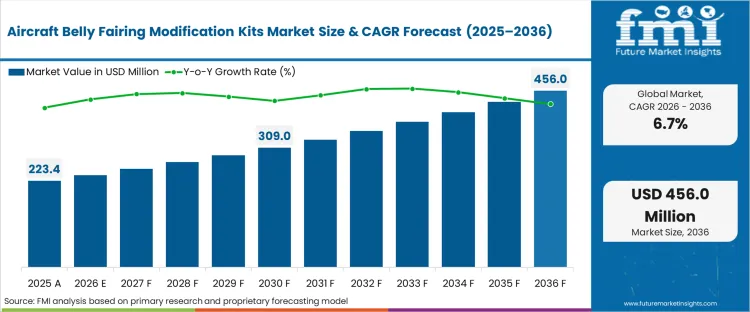
Aircraft Belly Fairing Modification Kits Market Key Takeaways
| Metric | Details |
|---|---|
| Industry Size (2026) | USD 238.4 million |
| Industry Value (2036) | USD 456.0 million |
| CAGR (2026 to 2036) | 6.70% |
Source: Future Market Insights (FMI) analysis, based on proprietary forecasting model and primary research
Once fleet engineering supervisors validate a Supplemental Type Certificate for a specific airframe class, fleet-wide adoption accelerates rapidly. Validation protocols shift from individual aircraft testing toward block approvals, dropping installation downtime significantly. Maintenance facilities standardizing around approved kits capture immediate labor efficiencies. Faster turnaround times lower overall upgrade costs substantially, positively influencing the long-term aircraft belly fairing market forecast.
India leads adoption at a 7.6% pace as localized repair hubs expand capacity for composite retrofits. Singapore tracks closely behind at 7.3% due to high concentrations of Asian aftermarket service contracts. United States operators upgrade legacy fleets at a 7.1% clip, driven by ageing general aviation inventory requirements. France manages a 6.4% expansion tied to native manufacturing ecosystems. Canada advances at 6.2% as harsh-weather operators reinforce belly structures. Germany expands at 5.9% by servicing mature commercial fleets. The United Kingdom facilities register a 5.8% increase through specialized business jet modifications. Asian repair hubs capture demand through faster certification cycles compared to traditional Western maintenance centers.
Definition
Functional boundaries distinguish this sector from original equipment manufacturing by focusing exclusively on post-production enhancements. Scope encompasses engineered add-ons, replacement panels, and aerodynamic smoothing modules designed for under-fuselage installation. Qualified systems require formal aviation authority approval before deployment. Components evaluated provide measurable, protective, or aerodynamic improvement beyond mere cosmetic alteration.
Inclusions
Analyzed revenue streams capture STC-approved modification packages, reinforcement kits, and aircraft fairing repair replacement kits integrated directly by line mechanics. Integrations targeting commercial aircraft mro applications form a core component of measured demand. Hardware, specialized fasteners, and primary composite layups bundled within formal upgrade packages are strictly tracked within valuation models.
Exclusions
Line-fit original equipment installations fall outside our parameters because they lack independent aftermarket certification processes. Pure cosmetic wraps providing zero aerodynamic benefit also sit beyond measured scope boundaries. General maintenance consumables, uncertified third-party panels, and interior cabin floorboards are excluded from all baseline calculations.
Aircraft Belly Fairing Modification Kits Market Research Methodology
- Primary Research: MRO facility managers, airline fleet engineering supervisors, and STC certification engineers
- Desk Research: FAA Supplemental Type Certificate registries, EASA modification databases, and global aircraft registration logs
- Market-Sizing and Forecasting: Certified installation counts cross-referenced with authorized component pricing models
- Data Validation and Update Cycle: Independent aftermarket service center throughput data cross-validates baseline projections
Segmental Analysis
Aircraft Belly Fairing Modification Kits Market Analysis by Kit Type
Legacy modular fairings fail to deliver required fuel efficiency margins, forcing operators toward continuous surface profiles. Aerodynamic smooth-belly retrofit kits command a 34.0% share in 2026, driven by MRO directors specifying a smooth belly retrofit kit aircraft to achieve measurable drag coefficient reductions. According to FMI's estimates, installing these packages transforms aerostructure airflow dynamics without requiring total fuselage reconstruction. Fleet engineering heads capture immediate fuel savings by covering exposed bolt channels and panel gaps. Airflow separation over exposed joints creates measurable drag penalties that smooth enclosures eliminate completely. What certification data rarely shows is how smooth-belly conversions permanently alter ground-crew maintenance access protocols, adding hidden inspection time during standard turnaround windows. Carriers delaying implementation face compounding fuel cost disadvantages on competitive long-haul routes.
- Initial screening criteria: Engineering supervisors evaluate baseline airframe geometry against available STC documentation. Selecting uncertified profiles requires expensive individual field approvals. Carriers avoid unverified designs to prevent grounding risks.
- Flight-test validation: Test pilots measure actual fuel flow reductions against calculated models during qualification flights. Discrepancies often stem from improper lightning strike protection bonding rather than aerodynamic failure. Mechanics must meticulously verify surface continuity.
- Fleet-wide roll-out: Maintenance directors sequence installations during heavy-C checks to minimize operational disruption. Spacing retrofits incorrectly triggers massive schedule delays. Successful integration requires precise supply chain coordination.
Aircraft Belly Fairing Modification Kits Market Analysis by Aircraft Platform
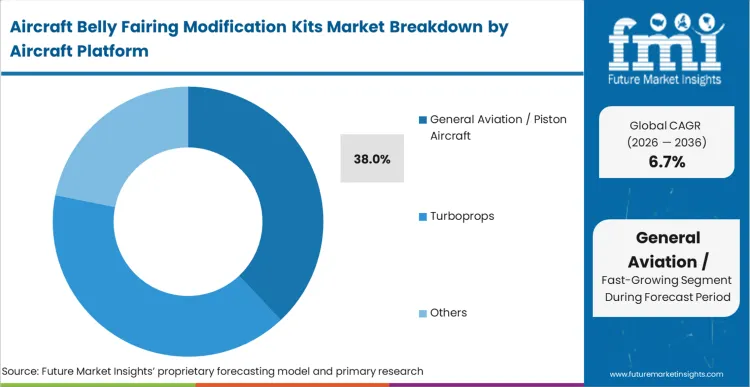
General aviation / piston aircraft hold a 38.0% share in 2026, representing a massive installed base reliant on general aviation smooth belly kits. Fatigue accumulated over decades forces private owners to source aftermarket solutions for aging airframes. FMI's analysis indicates widespread adoption by flight school directors seeking to ruggedize training fleets against frequent hard landings. Upgrading underside metallic composite hybrid modules prevents localized stress fractures from propagating into primary spars. Similarly, business jet belly fairing modification kits extend operational lifespans significantly for corporate fleets. A hidden complication emerges when installing rigid kits on older flexible airframes: localized stiffness transfers kinetic energy to adjacent unprotected ribs, occasionally initiating new cracking patterns nearby. Operations managers failing to reinforce surrounding structures risk unexpected grounding directives.
- Cost-benefit threshold: Flight school operators weigh module replacement costs against total airframe write-offs. Cheap cosmetic fixes fail under rigorous training cycles. Only certified packages deliver true return on investment.
- Hidden integration penalties: Mechanics frequently discover extensive hidden corrosion upon removing legacy panels. Addressing decay inflates baseline installation budgets dramatically. Procurement managers must allocate contingency funds for unexpected airframe repairs.
- Long-term lifecycle metrics: Aviation directors track mean-time-between-failures for upgraded belly sections over five-year horizons. Premium kits demonstrate significantly lower recurring maintenance costs. Cheaper alternatives require constant patching and re-sealing.
Aircraft Belly Fairing Modification Kits Market Analysis by Material
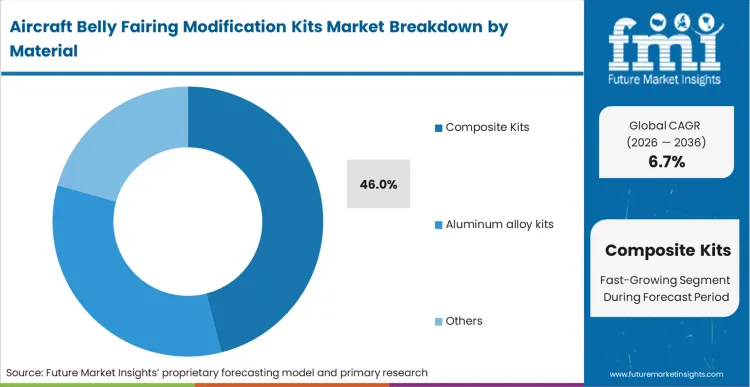
Weight reduction imperatives dictate modern aerospace engineering decisions across all upgrade categories. Composite kits capture a 46.0% share in 2026, offering optimal strength-to-weight ratios for commercial applications. Based on FMI's assessment, procurement managers evaluating a composite vs aluminum belly fairing retrofit consistently specify advanced carbon-fiber layups to offset added weight from newly mandated internal avionics. Swapping aluminum enclosures for composite equivalents yields immediate payload capacity increases. Mechanics appreciate lighter panels during routine access procedures. However, engineers know that composite fairings complicate localized aircraft refurbishing efforts; minor ramp damage that previously required simple metal patching now necessitates specialized resin curing environments. Maintenance supervisors lacking proper composite curing facilities incur massive outsourcing costs when minor damage occurs.
- Impact resilience: Ground service equipment collisions frequently damage underside structures. Rigid composites crack rather than dent under blunt force. Line mechanics must deploy specialized ultrasonic scanning to detect hidden delamination.
- Environmental degradation: Constant exposure to hydraulic fluids weakens standard resin matrices over time. Specialized exterior coating systems prevent chemical intrusion into composite layers. Fleet operators mandate chemical-resistant finishes for all belly components.
- End-of-life disposal: Decommissioning composite panels presents significant environmental compliance hurdles. Recycling aviation-grade carbon fiber remains economically unviable for most repair stations. Facilities stockpile damaged units pending affordable processing solutions.
Aircraft Belly Fairing Modification Kits Market Analysis by Installation Pathway
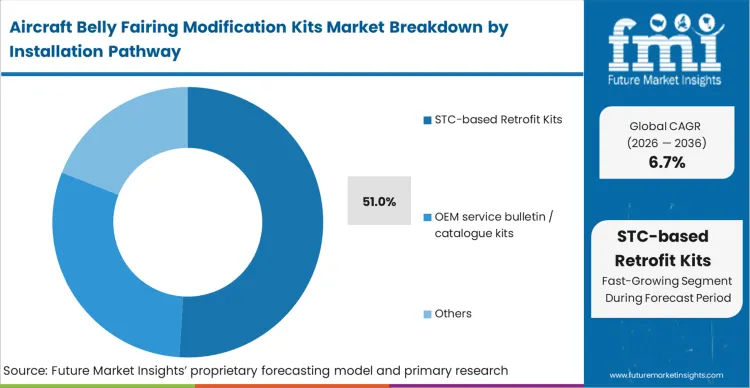
Regulatory compliance pathways dictate how quickly airlines can deploy fleet-wide modifications. STC-based retrofit kits dominate with a 51.0% share in 2026, providing universally recognized legal frameworks for complex integrations. In FMI's view, chief engineers rely on STC belly fairing kits because they shift primary engineering liabilities away from aircraft operators onto kit developers. Bypassing lengthy individual approval processes accelerates modernization schedules dramatically. Integrating modern exterior lighting modules requires verified aerodynamic enclosures. An unpublicized reality is that competing STCs for identical airframes often conflict physically; installing an approved speed kit might illegally obscure an approved aircraft sensors package. Operators failing to cross-reference existing airframe modifications against new STC requirements face immediate airworthiness certificate revocation.
- Developer qualification: Engineering firms invest millions proving kit designs meet rigorous safety parameters. Securing initial FAA approval establishes a lucrative monopoly for specific upgrades. Competitors face steep barriers attempting to certify duplicate designs.
- Supply chain constraints: Independent developers often struggle to scale production once approvals are granted. Procurement heads experience severe delivery delays for popular modification packages. Securing guaranteed delivery timelines requires massive upfront commitments.
- Future regulatory shifts: Aviation authorities continuously update safety mandates. Legacy STCs occasionally lose validity under revised crash-survival standards. Fleet managers monitor regulatory dockets closely to anticipate required kit removals.
Aircraft Belly Fairing Modification Kits Market Analysis by End Use
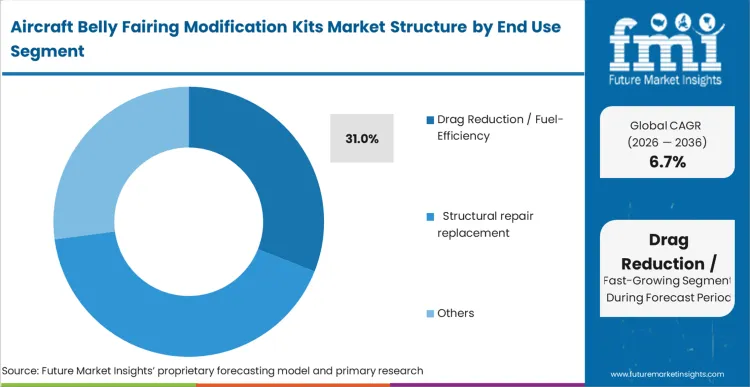
Rising jet fuel prices force carriers to optimize every available aerodynamic surface. Drag reduction / fuel-efficiency upgrades account for a 31.0% share in 2026, answering direct commercial pressure for operating cost reductions. As per FMI's projection, route planning directors deploying aircraft drag reduction retrofit kits calculate that minor drag improvements yield massive cumulative savings across high-frequency regional networks. Smoothing the underside contours minimises parasitic drag significantly. Installing flush-mounted hatch seal systems further enhances continuous airflow. A practitioner reality often ignored is that aerodynamic gains realized during pristine test flights degrade rapidly as line mechanics improperly torque access panels during routine servicing, creating new drag-inducing gaps. Maintenance trainers who fail to emphasize precise re-installation procedures inadvertently erase calculated fuel savings.
- Performance validation: Engineering teams require definitive telemetry to calculate aftermarket belly fairing kit ROI accurately. Flight data recorders capture precise fuel-burn metrics before and after installation. Demonstrable savings secure budget approvals for continued fleet rollouts.
- Operational limitations: Certain speed kits lower an aircraft's maximum demonstrated crosswind tolerance by altering lateral aerodynamics. Chief pilots must adjust operating manuals to reflect revised handling characteristics. Safety departments update simulator profiles accordingly.
- Manufacturing automation: Producing identical drag-reducing shapes requires extreme manufacturing precision. Facilities employing composite layup machines achieve tighter tolerances than manual fabrication shops. Consistent dimensional accuracy prevents variable aerodynamic performance across identical airframes.
Aircraft Belly Fairing Modification Kits Market Drivers, Restraints, and Opportunities
Strict fuel burn mandates compel regional airline maintenance directors to install smooth-belly aerodynamic kits immediately, accelerating current aircraft belly fairing retrofit trends. Delaying these modifications incurs compounding operational penalties on older turboprop airframes as fuel costs erode narrow profit margins. Purchasing localized packages yields faster return on capital than comprehensive aerodynamic overhauls. Operational executives prioritize modular enhancements to maintain continuous flight schedules. Bypassing lengthy hangar delays becomes critical during peak travel seasons. Faster turnaround times lower overall upgrade costs substantially. MRO supervisors gain significant bidding advantages by securing exclusive installation rights for specific manufacturer kits.
Complex Supplemental Type Certificate validation processes severely throttle new product introductions, presenting significant aircraft belly fairing retrofit challenges. Regulatory hurdles persist because strict aircraft fairing retrofit certification requirements demand exhaustive flight-testing for minor aerodynamic changes. Engineering developers spend years proving compliance before selling a single unit. This bureaucratic friction deters smaller composite fabricators from entering profitable niches. Limited competition artificially inflates kit prices for end users. While bilateral aviation agreements attempt to streamline cross-border approvals, local aviation authorities frequently demand redundant testing protocols.
Opportunities in the Aircraft Belly Fairing Modification Kits Market
- Outsourced engineering workflows: Smaller MRO facilities capture high-margin upgrade contracts by leveraging engineering services outsourcing to navigate complex STC paperwork. Maintenance directors avoid carrying expensive full-time certification staff.
- Protective film integration: Coating raw composite fairings with specialized livery change film systems prevents immediate surface degradation. Fleet managers reduce repainting frequencies significantly.
- Sensor-embedded panels: Developing fairings with integrated structural health monitoring coatings allows airlines to transition toward predictive maintenance. Engineering supervisors utilize a belly fairing modification kit RFQ specifying digital integration to eliminate unnecessary physical inspections.
Regional Analysis
Based on the regional assessment, the Aircraft Belly Fairing Modification Kits market is categorized into North America, Europe, and the Asia Pacific region, covering more than 40 countries.
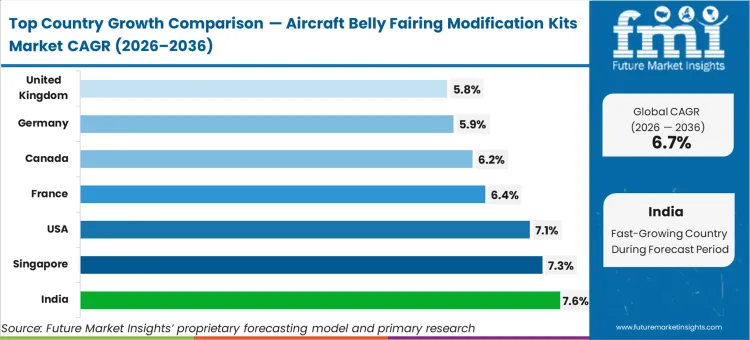
| Country | CAGR (2026 to 2036) |
|---|---|
| United States | 7.1% |
| Canada | 6.2% |
| France | 6.4% |
| Germany | 5.9% |
| United Kingdom | 5.8% |
| Singapore | 7.3% |
| India | 7.6% |
Source: Future Market Insights (FMI) analysis, based on proprietary forecasting model and primary research
North America Aircraft Belly Fairing Modification Kits Market Analysis
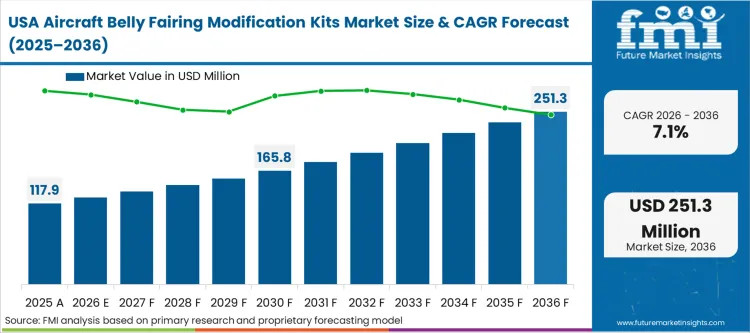
Aging general aviation inventories force United States operators to prioritize longevity over outright replacement. FMI analysts note that a massive concentration of legacy piston and turboprop airframes creates sustained demand for protective belly modules. Regional carriers rely heavily on aftermarket modifications to keep mature fleets viable under modern operating economics. Canadian operators face unique environmental pressures, requiring robust composite shields to deflect gravel and ice during rough-field operations. Deeply established regulatory frameworks allow local engineering firms to prototype and certify new aerodynamic packages rapidly. North American MRO facilities dictate global installation standards by holding primary design patents for highly sought-after speed kits.
- United States: The USA aircraft belly fairing modification kits market advances at a 7.1% CAGR locally. Vast networks of independent repair stations support continuous legacy fleet upgrades across domestic hubs. Procurement directors source specialized packages to modernize decades-old airframes without full replacements. By relying on established Supplemental Type Certificate libraries, American facilities accelerate complex installations. Securing exclusive regional distribution rights for popular modifications guarantees steady hangar throughput.
- Canada: Remote operational environments dictate extreme durability for under-fuselage components. Fleet engineers specify impact-resistant materials to survive daily unimproved runway operations. This severe physical condition pushes the local aircraft belly fairing modification kits market to expand at a 6.2% CAGR. Canadian repair hubs specialize in ruggedized conversions that deflect gravel strikes. Integrating specialized branding decal systems onto these reinforced composite panels allows operators to preserve corporate identity across freezing climates.
FMI's report includes detailed assessments of Mexico and specific Caribbean aviation hubs. MRO infrastructure expands southward as carriers seek lower-cost labor pools for labor-intensive retrofits.
Europe Aircraft Belly Fairing Modification Kits Market Analysis
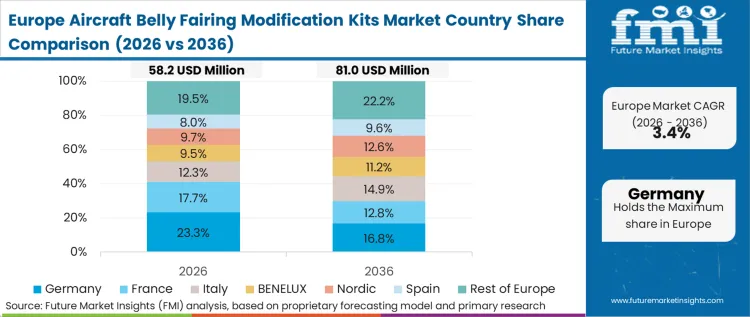
Native manufacturing ecosystems provide French operators direct access to highly integrated upgrade pathways. MRO supervisors benefit from close proximity to original equipment design bureaus, facilitating complex conversions. German facilities specialize in servicing mature commercial fleets, demanding exact engineering tolerances for every aftermarket panel. FMI observes that stringent EASA noise and emission regulations indirectly push carriers toward aerodynamic drag reduction kits to meet overall efficiency targets. United Kingdom repair stations capture niche high-value business jet modifications, integrating specialized communication arrays into belly fairings. European certification standards mandate exhaustive documentation, creating significant barriers for unproven foreign kit developers attempting to enter local supply chains.
- France: Proximity to Airbus and ATR design hubs grants local repair stations unparalleled technical support. The localized engineering advantage propels the aircraft belly fairing modification kits market to a 6.4% CAGR. Engineering supervisors execute retrofits by applying proprietary manufacturing data directly. French facilities dominate domestic turboprop modernization programs. Exporting these physically validated upgrade packages to foreign regional carriers creates highly lucrative secondary revenue streams for domestic suppliers.
- Germany: High-density commercial traffic forces rapid turnaround times for all modifications across major aviation hubs. Procurement heads demand pre-assembled aerodynamic packages to minimize hangar occupancy and prevent route cancellations. This operational urgency drives the aircraft belly fairing modification kits market to a 5.9% CAGR. German MRO providers excel at executing efficient block-upgrade programs. Deploying automated inspection tools ensures perfectly aligned fairing installations that maximize calculated aerodynamic efficiency.
- United Kingdom: Elite corporate fleet managers demand discrete communication antenna integrations to support continuous satellite connectivity. Line mechanics custom-fabricate complex belly pods to house sensitive electronics without compromising established airframe aerodynamics. This highly specialised demand pushes the aircraft belly fairing modification kits market toward a 5.8% CAGR. British facilities command premium pricing for bespoke engineering solutions. Procurement directors accept higher modification costs to secure seamless airborne corporate operations.
FMI's report includes extensive coverage spanning Italy, Spain, and emerging Eastern European aviation centers. Specialized component fabrication increasingly shifts toward specialized composite shops located outside traditional Western hubs.
Asia Pacific Aircraft Belly Fairing Modification Kits Market Analysis
Rapidly expanding domestic airline networks strain existing maintenance infrastructure across Asia. Localized repair hubs aggressively expand capacity to capture lucrative composite retrofit contracts. High concentrations of Asian aftermarket service contracts flow through Singapore, establishing regional dominance for complex repairs. FMI's analysis indicates that Indian facilities are rapidly acquiring advanced tooling to execute STC-based installations locally, bypassing expensive European outsourcing. High-cycle operations in humid, coastal environments accelerate corrosion on legacy metal fairings, prompting fleet-wide transitions to advanced composites. Asian engineering firms increasingly bypass traditional Western design bureaus, securing independent local approvals for custom aerodynamic modification packages.
- India: Massive influxes of leased commercial aircraft force continuous aftermarket support across regional hubs. Maintenance directors actively build localized capability to handle extensive composite fairing repairs instead of outsourcing. This domestic capacity expansion drives the aircraft belly fairing modification kits market at a 7.6% CAGR. Indian repair stations transition rapidly from basic maintenance to complex engineering. Capturing outsourced conversion contracts from Western carriers fundamentally shifts global repair dynamics.
- Singapore: The intense localised innovation in Singapore pushes the aircraft belly fairing modification kits market to achieve a 7.3% CAGR. Dense concentrations of global aerospace firms create an ideal ecosystem for rapid prototype validation. Engineering heads apply advanced testing facilities to certify new aerodynamic profiles quickly. Singaporean hubs attract complex widebody modification projects. Route planners direct aging widebodies specifically through these facilities to capture aerodynamic fuel savings during scheduled heavy maintenance.
FMI's report includes Japan, Australia, and growing Southeast Asian aviation sectors. Developing localized STC generation capabilities remains critical for regional MROs navigating the global air transport mro landscape independently from foreign design authorities.
Competitive Aligners for Market Players
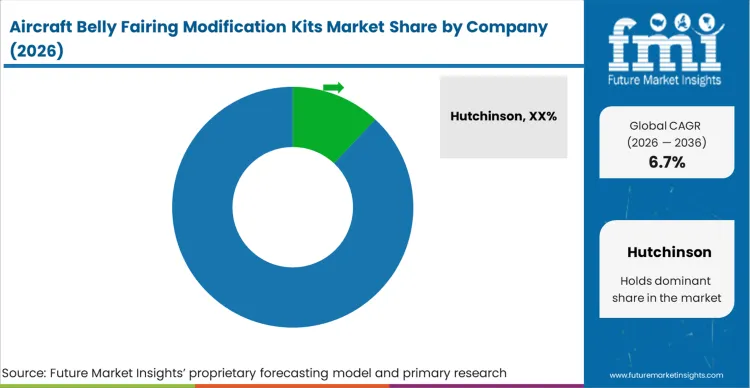
Hutchinson and Aciturri dominate large-scale commercial retrofits by leveraging deep relationships with primary airframe manufacturers. These prominent aircraft modification kit key players secure early access to technical specifications, allowing their engineering teams to develop aftermarket kits before competitors can reverse-engineer complex aerodynamic profiles. MRO directors prefer sourcing from established aircraft belly fairing kit suppliers because their documentation passes regulatory scrutiny immediately. Attempting to introduce unproven designs into risk-averse airline supply chains requires massive upfront capital for independent flight testing. Smaller engineering firms must partner with established distributors to gain credibility with major fleet operators.
Established aircraft belly fairing retrofit manufacturers hold vast libraries of approved Supplemental Type Certificates that act as nearly impenetrable competitive moats. ATR generates significant aftermarket revenue by controlling proprietary turboprop upgrade catalogs, forcing independent repair stations to purchase official kits or face insurmountable certification hurdles. Building an equivalent certification library requires decades of continuous regulatory negotiation. Challengers seeking to disrupt these monopolies focus on material science, developing advanced composite airframes expertise to offer lighter, stronger alternatives to aging metallic OEM components.
Fleet purchasing managers actively resist sole-source dependencies by sponsoring alternative kit developers for legacy airframes. When a primary supplier escalates pricing on replacement belly panels, large operators consolidate demand to guarantee minimum orders for competing fabrication shops. Approaching 2036, operators will demand standardized attachment points across competing modification kits. Integrating modern cabin interior systems increasingly requires belly-mounted communication arrays, shifting competitive advantage toward developers who seamlessly blend aerodynamic efficiency with electronic housing capabilities.
Key Players in Aircraft Belly Fairing Modification Kits Market
- Hutchinson
- Aciturri
- ATR
- Lake Aero Styling & Repair (LASAR)
- Aero Resources
- Aernnova
- Spirit AeroSystems
Scope of the Report
| Metric | Value |
|---|---|
| Quantitative Units | USD 238.4 million to USD 456.0 million, at a CAGR of 6.70% |
| Market Definition | Engineered add-ons, replacement panels, and aerodynamic smoothing modules designed for under-fuselage post-production installation. Qualified systems require formal aviation authority approval and provide measurable operational improvement. |
| Segmentation | Kit Type, Aircraft Platform, Material, Installation Pathway, End Use, Region |
| Regions Covered | North America, Latin America, Europe, Asia Pacific, Middle East and Africa |
| Countries Covered | United States, Canada, France, Germany, United Kingdom, Singapore, India |
| Key Companies Profiled | Hutchinson, Aciturri, ATR, Lake Aero Styling & Repair (LASAR), Aero Resources, Aernnova, Spirit AeroSystems |
| Forecast Period | 2026 to 2036 |
| Approach | Certified installation counts cross-referenced with authorized component pricing models |
Source: Future Market Insights (FMI) analysis, based on proprietary forecasting model and primary research
Aircraft Belly Fairing Modification Kits Market Analysis by Segments
Kit Type
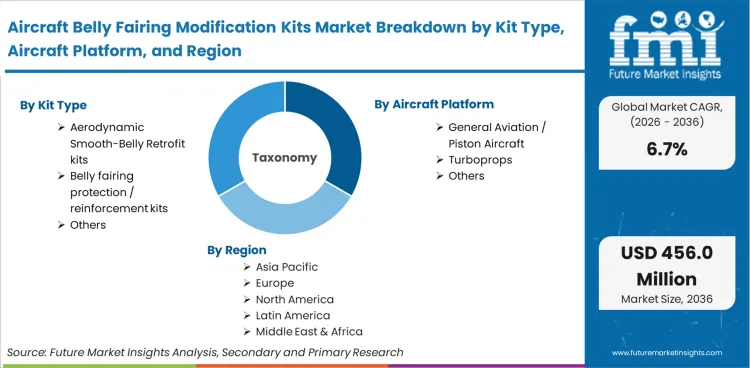
- Aerodynamic smooth-belly retrofit kits
- Belly fairing protection / reinforcement kits
- Belly light / access-door modification kits
- Inspection / removable panel conversion kits
Aircraft Platform
- General aviation / piston aircraft
- Turboprops
- Business jets
- Narrowbody commercial aircraft
- Special-mission / military derivatives
Material
- Composite kits
- Aluminum alloy kits
- Hybrid metal-composite kits
- Elastomeric / protection add-on kits
Installation Pathway
- STC-based retrofit kits
- OEM service bulletin / catalogue kits
- PMA-supported replacement / upgrade kits
- Custom MRO-engineered modification packages
End Use
- Drag reduction / fuel-efficiency upgrades
- Damage protection / rough-field operations
- Structural repair replacement
- Lighting / antenna / access integration
Region
- North America
- United States
- Canada
- Latin America
- Argentina
- Brazil
- Mexico
- Europe
- France
- Germany
- Spain
- Italy
- United Kingdom
- Asia Pacific
- Singapore
- India
- China
- Taiwan
- Japan
- Middle East and Africa
- Europe
- GCC Countries
- South Africa
Bibliography
- Federal Aviation Administration. (2025). FAA Aerospace Forecast Fiscal Years 2025-2045.
- Federal Aviation Administration. (2024, August 27). Field Approvals & Supplemental Type Certificates (STCs).
- International Air Transport Association. (2025). The global commercial aircraft fleet.
- International Air Transport Association. (2025). Reviving the commercial aircraft supply chain.
- European Union Aviation Safety Agency (EASA). (2025). Airworthiness Directive 2025‑0209: Centre Wing Box and Belly Fairing Fasteners – Mandatory Modification (Airbus A350‑941).
This bibliography is provided for reader reference. The full FMI report contains the complete reference list with primary source documentation.
This Report Addresses
- Fuel efficiency mandates compelling regional airline maintenance directors to install smooth-belly aerodynamic kits.
- MRO facility managers leveraging outsourced engineering workflows to bypass complex STC certification hurdles.
- Fatigue on legacy piston airframes driving general aviation procurement of reinforced composite belly panels.
- Asian repair hubs aggressively expanding capacity to capture lucrative turboprop modernization contracts.
- Engineering supervisors balancing composite weight advantages against specialized resin curing facility requirements.
- Fleet purchasing managers actively resisting sole-source monopolies by sponsoring alternative aerodynamic kit developers.
- Ground service equipment collisions dictating impact-resistant material selections for under-fuselage enclosures.
- Chief pilots recalculating crosswind tolerances after installing lateral aerodynamic modifications.
Frequently Asked Questions
Are belly fairing kits FAA STC approved?
Yes, qualified systems require formal aviation authority approval. STC-based retrofit kits secure a 51.0% share in 2026 because they provide universally recognized legal frameworks for complex integrations across global regulatory environments.
How much drag reduction comes from belly fairing retrofits?
Route planning directors calculate that even minor drag improvements yield massive cumulative savings across high-frequency regional networks. Continuous surface profiles eliminate parasitic drag caused by exposed joints and bolt channels.
How do engineers compare STC and OEM belly fairing modification kits?
Formal STC approval shifts primary engineering liabilities away from aircraft operators onto independent kit developers, bypassing lengthy individual field approvals. OEM kits rely on proprietary manufacturer data but often face shrinking availability for legacy platforms.
What was valuation in 2025?
Valuation reached USD 223.4 million in 2025. This baseline establishes how rapidly aging legacy airframes require intervention.
What is revenue forecast by 2036?
Revenue reaches USD 456.0 million by 2036. Consistent investment stems directly from strict fuel burn mandates forcing continuous aerodynamic upgrades.
What is expected growth rate?
Compound growth tracks at 6.70%. This consistent expansion reflects constant regulatory pressure to reduce operating costs across aging aviation fleets.
Which kit type leads adoption?
Aerodynamic smooth-belly retrofit kits capture a 34.0% share in 2026. MRO directors prioritize measurable drag coefficient reductions over simple cosmetic repairs.
Why do smooth-belly kits hold dominance?
Continuous surface profiles eliminate parasitic drag caused by exposed joints. Fleet engineering heads capture immediate fuel savings without executing total fuselage reconstruction.
Which aircraft platform dominates?
General aviation / piston aircraft account for a 38.0% share in 2026. Massive legacy fleets require continuous underside upgrades to remain airworthy.
Why do legacy aircraft require these upgrades?
Structural fatigue accumulated over decades forces private owners to source aftermarket protective solutions. Upgrading belly modules prevents localized stress fractures from spreading.
Which material captures primary share?
Composite kits hold a 46.0% share in 2026. Procurement managers specify advanced carbon-fiber layups to offset added weight from mandated internal avionics.
Why are composites favored over aluminum?
Advanced carbon-fiber layups provide optimal strength-to-weight ratios. Swapping metal enclosures yields immediate payload capacity increases while resisting chemical degradation.
Which end use application leads demand?
Drag reduction / fuel-efficiency upgrades register a 31.0% share in 2026. Route planning directors calculate that minor drag improvements yield massive cumulative savings.
Why is drag reduction prioritized?
Rising jet fuel prices force carriers to optimize every available aerodynamic surface. Smoothing underside contours minimizes operating costs across high-frequency regional networks.
Why does India lead regional growth?
Expanding at 7.6%, Indian repair stations capture outsourced conversion contracts from Western carriers. Massive influxes of leased commercial aircraft require continuous aftermarket support locally.
What drives Singaporean adoption?
Tracking a 7.3% expansion, dense concentrations of global aerospace firms create an ideal testing ecosystem. Engineering heads utilize advanced testing facilities to certify new aerodynamic profiles quickly.
Why do United States operators upgrade older fleets?
Advancing at 7.1%, vast networks of independent repair stations support continuous legacy fleet upgrades. Procurement directors source specialized kits to modernize decades-old airframes affordably.
How does France leverage native manufacturing?
Expanding at 6.4%, proximity to major design centers grants local repair stations unparalleled technical support. Engineering supervisors execute complex retrofits utilizing proprietary data.
What specialized demand exists in Canada?
Harsh remote environments demand extreme durability from under-fuselage components. Canadian repair hubs specialize in ruggedized conversions to survive unimproved runway operations.
How do German facilities operate?
High-density commercial traffic necessitates rapid turnaround times. German MRO providers excel at executing efficient block-upgrade programs requiring pre-assembled modification kits.
What drives United Kingdom adoption?
Elite corporate fleet managers require discrete communication antenna integrations. Technicians custom-fabricate complex belly pods to house sensitive electronics without compromising aerodynamics.
How do challengers compete?
Smaller engineering firms focus on advanced material science. Developing proprietary carbon-fiber layups allows independent fabrication shops to offer lighter alternatives to aging metallic components.
What limits new product introductions?
Complex validation processes severely throttle new designs. Regulatory hurdles persist because aviation authorities require exhaustive flight-testing for even minor aerodynamic changes.
Preview the report firsthand - request a free sample
Get SampleGet the brochure for pricing and purchase details.
Get PDFTable of Content
- Executive Summary
- Global Market Outlook
- Demand-side Trends
- Supply-side Trends
- Technology Roadmap Analysis
- Analysis and Recommendations
- Market Overview
- Market Coverage / Taxonomy
- Market Definition / Scope / Limitations
- Research Methodology
- Chapter Orientation
- Analytical Lens and Working Hypotheses
- Market Structure, Signals, and Trend Drivers
- Benchmarking and Cross-market Comparability
- Market Sizing, Forecasting, and Opportunity Mapping
- Research Design and Evidence Framework
- Desk Research Programme (Secondary Evidence)
- Company Annual and Sustainability Reports
- Peer-reviewed Journals and Academic Literature
- Corporate Websites, Product Literature, and Technical Notes
- Earnings Decks and Investor Briefings
- Statutory Filings and Regulatory Disclosures
- Technical White Papers and Standards Notes
- Trade Journals, Industry Magazines, and Analyst Briefs
- Conference Proceedings, Webinars, and Seminar Materials
- Government Statistics Portals and Public Data Releases
- Press Releases and Reputable Media Coverage
- Specialist Newsletters and Curated Briefings
- Sector Databases and Reference Repositories
- FMI Internal Proprietary Databases and Historical Market Datasets
- Subscription Datasets and Paid Sources
- Social Channels, Communities, and Digital Listening Inputs
- Additional Desk Sources
- Expert Input and Fieldwork (Primary Evidence)
- Primary Modes
- Qualitative Interviews and Expert Elicitation
- Quantitative Surveys and Structured Data Capture
- Blended Approach
- Why Primary Evidence is Used
- Field Techniques
- Interviews
- Surveys
- Focus Groups
- Observational and In-context Research
- Social and Community Interactions
- Stakeholder Universe Engaged
- C-suite Leaders
- Board Members
- Presidents and Vice Presidents
- R&D and Innovation Heads
- Technical Specialists
- Domain Subject-matter Experts
- Scientists
- Physicians and Other Healthcare Professionals
- Governance, Ethics, and Data Stewardship
- Research Ethics
- Data Integrity and Handling
- Primary Modes
- Tooling, Models, and Reference Databases
- Desk Research Programme (Secondary Evidence)
- Data Engineering and Model Build
- Data Acquisition and Ingestion
- Cleaning, Normalisation, and Verification
- Synthesis, Triangulation, and Analysis
- Quality Assurance and Audit Trail
- Market Background
- Market Dynamics
- Drivers
- Restraints
- Opportunity
- Trends
- Scenario Forecast
- Demand in Optimistic Scenario
- Demand in Likely Scenario
- Demand in Conservative Scenario
- Opportunity Map Analysis
- Product Life Cycle Analysis
- Supply Chain Analysis
- Investment Feasibility Matrix
- Value Chain Analysis
- PESTLE and Porter’s Analysis
- Regulatory Landscape
- Regional Parent Market Outlook
- Production and Consumption Statistics
- Import and Export Statistics
- Market Dynamics
- Global Market Analysis 2021 to 2025 and Forecast, 2026 to 2036
- Historical Market Size Value (USD Million) Analysis, 2021 to 2025
- Current and Future Market Size Value (USD Million) Projections, 2026 to 2036
- Y-o-Y Growth Trend Analysis
- Absolute $ Opportunity Analysis
- Global Market Pricing Analysis 2021 to 2025 and Forecast 2026 to 2036
- Global Market Analysis 2021 to 2025 and Forecast 2026 to 2036, By Kit Type
- Introduction / Key Findings
- Historical Market Size Value (USD Million) Analysis By Kit Type , 2021 to 2025
- Current and Future Market Size Value (USD Million) Analysis and Forecast By Kit Type , 2026 to 2036
- Aerodynamic Smooth-Belly Retrofit kits
- Belly fairing protection / reinforcement kits
- Others
- Aerodynamic Smooth-Belly Retrofit kits
- Y-o-Y Growth Trend Analysis By Kit Type , 2021 to 2025
- Absolute $ Opportunity Analysis By Kit Type , 2026 to 2036
- Global Market Analysis 2021 to 2025 and Forecast 2026 to 2036, By Aircraft Platform
- Introduction / Key Findings
- Historical Market Size Value (USD Million) Analysis By Aircraft Platform, 2021 to 2025
- Current and Future Market Size Value (USD Million) Analysis and Forecast By Aircraft Platform, 2026 to 2036
- General Aviation / Piston Aircraft
- Turboprops
- Others
- General Aviation / Piston Aircraft
- Y-o-Y Growth Trend Analysis By Aircraft Platform, 2021 to 2025
- Absolute $ Opportunity Analysis By Aircraft Platform, 2026 to 2036
- Global Market Analysis 2021 to 2025 and Forecast 2026 to 2036, By Material
- Introduction / Key Findings
- Historical Market Size Value (USD Million) Analysis By Material, 2021 to 2025
- Current and Future Market Size Value (USD Million) Analysis and Forecast By Material, 2026 to 2036
- Composite Kits
- Aluminum alloy kits
- Others
- Composite Kits
- Y-o-Y Growth Trend Analysis By Material, 2021 to 2025
- Absolute $ Opportunity Analysis By Material, 2026 to 2036
- Global Market Analysis 2021 to 2025 and Forecast 2026 to 2036, By Installation Pathway
- Introduction / Key Findings
- Historical Market Size Value (USD Million) Analysis By Installation Pathway, 2021 to 2025
- Current and Future Market Size Value (USD Million) Analysis and Forecast By Installation Pathway, 2026 to 2036
- STC-based Retrofit Kits
- OEM service bulletin / catalogue kits
- Others
- STC-based Retrofit Kits
- Y-o-Y Growth Trend Analysis By Installation Pathway, 2021 to 2025
- Absolute $ Opportunity Analysis By Installation Pathway, 2026 to 2036
- Global Market Analysis 2021 to 2025 and Forecast 2026 to 2036, By End Use
- Introduction / Key Findings
- Historical Market Size Value (USD Million) Analysis By End Use, 2021 to 2025
- Current and Future Market Size Value (USD Million) Analysis and Forecast By End Use, 2026 to 2036
- Drag Reduction / Fuel-Efficiency
- Structural repair replacement
- Others
- Drag Reduction / Fuel-Efficiency
- Y-o-Y Growth Trend Analysis By End Use, 2021 to 2025
- Absolute $ Opportunity Analysis By End Use, 2026 to 2036
- Global Market Analysis 2021 to 2025 and Forecast 2026 to 2036, By Region
- Introduction
- Historical Market Size Value (USD Million) Analysis By Region, 2021 to 2025
- Current Market Size Value (USD Million) Analysis and Forecast By Region, 2026 to 2036
- North America
- Latin America
- Western Europe
- Eastern Europe
- East Asia
- South Asia and Pacific
- Middle East & Africa
- Market Attractiveness Analysis By Region
- North America Market Analysis 2021 to 2025 and Forecast 2026 to 2036, By Country
- Historical Market Size Value (USD Million) Trend Analysis By Market Taxonomy, 2021 to 2025
- Market Size Value (USD Million) Forecast By Market Taxonomy, 2026 to 2036
- By Country
- USA
- Canada
- Mexico
- By Kit Type
- By Aircraft Platform
- By Material
- By Installation Pathway
- By End Use
- By Country
- Market Attractiveness Analysis
- By Country
- By Kit Type
- By Aircraft Platform
- By Material
- By Installation Pathway
- By End Use
- Key Takeaways
- Latin America Market Analysis 2021 to 2025 and Forecast 2026 to 2036, By Country
- Historical Market Size Value (USD Million) Trend Analysis By Market Taxonomy, 2021 to 2025
- Market Size Value (USD Million) Forecast By Market Taxonomy, 2026 to 2036
- By Country
- Brazil
- Chile
- Rest of Latin America
- By Kit Type
- By Aircraft Platform
- By Material
- By Installation Pathway
- By End Use
- By Country
- Market Attractiveness Analysis
- By Country
- By Kit Type
- By Aircraft Platform
- By Material
- By Installation Pathway
- By End Use
- Key Takeaways
- Western Europe Market Analysis 2021 to 2025 and Forecast 2026 to 2036, By Country
- Historical Market Size Value (USD Million) Trend Analysis By Market Taxonomy, 2021 to 2025
- Market Size Value (USD Million) Forecast By Market Taxonomy, 2026 to 2036
- By Country
- Germany
- UK
- Italy
- Spain
- France
- Nordic
- BENELUX
- Rest of Western Europe
- By Kit Type
- By Aircraft Platform
- By Material
- By Installation Pathway
- By End Use
- By Country
- Market Attractiveness Analysis
- By Country
- By Kit Type
- By Aircraft Platform
- By Material
- By Installation Pathway
- By End Use
- Key Takeaways
- Eastern Europe Market Analysis 2021 to 2025 and Forecast 2026 to 2036, By Country
- Historical Market Size Value (USD Million) Trend Analysis By Market Taxonomy, 2021 to 2025
- Market Size Value (USD Million) Forecast By Market Taxonomy, 2026 to 2036
- By Country
- Russia
- Poland
- Hungary
- Balkan & Baltic
- Rest of Eastern Europe
- By Kit Type
- By Aircraft Platform
- By Material
- By Installation Pathway
- By End Use
- By Country
- Market Attractiveness Analysis
- By Country
- By Kit Type
- By Aircraft Platform
- By Material
- By Installation Pathway
- By End Use
- Key Takeaways
- East Asia Market Analysis 2021 to 2025 and Forecast 2026 to 2036, By Country
- Historical Market Size Value (USD Million) Trend Analysis By Market Taxonomy, 2021 to 2025
- Market Size Value (USD Million) Forecast By Market Taxonomy, 2026 to 2036
- By Country
- China
- Japan
- South Korea
- By Kit Type
- By Aircraft Platform
- By Material
- By Installation Pathway
- By End Use
- By Country
- Market Attractiveness Analysis
- By Country
- By Kit Type
- By Aircraft Platform
- By Material
- By Installation Pathway
- By End Use
- Key Takeaways
- South Asia and Pacific Market Analysis 2021 to 2025 and Forecast 2026 to 2036, By Country
- Historical Market Size Value (USD Million) Trend Analysis By Market Taxonomy, 2021 to 2025
- Market Size Value (USD Million) Forecast By Market Taxonomy, 2026 to 2036
- By Country
- India
- ASEAN
- Australia & New Zealand
- Rest of South Asia and Pacific
- By Kit Type
- By Aircraft Platform
- By Material
- By Installation Pathway
- By End Use
- By Country
- Market Attractiveness Analysis
- By Country
- By Kit Type
- By Aircraft Platform
- By Material
- By Installation Pathway
- By End Use
- Key Takeaways
- Middle East & Africa Market Analysis 2021 to 2025 and Forecast 2026 to 2036, By Country
- Historical Market Size Value (USD Million) Trend Analysis By Market Taxonomy, 2021 to 2025
- Market Size Value (USD Million) Forecast By Market Taxonomy, 2026 to 2036
- By Country
- Kingdom of Saudi Arabia
- Other GCC Countries
- Turkiye
- South Africa
- Other African Union
- Rest of Middle East & Africa
- By Kit Type
- By Aircraft Platform
- By Material
- By Installation Pathway
- By End Use
- By Country
- Market Attractiveness Analysis
- By Country
- By Kit Type
- By Aircraft Platform
- By Material
- By Installation Pathway
- By End Use
- Key Takeaways
- Key Countries Market Analysis
- USA
- Pricing Analysis
- Market Share Analysis, 2025
- By Kit Type
- By Aircraft Platform
- By Material
- By Installation Pathway
- By End Use
- Canada
- Pricing Analysis
- Market Share Analysis, 2025
- By Kit Type
- By Aircraft Platform
- By Material
- By Installation Pathway
- By End Use
- Mexico
- Pricing Analysis
- Market Share Analysis, 2025
- By Kit Type
- By Aircraft Platform
- By Material
- By Installation Pathway
- By End Use
- Brazil
- Pricing Analysis
- Market Share Analysis, 2025
- By Kit Type
- By Aircraft Platform
- By Material
- By Installation Pathway
- By End Use
- Chile
- Pricing Analysis
- Market Share Analysis, 2025
- By Kit Type
- By Aircraft Platform
- By Material
- By Installation Pathway
- By End Use
- Germany
- Pricing Analysis
- Market Share Analysis, 2025
- By Kit Type
- By Aircraft Platform
- By Material
- By Installation Pathway
- By End Use
- UK
- Pricing Analysis
- Market Share Analysis, 2025
- By Kit Type
- By Aircraft Platform
- By Material
- By Installation Pathway
- By End Use
- Italy
- Pricing Analysis
- Market Share Analysis, 2025
- By Kit Type
- By Aircraft Platform
- By Material
- By Installation Pathway
- By End Use
- Spain
- Pricing Analysis
- Market Share Analysis, 2025
- By Kit Type
- By Aircraft Platform
- By Material
- By Installation Pathway
- By End Use
- France
- Pricing Analysis
- Market Share Analysis, 2025
- By Kit Type
- By Aircraft Platform
- By Material
- By Installation Pathway
- By End Use
- India
- Pricing Analysis
- Market Share Analysis, 2025
- By Kit Type
- By Aircraft Platform
- By Material
- By Installation Pathway
- By End Use
- ASEAN
- Pricing Analysis
- Market Share Analysis, 2025
- By Kit Type
- By Aircraft Platform
- By Material
- By Installation Pathway
- By End Use
- Australia & New Zealand
- Pricing Analysis
- Market Share Analysis, 2025
- By Kit Type
- By Aircraft Platform
- By Material
- By Installation Pathway
- By End Use
- China
- Pricing Analysis
- Market Share Analysis, 2025
- By Kit Type
- By Aircraft Platform
- By Material
- By Installation Pathway
- By End Use
- Japan
- Pricing Analysis
- Market Share Analysis, 2025
- By Kit Type
- By Aircraft Platform
- By Material
- By Installation Pathway
- By End Use
- South Korea
- Pricing Analysis
- Market Share Analysis, 2025
- By Kit Type
- By Aircraft Platform
- By Material
- By Installation Pathway
- By End Use
- Russia
- Pricing Analysis
- Market Share Analysis, 2025
- By Kit Type
- By Aircraft Platform
- By Material
- By Installation Pathway
- By End Use
- Poland
- Pricing Analysis
- Market Share Analysis, 2025
- By Kit Type
- By Aircraft Platform
- By Material
- By Installation Pathway
- By End Use
- Hungary
- Pricing Analysis
- Market Share Analysis, 2025
- By Kit Type
- By Aircraft Platform
- By Material
- By Installation Pathway
- By End Use
- Kingdom of Saudi Arabia
- Pricing Analysis
- Market Share Analysis, 2025
- By Kit Type
- By Aircraft Platform
- By Material
- By Installation Pathway
- By End Use
- Turkiye
- Pricing Analysis
- Market Share Analysis, 2025
- By Kit Type
- By Aircraft Platform
- By Material
- By Installation Pathway
- By End Use
- South Africa
- Pricing Analysis
- Market Share Analysis, 2025
- By Kit Type
- By Aircraft Platform
- By Material
- By Installation Pathway
- By End Use
- USA
- Market Structure Analysis
- Competition Dashboard
- Competition Benchmarking
- Market Share Analysis of Top Players
- By Regional
- By Kit Type
- By Aircraft Platform
- By Material
- By Installation Pathway
- By End Use
- Competition Analysis
- Competition Deep Dive
- Hutchinson
- Overview
- Product Portfolio
- Profitability by Market Segments (Product/Age /Sales Channel/Region)
- Sales Footprint
- Strategy Overview
- Marketing Strategy
- Product Strategy
- Channel Strategy
- Aciturri
- ATR
- Lake Aero Styling & Repair (LASAR)
- Aero Resources
- Aernnova
- Hutchinson
- Competition Deep Dive
- Assumptions & Acronyms Used


