

- Industry Size (2026)
- USD 63.5 Mn
- Forecast (2036)
- USD 154.5 Mn
- CAGR (2026 to 2036)
- 9.3%
Flap Track Fairing Drag Reduction Upgrade Kits Market Size, Market Forecast and Outlook By FMI
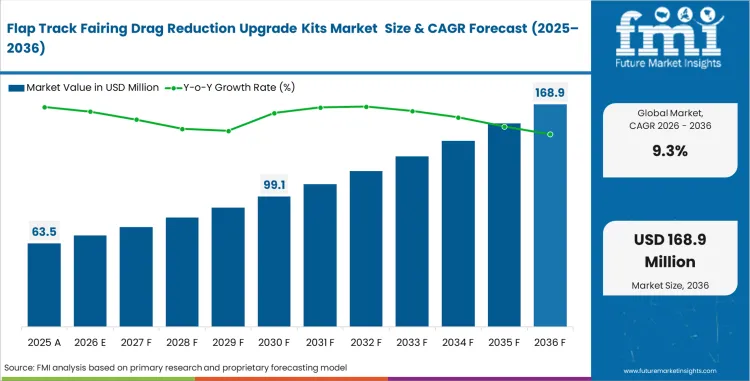
Flap track fairing drag reduction upgrade kits market was valued at USD 58 million in 2025. Industry is expected to reach USD 63.5 million in 2026 at a CAGR of 9.3% during the forecast period. Cumulative valuation is expected to advance to USD 154.5 million by 2036 as airlines treat small aerodynamic upgrades as part of fuel-efficiency discipline on in-service fleets rather than as optional exterior work.
Summary of Flap Track Fairing Drag Reduction Upgrade Kits Market
- Flap Track Fairing Drag Reduction Upgrade Kits Market Snapshot
- Flap track fairing drag reduction upgrade kits market is valued at USD 58.1 million in 2025 and is projected to reach USD 154.5 million by 2036.
- From 2026 to 2036, the market is expected to expand at a 9.3% CAGR, creating an incremental opportunity of USD 91 million over the forecast period.
- This market remains a certification-driven aircraft aftermarket niche focused on drag reduction upgrades for in-service fleets rather than OEM line-fit supply.
- Scope includes post-delivery fairing shells, tips, brackets, fasteners, and installation-linked upgrade kits, while original factory-fit installations and non-functional cosmetic treatments remain outside the market boundary.
- Flap Track Fairing Drag Reduction Upgrade Kits Market Demand and Growth Drivers
- Airline interest in this sector is on a positive trend because even modest drag reduction can improve fuel efficiency across active fleets where operating cost control remains important.
- Retrofit adoption is rising in mature fleets where carriers aim to improve aerodynamic performance without moving into a broader airframe modification program.
- Industry outlook is also inclining as fleet operators continue to extend aircraft service life and align efficiency-led upgrades with scheduled maintenance activity.
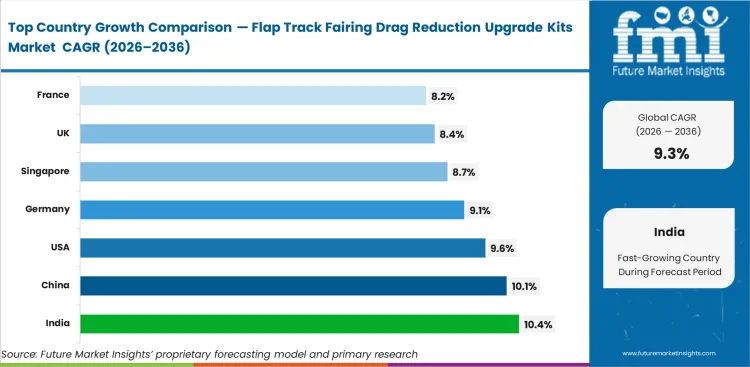
- India is expected to record a 10.4% CAGR through 2036, followed by China at 10.1%, the United States at 9.6%, Germany at 9.1%, Singapore at 8.7%, the United Kingdom at 8.4%, and France at 8.2% through 2036.
- Certification coverage remains the main limiting factor, since fleet-wide adoption is easier when the retrofit path is already cleared across multiple aircraft variants.
- Flap Track Fairing Drag Reduction Upgrade Kits Market Product and Segment View
- Market coverage includes retrofit hardware for commercial and selected non-commercial aircraft, using composite, metallic, and hybrid material systems installed through approved modification pathways.
- Use remains concentrated in legacy narrowbody fleets and selected widebody programs where airlines seek measurable drag reduction during planned maintenance activity.
- Large installed fleets and high daily utilization keep this platform group central to the industry outlook. Narrowbody aircraft are expected to account for 61% share in 2026.
- Within retrofit scope, tip kits are projected to secure 39% share in 2026 because they improve the aft drag area with lower installation burden than full fairing replacement.
- Lower weight and better aerodynamic shaping keep this category in a stronger position within the segment outlook. Composite kits are likely to represent 68% of the material segment in 2026.
- Airline direct programs are anticipated to contribute 44% of total market share in 2026 in the sales-channel segment, reflecting the need for tighter control over fleet commonality, engineering review, and installation timing.
- Heavy-check installs are forecast to represent 52% share in 2026 under installation type. Planned maintenance windows make these upgrades easier to execute with less operational disruption.
- Scope includes fairing tips, full assemblies, hybrid drag packages, reinforcement kits, and airline-specific variants, while OEM line-fit fairings, standalone winglets, and cosmetic-only film or livery treatments are excluded.
- Geography and Competitive Outlook
- India, China, and the United States remain the fastest-expanding demand centers, while Germany, the United Kingdom, France, and Singapore continue to matter because of fleet support capability and MRO depth.
- Competitive intensity is shaped by STC coverage, airline validation data, production readiness, and installation capability, since technical credibility carries more weight than price-led positioning in this niche.
- Industry outlook remains fragmented but specialist-led, with the strongest positions built on certification credibility, installation execution, and demonstrated operating-value potential.
Key Takeaways, Market Size, and Forecast
- Flap Track Fairing Drag Reduction Upgrade Kits Market is projected to grow from USD 63.5 million in 2026 to USD 154.5 million by 2036, at a CAGR of 9.3%.
- The Flap Track Fairing Drag Reduction Upgrade Kits Market was valued at USD 58.1 million in 2025.
- By 2036, the Flap Track Fairing Drag Reduction Upgrade Kits Market is expected to be worth USD 154.5 million.
- From 2026 to 2036, the market is projected to expand at a CAGR of 9.3%.
- The market is projected to create an incremental opportunity of USD 91.0 million between 2026 and 2036.
- In 2026, Narrowbody Aircraft is expected to account for 61.0% of the aircraft platform segment.
- India (10.4% CAGR) and China (10.1% CAGR) are two of the fastest growing markets.
Flap Track Fairing Drag Reduction Upgrade Kits Market Key Takeaways
| Metric | Details |
|---|---|
| Industry Size (2026) | USD 63.5 million |
| Industry Value (2036) | USD 154.5 million |
| CAGR (2026-2036) | 9.3% |
Source: Future Market Insights (FMI) analysis, based on proprietary forecasting model and primary research
Airlines running mature narrowbody fleets now have to decide whether drag-related wear should be managed through routine repair or through a certified retrofit path that improves the shape of the fairing itself. That decision carries more weight when aircraft are staying in service longer and maintenance windows have to deliver a clearer operating return. Aircraft fairings are no longer judged only on replacement need. Engineering teams also evaluate whether each intervention can improve baseline aerodynamic performance without widening downtime or certification burden.
Fleet-wide adoption becomes easier when a retrofit moves through maintenance planning as a repeatable approved task rather than remaining a one-off engineering exercise. Carriers, lessors, and modification teams create that inflection once installation fit, documentation quality, and aircraft-family coverage are clear enough to support a more standardized rollout across multiple tail numbers. Industry outlook improves when technical acceptance can be translated into routine execution without adding unnecessary review burden at each step. That matters because airlines usually expand retrofit work only after engineering confidence and maintenance practicality are proven together across more than a limited trial base.
India is expected to record a 10.4% CAGR through 2036, followed by China at 10.1%, the United States at 9.6%, Germany at 9.1%, Singapore at 8.7%, the United Kingdom at 8.4%, and France at 8.2%. Asia remains ahead because installed fleets are larger and aircraft utilization stays higher, which makes retrofit timing easier to justify within operating plans. Western Europe and Singapore stay relevant for a different reason, as certification handling, maintenance quality, and planned installation timing carry more weight in how this sector advances. Regional divergence reflects different operating priorities, with some countries led by fleet intensity and others supported by technical execution depth and the ability to place approved work into scheduled maintenance cycles.
Segmental Analysis
Flap Track Fairing Drag Reduction Upgrade Kits Market Analysis by Aircraft Platform
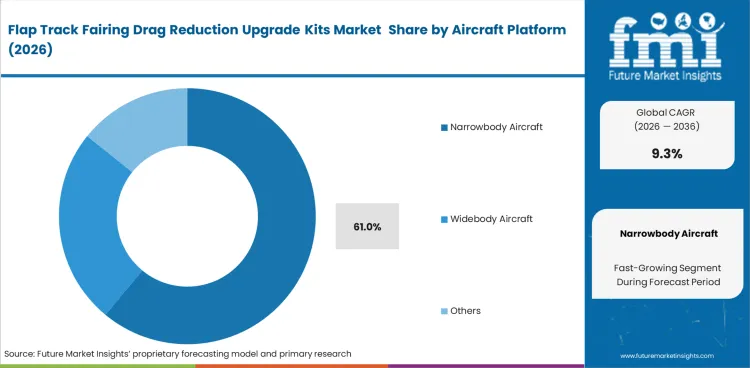
Airlines place most retrofit attention on aircraft that fly often enough for small aerodynamic gains to accumulate into a meaningful operating result. Narrowbody fleets fit that requirement because they combine high cycle counts with large installed volumes and a maintenance rhythm that supports repeatable upgrade work. commercial aircraft mro programs often provide the closest maintenance context for that rollout. Market estimates place narrowbody aircraft at 61.0% share in 2026. Widebody aircraft remain relevant, but retrofit timing is usually more selective because utilization patterns and fleet counts narrow the pace of rollout. Regional aircraft, military transports, and business jets stay in the mix where operators want targeted efficiency gains, yet the industry outlook still centers on narrowbody assets because scale and repetition make the economic case easier to defend across multiple aircraft.
- Installed-base logic: Large narrowbody fleets give carriers more room to spread retrofit benefits across repeated flying cycles.
- Maintenance fit: Scheduled checks on mature narrowbody aircraft create a cleaner installation route than unscheduled stand-alone modification events.
- Capital discipline: Smaller, repeatable gains become easier to approve when the same platform type is used across a wider fleet group.
Flap Track Fairing Drag Reduction Upgrade Kits Market Analysis by Retrofit Scope
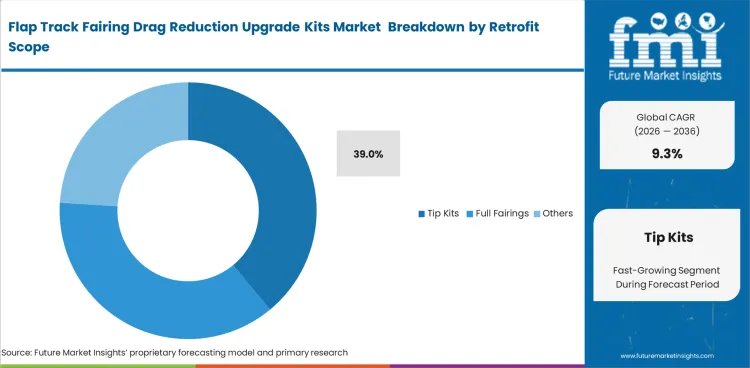
Engineering teams rarely begin with the broadest hardware change when a smaller intervention can address the drag penalty that matters most. Tip kits stay ahead on that basis, and they are projected to secure 39% share in 2026 within retrofit scope. Carriers often view them as a manageable entry point because installation burden stays lower than full fairing replacement and the work can remain closer to planned maintenance activity. Full fairings and hybrid kits are still important where wear is deeper or operators want a more complete aerodynamic reset. Reinforcement kits and custom kits serve more specific cases, but sector momentum remains with tip-focused upgrades because they usually balance effect, downtime, and installation complexity more cleanly than pylon fairings provides a useful adjacent reference for targeted fairing work.
- Entry route: Tip-focused work gives operators a narrower starting point when they want an aerodynamic upgrade without widening the maintenance task too far.
- Installation burden: Full fairing replacement asks for more removal, fit, and validation effort than many carriers want in an initial retrofit round.
- Use-case range: Custom and reinforcement packages remain relevant where fleet condition or airline requirements call for a more tailored intervention.
Flap Track Fairing Drag Reduction Upgrade Kits Market Analysis by Material
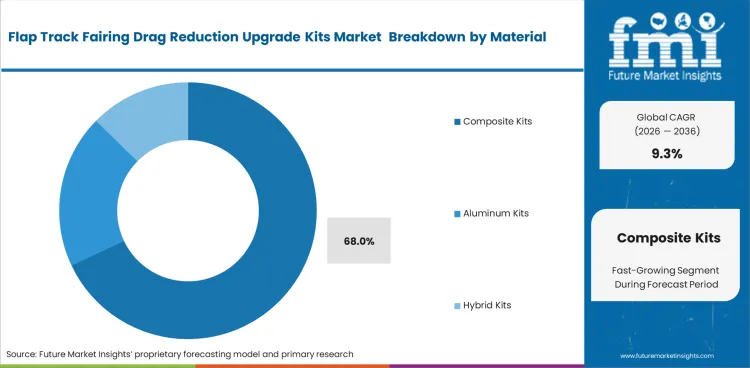
Material choice in this category is tied directly to aerodynamic shaping, weight control, and fit during retrofit work. Composite kits are likely to represent 68% of the material segment in 2026 because suppliers can use them to manage contour, durability, and mass more effectively in drag-sensitive applications. lightweight materials remain relevant to how suppliers position material choices around weight and contour control. Aluminum kits remain relevant where operators prefer familiar repair practice and simpler metal handling. Hybrid kits serve programs that need a balance between shaping flexibility and localized strength, while thermoplastic kits stay narrower in use. Demand analysis still leans toward composites because retrofit work is judged on the operating effect delivered after installation, and extra weight or limited contour freedom weakens the case for a fairing upgrade aimed at efficiency recovery.
- Aerodynamic fit: Composite materials give suppliers more control over contour accuracy in components where shape quality matters.
- Weight discipline: Retrofit programs built around efficiency recovery carry less room for materials that add unnecessary mass.
- Service practicality: Alternative material options remain in use where handling preference, repair familiarity, or local capability supports them.
Flap Track Fairing Drag Reduction Upgrade Kits Market Analysis by Sales Channel
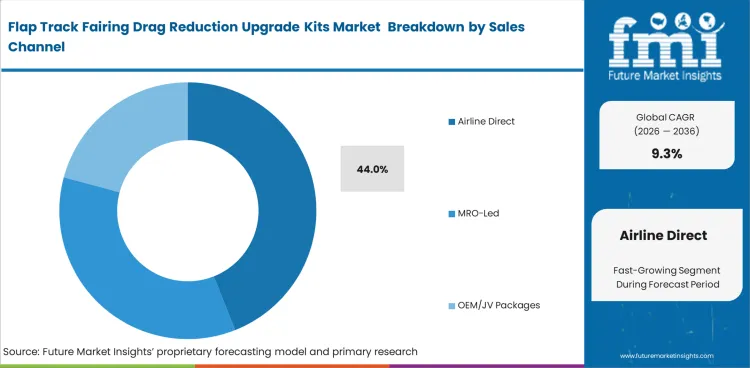
Channel choice reflects who controls the installation decision and how widely a retrofit is expected to move across a fleet. Airline direct programs are anticipated to contribute 44% of total market share in 2026 in the sales-channel segment. Large carriers often prefer that route when they want tighter control over hardware consistency, engineering review, and timing across several aircraft. MRO-led packages remain relevant where airlines rely on external maintenance capability to manage modification work. OEM or joint-venture packages and leasing programs have a place when approval handling or asset-transition needs carry more weight. aircraft refurbishing activity often overlaps with the same decision cycle when carriers update installed interiors and exterior hardware together. Industry outlook still favors airline direct engagement because retrofit standardization becomes easier when the operating carrier manages specification and rollout discipline closer to the fleet plan.
- Fleet commonality: Direct engagement helps carriers keep the same hardware and installation approach across multiple aircraft.
- Approval handling: Engineering review moves more smoothly when the operating airline stays close to the technical decision path.
- Channel variation: External maintenance partners and leasing-linked routes remain useful where internal modification capacity is limited.
Flap Track Fairing Drag Reduction Upgrade Kits Market Analysis by Installation Type
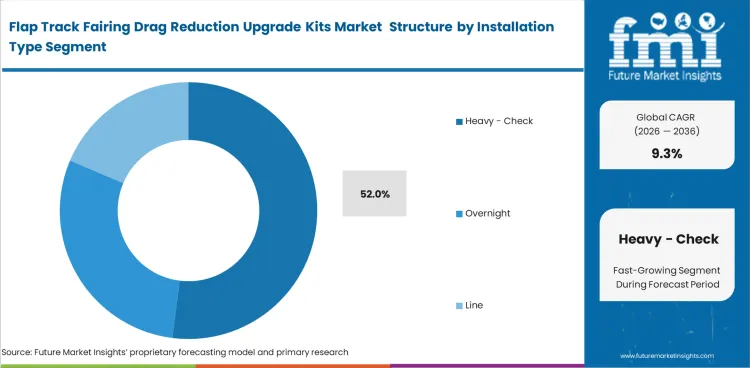
Installation timing plays a central role in whether a retrofit moves ahead or stays delayed. Heavy-check installs are forecast to represent 52% share in 2026 under installation type because operators prefer to absorb fairing work when labor access, grounding time, and documentation are already built into the maintenance plan. Air transport MRO remains the closest adjacent service lens for how installation timing shapes retrofit uptake. Overnight installs and line installs remain useful where the hardware scope is narrow and fleet schedules are tight. Transition installs support asset transfers and larger maintenance resets, but they do not carry the same volume base. A retrofit that requires a separate downtime event becomes harder to justify, which keeps heavy-check integration at the center of valuation across this category.
- Downtime control: Heavy checks reduce the need to create a separate maintenance event for aerodynamic upgrade work.
- Labor access: Planned base visits make removal, fit, and inspection work easier to manage than short-ground-time activity.
- Execution risk: Installation outside a scheduled maintenance window can weaken the case for adoption when time pressure is already high.
Flap Track Fairing Drag Reduction Upgrade Kits Market Drivers, Restraints, and Opportunities
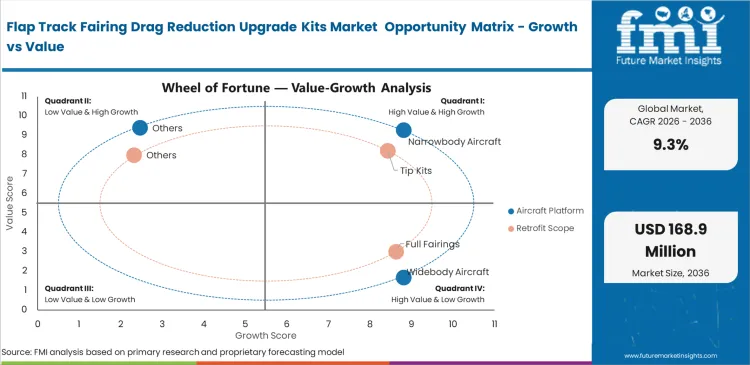
Airline cost discipline keeps this category on a positive trend as fuel-efficiency work extends beyond engines and flight operations into smaller exterior hardware decisions. Flap track fairings matter because they sit in an airframe area where drag recovery can support the operating case, especially on aircraft that fly frequently and stay in service for longer periods. Retrofit interest also rises when fairing work fits the same fleet-planning cycle as winglet retrofit kits or other approved efficiency upgrades, since airlines can review installation timing more coherently across the aircraft base.
Certification handling, aircraft-family coverage, and installation fit continue to limit broader adoption. A retrofit concept can look sound from an engineering standpoint and still move slowly when review remains narrow, maintenance timing does not align well, or documentation differs across operators and aircraft types. Industry outlook therefore depends on approval pathways that can be repeated with less friction and on retrofit packages that maintenance teams can absorb without adding avoidable labor burden or extra grounding time.
Flap Track Fairing Drag Reduction Upgrade Kits Market Opportunities
- Fleet-life extension: Longer service cycles for mature aircraft keep this opportunity on a positive trend, as operators look for targeted exterior upgrades that can improve operating efficiency without taking on broader redesign work.
- Maintenance bundling: Industry outlook is rising when fairing upgrades are aligned with other approved work during planned heavy checks, because installation timing becomes easier to justify within an existing maintenance window.
- Asset transitions: Aircraft moving between carriers or entering a new lease phase create a clearer opening for standardized retrofit work, since technical review is already underway and modification decisions are easier to place within that process.
Regional Analysis
Regional outlook reflects a clear divide between high-utilization fleet environments, where aerodynamic upgrades are easier to justify, and mature maintenance hubs, where adoption depends more on approval handling and installation discipline.
.webp "Top Country Growth Comparison Flap Track Fairing Drag Reduction Upgrade Kits Market Cagr (2026 2036)")
| Country | CAGR (2026-2036) |
|---|---|
| India | 10.4% |
| China | 10.1% |
| United States | 9.6% |
| Germany | 9.1% |
| Singapore | 8.7% |
| United Kingdom | 8.4% |
| France | 8.2% |
Asia Pacific Flap Track Fairing Drag Reduction Upgrade Kits Market Analysis
Asia Pacific remains the fastest-expanding region because active narrowbody fleets, tighter cost control, and heavy aircraft use makes small drag improvements commercially relevant. Retrofit work is easier to support when carriers want maintenance events to deliver operating benefit along with routine airframe work. India and China anchor that regional direction through fleet scale and utilization intensity, while Singapore contributes from a different position as a technical center for installation quality and maintenance execution. Regional momentum stays favorable when operators can align retrofit timing with scheduled checks and keep engineering handling consistent across aircraft types.
- India: Large narrowbody fleets and dense route activity keep retrofit planning commercially viable in India. Industry outlook in the country points to a 10.4% CAGR through 2036, as carriers remain focused on lowering operating burden without extending aircraft downtime. Maintenance timing also works in India’s favor because upgrade work can be folded into planned technical visits more easily.
- China: Fleet-use intensity keeps attention on aerodynamic retrofit work that can improve operating efficiency without adding a broader modification burden. China is likely to post 10.1% CAGR in this sector by 2036, supported by the scale of its installed base and the practical appeal of upgrades that fit existing maintenance cycles. Program consistency will matter because rollout becomes more useful when approval and installation can be repeated across more aircraft.
- Singapore: Maintenance depth and engineering capability keep Singapore relevant even with a smaller fleet base than India or China. The industry outlook in Singapore points to 8.7% CAGR through 2036, with demand analysis supported by its role in regional technical support and cross-border maintenance execution. That position gives Singapore value as an execution base rather than as a volume-led fleet center.
FMI’s report includes India, China, and Singapore. Familiarity with aircraft retrofit planning and maintenance-led efficiency upgrades across Asia Pacific gives suppliers room to scale approved fairing programs without rebuilding the operating case from the ground up.
North America Flap Track Fairing Drag Reduction Upgrade Kits Market Analysis
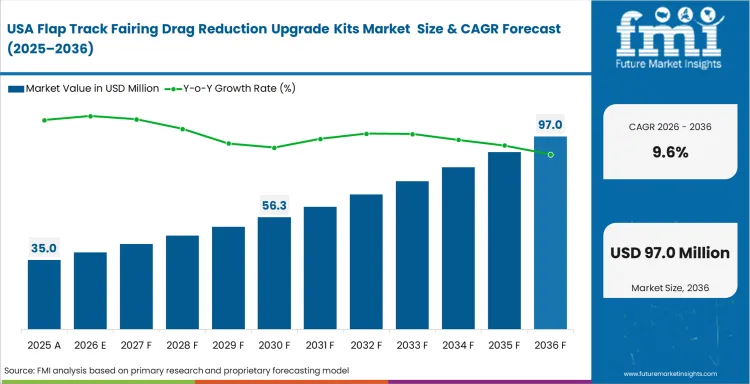
North America remains important because fleet scale, engineering review, and maintenance execution are closely tied within the same aftermarket environment. Retrofit adoption in this region depends less on new fleet addition and more on how smoothly approved upgrade work can be standardized across aircraft already in service. United States activity stays central because installed fleet depth gives carriers more room to apply aerodynamic modifications across active narrowbody programs. Regional outlook remains firm where technical acceptance translates into a routine maintenance action rather than a one-off engineering exercise.
- United States: Broad fleet exposure and a mature modification environment keep the United States central to this category. The market in the United States is projected to expand at a 9.6% CAGR through 2036, as carriers work to align approved fairing upgrades with wider fleet commonality and maintenance timing. Execution matters here because repeatable installation quality is what turns technical approval into real fleet coverage.
FMI’s report includes the United States. Installed fleet depth and established modification capability in North America give retrofit programs a clearer path when carriers want efficiency gains folded into routine technical planning.
Europe Flap Track Fairing Drag Reduction Upgrade Kits Market Analysis
Europe stays measured but important because retrofit activity usually moves ahead when maintenance discipline, aircraft condition review, and approval clarity are already well managed. Regional adoption is less tied to fleet expansion and more connected to engineering capability, installation quality, and the ability to insert fairing work into existing maintenance planning. Germany, the United Kingdom, and France all contribute from that base, supported by established aerospace service capacity and consistent technical handling. European industry outlook remains on a positive trend where operators can fit retrofit work into scheduled checks without creating extra downtime pressure.
- Germany: Aerospace engineering capability and maintenance depth keep Germany well placed in this category once retrofit approval is clear. Germany is forecast to register 9.1% CAGR in this market over the study period, supported by a disciplined technical environment that suits controlled rollout across active fleets. Consistency in execution remains important because retrofit value depends on repeatable installation quality.
- United Kingdom: Retrofit activity in the United Kingdom remains tied to aircraft support capability, installation quality, and maintenance scheduling discipline. A 8.4% CAGR is expected for the market in the United Kingdom through 2036, reflecting a steady role in approved upgrade execution rather than a volume-led fleet position. That keeps the country relevant where carriers want technical work to remain closely managed.
- France: Airline support activity and aerospace service capability keep France relevant in this sector. France is set to advance at a 8.2% CAGR through 2036, with retrofit work becoming easier to place when approved modifications can be absorbed into existing technical planning. Maintenance alignment remains important because operators want efficiency upgrades without creating separate downtime events.
FMI’s report includes Germany, the United Kingdom, and France. Maintenance discipline and established aerospace support capacity across Europe give approved retrofit work a more practical route when operators want aerodynamic upgrades to fit existing technical schedules.
Competitive Aligners for Market Players
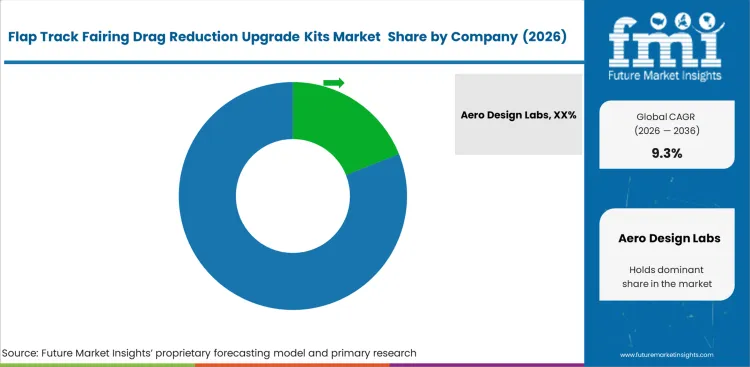
Competition in this niche is shaped by approval breadth, installation fit, and the ability to support airlines across more than one aircraft variant. Hardware design matters, but suppliers gain credibility only when engineering teams can see a clear path from technical concept to repeatable maintenance action. Adjacent categories such as antenna fairings show a similar pattern, where adoption depends on how easily exterior hardware can move through certification and maintenance planning.
Large aerospace names and specialist retrofit firms do not compete on exactly the same basis. Broader aerospace groups bring manufacturing depth, service reach, and familiarity with airline support requirements. Specialist players can still win when their fairing geometry, installation discipline, and aircraft-family focus solve a narrower problem more cleanly than a broad portfolio supplier can.
Industry positioning remains fragmented because no single company controls the category across every platform, material route, and installation model. Strength comes from matching technical credibility with delivery discipline and from staying close to air transport mro capability, where installation planning and technical support often influence supplier choice as much as the hardware itself.
Key Players in Flap Track Fairing Drag Reduction Upgrade Kits Market
- Aero Design Labs
- Aviation Partners Boeing
- Vortex Control Technologies
- SACS Aerospace
- ALOFT AeroArchitects
- The NORDAM Group
- Lufthansa Technik
Scope of the Report
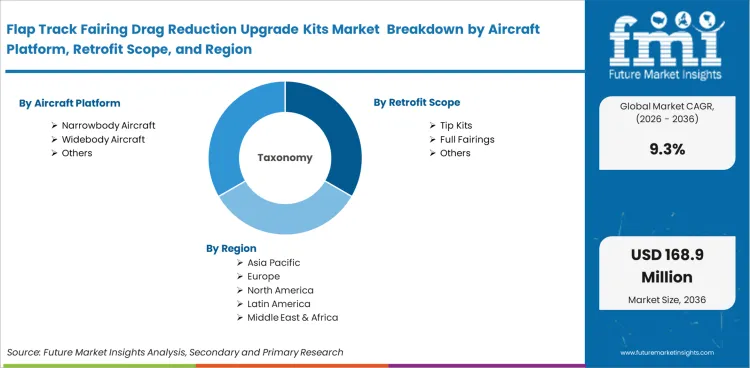
| Item | Value |
|---|---|
| Quantitative Units | USD 63.5 million in 2026 to and USD 154.5 million by 2036 at a CAGR of 9.3% |
| Market Definition | Post-delivery retrofit kits used to modify or replace aircraft flap track fairing components for drag-reduction and efficiency improvement |
| Aircraft Platform | Narrowbody aircraft, Widebody aircraft, regional aircraft, Military transports, Business jets |
| Retrofit Scope | Tip kits, Full fairings, Hybrid kits, Reinforcement kits, Custom kits |
| Material | Composite kits, Aluminum kits, Hybrid kits, Thermoplastic kits |
| Sales Channel | Airline direct, MRO-led, OEM/JV packages, Leasing programs |
| Installation Type | Heavy-check installs, Overnight installs, Line installs, Transition installs |
| Regions Covered | North America, Europe, Asia Pacific |
| Countries Covered | India, China, United States, Germany, Singapore, United Kingdom, France |
| Key Companies Profiled | Aero Design Labs, Aviation Partners Boeing, Vortex Control Technologies, SACS Aerospace, ALOFT AeroArchitects, The NORDAM Group, Lufthansa Technik |
| Forecast Period | 2026 to 2036 |
| Approach | FMI analysis based on retrofit adoption logic, maintenance-cycle fit, installed fleet relevance, and primary research |
Flap Track Fairing Drag Reduction Upgrade Kits Market Analysis by Segments
By Aircraft Platform:
- Narrowbody aircraft
- Widebody aircraft
- Regional aircraft
- Military transports
- Business jets
By Retrofit Scope:
- Tip kits
- Full fairings
- Hybrid kits
- Reinforcement kits
- Custom kits
By Material:
- Composite kits
- Aluminum kits
- Hybrid kits
- Thermoplastic kits
By Sales Channel:
- Airline direct
- MRO-led
- OEM/JV packages
- Leasing programs
By Installation Type:
- Heavy-check installs
- Overnight installs
- Line installs
- Transition installs
By Region:
- North America
- United States
- Europe
- Germany
- United Kingdom
- France
- Asia Pacific
- India
- China
- Singapore
Bibliography
- Airbus. (2025, April 15). Airbus Annual Report 2024.
- The Boeing Company. (2025, February 3). 2024 Annual Report.
- International Air Transport Association. (2024). Annual Review 2024.
- International Civil Aviation Organization. (2025). Environmental Report 2025.
- AAR CORP. (2025, September 23). Form 10-Q.
This Report Addresses
- How large the Flap Track Fairing Drag Reduction Upgrade Kits Market is expected to be in 2026 and 2036
- Which aircraft platform category is expected to lead segment share in 2026
- Why tip kits remain the leading retrofit-scope route across the forecast period
- How material choice affects valuation, installation fit, and aerodynamic intent
- Why airline direct programs remain important in the channel mix
- How heavy-check timing shapes retrofit adoption across in-service fleets
- Which countries are expected to post the strongest CAGR through 2036
- How competition is shaped by approval coverage, installation quality, and airline support
Frequently Asked Questions
What is the estimated size of the Flap Track Fairing Drag Reduction Upgrade Kits Market in 2026?
FMI estimates the market at USD 63.5 million in 2026. Valuation stays tied to retrofit adoption on in-service fleets rather than OEM line-fit demand.
What valuation is expected for the Flap Track Fairing Drag Reduction Upgrade Kits Market by 2036?
FMI projects the market to reach USD 154.5 million by 2036. Expansion reflects wider retrofit acceptance during planned maintenance cycles on active aircraft.
What CAGR is forecast for the Flap Track Fairing Drag Reduction Upgrade Kits Market from 2026 to 2036?
FMI expects the market to advance at a 9.3% CAGR through 2036. Adoption remains linked to fleet efficiency targets, approval handling, and installation timing.
Which aircraft platform is expected to lead the Flap Track Fairing Drag Reduction Upgrade Kits Market in 2026?
Narrowbody aircraft are expected to lead with 61% share in 2026. Large installed fleets and high use rates make retrofit work easier to justify.
Which retrofit-scope category leads the Flap Track Fairing Drag Reduction Upgrade Kits Market?
Tip kits remain the leading retrofit-scope category through the forecast period. Carriers often prefer them when they want lower installation burden than full replacement.
Which material segment is expected to remain dominant in 2026?
Composite kits are expected to represent 68% of the material segment in 2026. Weight discipline and contour flexibility support their leading position.
Which sales-channel segment is expected to stay ahead in 2026?
Airline direct programs are expected to contribute 44% market share in 2026. Large carriers often want tighter control over commonality and installation planning.
Which installation type is expected to lead the Flap Track Fairing Drag Reduction Upgrade Kits Market?
Heavy-check installs are projected to represent 52% share in 2026. Planned maintenance windows make retrofit work easier to absorb operationally.
Which country is expected to post the highest CAGR through 2036?
India is expected to record 10.4% CAGR through 2036. High fleet utilization and cost discipline keep the country at the top of the forecast range.
Why does India lead country-level CAGR in this market?
India stays ahead because narrowbody aircraft are used intensively and operators watch operating efficiency closely. Retrofit timing also fits active maintenance programs.
Why is China expected to remain close to India in CAGR terms?
China is projected to post 10.1% CAGR through 2036. Installed fleet scale and airline efficiency discipline keep retrofit relevance high across active aircraft.
What keeps the United States important in this market?
United States remains important because fleet scale and modification capability are both strong. That combination supports wider standardization once approval coverage is clear.
Why does Germany matter in the European outlook?
Germany is expected to record 9.1% CAGR through 2036. Engineering capability and maintenance depth support disciplined retrofit rollout when technical review is complete.
Why is Singapore relevant despite a smaller fleet base?
Singapore is forecast to post 8.7% CAGR through 2036. Regional maintenance capability gives it an important role in installation quality and program support.
Why do airlines prefer retrofit work during heavy checks?
Heavy checks reduce downtime pressure and simplify labor access. Retrofit work becomes easier to schedule when aircraft are already grounded for broader maintenance.
What is the main restraint affecting wider adoption?
Approval handling and aircraft-family coverage remain the main restraint. Technical interest alone is usually not enough when documentation and installation fit stay narrow.
How is this market different from aircraft winglet retrofit categories?
Winglet retrofits follow a different hardware and aerodynamic pathway. Flap track fairing kits focus on trailing-edge fairing performance inside a narrower retrofit scope.
What sits outside the scope of this market?
OEM line-fit fairings, standalone winglets, and cosmetic-only exterior treatments sit outside scope. Each follows a different supply path or installation intent.
Why do tip kits stay ahead of full fairing replacement?
Tip kits often provide a cleaner starting point for carriers. Installation burden stays lower, which helps when maintenance windows are already tight.
What do suppliers compete on most in this category?
Suppliers compete on approval breadth, installation fit, and technical support. Airlines still need hardware that can move cleanly through fleet planning.
Is this market concentrated or fragmented?
This category remains fragmented but specialist-led. No single supplier controls every aircraft platform, material route, and installation model across the retrofit base.
What changes most by 2036 in this market’s operating pattern?
Retrofit work is likely to move closer to standard maintenance planning by 2036. Adoption improves when approved kits become easier to repeat across fleets.
Preview the report firsthand - request a free sample
Get SampleGet the brochure for pricing and purchase details.
Get PDFTable of Content
- Executive Summary
- Global Market Outlook
- Demand-side Trends
- Supply-side Trends
- Technology Roadmap Analysis
- Analysis and Recommendations
- Market Overview
- Market Coverage / Taxonomy
- Market Definition / Scope / Limitations
- Research Methodology
- Chapter Orientation
- Analytical Lens and Working Hypotheses
- Market Structure, Signals, and Trend Drivers
- Benchmarking and Cross-market Comparability
- Market Sizing, Forecasting, and Opportunity Mapping
- Research Design and Evidence Framework
- Desk Research Programme (Secondary Evidence)
- Company Annual and Sustainability Reports
- Peer-reviewed Journals and Academic Literature
- Corporate Websites, Product Literature, and Technical Notes
- Earnings Decks and Investor Briefings
- Statutory Filings and Regulatory Disclosures
- Technical White Papers and Standards Notes
- Trade Journals, Industry Magazines, and Analyst Briefs
- Conference Proceedings, Webinars, and Seminar Materials
- Government Statistics Portals and Public Data Releases
- Press Releases and Reputable Media Coverage
- Specialist Newsletters and Curated Briefings
- Sector Databases and Reference Repositories
- FMI Internal Proprietary Databases and Historical Market Datasets
- Subscription Datasets and Paid Sources
- Social Channels, Communities, and Digital Listening Inputs
- Additional Desk Sources
- Expert Input and Fieldwork (Primary Evidence)
- Primary Modes
- Qualitative Interviews and Expert Elicitation
- Quantitative Surveys and Structured Data Capture
- Blended Approach
- Why Primary Evidence is Used
- Field Techniques
- Interviews
- Surveys
- Focus Groups
- Observational and In-context Research
- Social and Community Interactions
- Stakeholder Universe Engaged
- C-suite Leaders
- Board Members
- Presidents and Vice Presidents
- R&D and Innovation Heads
- Technical Specialists
- Domain Subject-matter Experts
- Scientists
- Physicians and Other Healthcare Professionals
- Governance, Ethics, and Data Stewardship
- Research Ethics
- Data Integrity and Handling
- Primary Modes
- Tooling, Models, and Reference Databases
- Desk Research Programme (Secondary Evidence)
- Data Engineering and Model Build
- Data Acquisition and Ingestion
- Cleaning, Normalisation, and Verification
- Synthesis, Triangulation, and Analysis
- Quality Assurance and Audit Trail
- Market Background
- Market Dynamics
- Drivers
- Restraints
- Opportunity
- Trends
- Scenario Forecast
- Demand in Optimistic Scenario
- Demand in Likely Scenario
- Demand in Conservative Scenario
- Opportunity Map Analysis
- Product Life Cycle Analysis
- Supply Chain Analysis
- Investment Feasibility Matrix
- Value Chain Analysis
- PESTLE and Porter’s Analysis
- Regulatory Landscape
- Regional Parent Market Outlook
- Production and Consumption Statistics
- Import and Export Statistics
- Market Dynamics
- Global Market Analysis 2021 to 2025 and Forecast, 2026 to 2036
- Historical Market Size Value (USD Million) Analysis, 2021 to 2025
- Current and Future Market Size Value (USD Million) Projections, 2026 to 2036
- Y-o-Y Growth Trend Analysis
- Absolute $ Opportunity Analysis
- Global Market Pricing Analysis 2021 to 2025 and Forecast 2026 to 2036
- Global Market Analysis 2021 to 2025 and Forecast 2026 to 2036, By Aircraft Platform
- Introduction / Key Findings
- Historical Market Size Value (USD Million) Analysis By Aircraft Platform , 2021 to 2025
- Current and Future Market Size Value (USD Million) Analysis and Forecast By Aircraft Platform , 2026 to 2036
- Narrowbody Aircraft
- Widebody Aircraft
- Others
- Narrowbody Aircraft
- Y-o-Y Growth Trend Analysis By Aircraft Platform , 2021 to 2025
- Absolute $ Opportunity Analysis By Aircraft Platform , 2026 to 2036
- Global Market Analysis 2021 to 2025 and Forecast 2026 to 2036, By Retrofit Scope
- Introduction / Key Findings
- Historical Market Size Value (USD Million) Analysis By Retrofit Scope, 2021 to 2025
- Current and Future Market Size Value (USD Million) Analysis and Forecast By Retrofit Scope, 2026 to 2036
- Tip Kits
- Full Fairings
- Others
- Tip Kits
- Y-o-Y Growth Trend Analysis By Retrofit Scope, 2021 to 2025
- Absolute $ Opportunity Analysis By Retrofit Scope, 2026 to 2036
- Global Market Analysis 2021 to 2025 and Forecast 2026 to 2036, By Material
- Introduction / Key Findings
- Historical Market Size Value (USD Million) Analysis By Material, 2021 to 2025
- Current and Future Market Size Value (USD Million) Analysis and Forecast By Material, 2026 to 2036
- Composite Kits
- Aluminum Kits
- Hybrid Kits
- Composite Kits
- Y-o-Y Growth Trend Analysis By Material, 2021 to 2025
- Absolute $ Opportunity Analysis By Material, 2026 to 2036
- Global Market Analysis 2021 to 2025 and Forecast 2026 to 2036, By Sales Channel
- Introduction / Key Findings
- Historical Market Size Value (USD Million) Analysis By Sales Channel, 2021 to 2025
- Current and Future Market Size Value (USD Million) Analysis and Forecast By Sales Channel, 2026 to 2036
- Airline Direct
- MRO-Led
- OEM/JV Packages
- Airline Direct
- Y-o-Y Growth Trend Analysis By Sales Channel, 2021 to 2025
- Absolute $ Opportunity Analysis By Sales Channel, 2026 to 2036
- Global Market Analysis 2021 to 2025 and Forecast 2026 to 2036, By Installation Type
- Introduction / Key Findings
- Historical Market Size Value (USD Million) Analysis By Installation Type, 2021 to 2025
- Current and Future Market Size Value (USD Million) Analysis and Forecast By Installation Type, 2026 to 2036
- Heavy - Check
- Overnight
- Line
- Heavy - Check
- Y-o-Y Growth Trend Analysis By Installation Type, 2021 to 2025
- Absolute $ Opportunity Analysis By Installation Type, 2026 to 2036
- Global Market Analysis 2021 to 2025 and Forecast 2026 to 2036, By Region
- Introduction
- Historical Market Size Value (USD Million) Analysis By Region, 2021 to 2025
- Current Market Size Value (USD Million) Analysis and Forecast By Region, 2026 to 2036
- North America
- Latin America
- Western Europe
- Eastern Europe
- East Asia
- South Asia and Pacific
- Middle East & Africa
- Market Attractiveness Analysis By Region
- North America Market Analysis 2021 to 2025 and Forecast 2026 to 2036, By Country
- Historical Market Size Value (USD Million) Trend Analysis By Market Taxonomy, 2021 to 2025
- Market Size Value (USD Million) Forecast By Market Taxonomy, 2026 to 2036
- By Country
- USA
- Canada
- Mexico
- By Aircraft Platform
- By Retrofit Scope
- By Material
- By Sales Channel
- By Installation Type
- By Country
- Market Attractiveness Analysis
- By Country
- By Aircraft Platform
- By Retrofit Scope
- By Material
- By Sales Channel
- By Installation Type
- Key Takeaways
- Latin America Market Analysis 2021 to 2025 and Forecast 2026 to 2036, By Country
- Historical Market Size Value (USD Million) Trend Analysis By Market Taxonomy, 2021 to 2025
- Market Size Value (USD Million) Forecast By Market Taxonomy, 2026 to 2036
- By Country
- Brazil
- Chile
- Rest of Latin America
- By Aircraft Platform
- By Retrofit Scope
- By Material
- By Sales Channel
- By Installation Type
- By Country
- Market Attractiveness Analysis
- By Country
- By Aircraft Platform
- By Retrofit Scope
- By Material
- By Sales Channel
- By Installation Type
- Key Takeaways
- Western Europe Market Analysis 2021 to 2025 and Forecast 2026 to 2036, By Country
- Historical Market Size Value (USD Million) Trend Analysis By Market Taxonomy, 2021 to 2025
- Market Size Value (USD Million) Forecast By Market Taxonomy, 2026 to 2036
- By Country
- Germany
- UK
- Italy
- Spain
- France
- Nordic
- BENELUX
- Rest of Western Europe
- By Aircraft Platform
- By Retrofit Scope
- By Material
- By Sales Channel
- By Installation Type
- By Country
- Market Attractiveness Analysis
- By Country
- By Aircraft Platform
- By Retrofit Scope
- By Material
- By Sales Channel
- By Installation Type
- Key Takeaways
- Eastern Europe Market Analysis 2021 to 2025 and Forecast 2026 to 2036, By Country
- Historical Market Size Value (USD Million) Trend Analysis By Market Taxonomy, 2021 to 2025
- Market Size Value (USD Million) Forecast By Market Taxonomy, 2026 to 2036
- By Country
- Russia
- Poland
- Hungary
- Balkan & Baltic
- Rest of Eastern Europe
- By Aircraft Platform
- By Retrofit Scope
- By Material
- By Sales Channel
- By Installation Type
- By Country
- Market Attractiveness Analysis
- By Country
- By Aircraft Platform
- By Retrofit Scope
- By Material
- By Sales Channel
- By Installation Type
- Key Takeaways
- East Asia Market Analysis 2021 to 2025 and Forecast 2026 to 2036, By Country
- Historical Market Size Value (USD Million) Trend Analysis By Market Taxonomy, 2021 to 2025
- Market Size Value (USD Million) Forecast By Market Taxonomy, 2026 to 2036
- By Country
- China
- Japan
- South Korea
- By Aircraft Platform
- By Retrofit Scope
- By Material
- By Sales Channel
- By Installation Type
- By Country
- Market Attractiveness Analysis
- By Country
- By Aircraft Platform
- By Retrofit Scope
- By Material
- By Sales Channel
- By Installation Type
- Key Takeaways
- South Asia and Pacific Market Analysis 2021 to 2025 and Forecast 2026 to 2036, By Country
- Historical Market Size Value (USD Million) Trend Analysis By Market Taxonomy, 2021 to 2025
- Market Size Value (USD Million) Forecast By Market Taxonomy, 2026 to 2036
- By Country
- India
- ASEAN
- Australia & New Zealand
- Rest of South Asia and Pacific
- By Aircraft Platform
- By Retrofit Scope
- By Material
- By Sales Channel
- By Installation Type
- By Country
- Market Attractiveness Analysis
- By Country
- By Aircraft Platform
- By Retrofit Scope
- By Material
- By Sales Channel
- By Installation Type
- Key Takeaways
- Middle East & Africa Market Analysis 2021 to 2025 and Forecast 2026 to 2036, By Country
- Historical Market Size Value (USD Million) Trend Analysis By Market Taxonomy, 2021 to 2025
- Market Size Value (USD Million) Forecast By Market Taxonomy, 2026 to 2036
- By Country
- Kingdom of Saudi Arabia
- Other GCC Countries
- Turkiye
- South Africa
- Other African Union
- Rest of Middle East & Africa
- By Aircraft Platform
- By Retrofit Scope
- By Material
- By Sales Channel
- By Installation Type
- By Country
- Market Attractiveness Analysis
- By Country
- By Aircraft Platform
- By Retrofit Scope
- By Material
- By Sales Channel
- By Installation Type
- Key Takeaways
- Key Countries Market Analysis
- USA
- Pricing Analysis
- Market Share Analysis, 2025
- By Aircraft Platform
- By Retrofit Scope
- By Material
- By Sales Channel
- By Installation Type
- Canada
- Pricing Analysis
- Market Share Analysis, 2025
- By Aircraft Platform
- By Retrofit Scope
- By Material
- By Sales Channel
- By Installation Type
- Mexico
- Pricing Analysis
- Market Share Analysis, 2025
- By Aircraft Platform
- By Retrofit Scope
- By Material
- By Sales Channel
- By Installation Type
- Brazil
- Pricing Analysis
- Market Share Analysis, 2025
- By Aircraft Platform
- By Retrofit Scope
- By Material
- By Sales Channel
- By Installation Type
- Chile
- Pricing Analysis
- Market Share Analysis, 2025
- By Aircraft Platform
- By Retrofit Scope
- By Material
- By Sales Channel
- By Installation Type
- Germany
- Pricing Analysis
- Market Share Analysis, 2025
- By Aircraft Platform
- By Retrofit Scope
- By Material
- By Sales Channel
- By Installation Type
- UK
- Pricing Analysis
- Market Share Analysis, 2025
- By Aircraft Platform
- By Retrofit Scope
- By Material
- By Sales Channel
- By Installation Type
- Italy
- Pricing Analysis
- Market Share Analysis, 2025
- By Aircraft Platform
- By Retrofit Scope
- By Material
- By Sales Channel
- By Installation Type
- Spain
- Pricing Analysis
- Market Share Analysis, 2025
- By Aircraft Platform
- By Retrofit Scope
- By Material
- By Sales Channel
- By Installation Type
- France
- Pricing Analysis
- Market Share Analysis, 2025
- By Aircraft Platform
- By Retrofit Scope
- By Material
- By Sales Channel
- By Installation Type
- India
- Pricing Analysis
- Market Share Analysis, 2025
- By Aircraft Platform
- By Retrofit Scope
- By Material
- By Sales Channel
- By Installation Type
- ASEAN
- Pricing Analysis
- Market Share Analysis, 2025
- By Aircraft Platform
- By Retrofit Scope
- By Material
- By Sales Channel
- By Installation Type
- Australia & New Zealand
- Pricing Analysis
- Market Share Analysis, 2025
- By Aircraft Platform
- By Retrofit Scope
- By Material
- By Sales Channel
- By Installation Type
- China
- Pricing Analysis
- Market Share Analysis, 2025
- By Aircraft Platform
- By Retrofit Scope
- By Material
- By Sales Channel
- By Installation Type
- Japan
- Pricing Analysis
- Market Share Analysis, 2025
- By Aircraft Platform
- By Retrofit Scope
- By Material
- By Sales Channel
- By Installation Type
- South Korea
- Pricing Analysis
- Market Share Analysis, 2025
- By Aircraft Platform
- By Retrofit Scope
- By Material
- By Sales Channel
- By Installation Type
- Russia
- Pricing Analysis
- Market Share Analysis, 2025
- By Aircraft Platform
- By Retrofit Scope
- By Material
- By Sales Channel
- By Installation Type
- Poland
- Pricing Analysis
- Market Share Analysis, 2025
- By Aircraft Platform
- By Retrofit Scope
- By Material
- By Sales Channel
- By Installation Type
- Hungary
- Pricing Analysis
- Market Share Analysis, 2025
- By Aircraft Platform
- By Retrofit Scope
- By Material
- By Sales Channel
- By Installation Type
- Kingdom of Saudi Arabia
- Pricing Analysis
- Market Share Analysis, 2025
- By Aircraft Platform
- By Retrofit Scope
- By Material
- By Sales Channel
- By Installation Type
- Turkiye
- Pricing Analysis
- Market Share Analysis, 2025
- By Aircraft Platform
- By Retrofit Scope
- By Material
- By Sales Channel
- By Installation Type
- South Africa
- Pricing Analysis
- Market Share Analysis, 2025
- By Aircraft Platform
- By Retrofit Scope
- By Material
- By Sales Channel
- By Installation Type
- USA
- Market Structure Analysis
- Competition Dashboard
- Competition Benchmarking
- Market Share Analysis of Top Players
- By Regional
- By Aircraft Platform
- By Retrofit Scope
- By Material
- By Sales Channel
- By Installation Type
- Competition Analysis
- Competition Deep Dive
- Aero Design Labs
- Overview
- Product Portfolio
- Profitability by Market Segments (Product/Age /Sales Channel/Region)
- Sales Footprint
- Strategy Overview
- Marketing Strategy
- Product Strategy
- Channel Strategy
- Aviation Partners Boeing
- Vortex Control Technologies
- SACS Aerospace
- ALOFT AeroArchitects
- The NORDAM Group
- Aero Design Labs
- Competition Deep Dive
- Assumptions & Acronyms Used


