

- Market Size (2026)
- USD 788.4 Mn
- Forecast (2036)
- USD 1466.1 Mn
- CAGR (2026 to 2036)
- 6.4%
Flap Track and Carriage Hardware Components Market Size, Forecast and Outlook By FMI
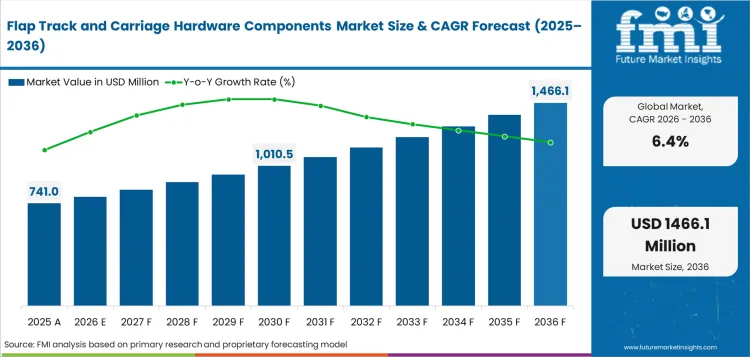
The flap track and carriage hardware components market size stood at USD 741.0 million in 2025. Industry revenue is estimated at USD 788.4 million in 2026 and projected to reach USD 1,466.1 million by 2036 at 6.4% CAGR. By end user, commercial aviation is expected to represent 61.4% share in 2026. By sales channel, OEM fitment is estimated to account for 57.2% share in 2026.
Safe flap movement depends on traceable tools and bearing quality across repeated aircraft cycles in daily airline service. Satair’s September 2025 list priced selected Airbus tool recertification entries from USD 167 to USD 316, reflecting why repair shops need clear tool cost and recertification planning before flap hardware work begins.
European Union Aviation Safety Agency AD 2026-0030 required inspection of movable flap track fairings 2 and 5 on A380 variants from March 12, 2026. Operators therefore need suppliers supporting inspection findings with approved parts and clean records. Bearing supply also affects carriage assembly reliability. RBC Bearings reported aerospace and defense as 36% of fiscal 2025 net sales and listed airframe flight control and actuation as representative applications. Suppliers with bearing depth and flight-control exposure are likely to gain preference where motion control and documentation decide approval.
Summary of Flap Track and Carriage Hardware Components Market
- Demand and Growth Drivers
- Aircraft builders are expected to keep certified track and carriage suppliers close to final assembly plans as wing release depends on tested hardware.
- Airlines need wear-prone carriage and roller parts in maintenance plans as short-haul aircraft continue frequent flap cycling.
- Traceable machining records and airworthiness paperwork support repeat orders from platform owners and tier-one wing suppliers.
- Product and Segment View
- Commercial aviation is expected to account for 61.4% share in 2026 as airline fleets create the main inspection and replacement pool.
- OEM fitment is expected to account for 57.2% share in 2026, influenced by aircraft programs qualifying parts before production release.
- Narrowbody aircraft is expected to account for 48.5% share in 2026, led by frequent short-haul cycles and high fleet counts.
- Geography and Competitive Outlook
- India is projected to record 8.9% CAGR by 2036, helped by airline capacity growth and expanding maintenance demand.
- China is expected to expand at 8.2% CAGR by 2036, shaped by aircraft movements and local aerospace manufacturing depth.
- Boeing, Airbus Atlantic and Sonaca anchor competition through wing work packages and certified high-lift hardware skill.
- Collins Aerospace adds depth through flap actuation systems and certified aftermarket support for airline maintenance channels.
- Analyst Opinion
- Nikhil Kaitwade, Principal Consultant for Automotive at FMI, opines, “The flap track and carriage hardware appear undersized relative to the wing. Program release depends on its fatigue record and fit accuracy. Airlines and airframers will favor suppliers showing machining proof and overhaul support in plain operating terms.”
- Flap Track and Carriage Hardware Components Market Value Analysis
- Market value is tied to certified machining proof before a wing program accepts track and carriage hardware.
- Supplier pricing reflects material grade and tolerance control before buyers approve hardware for repeated flap cycling.
- Revenue rises above basic metal value as inspection history and traceable part records become part of the order discussion.
- Airframe relationships create higher-value orders as suppliers align flap tracks with carriage assemblies and roller service needs.
Key Takeaways, Market Size, and Forecast
- The flap track and carriage hardware components market was valued at USD 741.0 million in 2025.
- Industry value is projected to reach USD 1,466.1 million by 2036 as certified wing hardware gains value in aircraft production and repair lines.
- From 2026 to 2036, the sector is projected to expand at 6.4% CAGR.
- Industry revenue is projected to create incremental opportunity of USD 677.7 million from 2026 to 2036.
- Commercial aviation is expected to account for 61.4% share of end user in 2026.
- OEM fitment is expected to secure 57.2% share of sales channel in 2026.
- India leads the country set with a projected 8.9% CAGR, followed by China at 8.2% CAGR by 2036.
Flap Track and Carriage Hardware Components Market Definition
Flap track and carriage hardware components cover load-bearing guide parts that support aircraft flap movement during takeoff and landing. Scope includes flap tracks and carriage assemblies used in certified fixed-wing aircraft. Roller assemblies, attachment fittings and wear plates are counted as hardware parts. Actuation systems are counted only when hardware is sold as part of the same mechanical package. Fairings are counted only when supplied with direct flap track hardware or replacement kits. Finished wings and complete aircraft are excluded from the value.
Flap Track and Carriage Hardware Components Market Inclusions
Scope includes machined flap tracks sold to aircraft programs and aftermarket repair channels. Carriage assemblies and roller hardware are counted when supplied as certified replacement parts. Titanium, aluminum and high-strength steel hardware are included. OEM fitment and maintenance repair channels are counted. Distributor sales are counted when parts carry approved aerospace documentation.
Flap Track and Carriage Hardware Components Market Exclusions
Scope excludes complete wing structures and finished high-lift systems sold as full assemblies. Hydraulic actuators, pumps and control electronics are excluded unless packaged with the mechanical hardware. Generic industrial rollers and non-aircraft machined brackets are excluded. Cabin parts, engine hardware and landing gear parts fall outside the scope unless tied to flap track replacement work.
Flap Track and Carriage Hardware Components Market Research Methodology
- Primary Research: FMI analysts reviewed buying needs across airframe suppliers, maintenance shops and aerospace hardware distributors.
- Desk Research: Official aviation traffic data and public safety rules supported the demand checks and scope mapping.
- Market Sizing and Forecasting: Estimates are based on aircraft production exposure and aftermarket replacement assumptions.
- Data Validation: Checks compared 2026 value with 2036 value and tested CAGR consistency across seven country rates.
Why is the Flap Track and Carriage Hardware Components Market Growing?
- Airline fleets need certified flap carriage parts as frequent aircraft use keeps high-lift hardware under regular inspection pressure.
- Aircraft programs need qualified track suppliers delivering tight-fit hardware with clear material and machining records.
- Repair providers gain recurring work as carriage rollers and guide tracks move into planned airframe maintenance cycles.
Higher aircraft use is keeping flap track and carriage hardware tied to fleet availability instead of one-time part replacement. In January 2026, the International Air Transport Association said 2025 air travel demand grew by 5.3%, with international demand rising 7.1% and domestic demand increasing 2.4%. Higher traffic raises takeoff and landing exposure, so flap tracks and carriage assemblies face more inspection events across active fleets. Aircraft production adds a second route for qualified suppliers. Airbus stated in February 2026 that it delivered 793 aircraft in 2025 and received 1,000 gross commercial aircraft orders. Boeing reported in January 2026, full-year 2025 commercial deliveries reached 600 aircraft. OEM programs therefore need track and carriage suppliers holding fit accuracy and delivery discipline. Adjacent aircraft flap track fairing retrofit kits and aircraft fairings activity supports the same wing inspection area, giving approved hardware suppliers a clearer aftermarket path.
Market Segmentation Analysis
- Flap tracks are projected to account for 36.8% share in 2026, backed by their load-bearing role in guiding flap travel.
- Narrowbody aircraft are forecast to represent 48.5% share in 2026, influenced by high flight-cycle intensity in commercial fleets.
- Titanium alloys are projected to hold 42.6% share in 2026 as fatigue resistance and weight control shape material choice.
- OEM fitment is forecast to account for 57.2% share in 2026 due to program qualification before aircraft delivery.
- Commercial aviation is projected to capture 61.4% share in 2026 since airline fleets dominate aircraft utilization and repair activity.
Segmentation is divided into five parent groups built around how buyers specify high-lift hardware. Aircraft flight control system planning keeps hardware approval tied to flap movement accuracy. Component type defines the physical part replaced or qualified. Aircraft type shows the platform that carries the hardware. Material type reflects weight and fatigue needs. Sales channel explains whether parts enter production or repair. End user identifies the operator group creating the final need.
Insights into Flap Track and Carriage Hardware Components Market by Component Type
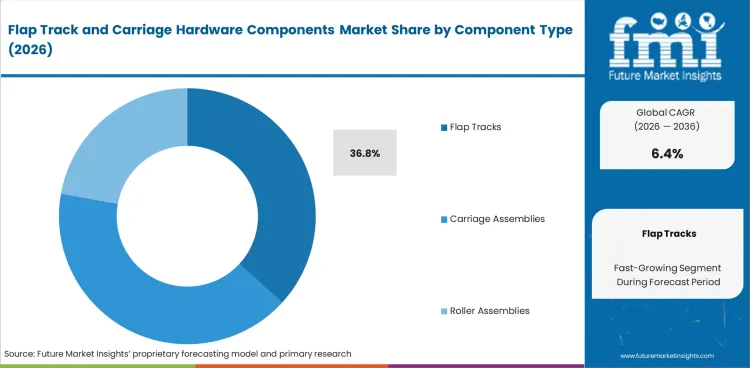
- Flap tracks are expected to account for 36.8% share in 2026, driven by their direct load path role and the need for exact guide surface geometry during flap travel.
- Carriage assemblies gain value in overhaul work as rollers and bushings face wear from repeated landing cycles.
Insights into Flap Track and Carriage Hardware Components Market by Aircraft Type
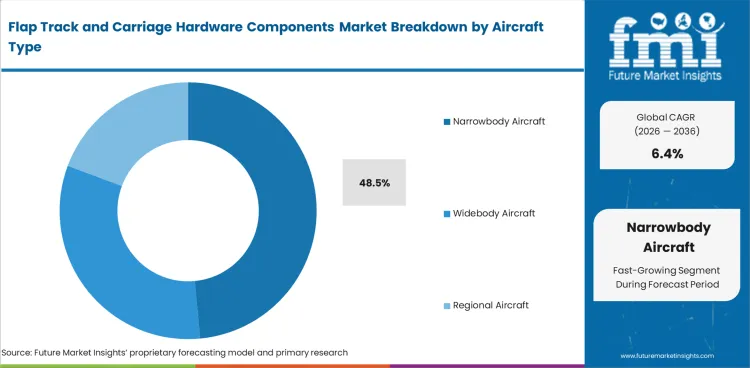
- Narrowbody aircraft are forecast to represent 48.5% share in 2026, influenced by high route frequency and larger active fleets that raise replacement need.
- Widebody aircraft attract higher-value parts since larger wing hardware needs heavier load capacity and tighter inspection records.
Insights into Flap Track and Carriage Hardware Components Market by Material Type
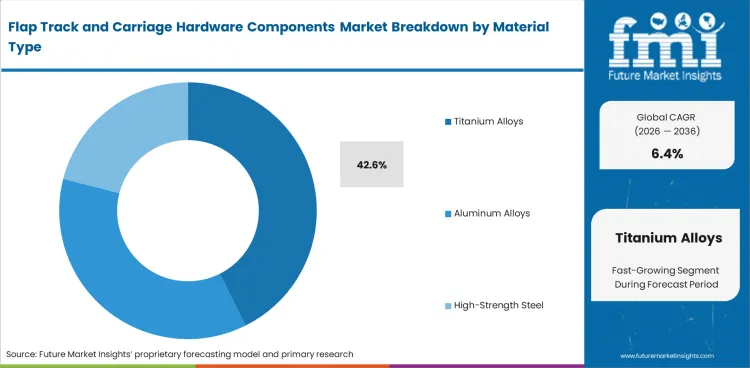
- Titanium alloys are projected to hold 42.6% share in 2026, led by suppliers balancing fatigue strength with weight limits in certified wing hardware.
- High-strength steel retains demand for roller contact zones and attachment points needing durable wear performance.
Insights into Flap Track and Carriage Hardware Components Market by Sales Channel
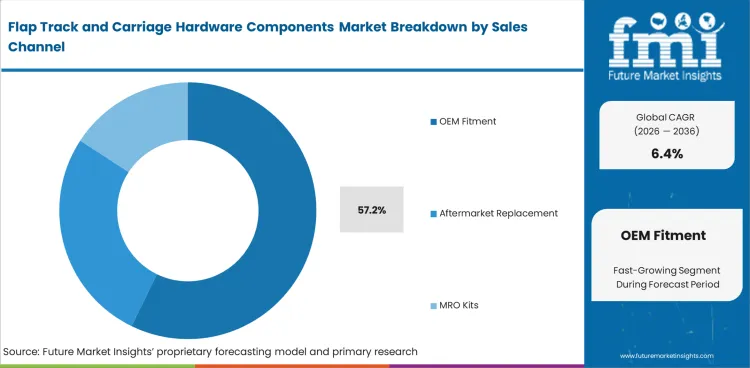
- OEM fitment is forecast to account for 57.2% share in 2026 due to airframe programs locking qualified parts before serial production release.
- Aftermarket replacement creates a steadier order route as commercial aircraft MRO providers buy approved parts for scheduled checks and damage repair.
Insights into Flap Track and Carriage Hardware Components Market by End User
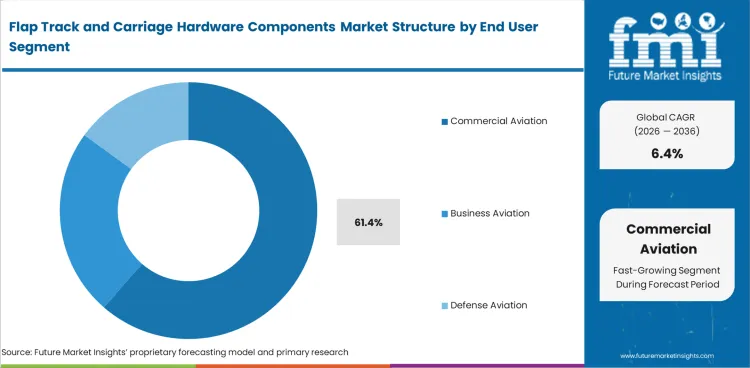
- Commercial aviation is projected to capture 61.4% share in 2026 as airlines create the main pool of high-cycle aircraft and replacement events.
- Defense aviation creates value through long service lives and platform-specific hardware that needs strict part traceability.
Flap Track and Carriage Hardware Components Market Drivers, Restraints and Opportunities
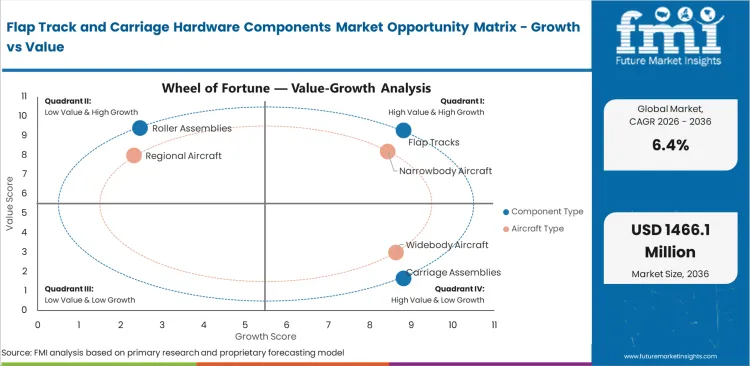
- Driver: High-cycle airline fleets are bringing flap track and carriage inspection into scheduled airframe planning.
- Restraint: Approval paperwork and close machining tolerances are slowing supplier changes for flight-critical wing hardware.
- Opportunity: Certified repair kits give approved suppliers a clearer route into airlines seeking shorter aircraft downtime.
Fleet expansion is keeping flap track and carriage hardware tied to aircraft availability and repair planning. In 2025, the Federal Aviation Administration forecast the United States commercial aircraft fleet to rise from 7,387 aircraft in 2024 to 10,607 aircraft by 2045. It also placed mainline passenger jets including regional jets at 4,829 in 2024 and 6,854 by 2045. A larger active fleet gives MRO shops more flap guide surfaces and carriage assemblies to inspect during scheduled checks. Airbus Global Services Forecast 2025 to 2044 expects the global fleet to exceed 49,000 aircraft by 2044 and services value to reach USD 311 billion. That service pool supports approved commercial aircraft MRO and certified repair kit suppliers. Federal Aviation Administration Order 8120.18A issued in September 2025 covers production approval holders and FAA Form 8130-3 use for return-to-service records. Such documentation need slows supplier switching but favors hardware makers with ready inspection files and traceable parts.
Application-wise High-Lift Hardware Deployment Analysis
Flap track and carriage hardware is used where wing motion must stay controlled during takeoff and landing. Boeing’s February 2025 patent for flap support systems describes a flap support system with a crank and carrier beam. The same patent states, a carriage can move in relation to a shaft. Such design detail shows why hardware demand is tied to airframe programs and repair planning. Suppliers are expected to gain more value where they can support track geometry and approved replacement routes in one hardware package.
High-Lift Hardware Inspection and Qualification Analysis
Technology progress in this market is centered on jam resistance and track design. Boeing’s August 2025 patent for failsafe jam-resistant flap tracks describes a flap carriage moving along a track with a primary roller and a pair of secondary rollers. It also describes back-to-back C-channel sub-tracks removing the need for a failsafe bar. Such design details show why buyers assess carriage fit and track geometry before approving suppliers for wing hardware programs. Suppliers are expected to gain stronger positions when they can prove reliable motion control and easier manufacturing paths in certified flap assemblies.
Analysis of Flap Track and Carriage Hardware Components Market by Key Countries
.webp "Top Country Growth Comparison Flap Track And Carriage Hardware Components Market Cagr (2026 2036)")
| Country | CAGR |
|---|---|
| India | 8.9% |
| China | 8.2% |
| United States | 6.7% |
| France | 6.1% |
| Germany | 5.8% |
| Japan | 5.3% |
| United Kingdom | 5.0% |
Source: Future Market Insights, 2026.
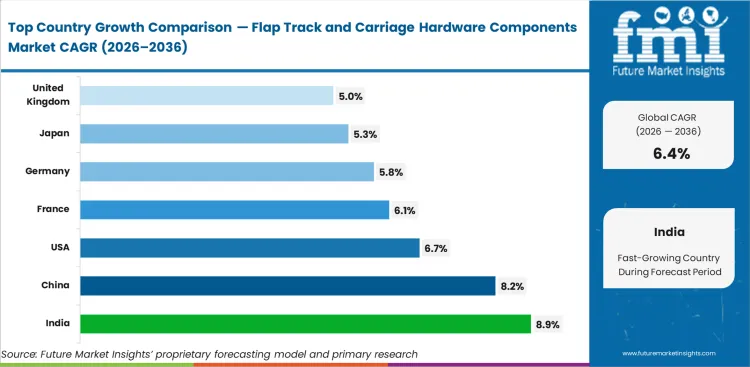
Flap Track and Carriage Hardware Components Market CAGR Analysis by Country
- India is projected to record 8.9% CAGR by 2036, influenced by domestic traffic growth and wider maintenance needs.
- China is expected to expand at 8.2% CAGR by 2036, led by aircraft movement scale and aerospace manufacturing depth.
- United States is forecast to grow at 6.7% CAGR by 2036 through airframe programs and a broad MRO network.
- France is expected to advance at 6.1% CAGR by 2036 as Airbus-linked wing supply work supports demand.
- Germany is projected to rise at 5.8% CAGR by 2036, reflecting precision manufacturing and European maintenance depth.
- Japan is forecast at 5.3% CAGR by 2036 with safety discipline and high-quality maintenance keeping parts demand steady.
- United Kingdom is expected to post 5.0% CAGR by 2036 as aircraft traffic and wing component work support the sector.
Country performance differs by aircraft utilization and local supply-chain depth. India and China track above the global pace as fleet growth and maintenance needs expand together. United States and France benefit from airframe programs and mature aerospace engineering capacity. Germany, Japan and United Kingdom grow at measured rates through established aircraft use and certification-heavy replacement work.
Demand Outlook for Flap Track and Carriage Hardware Components in India
Demand in India is projected to record 8.9% CAGR by 2036, driven by airline capacity and domestic repair work expanding around high-cycle narrowbody fleets. India’s Ministry of Civil Aviation recorded 6,681 domestic aircraft movements on 27 May 2026. Aircraft movement counts are important for hardware demand since every cycle adds inspection exposure to flap tracks and carriage assemblies. Local maintenance shops are expected to need approved parts as fleet utilization widens across large and second-tier airports.
- Airline capacity growth creates more scheduled inspection events for carriage rollers and guide tracks.
- Domestic maintenance providers need approved hardware with clear airworthiness documents for short-turn repairs.
- Local distributor coverage supports faster access to flap carriage kits for grounded aircraft.
Demand Analysis of Flap Track and Carriage Hardware Components in China
Industry in China is expected to expand at 8.2% CAGR by 2036, led by large aircraft movements and local production depth promoting the hardware pool. Civil Aviation Administration of China reported 5.5 million takeoffs in 2025 across the civil aviation industry. Extensive flight activity increases wear checks around high-lift assemblies. Local aerospace suppliers can support OEM work and repair demand when they meet tolerance and documentation requirements.
- Large airport traffic keeps flap inspection demand active across domestic and international routes.
- Local aerospace machining capacity supports shorter lead times for selected track and fitting orders.
- Certified repair channels gain value as airlines seek dependable part availability during scheduled checks.
Growth Outlook for Flap Track and Carriage Hardware Components in the United States
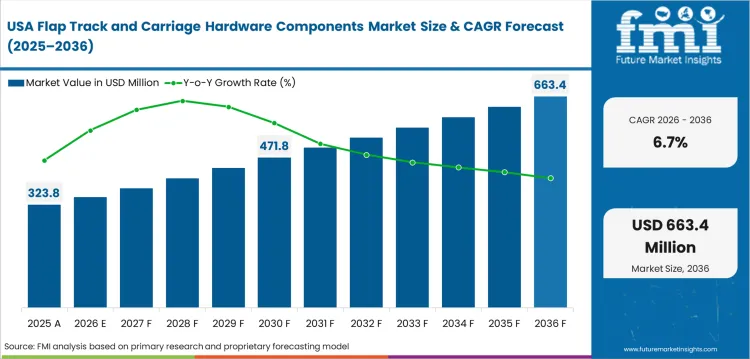
Sector in the United States is forecast to grow at 6.7% CAGR by 2036, supported by airframe programs and a deep repair network. Bureau of Transportation Statistics reported 65.4 million domestic scheduled passengers in November 2025. Domestic utilization keeps narrowbody fleets active across short and medium routes. Frequent cycles keep carriage rollers and wear plates in normal maintenance planning.
- Airframe suppliers benefit from strong engineering support and strict approval systems for flight-critical parts.
- MRO providers need replacement hardware fitting aircraft records and return-to-service checks.
- Distributor channels help airlines reduce wait time for approved carriage assemblies and attachment fittings.
Industry Outlook for Flap Track and Carriage Hardware Components in France
Aircraft production links make France an important market for flap track and carriage hardware. France’s transport statistics service reported 182.9 million airport passengers in 2025 across French airports. Industry in France is expected to rise at 6.1% CAGR by 2036 as air traffic and Airbus-centered supply work support certified hardware demand. Wing program exposure gives French suppliers a clear route into OEM and repair planning.
- Aircraft assembly links raise the value of suppliers that can pass program audits and delivery checks.
- Maintenance demand stays tied to commercial routes and aircraft returning to service after scheduled work.
- High-lift hardware suppliers benefit when production control and repair documentation move together.
Sales Analysis of Flap Track and Carriage Hardware Components in Germany
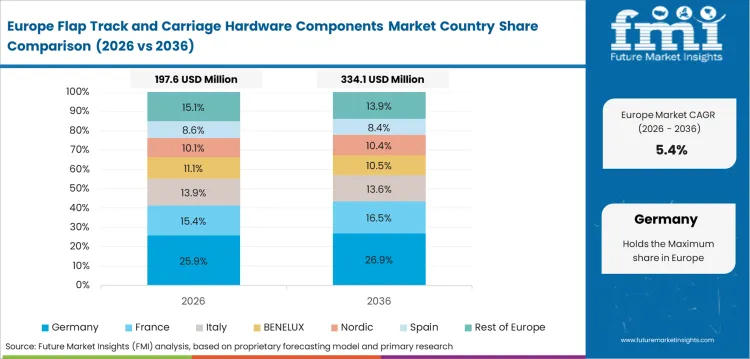
Sales in Germany are projected to grow at 5.8% CAGR by 2036 through precision machining and strong European airframe maintenance work. German Federal Statistical Office recorded 84.0 million air passengers subject to aviation tax in 2025. Passenger activity supports airframe checks and replacement needs across commercial operators. German suppliers remain important when tight tolerances and documented part histories decide supplier approval.
- Precision machining capability supports flap track surfaces requiring close fit and repeatable movement.
- European repair networks value approved hardware that can pass airline and regulator review.
- Aerospace manufacturing skill keeps Germany important for fittings and wear components tied to certified assemblies.
Sales Outlook for Flap Track and Carriage Hardware Components in Japan
Sales in Japan are forecast at 5.3% CAGR by 2036 since safety discipline and aircraft inspection quality maintain a steady replacement demand. Japan Transport Safety Board reported 19 aircraft accident investigations and 16 serious incident investigations newly launched in 2024. Safety review activity supports a culture of careful maintenance checks. Suppliers serving Japan need dependable records and parts meeting strict airline inspection expectations.
- Airline maintenance culture favors hardware with clear traceability and stable performance records.
- Aircraft inspection discipline supports replacement of worn rollers and attachment fittings before service risk rises.
- High-quality repair work keeps demand focused on approved carriage assemblies instead of generic metal parts.
Demand Outlook for Flap Track and Carriage Hardware Components in the United Kingdom
Demand in the United Kingdom is expected to post 5.0% CAGR by 2036, led by passenger traffic and wing component work. United Kingdom Civil Aviation Authority said airports handled 302.0 million passengers in 2025. High traffic keeps aircraft utilization strong and supports airframe repair needs. Wing component activity around the United Kingdom gives suppliers a route into flap track and carriage hardware programs.
- Wing manufacturing history supports supplier skill in machined parts and high-lift hardware fit.
- MRO shops need approved replacement items reducing aircraft downtime during scheduled checks.
- Airline traffic supports steady demand for track wear plates and carriage overhaul kits.
Competitive Landscape and Strategic Positioning
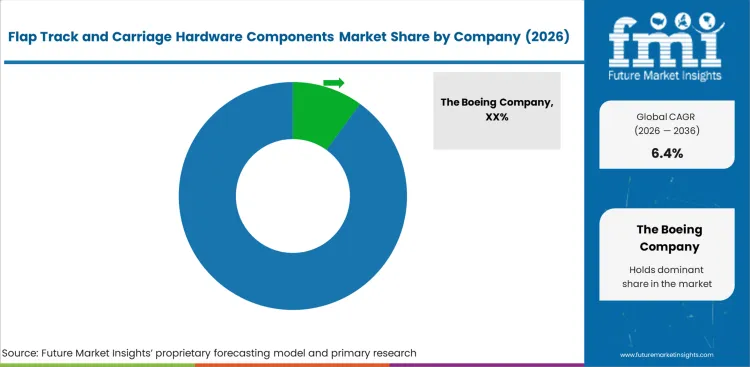
- High-lift hardware specialists hold an advantage based on fatigue proof and reliable carriage assembly fit.
- Integrated airframe groups compete by controlling wing component work and supplier approval routes.
- Aftermarket suppliers gain attention when they cut lead time for approved repair kits and replacement rollers.
- Certified parts distributors strengthen positioning by combining documentation support with faster access to carriage assemblies during maintenance checks.
Competition is led by airframe-linked work-package owners and aerospace hardware specialists. Boeing and Airbus Atlantic carry program influence through wing structures and supply-chain control. Collins Aerospace and Liebherr-Aerospace bring flight-control and actuation depth supporting high-lift system work. Sonaca, FACC and GKN Aerospace add aerostructure skill and repair capability. Demand near flap rudder systems and aircraft actuator work supports suppliers with strong system knowledge. Suppliers are expected to improve their position by proving fit accuracy and fatigue life before pricing enters the final discussion.
Supplier selection is shaped by proof before quoted price. Buyers need evidence that a track or carriage assembly can carry load and pass aircraft documentation checks. Adjacent areas such as aircraft pylon and strut fairing retrofit kits and aircraft nose and belly fairing systems influence aftermarket expectations around repair kits. Suppliers with certified test data and clear delivery visibility are better placed to acquire OEM and airline accounts. Practical engineering support further strengthens their position as aircraft operators protect turnaround time.
Key Companies in the Flap Track and Carriage Hardware Components Market
- Competitive structure is grouped by integrated airframers, high-lift system suppliers and aerostructure specialists.
- Integrated Airframe Groups: The Boeing Company and Airbus Atlantic support wing work packages and platform-level supplier control.
- High-Lift System Suppliers: Collins Aerospace and Liebherr-Aerospace support flight-control hardware and actuation-linked assemblies.
Aerostructure Specialists: Sonaca Group and FACC AG support flap and fairing capabilities across aircraft programs. GKN Aerospace supports repair capabilities across adjacent aerospace work.
Competitive Benchmarking: Flap Track and Carriage Hardware Components Market
| Company | Track Machining Depth | Carriage Assembly Skill | Certification Support | Program Reach |
|---|---|---|---|---|
| The Boeing Company | Very Strong | Strong | Very Strong | Global |
| Airbus Atlantic | Strong | Strong | Very Strong | Global |
| Collins Aerospace | Strong | Very Strong | Very Strong | Global |
| Liebherr-Aerospace | Strong | Very Strong | Strong | Global |
| Sonaca Group | Strong | Moderate | Strong | Europe |
| FACC AG | Moderate | Strong | Strong | Global |
| GKN Aerospace | Strong | Moderate | Strong | Global |
Source: Future Market Insights competitive analysis, 2026.
Key Developments in Flap Track and Carriage Hardware Components Market
- In February 2025, Boeing published a patent application for flap support systems and methods for a wing of an aircraft and carrier beam arrangement.
- In April 2025, Airbus signed a definitive agreement with Spirit AeroSystems and said it would acquire A320 and A350 wing component production in Prestwick.
- In February 2026, Sonaca reported that A321 inboard flap industrialization was progressing through new plant and machining equipment linked to flap skin production.
Key Players in the Flap Track and Carriage Hardware Components Market
- The Boeing Company
- Airbus Atlantic
- Collins Aerospace
- Liebherr-Aerospace
- Sonaca Group
- FACC AG
- GKN Aerospace
Market Report Scope
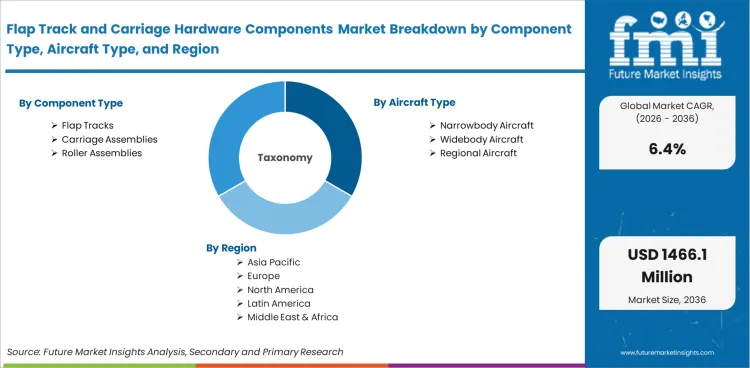
| Parameter | Details |
|---|---|
| Quantitative Units | USD 788.4 million in 2026 and USD 1,466.1 million by 2036 at 6.4% CAGR |
| Market Definition | Certified flap track, carriage, roller, fitting and wear hardware used in aircraft high-lift assemblies |
| By Component Type | Flap Tracks, Carriage Assemblies, Roller Assemblies, Attachment Fittings, Wear Plates |
| By Aircraft Type | Narrowbody Aircraft, Widebody Aircraft, Regional Aircraft, Business Jets, Military Aircraft |
| By Material Type | Titanium Alloys, Aluminum Alloys, High-Strength Steel, Composite Inserts |
| By Sales Channel | OEM Fitment, Aftermarket Replacement, MRO Kits, Distributor Sales |
| By End User | Commercial Aviation, Business Aviation, Defense Aviation, Cargo Operators |
| Regions Covered | North America, Latin America, Europe, East Asia, South Asia and Pacific, Middle East and Africa |
| Countries Covered | India, China, United States, France, Germany, Japan, United Kingdom |
| Key Companies Profiled | The Boeing Company, Airbus Atlantic, Collins Aerospace, Liebherr-Aerospace, Sonaca Group, FACC AG, GKN Aerospace |
| Forecast Period | 2026 to 2036 |
| Approach | Hybrid top-down and bottom-up sizing with aircraft production and repair checks |
Source: Future Market Insights, 2026.
Flap Track and Carriage Hardware Components Market Breakdown by Component Type, Aircraft Type, Material Type, Sales Channel, End User, and Region
By Component Type
- Flap Tracks
- Carriage Assemblies
- Roller Assemblies
- Attachment Fittings
- Wear Plates
By Aircraft Type
- Narrowbody Aircraft
- Widebody Aircraft
- Regional Aircraft
- Business Jets
- Military Aircraft
By Material Type
- Titanium Alloys
- Aluminum Alloys
- High-Strength Steel
- Composite Inserts
By Sales Channel
- OEM Fitment
- Aftermarket Replacement
- MRO Kits
- Distributor Sales
By End User
- Commercial Aviation
- Business Aviation
- Defense Aviation
- Cargo Operators
By Region
- North America
- Latin America
- Europe
- East Asia
- South Asia and Pacific
- Middle East and Africa
Research Sources and Bibliography
- The Boeing Company. (2025, February 6). Flap support systems and methods for a wing of an aircraft (U.S. Patent Application Publication No. US20250042535A1). Google Patents.
- The Boeing Company. (2025, August 6). Flap assemblies with failsafe jam-resistant flap tracks (European Patent No. EP4249372B1). Google Patents.
- RBC Bearings Incorporated. (2025, May 16). Form 10-K for the fiscal year ended March 29, 2025. U.S. Securities and Exchange Commission.
- Satair. (2025). Pricing policy recertification: Tools & GSE.
- European Union Aviation Safety Agency. (2026, February 26). AD 2026-0030: Wings - movable flap track fairings 2 and 5 / forward attachments - inspection.
- International Air Transport Association. (2026, January 29). Strong 2025 passenger demand masks ongoing capacity constraints.
- Airbus. (2026, February 19). Airbus reports full-year (FY) 2025 results.
- The Boeing Company. (2026, January 30). Form 10-K for the fiscal year ended December 31, 2025. U.S. Securities and Exchange Commission.
- Federal Aviation Administration. (2025). FAA aerospace forecast fiscal years 2025-2045. U.S. Department of Transportation.
- Airbus. (2025, October 9). Airbus projects resilient growth of services market in the next 20 years.
- Federal Aviation Administration. (2025, September 25). Order 8120.18A: Production approval holders (PAH) who rebuild or alter their own products or articles under 14 CFR 43.3(j). U.S. Department of Transportation.
- Airbus. (2025, April 28). Airbus signs definitive agreement with Spirit AeroSystems.
- Civil Aviation Administration of China. (2026, April 22). CAAC releases Statistical Bulletin of Civil Aviation Industry Development in 2025.
- Federal Aviation Administration. (2026, January 30). Order 8130.2L: Airworthiness certification of aircraft. U.S. Department of Transportation.
- German Federal Statistical Office. (2026, April 1). 2.1 billion euros of aviation tax declared in 2025 for roughly 84 million air passengers.
- Japan Transport Safety Board. (2025, March). Annual report 2025: Chapter 3 aircraft accident and serious incident investigations.
- Ministry of Civil Aviation, Government of India. (2026, May 27). Domestic traffic dashboard.
- Sonaca Group. (2026, February). Annual report 2024.
- Civil Aviation Authority. (2026, February 24). UK aviation officially breaks records with over 300m passenger journeys in 2025.
- FACC AG. (2025, May). Annual report 2024.
- The Boeing Company. (2025, February 6). Flap support systems and methods for a wing of an aircraft (U.S. Patent Application Publication No. US20250042535A1). Google Patents.
Bibliography uses official government, public body association and company sources.
This Report Answers
- What is the current and forecast value of the flap track and carriage hardware components market?
- Which end user is projected to hold a leading share in 2026?
- How do aircraft cycles shape replacement demand for flap track and carriage hardware?
- Which countries lead in the market for flap track and carriage hardware components?
- How do certification proof and machining tolerance affect supplier positioning?
- Which companies compete in flap track and carriage hardware components?
Frequently Asked Questions
What is the flap track and carriage hardware components market value in 2026?
The flap track and carriage hardware components market value is estimated at USD 788.4 million in 2026 and reach USD 1,466.1 million by 2036.
What CAGR is projected for the flap track and carriage hardware components market?
The flap track and carriage hardware components industry is projected to expand at 6.4% CAGR from 2026 to 2036 as aircraft production and repair needs rise.
Which end user leads the flap track and carriage hardware components market?
Commercial aviation is projected to account for 61.4% share in 2026 due to high fleet use and frequent maintenance checks.
Which sales channel is important for the flap track and carriage hardware components market?
OEM fitment is forecast to hold 57.2% share in 2026, reflected by aircraft programs qualifying hardware before final aircraft delivery.
Which country leads the flap track and carriage hardware components market?
India is projected to record 8.9% CAGR by 2036 as airline capacity and domestic maintenance needs continue rising.
Who are key players in the flap track and carriage hardware components market?
Boeing and Airbus Atlantic are active players. Collins Aerospace and Liebherr-Aerospace compete with Sonaca, FACC and GKN Aerospace through certified hardware skill.
Preview the report firsthand - request a free sample
Get SampleGet the brochure for pricing and purchase details.
Get PDFTable of Content
- Executive Summary
- Global Market Outlook
- Demand-side Trends
- Supply-side Trends
- Technology Roadmap Analysis
- Analysis and Recommendations
- Market Overview
- Market Coverage / Taxonomy
- Market Definition / Scope / Limitations
- Research Methodology
- Chapter Orientation
- Analytical Lens and Working Hypotheses
- Market Structure, Signals, and Trend Drivers
- Benchmarking and Cross-market Comparability
- Market Sizing, Forecasting, and Opportunity Mapping
- Research Design and Evidence Framework
- Desk Research Programme (Secondary Evidence)
- Company Annual and Sustainability Reports
- Peer-reviewed Journals and Academic Literature
- Corporate Websites, Product Literature, and Technical Notes
- Earnings Decks and Investor Briefings
- Statutory Filings and Regulatory Disclosures
- Technical White Papers and Standards Notes
- Trade Journals, Industry Magazines, and Analyst Briefs
- Conference Proceedings, Webinars, and Seminar Materials
- Government Statistics Portals and Public Data Releases
- Press Releases and Reputable Media Coverage
- Specialist Newsletters and Curated Briefings
- Sector Databases and Reference Repositories
- FMI Internal Proprietary Databases and Historical Market Datasets
- Subscription Datasets and Paid Sources
- Social Channels, Communities, and Digital Listening Inputs
- Additional Desk Sources
- Expert Input and Fieldwork (Primary Evidence)
- Primary Modes
- Qualitative Interviews and Expert Elicitation
- Quantitative Surveys and Structured Data Capture
- Blended Approach
- Why Primary Evidence is Used
- Field Techniques
- Interviews
- Surveys
- Focus Groups
- Observational and In-context Research
- Social and Community Interactions
- Stakeholder Universe Engaged
- C-suite Leaders
- Board Members
- Presidents and Vice Presidents
- R&D and Innovation Heads
- Technical Specialists
- Domain Subject-matter Experts
- Scientists
- Physicians and Other Healthcare Professionals
- Governance, Ethics, and Data Stewardship
- Research Ethics
- Data Integrity and Handling
- Primary Modes
- Tooling, Models, and Reference Databases
- Desk Research Programme (Secondary Evidence)
- Data Engineering and Model Build
- Data Acquisition and Ingestion
- Cleaning, Normalisation, and Verification
- Synthesis, Triangulation, and Analysis
- Quality Assurance and Audit Trail
- Market Background
- Market Dynamics
- Drivers
- Restraints
- Opportunity
- Trends
- Scenario Forecast
- Demand in Optimistic Scenario
- Demand in Likely Scenario
- Demand in Conservative Scenario
- Opportunity Map Analysis
- Product Life Cycle Analysis
- Supply Chain Analysis
- Investment Feasibility Matrix
- Value Chain Analysis
- PESTLE and Porter’s Analysis
- Regulatory Landscape
- Regional Parent Market Outlook
- Production and Consumption Statistics
- Import and Export Statistics
- Market Dynamics
- Global Market Analysis 2021 to 2025 and Forecast, 2026 to 2036
- Historical Market Size Value (USD Million) Analysis, 2021 to 2025
- Current and Future Market Size Value (USD Million) Projections, 2026 to 2036
- Y-o-Y Growth Trend Analysis
- Absolute $ Opportunity Analysis
- Global Market Pricing Analysis 2021 to 2025 and Forecast 2026 to 2036
- Global Market Analysis 2021 to 2025 and Forecast 2026 to 2036, By Component Type
- Introduction / Key Findings
- Historical Market Size Value (USD Million) Analysis By Component Type , 2021 to 2025
- Current and Future Market Size Value (USD Million) Analysis and Forecast By Component Type , 2026 to 2036
- Flap Tracks
- Carriage Assemblies
- Roller Assemblies
- Flap Tracks
- Y-o-Y Growth Trend Analysis By Component Type , 2021 to 2025
- Absolute $ Opportunity Analysis By Component Type , 2026 to 2036
- Global Market Analysis 2021 to 2025 and Forecast 2026 to 2036, By Aircraft Type
- Introduction / Key Findings
- Historical Market Size Value (USD Million) Analysis By Aircraft Type, 2021 to 2025
- Current and Future Market Size Value (USD Million) Analysis and Forecast By Aircraft Type, 2026 to 2036
- Narrowbody Aircraft
- Widebody Aircraft
- Regional Aircraft
- Narrowbody Aircraft
- Y-o-Y Growth Trend Analysis By Aircraft Type, 2021 to 2025
- Absolute $ Opportunity Analysis By Aircraft Type, 2026 to 2036
- Global Market Analysis 2021 to 2025 and Forecast 2026 to 2036, By Material Type
- Introduction / Key Findings
- Historical Market Size Value (USD Million) Analysis By Material Type, 2021 to 2025
- Current and Future Market Size Value (USD Million) Analysis and Forecast By Material Type, 2026 to 2036
- Titanium Alloys
- Aluminum Alloys
- High-Strength Steel
- Titanium Alloys
- Y-o-Y Growth Trend Analysis By Material Type, 2021 to 2025
- Absolute $ Opportunity Analysis By Material Type, 2026 to 2036
- Global Market Analysis 2021 to 2025 and Forecast 2026 to 2036, By Sales Channel
- Introduction / Key Findings
- Historical Market Size Value (USD Million) Analysis By Sales Channel, 2021 to 2025
- Current and Future Market Size Value (USD Million) Analysis and Forecast By Sales Channel, 2026 to 2036
- OEM Fitment
- Aftermarket Replacement
- MRO Kits
- OEM Fitment
- Y-o-Y Growth Trend Analysis By Sales Channel, 2021 to 2025
- Absolute $ Opportunity Analysis By Sales Channel, 2026 to 2036
- Global Market Analysis 2021 to 2025 and Forecast 2026 to 2036, By End User
- Introduction / Key Findings
- Historical Market Size Value (USD Million) Analysis By End User, 2021 to 2025
- Current and Future Market Size Value (USD Million) Analysis and Forecast By End User, 2026 to 2036
- Commercial Aviation
- Business Aviation
- Defense Aviation
- Commercial Aviation
- Y-o-Y Growth Trend Analysis By End User, 2021 to 2025
- Absolute $ Opportunity Analysis By End User, 2026 to 2036
- Global Market Analysis 2021 to 2025 and Forecast 2026 to 2036, By Region
- Introduction
- Historical Market Size Value (USD Million) Analysis By Region, 2021 to 2025
- Current Market Size Value (USD Million) Analysis and Forecast By Region, 2026 to 2036
- North America
- Latin America
- Western Europe
- Eastern Europe
- East Asia
- South Asia and Pacific
- Middle East & Africa
- Market Attractiveness Analysis By Region
- North America Market Analysis 2021 to 2025 and Forecast 2026 to 2036, By Country
- Historical Market Size Value (USD Million) Trend Analysis By Market Taxonomy, 2021 to 2025
- Market Size Value (USD Million) Forecast By Market Taxonomy, 2026 to 2036
- By Country
- USA
- Canada
- Mexico
- By Component Type
- By Aircraft Type
- By Material Type
- By Sales Channel
- By End User
- By Country
- Market Attractiveness Analysis
- By Country
- By Component Type
- By Aircraft Type
- By Material Type
- By Sales Channel
- By End User
- Key Takeaways
- Latin America Market Analysis 2021 to 2025 and Forecast 2026 to 2036, By Country
- Historical Market Size Value (USD Million) Trend Analysis By Market Taxonomy, 2021 to 2025
- Market Size Value (USD Million) Forecast By Market Taxonomy, 2026 to 2036
- By Country
- Brazil
- Chile
- Rest of Latin America
- By Component Type
- By Aircraft Type
- By Material Type
- By Sales Channel
- By End User
- By Country
- Market Attractiveness Analysis
- By Country
- By Component Type
- By Aircraft Type
- By Material Type
- By Sales Channel
- By End User
- Key Takeaways
- Western Europe Market Analysis 2021 to 2025 and Forecast 2026 to 2036, By Country
- Historical Market Size Value (USD Million) Trend Analysis By Market Taxonomy, 2021 to 2025
- Market Size Value (USD Million) Forecast By Market Taxonomy, 2026 to 2036
- By Country
- Germany
- UK
- Italy
- Spain
- France
- Nordic
- BENELUX
- Rest of Western Europe
- By Component Type
- By Aircraft Type
- By Material Type
- By Sales Channel
- By End User
- By Country
- Market Attractiveness Analysis
- By Country
- By Component Type
- By Aircraft Type
- By Material Type
- By Sales Channel
- By End User
- Key Takeaways
- Eastern Europe Market Analysis 2021 to 2025 and Forecast 2026 to 2036, By Country
- Historical Market Size Value (USD Million) Trend Analysis By Market Taxonomy, 2021 to 2025
- Market Size Value (USD Million) Forecast By Market Taxonomy, 2026 to 2036
- By Country
- Russia
- Poland
- Hungary
- Balkan & Baltic
- Rest of Eastern Europe
- By Component Type
- By Aircraft Type
- By Material Type
- By Sales Channel
- By End User
- By Country
- Market Attractiveness Analysis
- By Country
- By Component Type
- By Aircraft Type
- By Material Type
- By Sales Channel
- By End User
- Key Takeaways
- East Asia Market Analysis 2021 to 2025 and Forecast 2026 to 2036, By Country
- Historical Market Size Value (USD Million) Trend Analysis By Market Taxonomy, 2021 to 2025
- Market Size Value (USD Million) Forecast By Market Taxonomy, 2026 to 2036
- By Country
- China
- Japan
- South Korea
- By Component Type
- By Aircraft Type
- By Material Type
- By Sales Channel
- By End User
- By Country
- Market Attractiveness Analysis
- By Country
- By Component Type
- By Aircraft Type
- By Material Type
- By Sales Channel
- By End User
- Key Takeaways
- South Asia and Pacific Market Analysis 2021 to 2025 and Forecast 2026 to 2036, By Country
- Historical Market Size Value (USD Million) Trend Analysis By Market Taxonomy, 2021 to 2025
- Market Size Value (USD Million) Forecast By Market Taxonomy, 2026 to 2036
- By Country
- India
- ASEAN
- Australia & New Zealand
- Rest of South Asia and Pacific
- By Component Type
- By Aircraft Type
- By Material Type
- By Sales Channel
- By End User
- By Country
- Market Attractiveness Analysis
- By Country
- By Component Type
- By Aircraft Type
- By Material Type
- By Sales Channel
- By End User
- Key Takeaways
- Middle East & Africa Market Analysis 2021 to 2025 and Forecast 2026 to 2036, By Country
- Historical Market Size Value (USD Million) Trend Analysis By Market Taxonomy, 2021 to 2025
- Market Size Value (USD Million) Forecast By Market Taxonomy, 2026 to 2036
- By Country
- Kingdom of Saudi Arabia
- Other GCC Countries
- Turkiye
- South Africa
- Other African Union
- Rest of Middle East & Africa
- By Component Type
- By Aircraft Type
- By Material Type
- By Sales Channel
- By End User
- By Country
- Market Attractiveness Analysis
- By Country
- By Component Type
- By Aircraft Type
- By Material Type
- By Sales Channel
- By End User
- Key Takeaways
- Key Countries Market Analysis
- USA
- Pricing Analysis
- Market Share Analysis, 2025
- By Component Type
- By Aircraft Type
- By Material Type
- By Sales Channel
- By End User
- Canada
- Pricing Analysis
- Market Share Analysis, 2025
- By Component Type
- By Aircraft Type
- By Material Type
- By Sales Channel
- By End User
- Mexico
- Pricing Analysis
- Market Share Analysis, 2025
- By Component Type
- By Aircraft Type
- By Material Type
- By Sales Channel
- By End User
- Brazil
- Pricing Analysis
- Market Share Analysis, 2025
- By Component Type
- By Aircraft Type
- By Material Type
- By Sales Channel
- By End User
- Chile
- Pricing Analysis
- Market Share Analysis, 2025
- By Component Type
- By Aircraft Type
- By Material Type
- By Sales Channel
- By End User
- Germany
- Pricing Analysis
- Market Share Analysis, 2025
- By Component Type
- By Aircraft Type
- By Material Type
- By Sales Channel
- By End User
- UK
- Pricing Analysis
- Market Share Analysis, 2025
- By Component Type
- By Aircraft Type
- By Material Type
- By Sales Channel
- By End User
- Italy
- Pricing Analysis
- Market Share Analysis, 2025
- By Component Type
- By Aircraft Type
- By Material Type
- By Sales Channel
- By End User
- Spain
- Pricing Analysis
- Market Share Analysis, 2025
- By Component Type
- By Aircraft Type
- By Material Type
- By Sales Channel
- By End User
- France
- Pricing Analysis
- Market Share Analysis, 2025
- By Component Type
- By Aircraft Type
- By Material Type
- By Sales Channel
- By End User
- India
- Pricing Analysis
- Market Share Analysis, 2025
- By Component Type
- By Aircraft Type
- By Material Type
- By Sales Channel
- By End User
- ASEAN
- Pricing Analysis
- Market Share Analysis, 2025
- By Component Type
- By Aircraft Type
- By Material Type
- By Sales Channel
- By End User
- Australia & New Zealand
- Pricing Analysis
- Market Share Analysis, 2025
- By Component Type
- By Aircraft Type
- By Material Type
- By Sales Channel
- By End User
- China
- Pricing Analysis
- Market Share Analysis, 2025
- By Component Type
- By Aircraft Type
- By Material Type
- By Sales Channel
- By End User
- Japan
- Pricing Analysis
- Market Share Analysis, 2025
- By Component Type
- By Aircraft Type
- By Material Type
- By Sales Channel
- By End User
- South Korea
- Pricing Analysis
- Market Share Analysis, 2025
- By Component Type
- By Aircraft Type
- By Material Type
- By Sales Channel
- By End User
- Russia
- Pricing Analysis
- Market Share Analysis, 2025
- By Component Type
- By Aircraft Type
- By Material Type
- By Sales Channel
- By End User
- Poland
- Pricing Analysis
- Market Share Analysis, 2025
- By Component Type
- By Aircraft Type
- By Material Type
- By Sales Channel
- By End User
- Hungary
- Pricing Analysis
- Market Share Analysis, 2025
- By Component Type
- By Aircraft Type
- By Material Type
- By Sales Channel
- By End User
- Kingdom of Saudi Arabia
- Pricing Analysis
- Market Share Analysis, 2025
- By Component Type
- By Aircraft Type
- By Material Type
- By Sales Channel
- By End User
- Turkiye
- Pricing Analysis
- Market Share Analysis, 2025
- By Component Type
- By Aircraft Type
- By Material Type
- By Sales Channel
- By End User
- South Africa
- Pricing Analysis
- Market Share Analysis, 2025
- By Component Type
- By Aircraft Type
- By Material Type
- By Sales Channel
- By End User
- USA
- Market Structure Analysis
- Competition Dashboard
- Competition Benchmarking
- Market Share Analysis of Top Players
- By Regional
- By Component Type
- By Aircraft Type
- By Material Type
- By Sales Channel
- By End User
- Competition Analysis
- Competition Deep Dive
- The Boeing Company
- Overview
- Product Portfolio
- Profitability by Market Segments (Product/Age /Sales Channel/Region)
- Sales Footprint
- Strategy Overview
- Marketing Strategy
- Product Strategy
- Channel Strategy
- Airbus Atlantic
- Collins Aerospace
- Liebherr-Aerospace
- Sonaca Group
- FACC AG
- The Boeing Company
- Competition Deep Dive
- Assumptions & Acronyms Used


