

- Market Size (2026)
- USD 3.7 Bn
- Forecast (2036)
- USD 6.1 Bn
- CAGR (2026 to 2036)
- 5.0%
How Big is the Aircraft Seat Tracks Market in 2026?
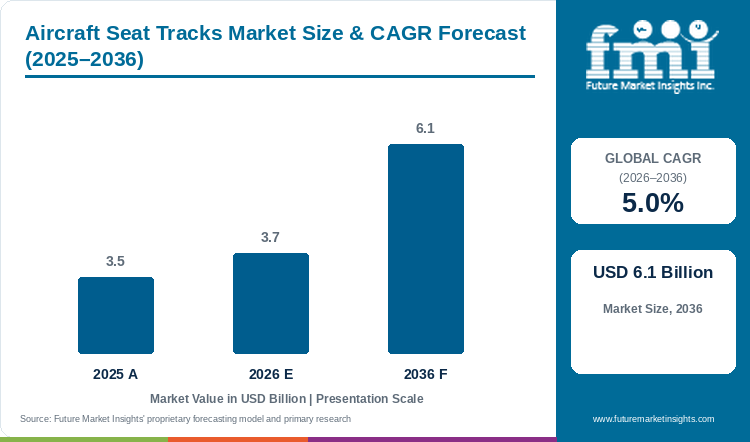
The aircraft seat tracks market size is USD 3.7 Billion in 2026, up from USD 3.5 Billion in 2025, and is projected to reach USD 6.1 Billion by 2036 at 5% CAGR.
Aircraft seat tracks form a USD 3.7 Billion market in 2026, according to FMI, set to reach USD 6.1 Billion by 2036 at 5% CAGR. The market size chart plots USD 2.4 Billion of added value over the decade on a 2025 base of USD 3.5 Billion. Narrow-body aircraft take 42% of demand by aircraft type in 2026, and aircraft OEMs buy 45% of tracks by sales channel.
Innovation is reaching seat tracks from two directions, the assembly line and the cabin. Airbus certified the CabinMarker robot in December 2025 to mark and position seat tracks, completing in 30 minutes a task that takes human operators 150 minutes, with the first two units due at the A321 line in Toulouse in late 2026 [1]. Faster track installation supports the single-aisle rate increases that carry most new shipsets. Lighter seats are adding retrofit work in the cabin, as Mirus secured an easyJet order for the Kestrel seat across 237 A320neo and A321neo aircraft, shown at Aircraft Interiors Expo 2026 [2]. Automated installation on new aircraft and lighter seats on existing floors are expected to raise track orders from both line-fit and retrofit programs through 2036.
Key Takeaways
- Leading companies in the aircraft seat tracks market include Ancra Aircraft, Safran Seats, Collins Aerospace, Diehl Aviation, Jamco, SCHROTH Safety Products and Triumph Group.
- Standard seat tracks will hold 37% of demand by track type in 2026. One rail and stud geometry serves most seat suppliers across fleets.
- With 58% of demand by material in 2026, aluminum remains the default floor rail choice for low mass and easy machining.
- Mexico is set for the fastest growth at 6% CAGR through 2036, with Brazil next at 5.7%, as regional aerospace plants add local orders for cabin hardware.
Analyst Perspective
“Automation such as the Airbus CabinMarker robot will shorten track installation on single-aisle lines, and lighter seat platforms will bring more retrofit interfaces to existing floors. Suppliers able to serve both streams from one approved rail design will hold the strongest position, with narrow-body aircraft already taking 42% of demand in 2026.”
- Nikhil Kaitwade, Principal Consultant, Future Market Insights
How is the Aircraft Seat Tracks Market Segmented?
The aircraft seat tracks market is divided into track type, material, aircraft type, sales channel, application and region.
Track types in the study range from standard seat tracks and heavy-duty cargo and seat tracks to quick-release tracks, lightweight aluminum tracks and custom cabin tracks. As per FMI, material coverage spans aluminum, titanium, stainless steel and hybrid lightweight alloy. Narrow-body, wide-body, regional, business and military aircraft make up the aircraft type split. Buyers are tracked across aircraft OEMs, cabin interior suppliers, MRO and retrofit, and defense programs, and applications cover passenger seating, crew seating, cargo restraint and convertible cabin layouts. Seven regions and more than 30 countries form the regional scope.
Why Do Standard Seat Tracks Lead the Aircraft Seat Tracks Market by Track Type?
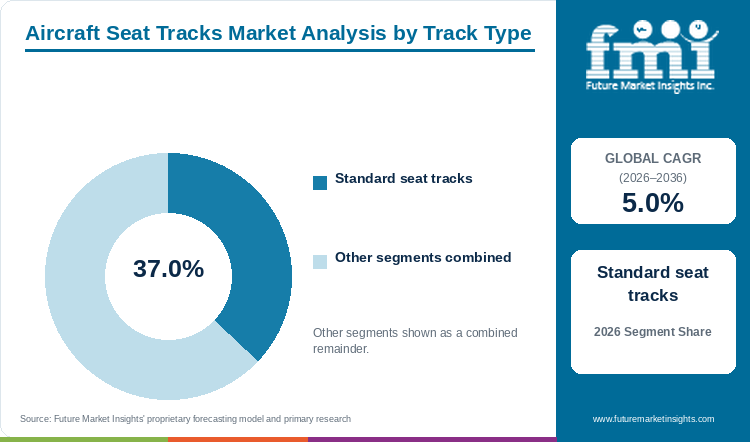
In 2026, standard seat tracks will account for 37% of market share by track type.
Standard seat tracks lead the track type category with 37% of demand in 2026, as one rail and stud pattern lets airlines move seats between aircraft with few special parts. Quick-release, heavy-duty cargo, lightweight aluminum and custom cabin tracks serve frequent layout changes, freighters, new floor sections and VIP aircraft in smaller lots.
- Airlines move seats between aircraft with fewer special parts when floors share the common rail pattern.
- ALOFT AeroArchitects announced a 737 retrofit supplemental type certificate program at Aircraft Interiors Expo 2026, supporting more modular cabin upgrades [2].
Why Does Aluminum Lead the Aircraft Seat Tracks Market by Material?
Aluminum makes up 58% of market share by material in 2026.
Aluminum holds 58% of demand by material in 2026, as OEMs keep aluminum as the standard rail material on most programs. Titanium, stainless steel and hybrid lightweight alloys are bought for high-load, corrosion-prone and wear zones, and higher raw material and machining costs keep these grades at smaller volumes.
- Galley and lavatory zones with corrosion risk are expected to add titanium sections on new floors through 2036.
- In April 2026, Constellium signed a multi-year agreement to supply Airbus with aluminium alloy extrusions, including Airware aluminium-lithium, from Issoire and Montreuil-Juigné in France [3].
Why Do Narrow-body Aircraft Lead the Aircraft Seat Tracks Market by Aircraft Type?
By aircraft type, narrow-body aircraft lead with 42% of market share in 2026.
Narrow-body aircraft are expected to take 42% of demand by aircraft type in 2026, as Airbus expects airlines to need 42,060 new aircraft through 2045, with 81% of that requirement in single-aisle models [4]. Wide-body, regional, business and military aircraft order fewer shipsets, as lower build rates, smaller fleets and defense budgets keep each program smaller.
- A320 and 737 family jets are built at the highest monthly rates, so track suppliers ship more identical sets for these programs.
- In April 2026, Collins Aerospace secured three airline launch customers for the Helix main cabin seat across nearly 200 A320 and 737 family aircraft [5].
Why Do Aircraft OEMs Lead the Aircraft Seat Tracks Market by Sales Channel?
Aircraft OEMs are projected to buy 45% of seat tracks by sales channel in 2026.
Aircraft OEMs buy 45% of seat tracks by sales channel in 2026, since floor rails are fitted and certified with the airframe before delivery. MRO and retrofit work is the second route, and orders there follow airline cabin refresh cycles, with cabin interior suppliers and defense programs buying in smaller lots and on longer timelines.
- OEM procurement teams set the approved specification and delivery schedule for each shipset, giving line-fit suppliers the most stable volume.
- Airbus inaugurated a second A320 family final assembly line in Toulouse in June 2026, completing a network of ten lines across Hamburg, Toulouse, Mobile and Tianjin [6].
Why Does Passenger Seating Lead the Aircraft Seat Tracks Market by Application?
Passenger seating takes 55% of market share by application in 2026.
Every passenger seat row in the main cabin needs an approved floor attachment, which gives passenger seating 55% of demand by application in 2026. Crew seats, cargo restraint and convertible layouts use far fewer track positions per aircraft, so orders in these applications stay small.
- Premium seat pitch changes during retrofits are expected to add new track interfaces on existing wide-body floors.
- In June 2025, ANA and Safran Seats unveiled THE Room FX business class seat for Boeing 787-9 aircraft, with service entry from 2026 [7].
What are the Drivers, Restraints, and Opportunities in the Aircraft Seat Tracks Market?
Higher build rates and cabin refresh programs are increasing demand for aircraft seat tracks, according to FMI. Certification slows supplier changes, and quick-release tracks are set to open new retrofit sales through 2036.
- Driver: Higher Airbus and Boeing build rates and airline cabin refresh programs are increasing line-fit and replacement orders for approved track shipsets together.
- Restraint: Structural testing and aircraft-specific qualification raise the cost and time of changing a track design or supplier.
- Opportunity: Quick-release and multi-use tracks keeping approved rail geometry can support faster cabin changes for airlines and MRO providers.
Production is moving back toward full rates, as Boeing delivered 600 commercial aircraft in 2025, the highest annual total since 2018 [8]. Regional and business aviation add a second stream of track orders, with smaller cabins needing custom track lengths and seat interfaces for each layout. Cabin spending supports both streams, with the aircraft cabin interiors market projected to grow from USD 37.2 Billion in 2026 to USD 52.1 Billion by 2036 and the privacy door-equipped premium cabin seat systems market from USD 0.89 Billion to USD 2.09 Billion over the same period.
Each seat track carries load between the seat and the airframe, which makes certification the hardest step for any new design or supplier. A change in alloy, finish or machining can call for new testing and paperwork, so airlines and OEMs keep approved suppliers for long periods. Retrofit demand in the economy cabin interior refurbishment services market, projected at 5.4% CAGR through 2036, and new alloys from the aerospace lightweight materials market both have to pass the same approval steps.
Which Country CAGRs are Profiled in the Aircraft Seat Tracks Market?
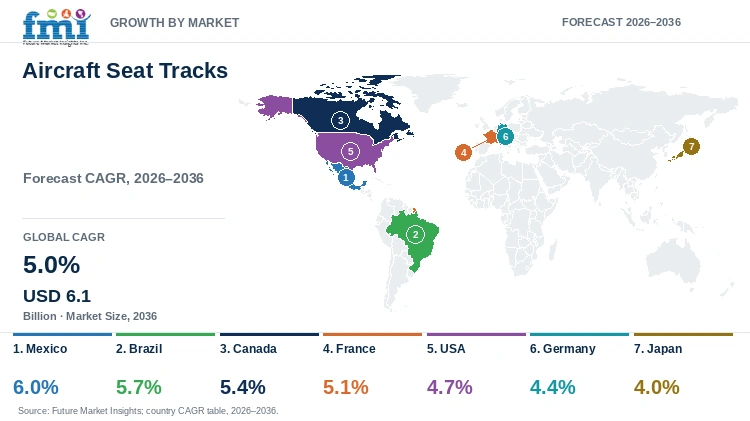
| Country | CAGR, 2026 to 2036 |
|---|---|
| Mexico | 6% |
| Brazil | 5.7% |
| Canada | 5.4% |
| France | 5.1% |
| USA | 4.7% |
| Germany | 4.4% |
| Japan | 4% |
How do Country-level CAGRs Compare in the Aircraft Seat Tracks Market?
FMI places Mexico at the top of the country CAGR chart at 6% and Japan at the bottom at 4% through 2036. Growth across the seven countries falls into three clear bands. Mexico, Brazil and Canada, at 5.4% to 6%, are adding parts plants, Embraer programs and business jet completion work. France, at 5.1%, follows A320 family rate increases in Toulouse, and the USA and Germany, at 4.7% and 4.4%, grow from large production bases. Japan relies on long-haul cabin retrofits and posts the lowest rate. Smaller jets add a separate stream tracked in the crashworthy lightweight regional jet seating systems market, projected at 6.1% CAGR during the forecast period.
- Aerospace parts plants near US assembly lines put Mexico at the top of the group, with 6% CAGR through 2036.
- Brazil is projected to grow at 5.7% CAGR by 2036. Embraer commercial, executive and defense programs each need separate track specifications.
- Business jet completion work will carry Canada to 5.4% CAGR during the forecast period.
- France is expected to grow at 5.1% CAGR through 2036, tracking A320 family rate increases in Toulouse.
- Boeing and Airbus output in the USA will support 4.7% CAGR by 2036, slightly above Germany.
- Hamburg builds customized A321 cabins at high rates, keeping Germany at 4.4% CAGR through 2036.
- Japan will post the lowest rate in the group at 4% CAGR by 2036, guided by airline cabin retrofit schedules on long-haul fleets.
The full report extends CAGR estimates to more than 30 national and grouped markets across seven regions.
Country Outlook
- Safran operates 20 sites with more than 15,000 employees in Mexico, including cabin interior and engine part production [9]. These plants supply US and European programs, so cabin hardware buyers gain a nearby source for line-fit parts, and Mexico is projected at 6% CAGR through 2036, the fastest in the profiled group.
- Embraer delivered 78 commercial jets and 155 executive jets in 2025 [10]. Commercial, executive and defense lines carry different cabin load cases, so Brazilian buyers order several track specifications, and demand in Brazil is set to rise at 5.7% CAGR during the forecast period.
- Completion centers around Canada's aerospace hubs order custom track lengths and premium seat interfaces for each business jet. Small batches keep volume steady, and Canada is projected at 5.4% CAGR by 2036.
- Airbus is ramping the A320 family toward 75 aircraft per month, supported by the second final assembly line opened in Toulouse in June 2026 [6]. Each added line raises the number of shipsets ordered every month, and demand for seat tracks in France is projected to grow at 5.1% CAGR through 2036.
- Boeing ended 2025 with more than 6,100 commercial airplanes in backlog [8]. Boeing output, Airbus assembly in Mobile and a large MRO base give US buyers both line-fit and replacement orders, and the USA is projected at 4.7% CAGR during the forecast period.
- Customized cabins set the pace of track demand in Germany. Hamburg operates four of the ten A320 family final assembly lines in the Airbus network and builds A321 aircraft with varied seat layouts [6]. Germany is projected to grow at 4.4% CAGR by 2036.
- Adoption of new track interfaces in Japan follows long-haul cabin renewals on global platforms. Japanese airlines plan retrofits years ahead, and Japan is projected at 4% CAGR through 2036, the slowest in the group.
Who are the Notable Companies in the Aircraft Seat Tracks Market?
Ancra Aircraft, Safran Seats, Collins Aerospace, Diehl Aviation, Jamco and Triumph Group are among the leading companies profiled by FMI across track hardware, seating and cabin integration.
Seat programs set the direction for new track designs and suppliers. Collins Aerospace signed three launch airlines for the Helix seat across nearly 200 narrow-body aircraft in April 2026, and Safran Seats and ANA unveiled THE Room FX for the Boeing 787-9 in June 2025 [5] [7]. Each new seat family needs approved rail interfaces, and a small group of rail and fitting makers holds most of those approvals, with OEMs checking geometry, material traceability, load ratings and delivery at build rates. Structural testing before the first shipset keeps approved sources in place for years. Premium suites in the next-generation business class suite seat modules market, projected at 8.1% CAGR through 2036, will add interface work. FMI expects delivery capacity at OEM build rates to separate leading track suppliers through 2036.
- Track, Restraint and Floor Interface Specialists: Ancra Aircraft, SCHROTH Safety Products and Triumph Group supply seat tracks, attachment fittings, restraint systems and floor or interior structures.
- Seating System Integrators: Safran Seats, Collins Aerospace, Jamco and Astronics shape track requirements through seat architecture, seat systems and in-seat equipment.
- Cabin and Floor Integration Suppliers: Diehl Aviation, FACC and AIM Altitude supply cabin interiors, floor components and aircraft-specific modification work fitted to rail interfaces.
Competitive Benchmarking
| Company | Direct Track & Fitting Capability | Seat/Floor Integration Depth | Multi-Platform Qualification Reach | Geographic Reach |
|---|---|---|---|---|
| Safran Seats | Low | High | High | Europe, North America, Asia and global airline programs |
| Collins Aerospace | Low | High | High | North America, Europe, Asia-Pacific and global airline support |
| Diehl Aviation | Low | High | High | Europe, Middle East, Americas and global OEM programs |
| Astronics | Low | Medium | High | North America, Europe and global airframe programs |
| Ancra Aircraft | High | Medium | High | United States with global commercial aircraft applications |
| SCHROTH Safety Products | Low | Medium | High | Europe, United States and global aerospace customers |
| Triumph Group | Low | Medium | High | United States, Mexico, Europe and Asia |
| Jamco | Low | High | High | Japan, United States and global aircraft programs |
| FACC | Low | High | High | Europe, North America and global OEM programs |
| AIM Altitude | Low | High | Medium | United Kingdom, Europe and global airline cabin programs |
Scoring basis: Direct Track & Fitting Capability rates documented production of seat rails, track fittings or closely related attachment hardware. Seat/Floor Integration Depth rates documented work on seating, cabin floors or interior architecture connected to track geometry. Multi-Platform Qualification Reach rates documented work across several aircraft families or OEM programs. High reflects broad documented capability, Medium a narrower proven role, and Low limited public documentation or an adjacent role.
Key Developments
- In June 2025, Safran Seats and All Nippon Airways unveiled THE Room FX business class seat for Boeing 787-9 long-haul aircraft, with service entry planned from 2026 [7].
- In April 2026, Collins Aerospace secured three airline launch customers for the Helix main cabin seat across nearly 200 A320 and 737 family aircraft [5].
- In June 2026, Airbus inaugurated a second A320 family final assembly line in Toulouse, completing a global network of ten lines [6].
Key Players
Track, Restraint and Floor Interface Specialists
- Ancra Aircraft
- SCHROTH Safety Products
- Triumph Group
Seating System Integrators
- Safran Seats
- Collins Aerospace
- Jamco
- Astronics
Cabin and Floor Integration Suppliers
- Diehl Aviation
- FACC
- AIM Altitude
Report Scope and Methodology
| Coverage field | Report scope |
|---|---|
| Market breakdown | 5 categories plus region: Track Type (Standard seat tracks, Heavy-duty cargo/seat tracks, Quick-release tracks, Lightweight aluminum tracks, Custom cabin tracks), Material (Aluminum, Titanium, Stainless steel, Hybrid lightweight alloy), Aircraft Type (Narrow-body aircraft, Wide-body aircraft, Regional aircraft, Business jets, Military aircraft), Sales Channel (Aircraft OEMs, Cabin interior suppliers, MRO/retrofit, Defense programs), Application (Passenger seating, Crew seating, Cargo restraint, Convertible cabin layouts), and Region |
| Quantitative units | USD Billion |
| Market definition | Revenue from aircraft seat tracks and track-specific attachment rail products sold for passenger, crew, cargo and convertible cabin applications. The definition excludes finished seats, complete cabin monuments, unrelated floor structures and substitute restraint products. |
| Regions covered | North America, Latin America, Western Europe, Eastern Europe, East Asia, South Asia and Pacific, Middle East and Africa |
| Countries covered | More than 30 countries and country groups, including Mexico, Brazil, Canada, France, the USA, Germany and Japan |
| Key companies profiled | A few of the leading companies out of many players covered in the study: Safran Seats, Collins Aerospace, Diehl Aviation, Astronics, Ancra Aircraft, SCHROTH Safety Products, Triumph Group, Jamco, FACC and AIM Altitude |
| Forecast period | 2026 to 2036 |
| Approach | A hybrid bottom-up and top-down model built by FMI reconciles aircraft production, retrofit activity, demand by application and supplier participation within the defined revenue boundary. |
Research Methodology
| Method | Approach |
|---|---|
| Primary research | Interviews with aircraft OEM sourcing teams, seat and cabin suppliers, track and restraint makers, MRO and retrofit providers, distributors and operators test specification choices, qualification cycles, pricing, replacement triggers and lead times. |
| Desk research | The analysis reviews airworthiness requirements, aircraft production and backlog disclosures, standards, company filings, product documentation and dated company developments relevant to aircraft seat tracks. |
| Market sizing and forecasting | Sizing combines aircraft production and installed fleet activity with track content by application, material and aircraft class. Forecasts consider OEM rate plans, retrofit activity, fleet renewal, cabin reconfiguration and country aerospace capacity. |
| Data validation | Findings are cross-checked across source types and reconciled against the market definition. Finished seat revenue, substitute categories and double counting between OEM, cabin supplier and aftermarket channels are excluded. |
Aircraft Seat Tracks Market by Segments
Aircraft Seat Tracks Market Segmented by Track Type
- Standard seat tracks
- Heavy-duty cargo/seat tracks
- Quick-release tracks
- Lightweight aluminum tracks
- Custom cabin tracks
Aircraft Seat Tracks Market Segmented by Material
- Aluminum
- Titanium
- Stainless steel
- Hybrid lightweight alloy
Aircraft Seat Tracks Market Segmented by Aircraft Type
- Narrow-body aircraft
- Wide-body aircraft
- Regional aircraft
- Business jets
- Military aircraft
Aircraft Seat Tracks Market Segmented by Sales Channel
- Aircraft OEMs
- Cabin interior suppliers
- MRO/retrofit
- Defense programs
Aircraft Seat Tracks Market Segmented by Application
- Passenger seating
- Crew seating
- Cargo restraint
- Convertible cabin layouts
Aircraft Seat Tracks Market Segmented by Region
- North America
- Latin America
- Western Europe
- Eastern Europe
- East Asia
- South Asia and Pacific
- Middle East and Africa
Research Sources and Bibliography
- [1] Aircraft Interiors International (2026, June 4). Airbus invents a robot to help install seat tracks.
- [2] PAX International (2026, May 12). AIX 2026 points to next era of cabin innovation.
- [3] AlCircle (2026, April 21). Constellium secures multi-year Airbus contract for aluminium alloy extrusions supply.
- [4] Engineering News (2026, July 9). Airbus expects a total global demand for 42 000 new airliners over the next 20 years.
- [5] RTX (2026, April 15). RTX's Collins Aerospace secures three airline launch customers for its Helix main cabin seat.
- [6] Airbus (2026, June 15). Airbus inaugurates new A320 Family final assembly line in Toulouse.
- [7] Safran (2025, June 16). All Nippon Airways takes business class to new heights with THE Room FX supersized seats.
- [8] Boeing (2026, January 27). Boeing Reports Fourth Quarter Results.
- [9] Mexico Industry (2026, May 12). Safran cumple 35 años en México: 20 sitios, 15,000 empleos y una operación clave para Airbus y Boeing.
- [10] Embraer (2026, January 12). Embraer reports 91 aircraft delivered in the fourth quarter and surpasses 4Q24 mark to meet 2025 guidance.
This bibliography is provided for reader reference and is not exhaustive. The full report contains the complete reference list and detailed citations.
This Report Answers
- What will the Aircraft Seat Tracks Market size be in 2026, and what value will the market reach by 2036?
- Which aircraft production and cabin refresh trends will support demand for aircraft seat tracks till 2036?
- Why will standard seat tracks hold the leading position within the Track Type category in 2026?
- What role will aluminum, titanium and hybrid alloys play in track weight and production cost?
- Why will narrow-body aircraft, aircraft OEMs and passenger seating anchor demand across the other categories?
- Which growth rates will Mexico, Brazil, Canada, France, the USA, Germany and Japan post till 2036?
- Which certification and load path requirements will slow the adoption of new track designs?
- What will OEM sourcing teams and cabin engineering leaders need to verify before approving a new track supplier?
Frequently Asked Questions
How Big Is the Aircraft Seat Tracks Market Expected to Be in 2026?
Aircraft seat track sales will reach USD 3.7 Billion in 2026, up from USD 3.5 Billion in 2025, as FMI estimates show. Revenue will increase to USD 6.1 Billion by 2036 as Airbus and Boeing raise single-aisle output and airlines refresh cabins.
What Is the CAGR of the Aircraft Seat Tracks Market from 2026 to 2036?
The market will grow at a 5% CAGR from 2026 to 2036. Line-fit orders from new aircraft and replacement tracks for cabin retrofits will both add to sales over the period.
Which Track Type Holds the Largest Share of the Aircraft Seat Tracks Market?
Standard seat tracks will lead with 37% of market share by track type in 2026. Common rail and stud geometry across seat suppliers and fleets will support the position.
Which Material Leads the Aircraft Seat Tracks Market?
Aluminum will account for 58% of market share by material in 2026. Low mass, easy machining and a long aerospace production record will keep aluminum ahead of titanium and stainless steel.
Which Country Is Expected to Grow Fastest in the Aircraft Seat Tracks Market?
Mexico will grow fastest at a 6% CAGR till 2036, followed by Brazil at 5.7% and Canada at 5.4%. Japan will post the slowest rate of the seven profiled countries at 4%.
What Notable Restraint Affects the Aircraft Seat Tracks Market?
Key challenges will come from certification, since a seat track will form part of the load path from the seat to the airframe. A change in design or supplier will need new testing and documentation, owing to which switching will stay slow.
Which Are the Key Companies in the Aircraft Seat Tracks Market?
Safran Seats, Collins Aerospace, Diehl Aviation, Astronics, Ancra Aircraft, SCHROTH Safety Products, Triumph Group, Jamco, FACC and AIM Altitude rank among the leading companies covered by FMI. The study places these companies in three supplier groups.
Preview the report firsthand - request a free sample
Get SampleGet the brochure for pricing and purchase details.
Get PDFTable of Content
- Key Takeaways
- Market Size and CAGR
- Top Growth Driver
- Fastest Growing Segment
- Leading Region
- Key Companies
- Emerging Opportunities
- Executive Summary
- Global Market Outlook
- Demand-side Trends
- Supply-side Trends
- Technology Roadmap Analysis
- Analysis and Recommendations
- Analyst Perspective (What is happening? Why now? What should investors know?)
- Key Questions Answered
- How large is the market?
- What is the CAGR?
- What are key trends?
- Which region dominates?
- Who are the leaders?
- Market Overview
- Market Coverage / Taxonomy
- Market Definition / Scope / Limitations
- Research Methodology
- Chapter Orientation
- Analytical Lens and Working Hypotheses
- Market Structure, Signals, and Trend Drivers
- Benchmarking and Cross-market Comparability
- Market Sizing, Forecasting, and Opportunity Mapping
- Research Design and Evidence Framework
- Desk Research Programme (Secondary Evidence)
- Expert Input and Fieldwork (Primary Evidence)
- Tooling, Models, and Reference Databases
- Data Engineering and Model Build
- Quality Assurance and Audit Trail
- Market Background
- Market Dynamics (Drivers, Restraints, Opportunity, Trends)
- Scenario Forecast (Optimistic, Likely, Conservative)
- Impact Analysis
- AI Impact
- Sustainability Impact
- Regulatory Impact
- Technology Impact
- Consumer / Buyer Analysis
- Purchase Drivers
- Adoption Barriers
- Buyer Journey
- Opportunity Map Analysis
- Product Life Cycle Analysis
- Supply Chain Analysis
- Investment Feasibility Matrix
- Value Chain Analysis
- PESTLE and Porter's Analysis
- Regulatory Landscape
- Regional Parent Market Outlook
- Production and Consumption Statistics
- Import and Export Statistics
- Global Market Analysis and Forecast, 2021 to 2036
- Historical Market Size Value (USD Billion) Analysis, 2021 to 2025
- Current and Future Market Size Value (USD Billion) Projections, 2026 to 2036
- Y-o-Y Growth Trend Analysis
- Absolute $ Opportunity Analysis
- Global Market Pricing Analysis, 2021 to 2036
- Global Market Analysis and Forecast, By Track Type, 2021 to 2036
- Introduction / Key Findings
- Historical Market Size Value (USD Billion) Analysis By Track Type, 2021 to 2025
- Current and Future Market Size Value (USD Billion) Analysis and Forecast By Track Type, 2026 to 2036
- Standard seat tracks
- Heavy-duty cargo/seat tracks
- Quick-release tracks
- Lightweight aluminum tracks
- Custom cabin tracks
- Y-o-Y Growth Trend Analysis By Track Type, 2021 to 2025
- Absolute $ Opportunity Analysis By Track Type, 2026 to 2036
- Global Market Analysis and Forecast, By Material, 2021 to 2036
- Introduction / Key Findings
- Historical Market Size Value (USD Billion) Analysis By Material, 2021 to 2025
- Current and Future Market Size Value (USD Billion) Analysis and Forecast By Material, 2026 to 2036
- Aluminum
- Titanium
- Stainless steel
- Hybrid lightweight alloy
- Y-o-Y Growth Trend Analysis By Material, 2021 to 2025
- Absolute $ Opportunity Analysis By Material, 2026 to 2036
- Global Market Analysis and Forecast, By Aircraft Type, 2021 to 2036
- Introduction / Key Findings
- Historical Market Size Value (USD Billion) Analysis By Aircraft Type, 2021 to 2025
- Current and Future Market Size Value (USD Billion) Analysis and Forecast By Aircraft Type, 2026 to 2036
- Narrow-body aircraft
- Wide-body aircraft
- Regional aircraft
- Business jets
- Military aircraft
- Y-o-Y Growth Trend Analysis By Aircraft Type, 2021 to 2025
- Absolute $ Opportunity Analysis By Aircraft Type, 2026 to 2036
- Global Market Analysis and Forecast, By Sales Channel, 2021 to 2036
- Introduction / Key Findings
- Historical Market Size Value (USD Billion) Analysis By Sales Channel, 2021 to 2025
- Current and Future Market Size Value (USD Billion) Analysis and Forecast By Sales Channel, 2026 to 2036
- Aircraft OEMs
- Cabin interior suppliers
- MRO/retrofit
- Defense programs
- Y-o-Y Growth Trend Analysis By Sales Channel, 2021 to 2025
- Absolute $ Opportunity Analysis By Sales Channel, 2026 to 2036
- Global Market Analysis and Forecast, By Application, 2021 to 2036
- Introduction / Key Findings
- Historical Market Size Value (USD Billion) Analysis By Application, 2021 to 2025
- Current and Future Market Size Value (USD Billion) Analysis and Forecast By Application, 2026 to 2036
- Passenger seating
- Crew seating
- Cargo restraint
- Convertible cabin layouts
- Y-o-Y Growth Trend Analysis By Application, 2021 to 2025
- Absolute $ Opportunity Analysis By Application, 2026 to 2036
- Global Market Analysis and Forecast, By Region, 2021 to 2036
- Introduction
- Historical Market Size Value (USD Billion) Analysis By Region, 2021 to 2025
- Current Market Size Value (USD Billion) Analysis and Forecast By Region, 2026 to 2036
- North America
- Latin America
- Western Europe
- Eastern Europe
- East Asia
- South Asia and Pacific
- Middle East and Africa
- Market Attractiveness Analysis By Region
- North America Market Analysis and Forecast, By Country, 2021 to 2036
- Historical Market Size Value (USD Billion) Trend Analysis By Market Taxonomy, 2021 to 2025
- Market Size Value (USD Billion) Forecast By Market Taxonomy, 2026 to 2036
- By Country
- By Track Type
- By Material
- By Aircraft Type
- By Sales Channel
- By Application
- Market Attractiveness Analysis
- By Country
- By Track Type
- By Material
- By Aircraft Type
- By Sales Channel
- By Application
- Key Takeaways
- Latin America Market Analysis and Forecast, By Country
- Historical Market Size Value (USD Billion) Trend Analysis By Market Taxonomy, 2021 to 2025
- Market Size Value (USD Billion) Forecast By Market Taxonomy, 2026 to 2036
- By Country
- By Track Type
- By Material
- By Aircraft Type
- By Sales Channel
- By Application
- Market Attractiveness Analysis
- By Country
- By Track Type
- By Material
- By Aircraft Type
- By Sales Channel
- By Application
- Key Takeaways
- Western Europe Market Analysis and Forecast, By Country
- Historical Market Size Value (USD Billion) Trend Analysis By Market Taxonomy, 2021 to 2025
- Market Size Value (USD Billion) Forecast By Market Taxonomy, 2026 to 2036
- By Country
- By Track Type
- By Material
- By Aircraft Type
- By Sales Channel
- By Application
- Market Attractiveness Analysis
- By Country
- By Track Type
- By Material
- By Aircraft Type
- By Sales Channel
- By Application
- Key Takeaways
- Eastern Europe Market Analysis and Forecast, By Country
- Historical Market Size Value (USD Billion) Trend Analysis By Market Taxonomy, 2021 to 2025
- Market Size Value (USD Billion) Forecast By Market Taxonomy, 2026 to 2036
- By Country
- By Track Type
- By Material
- By Aircraft Type
- By Sales Channel
- By Application
- Market Attractiveness Analysis
- By Country
- By Track Type
- By Material
- By Aircraft Type
- By Sales Channel
- By Application
- Key Takeaways
- East Asia Market Analysis and Forecast, By Country
- Historical Market Size Value (USD Billion) Trend Analysis By Market Taxonomy, 2021 to 2025
- Market Size Value (USD Billion) Forecast By Market Taxonomy, 2026 to 2036
- By Country
- By Track Type
- By Material
- By Aircraft Type
- By Sales Channel
- By Application
- Market Attractiveness Analysis
- By Country
- By Track Type
- By Material
- By Aircraft Type
- By Sales Channel
- By Application
- Key Takeaways
- South Asia and Pacific Market Analysis and Forecast, By Country
- Historical Market Size Value (USD Billion) Trend Analysis By Market Taxonomy, 2021 to 2025
- Market Size Value (USD Billion) Forecast By Market Taxonomy, 2026 to 2036
- By Country
- By Track Type
- By Material
- By Aircraft Type
- By Sales Channel
- By Application
- Market Attractiveness Analysis
- By Country
- By Track Type
- By Material
- By Aircraft Type
- By Sales Channel
- By Application
- Key Takeaways
- Middle East and Africa Market Analysis and Forecast, By Country
- Historical Market Size Value (USD Billion) Trend Analysis By Market Taxonomy, 2021 to 2025
- Market Size Value (USD Billion) Forecast By Market Taxonomy, 2026 to 2036
- By Country
- By Track Type
- By Material
- By Aircraft Type
- By Sales Channel
- By Application
- Market Attractiveness Analysis
- By Country
- By Track Type
- By Material
- By Aircraft Type
- By Sales Channel
- By Application
- Key Takeaways
- Key Countries Market Analysis
- Mexico
- Pricing Analysis
- Market Share Analysis, 2025
- By Track Type
- By Material
- By Aircraft Type
- By Sales Channel
- By Application
- Brazil
- Pricing Analysis
- Market Share Analysis, 2025
- By Track Type
- By Material
- By Aircraft Type
- By Sales Channel
- By Application
- Canada
- Pricing Analysis
- Market Share Analysis, 2025
- By Track Type
- By Material
- By Aircraft Type
- By Sales Channel
- By Application
- France
- Pricing Analysis
- Market Share Analysis, 2025
- By Track Type
- By Material
- By Aircraft Type
- By Sales Channel
- By Application
- USA
- Pricing Analysis
- Market Share Analysis, 2025
- By Track Type
- By Material
- By Aircraft Type
- By Sales Channel
- By Application
- Germany
- Pricing Analysis
- Market Share Analysis, 2025
- By Track Type
- By Material
- By Aircraft Type
- By Sales Channel
- By Application
- Japan
- Pricing Analysis
- Market Share Analysis, 2025
- By Track Type
- By Material
- By Aircraft Type
- By Sales Channel
- By Application
- Mexico
- Market Structure Analysis
- Competition Dashboard
- Competition Benchmarking
- Market Share Analysis of Top Players
- By Regional
- By Track Type
- By Material
- By Aircraft Type
- By Sales Channel
- By Application
- Emerging Startups
- Innovation Benchmarking
- Competition Analysis
- Competition Deep Dive
- Safran Seats
- Overview
- Product Portfolio
- Profitability by Market Segments
- Sales Footprint
- Strategy Overview
- Marketing Strategy
- Product Strategy
- Channel Strategy
- Collins Aerospace
- Diehl Aviation
- Astronics
- Ancra Aircraft
- SCHROTH Safety Products
- Triumph Group
- Jamco
- FACC
- AIM Altitude
- Safran Seats
- Case Studies
- Success Stories
- Recent Developments
- Competition Deep Dive
- Assumptions & Acronyms Used


